AI Summary
Discover 50 profitable app ideas shaping the USA market in 2026. Learn industry trends, AI opportunities, development costs, demand, and monetization potential. This comprehensive guide helps startups, entrepreneurs, and enterprises choose scalable app concepts before investing in app development.
Key Takeaways
- The app economy is evolving faster than ever, creating new opportunities across for every industry.
- This guide explores 50 high-potential app ideas expected to gain significant traction throughout 2026.
- Every idea includes practical insights, estimated development costs, and business potential for informed decision-making.
- Ideas are organized into industry-focused categories, making exploration simple for startups and enterprises.
- Whether validating a concept or planning investment, this guide helps identify opportunities backed by market demand.
What if the next big app isn't a completely new idea, but a familiar problem solved at exactly the right time? Every year, a small number of apps change how people shop, travel, learn, work, and manage everyday life. They don't succeed because they appear first. They succeed because they solve a real need better than everyone else.
Now, as a business owner, just ask yourself this: “If I launched an app today, would people still be using it a year from now?”
Markets evolve, technologies change, and customer expectations never stand still. The businesses that win are the ones that spot demand early and build products people genuinely want, not just what's trending on social media.
This guide brings together 50 trending app ideas expected to create opportunities across the USA in 2026. Instead of offering a random list, we've grouped ideas into practical industries. By the end, you'll have a clearer picture of which app idea fits your business goals, budget, and long-term growth plans.
Why 2026 Could Be One of The Best Years To Launch An App in United States?
What if the best time to launch your app isn't five years from now, but right now? Consumer demands are varying faster than ever, and people are actively looking for apps that make everyday tasks simpler, faster, and more personalized.
Whether it's AI-powered assistants, on-demand services, health tech, or niche business tools, users aren't just downloading apps anymore. They're adopting digital solutions that genuinely improve their daily lives.
That shift creates a huge opportunity for startups and businesses entering the market in 2026. Instead of competing on features alone, successful apps solve specific problems, deliver better user experiences, and build long-term customer loyalty.
If you have an idea that addresses a real need, this could be the perfect time to turn it into a product before the next wave of innovation raises the bar even higher.
Mobile App Market Size, Insights, & Growth Opportunities in USA
Every tap, booking, payment, and online purchase tells the same story: mobile apps have become part of everyday life across the United States. The market figures below explain how rising app adoption is creating new opportunities for startups, enterprises, and investors alike.
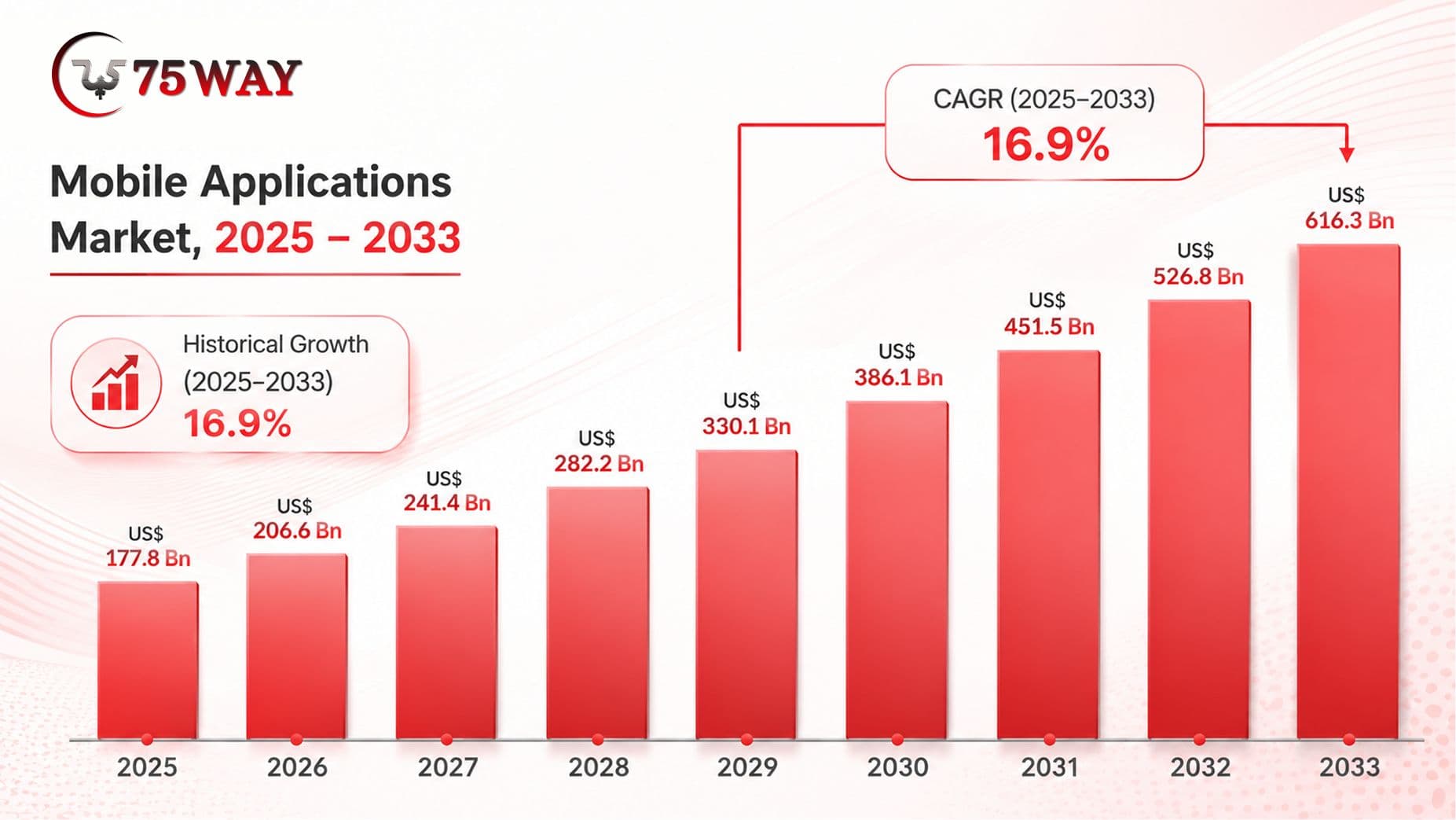
- According to Persistence Market Research, the global mobile apps market is projected to grow from $206.6 billion in 2026 to $616.4 billion by 2033, at a CAGR of 16.9%.
- North America leads the mobile applications market, accounting for 31% of the global share.
- The expansion of 5G-powered AR/VR applications could generate an additional $500 billion in revenue by 2030.
- According to Roots Analysis, the global mobile app market will reach $1.37 trillion by 2035, growing at a CAGR of 16.33%.
- There are currently nearly 6.3 billion smartphone users worldwide, driving mobile app adoption.
- According to Grand View Research, the global mobile application market is forecast to grow from $322.6 billion in 2026 to $885.3 billion by 2033, registering a CAGR of 15.5%.
Top 50 Profitable Mobile App Ideas For The US Market In 2026
To make exploring easier, we've grouped these 50 app ideas into different industries instead of presenting one long list. Each category highlights where demand is growing, followed by practical app concepts, estimated app development costs, and market opportunities. Rather than asking, "Which idea is the best?" the better question is, "Which idea solves a problem worth building?"
A) AI App Ideas Businesses Can Launch in USA
A few years ago, adding AI to an app felt like a bonus feature. Today, it's quickly becoming an expectation. Whether people are shopping online, tracking their health, learning new skills, or managing work, they appreciate apps that save time, offer relevant suggestions, and reduce manual effort. Below are some of the most promising AI-powered app ideas gaining momentum in the USA.
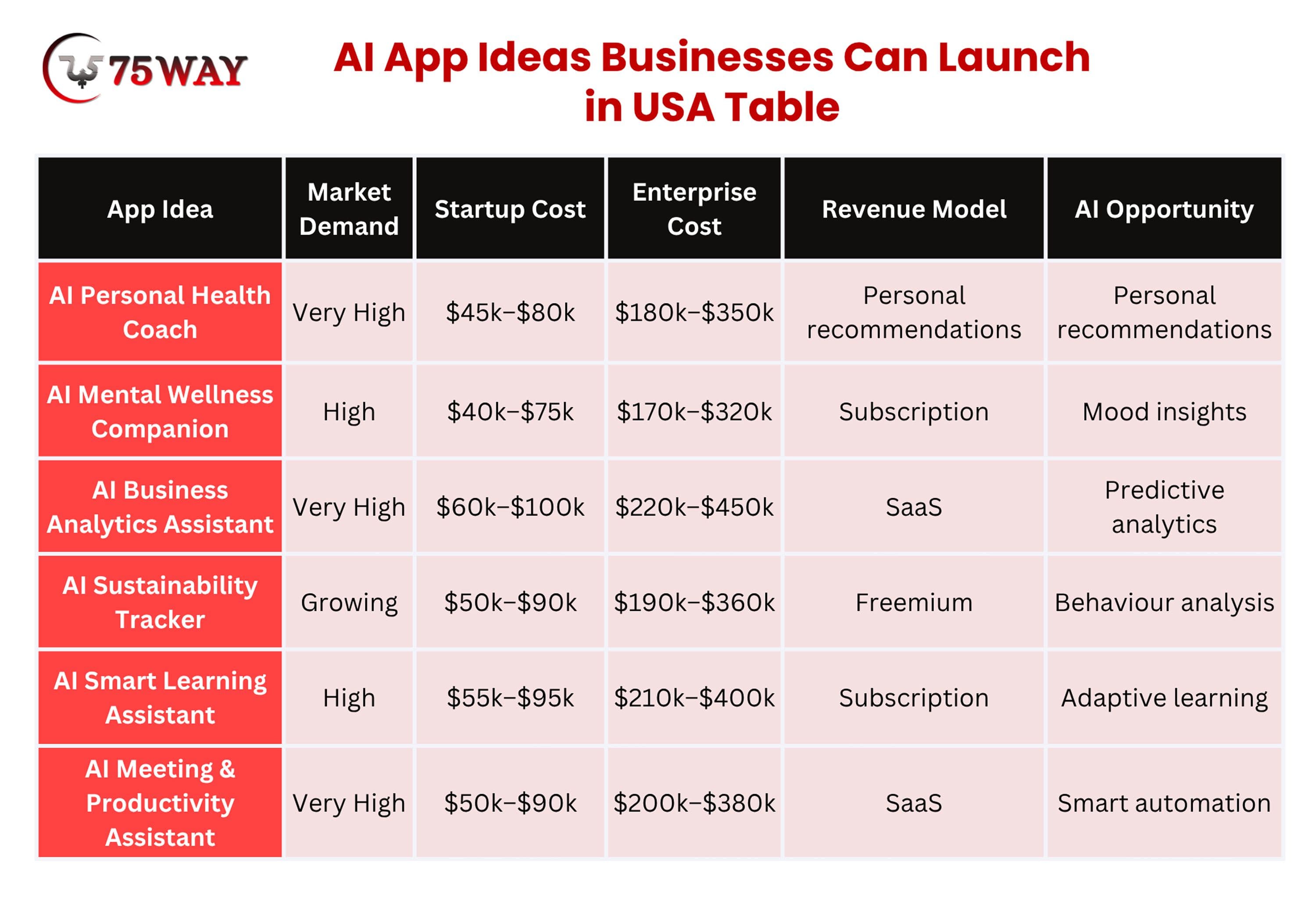
1. AI Personal Health Coach App
Sticking to fitness or wellness goals is easier when guidance feels personal instead of generic. An AI health coach can learn from users' daily habits, activity levels, sleep patterns, and wearable devices to suggest workouts, meal plans, hydration reminders, and healthy routines. As more people seek preventive healthcare, this remains one of the strongest AI-powered healthcare app ideas for startups aiming to build long-term user engagement.
Estimated Development Cost
- Startup MVP: $45,000–$80,000
- Enterprise Platform: $180,000–$350,000
2. AI Mental Wellness Companion
Many people need support between therapy sessions or simply want a private space to manage daily stress. An AI-powered wellness companion can offer mood tracking, guided breathing, journaling prompts, habit coaching, and personalized mindfulness recommendations. While AI in mental health should never replace licensed professionals, it can become a valuable everyday companion for millions seeking better emotional wellbeing.
Estimated Development Cost
- Startup MVP: $40,000–$75,000
- Enterprise Platform: $170,000–$320,000
3. AI Business Analytics Assistant
Businesses collect enormous amounts of data, but turning numbers into decisions remains difficult. An AI analytics app can automatically identify trends, explain sales performance in simple language, forecast demand, and recommend business actions without requiring advanced technical knowledge. Companies increasingly want faster insights, making this a high-value B2B opportunity.
Estimated Development Cost
- Startup MVP: $60,000–$100,000
- Enterprise Platform: $220,000–$450,000
4. AI Sustainability Tracker
Consumers and businesses now pay attention to their environmental impact. An AI-powered sustainability app can analyse travel, shopping habits, energy usage, and lifestyle choices to estimate a user's carbon footprint and suggest realistic ways to reduce it. As organisations invest in ESG initiatives, this is one of the profitable AI data-driven app ideas for health, wellness, and sustainability.
Estimated Development Cost
- Startup MVP: $50,000–$90,000
- Enterprise Platform: $190,000–$360,000
5. AI Smart Learning Assistant
Traditional learning apps often follow the same path for every student. An AI learning assistant adapts lessons based on strengths, weaknesses, learning speed, and progress. Whether preparing for exams, learning a language, or developing professional skills, users receive a personalized experience that keeps them motivated instead of overwhelmed.
Estimated Development Cost
- Startup MVP: $55,000–$95,000
- Enterprise Platform: $210,000–$400,000
6. AI Meeting & Productivity Assistant
Meetings generate ideas, action items, and decisions, yet much of that information gets lost afterwards. An AI productivity assistant can record conversations, generate summaries, assign tasks, create follow-up reminders, and integrate with workplace tools. As hybrid work continues to grow, businesses are actively searching for solutions that help teams stay organised without adding extra administrative work.
Estimated Development Cost
- Startup MVP: $50,000–$90,000
- Enterprise Platform: $200,000–$380,000
Founders who solve a real problem with practical AI stand a stronger chance of building products that remain relevant well beyond 2026.
B) Healthcare App Ideas in US: Improving Patient Care And Everyday Wellness
Hospitals, clinics, insurance providers, and healthcare startups are investing heavily in digital solutions that improve patient experiences while reducing administrative workload. That creates plenty of room for entrepreneurs who can solve practical healthcare challenges through technology. If you're exploring healthcare app ideas, the opportunities below are worth a closer look.
7. Virtual Doctor Consultation App
Not every medical concern requires a visit to the clinic. A telemedicine app lets patients book appointments, consult doctors through secure video calls, receive digital prescriptions, and access medical records from anywhere. As virtual healthcare becomes part of everyday life, demand for reliable consultation platforms continues to grow.
Estimated Development Cost
- Startup MVP: $55,000–$90,000
- Enterprise Platform: $220,000–$450,000
8. Medication Reminder & Health Tracking App
Missing medications or losing track of treatment schedules is more common than many realise. The medication reminder and health tracking app sends timely reminders, tracks medication history, monitors vital signs, and allows users to share progress with family members or healthcare providers. It's simple in concept but solves a problem millions face every day.
Estimated Development Cost
- Startup MVP: $35,000–$65,000
- Enterprise Platform: $140,000–$280,000
9. Women's Health & Pregnancy Companion
Every stage of a woman's health journey comes with different questions and needs. A dedicated women’s healthcare app can help users monitor menstrual cycles, fertility, pregnancy milestones, postpartum recovery, and overall wellness while providing educational content tailored to their current stage. Personalization keeps users engaged long after the initial download.
Estimated Development Cost
- Startup MVP: $50,000–$85,000
- Enterprise Platform: $180,000–$360,000
10. Senior Care Management App
Families often juggle appointments, medications, caregivers, and emergency contacts for ageing loved ones. A senior care app brings everything into one place, making it easier to coordinate daily care, receive health updates, schedule visits, and respond quickly when assistance is needed. With ageing populations increasing across the USA, this market continues to expand.
Estimated Development Cost
- Startup MVP: $45,000–$80,000
- Enterprise Platform: $170,000–$340,000
11. Nutrition & Chronic Disease Management App
Living with diabetes, hypertension, or heart disease requires ongoing lifestyle adjustments. The nutrition and chronic disease management app helps users track meals, monitor health metrics, receive personalized nutrition suggestions, and stay consistent with long-term treatment plans. Instead of offering generic advice, it encourages healthier decisions based on individual goals and medical conditions.
Estimated Development Cost
- Startup MVP: $50,000–$90,000
- Enterprise Platform: $190,000–$370,000
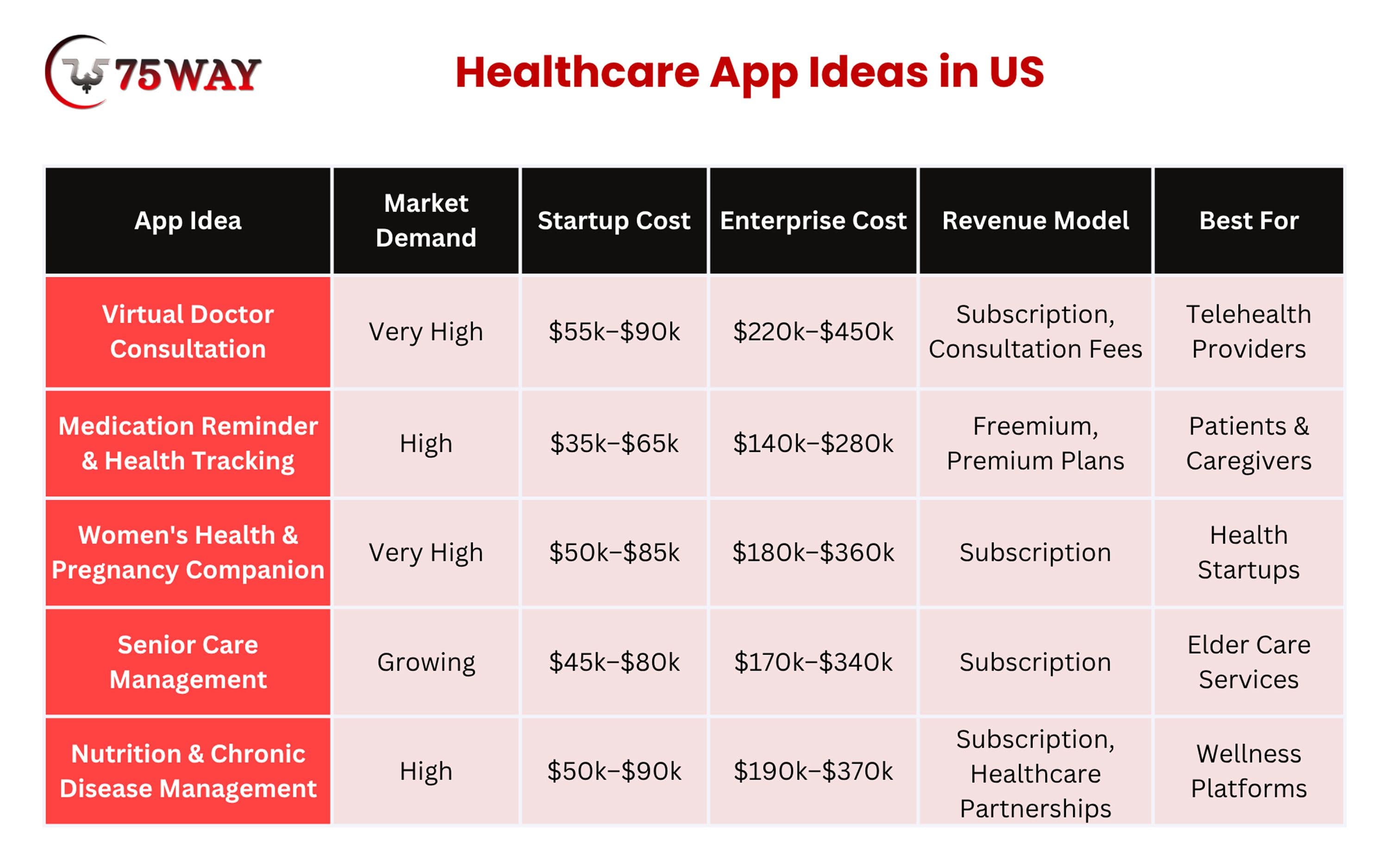
From preventive care and remote consultations to daily wellness and family caregiving, digital health solutions continue to attract users looking for convenience, accessibility, and better control over their wellbeing. For businesses entering this space, focusing on trust, and genuinely useful features often matters more than packing an app with unnecessary complexity.
C) FinTech App Ideas For USA Startups & Enterprises
The biggest opportunities aren't always about building another banking app. They're about helping people make smarter financial decisions, simplifying complicated processes, or offering services that existing platforms overlook. If you're searching for mobile application ideas with strong revenue potential and long-term demand, fintech remains one of the most promising categories.
12. AI Personal Finance Manager
Several people know they should budget, but few enjoy doing it. An AI-powered finance app can automatically categorise expenses, highlight unusual spending, predict upcoming bills, and recommend practical ways to save. Instead of overwhelming users with charts, it delivers simple insights they can act on immediately.
Estimated Development Cost
- Startup MVP: $50,000–$90,000
- Enterprise Platform: $200,000–$400,000
13. Investment Learning & Virtual Trading App
Investing can feel intimidating, especially for beginners. The investment learning and virtual trading app provides a risk-free environment where users can learn the basics of investing, build virtual portfolios, test strategies using real market data, and gain confidence before investing real money. As financial literacy becomes more important, educational investing platforms continue attracting new audiences.
Estimated Development Cost
- Startup MVP: $60,000–$100,000
- Enterprise Platform: $220,000–$450,000
14. Smart Bill Splitting App
Whether it's a holiday with friends, shared accommodation, or team lunches, splitting expenses often becomes confusing. A smart bill-sharing app automatically calculates who owes what, sends payment reminders, supports digital payments, and keeps everyone's balances updated in real time. It's a simple idea that solves an everyday frustration.
Estimated Development Cost
- Startup MVP: $35,000–$60,000
- Enterprise Platform: $140,000–$280,000
15. Subscription Management App
Streaming platforms, fitness memberships, cloud software, and shopping services have made subscriptions part of everyday life. Unfortunately, many users lose track of recurring payments. A subscription management app helps people view active subscriptions, receive renewal alerts, cancel unwanted services, and understand where their money goes every month.
Estimated Development Cost
- Startup MVP: $40,000–$70,000
- Enterprise Platform: $160,000–$300,000
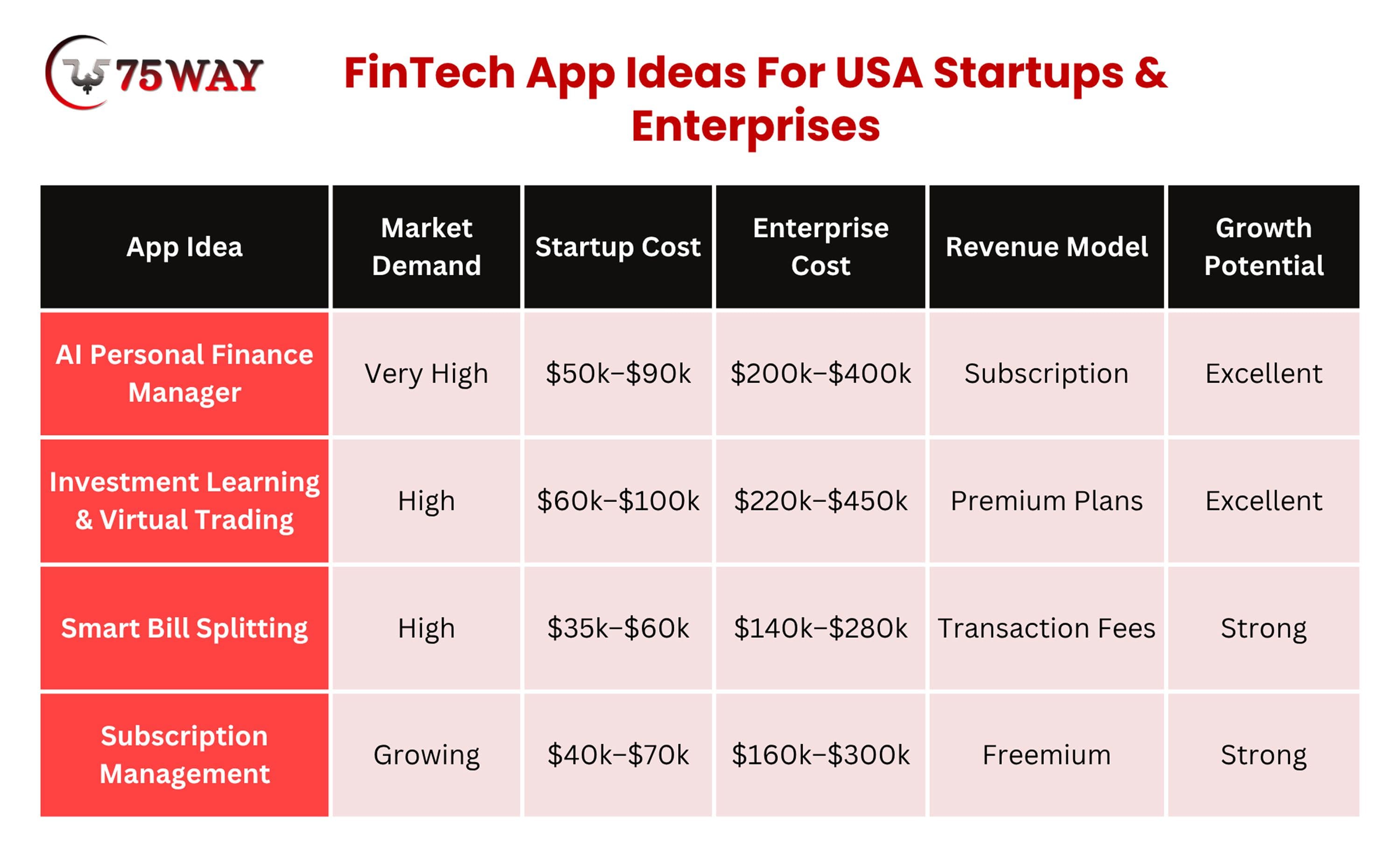
Apps that save users time, simplify money management, or build financial confidence are well-positioned to attract loyal users and generate recurring revenue through subscriptions or value-added services.
D) E-Commerce & Retail App Ideas For US Retailers
Whether it's using AI to recommend products or making second-hand shopping easier, the right e-commerce app can build long-term customer loyalty while opening new revenue streams.
16. AI Personal Shopping Assistant
We've all spent too much time scrolling through products without finding the right one. An AI shopping assistant changes that by learning users' preferences, budgets, favourite brands, and past purchases to recommend products that actually match their interests. The more it's used, the smarter the recommendations become, creating a shopping experience that feels tailored rather than overwhelming.
Estimated Development Cost
- Startup MVP: $55,000–$95,000
- Enterprise Platform: $220,000–$420,000
17. Social Commerce Marketplace
People often discover products while watching creators on social media. Instead of sending users to another website, a social commerce app combines short-form content, live shopping, product reviews, and secure checkout on a single platform. It allows creators to sell directly while helping brands reach highly engaged audiences.
Estimated Development Cost
- Startup MVP: $60,000–$100,000
- Enterprise Platform: $240,000–$450,000
18. Local Marketplace App
Many buyers want to support nearby businesses, while local sellers need affordable ways to reach customers. A local store connects both sides by allowing users to browse nearby products, message sellers, schedule pickups, or arrange same-day delivery, with AI-powered marketplace apps. From handmade crafts to fresh produce, it helps communities shop closer to home.
Estimated Development Cost
- Startup MVP: $45,000–$80,000
- Enterprise Platform: $180,000–$360,000
19. Pre-Owned Goods Marketplace
Buying second-hand things is not just about saving money. Shoppers actively choose pre-owned products to reduce waste and shop more sustainably. This app allows individuals and businesses to buy, sell, or trade verified products, complete with secure payments, seller ratings, and AI-powered pricing suggestions.
Estimated Development Cost
- Startup MVP: $50,000–$90,000
- Enterprise Platform: $190,000–$380,000
20. Smart Grocery Planning App
One forgotten ingredient can mean another trip to the store. A smart grocery app helps users build shopping lists, plan weekly meals, compare supermarket prices, and even suggest recipes based on what's already in the kitchen. It's the kind of everyday convenience that encourages regular use rather than occasional downloads.
Estimated Development Cost
- Startup MVP: $40,000–$75,000
- Enterprise Platform: $170,000–$330,000
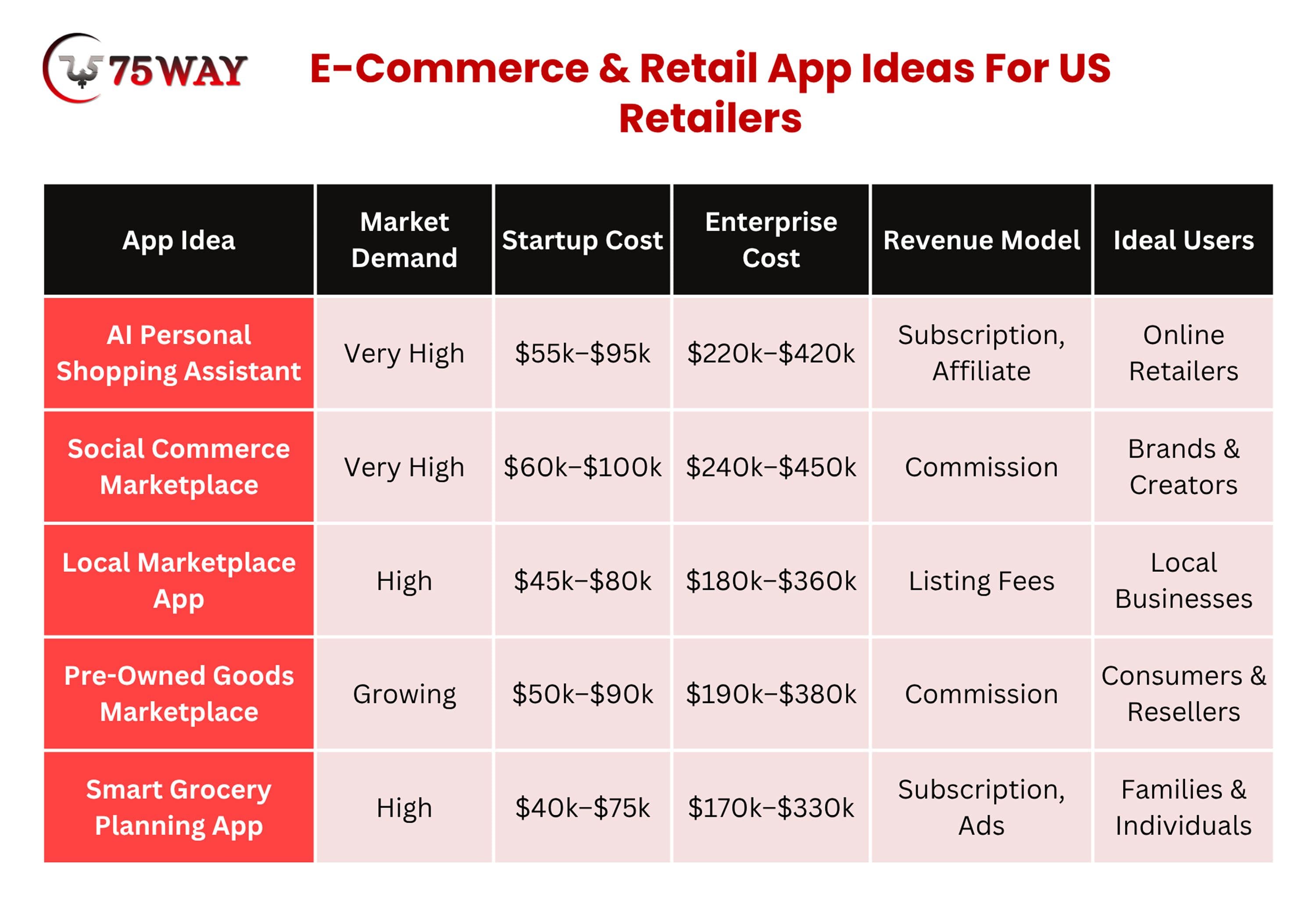
The future of retail belongs to businesses that make shopping simpler, more personal, and genuinely enjoyable. Apps that remove friction, help users make better buying decisions, or create stronger connections between customers and brands have a clear opportunity to stand out in an increasingly competitive market.
E) Business & Workplace App Ideas For Entrepreneurs In The USA
Every business wants the same outcome: get more done without making work more complicated. That's why companies are investing in apps that simplify daily work instead of adding another layer of complexity. For founders, this opens the door to building products businesses are willing to pay for month after month.
21. AI Knowledge Management App
Every company has valuable information buried in emails, PDFs, chat messages, and internal documents. Instead of asking coworkers the same questions, employees can search an AI-powered knowledge hub that delivers instant, accurate answers from company resources. As organisations embrace AI at work, demand for this type of solution continues to grow.
Estimated Development Cost
- Startup MVP: $60,000–$100,000
- Enterprise Platform: $240,000–$450,000
22. Employee Recognition & Rewards App
A simple "appreciation" can make a difference, but recognizing great work consistently is difficult in growing teams. This app lets colleagues appreciate one another, earn reward points, celebrate milestones, and highlight achievements publicly. Companies benefit from stronger engagement, while employees feel their contributions are noticed.
Estimated Development Cost
- Startup MVP: $40,000–$70,000
- Enterprise Platform: $160,000–$300,000
23. Field Workforce Management App
Managing teams spread across multiple locations isn't easy. Whether it's technicians, delivery staff, inspectors, or maintenance crews, businesses need real-time visibility. A field workforce app helps managers assign jobs, optimise routes, monitor progress, collect digital reports, and communicate instantly without relying on endless phone calls.
Estimated Development Cost
- Startup MVP: $55,000–$95,000
- Enterprise Platform: $210,000–$400,000
24. AI Contract Review Assistant
Reviewing contracts often takes hours, especially when legal teams handle large volumes of agreements. An AI-powered contract assistant can identify missing clauses, flag unusual terms, compare versions, and generate easy-to-understand summaries. Rather than replacing legal professionals, it helps them review documents faster and focus on higher-value work.
Estimated Development Cost
- Startup MVP: $70,000–$120,000
- Enterprise Platform: $260,000–$500,000
25. Business Expense Management App
Receipts disappear, reimbursement requests get delayed, and finance teams spend countless hours checking expenses manually. A business expense app lets employees scan receipts, submit claims instantly, track approvals, and generate expense reports automatically. It's a practical solution that saves time for both staff and finance departments.
Estimated Development Cost
- Startup MVP: $45,000–$80,000
- Enterprise Platform: $180,000–$350,000
26. Internal Team Collaboration Platform
Hybrid and remote work have made seamless communication more important than ever. An internal collaboration app helps organizations bring teams together, streamline daily workflows, and create a more connected workplace without relying on multiple disconnected tools.
Estimated Development Cost
- Startup MVP: $65,000–$110,000
- Enterprise Platform: $250,000–$480,000
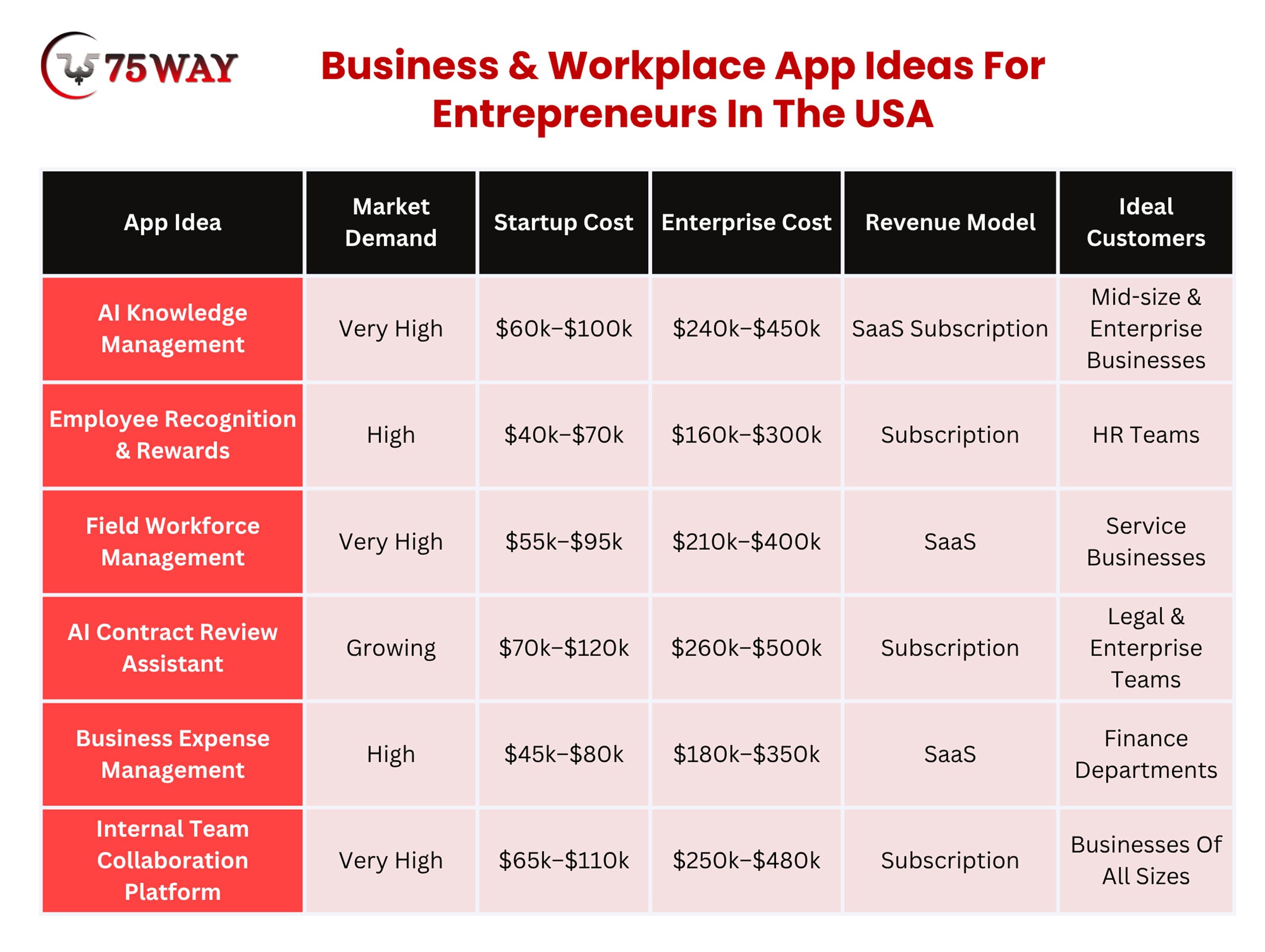
Businesses rarely keep software that looks impressive but fails to solve everyday problems. The strongest workplace apps remove repetitive work, improve collaboration, and help teams make faster decisions. For startups entering the B2B market, solving one clear business challenge exceptionally well often creates a stronger competitive advantage than trying to build an all-in-one platform from day one.
F) Education & Learning App Ideas To Build In USA In 2026
Learning no longer happens only in classrooms. People pick up new skills during lunch breaks, prepare for certifications on the train home, and watch five-minute lessons before an important meeting. The most successful e-learning platforms don't just deliver information. They keep learners motivated with personalized experiences, interactive activities, and measurable progress. If you're looking for educational app ideas, here’s a complete list.
27. AI Personal Tutor App
Imagine having a tutor available whenever you get stuck on a question. An AI tutor adapts to each learner's pace, explains difficult topics in different ways, creates personalized quizzes, and tracks progress over time. Instead of offering the same lesson to everyone, it adjusts the learning experience based on individual strengths and weaknesses.
Estimated Development Cost
- Startup MVP: $60,000–$100,000
- Enterprise Platform: $230,000–$450,000
28. Microlearning App For Professionals
Most professionals don't have hours to spend on training every week. A microlearning app delivers bite-sized lessons that take just five to ten minutes to complete, making it easier to learn new workplace skills without disrupting a busy schedule. Companies can also use it to train employees consistently across different teams.
Estimated Development Cost
- Startup MVP: $45,000–$80,000
- Enterprise Platform: $180,000–$340,000
29. Language Exchange Community App
Learning a language becomes easy through continous practice with real people. The language exchange community app connects users from different countries, allowing them to exchange conversations, correct each other's mistakes, complete speaking challenges, and build confidence naturally. AI can even provide pronunciation feedback and suggest improvements after each session.
Estimated Development Cost
- Startup MVP: $50,000–$90,000
- Enterprise Platform: $190,000–$370,000
30. Career Guidance & Skill Roadmap App
Students and job seekers often know where they want to go but not how to get there. A career guidance app recommends learning paths based on career goals, identifies skill gaps, suggests relevant certifications, and tracks progress towards specific roles. It turns career planning into a clear, step-by-step journey rather than a guessing game.
Estimated Development Cost
- Startup MVP: $50,000–$85,000
- Enterprise Platform: $200,000–$380,000
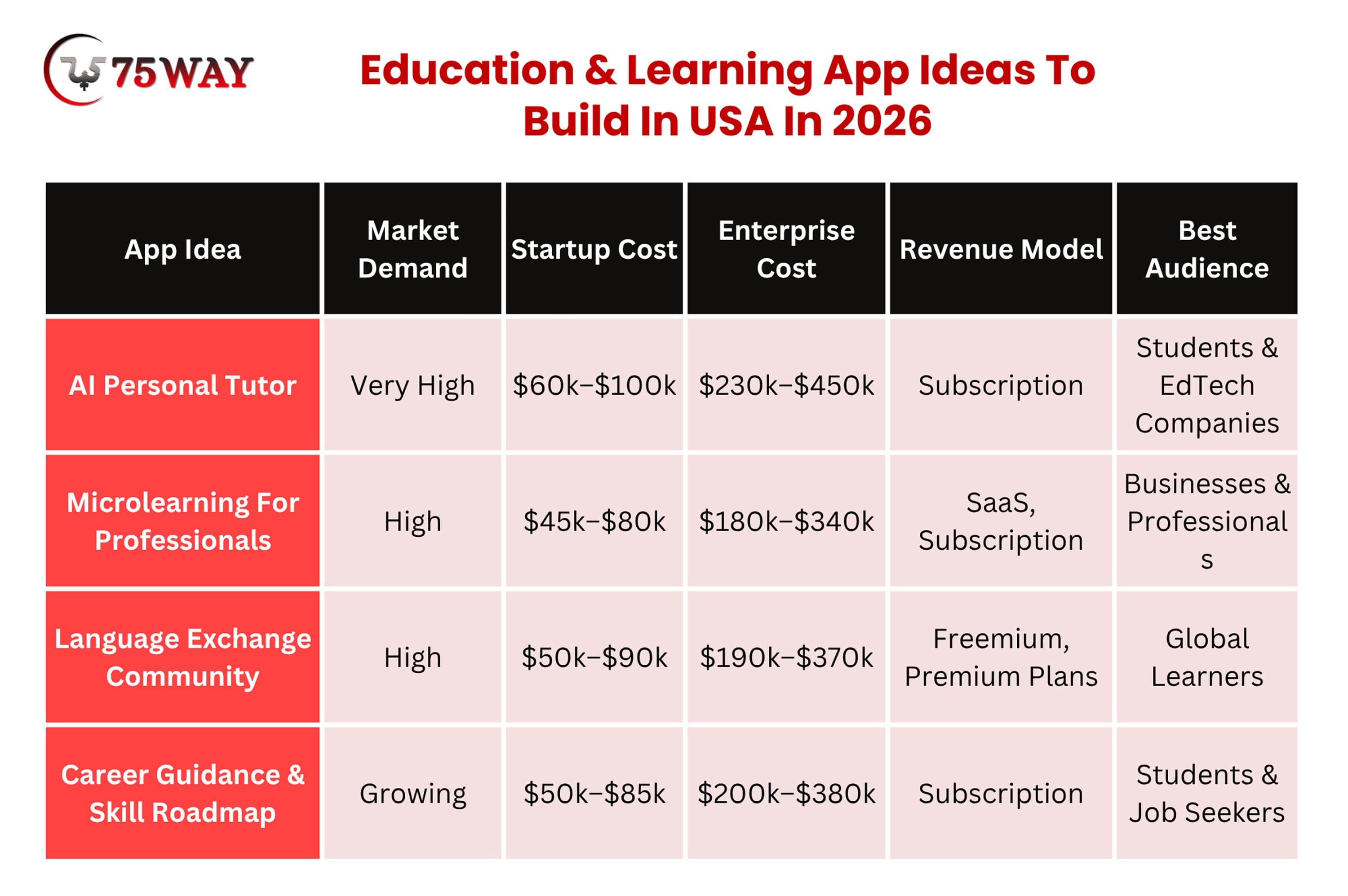
Apps that help people build practical skills, stay motivated, and achieve measurable results are likely to attract loyal users while creating sustainable business opportunities in the years ahead.
G) Travel & Mobility Mobile App Ideas In United States For 2026
Whether someone is planning a weekend or a business trip, apps that remove stress and help people make smarter decisions can quickly build a loyal user base. If you're looking for startup mobile app ideas with global appeal, travel and mobility offer plenty of room for innovation.
31. AI Travel Planner App
Planning a holiday often means spending hours comparing destinations, checking weather forecasts, finding attractions, and building itineraries. An AI travel planner app does the heavy lifting by creating personalized trip plans based on a traveller's budget, interests, travel dates, and preferred pace. It can even adjust recommendations when plans change unexpectedly.
Estimated Development Cost
- Startup MVP: $55,000–$95,000
- Enterprise Platform: $220,000–$420,000
32. Smart Parking Finder App
Few things are more frustrating than reaching your destination only to spend twenty minutes searching for parking. A smart parking app helps drivers locate available spaces in real time, compare parking prices, reserve spots before arriving, and navigate directly to the entrance. As cities become smarter, demand for these solutions will continue to grow.
Estimated Development Cost
- Startup MVP: $45,000–$80,000
- Enterprise Platform: $180,000–$350,000
33. EV Charging Station Locator
With electric vehicle adoption increasing across the USA, drivers need reliable information about charging availability. The EV charging station app shows nearby charging stations, real-time availability, charging speeds, pricing, estimated waiting times, and route planning for longer journeys. It removes one of the biggest concerns for EV owners: charging uncertainty.
Estimated Development Cost
- Startup MVP: $50,000–$85,000
- Enterprise Platform: $200,000–$380,000
34. Local Experiences Marketplace
Travellers today want more than sightseeing. They want cooking classes with local chefs, neighbourhood walking tours, outdoor adventures, cultural workshops, and unique experiences they can't find in traditional travel brochures. This marketplace connects local hosts with visitors, creating memorable experiences while supporting local businesses.
Estimated Development Cost
- Startup MVP: $60,000–$100,000
- Enterprise Platform: $230,000–$450,000
35. Business Travel Management App
Frequent business travellers often deal with changing schedules, expense reports, hotel bookings, flight updates, and meeting calendars. A dedicated business travel app keeps everything organised in one dashboard, helping companies manage travel policies while making life easier for employees on the move.
Estimated Development Cost
- Startup MVP: $60,000–$95,000
- Enterprise Platform: $240,000–$450,000
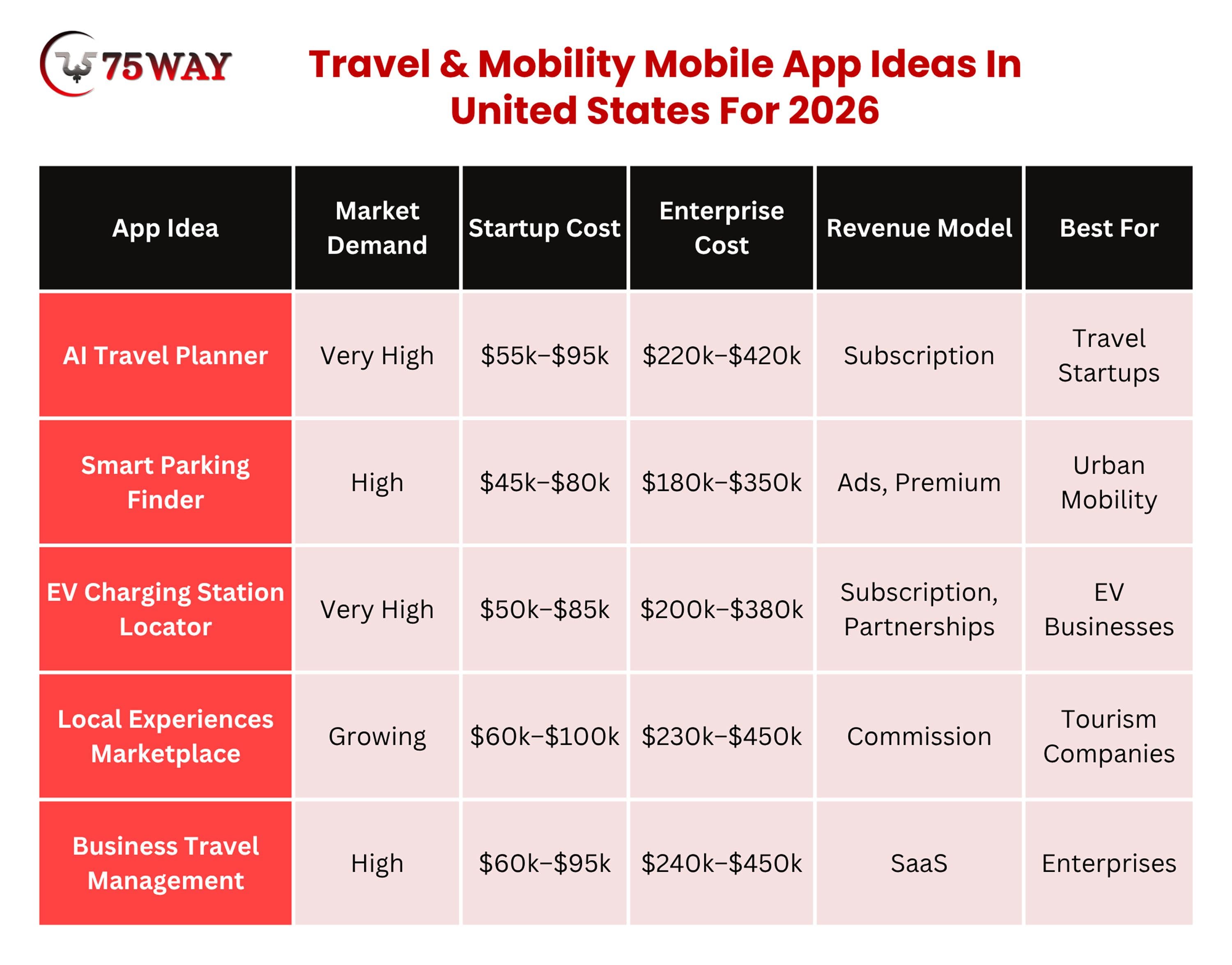
The travel industry continues to reward apps that make journeys smoother rather than more complicated. Whether it's helping travellers discover authentic experiences, supporting the rise of electric vehicles, or simplifying business travel, products that remove everyday friction have the potential to attract both loyal users and strong commercial partnerships.
H) Sustainability & Green Living Startup App Ideas in USA
For businesses, sustainability is no longer just part of a corporate responsibility report. Consumers increasingly support brands that help them live more responsibly, while organisations are investing in digital tools to meet environmental goals. These app ideas combine technology with practical solutions that benefit both users and the planet.
36. Household Carbon Footprint Tracker
Most people know their lifestyle affects the environment, but few understand where the biggest impact comes from. This app analyses activities like driving, electricity usage, flights, and shopping habits to estimate a household's carbon footprint. Instead of overwhelming users with statistics, it suggests realistic changes that fit everyday life.
Estimated Development Cost
- Startup MVP: $45,000–$80,000
- Enterprise Platform: $180,000–$350,000
37. Food Waste Reduction App
Perfectly good food often ends up in the bin because people forget what's already in their kitchen. A food waste app keeps track of groceries, sends expiry reminders, recommends recipes using available ingredients, and even connects users with nearby food donation programmes. It's a simple idea that saves money while reducing unnecessary waste.
Estimated Development Cost
- Startup MVP: $40,000–$70,000
- Enterprise Platform: $170,000–$320,000
38. Community Recycling & Rewards App
Recycling feels more rewarding when people can see the difference they're making. This app helps users locate nearby recycling centres, understand local recycling rules, scan products for disposal guidance, and earn reward points for sustainable actions. Communities, municipalities, and businesses can all benefit from greater participation.
Estimated Development Cost
- Startup MVP: $45,000–$75,000
- Enterprise Platform: $180,000–$340,000
39. Smart Home Energy Optimizer
Energy bills continue to rise, encouraging homeowners to look for practical ways to reduce consumption. A smart energy app connects with compatible home devices, monitors electricity usage, identifies energy-hungry appliances, and recommends simple adjustments that lower costs without sacrificing comfort.
Estimated Development Cost
- Startup MVP: $60,000–$100,000
- Enterprise Platform: $230,000–$450,000
40. Sustainable Shopping Guide
Buying environmentally friendly products isn't always straightforward. Labels can be confusing, and many shoppers struggle to identify genuinely sustainable brands. This app allows users to scan products, compare sustainability ratings, explore ethical alternatives, and make informed purchasing decisions within seconds.
Estimated Development Cost
- Startup MVP: $50,000–$85,000
- Enterprise Platform: $190,000–$370,000
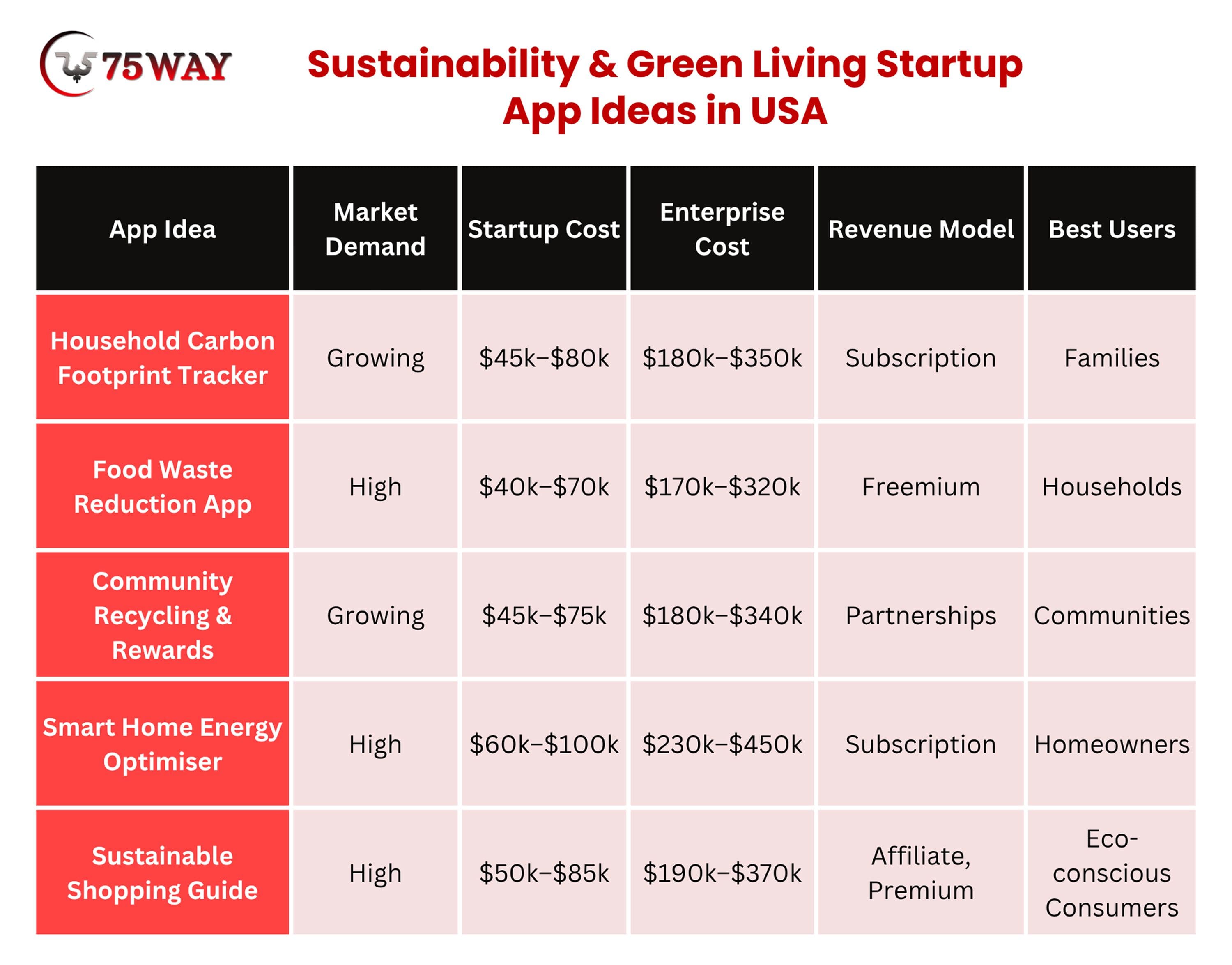
The most successful green apps don't ask users to change everything overnight—they help them make one better decision at a time. As governments, businesses, and consumers continue prioritising environmental responsibility, solutions that combine convenience with measurable impact are likely to see steady demand well beyond 2026.
I) Lifestyle & On-Demand App Ideas For USA Businesses
From finding a trusted pet sitter to booking a last-minute home service, users value convenience more than ever. If an app saves time, removes hassle, or helps people accomplish something in minutes instead of hours, there's a good chance they'll come back. For entrepreneurs, on-demand app ideas offer endless possibilities because everyday problems never disappear. They simply change.
41. Home Services Marketplace App
Finding a reliable plumber, electrician, cleaner, or painter often involves endless calls and uncertain pricing. An on-demand home services marketplace connects homeowners with verified professionals, displays transparent reviews, offers instant quotes, and allows users to book appointments in just a few taps. It's a win for customers looking for convenience and service providers wanting more local business.
Estimated Development Cost
- Startup MVP: $55,000–$90,000
- Enterprise Platform: $220,000–$420,000
42. Pet Care & Boarding App
For many people, pets are family members. Yet finding trustworthy pet sitters, walkers, groomers, or boarding facilities can be stressful, especially during holidays or business trips. The pet care and veterinary app brings pet owners and verified caregivers together while offering appointment scheduling, live updates, digital payments, and health records in one place.
Estimated Development Cost
- Startup MVP: $45,000–$80,000
- Enterprise Platform: $180,000–$340,000
43. Personal Event Planner App
Planning birthdays, weddings, baby showers, or corporate gatherings often means managing dozens of moving pieces. A personal event planning app keeps everything organised by helping users create guest lists, track budgets, compare vendors, manage invitations, and stay on top of important deadlines without juggling multiple spreadsheets.
Estimated Development Cost
- Startup MVP: $50,000–$85,000
- Enterprise Platform: $190,000–$360,000
44. Household Task Management App
Running a home takes more coordination than most people realise. Grocery shopping, paying bills, assigning chores, and remembering maintenance schedules can quickly become overwhelming. This app allows families or housemates to share responsibilities, assign tasks, receive reminders, and keep daily routines running smoothly.
Estimated Development Cost
- Startup MVP: $40,000–$70,000
- Enterprise Platform: $160,000–$310,000
45. Digital Wardrobe & Outfit Planner
Many people own plenty of clothes but still struggle to decide what to wear. A digital wardrobe app lets users upload their clothing, organise outfits, receive styling suggestions, and even get recommendations based on weather forecasts or upcoming events. It brings convenience to everyday decisions while encouraging smarter shopping habits.
Estimated Development Cost
- Startup MVP: $50,000–$90,000
- Enterprise Platform: $190,000–$370,000
46. Neighbourhood Community App
Strong communities often begin with better communication. A neighbourhood app allows residents to share local updates, recommend businesses, report concerns, organise community events, and even buy or sell items nearby. It creates a digital space where neighbours can connect beyond social media.
Estimated Development Cost
- Startup MVP: $45,000–$80,000
- Enterprise Platform: $180,000–$350,000
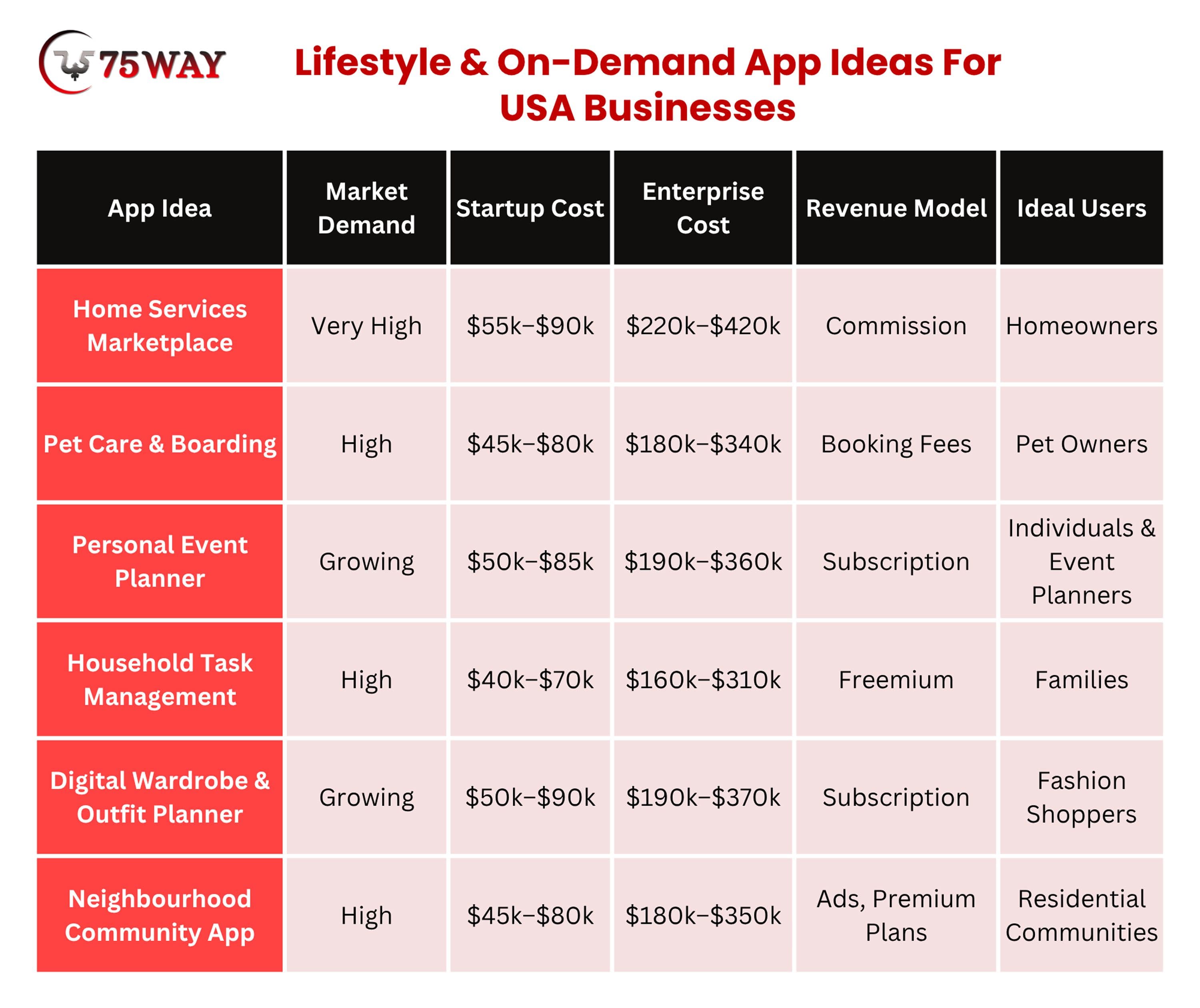
Not every successful startup has to disrupt an entire industry. Sometimes the biggest opportunities come from improving everyday experiences people deal with regularly. Apps that remove small frustrations, build trust, and become part of users' daily routines often enjoy higher engagement and stronger long-term retention than products built around short-lived trends.
J) Creator Economy & Entertainment App Ideas To Launch In US Market In 2026
For entrepreneurs, this opens exciting opportunities. Rather than building another social media platform, the focus should be on helping creators connect with audiences, monetize content, or deliver experiences people can't easily find elsewhere. These final app ideas tap into one of the fastest-growing digital markets in the USA.
47. Creator Membership & Fan Community App
Creators are moving beyond traditional social platforms to build stronger relationships with their audiences. This app allows influencers, educators, musicians, and experts to offer exclusive content, private communities, live sessions, digital products, and subscription memberships—all under their own brand instead of relying on third-party platforms.
Estimated Development Cost
- Startup MVP: $60,000–$100,000
- Enterprise Platform: $240,000–$450,000
48. Short Video Learning Platform
People love learning when it doesn't feel like studying. Imagine an app where every lesson takes less than a minute and covers topics like business, cooking, coding, finance, or fitness. Bite-sized educational videos, interactive quizzes, and personalized recommendations make learning enjoyable while encouraging users to return every day.
Estimated Development Cost
- Startup MVP: $55,000–$95,000
- Enterprise Platform: $220,000–$420,000
49. AI Content Creation Assistant
An AI-powered assistant can help generate content ideas, write captions, create video scripts, suggest hashtags, build posting schedules, and analyse audience engagement. Instead of replacing creativity, it helps creators spend more time creating and less time planning.
Estimated Development Cost
- Startup MVP: $65,000–$110,000
- Enterprise Platform: $250,000–$500,000
50. Live Event & Virtual Experience Platform
Not every event needs a physical venue anymore. From product launches and concerts to workshops and networking sessions, businesses are hosting more virtual and hybrid experiences than ever before. This app supports live streaming, ticket sales, audience interaction, breakout rooms, real-time polls, and post-event analytics, creating value for organisers and attendees alike.
Estimated Development Cost
- Startup MVP: $70,000–$120,000
- Enterprise Platform: $280,000–$550,000
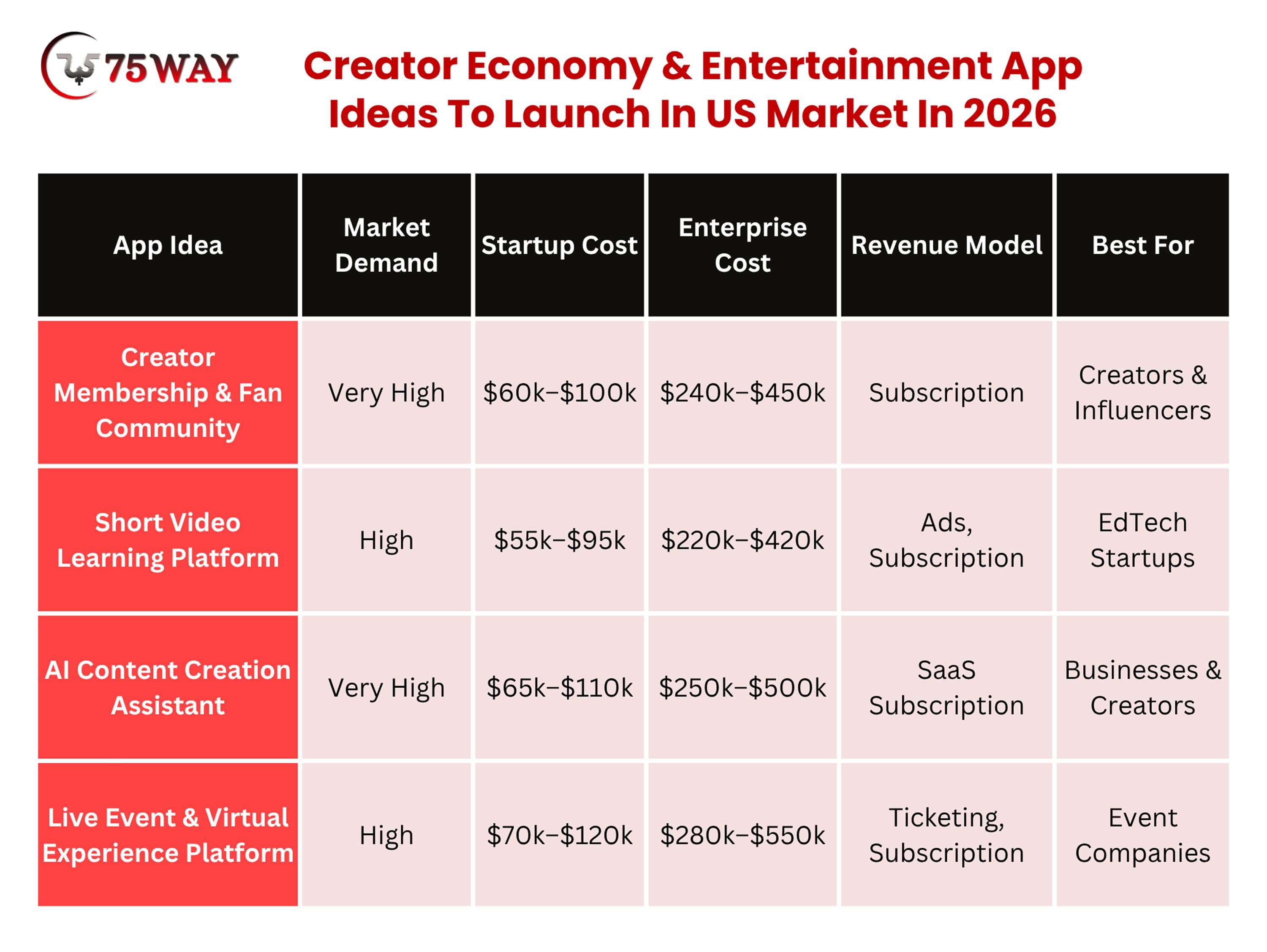
The creator economy is still evolving, and that's exactly what makes it exciting. Audiences are willing to pay for exclusive experiences, meaningful communities, and valuable content that fits their interests. Businesses that build tools helping creators grow, earn, and engage with their audiences are entering a market with strong momentum and long-term potential.
How We Selected These 50 Trending & Relevant App Ideas For US?
Not every app idea is worth pursuing. Some attract attention for a few months, while others solve real problems and continue growing year after year. That's why this list goes beyond popular trends and focuses on opportunities with genuine long-term potential.
We do not define random ideas collected from across the internet. We focused on opportunities that reflect where businesses are investing, how customer expectations are changing, and which technologies are enabling the creation of new products. The goal was simple: to help you explore app ideas with genuine business potential rather than short-lived trends.
Every idea in this guide was evaluated using practical factors that founders, investors, and businesses often consider before moving into development. While no market prediction is guaranteed, these indicators provide a realistic starting point for choosing an app that can grow over time.
- Market Demand: Measure whether users are actively looking for similar solutions.
- Growth Potential: Identify industries expected to expand over the next several years.
- Revenue Opportunities: Consider subscriptions, commissions, ads, marketplace models, and premium features.
- AI Integration: Evaluate where artificial intelligence can improve user experience or automate tasks.
- Scalability: Assess how easily the product can support more users and new features.
- Competitive Landscape: Review whether there is room for fresh ideas or better user experiences.
- Development Complexity: Help estimate the effort, timeline, and budget required.
- Long-Term Relevance: Focus on ideas likely to remain valuable beyond temporary market trends.
Which App Idea Has The Best Business Potential?
After exploring all 50 app ideas, one thing becomes clear. There isn't a single "perfect" app idea. The right choice depends on the problem you want to solve, the audience you understand, and the value you can deliver better than existing solutions.
If you're aiming for rapid growth, AI-powered business tools, healthcare platforms, and fintech solutions continue attracting significant investment. If you prefer consumer-focused products, lifestyle, travel, creator economy, and retail apps offer excellent opportunities to build loyal communities. The common thread across every successful app isn't the technology itself—it's solving a genuine problem in a way that feels simple, useful, and worth returning to.
Before investing in development, validate your concept with real users, research competitors carefully, and start with an MVP rather than a feature-heavy product. The businesses that succeed are often the ones that launch, learn from feedback, and improve quickly instead of trying to build everything on day one.
By focusing on market demand, user experience, and long-term value, your app idea has a far better chance of becoming a successful product, not just in 2026, but for years beyond.
How To Choose The Right App Idea For Your Business
Finding an exciting app idea is only the first step. The bigger question is whether that idea can attract users, solve a genuine problem, and generate sustainable revenue. Many startups fail because they build products people rarely need, not because the app itself is poorly developed.
Before investing in design or development, use the checklist below to evaluate your concept from a business perspective.
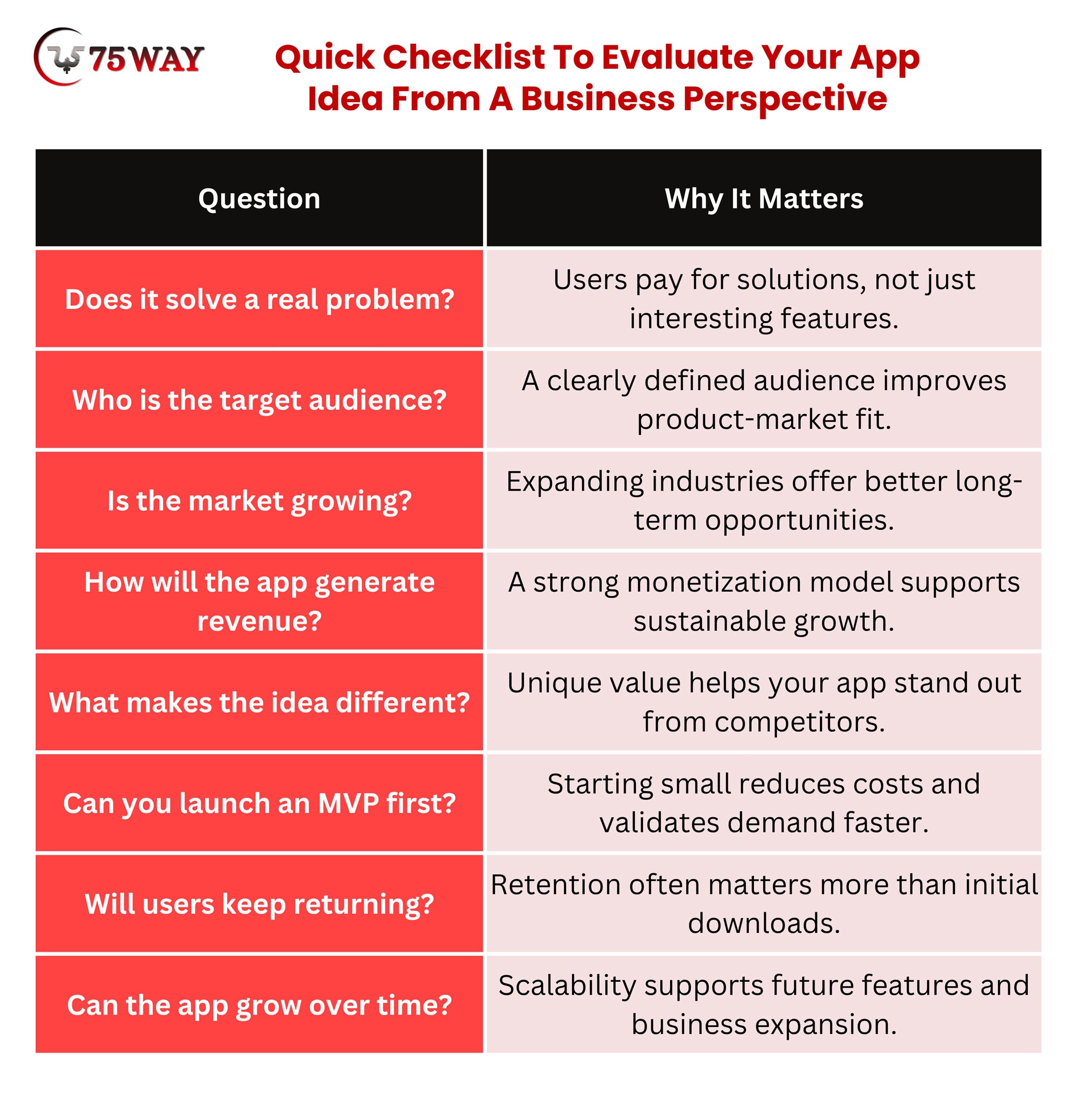
- Validate The Problem Before Building
An app should solve a problem that people already experience. Talk to potential users, read reviews of competing apps, and identify common frustrations. The stronger the problem, the greater the chance people will try your solution.
- Study Your Competition Carefully
Don't avoid crowded markets; understand them. Look at what competing apps do well, where users complain, and which features are missing. Those gaps often reveal better opportunities than trying to create something completely new.
- Start With A Focused MVP
Resist the temptation to build every feature from day one. Launch with the core functionality that delivers the biggest value, then improve the app using real customer feedback instead of assumptions.
- Choose A Sustainable Revenue Model
Think beyond downloads. Decide whether subscriptions, in-app purchases, advertising, commissions, or premium features fit your audience and provide long-term business growth.
- Think About Future Growth
Your first version won't be your last. Select an app idea that can expand with additional features, new user segments, integrations, or markets as your business grows.
- Test, Learn, And Improve
Successful apps are rarely perfect at launch. Monitor user behaviour, collect feedback, fix pain points quickly, and continue refining the experience. Consistent improvements often have a bigger impact than adding dozens of new features.
What Influences App Development Cost?
One of the first questions entrepreneurs ask is, "How much will my app cost?" The honest answer is that two apps with similar ideas can have very different budgets depending on what you want to build. A simple MVP focused on validating an idea requires far less investment than an enterprise platform supporting thousands of users and complex integrations.
Several factors influence the final development cost, and understanding them early helps you plan more.
- Number of Features: More functionality increases development time.
- AI Integration: Custom AI models and automation require additional investment.
- UI/UX Design: Interactive, polished designs take more effort to create.
- iOS & Android Development: Building for multiple platforms increases costs.
- Third-Party Integrations: Payment gateways, maps, CRMs, and APIs add complexity.
- Security & Compliance: Essential for healthcare, fintech, and enterprise apps.
- Cloud Infrastructure: Supports storage, scalability, and application performance.
- Ongoing Maintenance: Regular updates keep apps secure and competitive.
Launching with an MVP allows businesses to validate demand before committing to advanced features. Once user feedback starts coming in, new capabilities can be added based on actual market needs instead of assumptions.
Why AI Is Becoming A Must-Have Feature In Modern Apps?
A few years ago, AI was often treated as an optional enhancement. Today, users expect apps to feel smarter from the very first interaction. Whether it's personalized recommendations, intelligent search, automated support, or predictive insights, AI is changing what people consider a great user experience.
That doesn't mean every app needs a chatbot. The most effective AI features are often the ones users barely notice because they quietly make everyday tasks faster and more intuitive. Some of the most valuable AI capabilities businesses are adding include:
- Personalized content and product recommendations.
- Smart search with natural language understanding.
- Automated customer support and virtual assistants.
- Predictive analytics for business decision-making.
- Image, document, and voice recognition.
- Workflow automation that reduces manual tasks.
When AI directly improves usability rather than existing as a marketing feature, it creates stronger engagement and encourages users to keep coming back.
Final Thoughts
To summarize, 50 mobile app ideas in this guide highlight opportunities across AI, healthcare, fintech, retail, education, sustainability, travel, workplace software, and the creator economy. Some are ideal for first-time founders testing an MVP, while others are better suited for established businesses building enterprise-grade platforms.
If you're planning to launch an app in 2026, don't chase every trend. Choose a market you understand, validate your idea with real users, build a focused MVP, and improve it continuously based on feedback. To turn your concept into a successful product, partnering with an eminent mobile app development company can help you validate your idea, build a scalable solution, and launch with confidence.
Frequently Asked Questions (FAQs)
How Do You Patent An App Idea?
You can't patent a broad idea alone. A patent protects a new, useful, and non-obvious invention, such as the unique technology, process, or functionality behind your app. Before applying, document your concept, build a prototype or detailed specification, conduct a patent search, and consult a qualified patent attorney. If your app includes a truly innovative technical solution, applying for a utility patent may help protect your intellectual property.
Can You Patent An App Idea?
Not every app idea qualifies for a patent. Simply saying, "I want an app that delivers groceries," isn't enough because it's considered a business concept rather than an invention. However, if your app introduces a unique algorithm, workflow, or technical method that hasn't existed before, you may be able to patent those innovations. Many businesses also protect their apps through copyrights, trademarks, confidentiality agreements, and strong product execution.
How To Develop An App Idea?
Developing an app starts with validating the problem you want to solve. Research your target audience, study competitors, define your core features, and create a Minimum Viable Product (MVP) instead of building every feature at once. After validating demand, work with an experienced app development company to design, develop, test, and launch your application. Continuous updates based on user feedback are often the key to long-term success.
How To Sell An App Idea?
If you don't want to build the app yourself, you can sell the idea to startups, established businesses, or investors, but ideas alone rarely have significant value. Buyers are far more interested in concepts backed by market research, prototypes, user validation, or an existing MVP. Preparing a business plan, demonstrating market demand, and clearly explaining your revenue model can make your idea much more attractive to potential buyers.
I Have An App Idea. Where Do I Start?
Start by asking one simple question: What problem does my app solve? Once you have a clear answer, identify your target audience, research competing apps, validate the idea with potential users, and prioritize only the essential features for your first version. An MVP of your product allows you to test your concept quickly, gather real feedback, and improve the product before making a larger investment in development.
How Do I Know If My App Idea Is Worth Pursuing?
Start by validating the idea before investing in development. Talk to potential users, study competing apps, identify market gaps, and launch a Minimum Viable Product (MVP). If users find value in the core solution, you can confidently expand with additional features.