Summary
Mobile app development costs in 2026 typically range between $5,000 and $350,000+, depending on features, platform, complexity, and development approach. This guide explains real development costs, key pricing factors, industry-specific budgets, and strategies to reduce expenses while building scalable, high-performing mobile applications.
Quick Snapshot:
- Mobile app development costs typically range from $5,000 to $350,000+, depending on complexity.
- Over 6.9 billion smartphone users globally drive massive demand for mobile applications.
- App complexity, features, integrations, security, and infrastructure significantly influence overall development costs.
- Platform choice, including iOS, Android, cross-platform, or hybrid, affects development time and cost.
- Industries like fintech, healthcare, and AI apps require higher security and compliance.
- Starting with MVP development helps businesses reduce costs and launch scalable mobile apps faster.
If you are planning to launch a digital product, one of the first questions that comes to mind is simple but critical: how much does it cost to develop a mobile app in 2026? The answer is not fixed. The reason is that app development pricing depends on several factors, including features, platform choice, design complexity, integrations, and backend infrastructure.
On average, the mobile app development cost ranges from $5,000 for a basic MVP to $350,000+ for complex enterprise applications with advanced technologies and scalable architecture.
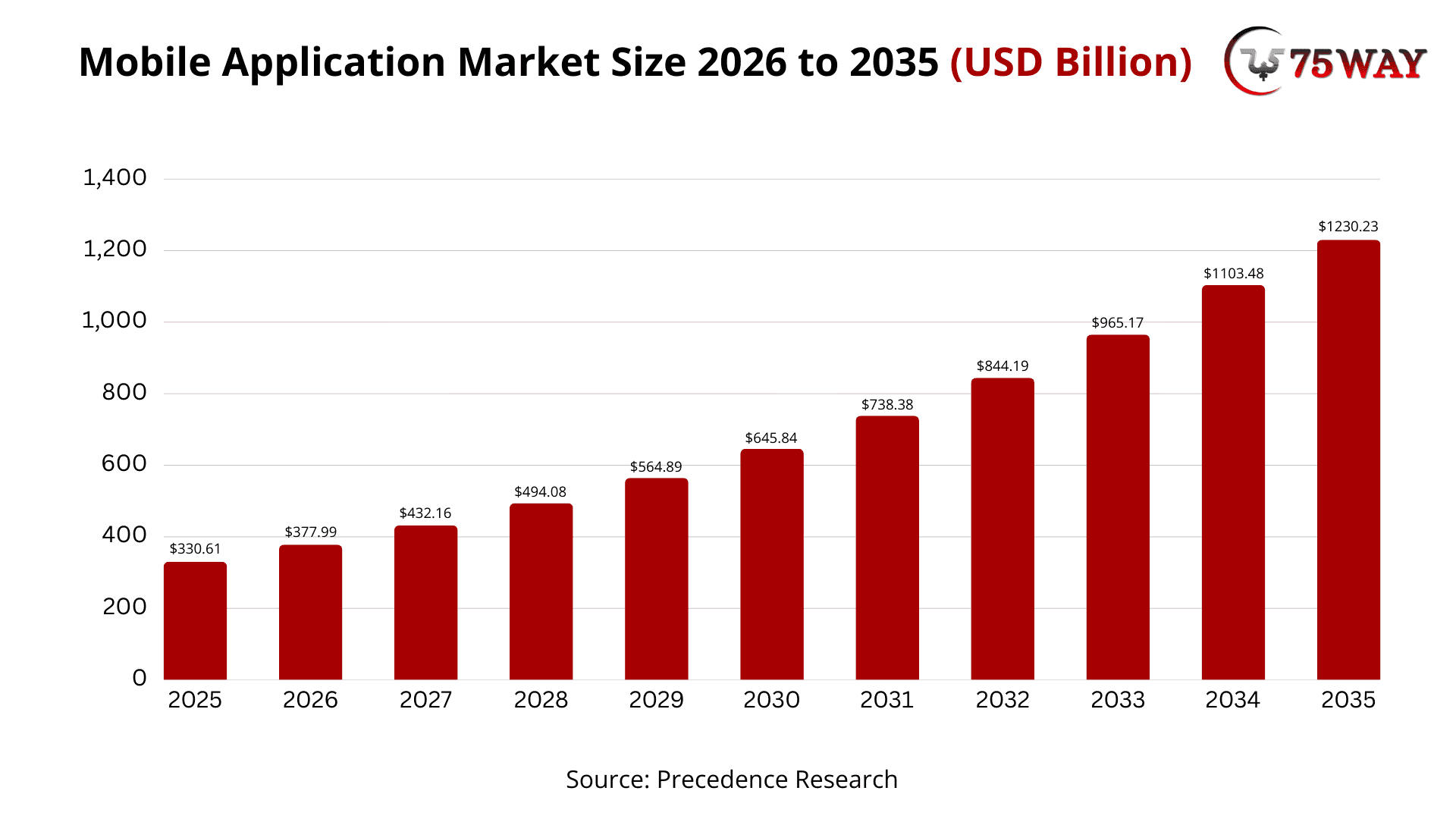
The most amazing part of investing in a mobile app is the huge opportunity for businesses. With over 6.9 billion smartphone users worldwide, mobile apps have become a primary channel for customer engagement. In fact, industry projections indicate the global mobile app market could exceed $1.23 trillion by 2035, growing at an annual rate of over 14%.
In this guide, we’ll break down the real cost of developing a mobile app in 2026, key pricing considerations, hidden factors, smart budgeting strategies, and techniques to generate revenue from it.
What Exactly Is Mobile App Development?
Before diving deeper into app development costs and budgeting strategies, it’s important to clearly understand what mobile app development actually involves. In simple terms, mobile app development is the process of designing, building, testing, and deploying software applications that run on mobile devices such as smartphones and tablets.
However, modern app development goes far beyond just writing code. It includes multiple stages such as market research, UI/UX design, backend infrastructure setup, API integrations, security implementation, performance testing, and continuous updates after launch.
In simple terms, you can consider it as opening a small restaurant. You start with a concept, create a menu, design the interior, hire staff, and test operations before welcoming customers. Likewise, building a mobile app involves idea validation, UI design, development, testing, and continuous improvements after launch.
Learn More: How to Start a Taxi Business? Guide for Beginners
A Complete Overview of Average App Development Cost
First of all, you must know the actual cost of building a mobile app. In 2026, the average cost of a mobile app typically ranges from $5,000 to $350,000+, depending on the application's complexity, technology stack, design requirements, integrations, and development time. A simple MVP with basic functionality can be built with a smaller budget, while large-scale platforms with advanced features such as real-time processing, AI capabilities, or enterprise-grade infrastructure require significantly higher investment.
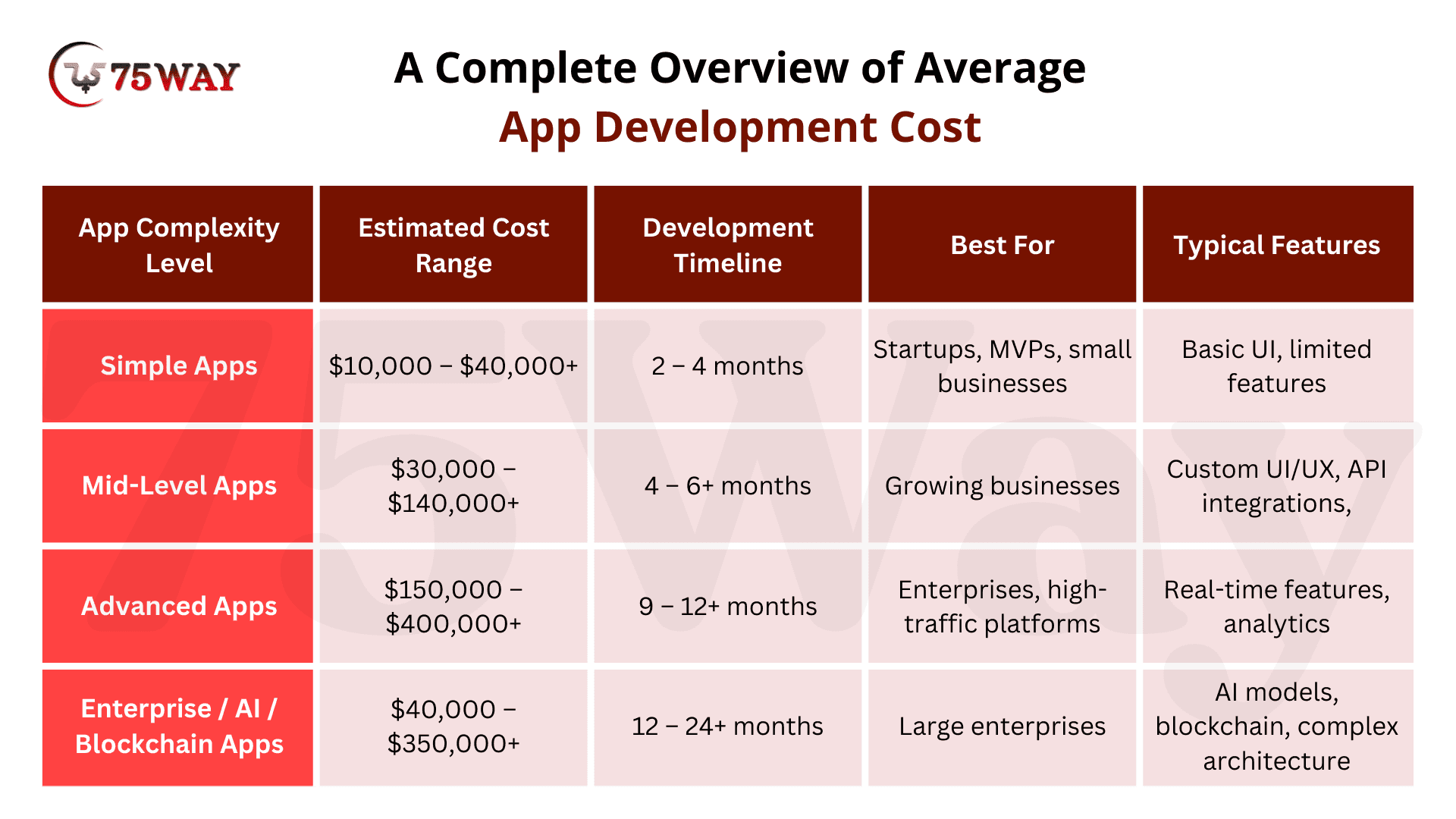
To make things easier to understand, the breakdown below highlights how development costs vary by app complexity, timeline, and typical features in USA.
Mobile App Development Cost in USA: Complete Overview
Simple Apps: $10,000 – $40,000+
Mid-Level Apps: $30,000 – $140,000+
Advanced Apps: $150,000 – $400,000+
Enterprise / AI / Blockchain Apps: $40,000 – $350,000+
Mobile App Development Cost in India: Complete Overview
Simple Apps: ₹50,000 – ₹4,00,000
Mid-Level Apps: ₹2 lakh – ₹12 lakh
Advanced Apps: ₹6 lakh – ₹20 lakh
Enterprise Apps: ₹7 lakh – ₹30 lakh+
Read Also: Top 10 IoT Development Companies in USA
How to Calculate the Cost of Developing a Mobile App
The cost of developing a mobile application is usually calculated by multiplying the estimated development hours by the hourly rate of the development team. The hours depend on the app’s features, complexity, integrations, and design requirements. You can estimate the cost using the formula below.
Total App Development Cost = Development Hours × Hourly Rate
Suppose your mobile app requires 1,800 hours to design, develop, test, and deploy. If the development company charges $50 per hour, the estimated development cost would be:
1,800 × $50 = $90,000
This amount typically covers stages like UI/UX design, frontend development, backend development, testing, and deployment. However, additional services such as maintenance, updates, or third-party integrations may increase the final cost.
Read More: Best iOS App Development Companies in USA Founders Must Know
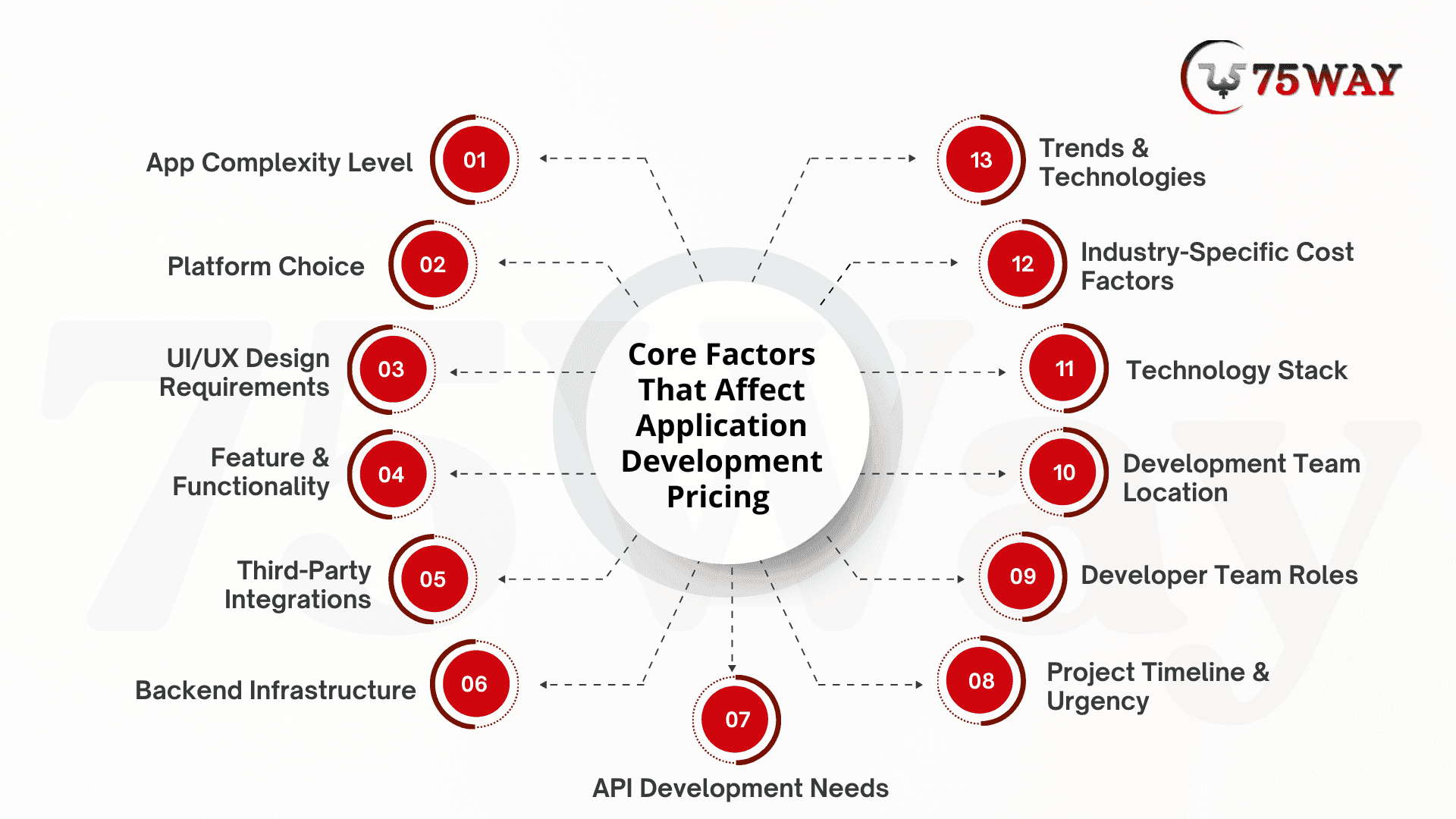
Core Factors That Affect Application Development Pricing
When you plan to build a mobile app, the final cost does not come from just one factor. Instead, several elements work together to shape the overall budget. For example, the complexity of your app, the features you choose, the platform you target, and the expertise of the development team all influence the price. When you understand these factors clearly, you can estimate your app development cost more confidently and plan your investment wisely.
App Complexity Level
App complexity plays a major role in determining the cost to develop your mobile app. If your app includes basic features and simple screens, development usually requires fewer hours and a smaller budget. However, when you add advanced features such as real-time updates, integrations, or custom systems, the development effort increases, directly raising the overall app development cost. For example, opening a small takeaway café costs far less than launching a full-service restaurant with dine-in, delivery, and reservations.
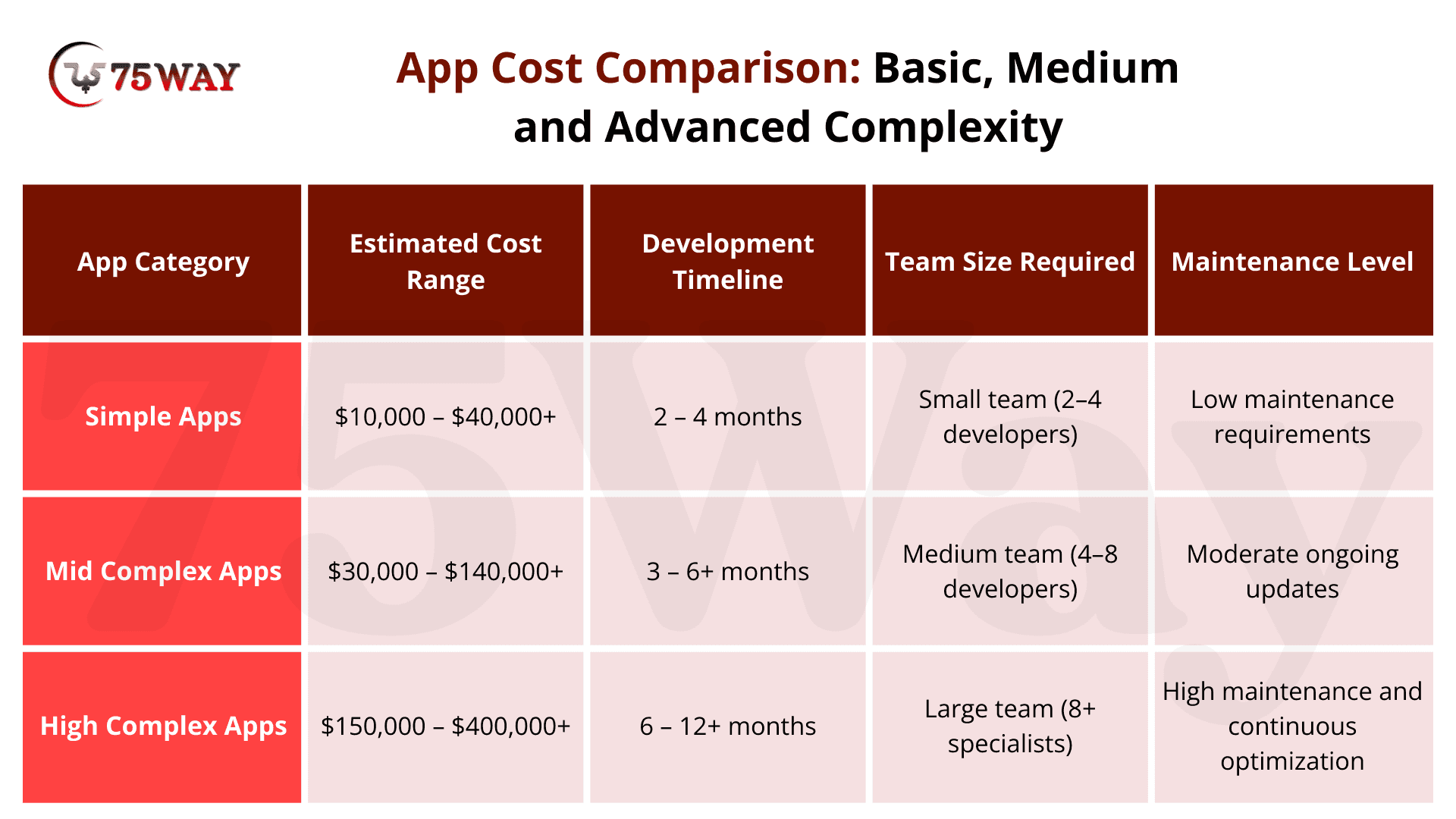
App Cost in USA Based On Complexity Level
- Simple Apps: $10,000 – $40,000+. These apps are usually developed within 2–4 months, as they include basic features and simple functionality.
- Mid-Complex Apps: $30,000 – $140,000+. These apps typically take 3–6+ months to develop due to multiple features, integrations, and custom UI/UX.
- High-Complex Apps: $150,000 – $400,000+. These apps generally require 6–12+ months of development because of advanced features, complex architecture, and high scalability.
App Cost in India Based On Complexity Level
- Simple Apps: ₹50,000 – ₹3 Lakh+. These apps are usually developed within 2 weeks to 2 months.
- Mid-Level Apps: ₹2 Lakh – ₹6 Lakh+. These apps typically take 2 – 5 months.
- Advanced Apps: ₹6 Lakh – ₹20 Lakh+. These apps generally require 5 – 9 months.
App Development Cost Based on Platform Choice
The platform you choose for your app significantly influences the overall development cost. If you build an app for a single platform like Android or iOS, the cost is usually lower because developers focus on one system. However, if you want your app to run on both platforms, development requires additional coding, testing, and optimization, which increases the total budget.
Choosing cross-platform development can sometimes reduce costs while still reaching a wider audience. It is just like a restaurant deciding whether to open in one city or expand to multiple locations. The wider the reach, the higher the investment.
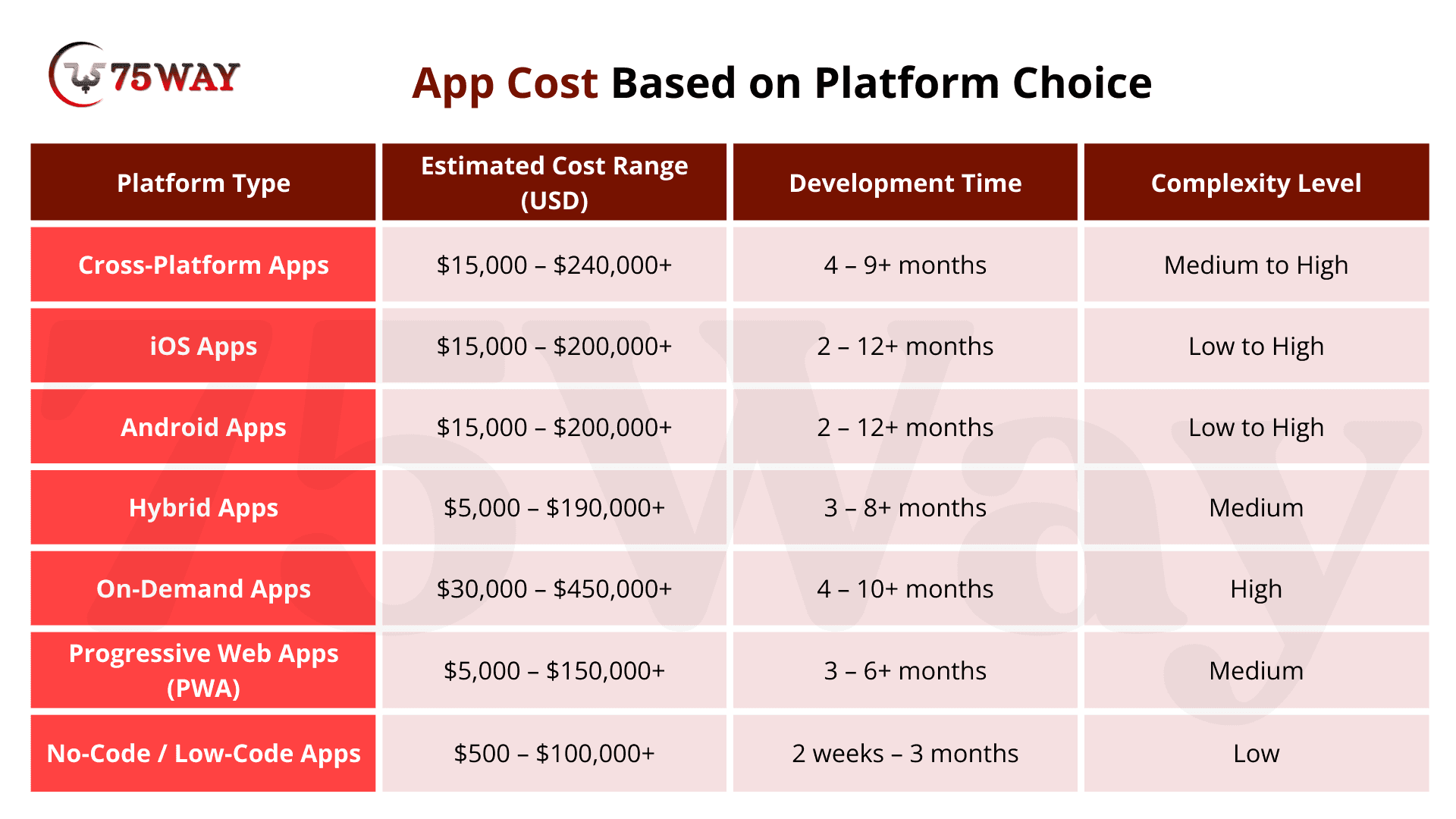
App Development Cost Based on Platform Selection in USA
- Cross-Platform Apps: $15,000 – $240,000+; 4 – 9+ months
- iOS Apps: $15,000 – $200,000+; 2 – 12+ months
- Android Apps: $15,000 – $200,000+; 2 – 12+ months
- Hybrid Apps: $5,000 – $190,000+; 3 – 8+ months
- On-Demand Apps: $30,000 – $450,000+; 4 – 10+ months
- Progressive Web Apps (PWA): $5,000 – $150,000+; 3 – 6+ months
- No-Code / Low-Code Apps: $500 – $100,000+; 2 weeks – 3 months
App Development Cost Based on Platform Selection in India
- Cross-Platform Apps: ₹6 Lakh – ₹18 Lakh+
- iOS Apps: ₹15 Lakh – ₹80 Lakh+
- Android Apps: ₹15 Lakh – ₹120 Lakh+
- Hybrid Apps: ₹8 Lakh – ₹40 Lakh+
- On-Demand Apps: ₹6 Lakh – ₹18 Lakh+
- Progressive Web Apps (PWA): ₹40,000 – ₹4 Lakh+
- No-Code / Low-Code Apps: ₹20,000 – ₹10 Lakh+
UI/UX Design Requirements
The design of your app directly impacts development cost. A simple, standard interface with pre-built components is quicker and cheaper to create. In contrast, a custom, interactive UI/UX design with unique animations, transitions, and user-centric features takes more time and expertise, increasing the overall budget. For example, designing a café’s menu board with ready-made templates costs less than creating a fully branded, interactive dining experience for every table.
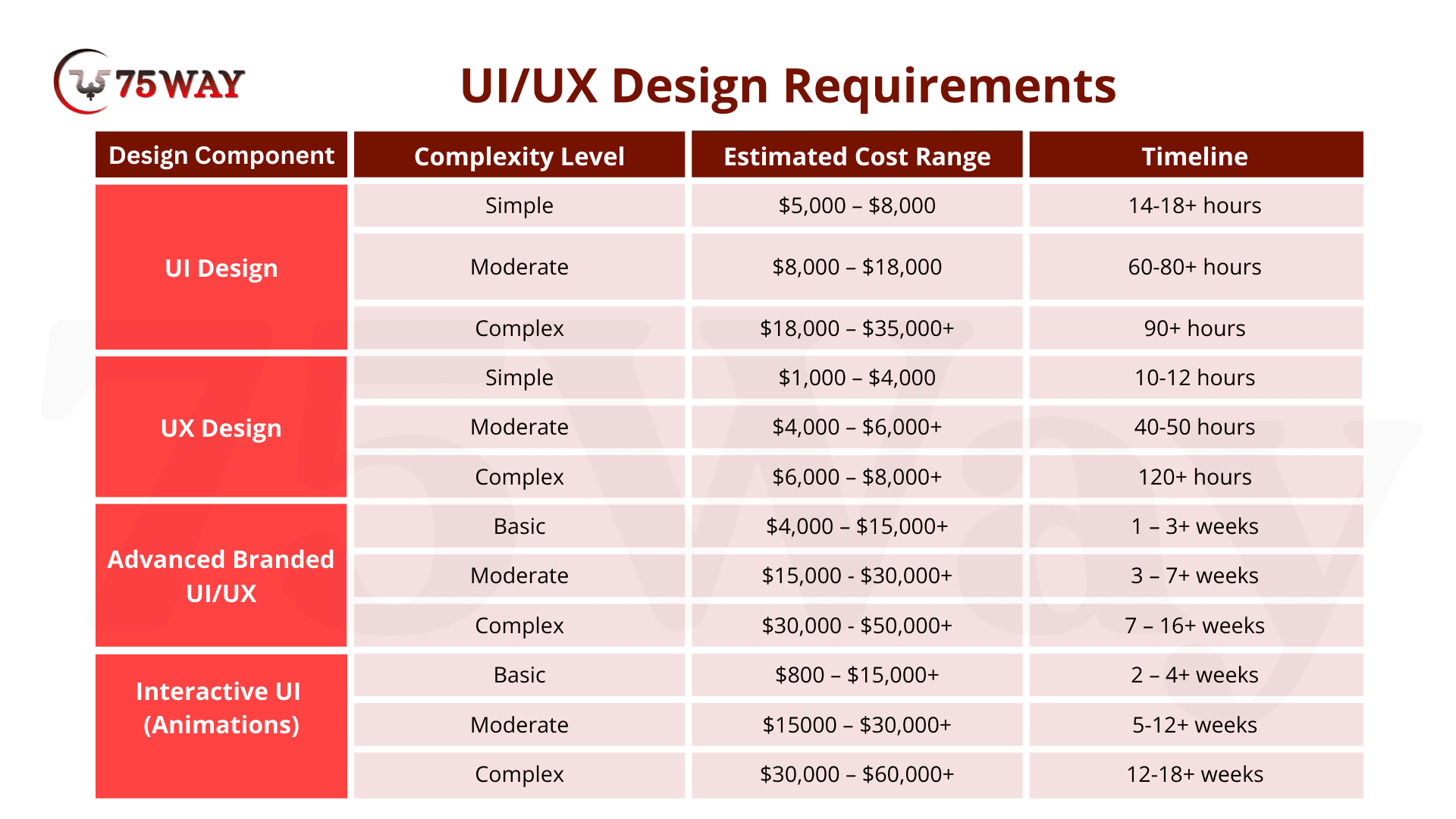
Cost of UI/UX Design To Build An App in USA
UI Design: $5,000 – $35,000. The design process usually takes 14–90+ hours depending on the number of screens and visual complexity.
UX Design: $1,000 – $8,000+. UX planning generally requires 10–120+ hours as it involves research, wireframing, and user journey mapping.
Advanced/Branded UI/UX: $4,000 – $50,000+. Creating branded, highly customized interfaces can take 1–16+ weeks due to the complexity of design systems and brand integration.
Interactive UI (Animations): $800 – $60,000+. Developing animated and interactive interfaces usually takes 2–18+ weeks, depending on animation complexity and transitions.
Cost of UI/UX Design To Build An App in USA
UI Design: $5,000 – $35,000. The design process usually takes 14–90+ hours depending on the number of screens and visual complexity.
UX Design: $1,000 – $8,000+. UX planning generally requires 10–120+ hours as it involves research, wireframing, and user journey mapping.
Advanced/Branded UI/UX: $4,000 – $50,000+. Creating branded, highly customized interfaces can take 1–16+ weeks due to the complexity of design systems and brand integration.
Interactive UI (Animations): $800 – $60,000+. Developing animated and interactive interfaces usually takes 2–18+ weeks, depending on animation complexity and transitions.
Cost of UI/UX Design To Build An App in India
UI Design: ₹5,000 – ₹200,000
UX Design: ₹20,000 – ₹40,000+
Advanced/Branded UI/UX: ₹3.3L – ₹30L+
Interactive UI (Animations): ₹65K – ₹45L+
Before actual development begins, creating wireframes and prototypes is essential. Wireframing maps out the app’s structure, user flow, and key screens, while prototyping allows you to test interactions and navigation before coding. This stage helps prevent costly mistakes later, ensures a smoother development process, and directly affects the overall cost of the app.
Feature & Functionality Scope
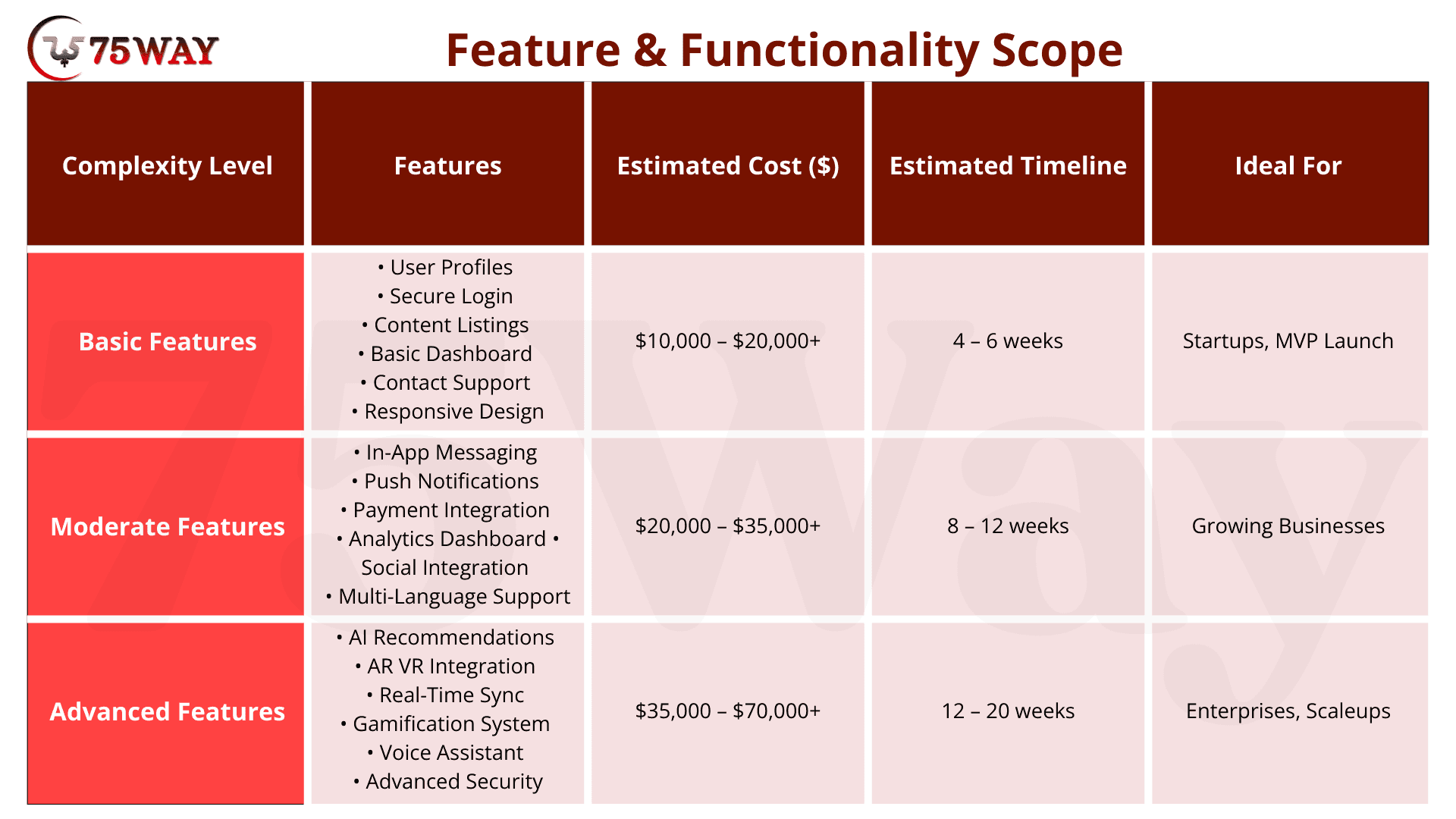
The number and complexity of features in your app heavily influence development costs. Basic apps with simple functionality, such as login, profiles, and content display, are relatively inexpensive. Moderate apps with in-app messaging, payments, and analytics require more development time, while advanced apps with agentic AI, AR/VR, real-time sync, AI voice agents, or gamification significantly increase the budget. For example, opening a small café with just a counter and menu is simple, but adding online ordering, loyalty programs, and delivery services requires more resources, similar to building a feature-rich app.
App Cost Based on Feature & Functionality In USA
- Basic Features: $10,000 – $20,000+. Developing apps with basic features usually takes 4–6 weeks.
- Moderate Features: $20,000 – $35,000+. Apps with moderate features typically require 8–12 weeks for development.
- Advanced Features: $35,000 – $70,000+. Apps with advanced features generally take 12–20 weeks due to complexity and integrations.
App Cost Based on Feature & Functionality In India
Basic Features: ₹40,000–₹2.5L. Includes basic functionality such as forms, user profiles, and dashboards.
Moderate Features: ₹2.5L–₹6.5L. Includes messaging, push notifications, payment gateways, analytics, and social integration.
Advanced Features: ₹6.5L–₹16L+. Includes AI/ML recommendations, AR/VR modules, gamification, real-time syncing, and high-end security layers.
Cost of Third-Party Integrations To Build Apps
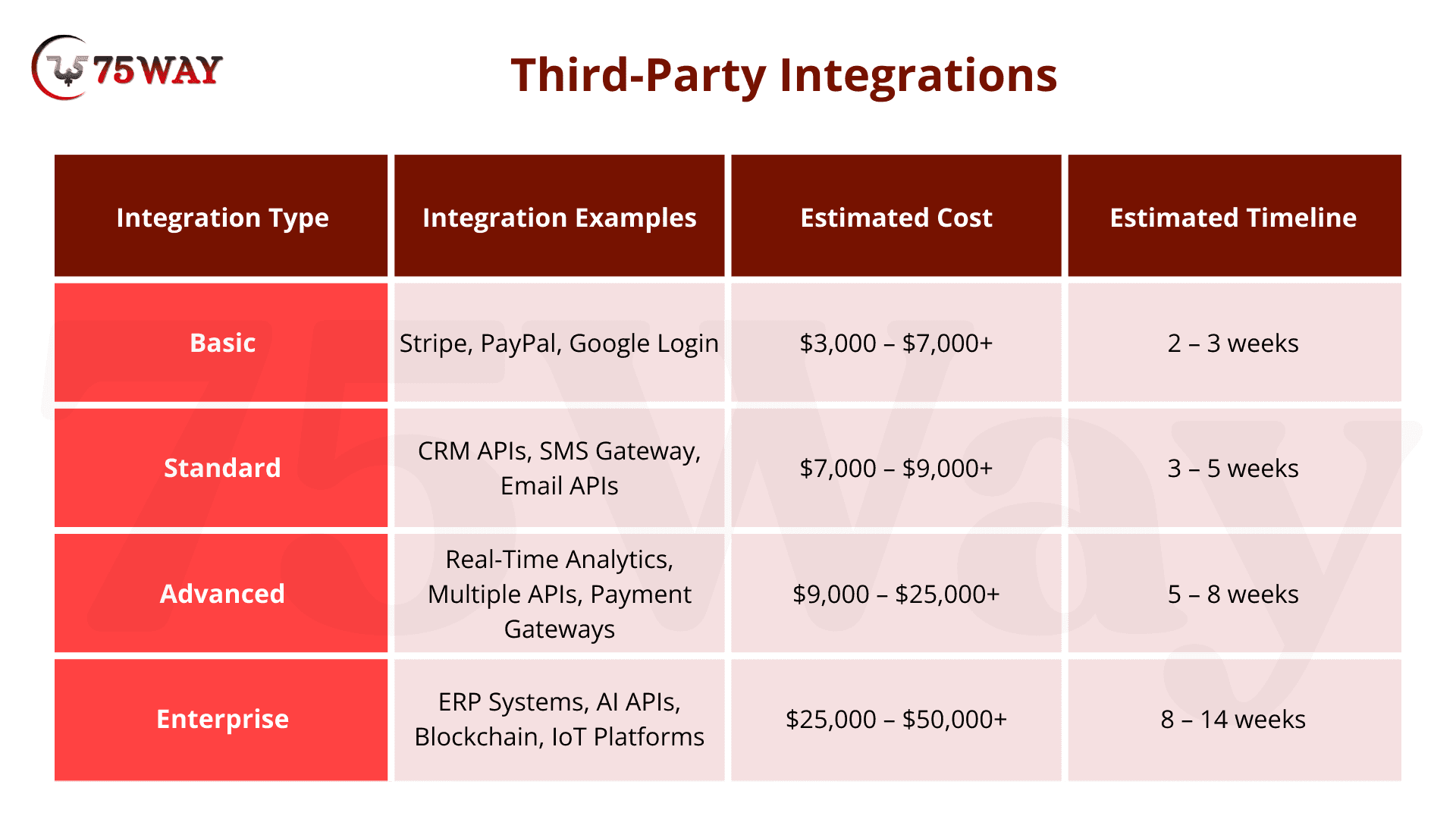
Integrating third-party services such as payment gateways, CRM systems, or advanced analytics tools can significantly impact your app’s development costs. Basic integrations are quick and inexpensive, while advanced integrations, such as multiple APIs, real-time data syncing, or AI services, require more time and expertise and increase the budget.
Cost of Third-Party Integrations To Build Apps In USA & India
Basic Integrations: ~$3,000 – $7,000+ in USA and ₹2.5 L – ₹6 L+ in India. Integration of simple payment systems and social logins usually takes about 2 – 3 weeks.
Standard Integrations: $7,000 – $9,000+ in USA and ₹6 L – ₹8 L+ in India. Connecting CRM systems, SMS gateways, and email service APIs typically requires 3 – 5 weeks of dev and testing.
Advanced Integrations: $9,000 – $25,000+ in USA and ₹8 L – ₹20 L+ in India. Implementing real‑time analytics dashboards, multiple API integrations, and payment processing takes around 5–8 weeks.
Enterprise Integrations: $25,000 – $50,000+ in USA and ₹20 L – ₹40 L+ in India. Integrating enterprise systems such as ERP, AI/machine‑learning APIs, blockchain, or IoT platforms generally takes 8 – 14 weeks due to complexity and custom backend requirements.
Backend Infrastructure
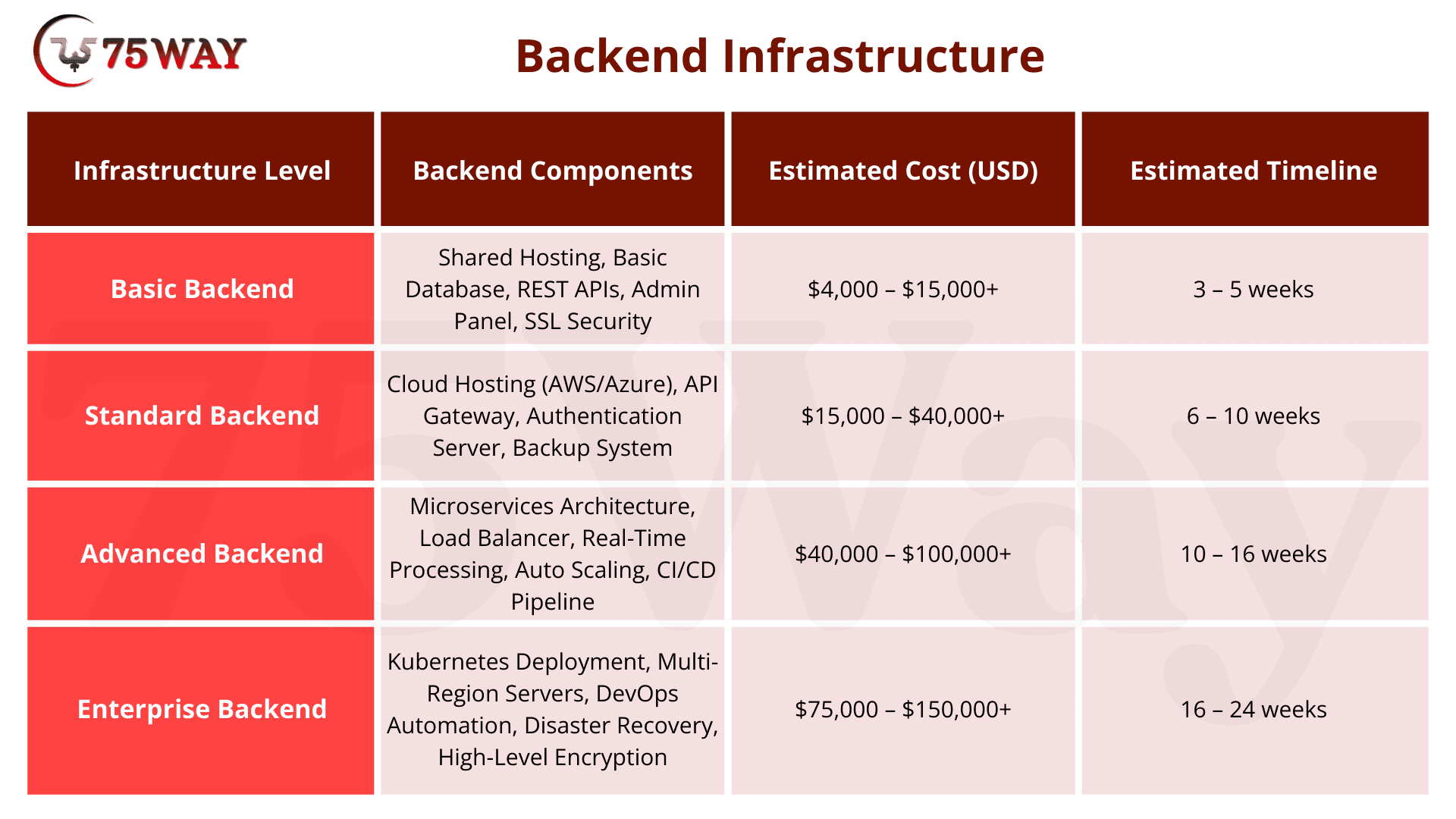
The backend of your app, the server, database, and APIs, forms the foundation that ensures it runs smoothly. A basic backend with simple data storage and APIs is affordable, but advanced backends with cloud hosting, real-time processing, auto-scaling, and high-level security significantly increase development costs. At 75way Technologies, we design secure, scalable backend infrastructure tailored to your app’s unique requirements, ensuring smooth performance even at high user volumes.
Basic Backend Cost for An App:
- USA: $4,000 – $15,000; 3–5 weeks
- India: ₹3 L – ₹12 L; 3–5 weeks
Standard Backend:
- USA: $15,000 – $40,000; 6–10 weeks
- India: ₹12 L – ₹32 L; 6–10 weeks
Advanced Backend:
- USA: $40,000 – $100,000; 10–16 weeks
- India: ₹32 L – ₹80 L; 10–16 weeks
Enterprise Backend:
- USA: $75,000 – $150,000; 16–24 weeks
- India: ₹60 L – ₹1.2 Cr; 16–24 weeks
API Development Needs
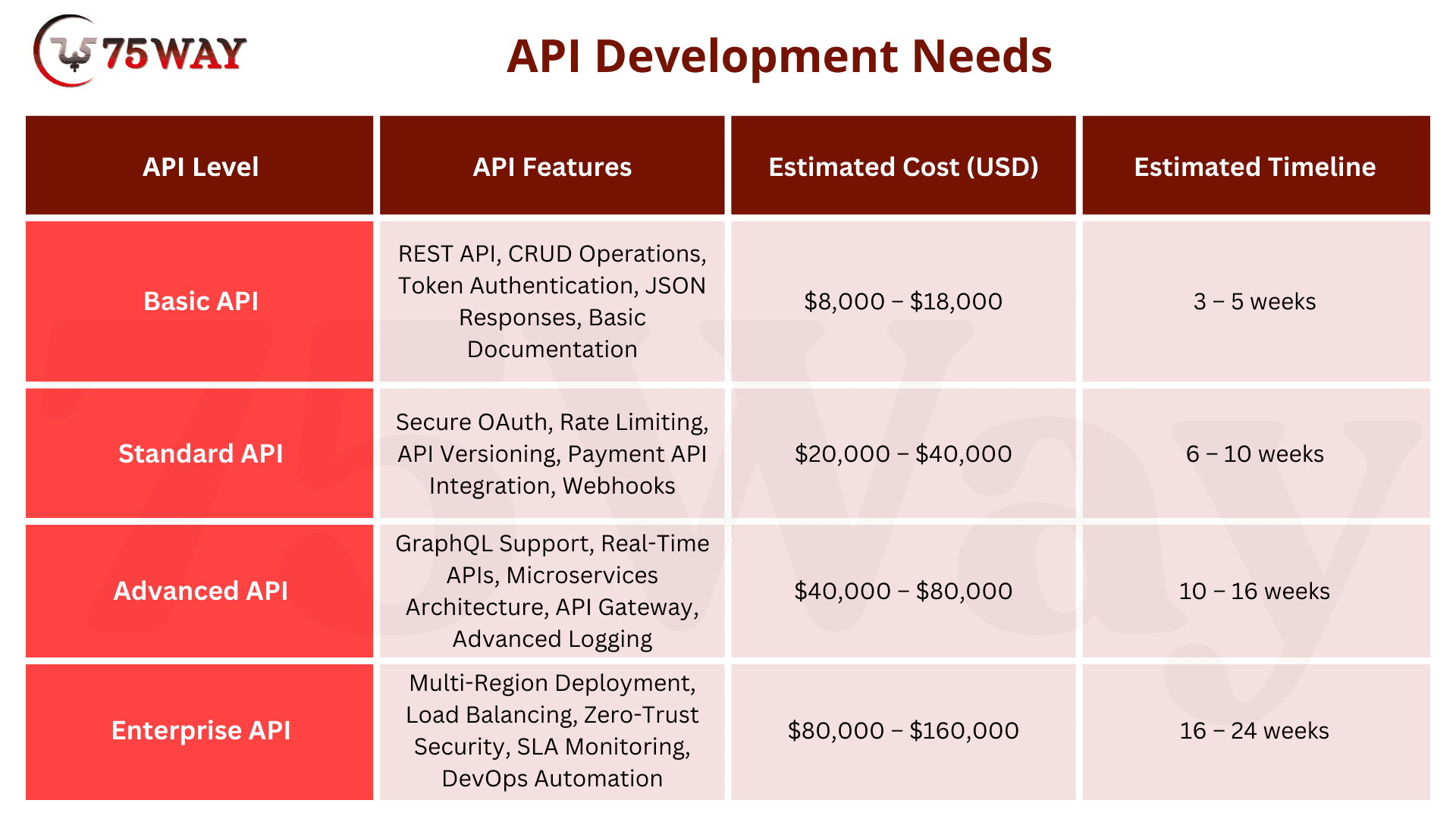
APIs (Application Programming Interfaces) allow your app to communicate with other systems, services, or platforms. Simple APIs with basic functions are quick and cost-effective, while advanced APIs. This stage supports real-time data, payment processing, or multi-system integration and requires more time and expertise, increasing development costs.
Cost of API For App Development in USA
- Basic API for App Cost: $8,000 – $18,000. It usually takes 3–5 weeks.
- Standard API for App Cost: $20,000 – $40,000. It typically requires 6–10 weeks.
- Advanced API for App Cost: $40,000 – $80,000. It generally takes 10–16 weeks.
- Enterprise API for App Cost: $80,000 – $160,000. It usually requires 16–24 weeks
Cost of API For App Development in India
- Basic API for App Cost: ₹50,000 – ₹1,25,000. It usually takes 3–5 weeks to build simple REST APIs with CRUD, token-based authentication, JSON responses, and basic documentation.
- Standard API for App Cost: ₹1,25,000 – ₹2,29,999. It typically takes 6–10 weeks to implement secure OAuth, rate limiting, API versioning, payment integrations, webhooks, and monitoring.
- Advanced API for App Cost: ₹2,25,000 – ₹3,50,000+. It generally takes 10–16 weeks to build GraphQL support, real‑time APIs, microservices architecture, API gateway setup, and advanced logging.
- Enterprise API for App Cost: ₹2,99,999 – ₹4,49,999+. It usually takes 16–24 weeks to deploy across multiple regions, enable load balancing, monitor SLAs, automate DevOps, and achieve enterprise‑grade scalability.
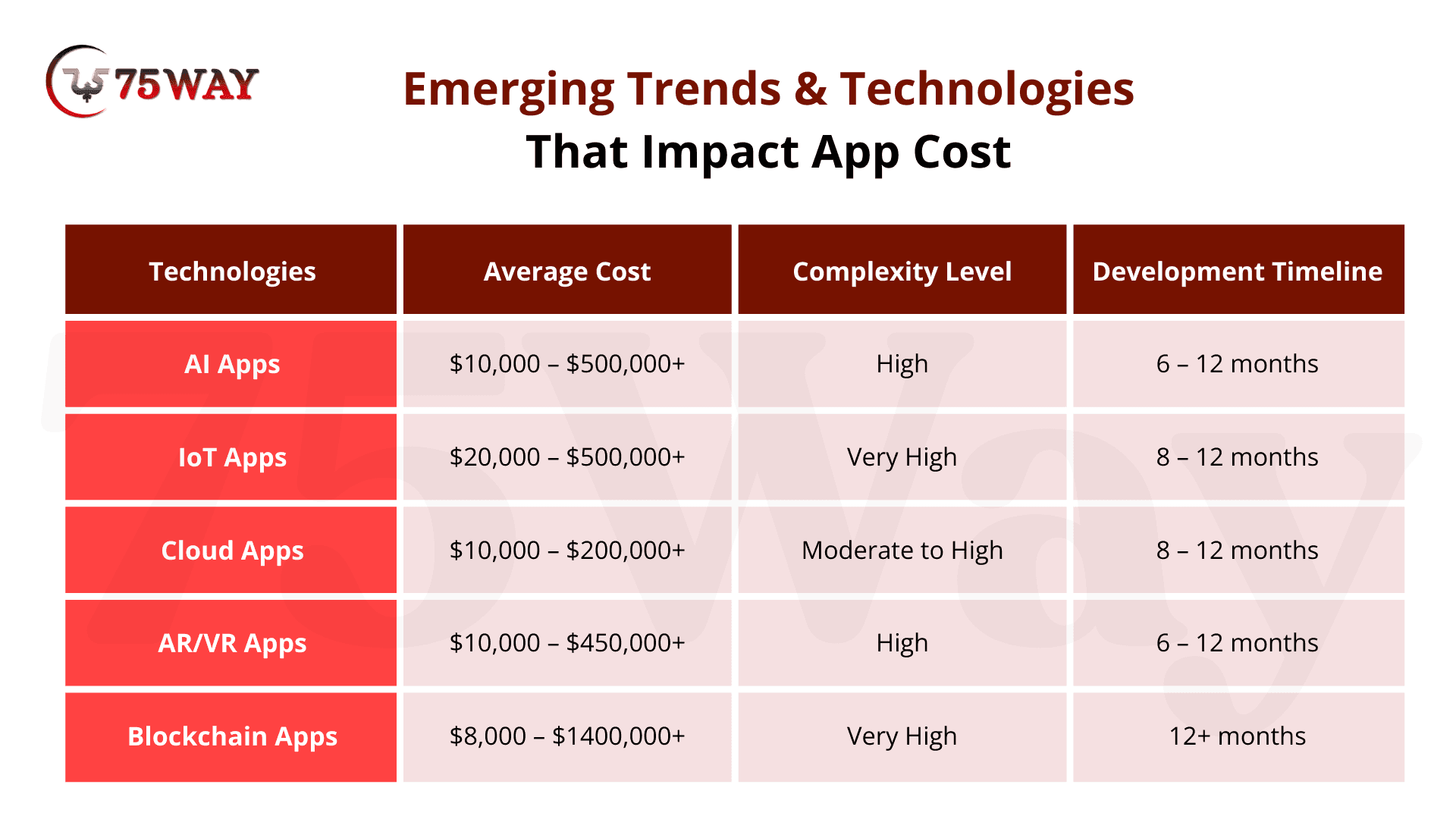
Emerging Trends & Technologies That Impact App Cost
New trends and advanced functionalities are constantly shaping mobile app development costs. Apps with innovative features, high interactivity, or enhanced automation require more development time, testing, and maintenance, which increases the overall budget. Staying updated with these trends ensures your app remains competitive, but it can add complexity and investment compared to standard applications.
AI Apps: Incorporating AI features into your artificial intelligence app, such as smart recommendations, predictive analytics, or personalized user experiences, significantly impacts development cost. Basic AI functionalities require moderate effort, while advanced AI capabilities increase complexity, testing, and ongoing maintenance, driving up the budget.
AI App Development Cost in USA
- Basic AI Cost: $10,000 – $60,000.
- Mid-Level Cost: $50,000 – $150,000.
- Advanced/Enterprise Cost: $150,000 – $500,000+
AI App Development Cost in India
- Basic AI Cost: ₹2,00,000 – ₹8,00,000. Its timelines typically range from 2 to 4 months.
- Mid‑Level AI Cost: ₹8,00,000 – ₹30,00,000. It usually takes 4 – 8 months to build.
- Advanced/Enterprise AI Cost: ₹30,00,000 – ₹75,00,000+. It generally requires 8 – 15+ months, depending on scope and integrations.
Internet of Things (IoT) Apps: Developing an app that connects with devices and collects real-time data adds complexity and increases development costs. Simple device integrations are relatively affordable, but apps that manage multiple devices, process real-time information, or require secure connectivity need more resources, testing, and ongoing maintenance.
For example, connecting a single smart coffee machine to an IoT mobile app is simple, but managing multiple kitchen devices with real-time monitoring requires a sophisticated system. At 75way Technologies, we build IoT apps that ensure smooth device communication and reliable performance, keeping costs optimized while maintaining scalability.
Cost To Build An IoT App in USA
- Basic IoT App Cost: $20,000 – $50,000
- Moderate IoT App Cost: $40,000 – $100,000.
- Complex/Enterprise IoT App Cost: $100,000 – $500,000+
Cost To Build An IoT App in India
- Basic IoT App Cost: ₹10 Lakh – ₹20+ Lakh
- Moderate IoT App Cost: ₹30 Lakh – ₹60 Lakh.
- Complex/Enterprise IoT App Cost: ₹70 Lakh – ₹1.5 Crore+
Cloud Apps: Apps that rely on cloud infrastructure for storage, processing, or collaboration can vary widely in cost. Basic cloud-based apps with minimal storage and simple data sync are affordable, while apps with heavy data processing, real-time collaboration, or scalable cloud architecture require more development effort and higher ongoing expenses.
Cloud App Development Cost in USA
- Simple/MVP Cloud App Cost: $10,000 – $30,000. Development usually takes 1–3 months for basic cloud setup, storage, and core functionality.
- Medium Complexity Cloud App Cost: $25,000 – $100,000. Typically requires 2–6 months to build with multiple features, integrations, and cloud services.
- High Complexity/Enterprise Cloud App Cost: $100,000 – $250,000+. Generally takes 6–12+ months due to advanced architecture, scalability, and enterprise‑grade solutions.
Cloud App Development Cost in India
Simple/MVP Cloud App Cost: ₹4 Lakh– ₹12 Lakh (1–3 months).
Medium Complexity App Cost: ₹12 Lakh – ₹25 Lakh (3–6+ months).
High Complexity/Enterprise App Cost: ₹25 Lakh– ₹80 Lakh+ (6–12+ months).
AR/VR Apps: Developing AR/VR apps involves creating immersive and interactive experiences, which makes them more complex and expensive than standard apps. Basic AR/VR features cost less, while apps with high interactivity, realistic graphics, and advanced simulations require significant development time, testing, and maintenance. For example, adding a simple virtual menu to a café is straightforward, but creating a fully immersive virtual dining experience requires advanced design and development.
Cost To Create AR/VR Apps in USA
- Basic/Simple AR/VR Apps Cost: $10,000 – $30,000. Development of a simple AR/VR prototype or basic filter usually takes 2–4 weeks.
- Mid-Level AR/VR Apps Cost: $30,000 – $100,000. Apps with moderate complexity, like AR e-commerce tools or educational experiences, typically require 2–5 months.
- High-End/Advanced AR/VR Apps Cost: $100,000 – $500,000+. Advanced AR/VR solutions, such as multiplayer games or complex simulations, typically take 6–12+ months due to the high complexity and the performance requirements.
Cost To Create AR/VR Apps in India
- Basic AR/VR App Cost: ₹4,00,000 – ₹8,00,000. Covers simple AR filters, placing 3D objects, or basic interactive elements.
- Moderate AR/VR App Cost: ₹8,00,000 – ₹15,00,000. Includes custom user interfaces, e-commerce features, or marker-based AR tracking.
- High-End/Complex AR/VR App Cost: ₹15,00,000 – ₹25,00,000+. Supports fully immersive environments, real-time tracking, AI integration, and multi-user experiences.
Blockchain Apps: Building a blockchain app is typically more expensive due to the need for secure, decentralized data management and complex smart contract development. Basic blockchain features cost less, but apps with advanced transactions, multi‑chain integration, or high security requirements demand more time, expertise, and ongoing maintenance, increasing overall development costs.
At 75way Technologies, we developed a DeFi app called cSigma that leverages secure smart contracts and decentralized finance protocols. It helped the client reduce development and operational costs by optimizing resource allocation and minimizing manual interventions.
Blockchain App Development Cost in USA
- Simple/MVP/Wallet Cost: $10,000 – $50,000
- Med-Level DApps Cost: $60,000 – $120,000
- Complex/Enterprise Blockchain App Cost: $150,000 – $500,000+
- Advanced Blockchain App Cost: $200,000 – $1,500,000+
Blockchain App Development Cost in India
- Simple MVP/Wallet Cost: ₹4,00,000 – ₹10,00,000+
- Medium Complexity dApp Cost: ₹12,00,000 – ₹40,00,000
- High Complexity/Enterprise dApp Cost: ₹40,00,000 – ₹4 Crore+
- Advanced App Cost: ₹25,00,000 – ₹1.2 Crore+
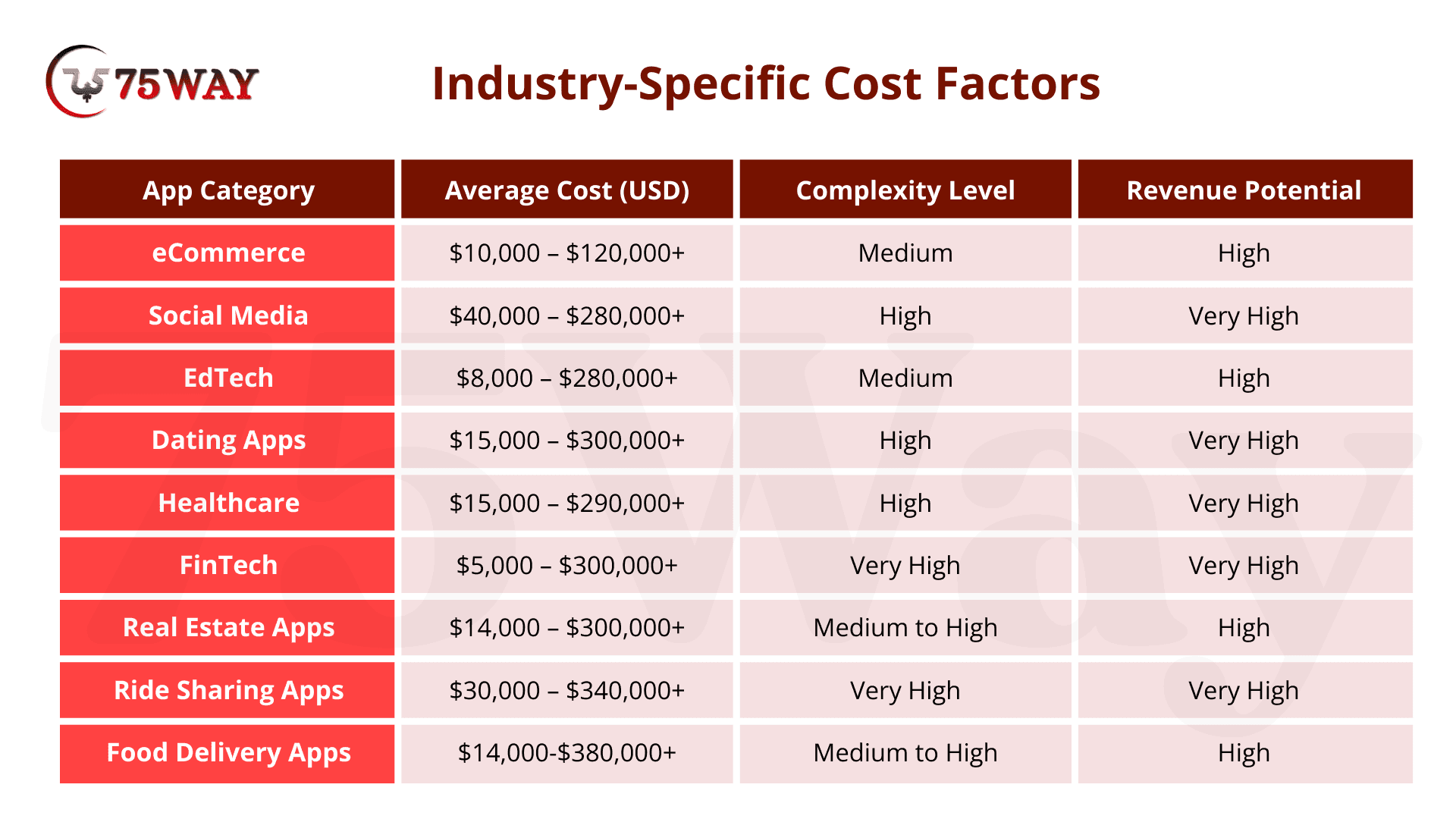
Industry-Specific Cost Factors
Industry-based apps play a significant role in determining development costs. Different sectors have unique requirements for features, security, scalability, and regulatory compliance, which directly impact the budget. For instance, finance, healthcare, or e-commerce apps often demand higher levels of security and data handling, while simpler apps in other sectors may require fewer resources. Understanding these industry-specific needs helps you plan your investment efficiently and avoid unexpected expenses.
E-commerce Apps: E-commerce app development involves creating platforms that manage product catalogs, payments, and user accounts while ensuring smooth performance and strong security. Basic apps with simple catalogs and checkout processes are affordable, but apps with advanced features like multi-vendor support, AI-driven recommendations, and real-time inventory tracking require more time, expertise, and resources, increasing overall development costs.
E-commerce App Development Cost Overview
Basic/MVP E-commerce App Cost: $10,000 – $60,000, ₹8 L – ₹50 L. Features a product catalog, simple checkout, user authentication, and a basic admin panel, usually developed in 2–4 months.
Mid-Tier E-commerce App Cost: $60,000 – $150,000, ₹50 L – ₹1.2 Cr. Includes AI recommendations, push notifications, advanced filters, loyalty programs, and user reviews, typically built in 4–8 months.
Enterprise/Advanced E-commerce App Cost: $150,000 – $450,000+, ₹1.2 Cr – ₹3.5 Cr+. Supports multi-vendor marketplace functionality, AI-driven personalization, AR/VR features, and complex ERP/CRM integration, generally taking 8–12+ months.
Social Media Apps: Social media apps are inherently complex because they must support high user engagement, real-time interactions, and multimedia content. Features like messaging, video streaming, social feeds, and advanced notifications increase development time and require robust backend infrastructure. Scalability, security, and third-party integrations also increase costs. At 75way Technologies, we developed a social interaction app called PromoteMe that delivered advanced social features while optimizing development efficiency.
Cost Breakdown of Social Media Apps
- MVP Social Media App Cost: $40,000 – $90,000+
- Medium Social Media App Cost: $80,000 – $150,000+ with Added search, analytics, and advanced UI/UX
- High-Complexity Social Media App Cost: $150,000 – $280,000+ with advanced AI, video streaming, and high security.
Educational Apps: These apps deliver interactive learning experiences, often featuring live classes, quizzes, progress tracking, and content libraries. The complexity of these features, integration with multimedia, and scalability requirements directly influence development costs. Basic educational apps with simple content and user tracking are affordable, while advanced platforms with AI tutors, AR/VR lessons, and real-time collaboration demand more resources and higher investment.
Educational App Development Cost in USA and India
- Basic/MVP App: $8,000– $50,000 in USA and ₹6 L – ₹40 L+ in India. Features user registration, simple profile, content display, and basic quizzes, typically developed in 2–4 months.
- Mid-Level App: $25,000 – $100,000 in USA and ₹20 L – ₹80 L in India. Includes live streaming, in-app chat, payment integration, and progress tracking, generally built in 4–8 months.
- Advanced/Enterprise App: $100,000 – $280,000+ in USA and ₹80 L – ₹2.2 Cr+ in India. Supports AI tutors, AR/VR integration, advanced analytics, and gamification, usually taking 8–12+ months.
Healthcare Apps: Healthcare apps require high levels of security, privacy, and compliance with regulations such as HIPAA, GDPR, or local health laws, which makes their development more complex and costly. Features like appointment scheduling, telemedicine, patient records, and secure messaging increase development time and demand robust backend systems. Basic health apps are simpler, but advanced apps with device integrations or AI-driven insights significantly raise overall costs.
Cost Breakdown of Healthcare App in USA and India
- Basic Healthcare App: $15,000 – $50,000 in USA and ₹12 L – ₹40 L in India. Minimum Viable Products (MVPs) focus on core functionality and generally take 3–4 months to develop.
- Moderate Healthcare App: $50,000 – $120,000 in USA and ₹40 L – ₹1 Cr in India. Apps with features such as secure messaging, telemedicine (audio/video), EHR/EMR integration, patient portals, and e-prescribing typically take 4–8 months to develop.
- Advanced Healthcare App: $120,000–$290,000+ in USA and ₹1 Cr – ₹2.3 Cr+in India. Enterprise-level healthcare apps with advanced analytics, AI-assisted diagnostics, multi-user management, and full-scale integrations generally require 8–12+ months.
FinTech Apps: FinTech apps handle sensitive financial data and transactions, requiring strict security, regulatory compliance, and real-time processing. Basic apps with simple budgeting or payment features are relatively affordable, while advanced apps with investment tracking, multi-currency support, AI-driven insights, or blockchain integration demand more development time, specialized expertise, and robust backend systems, increasing overall costs.
Costs To Develop FinTech Apps in USA and India
- Basic (MVP) Fintech App: $20,000 – $50,000 in USA and ₹16 L – ₹40 L in India. Minimum Viable Products focusing on core financial features, typically developed in 2–4 months.
- Mid-Level Fintech App: $50,000 – $150,000 in USA and ₹40 L – ₹1.2 Cr in India. Includes additional functionality like payment gateways, transaction history, basic analytics, and security features, usually taking 4–8 months.
- Advanced Fintech App: $150,000 – $300,000+ in USA and ₹1.2 Cr – ₹2.5 Cr+ in India. Enterprise-level apps with multi-currency support, advanced security, AI analytics, and complex banking integrations generally require 8–12+ months.
Dating Apps: Dating apps focus on connecting users through profiles, matches, and messaging, often requiring advanced algorithms, real-time notifications, and privacy controls. Basic apps with simple profiles and swiping features are cost-effective, while apps with AI matchmaking, video chats, geolocation, and social integrations increase development complexity and overall costs.
Costs to Create Dating Apps in USA and India
- Basic/MVP Dating App: $15,000 – $50,000 in USA and ₹12 L – ₹40 L in India. Includes core features like user registration, profile creation, basic search, and messaging, usually developed in 2–4 months.
- Moderate Complexity Dating App: $50,000 – $120,000+ in USA and ₹40 L – ₹1 Cr+ in India. Adds features such as in-app chat, swipe functionality, social media integration, and premium memberships, typically taking 4–8 months.
- Advanced / Custom Dating App: $120,000 – $300,000+ in USA and ₹1 Cr – ₹2.5 Cr+ in India. Enterprise-level apps with AI matchmaking, video chat, AR/VR experiences, and complex backend integrations generally require 8–12+ months.
Real Estate Apps: Real estate apps require features like property listings, search filters, maps, virtual tours, and contact systems, which influence development costs. Basic real estate apps with simple listings are affordable, while advanced apps with AI recommendations, virtual staging, and integrated analytics demand more resources and time, increasing overall expenses. At 75way Technologies, we have created Lotly, a comprehensive real estate app that simplifies property discovery and management while optimizing development efficiency and cost.
Cost of Real Estate App Development in USA and India
- Basic App: 2–4 months; $15,000 – $60,000 in USA and ₹12 L – ₹50 L in India. Includes core features and basic functionality, typically developed in 2–4 months.
- Moderate App: 4–8 months; $30,000 – $120,000 in USA and ₹25 L – ₹1 Cr in India. Adds additional features, integrations, and enhanced UI/UX, usually taking 4–8 months.
- Advanced/Enterprise App: 8+ months; $100,000 – $300,000+ in USA and ₹80 L – ₹2.5 Cr+ in India. Enterprise-grade apps with complex features, AI, multi-user support, and scalable backend generally require 8+ months.
Ride Sharing Apps: Ride-sharing apps involve complex features like real-time GPS tracking, ride matching, fare calculation, multiple payment options, and driver-passenger communication. Basic MVP apps with core functionality are relatively affordable, while full-featured apps with surge pricing, carpooling, and AI-driven analytics require extensive development time, robust backend systems, and higher costs. At 75way Technologies, we develop scalable ride-sharing solutions that ensure smooth real-time operations, enhanced user experience, and optimized development costs.
Cost To Build Ride Sharing Apps in USA and India
Basic MVP: $30,000 – $70,000 (USA), ₹25 L – ₹55 L (India). Focuses on core functionalities like user registration, basic GPS tracking, simple mapping, payment integration, and push notifications, typically developed in 2–4 months.
Moderate/Mid-Level: $80,000 – $150,000 (USA), ₹65 L – ₹1.2 Cr (India). Includes all basic features plus real-time ride tracking, in-app chat, multiple payment options, fare estimation, and driver ratings, generally taking 4–8 months.
Advanced/Full-Scale: $180,000 – $340,000+ (USA), ₹1.5 Cr – ₹2.8 Cr+ (India). High-end features include AI-based surge pricing, ride-sharing/carpooling options, and scalable backend architecture, usually developed in 8–12+ months.
Food Delivery App: Food delivery apps require seamless integration of restaurant menus, real-time order tracking, payment gateways, and delivery management systems. These apps include proper delivery partner apps, admin dashboards, and customer apps. Basic apps with simple ordering and notifications are cost-effective, while advanced apps with AI recommendations, multiple vendor management, and real-time analytics increase development complexity and overall costs.
Cost of Food Delivery App Development in USA and India
Basic/MVP App: $14,000 – $50,000 (USA), ₹12 L – ₹40 L (India). Focuses on core functionality and basic features, typically developed in 2–4 months.
Moderate Complexity App: $30,000 – $120,000 (USA), ₹25 L – ₹1 Cr (India). Includes additional features, integrations, and improved UI/UX, generally taking 4–8 months.
Advanced/Enterprise App: $80,000 – $380,000+ (USA), ₹65 L – ₹3 Cr+ (India). Enterprise-grade apps with complex functionality, AI, multi-user support, and scalable backend usually require 8–12+ months.
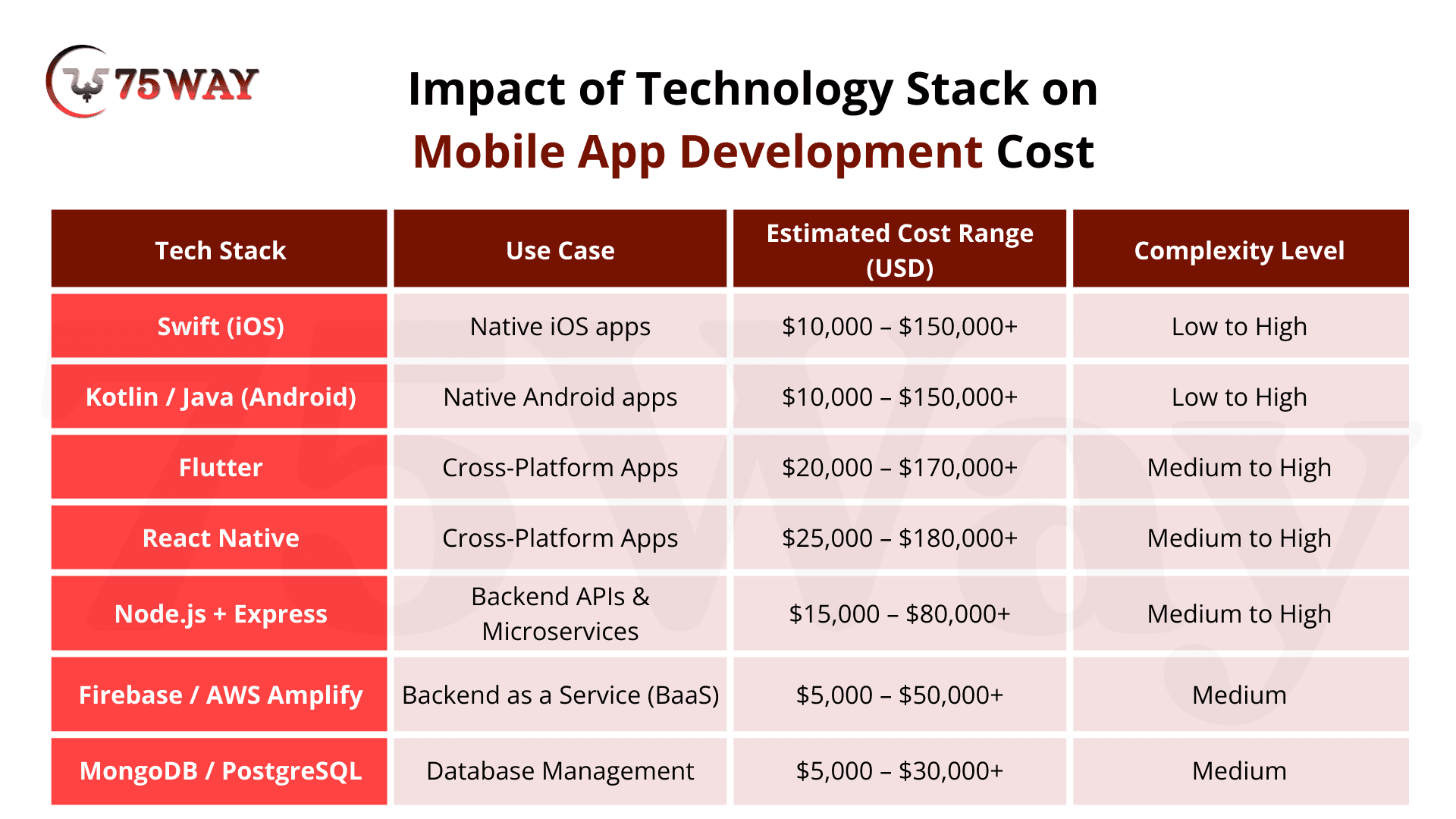
Impact of Technology Stack on Mobile App Development Cost
The technology stack you select can significantly influence your app’s budget. Choosing widely used, well-supported technologies reduces development time and costs, whereas niche or cutting-edge tools often require specialized expertise, increasing expenses. Additionally, the stack affects app speed, security, and scalability, which impact long-term maintenance. A strategic choice balances efficiency, performance, and innovation, ensuring your app meets business goals without overshooting the budget.
Cost of Selecting a Technology Stack for an App
- Swift (iOS): $10,000 – $150,000+. Development of native iOS apps, typically used for high-performance, platform-specific features.
- Kotlin / Java (Android): $10,000 – $150,000+. Development of native Android apps with full access to platform capabilities and optimized performance.
- Flutter: $20,000 – $170,000+. Cross-platform app development for iOS and Android using a single codebase, reducing time and cost.
- React Native: $25,000 – $180,000+. Cross-platform app development framework allowing a shared codebase for iOS and Android with near-native performance.
- Node.js + Express: $15,000 – $80,000+. Building backend APIs and microservices for scalable, fast, and efficient server-side applications.
- Firebase / AWS Amplify: $5,000 – $50,000+. Backend-as-a-Service (BaaS) solutions provide authentication, databases, hosting, and cloud functions for faster development.
- MongoDB / PostgreSQL: $5,000 – $30,000+. Database management systems for storing, querying, and managing app data efficiently.
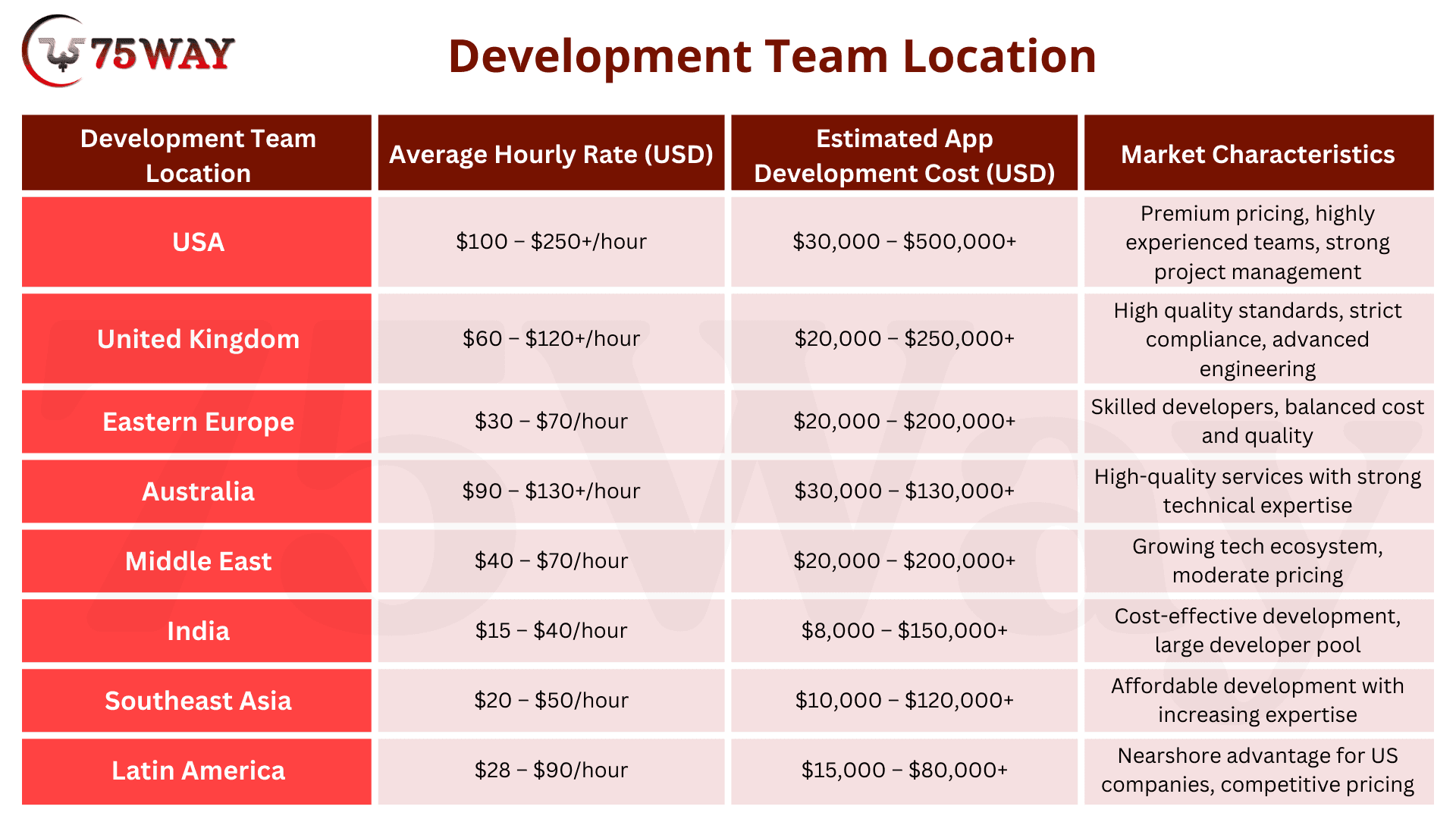
Development Team Location
The geographical location of your development team influences project cost, communication efficiency, and overall delivery speed. Teams based in North America or Western Europe typically charge higher rates but offer proximity to your time zone and often deeper familiarity with local market standards. Offshore teams in regions like India, Eastern Europe, or Southeast Asia provide cost-effective solutions with skilled developers and flexible scaling options, though they may require careful coordination across time zones and cultural differences. Choosing the right location depends on balancing budget, expertise, and the need for real-time collaboration to ensure timely, high-quality app delivery.
Cost of Apps based on Development Team Location
- USA: $30,000 – $500,000+. Hiring developers in the USA is the most premium option. High hourly rates of $100–$250/hour reflect extensive experience, strong project management, and advanced technical expertise. Apps developed here often benefit from top-quality standards and reliability.
- United Kingdom: $20,000 – $250,000+. UK-based teams charge $60–$120/hour, offering high-quality development and strict compliance with global standards. Projects here balance expertise and efficiency.
- Eastern Europe: $20,000 – $200,000+. Eastern European developers charge $30–$70/hour. This region offers skilled professionals at cost-effective rates, delivering quality apps without overshooting budgets.
- Australia: $30,000 – $130,000+. Australian teams work at $90–$130/hour, providing strong technical knowledge and professional development practices for medium to high-complexity apps.
- Middle East: $20,000 – $200,000+. Developers in the Middle East charge $40–$70/hour. The region has a growing tech ecosystem, offering moderate pricing with skilled teams.
- India: $8,000 – $150,000+. India provides the most cost-effective development, with rates between $15–$40/hour. Large talent pools make it ideal for startups and SMEs.
- Southeast Asia: $10,000 – $120,000+. Developers charge $20–$50/hour, providing affordable yet capable solutions for small to medium app projects.
- Latin America: $15,000 – $80,000+. Nearshore development in Latin America costs $28–$90/hour, offering competitive rates with good communication for US-based companies.
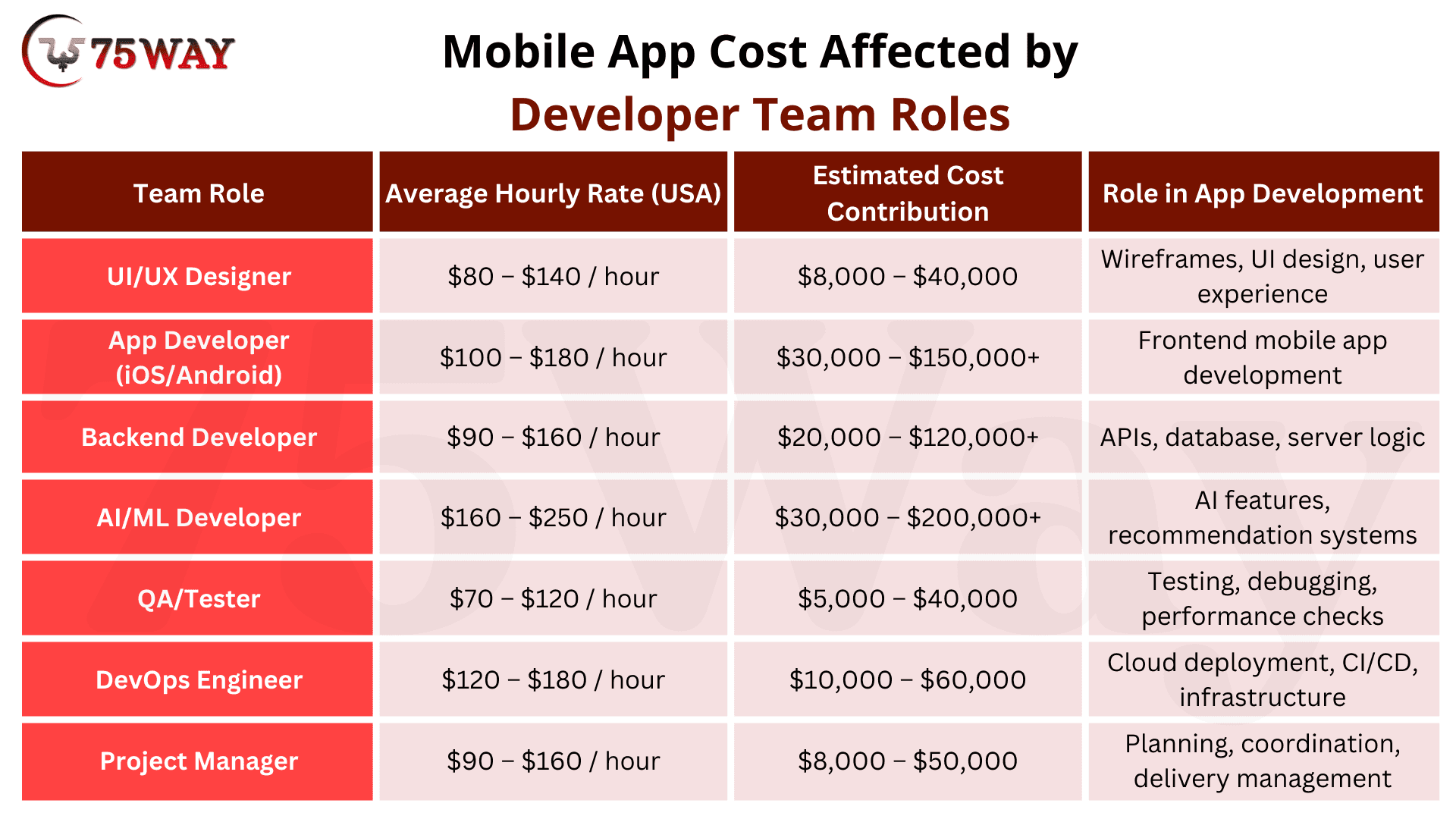
Mobile App Cost Affected by Developer Team Roles
The roles and expertise of your development team directly influence mobile app costs. UI/UX designers, frontend and backend developers, QA testers, AI specialists, DevOps engineers, and project managers all contribute differently to the overall budget. Highly skilled professionals may charge more per hour, but their efficiency and quality reduce long-term costs. Understanding each role’s responsibilities helps you allocate resources wisely, optimize development time, and control expenses as you build a high-quality, scalable mobile app.
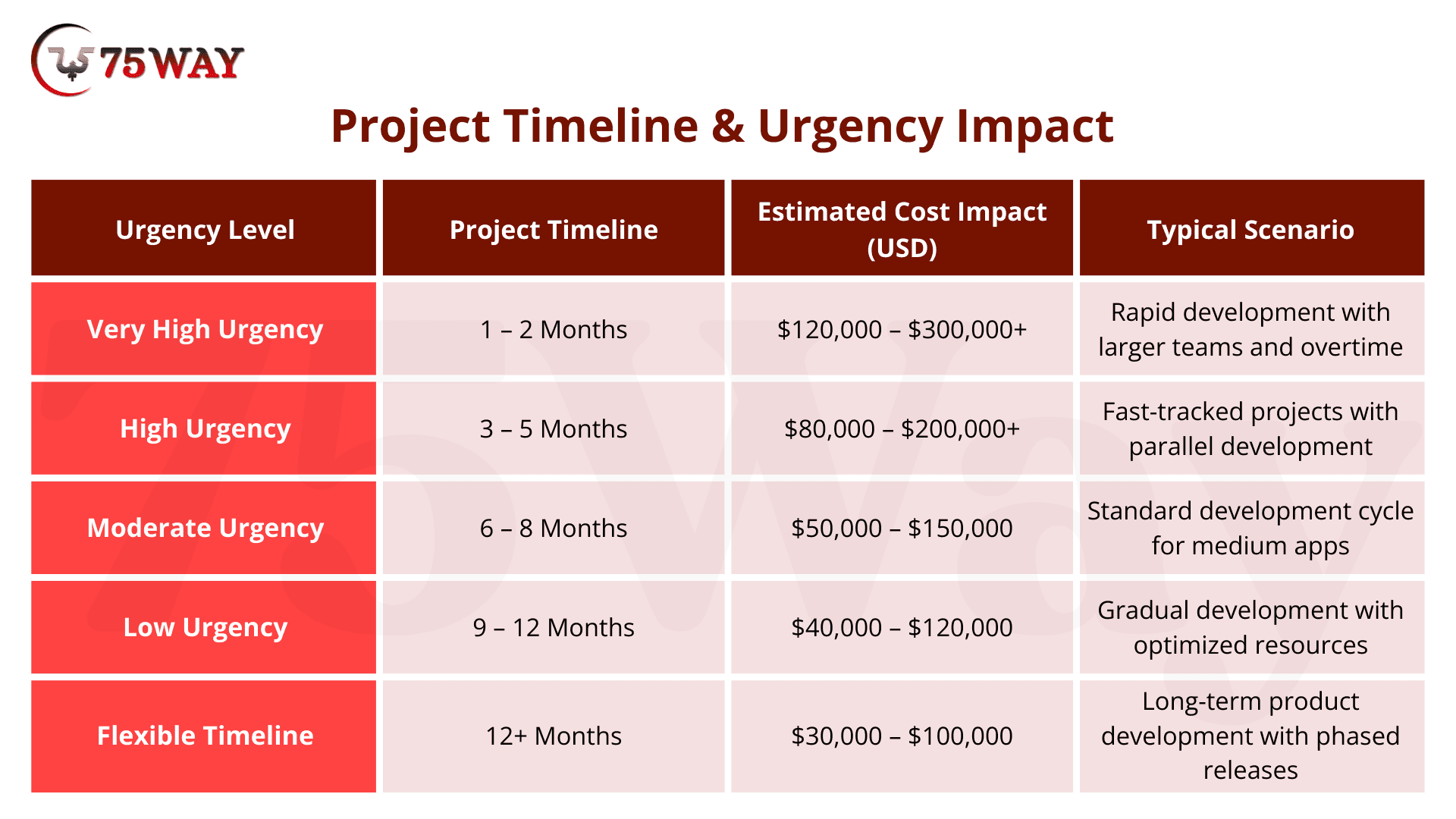
Project Timeline & Urgency Impact
The timeline and urgency of your mobile app project significantly affect development costs. Fast-tracked projects requiring completion in 1–2 months demand larger teams, overtime work, and rapid decision-making, increasing expenses. Standard timelines of 6–8 months allow balanced development at moderate costs, while flexible schedules over 12+ months optimize resources and reduce budget pressure. Planning your project timeline carefully ensures quality delivery without unnecessary financial strain, aligning speed with efficiency and cost-effectiveness.
More Insights: Candy AI Chatbot Development Cost in 2026: Complete Breakdown
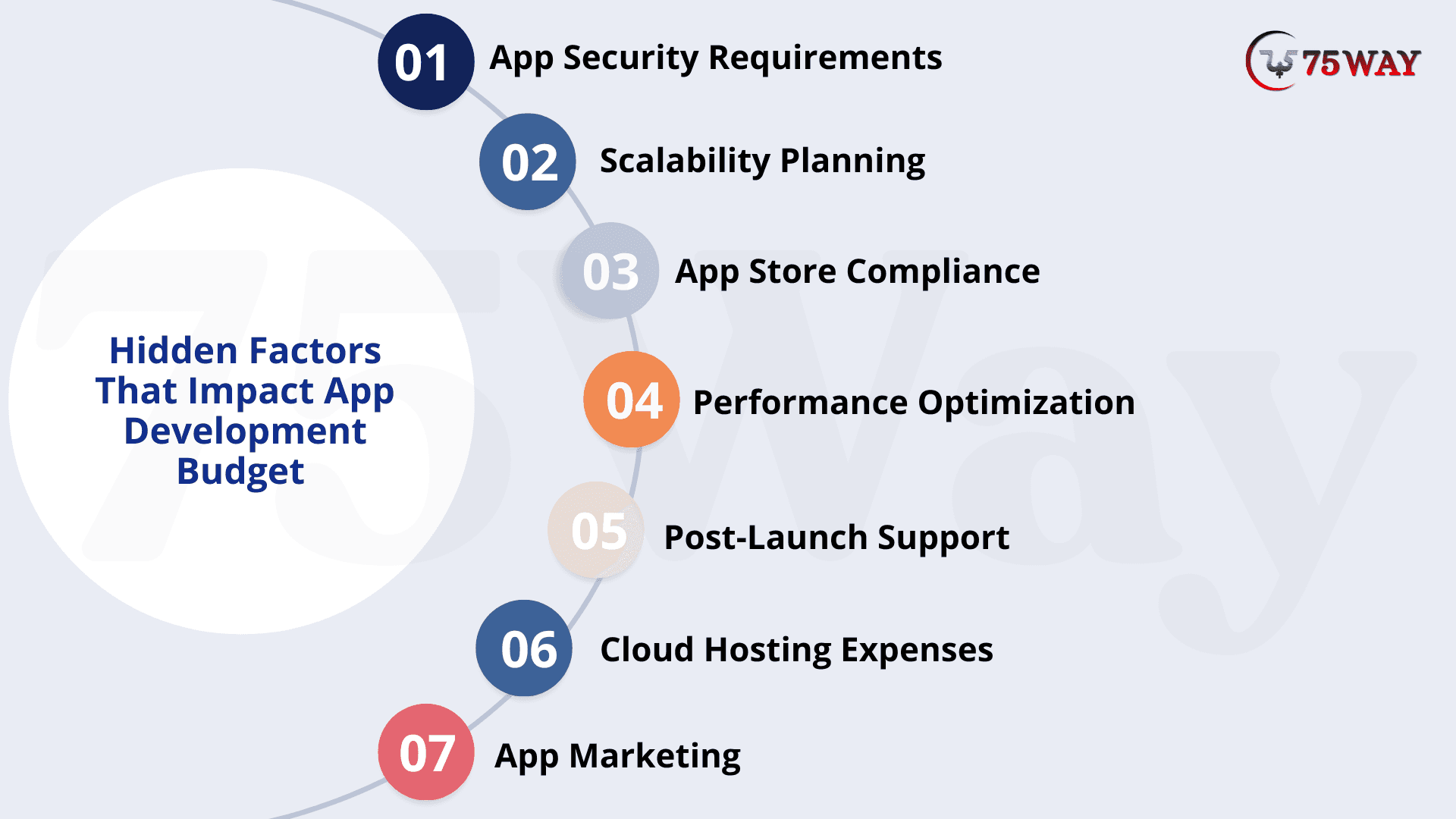
Hidden Factors That Impact App Development Budget
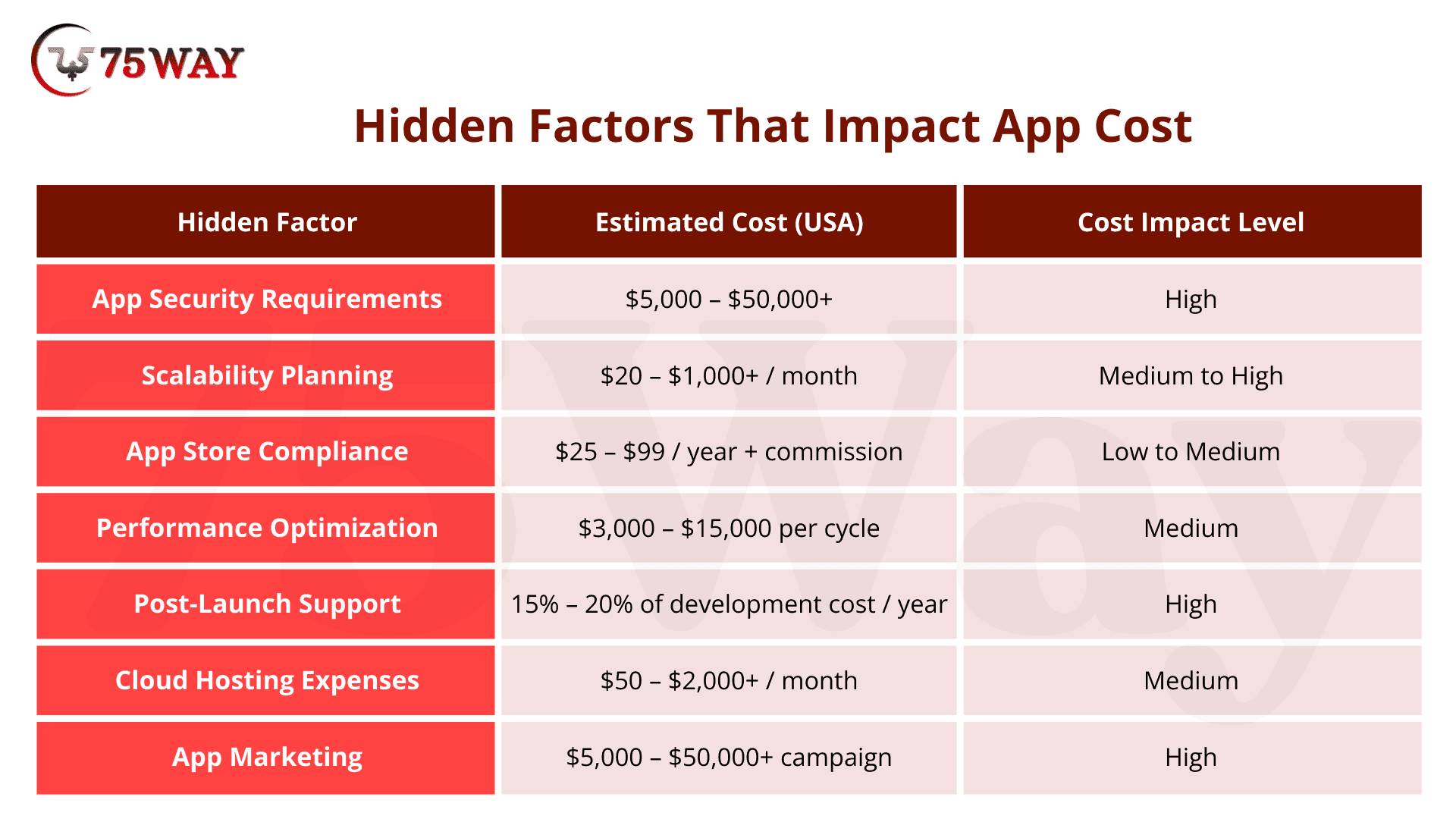
Several hidden elements can unexpectedly increase your mobile app development budget if overlooked. Security requirements, scalability planning, app store compliance, performance optimization, post-launch support, cloud hosting, and marketing all add costs beyond initial development. Each factor ensures your app runs smoothly, reaches the right audience, and remains reliable over time. Understanding these hidden costs helps you plan effectively, avoid surprises, and make informed decisions that protect both your budget and your app’s long-term success.
App Security Requirements: High-level security measures, such as encryption, secure authentication, and compliance with regulations like GDPR or HIPAA, increase development costs. Strong security ensures data protection, user trust, and reduces the risk of breaches, but requires additional resources and specialized expertise.
Scalability Planning: Infrastructure designed to support growing users, traffic, and data demands requires a higher initial investment. Apps built for scalability prevent costly future redesigns, but integrating load balancing, cloud resources, and efficient architecture increases upfront development costs.
App Store Compliance: Adhering to Apple App Store or Google Play guidelines adds costs through documentation, testing, and updates. Non-compliance can delay launch or require rework, increasing both time and budget for publishing the app.
Performance Optimization: Optimized app speed, responsiveness, and minimal crashes raise costs due to extra testing, code refinement, and server resources. Proper optimization reduces long-term maintenance and improves user retention, balancing upfront investment with future savings.
Post-Launch Support: Ongoing bug fixes, updates, and technical support increase recurring costs. Continuous support ensures app stability, user satisfaction, and compatibility with OS updates, affecting annual maintenance budgets.
Cloud Hosting Expenses: Cloud infrastructure for storage, servers, and backup adds monthly or yearly costs. Choice of hosting scale, redundancy, and security directly influences total app expenses and operational budget.
App Marketing: Promotional campaigns, user acquisition, and advertising increase overall project cost. Effective marketing ensures downloads, engagement, and ROI, but requires a dedicated budget beyond development expenses.
Read More: How AI Agents Automate Sales, Support & Operations in US Companies
Popular App Clones Businesses Can Build and Their Costs
The development of successful apps helps businesses enter the market faster while reducing development risk. Costs vary depending on features and complexity, from basic MVPs to fully-featured platforms. Understanding market demand, functionality, and target users ensures smart budgeting and strategic app investment.
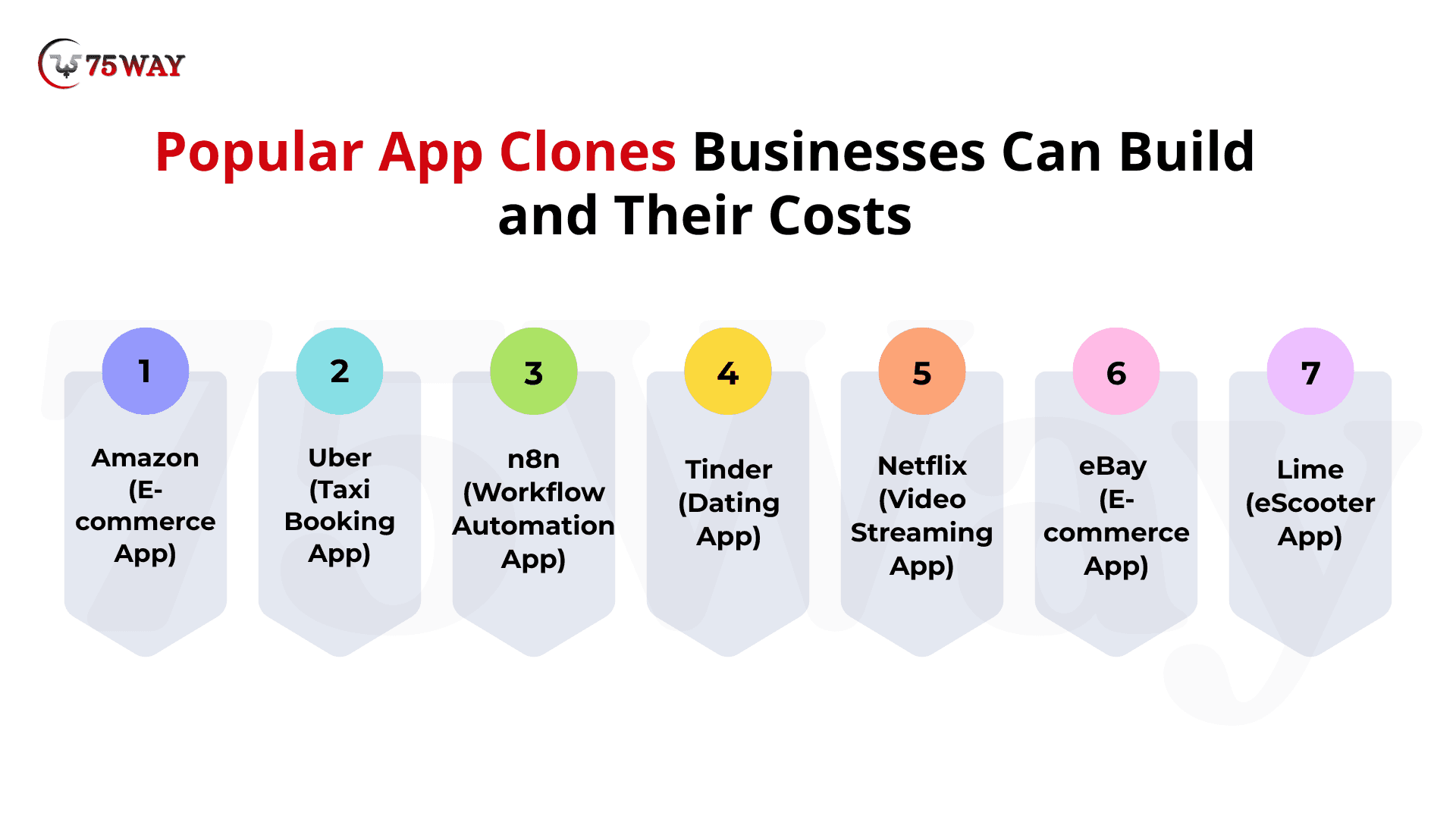
Amazon (E-commerce App): An e-commerce app like Amazon offering product catalogs, search filters, a shopping cart, secure payments, and order tracking. Advanced features like personalized recommendations and real-time analytics increase complexity. Its cost varies depending on features, integrations, and scalability requirements for handling high user traffic.
Estimated Cost: $50,000 – $120,000+
Uber (Taxi Booking App): A ride-hailing app like Uber connecting drivers and passengers with GPS tracking, fare calculation, real-time ride updates, and in-app payments. Additional features like surge pricing and multi-route optimization increase complexity. Its cost is influenced by location services, backend infrastructure, and real-time performance requirements.
Estimated Cost: $80,000 – $340,000+
n8n (Workflow Automation App): Business automation app like n8n workflow platform enabling custom workflows, multi-tool integrations, and task automation. Requires robust backend and API connectivity for efficiency. The cost may vary depending on workflow complexity, number of integrations, and automation logic.
Estimated Cost: $30,000 – $100,000+
Tinder (Dating App): A social/dating platform like Tinder with profile creation, swiping, matching algorithms, chat features, and geolocation services. Enhanced features like video calls or AI-based match suggestions increase cost. Tinder clone app development cost varies based on scalability, security, and advanced functionality.
Estimated Cost: $15,000 – $300,000+
Netflix (Video Streaming App): Streaming app with user subscriptions, content libraries, recommendation engines, multi-device support, and secure video delivery. Advanced features like offline playback and adaptive streaming increase costs. Its cost is affected depending on the platform, content management system, and scalability requirements.
Estimated Cost: $100,000 – $500,000+,
eBay (E-commerce App): Marketplace app like eBay allowing buying, selling, bidding, and secure transactions. Features such as real-time notifications, advanced search, and payment gateways increase complexity. Its cost is changed depending on multi-vendor support, scalability, and platform integrations.
Estimated Cost: $50,000 – $120,000+,
Lime (eScooter App): Mobility app managing scooter rentals, GPS tracking, ride history, and payments. Real-time location and fleet management increase development effort. The development cost of e-scooter apps is influenced by IoT integration, backend infrastructure, and user traffic handling.
Estimated Cost: $40,000 – $150,000+
Read More: Top AI Agent Development Companies in USA in 2026
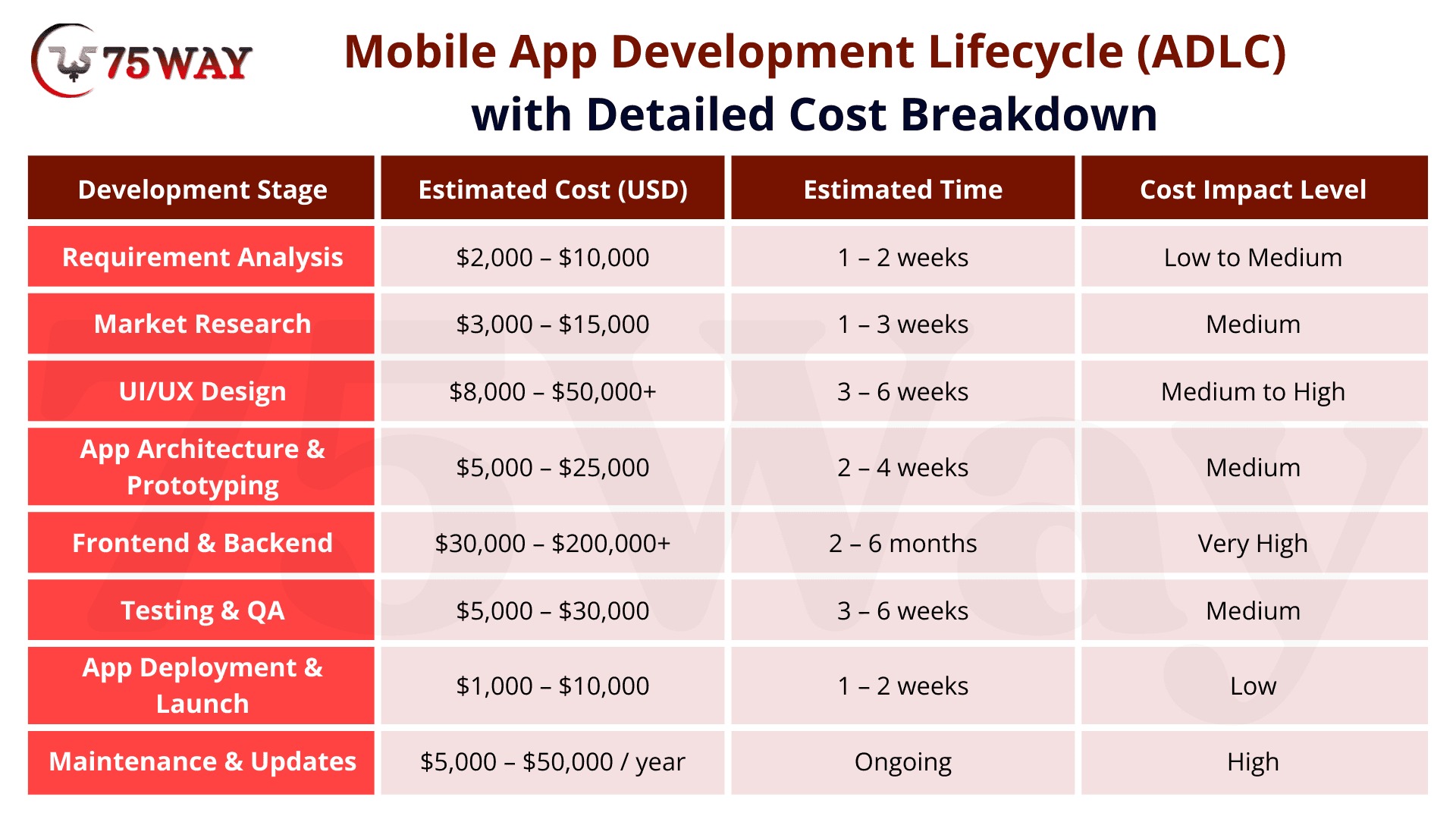
Mobile App Development Lifecycle (ADLC) with Detailed Cost Breakdown
The mobile app development process covers planning, design, development, testing, deployment, and maintenance. Each stage contributes differently to overall costs, from requirement analysis to post-launch updates. Understanding this lifecycle helps businesses budget effectively, allocate resources wisely, and ensure the timely delivery of a high-quality, scalable, and user-friendly mobile application.
Requirement Analysis: $2,000 – $10,000
The initial stage defines the app’s objectives, target audience, key features, and functionality. It sets the foundation for all subsequent stages. Proper analysis reduces the risk of scope creep and ensures development aligns with business goals, making the investment more efficient and cost-effective.
Market Research: $3,000 – $15,000
The next stage evaluates competitor apps, industry trends, user expectations, and potential demand. It guides feature prioritization, design decisions, and monetization strategies. Effective research increases the app’s chances of success while helping businesses allocate development resources efficiently and avoid costly missteps.
UI/UX Design: $8,000 – $50,000+
UI/UX designing phase focuses on creating an intuitive, engaging interface and seamless user experience. Custom visuals, wireframes, and interactive elements enhance usability and retention. Investing in quality design improves user satisfaction, boosts app adoption, and impacts development cost depending on complexity and branding requirements.
App Architecture & Prototyping: $5,000 – $25,000
App architecture defines the structural design, data flow, and system components, while prototyping visualizes functionality. This stage ensures technical feasibility and identifies potential issues early. Proper planning reduces future redesign costs and accelerates development efficiency, safeguarding both budget and project timeline.
Frontend & Backend Development: $30,000 – $200,000+
Frontend development handles the app’s interface and user interactions, while backend manages databases, servers, APIs, and logic. Complex apps require more advanced architecture, integrations, and real-time processing. This stage usually forms the largest portion of development costs due to its technical complexity and resource requirements.
Testing & QA: $5,000 – $30,000
This stage ensures the app runs smoothly, is bug-free, and performs consistently across devices. Comprehensive QA includes functional, performance, and security testing. Although it adds cost, it prevents post-launch failures and expensive fixes, ensuring higher user satisfaction and app reliability.
App Deployment & Launch: $1,000 – $10,000
The deployment involves submitting the app to stores, configuring servers, and ensuring compliance with platform guidelines. Costs depend on store fees, release preparation, and technical support. Smooth deployment ensures faster time-to-market and minimizes launch issues that could affect user adoption and revenue potential.
Maintenance & Updates: $5,000 – $50,000
Ongoing maintenance includes bug fixes, feature updates, security patches, and OS compatibility. Regular updates improve app performance, retain users, and prevent technical debt. Annual maintenance costs vary with app complexity, scale, and frequency of updates, making it essential for long-term app success.
Learn More: Top Taxi Booking Apps in USA: How To Build Your Taxi App
How to Reduce the Cost of Building Mobile Apps?
Reducing mobile app development costs doesn’t mean compromising quality. Smart planning, prioritization, and strategic choices can save significant resources. From defining clear requirements to leveraging pre-built solutions and using agile methods, businesses can streamline development, accelerate time-to-market, and maximize ROI while maintaining a high-quality, user-friendly app.
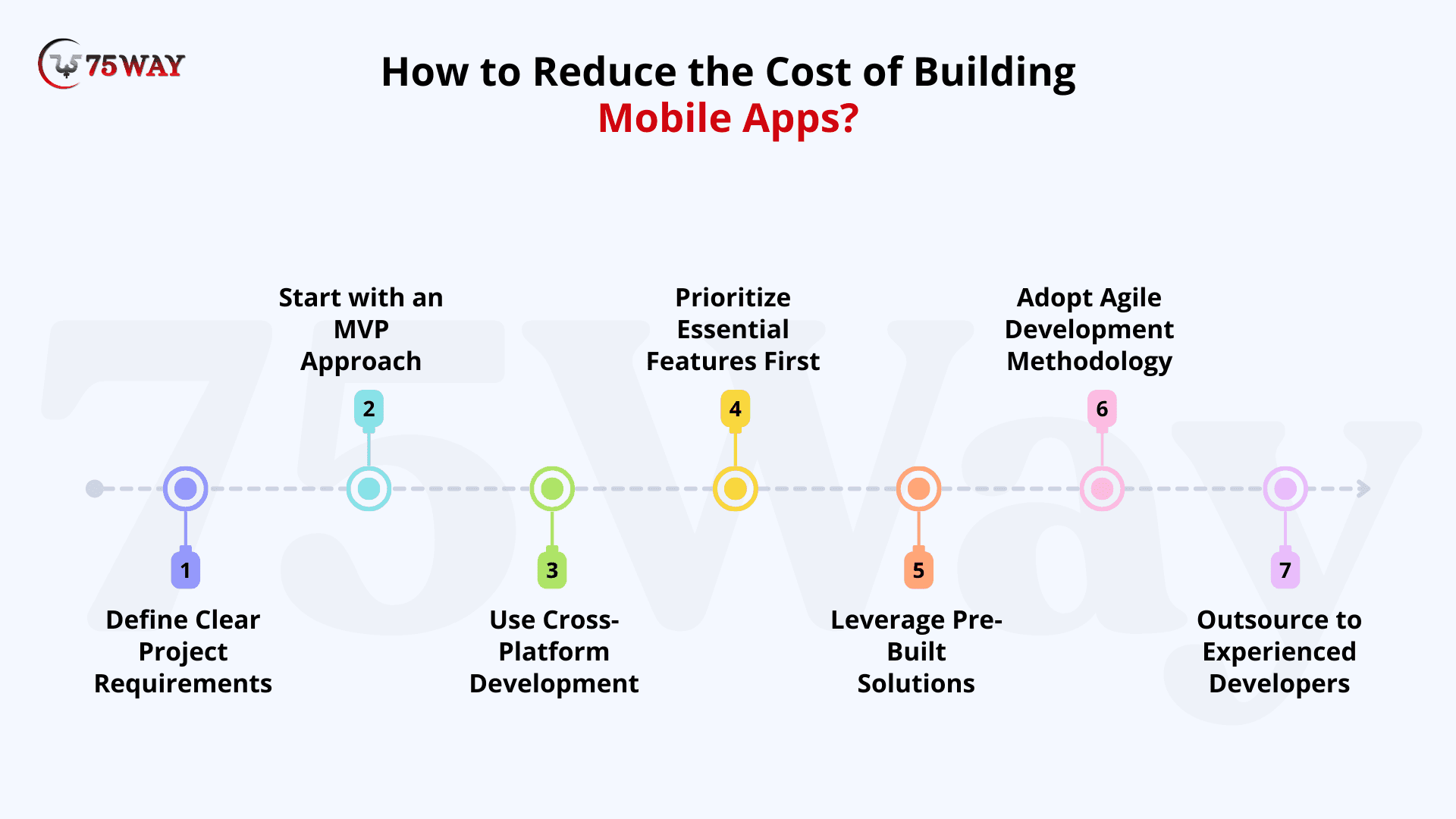
Define Clear Project Requirements: Clear project requirements outline the app’s goals, target audience, essential features, and design expectations. Well-documented requirements prevent scope creep, miscommunication, and unnecessary revisions, reducing wasted development hours and ensuring the team focuses on building exactly what the business needs.
Start with an MVP Approach: A Minimum Viable Product (MVP) focuses on core functionalities first, allowing early market validation without overspending. MVP development approach reduces upfront costs, accelerates user feedback, and guides further development, ensuring investments target features users actually value.
Use Cross-Platform Development: Cross-platform frameworks allow building apps for multiple operating systems simultaneously, cutting time and cost. Shared codebases minimize duplicate work while delivering consistent functionality and UI across iOS and Android, improving efficiency for startups and small businesses.
Prioritize Essential Features First: Focusing on core features reduces complexity, speeds up development, and limits unnecessary expenses. Additional features can be added later based on user feedback. Prioritization ensures cost-effectiveness while still creating a functional, valuable app for early adopters.
Leverage Pre-Built Solutions: Using existing libraries, templates, or APIs reduces development effort. Pre-built solutions streamline backend logic, UI components, or integrations, saving both time and money while maintaining app quality and functionality.
Adopt Agile Development Methodology: Agile enables iterative development with frequent testing, feedback, and adjustments. It reduces costly errors, ensures efficient resource allocation, and allows teams to adapt to changing requirements without ballooning budgets.
Outsource to Experienced Developers: Hiring skilled developers from cost-effective regions ensures high-quality work at lower rates. Experienced teams deliver faster, reduce errors, and manage projects efficiently, balancing cost savings with robust app performance and scalability.
Explore More: AI App Development Partner for Health and Wellness Startup
Best Monetization Strategies for Mobile App Growth
A precise revenue strategy mobile app ensures sustainable growth and revenue generation. Choosing the right strategy depends on your app type, target audience, and business goals. From advertising to subscriptions, in-app purchases, and partnerships, each method can maximize earnings while enhancing user engagement. A smart approach balances monetization with a seamless user experience
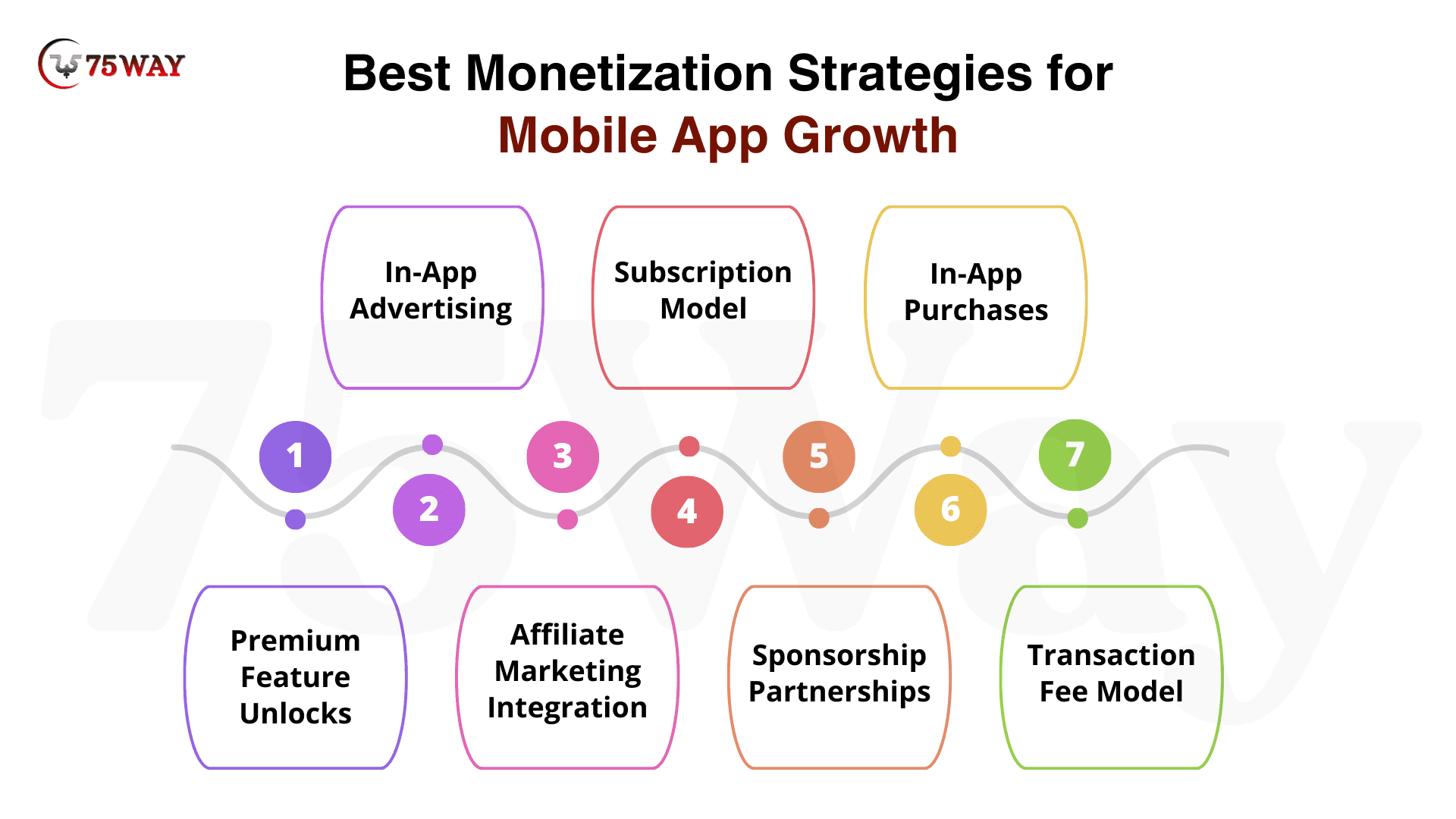
In-App Advertising: In-app ads generate revenue by displaying banners, interstitials, or video ads to users. Costs vary based on integration complexity. While this strategy can yield consistent income, it must be implemented carefully to avoid disrupting the user experience and retaining engagement.
Subscription Model: Recurring subscription fees provide steady, predictable revenue. This model works well for content-driven apps, services, or premium tools. Offering tiered plans or exclusive access encourages long-term retention, while development costs include secure payment integration and subscription management features.
In-App Purchases: Users can buy digital goods, features, or virtual currency within the app. Effective for games, utilities, or productivity apps, in-app purchases increase revenue potential. Development costs include secure payment processing, inventory management, and seamless purchase flows to enhance the user experience.
Premium Feature Unlocks: Offering advanced features or ad-free experiences behind a one-time or recurring payment encourages upgrades. This approach balances free access with monetization opportunities, requiring development effort to implement feature restrictions, user entitlements, and payment gateways.
Affiliate Marketing Integration: Apps can earn commission by promoting products or services via affiliate links. Costs include backend tracking, analytics, and API integration. Proper integration ensures smooth user experiences while generating incremental revenue without directly charging users.
Sponsorship Partnerships: Brands pay for visibility or exclusive content placement in the app. Sponsorships can enhance revenue without disturbing core functionality. Development costs cover integration, branding, and analytics to track campaign effectiveness.
Transaction Fee Model: Apps facilitating marketplace, booking, or payment transactions can charge a percentage per transaction. Implementation requires secure payment gateways, accounting systems, and compliance measures. Proper integration ensures revenue while maintaining user trust and app credibility.
How 75way Transforms Businesses with Affordable App Solutions?
75way Technologies specializes in delivering affordable mobile app solutions without compromising quality. By understanding your business goals, target audience, and budget, we craft tailored apps that meet your unique needs. Our cost-effective approach ensures startups, SMEs, and enterprises can access high-quality development services while maximizing ROI and minimizing unnecessary expenses.
From MVPs to complex enterprise apps, 75way focuses on efficient development strategies, optimized workflows, and smart technology choices. Our team leverages expertise across UI/UX design, backend development, and feature integration to create scalable, user-friendly apps. With our affordable solutions, businesses gain competitive digital products that drive growth, engagement, and measurable results.
The cost of developing a mobile app depends on factors like complexity, features, platform, and technology stack. Basic apps with essential functions usually range from $5,000 to $40,000. Apps with moderate complexity, including API integrations and custom features, can cost between $30,000 and $140,000. High-end, enterprise-level apps with advanced functionalities such as AI, real-time processing, or complex architectures may reach $110,000 to $280,000+.
Final Remarks
Mobile app development costs can vary widely depending on factors such as app complexity, features, platforms, design, technology stack, and industry requirements. Understanding these elements helps you plan a realistic budget, prioritize features, and make informed decisions that maximize ROI. With strategic planning, cost-effective development approaches, and emerging technologies, businesses can create apps that drive engagement, efficiency, and growth. For high-quality, affordable solutions tailored to your needs, partner with a trusted mobile app development company today.
Frequently Asked Questions
How Long Does It Take To Develop A Mobile App In 2026?
The development timeline depends on the app’s complexity and feature set. A simple MVP can take 2–4 months, while mid-level applications typically require 4–6 months. Advanced enterprise apps with AI, real-time systems, and large-scale infrastructure can take 9–18 months or longer.
What Is The Minimum Budget Required To Launch A Mobile App?
The minimum budget to launch a basic mobile app usually ranges from $5,000 to $10,000, including limited features, simple UI design, and minimal backend infrastructure. However, most business-ready apps with essential functionality require at least $20,000–$40,000.
Which Platform Is Cheaper to Develop Apps: iOS or Android?
The development cost for iOS and Android apps is generally similar, but Android development may take slightly longer due to device fragmentation and testing across multiple screen sizes. Many businesses reduce costs by using cross-platform frameworks like Flutter or React Native.
Why Do Enterprise Mobile Apps Cost Significantly More?
Enterprise applications require advanced architecture, high security standards, complex integrations, and scalable infrastructure to support large user bases. These systems also involve AI features, cloud services, and compliance requirements, which increase both development time and cost.
What Ongoing Costs After Launching An App?
After launch, businesses should budget for maintenance, security updates, cloud hosting, performance optimization, and feature upgrades. On average, post-launch maintenance costs around 15–20% of the total development cost per year.
Is It Better To Outsource Mobile App Development?
Outsourcing app development to experienced companies can significantly reduce costs while maintaining quality. Many businesses choose development teams in regions like India or Eastern Europe, where skilled developers offer competitive hourly rates compared to North America or Western Europe.