AI Summary
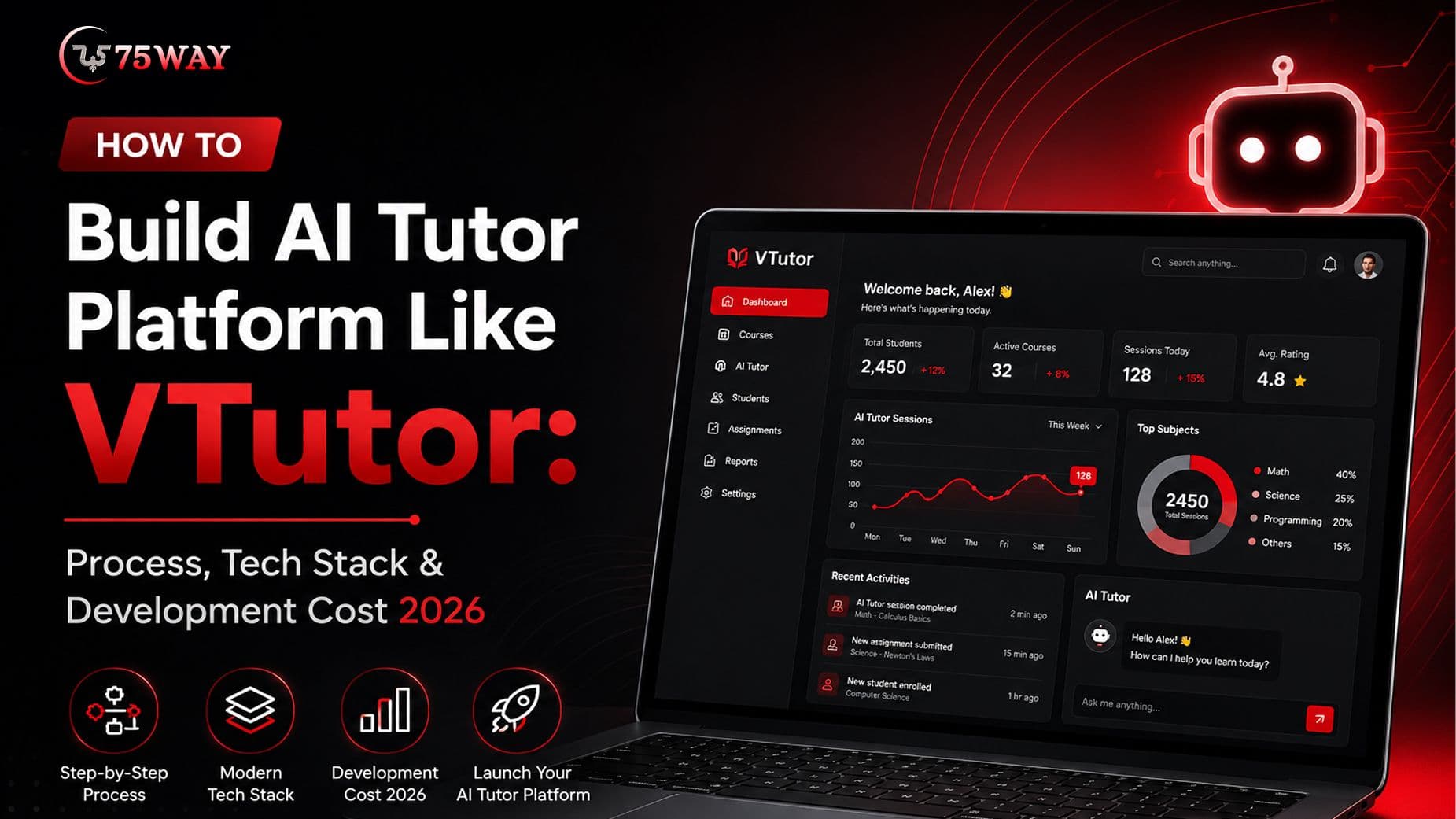
Build an AI tutor platform like VTutor with this complete 2026 guide. This guide explores planning, architecture, essential features, technology choices, implementation stages, development costs, monetization strategies, and emerging innovations behind creating a scalable AI tutor platform inspired by VTutor for startups, educational institutions, and enterprise learning providers.
Quick Overview
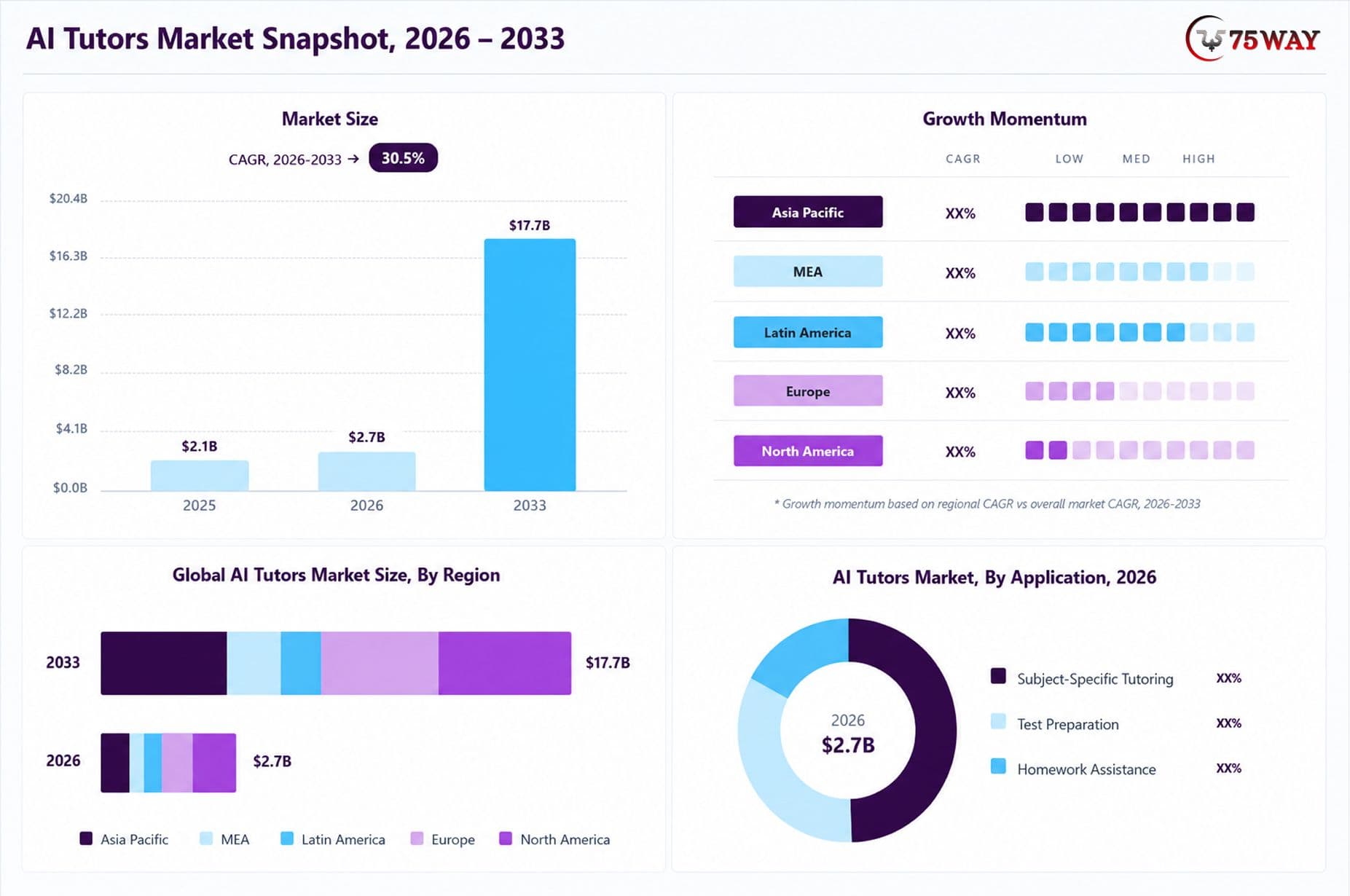
- AI tutoring market is expected to reach $17.7 billion by 2033 globally.
- AI tutor platforms like VTutor deliver personalized learning experiences with conversational educational assistance.
- Suitable AI models directly influence platform accuracy, scalability, and responsiveness.
- Well-planned AI tutor development architecture strengthens security, supports integrations, and simplifies future product enhancements without disruption.
- V-Tutor-like AI tutor development costs lie between $15K and $ 300K+ and vary based on features and customization requirements.
The next billion-dollar education platform may not hire thousands of teachers. It may rely on AI tutors that teach, answer questions, adapt to every student, and stay available 24/7. That is why startups and EdTech companies are racing to build AI tutor learning platforms, like VTutor.
Success, however, depends on much more than adding an AI chatbot to an education app. From selecting the right AI models and designing adaptive learning experiences to ensuring scalability, security, and measurable learning outcomes, every decision shapes the platform's long-term success. The sections below provide a practical roadmap to help you build an AI tutor platform that learners trust and continue using.
If you're one of them, this guide breaks down everything you need to know about building an AI tutor platform like VTutor, including the development process, technology stack, AI features, and expected costs in 2026.
AI Tutoring Is Reshaping Digital Learning Beyond Traditional LMS Platforms
Learning management systems (LMS) transformed online education by organizing courses, assignments, and assessments. However, most platforms still rely on static content that delivers identical learning experiences to every student, regardless of their pace, strengths, or knowledge gaps. AI tutor platforms introduce a different approach by creating interactive learning environments that adapt in real time through conversational intelligence and personalized guidance.
Instead of navigating lengthy course materials independently, learners can ask questions naturally, receive tailored explanations, request alternative examples, and revisit difficult concepts without waiting for instructor availability. This continuous interaction keeps students engaged while encouraging independent problem-solving.
Unlike conventional eLearning solutions, AI tutors analyze learning behavior over time. They identify weak areas, recommend targeted lessons, adjust question difficulty, and generate customized revision plans that evolve alongside each learner's progress. The result is a learning journey that feels more like one-on-one tutoring than self-paced online training.
For educators, AI tutoring platforms reduce administrative workloads by assisting with lesson creation, quiz generation, assignment evaluation, and student performance tracking. Teachers gain more time for mentoring and higher-value academic interactions instead of repetitive grading and content preparation.
Educational organizations also benefit from richer learning analytics. AI-powered dashboards reveal engagement patterns, completion rates, concept mastery, and knowledge gaps, helping institutions refine teaching strategies and improve academic outcomes through data-driven decisions.
As generative AI, speech recognition, multimodal learning, and retrieval-augmented generation (RAG) continue advancing, AI tutor platforms are evolving into comprehensive educational ecosystems capable of supporting K-12 schools, universities, corporate training programs, certification providers, and lifelong learning communities.
AI Tutors Market Size, Users & Revenue Growth Insights
The numbers behind AI tutors tell a much bigger story than market growth alone. They reveal how students are learning differently, how institutions are adopting AI, and where the biggest business opportunities are emerging. Here are the latest AI tutor market statistics and growth insights for 2026.
AI Tutor Adoption & Usage Statistics
- A Stanford University study found that students used AI reading tutors for only 2–5 minutes per week when dedicated classroom time was provided.
- Teacher adoption of AI for grading, assessments, and tutoring preparation has increased from 34% to over 61%.
- Around 60% of educators now use AI tools for lesson planning and activity creation, with 32% using them every week.
- More than 90% of university students and 84% of high school students now use generative AI for studying.
- AI-powered language learning apps and speech bots collectively serve over 360 million users worldwide.
AI Tutor Market Growth Statistics
- The global AI tutors market is projected to grow from $2.7 billion in 2026 to $17.7 billion by 2033, at a 30.5% CAGR.
- Another industry forecast estimates the market will expand from $4.12 billion in 2026 to $12.89 billion by 2034, growing at a 16.3% CAGR.
K-12 AI Tutoring Market Statistics
- The K-12 segment leads the AI tutoring market, accounting for more than 46% of total revenue.
- K-12 institutions represented 45.62% of the AI tutors market in 2024, while professional learning is expected to grow at a 14.65% CAGR through 2030.
AI Tutoring Performance & Learning Outcomes
- Research indicates AI tutoring platforms can improve student test scores by up to 62% while significantly enhancing overall learning outcomes.
AI Tutor Market Segment Statistics
- The subject-specific tutoring segment holds the largest market share at 49.0%.
- The machine learning and predictive analytics segment leads the market with a 47.0% share.
Why Businesses Are Investing In AI Tutor Platforms Like VTutor
Growing demand for personalized education, flexible learning schedules, and scalable digital teaching has accelerated investment in AI-powered tutoring solutions. Organizations across multiple industries recognize that intelligent tutoring platforms can improve learner experiences while expanding educational services without proportionally increasing operational costs.
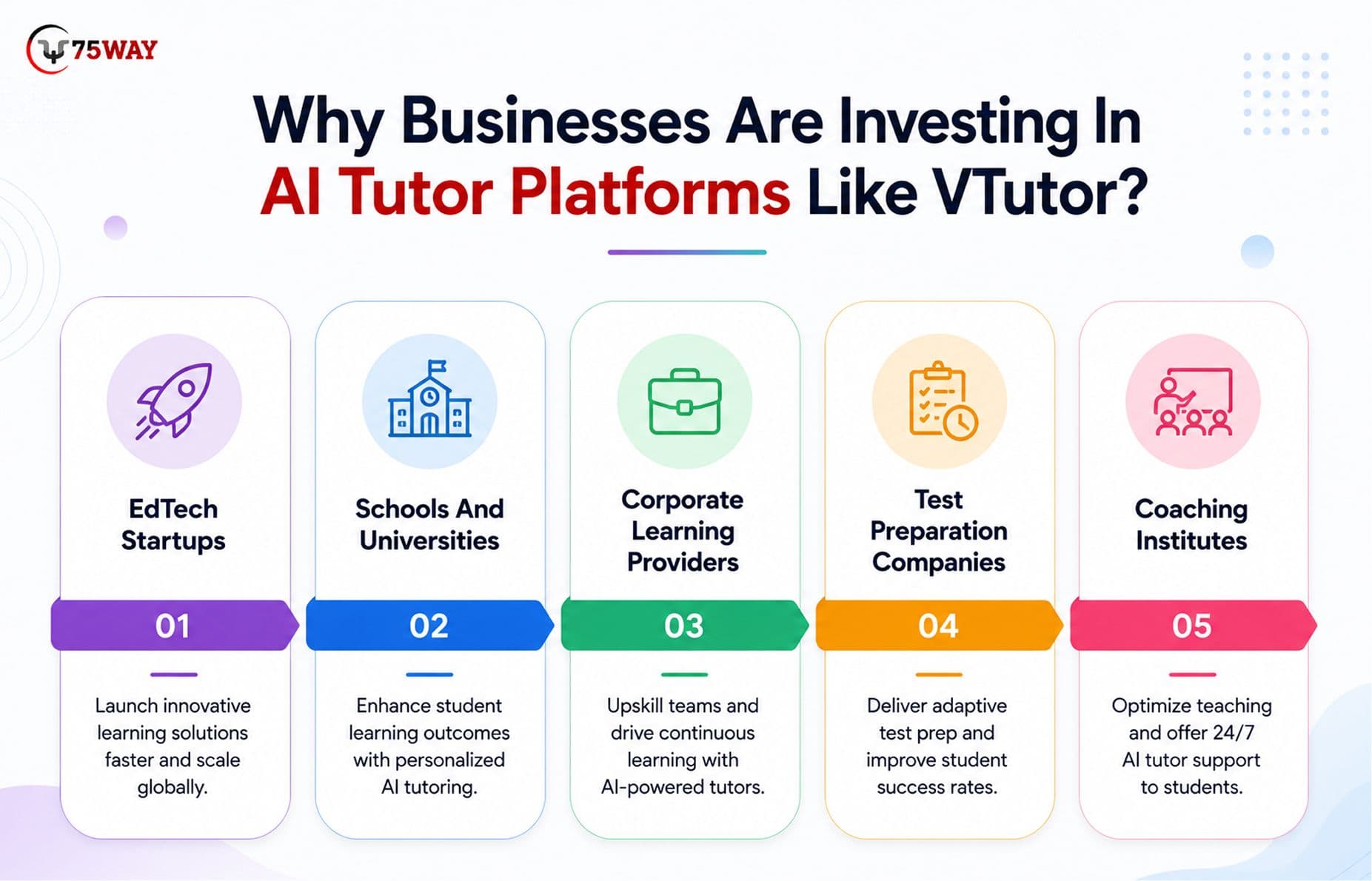
- EdTech Startups
AI tutors enable startups to launch innovative learning platforms with personalized lessons, adaptive assessments, multilingual support, and continuous student engagement that differentiate their offerings in an increasingly competitive education market.
- Schools And Universities
Educational institutions use AI tutors to provide academic assistance beyond classroom hours, helping students receive instant explanations, practice exercises, revision materials, and individualized support without increasing faculty workloads.
- Corporate Learning Providers
Companies adopt AI tutoring systems to deliver role-specific employee training, onboarding programs, compliance education, and professional development while tracking learning outcomes across distributed workforces.
- Test Preparation Companies
Competitive exam providers use AI tutors to generate customized study schedules, simulate examinations, explain incorrect answers, and strengthen weak subject areas through adaptive learning techniques.
- Coaching Institutes
Coaching businesses enhance student engagement by offering AI-assisted doubt resolution, automated practice sessions, personalized feedback, and progress tracking that complement instructor-led teaching.
- Educational Publishers
Publishers transform static digital textbooks into interactive learning experiences where students can ask contextual questions, receive concept explanations, and practice knowledge through AI-generated exercises.
VTutor-Like AI Tutor Platform Development Process: From Idea to Launch
A successful AI tutor platform is built through structured planning rather than simply by integrating an AI model. Every phase influences learning quality, scalability, compliance, and long-term product sustainability. The following roadmap reflects how experienced development teams approach modern AI-powered education platforms in 2026.
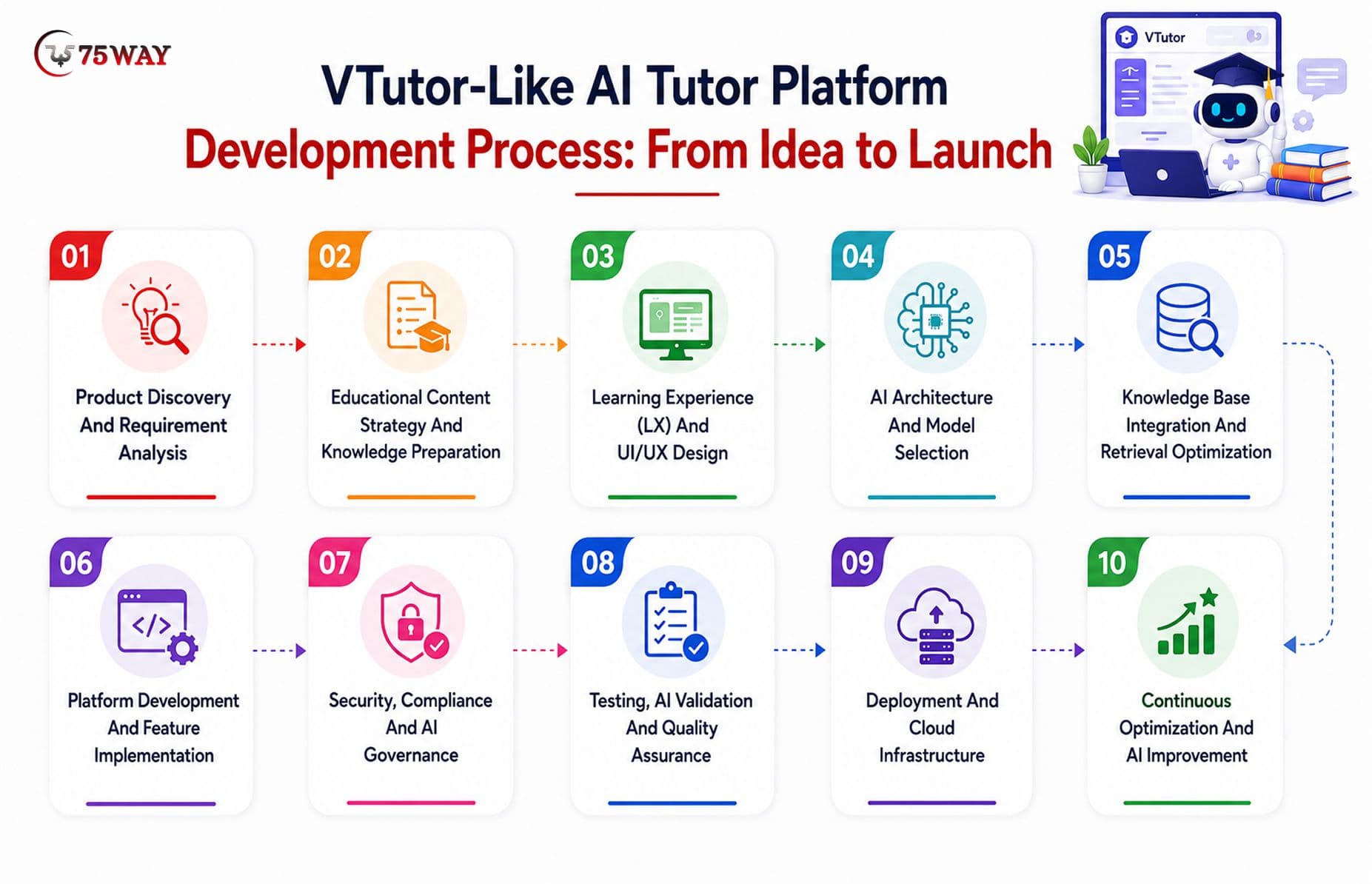
Step 1: Product Discovery And Requirement Analysis
Every successful AI tutor platform starts with understanding educational goals instead of selecting technologies. During this phase, development teams work with stakeholders to identify target learners, define teaching methodologies, analyze competitors, and establish measurable business objectives. These early decisions guide product architecture, feature prioritization, compliance planning, and future platform scalability.
Key Activities
- Identify learner personas
- Define educational objectives
- Analyze competitor platforms
- Prioritize core features
- Select monetization model
- Review FERPA, COPPA, and GDPR requirements
Deliverable: Product roadmap, feature backlog, business requirements document, and development timeline.
Step 2: Educational Content Strategy And Knowledge Preparation
Before AI can teach, it needs reliable educational content. This stage focuses on collecting, organizing, and standardizing learning resources that will become the platform's primary knowledge source. Preparing content early helps deliver consistent, curriculum-aligned responses instead of relying only on an AI model's general knowledge.
Content Sources
- Digital textbooks
- Course materials
- Lecture notes
- Question banks
- Research papers
- Video transcripts
- Institutional documents
Deliverable: Structured educational repository prepared for AI integration.
Step 3: Learning Experience (LX) And UI/UX Design
An AI tutor should guide learners naturally while minimizing distractions. Designers create intuitive learning journeys that combine conversational tutoring, quizzes, progress tracking, and interactive lessons into a seamless educational experience. Every interface is optimized to support continuous learning across desktop and mobile devices.
Design Components
- Student dashboard
- Teacher workspace
- Parent portal
- AI chat interface
- Voice interaction screens
- Progress visualization
- Gamification elements
Deliverable: Wireframes, interactive prototypes, and high-fidelity UI designs.
Step 4: AI Architecture And Model Selection
Choosing the right AI architecture has a greater impact than selecting the most popular language model. Development teams evaluate different AI models, define prompt engineering strategies, and design an architecture capable of delivering accurate, context-aware educational responses while supporting future scalability.
AI Architecture Includes
- Large Language Model (LLM)
- Retrieval-Augmented Generation (RAG)
- Prompt engineering
- Memory management
- Content moderation
- AI guardrails
- Vector database selection
Deliverable: AI architecture blueprint and model integration strategy.
Step 5: Knowledge Base Integration And Retrieval Optimization
Once the AI architecture is finalized, the educational repository is transformed into a searchable knowledge base. Learning materials are processed, indexed, and connected with Retrieval-Augmented Generation, allowing the AI tutor to retrieve verified information before generating responses.
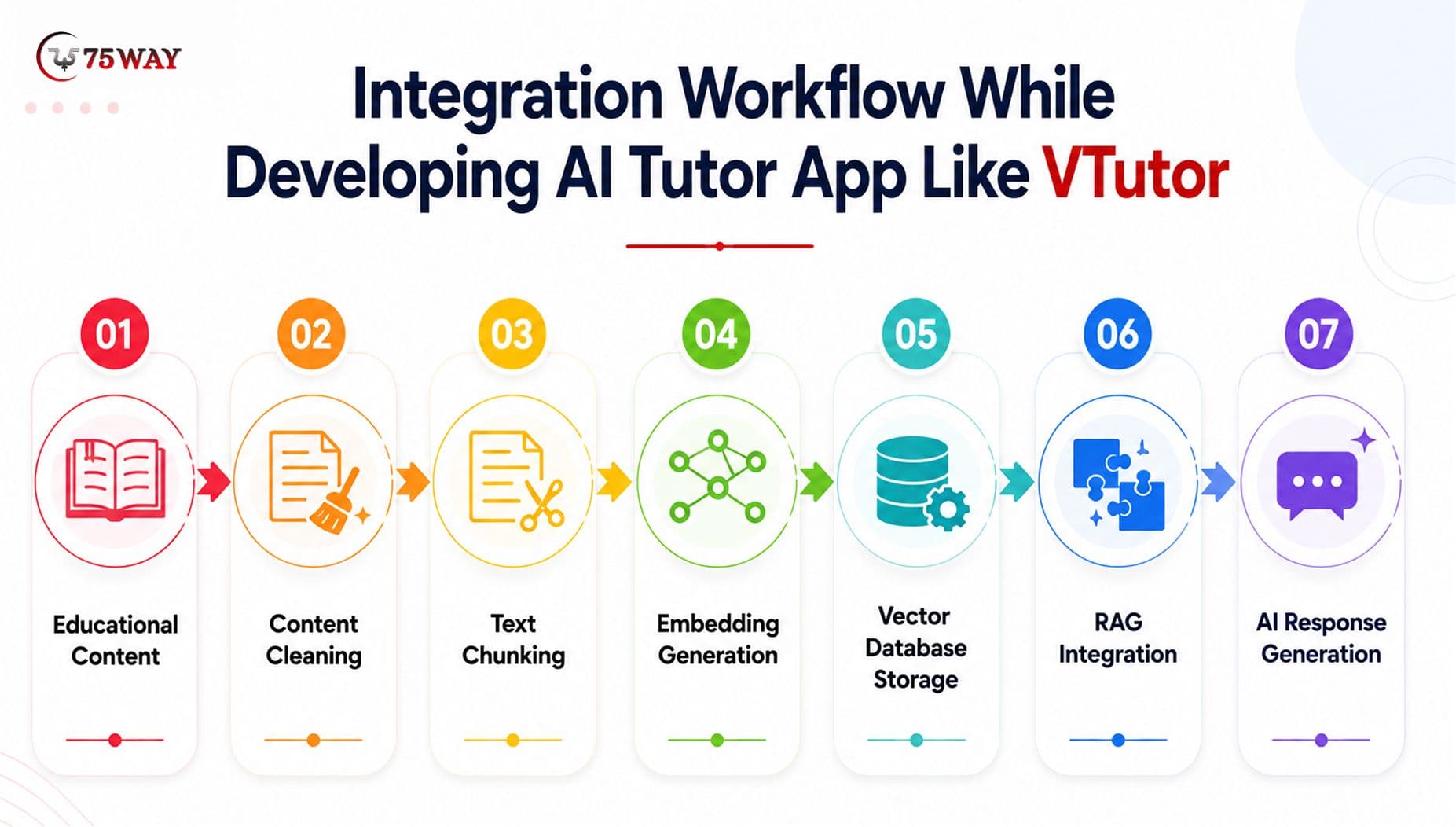
Integration Workflow While Developing AI Tutor App Like VTutor
- Educational Content: Gather trusted textbooks, lecture notes, assessments, institutional documents, and learning resources aligned with curriculum objectives and academic standards.
- Content Cleaning: Remove duplicate information, outdated materials, formatting inconsistencies, and irrelevant data before preparing educational resources for AI processing.
- Text Chunking: Divide lengthy educational content into smaller, meaningful sections that improve retrieval accuracy and contextual understanding during AI responses.
- Embedding Generation: Convert processed content into numerical vector representations, enabling semantic search based on meaning instead of exact keyword matches.
- Vector Database Storage: Store embeddings within a vector database, allowing rapid retrieval of relevant educational information during learner interactions consistently.
- RAG Integration: Connect the vector database with the language model, retrieving verified content before generating accurate, context-aware educational responses.
- AI Response Generation: Combine retrieved educational knowledge with AI reasoning to deliver personalized, curriculum-aligned answers supporting meaningful learner understanding and progress.
Deliverable: AI tutor capable of generating accurate, curriculum-based educational responses.
Step 6: Platform Development And Feature Implementation
With the AI foundation in place, engineers begin building the complete tutoring ecosystem. Frontend, backend, APIs, authentication, and AI services are developed simultaneously to create a scalable platform supporting every user role.
Core Development Modules
- Student dashboard
- Teacher dashboard
- Admin control panel
- Parent portal
- AI tutoring interface
- Assignment management
- Learning analytics
- Content Management System
- Subscription and payment module
- Notification services
Deliverable: Functional AI tutor platform with integrated learning modules.
Step 7: Security, Compliance And AI Governance
Educational platforms handle sensitive learner information, making security a fundamental development priority. This stage introduces data protection measures, regulatory compliance, AI governance policies, and access controls that safeguard both users and educational content while supporting institutional adoption.
Implementation Areas
- Role-based access control
- End-to-end encryption
- FERPA compliance
- COPPA compliance
- GDPR readiness
- Audit logs
- AI safety policies
- Data backup strategy
Deliverable: Secure AI tutor platform ready for institutional deployment.
Step 8: Testing, AI Validation, And Quality Assurance
Traditional software testing alone cannot verify an AI tutor's educational reliability. Development teams evaluate platform functionality alongside AI response quality, factual accuracy, fairness, and performance to deliver trustworthy learning experiences before production deployment.
Validation Areas
- Functional testing
- Educational accuracy review
- AI hallucination testing
- Prompt injection testing
- Bias detection
- Accessibility testing
- Performance testing
- Cross-browser compatibility
Deliverable: Production-ready platform validated by engineers and educational experts.
Step 9: Deployment And Cloud Infrastructure
Following successful validation, the AI tutor platform is deployed on scalable cloud infrastructure capable of supporting increasing learner activity without compromising performance. Automated deployment pipelines simplify future updates while monitoring tools maintain platform stability.
Deployment Activities
- CI/CD pipeline configuration
- Cloud infrastructure provisioning
- Load balancing
- CDN implementation
- Auto scaling
- API management
- System monitoring
- Disaster recovery planning
Deliverable: Live AI tutor platform with enterprise-grade cloud infrastructure.
Step 10: Continuous Optimization And AI Improvement
Launching the platform marks the beginning of continuous innovation rather than the end of development. User interactions, learning analytics, and educator feedback help refine AI behavior, expand educational content, improve recommendations, and introduce advanced capabilities as learning requirements evolve.
Performance Metrics
- Student engagement
- Lesson completion rate
- AI response accuracy
- Knowledge gap analysis
- Feature adoption
- User retention
- Infrastructure performance
- User feedback
Deliverable: An evolving AI tutor platform that delivers increasingly personalized learning experiences while supporting long-term business growth.
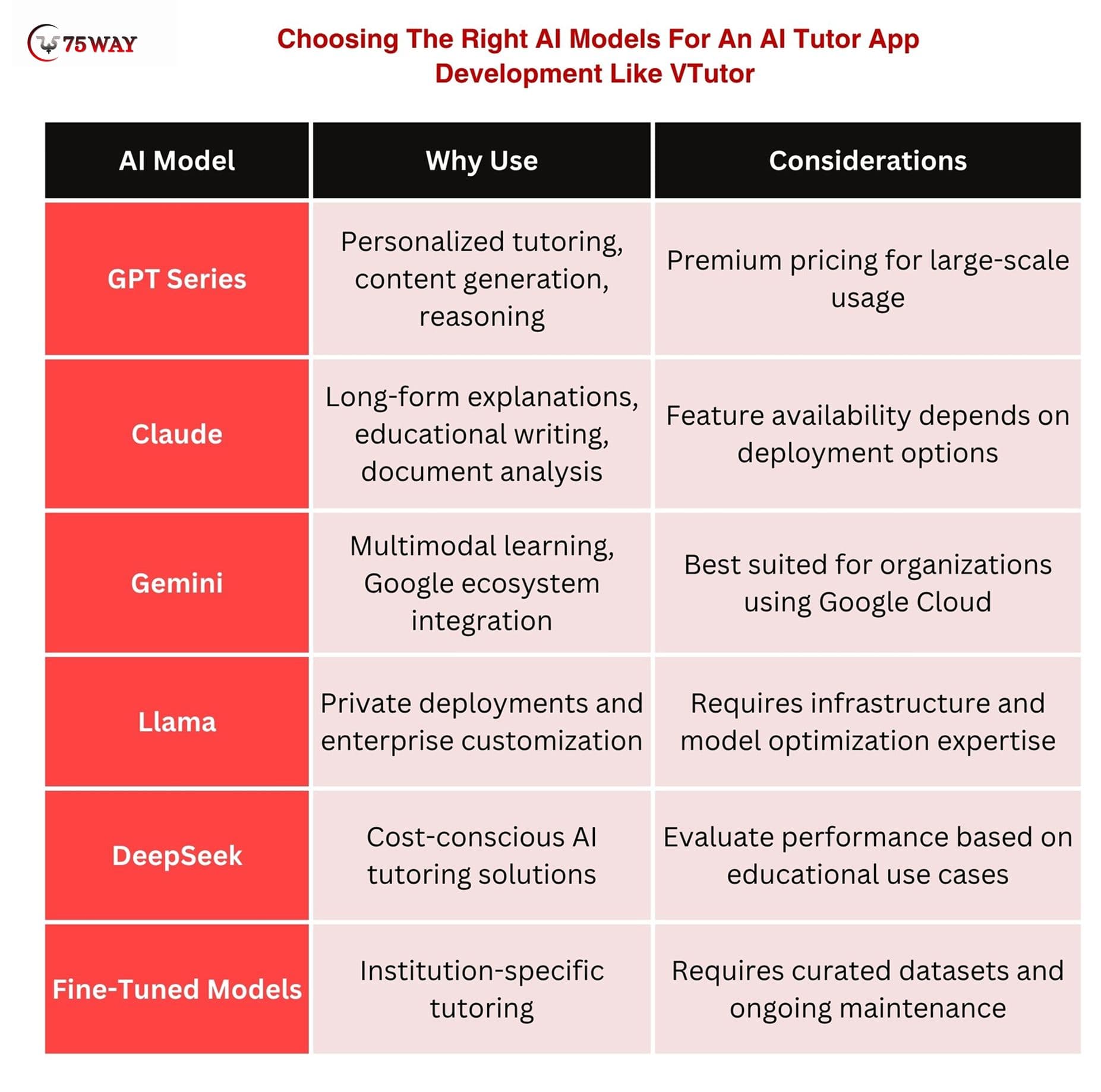
Essential Features To Build VTutor-Style AI Tutor App
Great AI tutor platforms do much more than answer questions. The following features help students learn faster, stay engaged, and receive personalized support throughout their learning journey.
- AI Conversational Tutor
Students often learn better by asking questions naturally instead of searching through lengthy materials. An AI conversational tutor responds instantly with contextual explanations. It adjusts answers based on previous interactions. Complex concepts become easier to understand. Learning feels more like a discussion than a lecture.
- Personalized Learning Paths
Every learner progresses at a different pace and has unique strengths. Personalized learning paths recommend lessons according to performance and interests. Easier or advanced topics appear when appropriate. Students stay motivated without feeling overwhelmed. Each study session becomes more meaningful.
- Homework Assistance
Homework can become frustrating when guidance isn't immediately available. AI provides step-by-step explanations instead of simply displaying answers. Students understand the reasoning behind every solution. This approach encourages independent thinking. Confidence gradually grows with regular practice.
- AI Quiz Generator
Creating fresh assessments manually requires considerable time and effort. An AI quiz generator builds questions from selected topics within seconds. Difficulty levels can match learner abilities. Instant feedback highlights improvement areas. Educators can evaluate knowledge more frequently.
- Smart Lesson Generator
Preparing engaging lessons for different learners is often challenging. AI creates structured lesson plans using educational objectives and available content. Examples and activities can be included automatically. Teachers spend less time preparing materials. More attention goes toward classroom interactions.
- Voice-Based Tutoring
Some learners prefer speaking instead of typing lengthy questions. Voice-based tutoring supports natural conversations through speech recognition and AI responses. Pronunciation guidance becomes easier during language learning. Interactions feel more engaging. Accessibility also improves for many students.
- Interactive Whiteboard
Visual explanations often simplify topics that text alone cannot. An interactive whiteboard allows diagrams, formulas, illustrations, and annotations during learning sessions. For presentation-based lessons, students and educators can also use annotations in PowerPoint to highlight key points, add notes, and mark important information while reviewing slides. Students participate actively while solving problems. Collaboration becomes more enjoyable. Complex ideas appear much clearer.
- Progress Analytics Dashboard
Learning progress becomes valuable when it is easy to measure. Analytics dashboards display performance trends, strengths, weak subjects, and study consistency. Students recognize improvement opportunities quickly. Educators gain meaningful academic insights. Decisions become data-driven instead of being based on assumptions.
- Teacher Dashboard
Teachers need one place to manage learners without unnecessary complexity. A dedicated dashboard organizes classes, assignments, assessments, and student progress. Routine administrative work decreases significantly. Academic monitoring becomes simpler. More time remains available for teaching.
- Student Dashboard
Students benefit from seeing everything related to learning in one location. The dashboard displays upcoming lessons, completed activities, achievements, and personalized recommendations. Navigation stays simple throughout the platform. Progress remains visible. Daily learning becomes more organized.
- Admin Control Panel
Managing a growing educational platform requires centralized administration. The admin panel controls users, permissions, courses, subscriptions, reports, and platform settings. Operational tasks become easier to supervise. Security controls remain accessible. Daily management requires less manual effort.
- Content Management System
Educational content changes regularly as courses continue evolving. A content management system helps administrators update lessons, videos, quizzes, documents, and learning resources effortlessly. Information stays organized. Publishing becomes faster. Learners always receive updated educational materials.
- Multi-language Support
Learning becomes more inclusive when students can study in their preferred language. Multi-language support translates interfaces and educational content naturally. Global audiences feel more comfortable using the platform. Accessibility improves across regions. International expansion becomes easier.
- Live Classroom Integration
Some learning experiences still benefit from real-time instructor interaction. Live classroom integration combines virtual sessions with AI-powered assistance inside one platform. Students move seamlessly between live teaching and self-learning. Collaboration remains uninterrupted. Digital classrooms become more connected.
- Retrieval-Augmented Generation (RAG)
Accurate educational responses depend on trustworthy information sources. RAG connects AI models with approved documents, textbooks, and institutional knowledge bases. Answers stay grounded in verified content. Hallucinated responses become less frequent. Students receive more reliable guidance.
- Gamification Module
Learning feels more enjoyable when achievements are recognized regularly. Gamification introduces points, badges, leaderboards, and rewards for completed activities. Students participate more consistently over time. Healthy competition encourages progress. Motivation remains strong throughout learning journeys.
- Parent Portal
Parents appreciate understanding their child's academic development without waiting for formal reports. A parent portal provides attendance, progress updates, assignment status, and performance summaries. Some portals also add a cumulative GPA calculator view so families can follow their child’s overall progress across semesters. Communication improves naturally. Families stay informed. Student support becomes a collaborative effort.
- AI Assignment Evaluation
Reviewing assignments manually often consumes valuable teaching hours. AI evaluates submissions using predefined academic criteria and provides constructive feedback. Students receive quicker responses after completing work. Teachers save considerable time. Assessment becomes more consistent across submissions.
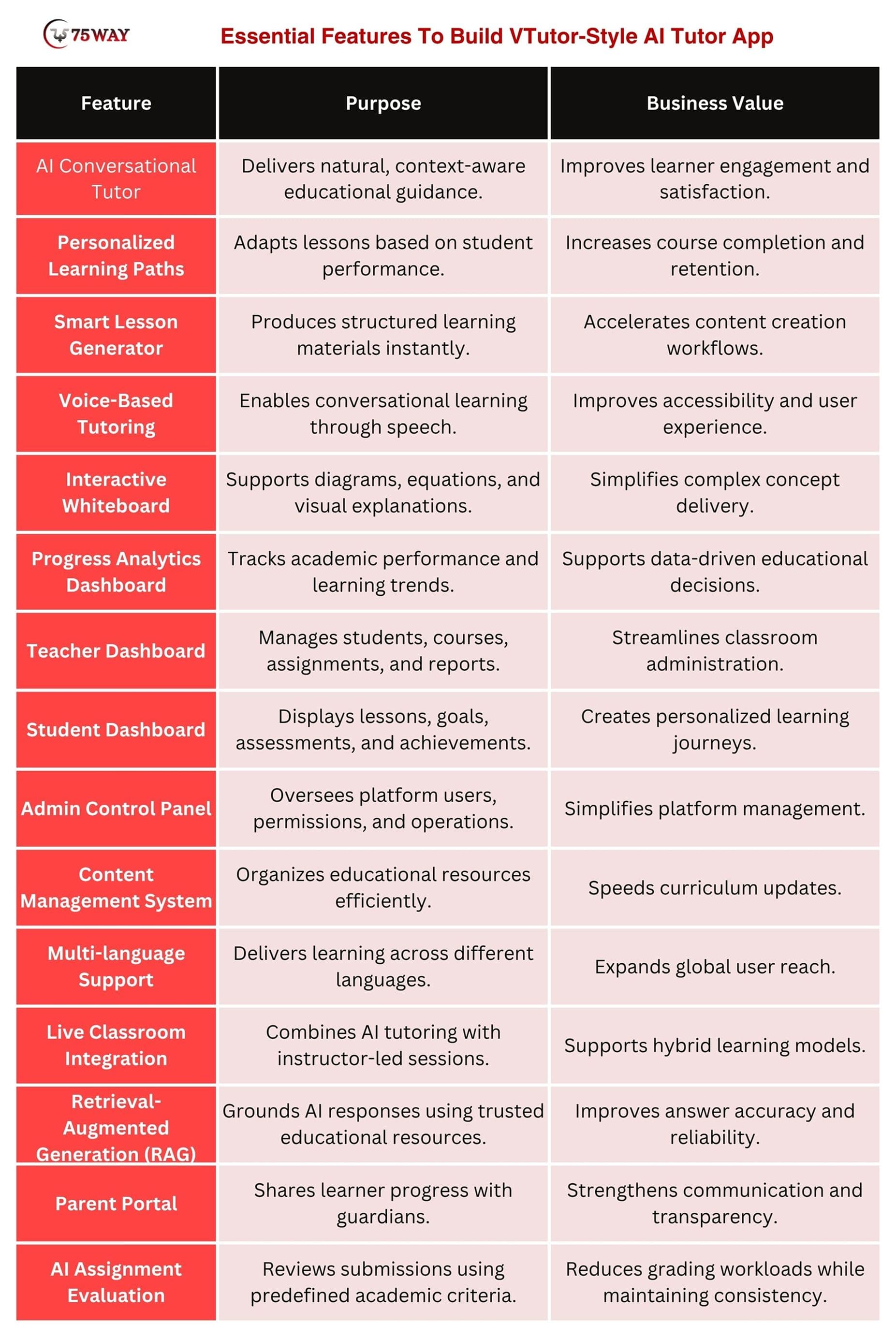
Choosing The Right AI Models For An AI Tutor App Development Like VTutor
The intelligence of an AI tutor depends on more than a single large language model (LLM). Different models excel at different tasks, such as explaining concepts, generating quizzes, supporting multilingual conversations, or processing voice and images. Selecting the right combination directly affects learning quality, infrastructure costs, and future scalability.
Rather than relying on one model for every interaction, many organizations adopt a multi-model strategy that routes requests based on complexity, subject, response speed, and budget.
- GPT Series: Delivers natural conversations, personalized tutoring, content generation, reasoning, and multilingual educational assistance across learning scenarios.
- Claude: Excels at long-context understanding, detailed explanations, document analysis, and safe educational conversations with learners.
- Gemini: Supports multimodal learning through text, images, videos, and interactive educational experiences within integrated ecosystems.
- Llama: Open-source language model offering flexible customization, private deployment, and cost-efficient AI tutor development for enterprises.
- DeepSeek: Provides strong reasoning capabilities and affordable AI performance suitable for scalable educational platforms and tutoring applications.
- Fine-Tuned Models: Customized AI models trained on domain-specific educational data for highly accurate, curriculum-aligned tutoring experiences.
Selecting Models Based On Learning Objectives
Different educational scenarios require different AI capabilities. For example:
- K–12 Learning: Personalized explanations, adaptive quizzes, and conversational guidance.
- Higher Education: Research assistance, complex reasoning, citation support, and technical problem-solving.
- Corporate Training: Compliance education, role-based learning, and knowledge retrieval from internal documentation.
- Professional Certification: Practice exams, progress tracking, and adaptive revision strategies.
A balanced AI architecture often combines a powerful LLM with retrieval systems, moderation layers, and analytics services to deliver reliable educational experiences while controlling operational costs.
RAG Vs. Fine-Tuning: Which Approach Works Better For Creating AI Tutor Platforms?
One of the biggest architectural decisions during AI tutor development is choosing between Retrieval-Augmented Generation (RAG) and fine-tuning. While both improve AI performance, they solve different problems and are often used together rather than treated as competing approaches.
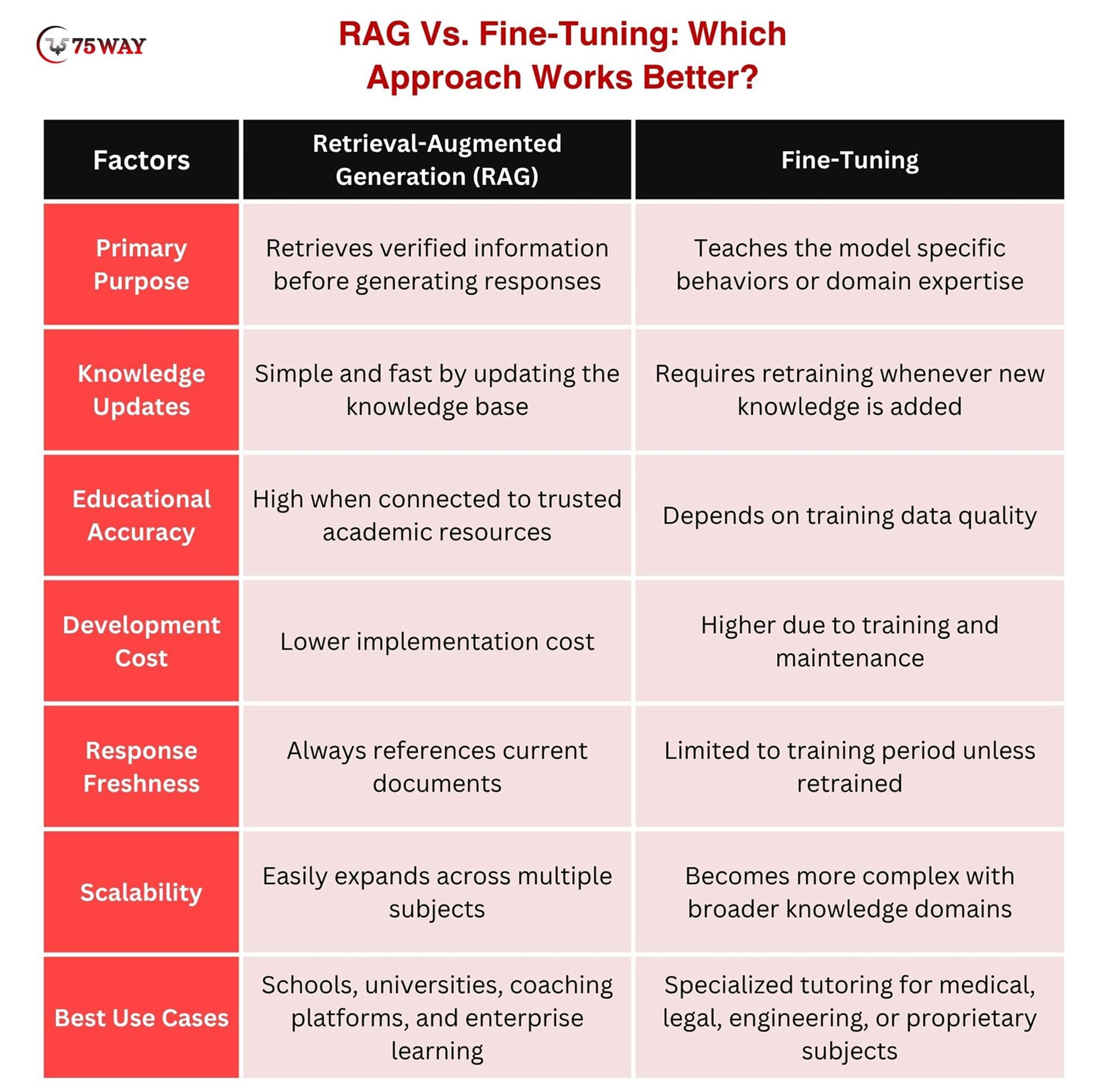
RAG is ideal when the platform needs to deliver responses based on frequently updated educational resources such as textbooks, lecture notes, institutional policies, or certification materials. Instead of relying only on the model's training data, it retrieves relevant information from trusted sources before generating answers, reducing hallucinations and improving reliability.
On the other hand, fine-tuning becomes valuable when an institution wants the AI tutor to adopt a specific teaching style, understand proprietary terminology, or support highly specialized academic disciplines. It shapes the model's behavior rather than continuously updating factual knowledge.
Best Practice For 2026
Most enterprise-grade AI tutor platforms combine RAG for factual accuracy with lightweight fine-tuning for teaching style and domain adaptation. This hybrid architecture offers better scalability, lower maintenance costs, and more dependable educational responses than relying on either approach alone.
Recommended Tech Stack For Building An AI Tutor Platform Similar To VTutor
A scalable AI tutor platform requires technologies that support real-time conversations, secure data management, intelligent search, cloud scalability, and seamless integrations. The following stack reflects commonly adopted technologies for modern AI-powered education platforms in 2026.
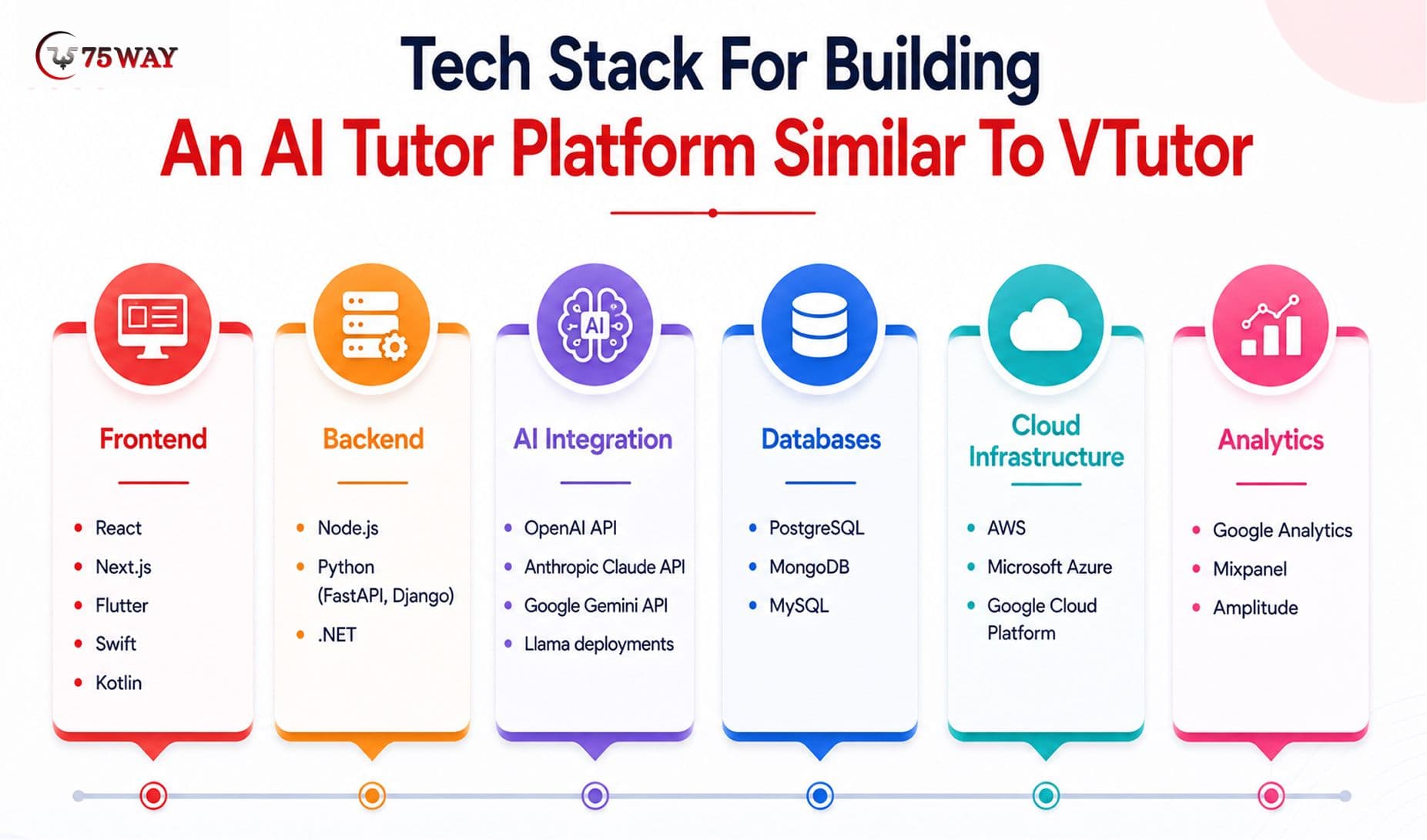
1. Frontend: Build responsive, user-friendly web and mobile interfaces with excellent performance and native-like experiences.
- Technologies: React, Next.js, Flutter, Swift, Kotlin
2. Backend: Manage business logic, APIs, user authentication, AI workflows, and large-scale application operations with reliable performance.
- Technologies: Node.js, Python (FastAPI, Django), .NET
3. AI Integration: Enable conversational tutoring, personalized learning, intelligent content generation, and contextual educational assistance through advanced language models.
- Technologies: OpenAI API, Anthropic Claude API, Google Gemini API, Llama Deployments
4. Databases: Store learner profiles, academic records, course content, assessments, and application data with high reliability.
- Technologies: PostgreSQL, MongoDB, MySQL
5. Vector Database: Power semantic search and Retrieval-Augmented Generation for accurate, context-aware educational responses from trusted learning resources.
- Technologies: Pinecone, Weaviate, Milvus, Chroma
6. Search Engine: Help learners quickly discover relevant courses, lessons, documents, and educational materials using intelligent search capabilities.
- Technologies: Elasticsearch, OpenSearch
7. Cloud Infrastructure: Deliver scalable hosting, high availability, automatic resource scaling, and dependable platform performance across global regions.
- Technologies: AWS, Microsoft Azure, Google Cloud Platform
8. Authentication: Protect user accounts through secure sign-in, role-based permissions, and identity management across all platform users.
- Technologies: OAuth 2.0, Firebase Authentication, Auth0
9. Real-Time Communication: Enable live classes, instant messaging, collaborative learning, and seamless interactions between educators, learners, and AI tutors.
- Technologies: WebRTC, Socket.IO
10. Voice AI: Support speech recognition and natural voice conversations for interactive, hands-free learning experiences across different educational environments.
- Technologies: Whisper, Google Speech-to-Text, Azure Speech Services
11. Payments: Process subscriptions, institutional licensing, one-time purchases, and recurring transactions through secure payment gateways.
- Technologies: Stripe, PayPal
12. Notifications: Keep learners informed through instant reminders, assignment alerts, emails, SMS updates, and important platform announcements.
- Technologies: Firebase Cloud Messaging, Twilio, SendGrid
13. Analytics: Measure learner engagement, feature adoption, academic progress, and business performance using comprehensive data-driven reporting tools.
- Technologies: Google Analytics, Mixpanel, Amplitude
14. DevOps: Automate application deployment, infrastructure management, testing, and continuous delivery for faster software releases and updates.
- Technologies: Docker, Kubernetes, GitHub Actions, Jenkins
15. Monitoring: Continuously track application performance, AI services, server health, and system reliability to identify issues proactively.
- Technologies: Grafana, Prometheus, Datadog
16. Security: Protect educational data with encryption, secure communication, role-based access, and strong identity verification across the platform.
- Technologies: SSL/TLS, AES-256 Encryption, Role-Based Access Control (RBAC), Multi-Factor Authentication
AI Tutor Platform Architecture: A Scalable Workflow
Behind every successful AI tutor platform is an architecture designed to deliver accurate responses, maintain low latency, protect student data, and support thousands of simultaneous learning sessions. Rather than sending every user query directly to a large language model (LLM), modern platforms process requests through multiple intelligent layers that validate context, retrieve trusted information, and monitor AI outputs.
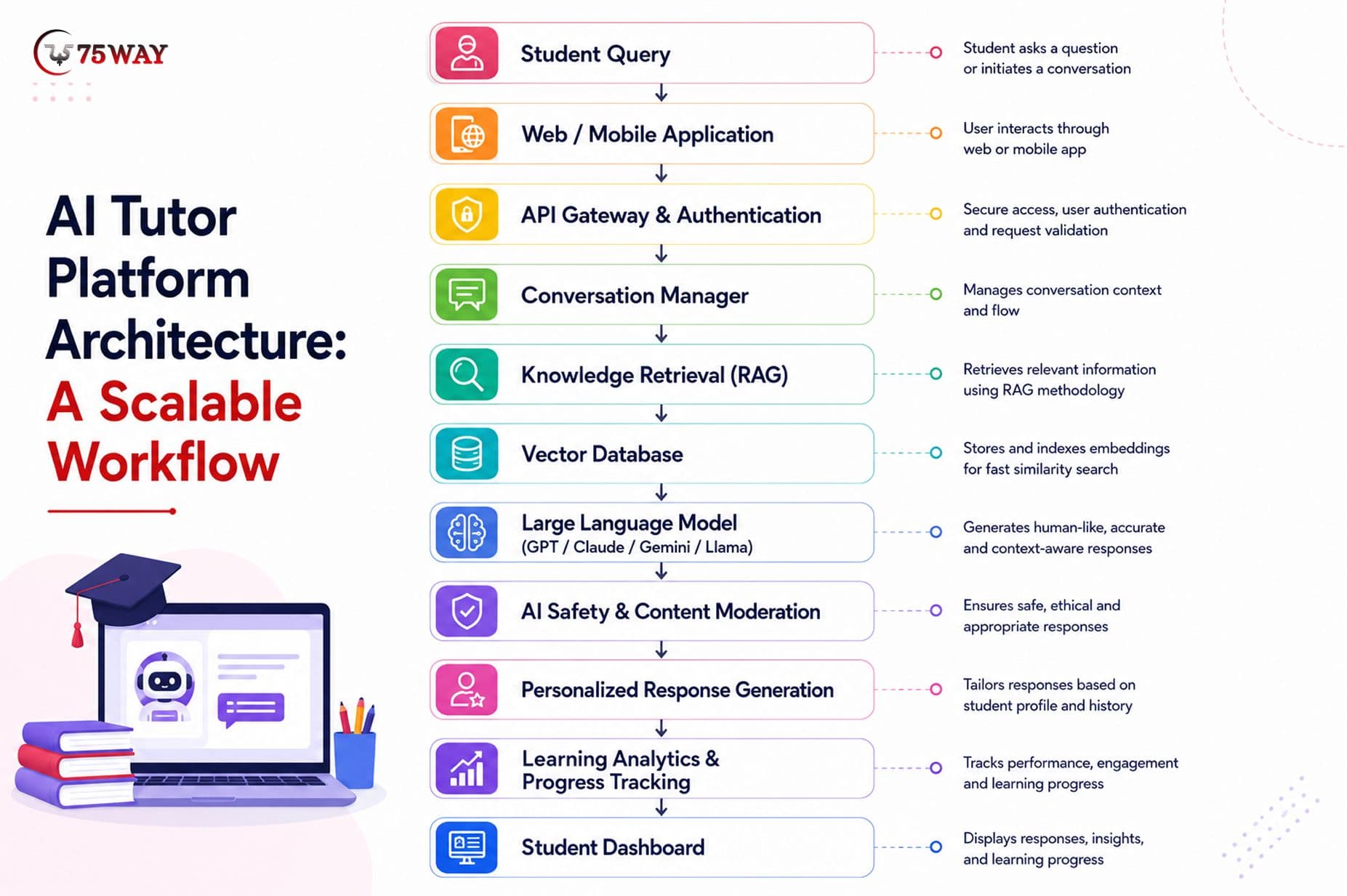
Each layer serves a specific purpose. Authentication protects user accounts. The conversation manager maintains context across sessions, RAG retrieves verified educational resources, the LLM generates responses, and safety filters screen outputs before learners receive them. Analytics continuously capture engagement metrics, helping educators refine learning experiences and identify improvement opportunities.
This modular architecture also makes future upgrades easier. Organizations can adopt newer AI models, expand subject coverage, or introduce additional learning tools without redesigning the entire platform.
What’s VTutor-Style AI Tutor Platform Development Cost In 2026?
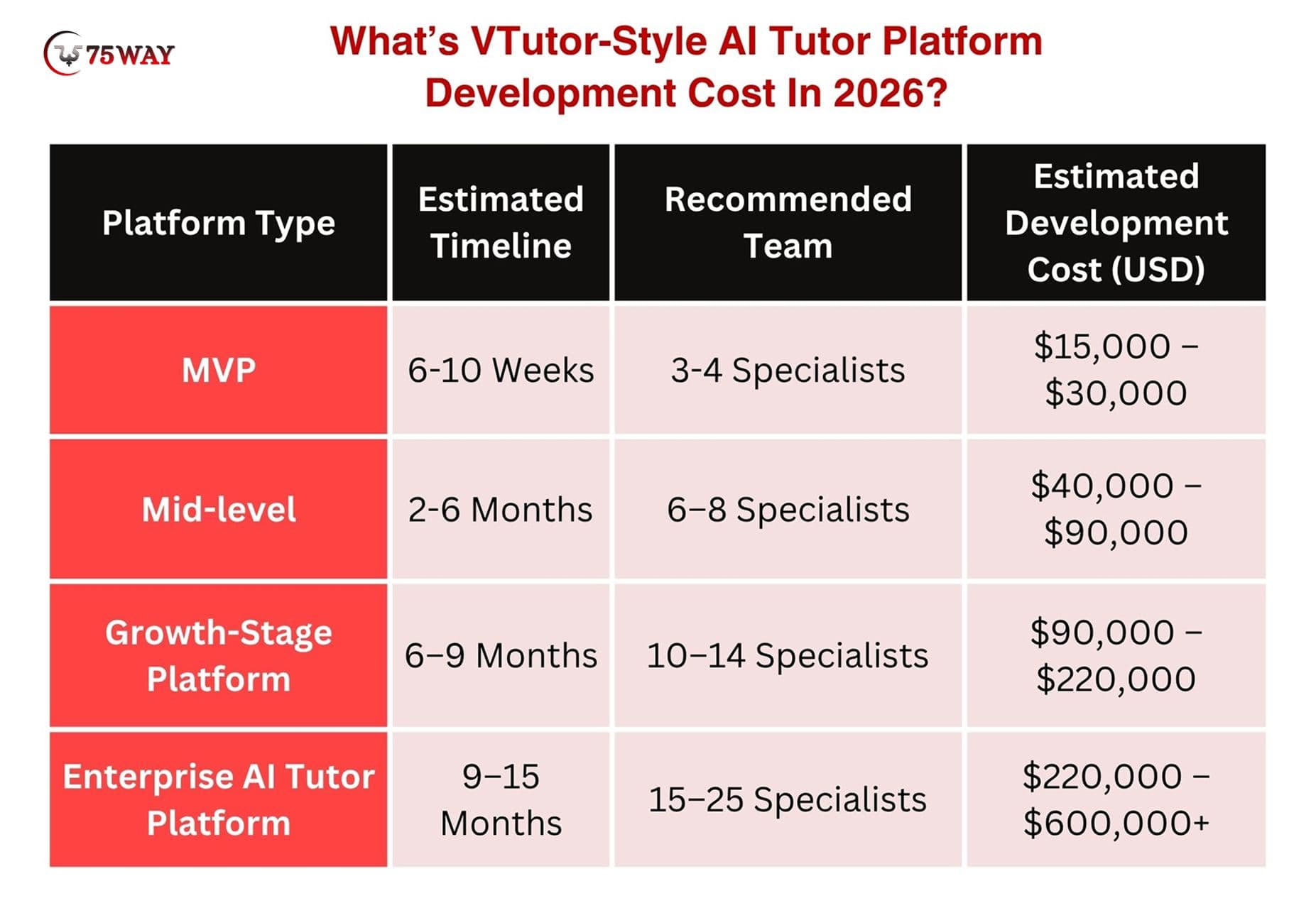
Development costs vary based on platform complexity, AI capabilities, supported devices, integrations, compliance requirements, and infrastructure choices. A simple MVP differs significantly from an enterprise-grade solution serving multiple institutions. The estimates below represent typical investment ranges for custom AI tutor platform development in 2026.
MVP AI Tutor Platform
Timeline: 6–10 Weeks
Team Size: 3–4 Specialists
Estimated Cost:$15,000–$30,000
An MVP covers the essential features needed to launch an AI tutor quickly. It usually includes AI chat, student login, basic dashboards, lesson management, and progress tracking. This option is ideal for validating your idea before making a larger investment.
Mid-Level AI Tutor Platform
Timeline: 2–6 Months
Team Size: 6–8 Specialists
Estimated Cost:$40,000–$90,000
This version offers a richer learning experience with adaptive learning, AI quizzes, teacher and admin dashboards, multilingual support, analytics, and RAG-powered responses. It's a great choice for growing EdTech startups and educational institutions.
Growth-Stage AI Tutor Platform
Timeline: 6–9 Months
Team Size: 10–14 Specialists
Estimated Cost:$90,000–$220,000
Built for expanding businesses, this platform includes voice tutoring, live classes, parent portals, advanced analytics, stronger security, and cloud scalability. It supports thousands of learners while delivering a personalized learning experience.
Enterprise AI Tutor Platform
Timeline: 9–15 Months
Team Size: 15–25 Specialists
Estimated Cost:$220,000–$600,000+
Enterprise platforms are designed for universities and large organizations with complex requirements. They include custom AI capabilities, enterprise integrations, regulatory compliance, advanced reporting, and infrastructure built to support large-scale learning environments.
No-Code Or Template-Based AI Tutor
Estimated Cost: $500–$10,000/year
This approach is suitable for businesses that need a simple AI-powered tutor without custom development. It works well for document-based question-answering, internal training assistants, or basic educational chatbots. However, customization, branding, and advanced learning capabilities remain limited.
Note: Ongoing AI usage costs, cloud infrastructure, third-party APIs, maintenance, and feature enhancements are separate from initial development expenses.
Factors Affecting the Development Cost of VTutor-Like AI Tutor Application
- Educational Content Preparation
Structuring, cleaning, organizing, and labeling proprietary curriculum content for AI training and knowledge retrieval typically add $10,000–$70,000, depending on the content volume and complexity.
- Development Team Location
Development costs vary significantly by region. Agencies in North America generally charge $120–$250 per hour, while experienced development teams in Eastern Europe and offshore locations typically charge between $22–$70 per hour.
- AI Model Selection
Premium language models typically deliver stronger reasoning and educational conversations but increase operational expenses. Open-weight models may reduce long-term costs while requiring additional infrastructure and optimization.
- Feature Complexity
Voice tutoring, multilingual support, adaptive learning, AI-generated assessments, collaborative classrooms, and analytics dashboards increase both development time and project investment.
- Platform Availability
Developing separate Android, iOS, and web applications requires additional engineering effort compared to launching a single platform initially.
- Knowledge Base Size
Large educational repositories demand scalable vector databases, advanced search capabilities, and optimized retrieval pipelines to maintain response quality.
- Compliance Requirements
Educational platforms serving schools or children often require FERPA, COPPA, GDPR, or regional privacy compliance, adding security implementation and audit efforts.
- Third-Party Integrations
Connecting payment gateways, learning management systems (LMS), video conferencing tools, CRM software, authentication providers, and analytics platforms influences overall development scope.
Major Challenges In AI Tutor Platform Development
Building an AI tutor involves balancing educational quality, technical performance, and regulatory compliance. Addressing these challenges early reduces operational risks after launch.
1. Reducing AI Hallucinations
Educational responses should be grounded in trusted academic sources rather than relying solely on model-generated knowledge. Retrieval-Augmented Generation (RAG), content validation, and expert-reviewed knowledge bases significantly improve reliability.
2. Protecting Student Privacy
AI tutor platforms process sensitive learner information, making encryption, role-based permissions, secure authentication, and regulatory compliance fundamental architectural requirements.
3. Maintaining Academic Integrity
The platform should encourage learning instead of completing assignments on behalf of students. Features such as guided explanations, step-by-step reasoning, and plagiarism prevention support responsible educational use.
4. Supporting Large User Volumes
Enrollment spikes during examination periods can create heavy workloads. Scalable cloud infrastructure, load balancing, caching, and optimized AI inference help maintain consistent performance.
5. Managing AI Operational Costs
Large language models generate ongoing inference expenses. Intelligent prompt optimization, response caching, hybrid AI architectures, and model routing strategies help control long-term operating costs.
6. Improving Response Speed
Students expect immediate assistance. Optimized APIs, efficient retrieval pipelines, and low-latency AI services contribute to smooth conversational experiences.
7. Addressing Bias And Content Safety
Educational AI should provide balanced, age-appropriate, and respectful responses. Continuous testing, moderation systems, and human oversight reduce harmful or misleading outputs while improving overall learning quality.
Monetization Models To Generate Profit From VTutor-Like AI Tutor Platform Development
No matter how advanced your AI tutor is, a strong revenue model determines its long-term success. Instead of relying on a single income stream, successful EdTech businesses often combine multiple monetization models to serve different customer segments. Here are the most popular ways AI tutor platforms generate income and scale their business.
- Subscription Plans
Generate recurring revenue by offering monthly or annual memberships that unlock premium tutoring features, personalized study plans, advanced analytics, and exclusive learning resources. This model creates predictable income while encouraging long-term learner engagement.
Example: Students pay $19/month for unlimited AI tutoring and personalized learning.
- Institution Licensing
Provide schools, universities, coaching institutes, and training centers with organization-wide platform access through annual or multi-year licensing agreements. Institutions receive centralized management, while your business benefits from high-value, long-term contracts.
Example: A university licenses the platform for 5,000 students under one annual agreement.
- Freemium Model
Attract a larger user base by offering essential learning tools for free while reserving advanced AI tutoring, personalized recommendations, premium courses, and detailed progress insights for paid subscribers.
Example: Free users receive 10 AI questions daily, while premium members enjoy unlimited access.
- Pay-Per-Session
Allow learners to purchase tutoring sessions or AI credits only when needed. This flexible pricing model appeals to occasional users who prefer paying for individual learning experiences instead of ongoing subscriptions.
Example: Charge $2–$5 for every AI tutoring session or lesson completed.
- White-Label Licensing
License your AI tutor platform to businesses that want to launch under their own brand. Partners gain a ready-to-market solution, while you expand revenue without building separate products for every client.
Example: A coaching company launches the platform using its own logo, domain, and branding.
- API Monetization
Offer AI tutoring capabilities as APIs that developers and educational platforms can integrate into their own applications. Every API request creates an additional revenue stream while expanding your platform's market reach.
Example: An LMS integrates your AI homework assistant through paid API access.
- Corporate Training Plans
Deliver customized AI-powered learning solutions for businesses covering employee onboarding, compliance training, leadership development, and upskilling. Organizations benefit from personalized learning, while your platform secures recurring enterprise contracts.
Example: A multinational company uses the platform to train new employees across multiple countries.
- Marketplace Revenue
Create a marketplace where educators publish courses, practice tests, and study materials. Learners access diverse educational content, while the platform earns commissions from every successful purchase or subscription.
Example: A math instructor sells premium practice exams, and the platform earns a percentage from each sale.
Future Trends Shaping AI Tutor Platforms Beyond 2026
AI tutoring continues to evolve from conversational assistance into intelligent learning ecosystems capable of understanding learner behavior, adapting teaching methods, and supporting multimodal education. Organizations planning long-term investments should consider these emerging trends.
- Agentic AI Tutors: Next-generation tutors will complete multi-step educational tasks independently, such as generating study plans, scheduling revision sessions, recommending resources, and tracking learner progress with minimal manual input.
- Multimodal Learning Experiences: Students will interact with AI using text, voice, images, handwritten notes, mathematical equations, videos, and diagrams within a unified learning environment.
- AI Voice Teachers: Natural, human-like voice interactions will make tutoring more conversational, improving accessibility for younger learners, language students, and visually impaired users.
- Persistent Learning Memory: Future AI tutors will securely retain each learner's progress, preferred study methods, completed lessons, and recurring challenges. This long-term context enables personalized recommendations and more meaningful academic support without requiring students to repeat information during every learning session.
- Real-Time Language Translation: Multilingual AI tutors will deliver explanations, quizzes, and conversations in multiple languages while preserving educational accuracy. This capability helps institutions reach international learners and makes quality education accessible across diverse linguistic communities.
- Emotion-Aware Learning: Advances in AI will enable tutoring platforms to detect signs of confusion, frustration, or confidence through conversational patterns, voice cues, and interaction behavior. The platform can then adjust explanations, pacing, or question difficulty to better support each learner.
- AI-Powered Learning Analytics: Educational institutions will increasingly rely on predictive analytics to identify struggling students, measure engagement, forecast academic performance, and evaluate curriculum effectiveness using real-time learning data.
- AR And VR Integration: Immersive technologies will allow students to explore virtual laboratories, historical landmarks, engineering simulations, and medical procedures while receiving contextual guidance from AI tutors, creating highly interactive learning experiences.
Why Partner With 75Way Technologies For AI Tutor Platform Development?
Building an AI tutor platform requires expertise across artificial intelligence, scalable software architecture, cloud infrastructure, mobile applications, and educational technology. Choosing an experienced AI development partner reduces technical risks while accelerating time to market.
At 75way Technologies, we help startups, educational institutions, and enterprises transform innovative learning ideas into production-ready AI platforms designed for long-term growth.
Our development approach includes:
- AI-first product strategy aligned with business objectives
- Custom AI tutor platform development tailored to educational use cases
- Secure cloud-native architecture supporting future scalability
- Integration of advanced LLMs, Retrieval-Augmented Generation (RAG), and multimodal AI capabilities
- Cross-platform web and mobile application development
- Enterprise-grade security, privacy, and regulatory compliance
- Continuous optimization, maintenance, and feature enhancements after launch
Whether you're creating an AI homework assistant, corporate learning platform, exam preparation solution, or virtual teaching ecosystem, our team delivers technology solutions built around measurable educational outcomes and sustainable business growth.
Final Thoughts
To summarize, a successful AI tutor platform like VTutor requires more than integrating a language model. It demands a clear product strategy, trusted educational content, scalable architecture, robust security, and continuous AI improvements. By combining adaptive learning, retrieval-augmented generation (RAG), intuitive user experiences, and reliable cloud infrastructure, businesses can create engaging learning ecosystems that serve students, educators, and institutions alike. As demand for AI-driven education continues to grow in 2026, investing in a thoughtfully designed AI tutor platform offers a strong opportunity to innovate, expand, and lead the future of digital learning. To launch your AI tutor platform, you can partner with a trusted AI-powered educational software development company that transforms your vision into a scalable, market-ready learning solution.
Frequently Asked Questions (FAQs)
Can AI Tutor Platforms Support Multiple Educational Boards Simultaneously?
Yes. A well-designed AI tutor platform can organize content for different educational boards, certification programs, and curricula using separate knowledge repositories. This enables students to receive accurate guidance aligned with their selected syllabus while allowing institutions to manage diverse learning programs from a single platform.
Can An AI Tutor Platform Operate Without Internet Connectivity?
Most AI tutor platforms require internet access because AI processing, cloud storage, and knowledge retrieval occur on remote servers. However, selected learning materials, downloaded lessons, quizzes, and previously synchronized content can be made available offline through mobile applications for uninterrupted study sessions.
Can Educational Institutions Customize AI Tutors For Different Subjects?
Absolutely. AI tutors can be configured with subject-specific knowledge bases, teaching styles, grading standards, and terminology. This customization enables institutions to create dedicated tutors for mathematics, science, medicine, law, engineering, languages, and many other academic disciplines without developing separate platforms.
Which Integrations Add More Value To AI Tutor Platforms?
Common integrations include Learning Management Systems (LMS), video conferencing platforms, payment gateways, student information systems, CRM software, cloud storage, authentication providers, calendar applications, and communication tools. These integrations streamline administration while creating a connected learning environment for students, educators, and administrators.
Can AI Tutor Platforms Support Learners With Disabilities?
Yes. Accessibility features such as voice interaction, screen reader compatibility, text-to-speech, speech-to-text, adjustable font sizes, multilingual support, and keyboard navigation help create inclusive learning experiences that accommodate diverse learner needs while complying with modern accessibility standards.
How Frequently Should Educational Knowledge Bases Be Updated?
Knowledge bases should be reviewed whenever curricula, regulations, certification requirements, or educational resources change. Regular updates help maintain accurate AI responses, minimize outdated information, and improve learner confidence. Automated synchronization with approved content repositories further simplifies ongoing maintenance and content management.
Can AI Tutor Platforms Measure Student Engagement Beyond Test Scores?
Yes. Modern AI tutor platforms analyze session duration, learning frequency, concept mastery, question patterns, interaction quality, content completion, revision habits, and participation trends.
Is White-Label AI Tutor Development Suitable For EdTech Startups?
White-label development provides a faster path to market by reducing foundational engineering work while allowing businesses to customize branding, features, user experiences, and integrations. Startups can validate their ideas more quickly, lower their initial investment, and scale the platform as customer demand increases.