Summary
EV Connect-like app development process builds an enterprise EV charging management system that enables businesses to control charging stations, fleets, energy usage, and billing operations. These solutions integrate IoT, cloud computing, OCPP protocols, and analytics to optimize charging efficiency, reduce operational costs, and support scalable electric vehicle infrastructure for commercial and fleet-focused environments.
Quick Overview
- EV Connect platforms focus on enterprise and fleet charging management systems.
- OCPP integration ensures seamless communication between chargers and backend systems.
- The cost for building EV Connect-like app is $40,000 – $500,000+
- Smart energy management reduces operational costs and grid dependency.
- Cloud-based architecture enables scalable charging network control.
- Fleet dashboards improve monitoring and charging optimization for businesses.
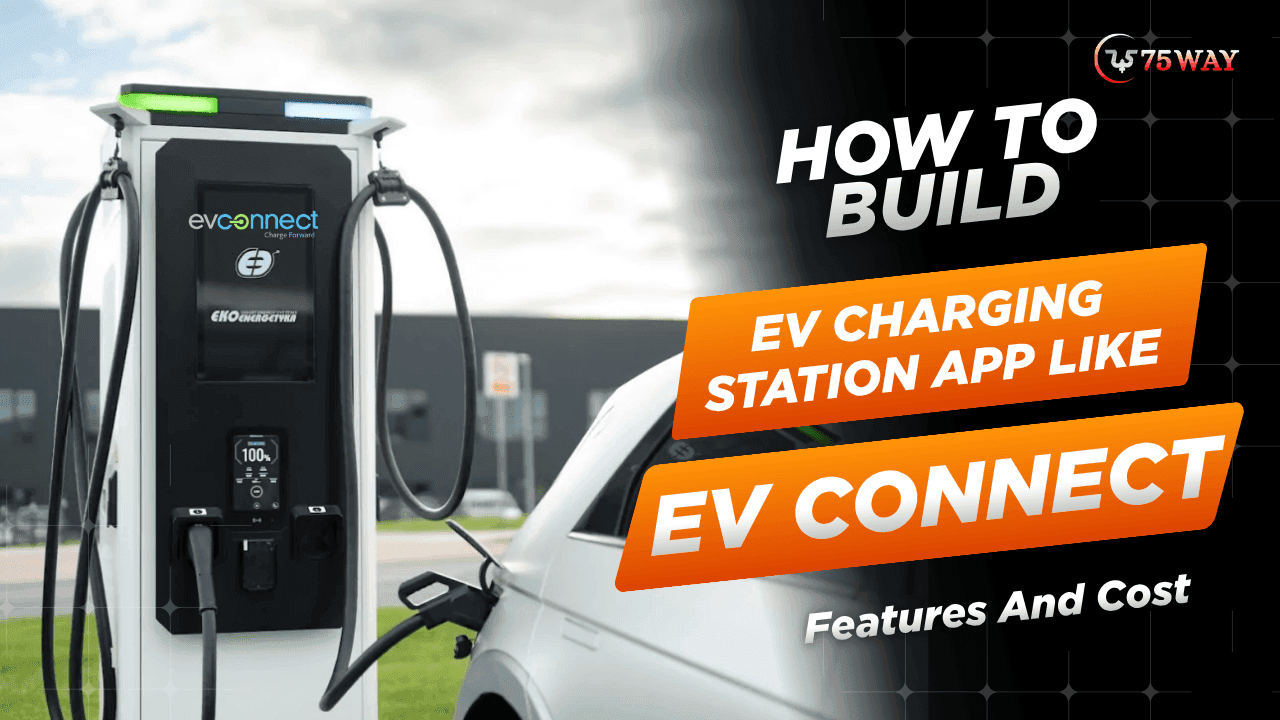
As electric vehicle adoption continues accelerating, businesses are increasingly shifting toward centralized EV charging management systems rather than standalone charging apps. EV Connect represents this enterprise-focused model by offering a platform that allows organizations, fleet operators, and commercial property owners to manage EV charging infrastructure efficiently through a unified software system.
With the rapid expansion of electric fleets, workplace charging, logistics electrification, and commercial EV adoption, demand for enterprise-grade EV charging platforms is increasing significantly. These platforms rely heavily on IoT connectivity, OCPP protocols, cloud computing, predictive analytics, and energy management systems to ensure efficiency and scalability.
This guide explains how to build an EV charging station app like EV Connect in 2026, covering essential features, enterprise architecture, technology stack, monetization models, development strategy, and cost breakdown.
What Is An EV Connect-Like App?
An EV Connect-like platform is a centralized enterprise EV charging management system designed to help organizations control, monitor, and optimize large-scale charging infrastructure. Unlike consumer-facing apps, it focuses on backend operations, enabling businesses, fleet operators, and utilities to manage multiple charging stations through a single unified dashboard. These platforms streamline energy distribution, automate billing, track usage data, and ensure real-time visibility into charging performance across different locations and networks.
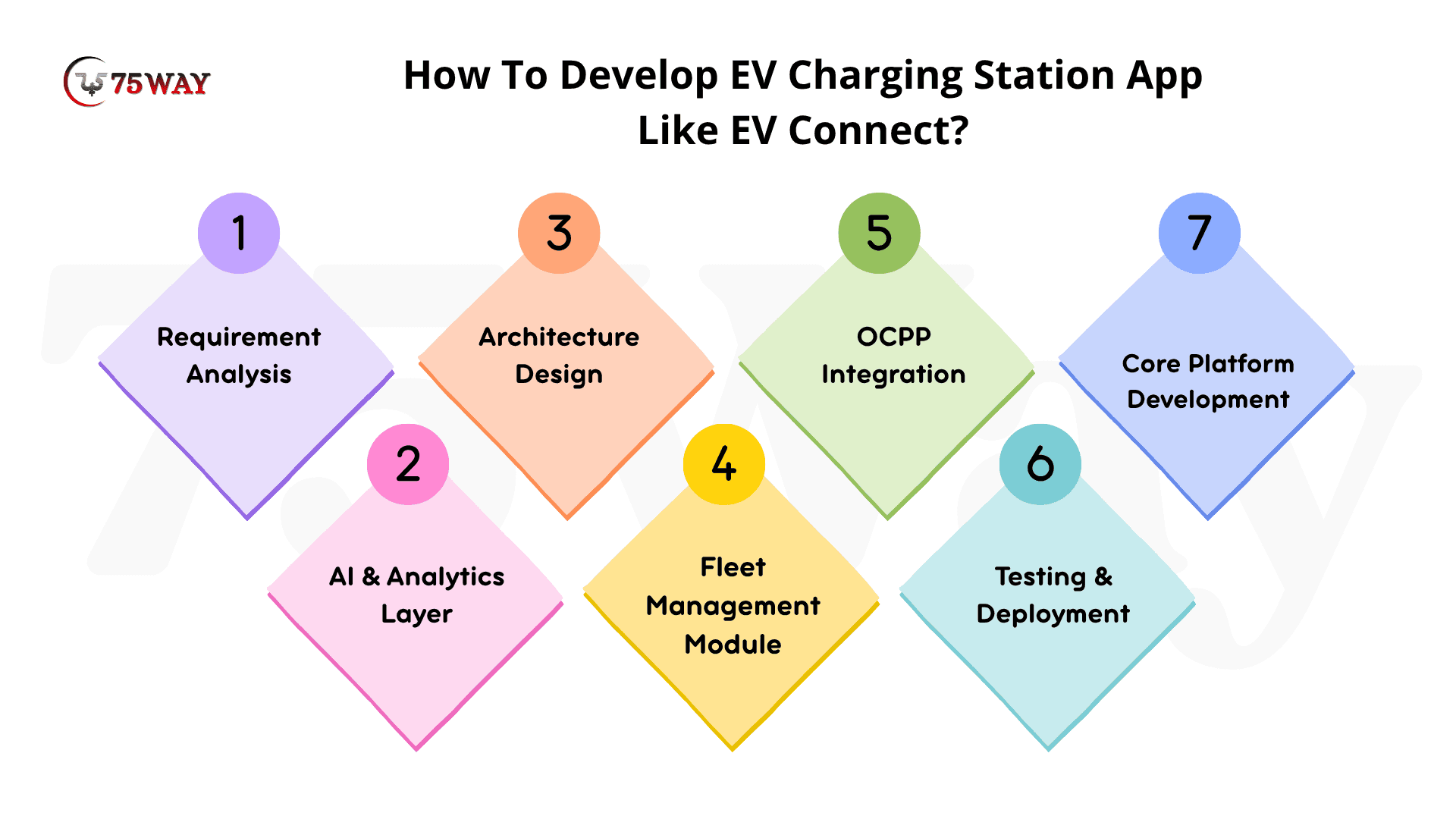
How To Develop EV Charging Station App Like EV Connect?
An EV Connect-like enterprise charging app development process requires a structured approach. It combines requirement planning, scalable architecture, hardware integration, and intelligent analytics. Each stage ensures seamless coordination between charging stations, cloud systems, fleet operations, and energy networks to deliver a reliable and high-performance EV infrastructure management solution.
Step 1: Requirement Analysis
This phase focuses on understanding enterprise charging needs, fleet size, energy consumption patterns, and operational goals. It defines system expectations and ensures alignment between business requirements and technical implementation for scalable EV infrastructure development.
- Define enterprise charging needs
- Analyze fleet usage patterns
- Identify energy requirements
- Study operational workflows
- Set system expectations
Step 2: Architecture Design
This stage involves designing a scalable system architecture combining cloud infrastructure, IoT connectivity, and energy management systems. It ensures smooth communication between chargers, backend systems, and fleet management platforms for real-time EV operations.
- Design cloud infrastructure
- Plan IoT connectivity layer
- Structure energy management system
- Enable real-time communication
- Ensure system scalability
Step 3: OCPP Integration
This phase connects EV charging hardware with backend systems using the OCPP protocol. It enables secure communication, session control, and real-time monitoring between chargers and centralized management platforms.
- Enable charger communication
- Integrate OCPP protocol
- Manage charging sessions
- Monitor real-time status
- Ensure hardware compatibility
Step 4: Core Platform Development
This stage focuses on building dashboards, billing systems, and monitoring tools for enterprise users. It provides centralized control over charging operations, financial tracking, and system performance visibility.
- Build admin dashboard
- Develop billing system
- Enable monitoring tools
- Track charging activity
- Manage user access
Step 5: AI & Analytics Layer
This phase integrates artificial intelligence and analytics engines to improve decision-making. It enables predictive insights, energy optimization, and intelligent forecasting for charging demand and fleet usage.
- Build prediction models
- Analyze energy usage
- Optimize charging patterns
- Forecast demand trends
- Improve decision accuracy
Step 6: Fleet Management Module
This stage enables enterprises to manage large EV fleets efficiently through centralized control systems. It supports scheduling, monitoring, and optimization of vehicle charging operations across multiple locations.
- Manage fleet charging
- Schedule charging sessions
- Track vehicle activity
- Optimize energy usage
- Control fleet operations
Step 7: Testing & Deployment
This final phase ensures system reliability, scalability, and performance under real-world conditions. It includes testing, optimization, and deployment across cloud environments for stable enterprise operations.
- Test system performance
- Validate scalability limits
- Ensure data accuracy
- Deploy cloud infrastructure
- Monitor live operations
Why Invest in EV Connect-Like App Development in 2026?
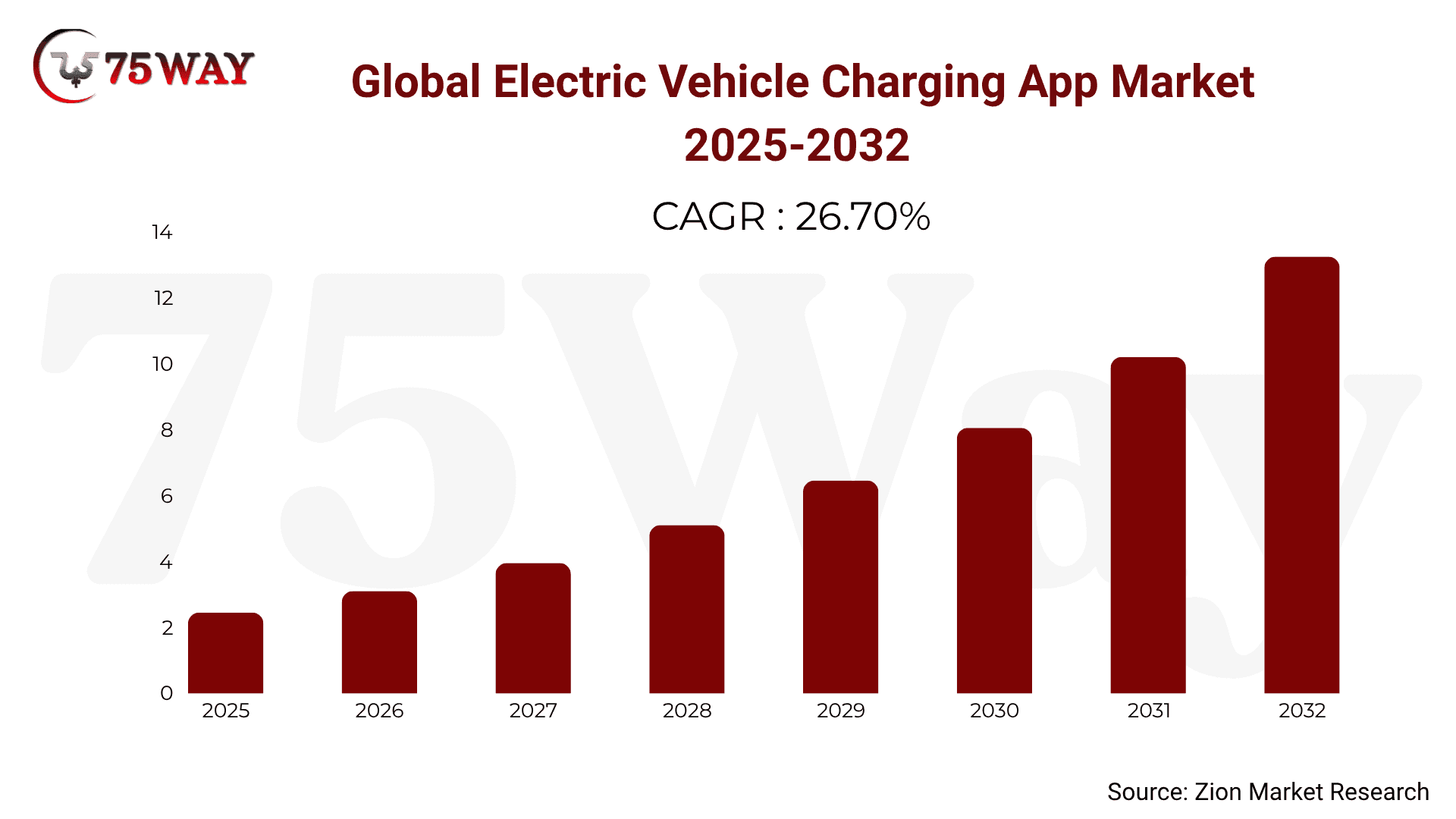
The EV charging ecosystem is expanding rapidly as global electric vehicle adoption accelerates, pushing demand for smarter and more connected charging infrastructure. The global electric vehicle charging apps market, valued at approximately USD 1.57 billion in 2023, is projected to reach nearly USD 13.24 billion by 2032, growing at a strong CAGR of around 26.70% from 2024 to 2032. This rapid growth highlights a massive opportunity for businesses to invest in EV Connect-like platforms that manage charging networks, fleet operations, and energy systems at scale.
- Rapid EV Market Expansion: The increasing adoption of electric vehicles worldwide is driving strong demand for reliable charging infrastructure, creating long-term growth opportunities for EV charging platforms.
- High Revenue Potential: EV Connect-like apps generate multiple income streams, including charging fees, enterprise subscriptions, fleet services, and data monetization, ensuring scalable profitability.
- Growing Enterprise Demand: Logistics companies, mobility providers, and corporate fleets require centralized charging management systems, making enterprise adoption a major investment driver.
- Technology-Driven Scalability: Integration of AI, IoT, and cloud systems allows platforms to scale globally while maintaining real-time performance and operational efficiency.
- Long-Term Infrastructure Value: EV charging platforms are becoming essential digital infrastructure, positioning early investors for strong long-term returns as the EV ecosystem expands globally.
Core Features of Building EV Charging App Like EV Connect
Enterprise EV charging platforms like EV Connect are built to manage large-scale charging networks, fleet operations, and energy distribution through a centralized digital system. These platforms combine real-time monitoring, smart energy management, billing automation, and hardware integration to ensure smooth and efficient charging operations across multiple locations and user roles.
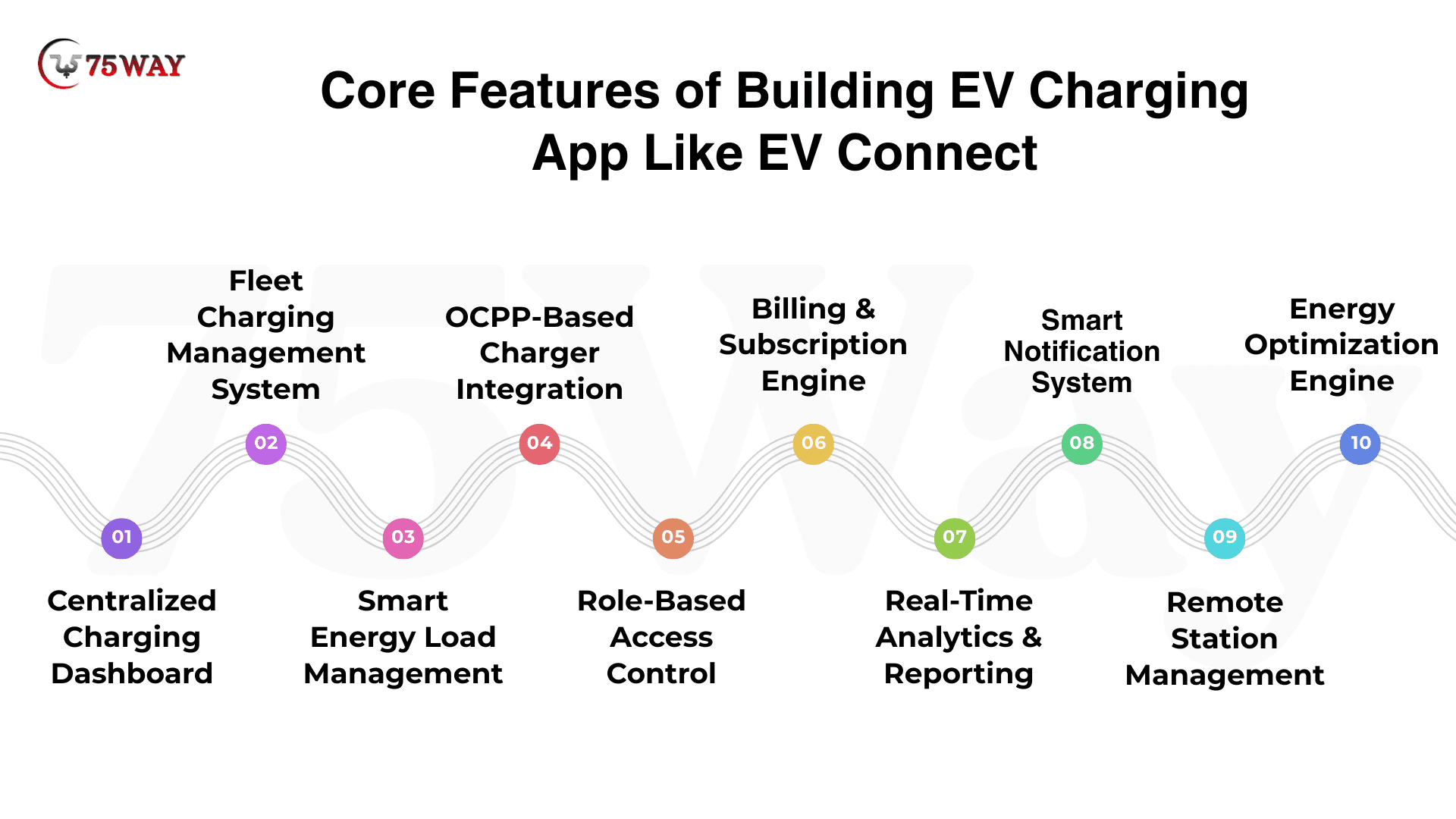
- Centralized Charging Dashboard: Provides a unified view of all charging stations with real-time status monitoring, performance tracking, fault detection, and usage analytics for complete operational visibility.
- Fleet Charging Management System: Enables enterprises to manage vehicle-wise charging schedules, optimize depot charging, track energy consumption, and generate cost allocation reports for fleet operations.
- Smart Energy Load Management: Balances electricity usage across chargers, reduces peak demand pressure, controls energy distribution, and optimizes grid impact for stable operations.
- OCPP-Based Charger Integration: Ensures seamless communication between charging hardware and backend systems with remote control, session authentication, firmware updates, and real-time synchronization.
- Role-Based Access Control: Defines user permissions for admins, fleet managers, station operators, and drivers to ensure secure and structured platform access management.
- Billing & Subscription Engine: Supports flexible billing models including pay-per-kWh, monthly subscriptions, corporate invoicing, and automated receipt generation for enterprises.
- Real-Time Analytics & Reporting: Provides insights into energy consumption, charger utilization, operational performance, and revenue tracking for data-driven decision-making.
- Smart Notification System: Sends alerts for charging faults, energy overloads, maintenance requirements, and fleet activity updates to ensure timely operational response.
- Remote Station Management: Allows operators to control charging stations remotely, monitor health status, and perform diagnostics without physical intervention.
- Energy Optimization Engine: Uses intelligent algorithms to optimize energy distribution, reduce wastage, and improve overall efficiency of charging infrastructure.
Advanced Features of EV Connect-Style App Development
EV charging platforms in 2026 are evolving into intelligent energy ecosystems powered by AI, IoT, and real-time analytics. These advanced features go beyond basic charging management by enabling predictive decision-making, automated optimization, and sustainability tracking, helping enterprises run large-scale EV infrastructure.
- AI Energy Optimization Engine: Uses artificial intelligence to forecast charging demand, optimize energy distribution across stations, and improve cost efficiency by balancing load in real time.
- Predictive Maintenance System: Leverages IoT sensor data to detect early signs of charger failure, reduce downtime, and schedule maintenance before breakdowns occur.
- Dynamic Energy Pricing Model: Adjusts charging costs dynamically based on demand levels, time of use, grid load conditions, and overall energy availability.
- Multi-Site Charging Management: Enables enterprises to monitor, control, and coordinate multiple charging stations across different cities and regions from a single platform.
- Carbon Emission Tracking: Provides detailed sustainability insights by tracking energy consumption and calculating carbon savings for ESG reporting and environmental compliance.
- Grid Load Balancing Automation: Automatically distributes electricity demand across connected stations to prevent overload and ensure stable energy usage across the grid.
- Smart Charging Reservation System: Allows users and fleet operators to pre-book charging slots based on availability, reducing waiting time and improving station utilization efficiency.
Tech Stack To Develop EV Connect-Like EV Charging Management Platform
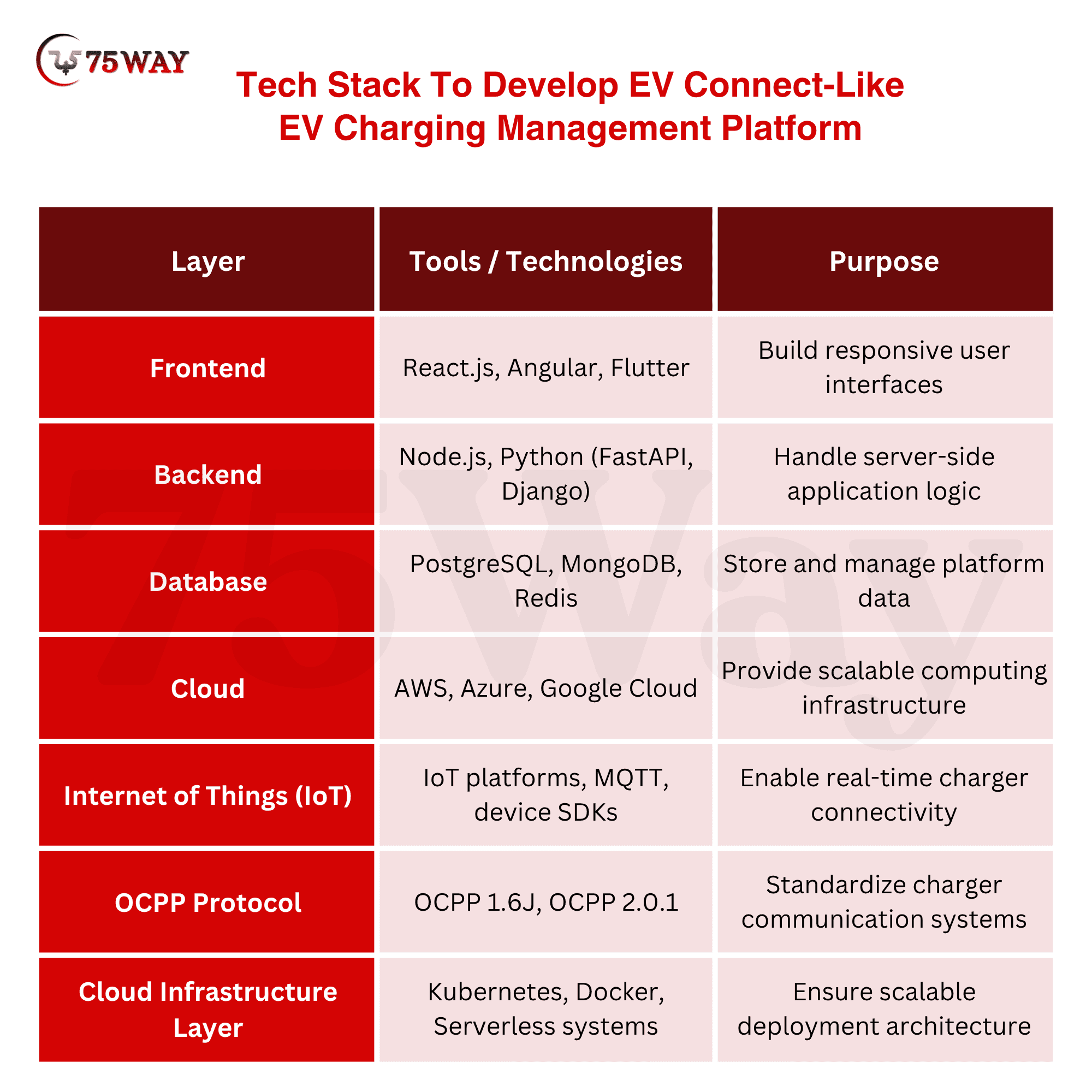
The technology stack for EV charging management platforms combines frontend frameworks, backend systems, databases, cloud infrastructure, and IoT protocols to ensure real-time communication, scalability, and efficient energy management across charging networks globally.
- Frontend: React.js, Angular, and Flutter are used to build responsive dashboards, mobile interfaces, and admin panels, ensuring smooth user experience, real-time updates, and interactive visualization of charging operations.
- Backend: Node.js, Python FastAPI, and Django handle server-side logic, API development, data processing, authentication, and real-time communication between chargers, applications, and cloud-based systems.
- Database: PostgreSQL, MongoDB, and Redis manage structured and unstructured data, enabling fast querying, caching, session management, and efficient storage of charging sessions and user activity records.
- Cloud: AWS, Azure, and Google Cloud provide scalable infrastructure for real-time data processing, storage, analytics, load balancing, and high availability across distributed EV charging networks.
- Internet of Things (IoT): IoT systems connect EV chargers with cloud platforms, enabling continuous data exchange, remote monitoring, fault detection, and real-time energy flow control across stations.
- OCPP Protocol: The Open Charge Point Protocol standardizes communication between charging hardware and backend systems, enabling secure session management, authentication, and real-time charger control operations.
- Cloud Infrastructure: Cloud systems manage real-time data processing, scalability, storage, and analytics, ensuring reliable performance and seamless coordination across large-scale EV charging ecosystems.
Cost To Build EV Charging App Like EV Connect
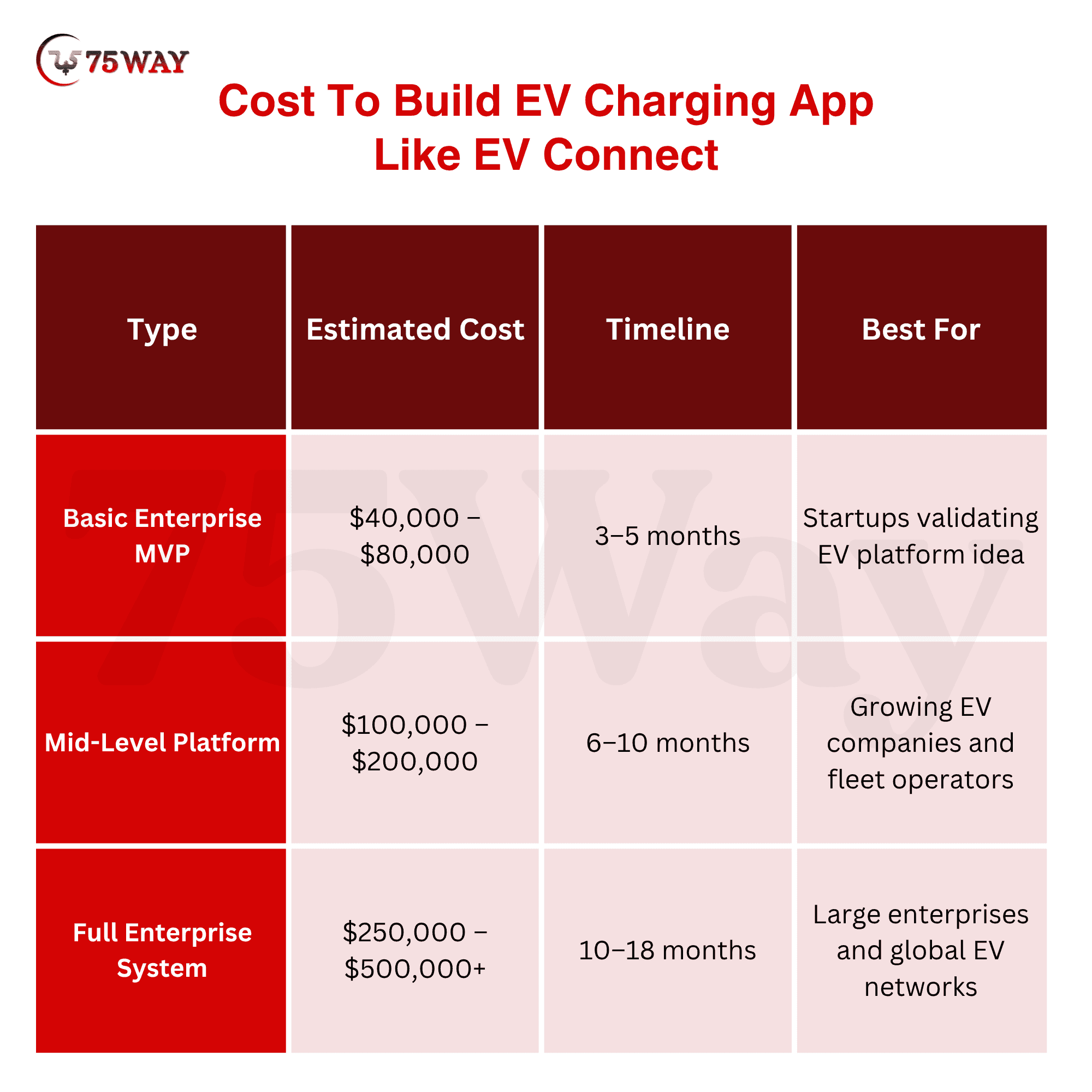
The overall cost to develop an EV Connect-like platform depends on system scale, number of charging stations, real-time capabilities, and advanced features like fleet management, predictive analytics, and dynamic pricing. As complexity increases, development requires larger engineering teams and longer timelines, significantly impacting total investment.
- Basic Enterprise MVP: This version focuses on core charging station management, basic dashboards, user authentication, and simple monitoring features for early-stage enterprise validation, with an estimated development cost of $40,000 – $80,000.
- Mid-Level Platform: Includes real-time charger monitoring, OCPP integration, billing systems, fleet management features, cloud scalability, and analytics dashboards for growing operations, with an estimated cost range of $100,000 – $200,000.
- Full Enterprise System: Advanced solution with AI-driven optimization, predictive maintenance, multi-site global management, dynamic pricing, IoT automation, and high-scale cloud infrastructure, with an estimated investment of $250,000 – $500,000+.
The cost of building an EV charging platform increases significantly due to advanced technical requirements such as IoT integrations for real-time charger connectivity, OCPP systems for standardized hardware communication, AI-driven optimization for energy prediction and load balancing, and multi-site scalability for managing distributed charging networks. Each of these components adds complexity in development, infrastructure, and maintenance, requiring specialized engineering resources and robust cloud architecture to ensure reliable performance at scale.
Future Trends In EV Connect-Like App Development
The future of EV charging platforms is shifting toward intelligent, automated, and sustainability-driven ecosystems powered by AI, smart grids, and urban mobility integration. These advancements will redefine how energy is consumed, stored, and optimized across transportation networks.
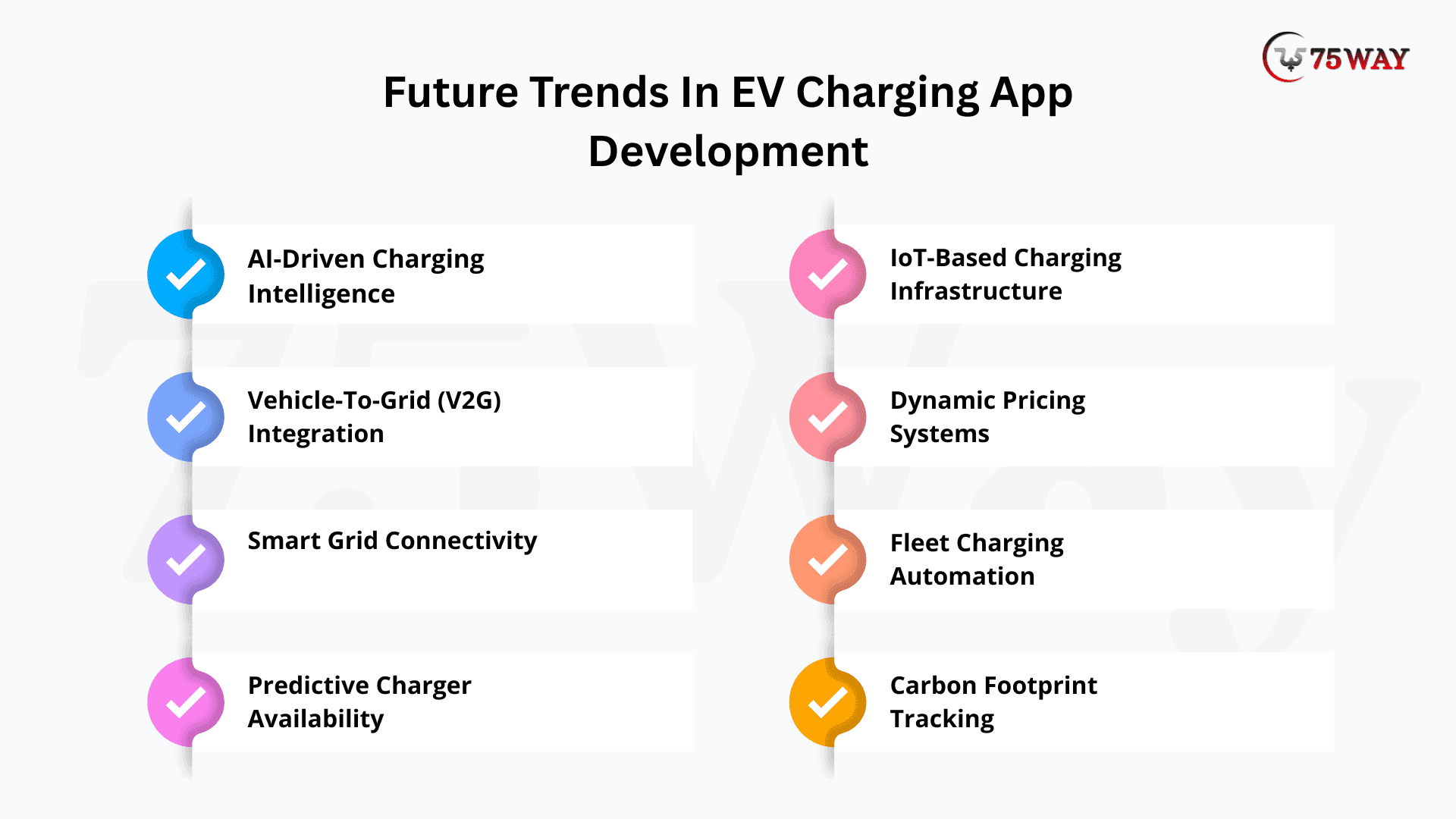
- AI-Driven Energy Grids: Intelligent systems manage energy distribution using artificial intelligence to balance demand, reduce overload, and optimize electricity flow across EV charging networks.
- Automated Charging Depots: Fully automated stations handle vehicle charging, scheduling, and energy distribution without human intervention, improving efficiency and reducing operational dependency.
- Smart City Integration Systems: EV charging platforms integrate with smart city infrastructure to coordinate traffic, energy usage, and public charging availability in real time.
- Autonomous Fleet Charging Systems: Self-managing charging systems automatically schedule, route, and charge electric fleets based on usage patterns and operational requirements.
- Carbon Neutral Charging Networks: Future platforms focus on renewable energy adoption, carbon tracking, and sustainability goals to create environmentally friendly charging ecosystems.
- Vehicle Grid Communication: EVs interact directly with power grids to store and supply energy, improving overall grid stability and energy efficiency.
- Predictive Urban Energy Planning: AI systems analyze city-wide charging data to forecast energy demand and support long-term infrastructure planning for EV expansion.
Final Thoughts
EV Connect-like platforms are redefining enterprise EV infrastructure by enabling centralized control of charging networks, fleet operations, and energy distribution systems. These platforms go beyond basic charging apps and function as intelligent energy management ecosystems powered by IoT, AI, and cloud computing. Building such a system in 2026 requires strong architecture design, OCPP integration, predictive analytics, and scalable SaaS models tailored for enterprise clients. Businesses entering this space can unlock long-term revenue from fleet electrification and energy optimization services. Partner with a trusted mobile app development company to build a future-ready EV infrastructure platform like EV Connect that drives operational efficiency, sustainability, and global market leadership.
Frequently Asked Questions (FAQs)
Why Do Enterprises Prefer EV Charging Management Platforms?
Enterprises prefer centralized platforms because they simplify monitoring, billing, and energy control across multiple charging stations. These systems reduce operational complexity and improve cost efficiency significantly.
Can EV Charging Platforms Support Multiple Business Locations?
Yes, modern platforms support multi-location management through cloud dashboards. Businesses can monitor stations, track energy usage, and manage operations across different cities or countries seamlessly.
How Do EV Charging Platforms Improve Energy Efficiency?
They use smart load balancing and AI-based forecasting to distribute electricity. This reduces peak demand pressure and optimizes energy consumption across all connected charging stations.
Are EV Charging Platforms Suitable For Commercial Properties?
Yes, commercial properties like malls, offices, and hotels use these platforms to manage visitor charging, track usage, and generate additional revenue through structured EV charging services.
How Do EV Charging Platforms Handle User Access Control?
They use role-based access systems to assign permissions for admins, fleet managers, and operators. This ensures secure and controlled access to charging infrastructure operations.
Can EV Charging Platforms Integrate With Renewable Energy Sources?
Yes, many platforms integrate with solar and wind energy systems. This helps organizations track green energy usage and reduce overall carbon emissions.