Summary
Hyperlocal delivery app development focuses on building real-time platforms that connect customers, vendors, and delivery partners within a local radius. It covers business models, technology stack, features, workflows, monetization, and scalability strategies. The approach enables faster deliveries, improved customer experience, and efficient logistics operations. Businesses can leverage AI, automation, and cloud systems to build scalable, high-performance delivery ecosystems for growth.
Quick Overview
- Hyperlocal delivery apps connect local vendors, customers, and delivery partners instantly.
- Development cost varies from $15,000 to $400,000 depending on complexity level.
- Market growth shows rapid expansion, reaching $7.27B by 2030 globally.
- Strategic planning improves scalability, operational efficiency, and long-term platform stability.
- Technology stack selection directly impacts performance, speed, and user experience quality.
- AI integration enhances routing accuracy, automation, and predictive demand forecasting capabilities.
The demand for instant delivery has totally changed the way modern businesses operate in 2026. As you all know, we as customers no longer wait days for essentials. We expect groceries, food, medicines, and services delivered within minutes. This shift has given rise to hyperlocal delivery apps, which connect nearby users with local vendors and delivery partners in real time.
Hyperlocal delivery app development is not just about building a mobile application. It is about creating a scalable digital ecosystem that enables fast logistics, real-time tracking, efficient vendor management, and seamless customer experiences within a defined geographic area.
Unlike traditional delivery systems that depend on centralized warehouses and long-distance logistics, hyperlocal models leverage local stores, dark stores, and nearby delivery partners to fulfill orders faster and more efficiently.
According to market research, the hyperlocal delivery app market is expected to reach $7.27 billion by 2030, growing at a CAGR of 22.2%, driven by increasing demand for instant commerce and on-demand delivery app services.
As industries like food delivery, grocery, pharmacy, and on-demand services continue to expand, startups and enterprises are investing heavily in hyperlocal platforms to improve speed, reduce operational costs, and increase customer retention.
In this strategic guide, you will learn everything from business models, technology stack, app development process, cost structure, and challenges to real-world monetization strategies. This will help you build a future-ready hyperlocal delivery app that scales successfully.
What is Hyperlocal Delivery App Development?
Hyperlocal delivery app development refers to the process of building digital platforms that enable on-demand delivery of goods and services within a limited geographic area, typically within a few-kilometer radius. These applications are designed to connect customers, nearby vendors, and delivery partners in real time to ensure faster order fulfillment and improved service efficiency.
You must also know the difference between traditional delivery and hyperlocal delivery apps. Unlike traditional delivery systems, hyperlocal apps focus on localized logistics, where products are sourced directly from nearby stores, restaurants, pharmacies, or dark stores instead of centralized warehouses. This significantly reduces delivery time and improves customer satisfaction. These platforms operate through a real-time ecosystem that manages ordering, dispatching, tracking, and delivery coordination seamlessly, making them highly effective for industries such as food delivery, grocery, pharmacy, and on-demand services.
Read Too: Managed IT Services for Manufacturing: Step-by-Step Guide for Businesses
How Hyperlocal Delivery App Works?
A hyperlocal delivery app operates through a multi-sided digital ecosystem that seamlessly connects customers, vendors, delivery partners, and administrators to enable real-time order fulfillment within a specific geographic area. The entire system is designed to ensure fast, efficient, and location-based delivery operations. The workflow is powered by automation, GPS tracking, and real-time data exchange, allowing orders to be processed and delivered within minutes instead of days.
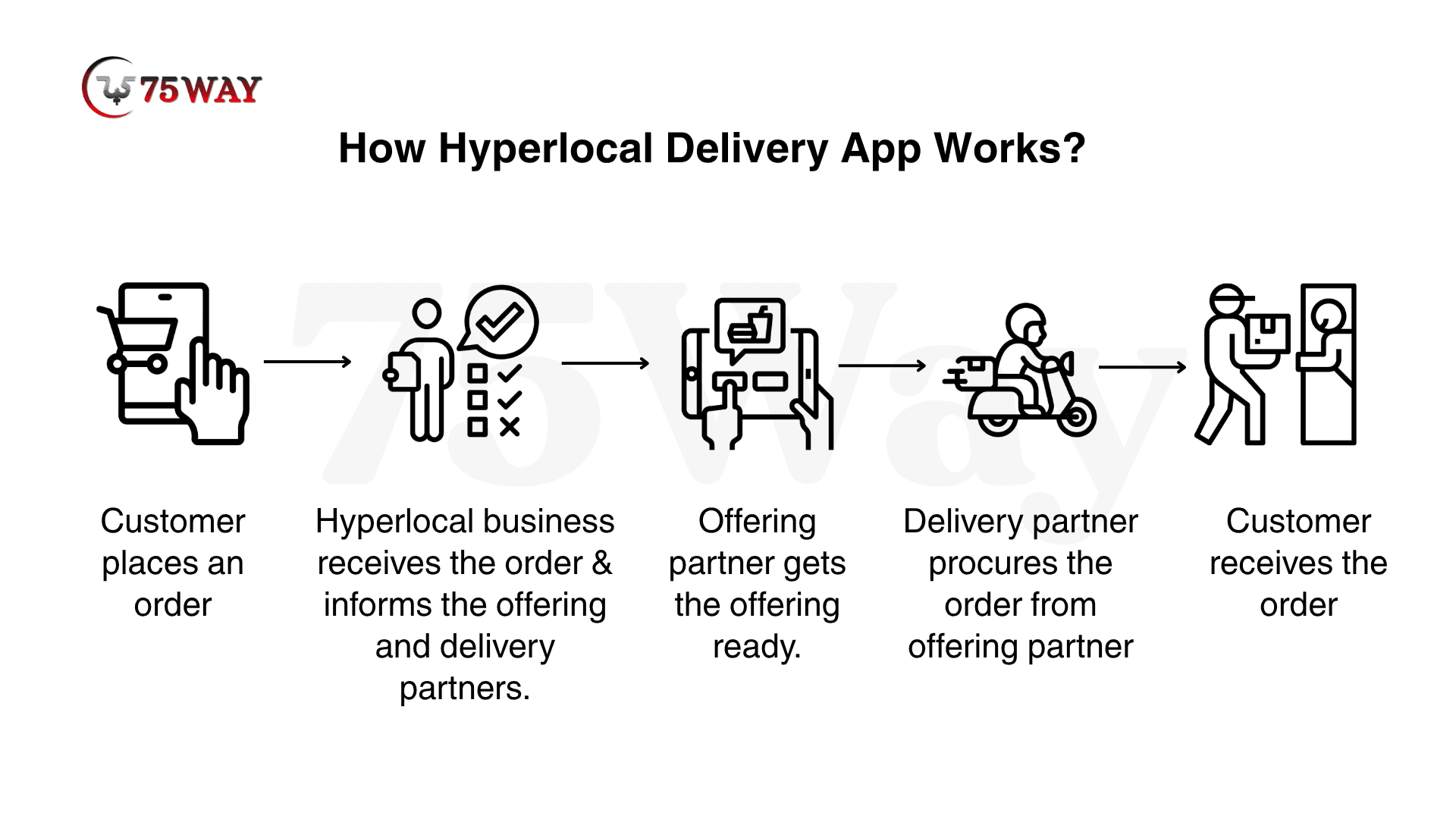
- User Places An Order Via The App: The customer browses nearby products or services and places an order through the mobile or web application.
- Nearby Vendor Receives The Request: The system automatically notifies the closest or most relevant vendor to confirm product availability.
- Order Is Accepted And Processed: The vendor prepares or packs the order for dispatch.
- Delivery Partner Is Assigned Automatically: The system assigns the nearest available delivery partner based on location, availability, and workload.
- Real-Time Tracking Begins: Customers can track the delivery partner’s live location, estimated arrival time, and order status.
- Order Is Delivered Within Minutes or Hours: The delivery partner completes the last-mile delivery efficiently within the defined hyperlocal radius.
Leading platforms such as Uber Eats and Instacart successfully implement the hyperlocal delivery model by connecting users with nearby restaurants, grocery stores, and retail outlets. These platforms rely on optimized logistics, intelligent routing, and real-time tracking systems to ensure fast and reliable deliveries.
Explore More: AI App Development Partner for Health and Wellness Startup
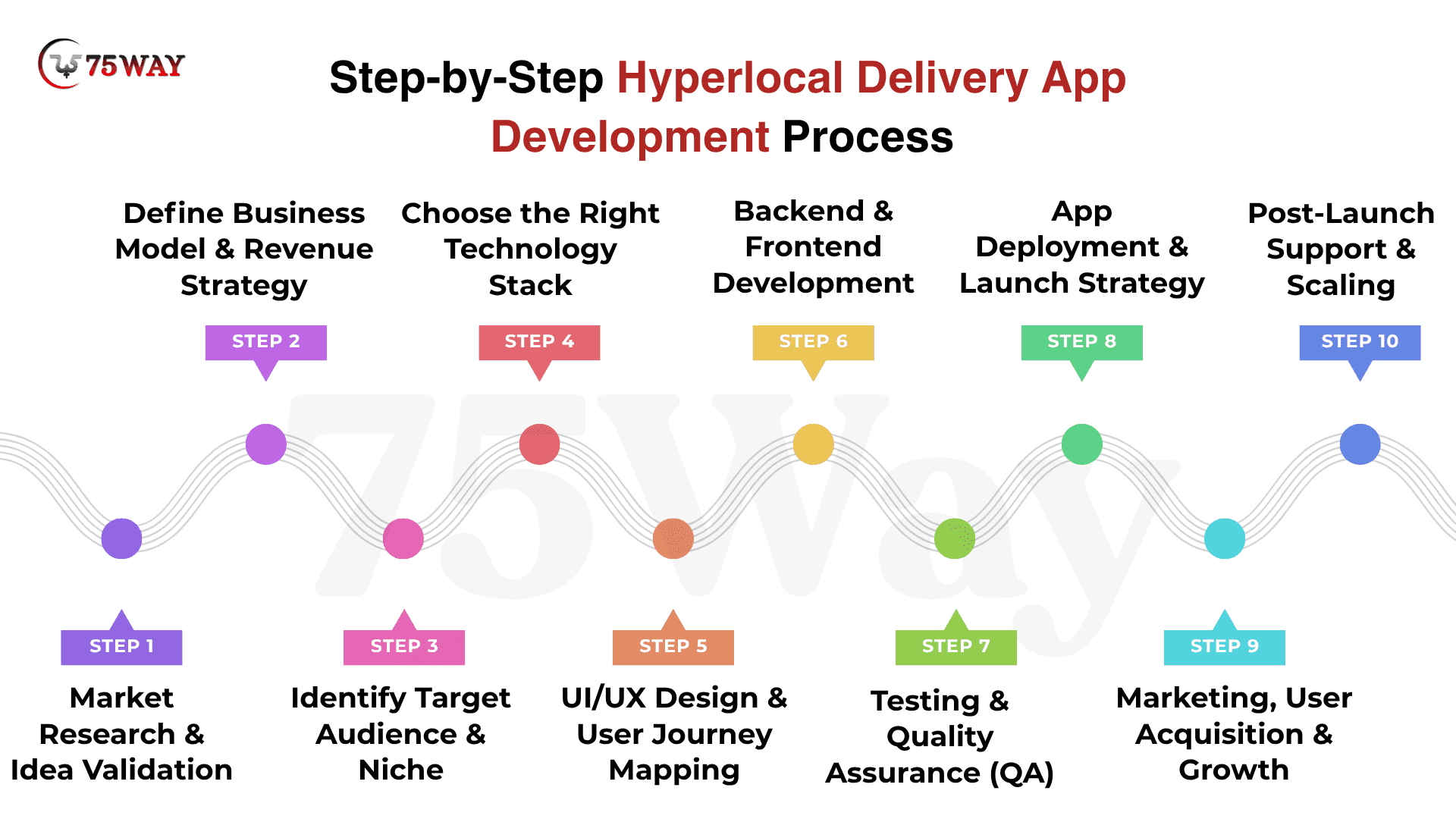
Step-by-Step Hyperlocal Delivery App Development Process
The methodology to create a hyperlocal delivery app goes far beyond designing a simple customer-facing interface. It requires the careful integration of business operations, delivery logistics, AI, and a scalable technical infrastructure capable of handling real-time order flow across multiple locations. A successful hyperlocal delivery system must ensure seamless coordination between customers, vendors, delivery partners, and backend operations to maintain speed and accuracy.
A well-structured hyperlocal delivery app development approach is essential for reducing operational risks, costs, and ensuring smooth scalability, especially for businesses planning to expand across multiple zones or cities. Each stage of development plays a critical role in strengthening platform stability, improving performance, and preparing the system for continuous updates as order volumes and user demand increase over time. Those stages are defined below.
Step 1: Market Research & Idea Validation
Market analysis is the foundational step in building a hyperlocal delivery app, where businesses evaluate real market demand, study user behavior, and analyze competitors. It ensures the idea solves a genuine problem, aligns with customer needs, and has strong commercial potential before investing in full-scale development.
- Identify target customer needs and pain points clearly
- Analyze top competitors and their feature offerings deeply
- Study market trends and regional demand patterns thoroughly
- Validate business idea using surveys and user feedback
- Evaluate monetization opportunities and revenue potential realistically
- Assess scalability and long-term growth opportunities carefully
Step 2: Define Business Model & Revenue Strategy
The next crucial step in hyperlocal delivery app development is to determine how the platform operates, connects stakeholders, and generates sustainable income. The right model, such as marketplace, inventory-led, or subscription, must be selected to optimize operations, improve scalability, and offer long-term profitability while aligning with customer expectations and market demand.
A strong revenue strategy ensures sustainable growth by identifying multiple income streams like commissions from vendors, delivery charges, subscription plans, and promotional listings. The chosen model should align with customer behavior and market demand while maintaining a balance between affordability and profitability. By structuring a clear monetization framework early, startups and enterprises can build a stable and scalable hyperlocal ecosystem that supports long-term success and continuous expansion.
Step 3: Identify Target Audience & Niche
When you decide on the business model, you have to recognize the target audience and niche is essential for building a successful hyperlocal delivery app. It helps businesses focus on a specific customer segment, such as grocery, pharmacy, or food delivery, for better personalization, stronger market positioning, and higher user engagement. A well-defined niche improves marketing efficiency and increases chances of long-term business growth.
- Customer Profile: Define age, location, behavior, and buying patterns to understand ideal users clearly.
- Industry Focus: Select a specific sector like food, grocery, pharmacy, or logistics services.
- Demand Analysis: Evaluate local demand trends to ensure strong market opportunity and growth potential.
- Competitor Analysis: Analyze competitors within the niche to identify gaps and build a better positioning strategy.
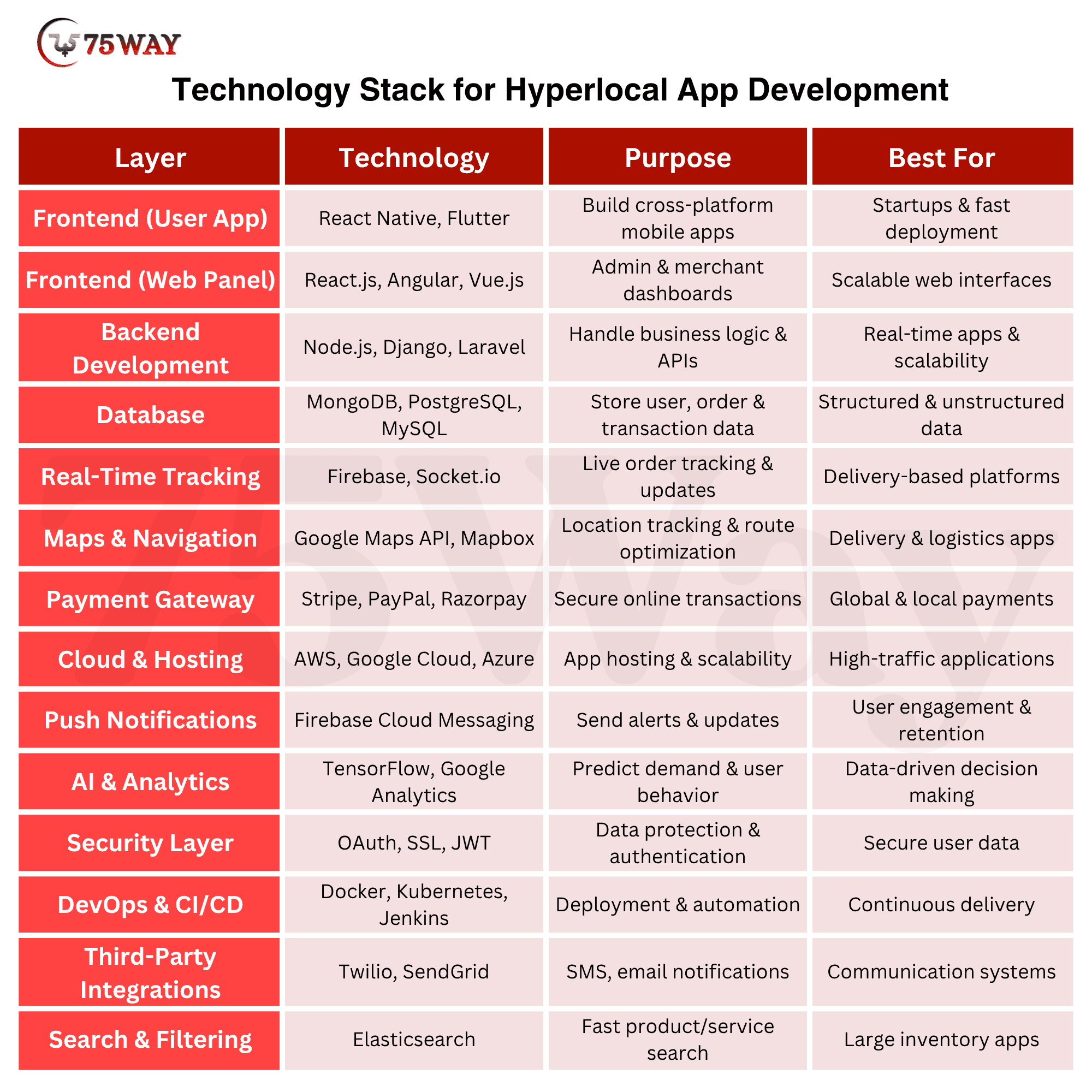
Step 4: Choose the Right Technology Stack
After defining the target audience and validating the business niche, the next critical step is selecting a technology that can support your business goals. A well-planned tech stack ensures the application can handle real-time delivery operations, high traffic, and seamless communication between customers, vendors, and delivery partners without performance issues. This decision directly impacts scalability, system speed, and long-term flexibility of the platform. By selecting modern frontend, backend, database, and cloud technologies, businesses can build a robust infrastructure that supports real-time tracking, secure transactions, and smooth user experiences across all devices.
- Frontend (User App): Once the user journey is defined, the frontend becomes the first real interaction point for customers. Using Flutter or React Native helps reduce development time while ensuring smooth performance across devices. To improve retention in low-connectivity areas, a lightweight design combined with offline caching becomes essential. You must keep UI under 3 taps for the ordering flow to increase conversion rate.
- Frontend (Web Panel): A React. js-based dashboard ensures flexibility and smooth performance for managing real-time activities. Role-based access further helps streamline workflows by separating admin, vendor, and delivery operations. You must integrate real-time dashboards to enable faster decision-making across the system.
- Backend Development: Technologies like Node.js, Django, or Laravel support high traffic and real-time processing efficiently. A microservices approach ensures each function operates independently without affecting the full system. You must separate core modules like orders and payments to maintain system stability under load.
- Database: A hybrid structure using PostgreSQL for structured data and MongoDB for dynamic updates creates a better balance. Proper indexing ensures faster retrieval of frequently accessed information, such as orders and user activity. You must optimize indexing on high-frequency queries to reduce system latency.
- Real-Time Tracking: Tools like WebSockets or Firebase enable continuous location updates without delay. However, the system must be optimized to avoid unnecessary battery drain or server overload. You must adjust location refresh intervals to maintain accuracy without compromising performance.
- Maps & Navigation: After enabling tracking, navigation systems play a key role in improving delivery efficiency. Google Maps API or Mapbox helps calculate optimal routes based on live traffic conditions. You must prioritize time-based route optimization to reduce overall delivery duration.
- Payment Gateway: Integrating Stripe, Razorpay, or PayPal ensures secure and flexible payment options for users. A simplified checkout flow reduces friction and prevents users from abandoning orders. You must enable one-click or saved payments to improve repeat purchase rates.
- Cloud & Hosting: AWS, Google Cloud, or Azure provide scalable environments with high availability. Auto-scaling ensures the system adapts automatically during peak demand without downtime. You must configure scaling rules to handle sudden traffic spikes efficiently.
- Push Notifications: Once the system is live, user engagement depends heavily on timely and relevant communication. Firebase Cloud Messaging allows real-time alerts for orders, promotions, and updates. Personalized messaging based on user behavior improves engagement significantly.
- AI & Analytics: As data accumulates, advanced analytics becomes essential for improving business decisions and operations. AI models help identify demand patterns, customer behavior, and delivery trends. This allows businesses to allocate resources more efficiently across high-demand zones. You must use predictive analytics to optimize delivery partner distribution.
- Security Layer: When user data and transactions increase, security becomes a critical foundation of the system. JWT authentication, SSL encryption, and role-based access ensure controlled access across all layers. Regular audits and API key rotation further strengthen system protection. You must enforce multi-layer authentication to secure sensitive operations.
- DevOps & CI/CD: After development, continuous deployment ensures smooth updates without disrupting the system. Tools like Docker and Kubernetes help manage scalable and consistent deployments. Automated CI/CD pipelines reduce manual errors and improve release speed. You must implement automated rollback to prevent failures during deployments.
- Third-Party Integrations: As the platform expands, external integrations enhance functionality and communication capabilities. SMS, email, WhatsApp, and CRM APIs ensure smooth interaction between users and businesses. Proper synchronization prevents delays in order updates and notifications. You must prioritize WhatsApp integration for higher engagement rates.
- Search & Filtering: When product listings grow, search and filtering become essential for user experience. Elasticsearch enables fast and accurate results across vendors, products, and categories. Advanced filters like price, distance, and ratings further refine user searches. You must optimize search indexing to deliver near-instant results for users.
Step 5: UI/UX Design & User Journey Mapping
Once the product idea and core functionality are defined, the next critical step is shaping how users will interact with the platform. UI/UX design focuses on creating intuitive interfaces that simplify navigation and make the entire hyperlocal delivery experience smooth and frictionless. A well-structured design ensures users can easily browse products, place orders, and track deliveries without confusion or unnecessary steps.
User journey mapping goes deeper by analyzing every touchpoint from app entry to order completion and post-delivery engagement. This process helps identify friction points and remove unnecessary actions that slow down conversions. You must design a journey where users can complete key actions in minimal steps, ensuring seamless navigation that directly improves retention and overall user satisfaction.
Step 6: Backend & Frontend Development
Building a hyperlocal delivery app requires a strong combination of scalable architecture and responsive user-facing applications. Both frontend and backend systems must work in sync to handle real-time orders, vendor coordination, and delivery tracking without delays. A well-structured development approach ensures performance stability, faster response time, and seamless user experience across all devices and operational layers.
- Frontend Development: This hyperlocal delivery app development stage emphasizes building the customer-facing and operational interfaces that users interact with daily. It includes designing mobile apps and web dashboards that are fast, intuitive, and responsive across devices. Technologies like Flutter, React Native, or React.js help create smooth user experiences with real-time updates. You must ensure the interface is optimized for speed and requires minimal steps for completing key actions like ordering and tracking.
- Backend Development: It forms the core engine that powers the entire hyperlocal ecosystem by managing data processing, business logic, and system communication. It handles orders, payments, user authentication, and real-time tracking through secure APIs and scalable architecture. Frameworks like Node.js, Django, or Laravel support high concurrency and performance stability. You must structure backend services using microservices to ensure independent scaling and uninterrupted system performance under heavy load.
Step 7: Testing & Quality Assurance (QA)
Testing stage confirms that the hyperlocal delivery platform performs reliably across all devices and user scenarios. It helps identify bugs, security vulnerabilities, and performance issues before deployment. A strong QA process guarantees smooth functionality, stable real-time operations, and a seamless user experience. You must implement continuous testing cycles to maintain product quality and prevent system failures after launch.
- Functional Testing: Validates that all application features operate correctly as per defined requirements.
- Performance Testing: Checks system behavior under heavy traffic and peak usage conditions.
- Security Testing: Identifies vulnerabilities and protects user data and transaction-related information.
- Usability Testing: Evaluates ease of navigation, clarity, and overall user interaction experience.
- API Testing: Verifies accurate data exchange between frontend, backend, and external services.
- Regression Testing: Confirms existing features remain stable after new updates or modifications.
Step 8: App Deployment & Launch Strategy
Once development and testing phases are completed, the next step is deploying the hyperlocal delivery application across digital platforms. This stage involves publishing the mobile app on major app stores, configuring backend servers, and ensuring all systems are fully synchronized for live operations. Proper deployment planning helps avoid downtime, technical glitches, and performance issues during launch, ensuring a smooth transition from development to real-world usage.
A strong launch strategy goes beyond technical deployment and focuses on market readiness and user acquisition. It includes preparing marketing campaigns, optimizing app store listings, and creating pre-launch buzz to attract early users and vendors. You must align deployment with a structured launch campaign that drives initial traffic, builds trust, and establishes strong market visibility from day one.
Step 9: Marketing, User Acquisition & Growth
After launching the platform, growth depends on how effectively you attract and retain users through structured marketing strategies. A combination of SEO, paid advertising, referral programs, and strategic partnerships helps build strong visibility and steady user acquisition. You must focus on data-driven marketing channels that generate consistent traffic and long-term engagement.
- ASO Optimization: Enhance app store visibility using optimized keywords, visuals, ratings, and descriptions to increase organic downloads.
- Paid Advertising: Drive instant installs using targeted campaigns across Google, Meta, and other digital advertising platforms effectively.
- Referral Programs: Encourage existing users to invite new users through reward-based incentives that increase organic app growth.
- Strategic Partnerships: Collaborate with local vendors and businesses to expand reach and strengthen market presence in targeted regions.
- Retention Strategy: Focus on push notifications, loyalty programs, and offers to improve user engagement and long-term retention rates.
Step 10: Post-Launch Support & Scaling
“A successful product is not launched once. It is continuously improved, optimized, and scaled to meet growing demand.”
After the hyperlocal delivery mobile application goes live, continuous support becomes essential to maintain stability, performance, and user satisfaction. At this stage, the focus shifts toward monitoring real-time system behavior, identifying issues, and deploying timely updates to keep the application running smoothly across all devices and user segments.
As usage increases, optimizing performance becomes a priority to ensure fast response times and uninterrupted service. Feedback from customers, vendors, and delivery partners plays a key role in refining features and improving the overall experience. You must establish a structured update cycle that enhances functionality without disrupting live operations or daily business flow.
When the platform begins scaling across new regions, infrastructure flexibility becomes critical for sustained growth. Cloud-based systems, modular architecture, and auto-scaling servers help manage increasing traffic and transactions efficiently. A well-planned scaling strategy ensures the system remains stable, cost-effective, and responsive even during peak demand periods.
More Insights: Candy AI Chatbot Development Cost in 2026: Complete Breakdown
Why Hyperlocal is Dominating Local Commerce: Market Size & Growth
The hyperlocal delivery market is rapidly transforming local commerce due to rising consumer demand for faster, on-demand services and instant fulfillment. Businesses are adopting hyperlocal app development solutions to improve convenience, reduce delivery time, and enhance customer satisfaction. This shift is driving strong market expansion, digital adoption, and continuous innovation across industries.
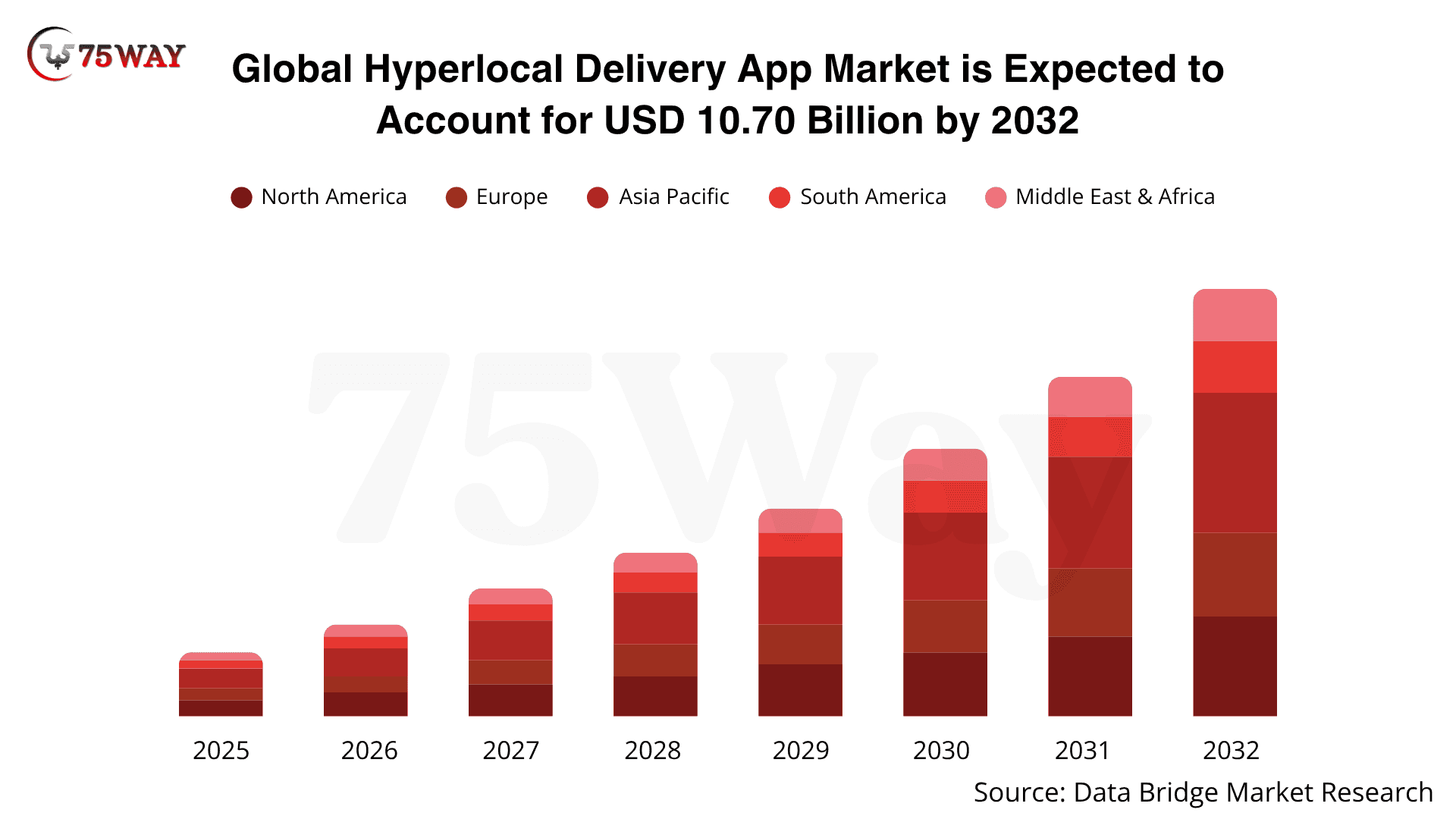
- The global hyperlocal services market is expected to grow significantly from $4,462.57 billion in 2026 to $2,546.94 billion by 2034, registering a CAGR of 13.79%, as stated in Fortune Business Insights.
- North America leads the hyperlocal services sector, contributing around 35% of total global revenue, driven by strong adoption of delivery-based platforms, according to Virtue Market Research.
- More than 50% of hyperlocal platforms are leveraging AI-powered route optimization to improve delivery speed and operational efficiency.
- Over 70% of online consumers engage with at least one hyperlocal service application on a weekly basis.
- The global hyperlocal delivery app market is projected to reach $10.70 billion by 2032, growing at a CAGR of 22.6% during the forecast period, as per Data Bridge Market Research.
Read Too: How to Build an Astrology App Like Astra in 2026: Step-by-Step Guide
Types of Hyperlocal Delivery Business Models
Hyperlocal delivery businesses operate through different operational frameworks that connect local vendors, customers, and delivery partners within a defined geographic area. These models determine how inventory is managed, how orders are fulfilled, and how revenue is generated. Choosing the right structure helps businesses improve scalability, optimize logistics, and ensure faster delivery while maintaining cost efficiency and better customer experience.
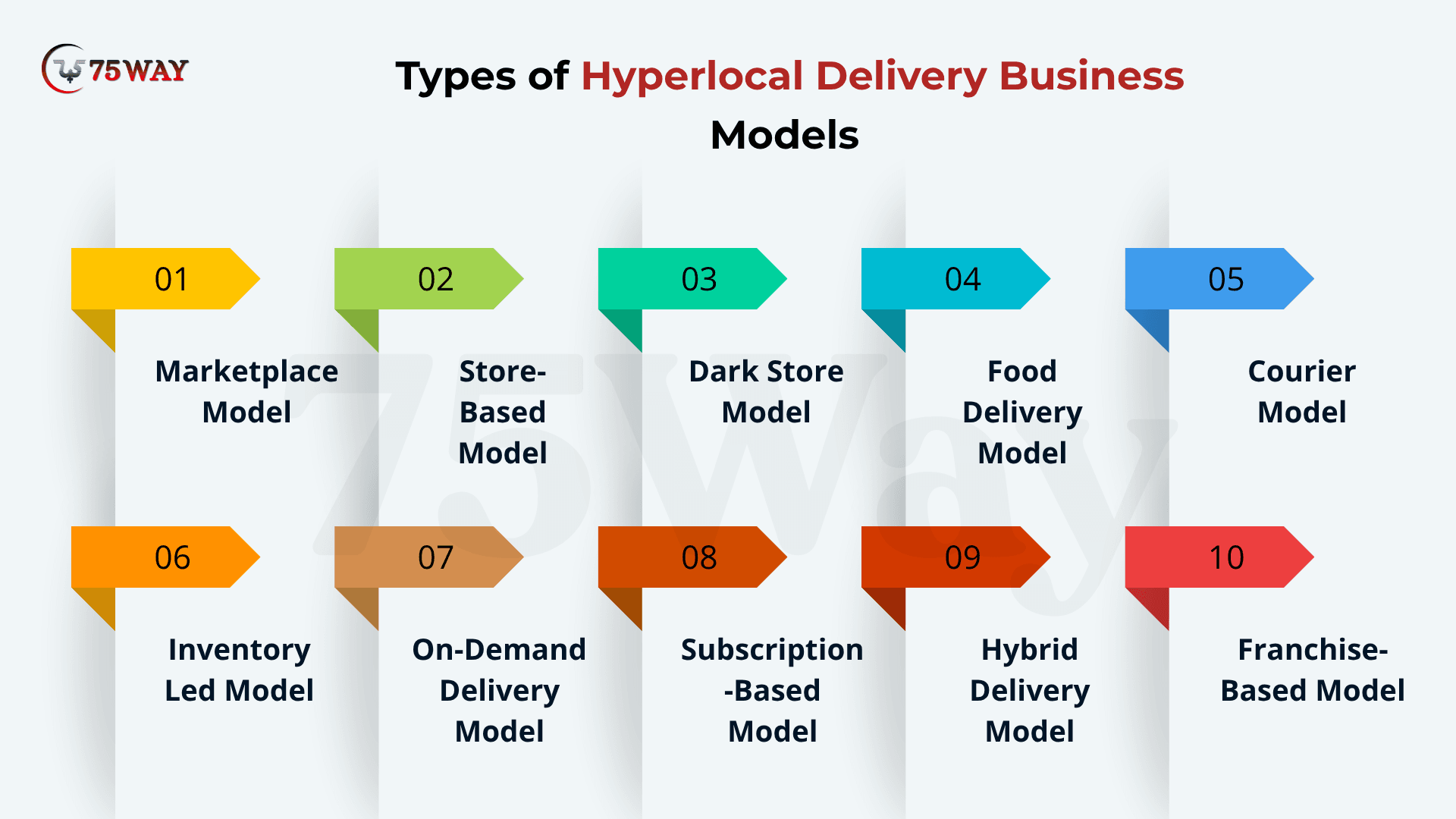
Marketplace Model: This model connects multiple local vendors with customers through a single platform without owning inventory. The platform acts as an intermediary handling orders, payments, and logistics coordination. It helps businesses scale quickly with minimal operational overhead while focusing on commissions and service fees for revenue generation.
Store-Based Model: In this model, existing physical stores are digitally integrated to fulfill online orders directly from their retail outlets. It enhances store reach without changing inventory ownership. Businesses benefit from increased sales channels, better customer engagement, and efficient utilization of existing stock and staff resources.
Dark Store Model: Dark stores operate as hidden fulfillment centers dedicated only to online orders without walk-in customers. They are strategically located for faster delivery and efficient inventory management. This model enables quick order processing, reduced delivery time, and better control over stock availability and logistics operations.
Food Delivery Model: This model focuses on delivering meals from restaurants to customers through a digital platform. Orders are placed online and fulfilled by partnered restaurants with delivery support. It ensures convenience, real-time tracking, and faster service while helping restaurants expand their customer base beyond physical locations.
Courier Model: The courier model handles parcel and document deliveries between individuals or businesses within a defined area. It focuses on quick pickup and drop services with optimized routing. Businesses using this model benefit from fast logistics solutions, real-time tracking, and improved last-mile delivery efficiency.
Inventory Led Model: In this model, the platform owns or manages inventory and directly fulfills customer orders. It provides better control over product quality, availability, and delivery timelines. Businesses benefit from higher margins, streamlined operations, and improved customer trust due to consistent service standards and product reliability.
On-Demand Delivery Model: The on-demand delivery app development model provides instant delivery services for various goods and services as soon as a customer places an order. It focuses on speed, convenience, and real-time fulfillment. Businesses can capture urgent demand segments and improve customer satisfaction through fast and responsive service delivery systems.
Subscription-Based Model: Customers pay a recurring fee to access delivery services or exclusive benefits such as free delivery and discounts. This model ensures predictable revenue and higher customer retention. Businesses benefit from consistent cash flow and stronger long-term relationships with loyal users who use the service frequently.
Hybrid Delivery Model: This model combines multiple operational approaches, such as marketplace, inventory, and on-demand delivery systems. It provides flexibility to scale across different business needs and customer segments. Businesses can diversify revenue streams, optimize logistics, and adapt quickly to changing market demands and operational challenges.
Franchise-Based Model: In this model, businesses expand by allowing franchise partners to operate under their brand using standardized systems and processes. It enables rapid geographic expansion with lower capital investment. Franchise partners handle local operations while the parent company focuses on branding, technology, and overall platform management.
Explore More: Hire AI Engineer To Build An Advanced Chatbot & AI Receptionist Platform
Benefits of Building A Hyperlocal Delivery Mobile App
A hyperlocal delivery mobile app helps businesses improve speed, efficiency, and customer satisfaction by connecting users with nearby vendors in real time. It streamlines order management, enhances operational control, and reduces delivery delays. Businesses can scale faster, increase revenue opportunities, and build stronger customer relationships through localized, technology-driven service delivery models.
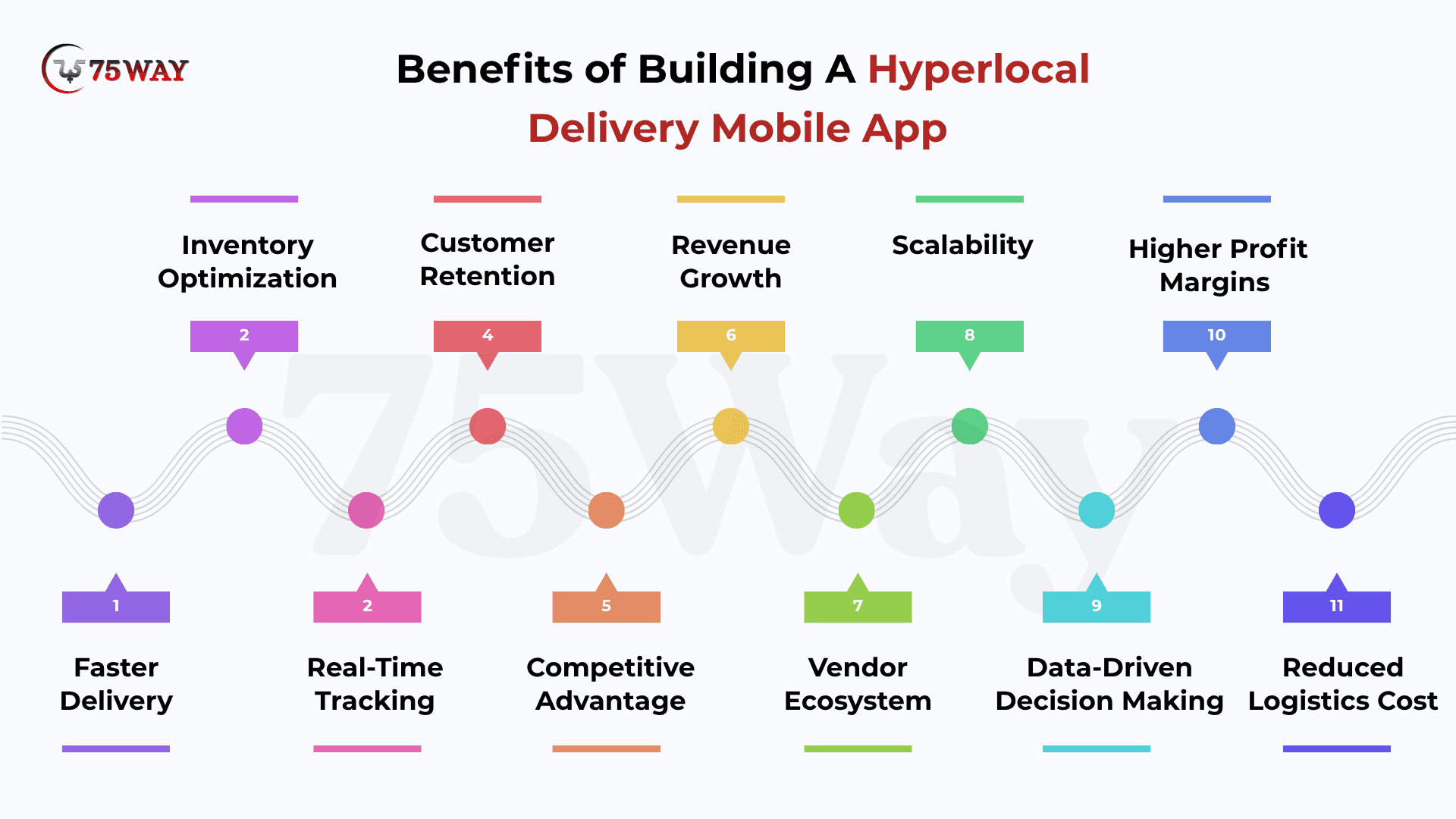
Faster Delivery: Hyperlocal apps reduce delivery time by connecting users with nearby vendors and optimized delivery routes. This improves service speed, enhances customer satisfaction, and ensures quicker order fulfillment, especially for time-sensitive products like food, groceries, and essential daily items.
Inventory Optimization: Businesses can manage stock more efficiently by tracking demand patterns in real time. It reduces overstocking and shortages while improving supply chain coordination, ensuring products are always available when customers need them without unnecessary storage costs or wastage.
Real-Time Tracking: Customers and vendors can monitor deliveries live from pickup to drop-off. This transparency improves trust, reduces customer anxiety, and allows businesses to manage delays proactively while improving overall delivery coordination and operational efficiency across multiple locations.
Customer Retention: Personalized offers, faster service, and smooth user experience encourage repeat purchases. Loyalty programs and consistent delivery performance help businesses retain customers, build long-term relationships, and increase lifetime value through continuous engagement and satisfaction-driven service delivery models.
Competitive Advantage: Hyperlocal platforms help businesses stand out by offering faster, localized, and more convenient services. This differentiation improves market positioning, attracts more users, and strengthens brand presence in highly competitive local commerce and on-demand delivery ecosystems.
Revenue Growth: Multiple income streams, such as delivery charges, commissions, subscriptions, and partnerships, increase overall profitability. Efficient scaling and higher-order volumes further contribute to consistent revenue growth and long-term financial sustainability for hyperlocal delivery businesses.
Vendor Ecosystem: A strong vendor network ensures product availability, faster fulfillment, and wider service coverage. It creates mutual growth opportunities for businesses and local sellers, improving platform reliability and increasing overall transaction volume across different categories.
Scalability: Hyperlocal apps are designed to expand easily into new regions and markets. Cloud infrastructure and modular architecture support growth without performance issues, enabling businesses to handle increasing users, orders, and operational complexity efficiently.
Data-Driven Decision Making: Analytics tools provide insights into customer behavior, order trends, and operational performance. Businesses can make informed decisions, optimize pricing strategies, and improve service efficiency using real-time and historical data for better growth outcomes.
Higher Profit Margins: Optimized operations, reduced dependency on intermediaries, and efficient logistics increase profitability. Businesses can minimize wastage, improve order volume, and maximize revenue per transaction, leading to stronger financial performance in competitive hyperlocal markets.
Reduced Logistics Cost: Smart routing, optimized delivery assignments, and local fulfillment reduce fuel usage and operational expenses. This lowers overall logistics costs while improving delivery speed and efficiency, making the business model more sustainable and cost-effective over time.
Also Read: How to Build an AI-Driven Anonymous Messaging App?
Must-Have Features of A Hyperlocal Delivery App
A hyperlocal delivery app development requires well-structured features for smooth coordination between customers, vendors, and delivery partners. These features are essential to reduce operational friction, enable real-time decision-making, and improve service speed. They also help businesses maintain accuracy in orders, enhance transparency, optimize logistics, and deliver a seamless user experience that supports scalability and long-term customer retention.
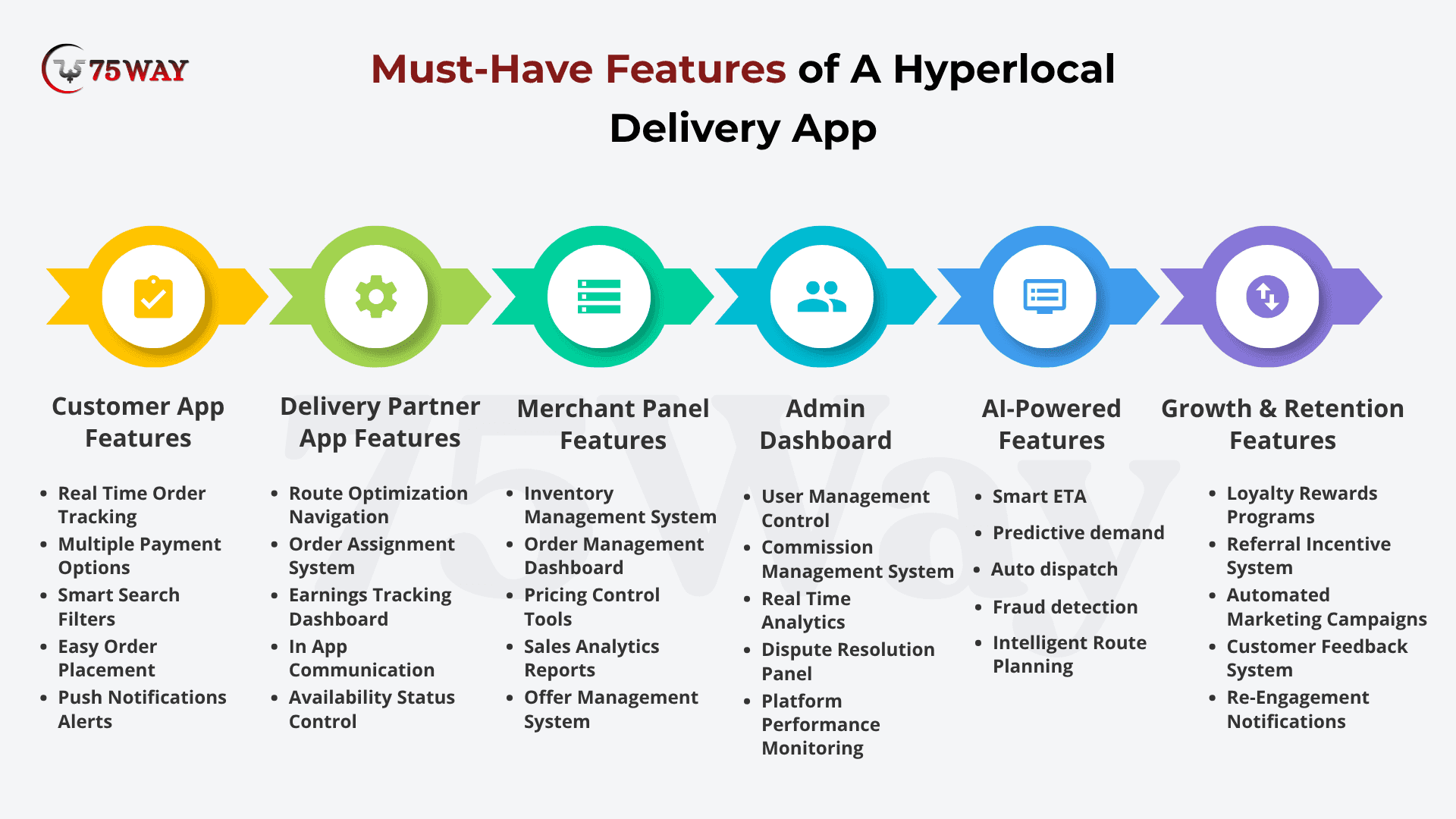
Customer App Features: The customer app is designed to provide a seamless ordering experience with speed, convenience, and transparency. It helps users discover products quickly, place orders effortlessly, and track deliveries in real time while ensuring secure payments and timely updates for better engagement and satisfaction.
- Real Time Order Tracking: Allow customers to monitor their delivery live from pickup to drop-off. It increases trust, reduces uncertainty, and improves transparency by providing accurate location updates and estimated arrival times throughout the entire order journey.
- Multiple Payment Options: Support various secure payment methods, including cards, wallets, and online banking. It enhances convenience, reduces payment failures, and ensures smooth checkout experiences for different user preferences and financial accessibility needs.
- Smart Search Filters: Help users quickly find products based on category, price, ratings, and distance. It improves browsing efficiency, saves time, and ensures customers can easily discover relevant items without unnecessary scrolling or confusion.
- Easy Order Placement: Enable users to complete purchases in just a few simple steps. It reduces friction in the ordering process, improves conversion rates, and ensures a smooth, user-friendly experience that encourages repeat usage.
- Push Notifications Alerts: Send timely updates about order status, offers, and delivery progress. It keeps users informed, improves engagement, and encourages repeat purchases by maintaining continuous communication between the platform and its customers.
Delivery Partner App Features: The delivery partner app is designed to improve efficiency, reduce delays, and optimize delivery workflows. It empowers delivery agents with smart navigation, automated order handling, and real-time communication tools. These features help maximize productivity, ensure timely deliveries, and provide complete visibility into earnings and performance for better operational control.
- Route Optimization Navigation: Guide delivery partners through the fastest and most efficient routes using real-time traffic and location data. It reduces travel time, saves fuel costs, and improves delivery speed while ensuring timely order fulfillment and higher customer satisfaction.
- Order Assignment System: Automatically assign orders to the nearest available delivery partner based on location and workload. It balances efficiency and fairness, reduces manual intervention, and ensures faster pickups and smooth coordination between vendors, customers, and delivery agents.
- Earnings Tracking Dashboard: Provide a clear view of daily, weekly, and monthly earnings in real time. It improves financial transparency, motivates delivery partners, and helps them track performance, incentives, and payout history for better income management and planning.
- In App Communication: Enable direct communication between delivery partners, customers, and vendors through chat or call options. It reduces misunderstandings, speeds up issue resolution, and ensures smooth coordination throughout the entire delivery process for better service quality.
- Availability Status Control: Allow delivery partners to set themselves as active or inactive based on availability. It improves work-life flexibility, ensures better order distribution, and helps platforms manage workforce efficiency during peak and non-peak delivery hours.
Merchant Panel Features: The merchant panel empowers vendors to manage their online store efficiently within the hyperlocal ecosystem. It streamlines product handling, order processing, pricing decisions, and performance tracking in one place. These capabilities help merchants improve operational efficiency, reduce manual workload, and make informed business decisions to increase sales and customer satisfaction.
- Inventory Management System: Help merchants track product availability in real time and update stock levels instantly. It reduces overselling, prevents stockouts, and ensures accurate inventory visibility, improving customer trust and operational efficiency across all sales channels.
- Order Management Dashboard: Provide a centralized system to view, accept, and process incoming orders efficiently. It improves order accuracy, reduces delays, and ensures smooth coordination between vendors, customers, and delivery partners for faster fulfillment.
- Pricing Control Tools: Allow merchants to adjust product prices dynamically based on demand, competition, or promotions. It enhances flexibility, improves profit margins, and enables strategic pricing decisions that support better market positioning and sales growth.
- Sales Analytics Reports: Offer detailed insights into sales performance, customer behavior, and order trends. It helps merchants identify growth opportunities, optimize product offerings, and make data-driven decisions to improve overall business performance and profitability.
- Offer Management System: Enable merchants to create discounts, coupons, and promotional campaigns easily. It increases customer engagement, drives higher order volume, and supports competitive positioning by attracting more users during peak sales periods.
Admin Dashboard: The admin dashboard acts as the central control system of a hyperlocal delivery platform, enabling complete visibility and management of users, vendors, and delivery operations. It ensures smooth platform governance, real-time monitoring, and data-driven decision-making. With centralized controls, administrators can maintain balance, resolve issues quickly, and optimize overall business performance efficiently.
- User Management Control: Enable administrators to manage customers, vendors, and delivery partners from a single system. It improves platform security, ensures proper onboarding, and allows efficient monitoring of user activity for smooth operational governance.
- Commission Management System: Define and control commission structures for vendors and delivery partners. It ensures transparent revenue distribution, supports flexible pricing strategies, and maintains financial accuracy across all transactions within the platform ecosystem.
- Real Time Analytics: Provide live insights into orders, revenue, and user behavior. It supports faster decision-making, helps identify trends, and enables businesses to optimize performance using accurate and up-to-date operational data.
- Dispute Resolution Panel: Allow administrators to handle conflicts between customers, vendors, and delivery partners efficiently. It improves trust, ensures fair resolution, and maintains smooth platform operations by addressing issues quickly and transparently.
- Platform Performance Monitoring: Track system health, server performance, and application stability in real time. It helps identify technical issues early, ensures uninterrupted service, and maintains high reliability across the entire platform infrastructure.
AI-Powered Features: AI-powered capabilities enhance the intelligence, speed, and efficiency of hyperlocal delivery apps by automating decision-making and improving operational accuracy. These features help businesses predict demand, optimize logistics, reduce errors, and deliver faster services. By leveraging machine learning, agentic AI, and real-time data, platforms can significantly improve customer experience and operational performance.
- Smart ETA: Calculate highly accurate delivery time estimates using traffic patterns, distance, and order volume. It improves customer transparency, reduces complaints, and helps businesses set realistic delivery expectations for better satisfaction.
- Predictive Demand: Analyze historical data and seasonal trends to forecast future order demand. It helps businesses prepare inventory, allocate resources efficiently, and reduce delays during peak ordering periods.
- Auto Dispatch: Automatically assign orders to the nearest and most suitable delivery partner. It reduces manual intervention, speeds up order processing, and improves overall delivery efficiency across the platform.
- Fraud Detection: Identify suspicious transactions, fake orders, and abnormal user behavior using AI algorithms. It enhances platform security, reduces financial losses, and builds trust across the ecosystem.
- Intelligent Route Planning: Optimize delivery routes using real-time traffic and distance data. It reduces travel time, saves fuel costs, and ensures faster order fulfillment with improved operational efficiency.
Growth & Retention Features: Growth and user retention features are essential for sustaining long-term success in a hyperlocal delivery app. These capabilities focus on increasing repeat usage, improving customer satisfaction, and encouraging organic user acquisition. By combining loyalty mechanisms, automated engagement, and feedback systems, businesses can strengthen user relationships and maximize lifetime value effectively.
- Loyalty Rewards Programs: Encourage repeat purchases by offering points, discounts, or cashback on frequent orders. It builds long-term customer relationships, increases retention rates, and motivates users to prefer the platform over competitors.
- Referral Incentive System: Reward users for inviting new customers to the platform through shared incentives. It drives organic growth, reduces customer acquisition cost, and expands the user base through trusted peer recommendations.
- Automated Marketing Campaigns: Send personalized offers, discounts, and reminders based on user behavior and preferences. It improves engagement, boosts conversions, and ensures consistent communication without manual intervention from the marketing team.
- Customer Feedback System: Collect ratings and reviews after each order to understand user satisfaction. It helps businesses identify improvement areas, enhance service quality, and build trust through transparent feedback handling.
- Re-Engagement Notifications: Reactivates inactive users through targeted alerts, offers, and reminders. It increases return visits, improves customer retention, and helps businesses recover lost engagement through strategic communication.
Quick Read: How to Build An AI App: A Strategic Guide 2026
White Label Vs Custom Hyperlocal App Development
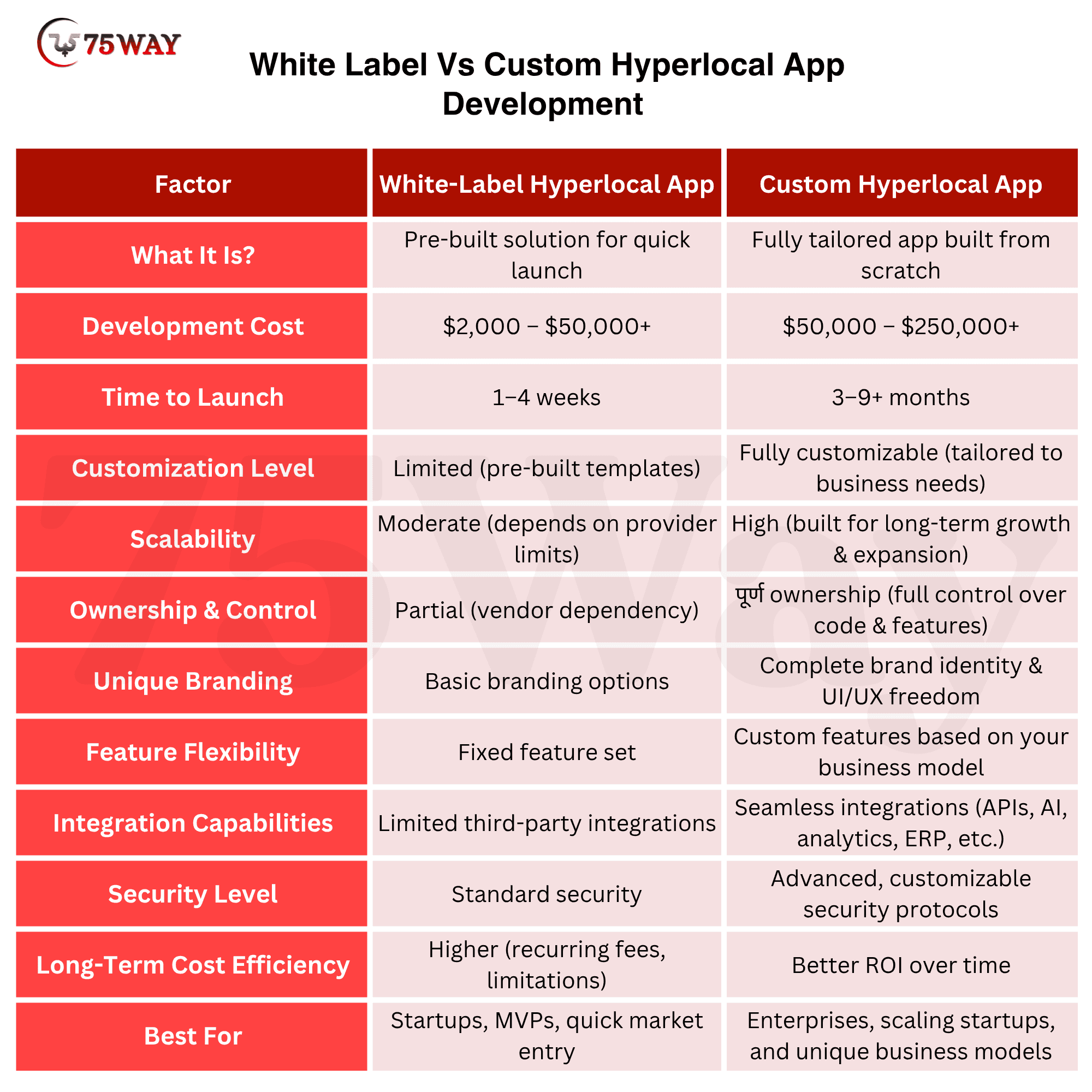
White-label hyperlocal app development is a pre-built solution that can be quickly branded and launched, while custom hyperlocal app development is built entirely from scratch based on specific business requirements and workflows. The key difference lies in flexibility, cost, time, and scalability, where white label focuses on speed and custom focuses on uniqueness and control.
Furthermore, white-label solutions offer faster deployment with limited customization, making them suitable for quick market entry. On the contrary, a custom hyperlocal app provides complete control over features, design, and integrations, supporting long-term scalability and complex business models. Businesses choose based on whether they prioritize speed-to-market or a fully tailored digital ecosystem.
Which One Should You Choose?
The choice between white-label and custom hyperlocal app development depends on your business goals, budget, and long-term vision. If you want to enter the market quickly with lower investment and test your idea, a white-label solution is a practical starting point. It allows faster deployment and helps validate demand without heavy technical complexity.
However, if your goal is to build a scalable, highly customized platform with unique workflows, advanced features, and strong brand differentiation, custom development is the better option. It offers complete control over functionality, user experience, and future scalability, making it ideal for businesses planning long-term growth and market leadership.
Learn More: How to Build a Self Driving Car Software: A Complete Roadmap
Real-World Use Cases of Creating A Hyperlocal Delivery App
Hyperlocal delivery app development services are widely used across industries to enable fast, location-based service delivery and improve customer convenience. Businesses use them to streamline last-mile logistics, connect local vendors with nearby customers, and optimize real-time order fulfillment. These applications are especially effective in sectors requiring quick delivery, high-frequency orders, and strong customer engagement within defined geographic areas.
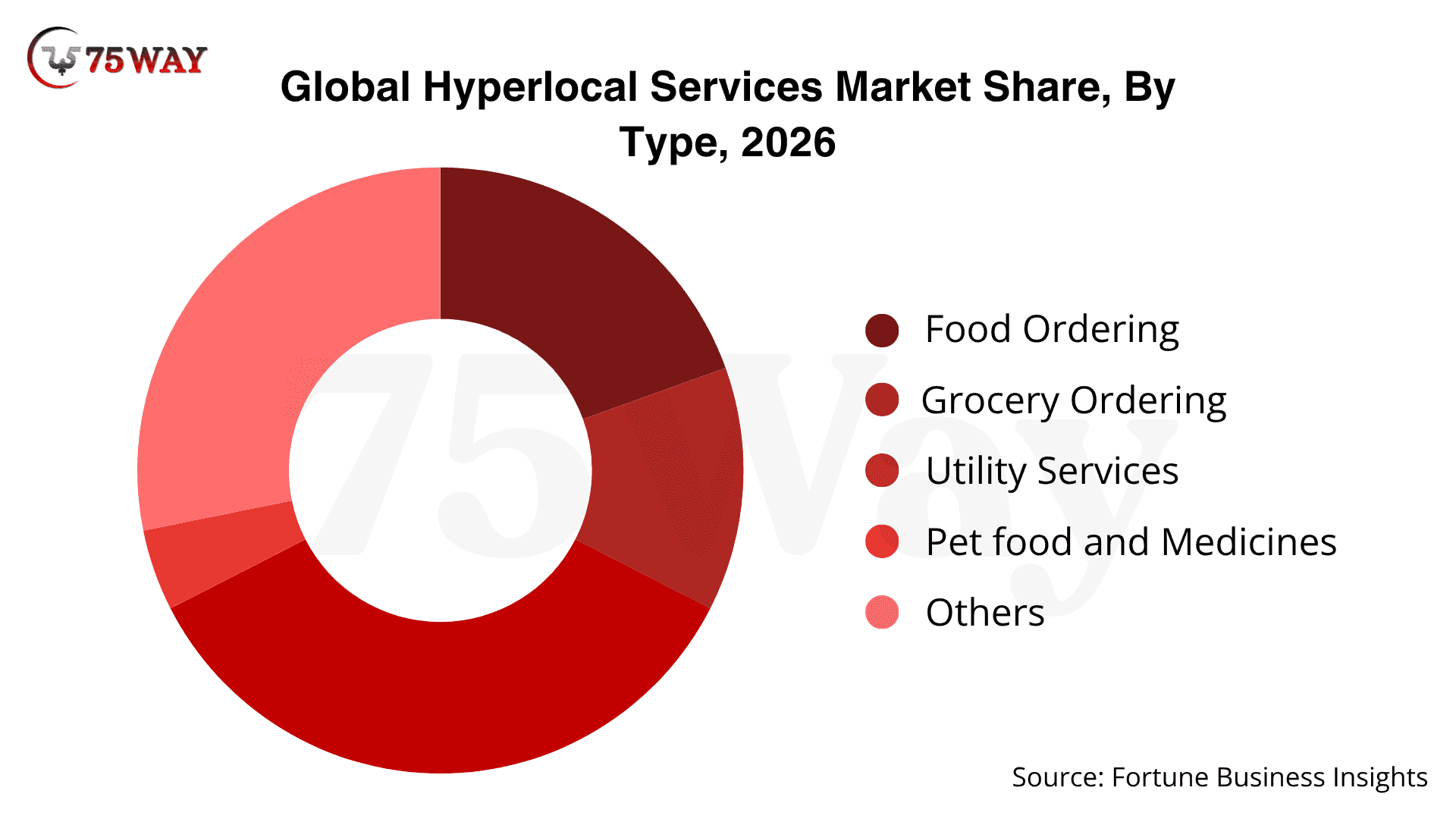
Grocery: Hyperlocal grocery app development solutions enable instant delivery of daily essentials from nearby stores. They help customers avoid store visits, improve stock availability visibility, and allow businesses to manage high-frequency orders efficiently with optimized last-mile delivery systems.
Pharmacy: Pharmacy app development solutions offer fast access to medicines and healthcare essentials within a limited radius. They improve emergency response time, support prescription-based ordering, and help local pharmacies expand reach while maintaining compliance and timely fulfillment.
Food Delivery: Hyperlocal food delivery apps connect users with nearby restaurants for quick meal ordering and delivery. They enhance convenience, increase restaurant visibility, and support real-time order tracking, improving overall dining accessibility and customer satisfaction.
Logistics: Hyperlocal logistics apps manage small parcel and document deliveries within cities. They optimize routing, reduce transit time, and improve operational efficiency for businesses requiring fast, reliable, and cost-effective last-mile delivery solutions.
Multi-Service Apps: Multi-service platforms combine various categories like food, grocery, and courier services in one app. They increase user engagement, provide convenience, and help businesses diversify revenue streams through a unified digital ecosystem.
Utility Services: Utility apps offer on-demand services like plumbing, cleaning, and repairs. They connect users with verified professionals quickly, improving service accessibility and ensuring faster problem resolution within local areas.
Pet Food & Medicines: These apps ensure the timely delivery of pet essentials, food, and medicines. They help pet owners manage urgent needs efficiently while improving the availability of specialized products through nearby stores and service providers.
Read More: Best iOS App Development Companies in USA Founders Must Know
What’s The Cost of Hyperlocal Delivery App Development?
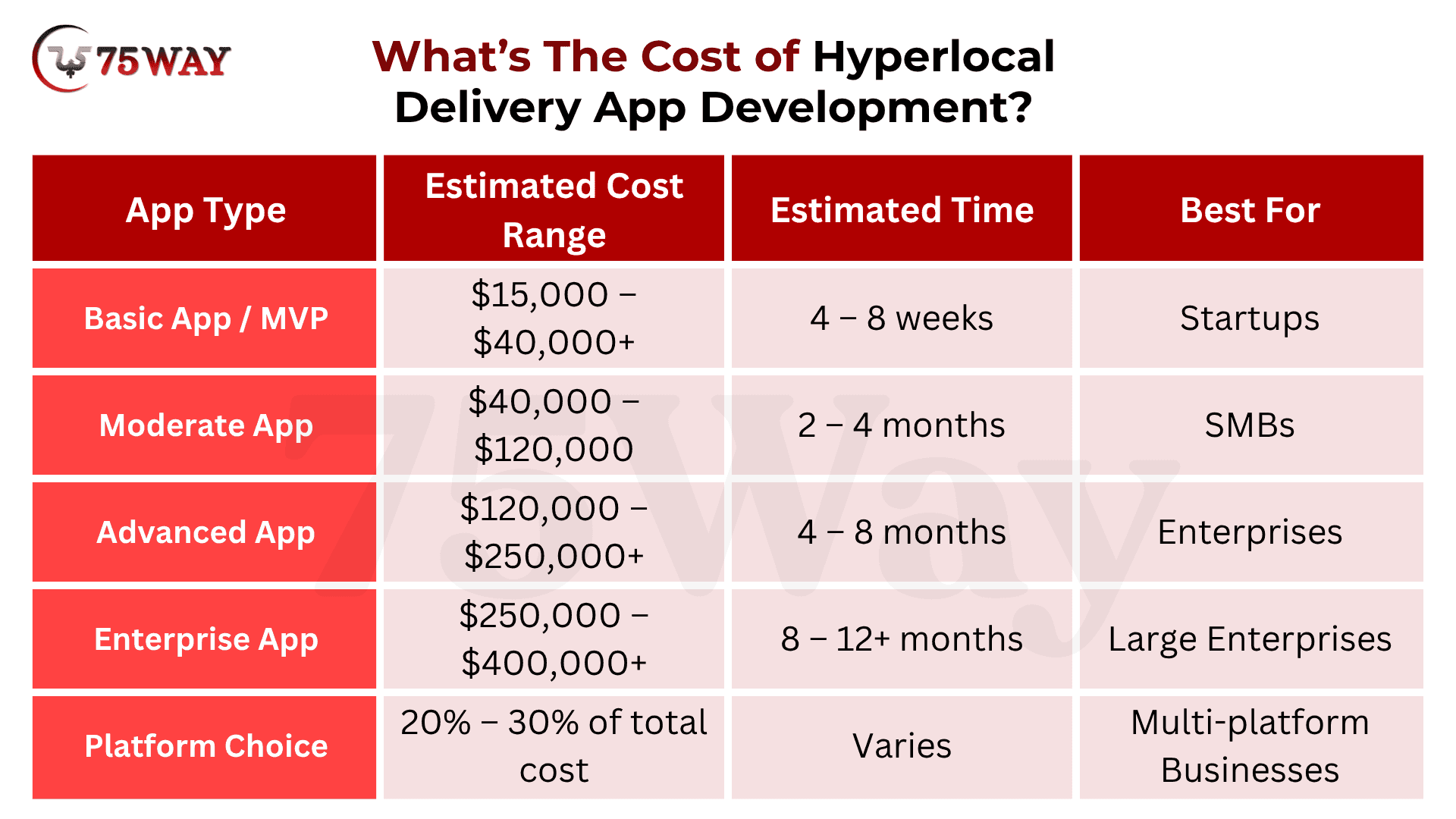
The hyperlocal delivery app development cost varies based on business requirements, feature complexity, technology stack, and scalability needs. Since it involves building multiple interconnected systems like customer apps, vendor panels, delivery partner apps, and an admin dashboard, the overall investment depends on how advanced and customized the platform is.
Basic App/MVP Hyperlocal Delivery App Cost: $15,000 – $40,000+
A Basic App or MVP is designed to validate the business idea with essential features like user registration, ordering, basic tracking, and payment integration. It focuses on quick market entry with limited complexity and core functionality. Estimated timeline: 4 – 8 weeks.
Moderate Hyperlocal Delivery App Cost: $40,000 – $120,000
A Moderate App includes advanced user experience, better UI/UX, multi-vendor support, enhanced tracking, and basic automation features. It is suitable for growing businesses that need improved performance and scalability. Estimated timeline: 2 – 4 months.
Advanced Hyperlocal Delivery App Cost: $120,000 – $250,000+
An Advanced App is a fully-featured solution with real-time tracking, AI-driven logistics, advanced analytics, multiple integrations, and optimized performance. It supports high traffic and complex operations. Estimated timeline: 4 – 8 months.
Enterprise Hyperlocal Delivery App Cost: $250,000 – $400,000+
An Enterprise App is a large-scale platform built for multi-city or global operations with high scalability, automation, AI systems, and robust infrastructure. It ensures maximum performance, security, and reliability. Estimated timeline: 8 – 12+ months.
Hourly Cost of Developing Hyperlocal Delivery App by Region
USA / North America: $80 – $150/hr
Higher development costs reflect advanced expertise, strong infrastructure, and premium service quality. This region is ideal for complex AI chat applications that require high performance, faster delivery, and enterprise-level support.
Western Europe: $60 – $100/hr
A balanced combination of cost and quality makes this region suitable for scalable AI projects. Strong technical standards and reliable communication ensure consistent development, making it a preferred choice for mid to large-scale applications.
UK: $70 – $85/hr
Moderate pricing with high-quality development practices defines this region. It is well-suited for businesses that require structured project management, regulatory compliance, and dependable delivery for AI chat app development.
Eastern Europe / Latin America: $30 – $50/hr
This region offers cost-effective development supported by skilled professionals. It is ideal for startups and growing businesses looking to build quality AI chat apps while maintaining budget efficiency and flexibility.
South Asia / India: $20 – $40/hr
Highly affordable development rates with access to a large talent pool. This region is best for startups and businesses aiming to reduce costs while building scalable AI chat applications with flexible engagement models.
Key Factors That Impact Cost To Build A A Hyperlocal Delivery App
Complexity: $30,000 – $400,000+
Basic MVP applications with essential panels cost significantly less compared to advanced apps with AI and analytics. Increasing complexity directly raises development time, technical requirements, and overall investment needed for scalable performance.
App Components: Major Cost Share
Core components such as real-time tracking, payment gateways, and backend systems consume a large portion of the budget. These elements define functionality, performance, and integration capabilities, making them critical to overall development cost.
UI/UX Design: $10,000 – $40,000+
Custom design, animations, and high-end user interfaces significantly increase costs. A well-crafted UI/UX improves engagement, usability, and brand perception, making it a valuable investment for better user retention and conversion rates.
Development Team: Varies by Region
The structure and location of your development team influence overall costs. Hiring experienced developers or agencies ensures better quality and faster delivery, while different regions offer varying pricing models based on expertise and availability.
Read Too: Best AI Development Companies in United States in 2026
Challenges in Hyperlocal App Development With Solutions
Hyperlocal app development involves challenges like real-time coordination, delivery delays, scalability issues, and integration complexities. However, these can be resolved through efficient architecture, AI-based automation, cloud infrastructure, and optimized logistics planning. A well-structured approach helps businesses maintain performance, reduce operational friction, and ensure a smooth user experience across all service layers.
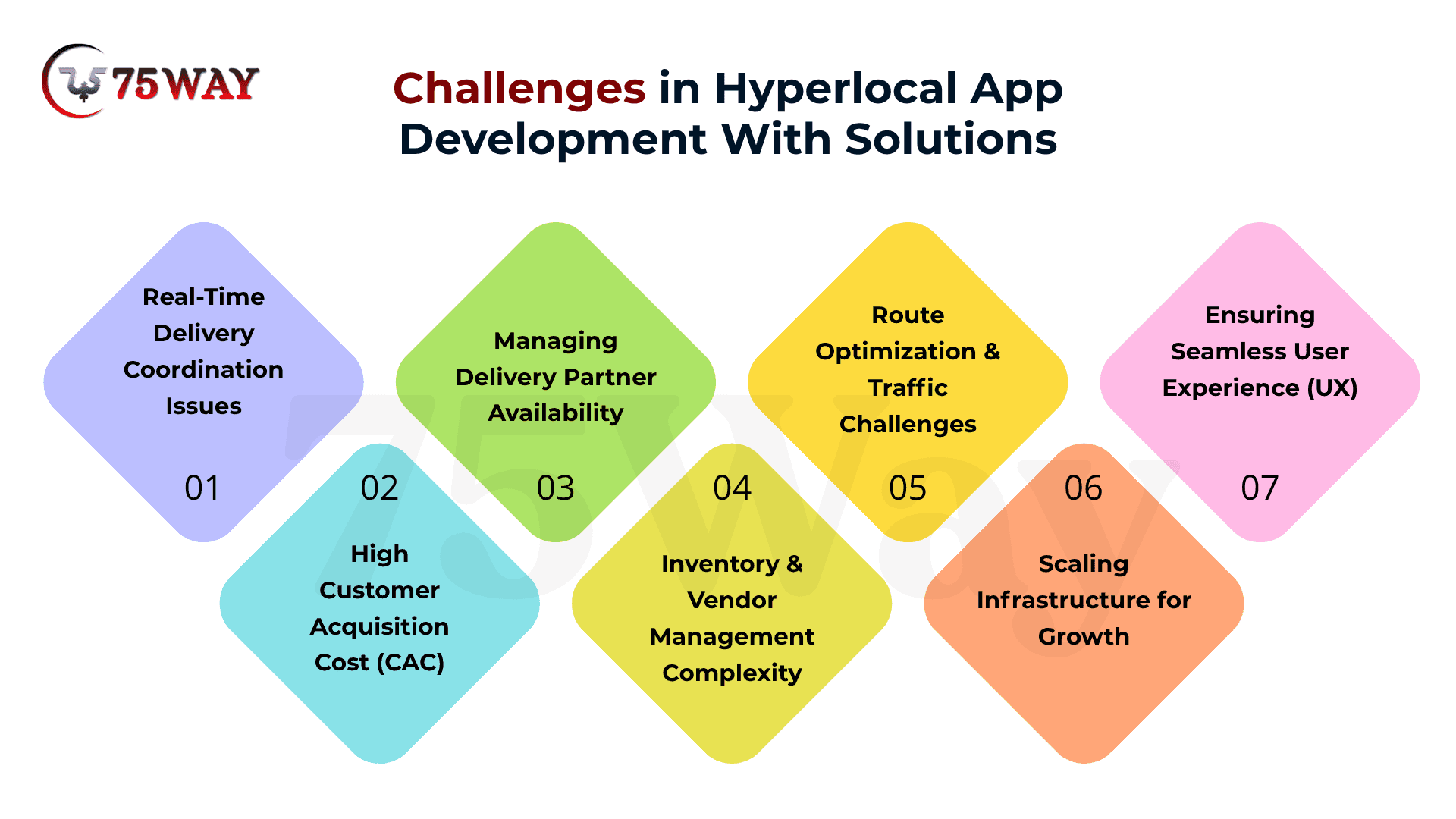
Real-Time Delivery Coordination Issues: Real-time coordination between customers, vendors, and delivery partners becomes difficult during peak demand situations. Automated order routing systems combined with live tracking mechanisms help reduce delays, improve communication flow, and maintain consistent delivery accuracy across all operations.
High Customer Acquisition Cost (CAC): Increasing competition and rising digital ad expenses often result in higher customer acquisition costs for hyperlocal platforms. Strong organic strategies such as referrals, SEO optimization, and retention-focused engagement reduce dependency on paid campaigns and improve long-term profitability.
Managing Delivery Partner Availability: Delivery partner shortages during peak hours can disrupt service efficiency and delay order fulfillment. Intelligent scheduling systems, incentive-based engagement programs, and real-time availability tracking maintain balanced workforce distribution across different locations and time slots.
Inventory & Vendor Management Complexity: Multiple vendors operating simultaneously create challenges in maintaining accurate inventory and order synchronization. Centralized dashboards with automated stock updates help reduce inconsistencies, improve fulfillment accuracy, and streamline vendor coordination within the platform ecosystem.
Route Optimization & Traffic Challenges: Traffic congestion and inefficient routing significantly impact delivery speed and operational efficiency. AI-based navigation systems and real-time traffic analysis improve route planning, reduce travel time, and enhance overall logistics performance.
Scaling Infrastructure for Growth: Rapid user growth places heavy pressure on system performance and backend infrastructure. Cloud-based architecture and modular system design ensure smooth scalability, stable performance, and uninterrupted service during high-demand conditions and multi-region expansion.
Ensuring Seamless User Experience (UX): Poor navigation flow and slow interface response reduce user engagement and satisfaction. Clean UI design, optimized loading speed, and simplified user journeys improve usability, increase conversions, and enhance overall platform retention rates.
Read Too: How to Build A Social Media App Like Upscrolled: 2026 Playbook
Monetization Strategies For Hyperlocal Delivery Apps
Hyperlocal delivery apps generate revenue through multiple structured income streams that balance customer affordability with business profitability. The most common approach includes charging commissions on each order placed through the platform, along with delivery fees based on distance, demand, and urgency. These models ensure consistent earnings while maintaining competitive pricing for users.
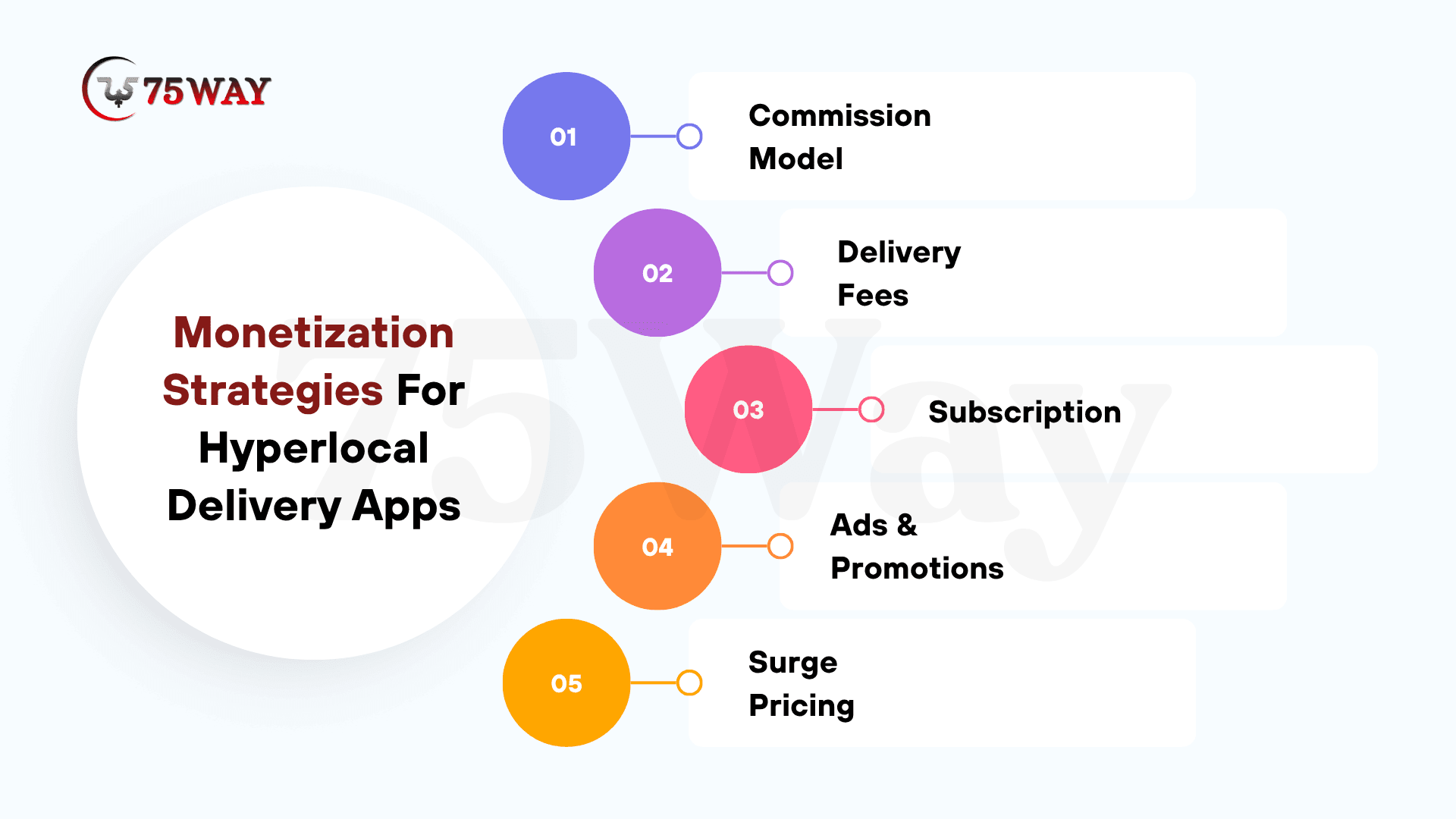
Commission Model: Revenue generation through the commission model depends on charging a fixed percentage on every successful order placed via the platform. It creates a scalable income stream as order volume increases and aligns platform growth with vendor success, ensuring consistent profitability without direct product ownership or inventory management.
Delivery Fees: Earnings through delivery fees are collected from customers based on distance, time, or order value. It helps cover logistics costs while generating additional revenue per transaction, ensuring financial balance between operational expenses and service efficiency across different delivery zones.
Subscription Model: Recurring subscription plans offered to vendors or customers provide predictable monthly or yearly revenue. Vendors benefit from enhanced visibility and platform tools, while customers may receive perks like free delivery or exclusive discounts, increasing long-term engagement and loyalty.
Ads & Promotions: Revenue from ads and promotions comes from allowing local businesses to feature their listings or run targeted campaigns within the app. It increases vendor visibility while creating a steady income stream for the platform through paid placements and promotional visibility.
Surge Pricing: Dynamic pricing during peak demand periods increases delivery charges based on availability and order intensity. It balances supply and demand efficiently while maximizing revenue opportunities during high-traffic hours without affecting overall service quality.
How to Choose the Right Hyperlocal Delivery App Development Company?
Selecting the right development partner is critical for building a scalable and high-performing hyperlocal delivery platform. Businesses should evaluate companies based on their technical expertise, industry experience, portfolio quality, and ability to deliver multi-panel systems such as customer apps, vendor apps, delivery apps, and admin dashboards. A strong company should also demonstrate capability in real-time tracking, API integrations, cloud infrastructure, and scalable architecture.
It is equally important to assess their understanding of business models, UI/UX design approach, post-launch support, and ability to build future-ready solutions. The right partner should not only develop the app but also guide you through product strategy, scalability planning, and performance optimization to ensure long-term success in a competitive market.
75way Technologies specializes in building end-to-end hyperlocal delivery app solutions tailored for startups and enterprises. With expertise in custom app development, real-time logistics systems, AI-powered features, and scalable cloud architecture, the team focuses on creating high-performance platforms that support rapid growth. Their approach combines strong technical execution with business-driven strategy to help clients launch, scale, and optimize successful hyperlocal ecosystems.
Final Thoughts
Hyperlocal delivery app development is transforming the way local commerce operates by enabling faster, more efficient, and technology-driven service delivery. From grocery and food delivery to logistics and on-demand services, businesses are adopting hyperlocal models to meet rising customer expectations for speed and convenience. A well-planned strategy covering features, technology stack, monetization, and scalability is essential to building a successful platform. To stay competitive, businesses must focus on user experience, real-time operations, AI-powered automation, and strong vendor ecosystems. Choosing the right hyperlocal delivery app development company further ensures long-term growth and stability. With the right execution, a hyperlocal delivery app can become a powerful revenue-generating platform that scales across regions and industries effectively.
Frequently Asked Questions (FAQs)
How Does A Hyperlocal Delivery App Improve Customer Experience?
Hyperlocal delivery apps enhance customer experience by enabling fast deliveries, real-time tracking, and easy access to nearby vendors. Users enjoy seamless ordering, multiple payment options, and accurate ETAs. Personalized recommendations and transparent communication increase trust, reduce waiting uncertainty, and create a smooth, convenient, and highly responsive shopping experience.
What Makes Hyperlocal Delivery Different From Traditional Delivery Models?
Hyperlocal delivery focuses on fulfilling orders within a small geographic radius using nearby vendors, while traditional delivery models often rely on centralized warehouses and longer delivery routes. This localized approach significantly reduces delivery time and improves service efficiency, especially for time-sensitive products like food and groceries.
Unlike traditional systems, hyperlocal platforms operate in real-time with dynamic order matching between customers, vendors, and delivery partners. This enables faster fulfillment, better inventory utilization, and improved customer satisfaction. Traditional models are more rigid and slower, whereas hyperlocal systems are flexible, scalable, and designed for instant commerce.
How Do Hyperlocal Apps Ensure Real-Time Tracking Accuracy?
Hyperlocal apps ensure tracking accuracy through GPS integration, live location updates, and continuous data syncing between delivery partners and servers. Advanced mapping APIs and traffic analysis improve ETA precision. Cloud systems process real-time movement instantly, allowing customers to track deliveries with reliable, up-to-date, and transparent location information.
Can Hyperlocal Delivery Apps Support Multi-Vendor Businesses?
Yes, hyperlocal delivery apps efficiently support multi-vendor businesses by allowing multiple sellers to operate on a single platform. Each vendor manages inventory, pricing, and orders through dedicated dashboards. This structure increases product variety, improves operational efficiency, and enables businesses to scale without owning inventory while ensuring smooth coordination.
What Role Does AI Play In Hyperlocal Delivery Apps?
AI enhances hyperlocal apps by enabling demand forecasting, smart dispatch, fraud detection, and personalized recommendations. It optimizes routes, improves ETA accuracy, and automates decision-making. AI reduces operational costs, increases efficiency, and helps businesses deliver faster, more reliable, and data-driven services across the entire delivery ecosystem.
How Can Businesses Scale Their Hyperlocal Delivery Operations Effectively?
Businesses scale hyperlocal operations using cloud infrastructure, modular architecture, and automated logistics systems. Strong vendor networks, optimized delivery management, and data analytics support expansion. AI-driven automation and continuous performance optimization ensure stable operations, enabling businesses to grow across multiple regions while maintaining efficiency, speed, and service quality.