Summary
Businesses can develop advanced chatbot and AI receptionist platforms by partnering with experienced AI engineers. This guide outlines key functions of AI receptionists, their strategic advantages for modern organisations, and the essential steps involved in building such systems. It also discusses customization options and important implementation considerations.
Key Points:
- AI receptionists automate customer communication and ensure businesses never miss calls or enquiries.
- Conversational AI platforms provide 24/7 support and handle multiple interactions simultaneously.
- AI engineers build platforms integrating chatbots, voice agents, CRM systems, and scheduling tools.
- Custom AI solutions improve customer experience with faster responses and personalized interactions.
- Proper implementation, testing, and data privacy practices ensure reliable and scalable AI systems.
Missed calls are no longer just a minor inconvenience. They directly impact business revenue and customer trust. Studies show that nearly 88% of customers are less likely to return after experiencing poor service or delayed responses. In today’s fast-paced digital environment, businesses cannot afford to miss enquiries, bookings, or support requests. This is why many organisations are investing in AI voice agent development to ensure every customer interaction is handled efficiently. Unlike traditional reception systems that rely on limited human availability, AI-powered voice agents can answer calls 24/7, handle multiple conversations simultaneously, and deliver instant responses without delays.
Businesses implementing AI-powered reception systems have reported up to an 80% reduction in response times while improving overall customer satisfaction. Custom AI receptionists built by experienced developers can integrate with CRMs, scheduling tools, and business workflows, making communication seamless. Rather than replacing human staff, these systems support teams by managing repetitive enquiries and ensuring no opportunity is missed. This guide explains how businesses can build an advanced chatbot and AI receptionist platform by hiring skilled AI engineers.
What is an AI Chatbot and AI Receptionist Platform?
An AI chatbot is software that simulates human conversations using natural language processing and machine learning. It understands user queries, provides instant responses, and learns from interactions to improve over time. These AI chatbot development solutions can handle everything from simple FAQs to complex customer service scenarios, enabling businesses to automate support, improve response times, and deliver consistent communication without constant human intervention.
An AI receptionist platform extends this capability specifically for front-desk operations. Unlike general conversational AI, it's designed to greet visitors, schedule appointments, answer phone calls, transfer enquiries to the right departments, and manage basic administrative tasks, all whilst maintaining a professional, brand-aligned tone.
The key difference lies in specialisation. Whilst standard chatbots handle text-based exchanges on websites, AI receptionists manage multi-channel communication, including voice calls, SMS, and live chat, simultaneously. Research shows that 64% of businesses view 24/7 service availability as the primary advantage of conversational AI, making these platforms indispensable for businesses that can't afford to miss opportunities outside traditional office hours.
Why Businesses Are Switching to AI Receptionists?
Businesses are rapidly adopting AI receptionist technology to address growing customer service demands and reduce missed opportunities. Traditional reception systems often struggle with limited availability, high call volumes, and inconsistent service quality. AI receptionists solve these challenges by providing instant responses, handling multiple conversations simultaneously, and ensuring consistent communication at any time of day. By automating call handling and customer interactions, companies can improve response speed, enhance customer experience, and capture more leads without increasing operational costs or staffing limitations.
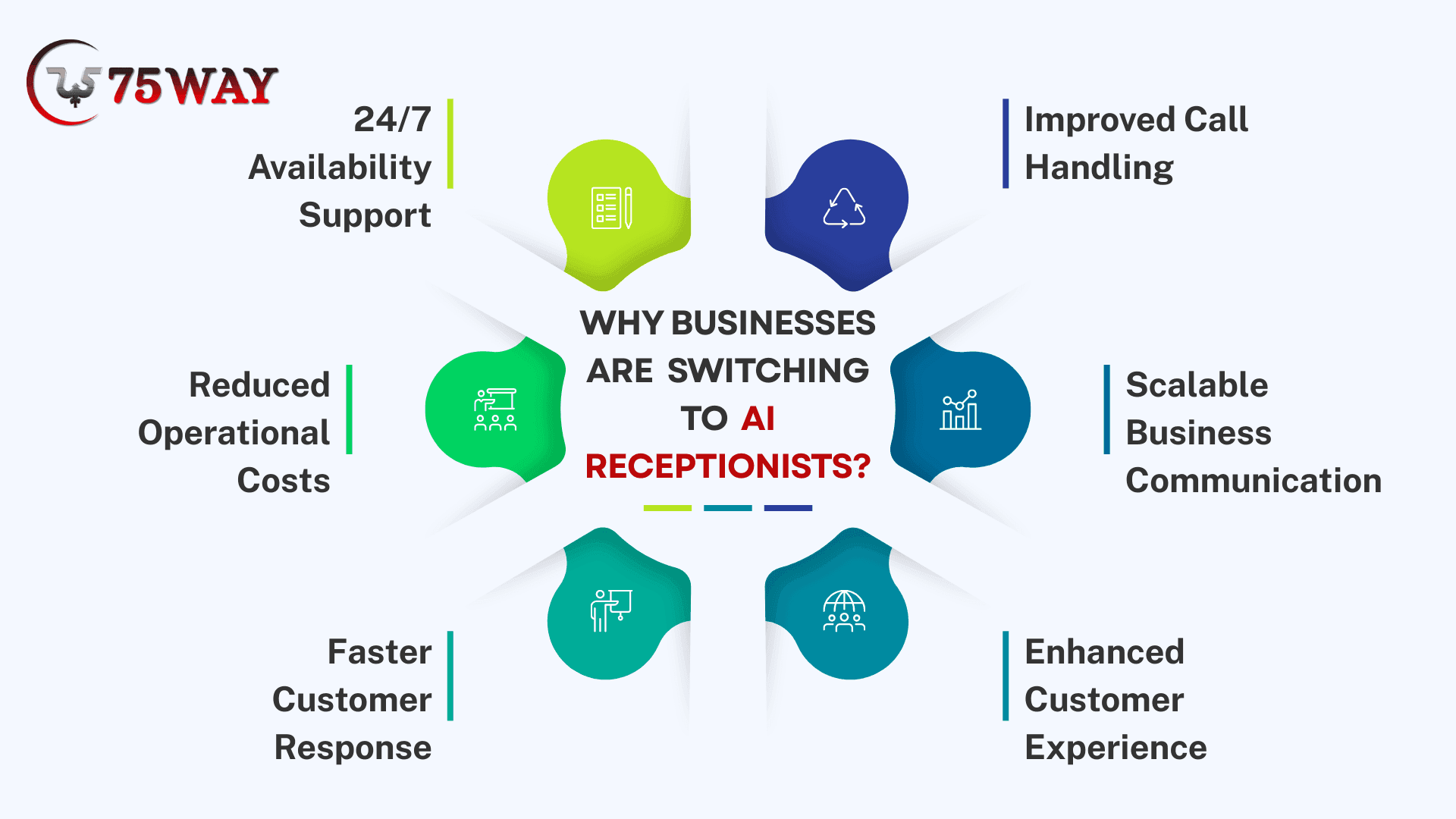
24/7 Availability Support
AI receptionists provide round-the-clock availability, ensuring businesses never miss customer calls or enquiries. They operate continuously without breaks, holidays, or time limitations, allowing companies to serve global customers anytime.
Reduced Operational Costs
AI receptionists help businesses reduce operational expenses by automating call handling and routine enquiries. Companies can minimise staffing costs while maintaining efficient customer service without increasing human workforce requirements.
Faster Customer Response
AI reception systems instantly respond to customer enquiries without waiting time. By processing multiple requests simultaneously, businesses deliver faster assistance, improving response speed and preventing potential customers from switching to competitors.
Improved Call Handling
AI receptionists manage high volumes of calls efficiently by understanding customer intent and routing conversations appropriately. This reduces call congestion, improves organisation, and ensures customers reach the correct department quickly.
Scalable Business Communication
As businesses grow, AI receptionists easily scale to manage increasing call volumes. They can handle hundreds of conversations simultaneously without affecting service quality or requiring additional infrastructure or staff.
Enhanced Customer Experience
AI receptionists deliver consistent, accurate, and personalised interactions for every caller. By understanding customer needs and providing quick solutions, businesses improve satisfaction, build trust, and strengthen long-term customer relationships.
Core Functions of Modern AI Receptionists
Modern AI receptionists combine advanced NLP, intelligent call routing, and system integrations to manage business communications efficiently. These systems understand customer intent, respond conversationally, and direct enquiries to the right departments automatically. By integrating with calendars, CRMs, and scheduling tools, AI receptionists streamline appointment booking, retrieve customer history, and maintain consistent service quality. They also include human escalation protocols for complex cases, ensuring businesses benefit from both automation efficiency and personalised support when required.
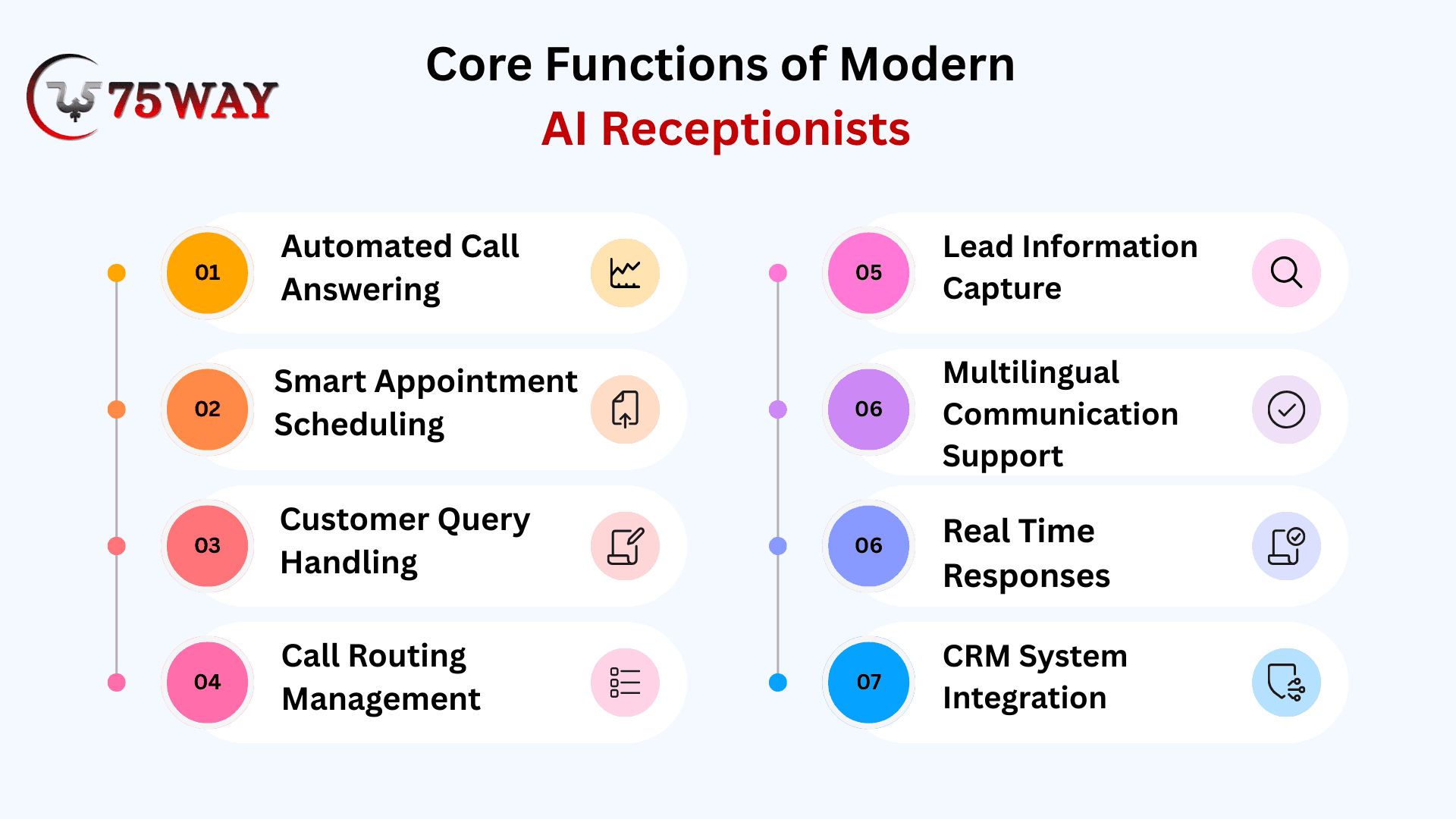
Automated Call Answering
Automated call answering allows AI receptionists to instantly pick up incoming calls without delays or missed connections. Using natural language processing, the system understands caller intent and responds conversationally. Businesses benefit from consistent call handling, reduced waiting times, and improved customer satisfaction. This automation ensures every call is addressed promptly while freeing human staff to focus on complex tasks.
Smart Appointment Scheduling
Smart appointment scheduling enables AI receptionists to manage bookings efficiently by accessing calendars and checking availability in real time. The system can schedule, modify, or cancel appointments based on customer requests. It also sends automated confirmations and reminders to reduce no-shows. This feature improves organisation, saves time for staff, and ensures customers receive quick and convenient booking experiences.
Customer Query Handling
AI receptionists can answer common customer questions instantly by analysing intent and retrieving relevant information from business databases. Whether customers ask about services, pricing, or support issues, the system provides quick and accurate responses. By handling routine queries automatically, businesses reduce the workload on support teams and ensure customers receive timely assistance without long waiting periods.
Call Routing Management
Call routing management ensures that incoming calls are directed to the appropriate department or team member based on the caller’s needs. AI receptionists analyse conversation context and identify the correct destination for each query. This intelligent routing reduces transfer errors, improves efficiency, and ensures customers reach the right person quickly, creating a smoother and more professional communication experience.
Lead Information Capture
AI receptionists can collect valuable customer details during conversations, including names, contact information, service requirements, and enquiry purpose. This data is automatically recorded and stored in business systems for follow-ups and marketing activities. By capturing leads efficiently, businesses can improve conversion rates, track potential opportunities, and ensure no valuable customer enquiry is missed.
Multilingual Communication Support
Multilingual communication support allows AI receptionists to interact with customers in multiple languages, helping businesses serve diverse audiences. The system automatically detects or switches languages during conversations, making communication easier for international clients. This capability improves accessibility, enhances customer satisfaction, and enables companies to expand their services globally without hiring multilingual support teams.
Real Time Responses
Real time responses ensure customers receive immediate answers to their queries without delays. AI receptionists process requests instantly and provide relevant information within seconds. This quick response capability improves customer engagement, reduces waiting times, and prevents frustration caused by slow service. Businesses benefit from faster communication while maintaining consistent and reliable support at all times.
CRM System Integration
CRM system integration allows AI receptionists to connect with customer relationship management platforms to access and update client information automatically. During conversations, the system can retrieve customer history, log interactions, and record new details. This integration helps businesses personalise customer communication, maintain organised records, and streamline workflows across sales, support, and customer service operations.
Step-by-Step: How to Build an AI Receptionist Platform?
Building an AI receptionist platform requires a structured approach that begins with identifying business needs such as call handling, appointment scheduling, or customer support. The next step involves selecting the right AI technologies or platforms to develop the system efficiently. Developers then train the AI with real conversation data to understand customer intent and industry terminology. Integration with CRMs, calendars, and communication tools ensures seamless workflow. Thorough testing and gradual deployment help improve accuracy, performance, and overall customer experience.
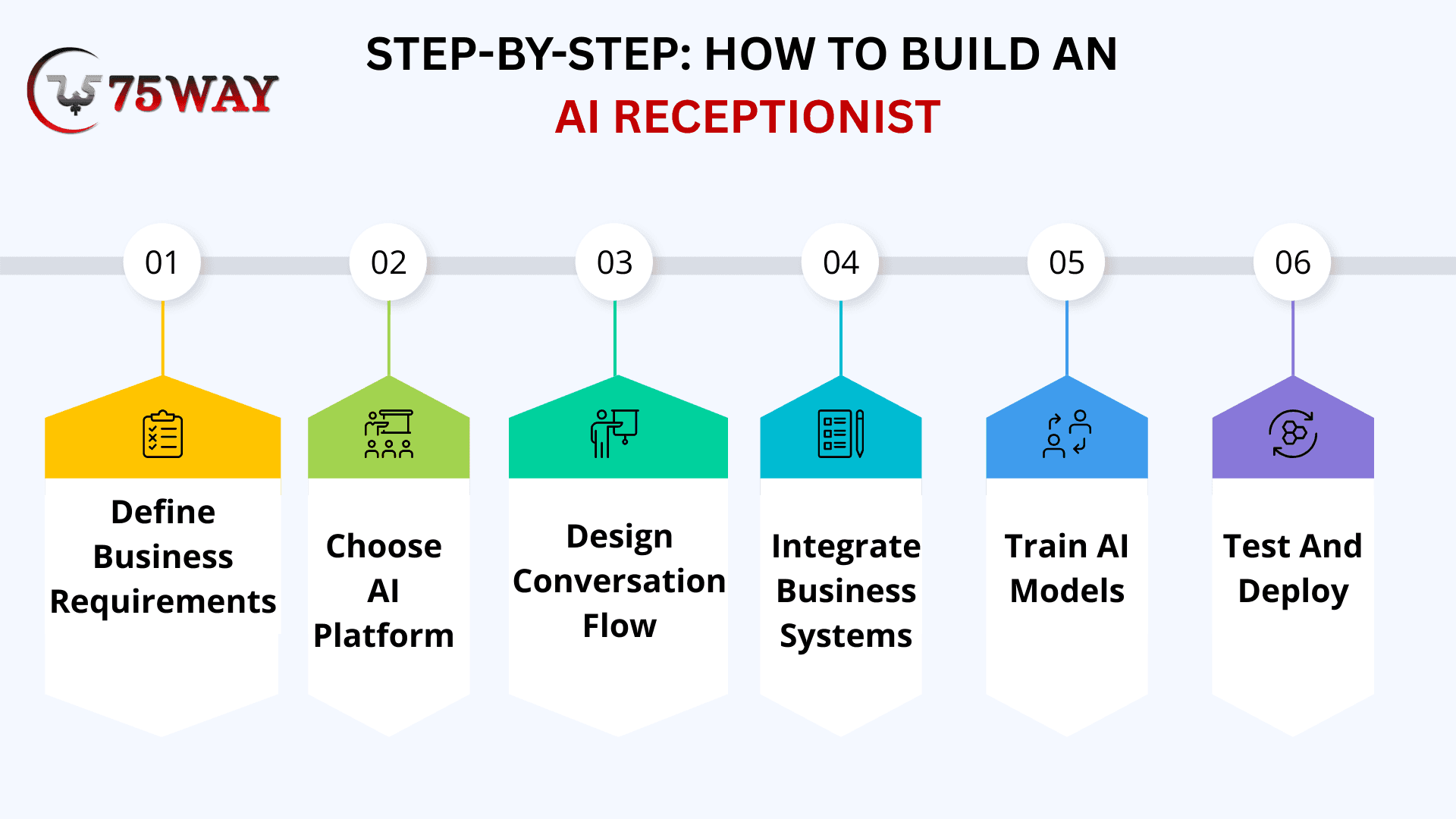
Define Business Requirements
Start by identifying the main goals of your AI receptionist, such as handling calls, scheduling appointments, answering FAQs, or routing enquiries. Clear requirements help determine the features, integrations, and automation level needed for effective customer communication.
Choose AI Platform
Select the right AI technology or platform to build your receptionist. Businesses can choose custom development frameworks or ready-made AI tools depending on scalability, budget, and functionality requirements for voice recognition, natural language processing, and automation.
Design Conversation Flow
Create structured conversation paths that guide how the AI interacts with callers. This includes greeting messages, question handling, decision points, and escalation options. A well-designed flow ensures smooth, natural conversations and accurate responses.
Integrate Business System
Connect the AI receptionist with essential tools such as CRM systems, calendars, booking software, and communication platforms. Integration ensures the AI can access real-time data, manage appointments, log interactions, and support seamless business operations.
Train AI Models
Train the AI using real conversation data, industry terminology, and common customer queries. Continuous learning helps the system understand intent, improve accuracy, and deliver more relevant responses over time.
Test And Deploy
Before launching, thoroughly test the AI receptionist using various customer scenarios and edge cases. After refining performance, deploy the system gradually while monitoring results to ensure reliability, accuracy, and positive customer experiences.
How to Customize the Voice and Personality of Your AI?
Personality customization transforms generic AI into a brand representative that reinforces your company identity. What typically happens is that businesses overlook this critical step, launching receptionists who sound robotic or misaligned with their culture.
Define your brand voice attributes first, professional versus casual, warm versus efficient, formal versus friendly. Your AI engineer then translates these into specific language patterns, response structures, and conversational styles. For example, a law firm needs measured, precise language, whilst a creative agency can embrace playful, energetic dialogue.
Voice selection extends beyond accent and tone. Modern platforms offer vocal characteristics, including pace, pitch variation, and emotional inflection. A common pattern is testing 3-4 voice options with actual team members, measuring which feels most authentic to your brand.
Personality parameters include proactivity level (how often the AI offers unsolicited help), humour tolerance (whether it uses light jokes), and empathy expression (how it acknowledges customer emotions). These settings create consistency across thousands of interactions whilst maintaining natural conversation flow.
The technical implementation involves prompt engineering, crafting detailed instructions that guide AI behaviour. However, avoid over-engineering personality; what typically happens is that excessive constraints make responses feel stiff. Balance structure with conversational flexibility, allowing your AI to adapt naturally whilst staying within brand guidelines.
Limitations and Considerations
AI receptionists offer many benefits, but businesses must consider certain limitations before implementation. These systems may struggle with complex emotional interactions, require high-quality training data, and involve initial setup efforts. Proper data privacy measures and human oversight are essential to ensure accuracy, maintain service quality, and handle situations where human judgment is still necessary.
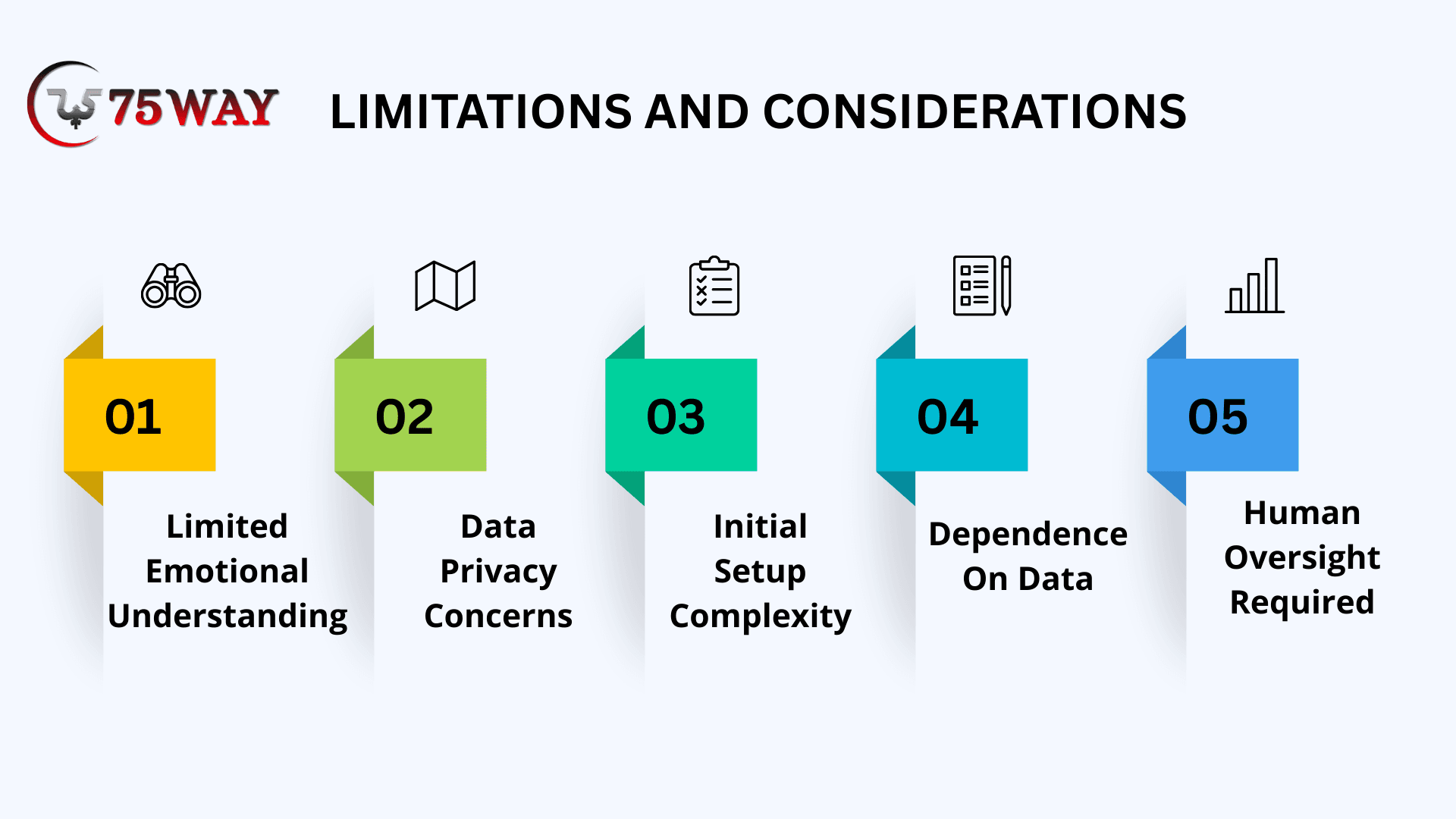
Limited Emotional Understanding
AI receptionists can understand language and intent but may struggle with emotional nuance or complex human sentiments. Sensitive conversations sometimes require human empathy, making human escalation important for certain customer interactions.
Data Privacy Concerns
AI systems often process customer data, including personal information and conversation history. Businesses must implement strong data protection measures, comply with privacy regulations, and ensure secure storage and handling of customer information.
Initial Setup Complexity
Setting up an AI receptionist requires planning, training data, and integration with existing systems. Businesses may need technical expertise to configure workflows, ensure accurate responses, and align the system with operational requirements.
Dependence On Data
AI performance heavily depends on the quality and quantity of training data. Poor or incomplete data can reduce accuracy and lead to incorrect responses, making continuous data improvement essential for reliable performance.
Human Oversight Required
Despite automation capabilities, AI receptionists still require human supervision to monitor performance, handle complex situations, and ensure accurate decision-making. Human involvement helps maintain service quality and prevents potential errors
Key Takeaways
Building an advanced AI receptionist platform requires strategic technical decisions and realistic expectations about capabilities and limitations. What typically happens is that businesses underestimate the complexity of creating systems that genuinely enhance customer experience whilst maintaining operational reliability.
The foundation lies in selecting appropriate AI frameworks and integration patterns. Research shows that 55% of businesses using conversational AI report improved customer satisfaction, but this depends entirely on implementation quality. Your platform needs robust NLU capabilities, seamless CRM connectivity, and comprehensive testing protocols before deployment.
However, success extends beyond the initial build. Continuous data refinement, regular model updates, and human oversight remain essential for sustained performance. The technology cannot function as a truly autonomous solution. It requires ongoing investment in both technical infrastructure and quality assurance processes.
The competitive advantage comes from differentiating your offering through specialisation, whether that's industry-specific workflows, advanced analytics capabilities, or superior integration ecosystems. The AI receptionist market continues expanding, with opportunities for businesses that approach development methodically rather than rushing to market with half-baked solutions.
Conclusion
Building an advanced AI receptionist platform represents a significant opportunity for businesses seeking to modernise customer engagement whilst reducing operational overhead. What typically happens is that organisations approaching this challenge underestimate the complexity involved—assuming that conversational AI is simply about deploying a chatbot template. In reality, creating a system that handles nuanced conversations, integrates seamlessly with existing infrastructure, and maintains brand voice requires strategic technical expertise and ongoing refinement.
The strategic decision isn't whether to implement AI receptionist capabilities—it's whether to invest in building a genuinely advanced platform that delivers measurable business value. This requires partnering with experienced AI engineers who understand both the technical foundations and the practical realities of deploying conversational systems at scale. The difference between a basic chatbot and a sophisticated AI receptionist lies in architectural decisions, training methodology, and integration depth—elements that directly impact your platform's ability to handle complex customer interactions and evolve alongside your business requirements.
Frequently Asked Questions
What's The Development Timeline For An AI Receptionist Platform?
A minimum viable product typically requires 8-12 weeks for development, testing, and initial deployment. Complex platforms with multiple integrations, custom voice recognition, and multilingual support may extend to 16-20 weeks. However, what typically happens is that successful platforms launch with core features first, then iterate based on real user feedback rather than attempting to build every feature upfront.
Can AI Receptionists Handle Multiple Languages Simultaneously?
Modern AI receptionist platforms support multilingual conversations through language detection and switching capabilities. Advanced systems can identify the caller's language within the first few seconds and respond appropriately. The quality depends significantly on your training data and NLP model selection—some languages require more extensive training datasets than others for optimal performance.
What Accuracy Rate Should I Expect From An AI Receptionist?
Professional AI receptionist platforms typically achieve 85-95% accuracy in understanding caller intent and providing appropriate responses. Research shows that conversational AI systems continue improving through machine learning, with accuracy rates increasing as the system processes more interactions. On the other hand, accuracy varies significantly based on industry terminology, accent diversity, and conversation complexity—medical practices may experience different accuracy patterns than retail businesses.
How Do I Ensure Data Privacy And Compliance?
Implement end-to-end encryption for all conversations, secure data storage with access controls, and ensure compliance with GDPR, CCPA, and industry-specific regulations. Your AI engineer should design the system with privacy-by-default principles, including automatic data retention policies, consent management, and audit logging. What typically happens is that businesses require legal review of data handling practices before launching customer-facing AI systems.