AI Summary
Pet care app development enables you to create digital platforms that simplify pet services and improve owner experiences. These apps connect pet parents with veterinarians, caregivers, and service providers. A successful pet care application requires thoughtful features, technology, and user-focused design. This guide explains the complete development journey. It covers costs, benefits, features, and future opportunities.
Key Takeaways
- Pet care apps simplify pet services through digital platforms and automation.
- Modern pet applications connect owners, veterinarians, and caregivers.
- Successful pet care app development requires strategic features and planning.
- AI technology enhances personalization, tracking, and pet health management.
- Businesses can scale revenue through innovative pet app solutions.
Around 67% of U.S. households own at least one pet, according to APPA. Pet owners today expect the same level of convenience for their pets that they already experience in other parts of their lives.
Booking a vet visit, scheduling grooming, ordering pet supplies, or tracking pet health should not require multiple calls, apps, or disconnected services. For businesses, this creates a strong opportunity to build a pet care app that brings essential services together in one platform.
The challenge is not simply creating another booking app. It is designing a pet care app development solution that supports pet owners, service providers, and business operations through a seamless digital experience.
Pet care business owners often have questions like, “How do I develop a pet care mobile app?” “Which features should I include?” and “How much does custom pet care app development cost?” before turning their idea into a successful digital platform.
This guide explains everything about pet care app development, including key features, the pet care veterinary app development process, technology requirements, costs, and important considerations for businesses planning to enter the growing pet care market.
Market Size & Revenue Potential of Pet Care Mobile Apps in USA
Pet care apps are becoming a valuable business opportunity as more owners prefer convenient digital services for their pets. The market data below explains why this space is attracting entrepreneurs and businesses looking for scalable revenue opportunities.
- The global pet care apps market is expected to reach $4.7 billion by 2034, growing at a CAGR of 5.9%, as stated in USD Analytics.
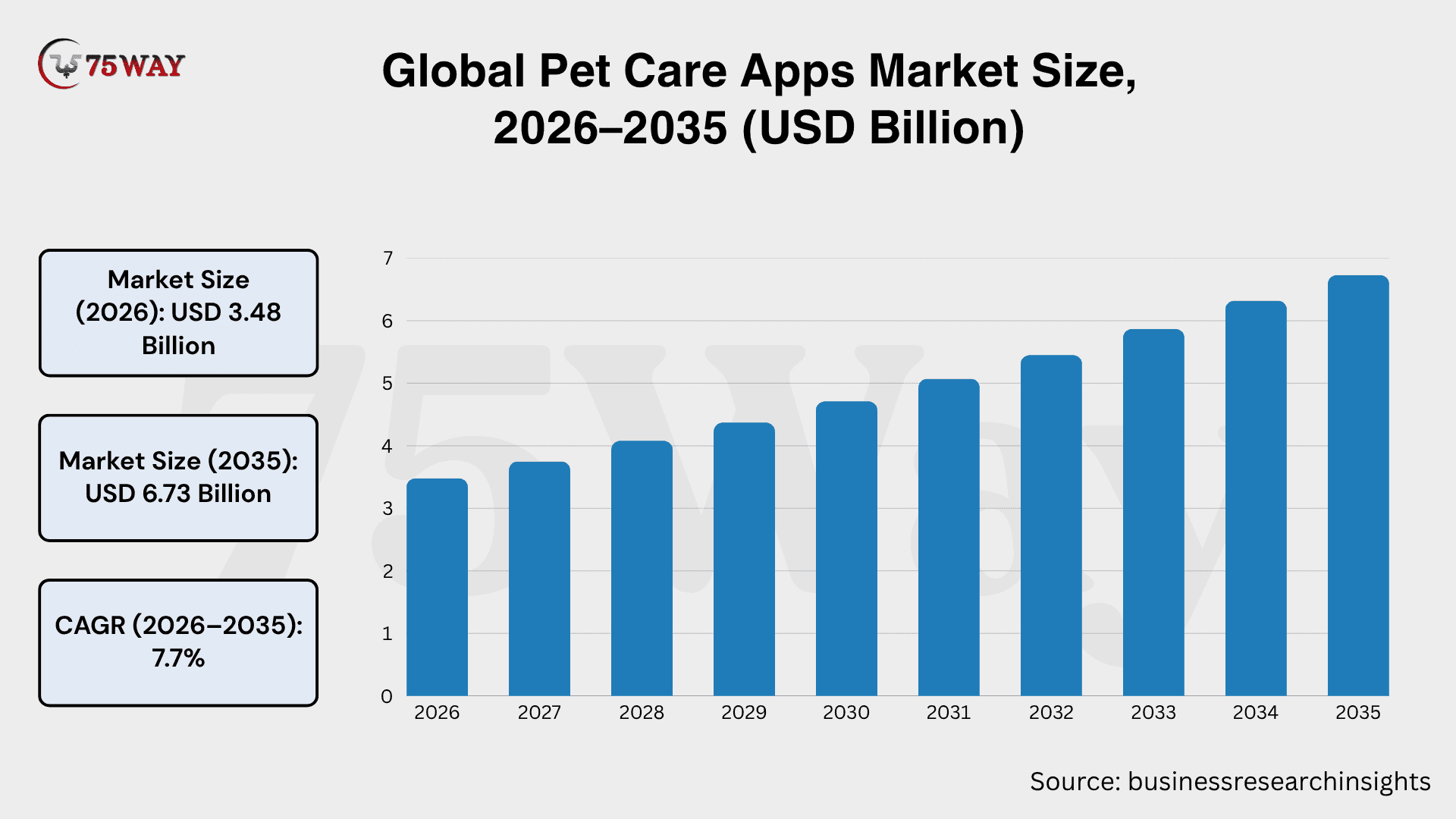
- Moreover, the pet care apps market is projected to grow from $3.48 billion in 2026 to $6.73 billion by 2035, at a CAGR of 7.7%, as per a Business Research Insights report.
- North America leads the pet care apps market with approximately 45% of the global share.
- Around 35% of pet app users utilize wearable device integration and telemedicine features.
- According to Fortune Business Insights, North America accounted for 42.09% of the global mobile pet care market in 2025.
- The dogs segment is expected to hold the largest share, accounting for 57.14% of the market in 2026.
- The medical care segment is projected to contribute 74.73% of the global mobile pet care market in 2026.
What Is Pet Care App Development?
Pet care app development involves creating a mobile app that helps pet owners better care for their animals and makes everyday tasks easier to manage. From booking a vet appointment to tracking vaccinations or finding a nearby groomer, these apps bring important pet services together in one convenient place.
Think about a pet owner who needs to remember a vaccination date, schedule a health checkup, order food, or find someone to walk their dog while they are away. Instead of using multiple websites or contacting multiple service providers, a pet care app gives them a simple way to manage these needs on their phone.
For businesses, a pet care app is more than just a service platform. It creates a direct connection with customers, helps manage operations efficiently, and opens new ways to offer services such as online consultations, subscriptions, pet products, and personalized care plans.
Today’s advanced pet care apps are also becoming smarter with technologies like AI, GPS, and data analytics. For example, an app can use a pet’s health records, activity patterns, and previous information to provide useful reminders or recommendations. Location-based features can also help owners quickly find nearby veterinarians, trainers, groomers, and pet care providers when they need support.
Why Building A Pet Care App Is A Smart Investment In 2026?
The pet care industry has moved beyond basic services. Pet owners increasingly treat their pets as family members and are willing to invest in solutions that improve their health, comfort, and overall lifestyle. This changing behavior has increased demand for digital pet care platforms that offer convenience and personalized services. Businesses investing in pet care app development can benefit from:
- Growing Digital Pet Care Demand: Pet owners prefer mobile solutions that allow them to schedule appointments, track health information, order products, and communicate with professionals from anywhere.
- Better Customer Engagement: A dedicated pet care app keeps businesses connected with customers through reminders, notifications, personalized recommendations, and loyalty programs.
- Multiple Revenue Opportunities: Pet care applications can generate income through subscription plans, service commissions, premium features, advertisements, and partnerships with pet brands.
- Improved Business Operations: Apps help automate repetitive tasks such as appointment scheduling, customer management, payments, and service tracking, reducing manual workload.
- Competitive Advantage: A well-designed pet care application helps businesses stand out in a competitive market by offering convenient and technology-driven experiences.
Why Businesses Are Choosing AI-Powered Pet Care App Development?
The growing demand for personalized pet services has changed how businesses approach customer relationships. Traditional pet care providers often depend on physical visits and manual communication, which limits scalability.
A mobile pet care solution allows businesses to provide services beyond physical locations. Customers can book appointments, receive health updates, communicate with experts, and manage their pet’s information anytime.
For startups, pet care apps create opportunities to enter niche markets with innovative solutions such as:
- AI-powered pet health assistants
- Virtual veterinary consultation platforms
- Pet activity tracking applications
- Smart feeding and medication reminder apps
- Pet community and social networking platforms
For established businesses, these applications improve customer retention by creating a connected ecosystem around pet care services.
Different Types of Pet Care Apps You Can Build For Your Business
Not every pet care app needs to solve the same problem. The best pet care app idea depends on the services you want to offer and the problems you want to solve for pet owners. Here are the different types of pet care apps businesses can develop to create valuable digital experiences.
1. Veterinary Telemedicine Apps
These apps allow pet owners to consult veterinarians remotely through video calls, chats, and digital health records. They help clinics provide faster support for common concerns while giving pet owners convenient access to professional advice without always visiting a physical location. Platforms like Vetster have shown the growing demand for virtual veterinary care in the U.S.
Estimated Development Cost: $40,000–$120,000
2. Pet Health Monitoring Apps
Pet health apps help owners keep track of important wellness information such as vaccinations, medications, weight changes, and medical history. These platforms create a complete health record that makes it easier to monitor long-term care and share accurate information with veterinarians when needed. Apps like Pawprint demonstrate how digital records can simplify pet healthcare management.
Estimated Development Cost: $35,000–$100,000
3. On-Demand Pet Service Marketplace Apps
These platforms connect pet owners with service providers for activities such as dog walking, grooming, pet sitting, and training. Similar to other marketplace models, users can discover trusted professionals, compare services, and schedule appointments through a single application. The success of Rover highlights the opportunity in connecting pet owners with local caregivers.
Estimated Development Cost: $60,000–$180,000
4. Pet Adoption Apps
Pet adoption apps simplify the process of finding pets and connecting with shelters, rescue organizations, and potential adopters. These platforms create a smoother adoption journey by helping users discover available animals and communicate with organizations from one place. Services like Petfinder have helped make online pet adoption more accessible across the U.S.
Estimated Development Cost: $40,000–$120,000
5. Pet Food And Product Delivery Apps
These apps allow customers to purchase pet food, medicines, accessories, and other essentials online. Businesses can improve customer loyalty by offering convenient ordering, repeat purchases, and personalized product suggestions based on pet needs. Companies like Chewy have built strong digital experiences around convenient pet shopping and home delivery.
Estimated Development Cost: $50,000–$150,000
6. Pet Social Networking Apps
Pet social apps focus on creating communities where owners can share experiences, post pet content, exchange advice, and connect with other animal lovers. These platforms build stronger emotional connections with users by turning pet ownership into a social experience. Apps like Petzbe show how pet-focused communities can increase engagement beyond traditional services.
Estimated Development Cost: $40,000–$120,000
7. AI-Powered Pet Care Assistant Apps
AI-based pet apps provide personalized support by helping owners understand behavior patterns, track wellness changes, and receive instant answers to common pet care questions. These solutions can combine pet information, user interactions, and health data to deliver smarter recommendations. AI-driven platforms such as TTcare represent the growing use of artificial intelligence in pet wellness.
Estimated Development Cost: $70,000–$200,000
8. Pet Training Apps
Pet training apps help owners improve their pets’ behavior through structured lessons, training programs, and expert guidance. These platforms are especially valuable for new pet owners who need simple, step-by-step support for obedience training and behavioral improvement. Applications like Dogo provide digital training programs that owners can follow at their own pace.
Estimated Development Cost: $30,000–$100,000
9. Pet Insurance Apps
Pet insurance applications help owners manage coverage, submit claims, access policy details, and handle healthcare expenses digitally. These apps make insurance processes easier while helping companies provide faster customer support and better policy management. Digital platforms from companies like Trupanion show how technology can simplify pet insurance experiences.
Estimated Development Cost: $60,000–$180,000
10. Pet Travel And Boarding Apps
These apps support pet owners who need reliable solutions for travel, boarding, transportation, and temporary care. Users can find suitable services, make reservations, and manage pet care arrangements when they are away from home. Platforms like Wag! highlight the demand for convenient digital pet care services.
Estimated Development Cost: $50,000–$150,000
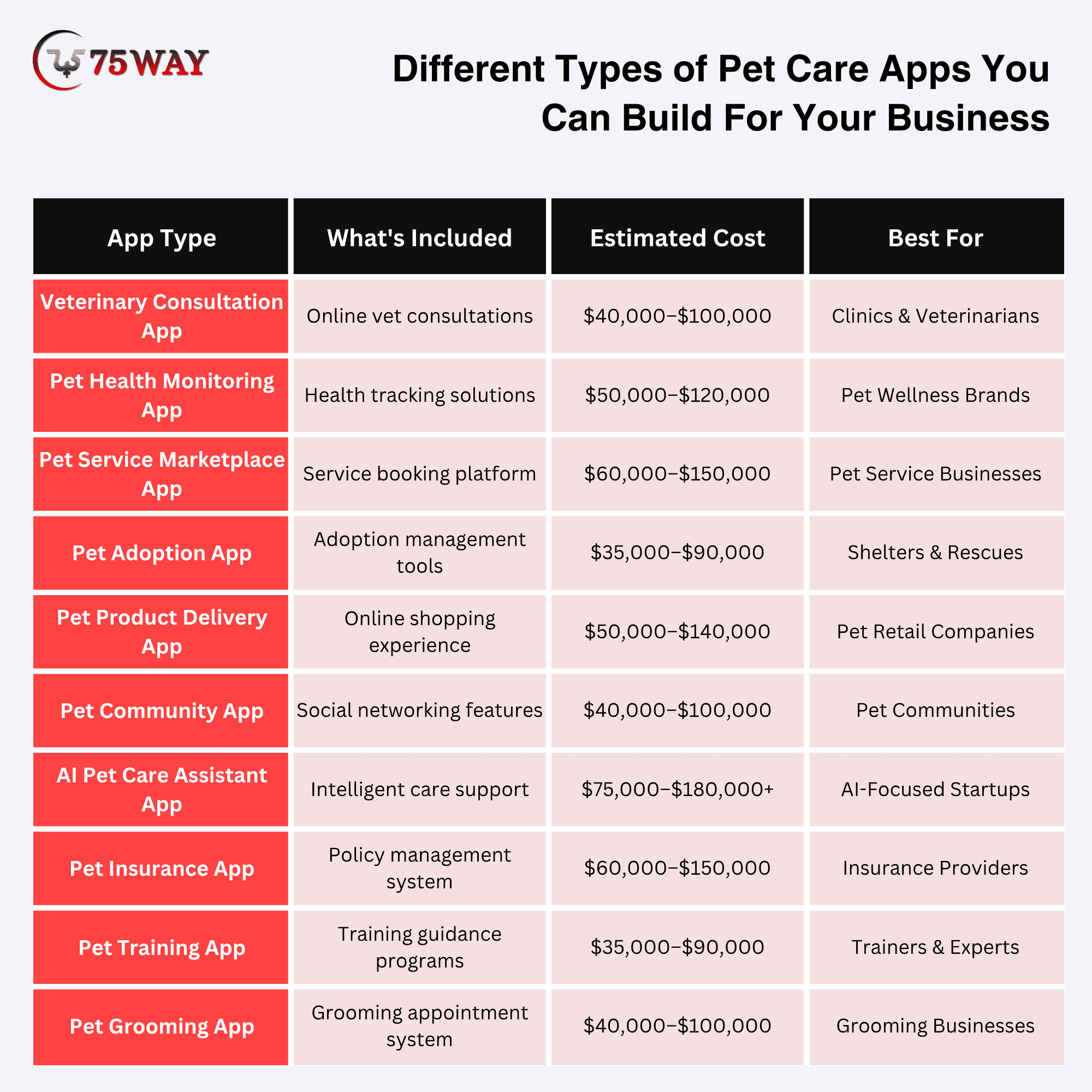
The best pet care app idea depends on your business objectives, customer requirements, and available resources.
Before starting development, businesses should evaluate:
- Who will use the app?
- What problem does it solve?
- Which services create the highest value?
- How will the application generate revenue?
- What features are essential for the first version?
A focused approach helps create a scalable pet care application instead of an app overloaded with unnecessary features. Businesses can begin with core functionalities and gradually introduce advanced solutions based on customer feedback and market demand.
Must-Have Features For Successful Pet Care App Development
A successful pet care app needs to make everyday pet management easier for owners while helping businesses deliver better services. The features below explain what businesses should include to create a useful, engaging, and scalable pet care platform.
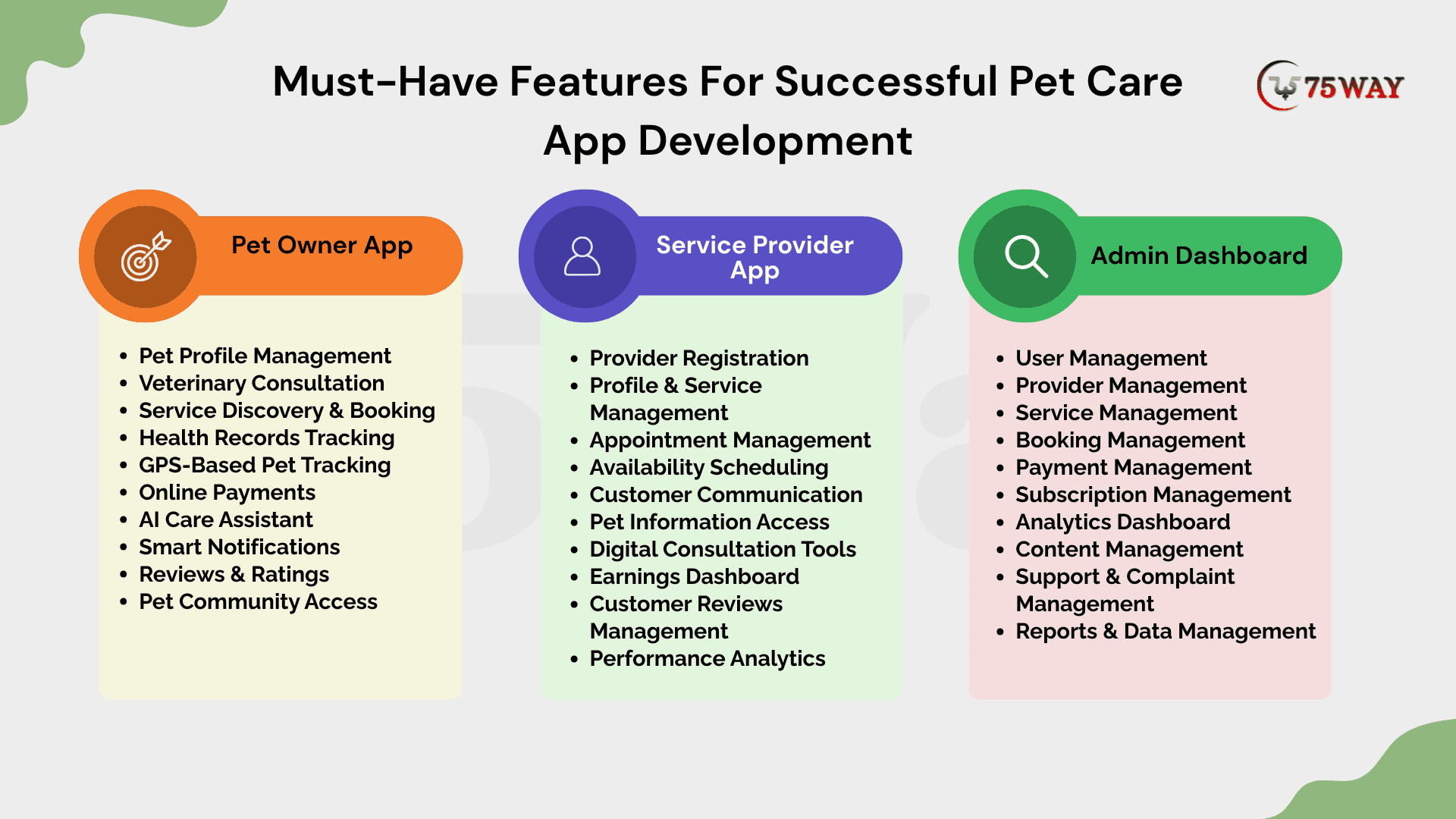
1. Pet Owner App or Customer Module
The pet owner app is the primary interface where users manage their pets, discover services, schedule appointments, and access personalized care solutions. The goal of this module is to make pet care simple, convenient, and accessible from a single platform.
- Pet Profile Management: Allows users to create detailed profiles for multiple pets, including breed, age, medical history, allergies, vaccination details, and daily care preferences.
- Veterinary Consultation: Enables pet owners to connect with veterinarians through video calls, chats, and online consultations without visiting a clinic for every concern.
- Service Discovery And Booking: Helps users find and book pet services such as grooming, walking, training, boarding, and healthcare appointments based on availability and location.
- Health Records Tracking: Allows owners to store and manage vaccination records, medication details, health reports, and veterinary history for better long-term pet care.
- GPS-Based Pet Tracking: Provides location tracking features that help owners monitor pets during walks, outdoor activities, or through connected smart devices.
- Online Payments: Supports secure payment options for consultations, bookings, subscriptions, and pet products through cards, wallets, and digital payment methods.
- AI Care Assistant: Uses artificial intelligence to provide personalized suggestions related to pet health, nutrition, behavior, reminders, and general care questions.
- Smart Notifications: Sends timely alerts for vaccinations, medications, appointments, service updates, and personalized pet care recommendations.
- Reviews And Ratings: Allows users to share feedback and rate veterinarians, groomers, trainers, and other service providers to improve trust within the platform.
- Pet Community Access: Creates a space where pet owners can connect, share experiences, access expert advice, and engage with other pet lovers.
2. Service Provider App or Veterinarian / Groomer / Trainer Module
The service provider app helps veterinarians, groomers, trainers, walkers, and other professionals manage their services efficiently. It allows providers to handle appointments, communicate with customers, track earnings, and deliver better pet care experiences.
- Provider Registration: Allows professionals to create accounts, submit verification details, and build trusted profiles for offering pet-related services.
- Profile And Service Management: Enables providers to update their experience, services, pricing, availability, service areas, and professional information.
- Appointment Management: Helps providers view, accept, reject, reschedule, and manage upcoming customer bookings from one dashboard.
- Availability Scheduling: Allows professionals to set working hours, update availability, block unavailable dates, and manage their service calendar.
- Customer Communication: Provides direct messaging options that help providers discuss pet requirements, share updates, and answer customer questions.
- Pet Information Access: Allows providers to view relevant pet details, health records, and care requirements before delivering services.
- Digital Consultation Tools: Supports online veterinary sessions through video calls, chats, and digital document sharing for remote consultations.
- Earnings Dashboard: Helps providers track completed services, payments received, commissions, and overall income performance.
- Customer Reviews Management: Allows professionals to view feedback, respond to reviews, and improve service quality based on customer experiences.
- Performance Analytics: Provides insights into bookings, customer engagement, service trends, and business growth opportunities.
3. Admin Dashboard or Business Management Module Features
The admin dashboard gives businesses complete control over their pet care platform. It helps manage customers, service providers, transactions, content, and overall operations from a centralized system.
- User Management: Allows administrators to monitor customer accounts, manage profiles, handle issues, and maintain platform security.
- Provider Management: Helps verify service providers, review documents, manage approvals, and monitor provider performance.
- Service Management: Enables admins to add, update, organize, and control different pet care services available on the platform.
- Booking Management: Provides complete visibility into appointments, cancellations, service status, and overall booking activity.
- Payment Management: Allows businesses to monitor transactions, manage commissions, process refunds, and track financial activities.
- Subscription Management: Helps manage premium plans, recurring payments, membership benefits, and user subscription activities.
- Analytics Dashboard: Provides real-time insights into revenue, user growth, bookings, provider performance, and customer behavior.
- Content Management: Allows admins to update blogs, educational resources, promotional content, and in-app information.
- Support And Complaint Management: Helps businesses handle customer issues, provider disputes, feedback, and service-related concerns.
- Reports And Data Management: Generates detailed reports related to operations, financial performance, customer activity, and platform growth.
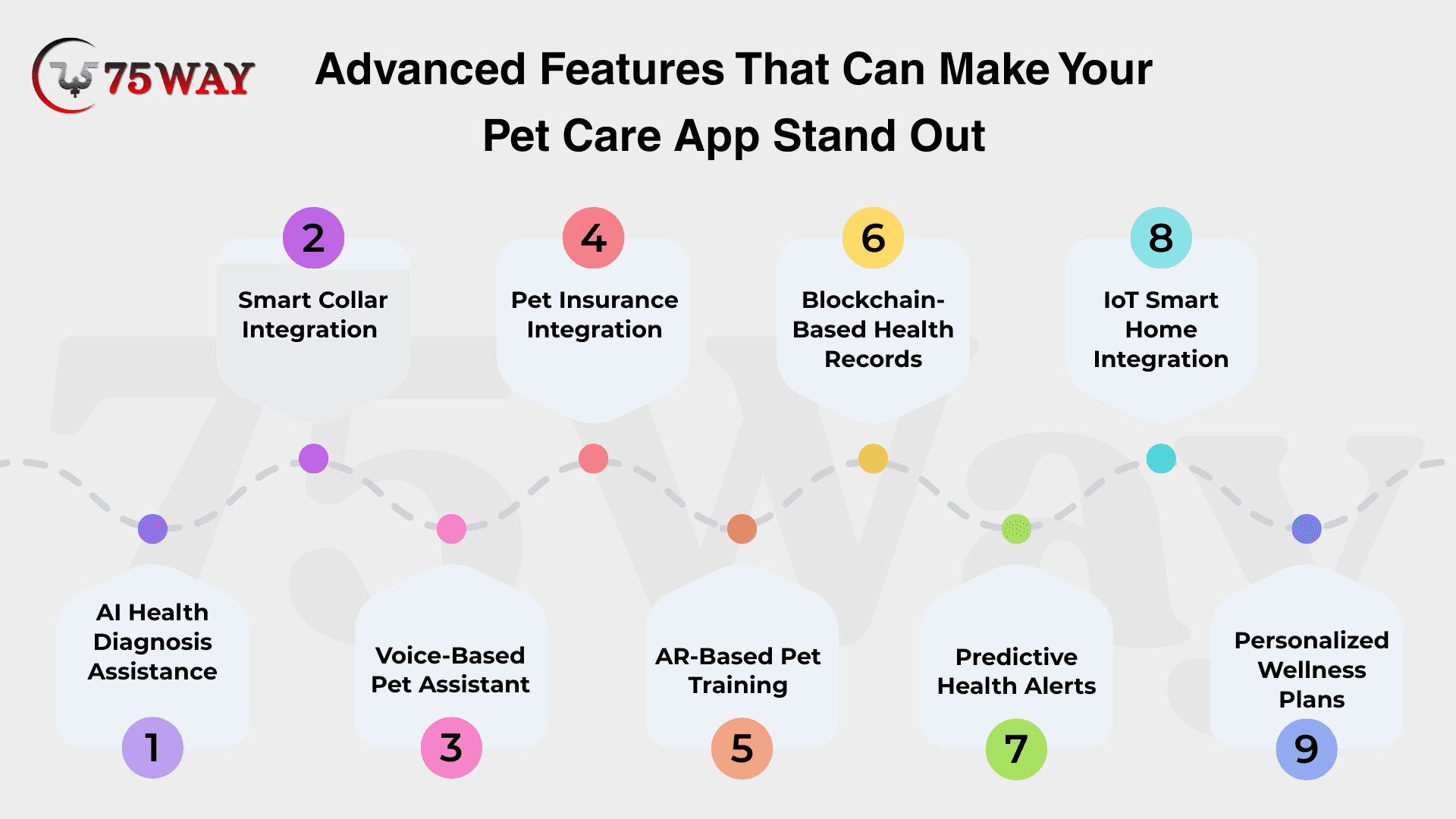
Advanced Features That Can Make Your AI-Powered Pet Care App Development Solution Stand Out
As pet owners become more technology-driven, advanced features can help businesses create a smarter and more personalized pet care experience. These innovations not only improve convenience for users but also help apps stand apart in a competitive market.
- AI Health Diagnosis Assistance
AI disease diagnosis tools can analyze symptoms, behavior patterns, and stored health information to provide early care suggestions for pet owners. While it does not replace veterinarians, it helps users understand potential concerns and decide when professional support may be needed.
- Smart Collar Integration
Smart collar connectivity allows pet care apps to collect real-time data about a pet’s location, activity levels, sleep patterns, and daily behavior. This information helps owners monitor their pets’ wellness and identify unusual changes quickly.
- Voice-Based Pet Assistant
Voice assistants make pet care management easier by allowing users to ask questions, set reminders, and access information through simple voice commands. This creates a more natural and convenient way for owners to interact with the application.
- Pet Insurance Integration
Insurance integration allows users to explore coverage options, manage policies, and access claim-related services without leaving the app. Pet insurance app creates a complete pet care ecosystem by connecting healthcare services with financial protection.
- AR-Based Pet Training
Augmented reality can turn traditional pet training into an interactive digital experience by guiding owners through activities and exercises. This feature makes learning more engaging while helping users improve their pets’ behavior through visual instructions.
- Blockchain-Based Health Records
Blockchain technology can create secure and tamper-resistant pet health records that can be shared with authorized veterinarians and service providers. This improves data transparency and ensures important medical information remains accurate and accessible.
- Predictive Health Alerts
By analyzing historical health records, activity patterns, and wearable data, the app can identify unusual trends before they become serious concerns. Early alerts encourage pet owners to seek veterinary care sooner, improving preventive healthcare.
- IoT Smart Home Integration
The IoT-powered apps can connect with smart pet feeders, automatic water dispensers, cameras, and pet doors to manage daily routines remotely. Owners can monitor and control essential pet care activities even when they are away from home.
- Personalized Wellness Plans
Every pet has unique needs based on its breed, age, lifestyle, and medical history. The app can create customized nutrition plans, exercise routines, vaccination schedules, and wellness goals that adapt as the pet grows.
- Predictive Health Alerts
By analyzing historical health records, activity patterns, and wearable data, the app can identify unusual trends before they become serious concerns. Early alerts encourage pet owners to seek veterinary care sooner, improving preventive healthcare.
- IoT Smart Home Integration
The app can connect with smart pet feeders, automatic water dispensers, cameras, and pet doors to manage daily routines remotely. Owners can monitor and control essential pet care activities even when they are away from home.
- Personalized Wellness Plans
Every pet has unique needs based on its breed, age, lifestyle, and medical history. The app can create customized nutrition plans, exercise routines, vaccination schedules, and wellness goals that adapt as the pet grows.
Not every pet care app requires every feature from the beginning. Startups often launch a minimum viable product (MVP) with essential functionalities and expand after understanding user behavior. A successful app development strategy focuses on solving customer problems first, then adding advanced technologies that improve convenience and engagement. The right feature combination depends on whether you are building a veterinary app, pet marketplace, health tracking platform, or a complete pet ecosystem.
How To Build A Custom Pet Care App: Step-By-Step Development Process
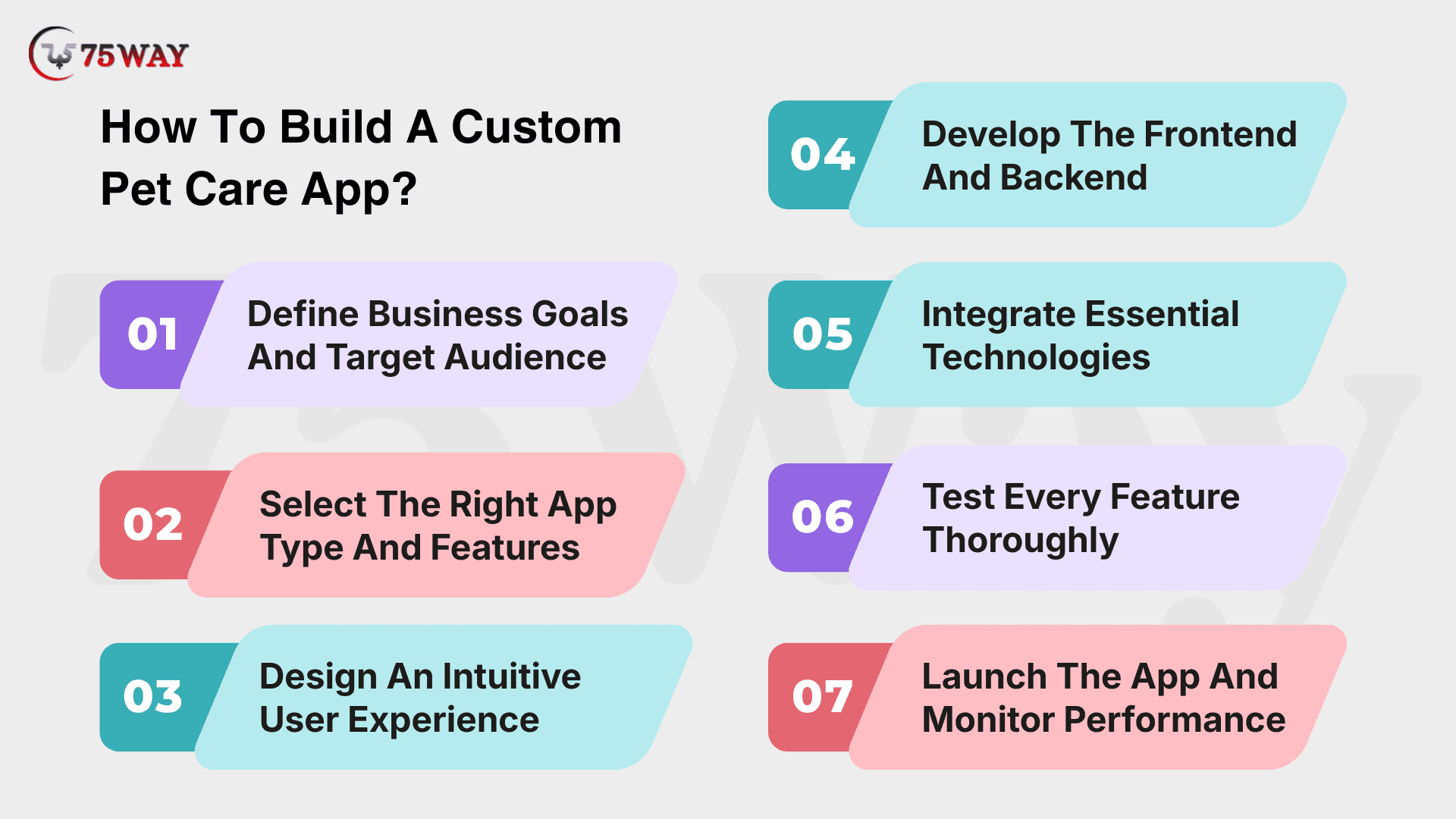
A pet care app is easier to scale when the right foundation is built from the beginning. We define a structured bespoke pet care app development process shows how successful businesses approach planning, design, engineering, testing, and deployment to avoid unnecessary rework.
1. Define Business Goals And Target Audience
The first step is understanding why the application is being built and who will use it. Different audiences have different expectations. A veterinary clinic, pet grooming business, pet insurance company, or startup marketplace will require completely different solutions.
This stage includes identifying customer pain points, defining business objectives, analyzing competitors, and deciding the unique value proposition of the application.
- Identify Target Users: Define whether your primary audience includes pet owners, veterinarians, groomers, trainers, or multiple user groups.
- Research Competitors: Analyze leading apps to understand their strengths, weaknesses, and market opportunities.
- Define Business Model: Decide how the app will generate revenue through subscriptions, commissions, bookings, or product sales.
- Validate App Idea: Gather market feedback to confirm there is genuine demand before investing in development.
- Prioritize Customer Problems: Focus on solving the biggest pain points instead of adding unnecessary functionality.
- Create Product Roadmap: Build a phased development plan that supports long-term growth.
A strong strategy prevents unnecessary development and ensures every feature supports measurable business goals.
2. Select The Right App Type And Features
Once the business direction is clear, the next step is deciding which features should be included in the first release. Rather than trying to build everything at once, businesses usually begin with an MVP (Minimum Viable Product) that includes only the core features users need. Additional functionality can be introduced after collecting real customer feedback.
- Choose App Model: Select whether you're building a telemedicine platform, service marketplace, adoption app, pet health tracker, or an all-in-one ecosystem.
- Finalize MVP Features: Include only the features users need to accomplish their primary tasks.
- Map User Journeys: Plan how users will move from registration to completing bookings or consultations.
- Plan Integrations: Identify APIs and third-party services required for payments, maps, notifications, or video consultations.
- Build Feature Roadmap: Organize future enhancements into planned development phases.
This approach shortens development time while reducing investment risks.
3. Design An Intuitive User Experience
Pet owners use these applications for important tasks such as booking appointments, tracking medications, or accessing veterinary advice. The interface should therefore feel simple, familiar, and easy to navigate.
Designers create wireframes, user flows, and interactive prototypes before development begins, ensuring users can complete actions with minimal effort.
- UX research
- Wireframing
- UI design
- Interactive prototypes
- Accessibility optimization
- Design testing
A clean user experience increases engagement, improves retention, and reduces user frustration.
4. Develop The Frontend And Backend
Once designs are approved, developers begin building the application.
Frontend development focuses on the user-facing interface, while backend development manages databases, authentication, APIs, payments, notifications, appointments, and overall business logic.
Depending on project requirements, developers may build native apps, cross-platform apps, or progressive web applications.
- Frontend Development: Build responsive interfaces for customers, service providers, and administrators using frameworks like Flutter, React Native, Swift (iOS), or Kotlin (Android) to deliver a fast and consistent user experience.
- Backend Development: Develop APIs, databases, authentication, and business logic using technologies such as Node.js, Python (Django/FastAPI), Java Spring Boot, .NET, PostgreSQL, and MongoDB to power the application securely.
- Cloud Infrastructure: Deploy and scale the application on cloud platforms like AWS, Google Cloud Platform (GCP), or Microsoft Azure, using services for storage, computing, backups, and monitoring.
- Third-Party Integrations: Connect essential services such as Stripe or PayPal for payments, Twilio for messaging, Google Maps API for location services, Zoom or Agora for video consultations, and Firebase Cloud Messaging (FCM) for push notifications.
- Security Implementation: Protect user information with OAuth 2.0, JWT authentication, SSL/TLS encryption, multi-factor authentication (MFA), and secure payment standards like PCI DSS compliance.
- Performance Optimization: Improve speed and reliability using Redis for caching, Cloudflare CDN for faster content delivery, Firebase Performance Monitoring, and tools like New Relic or Datadog to monitor application health and performance.
Tools & Technologies Used To Build Pet Care App
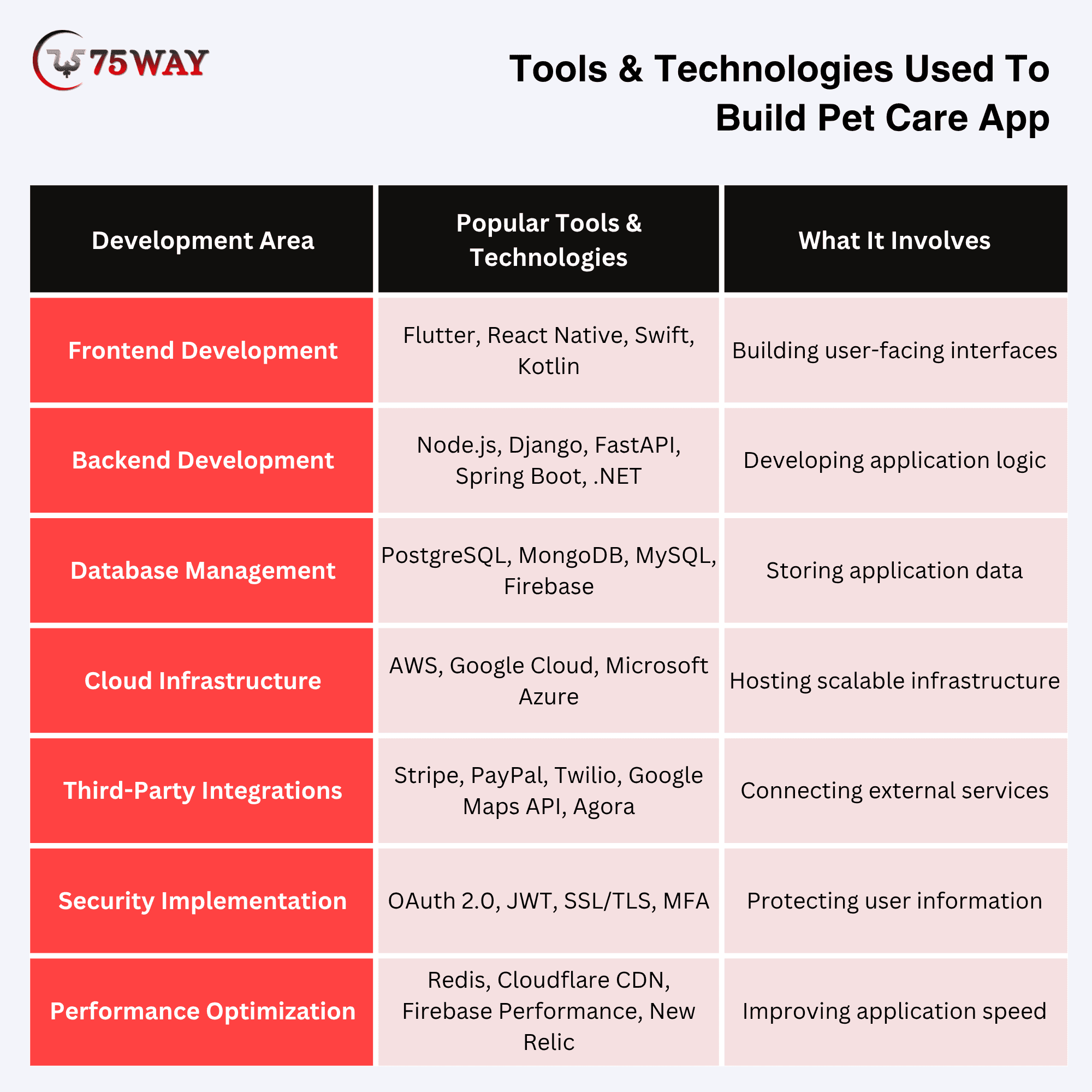
A scalable architecture ensures the application performs reliably as the number of users grows.
5. Integrate Essential Technologies
Modern pet care applications often require integrations beyond standard mobile development.
Businesses may connect payment gateways, GPS services, wearable devices, AI models, cloud storage, telemedicine platforms, and analytics tools to deliver richer experiences.
- Payment Gateway Integration: Stripe, PayPal, Square, Braintree
- GPS Services: Google Maps Platform, Mapbox, Apple Maps, HERE Maps
- Push Notifications: Firebase Cloud Messaging (FCM), OneSignal, Apple Push Notification Service (APNs)
- AI Implementation: OpenAI GPT, Google Gemini, Anthropic Claude, TensorFlow
- Video Consultation Tools: Agora, Twilio Video, Zoom SDK, Vonage Video API
- Analytics Integration: Google Analytics 4 (GA4), Firebase Analytics, Mixpanel, Amplitude
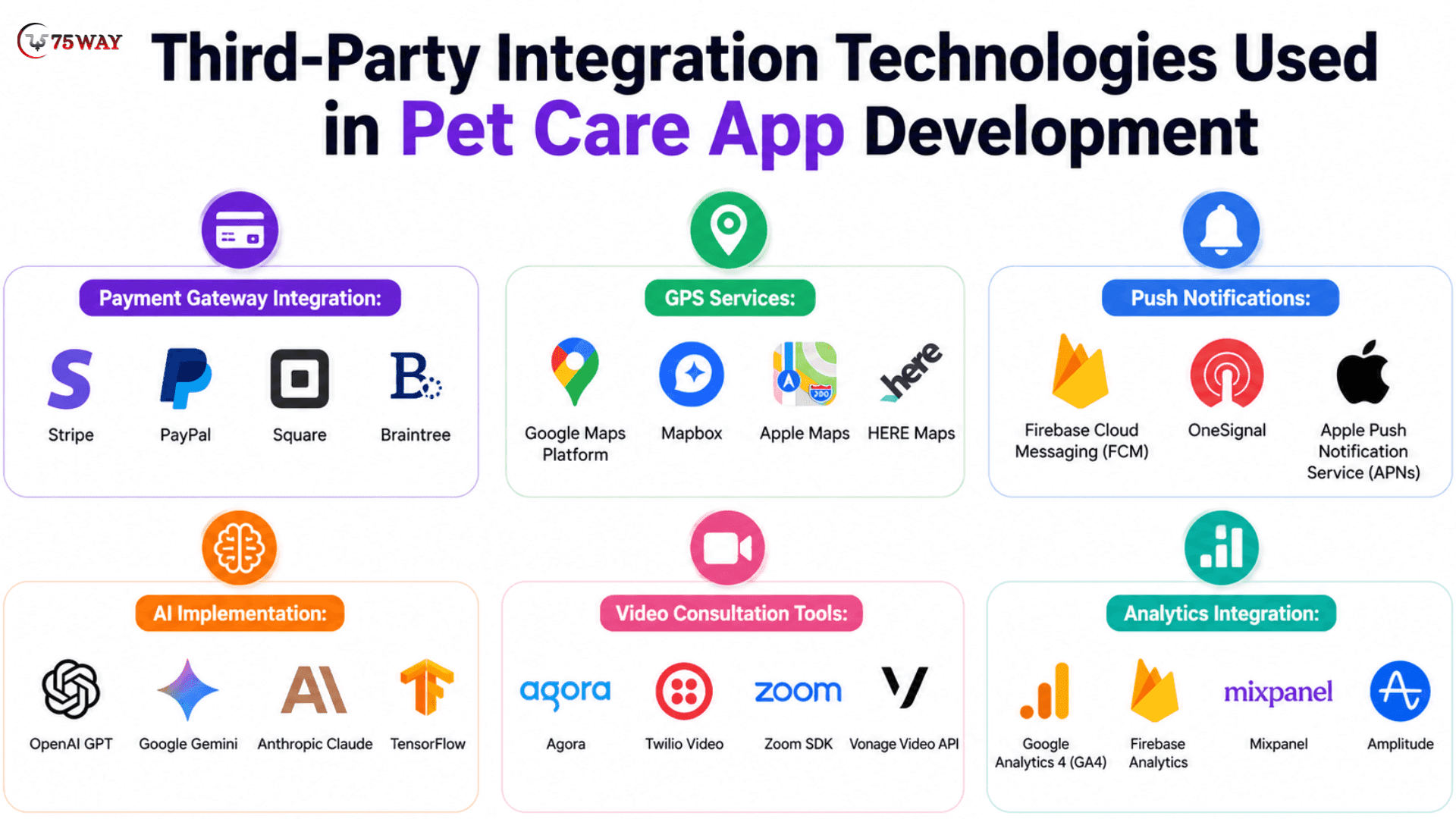
The right technology stack improves performance while supporting future expansion.
6. Test Every Feature Thoroughly
Before launching, the application should undergo extensive testing to ensure reliability, security, and usability. Testing helps identify technical issues before they affect real users and protects business reputation after launch.
- Functional Testing: Verifies that every feature works as expected, such as user registration, appointment booking, payment processing, and pet profile creation.
- Performance Testing: Measures how the app performs under different conditions, including loading speed, response time, and handling thousands of simultaneous users.
- Security Testing: Identifies vulnerabilities by testing user authentication, data encryption, payment security, and protection against unauthorized access.
- Cross-Device Compatibility Testing: Ensures the app functions consistently across different devices, operating systems, and screen sizes, such as iPhones, Samsung Galaxy devices, and tablets.
- User Acceptance Testing (UAT): Allows real users or business stakeholders to test the app and confirm it meets business requirements before launch.
- Bug Resolution: Fixes issues discovered during testing, such as app crashes, broken navigation, incorrect calculations, or payment failures, before the application goes live.
Comprehensive quality assurance results in a stable application that users can trust.
7. Launch The App And Monitor Performance
After testing is complete, the application is ready for deployment on the Apple App Store and Google Play Store. However, a successful launch is more than publishing the app. It involves optimizing store listings, monitoring the release, and ensuring users can download and use the application without issues from day one.
The work continues after launch by analyzing how users interact with the app in real-world conditions. Businesses should monitor downloads, user engagement, feature adoption, crash reports, customer reviews, and retention metrics to identify improvement opportunities. Regular updates based on user feedback help maintain performance, increase customer satisfaction, and keep the application competitive over time.
Why Building An MVP of Pet Care Mobile App Is The Smartest Starting Point?
Many businesses assume they need every advanced feature before launching. In reality, successful pet care apps often begin with a focused MVP that solves one primary problem exceptionally well.
Launching an MVP enables businesses to:
- Validate product-market fit before major investment.
- Gather real customer feedback instead of relying on assumptions.
- Reach the market faster than competitors.
- Reduce development costs and project risks.
- Prioritize future updates based on actual user behavior.
As users adopt the platform, advanced capabilities such as AI-powered health insights, wearable integrations, personalized recommendations, and predictive analytics can be introduced strategically rather than all at once.
How Much Does Pet Care App Development Cost?
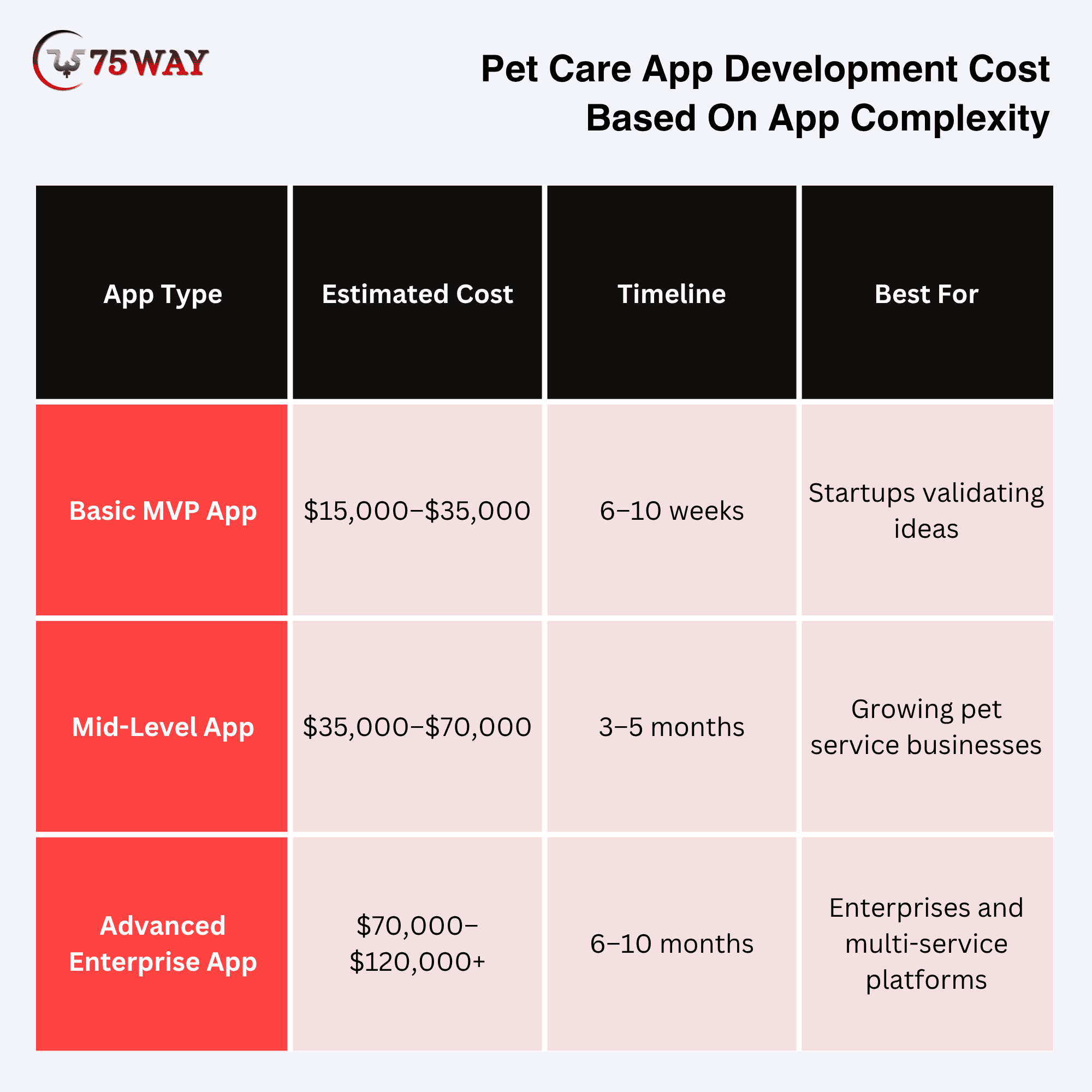
The average pet care app development cost ranges between $15,000 and $120,000+, depending on the app's complexity, features, platform, technology stack, third-party integrations, and development team's location. A basic MVP costs significantly less than an enterprise-grade pet healthcare platform with AI, telemedicine, GPS tracking, wearable integration, and advanced analytics.
1. Basic MVP App
- Estimated Cost:$15,000 – $35,000
- Timeline: 6–10 weeks
Builds essential pet management features for validating your idea with minimal investment and faster market launch.
2. Mid-Level App
- Estimated Cost:$35,000 – $70,000
- Timeline: 3–5 months
Includes service booking, in-app communication, payment integration, and automation for growing pet care businesses.
3. Advanced Enterprise App
- Estimated Cost:$70,000 – $120,000+
- Timeline: 6–10 months
Delivers AI capabilities, telemedicine, wearable integration, marketplace functionality, and enterprise-grade scalability for large businesses.
Pet Healthcare App Development Cost Based On Development Stages
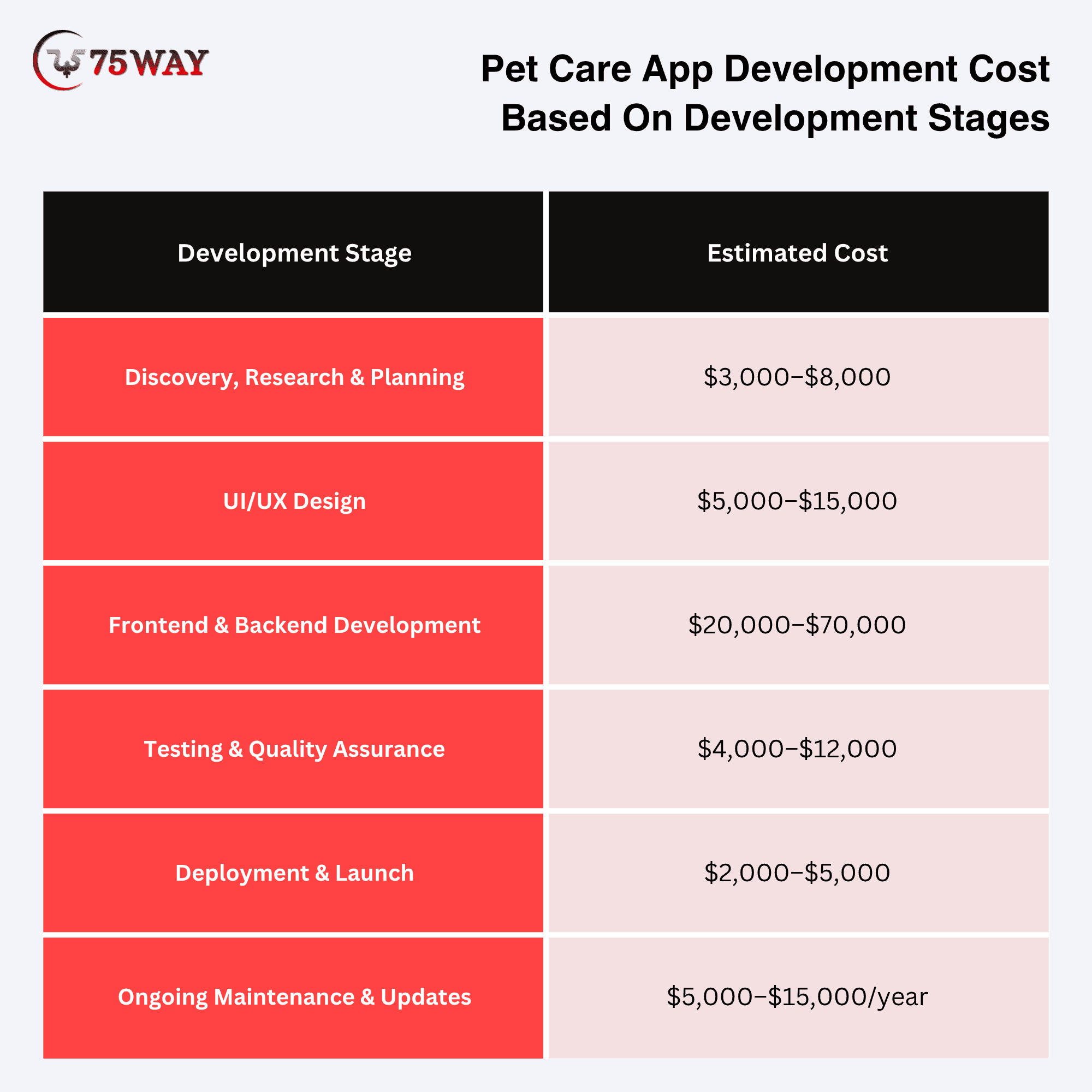
Every pet healthcare application goes through multiple development phases, and each stage contributes to the overall project budget. Proper planning at every stage helps reduce unexpected expenses and improves long-term development efficiency.
1. Discovery, Research & Planning
Estimated Cost:$3,000 – $8,000
Validates business goals, user requirements, competitors, feature priorities, and technical roadmap before development begins.
2. UI/UX Design
Estimated Cost:$5,000 – $15,000
Designs intuitive user journeys, wireframes, interactive prototypes, and visually engaging interfaces for better user experience.
3. Frontend & Backend Development (MVP)
Estimated Cost:$20,000 – $70,000
Builds application architecture, APIs, databases, mobile interfaces, and core business functionalities for initial product release.
4. Testing & Quality Assurance (QA)
Estimated Cost:$4,000 – $12,000
Ensures application stability through functional, security, usability, compatibility, and performance testing before launch.
5. Deployment & Launch
Estimated Cost:$2,000 – $5,000
Publishes applications, configures production environments, and completes store submission with launch monitoring support.
6. Ongoing Maintenance & Updates
Estimated Cost:$5,000 – $15,000 per year
Maintains security, fixes bugs, improves performance, and introduces new features based on user feedback.
Cost To Hire Pet Care App Developers Based On Location
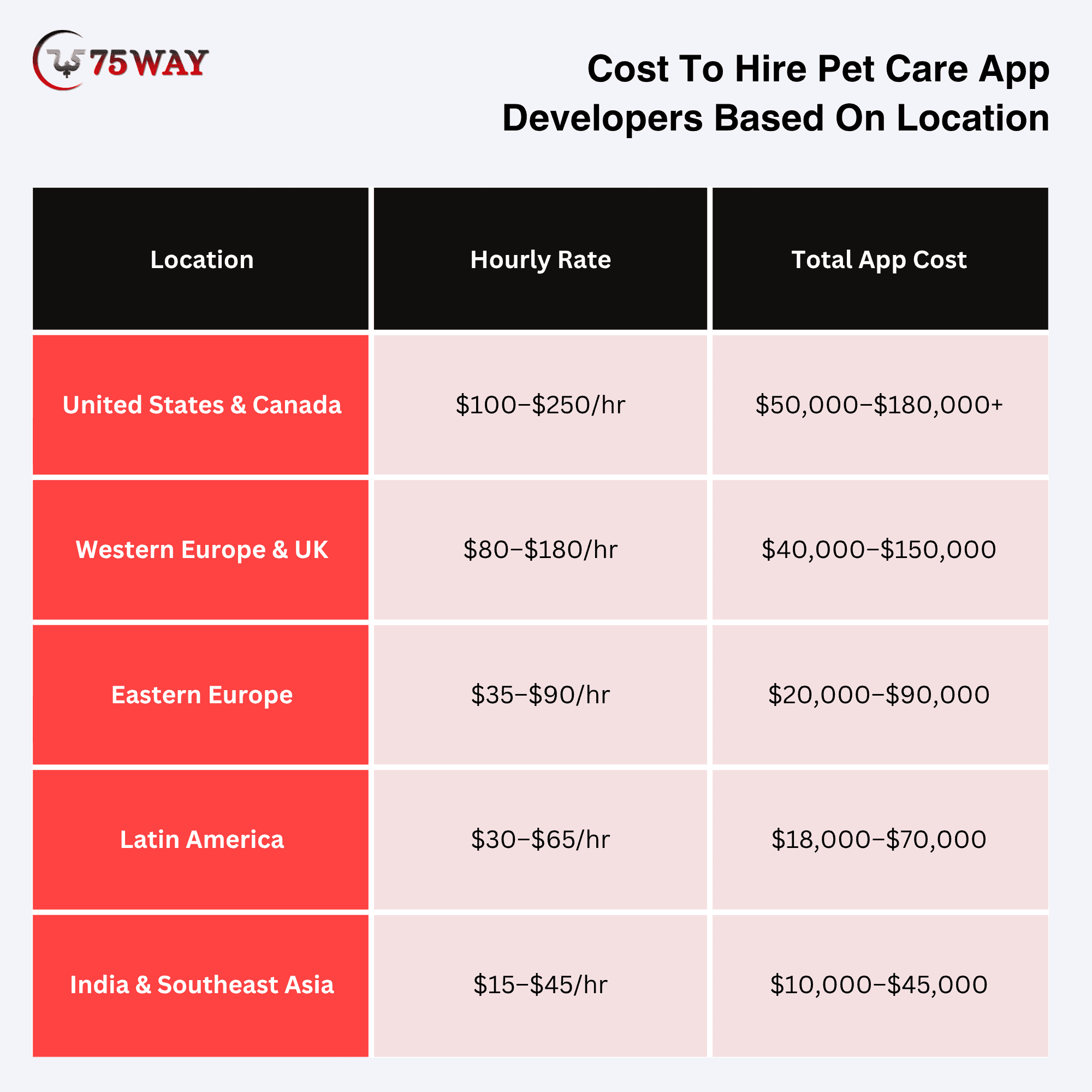
Developer rates vary significantly across regions because of differences in labor costs, market demand, technical expertise, and operational expenses. Choosing the right development partner requires balancing cost, experience, communication, and long-term project quality.
- United States & Canada
Estimated Cost:$100–$250/hour | Total App Cost: $50,000–$180,000+
Offers experienced enterprise developers, strong domain expertise, and premium-quality development for complex applications.
- Western Europe & UK
Estimated Cost:$80–$180/hour | Total App Cost:$40,000–$150,000
Provides highly skilled development teams with excellent engineering standards and reliable project management.
- Eastern Europe (Poland, Ukraine)
Estimated Cost:$35–$90/hour | Total App Cost:$20,000–$90,000
Balances affordability with experienced engineering talent for startups and mid-sized software development projects.
- Latin America (Brazil, Argentina, Mexico)
Estimated Cost:$30–$65/hour | Total App Cost:$18,000–$70,000
Delivers cost-effective development with convenient collaboration for North American businesses operating across similar time zones.
- India & Southeast Asia
Estimated Cost:$15–$45/hour | Total App Cost:$10,000–$45,000
Provides scalable development teams delivering quality applications at highly competitive pricing for global businesses.
Cost Factors Affecting Pet Care App Development
No two pet care applications cost the same because every project has unique business goals, feature requirements, and technical complexity. While app type provides a general estimate, several development decisions directly influence the final budget. Understanding these factors helps businesses allocate resources wisely and avoid unexpected expenses during development.
- App Complexity: Simple applications with basic pet profiles and appointment booking require less development time than enterprise platforms featuring AI, telemedicine, GPS tracking, and wearable integrations.
- Feature Requirements: Every additional feature increases development effort, testing, backend infrastructure, and future maintenance costs. Prioritizing essential functionalities for the initial launch helps optimize the budget.
- Platform Selection: Building for Android, iOS, or both platforms affects development costs. Cross-platform development often reduces overall investment compared to developing separate native applications.
- UI/UX Design Complexity: Custom animations, personalized dashboards, interactive user flows, and premium interfaces require more design and frontend development effort than standard layouts.
- Third-Party Integrations: Integrating payment gateways, maps, telemedicine platforms, wearable devices, cloud storage, AI services, or CRM systems increases development time and licensing expenses.
- AI And Advanced Technologies: Features such as AI chatbots, predictive health insights, image recognition, voice assistants, and personalized recommendations require additional development expertise and infrastructure.
- Security And Compliance: Applications storing pet medical records, payment information, or user data require advanced security, encryption, secure authentication, and regulatory compliance, increasing development costs.
- Development Team Location: Developer hourly rates vary significantly across countries, making the location of your development partner one of the biggest cost factors.
- Maintenance And Future Updates: Launching the application is only the beginning. Regular feature enhancements, security updates, bug fixes, server maintenance, and operating system compatibility require ongoing investment.
How To Reduce Cost of Developing Pet Care App?
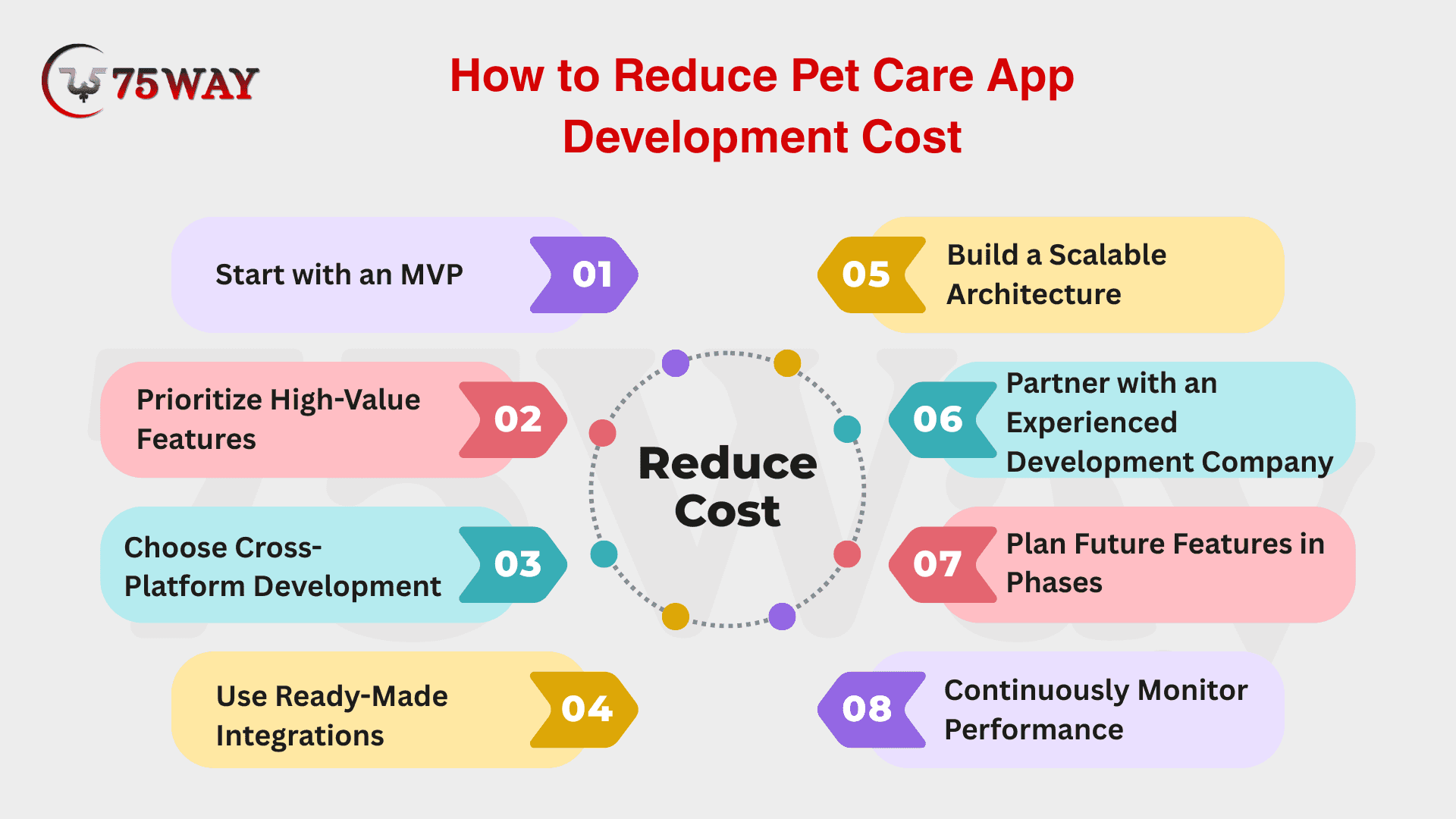
Many businesses spend more than necessary because of poor planning, changing requirements, or choosing the wrong development approach. Here are effective ways to optimise your investment while developing a pet care app.
1. Start With An MVP
Every cost-saving strategy begins by limiting the first release to the features users need most. An MVP helps validate your idea with real customers before investing in advanced capabilities, reducing both financial risk and unnecessary development.
2. Prioritize High-Value Features
Once the MVP is defined, identify which features directly support your business goals and customer experience. Keeping only high-impact functionality in the initial release prevents scope creep and allows development resources to be used more efficiently.
3. Choose Cross-Platform Development
With the feature list finalized, the next decision is selecting the right development approach. Frameworks like Flutter and React Native enable developers to build Android and iOS apps from a single codebase, reducing engineering effort, project timelines, and maintenance costs.
4. Use Ready-Made Integrations
After choosing the technology stack, avoid building every capability from scratch. Integrating proven solutions like Stripe, Firebase, Google Maps, and Twilio speeds up development, reduces engineering complexity, and improves overall reliability.
5. Build A Scalable Architecture
Once the core features and integrations are in place, focus on building a scalable foundation. A well-designed backend can support future users, services, and new features without requiring expensive redevelopment as the business grows.
6. Partner With An Experienced Development Company
Even with the right architecture, project execution plays a major role in controlling costs. An experienced app development partner helps avoid technical mistakes, improves planning, and delivers efficient solutions that reduce delays and costly rework.
7. Release Future Features In Phases
After the first version goes live, continue expanding the app gradually instead of introducing every planned feature at once. A phased release strategy allows businesses to prioritize improvements based on customer feedback rather than assumptions.
8. Continuously Monitor And Optimize
As the application grows, monitor performance, user behavior, and customer feedback to identify areas for improvement. Continuous optimization helps resolve issues before they become expensive problems, keeping maintenance costs lower while improving the overall user experience.
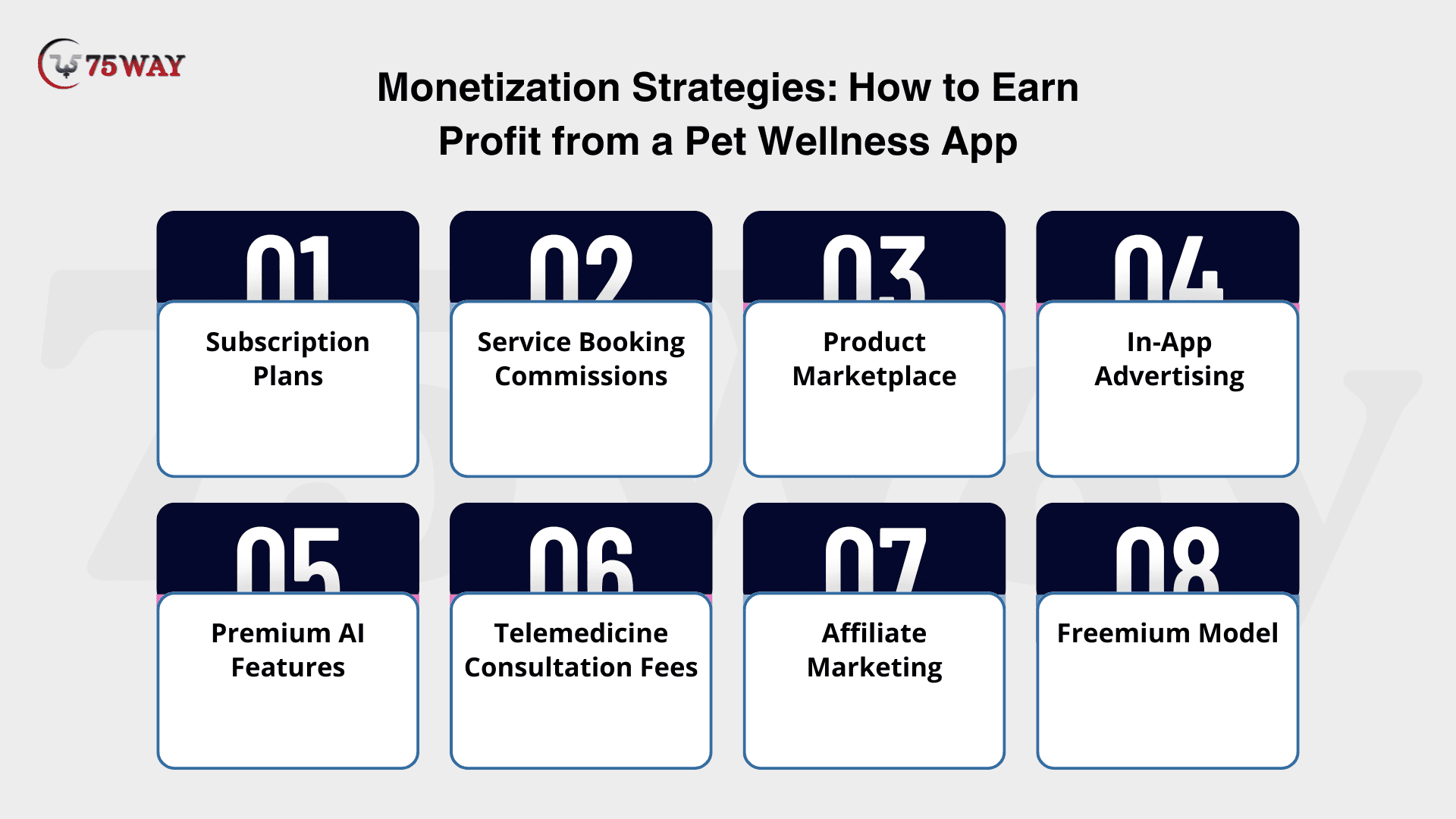
Monetization Strategies: How to Earn Profit from a Pet Wellness App
A successful pet care app generates revenue by solving everyday problems for pet owners while creating multiple income streams for the business. Rather than depending on a single monetization model, combining subscriptions, service commissions, eCommerce, and premium offerings helps build predictable, long-term revenue.
1. Subscription Plans
Offer monthly or annual memberships that unlock premium benefits such as unlimited veterinary consultations, AI-powered health insights, vaccination reminders, and exclusive discounts. For example, charging $14.99/month or $149/year to 8,000 subscribers can generate approximately $1.4 million in annual recurring revenue.
2. Service Booking Commissions
Earn a commission every time users book services like veterinary visits, grooming, pet boarding, walking, or training through your platform. For instance, if a $70 grooming appointment carries a 15% commission, your app earns $10.50 from a single booking.
3. Product Marketplace
Sell pet food, medicines, toys, supplements, grooming products, and accessories directly through the application. A $45 pet food order with a 30% profit margin generates $13.50 in revenue while providing customers with a convenient shopping experience.
4. In-App Advertising
Partner with pet food brands, insurance providers, veterinary clinics, and pet product manufacturers to display relevant promotions within the app. For example, a premium pet food brand may pay $2,000–$8,000 per month for targeted advertising campaigns that reach active pet owners.
5. Premium AI Features
Provide AI-powered services such as personalized health recommendations, nutrition planning, behavior analysis, and preventive care insights through a premium plan. Charging an additional $9.99/month for AI features creates a recurring revenue stream while increasing the app's value.
6. Telemedicine Consultation Fees
Allow pet owners to consult licensed veterinarians through video or chat and collect a platform fee from each session. For example, a $50 virtual consultation with a 20% platform commission generates $10 per appointment.
7. Affiliate Marketing
Recommend trusted pet insurance providers, wearable pet trackers, nutrition brands, and online pharmacies, earning commissions for successful referrals. If a pet insurance company pays $40 for every new customer acquired, 500 successful referrals could generate $20,000 in affiliate revenue.
8. Freemium Model
Offer essential features like pet profiles, appointment booking, and reminders for free while reserving advanced capabilities for paid users. If 5% of 100,000 free users upgrade to a $12.99/month premium plan, the app can generate nearly $65,000 in monthly recurring revenue.
Latest Technology Trends Shaping Pet Care Applications
The pet care apps gaining the most attention today are solving problems that barely existed a few years ago. The technologies below show where businesses are investing to deliver smarter services, improve operational efficiency, and create stronger relationships with pet owners.
- Artificial Intelligence (AI): Artificial intelligence is making pet care applications smarter by analyzing health records, daily activities, and behavioral patterns to provide personalized recommendations. AI-powered chatbots can answer common questions, assist with appointment scheduling, and offer instant support, while predictive analytics helps identify potential health concerns before they become serious.
- Machine Learning: Machine learning algorithms enable applications to improve over time by learning from user behavior and pet data. It can recommend suitable nutrition plans, identify changes in activity levels, predict health risks, and personalize content based on each pet's unique profile.
- Internet of Things (IoT): IoT devices such as smart collars, GPS trackers, and connected feeding systems allow pet owners to monitor their pets remotely. These devices continuously collect real-time information about location, physical activity, sleep patterns, and eating habits, providing valuable insights through the mobile application.
- Wearable Technology: Wearable devices have become increasingly popular for tracking pet fitness and health. When integrated with a pet care wearable application, smart wearables help owners monitor exercise, heart rate, calorie expenditure, sleep quality, and recovery after medical treatments.
- Telemedicine: Virtual veterinary consultations continue to gain popularity because they provide quick access to professional advice without requiring clinic visits for every concern. Telemedicine app features support video consultations, digital prescriptions, secure messaging, and medical record sharing, improving accessibility for both pet owners and veterinarians.
- Cloud Computing: Cloud technology enables secure storage of pet medical records, vaccination history, appointment information, and user profiles. It also allows seamless synchronization across multiple devices, ensuring users can access important information anytime.
- GPS And Location Intelligence: Location-based services help users locate nearby veterinary clinics, grooming centers, pet stores, parks, and emergency animal hospitals. GPS technology also supports real-time pet tracking, route history, and geofencing alerts for improved safety.
- Blockchain Technology: Blockchain enhances data security by creating tamper-resistant medical records and transparent transaction histories. It can also simplify insurance claims, vaccination verification, and secure sharing of veterinary records between healthcare providers.
- Voice Assistants: Voice-enabled features allow pet owners to schedule appointments, receive medication reminders, check feeding schedules, and access pet care information using simple voice commands, creating a more convenient user experience.
- Augmented Reality (AR): AR technology is beginning to support interactive pet training, educational experiences, and product visualization. Businesses can use AR to demonstrate training techniques or help customers visualize pet products before purchasing.
Challenges In Pet Health App Development And Their Solutions
Building a successful pet care application involves more than developing features. Businesses must address technical, operational, and user-experience challenges while ensuring the app remains secure, scalable, and easy to use. Identifying these challenges early and implementing the right solutions can reduce development risks, improve user satisfaction, and support long-term business growth.
1. Protecting User And Pet Data
Pet care applications store sensitive information such as medical records, payment details, and personal data. A security breach can damage customer trust and lead to regulatory issues.
Solution: Implement end-to-end encryption, secure authentication, role-based access controls, regular security audits, and compliance with applicable data privacy regulations.
2. Managing Complex Third-Party Integrations
Integrating payment gateways, GPS services, telemedicine platforms, wearable devices, cloud services, and AI tools can increase technical complexity and development time.
Solution: Use well-documented APIs, select reliable technology partners, perform integration testing early, and build a modular architecture that supports future integrations.
3. Delivering A Consistent User Experience
Users expect the application to work smoothly across different smartphones, tablets, and operating systems without performance issues.
Solution: Follow responsive UI/UX design principles, conduct cross-device testing, optimize application performance, and continuously gather user feedback for improvements.
4. Scaling As The Business Grows
As user numbers increase, the application must support more appointments, transactions, and real-time interactions without slowing down.
Solution: Build a cloud-based, scalable architecture with optimized databases, load balancing, and microservices that can handle increasing traffic efficiently.
5. Keeping Up With Changing Technology
Emerging technologies such as AI, IoT, wearable devices, and telemedicine continue to reshape customer expectations, making continuous innovation essential.
Solution: Develop the application using scalable technologies, schedule regular updates, monitor industry trends, and introduce new features based on market demand.
6. Building User Trust And Credibility
Pet owners rely on applications for healthcare decisions, making trust one of the most important factors for long-term success.
Solution: Verify service providers, display authentic customer reviews, maintain transparent pricing, provide reliable customer support, and ensure accurate health information.
7. Maintaining Long-Term Performance
Applications may become slower over time due to growing databases, increasing users, and outdated code if maintenance is ignored.
Solution: Perform routine maintenance, optimize databases, monitor application performance, fix bugs proactively, and release regular updates to maintain speed and stability.
8. Improving User Retention
Many users download apps but stop using them if they do not find continuous value or personalized experiences.
Solution: Introduce AI-powered recommendations, loyalty programs, personalized notifications, health reminders, and engaging features that encourage users to return regularly.
How 75way Helps You Build A Cost-Effective Pet Care App
Building a successful pet care application requires more than technical expertise. It demands a deep understanding of user behavior, business objectives, and industry trends. At 75way Technologies, we work closely with startups, veterinary clinics, pet service providers, and enterprises to transform innovative ideas into scalable mobile applications.
Our team begins by understanding your vision, target audience, and operational requirements before creating a development roadmap that aligns with your business goals and long-term growth strategy. From product discovery and UI/UX design to development, testing, deployment, and post-launch support, 75way delivers end-to-end pet care app development services under one roof.
We build secure, feature-rich applications with AI-powered capabilities, telemedicine, GPS tracking, wearable integrations, cloud infrastructure, and seamless third-party integrations. Using an agile development approach and transparent communication, we ensure your application launches faster, performs reliably, and continues evolving with changing customer expectations and emerging technologies.
Final Thoughts
Successful pet care app development requires more than an attractive design or advanced features. It demands a clear business strategy, user-focused functionality, scalable technology, robust security, and continuous product improvements based on real customer feedback.
Whether you're a startup launching an innovative pet platform, a veterinary clinic expanding digital services, or an established pet business looking to modernize operations, investing in pet care app development can unlock significant long-term growth opportunities.
If you're planning to build a custom pet healthcare platform, contact a trusted healthcare app development company for sustainable business growth.
Frequently Asked Questions (FAQs)
Can A Pet Care App Support Multiple Types of Pets?
Yes, modern applications can manage profiles for dogs, cats, birds, rabbits, reptiles, and more. Custom fields accommodate different breeds, healthcare records, diets, and care routines.
Is Offline Access Possible In A Pet Care Application?
Yes, selected information can remain accessible without internet connectivity using local storage. Data automatically synchronizes once the device reconnects online.
Can Existing Veterinary Software Be Integrated With The App?
Yes, APIs enable integration with many veterinary management systems and healthcare platforms. This reduces duplicate data entry and improves operational efficiency.
How Can Push Notifications Improve User Engagement?
Personalized notifications remind users about medications, feeding schedules, appointments, and wellness activities. Timely communication encourages consistent application usage and better pet care.
What Analytics Should Businesses Track After Launch?
Businesses should monitor user retention, feature adoption, booking conversions, customer satisfaction, and revenue metrics. These insights guide future updates and business decisions.
Can Pet Care Apps Support Multiple Languages?
Yes, multilingual functionality helps businesses serve users across different regions and markets. It improves accessibility while creating a better customer experience for diverse audiences.