AI Summary
AI wealth app development solutions help US firms personalize investing and portfolio insights. They can also streamline advisor workflows. This guide covers AI wealth management app development strategy, features, AI architecture, and compliance. USA Founders can evaluate development costs ($8,000 – $550,000+), timelines, and build-versus-buy decisions.
Key Takeaways
- AI wealth apps combine portfolio insights, planning, automation, and advisor tools.
- US founders must address SEC rules, privacy, security and fiduciary obligations.
- AI depends on clean data, integrations, explainability, and human oversight.
- Wealth management platforms may reach $11.82 billion globally by 2031.
- AI wealth app development can cost $8,000 – $550,000+, depending on scope.
If you're planning to build a wealth management app in the USA, AI can give your product capabilities that go beyond basic portfolio tracking.
Users want help understanding their investments, planning for retirement, managing risks, and making financial decisions without getting lost in complicated reports. That's where an AI-powered wealth management app development solution can make a real difference.
For your fintech startups and entrepreneurs in the USA, the opportunity is to bring these financial services into one application. You can combine portfolio analysis, automated investment insights, financial goal tracking, risk assessment, and AI-powered assistance based on user data.
But, wait a while! Before investing in wealth app development, there are several things worth understanding. And in this guide, we will cover the important decisions involved in building an AI wealth management app for the US market.
What Is an AI-Powered Wealth Management App?
An AI wealth management app is a digital financial platform that uses artificial intelligence, financial data, and automation to help individuals, advisors, and investment firms manage wealth.
Unlike conventional financial applications that primarily display account balances and transaction histories, AI-powered platforms can analyze financial information, identify patterns, generate portfolio insights, and support personalized financial planning.
Depending on its business model, a fintech application development solution may serve individual investors, high-net-worth clients, financial advisors, registered investment advisors (RIAs), or institutional wealth management firms.
For example, an individual investor could use an AI-powered wealth mobile app to understand portfolio allocation, track investment performance, and explore different retirement scenarios.
A financial advisor could use the same technology to review client portfolios, prepare financial summaries, and identify accounts that require attention.
Quick Answer: How To Develop AI Wealth Management Mobile App?
Step 1: Define Your Wealth Management Product Strategy
Step 2: Prepare Investor-Focused UI/UX Design
Step 3: Select Suitable Wealthtech Technology Stack
Step 4: Develop Core Wealth Management Application Modules
Step 5: Integrate And Validate AI Wealth Capabilities
Step 6: Integrate Financial APIs And Security Controls
Step 7: Test Financial Application And AI Performance
Step 8: Deploy And Monitor Wealthtech Application
All the stages of the AI wealth management app development process are defined below in detail.
Market Size And Growth Opportunities For AI Wealth Apps In USA
The growing demand for personalized financial advice is creating fresh opportunities for AI wealth apps in the USA. From new investors managing their first portfolios to experienced users looking for deeper insights, the potential audience is broad. A closer look at market size and emerging trends explains why this space deserves attention.
Global & US Wealth Growth
- The United States accounts for 35.7% of global personal wealth, making it the world's largest wealth market.
- The US continues to create wealth rapidly, with over 1,000 individuals becoming millionaires every day.
- According to the UBS Global Wealth Report, worldwide personal wealth grew by 10.8% in USD, recording its third consecutive year of growth.
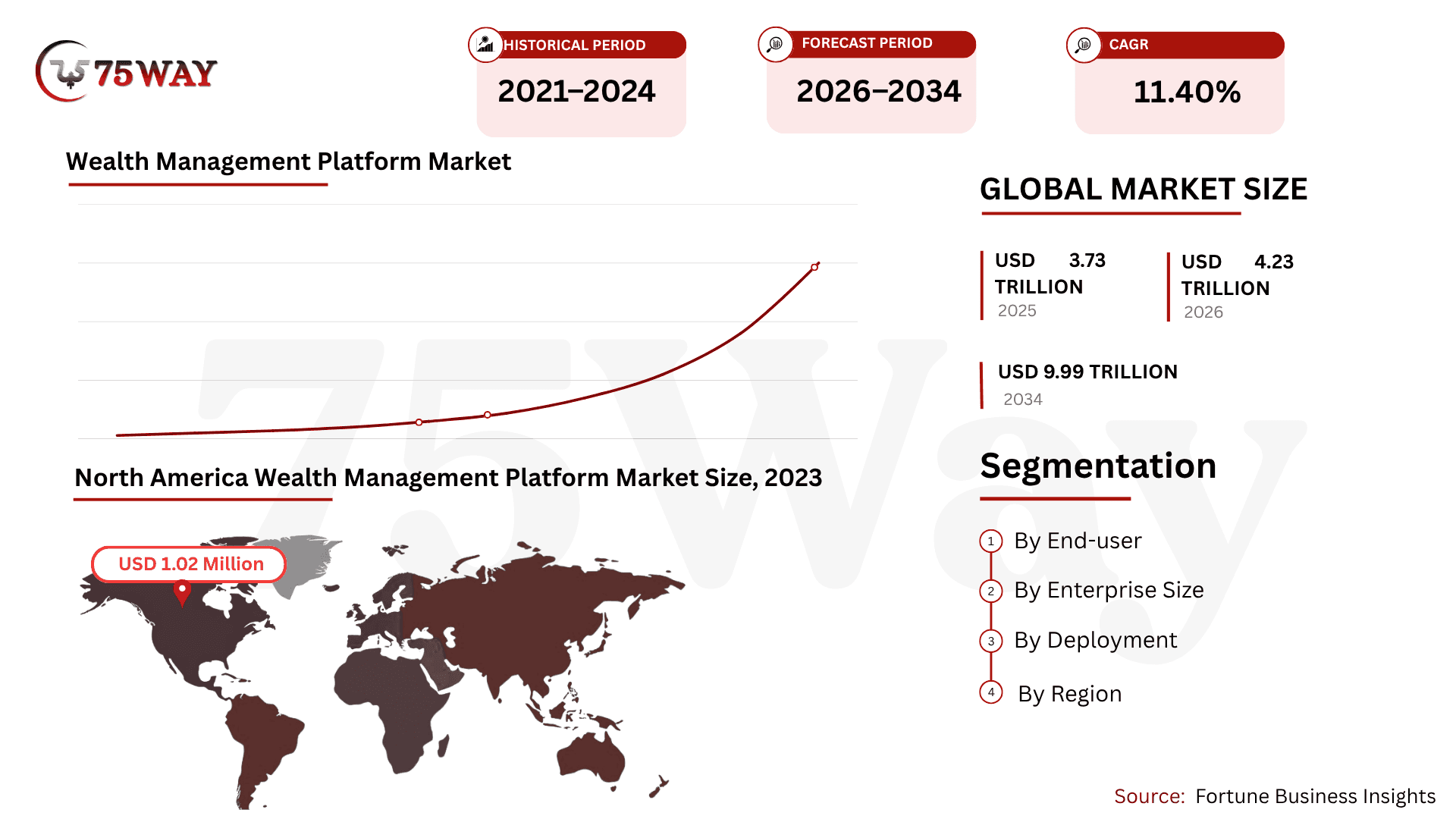
Wealth Management Platform Market Growth
- The global wealth management platform market was valued at $6.82 billion in 2026 and is projected to reach $11.82 billion by 2031, growing at an 11.63% CAGR.
- Cloud-based platforms held 62.32% of the wealth management platform market in 2025.
- Their adoption is expected to grow at a 12.18% CAGR through 2031.
- North America dominated the global wealth management platform market in 2025, holding a 33.10% share.
Global Wealth App Usage
- Gen X and Millennials are expected to inherit approximately $22 trillion, as per a McKinsey report.
- Women are projected to own more than 40% of US wealth by 2035.
- Family offices and RIAs are projected to expand at a 13.36% CAGR through 2031.
- Banks accounted for 38.13% of total market revenue.
How Does An AI-Powered Wealth Management App Work?
An AI wealth management app connects a user's financial data with intelligent analysis to simplify investment management. It helps users understand their portfolios and make sense of changing market conditions. The process involves several connected stages, each playing a specific role.
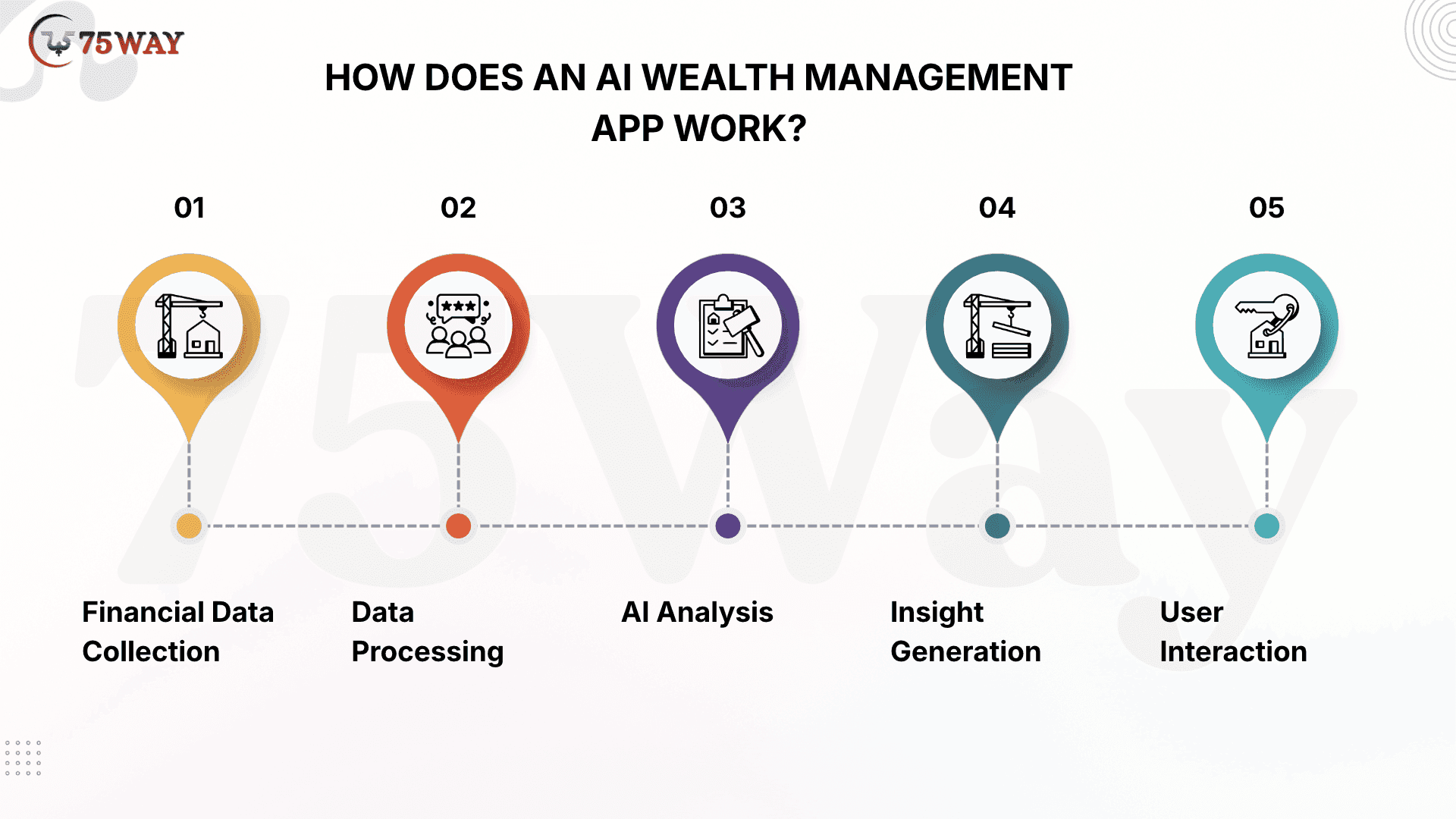
Stage 1: Financial Data Collection
The application gathers permitted financial information through banking APIs, brokerage integrations, investment accounts, and user-provided records.
Stage 2:Data Processing
The backend organizes account information, transactions, holdings, market data, and financial goals into structured formats.
Stage 3: AI Analysis
Machine learning models and analytical systems examine financial patterns, portfolio exposure, risk indicators, and relevant historical information.
Stage 4:Insight Generation
The application converts analytical results into portfolio summaries, alerts, financial projections, and personalized insights.
Stage 5:User Interaction
Investors and advisors access information through dashboards, reports, notifications, and conversational interfaces.
The exact workflow depends on the application's purpose. An advisor-focused platform may prioritize portfolio monitoring and client reporting, while a retail wealth management application may emphasize financial planning and investment education.
Why US Businesses Invest In AI Wealth Management Mobile App Development?
AI wealth management apps can open new revenue opportunities and attract digitally savvy investors. Customers want smarter financial tools without the complexity of traditional investment services. Here are the key reasons this investment deserves attention.
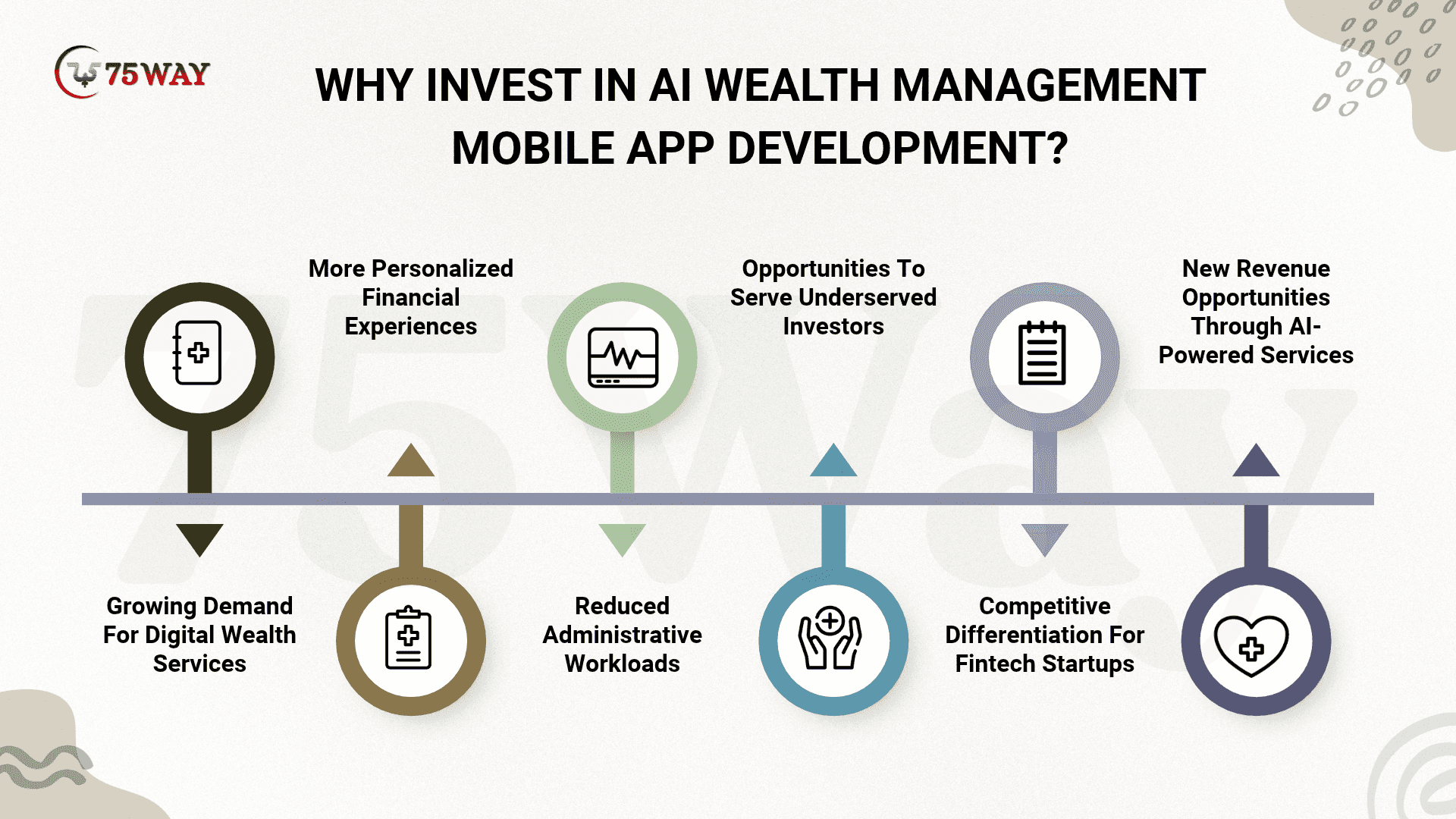
- Growing Demand For Digital Wealth Services
Investors want convenient access to financial information, portfolio performance, and planning tools. Digital platforms help wealth management firms serve more clients through accessible online advisory services.
- More Personalized Financial Experiences
Investors expect financial services that reflect their individual goals, income, and risk preferences. AI helps analyze customer data and generate more relevant financial insights.
- Reduced Administrative Workloads
Financial advisors spend considerable time preparing reports, reviewing portfolios, and managing client records. AI automation reduces repetitive tasks, allowing advisors to focus on financial planning and client relationships.
- Opportunities To Serve Underserved Investors
Traditional wealth management services can be costly for individuals with smaller portfolios. Digital platforms make financial tracking, goal planning, and investment education more accessible to younger and first-time investors.
- Competitive Differentiation For Fintech Startups
Established wealthtech platforms create strong competition for new fintech businesses. AI-powered features, personalized experiences, and specialized financial tools can help startups establish a distinct market position.
- New Revenue Opportunities Through AI-Powered Services
AI-powered wealth platforms allow businesses to introduce premium financial tools, subscription plans, and digital advisory services. These offerings create additional revenue opportunities while addressing evolving investor expectations.
Diverse Types of AI Wealth Management Apps You Can Develop
Before selecting technologies or estimating development costs, businesses must decide what type of wealth management application they want to launch. Different customer segments have different financial needs, regulatory considerations, and expectations. Here are different types of wealth apps worth considering in 2027.
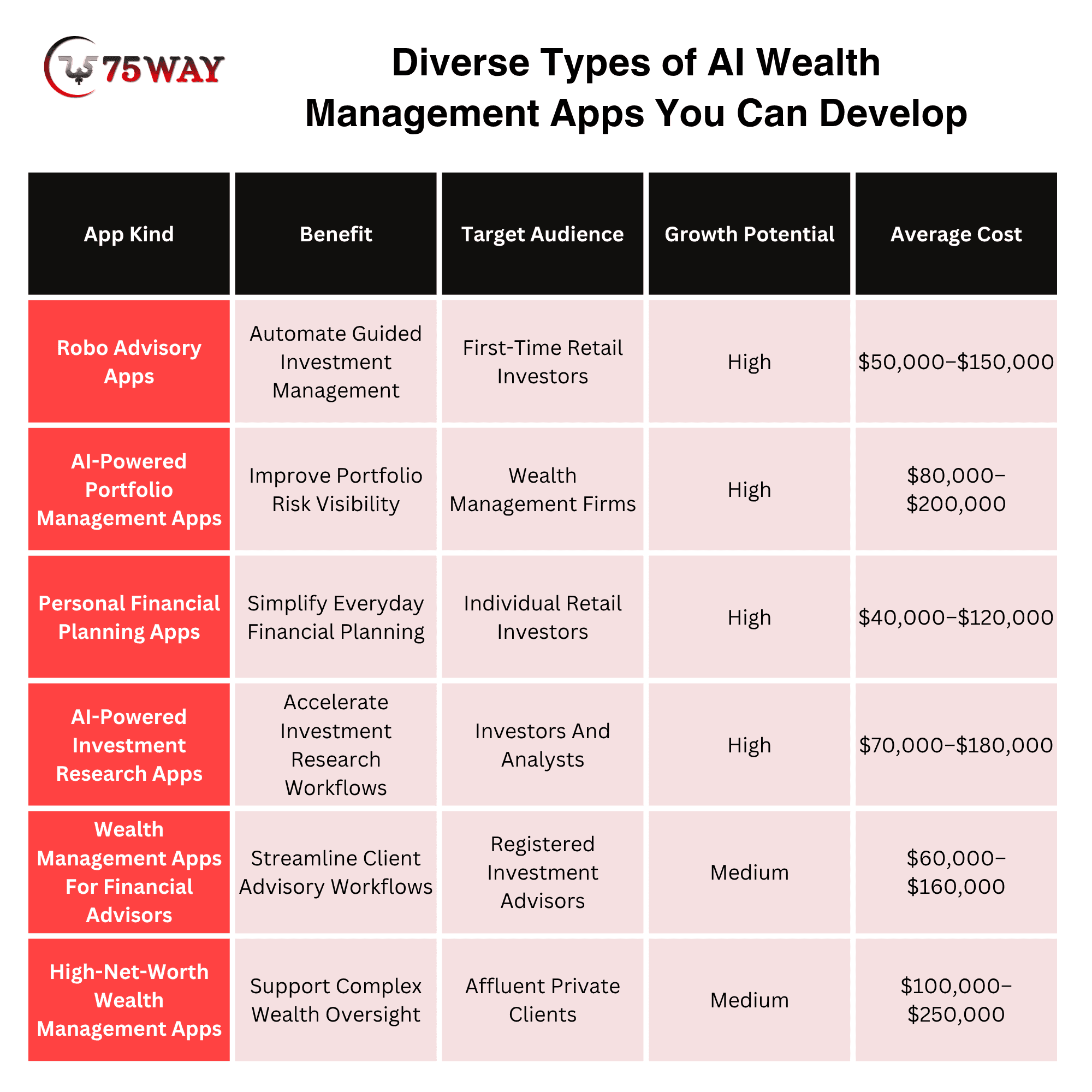
1. Robo Advisory Apps
Robo advisory applications use algorithms and financial data to support automated investment portfolio management.
Depending on their regulatory structure and service model, these platforms can collect investor information, assess risk tolerance, establish investment goals, and generate portfolio recommendations.
You can develop robo-advisory products for:
- First-time investors seeking guided investment experiences.
- Retail investors looking for automated portfolio management.
- Fintech companies offering digital investment services.
- Financial institutions expanding their digital advisory capabilities.
A robo advisor may also include human advisor support for customers who need additional guidance.
2. AI-Powered Portfolio Management Apps
Portfolio management applications help investors and financial professionals monitor investment holdings across different asset classes.
AI capabilities can support portfolio analysis, asset allocation monitoring, exposure identification, and performance reporting.
Useful capabilities include:
- Portfolio performance tracking.
- Asset allocation analysis.
- Investment concentration monitoring.
- Portfolio risk indicators.
- Historical performance comparisons.
- Rebalancing alerts.
These applications are particularly relevant for wealth management firms handling multiple client portfolios.
3. Personal Financial Planning Apps
Personal financial planning applications help individuals organize their finances and work toward specific financial goals.
AI can support expense categorization, cash flow analysis, savings projections, retirement planning scenarios, and financial goal tracking.
For example, a user planning for retirement could enter an expected retirement age, current savings, monthly contributions, and projected expenses. The application could generate different financial scenarios based on clearly disclosed assumptions.
4. AI-Powered Investment Research Apps
Investment research platforms use financial information, market data, and analytical models to help users understand investment opportunities.
AI can summarize company financial reports, organize market information, identify relevant trends, and support investment research workflows.
However, you must distinguish between research assistance and personalized investment recommendations. The latter can introduce additional regulatory obligations.
5. Wealth Management Apps For Financial Advisors
Advisor-focused applications are designed for RIAs, financial planners, and wealth management teams.
Instead of replacing financial advisors, these platforms help them manage client information and administrative responsibilities.
Potential capabilities include:
- Automated client summaries.
- Portfolio review assistance.
- Financial document extraction.
- Meeting preparation.
- Client communication support.
- Compliance documentation workflows.
This category offers opportunities for B2B SaaS businesses targeting advisory firms.
6. High-Net-Worth Wealth Management Apps
High-net-worth individuals often have more complex financial requirements involving multiple investment accounts, business interests, estate planning, alternative investments, and tax considerations.
A specialized application can bring relevant financial information into one secure environment.
If you are targeting this segment, you may consider:
- Consolidated wealth dashboards.
- Multi-account portfolio tracking.
- Alternative investment monitoring.
- Estate and legacy planning support.
- Tax-aware portfolio reporting.
- Relationship manager access.
These applications generally require more sophisticated data integrations, security controls, and personalized service workflows.
Core Features To Include In Custom Wealth Management App Development
When you have decided which kind of AI wealth management app you will develop for launch in the USA, the next important step is to select its features. Features of a custom wealth app should be chosen according to the target customer, product category, and business model. The following features provide a practical foundation for planning a custom AI-powered wealth app development.
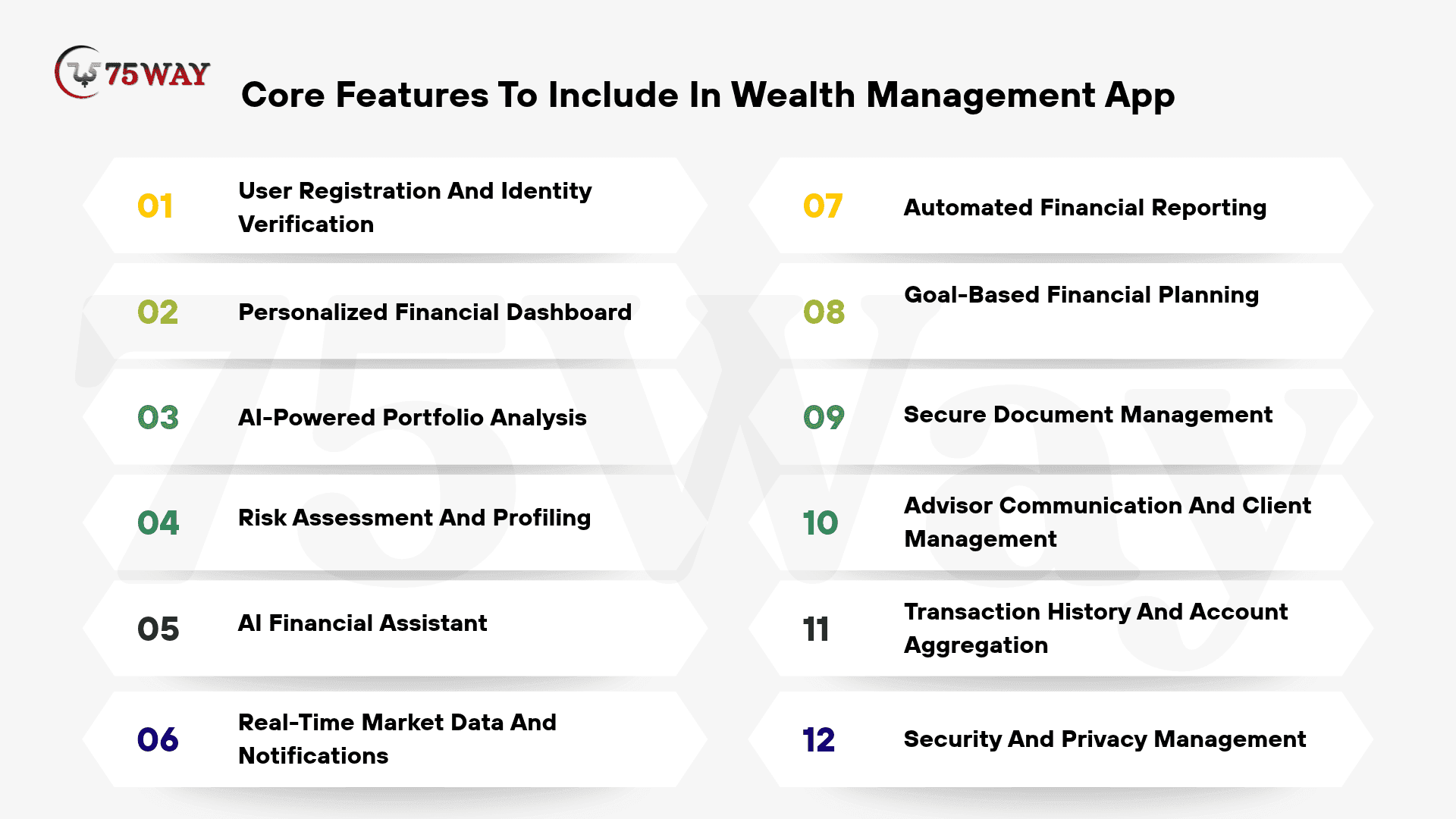
1. User Registration And Identity Verification
- Enables secure account creation and customer onboarding.
- Supports identity checks and account eligibility verification.
2. Personalized Financial Dashboard
- Displays consolidated financial information across supported accounts.
- Highlights portfolio performance, balances, and financial goals.
3. AI-Powered Portfolio Analysis
- Analyzes asset allocation, holdings, and portfolio exposure.
- Generates insights about performance and investment concentration.
4. Risk Assessment And Profiling
- Evaluates financial goals, investment experience, and risk preferences.
- Identifies potential inconsistencies requiring additional customer assessment.
5. AI Financial Assistant
- AI finance agent answers financial questions using authorized customer information.
- Explains portfolio activity through natural language interactions.
6. Real-Time Market Data And Notifications
- Provides timely updates on supported market information.
- Sends alerts about portfolio changes and account activity.
7. Automated Financial Reporting
- Generates summaries of portfolio performance and account activity.
- Reduces manual preparation of routine financial reports.
8. Goal-Based Financial Planning
- Helps users define and track financial objectives.
- Projects progress using clearly disclosed financial assumptions.
9. Secure Document Management
- Organizes sensitive financial documents within secure accounts.
- Extracts relevant information from uploaded financial records.
10. Advisor Communication And Client Management
- Connects clients with financial advisors through secure messaging.
- Organizes appointments, client records, and follow-up activities.
11. Transaction History And Account Aggregation
- Consolidates financial information from supported institutions.
- Helps users review transactions across connected accounts.
12. Security And Privacy Management
- Protects sensitive financial information through encryption and access controls.
- Maintains audit logs and monitors suspicious account activity.
AI Technologies Used To Build AI-Driven Wealth Management App
What makes an AI wealth management app smart enough to understand investments and offer useful financial insights? The answer lies in the AI technologies working behind its features. Each technology brings a different ability to the app, from analyzing market data to understanding user needs.
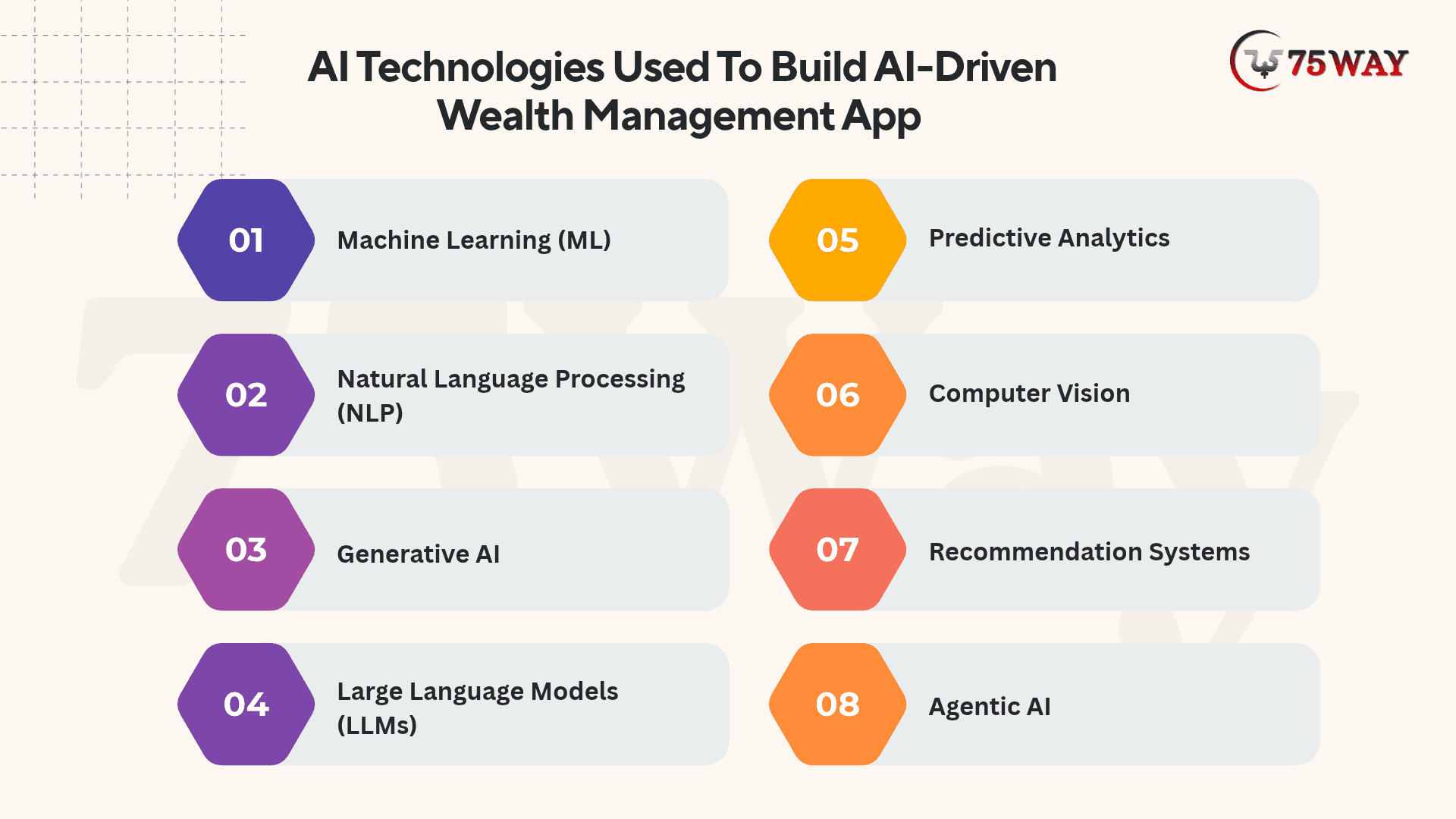
1. Machine Learning (ML)
Machine learning allows applications to identify patterns in financial data and improve analytical models through training and evaluation.
In wealth management, ML can support:
- Analyzes historical portfolio performance and asset allocation
- Identifies unusual financial patterns across customer accounts
- Classifies investment risk using relevant financial indicators
- Supports predictive modeling through historical financial datasets
2. Natural Language Processing (NLP)
Natural Language Processing helps applications understand and process human language.
It is particularly useful for wealth management platforms that handle financial documents, customer conversations, research materials, and advisor communications.
NLP can support:
- Extracts financial information from uploaded customer documents
- Classifies financial reports based on their content
- Interprets customer queries through natural language processing
- Summarizes advisor conversations and financial research materials
3. Generative AI
Generative AI enables applications to produce summaries, explanations, responses, and other content based on user requests and available information.
Wealth management businesses can use it to develop:
- Generates personalized explanations using authorized financial information
- Creates summaries of investment reports and statements
- Supports advisor workflows through AI-generated content
- Answers financial questions using approved knowledge sources
4. Large Language Models (LLMs)
Large Language Models are designed to understand and generate natural language. They can power conversational financial assistants that respond to customer questions, summarize portfolio information, and explain complex financial concepts.
For example, an investor might ask,
"Why did my portfolio value change this month?"
The application can retrieve authorized portfolio records, identify relevant changes, and use an LLM to generate an understandable explanation.
LLMs can support:
- Answers customer questions using relevant account information
- Explains portfolio changes through conversational responses
- Summarizes financial documents for advisor review
- Simplifies complex financial concepts for investors
5. Predictive Analytics
Predictive analytics uses historical data, statistical techniques, and machine learning models to estimate possible future outcomes.
In wealth management, it can support:
- Forecasts cash flow using historical financial activity
- Estimates retirement savings under different assumptions
- Identifies potential changes in portfolio exposure
- Tracks progress toward long-term financial goals
These outputs should be presented as estimates based on assumptions, not as promises about future returns.
6. Computer Vision
Computer vision allows applications to interpret information from images and scanned documents. This technology can be useful during digital onboarding and financial document processing.
For example, computer vision can help extract information from identity documents, scanned account statements, financial forms, investment reports, and supporting tax documents.
Computer vision can support:
- Extracts information from scanned financial documents
- Recognizes identity details during digital onboarding
- Classifies uploaded forms based on document content
- Converts document images into structured financial information
The extracted information should pass validation checks before being added to customer records or used in financial calculations.
7. Recommendation Systems
Recommendation systems analyze available information to identify relevant products, content, or actions for users.
Within wealth management applications, they can help organize financial education resources, surface relevant portfolio information, and support advisor workflows.
Recommendation systems can support:
- Suggests relevant financial education resources for users
- Highlights portfolio information requiring customer attention
- Matches financial content with individual user interests
- Supports advisor research through relevant information retrieval
Any personalized securities recommendation requires appropriate regulatory review, disclosure, and oversight based on the service being offered.
8. Agentic AI
Agentic AI enables finance AI systems to plan and perform multi-step tasks toward defined goals, using approved tools and workflows. In wealth management, it can coordinate activities across financial data, portfolio systems, and advisor platforms while following predefined permissions and controls.
Agentic AI can support:
- Retrieves authorized data from connected financial accounts
- Prepares portfolio reviews for advisor approval
- Coordinates client onboarding and document verification workflows
- Tracks assigned tasks across advisory operations
High-impact financial actions should require appropriate human approval, permission checks, audit trails, and regulatory safeguards.
Step-By-Step AI Wealth Management App Development Process: Key Stages
A successful wealth management application starts with a clearly defined business problem, not a technology stack.
Before the wealth app development process begins, founders should understand their target customers, financial service requirements, market opportunities, and revenue objectives. These decisions establish the foundation for product planning and technical execution.
The following stages explain how to plan, develop, integrate, and launch an AI-powered wealth management application.
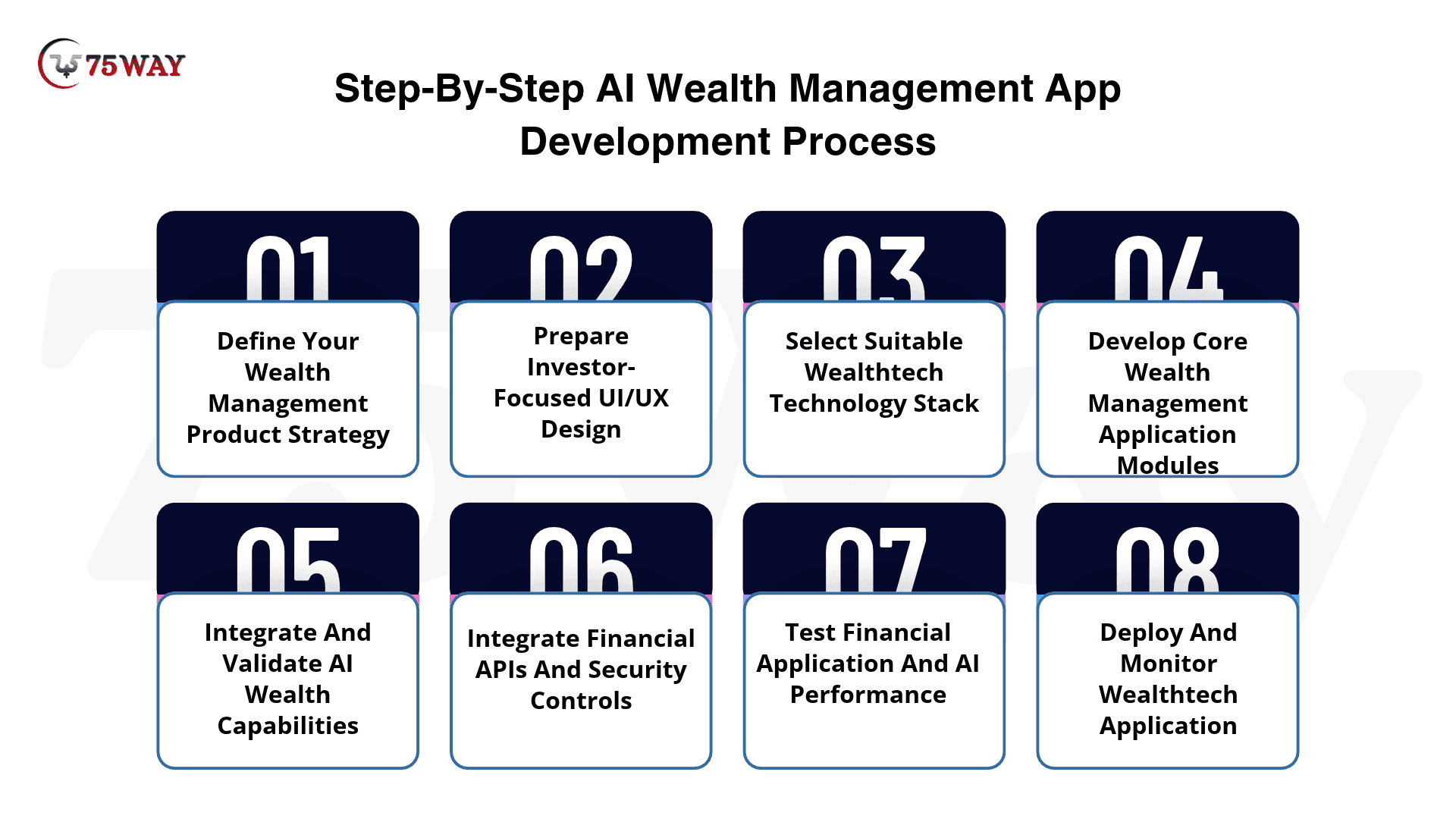
Step 1. Define Your Wealth Management Product Strategy
The first step is to establish the commercial purpose and market positioning of the application.
A fintech startup building a robo-advisory platform will have different requirements from an established RIA developing an internal advisor productivity system. Therefore, you should define the product scope while researching existing wealthtech platforms and customer expectations.
Start by defining:
- Target customer segments and their financial requirements
- Primary financial problems your application will address
- Core application features and advisory service offerings
- Revenue generation strategy and subscription pricing structure
- Competitor positioning and existing market opportunities
- Regulatory considerations based on planned financial activities
- Initial product scope and development priorities
For example, suppose a startup wants to serve independent financial advisors managing multiple client portfolios.
Its initial application could focus on account aggregation, AI-assisted portfolio summaries, client reporting, and secure communication.
You should also interview potential customers, financial advisors, and industry professionals to understand existing challenges. This research helps identify practical product opportunities instead of developing features that customers may not need.
Step 2. Prepare Investor-Focused UI/UX Design
Once the product scope and customer requirements are clear, the next stage involves UI/UX design of the application experience.
Wealth management applications deal with complex financial information. Their interfaces must make that information understandable without overwhelming users.
The design process should begin with user journeys and information architecture.
Important screens may include:
- Registration and customer onboarding workflows
- Identity verification and account setup screens
- Financial dashboards and portfolio overview interfaces
- Asset allocation and investment tracking screens
- Financial goal planning and progress dashboards
- AI assistant and conversational interface screens
- Transaction history and financial reporting sections
- Account settings and security management interfaces
For an advisor-facing platform, the design may also include client management, portfolio review, meeting preparation, and reporting workspaces.
The design team should create wireframes before developing high-fidelity interfaces. Usability testing is particularly important for financial dashboards. Users should understand portfolio changes, recognize important warnings, and distinguish estimates from actual account values.
Accessibility, responsive layouts, readable charts, and clear financial terminology should also be considered from the beginning.
Step 3. Select Suitable Wealthtech Technology Stack
With the application design established, the next priority is selecting technologies that support its financial and AI requirements.
Technology selection for building an AI wealth management app should follow product requirements rather than developer preferences.
A wealth management application may require a combination of mobile or web technologies, backend services, databases, cloud infrastructure, financial APIs, and AI components.
The architecture should account for:
- Financial data ingestion and processing requirements
- Secure account aggregation and data synchronization
- AI model integration and deployment architecture
- Portfolio calculations and financial reporting services
- User authentication and role-based access management
- Data encryption and regulatory audit trail requirements
- Third-party financial service integration capabilities
- Application monitoring and infrastructure management
Businesses should also decide whether to use commercial AI APIs, open-source models, internally developed models, or a combination.
For most startups, using existing models and specialized financial data services is a more practical starting point than training a large language model from scratch.
Step 4. Develop Core Wealth Management Application Modules
After selecting the technology stack, development begins with building the application's frontend, backend, and essential financial modules.
The frontend handles user interactions, dashboards, portfolio visualizations, notifications, and other interface components.
The backend manages business logic, financial records, authentication, integrations, permissions, and communication between services.
Typical development activities include:
- Building secure registration and onboarding workflows
- Creating investor and financial advisor dashboards
- Developing portfolio management and tracking modules
- Integrating financial calculations and reporting functionality
- Establishing database structures for customer information
- Connecting frontend interfaces with backend services
- Implementing account permissions and transaction management
- Integrating selected AI services into workflows
A modular backend is useful because financial applications often need to expand as the business adds new services, customer segments, and third-party integrations.
For example, portfolio analytics can operate as a separate service while the application backend manages account information and user permissions.
Deliverable: Working frontend, backend services, database infrastructure, and integrated application modules.
Step 5. Integrate And Validate AI Wealth Capabilities
Once the core application modules are functional, the next stage involves connecting AI capabilities with relevant financial workflows.
AI integration requires more than connecting an application to an LLM API. Businesses must define what information the AI can access, which tasks it can perform, and what restrictions should apply to its responses.
A practical implementation may involve:
- Connecting approved financial data sources
- Preparing and validating relevant financial datasets
- Selecting suitable AI models and analytical tools
- Defining model prompts and financial business rules
- Connecting models with authorized application services
- Testing AI response accuracy and reliability
- Implementing human review for sensitive outputs
- Monitoring model performance after application deployment
For example, an AI assistant that explains portfolio changes should retrieve current account information through authorized backend services.
The application should calculate the underlying figures using validated financial logic. The LLM should then explain those results in plain English.
This separation reduces the risk of inaccurate financial calculations and unsupported AI-generated statements.
Step 6. Integrate Financial APIs And Security Controls
After establishing the AI workflows, the application needs reliable connections with external financial services and appropriate security safeguards.
Most wealth management applications depend on external financial services. These integrations provide access to information and capabilities that would be expensive or impractical to develop independently.
Common integration categories include:
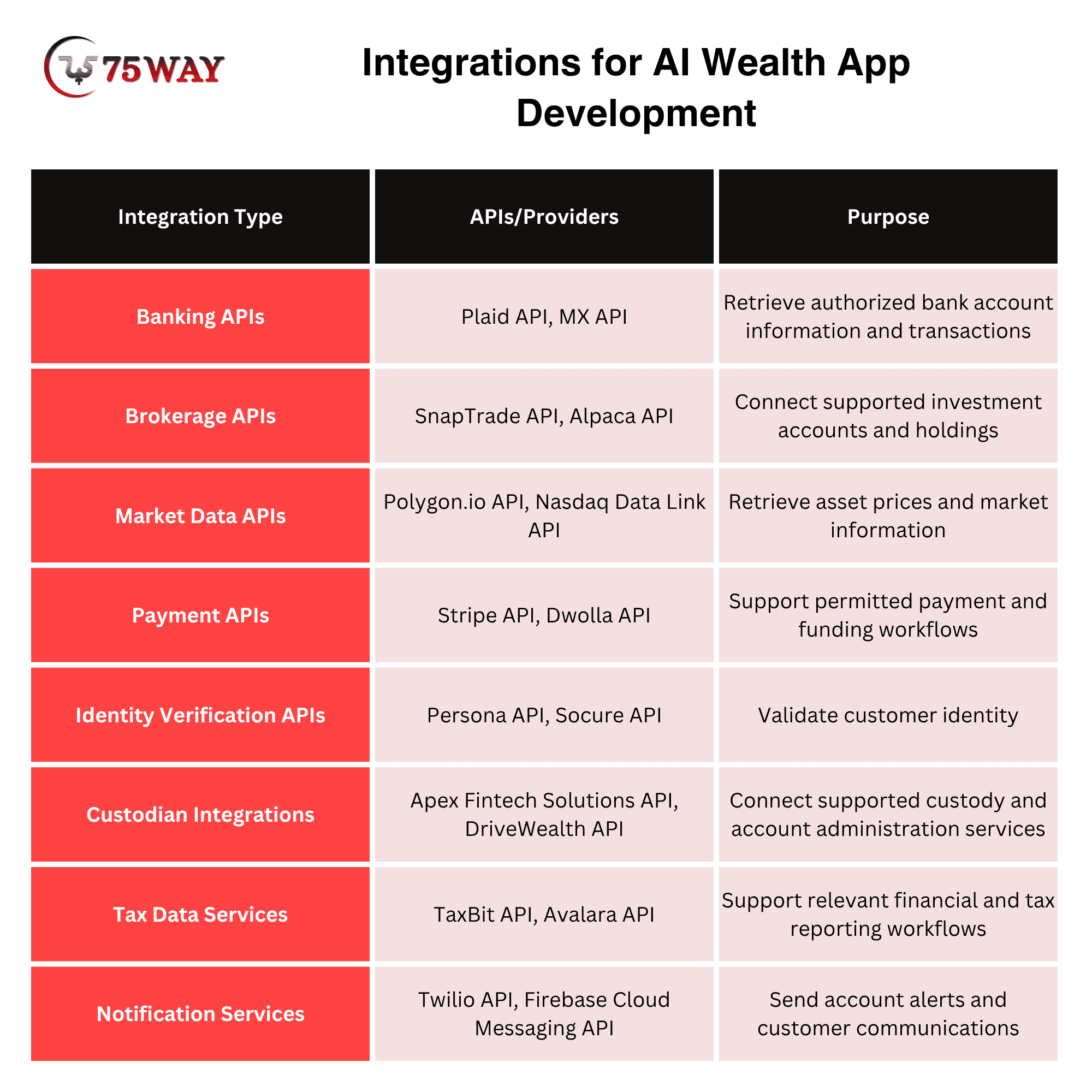
The exact providers depend on the business model, licensing requirements, supported institutions, and availability of their APIs.
Developers should also account for API rate limits, data synchronization, connection failures, consent management, and third-party service outages.
Alongside these integrations, the application must include appropriate security and compliance controls.
Its security design should include:
- Encryption for stored and transmitted financial data
- Role-based permissions for customer account access
- Multi-factor authentication and secure session handling
- Audit logs for important application activities
- API access controls and vulnerability testing
- Data backup and disaster recovery procedures
- Incident response and security monitoring mechanisms
Compliance requirements should be mapped against the actual services offered, business structure, and jurisdictions in which the platform operates.
For example, a platform that provides investment advice may have different obligations from an application that only displays financial information.
Step 7. Test Financial Application And AI Performance
With the core application, AI capabilities, and external integrations in place, comprehensive testing becomes the next priority.
Financial applications require extensive testing because incorrect information or failed workflows can affect customer decisions.
Testing should cover both conventional software functionality and AI-specific behavior.
User acceptance testing should also involve people who understand the intended financial workflows. Any issues identified during testing should be resolved before the production release.
Step 8. Deploy And Monitor Wealthtech Application
Once the wealth application passes testing and required security reviews, it can move into production.
Deployment should include production infrastructure, monitoring, backup systems, and a defined incident response process.
After launch, businesses should monitor:
- Application availability and overall system performance
- API response times and account connection failures
- AI response quality and financial information accuracy
- Customer onboarding completion and user engagement
- Security alerts and suspicious account activities
- Customer support requests and infrastructure expenses
AI models and financial integrations may change over time. Businesses should establish processes for reviewing model outputs, updating dependencies, managing third-party changes, and addressing new security risks.
Customer feedback and application analytics can also help identify areas that require improvement. The initial launch should be treated as the beginning of product development rather than its final stage.
Robust Technology Stack For AI Wealth App Development
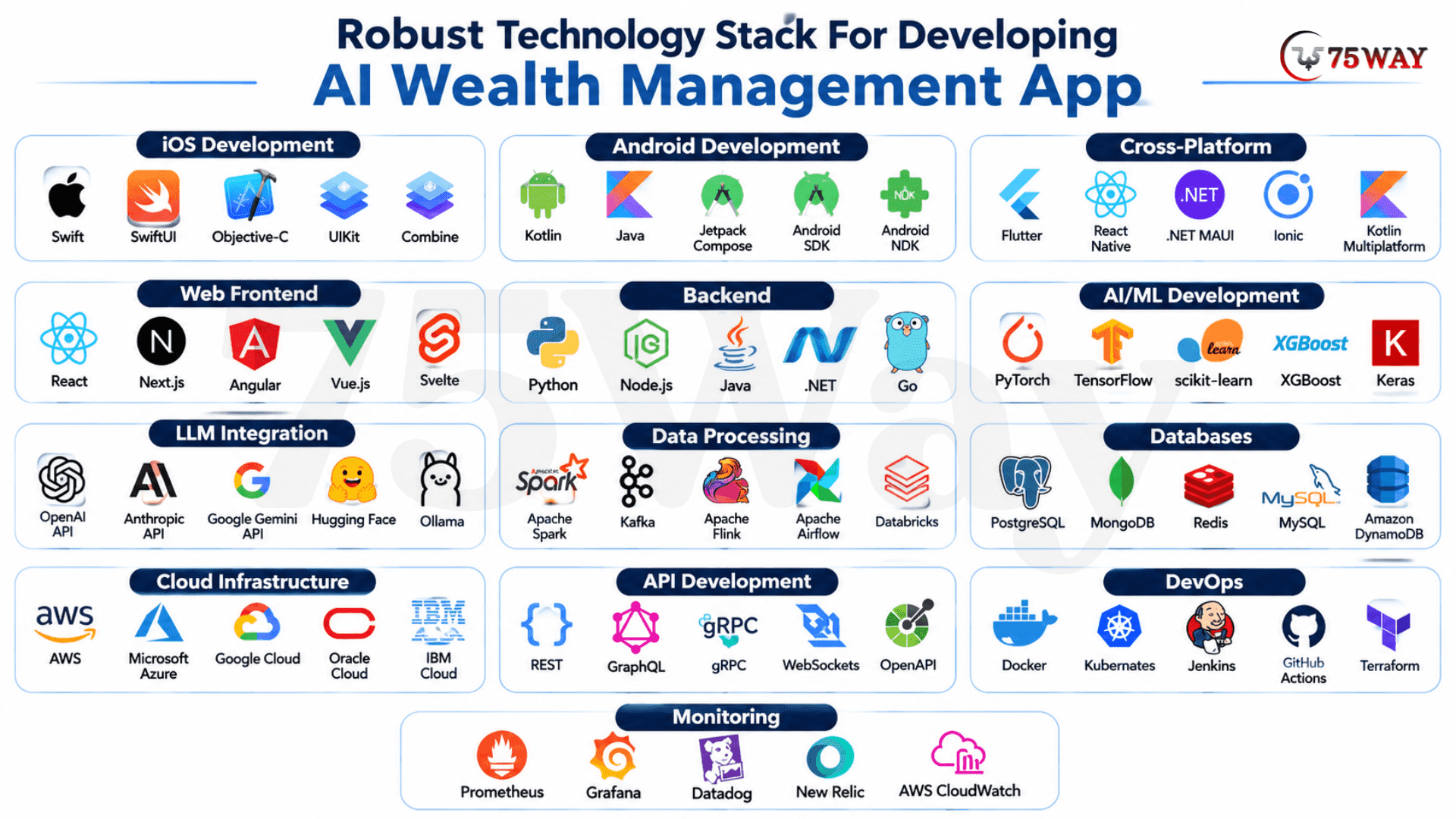
The technology stack determines how the application handles financial information, connects external services, processes AI requests, and supports future growth.
There is no universally correct technology combination. The selection depends on the product's scale, development budget, security requirements, and existing infrastructure. The following stack outlines technologies that businesses can evaluate.
Which Technology Stack Should Startups Choose To Create AI Wealth App?
A startup building an initial AI wealth management MVP does not necessarily need a complex enterprise architecture.
A practical starting combination could include:
- Flutter or React Native for mobile development.
- React for a web-based advisor dashboard.
- Python or Node.js for backend development.
- PostgreSQL for structured financial information.
- Redis for caching.
- Commercial LLM APIs for conversational features.
- Cloud infrastructure with appropriate security controls.
An established financial institution may require a different setup involving existing banking infrastructure, enterprise identity management, specialized financial databases, and stricter integration requirements.
The right approach is to select technologies based on the application's actual requirements and expected growth.
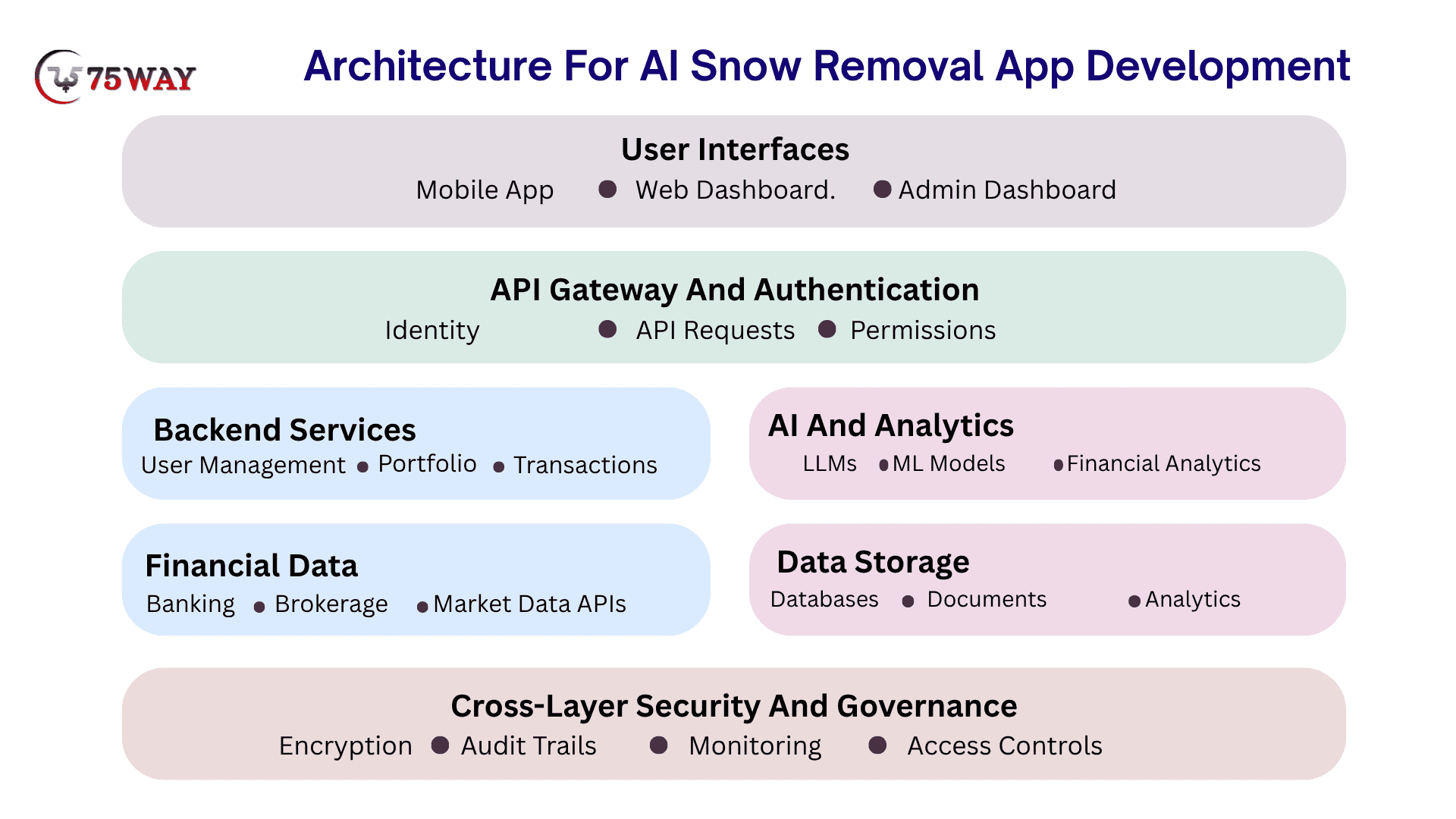
AI Wealth Management App Architecture: What Goes Behind The Application?
A wealth management application's architecture determines how financial data moves between users, external institutions, backend services, AI models, and reporting systems.
1. Presentation Layer
This is the part of the application that customers and financial advisors interact with.
It includes mobile applications, web dashboards, portfolio visualizations, account settings, and conversational AI interfaces.
The presentation layer should communicate with backend services through authenticated APIs rather than directly accessing financial databases.
2. Application And Business Logic Layer
This layer manages the application's primary operations.
It handles user accounts, permissions, financial goals, portfolio records, transaction history, and application workflows.
For example, when a user requests a portfolio summary, this layer checks the user's permissions, retrieves the required information, and sends it to the appropriate analytical service.
3. Financial Data Integration Layer
This layer connects the application with external financial institutions and data providers.
It handles account aggregation, investment holdings, transaction records, market information, and other permitted financial data.
It should also manage data validation, synchronization, API failures, and consent records.
4. AI And Analytics Layer
This layer contains the application's AI models and analytical services.
It may include:
- Machine learning models
- Large language models
- Natural language processing
- Portfolio analytics
- Predictive modeling
- Recommendation engines
- Document processing
Each service should have clearly defined responsibilities.
For example, a portfolio calculation service should calculate asset allocation using validated financial data, while an LLM can convert the results into an understandable explanation.
5. Database And Storage Layer
Financial applications may require multiple storage systems because different types of information have different requirements.
- Relational Database: User accounts, transactions, portfolio records
- Document Storage: Statements, financial reports, uploaded documents
- Cache: Frequently requested application information
- Data Warehouse: Historical financial and analytical datasets
- Vector Database: Embeddings for approved document retrieval and semantic search
Sensitive information should have appropriate encryption, access restrictions, retention policies, and backup controls.
6. Security And Compliance Layer
Security should operate across the entire architecture rather than exist as a separate feature.
This layer includes authentication, authorization, encryption, audit logging, data governance, monitoring, and incident response.
It should also support the business's regulatory obligations and internal compliance policies.
US Regulatory And Compliance Requirements For AI Wealth Management Apps
Regulatory planning is one of the most important parts of wealth management app development in the United States.
A financial application may handle personal information, investment accounts, securities-related information, and financial recommendations. Its regulatory obligations depend on the activities it performs, how it earns revenue, and which entities operate the service.
1. Securities And Exchange Commission (SEC)
The SEC regulates various activities involving securities markets and investment advisers.
If a business provides investment advice for compensation, it may fall within the definition of an investment adviser under applicable federal or state laws.
The business may need to evaluate:
- Investment adviser registration requirements.
- Fiduciary obligations.
- Client disclosures.
- Conflicts of interest.
- Investment recommendation practices.
- Compliance policies and supervision.
- Custody-related requirements, where applicable.
Robo advisory platforms are not automatically exempt from investment adviser obligations because their recommendations are generated through algorithms.
The SEC's robo-adviser guidance specifically discusses disclosures, collection of client information, and effective compliance programs. The SEC's fiduciary standards also emphasize duties of care and loyalty.
2. Financial Industry Regulatory Authority (FINRA)
FINRA oversees broker-dealers and their associated persons that fall within its regulatory framework.
If a wealth management application supports broker-dealer activities, the business must evaluate applicable FINRA requirements.
Relevant areas may include:
- Supervision of business activities.
- Communications with customers.
- Books and records.
- Customer account information.
- Cybersecurity and technology controls.
- Review of automated processes.
AI-generated communications and recommendations should have appropriate supervision and recordkeeping controls where applicable.
3. Gramm-Leach-Bliley Act (GLBA)
The Gramm-Leach-Bliley Act establishes privacy and safeguarding requirements for covered financial institutions.
Depending on the business and its regulatory classification, relevant requirements may include:
- Privacy notices.
- Customer information protection.
- Safeguards for sensitive financial records.
- Service provider oversight.
- Appropriate security procedures.
Businesses should evaluate which GLBA provisions apply to their operations rather than assuming every fintech application has identical obligations.
4. California Consumer Privacy Act (CCPA) And California Privacy Rights Act (CPRA)
Businesses collecting personal information from California residents should evaluate whether they fall within the scope of California's privacy laws.
Depending on applicability, requirements may involve:
- Disclosing personal information collection practices.
- Providing applicable consumer privacy rights.
- Managing requests to access or delete personal information.
- Addressing data sharing and selling.
- Implementing reasonable security measures.
- Managing service provider relationships.
Other US states also have comprehensive privacy laws, so a platform serving customers across multiple states needs a broader privacy assessment.
5. Bank Secrecy Act (BSA) And Anti-Money Laundering (AML)
Businesses involved in covered financial activities may have obligations under the Bank Secrecy Act and applicable anti-money laundering rules.
Depending on the business model, these may involve:
- Customer identification.
- Customer due diligence.
- Transaction monitoring.
- Suspicious activity reporting.
- Recordkeeping.
- Sanctions screening.
Not every wealth management software provider is directly subject to the same BSA/AML obligations. Applicability depends on the entity's regulated activities and role.
6. Know Your Customer (KYC)
KYC procedures help covered financial institutions establish and verify customer identities.
A wealth management application may incorporate identity verification, document collection, risk assessment, and customer onboarding workflows.
For businesses operating through regulated financial partners, responsibilities should be clearly allocated through contracts and compliance procedures.
7. Regulation Best Interest (Reg BI)
Regulation Best Interest applies to broker-dealers and their associated persons when making recommendations of securities transactions or investment strategies involving securities to retail customers.
Its requirements include disclosure, care, conflict of interest, and compliance obligations.
Businesses developing wealth management platforms should understand how automated recommendations and advisor workflows interact with these requirements.
Important: Not every application is subject to every regulation listed above. The applicable requirements depend on the company's legal structure, services, customers, activities, and regulatory status. This section is a product-planning overview, not legal advice.
Security Considerations For AI-Powered Wealth Management Platform Development
Financial information requires stronger protection than ordinary application data. A security failure can expose sensitive customer records, compromise financial accounts, and damage a company's reputation. Here are the security controls businesses should consider.
- Encrypts financial data during transmission and storage securely
- Restricts financial record access according to assigned user permissions
- Adds extra authentication layers to protect customer accounts
- Protects AI models against unauthorized access and data leakage
- Records important activities for security reviews and investigations
- Evaluates vendor security practices, data handling, and reliability
How Much Does AI Wealth Management App Development Cost In USA?
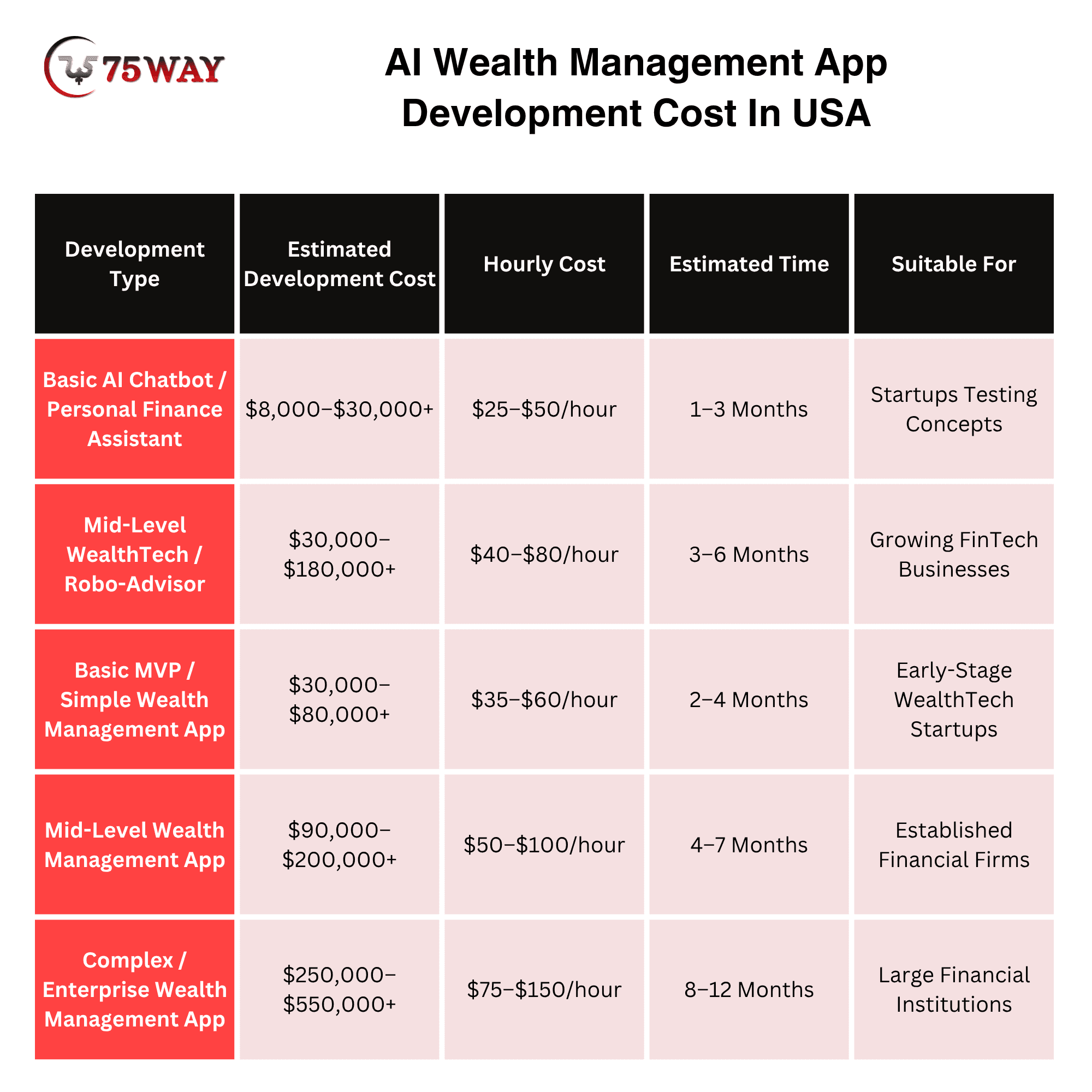
The cost of AI wealth management app development can range from $8,000 – $500,000+, depending on the application's complexity, AI capabilities, integrations, security requirements, and development scope. However, businesses should understand that this is a broad planning range, not a fixed US industry price or a guaranteed production-ready budget.
Basic AI Chatbot/Personal Finance Assistant: $8,000 – $30,000+
- Includes basic chatbot and financial query handling capabilities
- Supports expense tracking and simple financial summaries
- Requires limited integrations and straightforward AI functionality
Mid-Level WealthTech / Robo-Advisor: $30,000 – $180,000+
- Includes automated portfolio analysis and risk assessment
- Supports investment recommendations and goal-based financial planning
- Integrates financial APIs with advanced AI capabilities
Basic MVP/Simple Wealth Management App Cost: $30,000 – $80,000+
- Includes essential registration, dashboards, and portfolio tracking
- Supports basic financial reporting and account management
- Requires limited integrations and essential security controls
Mid-Level Wealth Management App Cost: $90,000 – $200,000+
- Includes advanced portfolio management and personalized financial insights
- Supports AI assistants and multiple financial integrations
- Provides automated reporting and enhanced security capabilities
Complex/Enterprise-Wealth Management App Cost: $250,000 – $550,000+
- Includes multi-tenant architecture and enterprise financial workflows
- Supports advanced AI analytics and extensive integrations
- Requires comprehensive security, compliance, and infrastructure controls
How To Reduce AI Wealth Management App Development Costs
Businesses can control initial investment without compromising essential product requirements.
Consider these approaches:
- Start with a clearly defined MVP.
- Prioritize one customer segment.
- Use existing financial APIs where suitable.
- Integrate established AI models before considering custom training.
- Develop reusable application components.
- Avoid unnecessary features during the first release.
- Validate product assumptions with real users.
- Plan infrastructure according to expected usage.
A phased development strategy also allows businesses to evaluate customer demand before investing in complex enterprise functionality.
How Long Does It Take To Develop An AI Wealth Management App?
Development timelines depend on the number of features, technical complexity, integrations, testing requirements, and regulatory readiness.
A prototype may take considerably less time than a production-ready application that connects to financial institutions and supports regulated advisory services. The following estimates provide a general planning framework.
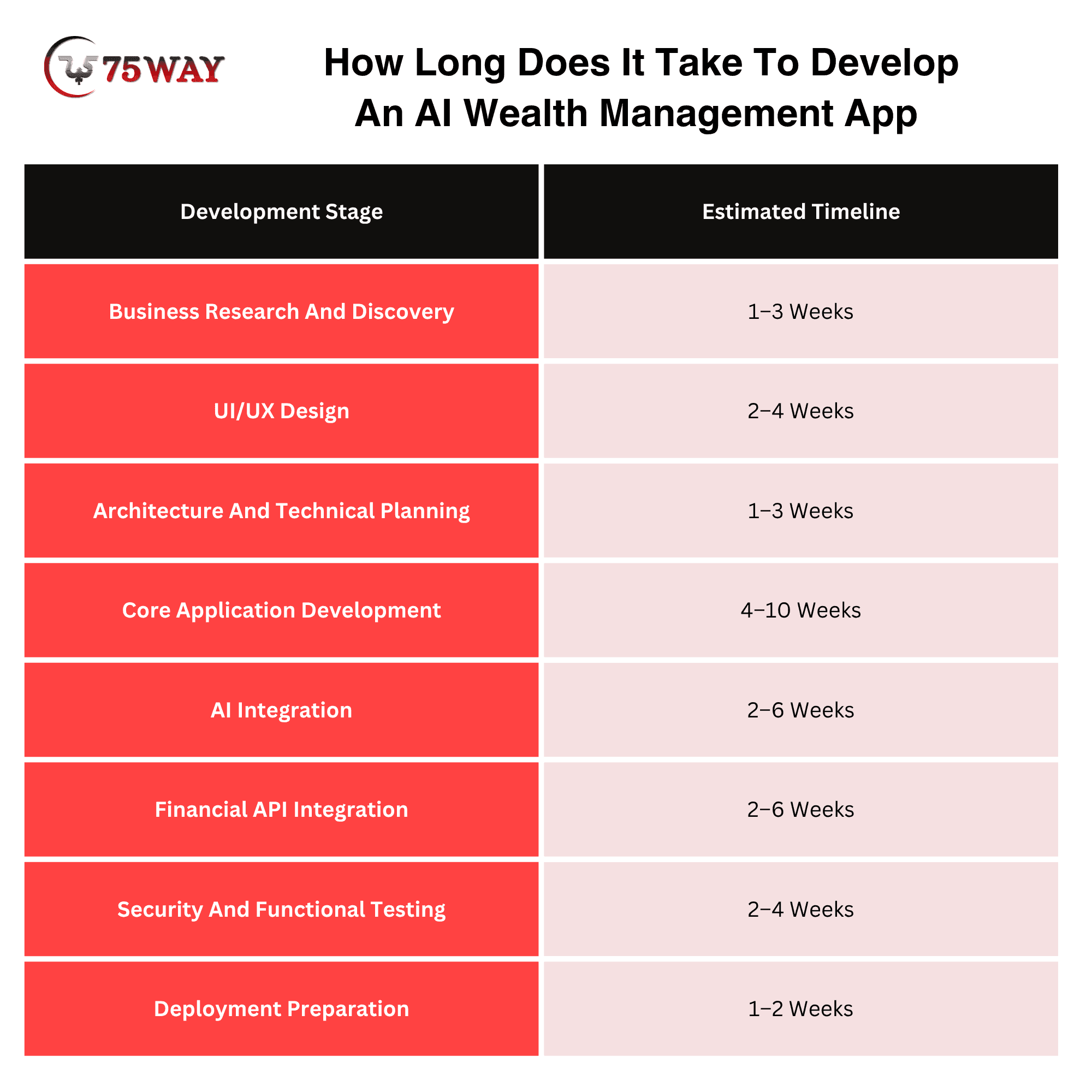
These stages may overlap. Their durations should not simply be added together to produce a guaranteed launch date.
A focused MVP might take approximately 3–5 months, while an advanced platform may require 6–12 months or longer.
Regulatory approvals, third-party provider onboarding, data access agreements, and security reviews can extend the overall launch schedule.
How Can AI Wealth Management Apps Generate Revenue?
A strong wealth management application needs a sustainable revenue model.
The right approach depends on the target audience, service offering, customer acquisition costs, and regulatory structure. Here are monetization models businesses can evaluate.
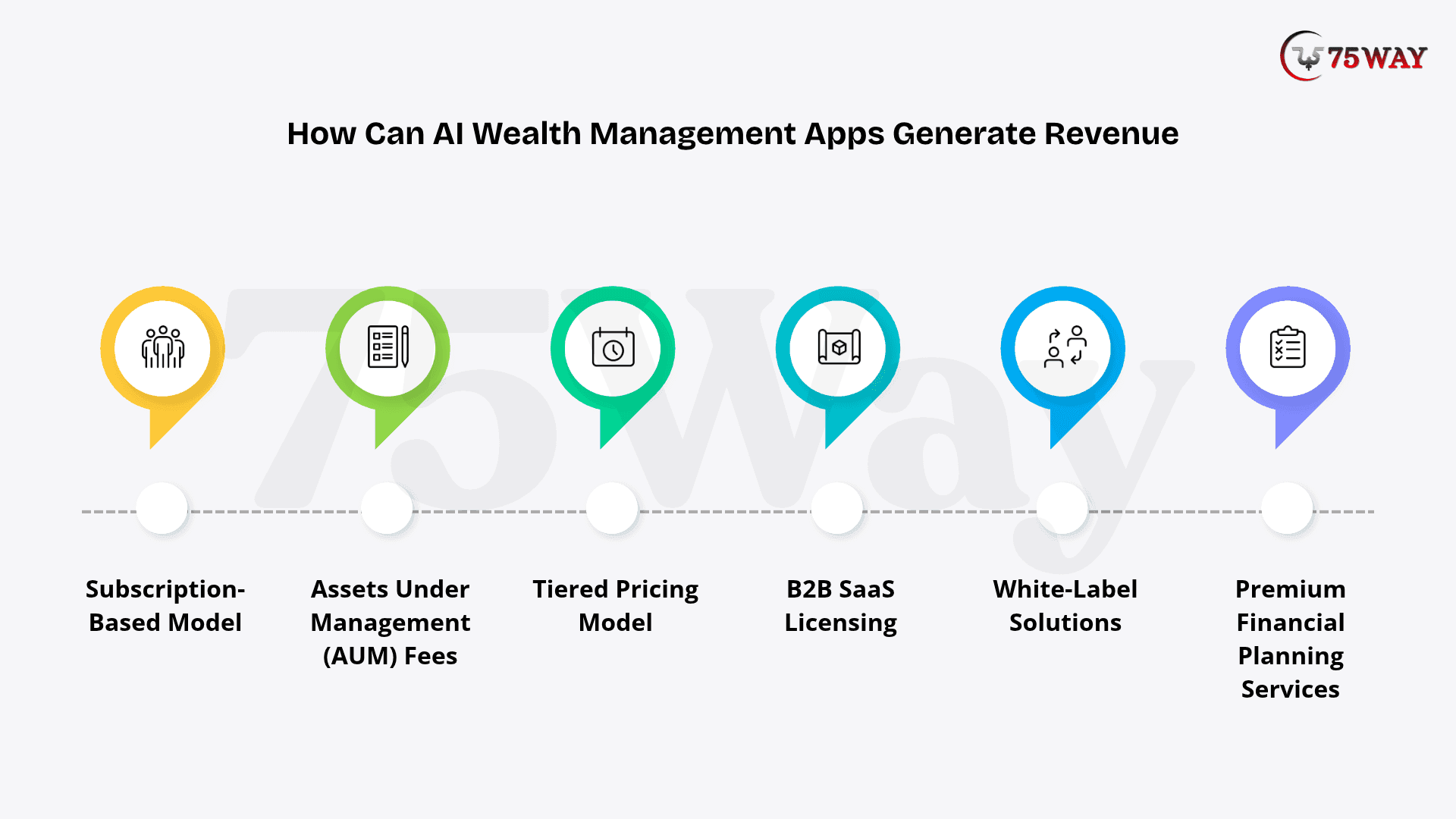
1. Subscription-Based Model
Customers pay a recurring monthly or annual fee to access application features.
Possible subscription tiers may include:
- Free: Basic financial tracking and educational resources.
- Premium: Advanced portfolio insights and financial planning tools.
- Professional: Advisor-oriented reporting and client management.
- Enterprise: Customized workflows and institutional integrations.
This model provides predictable recurring revenue when the product offers ongoing value.
2. Assets Under Management (AUM) Fees
Under an AUM-based model, an advisory business charges a fee based on the assets it manages for clients.
For example, an advisory firm may charge a percentage of a client's managed assets under an agreed fee arrangement.
This model is common in wealth management, but it involves advisory business and regulatory considerations. An app developer should not assume that software ownership alone authorizes the collection of advisory fees.
3. Tiered Pricing Model
A tiered pricing structure allows businesses to serve customers with different financial needs.
A basic tier might offer portfolio tracking, while higher tiers provide advanced planning, additional account connections, or advisor access.
This approach can support customer acquisition and expansion as users require more sophisticated services.
4. B2B SaaS Licensing
Businesses can license the platform to RIAs, financial planning firms, banks, and other eligible financial service providers.
The company may charge:
- Monthly platform fees
- Annual licensing fees
- Per-advisor fees
- Per-user fees
- Custom enterprise contracts
This model is particularly relevant for businesses building advisor productivity software.
5. White-Label Solutions
A white-label wealth management platform allows financial institutions or advisory businesses to offer an application under their own branding.
The technology provider can generate revenue through licensing, implementation fees, customization, and ongoing maintenance.
This model may appeal to established businesses that want digital wealth management capabilities without developing an entire platform internally.
6. Premium Financial Planning Services
Businesses may offer additional financial planning tools, advisor consultations, specialized reporting, or other permitted premium services.
The availability and pricing of these services depend on the actual business model and relevant regulatory requirements.
Which Revenue Model Should You Choose?
A retail wealthtech startup may find subscriptions more suitable, while a software company targeting RIAs may prefer SaaS licensing.
An investment advisory business may consider AUM-based fees if its legal structure, registration status, and service model support that arrangement.
The important thing is to choose monetization early enough to influence the product's feature set, customer onboarding, payment infrastructure, and compliance planning.
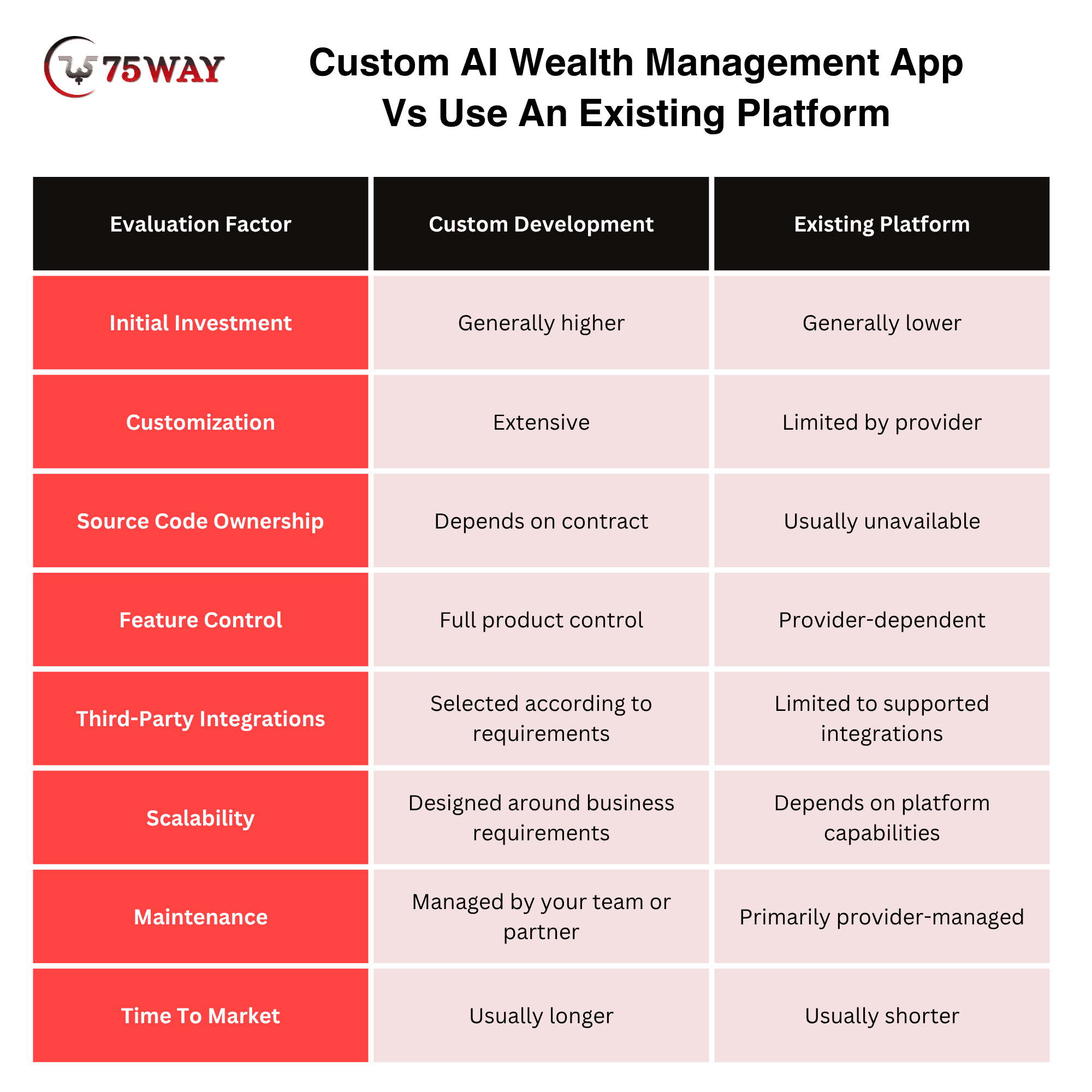
Build A Custom AI Wealth Management App Or Use An Existing Platform?
Before investing in development, business owners should decide whether to build a custom application, purchase an existing solution, or customize a third-party platform.
Each option has different implications for ownership, development costs, customization, and long-term business growth.
When Should You Choose Custom Wealth Management App Development?
Custom development makes sense when your business needs:
- Unique AI-powered financial workflows.
- Proprietary portfolio analytics.
- Customized advisor dashboards.
- Specific financial API integrations.
- Greater control over application architecture.
- A distinct subscription or licensing model.
- Long-term ownership of the product roadmap.
For example, a startup developing an AI-powered portfolio management platform for independent advisors may need specialized reporting, client management, and financial data processing capabilities that existing products cannot provide.
When Should You Choose An Existing Wealth Management Platform?
An existing platform may be suitable when your business needs standard wealth management functionality without extensive customization.
It can help businesses validate market demand, launch a service faster, and avoid managing an entire technology infrastructure.
However, evaluate vendor dependency, data ownership, API limitations, customization restrictions, and ongoing licensing costs before making a decision.
Common Mistakes To Avoid During AI Wealth Management Application Development
Even a technically advanced application can struggle if the product strategy, financial workflows, or security requirements are poorly planned. Here are some mistakes businesses should avoid.
1. Building Without Defining The Target Customer
An application designed for individual investors may not meet the needs of financial advisors or institutional wealth managers.
Trying to serve everyone from the beginning can increase development costs and complicate the user experience.
Better approach: Choose a primary customer segment and develop features around its specific financial requirements.
2. Treating AI As A Replacement For Financial Expertise
AI can analyze information and support financial workflows, but it should not automatically replace qualified financial professionals.
Unsupported recommendations, inaccurate calculations, and misleading investment projections can create significant business and regulatory risks.
Better approach: Define which decisions AI can support, which require human review, and which must remain under authorized professional control.
3. Ignoring Financial Data Quality
AI models cannot produce reliable insights from incomplete, outdated, or inaccurate financial information.
Poor data synchronization can lead to incorrect portfolio summaries and misleading financial projections.
Better approach: Establish data validation, source verification, synchronization, and reconciliation procedures.
4. Overcomplicating The First Version
Trying to include portfolio management, tax planning, investment research, advisor management, and multiple AI assistants in the initial release can delay product validation.
Better approach: Start with the smallest product that solves a meaningful customer problem.
5. Delaying Security Planning
Adding security controls after development can require architectural changes and increase expenses.
Better approach: Include encryption, access management, audit logging, and security testing in the original technical requirements.
6. Overlooking Third-Party Dependencies
A wealth management application may depend on several external providers.
Changes in API availability, pricing, permissions, or data formats can affect application operations.
Better approach: Evaluate provider reliability, contractual terms, alternative integrations, and failure-handling procedures.
7. Launching Without AI Evaluation
An AI assistant that performs well during demonstrations may generate inaccurate or inappropriate responses in production.
Better approach: Test AI behavior using realistic financial scenarios, edge cases, unauthorized requests, and adversarial prompts before launch.
Future Trends You Can Adopt To Make Wealth Management App
AI wealth management technology is moving beyond basic financial dashboards and automated customer support. Businesses planning new applications should consider emerging capabilities that may influence customer expectations and product architecture.
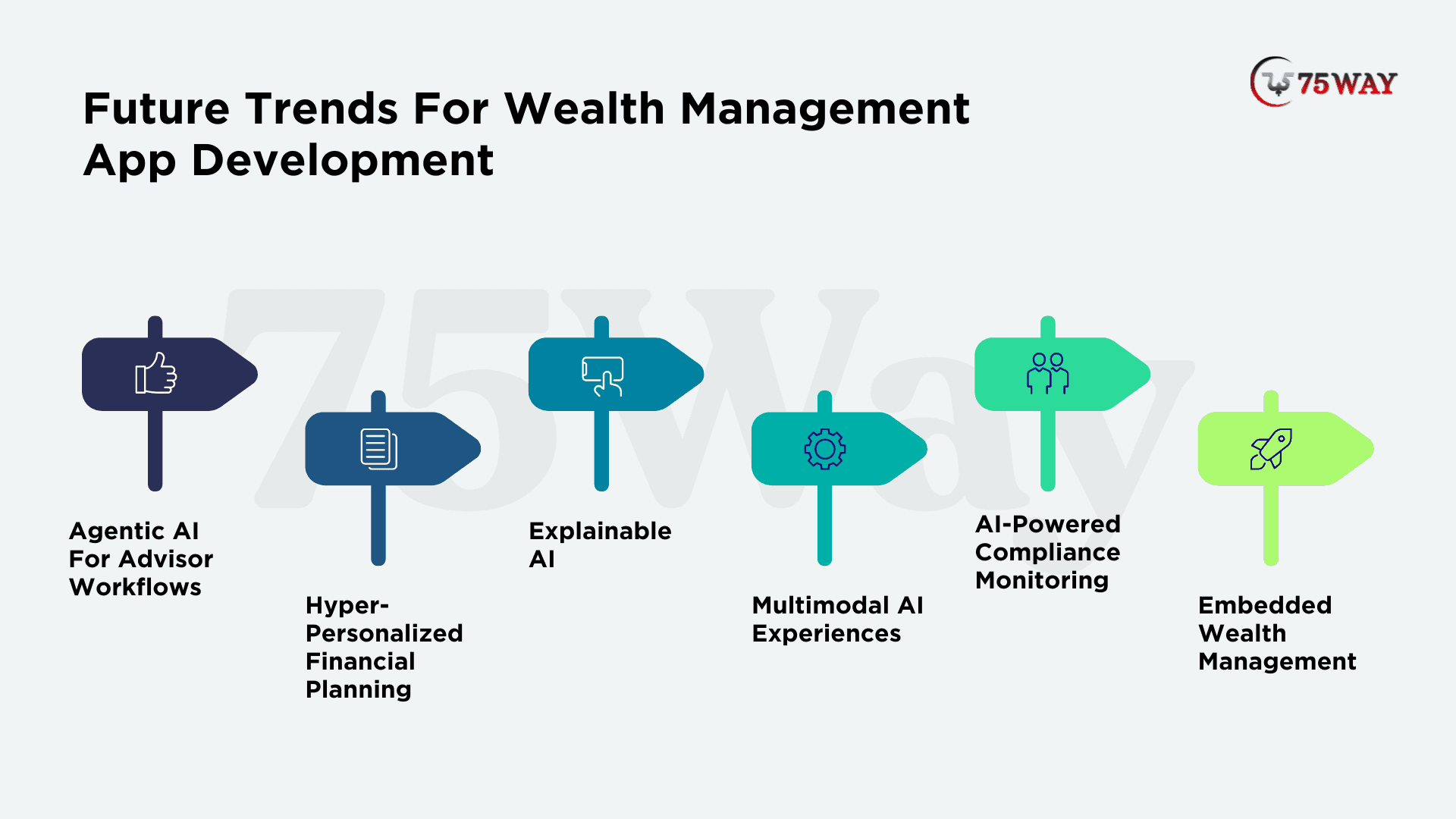
1. Agentic AI For Advisor Workflows
Agentic AI systems can coordinate multiple tasks through defined workflows and tools.
In wealth management, an AI agent could help prepare client review materials, retrieve authorized financial information, identify missing documents, and organize follow-up tasks.
2. Hyper-Personalized Financial Planning
Future wealth management applications may use more detailed financial information to support individualized planning experiences.
AI can help organize customer goals, income patterns, investment holdings, and financial obligations into more relevant planning scenarios.
Personalization should remain transparent and respect data privacy and applicable advisory requirements.
3. Explainable AI
Financial users need to understand why an application generates a particular insight.
Explainable AI focuses on making model outputs and underlying analytical factors easier to understand.
For example, an application could explain which portfolio holdings contributed to a concentration warning instead of displaying an unexplained risk score.
4. Multimodal AI Experiences
Multimodal AI can process different types of information, including text, documents, images, and audio.
This could support financial document interpretation, voice-based financial queries, and advisor meeting summaries.
5. AI-Powered Compliance Monitoring
AI can help compliance teams organize records, identify unusual activity patterns, review communications, and flag potential issues for investigation.
These systems should support established compliance processes rather than independently determine whether a business has met its regulatory obligations.
6. Embedded Wealth Management
Embedded wealth management allows financial services to become part of broader digital platforms.
This approach can create new distribution opportunities, although financial partnerships and regulatory responsibilities must be clearly defined.
How To Choose The Right AI Wealth Management App Development Company?
While selecting the right AI wealth management app development company, you require more than comparing development quotes. Your technology partner should understand financial workflows, AI integration, data security, and regulatory requirements. Evaluate these factors before selecting a development team.
- Review experience in fintech and wealthtech application development
- Assess expertise in AI models and financial analytics
- Examine previous projects and relevant client success stories
- Verify knowledge of financial data security requirements
- Evaluate third-party API integration and technical capabilities
- Compare communication, project timelines, and ongoing support
How Can 75way Technologies Help You Build An AI Wealth Management App?
An AI-powered wealth management application development requires a combination of product strategy, financial workflow understanding, AI integration, and secure software engineering.
75way Technologies can help businesses approach this development journey by translating their product requirements into a structured technical roadmap.
From initial product planning and UI/UX design to mobile and web development, backend engineering, AI integration, and third-party API connectivity, the focus should remain on building an application around your business model.
Whether you are a fintech startup planning an MVP, an established wealth management firm upgrading existing systems, or a financial services business exploring AI-powered advisory tools, the development scope should reflect your customers, operational requirements, and long-term objectives.
Final Thoughts
AI wealth management app development offers US businesses an opportunity to build more personalized financial experiences, improve advisory workflows, and introduce new digital wealth services.
However, commercial success depends on more than AI integration. Product positioning, financial data quality, technical architecture, security, regulatory planning, and monetization must work together.
The right development strategy starts with a specific customer problem and a realistic product scope. If you want to turn your wealthtech idea into a market-ready application, you can partner with an on-demand app development company to plan and build your custom AI wealth management app.
Frequently Asked Questions (FAQs)
How Much Does It Cost To Develop An AI Wealth Management App In The USA?
AI wealth management app development can cost $8,000 – $550,000+, depending on application complexity, AI capabilities, financial API integrations, security requirements, and development scope. Enterprise platforms may require additional investment.
Can AI Wealth Management Apps Provide Investment Advice?
Yes, certain platforms can provide investment advice when operated under an appropriate regulatory structure. Businesses must evaluate applicable investment adviser registration, fiduciary, disclosure, and compliance requirements before offering advisory services.
Is AI Wealth Management App Development Suitable For Fintech Startups?
Yes. Fintech startups can develop specialized applications for retail investors, financial advisors, and wealth management firms. Starting with a focused MVP helps validate customer demand before expanding the product.
Is It Better To Build A Custom Wealth Management App Or Buy An Existing Platform?
Custom development offers greater control over features, integrations, and product architecture. Existing platforms can reduce initial development effort. The right choice depends on budget, customization needs, ownership requirements, and long-term business objectives.
How Can Businesses Keep AI Wealth Management Apps Secure?
Businesses should implement encryption, multi-factor authentication, role-based access, secure API communication, audit logging, AI model safeguards, regular security testing, and third-party vendor assessments.