Summary
This guide explores AR VR app development, covering immersive technologies, frameworks, architecture, UX design, testing, deployment, and costs. It also explains monetization, AI integration, and security. It highlights innovations shaping spatial computing and business transformation in 2026.
Quick Overview
- AR/VR market revenue is projected to hit $13.7 billion by 2026.
- AR VR technologies transform digital engagement across diverse industries.
- Strategic planning improves application scalability, adoption, and business outcomes.
- AI integration enhances personalization, interaction quality, and user satisfaction.
- Average AR VR app development cost ranges from $10,000 to $500,000.
- Industry-specific solutions create measurable value through immersive experiences.
What if customers could place a virtual sofa in their living room before buying it, or try on clothes inside a fully immersive digital environment without any real-world risk? That is exactly why AR VR mobile apps and platforms are attracting massive business investment in 2026.
You have probably already used AR or VR in everyday life. For example, the Lenskartmobile app's 3D Virtual Try-On feature allows customers to see how eyeglasses look on their faces using Augmented Reality (AR) before placing an order. Similarly, IKEA Place lets shoppers visualize furniture inside their homes through a smartphone camera.
On the VR side, companies such as Walmart use immersive virtual training environments to prepare employees for real-world situations before they interact with customers. These AI-powered applications demonstrate how AR enhances the real world with digital elements, while VR creates entirely immersive digital experiences.
The real market growth reflects this trend. The global AR and VR market is projected to reach approximately $50.9 billion in 2026, growing at a 10.50% CAGR, while the worldwide user base is expected to surpass 3.8 billion users by 2030. These numbers highlight how immersive technologies are rapidly moving from niche adoption to mainstream adoption across consumer and enterprise markets.
As demand continues to grow, businesses are looking beyond gaming and entertainment. Retailers are using AR for virtual product visualization in ecommerce apps and platforms, healthcare organizations are adopting VR for medical training, real estate apps are offering virtual property tours, and manufacturers are improving workforce training through immersive simulations.
However, building a successful AR VR application requires much more than creating 3D experiences. Businesses must carefully plan user interactions, select the right hardware ecosystem, build scalable architectures, optimize performance, and ensure seamless integration with existing digital platforms.
So what does it actually take to build an AR/VR application in 2026? Which technologies should you choose, how much does AR VR app development cost, and what steps are involved in creating a scalable immersive experience?
This step-by-step guide covers everything you need to know about AR VR app development, including features, technology stack, development process, costs, challenges, and future industry trends.
What Is AR VR App Development?
AR VR app development refers to the process of designing, building, testing, and deploying applications that create immersive digital experiences using augmented reality and virtual reality technologies.
Augmented reality is useful for improving the physical environment by overlaying digital content onto real-world surroundings. Through smartphones, tablets, smart glasses, or wearable devices, users can interact with virtual objects while remaining connected to their physical environment.
Virtual Reality creates fully immersive digital environments that replace the real world with computer-generated experiences. Users interact with these environments through headsets, controllers, motion sensors, and increasingly sophisticated tracking technologies. The development process involves multiple disciplines, including:
- Software engineering
- 3D modeling and animation
- User experience design
- Spatial computing
- Computer vision
- Artificial intelligence
- Real-time rendering
- Cloud infrastructure
Modern AR VR development requires balancing technical performance with user comfort. AR/VR app developers must optimize graphics, reduce latency, maintain smooth frame rates, and create intuitive interaction systems that feel natural within immersive environments.
Applications range from simple product visualization tools to enterprise-grade training platforms, virtual collaboration environments, industrial simulations, and advanced mixed reality systems.
As hardware capabilities improve and development tools become more accessible, businesses of all sizes are exploring immersive technologies as part of their digital growth strategies.
Why Businesses Are Investing In AR VR Applications In 2026?
Business adoption of AR VR technologies has accelerated significantly over the past few years. Organizations increasingly recognize immersive experiences as strategic assets rather than experimental innovations. Several factors contribute to this growing investment.
- Enhanced Customer Engagement: Traditional digital experiences often struggle to capture attention in competitive markets. AR and VR create memorable interactions that increase engagement and encourage deeper customer participation. Consumers can visualize products, explore environments, and interact with services in highly engaging ways before making purchasing decisions.
- Improved Training Outcomes: Organizations spend substantial resources on workforce training. AR VR applications provide realistic simulations that improve learning effectiveness while reducing training costs. Employees can practice procedures, develop technical skills, and gain hands-on experience within controlled virtual environments.
- Faster Decision-Making: Immersive visualization tools help stakeholders evaluate products, facilities, and designs more. Engineers, architects, and designers can identify issues earlier, reducing costly revisions during later development stages.
- Increased Operational Efficiency: AR-powered guidance systems streamline maintenance tasks, equipment inspections, and manufacturing workflows. Workers receive real-time instructions, reducing errors and improving productivity.
- New Revenue Opportunities: Immersive commerce, virtual events, subscription experiences, and digital assets create additional revenue streams for businesses exploring AR VR technologies. Companies that embrace immersive experiences early often establish competitive advantages within their industries.
Market Trends And Industry Growth of AR/VR Solutions In 2026
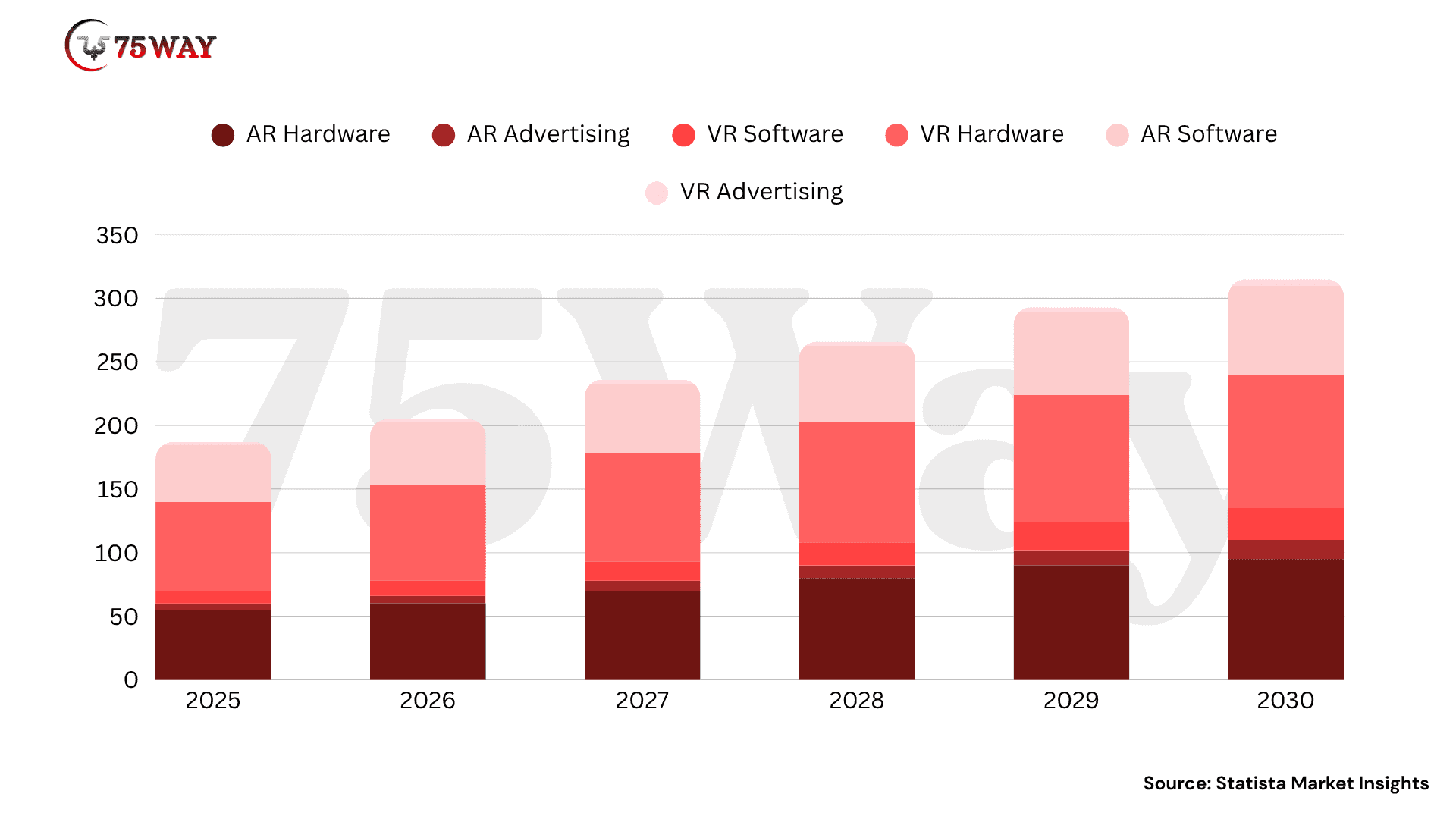
The AR VR market continues to experience strong growth as hardware, software, and connectivity technologies mature. The latest market insights below highlight the rapid expansion, investment trends, and business opportunities shaping the global AR VR industry in 2026 and beyond.
Market Size and Revenue Projections
- The United States is expected to lead revenue generation in 2026, with an estimated market volume of US$13.7 billion, as stated in Statista.
- User penetration is projected to reach 54.9% in 2026 and increase to 57.0% by 2030.
- ARPU is expected to remain around US$14.3.
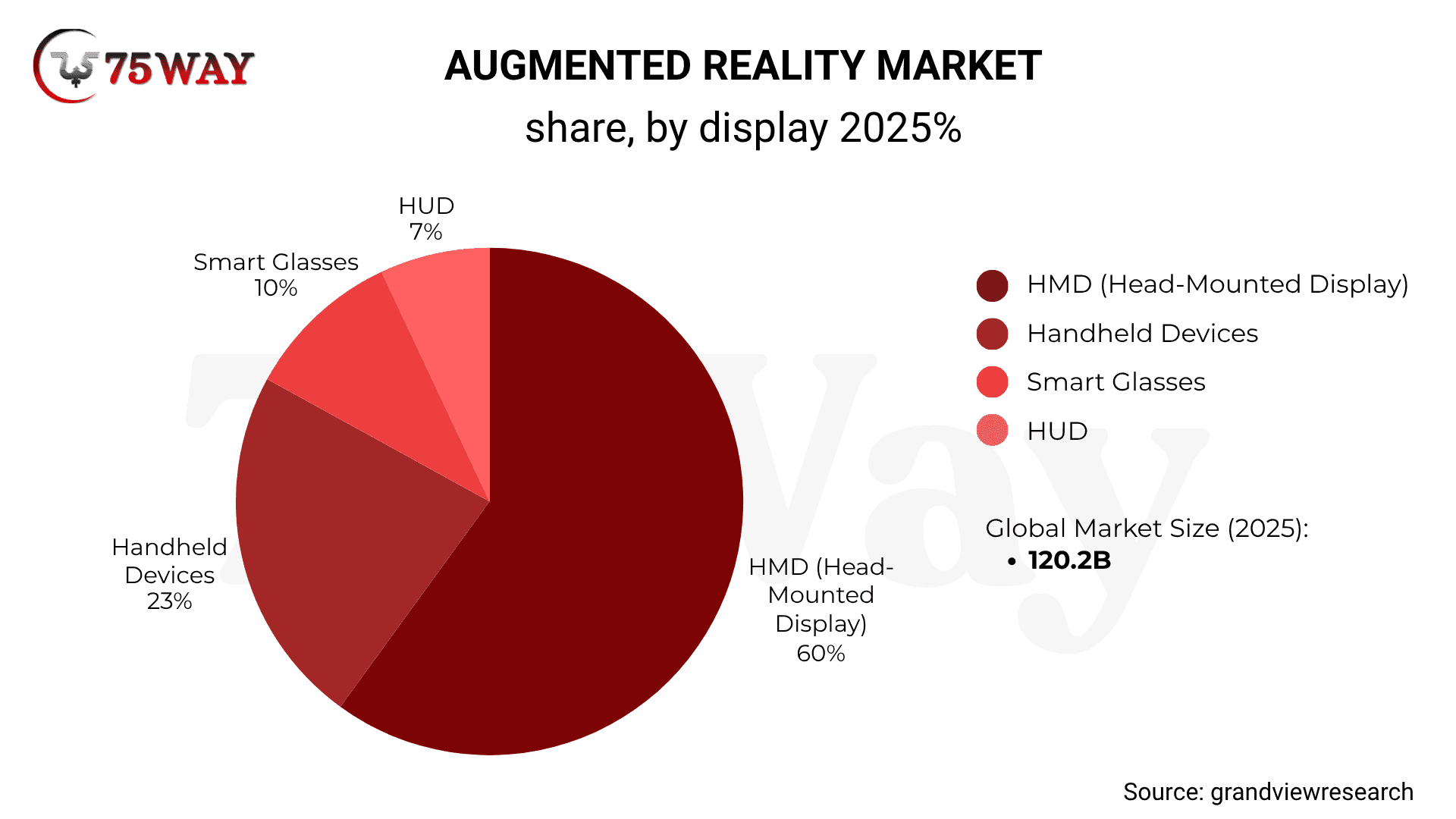
Augmented Reality Market Growth
- The AR market is estimated at $125.11 billion in 2026 and is projected to reach USD 387.23 billion by 2031, growing at a CAGR of 25.35%, according to a Mordor Intelligence report.
- Another estimate places the global AR market at $1,050.56 billion by 2033, expanding at a CAGR of 29.7%.
- North America holds the greatest part of the augmented reality market at over 34% worldwide.
Consumer Adoption Trends
- Around 35% of smartphone users actively engage with mobile AR experiences.
- Approximately 25% to 30% of U.S. adults have used a VR headset.
- Around 10% to 20% of AR/VR users engage with these platforms weekly or daily, mainly for entertainment, shopping, and gaming.
Enterprise Adoption and Business Usage
- More than 52% of global enterprises use AR/VR tools, while up to 91% are either adopting or planning to adopt XR technologies.
- About 38% of companies use VR for training and onboarding.
- Around 27% use AR for remote assistance and maintenance.
Several trends are driving expansion across industries.
- Spatial Computing Adoption: Organizations increasingly view spatial computing as the next major computing platform after mobile technology. Digital experiences are shifting from two-dimensional interfaces toward three-dimensional interactive environments.
- Enterprise-Focused Solutions: While gaming remains important, enterprise applications now account for a significant portion of AR VR investments. Businesses use immersive technologies for: training, collaboration, product development, remote support, and customer engagement.
- AI-Powered Immersion: Artificial intelligence is transforming immersive experiences through intelligent avatars, adaptive environments, and personalized interactions. AI-driven systems make AR VR applications more responsive and context-aware.
- Cloud Rendering Expansion: Cloud-based rendering enables high-quality experiences on devices with limited processing power. This approach reduces hardware requirements while expanding accessibility.
- Growth of Wearable Devices: Headsets, smart glasses, and mixed reality devices continue improving in comfort, performance, and affordability. These advancements contribute to broader consumer and enterprise adoption.
- Integration With Digital Twins: Digital twin technology is becoming increasingly important across manufacturing, logistics, healthcare, and infrastructure sectors. Organizations use immersive environments to visualize, monitor, and optimize real-world assets in real time.
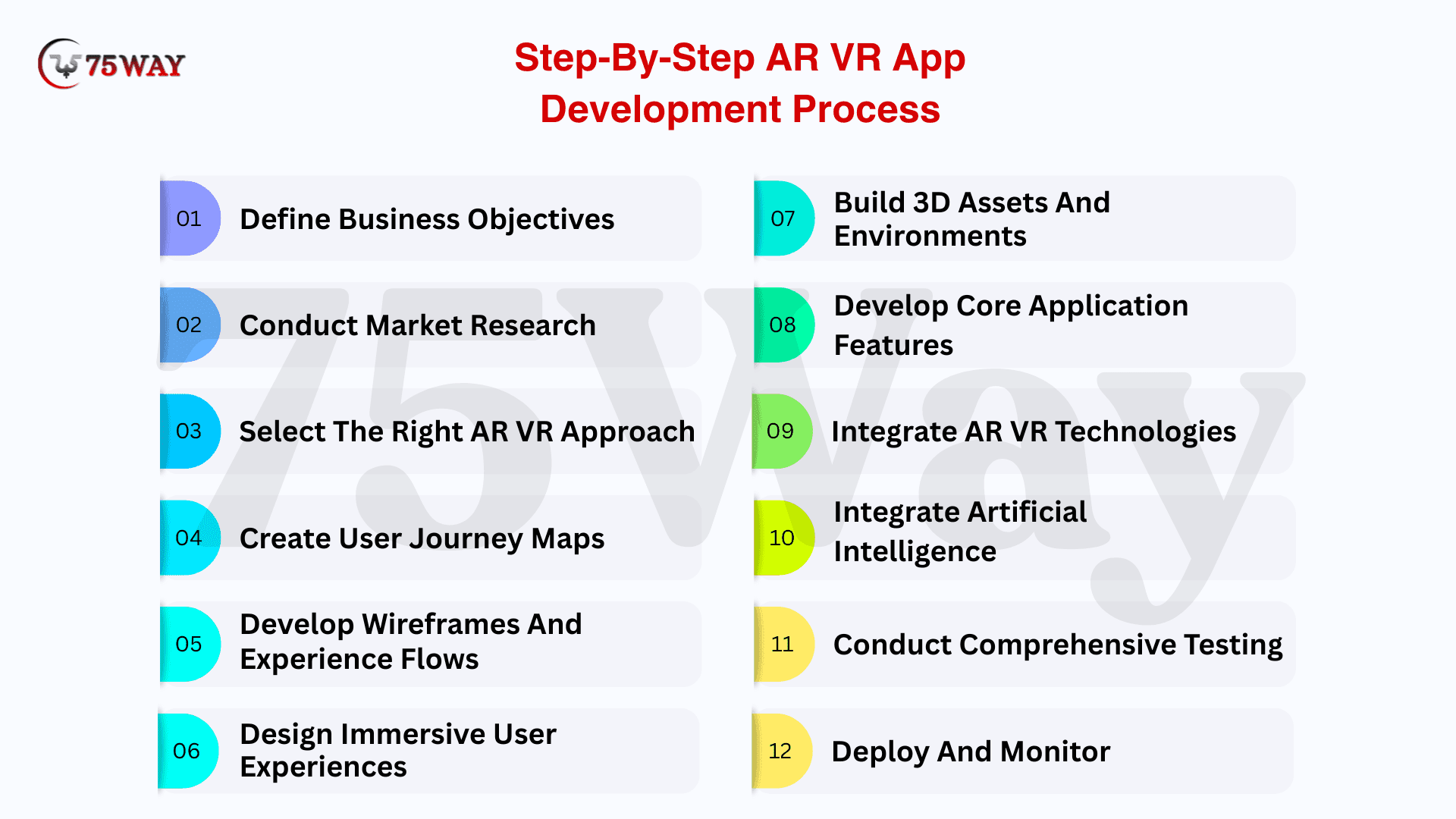
How to Build an AR/VR App: Step-by-Step Development Methodology
A structured development process significantly increases the likelihood of project success. Every stage contributes to performance, usability, scalability, and long-term business value. When executed correctly, it also reduces rework, improves ROI, and ensures the final product aligns with real user expectations.
Step 1: Define Business Objectives For AR VR Mobile App
The development journey begins with identifying clear and measurable business goals that guide the entire AR VR project. Organizations need to understand who they are building for and what real problem the solution will solve in practical environments.
Teams should clearly define the target audience, core business challenges, expected outcomes, success metrics, and competitive positioning. This clarity ensures that every technical and design decision aligns with business value instead of just visual appeal.
Without well-defined objectives, AR VR applications often become visually impressive but fail to deliver measurable impact, scalability, or long-term adoption in real-world use cases.
Step 2: Conduct Market Research
Market research helps validate the AR VR concept before any development effort begins. It ensures the idea is grounded in real demand rather than assumptions or trends alone.
Teams analyze industry trends, competitor solutions, user expectations, emerging technology opportunities, and existing market gaps. This stage helps identify where innovation can create real differentiation.
The insights gathered during research directly shape product strategy, feature prioritization, and overall positioning, ensuring the final solution aligns with both user needs and business opportunities.
Step 3: Select The Right AR VR Approach
Not every project requires the same immersive technology. The correct selection of technology directly influences performance, development cost, scalability, and overall user adoption. Organizations must determine whether they need:
- Augmented Reality: Overlay digital content onto real-world environments through smartphones and smart glasses, enhancing physical surroundings with interactive virtual elements.
- Virtual Reality: Create fully immersive digital environments that replace the physical world, enabling users to experience and interact within simulated spaces.
- Mixed Reality: Blend real and virtual environments together, allowing users to interact with physical and digital objects simultaneously in real time.
- WebXR: Deliver AR VR experiences directly through web browsers without requiring app installation, improving accessibility and reducing user friction.
- Cross-platform XR: Enable immersive applications to run seamlessly across multiple devices, operating systems, and hardware ecosystems for wider reach and scalability.
Step 4: Create User Journey Maps
User journey mapping is important in AR/VR app development to decide how users experience immersive AR VR applications from the very first interaction. It helps teams visualize the complete flow of user engagement inside virtual or augmented environments. This clarity ensures that every interaction feels natural, intuitive, and aligned with user expectations.
This stage focuses on identifying how users enter the experience, how they move through different environments, and how they interact with digital elements. It also highlights key behavioral patterns that influence engagement and decision-making within the application.
A well-designed user journey directly improves user engagement, reduces friction, and increases retention by ensuring that every step of the experience feels purposeful, smooth, and outcome-driven.
Step 5: Develop Wireframes And Experience Flows
Before creating 3D environments, designers define interaction structures to ensure clarity, consistency, and usability across the entire AR VR application. This stage acts as the foundational blueprint that connects user expectations with technical implementation and reduces unnecessary redesign during later development phases.
Wireframes establish navigation logic, user interfaces, information architecture, interaction zones, and workflow sequences that guide how users move through immersive environments. These structured layouts help teams visualize spatial interactions, object placement, and user behavior before actual development begins.
This process also helps identify usability issues early, preventing costly changes during 3D production and development stages. Clear wireframes improve collaboration between designers, developers, and stakeholders by creating a shared understanding of how the final immersive experience will function.
A well-defined wireframe process reduces design errors, improves development efficiency, and ensures smoother execution throughout the AR VR product lifecycle, ultimately leading to more intuitive and high-performing immersive applications.
Step 6: Design Immersive User Experiences
AR VR experiences require specialized UX approaches that go beyond traditional interface design. Design teams focus on creating environments that feel natural, intuitive, and comfortable for users interacting within 3D spaces. The main objective remains to reduce friction and ensure users can navigate immersive environments without confusion or cognitive overload.
Design teams focus on natural interactions, comfortable movement, environmental awareness, accessibility, and cognitive simplicity.
- Interaction Comfort: Ensure users perform actions naturally without strain, confusion, or excessive learning effort in immersive environments.
- Visual Clarity: Maintain clean and readable spatial interfaces that reduce cognitive load and improve decision-making speed.
- Motion Stability: Minimize motion sickness by controlling camera movement, transitions, and user navigation speed within virtual spaces.
Poor UX design can negatively impact adoption regardless of technical quality, as users quickly abandon experiences that feel uncomfortable or unintuitive.
Step 7: Build 3D Assets And Environments
Artists create digital content that forms the visual foundation of AR VR experiences, including characters, products, buildings, equipment, and interactive objects. These assets define how realistic, engaging, and immersive the final application feels to users. High-quality 3D content directly influences user perception, interaction depth, and overall experience satisfaction.
To build effective 3D assets, teams follow structured creation methods designed to ensure both visual quality and real-time performance efficiency in immersive environments.
- Modeling Geometry: Create detailed 3D structures using precise shapes and spatial dimensions for realistic representation.
- Texture Mapping: Apply surface textures and materials to enhance realism and visual depth of digital objects.
- Polygon Optimization: Reduce unnecessary geometry to ensure smooth performance across AR VR devices.
- Rigging And Animation: Prepare models for movement by adding skeletal structures and animation controls.
- Engine Integration: Import and configure assets within Unity or Unreal Engine for real-time rendering and interaction.
Asset quality directly influences immersion and realism, while optimization remains essential to maintain smooth performance across mobile, desktop, and headset-based AR VR platforms.
Step 8: Develop Core Application Features
Development teams implement core functionalities that transform AR VR concepts into fully interactive and usable applications. This stage ensures users can interact, navigate, and collaborate within immersive environments smoothly and reliably.
- Object Interactions: Enable users to grab, move, and manipulate virtual objects within immersive environments.
- Navigation Systems: Allow users to move seamlessly through virtual or augmented spaces with intuitive controls.
- Physics Simulations: Replicate real-world behavior such as gravity, collision, and object dynamics accurately.
- Multiplayer Functionality: Support multiple users interacting and collaborating within the same immersive environment simultaneously.
- User Authentication: Secure user access by verifying identity and managing personalized application sessions.
- Data Synchronization: Ensure real-time consistency of information across devices, users, and immersive environments.
Step 9: Integrate AR VR Technologies
Core immersive capabilities are integrated during this phase to transform a standard application into a fully interactive AR VR experience. This stage connects hardware inputs, software systems, and spatial computing engines to ensure the application can understand and respond to real-world user actions in real time.
You must integrate motion tracking, gesture recognition, spatial mapping, environmental understanding, and voice controls to create a seamless interaction layer between users and digital environments. These technologies work together to ensure accurate movement detection, natural interaction, and responsive system behavior across immersive experiences.
Proper integration significantly impacts user experience quality, as even minor delays or inaccuracies can break immersion, reduce usability, and negatively affect overall application performance.
Step 10: Integrate Artificial Intelligence
Many modern applications incorporate AI-powered features to enhance immersion, intelligence, and responsiveness within AR VR systems.
- Smart Recommendations: Analyze user behavior and suggest relevant content or actions within immersive environments.
- Virtual Assistants: Provide voice or avatar-based assistance for navigation, tasks, and real-time guidance.
- Adaptive Environments: Modify virtual spaces dynamically based on user actions, preferences, and interactions.
- Behavioral Analysis: Track and interpret user behavior patterns to improve system performance and engagement.
- Personalized Content: Deliver customized experiences tailored to individual user needs, preferences, and usage history.
AI contributes to more intelligent and responsive experiences by making AR VR systems adaptive, predictive, and user-centric.
Step 11: Conduct Comprehensive Testing
Comprehensive testing ensures that AR VR applications perform reliably across different devices, environments, and user conditions. This stage evaluates overall system stability, responsiveness, and real-world usability before deployment. It plays a critical role in identifying technical gaps that can affect immersion, performance, and user satisfaction.
Testing evaluates performance stability, device compatibility, interaction accuracy, frame rates, user comfort, and security requirements to ensure a seamless immersive experience. Multiple testing cycles help teams detect and fix issues early, reducing the risk of post-launch failures and improving overall application quality and reliability.
Step 12: Deploy And Monitor
After deployment, teams continuously monitor user behavior, performance metrics, technical issues, feature adoption, and overall business outcomes to ensure the AR VR application delivers consistent value in real-world usage. This ongoing monitoring helps identify optimization opportunities, improve system stability, and enhance user experience over time, while continuous improvements ensure long-term success, scalability, and sustained engagement across diverse user groups and evolving market needs.
UI/UX Best Practices For AR VR Applications
User experience plays a decisive role in immersive application adoption. Unlike traditional software, AR VR environments require careful attention to movement, comfort, perception, and interaction design.
1. Prioritize User Comfort
Motion discomfort remains one of the most common challenges in immersive experiences. Designers should:
- Reduce abrupt camera movement
- Maintain stable frame rates
- Avoid unnecessary visual effects
- Provide clear orientation cues
Comfort directly influences session duration and retention.
2. Create Natural Interactions
Users should be able to navigate immersive environments without requiring complex training or instructions. The experience should feel intuitive and easy to understand from the very first interaction. Natural interactions include:
- Hand gestures
- Eye tracking
- Voice commands
- Intuitive object manipulation
Simple interaction models improve usability.
3. Maintain Spatial Consistency
Digital elements must behave predictably within 3D environments to maintain immersion and user trust. Consistent positioning, scaling, and interaction patterns ensure that users can easily understand and predict system behavior.
This reduces confusion and strengthens the sense of presence within the virtual or augmented space.
4. Limit Cognitive Overload
Immersive environments can overwhelm users when too much information is displayed at once. Effective AR VR design focuses attention on relevant actions and objectives while removing unnecessary visual distractions.
Minimalist interfaces often perform better because they allow users to stay focused and process information more efficiently.
5. Design For Accessibility
Accessibility plays a critical role in expanding the reach of AR VR applications across diverse user groups. Examples include:
- Voice navigation
- Adjustable text sizes
- Color contrast optimization
- Alternative interaction methods
Inclusive design supports broader adoption.
Hardware Requirements For Developing AR VR Applications
Hardware capabilities significantly influence application performance, user comfort, and overall immersive quality. Developers must understand the strengths, limitations, and ideal use cases of each device before building AR VR solutions. The right hardware choice directly impacts adoption rates, scalability, and real-world business outcomes.
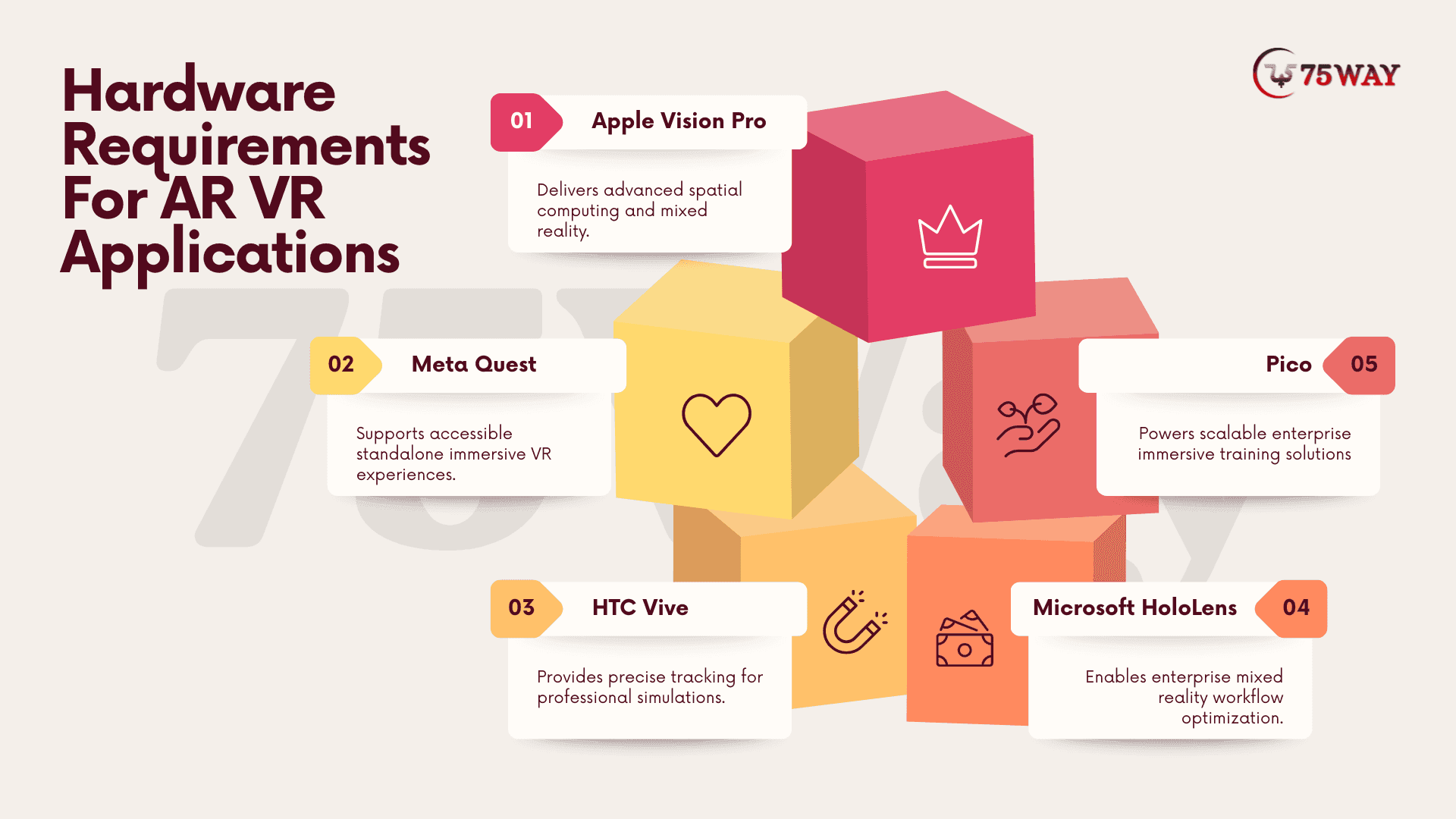
Apple Vision Pro
Apple Vision Pro accelerates enterprise adoption of spatial computing with a strong focus on mixed reality productivity and collaboration. It introduces advanced interaction models that blend physical and digital workflows seamlessly.
Key capabilities include high-resolution displays, eye tracking, gesture controls, spatial computing interfaces, and advanced mixed reality experiences. Organizations explore Vision Pro for design visualization, remote collaboration, and immersive productivity environments where precision and clarity matter most.
Meta Quest
Meta Quest stands as one of the most widely adopted VR platforms across both consumer and enterprise markets. Its standalone design eliminates the need for external computers or sensors, which makes it highly convenient, portable, and cost-effective for a wide range of immersive applications.
Key benefits include standalone operation, strong developer ecosystem, broad consumer adoption, competitive pricing, and an extensive content library. Meta Quest supports gaming, training, simulations, and enterprise immersive applications at scale.
HTC Vive
HTC Vive is known for high-quality tracking systems and strong immersive performance in professional environments. It delivers precise spatial tracking, making it suitable for complex and high-detail applications.
It is frequently used in enterprise simulations, training environments, design visualization, and industrial applications. HTC Vive continues to remain a preferred choice among professional users requiring accuracy and reliability.
Microsoft HoloLens
Microsoft HoloLens focuses on enterprise-grade mixed reality solutions with strong integration into industrial workflows. It enables hands-free computing, improving productivity in complex operational environments.
Industries utilizing HoloLens include manufacturing, healthcare, defense, engineering, and field service operations. Its ability to overlay digital instructions onto real-world tasks makes it highly valuable for on-site assistance and training.
Pico
Pico devices are gaining strong traction in global enterprise markets due to their flexibility and growing ecosystem support. They are increasingly used for scalable immersive deployments across organizations.
Their adoption supports training programs, collaborative workspaces, and immersive visualization initiatives. Pico continues expanding its presence as a competitive alternative in the AR VR hardware landscape.
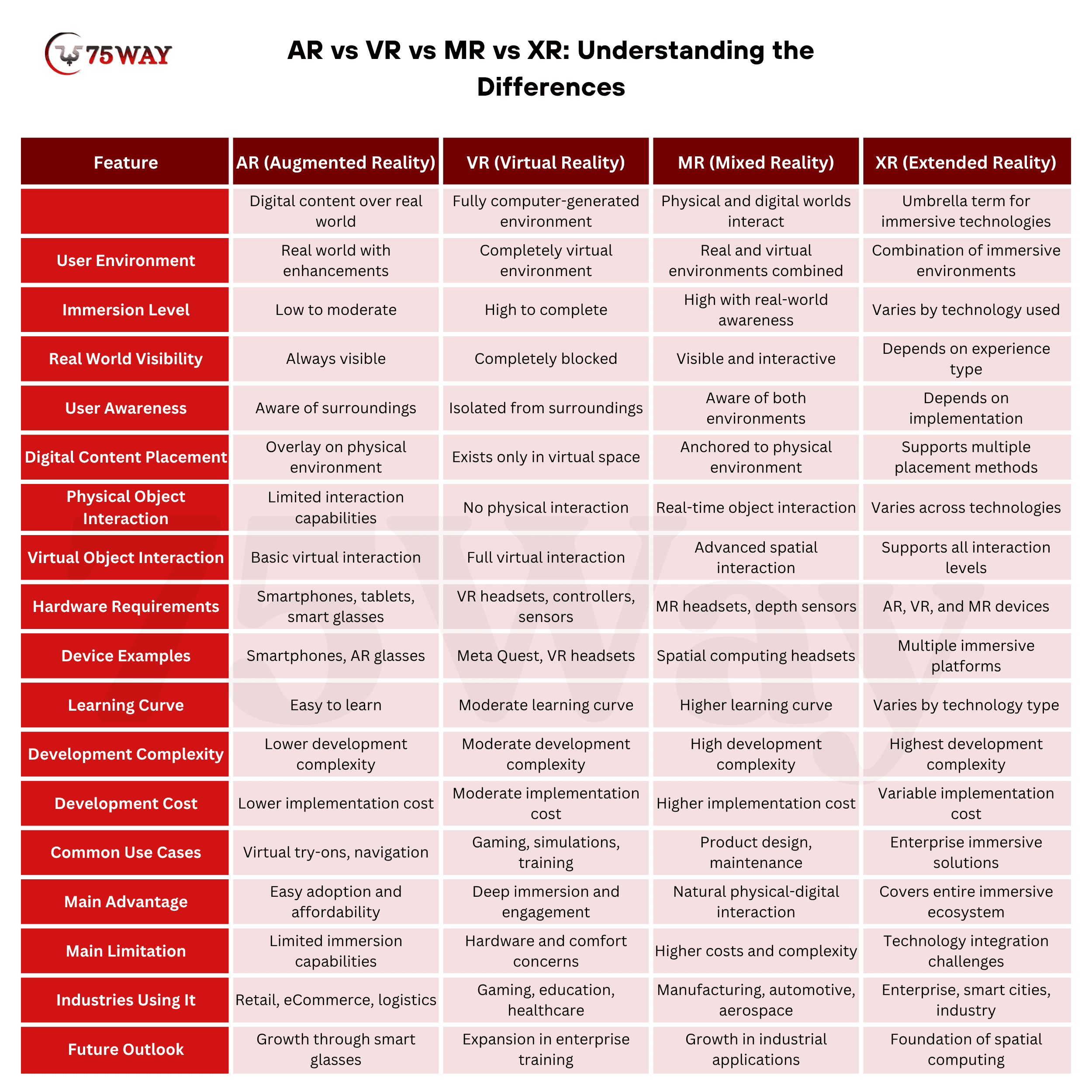
AR vs VR vs MR vs XR: Understanding the Differences
Many organizations use AR, VR, MR, and XR interchangeably. However, each represents a distinct technology category with unique capabilities and applications. In simple terms, AR overlays digital content onto the real world, VR creates a fully immersive virtual environment, MR blends physical and digital objects that interact in real time, and XR serves as an umbrella term covering all immersive technologies, including AR, VR, and MR.
1. Augmented Reality (AR)
It enhances the physical world by placing digital elements on top of it. Users can view virtual objects, informational overlays, and interactive content while remaining aware of their real surroundings.
In simple language, AR can be easily understood with the example of Snapchat. When users apply filters or lenses, digital effects and virtual objects appear on top of their real-world surroundings through the smartphone camera, creating an interactive augmented reality experience.
Examples include:
- Virtual furniture placement
- Interactive product demonstrations
- Navigation overlays
- Retail virtual try-ons
- Maintenance assistance systems
2. Virtual Reality (VR)
Virtual reality creates completely immersive digital environments. Users are transported into computer-generated spaces where they can interact with virtual objects and environments. A well-known example is Meta Quest, which enables users to enter fully immersive virtual environments for gaming, training, fitness, collaboration, and educational experiences through a VR headset.
Popular VR applications include:
- Training simulations
- Gaming experiences
- Virtual tourism
- Medical simulations
- Architectural walkthroughs
VR relies heavily on dedicated hardware such as headsets and motion-tracking systems.
3. Mixed Reality (MR)
Mixed reality (MR) combines physical and digital environments, allowing real and virtual objects to interact dynamically. Unlike traditional AR, MR enables users to manipulate virtual content as though it exists naturally within physical spaces. Let’s understand thi with a real-world example of BMW.
BMW uses mixed reality technologies, where potential buyers can explore life-sized virtual vehicle models, customize colors and features, view interiors in 3D, and experience how a car will look in real-world environments before making a purchase decision.
Examples include:
- Industrial maintenance systems
- Collaborative design environments
- Engineering simulations
- Interactive educational experiences
4. Extended Reality (XR)
XR serves as the major term as it encompasses AR, VR, and MR technologies. XR represents the broader vision of immersive computing where physical and digital experiences merge seamlessly through advanced hardware and software ecosystems.
A notable example is Apple Vision Pro, which combines augmented, virtual, and mixed reality capabilities into a single immersive platform, enabling users to interact with digital content seamlessly within their physical surroundings.
As spatial computing continues to evolve, XR is becoming the preferred term for describing the future of immersive technology.
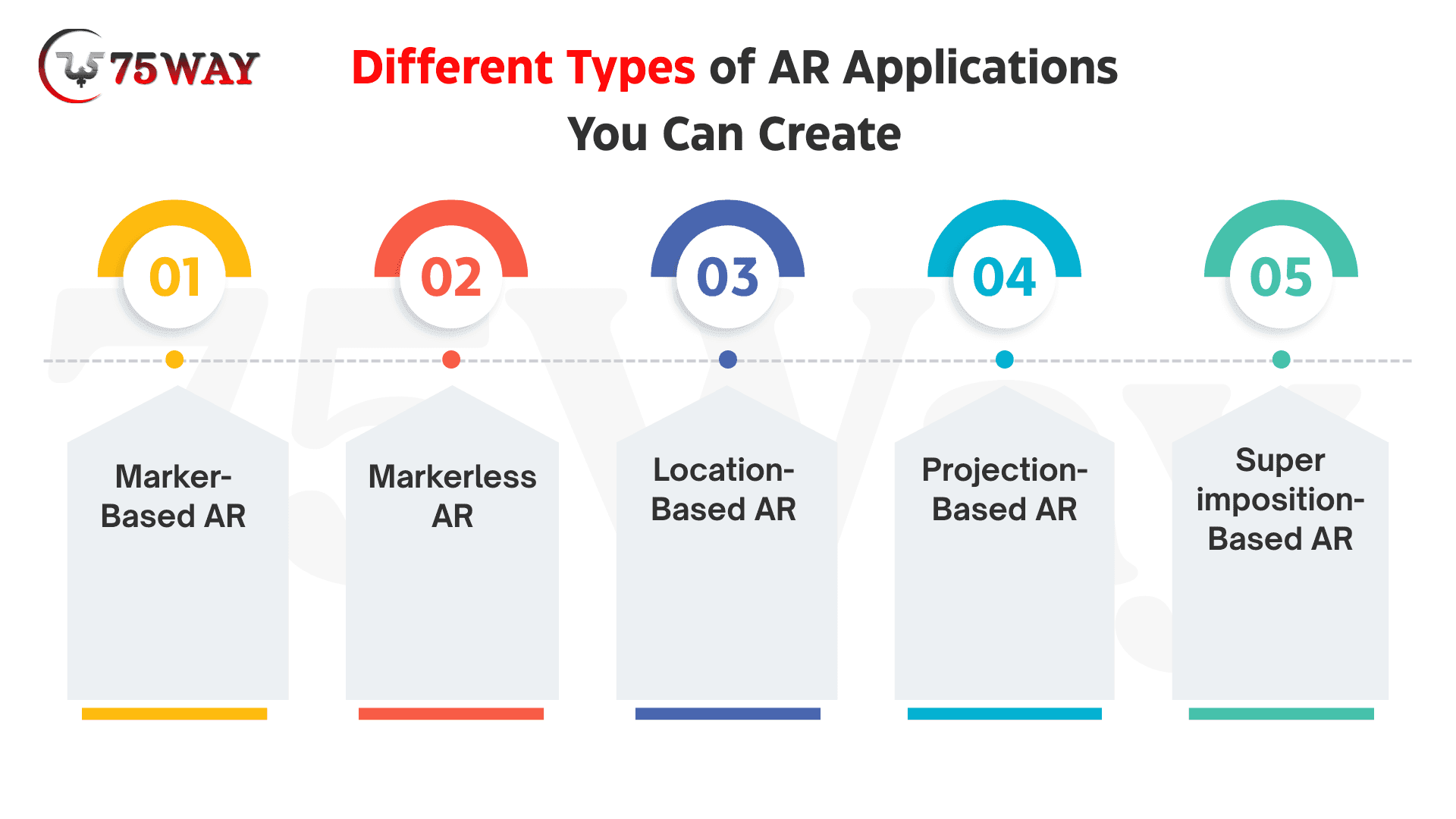
Exploring the Different Types of AR Applications You Can Create
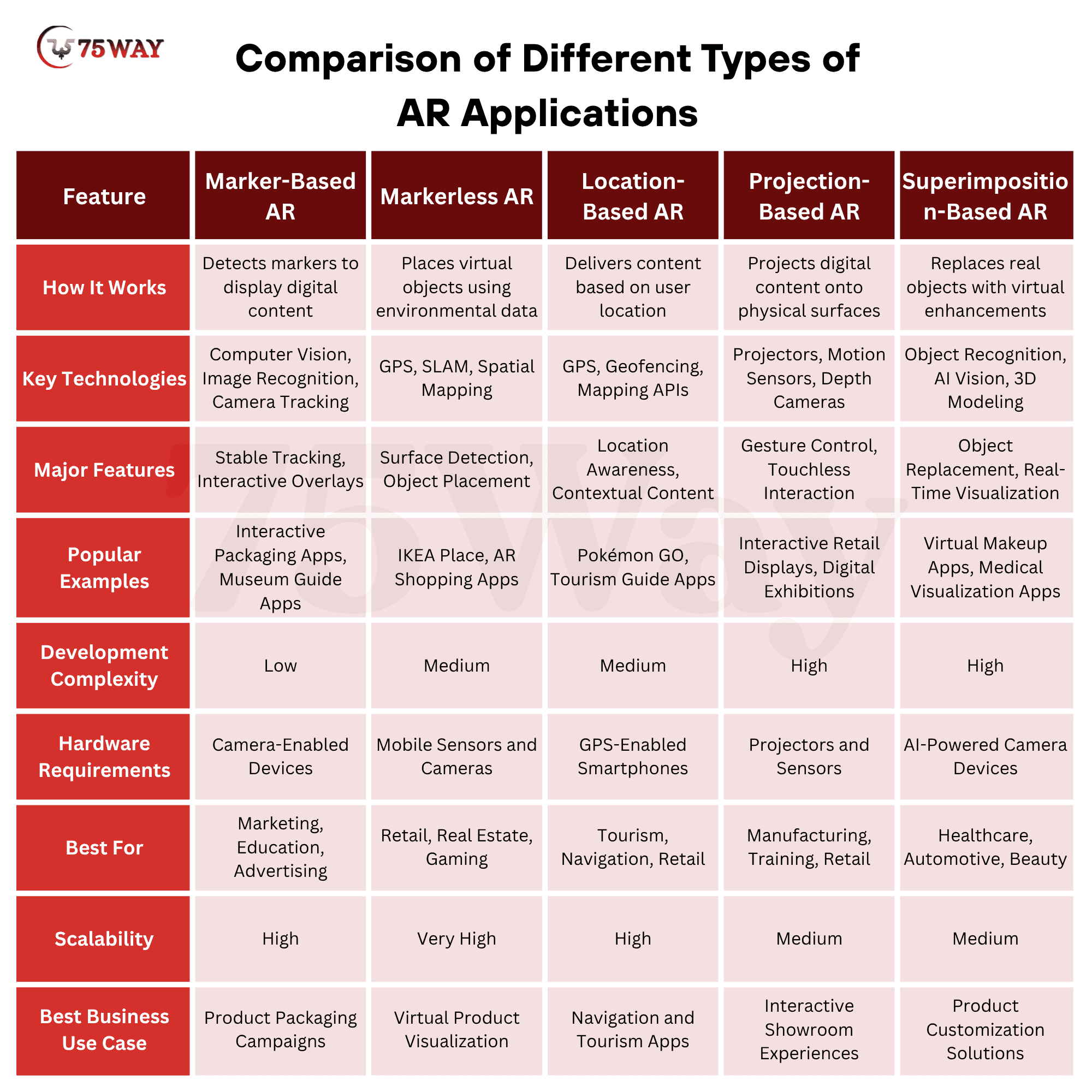
Not all AR applications function in the same way. Different approaches are designed for specific objectives, environments, and interaction requirements. Understanding these categories helps businesses identify the most suitable solution for their goals.
- Marker-Based AR
Marker-based AR relies on visual triggers such as QR codes, images, logos, or specific patterns. When the application recognizes a marker through the device camera, digital content appears on screen. Common use cases include:
- Product packaging experiences
- Interactive advertisements
- Educational materials
- Museum exhibits
Marker-based systems offer reliable tracking and straightforward implementation.
- Markerless AR
Markerless AR uses environmental data rather than predefined visual markers. These mobile apps enable AR content to be placed and anchored within real-world environments without requiring QR codes, images, or physical markers. Users can interact with virtual objects naturally as they move through physical spaces. These applications rely on technologies such as:
- GPS
- Accelerometers
- Gyroscopes
- Depth sensors
- Spatial mapping
Users can place digital objects in real-world environments without scanning specific images. Popular examples include furniture visualization and location-based experiences.
- Location-Based AR
Location-based AR combines geographic positioning with augmented reality experiences. The application determines user location through GPS and displays contextually relevant digital content. Industries utilizing location-based AR include:
- Tourism
- Retail
- Real estate
- Navigation
- Entertainment
This approach creates highly personalized experiences based on physical surroundings.
- Projection-Based AR
Projection-based AR projects digital content onto physical surfaces. Users can interact with projected images using gestures, movements, or touch interactions. Applications include:
- Interactive exhibitions
- Manufacturing interfaces
- Training systems
- Retail experiences
Projection systems eliminate the need for personal display devices in certain environments.
- Superimposition-Based AR
Superimposition AR replaces or modifies portions of real-world views with digital enhancements. Medical visualization systems frequently use this technique to overlay anatomical structures onto patient views. Retail and design applications also utilize superimposition to showcase product variations and customization options. This category often requires advanced object recognition and computer vision capabilities.
Different Kinds of VR Applications Every Business Should Know
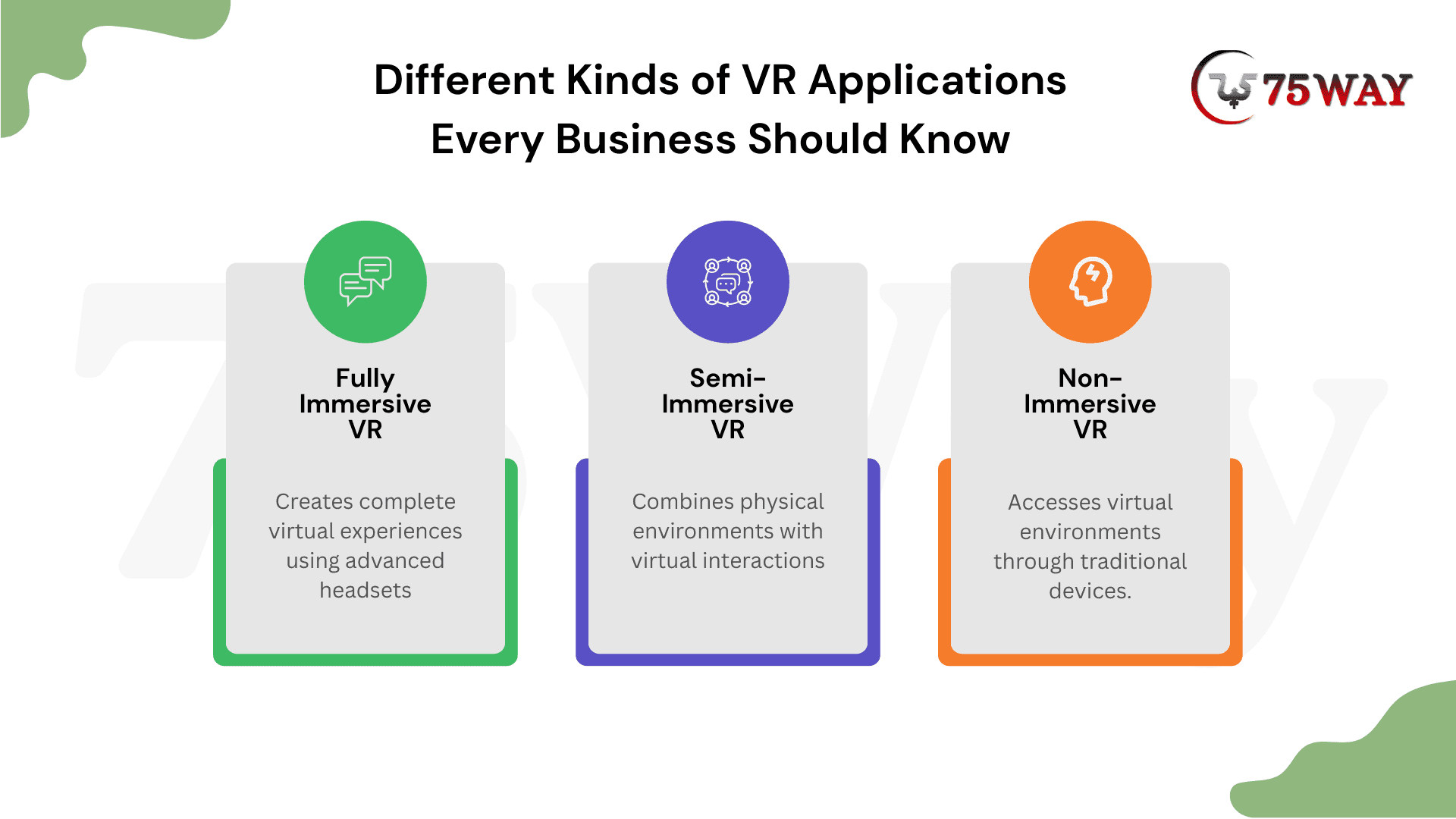
Virtual Reality solutions can also be categorized according to immersion levels and interaction complexity.
- Fully Immersive VR
Fully immersive VR provides complete digital experiences through dedicated headsets and motion-tracking systems. Users become entirely immersed within virtual environments and interact naturally using controllers, gestures, or body movements. Common applications include:
- Gaming
- Training simulations
- Virtual collaboration
- Medical education
This category delivers the highest level of immersion.
- Semi-Immersive VR
Semi-immersive VR combines physical and virtual elements through large displays, projection systems, or specialized simulators. Users stay conscious of their real-world environment while engaging with digital elements layered on top of it. Examples include:
- Flight simulators
- Driving simulators
- Industrial training systems
These solutions balance realism and accessibility.
- Non-Immersive VR
Non-immersive VR allows users to interact with virtual environments through traditional devices such as desktops and laptops. Although immersion levels are lower, these systems remain valuable for:
- Architectural visualization
- Product design
- Virtual tours
- Educational applications
Non-immersive solutions often require lower investment and broader accessibility.
Must-Have Features for Building High-Performance AR/VR Apps
Successful AR VR applications combine advanced technologies with intuitive user experiences. Several features define high-quality immersive solutions in 2026. The key features that contribute to immersive, scalable, and high-performing AR VR applications are outlined below.
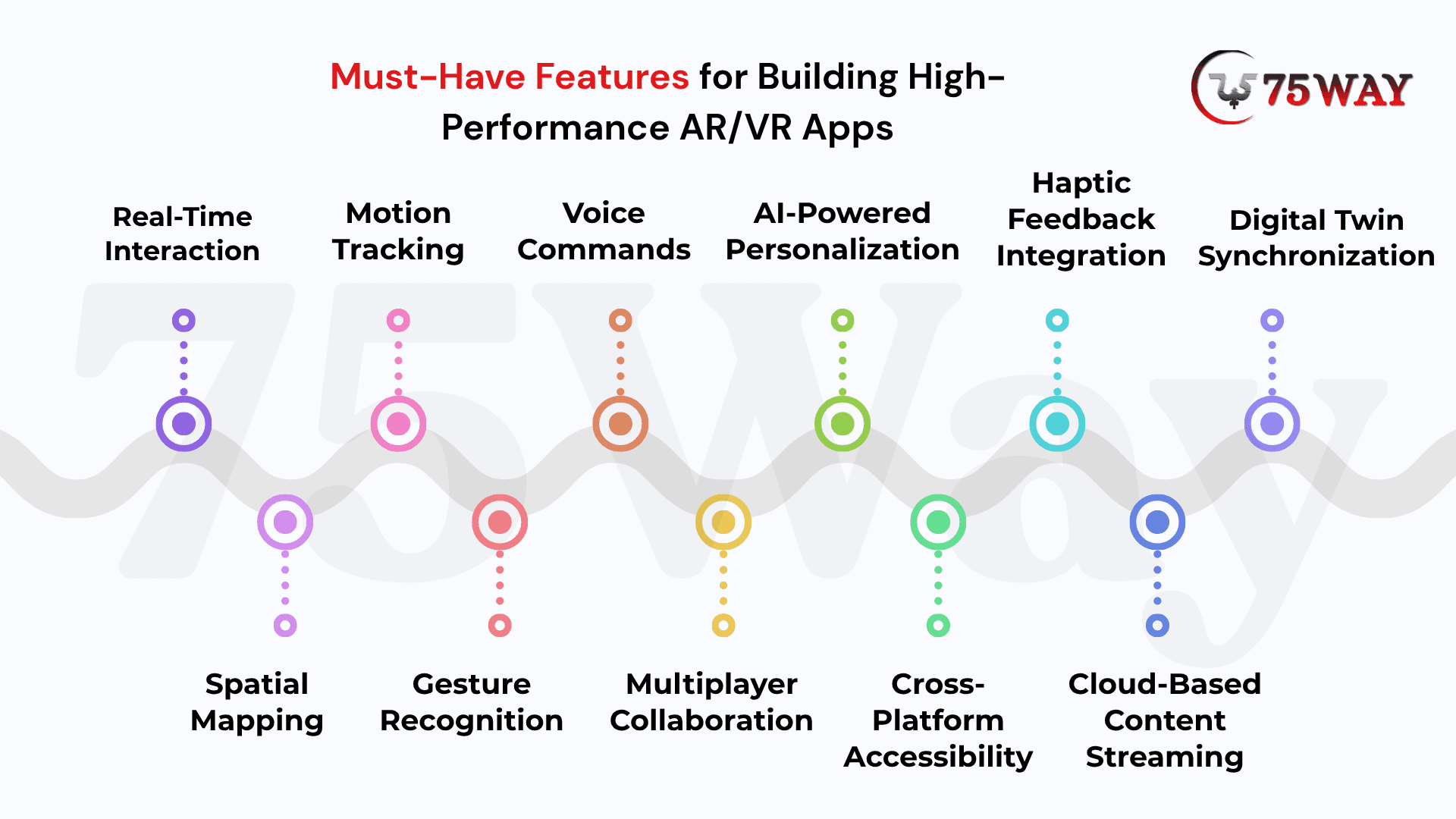
- Real-Time Interaction: Users expect immediate responses to movements, gestures, and actions. Low-latency interaction systems are critical for maintaining immersion and user comfort.
- Spatial Mapping: Spatial mapping enables applications to understand physical environments. This capability supports accurate object placement, navigation, and interaction within real-world spaces.
- Motion Tracking: Motion tracking captures user movements and translates them into digital environments. Advanced tracking improves realism and interaction accuracy.
- Gesture Recognition: Many immersive applications now support gesture-based controls. Natural interactions reduce learning curves and create more intuitive experiences.
- Voice Commands: Voice interfaces allow users to navigate environments and perform actions without traditional input devices. This capability improves accessibility and usability.
- Multiplayer Collaboration: Modern AR VR applications increasingly support shared experiences. Users can collaborate, communicate, and interact within virtual spaces regardless of physical location.
- AI-Powered Personalization: Artificial intelligence analyzes user behavior and preferences to create adaptive experiences. Personalized environments often improve engagement and satisfaction.
- Cross-Platform Accessibility: Organizations frequently require applications that function across multiple devices and operating systems. Cross-platform support expands reach while reducing development complexity.
- Haptic Feedback Integration: Advanced haptic systems provide tactile sensations that simulate touch, pressure, and physical interactions. This feature significantly enhances immersion and realism within virtual environments.
- Cloud-Based Content Streaming: Cloud infrastructure enables high-quality AR VR content delivery without relying entirely on local device processing power. This improves scalability, accessibility, and performance across devices.
- Digital Twin Synchronization: Digital twin integration connects virtual environments with real-world assets and systems. Organizations can monitor, analyze, and optimize physical operations through real-time virtual representations.
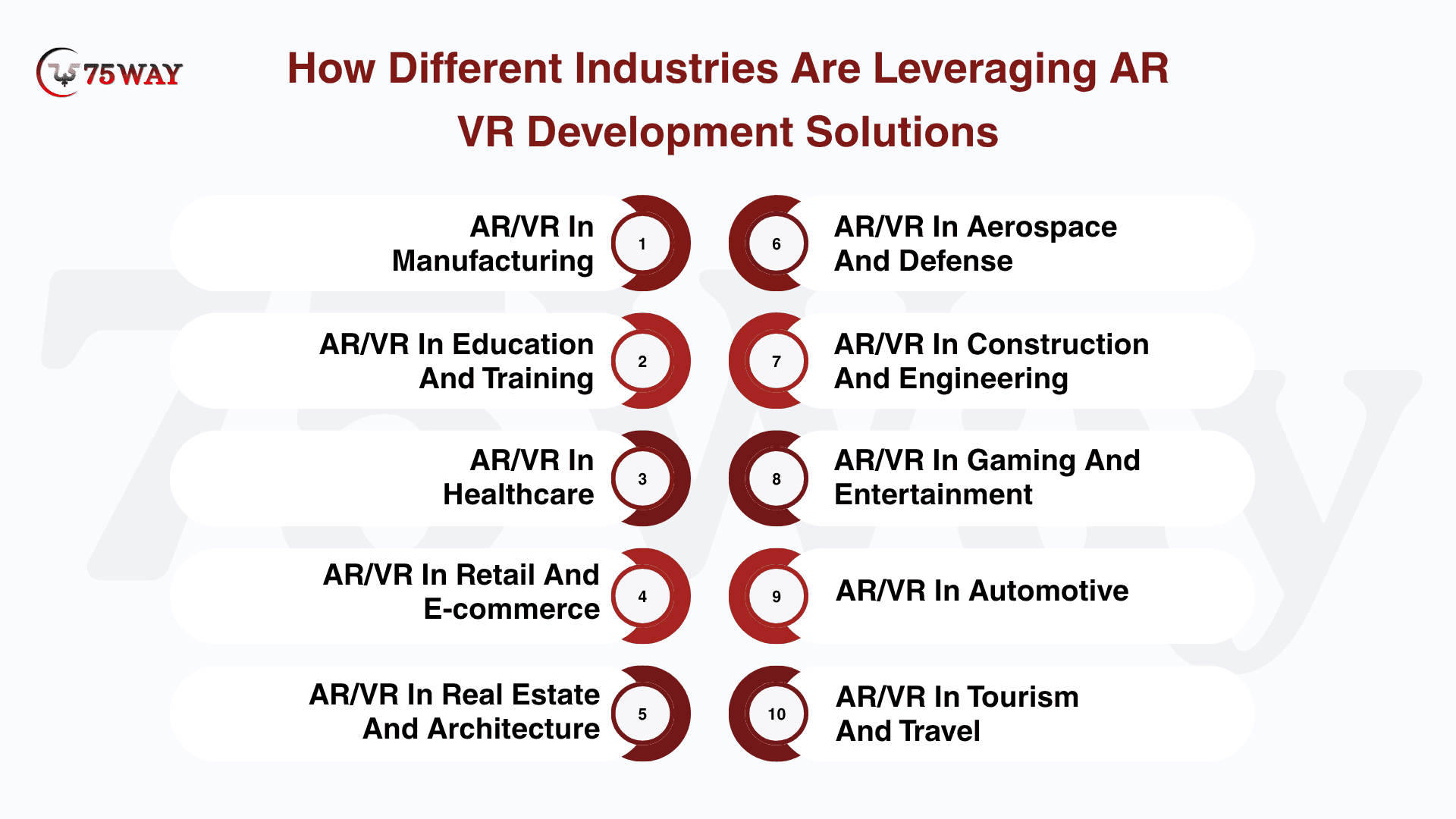
How Different Industries Are Leveraging AR VR Development Solutions
AR VR technologies are creating measurable value across numerous industries. Organizations use immersive experiences to solve operational challenges, improve customer engagement, and accelerate innovation.
1. AR/VR In Manufacturing
Manufacturing companies are among the largest adopters of AR VR technologies because immersive systems improve productivity, safety, and operational visibility.
AR-powered maintenance solutions help technicians receive real-time instructions while working on machinery. Instead of consulting manuals, workers can view step-by-step guidance directly within their field of vision. This reduces downtime and minimizes operational errors.
VR simulations are widely used for workforce training. Employees can learn equipment operation, safety procedures, and emergency response protocols within realistic virtual environments before entering production facilities.
Manufacturers also utilize digital twins integrated with AR VR platforms. These virtual replicas allow teams to monitor equipment performance, predict maintenance needs, and optimize production processes.
As Industry 4.0 initiatives continue expanding globally, AR VR technologies are becoming fundamental components of modern manufacturing ecosystems.
2. AR/VR In Education And Training
Traditional learning methods often struggle to maintain engagement and practical understanding. AR/VR-powered educational apps address these challenges through interactive and experiential learning environments.
Educational institutions use VR to create immersive classrooms where students can explore historical events, scientific concepts, and complex subjects through direct interaction.
AR enhances textbooks and learning materials by overlaying three-dimensional models, animations, and contextual information onto physical content.
Corporate training programs also benefit significantly from immersive learning environments. Employees can practice real-world scenarios repeatedly without physical risks or resource constraints.
Research continues to show that experiential learning often improves knowledge retention compared to conventional training approaches, making AR VR increasingly valuable across educational sectors.
3. AR/VR In Healthcare
Healthcare organizations are rapidly adopting AR VR technologies to improve patient care, medical training, and surgical precision.
VR-based simulations allow medical students and healthcare professionals to practice complex procedures in risk-free virtual environments. This approach improves skill development while reducing training costs.
AR assists surgeons by displaying real-time patient data, anatomical structures, and procedural guidance during operations. These visual overlays can enhance accuracy and decision-making.
Healthcare providers also use immersive experiences for pain management, physical rehabilitation, and mental health treatments. Patients can participate in controlled virtual environments designed to support recovery and therapy.
As digital healthcare continues evolving, AR/VR healthcare applications are helping organizations deliver more efficient, personalized, and accessible medical services.
4. AR/VR In Retail And E-commerce
Retail brands use AR VR technologies in ecommerce platforms to create engaging shopping experiences and reduce purchase uncertainty.
AR-powered virtual try-on solutions allow customers to visualize products before purchasing. Consumers can test eyewear, clothing, cosmetics, furniture, and home décor directly from their smartphones.
VR-based virtual stores enable shoppers to explore digital showrooms and interact with products from anywhere in the world.
Retailers also leverage immersive technologies to improve product demonstrations and increase customer engagement. These experiences typically improve conversion rates while also reducing the likelihood of product returns.
As online shopping continues to grow, AR/VR ecommerce app development solutions are becoming valuable tools for enhancing customer confidence and improving buying decisions.
5. AR/VR In Real Estate And Architecture
Real estate developers and architectural firms use AR/VR real estate app development solutions to transform how properties are designed, presented, and sold.
VR property tours enable potential buyers to virtually explore residential and commercial properties from any location. This helps clients evaluate properties without scheduling physical visits.
Architects use immersive visualization tools to review floor plans, interior layouts, and structural designs before construction begins.
AR applications help stakeholders visualize future buildings within real-world locations, providing greater clarity during project planning and approvals.
These technologies improve communication among developers, architects, investors, and buyers while reducing costly design revisions.
6. AR/VR In Aerospace And Defense
Aerospace and defense organizations rely on AR VR aviation apps to support training, maintenance, and mission planning activities.
VR simulations allow pilots, military personnel, and engineers to practice complex scenarios within highly realistic environments. This reduces operational risks and training expenses.
AR-powered systems provide technicians with real-time maintenance instructions and equipment diagnostics while working on aircraft and defense systems.
Immersive technologies also support mission planning by enabling teams to visualize environments, assess risks, and test strategies before deployment.
As operational complexity increases, AR VR solutions continue improving readiness, safety, and performance across defense and aerospace sectors.
7. AR/VR In Construction And Engineering
Construction and engineering firms use AR/VR construction apps to improve project visualization, collaboration, and execution.
VR environments help stakeholders review building designs, identify conflicts, and validate construction plans before work begins. This reduces costly errors during development.
AR applications allow engineers and field teams to access project data, blueprints, and installation instructions directly at construction sites. Teams looking beyond these immersive technologies can also explore alternatives to Bluebeam for construction that support plan viewing, markups, field coordination, and project management.
Project managers can use immersive technologies to monitor progress, improve communication, and coordinate multiple teams more effectively.
As construction projects become increasingly complex, AR VR solutions are helping organizations streamline workflows, reduce rework, and improve project outcomes.
8. AR/VR In Gaming And Entertainment
Gaming remains one of the most recognizable applications of immersive technology.
VR gaming delivers highly interactive experiences where players physically engage with virtual environments. Motion tracking, spatial audio, and realistic interactions contribute to deeper immersion.
Beyond gaming, entertainment companies use AR/VR technologies in gaming apps and platforms for:
- Virtual concerts
- Interactive storytelling
- Immersive cinematic experiences
- Theme park attractions
- Sports broadcasting enhancements
Content creators are increasingly exploring immersive storytelling formats that place audiences directly within narratives rather than positioning them as passive observers.
This evolution is transforming how entertainment is produced, distributed, and consumed.
9. AR/VR In Automotive
Automotive companies use AR/VR technologies throughout product development, manufacturing, marketing, and customer engagement processes.
Engineers leverage VR environments to evaluate vehicle designs before physical prototypes are produced. This accelerates development cycles and reduces costs.
AR assists manufacturing teams by providing assembly instructions and quality control guidance.
Automotive retailers increasingly offer virtual showrooms where customers can explore vehicle features, customize configurations, and experience products remotely.
As connected vehicles and autonomous technologies advance, immersive experiences will continue playing a significant role in automotive innovation and emobility solutions.
10. AR/VR In Tourism And Travel
Tourism organizations use immersive technologies to inspire travelers and improve planning experiences with AR/VR travel app creation solutions.
Virtual destination tours allow users to explore hotels, landmarks, attractions, and cultural sites before booking trips.
Travel agencies use VR experiences to showcase destinations more effectively than traditional photos or videos.
Museums, heritage sites, and cultural institutions also utilize AR applications to provide interactive educational experiences for visitors.
Immersive tourism experiences help travelers make informed decisions while creating new opportunities for destination marketing.
Advanced Technologies Enable Immersive AR/VR Development
Immersive experiences depend on a sophisticated collection of technologies working together seamlessly. Understanding these technologies helps businesses make informed development decisions. The core technologies that power modern AR VR applications are outlined below.
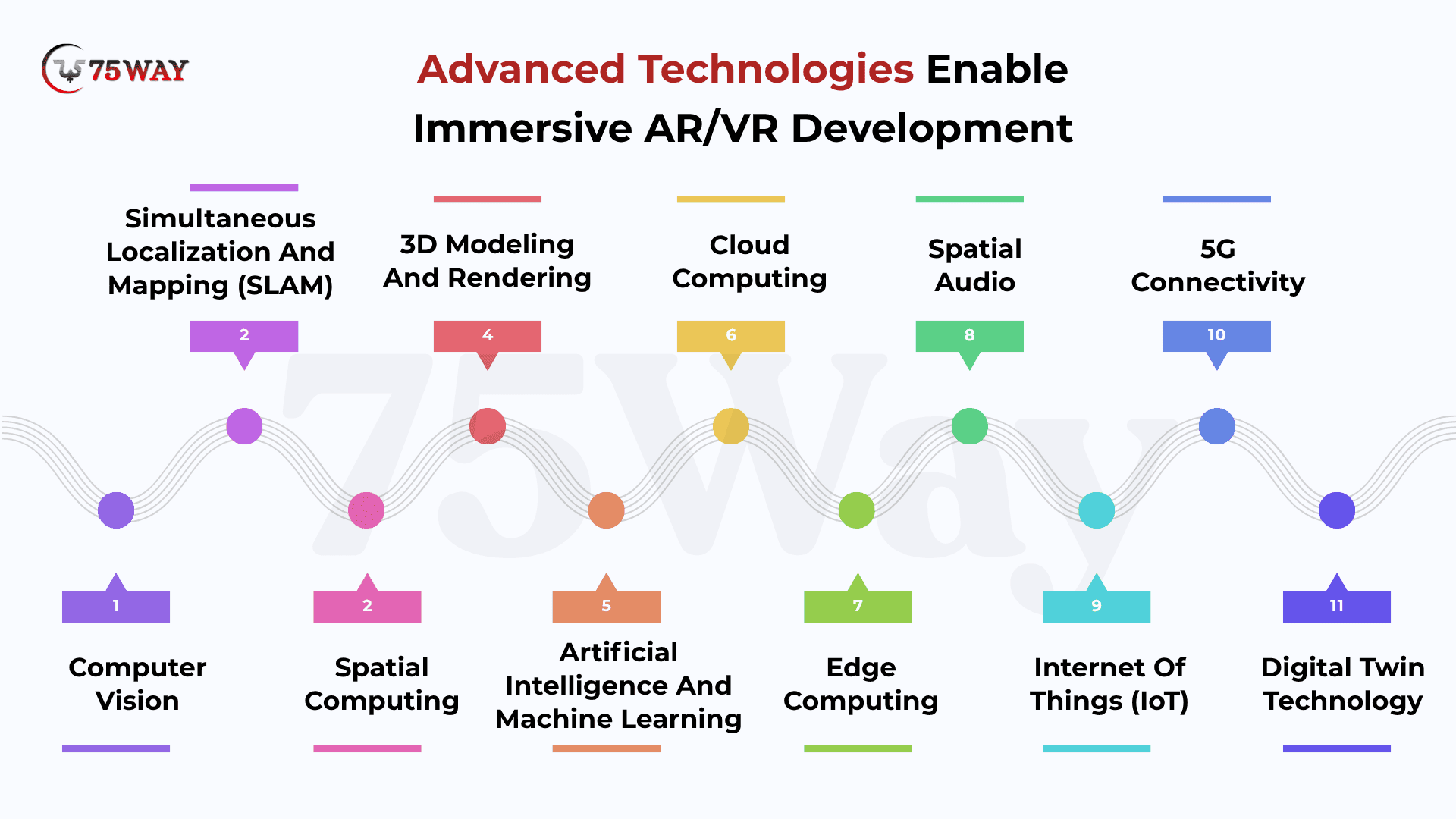
- Computer Vision: Computer vision enables devices to interpret and understand visual information from the physical world. Applications use computer vision for object recognition, facial tracking, environmental analysis, and image detection. This technology forms the foundation of many AR experiences.
- Simultaneous Localization And Mapping (SLAM): SLAM technology enables devices to create maps of physical environments while simultaneously identifying their own position within those spaces. It enhances spatial awareness, supports accurate object placement, improves environmental interaction, and ensures precise navigation. Most advanced AR applications depend heavily on SLAM to deliver stable and realistic immersive experiences.
- Spatial Computing: Spatial computing transforms physical spaces into interactive digital environments. This technology enables applications to understand relationships between objects, users, and surroundings. Spatial computing serves as a cornerstone of modern XR experiences.
- Artificial Intelligence And Machine Learning: AI enhances immersive experiences through predictive interactions, intelligent avatars, behavioral analysis, content personalization, and object recognition. Machine learning continuously improves system performance through data-driven optimization.
- 3D Modeling And Rendering: Immersive applications require realistic digital assets and environments. Development teams use specialized tools to create characters, products, buildings, simulations, and interactive environments. Rendering engines convert these assets into real-time visual experiences.
- Cloud Computing: Cloud infrastructure provides scalable processing power for AR VR applications. Benefits include content streaming, remote rendering, data synchronization, and multi-user collaboration. Cloud technologies reduce hardware limitations while expanding functionality.
- Edge Computing: processes data nearer to the user’s location instead of relying on distant centralized servers. This reduces latency and improves responsiveness within immersive environments. Applications requiring real-time interactions benefit significantly from edge-based architectures.
- Spatial Audio: It is crucial in creating immersive experiences. Spatial audio systems replicate realistic sound placement based on the user’s position and movement within the environment. This improves awareness of surroundings and strengthens emotional connection with the experience.
- Internet of Things (IoT): IoT devices enable AR VR applications to collect and exchange real-time data from connected equipment, sensors, and environments. This improves monitoring, automation, and contextual interactions across immersive experiences.
- 5G Connectivity: 5G networks provide high-speed data transfer, lower latency, and reliable connectivity for immersive applications. This technology supports cloud rendering, multiplayer experiences, and real-time interactions at scale.
- Digital Twin Technology: Digital twins create virtual representations of physical assets, systems, and environments. Organizations use them to monitor performance, simulate scenarios, predict maintenance needs, and optimize operational processes.
Best Platforms and Frameworks for Building AR/VR Applications
Selecting the right development platform significantly influences project success. Different frameworks provide varying capabilities depending on business goals, technical requirements, scalability needs, and target devices. The most popular AR VR development platforms and frameworks are:
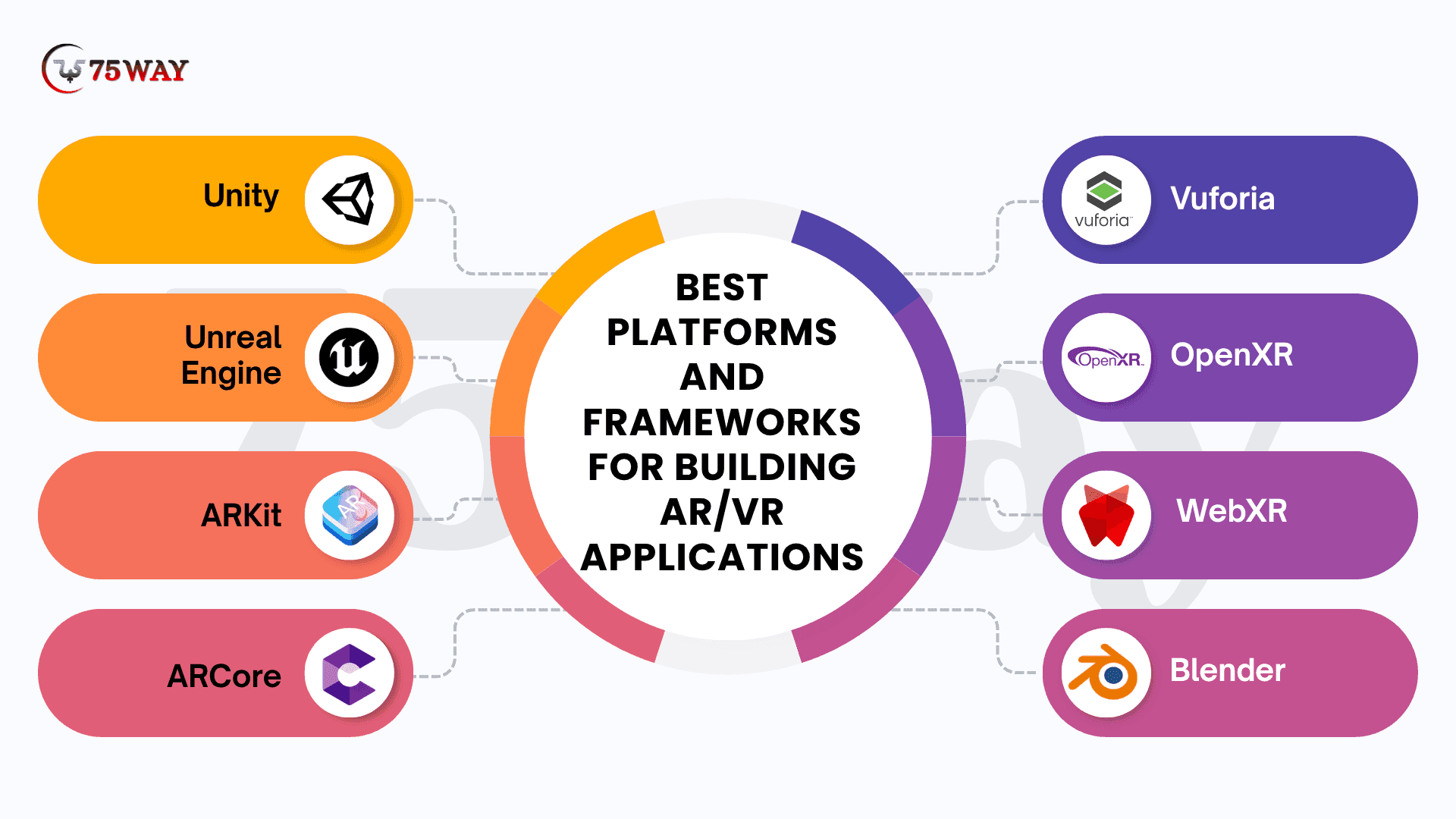
1. Unity
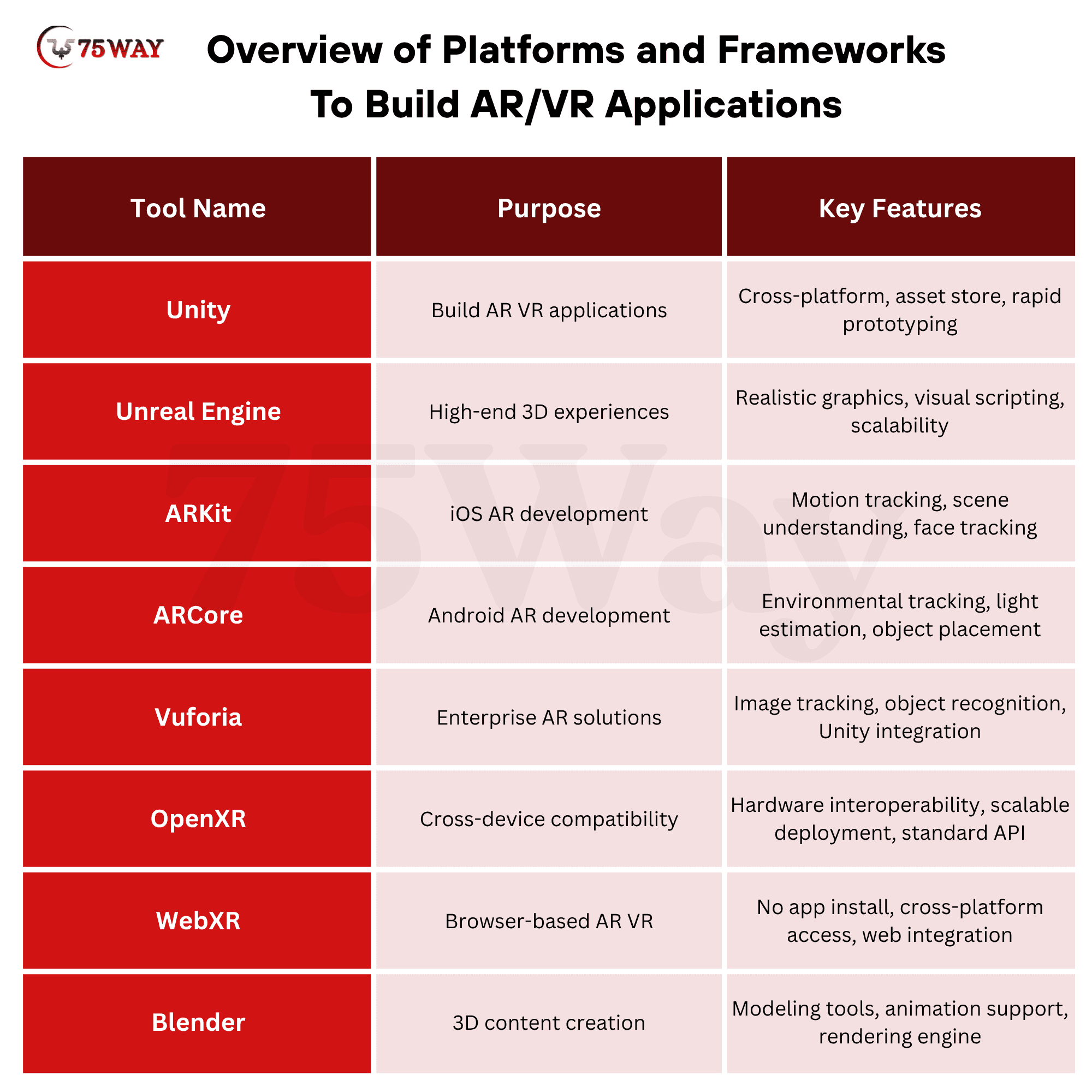
Unity is one of the most widely used development engines for building AR, VR, and XR applications. It offers flexibility, scalability, and extensive platform support. Organizations use Unity to create immersive experiences across mobile, desktop, web, and wearable devices.
Advantages include:
- Extensive asset marketplace
- Cross-platform compatibility
- Strong developer community
- AR and VR support
- Rapid prototyping capabilities
Unity is particularly popular among startups and enterprises seeking flexible development environments.
2. Unreal Engine
Unreal Engine is a leading real-time 3D development platform known for producing highly realistic immersive experiences. Its advanced graphics capabilities support visually rich applications. Many organizations choose Unreal Engine for enterprise simulations, gaming, and visualization projects.
Benefits include:
- Advanced rendering capabilities
- High-fidelity graphics
- Powerful visual scripting tools
- Enterprise-grade scalability
Industries such as automotive, architecture, and gaming frequently choose Unreal Engine for complex projects.
3. ARKit
ARKit is Apple's augmented reality framework designed for iPhone and iPad application development. It provides advanced environmental understanding and motion tracking capabilities. Businesses use ARKit to create seamless AR experiences within the Apple ecosystem.
Key capabilities include:
- Motion tracking
- Scene understanding
- Face tracking
- Environmental analysis
ARKit continues evolving alongside Apple's spatial computing ecosystem.
4. ARCore
ARCore is Google's augmented reality platform for Android devices. It enables applications to understand environments, track movement, and place digital content accurately. Organizations use ARCore to deliver scalable AR experiences across diverse Android hardware ecosystems.
Features include:
- Environmental understanding
- Motion tracking
- Light estimation
- Object placement
ARCore supports large-scale deployment across diverse hardware ecosystems.
5. Vuforia
Vuforia is a powerful augmented reality development platform focused on image recognition and object tracking. It is widely adopted for enterprise AR solutions. Organizations use Vuforia to create training, maintenance, and industrial assistance applications.
Key benefits include:
- Advanced image recognition
- Object tracking functionality
- Industrial AR support
- Enterprise deployment capabilities
- Integration with Unity
Manufacturing, logistics, and field service organizations frequently use Vuforia to create guided workflows, maintenance assistance tools, and interactive training applications.
6. OpenXR
OpenXR is an open standard that simplifies immersive application development across multiple AR and VR devices. It reduces platform-specific development requirements. Businesses use OpenXR to improve compatibility, scalability, and long-term technology flexibility.
Advantages include:
- Hardware interoperability
- Reduced development effort
- Simplified maintenance
- Future scalability
- Broad industry adoption
OpenXR is becoming increasingly important as businesses seek platform-independent immersive solutions.
7. WebXR
WebXR enables immersive AR and VR experiences directly through modern web browsers. Users can access experiences without downloading dedicated applications. Organizations use WebXR to increase accessibility, audience reach, and deployment efficiency.
Benefits include:
- Improved accessibility
- Reduced user acquisition barriers
- Faster deployment
- Cross-platform compatibility
- Simplified content distribution
Retail, education, marketing, and ecommerce organizations increasingly utilize WebXR to reach larger audiences with immersive experiences.
8. Blender
Blender is a powerful open-source 3D modeling and animation platform widely used in AR VR development. It enables the creation of realistic assets and environments. Development teams use Blender to build immersive content while reducing software licensing costs.
Keybenefits include:
- 3D modeling and sculpting
- Character animation tools
- Real-time rendering capabilities
- Open-source and cost-effective
- Integration with Unity and Unreal Engine
Development teams frequently use Blender to design virtual objects, product visualizations, architectural models, game assets, and interactive environments that power AR VR experiences across multiple industries.
Overview of Platforms and Frameworks To Build AR/VR Applications
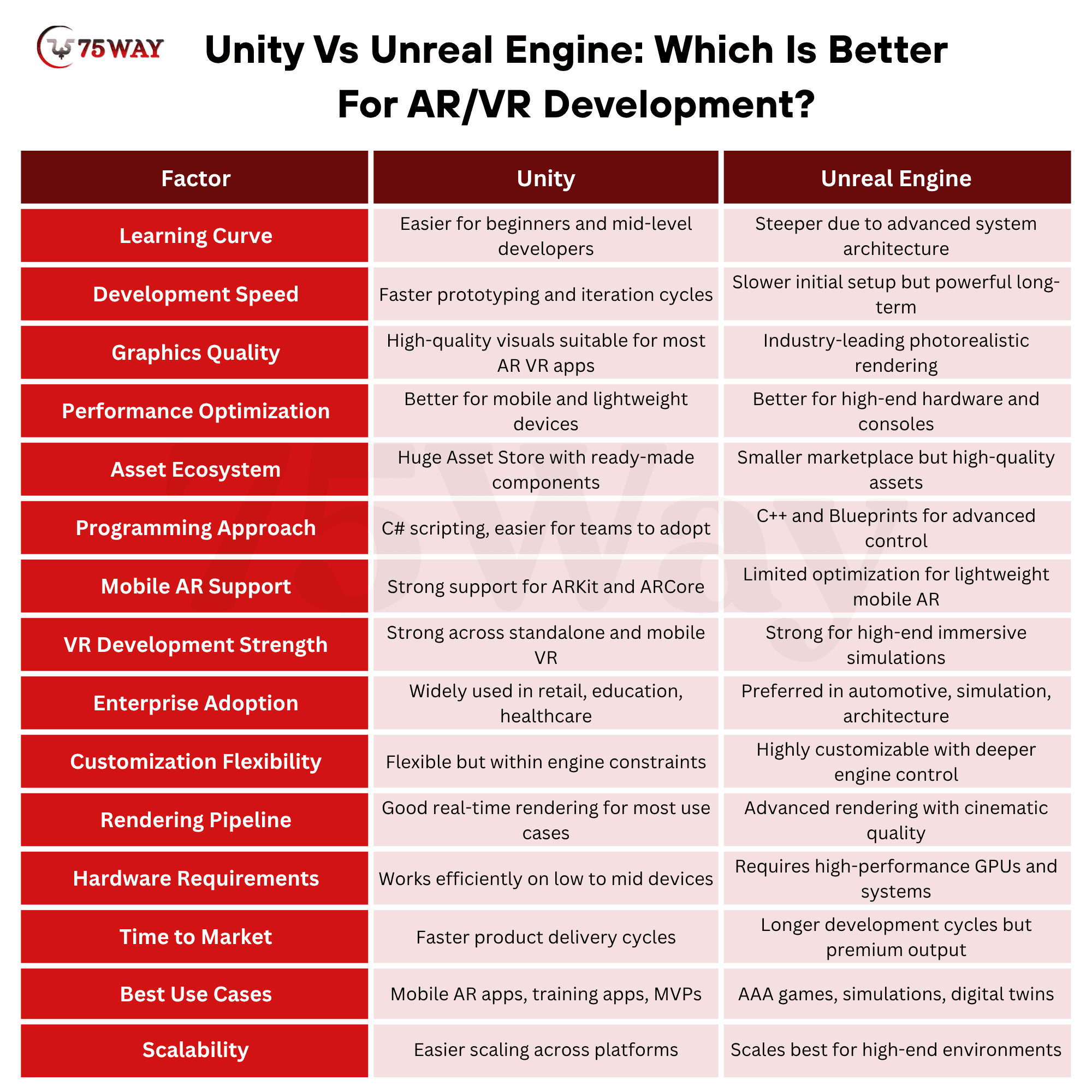
Unity Vs Unreal Engine: Which Is Better For AR/VR Development?
Unity and Unreal Engine differ primarily in approach, performance focus, and development flexibility. Unity is widely preferred for rapid development, cross-platform deployment, and mobile-first AR VR applications. It offers a simpler learning curve, a large asset store, and strong support for Android, iOS, and lightweight immersive experiences.
Unreal Engine, on the other hand, is designed for high-end visual fidelity and complex 3D simulations. It delivers superior graphics quality, advanced rendering capabilities, and better performance for realistic environments. It is commonly used in enterprise simulations, gaming, automotive visualization, and architecture projects where visual realism is a top priority. Both platforms offer powerful capabilities, but each serves different project requirements.
How Artificial Intelligence Is Powering AR/VR Development?
Artificial Intelligence is transforming immersive experiences by making environments more adaptive, intelligent, and personalized. In modern AR VR applications, AI acts as the core layer that connects user behavior with real-time system responses, improving engagement, realism, and decision-making across industries.
- Intelligent Virtual Assistants: AI-powered assistants guide users through immersive experiences by offering real-time support and interaction. These systems reduce complexity and help users navigate virtual environments.
- Personalized Experiences: AI analyzes user behavior to customize immersive environments based on individual preferences and actions. This creates more relevant and engaging experiences.
- Advanced Object Recognition: Machine learning models improve object identification accuracy within AR VR systems. This enables applications to understand real-world elements more effectively.
- Digital Humans And AI Avatars: Digital humans represent one of the most advanced applications of AI in immersive technology. These avatars simulate realistic human behavior and interaction within virtual environments. They can communicate naturally, answer questions, provide guidance, and simulate real-world interactions.
- Predictive Analytics: AI systems analyze behavioral data to identify patterns, trends, and opportunities within immersive environments. This helps organizations improve both user experience and system performance.
- AI-Driven Environment Adaptation: AI enables virtual environments to adjust dynamically based on user behavior, emotional responses, and interaction patterns. This creates more responsive and immersive experiences that feel natural and engaging.
- Real-Time Performance Optimization: AI continuously monitors system performance and automatically adjusts rendering quality, frame rates, and resource allocation. This ensures smooth experiences even on lower-end devices while maintaining visual consistency.
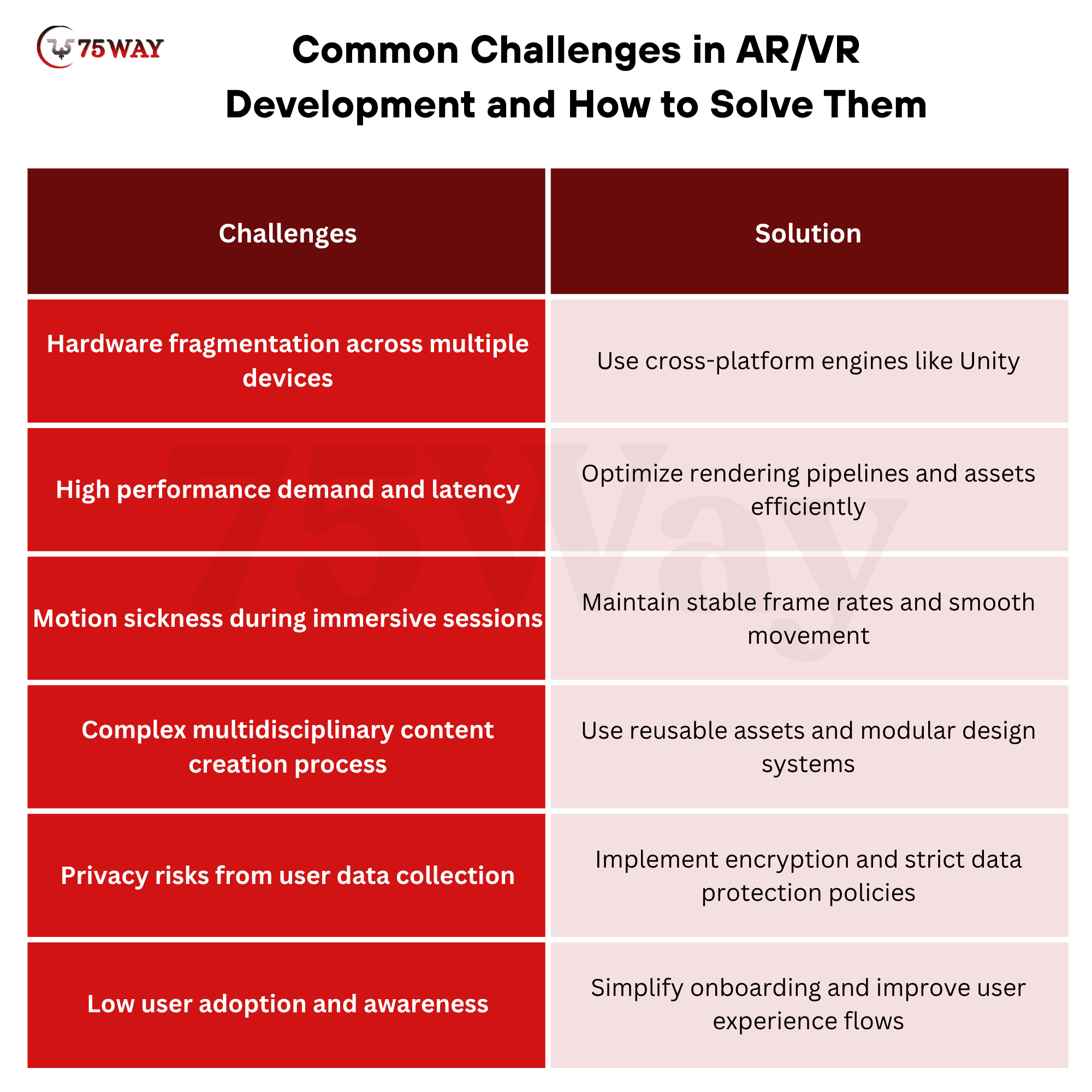
Why AR/VR Development Is Complex: Common Problems and Solutions
Although immersive technologies offer significant opportunities, development teams must overcome several technical, operational, and user experience challenges. Each challenge directly impacts performance, adoption, and overall product success, making it essential to address them early in the development lifecycle.
- Hardware Fragmentation
AR VR ecosystems include a wide range of devices with different capabilities and performance levels. This makes it difficult to create a single solution that works consistently across all platforms.
Developers must optimize applications for different processors, display technologies, tracking systems, and operating systems. The best solution involves using cross-platform engines like Unity or Unreal Engine and adopting frameworks such as OpenXR to ensure compatibility and reduce fragmentation issues.
- Performance Optimization
Immersive applications require high computational power to maintain smooth and realistic experiences. Poor optimization can quickly break immersion and reduce user engagement.
Challenges include maintaining stable frame rates, managing memory usage, reducing latency, and optimizing rendering pipelines. Developers solve this by using level-of-detail (LOD) techniques, efficient asset optimization, and GPU-optimized rendering workflows.
- Motion Discomfort
Some users experience motion sickness or discomfort during immersive sessions, especially in VR environments. This can significantly reduce session duration and overall user satisfaction.
Factors include lag, poor frame rates, inconsistent movement, and visual conflicts. Solutions involve maintaining high refresh rates, reducing camera acceleration, using teleportation-based movement, and ensuring stable frame synchronization.
- Content Creation Complexity
Building high-quality AR VR content requires specialized skills across multiple disciplines. This increases both development time and production costs.
Teams typically include developers, designers, 3D artists, animators, and AI specialists. This challenge can be addressed by using reusable asset libraries, modular design systems, and tools like Blender, Unity Asset Store, and procedural generation techniques.
- Privacy And Security Concerns
AR VR applications collect sensitive user data such as location, biometrics, eye tracking, and behavioral patterns. This creates serious privacy risks if not handled properly.
Organizations must implement strong encryption, data anonymization, secure authentication systems, and compliance with regulations like GDPR to protect user information and build trust.
- User Adoption Barriers
Many users are still unfamiliar with immersive technologies, which creates hesitation and learning resistance. Poor onboarding can significantly reduce adoption rates.
Solutions include simplified onboarding flows, intuitive UI design, guided tutorials, and accessible interfaces. Reducing complexity and improving first-time user experience greatly enhances adoption and engagement.
How Much Does AR/VR App Development Cost?
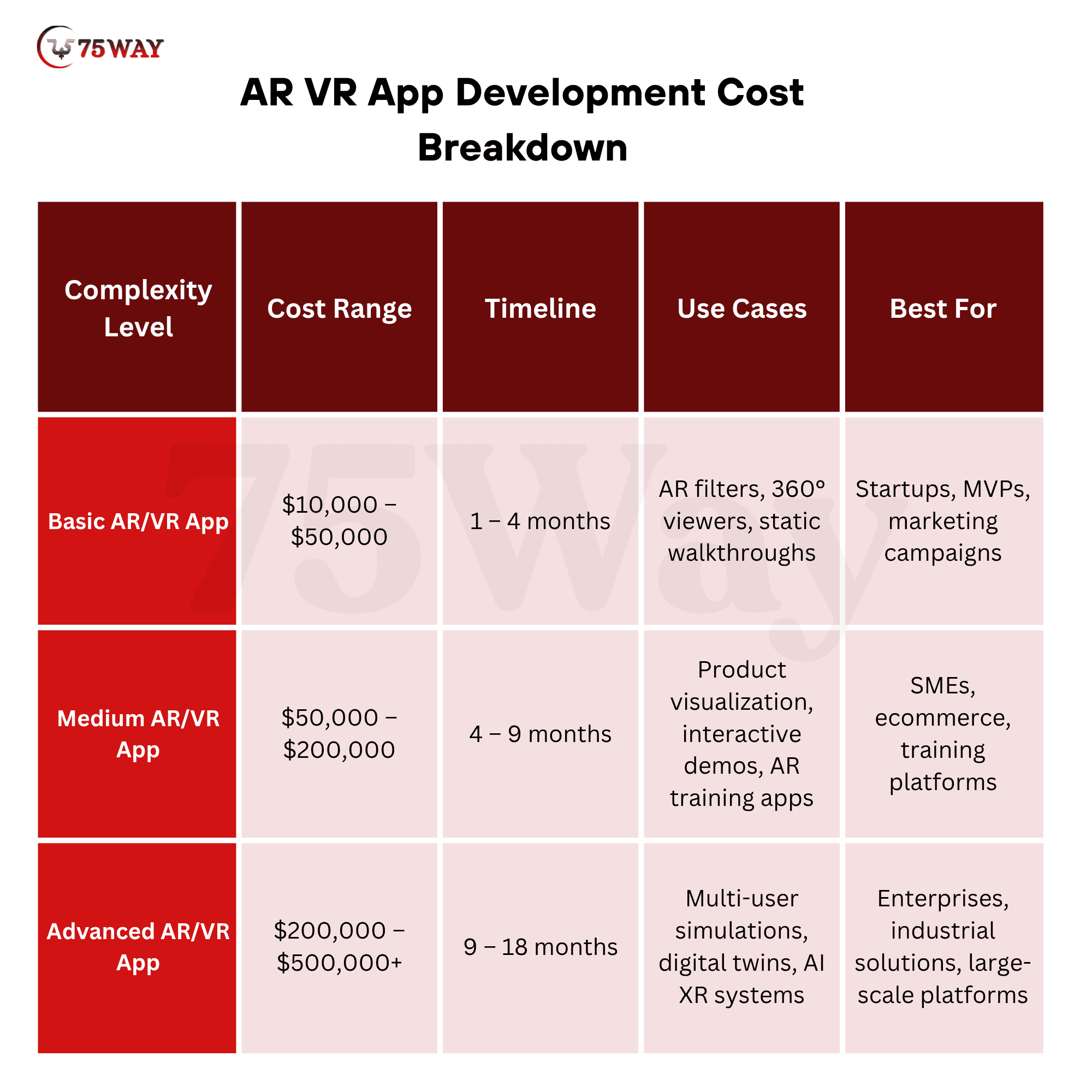
The cost of AR VR App Development varies widely depending on complexity, platform choice, 3D asset quality, AI integration, and target devices. Most immersive projects fall within an average development range of $10,000 to $500,000+, depending on business goals, scalability needs, and technology depth. This variation reflects how different industries adopt AR VR for simple visualization versus advanced enterprise simulations.
- Basic AR/VR App Development Cost: $10,000 – $50,000
Simple AR VR apps with limited interactivity and basic 3D elements used mainly for engagement and marketing.
- Medium AR/VR App Development Cost: $50,000 – $200,000
Feature-rich applications with interactive environments, improved graphics, and cross-platform support for better user engagement.
- Advanced AR/VR App Development Cost: $200,000 – $500,000+
Enterprise-grade immersive systems with advanced simulations, digital twins, cloud architecture, and high-end performance optimization.
Monetization Models for AR/VR Applications: How to Generate Revenue
Businesses are increasingly using immersive applications as powerful revenue-generating assets, transforming AR VR from a cost center into a long-term profit driver. Different monetization strategies are used depending on the target audience, industry, and application purpose.
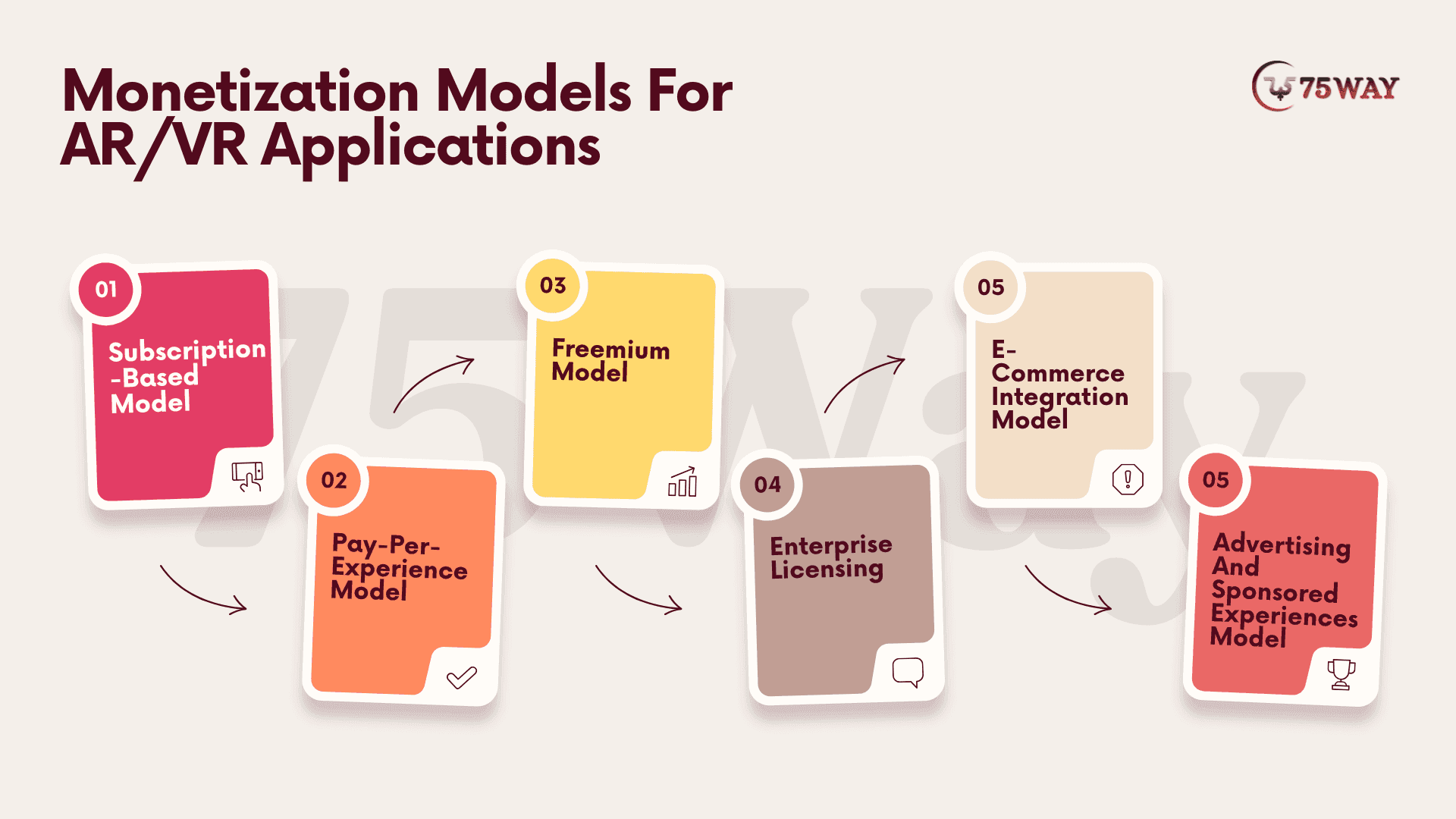
- Subscription-Based Model: Users pay recurring monthly or yearly fees to access immersive AR VR experiences, commonly used in training platforms, educational systems, and enterprise productivity tools where continuous value delivery is required.
- Pay-Per-Experience Model: Users pay for each individual immersive session or interaction, widely used in virtual tourism, VR gaming environments, and entertainment experiences where content is consumed on demand.
- Freemium Model: Basic features remain free while advanced functionalities require payment, commonly used in mobile AR applications and consumer VR apps to drive large user acquisition before monetization.
- Enterprise Licensing: Organizations purchase licenses for internal deployment of AR VR solutions, commonly adopted in manufacturing, healthcare, and corporate training environments for scalable enterprise usage.
- E-Commerce Integration Model: AR enhances product visualization and try-before-you-buy experiences, directly improving conversion rates and generating indirect revenue for retail and online shopping platforms.
- Advertising and Sponsored Experiences Model: Brands integrate immersive ads or sponsored AR VR environments where businesses pay for exposure within interactive experiences, commonly used in retail, gaming, and location-based AR applications.
What’s Next in AR/VR App Creation? Future Trends for 2026 and Beyond
Immersive technology is evolving rapidly toward more intelligent, connected, and seamless ecosystems where physical and digital worlds merge naturally. Businesses are increasingly adopting AR VR not just for visualization, but for real-time decision-making, automation, and long-term digital transformation.
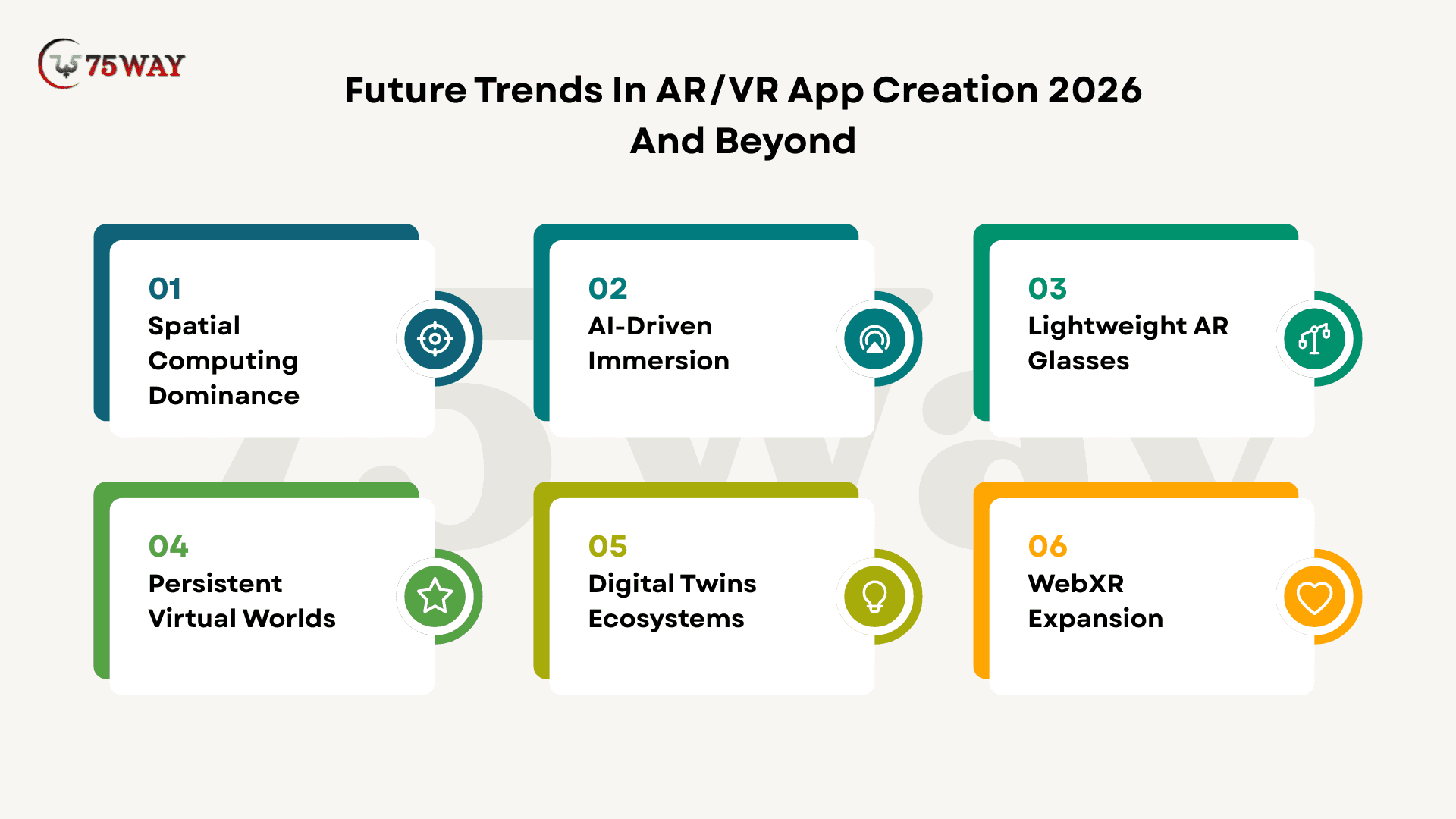
- Spatial Computing Dominance: Computing will shift from traditional screens to spatial environments where digital objects exist and interact within real-world context, enabling more natural human-computer interaction.
- AI-Driven Immersion: Artificial intelligence will dynamically generate environments, avatars, and interactions based on user behavior, creating adaptive and highly personalized immersive experiences.
- Lightweight AR Glasses: Next-generation AR devices will replace bulky headsets with lightweight wearable glasses, making immersive technology more practical for daily enterprise and consumer use.
- WebXR Expansion: Browser-based immersive experiences will grow significantly, reducing dependency on app installations and enabling faster, more accessible AR VR adoption across industries.
- Digital Twins Ecosystems: Entire industries will rely on real-time virtual replicas of physical systems to monitor performance, predict outcomes, and optimize operations at scale.
- Persistent Virtual Worlds: Virtual environments will remain continuously active and evolve even when users are offline, creating long-term interactive digital ecosystems for collaboration, training, and entertainment.
How 75way Delivers End-to-End AR/VR Mobile App Development Services?
75way Technologies delivers end-to-end AR VR mobile app development by combining strategy, design, engineering, and optimization into a single structured workflow. The process begins with understanding business objectives, user expectations, and industry challenges to ensure every immersive solution is aligned with real-world outcomes. With a team of 150+ experts, including AR VR developers, 3D artists, AI engineers, and UX designers, 75Way builds scalable solutions for startups and enterprises across global markets.
The development approach focuses on creating high-quality immersive experiences using advanced technologies like Unity, Unreal Engine, AI integration, spatial computing, and real-time rendering systems. Every project goes through structured phases such as prototyping, 3D asset creation, interaction design, development, testing, and deployment to ensure performance, usability, and long-term scalability. Strong emphasis is placed on optimization, ensuring applications run smoothly across mobile devices, headsets, and cross-platform environments.
Recently, we have delivered a retail AR solution where we developed a virtual product visualization app that allowed users to interact with 3D products before purchase. The solution improved customer engagement and increased conversion rates by enhancing product understanding through immersive experiences. Continuous monitoring and optimization ensured the platform remained stable and scalable after launch, supporting long-term business growth.
Wrap up
AR/VR app development represents a major shift in how digital experiences are designed, delivered, and consumed across industries. From healthcare simulations to retail visualization and enterprise training systems, immersive technologies are redefining engagement and operational efficiency. Businesses adopting AR VR solutions gain measurable advantages in innovation, customer experience, and revenue generation. Transform your business idea into a powerful immersive experience with a trusted app development company that specializes in creating AR/VR solutions.
Frequently Asked Questions (FAQ)
What Makes AR VR App Development Important For Modern Businesses?
AR/VR app development enhances customer engagement through immersive, interactive digital experiences. It improves training, product visualization, and decision-making processes across industries. Businesses adopt it to increase efficiency, conversions, and user satisfaction.
How Does AR VR Technology Improve Customer Experience?
AR VR technology allows users to experience products and environments before real-world interaction. This increases confidence in purchase decisions and reduces uncertainty. It also delivers memorable, interactive brand engagement that strengthens customer loyalty.
Is AR VR App Development Expensive For Startups?
Costs depend on complexity, features, and platform selection. Startups can begin with basic AR VR applications at lower budgets. Enterprise-grade solutions require higher investment due to advanced functionality and scalability needs.
How To Become AR VR Developer?
Becoming an AR VR developer requires learning game engines like Unity or Unreal Engine. Strong knowledge of 3D modeling, programming languages, and spatial computing is essential. Continuous practice with real projects helps build expertise.
Which App Development Platforms Support AR VR For Retail Engagement?
Platforms like Unity, Unreal Engine, ARKit, and ARCore support AR VR retail experiences. These tools help create virtual try-ons, product visualization, and interactive shopping environments. Retailers use them to improve engagement and conversions.
What Are The Latest Developments In VR AR For Educational Applications?
Recent developments include AI-powered virtual classrooms, immersive simulations, and interactive 3D learning environments. AR overlays enhance textbooks with real-time visuals. VR enables experiential learning that improves retention and engagement.