AI Summary
Stop guessing when hiring an app development company in United States in 2026. This guide helps you compare agencies, evaluate technical expertise, avoid costly mistakes, review contracts confidently, and hire a reliable mobile app development company in the USA that supports sustainable business growth.
Key Takeaways
- Evaluate expertise beyond attractive portfolios and impressive client logos alone.
- Ask strategic questions before signing any development partnership agreement.
- Compare pricing models alongside quality, communication, and post-launch support.
- Verify technical capabilities through proven processes, documentation, and real outcomes.
- Choose long-term technology partners focused on measurable business growth and innovation.
Do you remember the last major business investment your company made? Whether it was adopting a new CRM, upgrading your ERP system, or expanding into a new market with an AI-powered application, every decision likely involved weeks of research, stakeholder discussions, and careful financial planning.
Hiring an app development company deserves the same level of attention. Unlike purchasing software, building a custom mobile application means choosing a team that will shape your product from the ground up.
They will influence technical architecture, user experience, security, scalability, integrations, and even how quickly your business can respond to changing customer expectations. Once development begins, replacing the partner midway through the project can become expensive, time-consuming, and disruptive.
That is why experienced business leaders do not evaluate mobile application development partners solely by their hourly rates or portfolios. They focus on whether the app creation agency can become a reliable technology partner that supports long-term business goals.
An App Development Partner Shapes More Than Your Mobile Application
Many first-time buyers assume they are hiring developers to build screens, write code, and launch an application. In reality, an experienced app development partner contributes much more than technical execution.
From the earliest discovery sessions, the right team challenges assumptions, identifies potential risks, recommends practical solutions, and helps prioritize features that create measurable business value. Instead of saying "yes" to every request, they ask thoughtful questions that protect your budget and improve the final product.
For example, imagine a retail company planning to launch a customer loyalty application. A less experienced agency may immediately begin development based on the initial requirements. An experienced partner, however, is more likely to ask questions such as:
- Will the application need to support multiple store locations?
- Should it integrate with the existing POS system?
- How will customer data remain secure?
- What happens when the user base grows from 10,000 to one million?
- Which features belong in the first release, and which should wait?
These conversations often prevent expensive changes later in the project.
The Cost of Choosing the Wrong Development Company
Many failed software projects do not fail because the original idea lacked potential. They fail because businesses selected a partner that could build an application but could not manage a successful product journey.
The warning signs are often easy to overlook during the sales process. Every company promises experienced developers, agile methodologies, transparent communication, and timely delivery. The differences usually become visible only after contracts are signed and development begins.
Choosing the wrong partner can lead to problems such as:
- Repeated project delays that affect launch schedules.
- Unexpected budget increases caused by poor planning.
- Technical debt that makes future enhancements expensive.
- Weak documentation that complicates maintenance.
- Limited communication between technical and business teams.
- Security vulnerabilities discovered after deployment.
- Poor-quality code that requires extensive redevelopment.
These issues rarely appear overnight. They build gradually throughout the project until deadlines slip, costs increase, and confidence begins to decline.
Why Long-Term Thinking Produces Better Business Outcomes?
Many businesses evaluate app development companies with one question in mind:
"Can they build our application?"
A more valuable question is:
"Can they continue supporting our business as our product evolves?"
Launching Version 1 is only the beginning of your digital product journey. Customer feedback, operating system updates, security improvements, performance optimization, AI capabilities, and new business opportunities will continue shaping your application for years.
A development partner that understands long-term product evolution helps you:
- Build a scalable architecture from the beginning.
- Reduce future maintenance costs.
- Release updates faster without disrupting existing functionality.
- Adopt emerging technologies when they create genuine business value.
- Support continuous growth instead of requiring costly redevelopment.
That long-term perspective often separates successful digital products from applications that struggle to remain competitive after launch.
Why Choosing the Right App Development Partner Matters More Than Most Businesses Realize
The right app creation company doesn't just write code. It helps you avoid costly mistakes, accelerate growth, and build an app that delivers measurable business results.
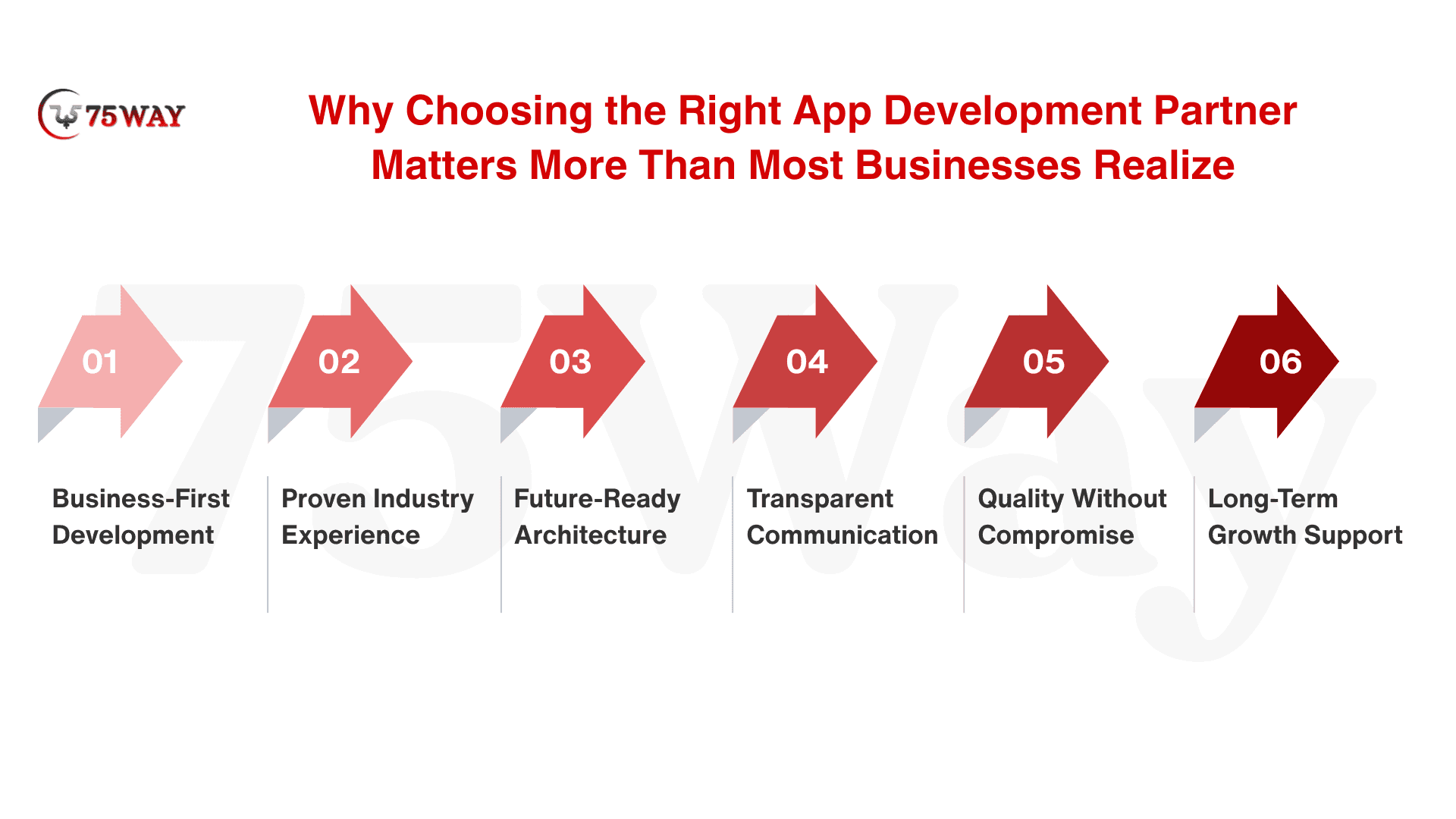
- Business-First Development: A reliable development partner looks beyond technical requirements. They take time to understand your business model, target audience, revenue goals, and long-term vision before recommending the right development approach.
- Proven Industry Experience: Experience matters when unexpected challenges arise. A team that has delivered apps across multiple industries can identify risks early, recommend proven solutions, and keep your project moving in the right direction.
- Future-Ready Architecture: Your app should support growth from day one. The right partner builds scalable architecture that can handle more users, new features, third-party integrations, and changing business requirements without major redevelopment.
- Transparent Communication: Successful projects depend on clear communication. Regular progress updates, realistic timelines, honest feedback, and collaborative decision-making help eliminate confusion and keep every stakeholder aligned throughout development.
- Quality Without Compromise: A polished user interface means very little if the app crashes or performs poorly. Strong development partners prioritize code quality, security, performance, and thorough testing to deliver a reliable product users can trust.
- Long-Term Growth Support: Launching your app is only the beginning. The best development partners continue improving the product through updates, performance monitoring, feature enhancements, and technical support, helping your app stay competitive as your business evolves.
Different Types of App Creation Partners You Can Hire
Before you compare proposals, review portfolios, or negotiate pricing, it is important to understand one thing: Not every app programming company offers the same type of partnership.
On paper, two companies may promise similar deliverables, comparable timelines, and competitive pricing. However, the way they approach strategy, product planning, development, communication, and long-term support can be entirely different.
That is why many businesses feel confused after receiving proposals. One agency recommends a 6-week discovery phase, another wants to start coding immediately, while a third suggests building an MVP first. None of these approaches are automatically right or wrong. The right choice depends on your business objectives, project complexity, available budget, and future growth plans.
Before evaluating companies, you should first understand the different types of app development partners available in the market.
1. Product Development Companies
If you are building a new digital product, launching a startup, or creating a revenue-generating mobile application, a product development company is often the strongest choice. These companies do far more than develop software. They help shape the product itself.
Instead of waiting for complete specifications, they collaborate with your team to validate ideas, prioritize features, improve user experience, and reduce unnecessary development costs before coding begins.
Best suited for:
- Startup founders building an MVP.
- Businesses launching a new digital product.
- Companies creating customer-facing applications.
- Organizations entering new digital markets.
What to expect:
- Product discovery workshops.
- Business and technical consulting.
- User-focused feature prioritization.
- Iterative development with regular feedback.
- Long-term product evolution.
If your application is expected to generate revenue or become a core business asset, this type of partnership usually creates more value than simply hiring developers.
2. Custom App Development Companies
Some businesses already know exactly what they need.
Perhaps internal teams have completed research, stakeholders have approved requirements, and the primary goal is building a tailored application that integrates with existing systems.
In these situations, a custom app creation company focuses on transforming detailed business requirements into a functional software solution.
Rather than defining the product strategy, they concentrate on execution, quality assurance, integrations, security, and deployment.
Best suited for:
- Enterprise software modernization.
- Internal business applications.
- Industry-specific software.
- Process automation projects.
- Existing products requiring new functionality.
3. Dedicated Development Teams
Sometimes, businesses do not need an agency to manage the entire project.
Instead, they need experienced developers who can work alongside their internal product managers, designers, or engineering leaders. A dedicated development team operates as an extension of your organization rather than an external vendor.
Communication is usually more direct, priorities change quickly, and collaboration becomes part of the company's daily workflow.
Best suited for:
- Companies with internal product teams.
- Businesses expanding engineering capacity.
- Long-term software development.
- Organizations needing specialized technical expertise.
4. Full-Service Digital Product Agencies
Some projects require much more than software development. You may also need branding, UX research, UI design, backend development, cloud infrastructure, AI integration, quality assurance, DevOps, analytics, and ongoing maintenance.
Rather than coordinating multiple vendors, many organizations choose a full-service digital product agency that manages the complete lifecycle under one roof.
This approach often improves communication because strategy, design, engineering, testing, and deployment remain aligned throughout the project.
Best suited for:
- Large digital transformation initiatives.
- Businesses launching multiple applications.
- Companies seeking a single technology partner.
- Organizations requiring continuous product support.
Offshore Vs Nearshore Vs U.S.-Based App Dev Partners: Which to Hire?
The biggest difference between offshore, nearshore, and U.S.-based development partners is where your team is located—and how that impacts communication, collaboration, costs, and project execution. Offshore partners typically offer the lowest development costs, nearshore teams provide better time-zone alignment, and U.S.-based companies deliver the closest collaboration with a deeper understanding of the local market, regulations, and customer expectations.
Cost is important, but it shouldn't be the only factor driving your decision. A lower hourly rate can quickly lose its value if communication gaps, delayed feedback, or project misunderstandings slow development. The right choice depends on your priorities. If your project requires frequent collaboration, complex integrations, or long-term product growth, factors like responsiveness, cultural alignment, and business expertise often matter just as much as the development budget.
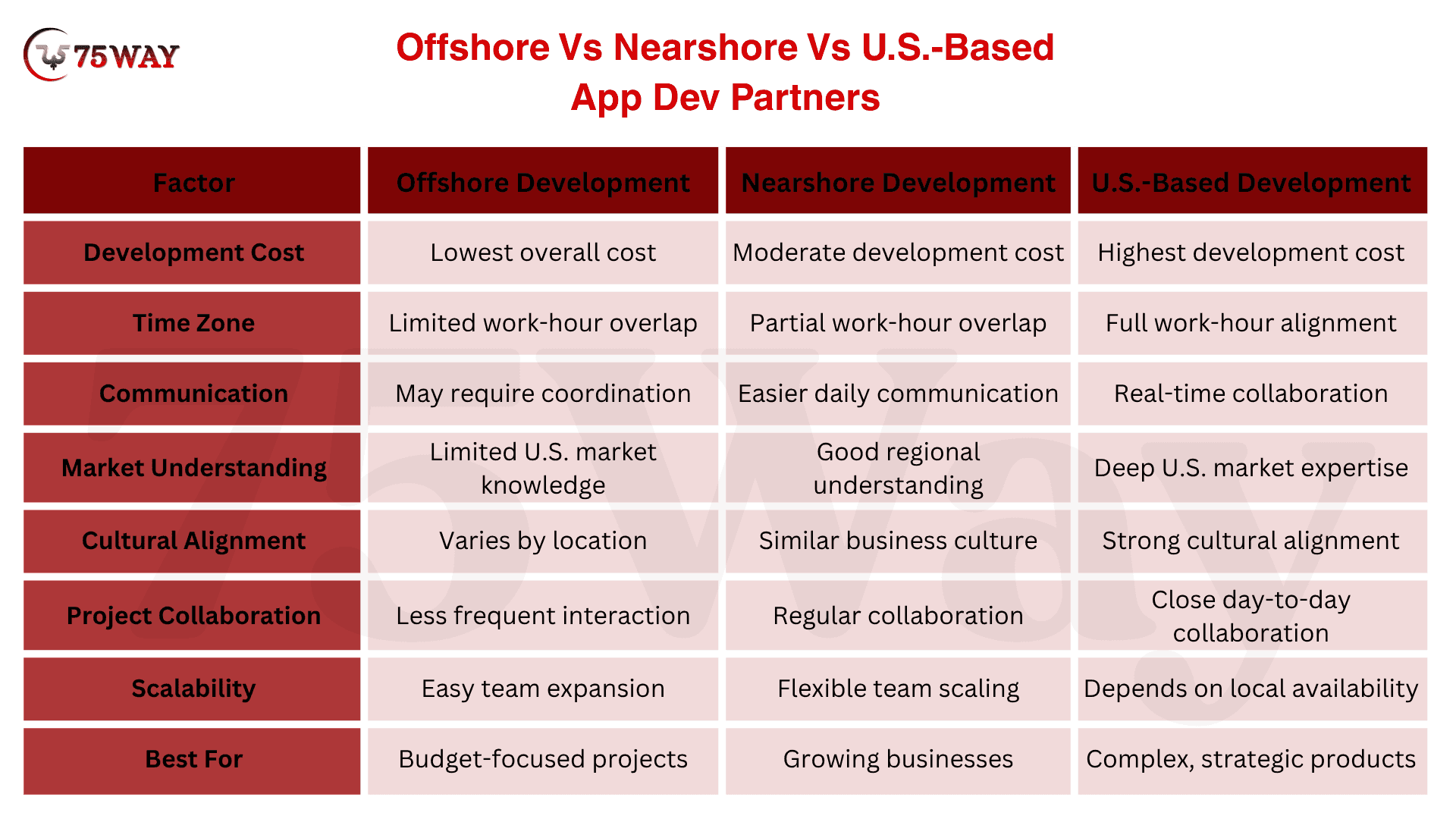
There is no universally correct option. The best choice depends on how involved your internal team plans to be, the complexity of your project, compliance requirements, and how important real-time collaboration is throughout development.
How to Hire the Right Mobile App Development Company in the USA
If you are investing in a custom mobile application, the following framework can help you make a more informed decision. Whether you're comparing an agency, a solo freelancer, or a dedicated team for custom mobile app development, the underlying criteria stay the same: technical depth, communication cadence, and a track record you can actually verify before signing anything.
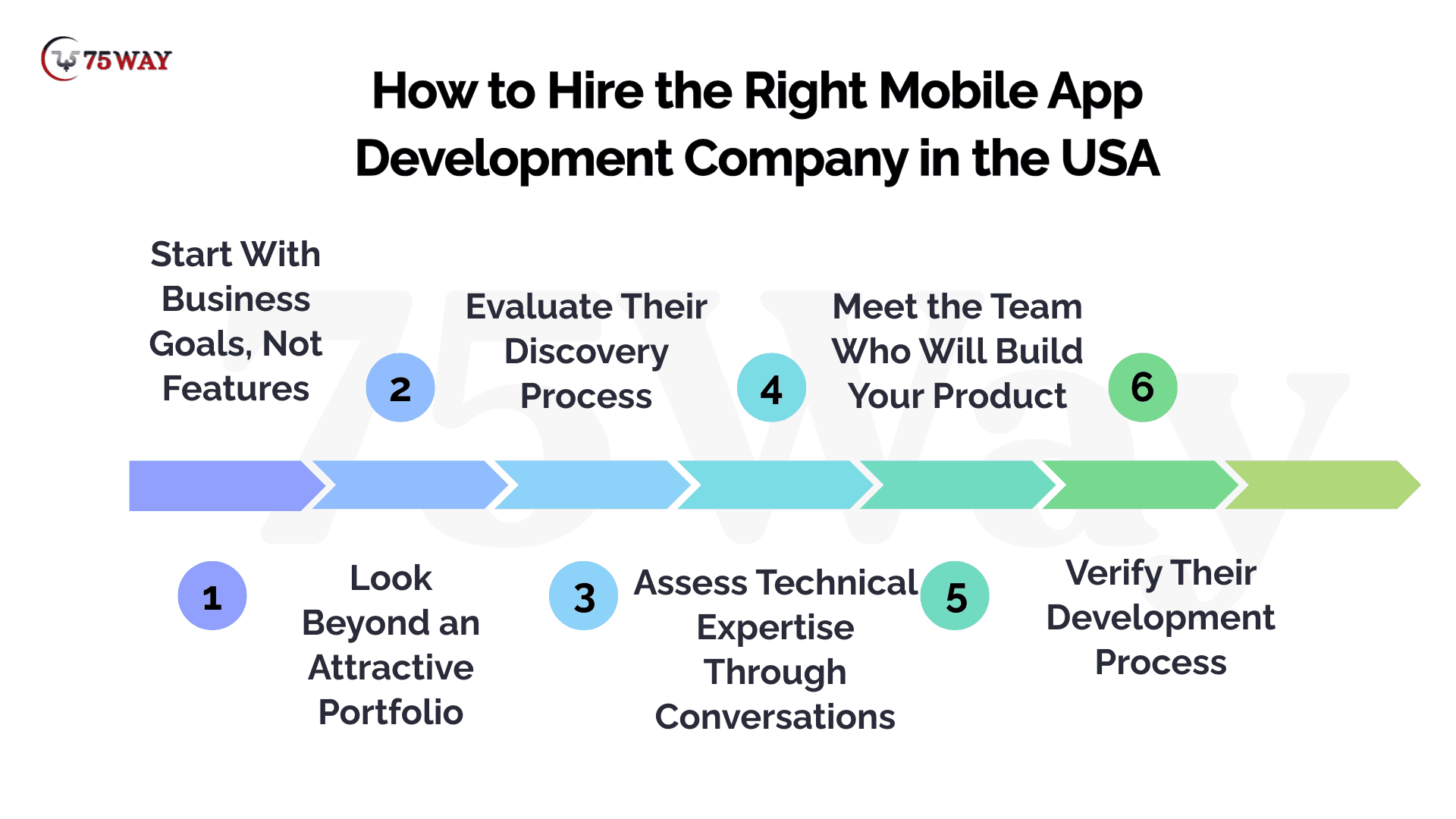
Step 1: Start With Business Goals, Not Features
One of the biggest mistakes companies make is contacting development agencies with a list of features before defining the business problem they are trying to solve. Features describe what your application should do. Business goals explain why you are building it.
That distinction changes the entire project. For example, imagine two companies requesting exactly the same feature:
"We need an appointment booking system."
At first glance, both projects appear identical. However, the underlying business goals may be completely different.
- A healthcare provider wants to reduce administrative workload.
- A beauty brand wants to increase repeat bookings.
- A logistics company wants to optimize technician scheduling.
- A fitness startup wants to improve customer retention.
An experienced development partner will spend time understanding these objectives before discussing technologies or development timelines. Before contacting any agency, define:
- The primary business problem you want to solve.
- Your target audience.
- The measurable outcome you expect.
- Your launch priorities.
- The budget range you are comfortable investing.
The clearer your objectives, the more accurate the recommendations and project estimates will be.
Step 2: Look Beyond an Attractive Portfolio
Almost every development company has a portfolio filled with visually appealing applications. However, attractive screenshots rarely tell the complete story.
A portfolio should help you understand how the company solves business challenges, not simply prove that they have built mobile applications.
When reviewing previous work, pay attention to the thinking behind each project.
Ask questions such as:
- What business challenge did the client face?
- Why was this technology stack selected?
- What measurable results did the application achieve?
- How complex was the project?
- Is the application still actively maintained?
A company that confidently discusses project decisions, technical challenges, and measurable outcomes usually demonstrates far greater experience than one that simply presents polished visuals. Strong portfolios often include:
- Industry-specific experience.
- Detailed project case studies.
- Business challenges and solutions.
- Technologies used and the reasons behind those choices.
- Measurable outcomes after launch.
Remember, portfolios should demonstrate problem-solving ability, not only design quality.
Step 3: Evaluate Their Discovery Process
One of the easiest ways to identify an experienced app development company is by observing what happens before development begins.
- Do they immediately send a proposal after a short sales call?
- Or do they spend time learning about your business?
Experienced companies know that successful software starts with discovery, not development.
A structured discovery process reduces uncertainty, improves budget accuracy, and identifies technical risks before they become expensive problems. A quality discovery phase usually includes:
- Business requirement workshops.
- Competitor analysis.
- User journey discussions.
- Technical feasibility assessments.
- Feature prioritization.
- Architecture planning.
- Timeline and risk evaluation.
If a company promises an exact timeline and fixed budget after only a brief conversation, you should understand how they reached those conclusions. Reliable estimates require thoughtful planning.
Step 4: Assess Technical Expertise Through Conversations
Business owners often assume they need deep technical knowledge to evaluate developers.
You do not. Instead of testing programming skills, evaluate how clearly the company explains technical decisions. Experienced professionals simplify complexity.
For example, ask why they would recommend Flutter instead of React Native, or why a cloud-native architecture may suit your business better than a traditional deployment model. You are not looking for the "correct" technology. You are looking for logical reasoning.
Strong technical partners usually:
- Explain trade-offs instead of promoting trends.
- Recommend technologies based on business objectives.
- Discuss scalability from the beginning.
- Address security and performance proactively.
- Explain technical concepts in plain business language.
If every recommendation sounds like a sales pitch, continue asking questions until you understand the reasoning behind it.
Step 5: Meet the Team Who Will Build Your Product
Many businesses spend weeks speaking with experienced sales representatives but never meet the people who will actually develop the application.
That creates unnecessary risk. Before signing a contract, ask to meet key members of the delivery team. This conversation often reveals far more than any presentation. Consider speaking with:
- Project Manager.
- Technical Architect.
- Lead Mobile Developer.
- UI/UX Designer.
- Quality Assurance Lead.
During these conversations, observe more than technical knowledge. Pay attention to:
- Communication style.
- Business understanding.
- Problem-solving approach.
- Ability to explain complex ideas clearly.
- Interest in your project's long-term success.
You are hiring people, not just a company logo.
Step 6: Verify Their Development Process
Every agency claims to follow Agile development.
The important question is:
What does Agile actually look like inside their organization?
Ask them to explain their workflow from project kickoff to launch. A mature development process should provide visibility, accountability, and flexibility throughout the project. Look for processes that include:
- Sprint planning.
- Weekly progress reviews.
- Transparent project tracking.
- Continuous testing.
- Regular stakeholder feedback.
- Version control.
- Structured deployment planning.
A clearly defined process reduces misunderstandings and keeps projects moving forward, even when priorities evolve.
Expert Insight: The best app development companies are not the ones that promise everything. They are the ones that ask thoughtful questions, explain difficult decisions honestly, identify risks early, and help you make better business decisions before writing a single line of code. That is often the difference between hiring a software vendor and choosing a long-term technology partner.
How to Evaluate an App Development Company Before You Sign a Contract
By the time you receive a proposal, it is easy to feel like the hard work is over. You have compared portfolios, attended discovery calls, reviewed pricing, and narrowed your shortlist to one or two companies. At this stage, many businesses become eager to move forward, especially when they are under pressure to launch quickly. That is exactly when costly mistakes happen.
Before making your final decision, take time to evaluate the company from a business perspective, not just a technical one. The following checkpoints can help you identify potential risks before they become expensive problems.
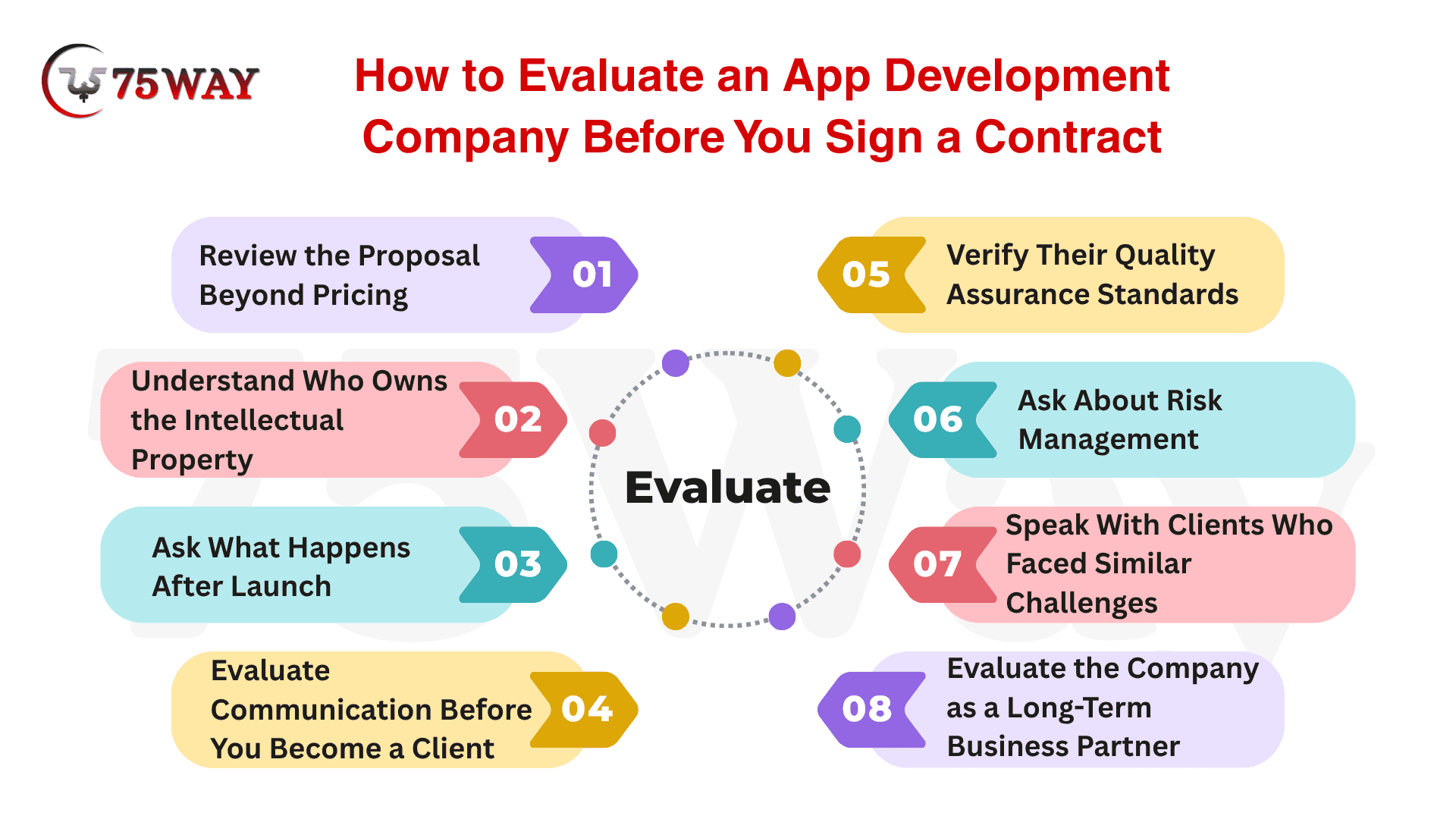
1. Review the Proposal Beyond Pricing
Many business owners compare proposals the same way they compare insurance quotes. They look at the final number. Experienced buyers look at everything else first. A lower estimate may seem attractive, but it often reflects different assumptions, reduced project scope, fewer quality assurance activities, or limited post-launch support.
Instead of asking, "Which proposal is cheaper?", ask:
"Which proposal gives us the clearest understanding of what we are paying for?"
A strong proposal should clearly explain:
- Project scope and deliverables.
- Features included in each development phase.
- Assumptions made during estimation.
- Project timeline with milestones.
- Testing and quality assurance activities.
- Third-party integrations.
- Post-launch support.
- Payment schedule.
- Potential exclusions.
If important details are missing before the contract is signed, misunderstandings are much more likely once development begins.
2. Understand Who Owns the Intellectual Property
Imagine investing months into building a custom application only to discover that you do not fully own the source code or supporting assets. Although this situation is uncommon with reputable companies, it is still worth discussing before work begins. Ownership should never be left open to interpretation. Clarify ownership of:
- Source code.
- Mobile application designs.
- Backend architecture.
- APIs developed specifically for your project.
- Documentation.
- Databases.
- Custom integrations.
- Creative assets produced during development.
A professional development company will explain these terms clearly and include them in the agreement.
3. Ask What Happens After Launch
Many businesses focus almost entirely on development. Experienced companies think beyond launch day. Every application requires ongoing attention. Operating systems receive updates. Security threats evolve.
The real question is not whether your application will need maintenance. It is who will manage it and how. Ask questions such as:
- What support is included after launch?
- How quickly are critical issues resolved?
- How are software updates managed?
- Will the same development team remain involved?
- How are enhancement requests prioritized?
- What happens if additional features are required?
The answers will help you understand whether the company is interested in a long-term partnership or simply completing the initial project.
4. Evaluate Communication Before You Become a Client
One of the most reliable indicators of future project success is how the company communicates before any contract exists.
- Think about your conversations so far.
- Have they responded thoughtfully?
- Do they answer questions directly?
- Have they explained technical concepts in language your leadership team understands?
- Or do they rely on buzzwords and vague promises?
Strong communication during the sales process often reflects how the delivery team will communicate once development begins.
Positive signs include:
- Clear and timely responses.
- Honest discussions about risks.
- Realistic timelines.
- Transparent pricing conversations.
- Willingness to challenge unrealistic expectations.
- Consistent follow-up after meetings.
If communication feels confusing before the partnership begins, it rarely improves afterward.
5. Verify Their Quality Assurance Standards
A beautiful application means very little if customers constantly encounter bugs. Quality assurance should never be treated as the final step before launch. It should be integrated throughout development. Ask how the company approaches testing rather than simply asking whether they perform testing. Areas worth discussing include:
- Functional testing.
- Performance testing.
- Security testing.
- Device compatibility.
- User acceptance testing.
- Regression testing.
- Bug reporting process.
Experienced development teams can explain these processes confidently because they follow them every day.
6. Ask About Risk Management
Every software project encounters unexpected challenges. Requirements change. Third-party integrations behave differently than expected.
Business priorities evolve. The question is not whether risks will appear. The question is how your development partner responds when they do. Ask questions like:
- How do you handle changing project requirements?
- What happens if development falls behind schedule?
- How are project risks communicated?
- How often are stakeholders updated?
- How do you manage scope changes?
Companies with mature delivery processes usually have structured answers rather than improvised solutions.
7. Speak With Clients Who Faced Similar Challenges
Testimonials on a website provide useful context. Conversations with former clients provide much deeper insight. Whenever possible, request references from organizations that completed projects similar to yours. Instead of asking whether they were satisfied, ask questions that reveal how the partnership worked in practice. Useful questions include:
- How accurately did the company estimate timelines?
- Were unexpected costs communicated transparently?
- How did they respond when challenges emerged?
- Did communication remain consistent throughout the project?
- Would you hire the same company again?
The answers often reveal strengths and weaknesses that no sales presentation will mention.
8. Evaluate the Company as a Long-Term Business Partner
Your application will almost certainly change after launch. That is why your decision should not be based solely on who can deliver Version 1. Instead, ask yourself:
- Can this company support us as our business grows?
- Do they understand our long-term objectives?
- Will they continue bringing strategic ideas after launch?
- Can they scale their team if our product expands?
- Do we trust them to become part of our technology journey?
The strongest partnerships are built on shared goals, transparent communication, and continuous collaboration rather than one-time project delivery.
Final Evaluation Checklist Before Signing an App Programming Agency
Before committing to any app development company, confirm that you can confidently answer "Yes" to each of these questions.
✔ Do they understand our business objectives, not just our feature list?
✔ Is the proposal detailed enough to avoid misunderstandings?
✔ Have we met the people who will actually build our application?
✔ Are timelines, pricing, and deliverables clearly documented?
✔ Do we understand ownership of the source code and intellectual property?
✔ Is post-launch support clearly defined?
✔ Do we trust their communication and problem-solving approach?
✔ Can we see ourselves working with this team for the next three to five years?
If you hesitate on several of these questions, continue your evaluation before signing. Choosing the right app development company is not about finding the fastest "yes." It is about selecting a partner capable of supporting your business long after your application reaches the App Store or Google Play.
Red Flags That Signal You Should Walk Away From Wrong App Service Provider
Most software projects do not fail because businesses choose an incapable team. They fail because early warning signs are ignored. During the excitement of discussing new ideas, reviewing impressive portfolios, or receiving competitive proposals, it is easy to overlook behaviors that later become expensive problems.
The good news is that many of these warning signs appear long before the first line of code is written. If you know what to look for, you can avoid unnecessary delays, unexpected costs, and frustrating partnerships.
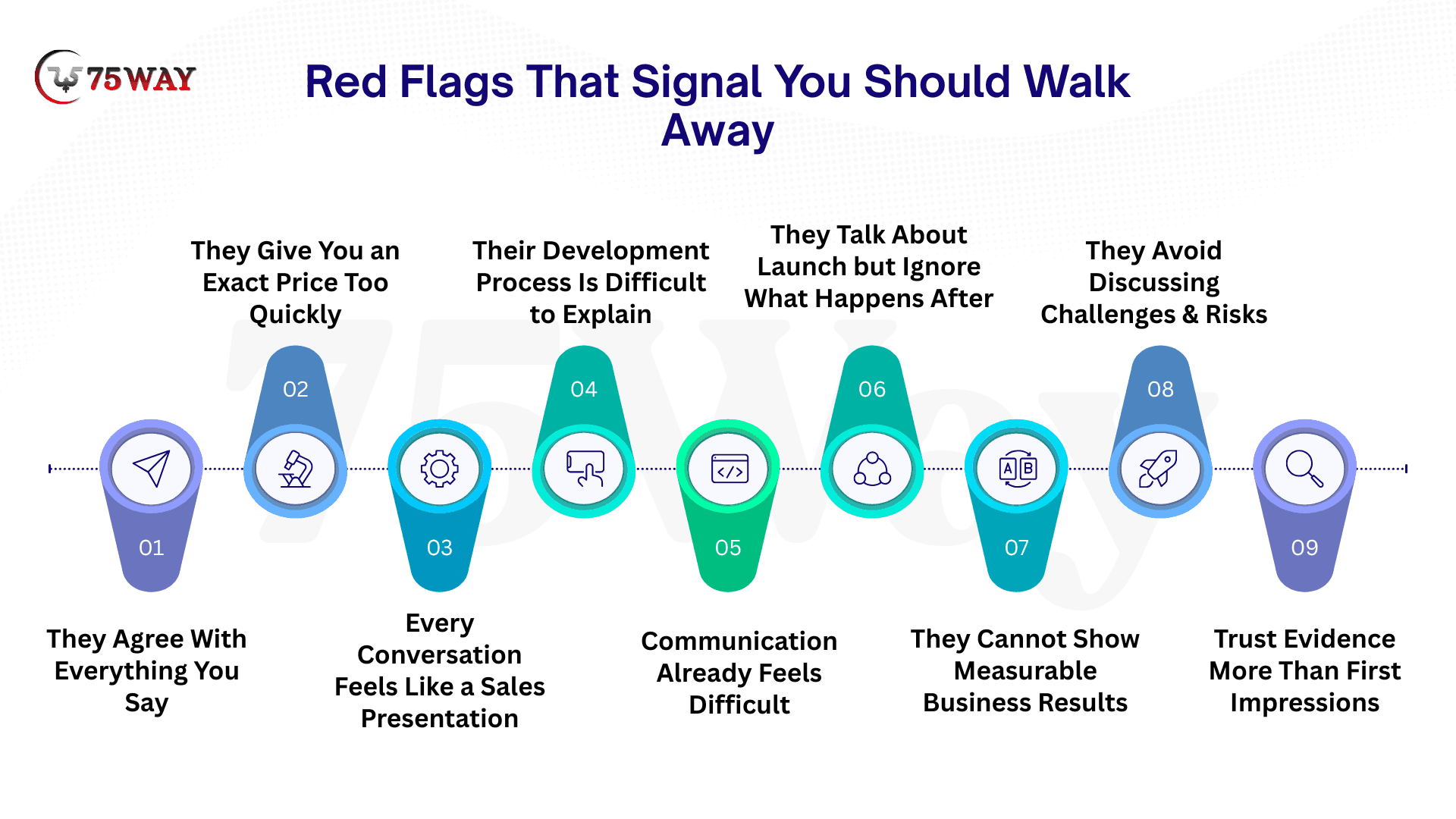
1. They Agree With Everything You Say
Imagine sharing your app idea with two different development companies. The first company immediately tells you that every feature is possible, promises a quick launch, and assures you there will not be any major challenges.
The second company responds differently. They begin asking questions about your business model, target audience, customer journey, long-term goals, existing systems, security requirements, and expected growth. They even challenge a few of your assumptions and recommend a different approach for certain features.
Many businesses naturally feel more comfortable with the first conversation because everything sounds simple. Ironically, the second company is often the better partner.
Experienced app development companies understand that successful software starts with asking the right questions. They know every business has unique challenges, technical limitations, and budget considerations. Instead of agreeing with every request, they focus on understanding the bigger picture before recommending a solution.
If a company is ready to promise everything after a short introductory meeting, it is worth asking yourself whether they truly understand your project or are simply trying to secure the contract.
2. They Give You an Exact Price Too Quickly
Every business appreciates a fast response. However, software estimation is rarely as straightforward as requesting a quote for office equipment or business services.
Building a custom application involves understanding user requirements, integrations, technical architecture, scalability, security, testing, and future maintenance. Those factors cannot be evaluated accurately during a brief introductory call.
When a company provides an exact budget and delivery timeline almost immediately, ask how they reached those numbers.
A reliable development partner should be able to explain the assumptions behind the estimate, identify areas that still require clarification, and discuss factors that could influence the overall cost.
If the pricing seems unusually low or the timeline appears surprisingly short, there is often more to the story. Missing requirements, underestimated complexity, or future change requests may eventually increase both the budget and delivery schedule.
Transparent estimates build confidence because they are supported by careful planning rather than optimistic assumptions.
3. Every Conversation Feels Like a Sales Presentation
A good sales team should communicate clearly and professionally. However, there is a difference between presenting capabilities and avoiding difficult conversations.
If every meeting focuses on awards, client logos, and marketing claims without discussing project risks, technical trade-offs, or implementation challenges, you may only be seeing the company's promotional side.
Experienced technology partners understand that software projects involve uncertainty. They openly discuss potential obstacles, explain different technical options, and recommend solutions based on your business objectives rather than trying to sell the most expensive package. Pay close attention to how they respond when you ask challenging questions.
- Do they provide thoughtful explanations?
- Or do they quickly change the subject?
The willingness to have honest conversations before signing a contract usually reflects how they will communicate throughout the project.
4. Their Development Process Is Difficult to Explain
Almost every app development company claims to follow Agile methodologies. That statement alone should never influence your decision. Instead, ask them to explain exactly what happens after the contract is signed.
- How does the project begin?
- Who manages communication?
- How often will progress be reviewed?
- What happens if priorities change?
- How are testing and quality assurance handled?
A mature development company can answer these questions confidently because they follow a structured process every day.
If the explanation feels vague, inconsistent, or changes during different meetings, it may indicate that the company's delivery process depends more on individual team members than established project management practices. Clear processes create predictable outcomes. Unclear processes often create unnecessary surprises.
5. Communication Already Feels Difficult
The sales process is usually when companies are most responsive. If communication already feels slow, confusing, or inconsistent, consider how those same issues might affect a six-month development project. Notice the small details during your interactions.
- Do emails receive timely responses?
- Are meeting notes shared afterward?
- Does every team member communicate the same information?
- Are your questions answered directly, or do you receive generic responses?
While these details may seem minor, they often reflect the company's overall communication culture.
Strong communication builds trust throughout software development. Weak communication creates misunderstandings that eventually affect budgets, timelines, and project quality.
6. They Talk About Launch but Ignore What Happens After
Launching an application is an important milestone, but it is rarely the end of the journey.
- Customers request new features.
- Operating systems introduce updates.
- Security standards evolve.
- Business priorities change.
A reliable development partner discusses these realities from the beginning instead of waiting until the application is live.
Ask how they handle maintenance, feature enhancements, bug fixes, performance optimization, and future scaling. If those conversations never happen, the company may be focused only on completing the initial project rather than supporting your product's long-term success.
The best technology partners think beyond Version One because they understand that successful digital products continue evolving for years.
7. They Cannot Show Measurable Business Results
A portfolio filled with beautiful mobile applications can certainly create a positive first impression. However, attractive design does not automatically translate into business success. Ask the company to explain what happened after those applications were launched.
- Did customer engagement improve?
- Did operational costs decrease?
- Did revenue increase?
- Did user retention grow?
- Are those applications still actively maintained?
Experienced app development companies enjoy discussing business outcomes because they understand that software exists to solve problems, not simply to look impressive.
When conversations focus only on visual design or technical features without mentioning measurable results, it becomes difficult to evaluate the true impact of their work.
8. They Avoid Discussing Challenges and Risks
No software project progresses exactly as planned. Requirements evolve. New ideas emerge. Unexpected technical challenges appear. Experienced companies know this because they have managed enough projects to expect change.
Instead of promising that everything will be perfect, they explain how they manage uncertainty. They discuss risk management, scope control, communication strategies, and contingency planning before development even begins.
- Be cautious if every conversation sounds overly optimistic.
- Confidence is valuable.
- Pretending that risks do not exist is not.
A trustworthy development partner prepares you for challenges while demonstrating a clear plan for handling them professionally.
9. Trust Evidence More Than First Impressions
Choosing an app development company is one of the most important technology decisions your business will make. While positive chemistry and engaging presentations certainly matter, they should never outweigh careful evaluation.
Take time to compare each company using the same criteria. Review how they communicate, how they estimate projects, how they approach risk, and how they discuss long-term support. Look beyond marketing claims and focus on whether their actions consistently support what they promise.
At the end of the evaluation process, ask yourself one final question:
If this team becomes responsible for one of our company's most important digital investments over the next five years, would we trust them to make the right decisions when unexpected challenges arise?
If the answer is anything less than a confident yes, continue your search. The right app development partner will not simply deliver software. They will provide strategic guidance, transparent communication, and the confidence that your business has chosen a technology partner capable of supporting growth long after the application goes live.
What Separates an Average App Development Company From a Great Technology Partner?
The real difference becomes visible when you evaluate how companies approach your business goals, handle complex decisions, manage projects, and support your product beyond launch. These factors help you identify whether you are choosing a reliable technology partner or simply hiring a team to complete a development task.
- Discovery Before Development: Great companies do not rush into coding without understanding your business objectives, target users, operational challenges, and long-term goals. A detailed discovery process helps identify risks, refine requirements, and create a development roadmap that supports meaningful business outcomes.
- Technology Choices With Purpose: Experienced partners select technologies based on your application's needs, scalability expectations, security requirements, and future plans. They avoid choosing tools simply because they are popular and instead focus on creating solutions that deliver long-term value.
- Realistic Planning And Execution: Reliable development companies create practical timelines, define clear milestones, identify possible challenges, and communicate project expectations from the beginning. Their planning approach reduces surprises and helps businesses make confident decisions throughout the development journey.
- Taking Complete Product Ownership: Strong technology partners do not simply wait for instructions. They actively participate in decision-making, identify potential improvements, solve challenges, and ensure every development choice contributes toward creating a successful digital product.
- Experience Proven Through Results: A valuable portfolio is not measured by the number of applications displayed. The strongest companies can explain the challenges they solved, decisions they made, and outcomes their projects achieved for previous clients.
- Planning Beyond Initial Launch: Great partners understand that launching an application is only the first stage. They consider future updates, growing user demands, technology changes, and business expansion while creating a foundation that supports continuous product improvement.
Final Thoughts
The selection of the best partner to build an app is a strategic decision that can influence your application's success, customer experience, and long-term business growth. The ideal company is not simply the one offering the lowest price or fastest delivery timeline. It is the partner that understands your goals, provides thoughtful guidance, follows a transparent process, and builds solutions designed for future growth.
By evaluating experience, communication, technical capabilities, and long-term support, businesses can make confident decisions and avoid costly mistakes throughout their digital product journey. To take the next step toward digital innovation, reach out to a prominent app development company that combines technical expertise, business understanding, and product strategy.
Frequently Asked Questions (FAQs)
How Do I Know If An App Development Company Understands My Business Needs?
A reliable partner asks detailed questions about your goals, customers, challenges, and growth plans before suggesting solutions. Their recommendations should connect technology decisions with business outcomes.
What Should I Look For In An App Development Company Portfolio?
Look beyond screenshots and check project complexity, industry experience, problem-solving approach, client outcomes, and technical decisions. A strong portfolio demonstrates measurable value, not just attractive designs.
How Can I Compare Multiple App Development Companies Effectively?
Compare companies based on expertise, communication approach, development methodology, relevant experience, pricing transparency, and long-term support capabilities. The cheapest option may not always provide the best value.
Is Location Important When Choosing An App Development Partner?
Location can influence communication, collaboration, market understanding, and working hours. Businesses should evaluate expertise, reliability, and partnership quality rather than selecting a company only by location.
What Documents Should I Review Before Selecting An App Partner?
Review proposals, case studies, service agreements, project scope documents, ownership terms, support plans, and client references. These documents help clarify expectations before making commitments.
How Important Is Industry Experience When Hiring Developers?
Industry experience helps companies understand specific challenges, customer expectations, and compliance requirements. However, strong problem-solving ability and technical expertise are equally important during evaluation.
What Should A Good App Development Proposal Include?
A strong proposal should explain project scope, estimated timeline, deliverables, development approach, pricing structure, assumptions, and potential risks. Clear details reduce misunderstandings during execution.