AI Summary
E-commerce growth brings sales tax obligations across states and marketplaces. This guide explains platform features, AI technologies, integrations, development stages, and costs. It also covers compliance and launch considerations.
Key Takeaways
- Automation helps e-commerce brands calculate tax across multiple jurisdictions accurately.
- AI sales tax supports transaction classification, exemption checks, and tax anomaly detection.
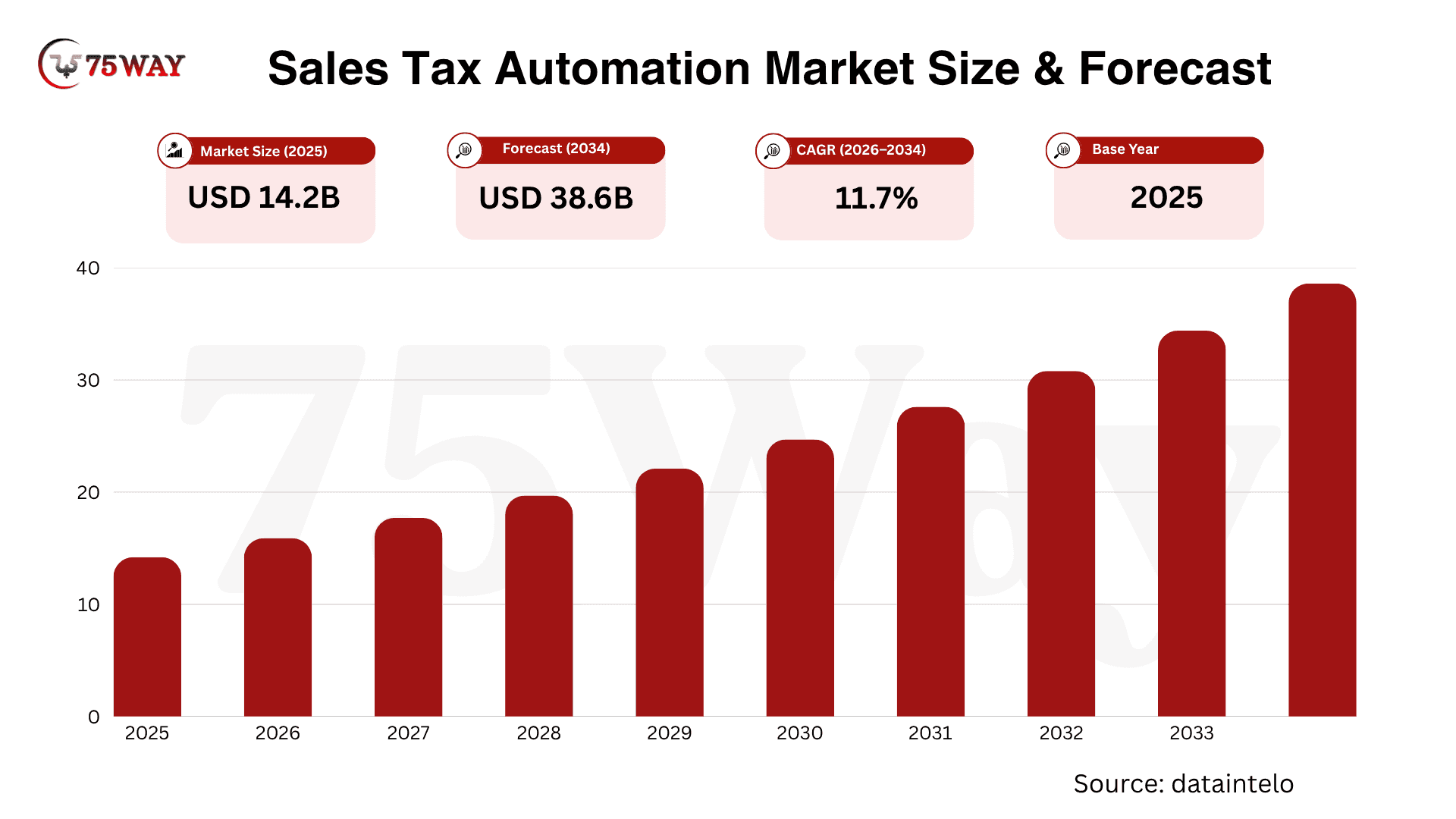
- Sales tax automation market: $38.6 billion by 2034, 11.7% CAGR.
- Development costs range from $30,000 to $350,000+, depending on complexity.
Being an ecommerce store founder or owner, have you ever thought about how much time your e-commerce team spends calculating sales tax, checking changing rates, and preparing returns?
As your store reaches more customers across different states, these tasks become harder to manage. Manual tracking can also leave room for costly errors.
An AI-powered sales tax automation platform for ecommerce store can take much of that pressure off your team. It can analyze transactions, identify applicable tax rules, calculate liabilities, and organize important tax information. This gives online retailers more control over their tax responsibilities as sales grow.
But what does it take to build an AI-powered sales tax automation from scratch for ecommerce? A clear development strategy can help you choose the right features, AI technologies, integrations, and compliance workflows. The following guide highlights all the key decisions involved.
Understanding AI-Powered Sales Tax Automation Platforms
First of all, let’s understand what an AI-powered sales tax automation platform actually is. In simple language, it is a software solution that helps e-commerce marketplaces and businesses calculate, collect, report, and manage sales tax across applicable jurisdictions.
It combines tax calculation engines, jurisdictional rules, transaction data, integrations, and AI-assisted workflows to reduce manual compliance work.
For an online retailer, the platform can connect with an e-commerce store, identify the destination jurisdiction, evaluate product taxability, and calculate the applicable tax during checkout. It can also monitor sales activity, organize exemption certificates, prepare filing information, and highlight transactions that may need review.
How AI Sales Tax Automation Works?
AI sales tax automation takes the guesswork out of managing tax responsibilities for growing e-commerce stores. It uses intelligent data analysis to support accurate calculations and tax-related decisions. A typical workflow looks like this:
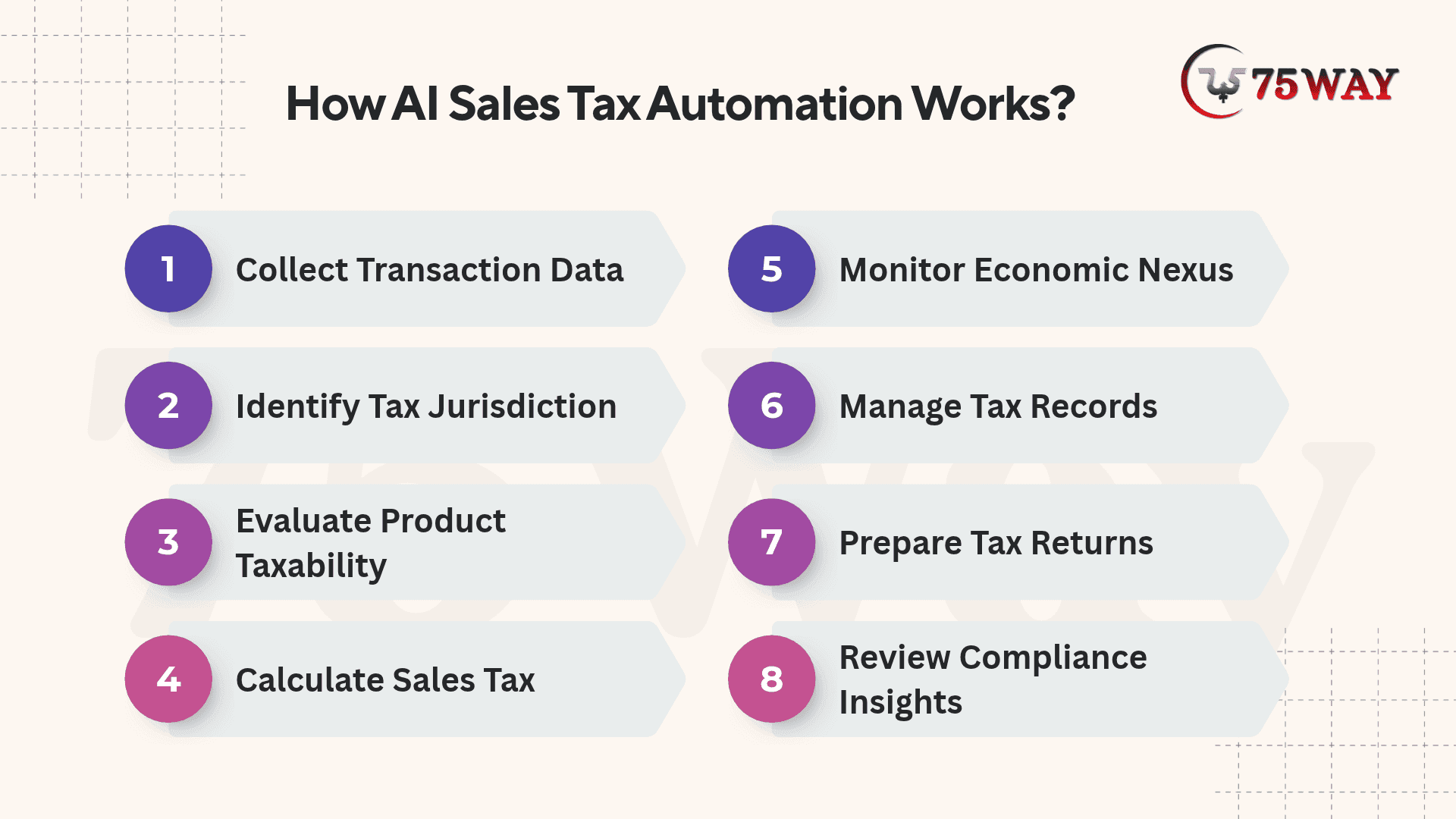
1. Collect Transaction Data
Retrieve order details from online stores, marketplaces, and payment systems.
2. Identify Tax Jurisdiction
Determine the applicable state and local tax jurisdiction using transaction location details.
3. Evaluate Product Taxability
Apply relevant product tax codes, exemptions, and jurisdiction-specific rules.
4. Calculate Sales Tax
Determine the applicable tax amount for each eligible transaction.
5. Monitor Economic Nexus
Track sales activity against relevant state registration thresholds.
6. Manage Tax Records
Organize transaction details, exemption certificates, and supporting documentation.
7. Prepare Tax Returns
Consolidate transaction data and prepare filing information for applicable jurisdictions.
8. Review Compliance Insights
Use AI-assisted analysis to flag unusual transactions, missing records, and potential compliance issues.
The platform should use validated tax rules and calculation logic as its source of truth. AI can assist with classification, document processing, and exception detection, but it should not independently invent tax rates or legal interpretations.
Investment Opportunities In AI Sales Tax Automation Platform Development
The growing complexity of e-commerce taxation is opening new opportunities for AI-powered automation platforms for ecommerce. Retailers are looking for smarter solutions that reduce manual work and help manage tax obligations across different markets.
The global sales tax automation industry is forecast to grow from $14.2 billion in 2025 to $38.6 billion by 2034, registering a CAGR of 11.7%. Let's look at the investment areas gaining importance in this space. Several opportunities are driving demand for more capable platforms:
- Growing E-Commerce Tax Complexity
Online retailers may sell to customers across multiple states, each with its own tax rules, product classifications, and filing requirements.
Automation helps centralize transaction information and apply the relevant tax logic.
- Increasing Demand For Real-Time Tax Calculations
Customers expect accurate tax amounts during checkout, not unexpected charges after placing an order.
Real-time tax calculation integrations help online stores display applicable taxes before payment.
- Expansion of Marketplace And Omnichannel Selling
Retailers increasingly combine direct websites with third-party marketplaces and other sales channels.
A centralized platform can consolidate transactions while distinguishing taxes collected by marketplace facilitators from the seller's remaining obligations.
- Growing Need For Nexus Monitoring
Economic nexus rules can create collection obligations even when a retailer has no physical location in a state.
For example, Virginia uses a threshold of more than $100,000 in annual gross retail sales or 200 or more transactions, while other states use different criteria.
- Opportunities For AI-Driven Tax Operations
AI can help classify products, extract information from exemption certificates, identify unusual transaction patterns, and prioritize records for review.
These capabilities can reduce repetitive work while keeping tax determinations connected to verified rules.
Businesses in the United States face a complex tax environment involving more than 12,000 tax jurisdictions, each with its own rates, exemptions, and filing schedules. Managing these requirements manually becomes extremely challenging for companies handling thousands of transactions every day.
Comprehensive Roadmap To Design & Develop An AI-Powered Sales Tax Automation Platform
A reliable AI-powered sales tax automation platform starts with the right development decisions. Each stage, from understanding tax requirements to testing intelligent features, contributes to the final product. Let's look at the essential steps involved in bringing your platform to life.
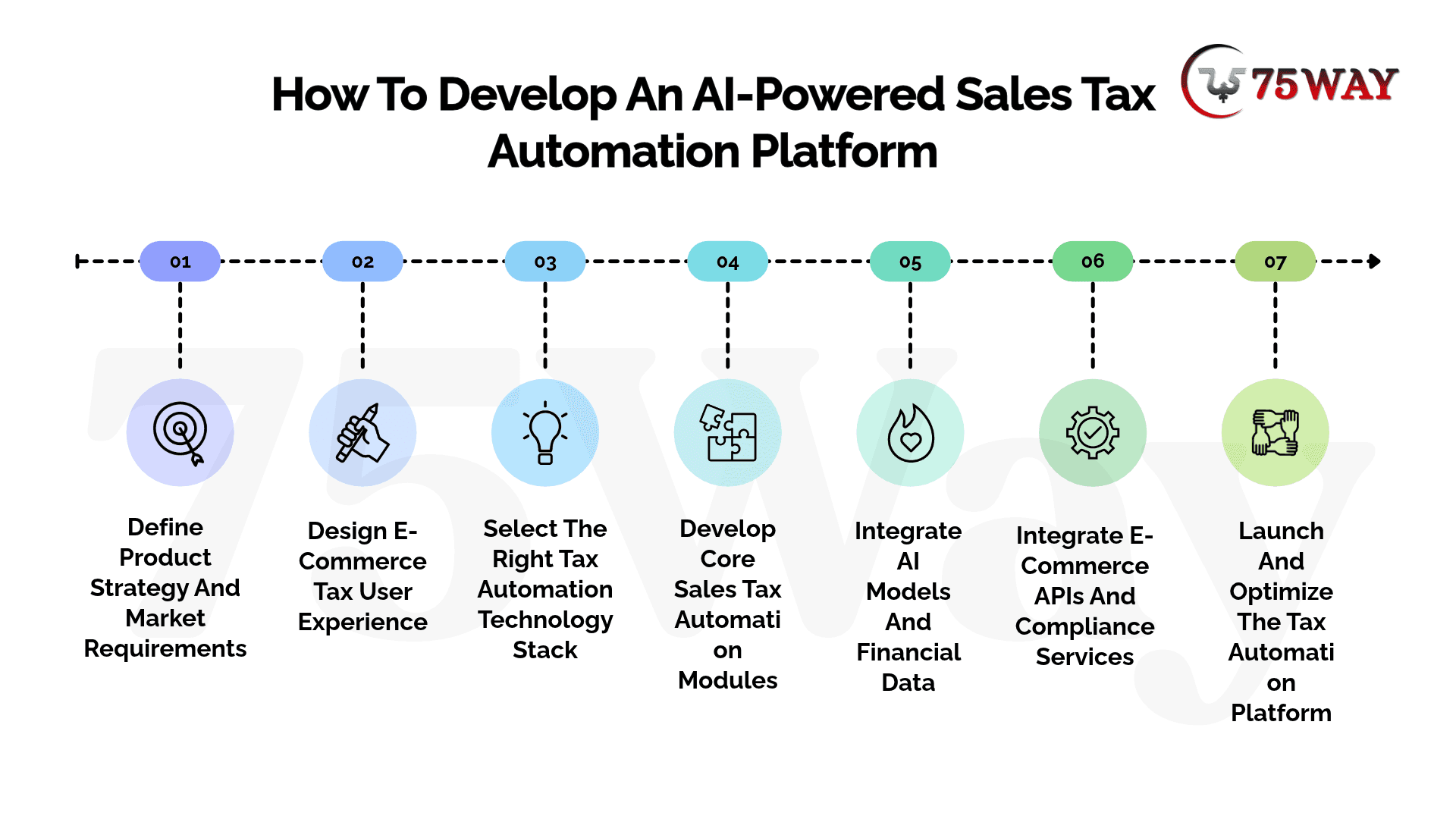
Step 1. Define Product Strategy And Market Requirements
Start by identifying your target e-commerce customers, the tax-related challenges they face, and the services your platform will provide.
Research competitors such as Avalara, TaxJar, Vertex, and Sovos while evaluating state-specific tax rules, economic nexus requirements, marketplace responsibilities, and product taxability.
Use these findings to establish your product requirements, pricing strategy, supported jurisdictions, target sales channels, and initial feature roadmap.
Step 2. Design E-Commerce Tax User Experience
Once your product requirements and market research are complete, design interfaces that make tax operations easier for retailers and finance teams.
You must include essential screens for business onboarding, store connections, tax calculations, nexus monitoring, product classification, exemption certificates, filing calendars, and AI assistance.
Create wireframes and interactive prototypes, then test them with potential users to improve navigation, reporting clarity, and overall usability.
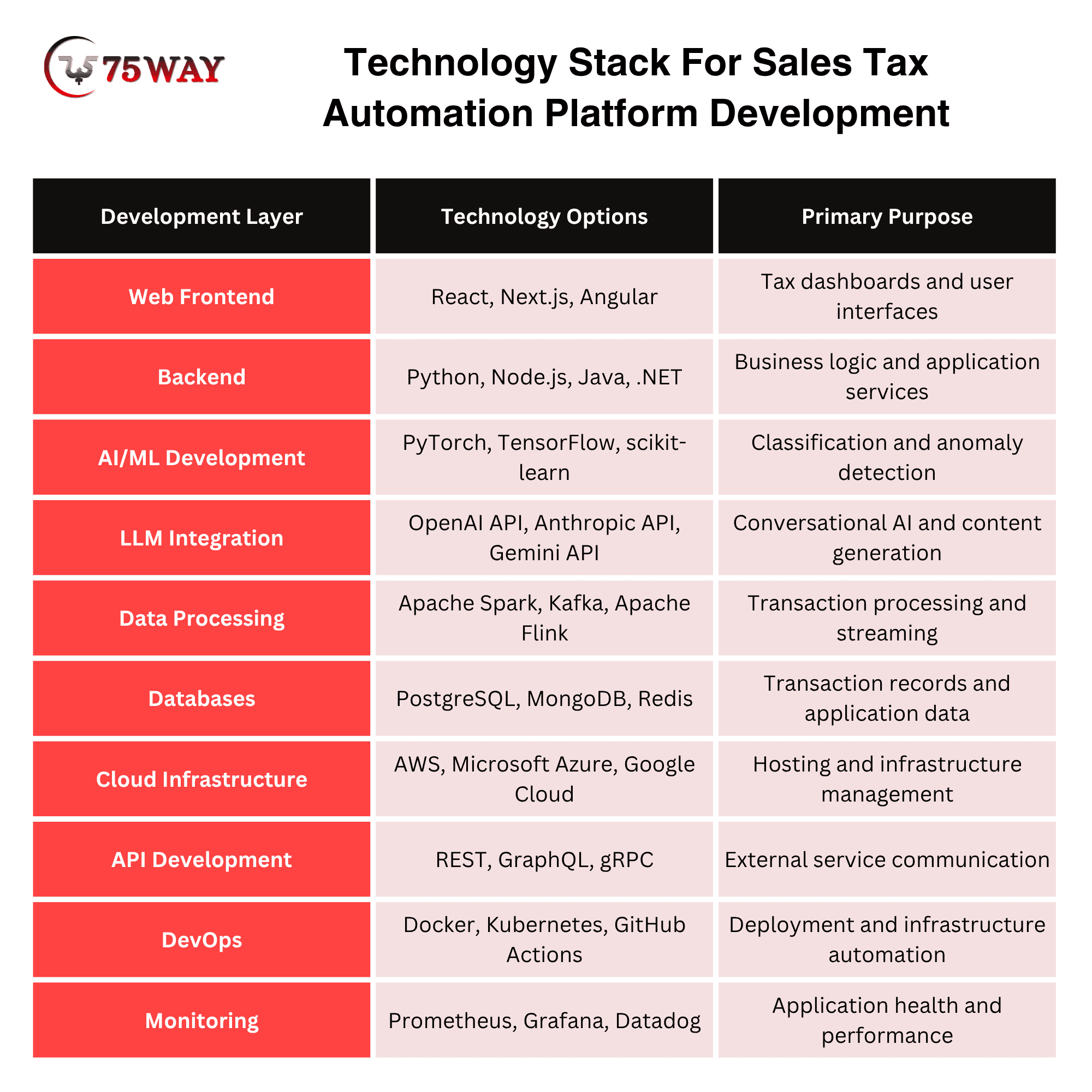
Step 3. Select Right Technology Stack For Sales Tax Automation Platform Development
After finalizing the user experience, select technologies that support transaction processing, tax calculations, AI services, and external integrations.
The technology stack should handle high transaction volumes, secure business information, and regular updates to tax rules while allowing future expansion.
Consider the following technology options for different development requirements.
Step 4. Develop Core Sales Tax Automation Modules
With the technical foundation established, begin developing the platform's frontend, backend, database, and essential tax management modules. Build secure business onboarding, tax calculation, product classification, nexus monitoring, exemption certificate management, transaction tracking, and reconciliation functionality. Ensure the tax engine uses verified rates, jurisdiction boundaries, product taxability rules, and applicable exemptions rather than relying on AI-generated suggestions for final calculations.
Step 5. Integrate AI Models And Financial Data
After developing the core modules, integrate AI capabilities into workflows where they can reduce manual work and improve data analysis. Prepare transaction datasets, select suitable models, establish prompts and business rules, and connect AI services with authorized application workflows. Test model outputs against verified records, introduce human review for uncertain results, and monitor accuracy before expanding AI functionality across the platform.
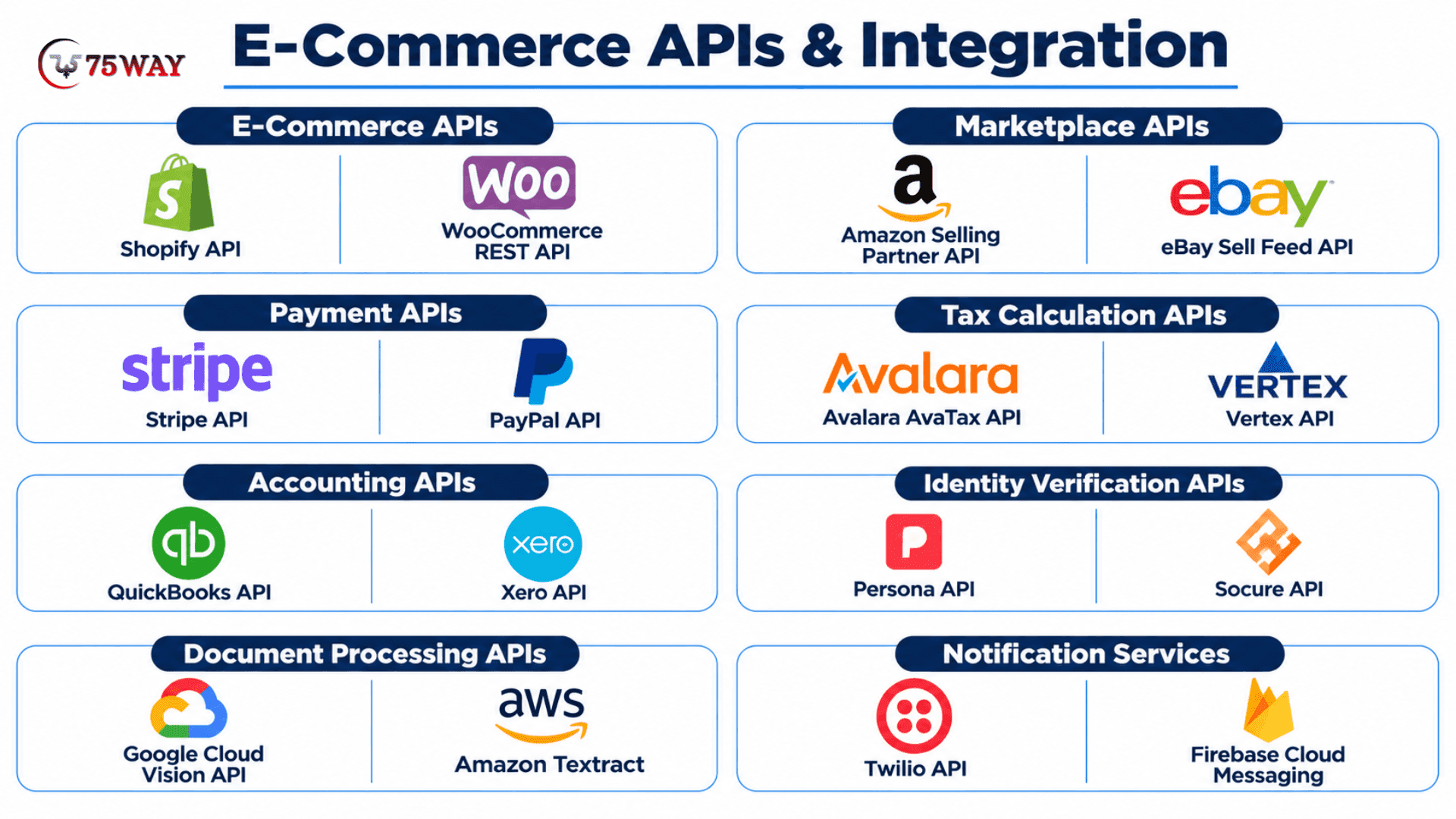
Step 6. Integrate E-Commerce APIs And Compliance Services
With the core modules and AI capabilities connected, integrate external services that provide transaction information, tax calculations, accounting records, and document processing. Select providers according to API availability, supported regions, licensing terms, transaction limits, and integration requirements. Implement encryption, role-based permissions, secure API credential management, audit trails, and suspicious activity monitoring alongside these integrations.
Step 7. Launch And Optimize The Tax Automation Platform
Once the application components and integrations are ready, conduct functional, integration, security, performance, and user acceptance testing. Validate tax calculations across jurisdictions, evaluate AI classification accuracy, and check how the platform handles high transaction volumes and external service interruptions.
After resolving identified issues, deploy the platform using scalable cloud infrastructure, monitor application performance, update tax rules through verified sources, and improve workflows using customer feedback.
Different AI Ecommerce Sales Tax Automation Platforms You Can Build
Before selecting features and technologies, define the type of product you want to build. Different platform models serve different customer needs and operational requirements. The following platform types show how AI automation can address these distinct business needs.
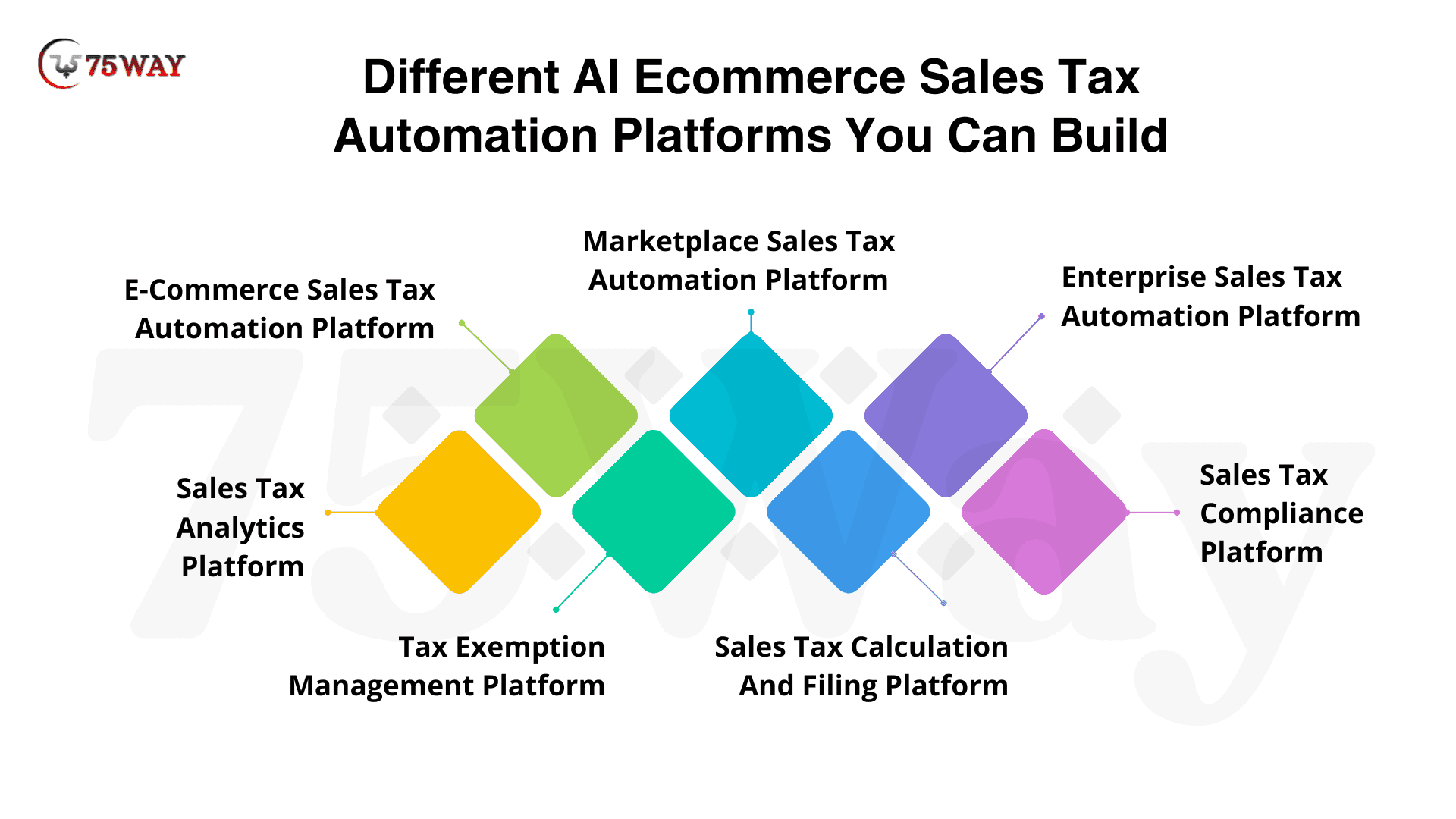
- E-Commerce Sales Tax Automation Platform
These platforms calculate sales tax on online purchases across different states and jurisdictions. AI helps identify applicable tax rates, monitor nexus thresholds, and automate transaction-level tax calculations. They integrate with online stores to simplify tax management as businesses expand.
Estimated Cost: $20,000–$80,000+
- Marketplace Sales Tax Automation Platform
These platforms help sellers manage tax obligations across multiple online marketplaces. AI analyzes marketplace transactions, identifies applicable tax rules, and supports accurate tax reporting. Integrations with platforms like Amazon and eBay help synchronize sales data and reduce manual work.
Estimated Cost: $15,000–$100,000+
- Enterprise Sales Tax Automation Platform
Enterprise platforms manage complex tax requirements across multiple brands, subsidiaries, regions, and sales channels. AI supports transaction analysis, tax anomaly detection, compliance monitoring, and centralized reporting. They also connect with ERP, accounting, and financial systems to support large-scale operations.
Estimated Cost: $150,000–$250,000+
- AI-Powered Sales Tax Compliance Platform
These platforms help businesses monitor tax obligations, manage filing deadlines, and maintain compliance records. AI analyzes regulatory updates, flags potential compliance gaps, and organizes relevant tax information. Automated reporting and document management reduce the administrative burden of meeting state and local requirements.
Estimated Cost: $20,000–$150,000+
- Sales Tax Calculation And Filing Platform
These platforms automate tax calculations during checkout and support the preparation or submission of sales tax returns. AI helps classify transactions, identify unusual tax amounts, and organize filing data. They can integrate with tax engines and accounting systems to simplify calculation and filing workflows.
Estimated Cost: $10,000–$130,000+
- AI-Powered Tax Exemption Management Platform
These platforms help businesses validate exemption certificates and manage tax-exempt customer transactions. AI can extract certificate details, identify missing information, and flag expired or potentially invalid documents. Centralized certificate storage and verification workflows help businesses maintain organized exemption records.
Estimated Cost: $20,000–$100,000+
- AI-Powered Sales Tax Analytics Platform
These platforms help businesses analyze sales tax data across transactions, regions, and sales channels. AI identifies tax trends, detects unusual patterns, and generates insights to support financial planning. Interactive dashboards and predictive analytics help businesses understand tax liabilities and make informed decisions.
Estimated Cost: $30,000–$120,000+
A startup may begin with a focused tax calculation or exemption management product. Larger platforms can combine several capabilities to support end-to-end sales tax operations.
1What Type of Platform Do You Want To Build?
Single choice2Which Features Do You Need?
Multiple choice3What Is Your Estimated Development Budget?
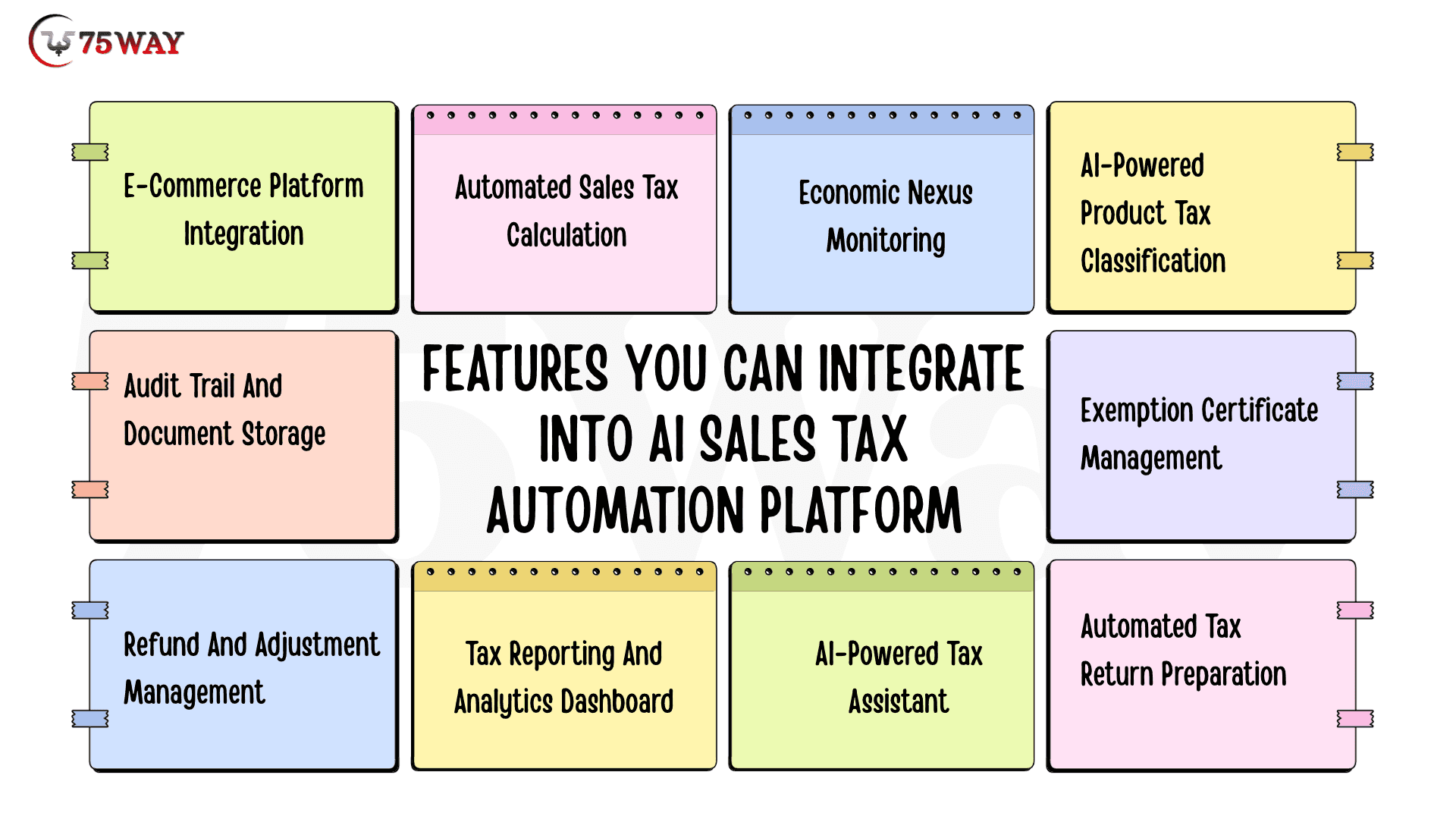
Multiple choiceWhich Features You Can Integrate into Custom Sales Tax Automation Platform
Your sales tax automation platform should do more than calculate taxes on customer orders. A platform for small online retailers will not require the same functionality as an enterprise solution handling multiple brands and marketplaces. The following capabilities provide a practical foundation.
1. E-Commerce Platform Integration
The application should connect with online stores and marketplaces to retrieve transaction information.
Consider including:
- Shopify and WooCommerce integrations
- BigCommerce and Adobe Commerce connectivity
- Order and customer data synchronization
- Product and SKU information retrieval
- Refund and cancellation data updates
2. Automated Sales Tax Calculation
A tax calculation engine determines the applicable tax for each transaction using verified jurisdictional rules and product taxability information.
Important capabilities include:
- State and local tax rate determination
- Destination-based tax calculation where applicable
- Product-specific taxability rules
- Shipping and handling tax treatment
- Discounts, refunds, and adjustment calculations
3. Economic Nexus Monitoring
Nexus monitoring helps retailers track sales activity and identify when they may approach state-specific registration thresholds.
The feature should support:
- State-wise sales tracking
- Transaction volume monitoring
- Economic nexus threshold configuration
- Approaching-threshold notifications
- Historical sales reporting
The platform should distinguish economic nexus from physical presence and other possible nexus factors. Thresholds and measurement periods vary by jurisdiction, so the system needs regularly maintained tax rules.
4. AI-Powered Product Tax Classification
Product tax classification helps determine how different products should be treated under applicable tax rules.
AI can assist by:
- Analyzing product descriptions and attributes
- Suggesting relevant tax categories
- Identifying incomplete product information
- Flagging uncertain classifications for review
For example, an AI model could examine a product description and suggest a possible tax category. The system should validate that suggestion against jurisdiction-specific rules before applying it to transactions.
5. Exemption Certificate Management
Some customers and transactions may qualify for sales tax exemptions when the required conditions and documentation are satisfied.
This feature can support:
- Digital certificate collection and storage
- Document information extraction
- Certificate validation workflows
- Expiration date tracking
- Renewal notifications
AI-assisted extraction can reduce manual document handling, but validation should follow the relevant jurisdiction's requirements.
6. Automated Tax Return Preparation
The platform should organize transaction data into reports that support sales tax return preparation.
Useful capabilities include:
- Jurisdiction-wise sales summaries
- Taxable and exempt sales reporting
- Tax liability calculations
- Filing calendar management
- Return preparation and export
Automated filing and payment remittance can be added through supported providers or integrations. Businesses should clearly distinguish between preparing a return and actually submitting it to a tax authority.
7. AI-Powered Tax Assistant
A conversational AI tax assistant can help users retrieve information and understand platform activity.
For example, users could ask:
- Which states are approaching nexus thresholds?
- Why was tax applied to this order?
- Which exemption certificates expire soon?
- How much tax was collected last month?
The assistant should retrieve answers from approved tax content and the user's authorized records. It should provide references or explanations where possible and avoid presenting unverified legal interpretations as professional tax advice.
8. Tax Reporting And Analytics Dashboard
A centralized dashboard helps retailers review their tax position across different channels and jurisdictions.
Consider including:
- Total tax collected
- Taxable and exempt sales
- State-wise tax liabilities
- Filing status and upcoming deadlines
- Nexus monitoring summaries
- Unresolved transaction exceptions
9. Refund And Adjustment Management
Returns and cancellations can affect previously calculated tax amounts. The platform should capture these changes and update relevant records.
Important functions include:
- Refund transaction synchronization
- Tax adjustment calculations
- Order cancellation handling
- Credit and debit adjustments
- Reconciliation reports
10. Audit Trail And Document Storage
Businesses need organized records to investigate discrepancies and respond to tax authority inquiries.
The platform should maintain transaction histories, calculation details, exemption documents, filing records, and user activity logs. Access permissions should ensure that sensitive tax and customer information remains available only to authorized users.
Security Considerations For Ecommerce Sales Tax Automation Platforms
Sales tax platforms for e-commerce process business transactions, customer details, payment-related information, and sensitive tax documents. Security must therefore be included throughout the development lifecycle.
Important controls include:
- Data Encryption: Protects business information during transmission and storage
- Role-Based Access: Restricts financial records to authorized users
- Multi-Factor Authentication: Adds verification beyond standard account passwords
- AI Model Security: Prevents unauthorized access and sensitive data leakage
- Audit Logging: Records important activities for investigations and reviews
- Vendor Risk Management: Evaluates external provider security and data practices
AI systems also require protection against prompt injection, unauthorized data retrieval, and unsafe tool execution. Access to transaction records should follow customer permissions, while sensitive actions should require appropriate approval.
Cost To Develop An AI-Powered Sales Tax Automation Platform For Ecommerce
Planning your budget is an important part of building an AI-powered sales tax automation platform. On average, development can cost between $30,000 and $350,000+, depending on the features, automation level, and technical requirements. Let's break down what contributes to this cost.
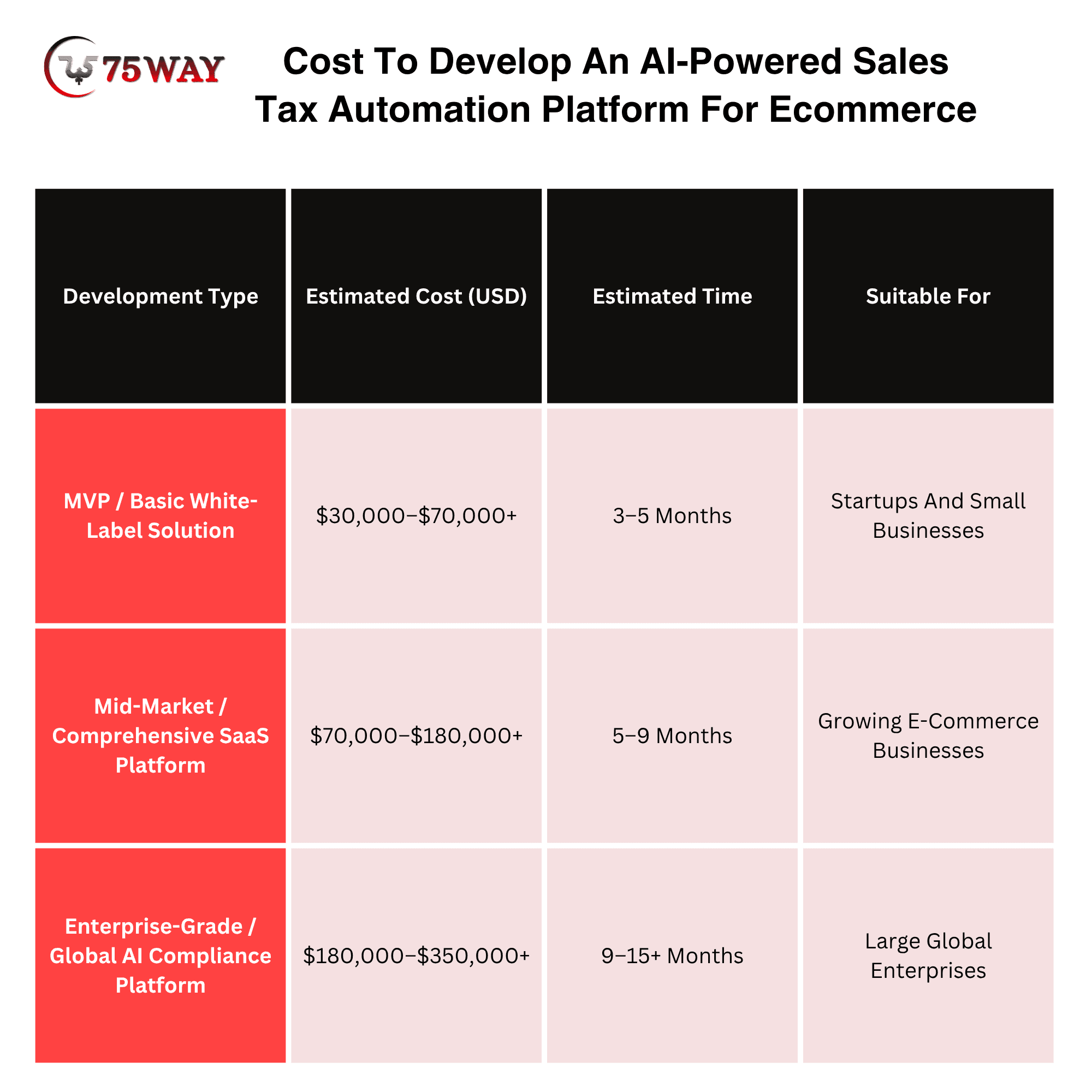
1. MVP / Basic White-Label Solution: $30,000 – $70,000+
- Estimated Time: 3–5 months
- Suitable For: Startups, small businesses, and early-stage SaaS providers
- Core Scope: Basic tax calculations, transaction management, and standard reports
2. Mid-Market / Comprehensive SaaS Platform: $70,000 – $180,000+
- Estimated Time: 5–9 months
- Suitable For: Growing e-commerce businesses and established SaaS companies
- Core Scope: AI tax automation, multi-channel integrations, and compliance reporting
3. Enterprise-Grade / Global AI Compliance Platform: $180,000 – $350,000+
- Estimated Time: 9–15+ months
- Suitable For: Large enterprises, global retailers, and multinational e-commerce businesses
- Core Scope: Advanced AI compliance, global tax coverage, and enterprise integrations
Development Timeline For An AI Sales Tax Automation Platform
The development timeline depends on the product scope, number of integrations, tax jurisdiction coverage, and AI requirements.
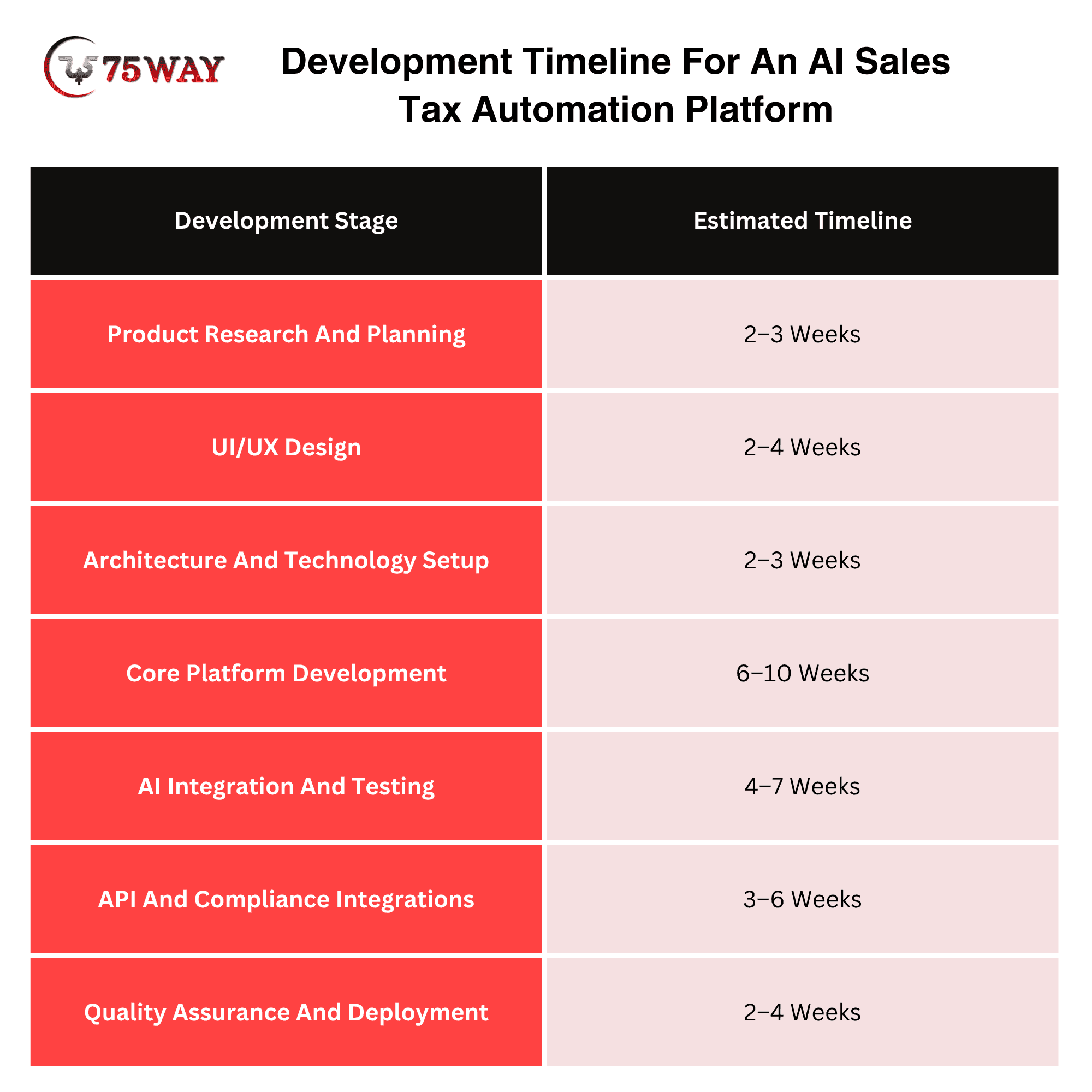
A focused MVP may take approximately 3–5 months, while a more advanced platform can require 6–9 months or longer. Some stages can overlap, depending on team size and project planning.
Revenue Models For Ecommerce AI Sales Tax Automation Platforms
How will your AI sales tax automation platform make money after launch? Your answer depends on the businesses you serve and the value your platform delivers. Let's look at the revenue models that can help turn your solution into a sustainable business.
1. Subscription-Based Pricing
Businesses pay monthly or annual fees to access selected platform features. Pricing can vary according to transaction volume, number of stores, and supported jurisdictions.
For example, a platform charging $199 per month with $100 in monthly operating costs can generate an approximate 50% profit margin.
2. Usage-Based Pricing
Customers pay according to the number of tax calculations, transactions, API requests, or documents processed through the platform.
For instance, charging $0.02 per tax calculation when the processing cost is $0.01 can deliver an approximate 50% profit margin.
3. Tiered Pricing
Different subscription plans provide different feature sets. For example, a basic plan may include tax calculations, while premium plans offer nexus monitoring, AI analytics, and advanced reporting.
If a premium plan generates $500 per month against $300 in service costs, the platform earns an approximate 40% profit margin.
4. Enterprise Licensing
Large retailers and marketplaces can pay customized licensing fees for multi-entity support, dedicated infrastructure, advanced integrations, and enterprise administration.
For example, a $50,000 annual license with $30,000 in associated service and maintenance costs can produce an approximate 40% profit margin.
5. API-Based Monetization
Businesses can offer tax calculation, classification, or compliance capabilities through APIs. Other software providers can integrate these services into their own products and pay according to usage. For example, charging $0.05 per API request against a $0.02 processing cost can generate an approximate 60% profit margin.
Emerging Trends Shaping The Future of AI Sales Tax Automation
Sales tax automation is moving beyond basic calculations as AI capabilities continue to advance. Businesses can expect smarter compliance tools, faster data analysis, and more proactive tax management. Here's a look at the emerging trends that could influence the future of this technology.
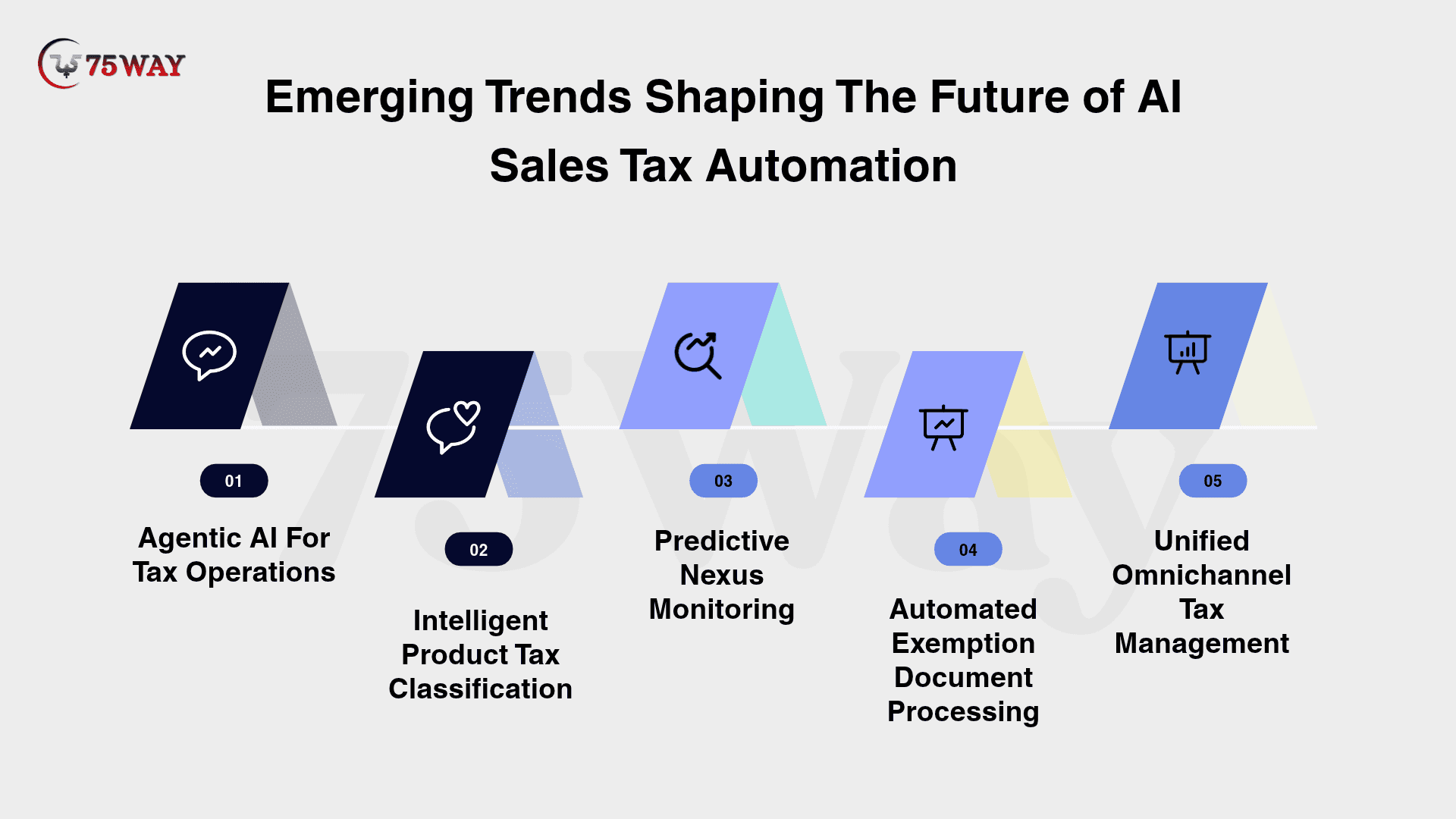
- Agentic AI For Tax Operations
AI agents can coordinate approved tasks such as retrieving transaction records, identifying missing information, and preparing compliance workflows. Human approval should remain part of high-impact actions.
- Intelligent Product Tax Classification
AI models can analyze product descriptions, attributes, and historical classifications to suggest appropriate tax categories. Verified tax rules should determine the final treatment.
- Predictive Nexus Monitoring
Predictive analytics can help businesses identify sales trends that may bring them closer to economic nexus thresholds. These insights can support earlier registration planning.
- Automated Exemption Document Processing
OCR and AI can extract information from exemption certificates, organize records, and flag missing or expired documentation for review.
- Unified Omnichannel Tax Management
Retailers will continue seeking platforms that consolidate tax information from websites, marketplaces, point-of-sale systems, and other sales channels.
How Can 75way Approach AI Sales Tax Automation Platform Development?
75way Technologies develops AI-powered sales tax automation platforms that simplify tax calculations, compliance management, and financial operations. Our development approach combines intelligent automation, secure architecture, and seamless integrations to address complex e-commerce tax requirements.
- Business Analysis: Identify tax requirements, workflows, and automation opportunities
- Custom Development: Build scalable platforms with tailored tax automation capabilities
- AI Integration: Implement intelligent classification, analytics, and anomaly detection
- System Integration: Connect e-commerce, payment, accounting, and tax systems
An e-commerce business, ShopSphere, managing sales across multiple states, struggled with complex tax calculations, transaction tracking, and changing compliance requirements.
We developed an AI-powered sales tax automation platform that streamlined tax calculations, monitored compliance requirements, and simplified financial reporting across sales channels.
Conclusion
An AI-powered sales tax automation platform can help e-commerce businesses manage complex tax operations across multiple sales channels and jurisdictions. Its value comes from combining accurate tax calculations, reliable integrations, nexus monitoring, exemption management, and AI-assisted workflows within one system.
For founders and technology leaders, the right approach is to begin with a focused product strategy, build a dependable tax calculation engine, and introduce AI where it can reduce manual work. To build an AI-powered sales tax automation platform and turn your e-commerce software vision into a scalable digital solution, you can connect with a leading AI ecommerce software development company.
Frequently Asked Questions (FAQs)
How Much Does It Cost To Build An AI Sales Tax Automation Platform?
The development cost can range from $30,000 to $350,000+, depending on features, AI capabilities, integrations, jurisdiction coverage, and infrastructure requirements.
How Long Does It Take To Develop Sales Tax Automation Software?
A basic MVP may take approximately 3–5 months, while an advanced platform can require 6–9 months or longer, depending on technical complexity.
Can AI Calculate Sales Tax Automatically?
AI can assist with product classification, transaction analysis, and tax research. Actual tax calculations should rely on verified tax rates, jurisdictional rules, and validated calculation logic.
What Is Economic Nexus In E-Commerce Sales Tax?
Economic nexus refers to a connection with a state created through sales activity or transaction volume. When a seller meets a state's applicable threshold, it may need to register, collect, and remit sales tax.
Can A Sales Tax Automation Platform Support Multiple Marketplaces?
Yes. It can connect with supported marketplaces, synchronize order information, consolidate tax records, and distinguish marketplace-collected taxes from obligations associated with direct sales.