Summary
AI development costs in 2026 range from $15,000 for basic MVP applications to $500,000+ for advanced large language models. This blog explains pricing by complexity, project stages, industries, hiring models, and regions. It also covers hidden costs, budget estimation strategies, cost reduction methods, monetization models, and key factors influencing overall AI investment decisions.
Key Overview:
Global AI market projected to reach $1.68 trillion by 2031.
Strategic phased development helps reduce risks and optimize overall AI spending.
AI development costs range from $15,000 to $500K+ in 2026.
Basic AI MVP applications typically cost between $15,000 and $75,000.
Data preparation and model training heavily impact total project costs.
Enterprise AI systems demand longer timelines and advanced infrastructure investments.
Artificial Intelligence is no longer a futuristic experiment. Now, businesses across diverse industries are adopting AI systems to automate operations, extract valuable information from massive datasets, and make faster, smarter decisions.
Companies that adopt AI early have improved their customer experience and innovation. On the other hand, others may struggle to keep pace in an increasingly competitive landscape.
Here, a question arises, “What is the cost of AI development?” And, “Why is it essential for strategic planning?” In 2026, prices for creating AI solutions typically range from $15,000 to $500,000+, depending on various factors. However, its overall investment is influenced by project complexity, data quality and volume, model type, infrastructure requirements, scalability goals, and technical expertise.
Here, a question arises, “What is the cost of AI development?” And, “Why is it essential for strategic planning?” In 2026, AI development costs typically range from $5,000 to $1000,000+ based on various factors. However, its overall investment is influenced by project complexity, data quality and volume, model type, infrastructure requirements, scalability goals, and technical expertise.
A simple AI-powered solution with limited AI automation usually falls at the lower end of the pricing range. On the contrary, if you want an advanced enterprise AI development solution with machine learning, natural language processing, predictive analytics, AI voice agent, or agentic AI, it requires higher budgets and longer development timelines. In one of ScienceSoft's custom healthcare projects, developing a secure AI voice agent featuring Amazon Nova Sonic and LiveKit integration successfully automated patient appointment scheduling while cutting operational costs by fifty percent and eliminating backend latency for natural conversations. In one of ScienceSoft's custom healthcare projects, developing a secure AI voice agent featuring Amazon Nova Sonic and LiveKit integration successfully automated patient appointment scheduling while cutting operational costs by fifty percent and eliminating backend latency for natural conversations.
For this, you must have prior knowledge regarding the cost to build an AI app. Thus, we create a comprehensive guide that breaks down AI development costs by complexity level, project stage, hidden expenses, and industry-specific estimates. Moreover, by the end, you will have practical budgeting strategies to plan your AI investment and maximize long-term value.
Why Should You Invest in Artificial Intelligence Development in 2026?
Artificial Intelligence has become a core driver of business performance. What was once considered experimental technology is now central to operational efficiency, smarter decision-making, and long-term competitive advantage. Here are some other reasons to invest in AI-powered solutions in 2026.
- The global AI infrastructure market was valued at USD 58.78 billion in 2025 and is expected to increase from USD 75.40 billion in 2026 to nearly USD 497.98 billion by 2034, reflecting a 26.60% CAGR.
- According to Statista, the worldwide artificial intelligence market is projected to reach approximately US$1.68 trillion by 2031, growing at a 37.0% compound annual rate.
- A recent UNCTAD report forecasts extraordinary growth in the artificial intelligence sector. The global AI market is expected to expand from $189 billion in 2023 to $4.8 trillion by 2033, marking a 25-fold increase within just 10 years.
- Meanwhile, findings from McKinsey & Company reveal that 88% of organizations now use AI regularly in at least one business function, up from 78% last year, highlighting the rapid acceleration of AI adoption across industries.
Organizations that integrate AI into strategic business functions are achieving measurable improvements in productivity, innovation, and market responsiveness. For example, Microsoft has embedded AI across its cloud ecosystem, productivity tools, and enterprise solutions, strengthening automation, analytics, and user engagement across industries.
These developments highlight an important reality: AI delivers meaningful value when deployed at scale and aligned with clear business objectives. For companies evaluating AI development costs, the takeaway is straightforward. AI is not simply a technology upgrade. It is a long-term growth investment.
With high-quality data, skilled professionals, and scalable infrastructure, AI becomes a compounding asset that improves efficiency, enhances customer experiences, and drives measurable returns. Selecting the right AI expertise is critical to maximizing ROI, which is why many enterprises carefully assess development talent before launching custom AI initiatives.
Read Too: Best AI Development Companies in United States in 2026
A Comprehensive View of the Costs for Developing An Al App
Any business planning to implement an artificial intelligence solution must clearly understand the development costs involved. Whether their goal is workflow automation, advanced data analytics, predictive modeling, or building an AI-powered healthcare app and AI fintech software, the total investment depends on the scope and technical depth of the solution.
AI development is not a fixed expense. Its costs vary based on project complexity, the type of model required, data availability and quality, integration needs, and scalability expectations. A simple automation tool, like n8n workflow automation platform will naturally require a smaller budget than a system powered by custom-trained models or advanced machine learning algorithms.
Learn More: How to Build an Astrology App Like Co-Star? A Strategic Guide 2026
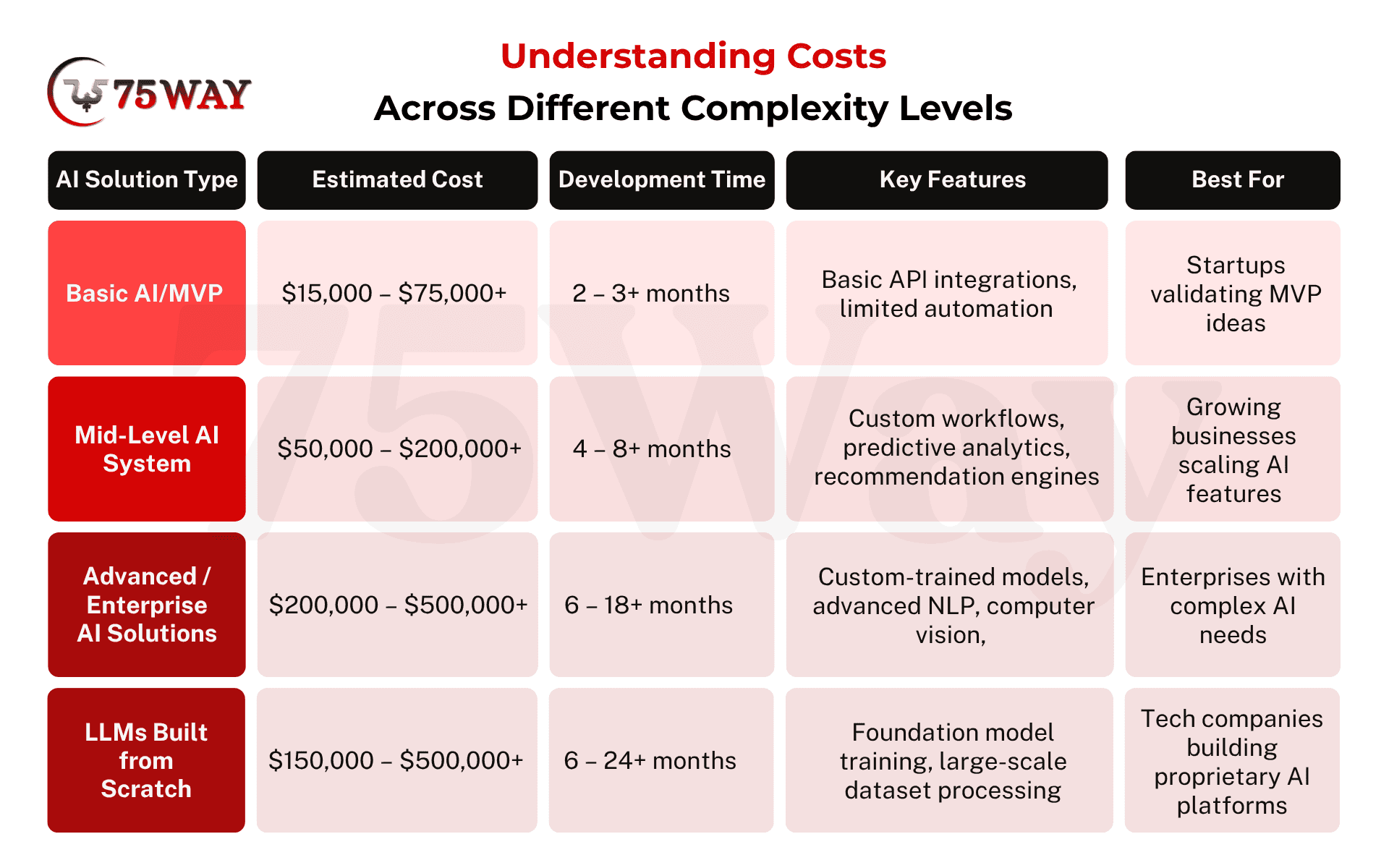
Cost of AI Development Across Different Complexity Levels
The cost of building an AI solution largely depends on its complexity. The smart systems with advanced features and capabilities generally require more resources. Naturally, the more sophisticated the solution, the higher the overall investment.
- More features increase development time and associated expenses.
- Higher automation requires advanced algorithms and additional resources.
- Advanced ML and AI models demand specialized expertise and longer implementation.
- Large datasets increase model accuracy and development cost.
- Connecting with other platforms adds complexity and project expenses.
Cost Breakdown
Basic AI/MVP Cost: $15,000 – $75,000+
A foundational solution with core features, simple models, limited data usage, and quick deployment.
Mid-Level AI Cost: $50,000 – $200,000+
A scalable system with improved accuracy, integrations, and support for real-world business applications.
Advanced/Enterprise AI Cost: $200,000 – $500,000+
A comprehensive enterprise AI solution with high performance, security, customization, and enterprise-grade operational capabilities.
LLMs Built from Scratch: $150,000 – $500,000+
A complex setup involving large datasets, intensive training, high computation, and specialized AI expertise.
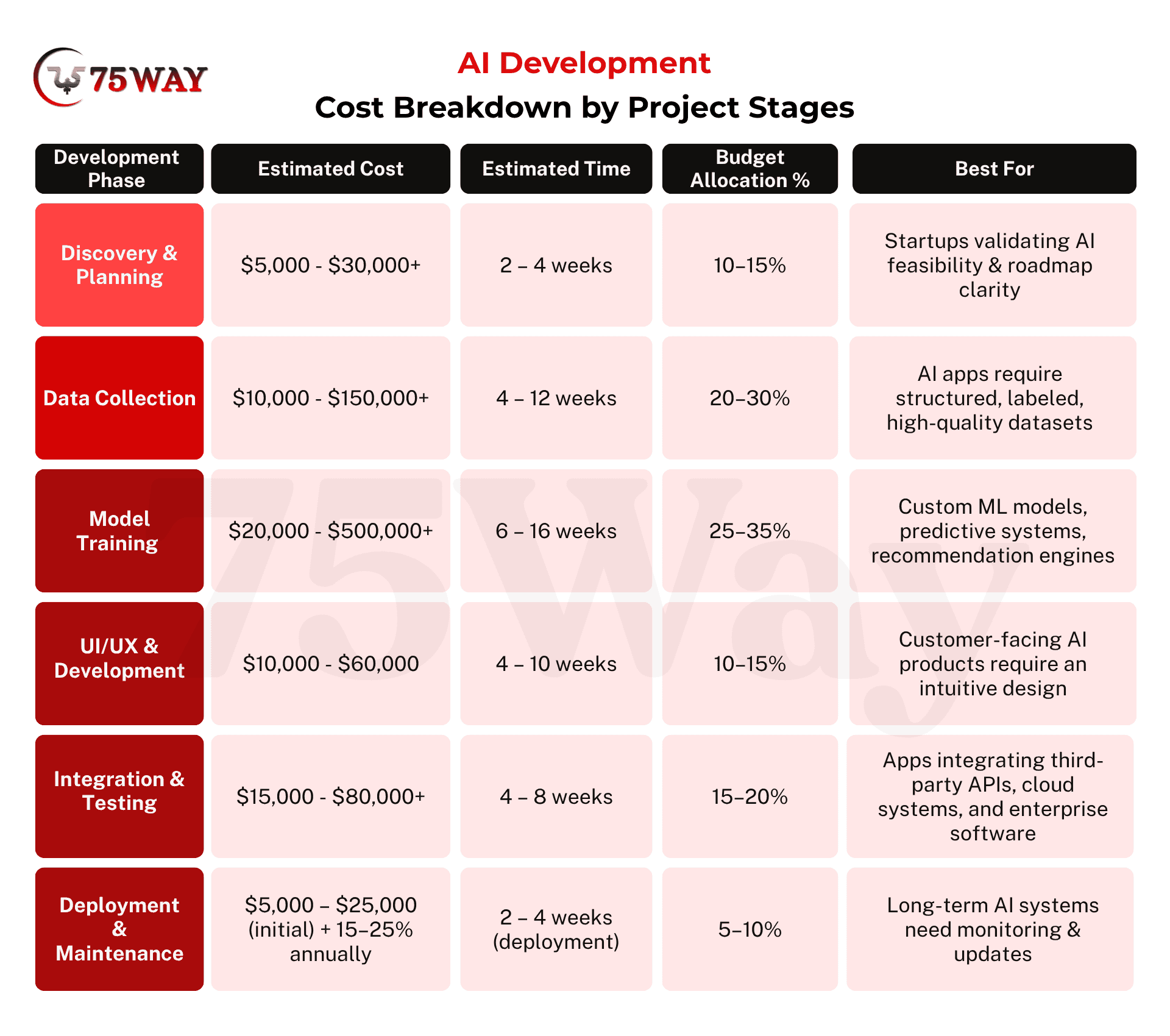
AI Solution Cost Breakdown by Project Stages
The AI-based system can be developed with varied investments across multiple stages. The total development cost depends on how resources are allocated from initial planning to ongoing maintenance and optimization. Each phase plays a distinct role in determining the system’s overall performance and effectiveness.
Discovery & Planning: This phase of AI development defines the AI project’s goals, scope, and feasibility to ensure a clear roadmap. It involves identifying key requirements, planning workflows, and evaluating technical possibilities. Typically lasting 2–4 weeks, it sets the foundation for smooth development and reduces risks.
Expected Cost: $5,000 - $30,000+, 10–15
Data Collection: During this stage, relevant datasets are gathered, cleaned, and structured for model training. The team ensures data quality, consistency, and labeling to enhance AI performance. This process usually takes 4–12 weeks and forms the backbone of accurate and reliable AI solutions.
Expected Cost: $10,000 - $150,000+, 20–30
Model Training: AI algorithms are trained using the prepared datasets to recognize patterns and make predictions. Models are continuously tested, refined, and validated for efficiency and accuracy. This phase generally lasts 6–16 weeks, and is essential for building intelligent, high-performing AI systems.
Expected Cost: $20,000 - $500,000+, 25–35%
UI/UX & Development: This phase focuses on creating intuitive interfaces and developing functional, user-friendly systems. Front-end and back-end components are integrated to align with project objectives. Typically completed in 4–10 weeks, it ensures smooth interaction and high adoption of the AI solution.
Expected Cost: $10,000 – $60,000, 10–15%
Integration & Testing: AI systems are integrated with existing platforms, APIs, and services during this stage. Comprehensive testing ensures reliability, security, and real-world performance while detecting and fixing errors. This phase usually takes 4–8 weeks, guaranteeing seamless system operation.
Expected Cost: $15,000 – $80,000, 15–20%
Deployment & Maintenance: After deployment, the AI system requires ongoing monitoring, updates, and optimization to maintain performance. Teams address retraining, scaling, and system security while ensuring the solution remains efficient. Deployment and initial setup typically take 2–4 weeks, with annual maintenance costing 15–25%.
Expected Cost: $5,000 – $25,000 initial + 15–25% annually
Estimating the Overall Cost of AI Development
You can find the total cost of developing an AI solution by breaking down the main expense components. Businesses should consider the AI developer’s hourly rate multiplied by the total development hours, along with costs for data preparation, design, and ongoing maintenance. This approach provides a practical way to understand potential investments and plan budgets even when specific project requirements are not yet finalized. You can estimate the cost of an artificial intelligence development by following the given equation.
Total AI Development Cost = (Developer Hourly Rate × Development Hours) + Data Preparation Cost + Design Charges + Maintenance Cost
Calculating Time and Effort Requirements
The time and effort required to develop an AI application depend on the project’s complexity, data requirements, team size, and integration needs. More advanced systems, such as predictive or highly automated solutions, require longer development cycles and greater technical coordination. Understanding these timelines helps businesses plan resources and budgets effectively.
Basic AI Apps/MVP: Typically completed in 2–3 months, suitable for validating ideas with limited functionality and automation.
Mid-Level AI Apps: Generally take 4–8 months, allowing for additional features, predictive analytics, and improved workflow integration.
Advanced/Enterprise AI Solutions: Usually require 6–18 months, supporting complex automation, deep learning, and multi-system integrations.
LLMs Built from Scratch: Can span 6–24 months, involving large-scale data processing, foundation model training, and significant computational resources.
Discover More: How to Build AI Agents From Scratch? Step-By-Step Guide
Core Factors Affecting AI Implementation Cost
The core factors that influence AI implementation costs are essential to consider when planning realistic budgets for developing an AI platform. Each component of an AI project can significantly impact the total investment. From model selection to platform choice, integration needs, and security requirements, careful consideration of these factors ensures that resources are allocated efficiently and the project delivers maximum value.
Custom vs Pre-Trained Models: Choosing between a custom-built AI model and a pre-trained one significantly affects development time and cost. Custom models are tailored to specific business needs and offer higher accuracy, while pre-trained models are faster to deploy but less flexible. For example, a logistics company building a custom route-optimization AI will spend more time and resources than using a pre-trained mapping model.
Cost To Build Custom AI Models: $10,000 – $49,000
Cost of Pre-Trained AI Models: $60,000 – $500,000+
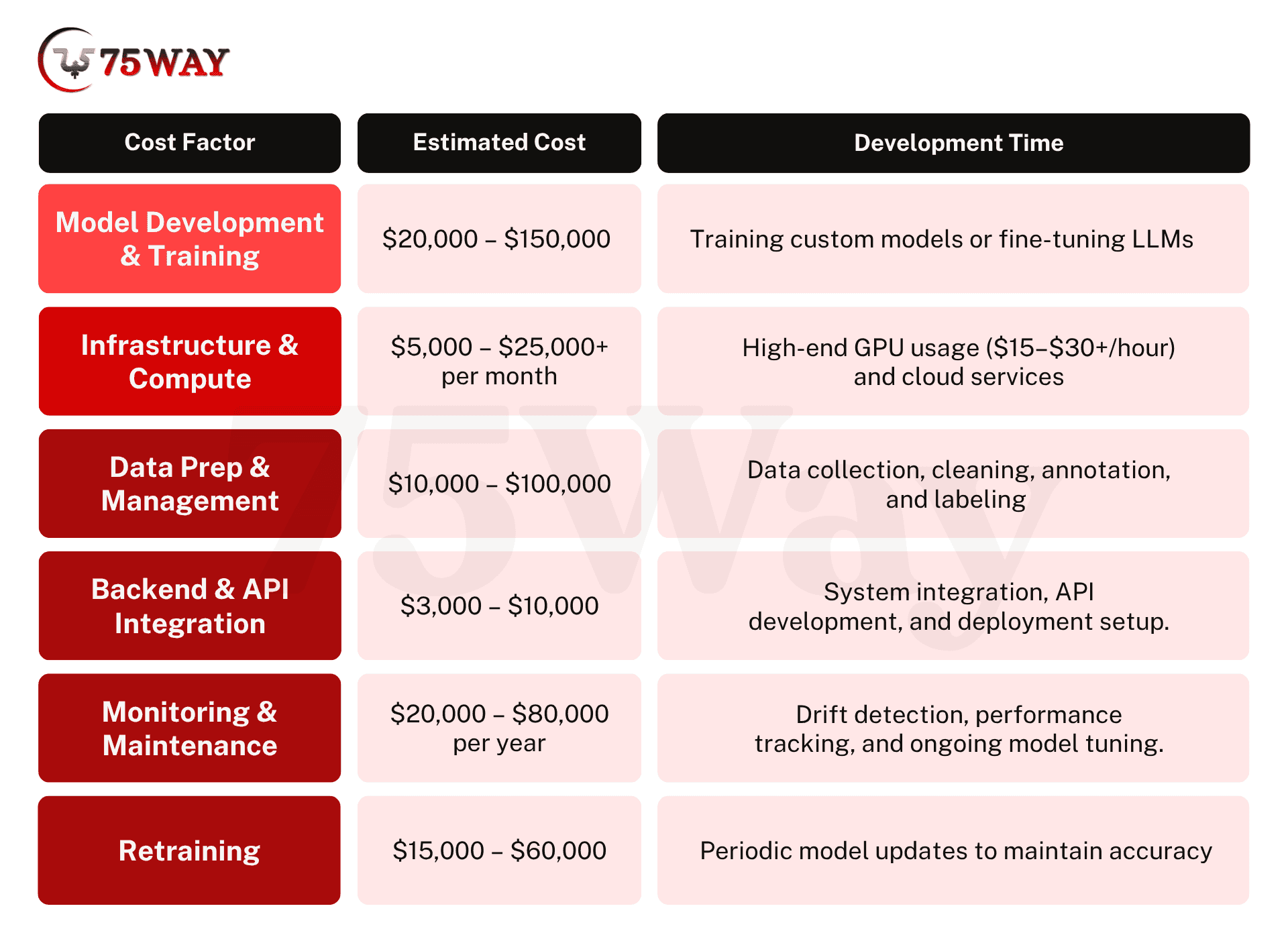
Tech Stack Selection: The technology stack, including programming languages, AI frameworks, and cloud platforms, determines both development efficiency and long-term costs. Choosing the right stack ensures seamless integration, scalability, and maintainability. For instance, using a cloud-based TensorFlow stack allows rapid prototyping, while on-premises solutions require additional hardware and technical support.
- Model Development & Training: $20,000 – $150,000
- Infrastructure & Compute: $5,000 – $25,000+ per month
- Data Prep & Management: $10,000 – $100,000
- Backend & API Integration: $3,000 – $10,000
- Monitoring & Maintenance: $20,000 – $80,000 per year
- Retraining: $15,000 – $60,000
Third-Party Integrations: AI applications frequently rely on third-party services, such as payment gateways, cloud APIs, GPS, or social media platforms. Each integration requires careful configuration, testing, and sometimes custom coding to ensure seamless functionality. These additional steps increase both time and cost, making proper planning essential to avoid delays or operational issues.
- Small-Scale: $5,000 – $25,000 A basic solution with chatbot integration, simple APIs, and lightweight AI-powered website features.
- Mid-Level: $25,000 – $100,000+ A functional system with recommendation engines, workflow automation, and integration with business tools.
- Large-Scale: $100,000 – $500,000+ A complete solution with custom models, full-stack development, and high-volume real-time AI processing.
UI/UX Design: The design of an AI application goes beyond just visuals. It includes user flows, dashboards, and data visualizations that make the app intuitive and actionable. Advanced or interactive designs often require multiple iterations, prototyping, and usability testing to ensure efficiency. For example, incorporating live analytics or feedback monitors increases development effort, directly affecting costs due to the expertise and resources needed for a polished, user-friendly interface.
Cost Estimation: $10,000 - $60,00
Platform Selection: The right platform for deploying an AI application affects scalability, accessibility, and ongoing maintenance. Cloud, on-premises, or hybrid solutions all have different infrastructure requirements, and selecting the wrong one can increase costs. For example, using a cloud platform for real-time AI predictions reduces hardware needs but adds subscription fees.
- No-Code/AutoML Platforms: $10,000 – $50,000
A simplified approach using pre-built models, enabling faster development without deep coding expertise.
- Specialized AI Platforms: $5,000 – $50,000+/month
A subscription-based solution offering advanced tools for model development, deployment, and data science workflows.
- Cloud Infrastructure/LLMs: $1,000 – $100,000+/month
A scalable environment supporting storage, compute power, and large language model operations on demand.
- Custom AI Systems: $50,000 – $1,000,000+
A fully tailored solution built from scratch with unique models, high customization, and specialized capabilities.
Feature Complexity: The number and functionalities of AI features directly influence development effort and budget. Advanced functionalities, such as AI-powered analytics and agentic AI, or RPA, require additional testing and computational resources. For example, adding a product recommendation engine for an e-commerce app increases both model complexity and infrastructure requirements.
Cost Estimation: $15,000-$300,000K+
Licensing & Tool Subscription: Many AI tools, libraries, and cloud services require paid licenses or subscriptions that vary with usage and support levels. Ignoring these recurring costs can inflate the project budget unexpectedly. For instance, integrating a third-party NLP library to enhance AI chatbots in educational apps will raise both initial and ongoing expenses.
- Off-the-Shelf AI Solutions: $1,000 – $40,000/year
- API Licensing: $10,000 – $15,000/year
Security & Compliance: Data privacy, encryption, and regulatory compliance are essential for any AI solution. Implementing these measures adds complexity and requires careful resource planning. For example, deploying an AI fraud detection system in banking and digital wallets requires strict security protocols and audit trails, which increase development time and costs.
Estimated Cost: $15,000 – $30,000+
Read Too: Best AI Development Companies in United States in 2026
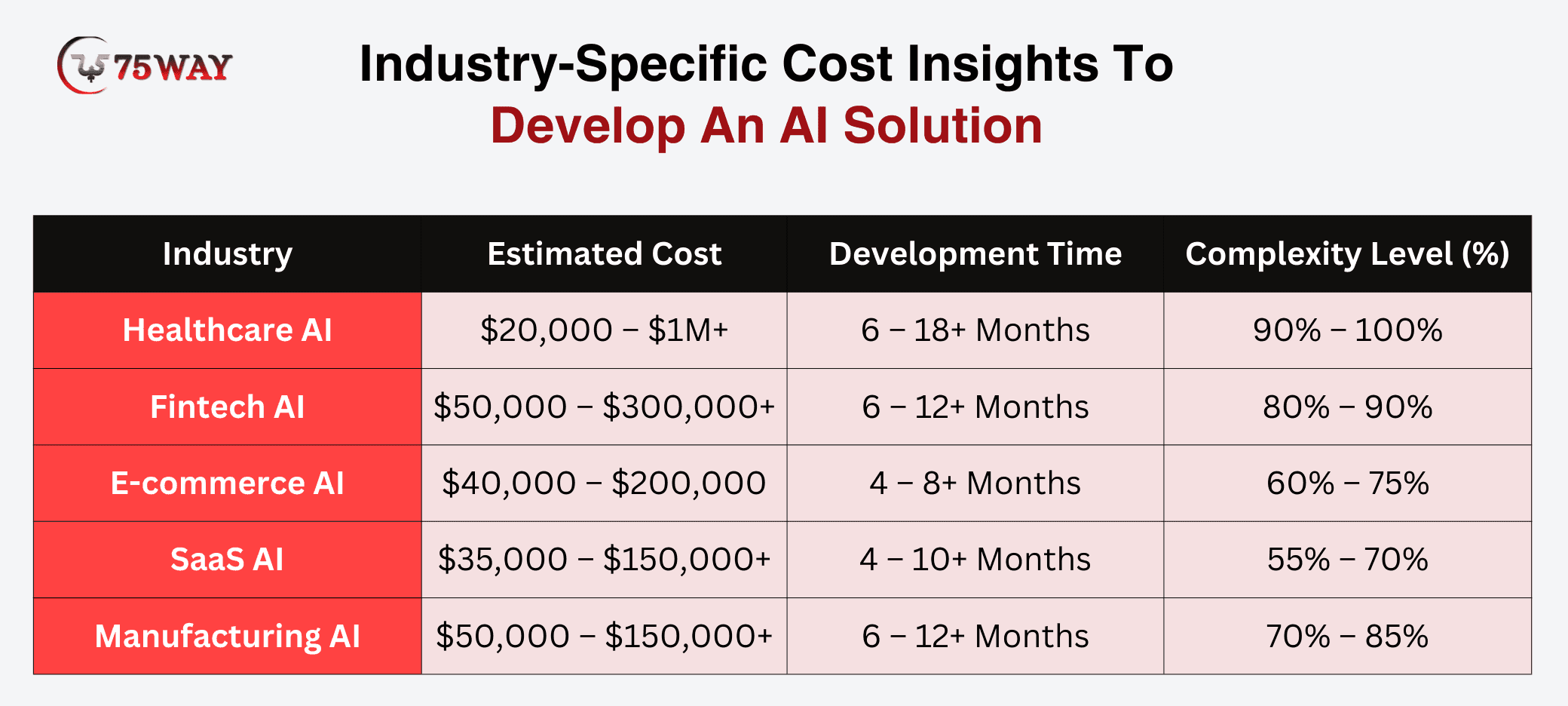
Industry-Specific Cost Insights To Develop An AI Solution
The cost of developing AI solutions varies widely across industries due to differences in data complexity, regulatory requirements, and feature sophistication. Each sector has unique needs, from predictive analytics in finance to patient data management in healthcare. Understanding these industry-specific factors helps businesses estimate budgets and plan resources effectively.
Healthcare AI Cost: AI solutions in healthcare, such as patient monitoring, diagnostic tools, and predictive analytics, require high-quality, secure data and compliance with strict regulations. The development of AI-powered healthcare apps and systems involves complex algorithms and thorough testing to ensure accuracy and reliability.
Estimated Cost: $20,000 – $1M+
Fintech AI Cost: AI in fintech focuses on fraud detection, credit scoring, and personalized financial recommendations. The AI-powered fintech software and insurance applications demand secure, scalable systems and adherence to strict financial regulations, increasing both complexity and development effort. Typically, fintech AI projects take 6 to 12+ months to fully implement.
Estimated Cost: $50,000 – $300,000+
E-commerce AI Cost: AI for e-commerce includes product recommendations, inventory forecasting, and customer behavior analysis. Integration with existing platforms and handling large datasets are key aspects that influence development. Building an e-commerce AI app solution usually requires around 4 to 8+ months.
Estimated Cost: $40,000 – $200,000
SaaS AI Cost: AI-powered SaaS solutions provide automation, analytics, and personalized experiences for subscription software platforms. Developers need to focus on cloud-based, multi-tenant architecture and seamless integration to achieve optimal performance. The typical timeframe to develop a SaaS AI system is 4 to 10+ months.
Estimated Cost: $35,000 – $150,000+
Manufacturing AI Cost: AI in manufacturing involves predictive maintenance, process optimization, and quality control. These applications require real-time IoT data integration and sophisticated analytics to improve operational efficiency. On average, building a manufacturing AI solution takes 6 to 12+ months.
Estimated Cost: $50,000 – $150,000+
Read More: Top AI Agent Development Companies in USA in 2026
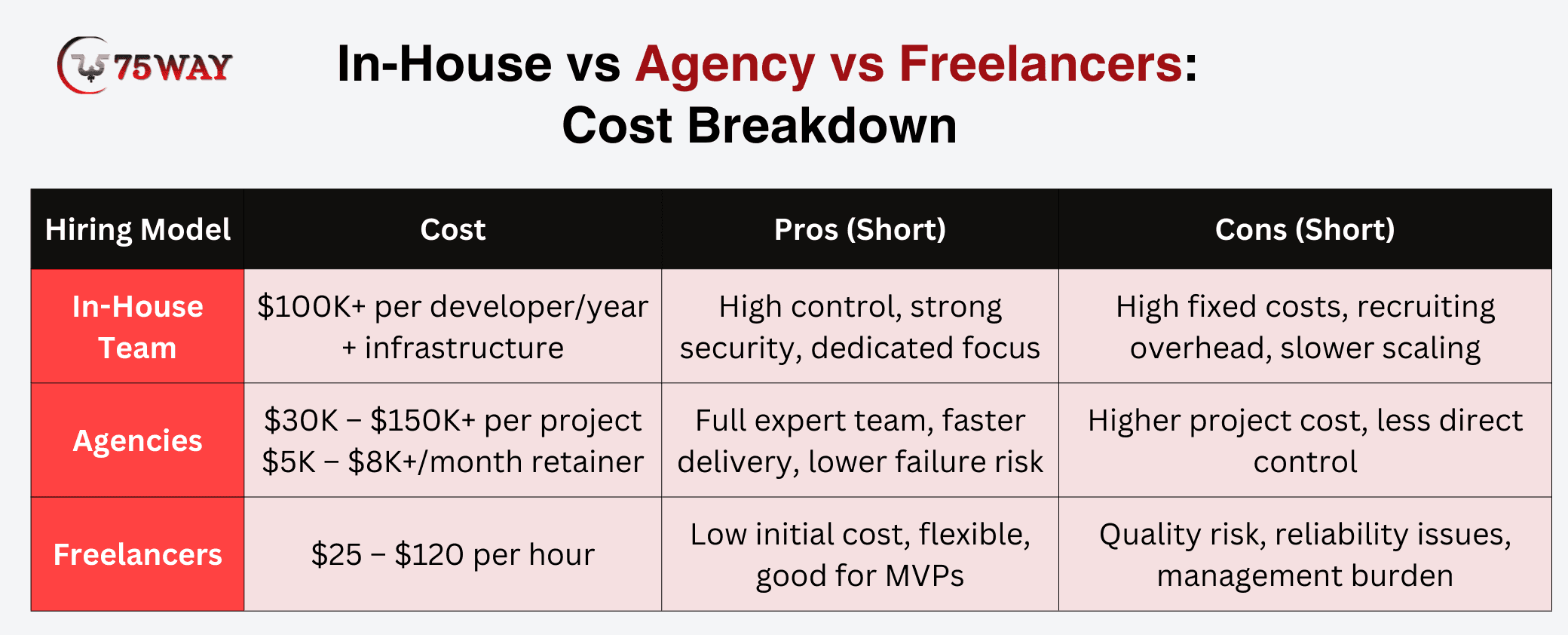
In-House vs Agency vs Freelancers: Cost Breakdown
The right hiring model for AI development significantly impacts cost, quality, and project timelines. Businesses can opt for an in-house team, a specialized agency, or freelancers, depending on budget, expertise, and project scope. Each option has distinct advantages and limitations that must be considered for optimal results.
In-House Team: $100K+ per developer/year + infrastructure
If you want full control over AI development and ensure strong security and alignment with company objectives, you can build an internal team. Teams can rapidly adapt to changes and maintain intellectual property internally. Hiring developers, data engineers, and AI specialists requires significant upfront investment, infrastructure, and long-term commitment.
- Offers dedicated focus and deep understanding of company-specific needs.
- High fixed costs for salaries, benefits, and infrastructure.
- Longer onboarding and scaling times compared to external resources.
Agencies: $30K – $150K+ per project $5K – $8K+/month retainer
Hiring an agency provides access to a full team of AI experts with experience across industries. Agencies can deliver faster results and reduce the risk of failure through tested processes and specialized tools. This approach works well for businesses that need complex AI solutions without building internal capacity.
- Provides a complete team with diverse AI expertise.
- Faster project delivery due to established workflows and tools.
- Project costs can be higher than with freelancers but lower than with in-house teams for complex projects.
Freelancers: $25 – $120 per hour
Freelancers offer flexibility and lower initial costs, making them ideal for MVPs or smaller AI projects. They can handle specific tasks, such as data preprocessing, model training, or UI development, but require careful oversight to ensure quality. Freelancers are best suited for businesses with limited budgets or short-term AI needs.
- Low upfront costs and flexible engagement terms.
- Quality and reliability depend on individual expertise and availability.
- Management and coordination require more effort from internal teams.
Explore More: AI App Development Partner for Health and Wellness Startup
Geographical & Location-Based Cost Factors in AI Development
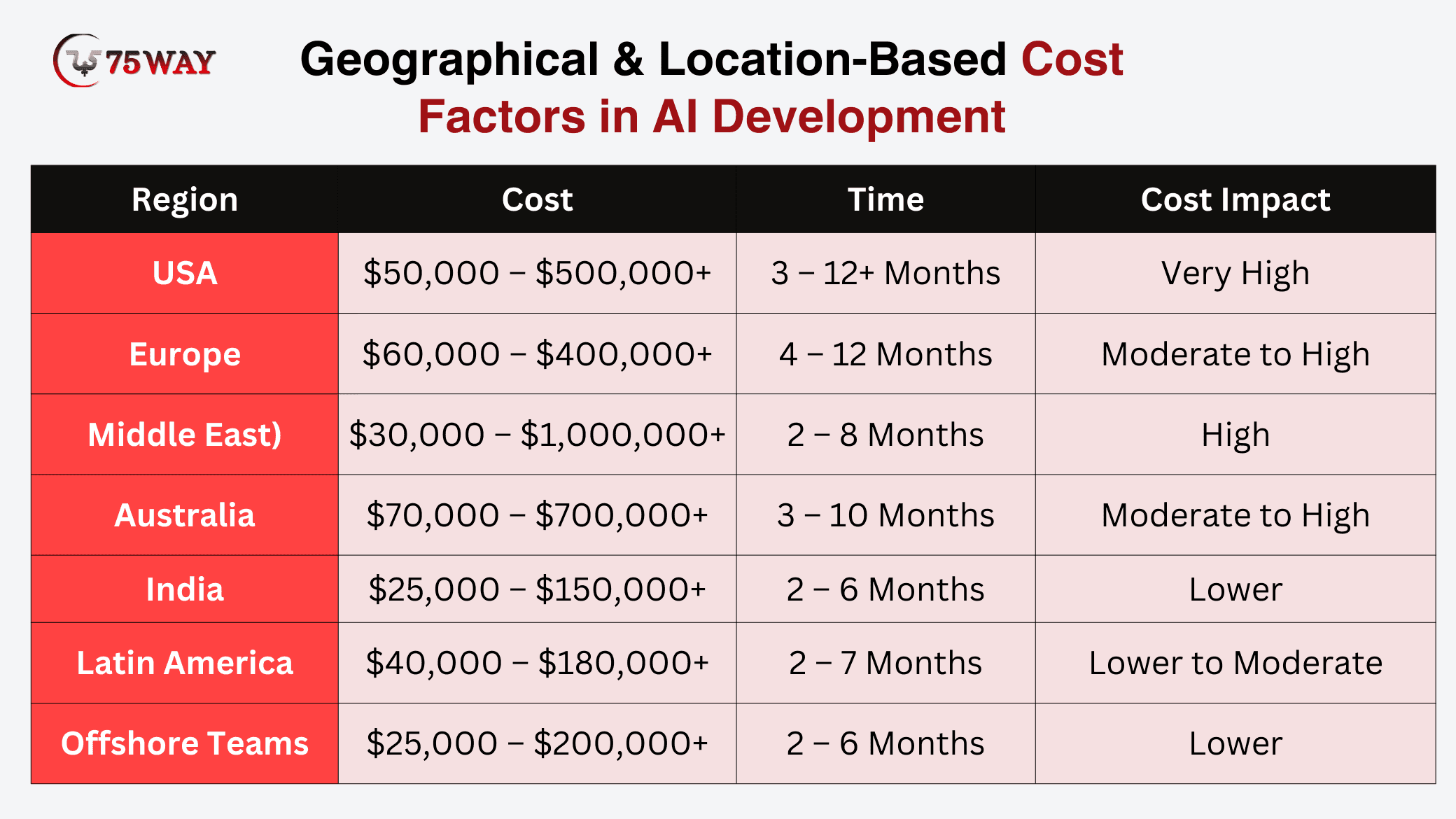
The cost of developing AI varies significantly across regions due to differences in labor rates, regulatory requirements, infrastructure, and access to technical talent. Choosing the right location can affect both budget and project timelines, making it essential for companies to evaluate regional advantages, compliance standards, and operational efficiency before starting development.
United States (USA)
Cost: $50,000 – $500,000+
AI development in the United States is one of the most expensive globally due to highly skilled engineering talent and strict legal requirements. Companies must allocate resources for security, reliability, and compliance while ensuring performance for large-scale enterprise applications. The investment in infrastructure and system robustness is significant.
Legal and operational standards increase overall project costs. Platforms require disaster recovery mechanisms, advanced moderation workflows, and thorough audits to meet both user expectations and federal or state-level privacy laws. Long-term planning is essential for maintaining user trust and platform integrity.
- State-level privacy regulations and CCPA compliance
- Age verification and content moderation systems
- Advanced monitoring and trust-and-safety workflows
- High-availability infrastructure and disaster recovery mechanisms
- Regular security audits and legal review cycles
Europe
Cost: $60,000 – $400,000+
AI development in Europe involves moderately high costs due to strict regulatory frameworks and established technical infrastructure. Skilled teams provide high-quality development, while compliance with GDPR and other data protection laws requires additional budget and attention. Reliable and secure AI deployment is a priority.
Platforms in Europe must implement transparent data handling, consent management, and regulatory reporting to maintain legal and operational standards. Proper resource allocation ensures compliance with security and privacy laws while enabling scalable, efficient AI systems.
- GDPR compliance and data protection enforcement
- Automated reporting systems for regulatory adherence
- Secure cloud and on-premises data storage
- Consent management workflows for user information
- Continuous auditing and legal oversight
Middle East
Estimated Cost: $30,000 – $1,000,000+
AI development in the Middle East offers competitive pricing and access to emerging technical talent. Regional AI initiatives encourage innovation, but regulatory standards vary, making careful planning essential. Infrastructure investments focus on secure, scalable, and reliable systems.
Compliance with local regulations and operational standards is critical. Projects often require secure cloud integration, robust monitoring, and planning for future scalability. Companies must balance cost efficiency with regulatory and operational requirements.
- Data localization and protection standards
- Secure cloud and on-site infrastructure
- Compliance with local regulations and laws
- System scalability for enterprise requirements
- Ongoing monitoring and operational reliability
Australia
Estimated Cost: $70,000 – $700,000+
AI projects in Australia involve relatively high costs due to labor rates and sophisticated infrastructure requirements. Skilled professionals and modern IT systems support secure, scalable AI applications across multiple sectors. Budget planning focuses on reliable long-term performance.
National regulations provide clear guidelines for data protection and compliance. Companies must allocate funds for maintenance, cloud integration, and robust architecture to ensure smooth operation and minimize risks.
- Skilled AI professionals with advanced technical expertise
- Data protection and compliance with national regulations
- High labor and operational expenses
- Advanced cloud infrastructure and computational resources
- Long-term system maintenance and monitoring
India
Estimated Cost To Hire Indian Team: $25,000 – $150,000+
India offers cost-effective AI development with a large talent pool and competitive labor rates. Companies benefit from faster project execution and scalable teams while effectively managing budget constraints.
Ensuring adherence to global standards and compliance requires proper guidance. Investments are often directed toward cloud services, model training, and data processing, balancing efficiency with cost-effectiveness.
- Large pool of skilled AI developers
- Lower labor costs compared to Western regions
- Moderate compliance with international standards
- Strong IT infrastructure in urban centers
- Effective for MVPs and outsourced projects
Latin America
Estimated Cost To Hire Latin American Team: $40,000 – $180,000+
Building an AI product in Latin America is affordable, with access to a growing number of qualified professionals. Companies can achieve nearshore collaboration advantages while maintaining reasonable budgets. Infrastructure and regulatory standards vary by country.
Local regulations require careful consideration for data handling and privacy. Development costs are influenced by team experience, infrastructure quality, and regional compliance requirements.
- Primary factors influencing development costs include:
- Cost-effective development services
- Emerging AI talent with technical expertise
- Varying data privacy and compliance standards
- Moderate operational and infrastructure support
- Nearshore collaboration and communication benefits
Offshore Teams
Estimated Cost To Hire Offshore Teams: $25,000 – $200,000+
Offshore AI teams provide cost savings while offering access to global expertise. Projects require careful coordination to maintain quality and ensure adherence to international standards. Companies must implement strong management practices for remote collaboration.
Time zone differences, communication, and quality control influence project timelines. Investments are necessary for oversight, secure data handling, and system monitoring to ensure consistent performance.
- Primary factors influencing development costs include:
- Lower development costs than local teams
- Flexible engagement and scalability
- Requires careful project management
- Ensuring adherence to global standards
- Coordination across multiple time zones
Hidden AI Development Costs That Affect Your AI Budget
AI development budgets often extend beyond initial design and implementation. Hidden costs arise during model maintenance, system optimization, and infrastructure management, which are essential for consistent performance, reliability, and scalability. Ignoring these expenses can lead to underestimating the total investment required for a successful AI solution.
Model Retraining: AI models need regular updates to maintain accuracy as new data becomes available or user behavior changes. For example, a recommendation engine in a retail platform must be retrained seasonally to provide relevant product suggestions. These updates require dedicated resources and technical expertise.
Ongoing Optimization: AI algorithms are continually optimized to achieve faster performance and greater efficiency across applications. This includes refining models, adjusting parameters, and enhancing workflows. Companies may conduct routine audits to maintain competitive performance.
Data Storage: Large datasets require secure, high-capacity storage solutions to support AI operations. Industries like healthcare and finance must manage sensitive information with strict security and backup systems. Storage costs grow with the volume and frequency of data processing.
Monitoring: Continuous monitoring is crucial to detect performance drops, errors, or unusual patterns. Real-time monitoring ensures reliability and maintains user trust. For instance, AI-powered chatbots need performance tracking to avoid providing incorrect responses.
Scaling: Expanding AI systems to handle increased users or data requires scaling infrastructure, such as additional servers or cloud capacity. Platforms like ride-sharing apps or logistics software must scale dynamically to meet peak demands without service disruption.
Licensing: Many AI projects rely on licensed software, APIs, or tools, which incur recurring costs. Licensing fees vary based on the technology, number of users, and integrations. For example, commercial NLP libraries may require annual licensing, affecting overall budgets.
Read More: What is Character AI? Everything You Need To Know
How to Estimate Your AI Project Budget?
To accurately estimate an AI project budget, you must require a careful planning and understanding of all project requirements. Costs depend on the type of AI solution, data volume, model complexity, integration needs, and scalability. Proper assessment for realistic budgeting avoids unexpected expenses during development and deployment.
Define Use Case: You must outline the purpose of the AI solution to determine the scope and necessary features. For example, a healthcare AI app for diagnostics will require different resources than a recommendation system for e-commerce. Precise use cases guide development priorities and cost allocation.
Estimate Data Volume: The amount and quality of data significantly influence AI project costs. Large datasets require storage, preprocessing, and cleaning, which increase development costs. For instance, training a natural language processing model with millions of documents requires substantial data-handling infrastructure.
Choose Model Type: The selection of pre-trained models and custom-built AI solutions affects both budget and timeline. Pre-trained models reduce costs but limit customization, while custom models require specialized expertise and additional investment. The model type directly impacts accuracy, performance, and overall project expenditure.
Determine Integration Needs: Integrating AI with existing systems, APIs, or third-party services increases complexity and budget. For example, connecting an AI fraud detection system to a banking platform involves secure data transfer, compliance checks, and API development. Thorough planning prevents delays and cost overruns.
Define Scalability Needs: Planning for future growth ensures that AI solutions can handle increased data, users, or transactions. Scalable architecture may require cloud infrastructure, load balancing, and additional computational resources. Companies must account for long-term maintenance and expansion costs.
Read Too: Dating App Development Cost in 2026: A Complete Guide
How to Reduce Costs When Building AI Systems?
Cost reduction in AI development depends on careful planning and strategic decisions. Companies can optimize budgets by focusing on essential features, leveraging existing tools, and collaborating with experienced teams. Efficient cost management in developing an AI solution provides faster delivery, reliable performance, and long-term ROI.
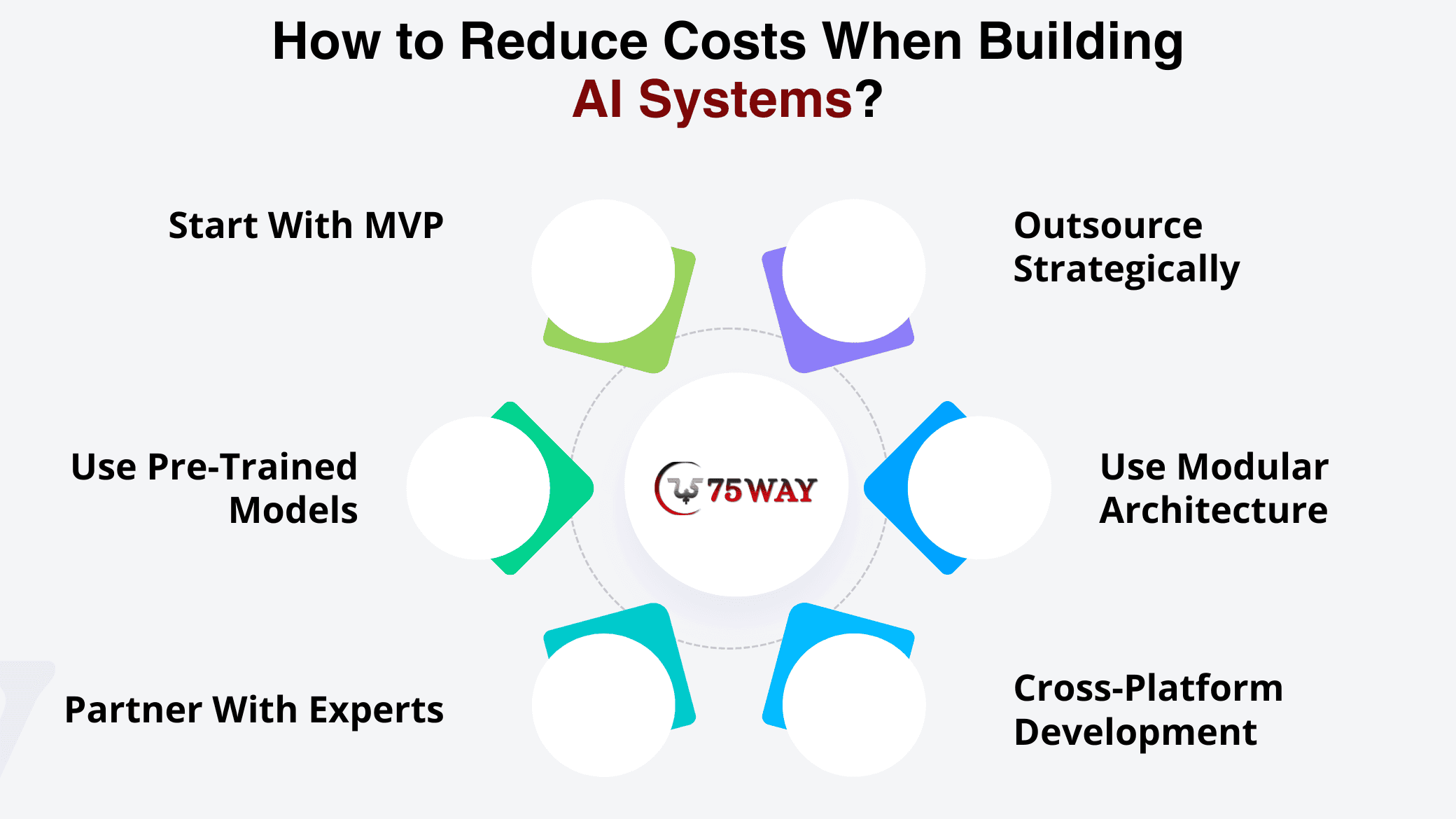
Start With MVP: A minimum viable product (MVP) allows testing AI functionality with only core features before full-scale deployment. For example, a chatbot can launch with basic query handling first, enabling feedback collection and gradual improvements. MVP development minimizes upfront costs and reduces project risk.
Use Pre-Trained Models: Pre-trained AI models save both time and money by utilizing existing algorithms. You can implement an NLP model for sentiment analysis, for instance, which costs significantly less than building a custom model from scratch. Pre-trained models accelerate deployment while maintaining consistent performance.
Partner With Experts: Collaboration with experienced AI developers or consulting firms improves project efficiency. Expert guidance prevents costly errors, optimizes algorithms, and selects appropriate technology stacks. For example, working with a machine learning specialist enhances model accuracy and reduces development delays.
Outsource Strategically: You can outsource specific tasks to reduce labor expenses while maintaining quality. Companies may delegate data preprocessing, cloud integration, or testing to skilled external teams while retaining core development in-house. This approach balances cost efficiency and project reliability.
Use Modular Architecture: Modular AI system design simplifies updates and maintenance, reducing redevelopment costs. Separate modules for data processing, model training, and API integration allow future enhancements without affecting the entire system. Incremental changes save both time and budget during scaling.
Cross-Platform Development: Developing AI solutions for multiple platforms simultaneously minimizes duplication of effort. A predictive analytics tool, for example, can serve web and mobile users from a single codebase. Cross-platform deployment reduces operational expenses and ensures consistent performance across platforms.
Get More Insights: How to Build IoT Apps in 2026: A Guide for Startups, Founders & Business Owners
Key Stages of the Artificial Intelligence Development Process
AI application development requires a structured approach to ensure effectiveness, functionality, and measurable business value. Following well-defined steps makes the process more organized, helps manage costs efficiently, and reduces the risk of errors during deployment. Each stage contributes to the overall quality and performance of the solution.
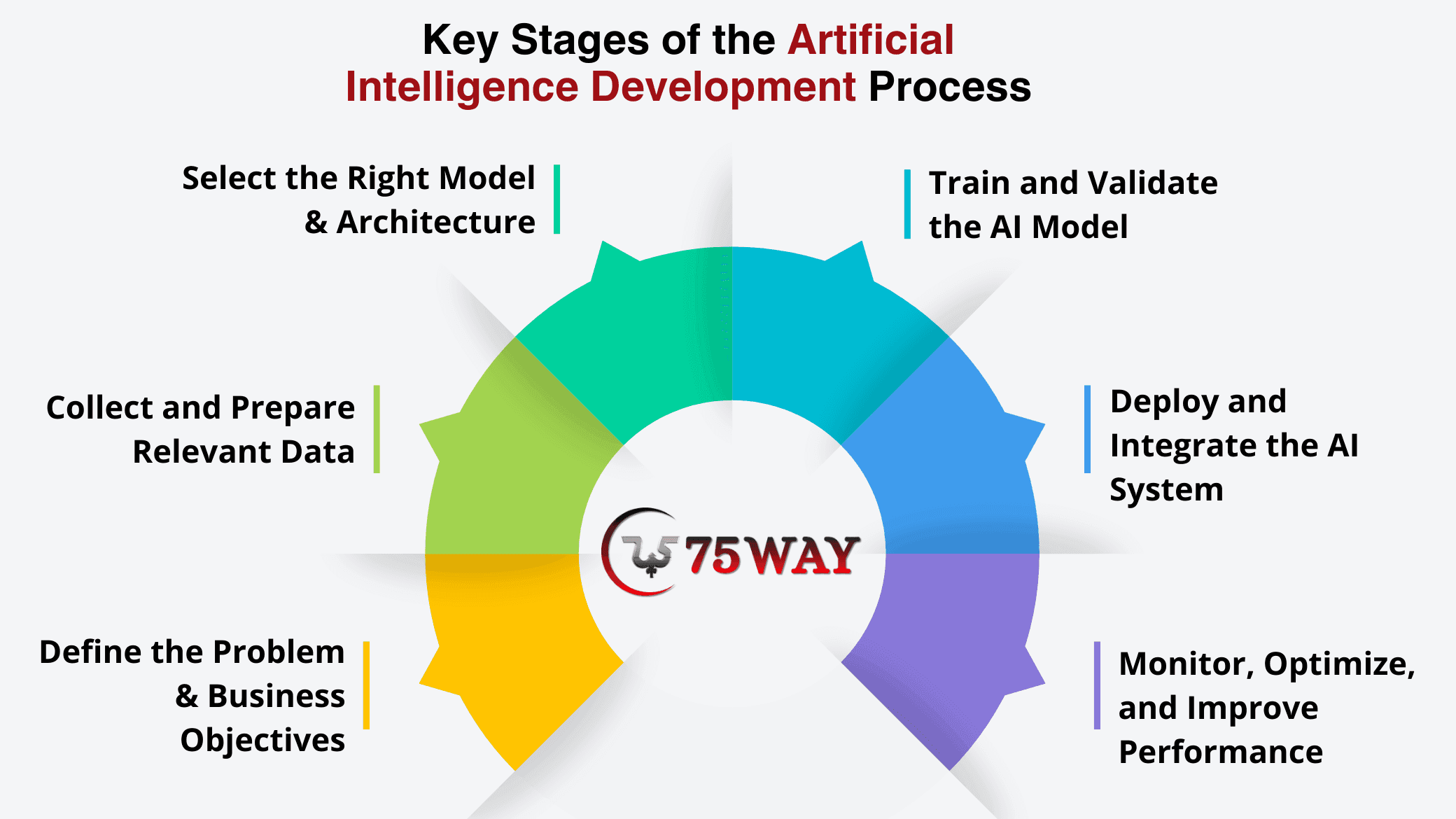
Define the Problem & Business Objectives
A successful AI project begins with a clear understanding of the business problem and measurable objectives. You have to define the use case for GPT or LLM-based solutions to ensure that resources are allocated efficiently. For instance, if you plan to develop a customer support chatbot, you must identify target workflows, expected outcomes, and KPIs before development. Clear objectives align the project with strategic goals and prevent costly misdirection.
Collect and Prepare Relevant Data
High-quality, structured data is the foundation of any AI or LLM project. You must collect and clean datasets, so the model can learn patterns accurately and generate reliable results. For example, training a GPT-based language model for healthcare requires anonymized, labeled patient records and domain-specific documentation. Proper data preparation directly impacts model performance, prediction accuracy, and overall project success.
Select the Right Model & Architecture
An appropriate AI model and architecture must be selected carefully to enhance efficiency and scalability. GPT and other large language models (LLMs) differ in size, training requirements, and computational resources. Organizations targeting the USA market often balance model complexity with budget and cloud infrastructure capabilities. You must choose the right architecture to improve accuracy, reduce latency, and meet compliance with regional standards.
Train and Validate the AI Model
This stage involves teaching the model to recognize patterns in data, while validation measures its effectiveness against unseen data. LLMs, for example, require careful tuning to handle region-specific language, regulations, and context. Rigorous validation prevents biased outputs, ensures reliability, and prepares the AI system for real-world deployment. Iterative training cycles help maintain performance as datasets expand.
Deploy and Integrate the AI System
In this stage of AI development, you can integrate the AI or LLM system into business workflows to make your platform operational and accessible. GPT-based applications may connect with cloud platforms, enterprise databases, or mobile interfaces. Proper integration ensures smooth interaction with existing systems while maintaining data security and compliance with privacy regulations. Scalability and monitoring are considered during this stage to accommodate growing usage.
Monitor, Optimize, and Improve Performance
Once your AI platform is launched, continuous monitoring is required to check whether AI models maintain efficiency, accuracy, and relevance over time. Performance optimization includes retraining models, updating datasets, and refining algorithms to reflect changing trends. For example, an AI-driven marketing assistant must evolve as consumer behavior shifts. Ongoing evaluation protects the investment, improves ROI, and guarantees the system remains aligned with business goals.
Know More: Top AI Trends Businesses Must Follow in 2026
How to Monetize AI Platforms Successfully?
Every AI platform requires aligning revenue strategies with business goals and user needs. A well-planned approach ensures long-term growth while maximizing the platform’s value. Selecting the right model allows flexibility and creates multiple revenue streams that support sustainability and scalability.
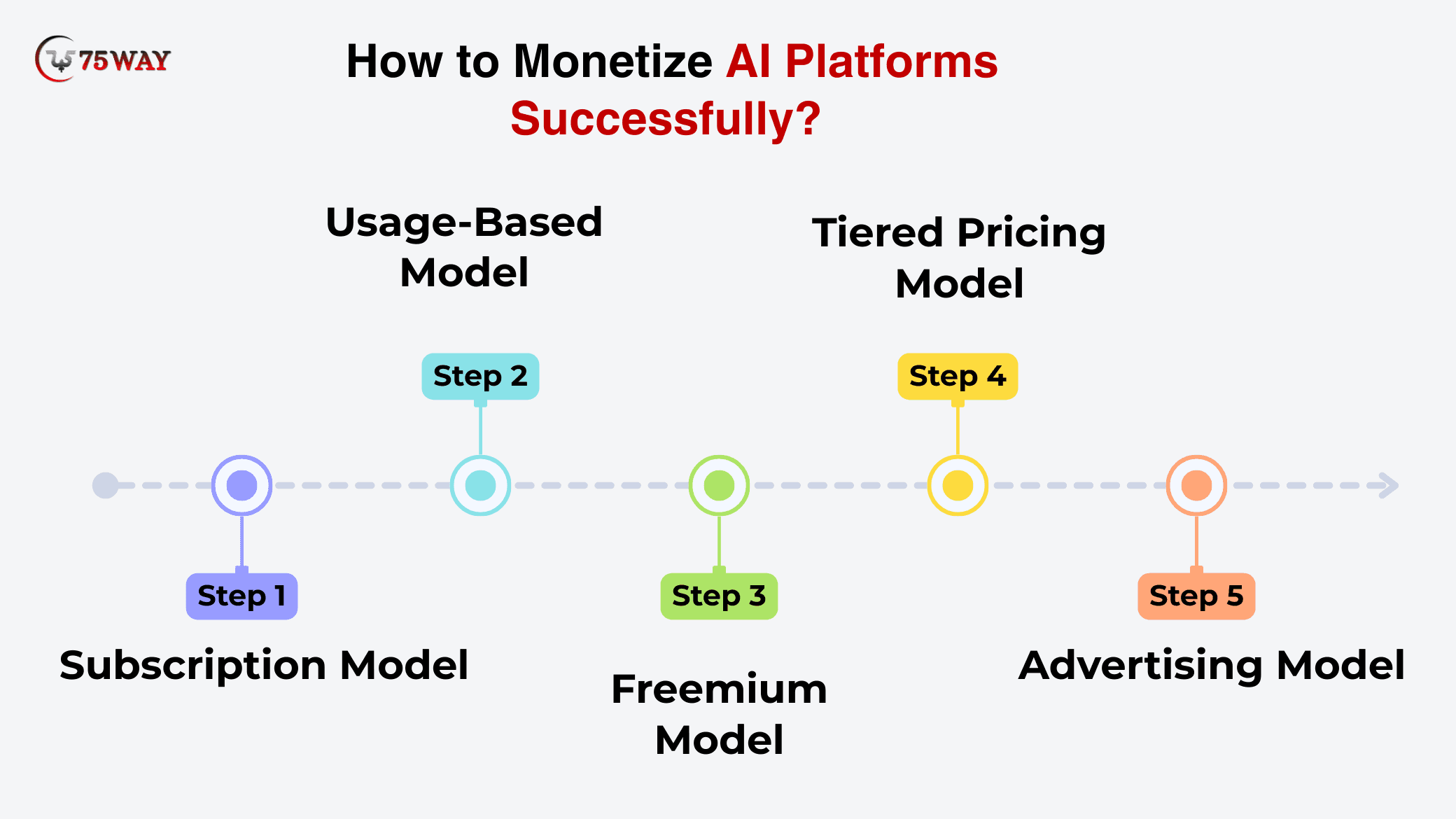
Subscription Model: Recurring subscriptions provide predictable income by offering continuous access to AI services. Customers receive regular updates and consistent value, which encourages loyalty. Businesses benefit from stable revenue streams, enabling better financial planning and long-term investment in platform improvements.
Usage-Based Model: A consumption-based pricing model charges users according to the resources they utilize, offering fairness and flexibility. This method adapts to changing demand and encourages efficient use of AI capabilities. Companies capture revenue from both light and heavy users, maintaining profitability as the platform grows.
Freemium Model: A free tier attracts a wide audience while premium features drive monetization. Users develop familiarity and confidence in the system before upgrading to paid plans. Over time, some free users transition to paid tiers, increasing revenue and strengthening engagement with the platform.
Tiered Pricing Model: This revenue model provides multiple service levels that match different user needs and usage intensity. Businesses can address diverse customer segments and create incentives for upgrades. The approach maximizes earning potential and delivers appropriate value at every service level.
Advertising Model: Targeted advertisements integrated into the platform generate additional revenue without affecting user experience. Advertisers gain access to relevant audiences, while users continue to receive the platform’s core functionality. This method creates another income stream that complements subscription and premium services.
75way Technologies: Your Partner for Affordable AI Solutions
75way Technologies is a leading AI development company that builds tailored artificial inteligenec solutions based on your business goals and budgets. We focus on providing end-to-end support, from strategy and model selection to deployment and optimization. Its approach helps organizations implement AI efficiently, allowing access to advanced technologies without overspending on unnecessary infrastructure or development.
Our team of AI engineers, UI/UX designers, and testers combines technical expertise with industry knowledge to create scalable, reliable AI systems. Collaboration with clients ensures solutions address real business challenges, improving efficiency, decision-making, and competitive advantage. Flexible pricing and modular solutions make AI adoption accessible for startups, mid-sized companies, and enterprise-level organizations alike.
Learn More: How to Build a Self Driving Car Software: A Complete Roadmap
Final Thoughts
Artificial intelligence development in 2026 represents a strategic investment that drives efficiency, innovation, and competitive advantage across industries. Costs vary widely, influenced by project complexity, model type, data quality, integration requirements, and regulatory compliance. From basic MVP applications to advanced LLM platforms, understanding timelines, hidden expenses, and industry-specific factors helps businesses plan realistic budgets and optimize resources. Companies that align development with clear objectives can maximize ROI, improve decision-making, and deliver meaningful value to users. Looking to transform your business with AI? Partner with a reliable AI development company to create cost-effective solutions tailored to your needs.
Frequently Asked Questions (FAQs)
Why Is AI Development Considered Expensive?
AI development requires advanced technical expertise, extensive datasets, and specialized infrastructure. Building custom models or integrating large language models (LLMs) involves significant computational resources and continuous testing. Additionally, compliance with data privacy, security regulations, and scalability needs adds to development costs. Enterprises must also account for maintenance, retraining, and optimization, making AI a long-term investment rather than a one-time expense.
Can Small Businesses Afford AI Development?
Yes, small businesses can afford AI development with strategic planning. Options like using pre-trained models, outsourcing development, or starting with a minimum viable product (MVP) significantly reduce upfront costs. Modular architectures, cloud-based AI services, and strategic partnerships allow smaller companies to access intelligent solutions without investing heavily in in-house teams or infrastructure.
What Is The Cost To Build A ChatGPT-Like Application?
The cost of developing a ChatGPT-like AI system varies widely, depending on complexity, data volume, and model type. Basic implementations may start around $100,000, while advanced custom LLMs with domain-specific training can exceed $1 million. Expenses include data collection, model training, UI/UX development, integration, infrastructure, and ongoing maintenance.
How Much Does AI Maintenance And Support Cost Annually?
Annual AI maintenance and support typically range from 15% to 25% of the initial development cost. This includes model retraining, system optimization, security audits, bug fixes, and cloud infrastructure updates. Regular maintenance ensures continued model accuracy, performance, and compliance with evolving regulations, safeguarding your AI investment.
Does AI Development Cost Vary By Industry?
Yes, AI development costs vary significantly by industry. Healthcare and fintech AI solutions require strict compliance, secure data handling, and highly accurate models, which in turn drive higher costs. E-commerce or SaaS AI solutions generally have moderate budgets, whereas manufacturing AI solutions often involve IoT integration and real-time analytics, which affect timelines and expenses.
What Are The Hidden Costs In AI Development Projects?
Hidden costs often include model retraining, ongoing optimization, data storage, monitoring, scaling infrastructure, and software licensing. Additional expenses arise from security compliance, third-party API integration, and unexpected operational challenges. Failing to account for these costs can lead to budget overruns and impact long-term ROI.