Summary
Discover how AI transforms startups and businesses with a structured development process, from data strategy and model selection to deployment, monitoring, and governance. Learn key tools, industry use cases, and best practices to optimize performance, drive efficiency, increase revenue, and unlock measurable business value with AI solutions.
Key Takeaways
- AI drives automation, efficiency, and predictive insights for measurable business growth.
- High-quality data is essential to train accurate, reliable, and scalable AI models.
- Selecting the right AI model ensures optimal performance and real-world applicability.
- Deployment, integration, and monitoring maintain AI effectiveness across dynamic business environments.
- Governance, ethics, and compliance reduce risk while building trustworthy AI systems.
- Proper AI implementation increases revenue, reduces costs, and strengthens competitive advantage.
Artificial Intelligence is transforming how startups and business leaders make decisions, automate operations, and create smarter solutions. But diving into AI without a clear roadmap can feel overwhelming. There’s data to manage, models to choose, and integration challenges at every turn. Imagine having a step-by-step framework that simplifies this process, helping you design, build, and deploy AI systems that actually deliver results.
From predictive insights and automation to real-time decision-making, understanding the right AI development process ensures your business stays ahead, scales efficiently, and maximizes ROI. Whether it’s machine learning, deep learning, or GPT-powered solutions, mastering this process turns AI from a complex buzzword into a practical, revenue-driving tool for your company. This blog will answer, what is AI development process? Which technologies are used to develop AI solutions?
What Is AI Development?
AI Development is the methodical process of creating intelligent systems that can learn, adapt, and make decisions from data, tasks that once required human intervention. These systems don’t just follow instructions; they analyze patterns, make predictions, automate processes, classify information, and deliver personalized experiences.
Unlike traditional software that performs the same task repeatedly, AI evolves over time. It improves with usage, adapts to changing data, and becomes smarter, enabling businesses to respond faster, optimize operations, and uncover insights that drive growth. Essentially, AI development transforms raw data into actionable intelligence, turning complex challenges into opportunities for efficiency, innovation, and competitive advantage.
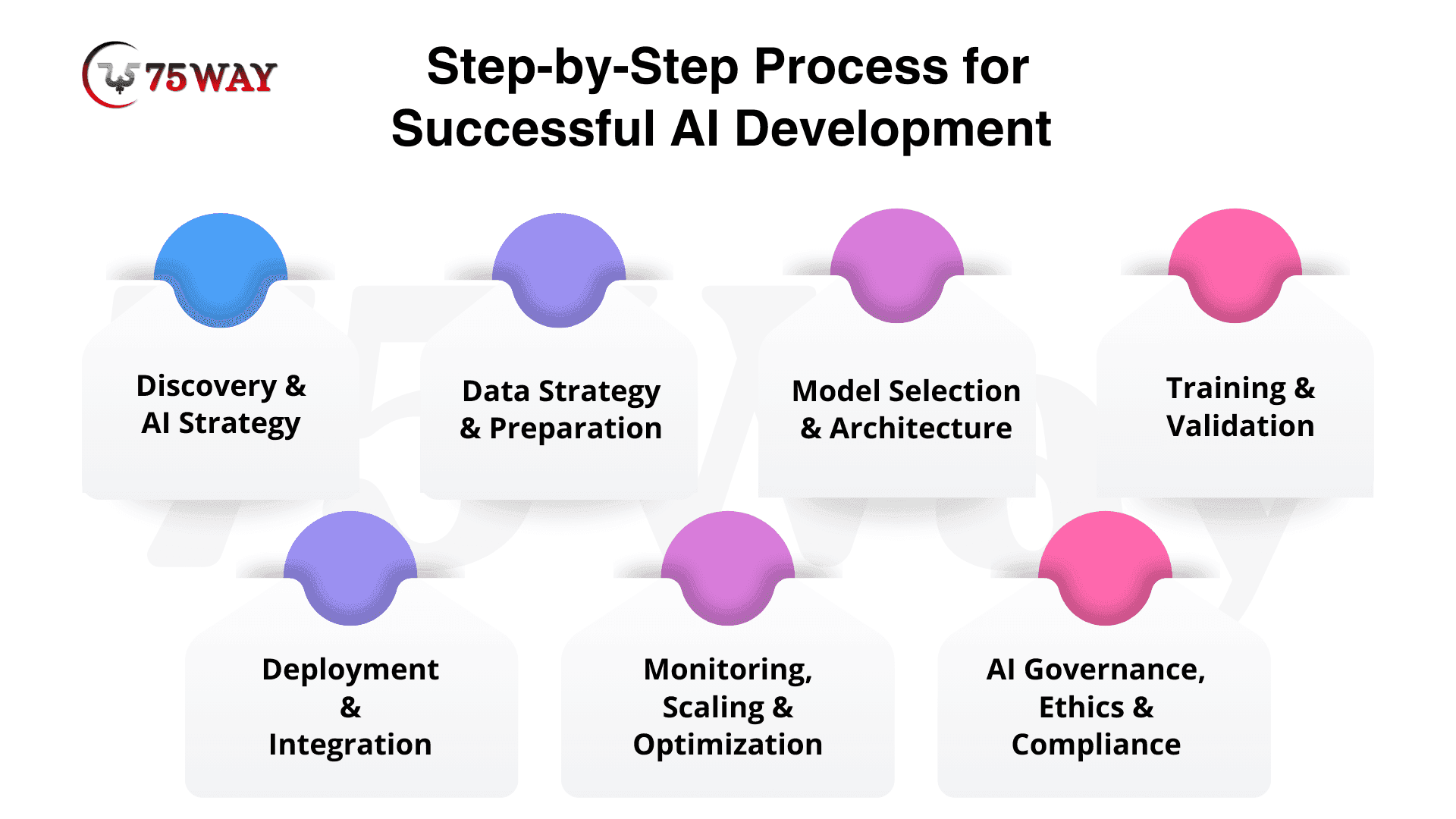
Step-by-Step Process for Successful AI Development: A Complete Lifecycle
The AI development process transforms business ideas into intelligent systems through seven key steps: defining objectives, preparing and managing data, selecting appropriate models, training and validating algorithms, deploying solutions, monitoring performance, and ensuring ethical governance. Following this framework ensures AI delivers measurable value, scalability, and reliable decision-making.
Step 1: Discovery & AI Strategy
The discovery phase identifies where AI can deliver genuine business impact by analyzing challenges, defining objectives, and prioritizing opportunities for automation, prediction, or personalization. A clear strategy ensures resources are focused effectively, guiding measurable outcomes, shaping a practical AI roadmap, and establishing the foundation for successful, scalable AI implementation. Key questions to ask include:
- What business problem are we solving?
- Is the goal automation, accuracy, prediction, or personalization?
- How will success be measured through KPIs?
By answering these questions and setting clear priorities, organizations create a structured approach that minimizes risks, maximizes ROI, and ensures AI initiatives align directly with business goals. This phase transforms abstract ideas into actionable plans, making subsequent data preparation, model selection, and deployment far more efficient and effective.
Step 2: Data Strategy & Preparation
Data strategy and preparation are critical foundations for AI success. This stage ensures that all datasets are accurate, clean, and structured to train models effectively. Proper auditing, labeling, pipeline creation, and quality checks prevent errors, enhance model performance, and guarantee that AI delivers reliable, actionable insights for decision-making.
- Data Audit: Carefully examine all existing datasets to identify gaps, inconsistencies, and missing information. Understanding current data quality and availability ensures accurate AI model training and highlights areas that need enrichment, helping prevent downstream errors and unreliable AI predictions.
- Data Labeling: Organize and annotate raw data accurately for supervised learning. Proper labeling ensures models can identify patterns and relationships correctly, improving AI accuracy and performance. Mislabeling can lead to biased outputs and poor predictive or classification results.
- Pipeline Creation: Design data pipelines to collect, process, and integrate real-time and historical data efficiently. Structured pipelines streamline AI training, allow smooth data flow, and enable scalable deployment while maintaining consistency across all datasets and applications.
- Quality Assurance: Implement checks to maintain data accuracy, integrity, and security. High-quality, validated data reduces errors, ensures model reliability, and safeguards against security or compliance risks, forming a robust foundation for effective AI development and business decision-making.
Step 3: Model Selection & Architecture
Choosing the right AI approach is crucial because the model determines how well your system can learn from data, make predictions, and deliver actionable insights. Selecting the wrong model can lead to poor performance, wasted resources, or biased outputs. Here’s a breakdown of key AI approaches:
Rule-Based Systems: Rule-based AI relies on predefined “if-then” logic to automate tasks. These systems are ideal for simple, repetitive processes, such as sorting emails, processing forms, or automating customer responses. They are fast, easy to implement, and highly interpretable, but lack adaptability for complex or evolving scenarios.
Machine Learning (ML): ML uses historical data to identify patterns and make predictions without explicit programming. It’s suitable for forecasting sales, detecting fraud, or recommending products. ML models improve over time with more data, offering predictive power, but require careful feature selection, data quality, and performance validation.
Deep Learning (DL): DL is a subset of ML that uses neural networks to process large, complex datasets, including images, audio, or video. It excels in tasks like image recognition, speech-to-text, and autonomous systems. DL can learn intricate patterns, but it demands substantial computational resources and large volumes of data for effective training.
Natural Language Processing (NLP) / LLMs: NLP enables machines to understand, process, and generate human language. Large Language Models (LLMs), such as GPT, can perform advanced tasks like content generation, summarization, translation, and conversational AI. These models excel in understanding context and semantics but require high-quality textual data and careful fine-tuning for domain-specific accuracy.
Step 4: Training & Validation
Once the appropriate AI model is selected, the next step is training and validation. This is where your AI truly learns from data. Proper training ensures that the chosen model, whether ML, DL, or NLP/LLM, can interpret patterns, make accurate predictions, and perform effectively in real-world business scenarios.
- Data Splitting: Divide your dataset into training, validation, and testing subsets. Training data teaches the model, validation data tunes hyperparameters, and test data evaluates final performance. Proper splitting prevents overfitting and ensures the model generalizes effectively to unseen data in real-world applications.
- Hyperparameter Tuning: Adjust model parameters like learning rate, batch size, or number of layers to optimize performance. Fine-tuning ensures that the model learns efficiently, balances accuracy with computational cost, and adapts appropriately to the dataset's characteristics.
- Overfitting Prevention: Implement strategies like regularization, dropout, or cross-validation to prevent the model from memorizing data patterns. Avoiding overfitting ensures the AI system performs reliably on new inputs and maintains predictive accuracy in production.
- Business Validation: Test model outputs against real-world business scenarios and KPIs. Aligning AI predictions with actual use cases ensures practical relevance, mitigates operational risks, and confirms that the AI solution contributes measurable value to business objectives.
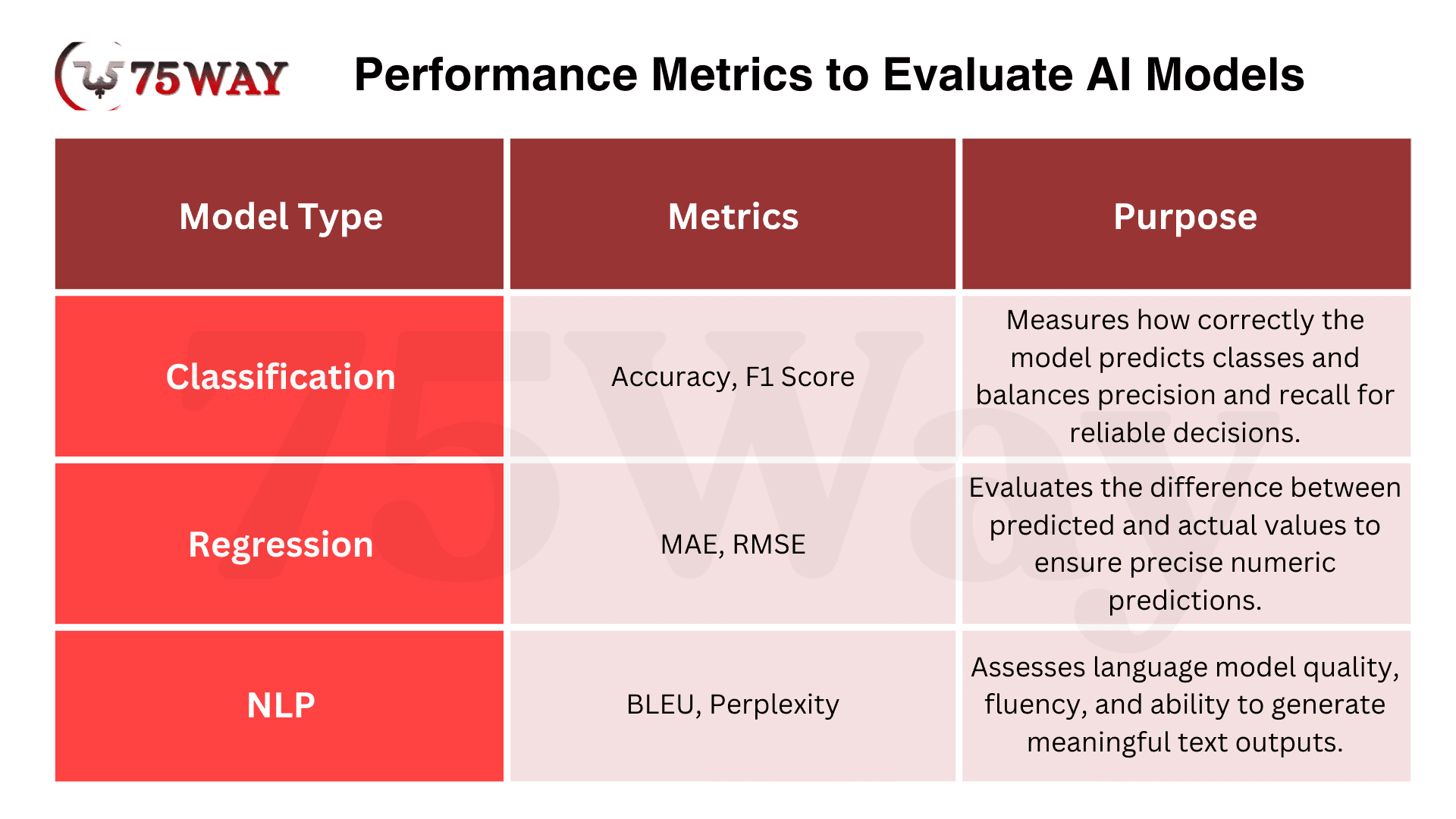
- Performance Metrics: Track model performance using appropriate metrics: Accuracy, F1 Score for classification, MAE/RMSE for regression, BLEU/Perplexity for NLP tasks. Metrics guide iterative improvements and validate that the AI meets business goals.
Evaluating AI models requires tracking the right performance metrics to ensure predictions are accurate and reliable. Different types of models demand different metrics. Using the correct metrics helps validate outcomes, guide improvements, and ensure AI delivers meaningful business impact.
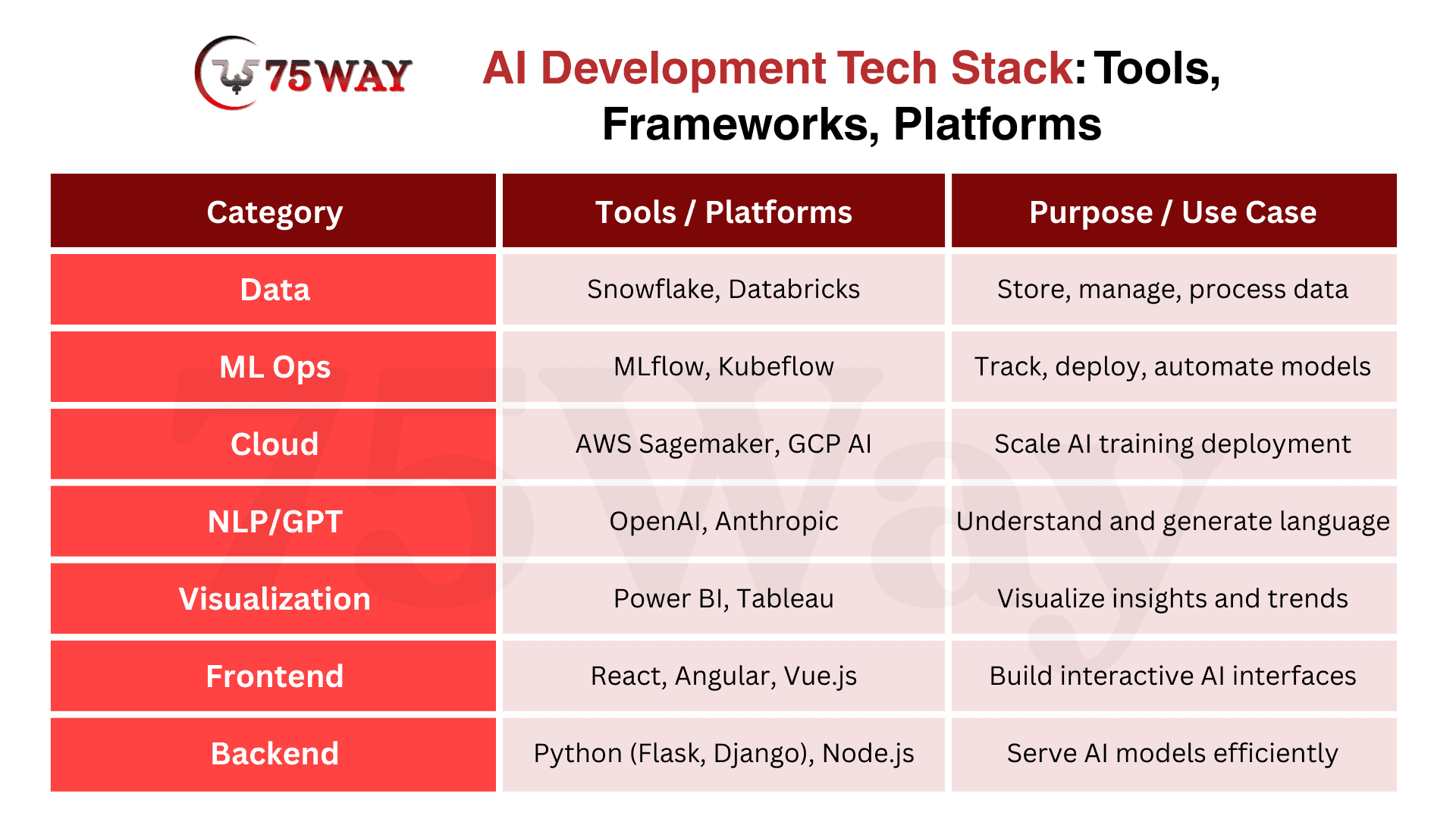
AI Development Tech Stack: Tools, Frameworks, Platforms
A robust AI tech stack combines tools and platforms across data management, ML operations, cloud infrastructure, NLP/LLMs, visualization, frontend, and backend development. Choosing the right stack ensures seamless model development, deployment, monitoring, and integration, enabling businesses to implement scalable, efficient, and high-performing AI solutions that deliver measurable outcomes.
Databases: Platforms like Snowflake and Databricks store, organize, and process structured, unstructured, and streaming data. Proper data management ensures AI models receive clean, high-quality information, forming the foundation for accurate predictions, insights, and effective decision-making in business applications.
ML Ops: Tools such as MLflow and Kubeflow automate model tracking, versioning, deployment, and retraining. ML Ops frameworks streamline AI lifecycle management, improve collaboration, and ensure models maintain accuracy and performance over time, reducing operational risk and accelerating business value delivery.
Cloud: Cloud platforms like AWS Sagemaker and GCP AI provide scalable infrastructure for training, deploying, and running AI models. Cloud services offer flexibility, resource efficiency, and easy integration with existing systems, enabling startups and enterprises to expand AI capabilities rapidly.
NLP/GPT: Tools like OpenAI and Anthropic enable natural language understanding and generation. NLP/LLM platforms power chatbots, automated content creation, sentiment analysis, and conversational AI, allowing businesses to leverage human language processing for engagement, insights, and decision-making.
Visualization: Platforms such as Power BI and Tableau transform AI outputs into visual dashboards, charts, and insights. Visualization helps stakeholders interpret complex model results quickly, supports data-driven decisions, and communicates performance metrics effectively across teams and leadership.
Frontend: Frameworks like React, Angular, and Vue.js build intuitive, interactive user interfaces for AI applications. Frontend development ensures AI tools are accessible, user-friendly, and integrated into web or mobile platforms for seamless business operations and customer interactions.
Backend: Backend frameworks like Python (Flask, Django) and Node.js serve AI models, manage APIs, and handle data processing. Backend development supports model deployment, system integration, and secure business logic execution, ensuring AI applications function efficiently at scale.
Why AI Matters for Startups and Business Owners?
AI isn’t just a technical trend. It is a strategic growth engine that can transform how startups operate, compete, and scale. By integrating AI, businesses can automate processes, uncover actionable insights, and deliver personalized experiences, all while maximizing efficiency, reducing costs, and driving measurable revenue growth.
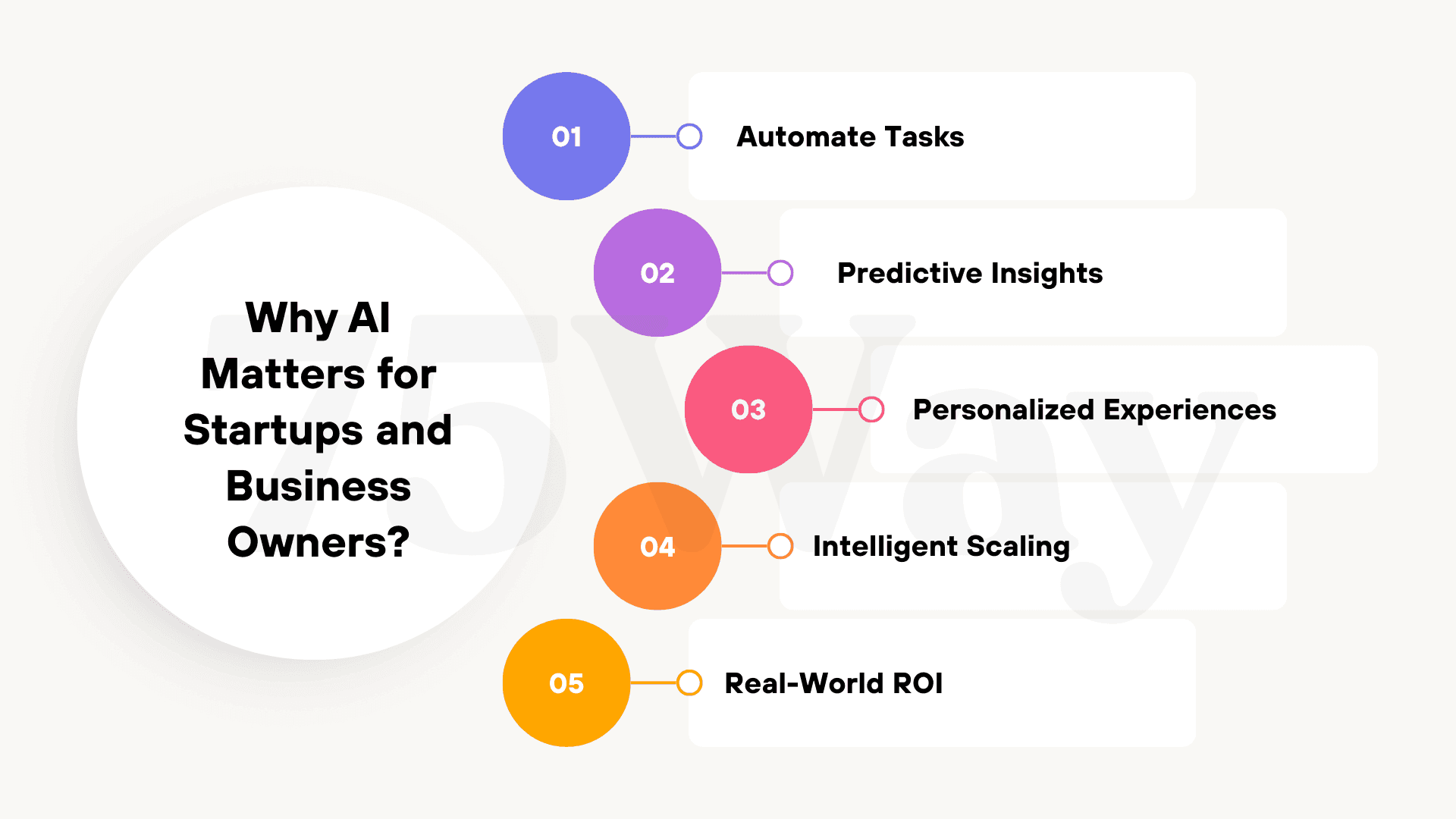
Automate Tasks: AI handles repetitive, time-consuming tasks such as data entry, report generation, and customer queries. Automation saves time, reduces human error, and allows teams to focus on strategic initiatives, improving overall productivity and operational efficiency.
Predictive Insights: By analyzing historical and real-time data, AI models generate forecasts and actionable insights. Predictive analytics helps startups anticipate trends, optimize decision-making, reduce risk, and gain a competitive edge in rapidly changing markets.
Personalized Experiences: AI enables hyper-personalization of customer interactions, from product recommendations to tailored marketing campaigns. Personalization increases engagement, boosts conversion rates, and strengthens customer loyalty by delivering relevant, context-aware experiences.
Intelligent Scaling: AI supports growth without proportionally increasing headcount. Smart resource allocation, automated operations, and predictive planning allow startups to scale efficiently, maintain performance quality, and expand offerings with minimal incremental cost.
Real-World ROI: Effective AI implementation can drive significant business impact, including revenue growth up to 40% and operational cost reductions of around 30%, depending on adoption strategy. Measuring ROI ensures that AI investments deliver tangible, measurable results for startups and business owners.
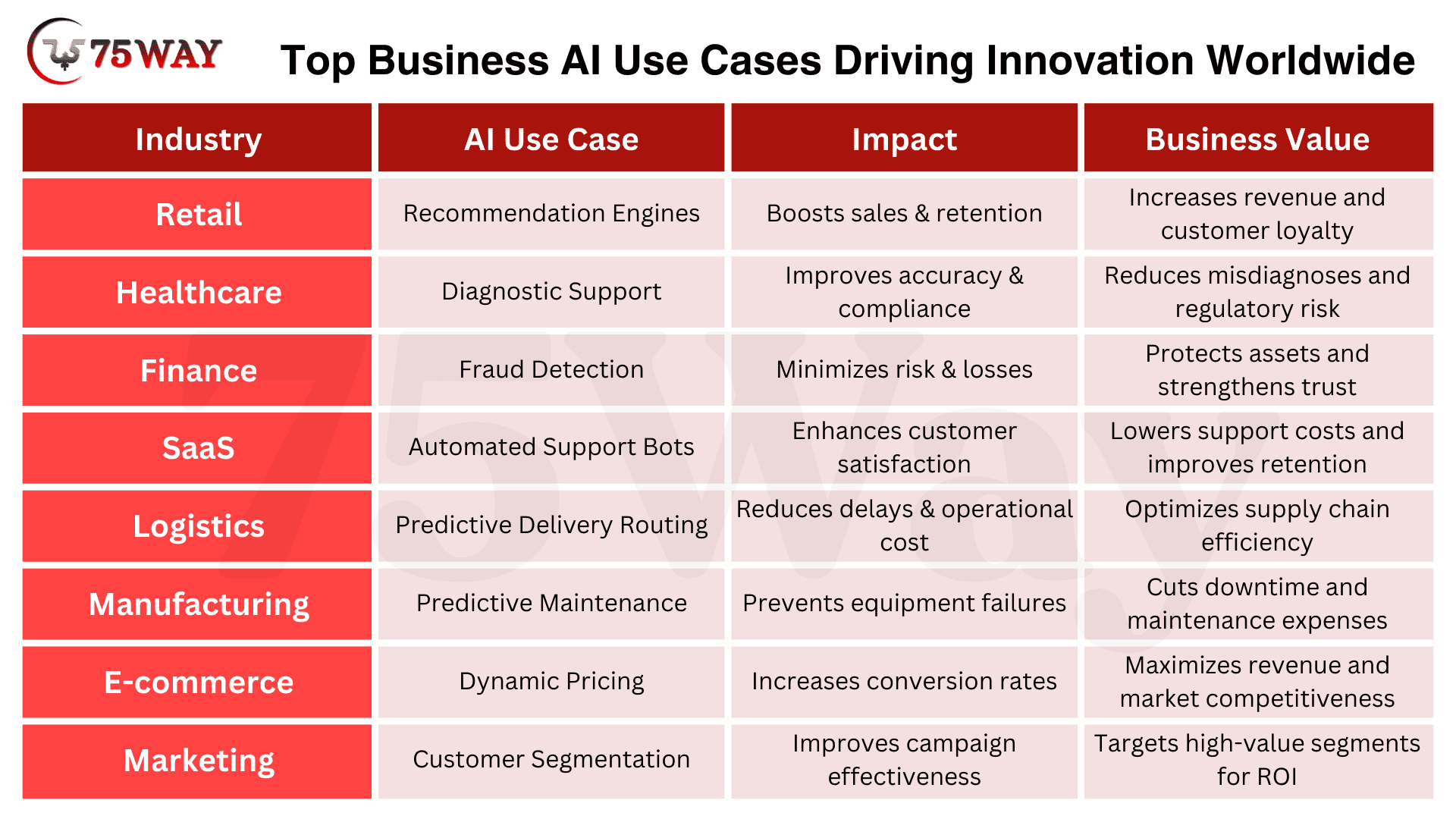
Top Business AI Use Cases Driving Innovation Worldwide
AI is reshaping industries globally, driving innovation, efficiency, and competitive advantage. Businesses leverage AI to automate processes, gain predictive insights, personalize customer experiences, and optimize operations. From retail and healthcare to finance and marketing, these use cases deliver measurable impact, boost revenue, reduce costs, and transform how organizations operate.
Retail AI: In retail, AI transforms shopping by analyzing customer behavior and predicting preferences. Recommendation engines and inventory forecasting increase sales and retention while helping retailers manage stock efficiently. Personalized offerings improve engagement, loyalty, and revenue across online and offline channels.
Healthcare AI: AI in healthcare supports faster, more accurate diagnoses and patient monitoring. AI-powered apps and predictive analytics reduce errors, ensure regulatory compliance, and optimize workflows, enabling medical professionals to deliver better outcomes, improve efficiency, and maintain high-quality patient care standards.
Finance AI: Within finance, AI-driven FinTech apps and platforms detect fraud, automate credit scoring, and power algorithmic trading. It mitigates risk, prevents financial losses, and streamlines operations, helping institutions safeguard assets, maintain compliance, and build trust while improving decision-making and operational efficiency.
SaaS AI: SaaS companies leverage AI to automate customer support, predict churn, and track usage patterns. Intelligent AI chatbots, AI SaaS solutions and predictive models improve customer satisfaction, reduce manual workload, and enable scalable, efficient operations without increasing headcount.
Logistics AI: AI in logistics optimizes delivery routes, fleet management, and demand forecasting. By predicting delays and improving efficiency, AI-powered logistics software lowers operational costs, accelerates shipments, and enhances customer satisfaction, enabling businesses to run smarter and more responsive supply chains.
Manufacturing AI: In manufacturing, AI drives predictive maintenance, quality assurance, and automation. It minimizes downtime, ensures product consistency, and reduces operational costs, helping factories improve efficiency, safety, and profitability while maintaining high standards of production quality.
E-commerce AI: AI powers dynamic pricing, personalized product recommendations, and behavior analysis in e-commerce. AI-powered ecommerce apps and software increase conversion rates, enhance engagement, and drive sales, enabling retailers to target customers effectively and provide tailored shopping experiences that boost revenue.
Marketing AI: AI enhances marketing by segmenting customers, optimizing campaigns, and predicting trends. It improves targeting, increases ROI, and enables marketers to focus on high-value audiences, driving engagement, conversions, and measurable business growth through intelligent, data-driven strategies.