Key Takeaways
- The average cost of enterprise dating app development ranges from $40K to $400K.
- Platform choices directly affect budgets, with U.S. apps costing up to $400K.
- The dating app market continues to grow, projected at $310B by 2030.
- AI-powered matchmaking, video streaming, and live features drive higher costs.
- Modular, cross-platform, and cloud-based architectures help control costs.
- Compliance, privacy, and trust systems are essential for user retention and long-term credibility.
Did you know? More than 240 million new users joined social media platforms last year, which marked an impressive 4.7% growth rate. As social media continues to attain popularity, it has become clear that engagement, retention, and building digital communities are the real growth drivers for businesses. In the U.S. alone, Millennials make up the largest group of social media users, with around 68.5 million people, followed closely by Gen Z at 56.4 million.
This surge in social media users presents significant opportunities for startups and enterprises to enhance their business strategies through digital strategies. Social discovery platforms, including dating app ecosystems, chat apps, and AI-powered girlfriend apps, are now at the forefront of this transformation.
What was once a niche market for dating apps is now a broader digital trend. Consumer brands are gaining visibility in private social networks, which deepen lifetime value by integrating dating and social discovery into larger ecosystems.
So, investing in social media app development is a smarter choice for businesses in 2026. Seems quite exciting? However, this excitement often fades when it comes to the development cost of dating apps.
In 2026, the cost of creating a dating app typically ranges from $40K to $400K, depending on factors such as scalability, functionality, AI integration, and required compliance. This guide highlights a framework for cost breakdowns to develop a dating app, its major factors, and hidden risks to help you understand strategies for allocating your budget for long-term control, rather than a methodology to develop a social media app.
Major Factors Influencing Dating App Development Costs
When your team begins scoping out a social discovery platform, cost planning transitions from simply listing features to understanding the platform's system behavior. The global social networking app market is projected to exceed USD 310 billion by 2030, growing at a remarkable CAGR of 26.2%.
At this point, the primary focus becomes clear: "How much infrastructure, governance, and resilience does your platform need to manage real user behavior at scale?" Below are the key cost drivers that influence the cost of building a dating app at the enterprise level.
Product Scope and Feature Requirements
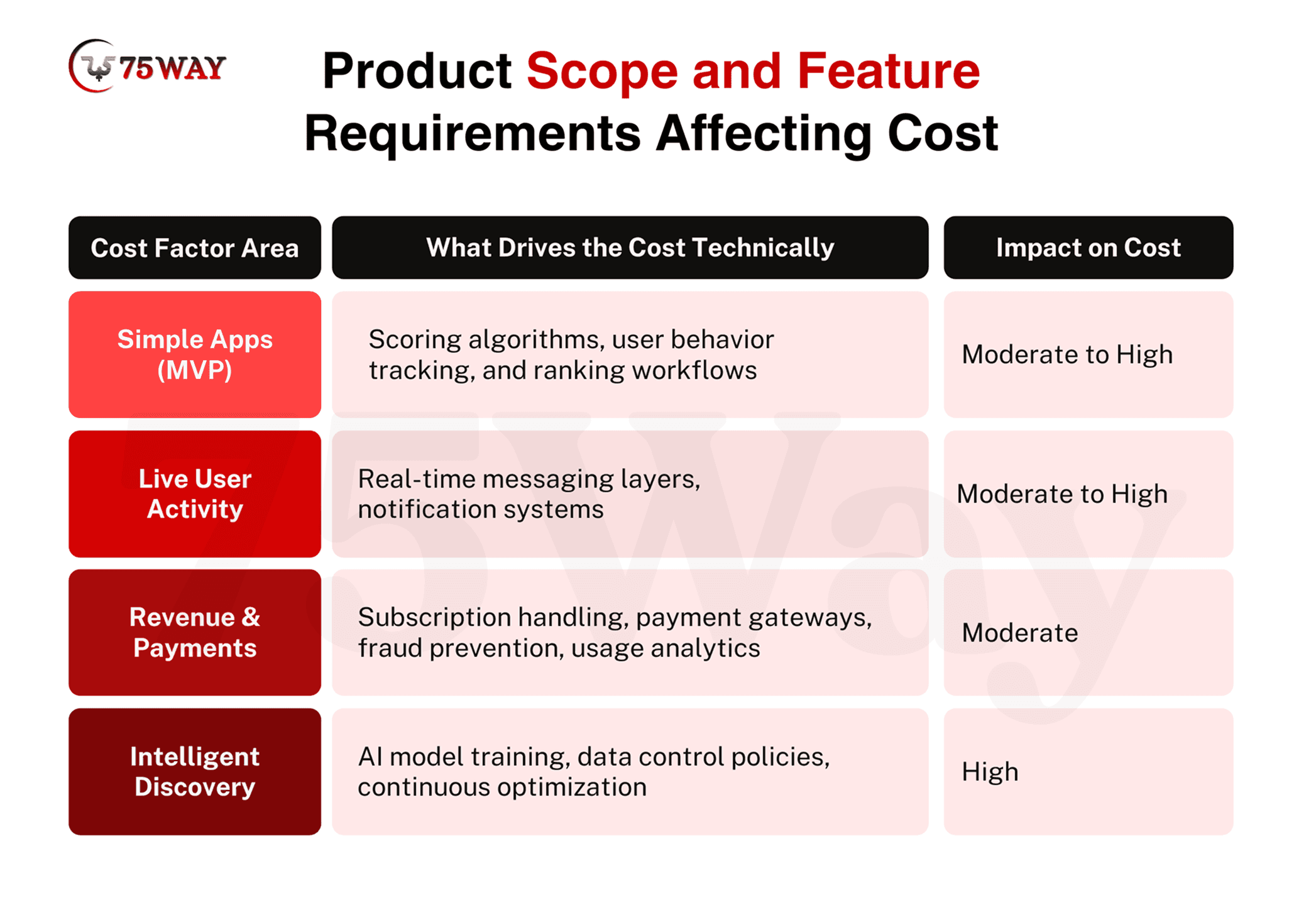
Most dating apps look simple at first, when it comes to their profiles, matches, and chats. However, the costs of creating dating apps rise when the system must respond in real time to user behavior, preferences, and monetization rules.
This is usually where pricing starts to vary. The cost of building a dating app increases with each added feature, especially as complexity grows. Core features are expected, but advanced functionality is what drives the overall development cost. Advanced functionality increases demands on infrastructure, content moderation, and regulatory compliance.
Core User Interaction Components
- Account setup with profile creation and identity checks
- One-to-one messaging with live chat
- Swipe actions and match generation logic
- Preference-based search and discovery settings
- Engagement alerts with push notifications
Engagement And Intelligence Features
- Smart matchmaking with AI recommendations
- Interactive elements like games
- Built-in video and voice communication
- External platform connectivity
- Safety systems with reporting
Moreover, if you enhance the features, the costs for backend coordination, moderation coverage, and long-term maintenance also increase. A more adaptive user experience requires stronger server management, expanded data handling, and higher computing capacity to sustain performance.
Quick Snapshot: How to Build an App Like SpicyChat AI From Scratch
Safety & Moderation Systems Affecting Dating App Budget
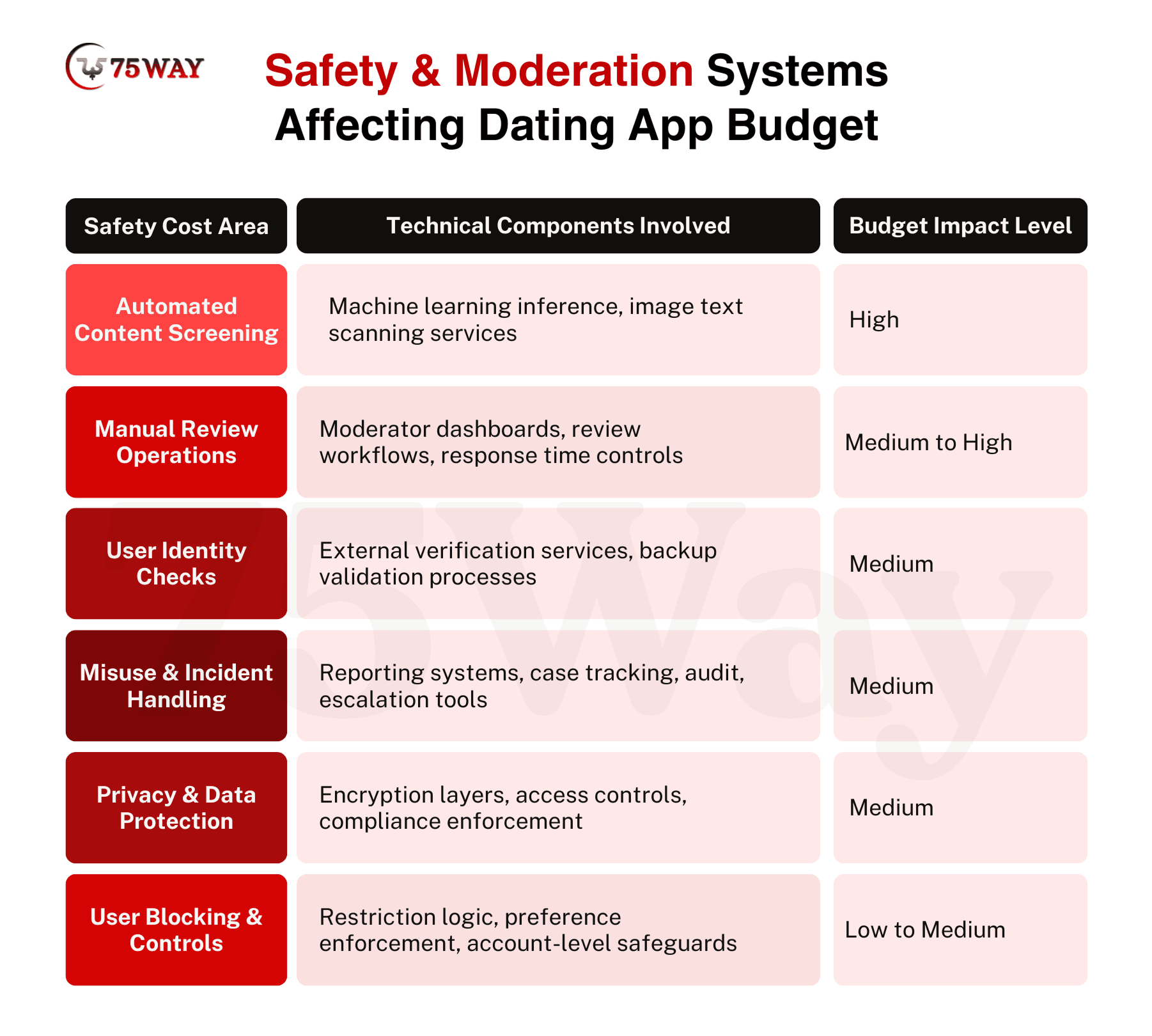
When users interact in real time, safety becomes a major feature. Enterprise-level costs appear when you have to add automated content scanning, human review dashboards, and audit logs, in dating apps. This is where enterprise-grade cost profiles begin. A typical trust and safety setup includes:
- Automated content checks using NLP and computer vision
- Human review dashboards and moderation queues
- Identity and age verification via third-party integrations
- Abuse reporting and case management workflows
- Audit trails for legal and regulatory compliance
At a smaller scale, moderation may be handled in a manual way. At enterprise scale, it grows into a dedicated platform with its own processes, staffing, tools, and analytics.
Read Also: Top 10 IoT Development Companies in USA
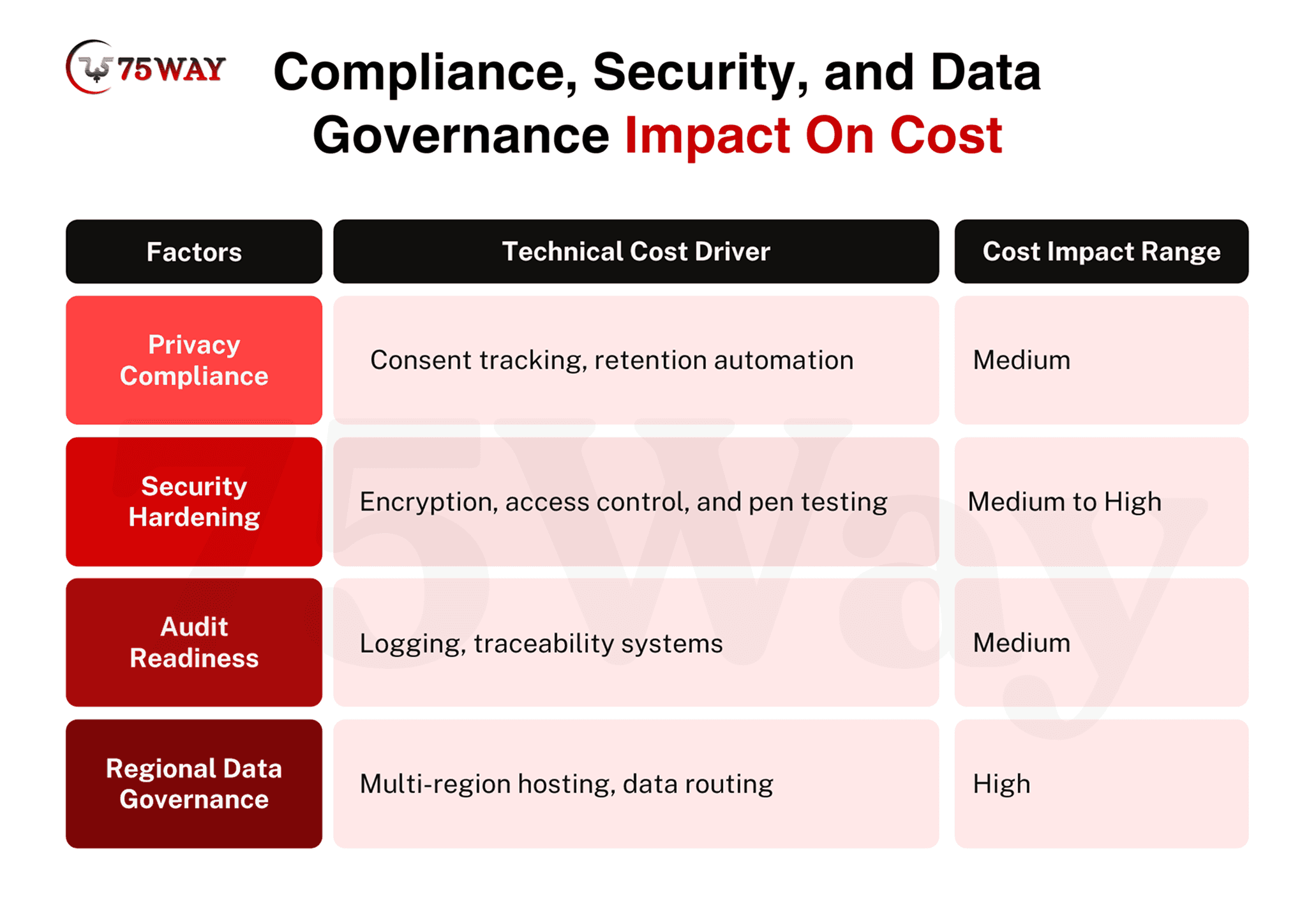
Compliance, Security, and Data Governance Impact
Every dating app that stores personal information carries responsibility from day one. Users trust platforms with identity data, location history, and private conversations, and any lapse can damage credibility. So, regular monitoring and incident response processes are required to maintain compliance and establish user trust across the platform.
- Consent and preference management engines to handle user permissions and settings
- Encryption of data at rest and during transmission for confidentiality
- Role-based access control for internal teams to limit sensitive access
- Automated workflows for data retention and secure deletion processes
- Enforcement of regional data residency rules to meet local regulations
- Audit-ready governance with traceable logs, security testing cycles, and incident response playbooks
Enterprises require audit-ready governance to maintain accountability. These traceable logs, regular security testing, and detailed incident response playbooks help you operate safely, meet regulations, and build lasting user trust.
Know More: Top AI Trends Businesses Must Follow in 2026
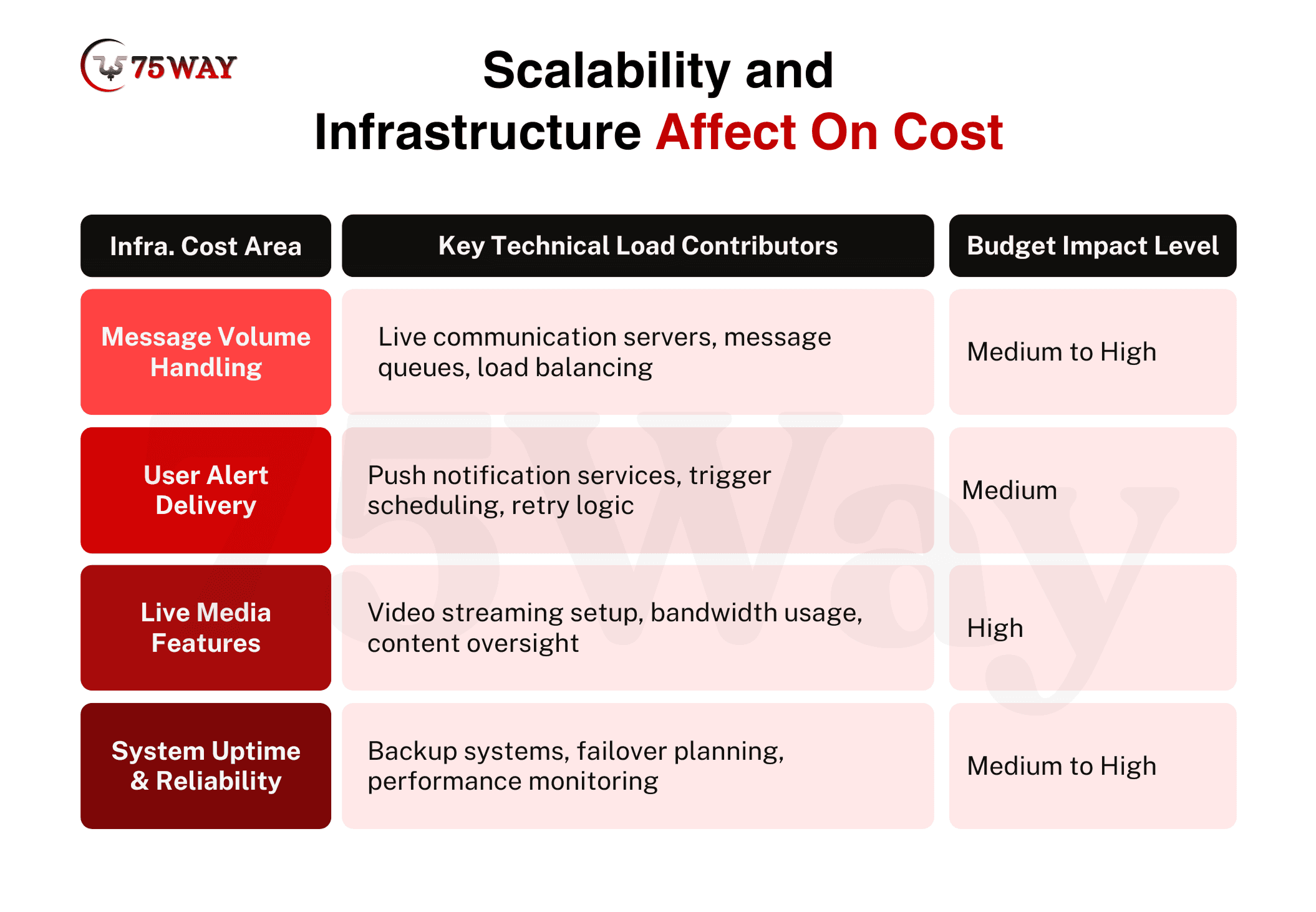
How Do Scalability and Infrastructure Affect Costs?
Social discovery platforms act like complex communication networks where user activity can spike unpredictably. Systems must respond instantly to maintain performance. Scalable architecture and strong infrastructure reduce long-term risks, support growth, and provide reliable experiences. The right technology layers prevent repeated rework and control ongoing development and operational costs.
- Load-balanced microservices to distribute traffic and workloads
- Real-time messaging clusters for seamless user communication
- Notification delivery pipelines to manage alerts and updates
- Auto-scaling compute and database layers for dynamic demand
- Redundancy and failover systems to maintain uptime during failures
Thus, businesses can plan infrastructure early and choose a precise technology stack for scalability and future growth. Regular monitoring and proactive optimization help you prevent costly rework and reduce long-term operational expenses.
The right technologies and tools to develop a dating app play a significant role in controlling development costs. You can utilize cross-platform frameworks like React Native or Flutter to reduce the same work for iOS and Android. On the other hand, reliable backend tools such as Node.js, PostgreSQL, and Redis provide scalable performance. Cloud services and containerized environments minimize infrastructure expenses and lower long-term maintenance.
Cost Overview of Scalability and Infrastructure
Read More: How AI Agents Automate Sales, Support & Operations in US Companies
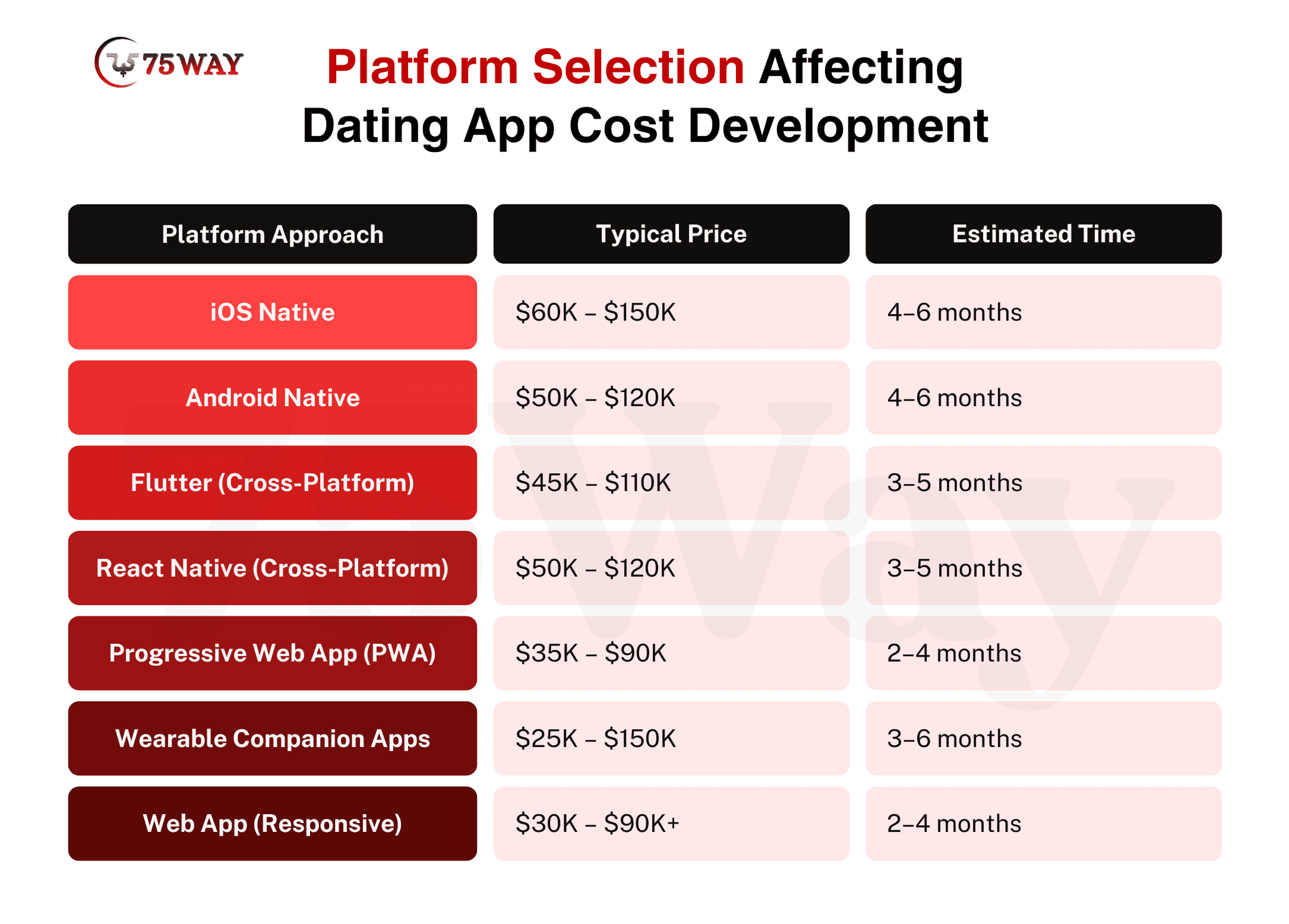
Platform Selection Affecting Dating App Cost Development
Whether you select native or cross-platform to create your dating app, each platform influences costs over time. Thus, you must have a deep understanding of native vs. cross-platform app development. This distinction helps you balance launch expenses and maintain long-term scalability and performance.
In short, native development, such as for iOS, requires a higher initial investment but offers performance tuning as the app grows. On the contrary, cross-platform solutions reduce early development costs and speed up launch, though advanced features like real-time messaging and video may eventually need native optimization.
Read Too: Top 10 Dating Apps in USA in 2026: A Complete Guide
How Revenue Models Impact Platform Development Cost?
Revenue models do more than generate income. They decide the architecture, data flows, and compliance obligations of a dating app. The choice of monetization models directly influences the app development complexity and long-term operating costs. Each revenue model introduces unique technical and regulatory requirements. Different monetisation models that affect the dating app cost are:
Subscription Tiers: Premium access with ad-free experiences requires reliable billing engines, recurring payments, and secure user account management.
In-App Purchases: Virtual gifts, boosts, and special features demand real-time transaction handling and inventory control systems.
Advertising Placement: Sponsored profiles and native ads need targeting logic, consent management, and advanced analytics pipelines.
Affiliate Partnerships: Referral and affiliate programs require secure tracking, commission calculations, and integration with partner APIs.
Third-Party Commissions: Commission models for services outside the platform introduce payment orchestration, currency handling, and compliance monitoring.
Payment Orchestration: Recurring billing across global currencies requires fraud detection, transaction reconciliation, and secure financial workflows.
Therefore, you have to select the accurate monetization strategy. Careful planning of subscriptions, in-app purchases, and third-party integrations can control backend complexity and provide predictable costs for the sustainable growth of the dating platform.
Read More: AI Automation vs AI Agents: A Complete Guide
Cost Distribution in Dating App Development
When you select prototypes, it is time to decide how to allocate the budget. It becomes a key leadership task. Every dollar invested affects not just app features, but also the stability, compliance, and scalability of the platform as usage grows.
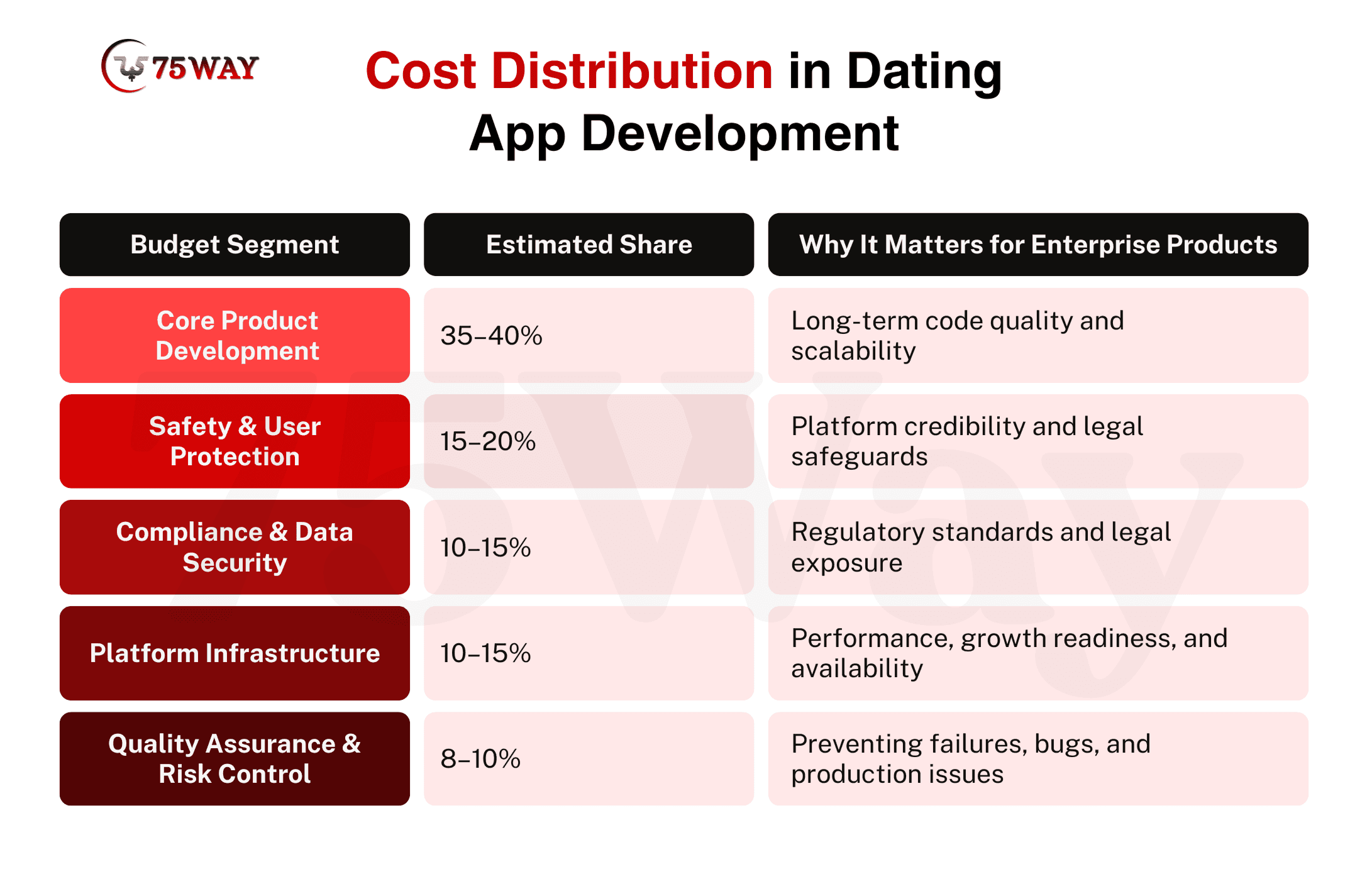
Core engineering covers backend services and platform architecture to maintain adaptability. Trust and safety funding builds user confidence and reduces legal risk. Compliance and security maintain audit readiness, while infrastructure investments support reliability at scale and prevent expensive post-launch issues.
Learn More: How to Build an Astrology App Like Co-Star? A Strategic Guide 2026
Development Timelines and Their Impact on Dating App Cost
Another factor that influnce daying app development cost is project timelines. This factor influences both immediate and long-term expenses. If you need faster delivery, you require more resources and coordination, while staged approaches spread spending over time. Proper planning for compliance, governance, and security avoids costly rework, helps you predict when investments will occur, and maintains control over the budget.
- Parallel Teams: Multiple engineering groups speed up launch but increase short-term spending.
- Phased Releases: Gradual launch reduces initial cost but delays full platform capabilities.
- Compliance Checkpoints: Regular security and regulatory reviews add structured release stages.
- Governance Planning: Delayed oversight leads to rework and potential budget overruns.
Also Read: How to Build an AI-Driven Anonymous Messaging App?
Enterprise-Level Cost Planning for Dating App Platforms
After leadership approves a budget range, finance teams face the next question: how does that figure translate into real project terms? A straightforward cost model provides a practical framework that helps teams plan, allocate resources, and anticipate investments across development, infrastructure, and operations. You can compute the enterprise dating app cost with below gicven equation.
Total Cost = App Complexity × Hourty Charges × Key Development Phases +
Infrastructure + Governance
Quick Read: How to Build An AI App: A Strategic Guide 2026
Quick Breakdown of Dating App Development Costs
Not only that, you have to understand more cost components at a glance, making your budget planning more practical. This overview helps you decide the spending of resources across product design, core engineering, trust and safety, and operational systems. Hence, you can plan resources and anticipate both development and long-term platform expenses effectively.
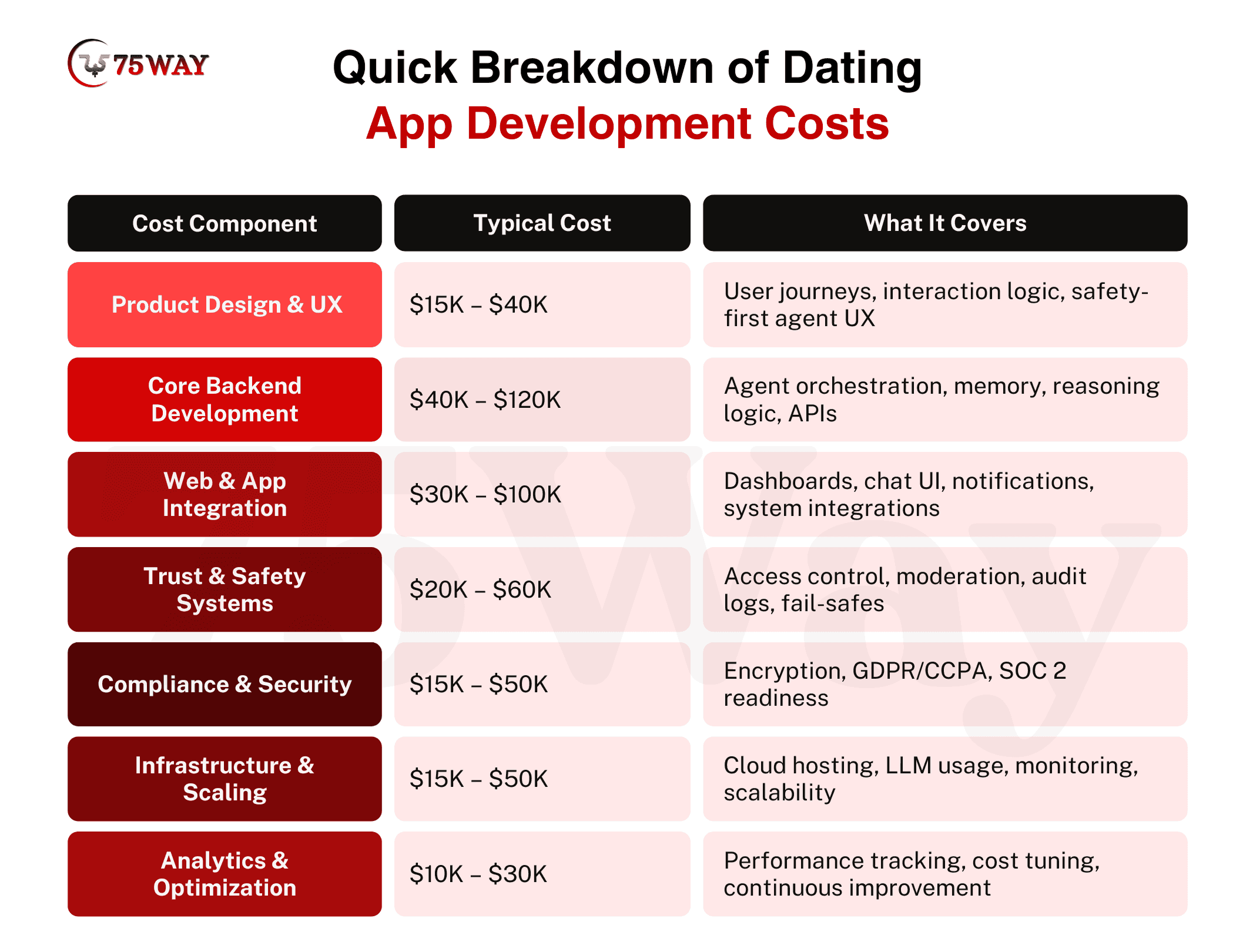
Leading platforms like Tinder, Bumble, Grindr, and Hinge operate with high system complexity. Their cost structures cover ongoing backend development, scalable APIs for real-time messaging, and optimization for in-app purchases and user engagement.
For enterprise-grade apps, dating app development is treated as a multi-year investment rather than a one-time MVP development cost. This approach provides continuous improvements, long-term scalability, and the ability to adapt to growing user demands while maintaining reliability and performance.
Know More: How AI Development Helps US Companies Scale Faster
Dating App Variants and Their Cost Impact
Every dating app comes with its own cost considerations. There is a huge difference between building a dating app for a startup and for enterprise-level platforms, where higher intelligence, real-time interaction, and governance become essential as user numbers grow.
Globally, around 3.6 billion people actively use social media, and over 9 in 10 adults (18+) engage with at least one platform regularly. From simple swipe-based apps to feature-rich social matchmaking platforms, designs, backend complexity, and compliance needs directly influence development budgets.
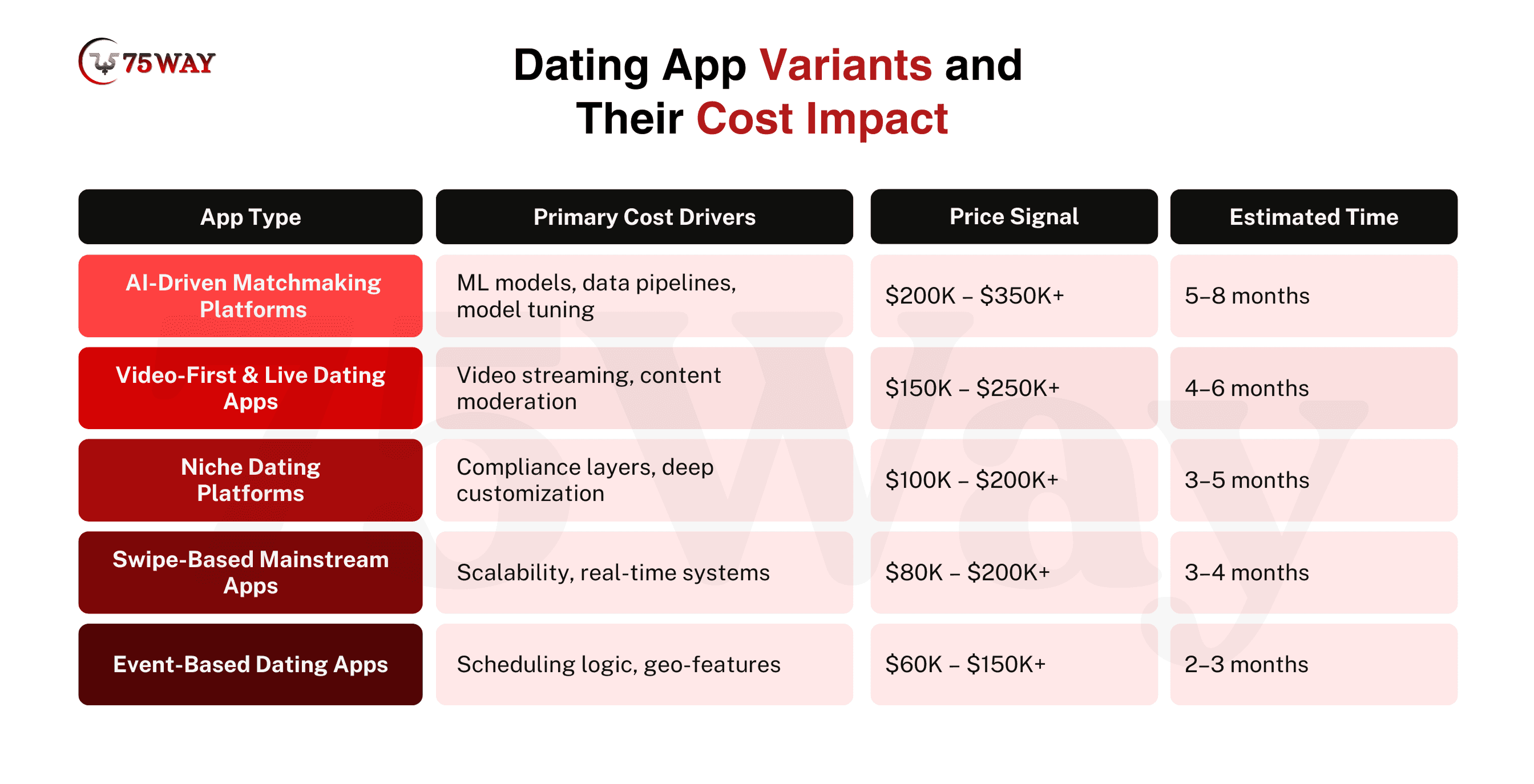
The dating and matchmaking apps powered by artificial intelligence usually require the largest investment because they rely on continuous model updates, data management, and governance processes. Further, platforms based on video streaming demand extra spending on streaming and moderation. Niche apps focus on tailored features and regulatory compliance, swipe-based apps prioritize real-time performance, and event-based apps concentrate on scheduling and location. The product type ultimately sets the starting point for development costs.
Read More: Best AI Development Companies in United States in 2026
Geographical & Regional Cost Differences in Dating App Development
When planning a dating app rollout, location plays a major role in affecting costs. Building, hosting, and managing the platform in different regions can lead to significant variations in investment. Local regulations, availability of skilled developers, infrastructure pricing, and moderation standards all influence the overall budget.
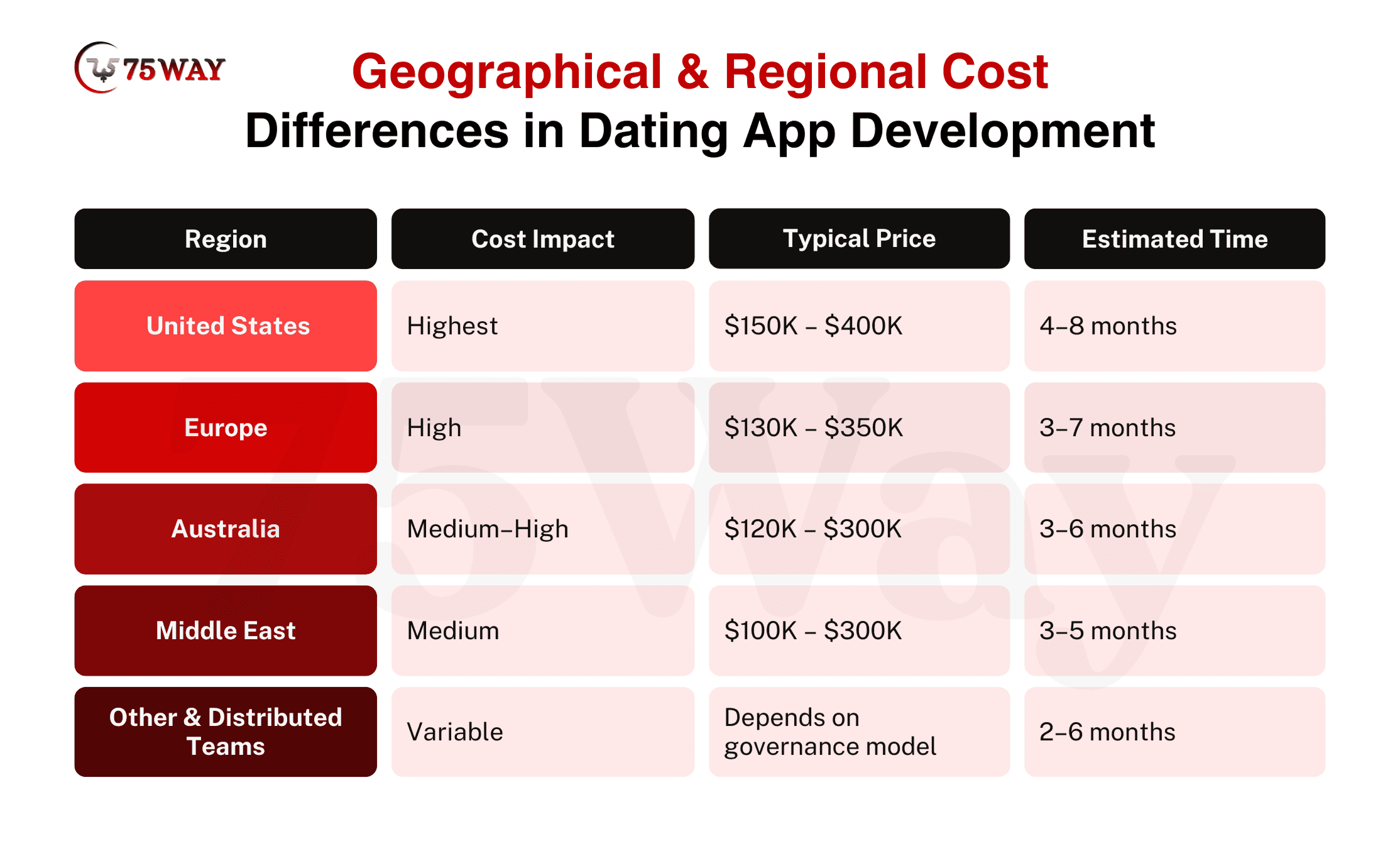
United States: If you want to build and launch a dating app in the United States, it comes with one of the highest cost profiles globally. Premium engineering talent, combined with privacy laws and active litigation risk, requires continuous investment in safety and security systems to maintain platform reliability and user confidence.
Regulatory requirements and high operational standards add further pressure on budgets. Platforms must plan for disaster recovery, advanced moderation workflows, and intensive security audits to meet both legal and user expectations, making enterprise-scale development in the U.S. a significant long-term investment.
Primary factors driving development costs:
- State-level privacy regulations and CCPA compliance
- COPPA enforcement and strict age-gating systems
- Advanced trust and safety tools with escalation workflows
- High-availability and disaster recovery infrastructure
- Intensive security audits, penetration testing, and legal review cycles
Middle East
Developing a dating app in the UAE and the broader Middle East offers a strong balance between capability and cost. The development team is growing more skilled, while regulatory frameworks for social platforms remain less strict than in Western markets, allowing enterprises to build scalable platforms without immediate heavy compliance burdens.
This region provides opportunities to launch feature-rich apps while managing budgets effectively. Companies can focus on platform growth, user engagement, and operational stability before full-scale regulatory demands increase, making it a practical choice for cost-conscious enterprises seeking long-term expansion.
Primary factors driving development costs:
- Local data residency requirements in select markets
- Cultural sensitivity in content moderation and review policies
- Regional payment gateway and telecom integrations
- Arabic language processing for discovery and safety systems
Australia
The cost for dating app development in Australia is nearly twice as much as in the Middle East. Higher engineering wages, combined with stricter privacy regulations, drive increased investment in both development and ongoing platform operations. Enterprises must plan for early compliance and robust infrastructure from the start.
The regulatory environment demands careful attention to data protection and age-verification processes, making upfront spending essential. Companies operating in Australia need to account for legal reviews, cloud hosting, and local app store requirements to keep the platform secure, reliable, and fully compliant.
Primary factors driving development costs:
- Privacy Act compliance and consent management systems
- Mandatory age verification and identity validation workflows
- Higher cloud hosting and infrastructure operating costs
- Local app store compliance and review requirements
Europe
Developing a dating app in the UK and Europe typically costs more than in Australia. GDPR affects nearly every aspect of data handling, driving enterprises to invest heavily in consent management, audit readiness, and region-specific hosting to minimize regulatory exposure.
The focus on privacy and governance adds upfront and ongoing expenses. Platforms must plan for multilingual support, regional customer service, and consumer protection measures, ensuring operations remain secure, compliant, and scalable across multiple European markets.
Primary factors driving development costs:
- GDPR compliance, including consent, retention, and deletion automation
- Regional data residency and cross-border data routing controls
- Audit-ready governance documentation and traceability
- Multi-language localization and regional support structures
- Strong consumer protection enforcement
Other & Distributed Teams
Some enterprises manage development budgets by leveraging distributed or remote engineering teams. This approach can reduce base engineering costs, offering a more flexible and cost-efficient way to build and maintain a dating platform.
However, distributed models introduce new expenses, including coordination across time zones, cross-region compliance management, and communication overhead. Geography impacts more than just labor rates. It also shapes infrastructure planning, governance workflows, and long-term operational costs for enterprise-scale platforms.
Discover More: Top AI Agent Development Companies in USA in 2026
Build Vs Customize Dating App: Enterprise Cost Impact
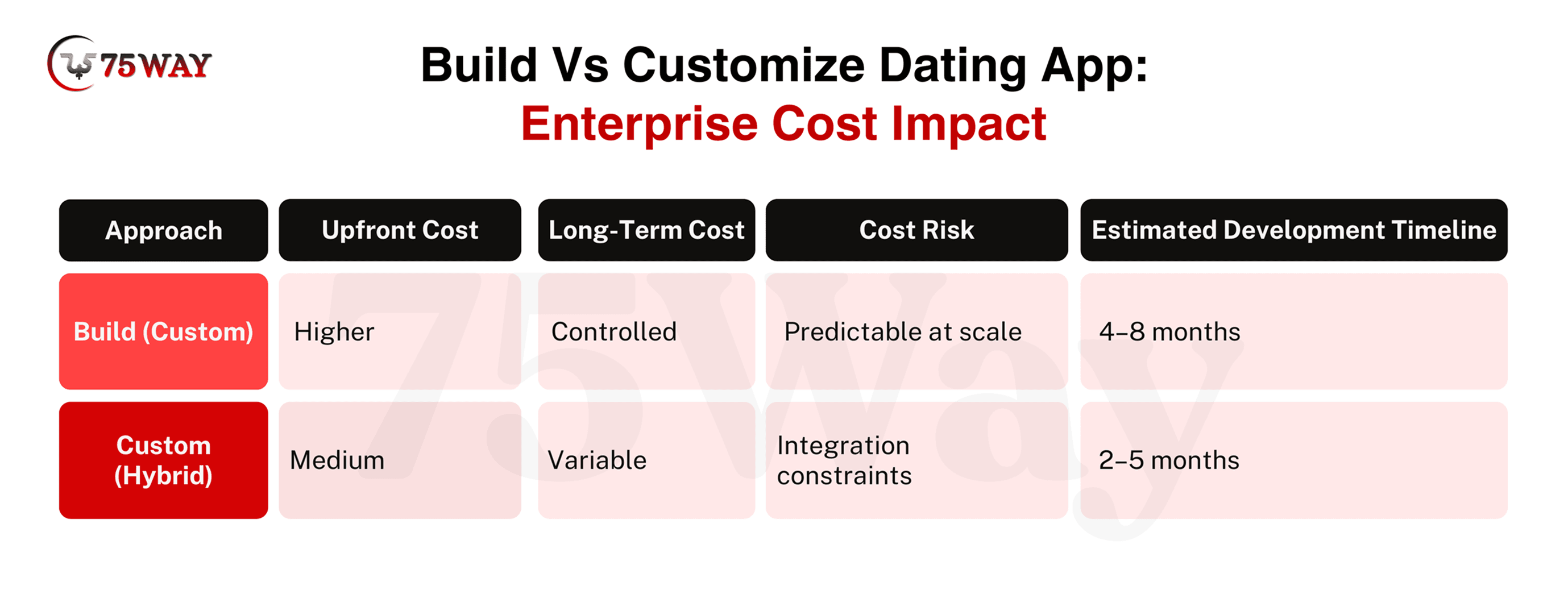
The next factor in deciding on budget planning to create a dating app is to decide between a build and a custom solution. A dating app development from scratch or customizing an existing solution significantly affects both short-term and long-term costs. Each approach has trade-offs in speed, flexibility, and scalability, shaping the platform’s investment profile.
Custom development requires a higher upfront investment but offers full control over architecture, compliance, and scaling. Enterprises can design the system to meet specific governance standards, integrate advanced features seamlessly, and adapt over time without facing integration limitations. Hybrid or white-label platforms lower initial spending and accelerate launch, but they may introduce integration challenges and hidden costs as the platform grows. Long-term scalability, feature flexibility, and governance control can be limited compared to fully custom builds.
Get More Insights: How to Build IoT Apps in 2026: A Guide for Startups, Founders & Business Owners
Unexpected Costs Businesses Don’t Plan For
Even well-planned dating app projects face unforeseen expenses. Regulatory updates, feature adjustments, third-party integrations, and user support can increase budgets beyond initial estimates. Enterprise teams must include contingency planning to manage surprises and ensure platform stability, compliance, and long-term scalability without compromising user experience or growth.
At 75way, our team successfully developed a feature-rich dating platform for a U.S.-based startup. By integrating AI-driven matching, secure messaging, and real-time video features, we delivered a scalable solution while optimizing development costs. Continuous compliance, moderation workflows, and cloud infrastructure ensured long-term reliability and user trust, highlighting our expertise in enterprise-grade dating app development.
Learn More: How To Develop A Mobile App in 2026: Complete Guide
What Is Total Cost of Ownership (TCO)?
Total Cost of Ownership (TCO) for a dating app is the complete cost of building, launching, and operating the platform over time. Most cost discussions end once a dating app is launched, but the real enterprise cost begins after the final launch. Users generate data, moderation queues expand, compliance checks repeat, and infrastructure scales. This is where the ownership cost becomes critical, especially at mass-market adoption levels. A practical TCO perspective separates early build spend from long-term operational commitments:
Build Cost: Covers engineering, architecture, and initial compliance setup.
Operational Cost: Includes hosting, moderation, security, and continuous optimization cycles.
Year-1 Spend: Product-heavy, focusing on core platform launch and stability.
Year-2 & 3 Spend: Scale-heavy, focusing on system reliability, moderation, and compliance.
Enterprises plan controlled cost expansion to avoid reactive re-architecture and unexpected overspending.
Read Too: How to Build an Astrology App Like Astra in 2026: Step-by-Step Guide
How To Optimize Dating App Development Costs Safely?
Enterprise costs enhancement is about timing and focus rather than reducing spending. Investments in the right platform layers prevent costly rework while maintaining compliance, trust, and scalability. Strategic planning allows teams to grow features, infrastructure, and governance in stages, balancing risk and efficiency across the project lifecycle.
Modular Architecture: Core systems like messaging, matching, and data storage remain separate from feature layers such as AI recommendations or gamification. This separation allows new features to launch without affecting critical infrastructure, reducing downtime and costly rework.
Phased Regional Launch: To launch your app in selected regions first helps validate demand before global rollout. This approach lowers upfront compliance, moderation, and infrastructure costs while enabling improvements to features based on real-world feedback and usage patterns.
Feature Gating: You can restrict access to advanced features during early releases to keep initial development focused and budget-friendly. Essential functionalities are prioritized first, and advanced capabilities are introduced gradually as adoption grows, avoiding overbuilding too soon.
Automation in Moderation & Trust Systems: AI-powered moderation pipelines and automated identity verification reduce manual workload while maintaining safety and compliance. Escalation workflows minimize operational risks and enable platforms to scale without proportional increases in staffing costs.
Cloud-Based Scalable Infrastructure: You can deploy cloud platforms with auto-scaling compute, microservices, and event-driven systems that allow resources to match demand. Platforms avoid over-provisioning costs while managing sudden traffic spikes efficiently without expensive infrastructure rework.
Data-Driven Decisions & Analytics: Continuous monitoring of user behavior, engagement, and system performance informs targeted optimizations. Insights prevent reactive fixes, anticipate scaling needs, and reduce long-term operational costs through proactive planning and measurement.
Compliance-First Design: In dating app development, integrating privacy, consent, and regulatory rules from the start prevents post-launch legal challenges. Platforms maintain GDPR, CCPA, or regional compliance while avoiding costly rework, redesign, and potential fines.
Partnering With Experienced Vendors: You can collaborate with a seasoned development team ensures scalable architecture, mature engineering, and governance discipline. Hidden costs are minimized, time-to-market improves, and enterprise platforms achieve reliability, compliance, and growth readiness.
Quick Read: AI Agent Developer: Multi-Agent System in Azure AI Foundry
How Does 75way Deliver Cost-Effective Dating Apps?
75way helps businesses create smart and cost-effective dating app development solutions. By combining flexible architecture, built-in compliance, and cloud-based infrastructure, platforms launch faster, handle growth smoothly, and stay secure, all while keeping long-term expenses under control.
With over 10+ years of experience, 75way delivers enterprise-grade dating apps that scale reliably. Our dating app development teams anticipate challenges, reduce development risks, and implement solutions that save clients time and lower long-term operational costs.
We deploy cloud platforms with auto-scaling compute and microservices to align resources with real-time demand. This prevents over-provisioning, reduces hosting costs, and provides flexibility to handle traffic spikes efficiently, supporting both growth and reliability. We also separate core systems from advanced features that allow updates or new functionalities without disrupting existing operations. This approach minimizes downtime, lowers infrastructure risk, and enables platforms to evolve with user growth and changing market demands.
Final Thoughts
To conclude, building a successful dating app requires more than just coding features. The development cost depends on platform choice, scalability, infrastructure, compliance, engagement models, and long-term operational planning. Startups and businesses can make strategic decisions in architecture, moderation, and technology stack help control expenses while delivering secure, engaging experiences. If you are looking for a cost-effective, scalable dating app, partner with a reliable dating app development company like 75way for faster time-to-market and growth.
FAQs
What Factors Influence Dating App Development Costs The Most?
Platform choice, feature complexity, AI integrations, cloud infrastructure, compliance, moderation systems, and scalability all shape overall investment. Advanced features or real-time interactions increase costs.
Is Building A Custom App More Expensive Than A White-Label Solution?
Custom builds have higher upfront costs but offer full control over architecture, compliance, and scalability. White-label or hybrid solutions reduce early spend but may introduce limitations and higher long-term integration costs.
How Does Geography Affect Dating App Development Costs?
Regional factors like talent availability, regulatory requirements, infrastructure pricing, and moderation expectations influence budgets. The USA typically represents the highest investment tier for enterprise-grade platforms.