Summary
Enterprise AI development enables organizations to transform large-scale data into intelligent systems that automate processes, enhance decision-making, and drive operational efficiency. This resource explains enterprise AI architecture, development lifecycle, essential technologies, implementation challenges, and cost considerations, providing a clear understanding of building scalable AI solutions across modern enterprises.
Key Takeaways
- Enterprise AI development automates processes and scales operations.
- The global enterprise AI market may exceed $150 billion by 2030, growing rapidly.
- Building enterprise AI solutions can cost between $20,000 and $1M+, based on needs.
- Successful enterprise AI systems require strong data infrastructure, architecture, and governance.
- A pilot-to-production strategy ensures AI models deliver measurable business impact.
- Enterprise AI development lifecycle includes strategy, data preparation, model development, and optimization.
Businesses today are sitting on massive amounts of data, but turning that data into actionable decisions remains a challenge. That is where enterprise AI development comes into the light. Companies are using artificial intelligence to predict trends, automate operations, and uncover insights that were previously nearly impossible to see. You know what the problem is behind?
Many organizations start strong with AI experiments but struggle when it’s time to scale those ideas across the entire business. Moving from a promising pilot project to a reliable enterprise system requires the right strategy, infrastructure, and strategic AI development approach.
When done right, enterprise AI can transform how businesses operate and compete. In this guide, we will explore how businesses successfully build, deploy, and scale enterprise AI solutions for long-term impact.
What Is Enterprise AI Development?
Enterprise AI development is the process of designing, building, deploying, and scaling artificial intelligence solutions for large organizations. Unlike small standalone AI tools, enterprise AI systems are built to work within complex business environments, integrating with existing software, large datasets, and critical operational systems. These AI automation solutions help businesses automate processes, analyze massive amounts of data, and generate insights that support faster and more informed decision-making across different departments.
In simple language, when an e-commerce app or platform suggests products based on previous searches or purchases, AI is quietly analyzing behavior and patterns in the background. In a similar way, enterprises use AI systems to study large volumes of business data and generate insights that guide smarter operational and strategic decisions.
Enterprise AI development often involves technologies such as machine learning models, natural language processing systems, computer vision applications, generative AI tools, and predictive analytics platforms. Together, these technologies process both structured and unstructured data while delivering real-time intelligence that improves efficiency, customer experiences, and long-term business strategy.
Enterprise AI Vs Traditional AI Solutions: Comparative Analysis
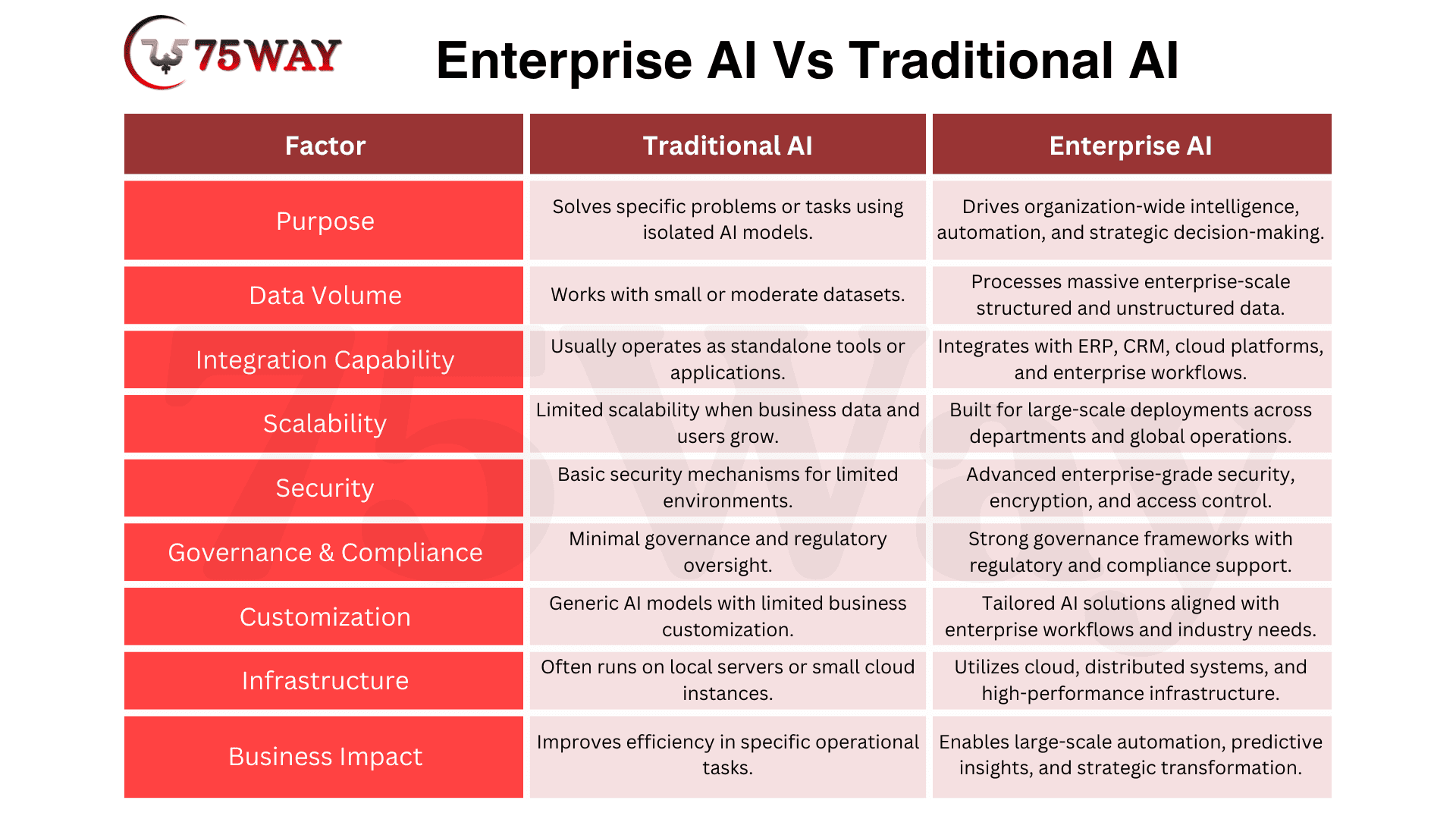
Artificial intelligence can be implemented in many ways, but not all AI systems are built for large-scale business environments. Traditional AI solutions are often designed for specific tasks or small-scale applications. They usually operate as standalone tools with limited datasets and minimal integration with other systems.
Enterprise AI solutions, on the other hand, are developed to function within complex organizational ecosystems. They are built to process massive volumes of structured and unstructured data while integrating with enterprise platforms such as ERP, CRM, and cloud infrastructure.
Because of this broader scope, enterprise AI systems focus on scalability, security, and continuous performance monitoring. This allows organizations to deploy AI across departments, support real-time decision-making, and maintain consistent performance as business operations grow and evolve.
Enterprise AI Development Lifecycle: Key Stages Explained
When you are building enterprise-grade AI systems, it involves multiple stages that ensure reliability, scalability, and long-term performance. A structured lifecycle helps you transition from conceptual AI initiatives to enterprise-wide deployment.
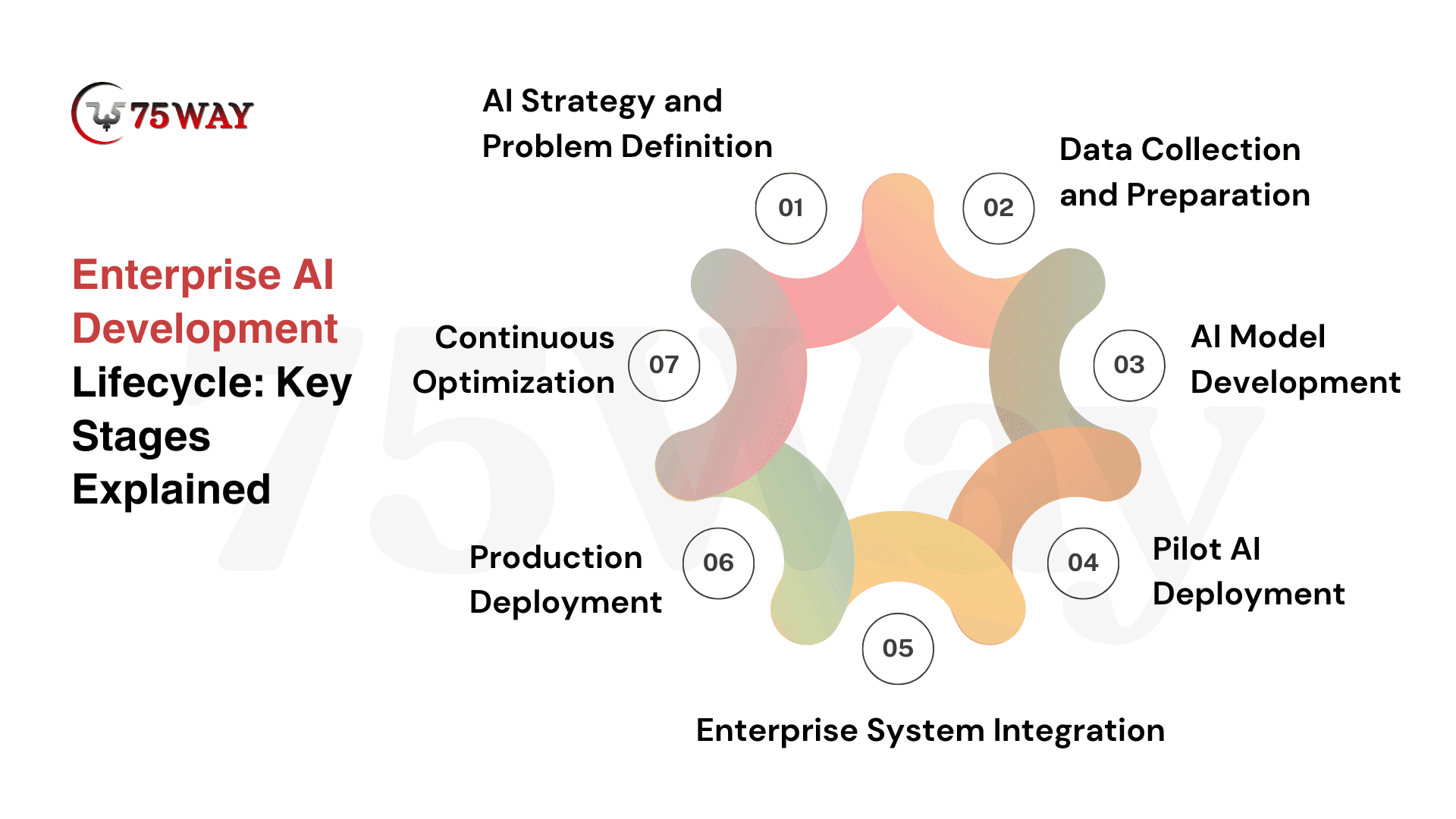
AI Strategy and Problem Definition
Every successful enterprise AI initiative begins with a clearly defined strategy. At this stage, you must identify the business problems AI should address and connect them to measurable objectives such as cost reduction, operational efficiency, or improved customer experience. Instead of adopting AI for experimentation alone, companies evaluate where intelligent automation or predictive analytics can deliver real business value.
This process often involves analyzing operational workflows, assessing available datasets, and prioritizing high-impact use cases aligned with strategic goals. When businesses start with a clear AI strategy and well-defined problem statements, development teams can design solutions that directly support organizational outcomes rather than building models that remain isolated from real-world operations.
Data Collection and Preparation
Data forms the foundation of every enterprise AI system. In this stage, organizations collect large volumes of structured and unstructured data from multiple sources such as databases, enterprise applications, customer platforms, and operational systems. However, raw data alone cannot power reliable AI models. Enterprises must clean, label, normalize, and structure datasets to ensure quality and consistency.
Data engineers often build pipelines that organize information into centralized storage environments such as data lakes or data warehouses. These pipelines make data accessible for training AI models while maintaining governance and security standards. High-quality data preparation significantly improves model accuracy and ensures that AI solutions generate insights businesses can confidently use for decision-making.
AI Model Development
Once data pipelines are prepared, AI engineers and data scientists begin building machine learning models that can identify patterns, generate predictions, or automate decisions. This stage involves selecting appropriate algorithms, training models on historical data, and validating performance through rigorous testing.
Development teams may use advanced frameworks and tools to experiment with different architectures, optimize model parameters, and improve accuracy. The goal is to develop models that can analyze enterprise-scale data while maintaining reliability and efficiency. During this process, teams also document model behavior and performance metrics, which helps ensure transparency and supports responsible AI practices within enterprise environments.
Pilot AI Deployment
Before deploying AI across an entire organization, companies typically launch pilot projects to evaluate real-world performance. A pilot deployment allows teams to test AI models within a controlled environment using limited datasets or specific business processes. This stage helps organizations measure model accuracy, assess operational impact, and gather feedback from stakeholders who interact with the system.
Thorough testing also helps identify integration challenges, data inconsistencies, or workflow adjustments needed before full-scale implementation. By validating the technology in a smaller setting first, organizations reduce risk and gain valuable insights that improve the final enterprise deployment.
Enterprise System Integration
For AI solutions to deliver measurable value, they must integrate seamlessly with existing enterprise systems. This stage connects AI models with operational platforms, such as ERP systems, CRM software, internal databases, analytics tools, and customer applications. Integration ensures that insights generated by AI models are automatically embedded within business workflows rather than remaining in isolated dashboards.
For example, predictive analytics results can trigger automated alerts, update enterprise systems, or guide operational decisions in real time. Proper integration also requires secure data exchange, API connectivity, and compatibility with existing infrastructure to ensure smooth collaboration between AI systems and enterprise software environments.
Production Deployment
Once testing and integration are complete, AI solutions move into production environments where they operate at enterprise scale. Production deployment involves configuring infrastructure that allows AI models to process large volumes of real-time data while maintaining speed, reliability, and security.
Businesses often use cloud platforms, scalable computing resources, and automated pipelines to support continuous AI operations. In production, AI models interact with live business data and deliver insights that influence daily decisions across departments. A successful deployment ensures that AI systems remain stable under heavy workloads while continuing to generate accurate predictions and actionable intelligence.
Continuous Optimization
Enterprise AI development does not end after deployment. As business conditions evolve and new data becomes available, AI models must be continuously monitored and improved. Organizations implement MLOps frameworks to track model performance, detect accuracy changes, and automate retraining processes when necessary.
Continuous optimization ensures that AI systems adapt to shifting patterns in customer behavior, market trends, or operational data. Regular updates, performance monitoring, and feedback loops enable enterprises to maintain reliable AI systems that continue to deliver value over time. By investing in ongoing optimization, businesses ensure their AI infrastructure remains relevant, scalable, and capable of supporting long-term innovation.
Enterprise AI Architecture Explained
Enterprise AI systems rely on a layered architecture that organizes data management, model development, infrastructure, and governance in a structured way. This approach helps you build scalable AI platforms that support large datasets, complex enterprise applications, and secure operations while maintaining reliable performance across departments.
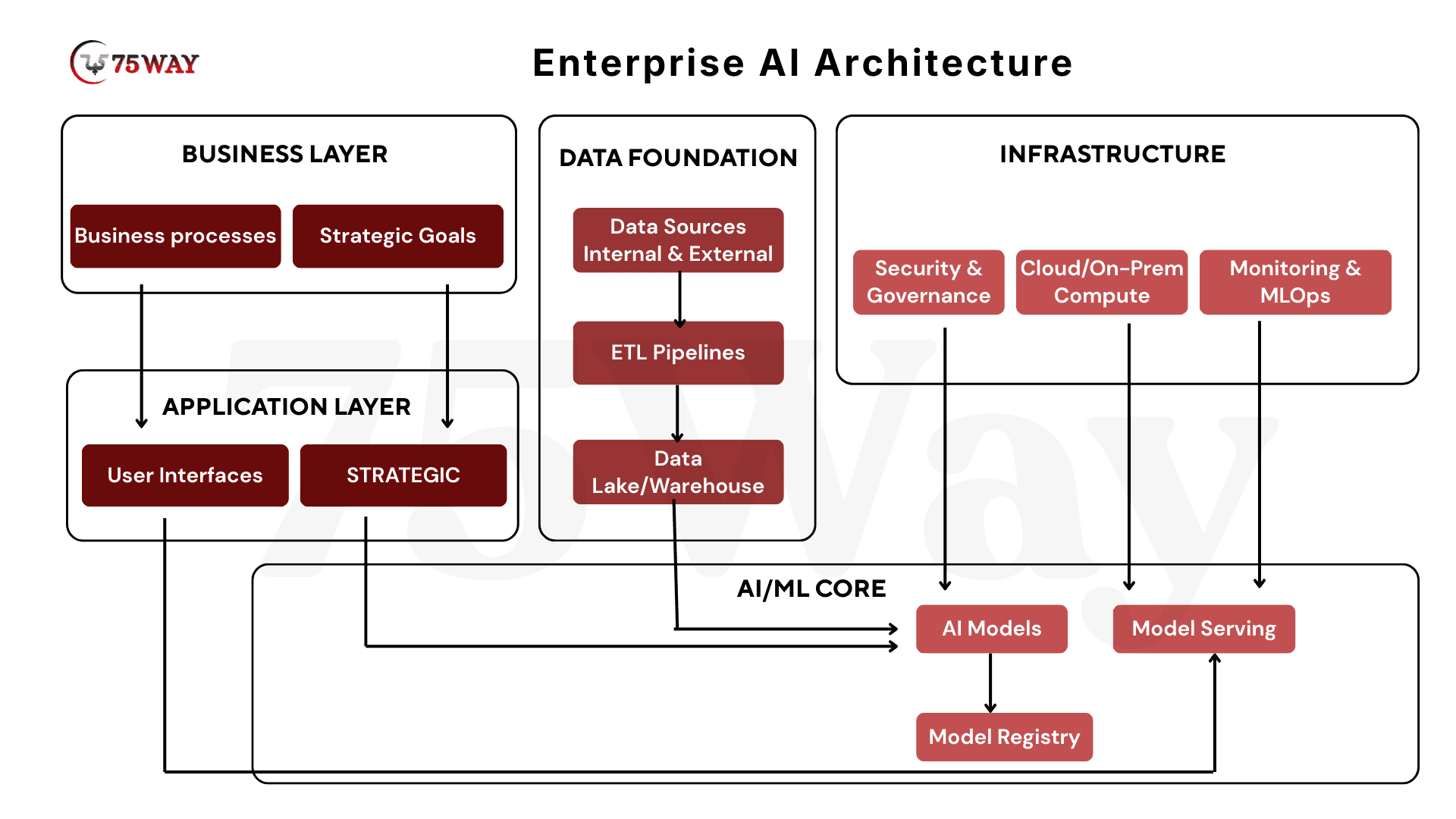
Strategy & Business Layer: This layer defines how artificial intelligence aligns with business priorities. It focuses on identifying strategic goals, evaluating operational challenges, and integrating AI capabilities into core business processes. This layer ensures AI initiatives support measurable outcomes such as efficiency improvements, revenue growth, and enhanced customer experiences.
Application Layer: It connects AI capabilities with the tools employees and customers use daily. It includes user interfaces, enterprise applications, and platforms such as ERP systems, CRM software, and business management tools. Through this layer, AI insights become actionable, supporting decision-making and automating workflows across departments.
Data Layer: This layer manages the collection, preparation, and storage of information used to train and operate AI systems. It integrates internal and external data sources, organizes ETL pipelines, and stores processed information within data lakes or data warehouses. This layer ensures reliable access to high-quality datasets for analytics and model training.
Infrastructure & Governance Layer: It provides the technical environment where enterprise AI operates securely. It includes cloud or on-premise infrastructure, compute resources, monitoring systems, and security frameworks that maintain compliance and protect sensitive data. MLOps platforms within this layer support model monitoring, lifecycle management, and performance optimization.
AI Model Layer: The AI model layer is responsible for building and managing intelligent systems that generate predictions and insights. It includes machine learning models, algorithms, model registries, and model serving systems that deliver AI capabilities to enterprise applications. This layer ensures models remain accurate, scalable, and accessible for real-time decision support.
How To Develop A Scalable Enterprise AI System?
A structured approach is required to develop a scalable enterprise AI system that connects business strategy, data infrastructure, and advanced AI technologies. You must move through clearly defined stages, from identifying business objectives to scaling intelligent solutions across departments. So, AI systems deliver measurable business value and operate reliably at enterprise scale.
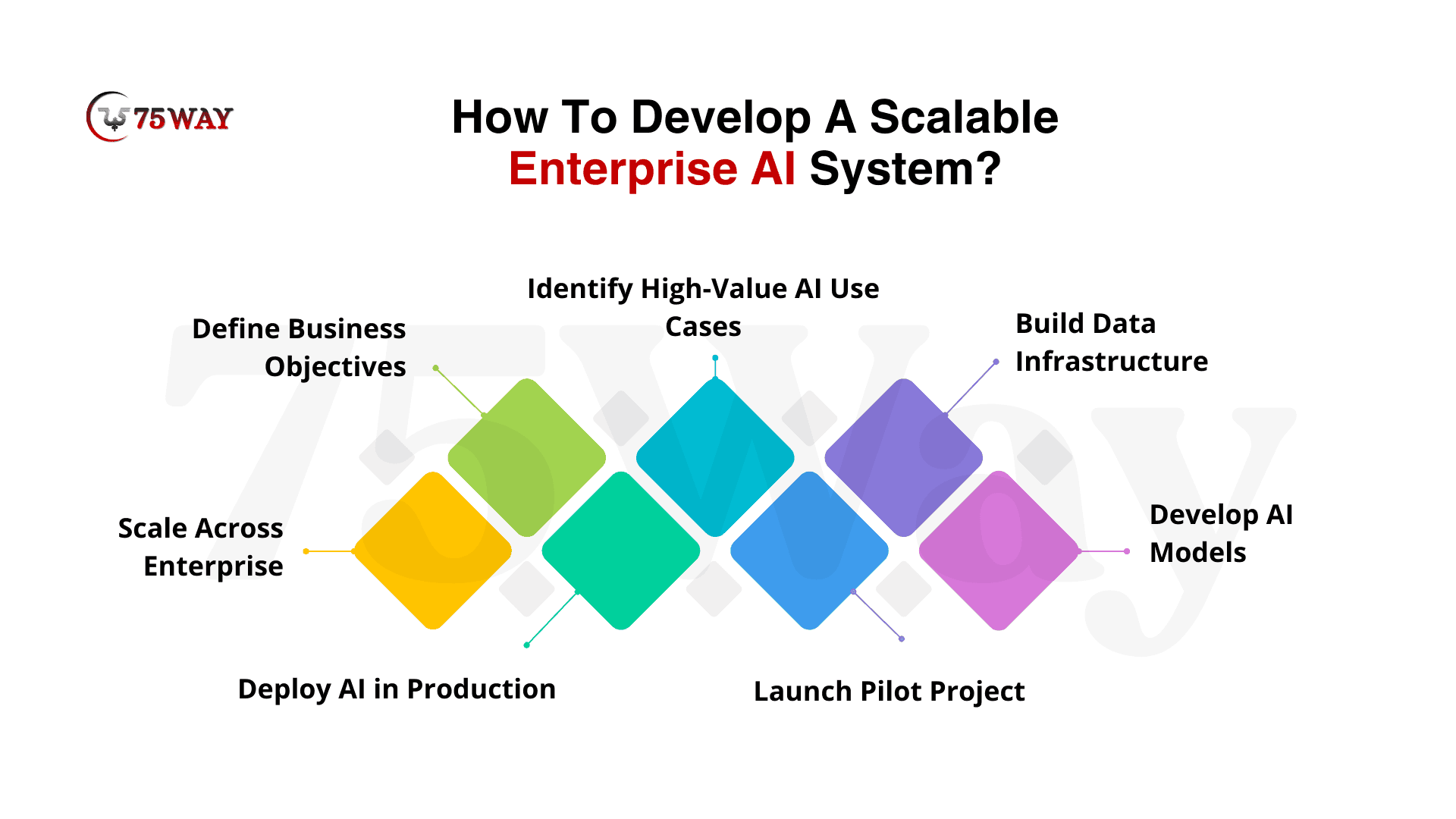
Define Business Objectives
The first step in enterprise AI development is to establish clear business objectives. AI initiatives should address real operational challenges rather than being implemented solely for experimentation. You can evaluate where intelligent systems can improve efficiency, automate processes, or enhance strategic decision-making. Its key considerations include:
- Identifying operational bottlenecks or inefficiencies
- Defining measurable success metrics, such as cost reduction or productivity improvement
- Aligning AI initiatives with long-term digital transformation strategies
Identify High-Value AI Use Cases
After defining objectives, organizations identify specific AI use cases that can deliver measurable results. Not every business problem requires artificial intelligence, so teams evaluate potential applications based on feasibility, data availability, and expected return on investment. Selecting high-value use cases allows businesses to prioritize projects that produce meaningful operational improvements. Common enterprise AI use cases include:
- Predictive maintenance for industrial equipment
- Fraud detection in financial transactions
- Intelligent customer support systems
- Demand forecasting and supply chain optimization
- Automated document processing
Build Data Infrastructure
A scalable AI system relies on a strong and well-structured data infrastructure. Enterprises must establish systems that can collect, store, and process large volumes of data generated across departments and digital platforms. A well-designed infrastructure ensures AI models always have access to accurate, updated datasets.
- Data Lakes: Data lakes store large volumes of raw, unprocessed data collected from multiple enterprise sources. They centralize structured and unstructured data, making it accessible for analytics, machine learning training, and advanced data exploration.
- ETL Pipelines: ETL pipelines extract data from different systems, transform it into standardized formats, and load it into centralized storage environments. These automated workflows ensure data remains organized, consistent, and ready for AI model development.
- Cloud Storage: Cloud storage platforms provide scalable computing environments that can handle enterprise-scale datasets. They enable flexible storage, high processing power, and seamless data access for AI workloads, analytics platforms, and machine learning applications.
- Data Governance: These frameworks ensure that enterprise data remains accurate, secure, and compliant with regulatory standards. These policies define how data is managed, protected, and accessed while maintaining quality and accountability.
- Data Monitoring: Data monitoring systems continuously track data quality, availability, and consistency across enterprise pipelines. They detect anomalies, missing values, and inconsistencies early, ensuring AI models operate on reliable, up-to-date datasets.
Develop AI Models
Once the data environment is prepared, AI engineers and data scientists begin developing machine learning models. This process involves selecting suitable algorithms, training models using historical datasets, and validating model performance through testing and optimization.
- Common development practices include:
- Using frameworks such as TensorFlow or PyTorch
- Training models on labeled datasets
- Evaluating performance using accuracy and validation metrics
- Optimizing parameters to improve prediction quality
Launch Pilot Project
Before deploying AI across the entire organization, businesses usually launch a pilot project to test the system in a controlled environment. This stage helps teams evaluate model accuracy, understand how the AI solution interacts with existing workflows, and assess its practical impact on operations. By testing with real operational data, organizations can identify integration challenges and gather feedback from users. Running a pilot at a smaller scale reduces implementation risks and provides valuable insights that strengthen the system before enterprise-wide deployment. This deployment helps organizations:
- Validate model performance using real operational data
- Identify integration challenges with enterprise systems
- Gather feedback from teams using the AI solution
Deploy AI in Production
Once pilot testing confirms reliability, AI models are deployed within production environments where they can process real-time data and support everyday business operations. At this stage, organizations focus on integrating AI systems with enterprise platforms and ensuring reliable performance at scale.
- System Integration: AI models are integrated with enterprise platforms such as ERP systems, CRM software, databases, and internal applications. This AI integration allows AI-generated insights to directly support operational workflows, helping teams automate tasks and improve decision-making.
- Workflow Automation: AI predictions are connected with automated workflows that trigger actions across enterprise systems. For example, predictive insights may initiate alerts, update business records, or automate routine processes, enabling faster responses and improved operational efficiency.
- Performance Monitoring: Continuous monitoring ensures AI systems operate reliably within production environments. Organizations track system performance, model accuracy, security standards, and infrastructure stability to maintain consistent results and quickly resolve issues affecting enterprise operations.
Scale Across Enterprise
After successful deployment, AI capabilities can gradually expand across departments and business functions. Scaling ensures AI technologies support enterprise-wide automation, advanced analytics, and smarter decision-making while helping businesses unlock the full value of intelligent systems over time.
- Department Expansion: AI applications can be extended to different business units such as operations, marketing, finance, and customer support. Expanding AI use across teams improves productivity, streamlines workflows, and enables data-driven decisions throughout the business.
- MLOps Implementation: MLOps frameworks help manage the entire lifecycle of AI models, including deployment, monitoring, version control, and retraining. This approach ensures models remain accurate, reliable, and continuously optimized as new data and operational conditions emerge.
- Process Standardization: Standardizing AI development processes ensures teams follow consistent practices for data preparation, model training, validation, and deployment. Clear development standards improve collaboration, accelerate AI adoption, and maintain quality across enterprise AI projects.
- Model Retraining: AI models must be updated regularly as data patterns and market conditions evolve. Continuous retraining with fresh datasets helps maintain prediction accuracy, reduce performance drift, and ensure AI systems continue delivering reliable insights for business decisions.
Enterprise AI Adoption Market Insights and Growth Opportunities
Artificial intelligence adoption across large enterprises is accelerating as businesses invest in intelligent technologies to improve productivity, automate complex operations, and strengthen data-driven decision-making. Expanding data ecosystems, advanced analytics capabilities, and scalable cloud infrastructure are creating new opportunities for companies to integrate AI solutions that support innovation, operational efficiency, and long-term competitive advantage.
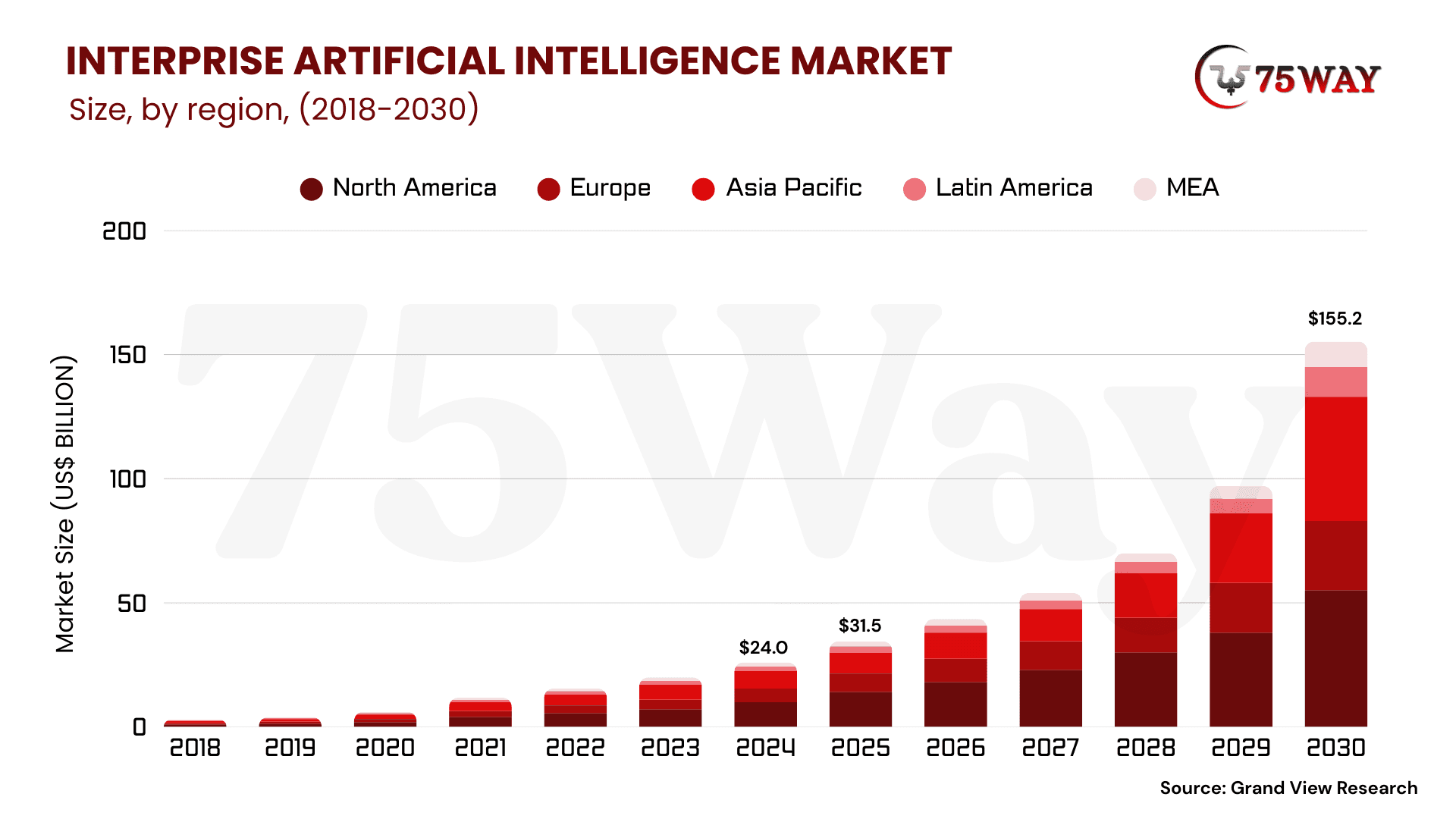
- The global enterprise artificial intelligence market is projected to reach approximately $1,55,210.3 million by 2030, expanding at a CAGR of 37.6%, according to Grand View Research.
- The enterprise AI market is expected to surpass $150–$200 billion in annual value by 2030, supported by compound annual growth rates exceeding 30%.
- According to Technavio, the enterprise AI sector is forecast to grow by $94.23 billion between 2024 and 2029, registering an impressive CAGR of 54.1%.
- In terms of deployment models, cloud-based solutions dominate the enterprise AI market, accounting for 65.8% of the total share.
- North America currently leads the enterprise artificial intelligence market, holding the largest global share of 36.9%.
Key Tools & Technologies Used To Develop Enterprise AI
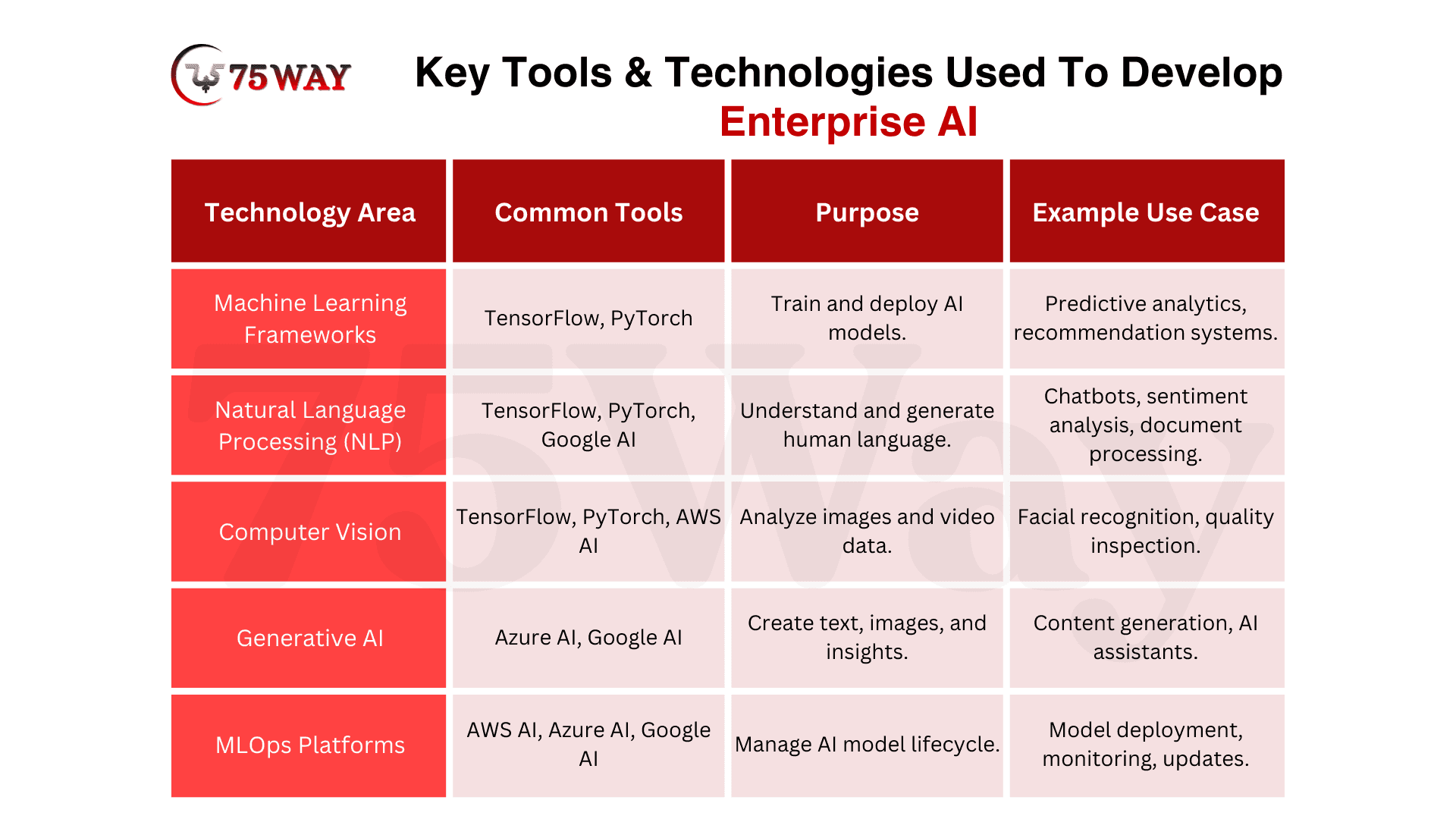
Enterprise AI development relies on advanced tools and technologies that build, train, deploy, and manage intelligent systems at scale. These technologies support data processing, model development, automation, and continuous monitoring, enabling enterprises to transform large datasets into actionable insights and intelligent business solutions.
Machine Learning Frameworks: These frameworks provide the foundation for building and training AI models. Tools like TensorFlow and PyTorch help developers design algorithms, process large datasets, and create scalable machine learning systems for enterprise applications.
Natural Language Processing (NLP): It enables AI systems to understand, interpret, and generate human language. Enterprises use NLP for applications such as chatbots, sentiment analysis, document processing, and automated customer support.
Computer Vision: Computer vision allows AI systems to interpret visual information from images and videos. Businesses apply computer vision for quality inspection, medical imaging analysis, facial recognition, and automated monitoring systems.
Generative AI: Generative AI models create new content such as text, images, and code by learning patterns from large datasets. Enterprises use generative AI for content creation, product design assistance, and intelligent automation.
MLOps Platforms: MLOps platforms manage the lifecycle of machine learning models in production environments. They support model deployment, monitoring, version control, and automated retraining, ensuring enterprise AI systems remain accurate and reliable.
Common Challenges in Enterprise AI Implementation & Development
Enterprise AI initiatives often promise significant business value, but implementing intelligent systems at scale is rarely straightforward. Businesses must overcome technical, operational, and strategic barriers before AI solutions can deliver measurable results. Addressing these challenges early helps businesses build reliable, scalable AI systems that integrate smoothly with enterprise operations and generate long-term value.
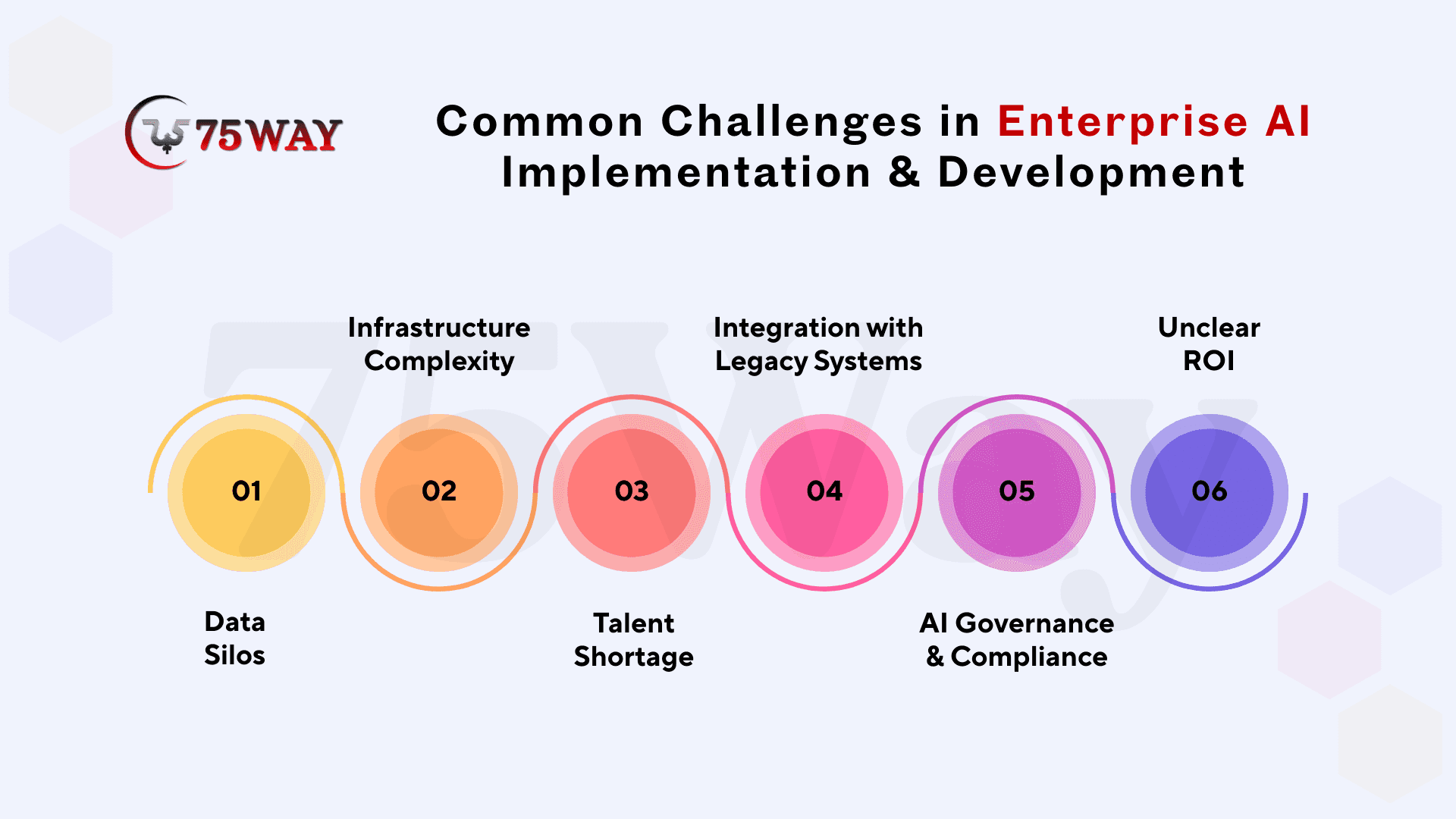
Data Silos: In many organizations, data is stored across multiple departments, platforms, and legacy databases. These fragmented data sources create silos that limit visibility and make it difficult for AI models to access comprehensive datasets. Without unified data pipelines and centralized storage environments such as data lakes or warehouses, enterprises struggle to generate accurate insights and train reliable machine learning models.
Infrastructure Complexity: Enterprise AI systems require powerful computing environments capable of processing massive datasets and supporting advanced analytics. Building this infrastructure often involves cloud platforms, distributed computing systems, high-performance storage, and scalable data pipelines. Designing and managing such environments demands specialized expertise in data engineering, cloud architecture, and AI infrastructure management.
Talent Shortage: Developing enterprise AI solutions requires highly skilled professionals, including data scientists, machine learning engineers, AI architects, and MLOps specialists. However, global demand for AI talent continues to exceed supply. Many organizations face challenges in recruiting experienced professionals who can design scalable AI systems, optimize models, and maintain production environments.
Integration with Legacy Systems: Large enterprises often operate complex legacy infrastructure that has evolved over many years. Integrating modern AI solutions with these systems can be technically challenging. AI developers must create secure APIs, ensure compatibility with existing applications, and maintain operational stability while introducing new AI-driven capabilities.
AI Governance & Compliance: As organizations adopt artificial intelligence across critical operations, governance becomes essential. Enterprises must establish policies that address ethical AI use, algorithmic transparency, and regulatory compliance. Strong governance frameworks also help protect sensitive data, prevent bias in AI models, and ensure responsible decision-making processes.
Unclear ROI: Although AI technologies offer significant potential, measuring their financial impact can be difficult without clearly defined success metrics. Organizations must evaluate both direct and indirect benefits, such as operational efficiency, improved decision-making, and cost savings. Establishing measurable KPIs helps businesses assess the true value of enterprise AI investments.
Cost of Building Enterprise AI Solutions for Businesses
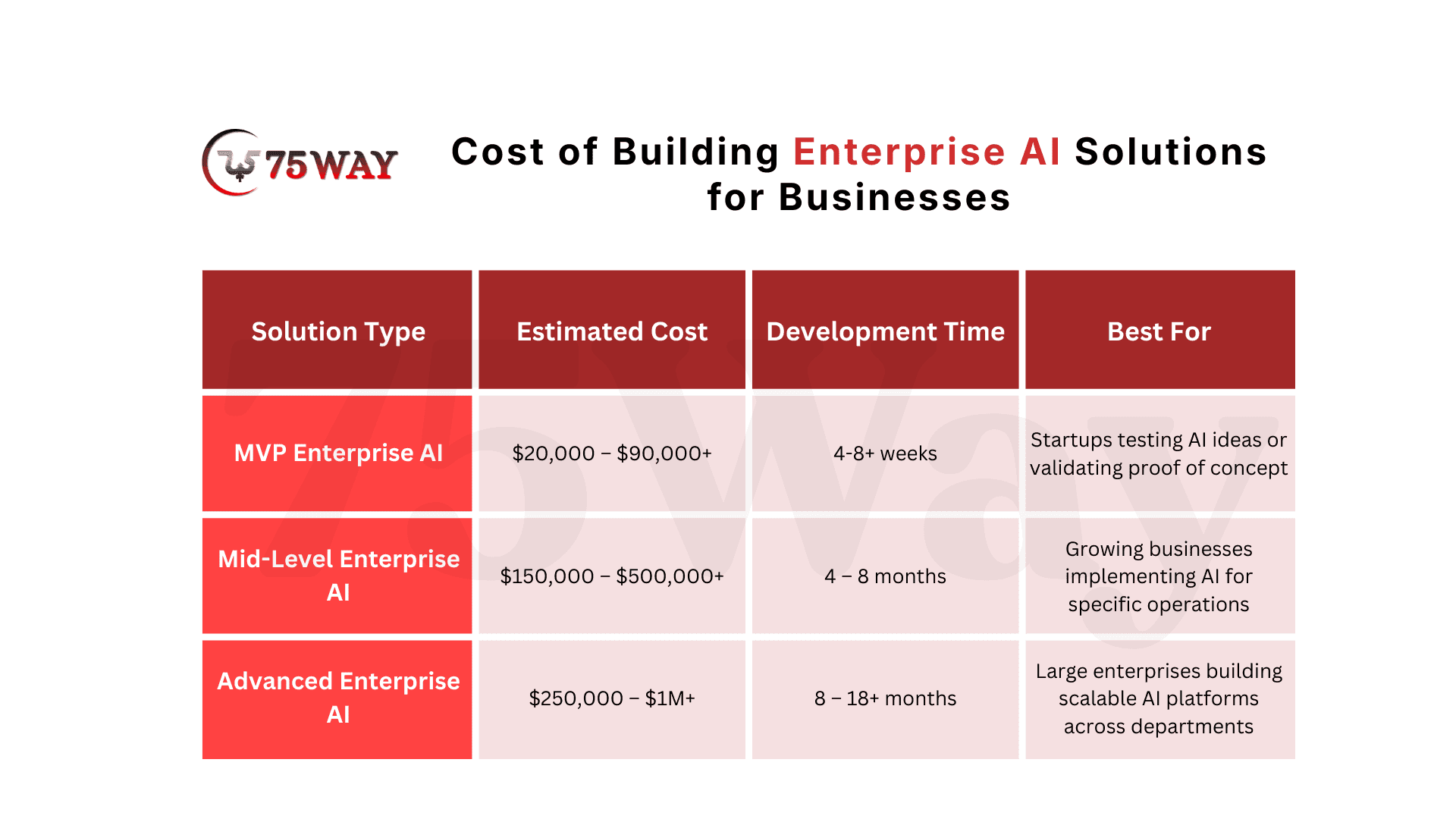
The cost to develop enterprise AI solutions varies widely depending on project scope, data complexity, infrastructure requirements, and the level of customization involved. Organizations typically begin with smaller pilot systems and gradually expand toward fully integrated AI platforms that support large-scale data processing, automation, and advanced analytics across multiple business functions.
MVP Enterprise AI Cost : $20,000 – $90,000+
An MVP (Minimum Viable Product) enterprise AI solution focuses on validating a specific AI use case with limited features and controlled datasets. Businesses often build MVP systems to test feasibility before committing to large-scale development. These projects may include basic machine learning models, small datasets, and simple integrations with existing tools. MVP solutions allow you to measure performance, evaluate operational value, and identify improvements before scaling the technology across the enterprise.
Mid-Level Enterprise AI Cost: $150,000 – $500,000+
Mid-level enterprise AI systems expand beyond initial pilots and integrate intelligent capabilities into operational workflows. At this stage, you can build more sophisticated models, deploy scalable data pipelines, and integrate AI with enterprise platforms such as ERP, CRM, and analytics systems. These solutions often support real-time analytics, predictive insights, and automated decision-making while handling significantly larger volumes of business data.
Advanced Enterprise AI Cost: $250,000 – $1M+
Advanced enterprise AI solutions involve highly complex systems designed to operate across multiple departments or global operations. These platforms include large-scale machine learning models, robust cloud infrastructure, advanced data engineering pipelines, and continuous MLOps management. You may invest in advanced AI systems when they aim to enable enterprise-wide automation, real-time intelligence, and predictive capabilities that drive long-term digital transformation and strategic innovation.
Key Factors Affecting Enterprise AI Solution Costs
- Data preparation consumes 40–60% costs, including cleaning, labeling, and structuring enterprise datasets effectively.
- Custom AI model training may cost $100,000 to $6M+, depending on the complexity requirements.
- Integration requires connecting AI with existing enterprise systems, APIs, databases, and workflows.
- Advanced security, compliance, and complex features can increase AI project budgets significantly.
- Development location impacts costs; US projects $60k–$320k, India projects $50k–$250k typically.
- Ongoing maintenance requires an annual investment of 15–25% for monitoring, updates, and model retraining.
How To Select an Enterprise AI Development Partner?
A reliable partner from top AI development companies can significantly influence the success of an enterprise AI initiative. A reliable partner does more than build models. They help design scalable systems, integrate AI into business workflows, and ensure long-term performance. Careful evaluation of expertise, security practices, and technical capabilities helps you choose a partner who can deliver solutions that grow with your business needs.
Technical Expertise: You can start by evaluating the team’s technical capabilities in areas, such as machine learning, AI architecture, data engineering, and scalable system design. An experienced partner should understand advanced AI frameworks, model deployment strategies, and enterprise infrastructure requirements needed to build reliable AI solutions.
AI Portfolio: Review past AI projects to assess the partner’s practical experience. A strong portfolio demonstrates their ability to build and deploy intelligent systems across different applications. Look for examples that highlight measurable outcomes, such as improved automation, predictive insights, or operational efficiency.
Industry Experience: A partner with industry-specific knowledge can design and build AI apps and software that address real operational challenges. Familiarity with industry workflows, regulatory requirements, and data environments allows them to develop systems that integrate more effectively with existing processes and compliance standards.
Data Security Standards: Data protection is essential when working with enterprise AI systems. You must ensure the development partner follows strong security practices, including encryption protocols, secure data-handling procedures, and compliance frameworks that protect sensitive business and customer information.
AI Scalability: An effective development partner designs AI systems that can expand as business operations grow. Scalable architectures allow AI models to handle increasing data volumes, support additional users, and integrate with evolving enterprise platforms without compromising performance.
Post-deployment Support: AI systems require continuous monitoring and improvement after deployment. You must choose a partner who provides long-term support, including model monitoring, performance optimization, and periodic retraining. Ongoing technical support ensures your AI solutions remain accurate, reliable, and aligned with changing business requirements.
Future of Enterprise AI That Transforms Business Operations
Advanced enterprise AI solutions refine a new era of intelligent business operations. Organizations are moving beyond basic automation and predictive analytics toward AI systems that actively assist, optimize, and even make decisions in real time, transforming productivity and operational efficiency at scale.
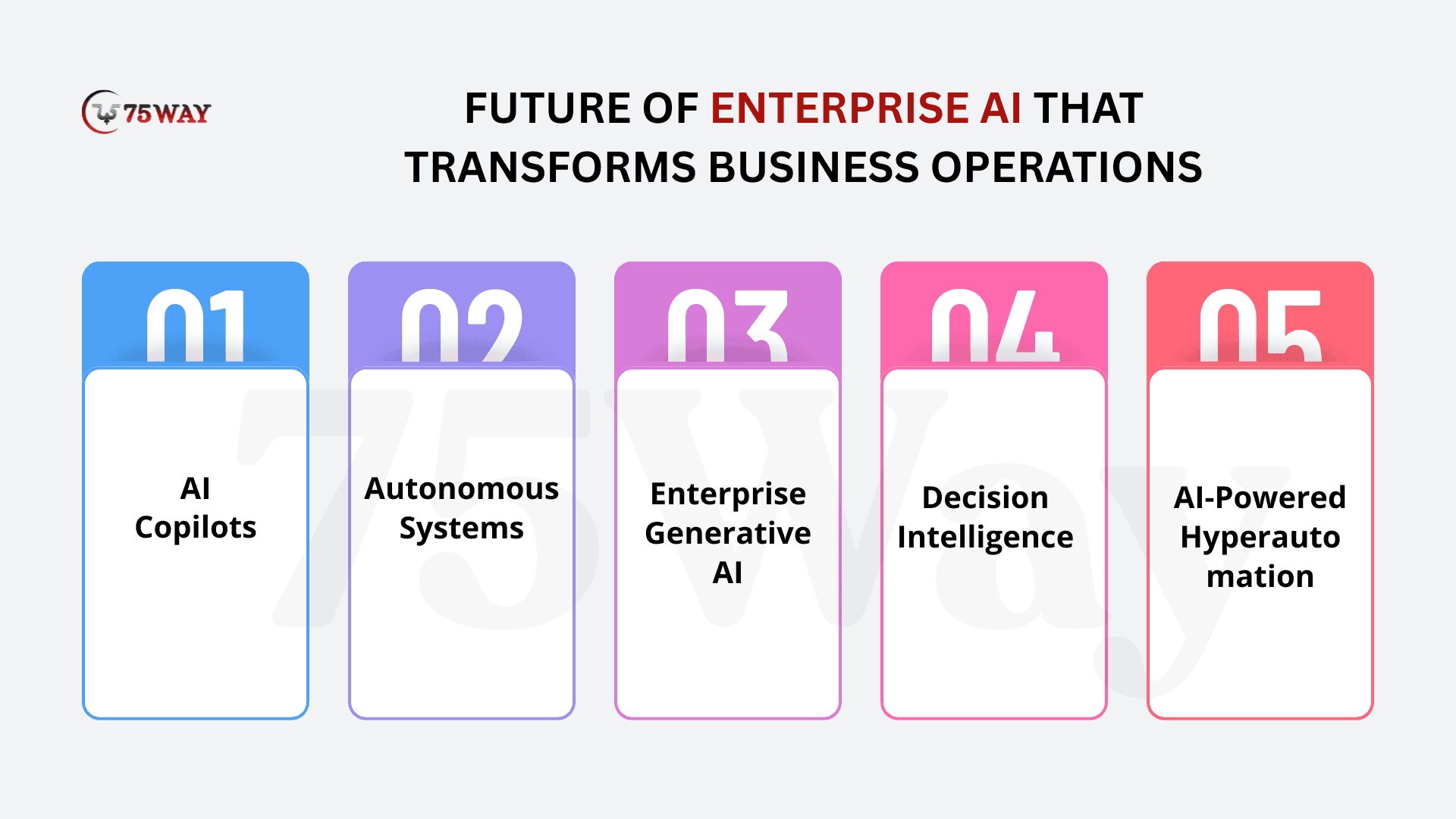
AI Copilots: AI copilot development solutions work alongside employees, helping with decision-making, automating repetitive tasks, and enhancing productivity. These AI assistants can provide real-time suggestions, analyze data on the fly, and streamline workflows across multiple business functions.
Autonomous Systems: Next-generation AI systems are becoming increasingly autonomous, capable of executing complex operational processes without human intervention. This enables faster execution, reduces errors, and improves consistency across enterprise operations.
Enterprise Generative AI: Generative AI platforms create content, insights, and automated responses by learning patterns from large datasets. Enterprises leverage these tools for reporting, intelligent assistants, and automated content generation that accelerates business processes.
Decision Intelligence: Decision intelligence platforms combine AI-driven analytics, predictive modeling, and contextual insights to help leaders make faster, smarter, and data-driven decisions. These systems turn raw data into actionable strategies.
AI-Powered Hyperautomation: By integrating AI with robotic process automation (RPA), businesses can automate entire workflows across departments. This hyperautomation reduces manual effort, enhances operational efficiency, and enables organizations to scale processes seamlessly while maintaining accuracy.
Final Remarks
Enterprise AI development is revolutionizing the way businesses operate, compete, and innovate in today’s digital economy. By implementing scalable AI architectures, investing in robust data infrastructure, and following a structured development lifecycle, you can transform experimental AI projects into enterprise-wide intelligent systems that deliver measurable value. With the right strategy, these intelligent systems become a foundation for long-term competitive advantage in a rapidly evolving, data-driven world. For organizations ready to scale their AI initiatives, partnering with a trusted enterprise AI development company can ensure seamless implementation and sustainable growth. Start building your intelligent enterprise today.
Frequently Asked Questions (FAQs)
How Do Companies Start AI Development?
Businesses can start AI development by identifying high-impact business problems and defining clear objectives. They assess available data, evaluate operational challenges, and prioritize use cases where AI can improve efficiency, reduce costs, or enhance decision-making. A structured roadmap ensures AI projects align with strategic goals from the beginning.
What Are Enterprise AI Platforms?
Enterprise AI platforms are integrated software environments that allow organizations to build, deploy, and manage AI models at scale. These platforms combine data processing, machine learning frameworks, MLOps tools, and analytics capabilities to deliver intelligent insights across departments and enterprise systems.
How Is AI Integrated Into Enterprises?
AI is integrated into enterprises by connecting models with operational platforms such as ERP, CRM, analytics tools, and internal applications. Integration ensures that AI-generated insights directly support workflows, automate repetitive tasks, and provide actionable intelligence across departments in real time.
What Is AI Model Training?
AI model training is the process of teaching machine learning algorithms to recognize patterns and make predictions using structured and unstructured datasets. This involves selecting algorithms, feeding data into models, validating results, and optimizing performance to ensure accurate, reliable outputs for enterprise applications.
How Do Enterprises Deploy AI Systems?
Enterprises deploy AI systems by moving validated models from testing or pilot phases into production environments. Deployment involves integrating AI models with business platforms, configuring infrastructure for real-time data processing, and establishing monitoring systems to maintain performance and scalability.
What Skills Are Needed For AI Development?
AI development requires a combination of technical and domain-specific skills, including machine learning, data engineering, MLOps, AI model optimization, cloud computing, and Python or R programming. Strong analytical and problem-solving abilities, along with experience with enterprise systems, ensure successful AI implementation.