Summary
Business communication now relies on speed, availability, and natural interaction. Voice-driven artificial intelligence systems address these expectations through automated conversations and intelligent call handling. This guide presents leading AI voice agents, practical applications, and decision factors that assist organizations in planning large-scale communication automation.
Quick Overview:
- The voice AI agents market is projected to reach $47.5 billion by 2034 globally.
- Businesses adopt AI voice agents for faster responses and continuous automated customer communication.
- Leading platforms like Retell, Vapi, and Bland AI simplify conversational voice automation deployment.
- AI voice agents integrate with CRM systems to automate calls, scheduling, and service requests.
- Strategic AI agent development enables startups and enterprises to scale communication operations rapidly.
- Selecting the right voice AI platform improves customer satisfaction, productivity, and operational cost control.
“Customers expect conversations, not waiting lines.” It's 2026, the era of AI automation, and now business communication has entered a place where quick responses meet the demands of customers. If you are a startup owner or a founder, you know the struggle of longer call queues, delayed responses, and repetitive tasks that often slow down communication processes.
Thus, AI voice agents become the extensively adopted tool to increase customer satisfaction and personalized responses on time. The AI voice agent development solutions provide a conversational approach that enables automated calls, real-time responses, and intelligent task execution across business environments.
Here, a question hits the decision-makers' mind that what are these AI voice agents? Which are the top 10 AI voice agents? To answer all these queries, we curated a detailed evaluation of leading voice AI platforms, their business use cases, implementation frameworks, and strategic processes to build these artificial intelligence-powered voice agents.
What Are AI Voice Agents?
AI voice agents refer to intelligent software systems capable of conducting spoken conversations with users through speech recognition and NLP technologies. These systems interpret voice input, identify the intention behind spoken requests, and generate spoken responses during real-time conversations.
Conversational AI models allow the interaction process through natural language understanding (NLU), dialogue management, and speech generation systems. Real-time speech processing enables AI voice agents to manage conversations across phone calls, mobile applications, customer service platforms, and virtual assistants.
Advanced AI voice systems also connect with business software environments such as customer databases, booking platforms, and internal applications. This integration allows these voice-enabled AI agent development solutions to perform operational tasks, including retrieving records, updating information, scheduling appointments, and responding to service requests.
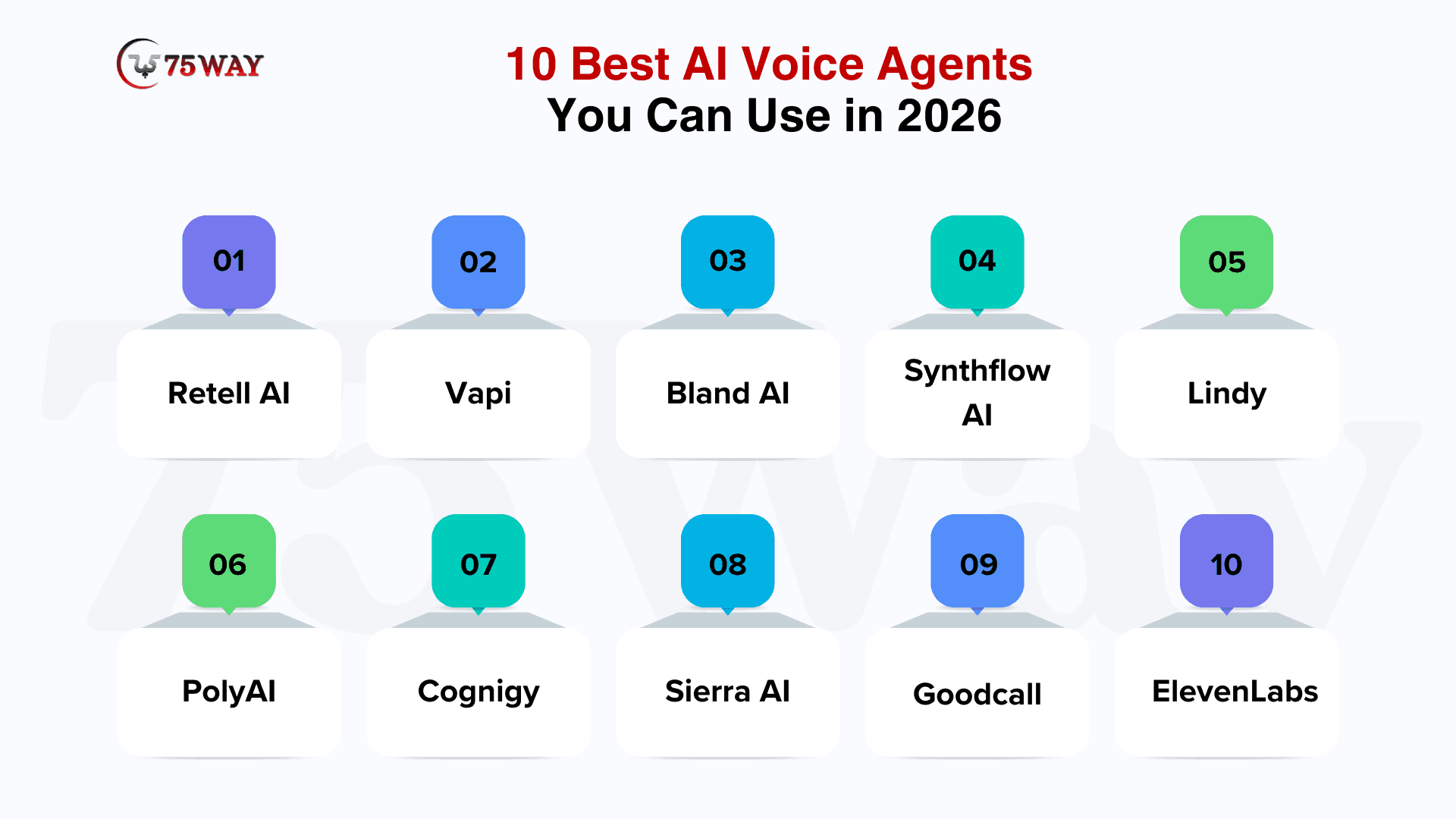
10 Best AI Voice Agents You Can Use in 2026
AI voice agents are proficient in managing customer communication through automated phone conversations and intelligent virtual assistants. These systems combine speech recognition, language processing, and voice synthesis to handle tasks like customer support, appointment scheduling, and sales calls. The following list of top AI voice agent platforms offers different capabilities, pricing models, and automation features suited for startups, enterprises, and growing businesses.
1. Retell AI
Retell AI represents a developer-focused platform designed for building real-time conversational voice agents. The system connects speech recognition, language understanding, and speech synthesis to conduct automated phone conversations. Businesses use this platform for customer support calls, appointment handling, outbound campaigns, and voice-based service interactions across operational environments.
Key Features of Retell AI
Real Time Processing: Speech recognition and response generation operate during live conversations. This capability allows businesses to maintain natural dialogue flow during inbound or outbound calls without interruption.
Conversation Intelligence: Advanced language models interpret spoken requests and determine appropriate responses. Context retention during conversations allows this AI agent to maintain meaningful interactions across multiple dialogue turns.
Call Automation: Automated inbound and outbound call handling allows organizations to manage appointment booking, customer queries, and service requests without continuous human involvement.
Knowledge Integration: Business knowledge bases connect with the voice agent so the system retrieves information such as order details, policies, or product data during conversations.
CRM Connectivity: Integration with CRM platforms allows call data, notes, and customer information to synchronize automatically during conversations, improving operational record management.
Analytics Reporting: Conversation transcripts and call analytics provide insight into customer interactions, conversation outcomes, and agent performance metrics.
Advantages of Retell AI
- Flexible pay-as-you-go pricing allows businesses to scale usage without long-term commitments or upfront subscription costs.
- Developer-friendly APIs support rapid integration with existing telephony systems, business platforms, and automation workflows.
- Real-time conversation processing allows natural dialogue during phone interactions across customer service or sales operations.
- Integration with voice models and language systems allows you to customize conversational experiences for different business needs.
- Transparent billing structure helps businesses estimate operational costs before scaling voice agent deployment.
Disadvantages of Retell AI
- Technical setup often requires development knowledge, which may create adoption barriers for teams without engineering resources.
- Pricing depends on multiple components, including telephony and language models, which can increase overall operational cost.
- Advanced features such as enterprise compliance or custom deployment require sales consultation and enterprise agreements.
- Conversation accuracy may depend on the external speech recognition models selected during system configuration.
- Initial conversation design and testing require careful planning before large-scale production deployment.
Pricing Model of Retell AI Voice Agent: Retell AI follows a transparent pay-as-you-go pricing model with no platform fee. AI voice agent usage begins at approximately $0.07 per minute, with additional charges depending on the voice model and telephony provider used for calls. Free credits of $10 and 20 free concurrent calls are available for testing before production deployment.
Best For: Retell AI suits software development teams and technology businesses that plan to build customized voice AI systems. Businesses requiring programmable APIs, flexible integrations, and scalable call handling environments can benefit from this platform for customer service, support operations, and automated communication workflows.
2. Vapi
Vapi provides a programmable infrastructure for building real-time AI voice agents capable of handling phone calls, app conversations, and automated service interactions. Developers and product teams use this platform to integrate speech recognition, large language models, and voice synthesis into conversational systems. This AI-powered conversational agent can manage customer inquiries, booking requests, and operational communications across digital and telephony channels.
Major Features of Vapi AI Agent
Real-Time Conversations: Continuous speech recognition and response generation allow conversations to occur naturally during live calls. Users experience minimal response delays during interactions with automated voice agents.
Developer APIs: Extensive APIs allow teams to embed voice agents into applications, websites, and telephony systems. This approach enables complete control over voice automation workflows.
Model Flexibility: Support for multiple speech recognition engines and language models allows businesses to select AI technologies suited to their operational needs.
Call Routing: This voice agent can route conversations between automated systems and human representatives when complex situations require manual intervention.
Conversation Memory: Dialogue tracking allows the system to maintain context during conversations, allowing accurate responses across multiple conversational turns.
Workflow Automation: Integration with business software allows the voice AI agent to execute actions such as updating records, retrieving customer information, and scheduling appointments.
Pros of Vapi AI Voice Agent
- Flexible infrastructure supports integration with multiple language models and speech technologies for customized conversational systems.
- Developer-friendly architecture allows businesses to build tailored voice automation workflows suited to unique operational requirements.
- A usage-based pricing structure provides cost control during early experimentation and pilot deployments.
- Real-time communication infrastructure allows voice agents to interact naturally during customer conversations.
- Open architecture allows connection with CRM systems, databases, and internal automation platforms.
Cons of Vapi AI Voice Agent
- Technical implementation requires development expertise and system integration knowledge for full functionality.
- Total operational cost depends on additional speech models, telephony providers, and infrastructure components.
- Conversation accuracy depends on the language models and training data selected during system configuration.
- Platform documentation may require technical interpretation for organizations without engineering teams.
- Large-scale deployments often require infrastructure planning and performance monitoring.
Perfect For: Vapi suits software teams, startups, and product companies building programmable voice automation solutions. Businesses that develop custom conversational AI agents to automate sales operations or digital products can benefit from its flexible architecture and real-time voice interaction capabilities.
Pricing Model of Vapi AI Voice Agent: This agent offers a usage-based pricing structure designed for developers and businesses building voice automation. It offers $10 in free credits upon registration of a new account. The platform currently charges approximately $0.05 per minute for voice agent usage, excluding additional model or telephony provider costs. Pricing may vary depending on speech models, language processing engines, and call routing services integrated with the platform.
3. Bland AI
Bland AI provides a conversational voice automation platform designed for large-scale phone communication across sales, customer support, and operational workflows. The system conducts natural conversations through advanced speech models and language intelligence. Companies can adopt this voice AI agent to make outbound call campaigns, automate inbound calls, appointment confirmations, and service interactions that require continuous communication with customers.
Core Features of Bland AI Voice Agent
Natural Conversations: Advanced speech generation produces highly natural voice responses during live calls. Customers experience conversations that resemble human dialogue rather than robotic automated responses.
Call Automation: The system handles inbound and outbound phone conversations automatically, supporting tasks such as appointment confirmations, lead outreach, and service inquiries.
Voice Customization: Multiple voice options allow organizations to select voice styles and tones suitable for brand communication during automated conversations.
Conversation Memory: Dialogue context remains available throughout the conversation, so the system can respond accurately across multiple exchanges during a call.
System Integrations: Connections with CRM systems, internal databases, and operational tools allow the voice agent to retrieve information and update records during conversations. Connections with CRM software systems, internal databases, and operational tools allow the voice agent to retrieve information and update records during conversations.
Call Analytics: Conversation transcripts and interaction metrics provide insights into customer behavior, conversation outcomes, and communication performance.
Benefits of Bland AI Voice Agent
- Natural-sounding speech technology improves the customer experience during automated phone conversations.
- Automated call handling reduces the need for large support teams during repetitive communication tasks.
- Scalable infrastructure allows businesses to manage thousands of calls simultaneously without human limitations.
- Conversation analytics provide valuable operational insight for customer service and sales optimization.
- Integration capability allows businesses to connect voice automation with existing operational platforms.
Limitations of Bland AI Voice Agent
- Operational pricing may increase when large volumes of automated calls occur during business campaigns.
- Conversation design and training require planning to produce accurate responses across diverse customer requests.
- Advanced configuration may require technical knowledge or assistance from development teams.
- Speech model performance may vary depending on accents, languages, or complex conversation scenarios.
- Enterprise features often require custom agreements and consultation with the platform provider.
Pricing of Bland AI Voice Agent: Bland AI offers a usage-based pricing model primarily calculated through call duration. The platform currently charges approximately $0.09 per minute for voice conversations, although the total cost may vary depending on the speech models, voice generation services, and telephony infrastructure integrated with the platform.
Best For: Bland AI suits organizations that manage high volumes of phone communication, such as sales teams, service providers, and customer support operations. Businesses seeking automated call handling with natural speech responses can adopt this conversational technology and scalable communication infrastructure.
4. Synthflow AI
Synthflow AI offers a no-code platform that enables organizations to launch conversational voice agents for automated phone communication. Businesses deploy the platform for call handling, appointment booking, inbound inquiries, and lead follow-ups. Visual workflow tools allow teams without development experience to configure conversation flows and automate customer interactions across communication channels.
Key Features of Synthflow AI Voice Agent
Visual Builder: Drag-and-drop workflow tools allow teams to design conversational agents without writing code. Business users configure call flows, automated responses, and integrations through graphical interfaces.
Call Automation: Voice AI agents handle inbound and outbound conversations automatically, allowing businesses to manage bookings, service requests, and customer inquiries through automated communication.
Multilingual Support: The platform supports numerous languages and dialects, enabling businesses to communicate with diverse audiences through automated voice conversations.
CRM Integration: Connections with customer management systems allow voice agents to retrieve customer data, update records, and log call activity during conversations.
Concurrent Calls: Infrastructure supports multiple simultaneous calls depending on the selected plan, enabling businesses to manage large call volumes during operational peaks.
Analytics Insights: Conversation transcripts, interaction metrics, and reporting tools help businesses monitor performance and analyze communication trends.
Advantages of Synthflow AI Voice Agent
- Visual workflow builder allows non-technical teams to deploy conversational voice automation without development knowledge.
- Subscription model bundles telephony features, speech recognition, and language processing into a single platform environment.
- Multilingual support enables businesses to manage international customer communication through automated conversations.
- White-label capabilities allow agencies to resell voice automation services under their own branding.
- Integration tools connect voice agents with CRM systems, booking platforms, and automation workflows.
Disadvantages of Synthflow AI Voice Agent
- Subscription pricing may become expensive when organizations scale call volumes beyond the included minutes.
- Limited customization flexibility compared with developer-focused voice AI platforms.
- Complex workflow automation sometimes requires experimentation to achieve accurate conversation responses.
- Advanced enterprise features require custom pricing agreements and direct consultation with the platform provider.
- Conversation accuracy may depend on configuration quality and integration setup.
Pricing of Synthflow AI Voice Agent: Synthflow AI provides a tier-based subscription model with bundled minutes and concurrency limits. The Starter plan begins at about $29 per month with 50 call minutes included. Higher tiers increase minutes and operational capacity. Pro costs around $375 per month with 2,000 minutes, Growth around $750 per month with 4,000 minutes, and Agency about $1,250–$1,400 per month with 6,000 minutes. Enterprise plans offer custom pricing with rates starting near $0.08 per minute, depending on usage volume.
Suitable For: Synthflow AI agent suits small businesses, agencies, and service businesses that seek voice automation without technical development. Visual configuration tools, bundled telephony features, and scalable plans allow teams to launch conversational voice agents for customer communication, appointment scheduling, and automated call management. This AI agent is free to create an account and develop your agent. However, if you make calls or send messages, some charges are applied.
5. Lindy
Lindy provides an AI agent platform designed to automate communication workflows through voice calls, messaging, and task automation. Businesses use Lindy agents to handle phone interactions, manage inbox communication, schedule meetings, and execute operational tasks. The platform combines conversational intelligence with workflow automation so voice agents can perform actions such as retrieving information, scheduling appointments, and updating internal systems during conversations.
Core Features of Lindy
Voice Automation: AI agents manage inbound and outbound phone conversations automatically, enabling businesses to respond to inquiries, schedule appointments, and assist customers during voice interactions.
Workflow Execution: Automation capabilities allow agents to perform operational tasks such as sending emails, updating calendars, retrieving documents, or managing customer requests during conversations.
Integration Network: Hundreds of integrations connect Lindy with applications such as email platforms, calendar systems, collaboration tools, and CRM platforms.
Conversation Memory: Context awareness allows the agent to remember earlier conversation details, which improves response accuracy across longer interactions.
Multichannel Support: Voice calls, email automation, messaging, and workflow automation operate within a single AI assistant environment.
Security Controls: Enterprise-level encryption and compliance tools allow teams to maintain data protection and operational governance during automation workflows.
Pros of Lindy AI Voice Agent
- No code configuration allows teams to create AI agents without extensive development knowledge or complex technical infrastructure.
- Integration ecosystem connects communication workflows with hundreds of commonly used business applications and productivity platforms.
- Automated assistants operate continuously and manage multiple tasks simultaneously across voice conversations and messaging systems.
- Subscription pricing allows startups and growing businesses to begin automation without large initial infrastructure investments.
- Conversation memory and automation workflows allow voice agents to complete operational tasks during customer communication.
Cons of Lindy AI Voice Agent
- Per-minute calling charges combined with subscription pricing may increase operational costs for large call volumes.
- Complex workflow automation may require testing and configuration before achieving accurate conversation behavior.
- Customization flexibility remains lower than developer-focused voice AI frameworks designed for engineering teams.
- Advanced enterprise deployment features require consultation with the platform provider and custom pricing agreements.
- Voice automation capabilities may require integration setup with external telephony infrastructure, depending on deployment needs.
Perfect For: Lindy suits startups, founders, and operational teams seeking a conversational AI assistant capable of managing voice communication and business workflows simultaneously. Businesses that look for no-code automation with strong integration capabilities can deploy Lindy agents for customer communication, scheduling operations, and automated task management.
Pricing of Lindy AI Voice Agent: Lindy provides several pricing tiers depending on usage and automation volume. The Plus plan costs about $49.99 per month, and the Pro plan costs about $59.99 per month, providing automation tools, integrations, and AI assistant capabilities. Enterprise deployments offer expanded usage and team management features with custom pricing. Voice calling features require a phone number costing $10 per month, and automated calls generally cost about $0.19 per minute based on configuration and location. It also offer free plan, but conditions are applied.
6. Botphonic
Botphonic is an AI voice agent platform that helps businesses automate customer communication through voice calls, workflow automation, and conversational AI. Companies use Botphonic to handle inbound and outbound calls, schedule appointments, qualify leads, and automate customer support operations without large support teams.
The platform combines human-like voice conversations with workflow execution, allowing AI agents to perform tasks such as updating CRM systems, sending follow-ups, and managing operational workflows during live interactions.
Core Features of Botphonic
Voice AI Automation: AI agents manage inbound and outbound calls for customer support, lead generation, appointment booking, and sales engagement.
Workflow Automation: Botphonic can automate tasks like CRM updates, scheduling meetings, sending emails, and triggering workflows during conversations.
No-Code AI Builder: Businesses can create and customize AI voice agents using a visual no-code platform without extensive technical knowledge.
Integrations: Supports integrations with CRM systems, telephony providers, APIs, and workflow tools like Zapier and HubSpot.
Multilingual & Real-Time Conversations: Human-like voice responses, live transcription, and multilingual support improve customer interactions.
Security & Scalability: Enterprise-grade security and scalable AI calling infrastructure support growing business communication needs.
Pros of Botphonic AI Voice Agent
- Easy no-code setup for fast AI voice agent deployment.
- Supports both inbound and outbound AI calling workflows.
- Strong integration ecosystem with CRM and automation tools.
- Human-like multilingual conversations improve engagement.
- Scalable platform suitable for startups and growing businesses.
Cons of Botphonic AI Voice Agent
- Advanced workflow customization may require additional setup and testing.
- Higher call volumes can increase operational costs depending on usage.
- Some enterprise features are only available in premium plans.
- Telephony configuration may require external provider setup.
Perfect For: Botphonic is ideal for startups, sales teams, customer support operations, and businesses looking to automate voice communication, lead qualification, appointment scheduling, and customer engagement using AI voice agents.
Pricing of Botphonic AI Voice Agent: Botphonic offers multiple pricing plans based on usage and automation needs. Starter plans begin around $20–$22 per month, while Pro plans cost approximately $55–$60 per month with expanded calling and workflow capabilities. Enterprise plans include custom pricing for advanced integrations and large-scale deployments. Free trial access is also available.
7. Cognigy
Cognigy delivers an enterprise conversational AI platform that supports voice automation across contact centers, customer support operations, and service management systems. The platform combines natural language understanding, voice interaction technology, and workflow automation to manage conversations across phone channels. Many organizations deploy Cognigy voice agents to automate customer inquiries, service requests, and operational communication across digital and telephony environments.
Major Features of Cognigy Voice AI Agent
Voice Automation: Conversational AI agents manage customer phone interactions across support inquiries, account requests, and operational communication processes.
NLU Engine: Natural language understanding models analyze spoken requests and identify user intent during real time conversations.
Contact Center Integration: Direct connections with contact center platforms allow voice agents to cooperate with human support teams during customer interactions.
Conversation Routing: Intelligent routing transfers calls between automated systems and human representatives when complex requests arise.
Workflow Automation: Business workflows trigger actions such as retrieving customer records, creating service tickets, or updating account information.
Enterprise Security: Data protection controls and governance frameworks support compliance requirements across regulated industries.
Benefits of Cognigy Voice AI Agent
- Enterprise conversational infrastructure supports large-scale customer communication environments across contact center systems.
- Advanced language understanding allows accurate interpretation of spoken requests during automated voice conversations.
- Integration support connects the voice agent with CRM systems, enterprise databases, and operational software platforms.
- Conversation routing allows seamless transition between automated systems and human support representatives.
- Enterprise governance controls allow teams to maintain regulatory compliance and secure customer data.
Limitations of Cognigy Voice AI Agent
- Enterprise deployment requires planning and consultation before production implementation.
- Pricing transparency remains limited because final costs depend on enterprise agreements and conversation volumes.
- Initial configuration may require technical expertise and integration planning across internal systems.
- Advanced capabilities may exceed the needs of smaller businesses or early-stage startups.
- Implementation timelines may extend due to enterprise infrastructure and compliance considerations.
Pricing of Cognigy Voice Agent: This AI agent operates through an enterprise subscription licensing model. Pricing typically starts around $2,500 per month for access to the platform, including conversational AI tools, workflow automation, and support services. Additional costs depend on conversation volume, concurrent call lines, integrations, and deployment complexity. Conversation processing and voice gateway usage may also contribute to overall operational expenses.
Suitable For: Cognigy suits large enterprises operating customer service environments that require conversational automation combined with contact center integration. Businesses that manage complex support operations benefit from the platform’s enterprise infrastructure, language understanding capabilities, and workflow automation features.
8. Sierra AI
Sierra AI provides conversational AI agents designed to manage customer interactions across voice and digital channels. The platform focuses on delivering natural conversations that assist customers during service inquiries, product questions, and account support. Businesses deploy Sierra AI agents to automate communication workflows and reduce pressure on human support teams during high conversation volumes.
Major Features of Sierra AI
Conversational Intelligence: Advanced language models interpret customer speech and generate contextual responses during automated voice interactions.
Service Automation: Voice AI agents respond to routine customer requests such as account questions, service inquiries, and operational support needs.
Enterprise Integration: Integration capabilities allow connection with customer databases, support systems, and operational platforms.
Context Tracking: Conversation context remains available during multi-step interactions, which improves response relevance and continuity.
Omnichannel Support: Customer communication operates across voice channels and digital messaging environments.
Performance Analytics: Conversation data and operational insights help businesses evaluate communication trends and agent performance.
Advantages of Sierra AI Voice Agent
- Natural conversation capability improves customer interaction quality during automated communication.
- Enterprise integration options connect voice automation with existing service systems.
- Automation reduces repetitive communication tasks for customer service teams.
- Analytics tools provide insight into customer interactions and service outcomes.
- AI Voice agents operate continuously without time limitations.
Disadvantages of Sierra AI Voice Agent
- Limited public pricing transparency requires consultation before deployment planning.
- An enterprise platform may exceed the operational needs of small organizations.
- Integration setup may require technical expertise and infrastructure planning.
- Advanced configuration may require collaboration with Sierra technical teams.
- Large-scale deployments often involve long onboarding and system configuration periods.
Pricing of Sierra AI Voice Agent: Sierra AI follows an enterprise pricing model with customized agreements based on usage scale, integrations, and operational requirements. Public pricing tiers are not listed. Industry discussions suggest that pilot deployments often begin around $3,000 to $5,000 per month, with enterprise implementations increasing depending on conversation volume, support services, and integration scope.
Best For: Sierra AI suits businesses that manage complex customer communication environments that require conversational automation and enterprise system integration. Businesses seeking intelligent voice agents capable of assisting customers across service operations benefit from this platform.
9. Goodcall
Goodcall offers an AI-powered phone assistant designed for small businesses that require automated call handling without complex technical infrastructure. The platform answers incoming calls, provides information to customers, and schedules appointments automatically. Service-based businesses adopt Goodcall to maintain consistent communication with customers during busy hours or outside operating schedules.
Key Features of Goodcall AI Voice Agent
Call Answering: Automated phone assistants respond to incoming calls and provide information to customers during service inquiries.
Appointment Booking: The system schedules appointments directly through conversations and updates booking calendars automatically.
Call Routing: Customer calls can transfer to business representatives when automated responses cannot resolve the request.
Business Knowledge: Voice assistants retrieve answers from business information such as services, working hours, or policies.
Customer Interaction: Conversational responses provide a friendly communication experience during automated calls.
Call Insights: Interaction records allow businesses to review call summaries and customer requests.
Advantages of Goodcall AI Voice Agent
- Simple deployment allows small businesses to automate phone communication quickly.
- Subscription pricing remains accessible compared with large enterprise voice AI platforms.
- Automated call answering prevents missed calls during busy periods.
- Appointment scheduling reduces manual administrative workload.
- Voice assistant operates continuously to respond to customer inquiries.
Disadvantages of Goodcall AI Voice Agent
- Limited customization compared with developer-focused voice AI platforms.
- Advanced integrations with complex business systems may not be available.
- Large enterprises may require more advanced conversational capabilities.
- High call volumes may require plan upgrades or additional service agreements.
- Conversation flexibility remains lower than that of enterprise conversational AI platforms.
Pricing of Goodcall AI Voice Agent: This AI voice agent provides a simple subscription model designed for small business communication needs. The basic plan begins around $59 per month per phone number, which includes automated call answering, appointment scheduling, and call routing features. Additional usage charges may apply when call volumes exceed the included limits.
Suitable For: Goodcall AI voice agent suits small businesses, service providers, and local organizations that require automated phone answering and appointment scheduling. Companies seeking simple voice automation without technical development benefit from this platform.
10. ElevenLabs
ElevenLabs provides advanced AI voice generation technology widely used for speech synthesis, conversational assistants, and digital voice applications. The platform produces highly natural speech that supports multiple languages and voice styles. Businesses can integrate ElevenLabs voice technology into conversational AI systems, voice assistants, and automated communication platforms.
Core Features of Elevenlabs
Voice Generation: Advanced neural speech technology produces realistic voices for conversational applications and digital assistants.
Multilingual Voices: Support for many languages allows organizations to generate speech for global audiences.
Voice Cloning: Custom voice cloning technology allows teams to generate speech using unique brand voices.
Speech Customization: Control over tone, emotion, and pacing enables personalized voice experiences.
API Access: Developers integrate speech generation capabilities into applications, voice assistants, and conversational systems.
Audio Production: Speech generation supports use cases such as voice assistants, narration, automated calls, and digital media.
Pros of Elevenlabs
- Highly realistic speech generation improves conversational AI communication experiences.
- Voice cloning capability allows brands to create distinctive voice identities.
- Flexible API integration supports many applications, including voice agents and digital assistants.
- Subscription pricing allows individuals and teams to access speech generation tools easily.
- Multilingual speech support enables communication across global markets.
Cons of Elevenlabs
- Voice generation platform focuses on speech technology rather than complete voice agent automation systems.
- Organizations often require additional conversational AI tools to build full voice agent solutions.
- High-volume speech generation may increase operational costs.
- Advanced features and higher limits require upgraded subscription plans.
- Implementation requires integration with external conversational systems for voice interaction workflows.
Pricing Model: ElevenLabs offers several subscription tiers depending on voice generation usage. The Starter plan costs about $5 per month, providing access to voice generation features with limited characters. The Creator plan costs around $22 per month, offering larger usage capacity. The Pro plan costs about $99 per month, supporting advanced voice generation and higher limits for speech production.
Best For: ElevenLabs suits developers, product teams, and businesses seeking high-quality voice generation technology for conversational AI systems. Businesses building voice agents, digital assistants, or automated communication tools benefit from its realistic speech synthesis capabilities.
Read More: What is Character AI? Everything You Need To Know
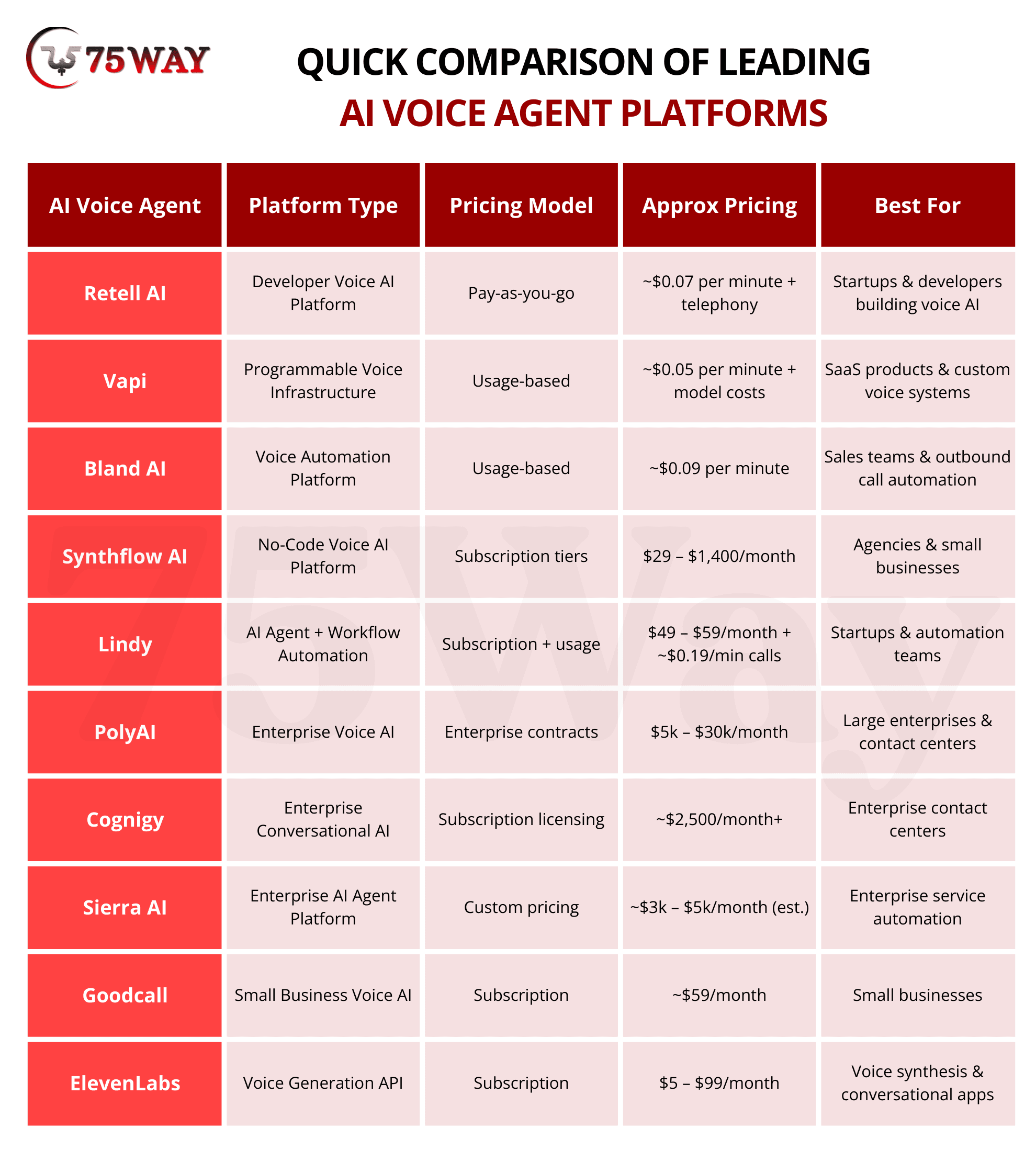
Quick Comparison of Leading AI Voice Agent Platforms
Before choosing a voice automation platform, businesses should evaluate factors such as pricing structure, integration flexibility, scalability, and ease of deployment. Each AI voice agent offers unique strengths depending on technical requirements and operational goals. The comparison below highlights key differences in features, pricing models, and ideal use cases across leading AI voice agent platforms.
Learn More: How To Develop A Mobile App in 2026: Complete Guide
Why Businesses Are Adopting AI Voice Agents in 2026?
Businesses are rapidly adopting AI voice agents in 2026 to manage rising customer support costs and increasing communication demands. These systems provide 24/7 automation, allowing companies to handle customer inquiries, bookings, and service requests without human limitations. AI voice agents also enhance customer experience by delivering faster responses and personalized conversations. As organizations scale operations, voice automation helps improve efficiency, reduce operational expenses, and support secure enterprise communication across multiple customer interaction channels.
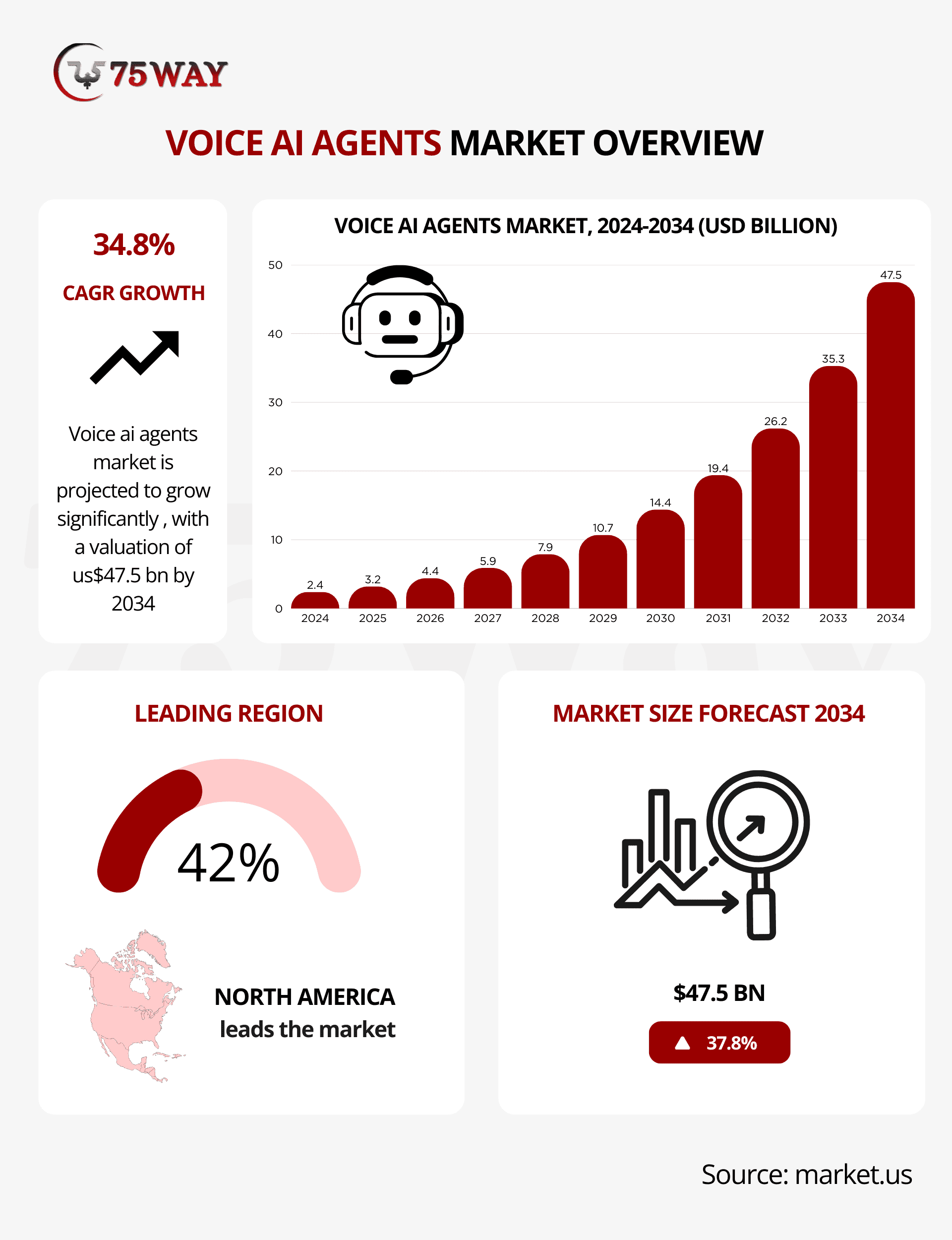
- The global voice AI agents market is forecasted to reach $47.5 billion by 2034, growing at a 34.8% compound annual growth rate, according to the Market.us report.
- Neural text-to-speech (TTS) technologies are expected to dominate the sector, capturing approximately 49.6% of the total market share.
- The AI voice generator market is anticipated to grow to $20.71 billion by 2031, advancing at a 30.7% CAGR, as reported by MarketsandMarkets.
- North America is projected to lead the global market, accounting for around 40.9% of the total share.
- Around 22% of recent startup batches from Y Combinator are developing products based on voice-based technologies.
Read Too: Dating App Development Cost in 2026: A Complete Guide
How AI Voice Agent Works?
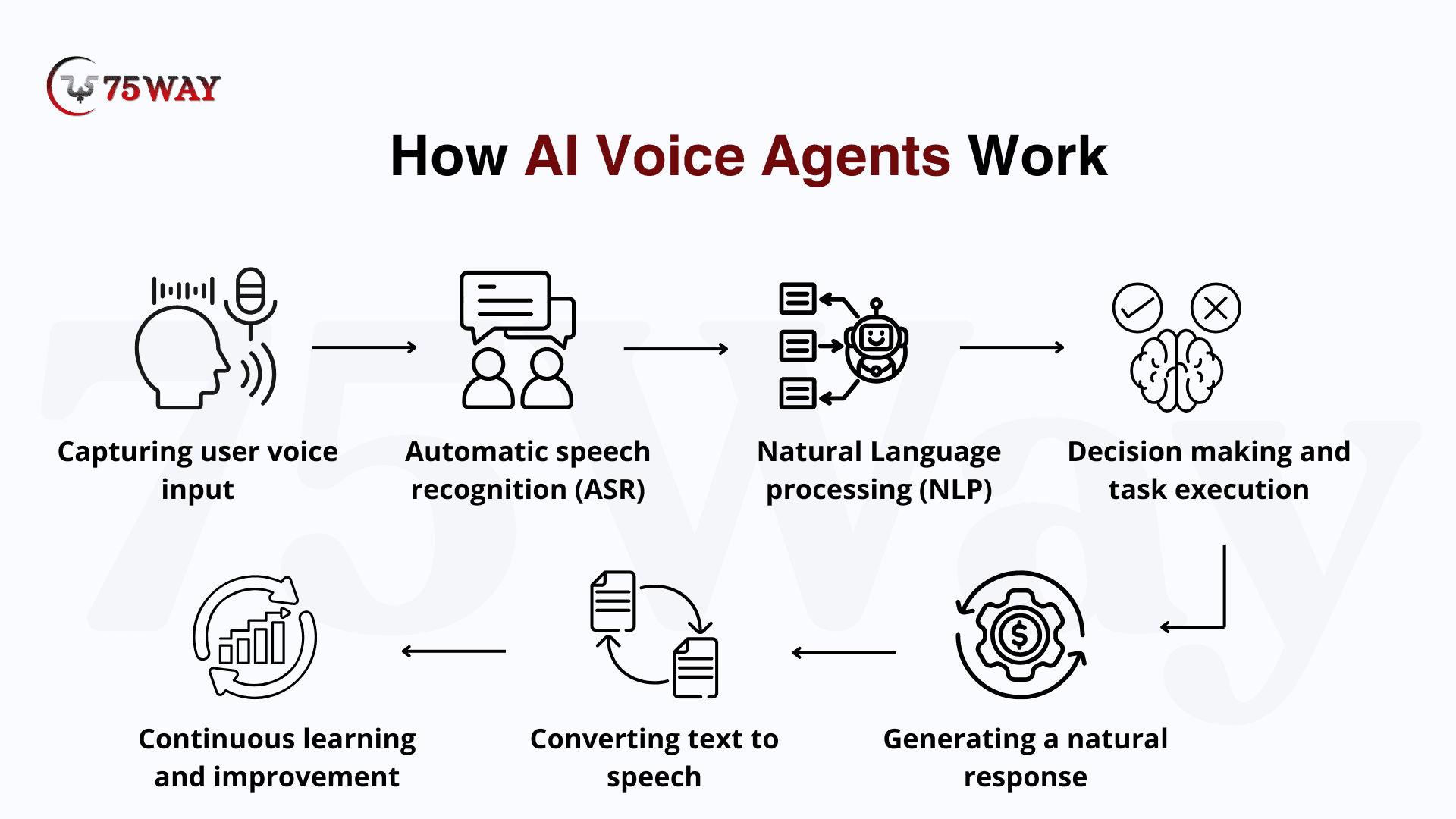
AI voice agents function through multiple speech and language processing layers that enable natural, real-time conversations with users. The process begins with Automatic Speech Recognition (ASR), which converts spoken language into written text, even when there is background noise or different accents. After the speech is transcribed, Natural Language Understanding (NLU) examines the text to determine the user’s intent and identify important details such as names, dates, or order numbers, allowing the system to understand the request accurately.
Next, Dialogue Management keeps track of the conversation context so the interaction remains consistent across multiple exchanges. The Action Layer then connects the voice agent to business systems such as CRMs, ERPs, or internal APIs to retrieve information, perform tasks, or update records instantly. Finally, Text-to-Speech (TTS) transforms the generated response into natural-sounding voice output, which can be customized to match different languages, tones, or brand personalities for a smoother user experience.
Read More: Best iOS App Development Companies in USA Founders Must Know
AI Voice Agents: Business Use Cases Explained
AI voice agents automate real-time phone conversations to manage customer interactions, service requests, and operational tasks. From customer support to internal assistance, voice AI improves efficiency, response speed, and service quality across multiple operational workflows.
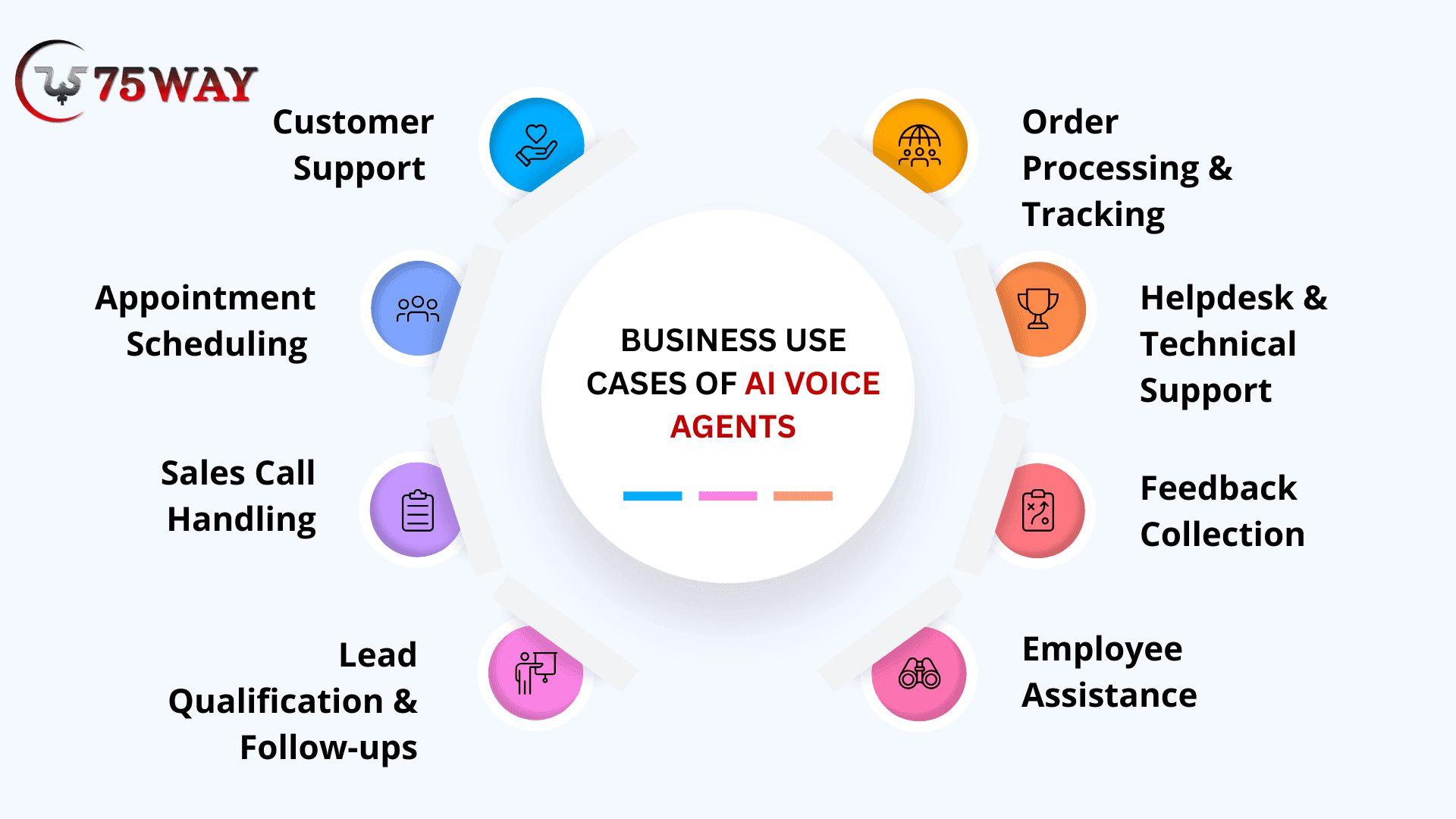
Customer Support: AI voice agents handle common customer support inquiries such as account questions, product information, service requests, and complaint resolution. By answering calls automatically and providing instant responses, businesses reduce support workloads while ensuring customers receive timely assistance during peak service hours.
Appointment Scheduling: Voice AI agents automate appointment booking by interacting with callers, checking calendar availability, and confirming reservations. Businesses in healthcare, consulting, and service industries use these systems to reduce missed calls and streamline scheduling without requiring staff to manually manage bookings.
Sales Call Handling: These conversational AI systems assist sales teams by managing outbound and inbound calls related to product inquiries, promotional campaigns, and service explanations. Automated conversations help businesses maintain consistent outreach while allowing human sales representatives to focus on closing complex deals.
Lead Qualification & Follow-ups: These AI-powered voice agents evaluate potential leads by asking qualification questions, capturing responses, and updating CRM records. Businesses use automated follow-up calls to maintain engagement with prospects, ensuring timely communication while prioritizing high-value opportunities for human sales teams.
Order Processing & Tracking: The voice-enabled AI agents help customers place orders, confirm purchases, and check shipment status through automated phone interactions. By connecting with order management systems, businesses provide real-time updates and reduce customer frustration caused by delayed responses or unavailable support representatives.
Helpdesk & Technical Support: Voice AI agents support technical helpdesk operations by guiding users through troubleshooting steps, diagnosing basic issues, and creating service tickets when necessary. Automated assistance allows IT teams to focus on complex technical problems while routine support requests are handled efficiently.
Feedback Collection: Businesses can use AI voice agents to collect customer feedback after purchases, service interactions, or support calls. Automated surveys through phone conversations allow to gather insights about customer satisfaction, service quality, and product performance without manual outreach efforts.
Employee Assistance: AI voice agents also assist internal teams by answering HR questions, retrieving company information, and guiding employees through internal processes. Organizations use these systems to provide instant workplace assistance while reducing repetitive administrative tasks for human support teams.
Learn More: How to Build a Self Driving Car Software: A Complete Roadmap
AI Voice Agents Vs Traditional Call Centers: Key Differences
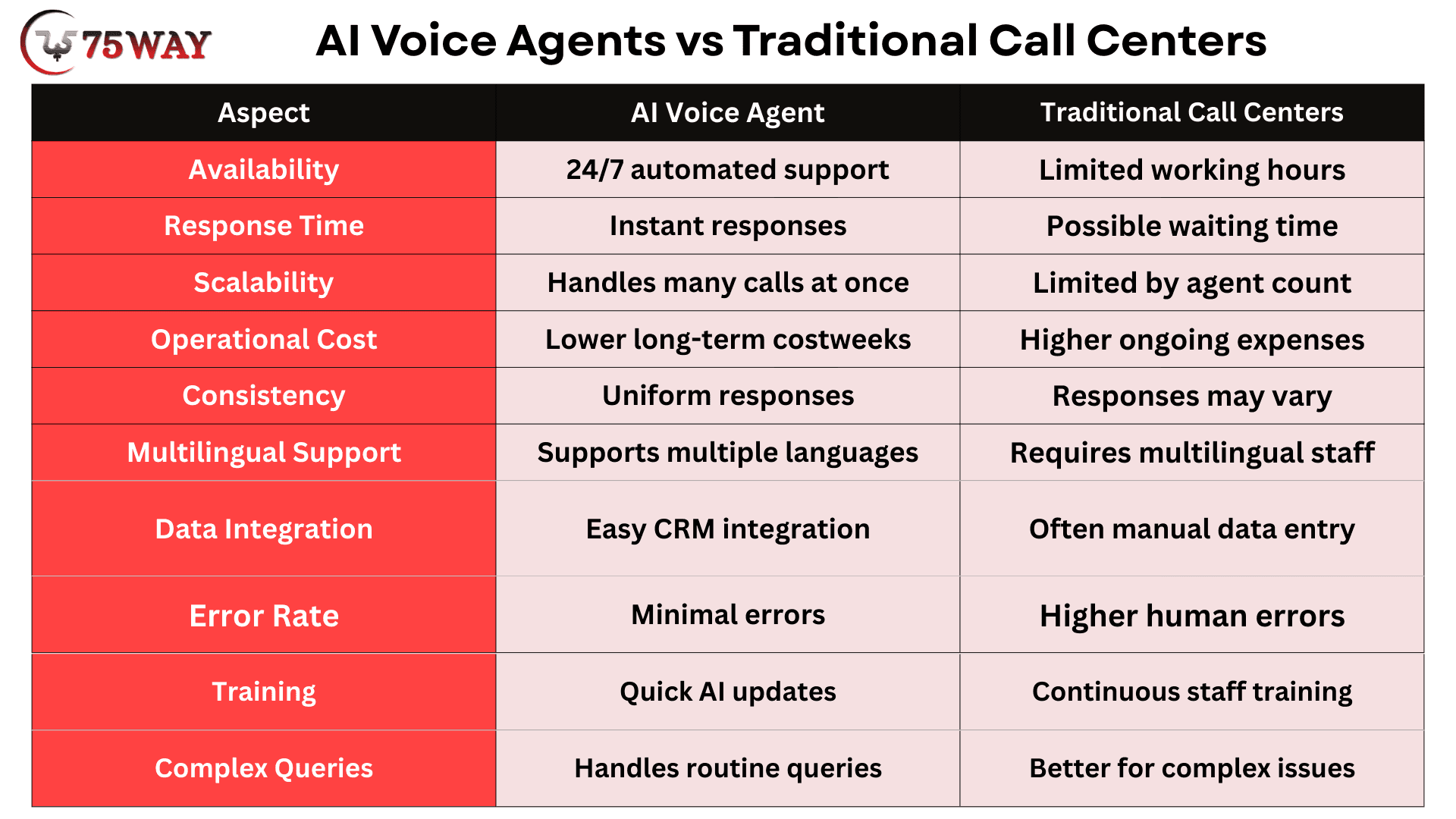
AI voice agents and traditional call centers differ significantly in how customer communication is managed. AI voice agents use speech recognition, language processing, and voice synthesis to handle conversations automatically, allowing businesses to respond to customer inquiries instantly without human intervention. These systems operate continuously, manage multiple calls simultaneously, and help businesses reduce operational costs while maintaining consistent communication.
Traditional call centers rely on human agents to answer customer calls, resolve issues, and manage service requests. While human representatives provide emotional understanding and handle complex situations effectively, call centers often face limitations such as staffing costs, limited working hours, and slower response times during peak call volumes. AI voice agents complement or partially replace these systems by automating repetitive communication tasks and improving operational efficiency.
Know More: How AI Development Help US Companies Scale Faster
How to Choose the Right AI Voice Agent?
The selection of a reliable AI voice agent starts with identifying your business needs and evaluating platforms based on performance, flexibility, and operational efficiency. The ideal solution balances automation, cost-effectiveness, and customer experience while integrating seamlessly with existing systems for scalable, secure, and reliable communication.
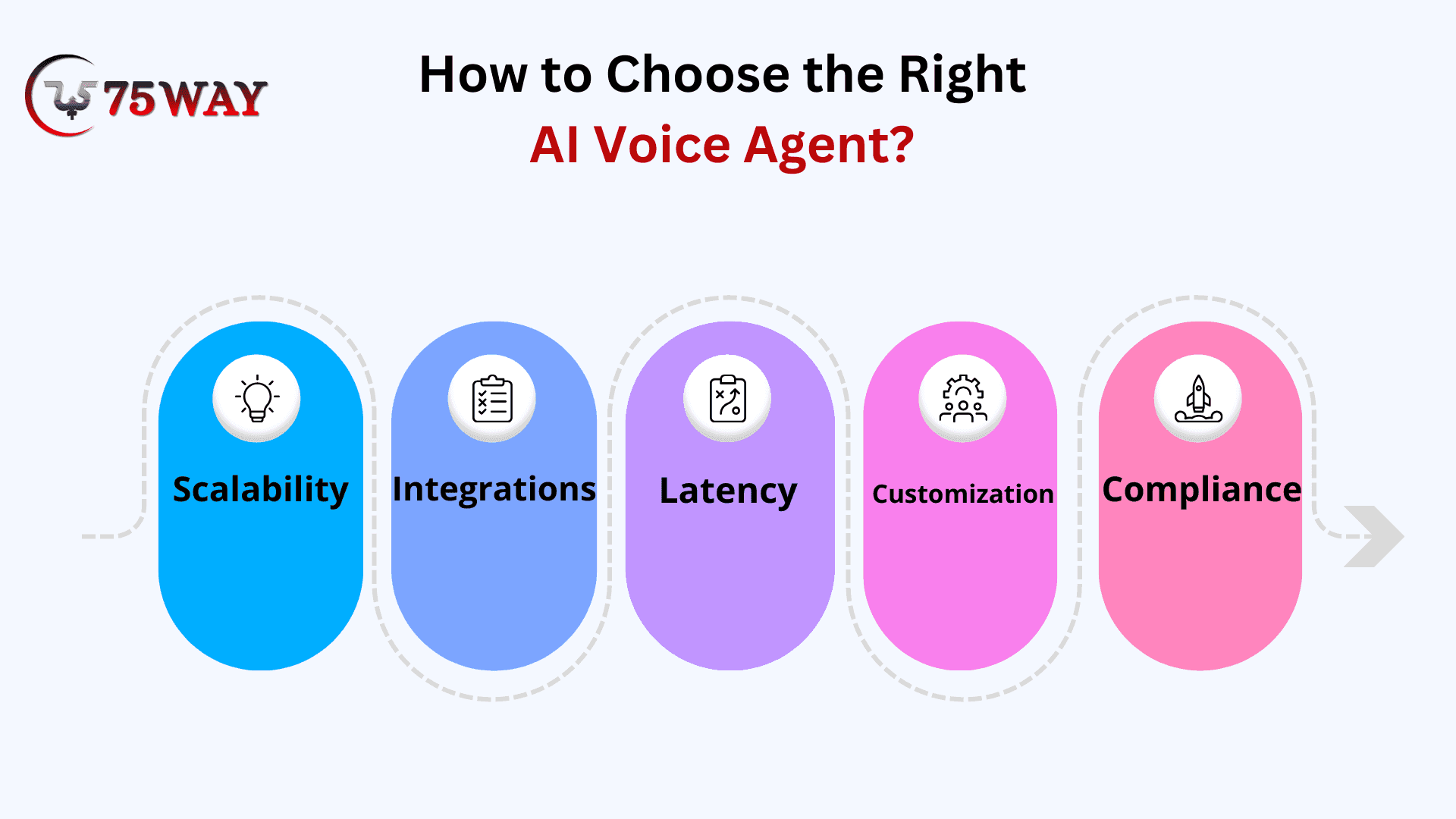
Scalability: A suitable AI voice agent must handle increasing call volumes without performance drops. You must choose the platforms that offer concurrent call support, cloud infrastructure, and flexible pricing models that grow with your business demands, ensuring uninterrupted customer interactions during peak times.
Integrations: Effective AI voice agents integrate with CRM, ERP, and workflow automation tools. Smooth connectivity allows automated retrieval and updating of customer data, improving efficiency, maintaining records, and enabling personalized interactions across multiple communication channels.
Latency: Low-latency systems deliver faster responses during live conversations, ensuring natural dialogue flow. You can evaluate platforms for real-time processing capabilities and minimal delay in speech recognition, response generation, and call routing to enhance user satisfaction.
Customization: This feature enables tailoring voice tone, conversation flow, and AI behavior to match brand identity. Platforms with flexible APIs or visual workflow builders allow businesses to create specific scripts, handle unique scenarios, and maintain a consistent customer experience.
Compliance: Businesses must ensure the AI voice agent adheres to data privacy, call recording, and industry regulations. Compliance features like encryption, secure storage, and audit trails are essential for protecting sensitive information and avoiding legal or regulatory penalties.
Explore More: AI App Development Partner for Health and Wellness Startup
How to Build an AI Voice Agent? A Detailed Process
A structured approach is required to create an AI voice agent. In this process, you have to select the right technologies and align the system with business objectives. By combining speech recognition, natural language processing, and voice generation with workflow automation, companies can create intelligent AI copilots with voice enablement that improve customer interactions, streamline operations, and deliver scalable, real-time communication solutions.
Define the Business Use Case
The primary stage to develop an AI voice agent is to determine its design and capabilities. Customer support, appointment scheduling, sales calls, or internal operations guide technology choices, conversation structures, and performance evaluation. Clear identification of business needs allows these AI models to deliver meaningful interactions, address operational requirements, and contribute to improved customer engagement and workflow management.
Select the Right Speech Recognition Engine
The choice of speech recognition engine affects the accuracy of voice understanding. Support for multiple accents and languages increases transcription reliability and reduces misinterpretation during interactions. High-quality recognition forms the foundation of seamless voice communication, allowing AI agents to process complex queries naturally and support multi-turn conversations with consistent performance.
Integrate Natural Language Processing (NLP)
The next stage in building an AI voice agent is to embed natural language processing (NLP), which adds intelligence to speech recognition by interpreting user intent and extracting essential information. Context awareness and conversational memory allow agents to respond appropriately to complex questions. NLP integration transforms simple voice input into actionable responses, enabling AI systems to deliver human-like engagement and enhance both user experience and task completion.
Design Conversation Flows & Dialogue Logic
Structured conversation flows guide interactions from prompts to responses. Predefined dialogue paths, fallback procedures, and escalation strategies create coherence in multi-turn conversations. Thoughtful mapping of dialogue logic allows AI agents to handle diverse scenarios, maintain continuity across exchanges, and reduce errors, resulting in conversations that feel natural and responsive.
Implement Text-to-Speech (TTS) Voice Generation
Text-to-speech technology converts AI responses into a natural voice. Voice tone, pace, and emotion can reflect brand personality and create a more engaging interaction. TTS integration allows automated communication to feel human-like, enhancing customer satisfaction and reinforcing the perception of intelligent conversational support.
Connect APIs & Business Systems
API connections integrate AI voice agents with CRM platforms, booking systems, databases, and other business tools. Real-time data access allows agents to check order status, update records, or schedule appointments without human intervention. Seamless connectivity strengthens workflow automation and ensures the AI operates as a cohesive part of existing business processes.
Test, Train, & Deploy the Voice Agent
Comprehensive testing identifies issues in recognition accuracy, dialogue logic, and system integration. Real conversation data supports training, improving response reliability and adaptability. After deployment, the last stage is continuous monitoring, which allows iterative optimization for scalability, interaction quality, and operational impact, making the AI voice agent a robust solution for business communication.
Learn More: Top Taxi Booking Apps in USA: How To Build Your Taxi App
Final Thoughts
AI voice agents are revolutionizing business communication by managing customer support, appointment scheduling, sales calls, lead follow-ups, and order tracking. Platforms like Retell AI, Vapi, Bland AI, Synthflow, Lindy, PolyAI, and ElevenLabs combine advanced speech recognition, natural language processing, and text-to-speech technology to create human-like conversations. Compared with traditional call centers, these solutions lower operational costs, offer round-the-clock assistance, and provide actionable insights. The right platform involves evaluating scalability, integrations, and compliance. Businesses that need advanced conversational solutions can collaborate with a trusted AI development company to design, build, and optimize AI voice agents tailored to their unique requirements.
Frequently Asked Questions (FAQs)
How Do AI Voice Agents Improve Customer Engagement?
AI voice agents deliver natural, conversational interactions, providing instant responses and personalized experiences. They handle inquiries across multiple channels, reduce wait times, and maintain context, boosting customer satisfaction, retention, and overall engagement with business services.
Can Small Businesses Benefit From AI Voice Automation?
Yes, small businesses can leverage AI voice agents to automate customer support, appointment scheduling, and order tracking. These agents reduce manual workloads, enhance accessibility, and provide professional, consistent communication, allowing smaller teams to operate at enterprise-level efficiency.
What Security Measures Protect Data In AI Voice Systems?
AI voice platforms implement encryption, access controls, and compliance frameworks to protect sensitive customer information. Integration with secure APIs, audit logs, and privacy policies ensures that conversations, recordings, and transactional data remain safe during interactions.
How Do AI Voice Agents Handle Multiple Languages?
Multilingual AI voice agents use advanced language models to recognize speech, interpret intent, and respond accurately in various languages. Accent adaptation and contextual understanding allow businesses to communicate effectively with diverse audiences across regions.
Are AI Voice Agents Compatible With Existing CRMs?
Yes, most AI voice systems integrate with popular CRM platforms, allowing automated call logging, customer record updates, and data retrieval. Seamless CRM integration ensures consistent workflows and helps teams track customer interactions efficiently.
How Is Performance Measured For AI Voice Interactions?
Performance metrics include call completion rates, response accuracy, user satisfaction scores, and average handling time. Analytics dashboards provide actionable insights, helping businesses optimize dialogue flows, improve AI responses, and enhance overall voice agent effectiveness.