AI Summary
Building an Airbnb clone requires a clear marketplace strategy, user-focused features, and reliable booking infrastructure. This guide covers the business model, essential features, technology stack, development process, AI opportunities, security, and launch considerations to help businesses understand what it takes to create a competitive rental platform.
Key Takeaways
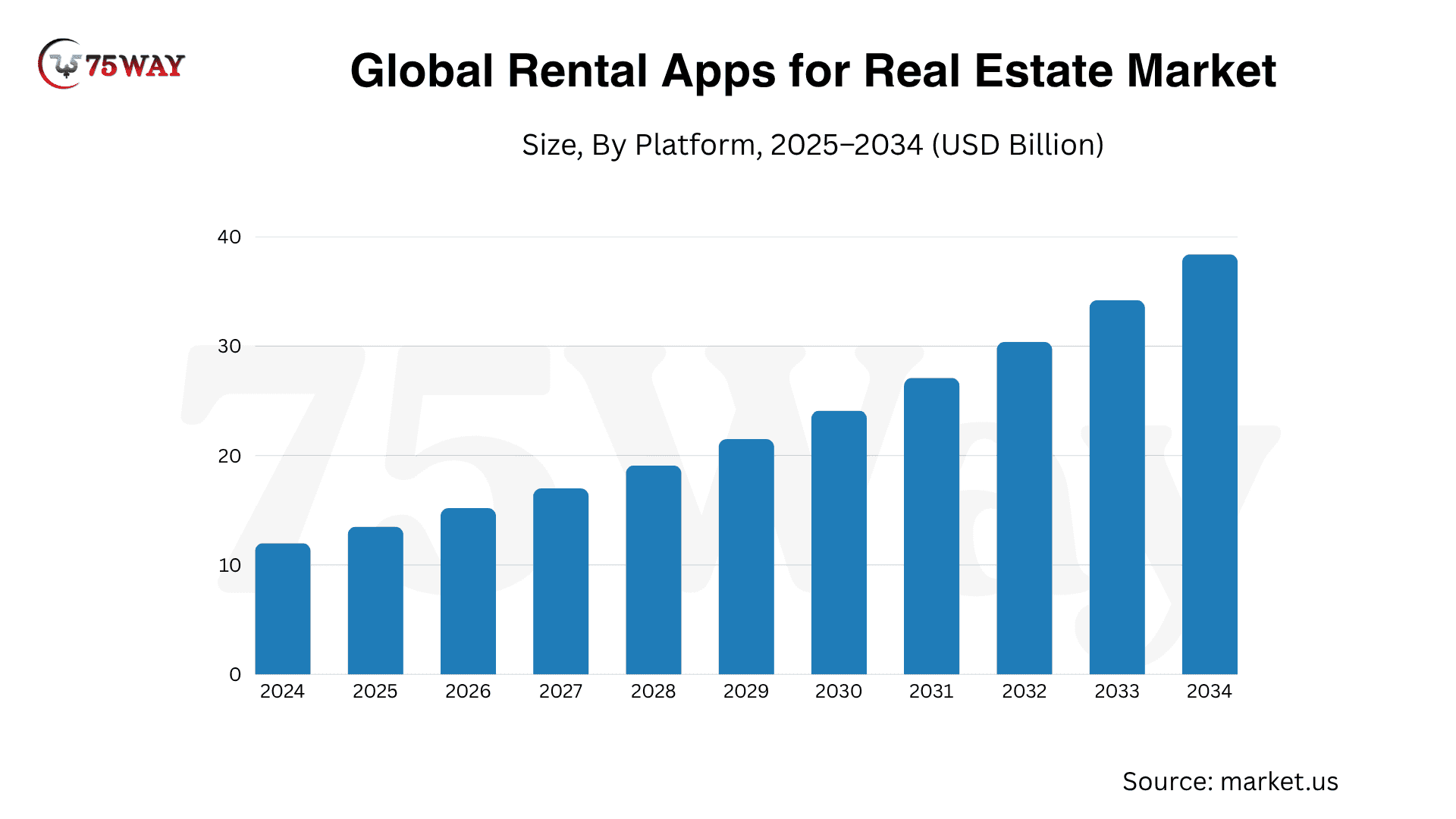
- Global rental apps for real estate market may reach USD 38.4B by 2034.
- Airbnb clone development requires essential guest, host, and admin marketplace features.
- Its business model can generate revenue through commissions, fees, subscriptions, and partnerships.
- Development involves planning, design, architecture, coding, testing, deployment, and optimization.
- Airbnb-style app development costs range from $35,000 to $300,000+ depending on complexity.
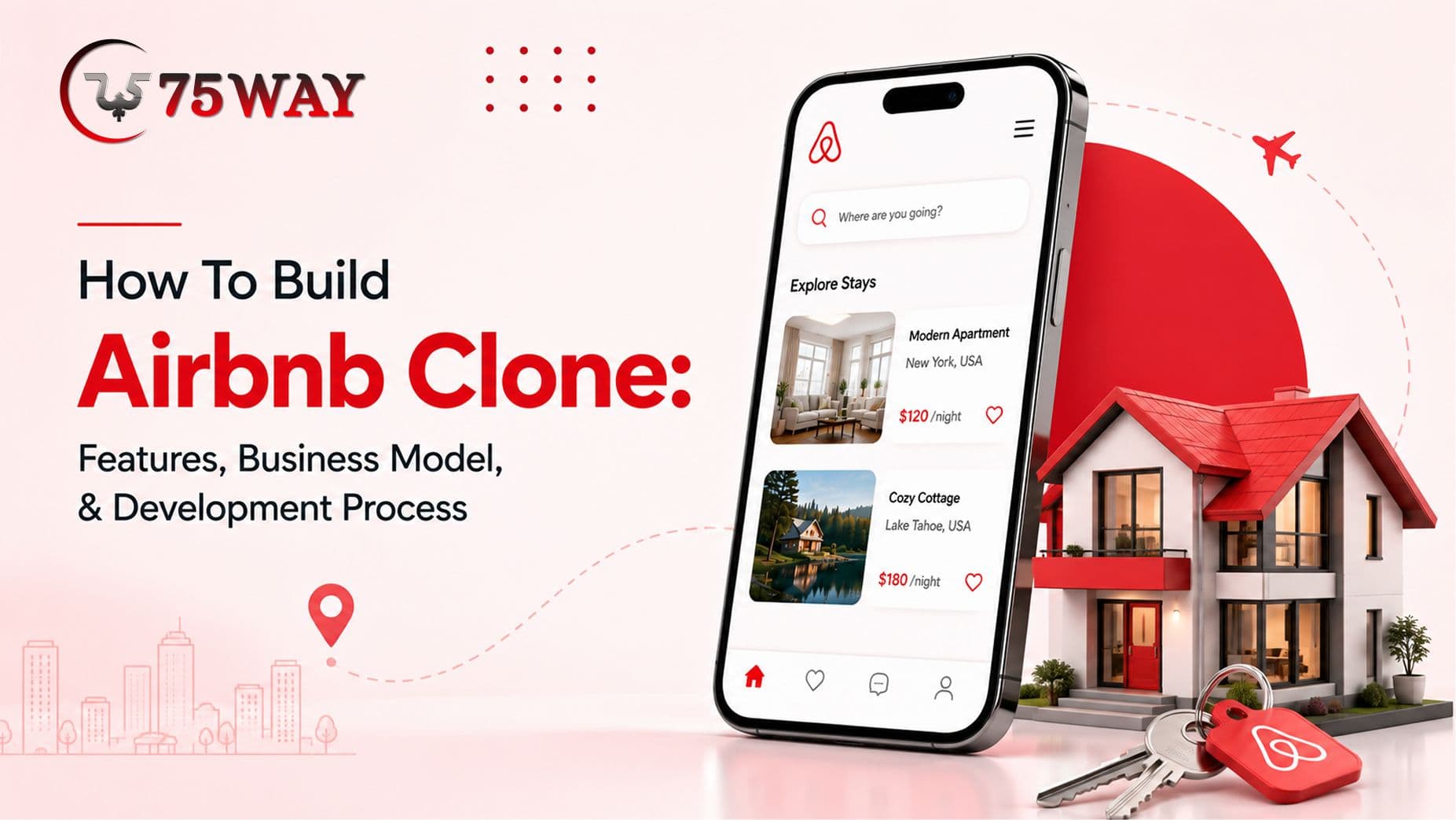
An Airbnb clone is not simply about recreating a property-booking interface. A successful Airbnb-style house rental app development solution for real estate needs a two-sided platform where hosts can list and manage properties, guests can search and book stays, payments can move securely between parties, and the business can earn revenue from every transaction.
For startups, founders, and established businesses, the better approach is to build a mobile app like Airbnb clone around a specific market opportunity rather than copy Airbnb feature for feature. You need to define your niche, validate demand, choose the right marketplace app model, prioritize MVP features, design the booking and payment architecture, and plan for trust, scalability, and regulatory requirements from the beginning.
This guide explains how to build an Airbnb clone, which features matter, how the business model works, what Airbnb-like app development costs, which technology options make sense, and how to turn an Airbnb app clone into a scalable rental marketplace.
What Is An Airbnb Clone?
An Airbnb clone is a rental marketplace that brings two groups together: people looking for places to stay and property owners looking to earn from their available spaces. Guests can search listings, compare prices, check dates, book properties, pay online, message hosts, and share reviews, while hosts manage listings, availability, bookings, and earnings.
The idea becomes clearer when you look at what happens behind the screen. A guest searches for a stay → the platform displays matching properties → the guest checks availability and pricing → a booking is confirmed → payment is processed → the host receives the reservation details → both sides can communicate and review the experience afterward.
How An Airbnb Clone Is Structured
Rather than being just an Airbnb clone website or Airbnb clone mobile app, the platform works as a complete two-sided marketplace.
- Guest Side: Travelers can discover properties, apply filters, compare listings, view photos and amenities, check availability, reserve stays, make payments, communicate with hosts, and leave reviews.
- Host Side: Property owners can publish listings, upload property details, manage calendars, adjust pricing, accept or manage reservations, communicate with guests, and monitor their earnings.
- Admin Side: The business owner controls the marketplace through tools for user management, listing moderation, bookings, commissions, payments, disputes, reviews, analytics, and platform settings.
The real opportunity lies in choosing a rental niche instead of copying every part of Airbnb. A new marketplace could focus on luxury villas, mountain cabins, student accommodation, corporate stays, RV rentals, beachfront homes, pet-friendly properties, or another clearly defined audience.
This approach lets businesses build an app like Airbnb around a specific customer problem, location, property category, or revenue model rather than creating a generic accommodation marketplace.
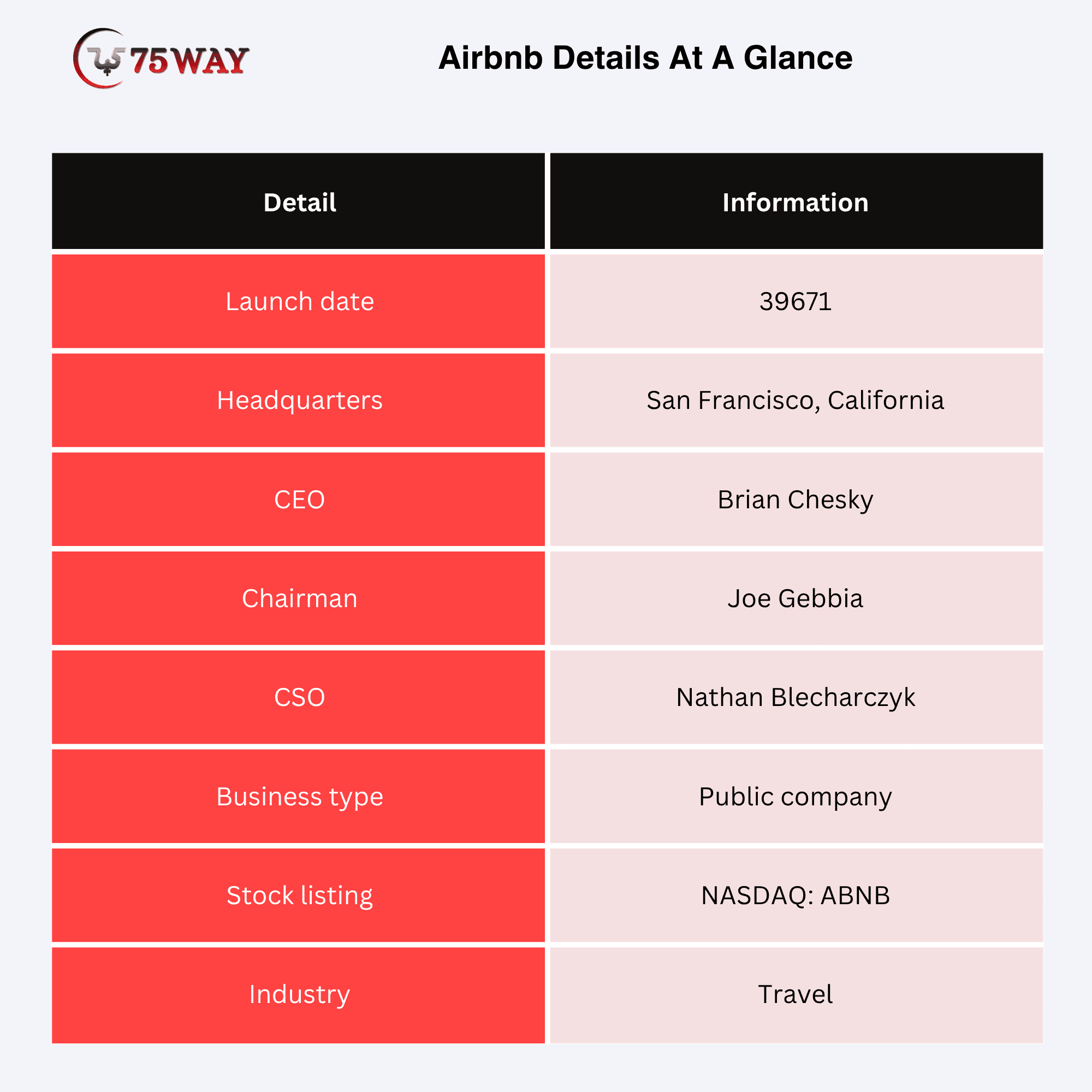
Airbnb At A Glance
If you're using Airbnb as the benchmark for your rental marketplace, these details provide useful context:
Market Size & Growth Insights To Build A Rental App Like Airbnb
The opportunity behind an Airbnb-like app becomes easier to understand when you look at booking activity rather than the app itself. Airbnb recorded 533 million nights and seats booked and $91.3 billion in gross booking value in 2025, both up year over year. The broader market signals below show why rental platforms continue to attract business interest.
Airbnb Hosts & Listings
- Airbnb has more than 5 million hosts and over 9 million active listings worldwide.
- Airbnb listings are available across 150,000+ cities globally.
Airbnb Users & Bookings
- The platform has served 150+ million users, who have collectively booked more than 1.5 billion stays.
- More than 490 million nights and experiences were booked through Airbnb, generating over $11 billion in revenue.
- Approximately 6 guests check into an Airbnb listing every second.
- Guests stay an average of 4.3 nights per Airbnb booking.
- Users spend approximately 11 minutes and 31 seconds booking a stay through the Airbnb app.
Airbnb Pricing & Market Share
- The average Airbnb stay in North America costs around $163 per night.
- Airbnb is estimated to hold more than 20% of the global vacation rental market.
Vacation Rental Market Growth
- The global vacation rental market is projected to grow from $109.40 billion in 2026 to $136.78 billion by 2031, at a CAGR of 4.57%.
- Offline booking channels accounted for 50.60% of the vacation rental market, while online portals are projected to grow at a 6.38% CAGR through 2031.
Why Invest in Airbnb Clone Development in 2026?
Building an Airbnb clone can give startups and established businesses an opportunity to create a specialized rental marketplace without owning every property listed on the platform. The model connects property owners with travelers while the platform earns revenue by facilitating discovery, reservations, payments, and other services.
For founders and business owners, the opportunity becomes stronger when the platform addresses a specific market gap instead of competing with Airbnb solely on inventory size.
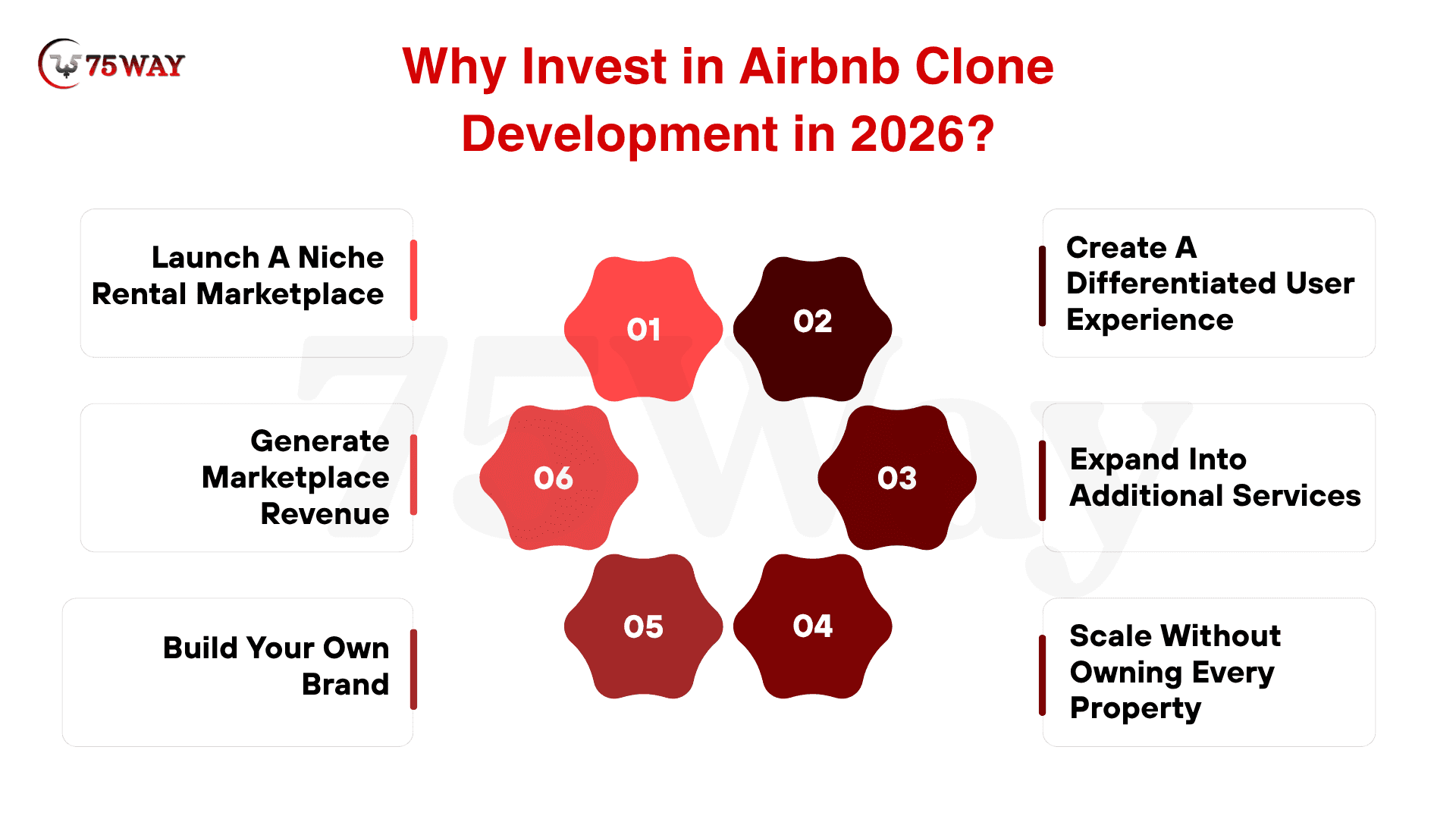
1. Launch A Niche Rental Marketplace
A focused platform can serve a specific audience or property category, such as luxury vacation homes, cabins, student rentals, corporate housing, or long-term stays.
A niche strategy can make customer acquisition and marketplace positioning more focused than launching a general-purpose rental platform.
2. Generate Marketplace Revenue
An Airbnb-style marketplace can generate revenue without purchasing or managing every property itself. Potential revenue streams include:
- Booking commissions
- Guest service fees
- Host subscriptions
- Featured listings
- Premium host tools
- Advertising
- Partner services
The right monetization strategy depends on your target market, booking volume, customer acquisition costs, and value provided to hosts and guests.
3. Build Your Own Brand
An Airbnb clone app allows businesses to create their own brand, customer experience, pricing structure, marketplace rules, and positioning.
Instead of relying entirely on an established third-party marketplace, you can build a direct relationship with hosts and guests through your own website and mobile applications.
4. Create A Differentiated User Experience
A new rental marketplace does not need to reproduce every Airbnb feature. You can differentiate through:
- Faster booking
- Specialized property categories
- Better host tools
- Local experiences
- Flexible cancellation options
- Loyalty programs
- AI-powered recommendations
- Smarter search
- Personalized pricing insights
The strongest differentiation usually comes from solving a specific customer problem better, rather than simply adding more features.
5. Expand Into Additional Services
Once the marketplace develops sufficient supply and demand, businesses can explore complementary services such as property management, travel experiences, concierge services, transportation partnerships, or other relevant offerings.
This creates opportunities to increase revenue per customer while making the platform more valuable to its existing users.
6. Scale Without Owning Every Property
One of the biggest advantages of the marketplace model is that platform growth does not necessarily require purchasing additional real estate.
As more qualified hosts join, the available inventory can expand across locations and property categories. However, growth still depends on maintaining quality supply, customer trust, operational capacity, and sufficient booking demand.
The goal of an Airbnb clone should not be to reproduce Airbnb's interface or every feature. The better strategy is to understand the marketplace mechanics and build a differentiated product around a specific audience, geography, property type, or customer problem.
Business Model of Airbnb Housing Rental App: How Does It Make Money?
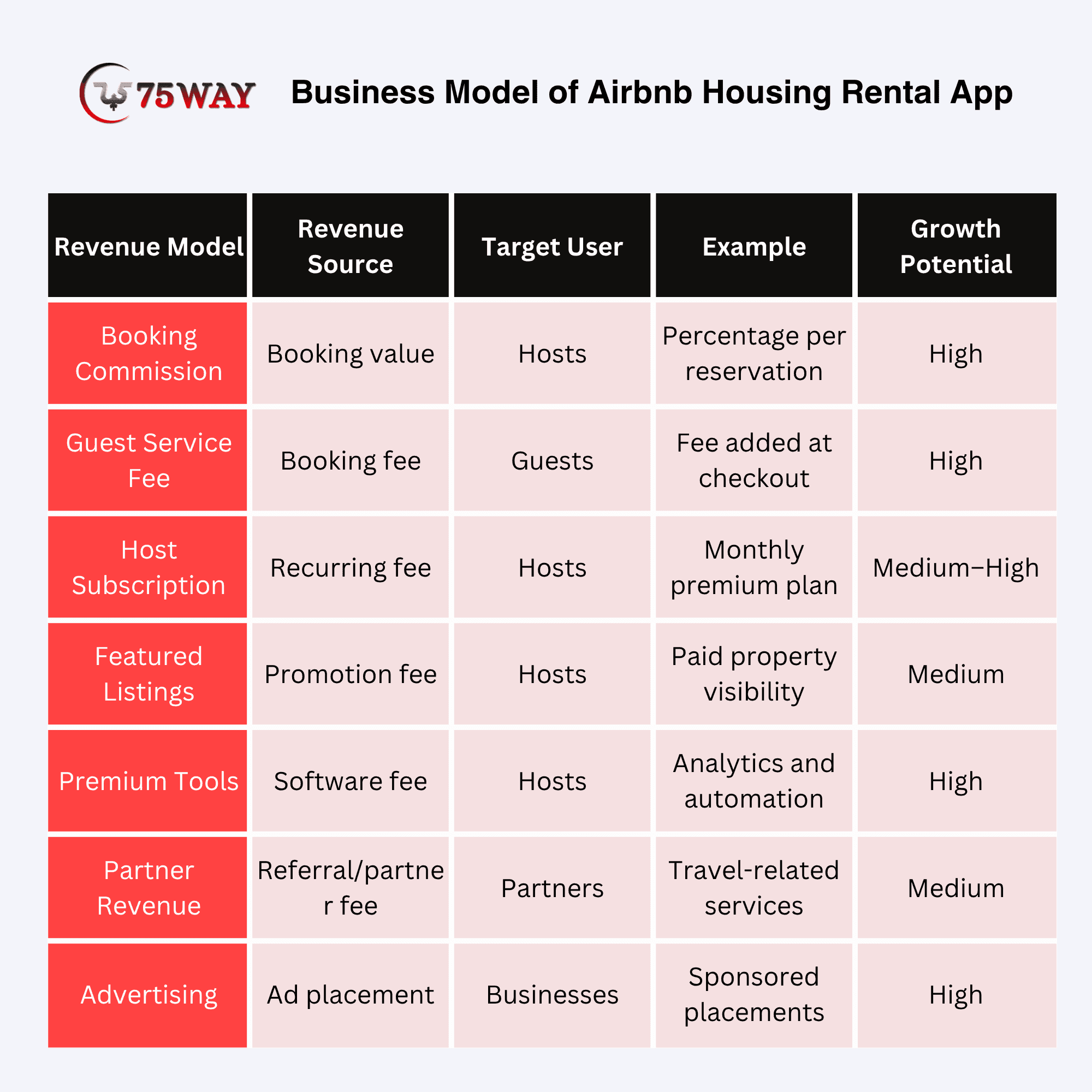
An Airbnb clone can make money whenever it successfully brings a guest and host together, but bookings do not have to be the only source of income. A well-planned rental marketplace for real estate can combine transaction fees with subscriptions, premium tools, promotions, and relevant partnerships. The right mix depends on the audience, property type, location, booking frequency, and stage of marketplace growth.
- Booking Commission
Every successful reservation can create revenue for the platform through a commission. For instance, a $500 reservation with a 10% platform commission would generate $50 before payment processing costs, refunds, taxes, or other applicable adjustments.
This model naturally grows with marketplace activity. More properties, more bookings, and higher transaction value can translate into greater platform revenue, provided the commission remains acceptable to hosts and guests.
- Guest Service Fees
A small service fee can be added to the guest's checkout total. This gives the platform another revenue source while allowing the property price itself to remain under the host's control.
A transparent checkout can show the property charge, applicable cleaning fee, platform fee, taxes, discounts, and final amount separately. Clear pricing matters because unexpected charges at the last step can make guests abandon a booking.
- Host Subscription Plans
Professional hosts may be willing to pay regularly for tools that help them manage properties and improve bookings. Instead of charging the same commission structure to everyone, the platform can offer different subscription levels based on host requirements.
Higher plans could unlock advanced analytics, automated guest communication, pricing insights, promotional features, additional listings, and property management capabilities. Recurring subscriptions can also give the business a more predictable revenue stream.
- Featured Property Listings
A host with a beautiful property may want it to stand out when travelers browse a crowded destination. The platform can offer paid promotional placements that give selected listings additional visibility in relevant categories or locations.
The important part is maintaining transparency. Sponsored or promoted properties should be clearly identified so guests can distinguish paid visibility from normal search rankings.
- Premium Host Tools
Professional property managers often need more than basic listing and booking features. They may pay for advanced tools that help them understand occupancy, revenue, guest activity, pricing, and portfolio performance.
A premium toolkit could include automated communication, multi-property management, calendar synchronization, revenue reporting, occupancy forecasting, and pricing recommendations. This turns the platform from simply a booking channel into a useful operating system for hosts.
- Partner Revenue
Once guests are regularly using the platform, relevant travel services can create another commercial opportunity. The marketplace could work with businesses offering transportation, cleaning, local experiences, property management, hospitality services, or other services connected to a guest's stay.
For example, a traveler booking a remote villa might also need airport transportation or local activities. Partnerships can generate additional revenue while making the overall trip more convenient.
- Advertising Revenue
A rental marketplace with substantial traffic can eventually attract businesses that want to reach travelers or property owners. Local restaurants, travel companies, transportation providers, hospitality brands, and property-related businesses could potentially pay for relevant advertising placements.
Advertising works best when it feels connected to the user's journey rather than interrupting it. Too many promotional placements can make property discovery harder and may reduce trust, so this revenue stream is usually better suited to a mature marketplace with strong traffic.
Which Airbnb Clone Business Model Should You Choose?
For an early-stage marketplace, a booking commission or transaction-based model is usually easier to understand and align with marketplace activity.
As the platform grows, you can introduce subscriptions, promoted listings, premium host tools, and partnerships.
A practical progression can look like:
MVP → Booking Commission → Premium Host Tools → Subscriptions → Featured Listings → Partnerships
The important point is to avoid charging users simply because a monetization option exists. Each revenue stream should provide measurable value while keeping the marketplace attractive to both hosts and guests.
How To Build An App-Like Airbnb: Step-By-Step Airbnb Clone Development Process
An Airbnb-style marketplace takes shape through several connected decisions, from defining the target rental niche to designing booking workflows, host tools, payments, and platform controls. Getting those decisions right early can prevent expensive changes later. The Airbnb-like app development process outlines how to move from the initial concept to a launch-ready product.
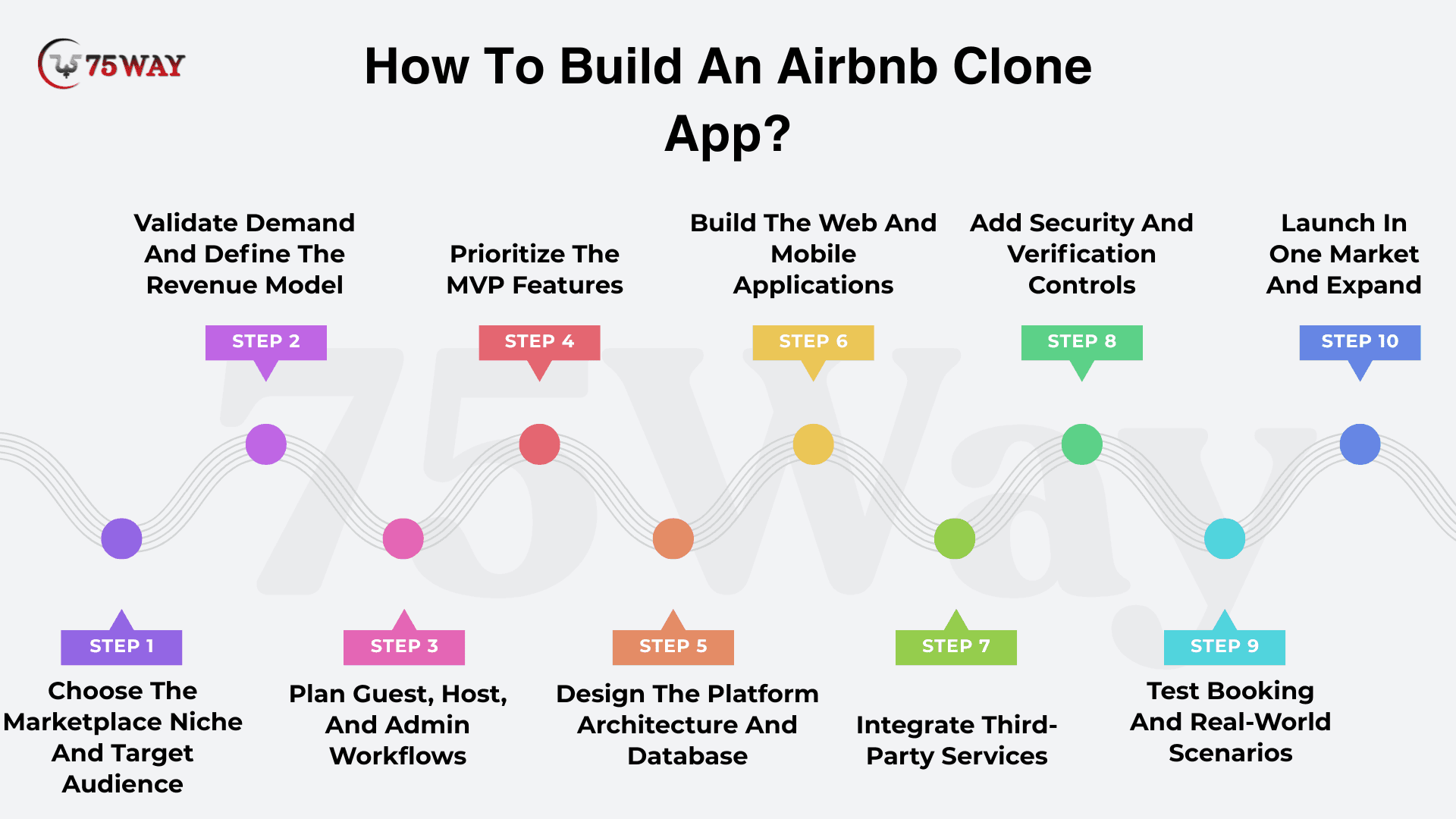
1. Choose The Marketplace Niche And Target Audience
At the initial stage of an Airbnb-like app development methodology, you must start with a clear answer to two questions: Who will use the platform, and what will they book? Your marketplace could focus on luxury villas, vacation homes, student accommodation, corporate stays, cabins, or budget-friendly rentals.
Research the market before development begins. Look at:
- Target guest expectations
- Available property supply
- Competitor offerings
- Popular locations
- Average booking value
- Unserved customer needs
A focused niche gives the marketplace a clearer identity and makes the initial customer acquisition strategy easier to shape.
2. Validate Demand And Define The Revenue Model
A good concept still needs real market demand. Before investing heavily in development, make sure the concept has enough potential demand. Research prospective guests and hosts, study competitor strengths and weaknesses, and test whether your proposed experience solves a real problem.
Key validation actions:
- Interview target guests and property owners.
- Analyse competitor pricing and positioning.
- Test the concept with a landing page.
- Estimate demand within the initial market.
- Identify customer acquisition opportunities and costs.
The revenue model should be decided at this stage because it can influence the entire marketplace structure. Booking commissions, guest fees, host subscriptions, featured listings, and premium tools are possible options, but the right combination depends on your audience and operating model.
3. Plan Guest, Host, And Admin Workflows
Once the business model is clear, map what each person needs to accomplish inside the platform.
The platform serves three different groups, so each journey needs to be planned separately. A guest should find and reserve a property without unnecessary steps, while hosts need enough control to manage their listings.
Map the main journeys before development:
- Guest: Search → property details → availability → booking → payment → stay → review
- Host: Registration → verification → listing → calendar → reservation → communication → payout
- Admin: User management → listing approval → booking oversight → payments → disputes → reporting
Connecting these workflows early helps prevent gaps between customer actions and backend operations.
4. Prioritize The MVP Features
Do not try to build every feature on your first release. The first version should solve the main booking problem instead of trying to include every advanced capability from day one. Start with the functions needed to make a real booking possible from beginning to end.
- Map Core Requirements: Identify the minimum capabilities required to complete the marketplace’s primary customer journey.
- Rank Business Value: Give higher priority to capabilities directly supporting bookings, revenue, retention, or operations.
- Assess Development Effort: Compare expected business value against development complexity, cost, dependencies, and maintenance requirements.
- Separate Release Phases: Divide requirements into launch essentials, growth-stage additions, and future advanced capabilities.
- Set Clear Boundaries: Remove low-priority requirements that could delay launch without providing meaningful early-stage value.
Once the priorities are clear, create a focused MVP roadmap with measurable objectives. The remaining ideas can move into later releases and be reassessed using actual customer behaviour, host feedback, marketplace performance, and changing business priorities.
5. Design The Platform Architecture And Database
The technology underneath the application needs to handle much more than property information. It must keep track of users, listings, availability, reservations, payments, reviews, messages, notifications, and other connected data.
The technical team should decide how the database, APIs, authentication, cloud infrastructure, storage, and backend services will work together. A well-planned architecture also leaves room for future integrations and higher traffic without forcing the business to rebuild the platform later.
6. Build The Web And Mobile Applications
With the product structure, MVP priorities, and technical requirements defined, this stage turns the approved plan into a working product. The focus should be on creating smooth journeys for guests, hosts, and administrators while keeping the underlying system reliable.
- Translate Workflows Into Screens: Turn approved user journeys into clear interfaces that feel natural and easy to navigate.
- Maintain Design Consistency: Keep navigation, layouts, interactions, and visual elements consistent across supported platforms.
- Connect Frontend & Backend: Ensure user actions communicate correctly with databases, APIs, payments, notifications, and other services.
- Develop Role-Based Experiences: Build each interface around the responsibilities and decisions of its intended users.
- Review Progress Regularly: Test completed screens and workflows against approved requirements before moving deeper into development.
The team should develop in manageable iterations rather than waiting until the entire application is finished. Regular reviews make it easier to identify usability problems, technical gaps, and workflow issues while changes are still practical to make.
7. Integrate Third-Party Services
A rental marketplace usually depends on several external services to complete the booking experience. These integrations should be selected according to actual business requirements.
Common integration areas include:
- Payment gateways
- Maps and location services
- Email and SMS
- Identity verification
- Calendar synchronization
- Analytics
- Cloud storage
For example, once a payment succeeds, the system may need to confirm the reservation, block the dates, notify the host, and send confirmation to the guest. These connected actions should be tested as one workflow.
8. Add Security And Verification Controls
Trust can make or break a rental marketplace because guests are booking properties from people they may have never met. Hosts also need confidence that bookings and payments are legitimate.
The platform should therefore include suitable authentication, authorization, identity or host verification, secure payment handling, data protection, fraud monitoring, role-based permissions, and audit controls. The exact requirements should also reflect the countries and markets where the platform operates.
9. Test Booking And Real-World Scenarios
A booking flow can look perfect during a normal test and still fail when something unexpected happens. Quality assurance should therefore cover complete user journeys rather than checking each screen separately.
Test scenarios should include double-booking attempts, failed payments, cancellations, refunds, unavailable properties, notification failures, incorrect listing data, account issues, and unusual booking behaviour. Testing across supported devices and browsers also helps identify problems before customers encounter them.
10. Launch In One Market And Expand
Launching everywhere at once can make marketplace problems harder to identify. A controlled launch in one city, region, or property category gives the business time to understand how guests and hosts actually use the platform.
Monitor booking conversion, listing growth, cancellations, customer feedback, host activity, support requests, acquisition costs, and repeat bookings. Once the marketplace starts showing healthy demand and reliable operations, expansion into new locations and advanced features becomes a much more informed decision.
Key Features Required To Build An Airbnb Clone App
An Airbnb clone should include features that support the complete rental journey for guests, hosts, and administrators. The MVP for Airbnb-like app should focus on essential booking functionality first, while advanced features can be added as the marketplace grows.
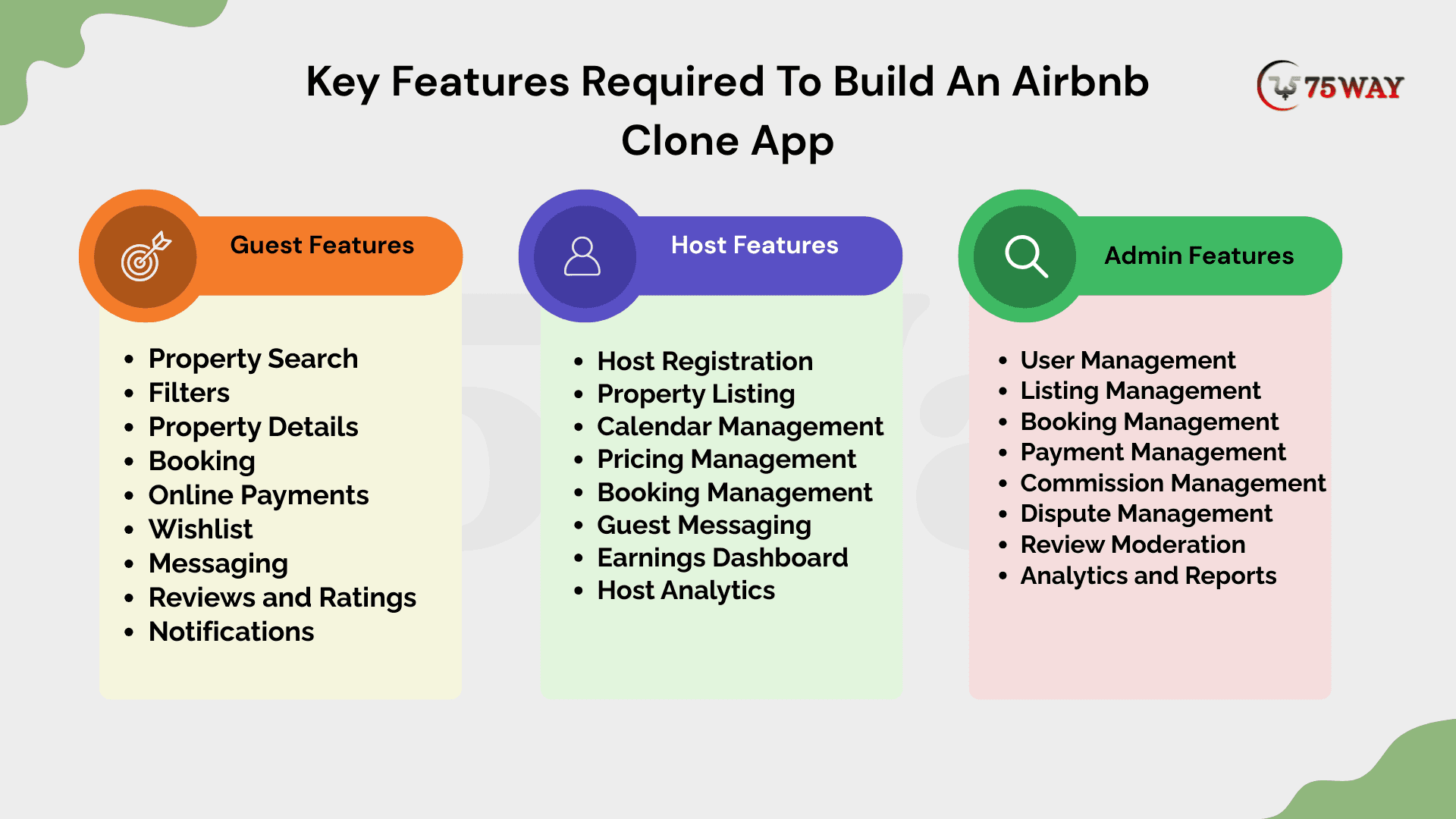
1. Guest Features in Airbnb Clone App Development
Guests need simple tools to discover properties, compare options, and complete reservations.
- Property Search: Lets guests search rentals by destination, dates, guests, price, and property type.
- Filters: Helps users narrow results based on amenities, ratings, bedrooms, cancellation options, and other preferences.
- Property Details: Displays photos, descriptions, amenities, pricing, location, house rules, availability, and reviews.
- Booking: Allows guests to select dates, confirm availability, review pricing, and reserve properties.
- Online Payments: Enables secure checkout and displays applicable charges before the reservation is confirmed.
- Wishlist: Lets guests save properties they may want to book later.
- Messaging: Allows guests to communicate with hosts before and after eligible bookings.
- Reviews and Ratings: Gives guests a way to share feedback about their stay and property experience.
- Notifications: Sends updates about bookings, payments, cancellations, messages, and upcoming stays.
2. Host Features in Airbnb Clone Development
Hosts need tools to publish properties, manage reservations, communicate with guests, and track earnings.
- Host Registration: Allows property owners to create accounts and complete required onboarding information.
- Property Listing: Lets hosts add property details, photos, amenities, pricing, rules, and availability.
- Calendar Management: Allows hosts to block dates, manage reservations, and control property availability.
- Pricing Management: Enables hosts to set nightly rates, seasonal pricing, minimum stays, and other applicable pricing rules.
- Booking Management: Gives hosts visibility into upcoming, pending, completed, and cancelled reservations.
- Guest Messaging: Helps hosts answer questions and share relevant booking or property information.
- Earnings Dashboard: Displays booking revenue, platform fees, refunds, adjustments, and payout information.
- Host Analytics: Shows useful performance information such as views, bookings, occupancy, revenue, and conversion rates.
3. Admin Features in Airbnb Clone Software Development
The admin panel gives the business control over marketplace operations.
- User Management: Allows administrators to manage guest and host accounts.
- Listing Management: Provides tools to review, approve, update, suspend, or remove property listings.
- Booking Management: Helps administrators monitor reservations and resolve booking-related issues.
- Payment Management: Tracks transactions, refunds, commissions, and payout-related activity.
- Commission Management: Allows the business to configure and manage its marketplace revenue structure.
- Dispute Management: Gives support teams tools to investigate and resolve guest-host disputes.
- Review Moderation: Helps administrators manage inappropriate, fraudulent, or policy-violating reviews.
- Analytics and Reports: Provides insights into bookings, revenue, users, listings, and overall marketplace performance.
Advanced Features Utilized For Airbnb Clone App Development
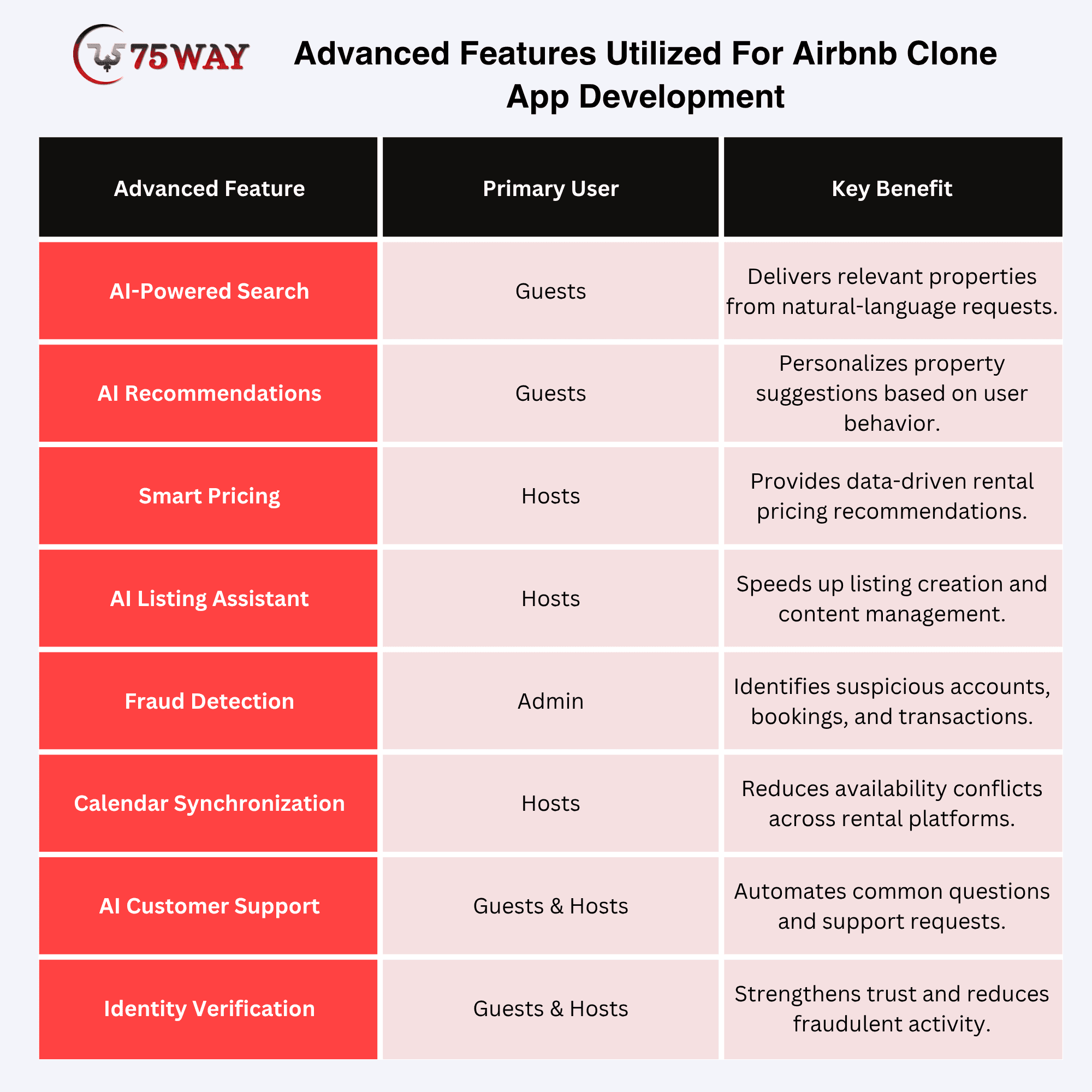
Once the MVP has proven that guests and hosts are willing to use the platform, the next step is adding features that make the experience smarter and easier to manage. These capabilities can improve property discovery, help hosts make better decisions, reduce manual work, and strengthen trust across the marketplace.
- AI-Powered Search
Guests do not always know the exact filters they need. They might simply type, “I need a quiet mountain stay for four people with Wi-Fi under $150 a night.” AI can understand that request and turn it into relevant search criteria. This makes property discovery feel more natural and can help users find suitable stays with fewer searches.
- AI Recommendations
A guest's preferences often become clearer through their activity on the platform. The system can consider viewed properties, saved stays, previous bookings, preferred locations, budgets, and selected amenities to suggest places that match their interests.
More relevant recommendations can keep guests exploring and may uncover properties they would otherwise miss.
- Smart Pricing
Hosts often struggle to decide what their property should cost during different periods. Smart pricing can examine factors such as local demand, seasonality, occupancy, historical bookings, and nearby market activity to suggest suitable rates.
Hosts still retain control over their prices, while the insights can help them make more informed pricing decisions.
- AI Listing Assistant
Writing a property listing can become tedious when a host manages several accommodations. An AI listing assistant can turn basic property information into a draft title, description, amenity summary, or guest message.
The host can edit and approve the content before publishing it, making the process faster without taking control away from the property owner.
- Fraud Detection
Trust becomes increasingly important as the marketplace grows. Fraud detection systems can look for unusual booking behaviour, suspicious payment activity, repeated account patterns, or other signals that may require attention.
Potentially risky activity can then be flagged for review, helping the platform respond before it turns into a larger problem.
- Calendar Synchronization
Hosts who list properties on several platforms can easily run into double-booking problems.
Calendar synchronization keeps availability information aligned across supported channels, reducing the need to update every calendar manually. This becomes especially valuable for professional hosts managing several properties or receiving reservations from multiple sources.
- AI Customer Support
Guests often ask the same questions about check-in, cancellation policies, amenities, payments, or reservations.
An AI support layer can handle straightforward questions using approved information and conversation context. When a situation requires judgment or manual intervention, the conversation can move to a human support representative.
- Identity Verification
Trust matters on both sides of a rental marketplace. Identity verification can help confirm relevant guest or host information through suitable verification providers before certain activities are allowed.
A visible verification status can give users additional confidence while helping the platform reduce some forms of fraudulent account activity.
Airbnb Clone Script Vs Custom Rental App Development For Real Estate
The main difference between an Airbnb clone script and custom development is flexibility. A clone script comes with ready-made rental marketplace features, while custom development builds the platform around your specific business model, user requirements, workflows, and growth plans.
An Airbnb clone script can be a practical choice when speed and initial cost matter most. You receive a prebuilt foundation with features such as property listings, search, bookings, payments, host management, reviews, and admin controls. This can shorten the path to launch, but the available architecture and customization options may depend on the script.
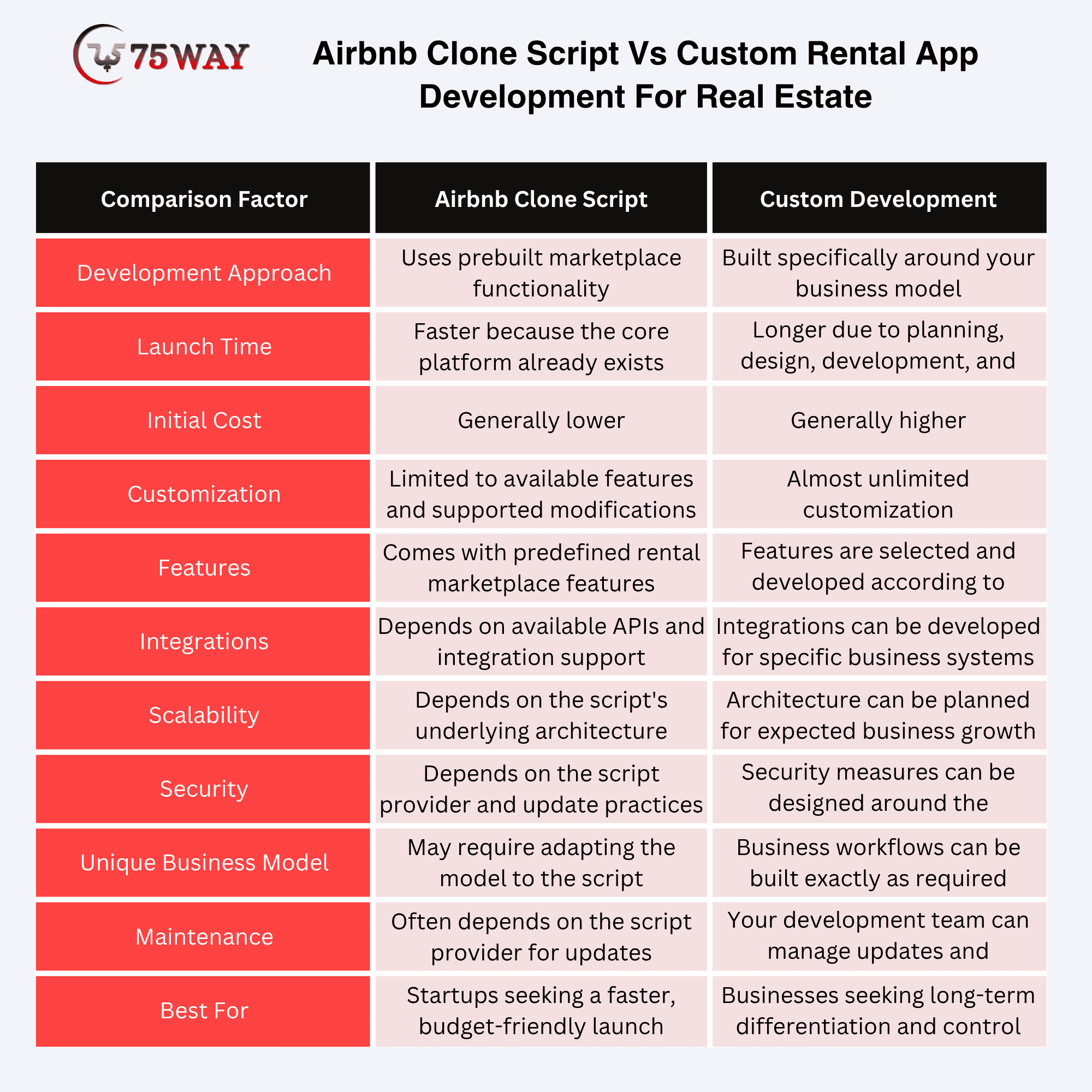
Custom rental app development takes longer and usually requires a larger investment, but it gives you much greater control over the final product. You can design unique booking workflows, build specialized features, connect business-specific systems, choose the technology architecture, and scale the platform according to future requirements rather than adapting your business around an existing script.
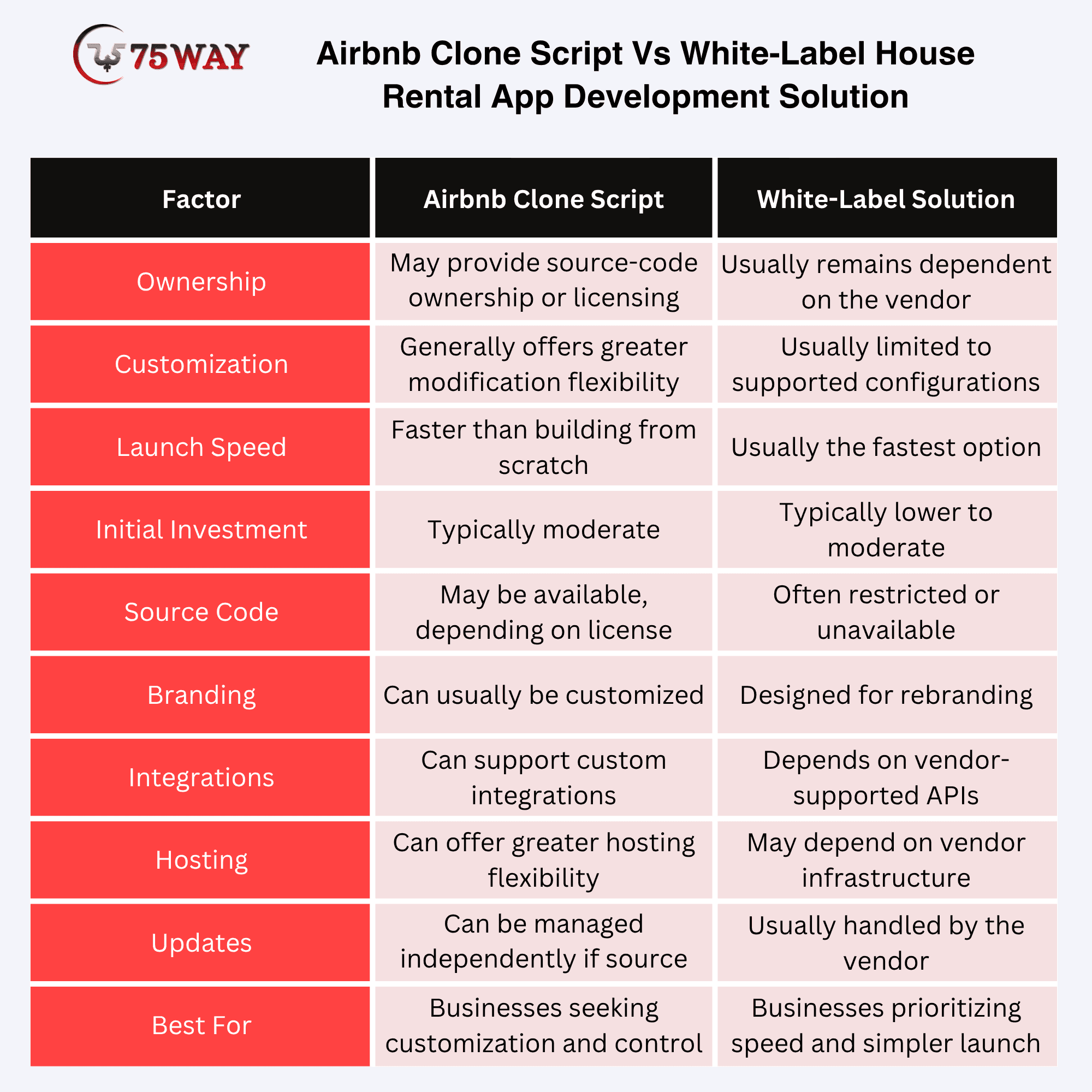
Airbnb Clone Script Vs White-Label House Rental App Development Solution
The main difference is ownership and flexibility. An Airbnb clone script usually gives you a ready-made rental marketplace codebase that you can modify and deploy, while a white-label solution is typically a prebuilt platform that you brand and configure for your business.
An Airbnb clone script can offer more control over the underlying product because the available source code may be customized according to your requirements. You can modify features, workflows, integrations, design, and business logic, depending on the script's licensing terms and technical architecture. This makes it more suitable when you expect the platform to evolve beyond the original feature set.
A white-label solution focuses more on speed and convenience. The core marketplace is already developed, so businesses can launch under their own brand with configured features, branding, and business settings. However, customization, source-code access, hosting, integrations, updates, and long-term control can depend heavily on the vendor.
Do not choose an Appkodes Airbnb clone white label or any other vendor solely because its demo resembles Airbnb. Evaluate the underlying architecture and business fit.
Recommended Technology Stack To Build Airbnb Booking Reservation Clone
The technology stack for developing an airbnb booking reservation clone should support fast property search, real-time availability, secure payments, scalable booking operations, and reliable communication. The final selection should depend on your platform requirements, development team, expected traffic, integrations, and long-term growth plans.
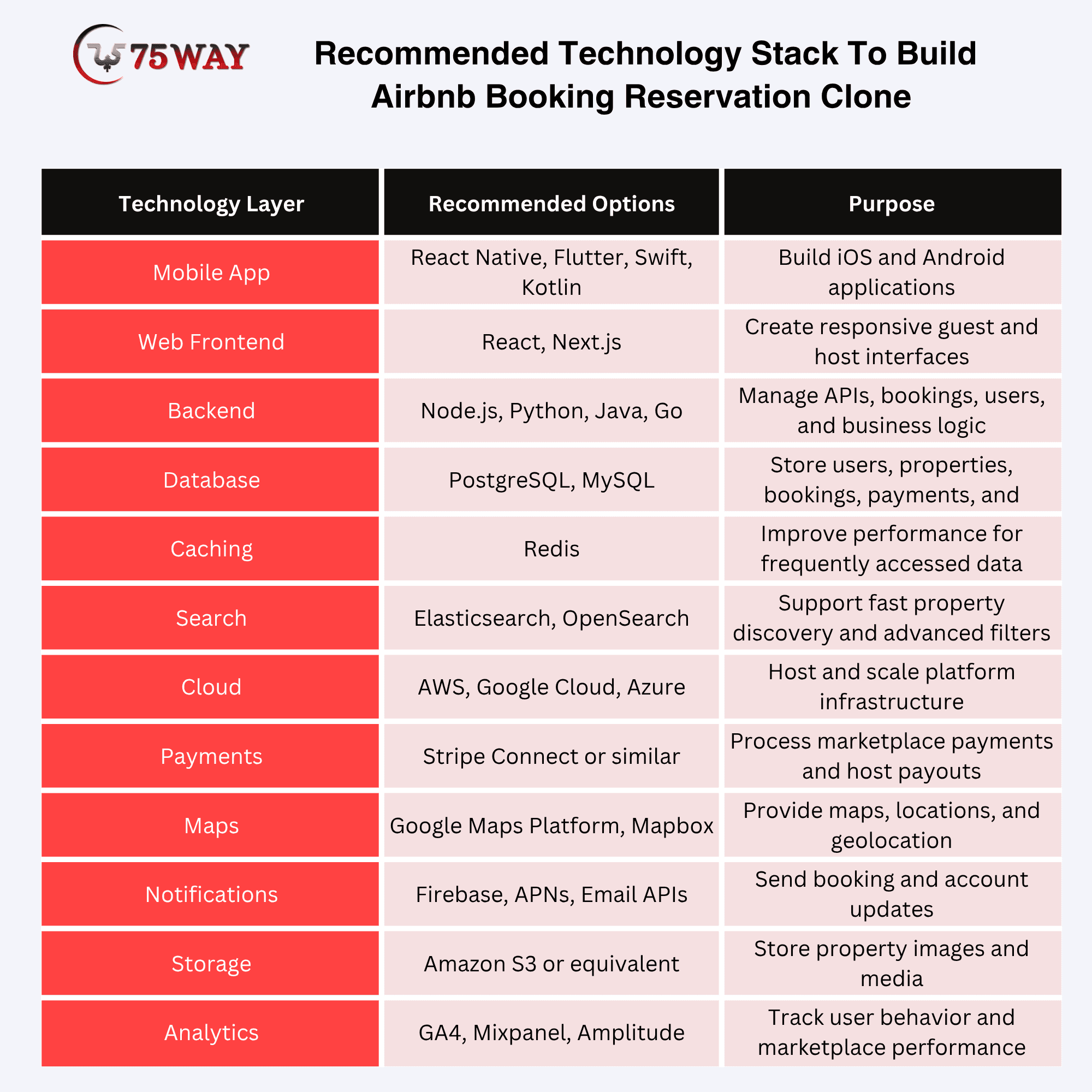
For a startup looking to build an Airbnb clone without unnecessary complexity, a practical combination could be React or Next.js for the web, React Native for mobile, Node.js for the backend, PostgreSQL for core data, Redis for caching, and AWS for cloud infrastructure.
This combination can support the initial marketplace while leaving room for advanced search, AI capabilities, additional integrations, and higher traffic as the platform grows.
Why Technology Selection Matters In Development of AI-Powered Airbnb Clone Script
The technology stack directly affects development speed, scalability, maintenance, integration flexibility, and long-term costs. For example, the booking engine requires reliable database operations, while property discovery may eventually require a dedicated search system as inventory grows.
For an Airbnb clone mobile app, React Native or Flutter can reduce duplicated development across iOS and Android, while native Swift and Kotlin can be considered when platform-specific performance or functionality becomes a priority.
How Much Does It Cost To Build An Airbnb Clone?
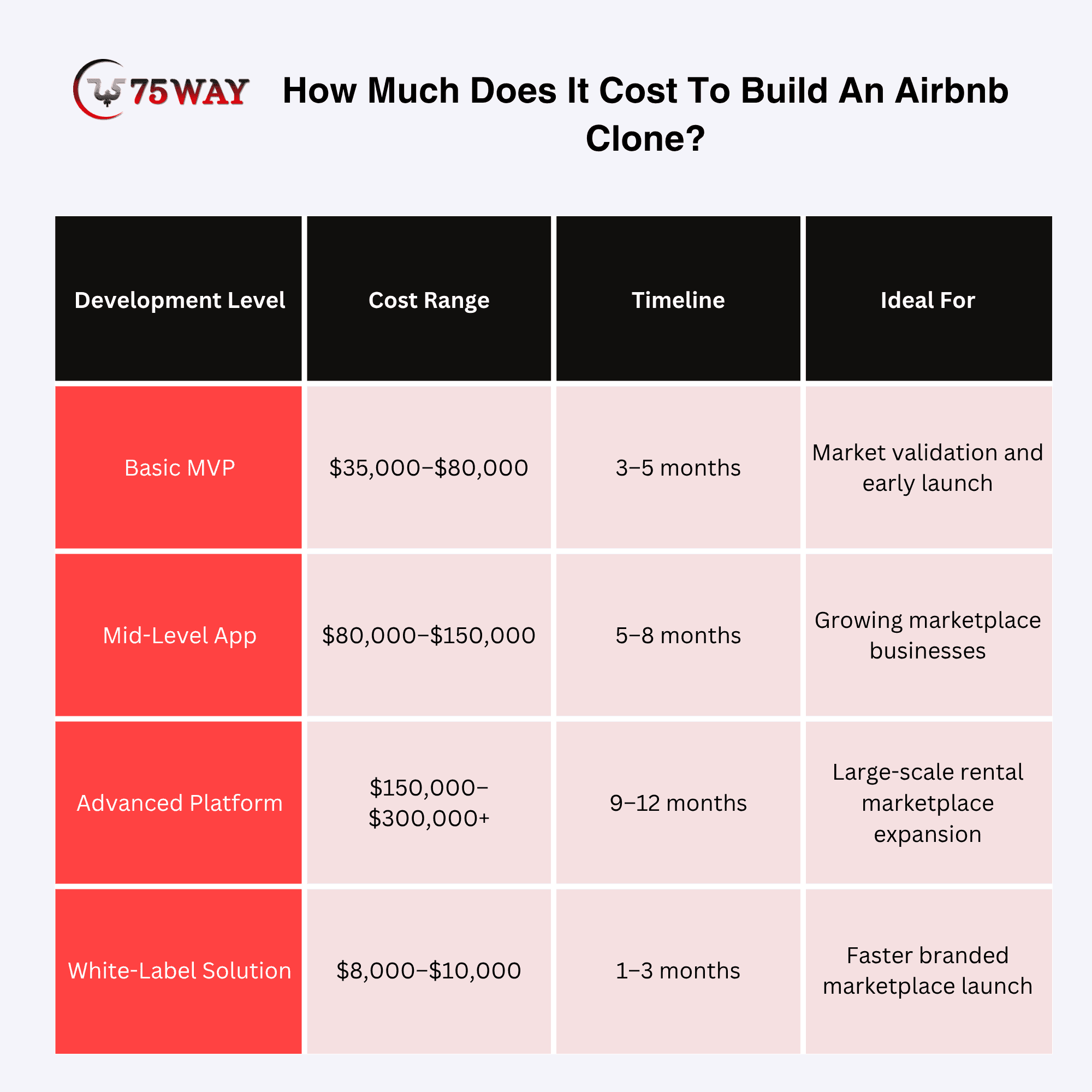
The cost to build an Airbnb clone typically ranges from $35,000 to $300,000+, depending on features, platforms, integrations, and scalability requirements. Development timelines also vary from three to twelve months based on complexity. The cost breakdown below explains each development level in detail.
1. Basic MVP Airbnb Clone: $35,000–$80,000
A basic Airbnb clone focuses on the core booking journey without complex automation or advanced personalization. It typically includes user registration, property listings, search, category filters, booking requests, a payment gateway, and essential admin controls.
This option suits startups that want to validate a rental marketplace before investing in advanced functionality.
2. Mid-Level Airbnb Clone App: $80,000–$150,000
A mid-level platform adds features that improve discovery, communication, booking convenience, and marketplace engagement. These can include map-based search, instant booking, in-app messaging, reviews, dedicated host and guest dashboards, push notifications, and multi-currency support.
This level is suitable for businesses preparing to operate across multiple locations or serve a growing customer base.
3. Advanced Airbnb Clone App: $150,000–$300,000+
An advanced Airbnb clone is designed for larger-scale operations and stronger differentiation. It can include AI-powered recommendations, dynamic pricing, multilingual functionality, fraud detection, calendar synchronization, advanced analytics, and enterprise-grade cloud infrastructure.
This option is better suited to businesses planning a sophisticated marketplace with automation, personalization, and expansion across multiple markets.
4. Ready-Made Airbnb Clone Scripts: $3,000–$10,000
A ready-made Airbnb clone script can provide a faster and lower-cost way to launch a rental marketplace. These solutions typically include prebuilt booking, listing, user, payment, and admin functionality, making them suitable for businesses testing an idea before investing in custom development.
Cost To Hire Developers For Airbnb Clone App Services
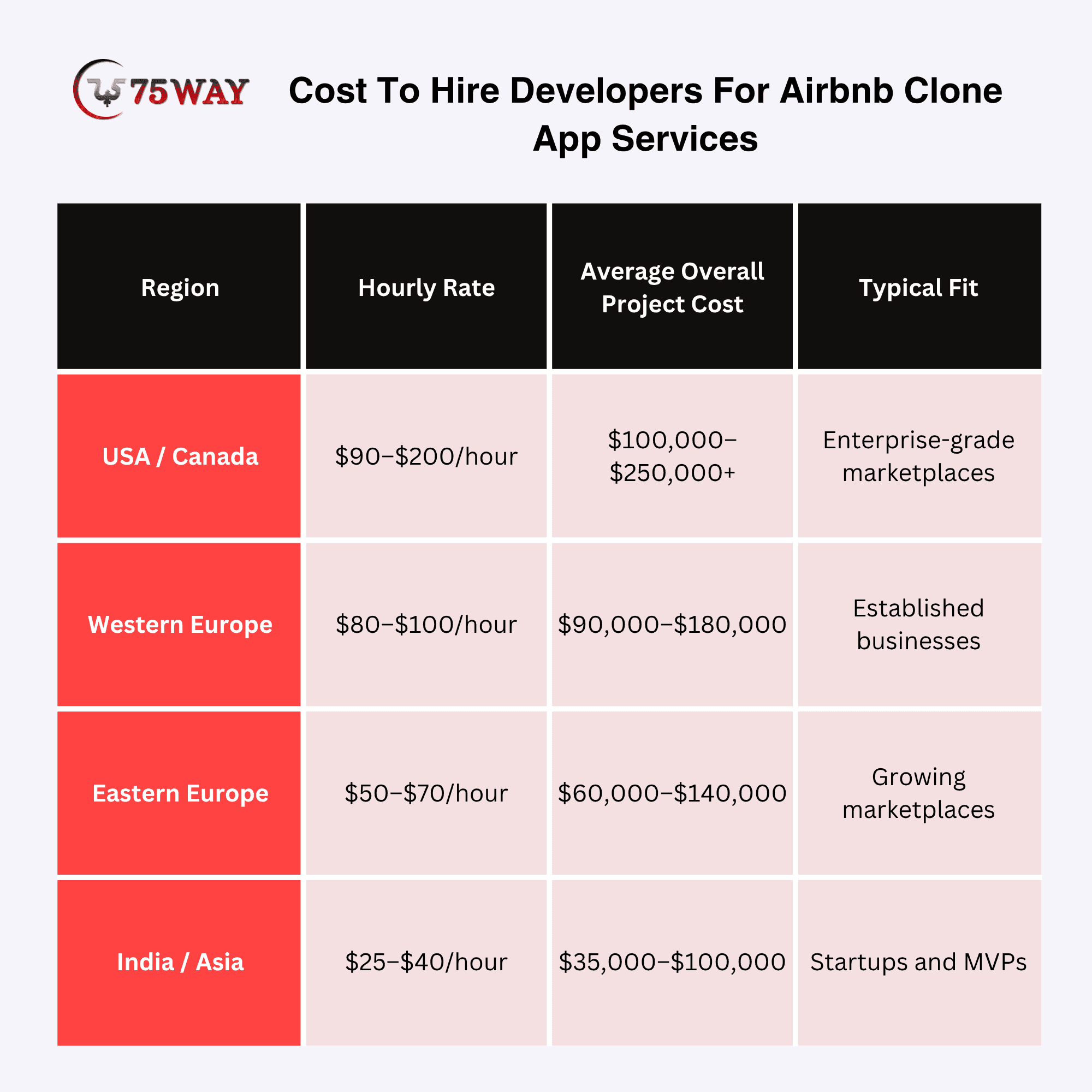
Airbnb clone app development costs vary significantly by region, mainly because of differences in developer salaries, operating costs, expertise, and market demand. However, the lowest hourly rate does not always mean the lowest overall project cost.
USA/Canada: $90–$200/hour
Suitable for businesses seeking enterprise-grade development, close collaboration, and access to larger local technology teams.
Western Europe: $80–$100/hour
A suitable choice for companies looking for experienced development teams, strong product engineering, and closer alignment with European business requirements.
Eastern Europe: $50–$70/hour
Offers a balance between development expertise and project costs, making the region attractive for startups and growing technology businesses.
India / Asia: $25–$40/hour
Often preferred by cost-conscious businesses seeking experienced development teams for MVPs, custom platforms, and ongoing product development.
Factors Affecting The Cost To Build An App Like Airbnb
The cost to build an app like Airbnb depends on more than the number of screens or features. Your business model, target market, technology choices, integrations, security requirements, and level of customization can all change the development effort and overall budget. The most important cost factors include:
- Platform Scope
Building only a mobile app costs less than developing a complete ecosystem with iOS, Android, web, host dashboard, and admin panel. Each additional platform adds design, development, testing, and maintenance work.
- Feature Complexity
Basic property discovery and booking require less development than advanced capabilities such as AI recommendations, smart pricing, predictive analytics, dynamic search, automated support, or sophisticated host management.
- UI/UX Design
A ready-made interface may reduce design costs, while a completely customized experience requires more research, wireframing, prototyping, visual design, and usability testing. Unique user journeys also increase design effort.
- Backend Architecture
The backend handles listings, availability, bookings, payments, users, reviews, messaging, notifications, and marketplace rules. A platform designed for large-scale traffic generally requires more robust architecture, infrastructure, monitoring, and performance optimization.
- Third-Party Integrations
External services can significantly influence development costs. Maps, payment gateways, identity verification, calendars, analytics, communication tools, cloud services, and property-management integrations may each require separate implementation and maintenance.
- Payment And Payout Requirements
A simple payment flow is easier to build than a marketplace payment system involving guest charges, host payouts, platform commissions, refunds, taxes, multiple currencies, and different payment methods.
- Location And Market Coverage
Launching in one city is considerably simpler than supporting multiple countries. Expanding geographically can introduce additional currencies, languages, payment methods, tax requirements, regulations, and localization work.
- Security Requirements
Rental platforms handle personal information, booking details, payment-related data, and private communications. Strong authentication, authorization, encryption, fraud monitoring, audit controls, and security testing can increase the initial development investment.
- Airbnb-Like App Development Team Location
Developer rates vary significantly by region. Teams in North America and Western Europe generally charge more than teams in India, Asia, or Eastern Europe. However, price should be evaluated alongside technical expertise, communication, quality, and post-launch support.
Challenges In Building An Airbnb Clone Mobile App And How To Resolve Them
Building an Airbnb clone mobile app involves more than recreating property listings and booking screens. The real challenge lies in managing a two-sided marketplace where guests, hosts, payments, availability, communication, security, and support must work together without creating friction. Identifying these challenges early helps businesses make better technical decisions and avoid expensive changes after launch.
1. Keeping Property Availability Accurate
Double bookings can quickly damage customer trust, especially when the same property is listed across multiple platforms. Availability can change through bookings, cancellations, blocked dates, or external reservations.
How To Resolve?
Use a centralized availability system with real-time updates and calendar synchronization where required. Reservation locks and transaction checks should prevent two users from confirming the same dates simultaneously.
2. Building Trust Between Guests And Hosts
A rental marketplace connects people who may have never interacted before. Fake profiles, misleading listings, fraudulent bookings, and poor-quality properties can make users hesitant to transact.
How To Resolve?
Introduce appropriate identity verification, listing checks, reviews, reporting tools, secure communication, and fraud-monitoring workflows. Verification should be proportionate to the marketplace's risk and operating requirements.
3. Handling Payments, Refunds, And Payouts
A booking may involve guest payments, platform commissions, taxes, refunds, cancellations, and host payouts. These transactions become more complicated when different currencies, payment methods, or cancellation policies are involved.
How To Resolve?
Design the payment workflow before development is finalized. Use established payment infrastructure and clearly define how authorization, capture, refunds, commissions, and host payouts should work for every booking scenario.
4. Managing Different User Roles
Guests, hosts, administrators, support teams, and sometimes property managers need different permissions and workflows. Giving everyone the same access can create both usability and security problems.
How To Resolve?
Build role-specific experiences with clearly defined permissions. Map what each user can view, create, modify, approve, or delete before implementing the application's access-control system.
5. Maintaining Search And Discovery Quality
A growing rental marketplace can quickly accumulate thousands of properties across locations, price ranges, amenities, dates, and property categories. A basic search box may not provide useful results as inventory grows.
How To Resolve?
Build search around actual guest intent. Combine filters, location data, availability, pricing, amenities, property attributes, and relevance ranking. Search performance should also be tested with realistic inventory volumes before launch.
6. Supporting Marketplace Scalability
A platform that works well with a few hundred listings may behave very differently when bookings, users, searches, messages, and transactions increase substantially.
How To Resolve?
Plan the backend for expected growth from the beginning. Use scalable infrastructure, optimized database queries, caching where appropriate, background processing, monitoring, and clear service boundaries rather than waiting for performance problems to appear.
7. Handling Cancellations And Disputes
Travel plans change, properties may become unavailable, and guests or hosts may disagree about cancellations, refunds, damages, or listing conditions. These situations can create significant support workloads.
How To Resolve?
Define cancellation and dispute rules before launch. Build workflows that capture booking details, payment status, communication history, evidence, and policy conditions, so support teams can review cases consistently.
8. Protecting Sensitive User Information
A rental platform may process identity details, contact information, payment-related data, property information, and private conversations. Weak security can expose both users and the business to serious risks.
How To Resolve?
Apply appropriate authentication, authorization, encryption, secure API practices, audit logging, data minimization, and monitoring. Security requirements should also reflect the jurisdictions where the application operates.
How 75way Technologies Helps You Build An App Like Airbnb?
Turning a rental idea into a working marketplace involves many moving parts, from convincing the first host to list a property to making sure a guest can complete a booking without friction.
75way Technologies is an AI-powered real estate app development company that works with businesses to shape these moving parts into one connected product. We can help you plan guest and host journeys, build the mobile and web experience, connect bookings and payments, and create the admin tools needed to keep the marketplace running smoothly.
What makes the approach different is the scope beyond basic app development. 75way brings AI into real estate applications where it has a practical role, such as helping guests discover relevant properties, assisting hosts with listings, supporting smarter pricing decisions, answering routine queries, or turning marketplace data into useful insights.
Whether you are starting with a focused rental concept or planning a larger property marketplace, the platform can be built around your audience, revenue model, operating process, and expansion plans rather than following a ready-made Airbnb template.
Final Thoughts
To summarize, the development of an app like Airbnb can open the door to a scalable rental marketplace, but success depends on much more than copying an existing platform. You need a clear niche, reliable booking workflows, strong host and guest experiences, secure payments, accurate availability, and a business model that can support growth.
AI-powered airbnb clone can further strengthen the platform through personalized discovery, smarter pricing, virtual assistance, and operational insights. The right real estate app development approach should therefore balance launch speed with customization and future scalability. With a trusted real estate app development partner, your Airbnb-like platform can evolve from an initial marketplace idea into a differentiated real estate business.
Frequently Asked Questions (FAQs)
Can An Airbnb Clone Support Multiple Property Types?
Yes, the platform can support apartments, houses, villas, rooms, cabins, vacation homes, and other rental categories. Businesses can also create custom listing attributes based on their target market.
Can An Airbnb Clone Include Short-Term And Long-Term Rentals?
Yes, the marketplace can support different rental durations by adding flexible availability, monthly pricing, extended-stay discounts, minimum booking periods, and suitable host and guest workflows.
How Can An Airbnb Clone Attract Hosts And Guests?
Businesses can use referral programs, promotional campaigns, host incentives, personalized recommendations, loyalty programs, local partnerships, and targeted digital marketing to build both sides of the marketplace.
Can Hosts Manage Their Properties Through The Platform?
Yes, hosts can manage listings, availability, pricing, booking requests, guest communication, property information, earnings, and reviews through a dedicated host dashboard or application.
Can An Airbnb Clone Support International Markets?
Yes, the platform can be designed for multiple countries with localization, multiple currencies, language support, regional payment methods, tax configurations, and location-specific marketplace rules.