AI Summary
Hiring remote AI developers gives businesses access to specialized talent without limiting recruitment to one location. This guide explains where to find candidates, which skills to evaluate, how to conduct technical interviews, compare hiring models, estimate costs, verify experience, and build successful remote AI teams.
Key Takeaways
- Define project requirements before searching for remote AI development talent.
- Evaluate remote AI engineer’s expertise alongside communication, problem-solving, and collaboration skills.
- Compare freelancers, dedicated developers, agencies, and different engagement models.
- Assess portfolios through real AI projects, technical decisions, and measurable outcomes.
- Hiring costs vary by expertise, location, project complexity, and engagement model.
The first AI developer you hire can influence much more than the codebase. Their technical choices can affect model performance, infrastructure costs, data security, scalability, and how quickly your AI product moves from an experiment to something customers can actually use.
That is why USA-based businesses should approach remote AI hiring differently from conventional software recruitment. A strong candidate needs more than Python or machine-learning experience; they may need to understand LLMs, RAG, AI agents, APIs, cloud infrastructure, evaluation, deployment, and the business problem behind the product.
Remote hiring can make those artificial intelligence specialists easier to access, particularly when local recruitment cannot provide the required combination of skills. At the same time, distance makes structured communication, technical evaluation, project ownership, and clear expectations even more important.
This guide takes a practical look at remote AI hiring for U.S. businesses, from defining the role and sourcing candidates to evaluating expertise, comparing engagement models, estimating costs, and building a hiring process that supports long-term AI development.
Why Hire Remote AI Developers For Your Business?
Hiring remote AI developers can give businesses access to specialized technical talent without restricting recruitment to a single city or local hiring market. For startups and growing companies, this model can also make it easier to assemble teams around specific AI requirements, from machine learning and generative AI to computer vision, NLP, and AI agent development.
- Access Specialized AI Expertise
Remote hiring allows businesses to search for developers based on the skills their project actually requires. Instead of hiring a general software developer, you can look specifically for professionals experienced in LLMs, machine learning, computer vision, NLP, recommendation systems, predictive analytics, or AI agents.
- Reach A Larger Talent Pool
Geographic restrictions can significantly reduce the number of qualified candidates available for specialized AI roles. A remote hiring strategy opens recruitment across different regions, making it possible to compare developers based on experience, technical capability, project history, and availability rather than location alone.
- Build Teams Around Project Needs
AI projects often require multiple skill sets rather than one developer. A business can hire different remote specialists for AI model development, backend engineering, data engineering, AI integration, frontend development, DevOps, or testing and assemble a team according to the project's requirements.
- Control Development Expenses
Remote hiring can provide access to developers operating at different market rates. Businesses can compare talent from multiple regions and select a hiring model that fits their budget without automatically compromising on the technical capabilities required for the project.
- Scale AI Development Faster
Project requirements can change as an AI product moves from proof of concept to production. Remote hiring makes it easier to add specialized developers when additional expertise is needed and reduce team size when specific development phases are completed.
- Support Different Time Zones
A distributed AI development team can provide development coverage across multiple working hours. With clear documentation, communication processes, and handoff procedures, businesses can use time-zone differences to maintain progress between development cycles.
- Find Niche Technical Skills
Some AI projects require expertise that can be difficult to source locally. Remote recruitment can help businesses find developers with experience in areas such as retrieval-augmented generation, large language models, MLOps, speech AI, autonomous agents, or computer vision.
- Reduce Long-Term Hiring Constraints
Businesses do not always need to create permanent in-house AI teams. Depending on the project, they can hire remote developers for a defined period, engage dedicated specialists, or build an extended team that can continue supporting the product as requirements evolve.
What Skills Should Remote Artificial Intelligence Developer Have?
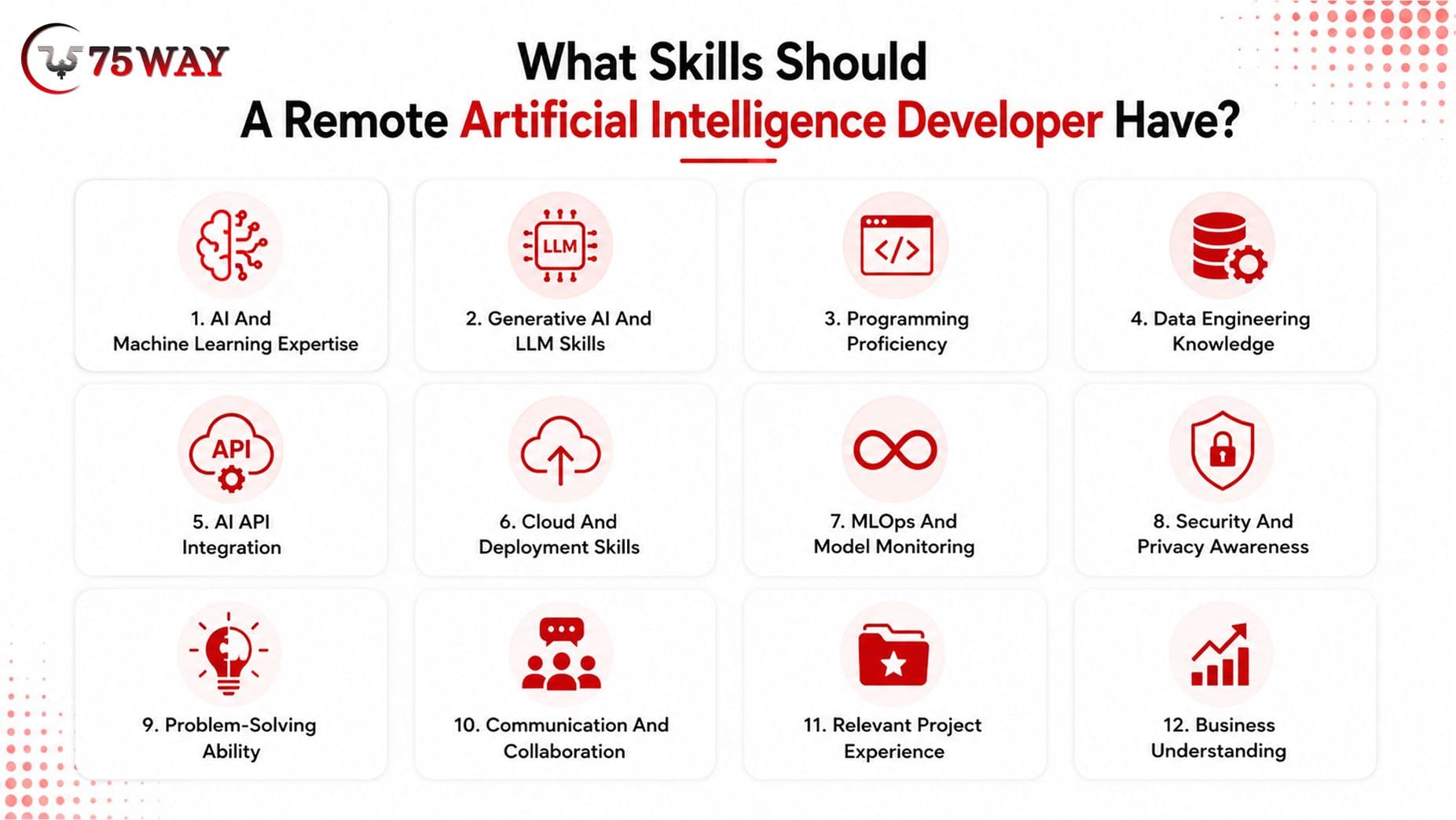
The right remote artificial intelligence developer should bring more than familiarity with AI tools. Businesses should evaluate technical depth, practical project experience, software engineering ability, communication, and the developer's capacity to turn a business requirement into a reliable AI solution.
- AI And Machine Learning Expertise
An AI engineer should understand machine learning fundamentals, model selection, training approaches, evaluation methods, and deployment. The required depth depends on whether the project involves predictive models, generative AI, recommendation systems, computer vision, or other AI applications.
- Generative AI And LLM Skills
For applications using generative AI, developers should understand LLM APIs, prompt engineering, embeddings, vector databases, RAG, fine-tuning, structured outputs, tool calling, and model evaluation. They should also know how to manage hallucinations, latency, token usage, and model costs.
- Programming Proficiency
Strong programming fundamentals remain essential even when developers use pre-built AI models. Python is widely used for AI and machine learning, while JavaScript, TypeScript, Java, Go, or other languages may be required for application and backend development.
- Data Engineering Knowledge
AI systems depend on reliable data. Developers should understand data collection, preprocessing, cleaning, transformation, storage, pipelines, and quality validation when the project requires custom datasets or continuous data processing.
- AI API Integration
Many modern AI applications rely on external model and platform APIs. Developers should be comfortable integrating AI services, managing authentication, handling API failures, controlling usage, and designing systems that can switch models when business requirements change.
- Cloud And Deployment Skills
A developer should understand the infrastructure required to move AI applications from development into production. Relevant experience may include AWS, Microsoft Azure, Google Cloud, containers, APIs, databases, CI/CD, monitoring, and scalable deployment.
- MLOps And Model Monitoring
Production AI systems require ongoing monitoring and maintenance. Developers working on advanced projects should understand model versioning, performance tracking, deployment pipelines, data drift, evaluation, logging, and mechanisms for updating models when necessary.
- Security And Privacy Awareness
AI applications may process sensitive customer or business information. Developers should understand authentication, authorization, encryption, secure API usage, access controls, data protection, prompt injection risks, and responsible handling of AI-generated outputs.
- Problem-Solving Ability
Technical knowledge alone does not guarantee a successful project. Strong developers should be able to break complex requirements into manageable components, identify technical constraints, compare implementation approaches, and explain why a particular solution fits the business objective.
- Communication And Collaboration
Remote development requires clear communication because developers cannot rely on constant in-person interaction. Candidates should be comfortable documenting decisions, explaining technical issues, participating in meetings, providing progress updates, and collaborating through project-management and communication platforms.
- Relevant Project Experience
A strong portfolio should demonstrate real implementations rather than simply listing AI technologies. Look for projects similar to your requirements and examine the developer's contribution, architecture decisions, challenges addressed, measurable outcomes, and production experience.
- Business Understanding
The best remote AI developers understand that the objective is not simply to add AI. They should connect technical decisions with business outcomes such as reducing operational costs, improving customer experience, automating workflows, increasing conversions, or creating new product capabilities.
Where To Find Skilled Remote AI Engineer For Your Project?
Finding remote AI developers is easier when you use channels that match your project complexity, budget, and hiring model. Instead of relying on one platform, businesses should compare developer communities, professional networks, specialized hiring platforms, referrals, and AI development companies before making a decision.
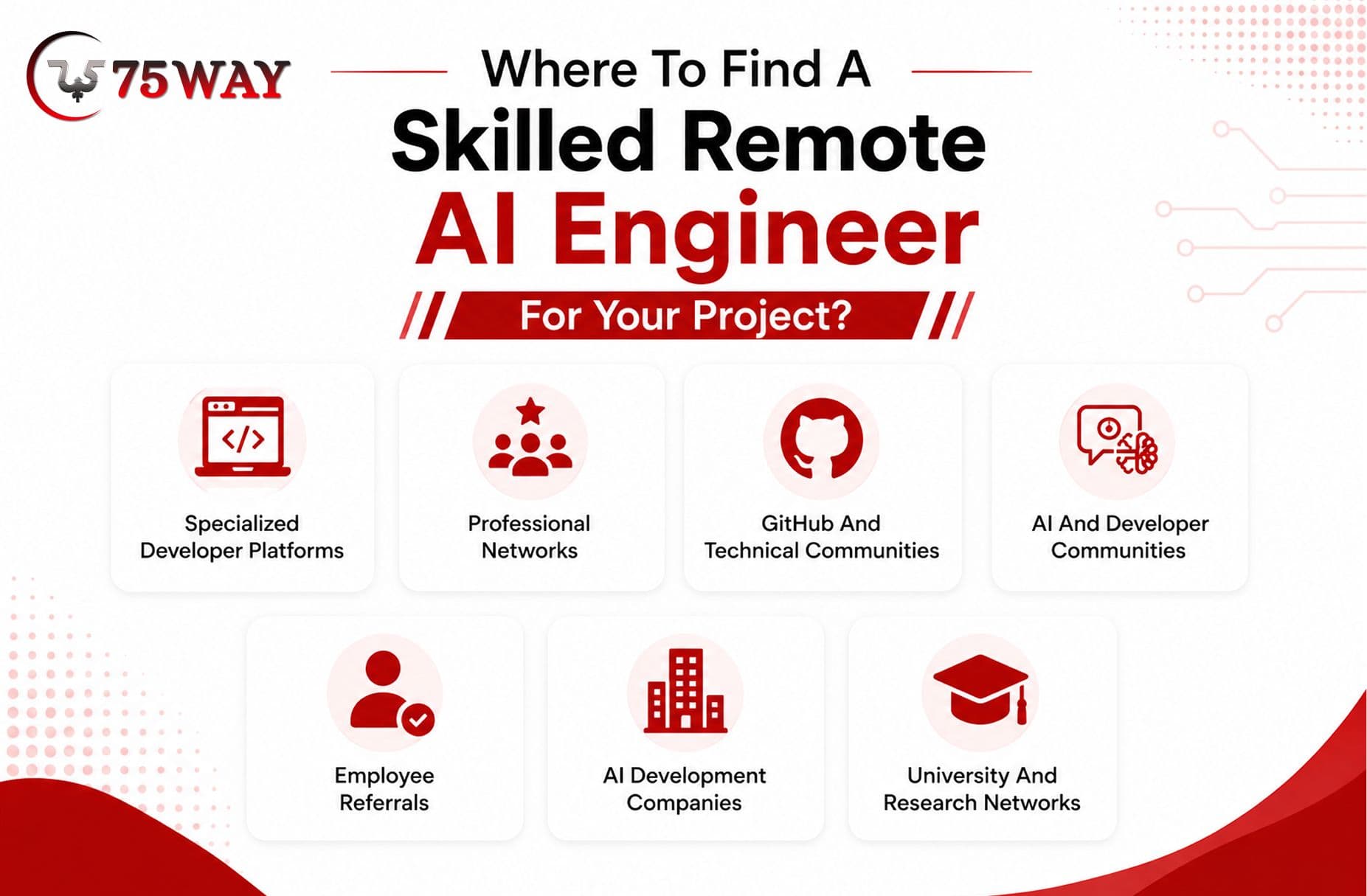
- Specialized Developer Platforms: Platforms such as Toptal, Upwork, and Arc can help businesses discover developers based on technical skills, experience, availability, and engagement preferences.
These platforms can work well when you need individual specialists or want to compare multiple candidates.
- Professional Networks: LinkedIn can help founders identify AI developers based on their technical background, previous employers, published work, certifications, projects, and professional recommendations.
Direct outreach can be useful when looking for developers with specific experience in LLMs, machine learning, computer vision, or AI agents.
- GitHub And Technical Communities: GitHub provides useful evidence of a developer's practical technical work.
Reviewing repositories, contributions, documentation, code quality, and project activity can provide more insight than a resume alone, particularly when hiring developers for technically demanding AI projects.
- AI And Developer Communities: AI-focused communities, technical forums, conferences, open-source groups, and professional networks can help businesses discover specialists who actively work with emerging technologies.
These channels can be particularly useful for finding developers with niche expertise that may be difficult to identify through general hiring platforms.
- Employee Referrals: Referrals from existing employees, technology partners, founders, or professional contacts can shorten the candidate discovery process.
A trusted recommendation can also provide additional context about a developer's communication style, reliability, technical strengths, and previous project performance.
- AI Development Companies: A specialized AI development company can provide an entire team instead of requiring you to recruit individual developers.
This approach may be suitable when the project requires multiple capabilities such as AI engineering, backend development, data engineering, UI development, DevOps, testing, and project management.
- University And Research Networks: Businesses working on advanced AI applications can explore university research groups, technical programs, and AI research communities.
These networks may provide access to candidates with strong backgrounds in machine learning, natural language processing, computer vision, robotics, and other specialized fields.
What To Check Before Contacting Candidates
Do not evaluate candidates only by their job titles or years of experience. Review their AI project portfolio, technical contributions, model experience, production deployments, communication ability, availability, timezone compatibility, references, and understanding of your business requirements before moving them to the interview stage.
How To Hire Remote AI Developers: Step-By-Step Process
The right remote AI developer can influence whether your AI product becomes a reliable business tool or an expensive experiment. Hiring should therefore focus on problem-solving ability, relevant delivery experience, communication, and technical judgment, not just AI keywords on a CV. The following process gives decision-makers a practical way to assess candidates before making a long-term commitment.
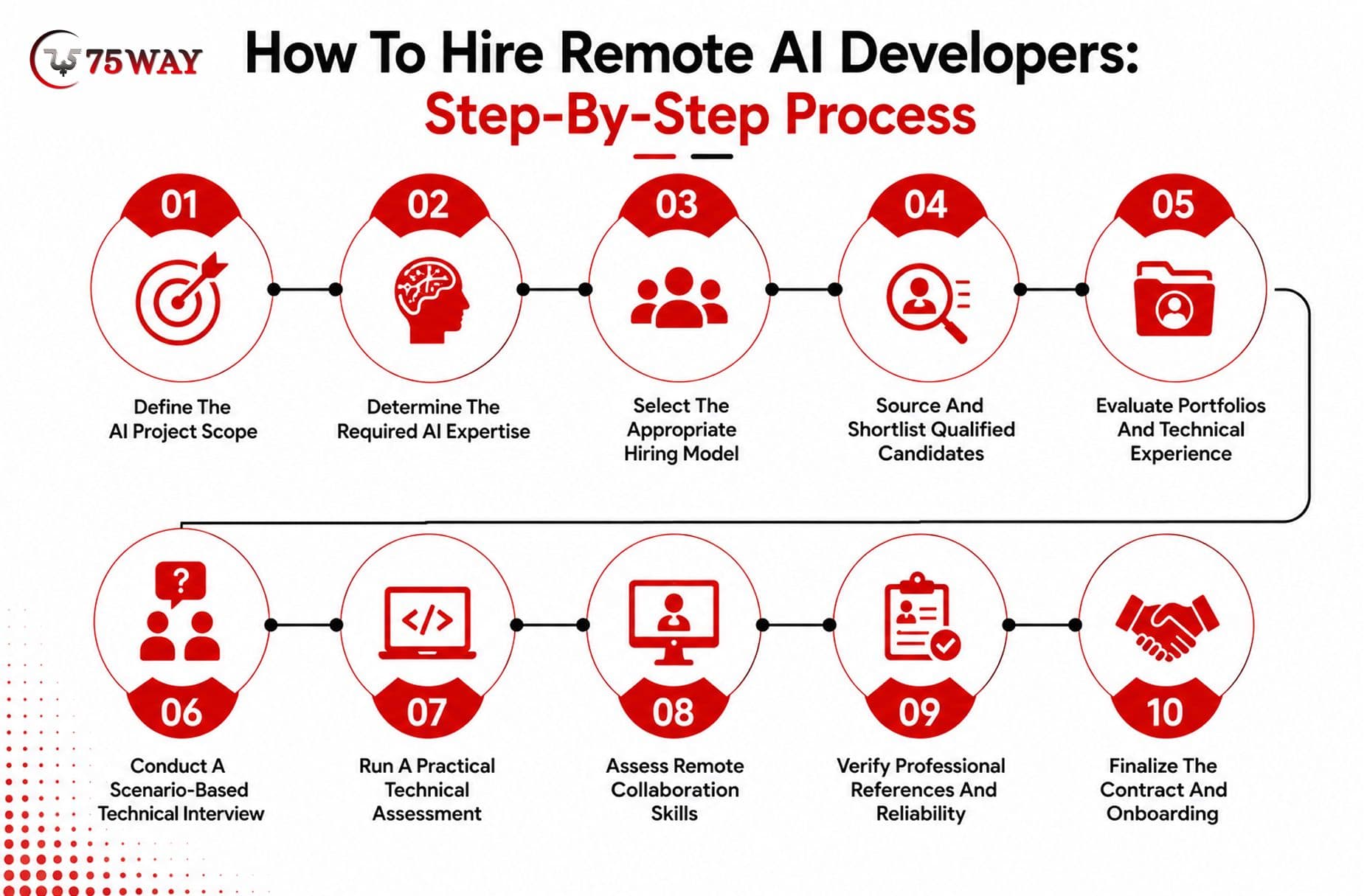
1. Define The AI Project Scope
A strong hiring decision starts with a clear picture of the product. Write down the problem, expected AI behaviour, target users, existing software, integrations, data requirements, budget, and delivery expectations.
Include these details:
- Business problem the AI should address
- Expected output or user experience
- Required integrations and platforms
- Data sources and access requirements
- Expected delivery milestones
- Budget and engagement duration
This brief gives candidates something concrete to respond to and makes weak or mismatched applications easier to eliminate.
2. Determine The Required AI Expertise
AI development covers several specialties, so a generic “AI developer” search can produce an unfocused shortlist. Your project may need an LLM developer, machine learning engineer, AI agent developer, NLP specialist, computer vision engineer, or AI solutions architect.
The technology behind the product should determine the role. A customer-support agent, predictive maintenance system, recommendation engine, and computer-vision application each require different technical strengths.
3. Select The Appropriate Hiring Model
The project's size and uncertainty should influence how you hire. A short proof of concept may need one specialist, while a production AI platform can require several disciplines working together.
Consider:
- Freelance specialist for defined tasks
- Dedicated developer for ongoing work
- Remote development team for broader delivery
- AI development company for end-to-end ownership
The choice should reflect your internal technical capacity as much as your budget.
4. Source And Shortlist Qualified Candidates
A profile filled with “GenAI,” “LLMs,” and “machine learning” does not automatically demonstrate production capability. Look for evidence that the candidate has actually designed, built, deployed, and improved AI systems.
Useful signals include GitHub contributions, technical case studies, production applications, open-source work, published technical material, and projects that resemble your business requirements.
5. Evaluate Portfolios And Technical Experience
A project listed in a portfolio may represent a candidate's personal work, a small contribution, or an entire development responsibility. Ask directly about their role.
Questions worth asking include:
- Which part did you personally develop?
- Why was that architecture selected?
- How was model quality evaluated?
- What happened when the system produced poor results?
- How was the solution deployed and monitored?
- What would you change if rebuilding it?
The answers can reveal practical experience far better than a technology list.
6. Conduct A Scenario-Based Technical Interview
Real AI projects rarely arrive as neat interview questions. Give candidates a situation that resembles your product and ask them to reason through it.
For an AI email agent, for example, discuss context retrieval, hallucination control, tool permissions, human approval, and evaluation. For a recommendation system, explore data quality, ranking logic, feedback loops, cold-start problems, and model evaluation.
The goal is to understand how the developer thinks when several technically valid options exist.
7. Run A Practical Technical Assessment
A short, paid technical exercise can provide stronger evidence than several interviews. Give the candidate a limited problem from the actual project and define what a useful outcome should look like.
The assessment can reveal code quality, documentation habits, technical judgment, testing discipline, estimation ability, and responsiveness to feedback. Keep the assignment small enough to respect the candidate's time and avoid asking for free production work.
8. Assess Remote Collaboration Skills
Remote development creates its own hiring criteria. Strong candidates should be comfortable explaining decisions in writing, raising blockers early, documenting technical changes, and working with people who may not share their location or schedule.
Pay attention to how they communicate during the hiring process itself. Their clarity, responsiveness, questions, and ability to explain complex AI concepts often provide an early indication of how collaboration will feel after hiring.
9. Verify Professional References And Reliability
References and previous-client checks become particularly important when an AI developer will handle proprietary datasets, source code, cloud infrastructure, or customer information.
Ask previous clients or employers about delivery reliability, ownership, communication, technical problem-solving, and behaviour when projects encountered setbacks. Security and access requirements should also be considered before credentials or production data are shared.
10. Finalize The Contract And Onboarding
The final agreement should remove ambiguity before development begins. Define deliverables, milestones, payment structure, intellectual-property ownership, confidentiality, security obligations, communication expectations, working hours, code ownership, documentation, and post-launch responsibilities. For developers based outside the US, the payment structure should also set out how you will pay freelancers abroad compliantly, including currency and tax paperwork.
A proper onboarding plan should then give the developer the context required to contribute: product documentation, architecture decisions, repositories, development environments, access permissions, priorities, and acceptance criteria. This creates accountability on both sides and gives the project a measurable starting point.
Types of Remote AI Creation Experts You Can Hire
“AI developer” can mean very different things depending on the product you are building. A company creating an AI chatbot does not necessarily need the same specialist as a business developing a fraud-detection engine or computer-vision system. The right hire depends on where AI sits inside your product, what needs to be built from scratch, and what can be integrated from existing models.
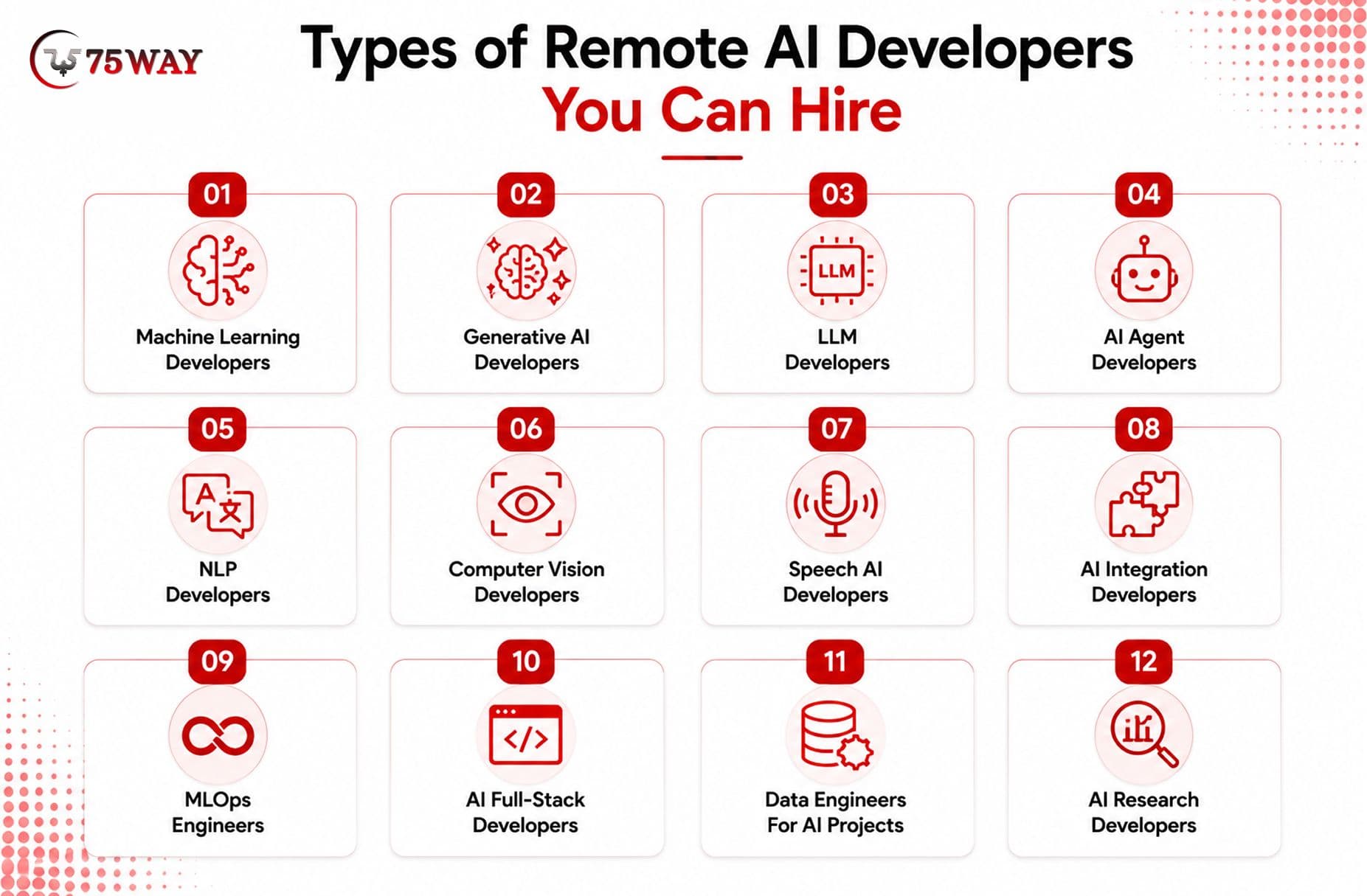
1. Machine Learning Developers
Machine learning developers are a strong fit when your product needs to learn from business data and make predictions.
Their work can support demand forecasting, recommendation engines, fraud detection, customer scoring, risk assessment, and other systems where historical data influences future decisions.
2. Generative AI Developers
Generative AI developers focus on applications that create new content rather than simply classify existing information.
They can work with foundation models, RAG, embeddings, fine-tuning, structured outputs, and prompt strategies to build text, image, code, or content-generation experiences.
3. LLM Developers
LLM developers specialize in turning large language models into useful product functionality. Their expertise can support AI assistants, document analysis, knowledge platforms, conversational applications, and business automation. The reason is that understanding context and generating useful language are central to the experience.
4. AI Agent Developers
AI agent developers take automation a step further by building systems that can interpret a goal, decide what needs to happen, use approved tools, and complete multiple actions.
Their skills are particularly relevant to email agents, customer-service automation, research assistants, scheduling systems, and other workflow-driven products.
5. NLP Developers
NLP developers become valuable when human language is at the heart of the application. They can work on text classification, entity extraction, sentiment analysis, semantic search, document understanding, translation, and other language-processing tasks that help software make sense of written communication.
6. Computer Vision Developers
Computer vision developers give software the ability to interpret visual information. Their expertise can support object detection, image classification, document analysis, visual inspection, medical imaging, facial recognition, and visual search, depending on the application's requirements and applicable regulations.
7. Speech AI Developers
Speech AI developers focus on applications where people talk rather than type. Their work can cover speech-to-text, text-to-speech, voice recognition, conversational voice systems, transcription, call analysis, and voice assistants for customer-facing or internal business applications.
8. AI Integration Developers
Not every business needs to train its own AI model. AI integration developers connect existing models and AI services with the software a company already uses, including CRMs, databases, communication platforms, business applications, and internal systems.
This makes them particularly useful when speed and practical integration matter.
9. MLOps Engineers
A promising AI model still needs dependable infrastructure before it can serve real users. MLOps engineers handle the production side of AI, including deployment pipelines, model versioning, monitoring, infrastructure, performance tracking, and operational processes that keep AI systems reliable after launch.
10. AI Full-Stack Developers
AI full-stack developers can bridge the gap between the AI layer and the actual application users interact with.
They may handle frontend development, backend services, databases, APIs, AI integrations, and deployment, making this profile particularly useful for startups that want a smaller team during an MVP or early product phase.
11. Data Engineers For AI Projects
Good AI depends heavily on usable data. Data engineers create the pipelines and infrastructure that collect, clean, transform, store, and deliver information to AI systems.
Their involvement becomes especially important when the product relies on large datasets, real-time information, multiple data sources, or custom training pipelines.
12. AI Research Developers
AI research developers are the specialists to consider when an ordinary API integration or established model cannot meet the technical requirements.
Their work can involve experimenting with new algorithms, optimizing models, reinforcement learning, advanced NLP, computer vision research, or other problems where significant experimentation is part of the project.
How Much Does It Cost To Hire Remote AI Developers?
The cost to hire remote AI developers can range from $20–$150+ per hour, depending on the developer's location, experience, specialization, project complexity, and engagement model. Businesses should compare total value rather than choosing developers solely according to hourly rates.
Junior AI Developers
Junior developers typically have limited professional AI experience but may be suitable for defined development tasks, testing, data preparation, API integrations, and supervised implementation work.
Typical Rate: $20–$45/hour
Mid-Level AI Developers
Mid-level developers generally have several years of development experience and can independently handle AI integrations, model implementation, backend services, testing, and production-oriented development.
Typical Rate: $40–$80/hour
Senior AI Developers
Senior developers can handle complex architecture, model selection, system optimization, AI integrations, security considerations, and technical decision-making. They are often suitable for products with significant AI complexity.
Typical Rate: $70–$120/hour
AI Specialists And Architects
Highly specialized AI engineers, technical leads, and AI architects may command higher rates because they handle advanced architecture, enterprise AI systems, model optimization, agentic workflows, or technically demanding implementations.
Typical Rate: $100–$150+/hour
Monthly figures are indicative and depend on working hours, contract structure, seniority, and engagement model.
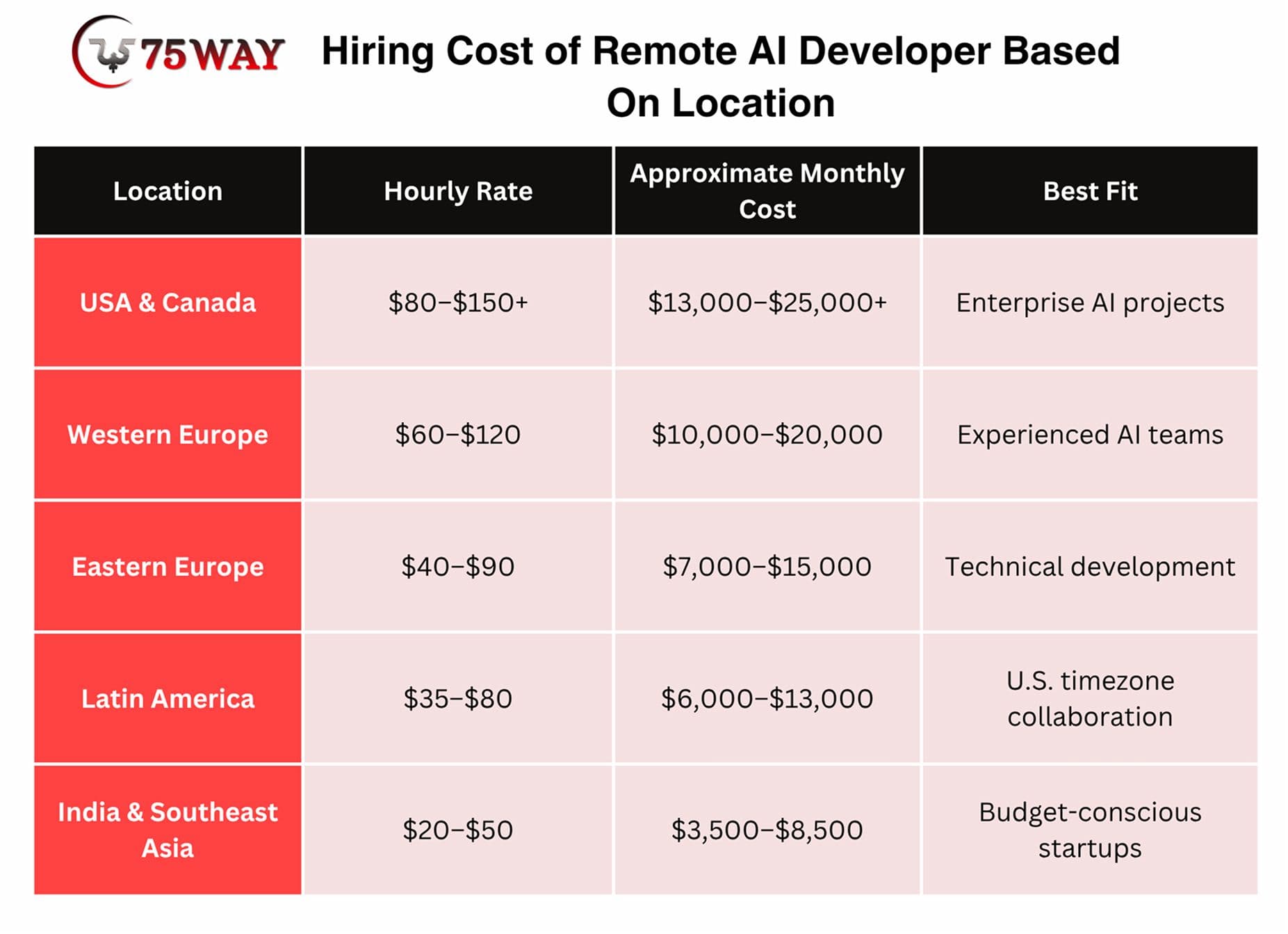
Hiring Cost of Remote AI Developer Based On Location
Location can significantly influence the cost of hiring remote AI developers, but businesses should not compare regions only by hourly rates. Developer experience, AI specialization, project complexity, communication, timezone overlap, and availability can also affect the final hiring budget.
- United States And Canada: Remote AI developers typically charge $80–$150+ per hour, while experienced specialists and AI architects can command higher rates. This market is suitable for businesses prioritizing close timezone alignment, strong communication, and access to senior AI talent.
- Western Europe: Developers commonly charge around $60–$120 per hour, depending on specialization and experience. The region can be suitable for businesses seeking experienced developers with strong engineering practices and substantial overlap with European and North American working hours.
- Eastern Europe: Typical rates range from $40–$90 per hour, offering access to developers experienced in machine learning, backend engineering, generative AI, and software development. Countries such as Poland and Romania are established outsourcing markets for technical development.
- Latin America: Remote AI developers generally charge $35–$80 per hour. Proximity to U.S. time zones can make this region attractive for American startups and businesses that want easier real-time collaboration.
- India And Southeast Asia: Rates commonly range from $20–$50 per hour, depending on seniority and specialization. These markets provide access to large technology talent pools and can be suitable for startups seeking development capacity within controlled budgets.
What Affects The Cost of Hiring Dedicated Remote AI Developer?
- Technical Specialization: LLM, computer vision, AI agents, MLOps, and advanced machine learning specialists can command different rates based on market demand and expertise.
- Experience Level: Developers with production experience and strong architecture skills generally cost more than developers handling supervised or narrowly defined tasks.
- Project Complexity: An AI chatbot using an existing API will usually require less development effort than an enterprise AI platform involving custom models, RAG, multiple integrations, security, and monitoring.
- Engagement Duration: Longer contracts may provide more predictable development costs, while short-term specialist engagements can carry higher hourly rates.
- Hiring Location: Developer rates vary significantly between markets because of differences in labor costs, talent availability, experience, and demand.
- Team Structure: Hiring one developer may cost less initially, but complex projects can require AI engineers, backend developers, data engineers, UI developers, DevOps specialists, and QA professionals.
The hourly rate is only one part of the budget. Businesses should also account for AI model usage, cloud infrastructure, APIs, software licenses, testing, maintenance, project management, and security requirements when calculating the total cost of building an AI product.
Remote AI Developer Hiring Models: Which One Should You Choose?
Choosing the right hiring model depends on your project scope, available budget, development timeline, internal management capacity, and level of technical expertise required. The cheapest option is not always the most suitable, particularly when your AI product requires multiple specialists or long-term technical support.
- Freelance AI Developers: Freelancers can be useful when you need a specific AI skill for a limited period. They can handle tasks such as API integration, model implementation, prompt engineering, testing, or fixing existing AI functionality.
The main advantage is flexibility, but businesses may need to manage communication, project coordination, quality assurance, documentation, and technical dependencies themselves.
- Dedicated Remote AI Developers: A dedicated developer works with your business for an extended period and becomes more familiar with your product, architecture, workflows, and development priorities. This model works well when you have an internal product or technology team that can provide direction.
It provides greater continuity than short-term freelancing while allowing businesses to scale development capacity without making a permanent local hire.
- Remote AI Development Team: A remote team can include AI engineers, backend developers, frontend developers, data engineers, QA specialists, DevOps professionals, and project managers.
This model is appropriate when building a complete AI product requires multiple technical disciplines. The business gains access to broader expertise without recruiting every position individually.
- AI Development Company: An AI development company can manage the complete development lifecycle, including discovery, architecture, UI/UX, AI implementation, integrations, testing, deployment, and maintenance.
This approach can be suitable for startups and businesses that have a product idea but lack the internal technical resources to manage an AI development project.
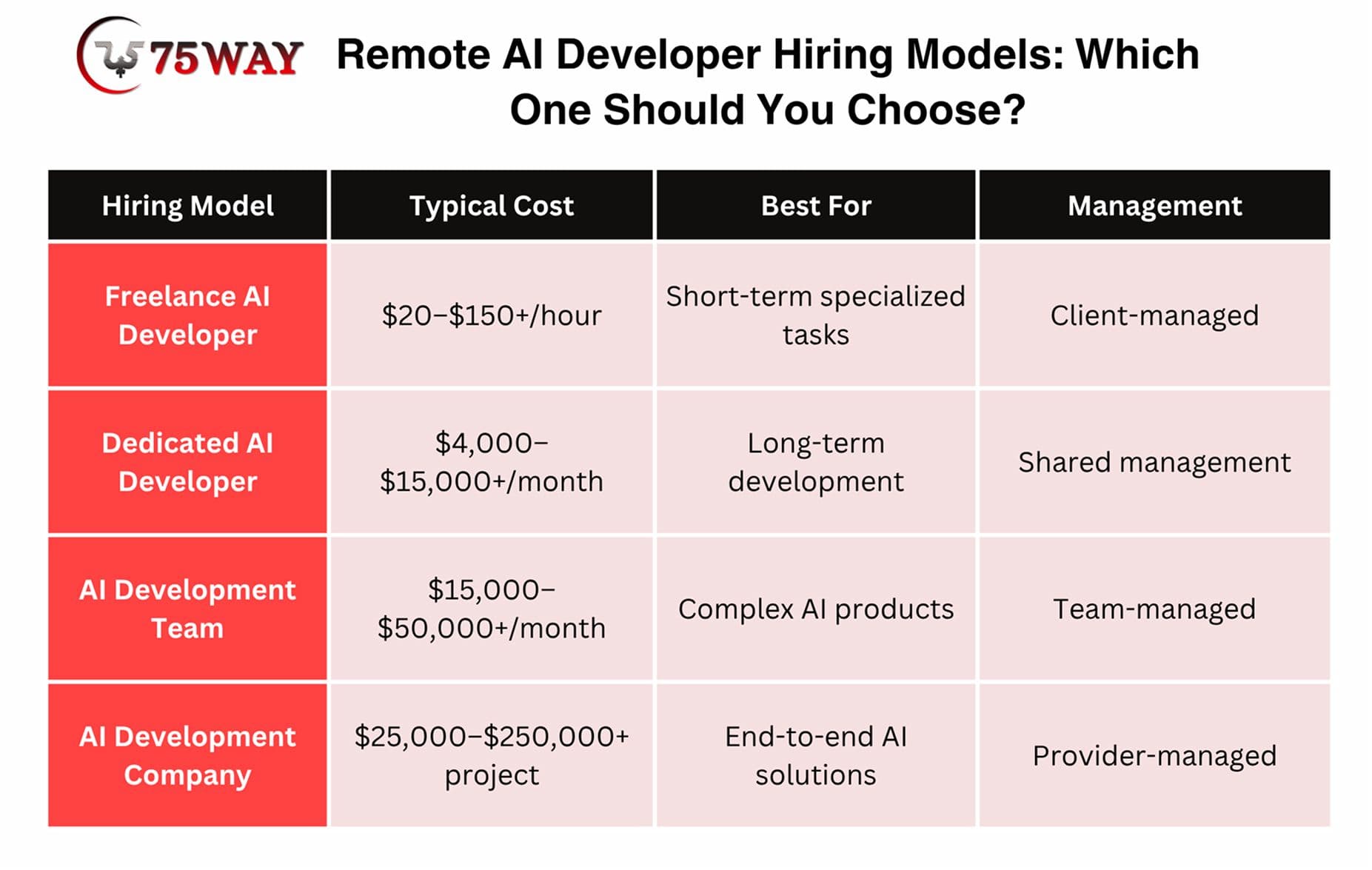
- Choose a freelancer when you need limited specialist support or a clearly defined development task.
- Choose a dedicated developer when you have an internal team but need additional AI expertise for ongoing development.
- Choose a remote development team when your product requires multiple technical skills and continuous development.
- Choose an AI development company when you need end-to-end ownership, technical leadership, project management, and long-term product support.
How To Interview A Remote AI Specialist Effectively?
A strong interview should determine whether a developer can solve your actual AI problem, not simply repeat technical terminology. Combine technical questions, architecture discussions, practical assessments, and communication evaluation to understand how a candidate thinks and performs in real project conditions.
1. Start With Project-Specific Questions
Explain your product requirement and ask the candidate how they would approach it. Their response can reveal whether they understand the business problem, identify technical dependencies, and know which AI approach is appropriate.
2. Test AI Fundamentals
Ask candidates to explain concepts relevant to your project, such as model training, embeddings, RAG, fine-tuning, inference, vector databases, evaluation, or AI agents. Strong candidates should explain these concepts clearly rather than relying entirely on memorized definitions.
3. Discuss Architecture Decisions
Present a realistic system requirement and ask the developer to design a high-level architecture. Evaluate how they approach model selection, databases, APIs, security, scalability, latency, monitoring, and integration requirements.
4. Examine Previous AI Projects
Ask candidates to walk through one or two relevant projects from their portfolio. Focus on their personal contribution, technical challenges, decisions they made, failures encountered, and measurable results rather than simply asking which technologies they used.
5. Give A Practical Assessment
Use a short project-related exercise to evaluate practical ability. For example, you could ask an LLM developer to design a RAG pipeline, improve an AI response workflow, or explain how they would reduce hallucinations in a specific application.
6. Evaluate Problem-Solving
Give candidates an imperfect scenario rather than a straightforward coding problem. Ask what they would investigate, which assumptions they would challenge, how they would identify the root cause, and how they would compare alternative solutions.
7. Assess Security Awareness
Ask how they would protect customer data, API credentials, model inputs, email content, or proprietary business information. Their response should demonstrate awareness of authentication, authorization, encryption, access controls, data handling, and AI-specific security risks.
8. Test Communication Skills
Remote developers need to explain complex technical decisions to both technical and non-technical stakeholders. Evaluate whether candidates communicate clearly, document their work, ask useful questions, report risks early, and respond constructively to feedback.
9. Ask About AI Evaluation
A developer should know how to determine whether an AI system is actually working well. Ask which metrics, test datasets, evaluation methods, human review processes, or monitoring techniques they would use for your particular application.
10. Discuss Maintenance And Scaling
Ask what happens after launch. Strong candidates should consider model updates, changing APIs, increased traffic, infrastructure costs, monitoring, performance degradation, security updates, and future feature requirements.
Questions To Ask Before Hiring Remote AI Developers
A developer can sound impressive during an interview and still lack the experience your AI project actually demands. The right questions help you uncover how they approach models, data, deployment, security, and real-world problems. The questions worth asking before making a remote AI hire are covered below.
- Which AI Projects Have You Built That Resemble Ours?
Look for direct experience rather than generic AI exposure. Ask what the developer personally built and whether the system reached production.
- Which AI Approach Would You Recommend For Our Use Case?
The candidate should explain why they would choose a particular model, architecture, API, RAG approach, or custom development strategy instead of recommending technology without considering requirements.
- How Would You Evaluate The AI System?
Look for practical evaluation methods covering accuracy, relevance, latency, reliability, cost, hallucination rates, and user outcomes.
- How Would You Handle Incorrect AI Responses?
A strong candidate should discuss grounding, retrieval, validation, guardrails, confidence thresholds, monitoring, and human escalation rather than assuming the model will always provide correct answers.
- How Would You Protect Our Business And Customer Data?
Candidates should demonstrate knowledge of access controls, encryption, authentication, secure APIs, data retention, privacy requirements, and appropriate model-data handling.
- How Would You Control AI Operating Costs?
Ask how they would approach model selection, caching, token management, request routing, batching, retrieval optimization, and monitoring to prevent unnecessary infrastructure and API expenses.
- How Would You Integrate AI With Our Existing Systems?
The candidate should explain how APIs, authentication, databases, webhooks, business logic, and error handling would connect the AI system with your existing technology stack.
- What Happens If The AI Or An External API Fails?
Good candidates should have a clear approach involving retries, fallbacks, error handling, monitoring, graceful degradation, and human intervention where appropriate.
Common Mistakes When Hiring Remote AI Developers
Hiring the wrong AI developer can create delays, unnecessary expenses, security concerns, and technical debt. The biggest problems often occur when businesses focus only on hourly rates or impressive AI terminology instead of evaluating practical experience, communication, project fit, and long-term development requirements.
- Choosing The Lowest Rate
A low hourly rate may appear attractive initially, but inexperienced development can create additional costs through rework, poor architecture, security issues, and delayed delivery.
- Hiring Without Clear Requirements
Developers cannot accurately estimate or build an AI solution when the business objective is unclear. Define the problem, expected outcomes, users, integrations, AI capabilities, and project priorities before recruitment.
- Relying Only On Resumes
A resume can list technologies without proving practical expertise. Review portfolios, GitHub contributions, production deployments, technical decisions, and measurable results to understand what the developer can actually deliver.
- Ignoring AI Specialization
AI development covers many disciplines. Hiring an NLP developer for a computer vision project or a general software developer for an advanced LLM system can create capability gaps.
- Skipping Technical Assessments
Interviews alone may not reveal how a developer handles real implementation problems. A practical, project-relevant assessment provides stronger evidence of technical reasoning and problem-solving ability.
- Overlooking Communication Skills
Remote development depends heavily on written communication, documentation, meetings, and progress reporting. A technically capable developer who communicates poorly can still create significant project-management challenges.
- Not Checking Production Experience
Building an AI prototype is different from maintaining a production application. Ask whether candidates have handled deployment, monitoring, scaling, security, model updates, failures, and ongoing maintenance.
- Ignoring Security Requirements
AI applications may process confidential business or customer information. Security expectations should be discussed before hiring, including authentication, authorization, encryption, data access, API security, and AI-specific risks.
- Failing To Define Ownership
Contracts should clearly establish intellectual property ownership, source-code rights, confidentiality, deliverables, documentation requirements, and access to project repositories and infrastructure.
- Expecting One Developer To Do Everything
Complex AI products may require AI engineering, backend development, data engineering, DevOps, frontend development, QA, and product expertise. Trying to force every responsibility onto one developer can create bottlenecks.
- Not Planning For Post-Launch Support
AI systems require monitoring, model updates, API maintenance, bug fixes, security improvements, and performance optimization. Discuss ongoing support before the initial development agreement is finalized.
How To Manage A Remote AI Development Team?
Hiring remote AI developers is only the beginning. Clear processes are needed to keep development aligned with business goals, technical requirements, deadlines, and quality expectations. A structured management approach also helps founders maintain visibility without unnecessarily micromanaging developers.
- Set Clear Responsibilities: Define ownership for AI engineering, backend development, data, testing, DevOps, product decisions, and project management. Every team member should understand what they are responsible for delivering.
- Establish Communication Channels: Use dedicated channels for project discussions, urgent issues, documentation, and daily communication. This prevents important technical decisions from becoming scattered across unrelated conversations.
- Create Measurable Milestones: Break development into practical milestones such as architecture, prototype, AI integration, testing, MVP launch, and production optimization. Each milestone should have clearly defined deliverables and acceptance criteria.
- Use Project Management Tools: Platforms such as Jira, Linear, Asana, Trello, or similar tools can help track tasks, priorities, dependencies, blockers, and development progress across distributed teams.
- Maintain Technical Documentation: Document architecture decisions, APIs, data flows, AI prompts, model configurations, deployment processes, security controls, and important development decisions. Good documentation reduces dependency on individual developers.
- Schedule Regular Reviews: Hold regular technical and product reviews to assess progress, identify risks, review AI performance, and confirm that development remains aligned with the original business objectives.
- Track AI Performance: Monitor metrics that matter to your application, such as response accuracy, hallucination rates, latency, model costs, task completion, user feedback, and escalation frequency.
- Manage Time-Zone Differences: Establish overlapping working hours for important meetings and define clear handoff procedures for distributed teams. Documentation becomes especially important when developers work across different time zones.
- Protect Access And Credentials: Use role-based access, secure credential management, separate development and production environments, and appropriate authentication controls. Developers should only access systems and information necessary for their responsibilities.
- Encourage Early Risk Reporting: Developers should feel comfortable raising technical concerns before they become major problems. Encourage the team to report blockers, uncertain requirements, security concerns, integration failures, and unrealistic timelines early.
- Review Deliverables Regularly: Do not wait until the final launch to evaluate the product. Review working builds, AI outputs, integrations, and technical deliverables throughout development so issues can be addressed before they become expensive to fix.
Conclusion
Hiring remote AI developers can help businesses access specialized expertise, expand development capacity, and build AI products without limiting recruitment to one location. However, successful hiring requires more than comparing hourly rates or reviewing resumes. Businesses should define project requirements, identify the right AI specialization, evaluate portfolios, conduct technical assessments, verify experience, and assess communication skills before making a decision.
Once the right developers are hired, clear responsibilities, documentation, milestones, communication processes, and performance monitoring can support successful collaboration and long-term AI product development. To hire remote AI developers, you can partner with a leading AI development agency to build the right team for your project.
Frequently Asked Questions (FAQs)
What Should I Look For When Hiring Remote AI Developers?
Look for relevant AI experience, strong programming skills, production project experience, problem-solving ability, communication skills, and familiarity with technologies required for your specific application.
Should I Hire A Freelance AI Developer Or A Dedicated Developer?
Choose freelancers for specific short-term tasks and dedicated developers for ongoing development. Your project complexity, management capacity, timeline, and required technical expertise should guide the decision.
Can Remote AI Developers Work With My Existing Development Team?
Yes, remote AI developers can collaborate with internal teams through shared repositories, project-management platforms, documentation, communication tools, code reviews, and clearly defined responsibilities and workflows.
How Long Does It Take To Hire Remote AI Developers?
Hiring timelines vary according to specialization, availability, screening requirements, and project urgency. A straightforward role may be filled within weeks, while highly specialized AI positions can require longer searches.
When Should I Hire An AI Development Company Instead?
An AI development company may be more suitable when your project requires multiple specialists, technical leadership, project management, complex integrations, security implementation, testing, deployment, and ongoing support.