Summary
This guide provides a comprehensive roadmap for building an Instacart-like grocery delivery app in 2026. It covers market opportunities, business models, app features, development processes, technology stack, AI integration, monetization strategies, and cost considerations.
Quick Overview
- The online food delivery market is expected to surpass $2.05 trillion by 2031.
- Building a grocery delivery app like Instacart requires strategic planning.
- Instacart's model proves convenience drives digital grocery adoption.
- Choosing the right business model impacts long-term profitability.
- Multi-panel architecture powers seamless grocery delivery operations.
- The cost to build an Instacart-like app lies between $25K-$300K+.
Just be honest, how many times do you visit a grocery store now? Only once or twice a month. The reason is that we don’t want to wait in long queues, don’t have time, and may have other reasons. So we just order household essentials online from grocery delivery apps like Instacart. For millions of consumers, it has become an everyday expectation rather than a luxury.
That shift is exactly why grocery delivery apps continue to attract massive attention from startups, retailers, and investors in 2026. But building a grocery delivery app like Instacart today requires much more than listing products and assigning drivers.
The numbers tell the story. More than 25 million consumers across the United States and Canada use Instacart annually, and the company currently commands approximately 21.6% of the U.S. online grocery market. That level of adoption highlights just how quickly digital grocery shopping has become part of everyday life.
Customers expect personalized recommendations, and grocery retailers also need powerful on-demand delivery app development solutions for inventory management, order fulfillment, pricing control, and operational analytics.
That is why businesses entering this space are investing in scalable, technology-driven grocery delivery app development solutions rather than simple ordering applications.
So what does it actually take to build a grocery delivery app like Instacart in 2026? Which features matter most? How much does grocery delivery app development cost? And what technologies power these modern grocery platforms?
In this guide, we will break down everything you need to know, including business models, essential features, tech stack, development stages, artificial intelligence, and development costs.
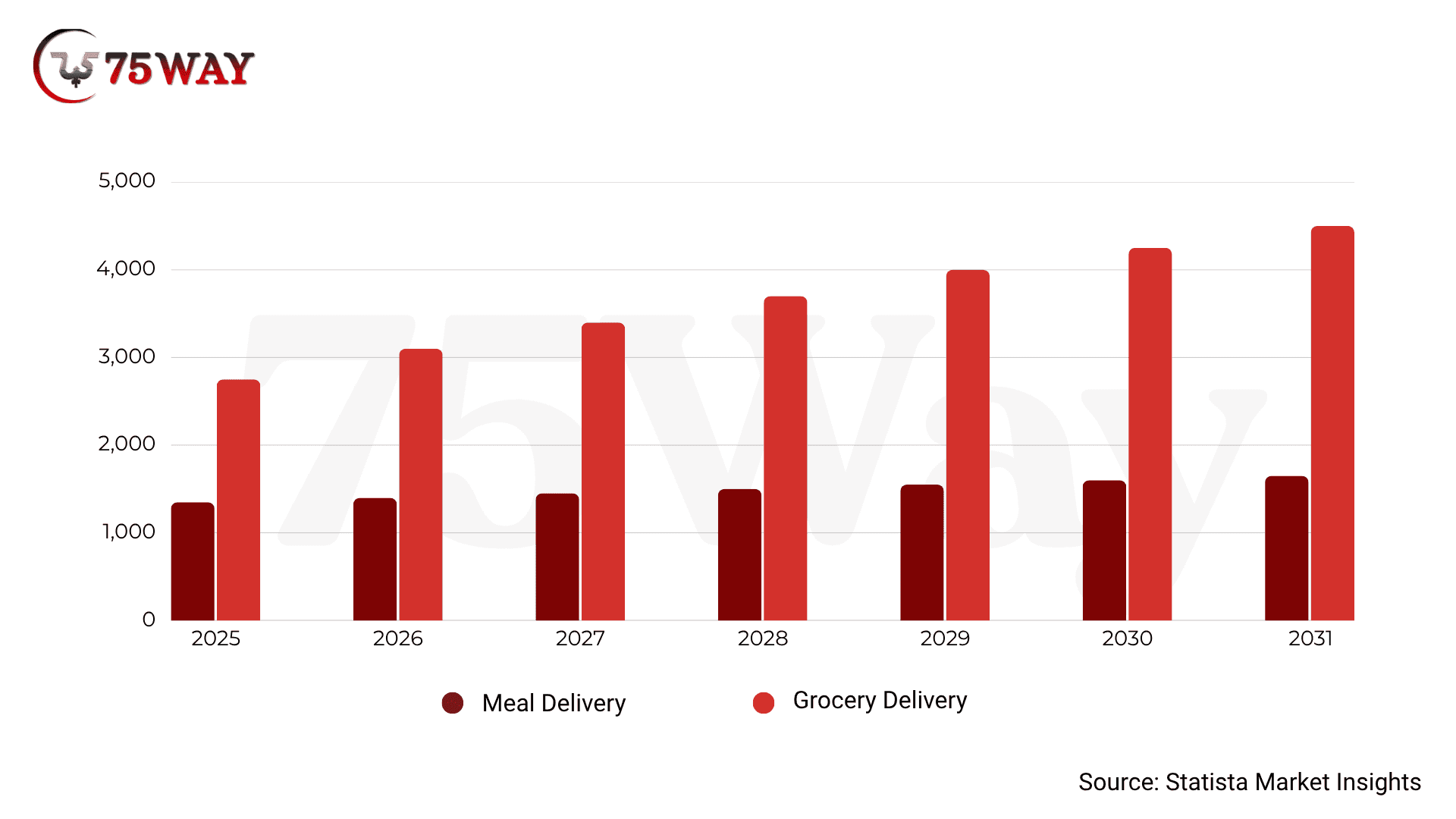
Online Grocery Delivery App Market 2026: Growth & Revenue Insights
Revenue in the online food delivery market is projected to reach $1.51 trillion in 2026 and grow to $2.05 trillion by 2031 at an annual growth rate of 6.24%.
- Around 52% of shoppers prefer ordering through first-party grocery apps or websites, while 27% rely on third-party aggregator platforms.
- Nearly 69% of consumers purchase groceries online occasionally, while only 30% use online platforms for up to one-quarter of their weekly grocery shopping.
- The grocery delivery market is expected to record a revenue growth rate of 9.8% in 2027.
- Instacart has surpassed 7 million app installations in recent years and processes more than $1 out of every $5 spent on online groceries.
- The global online grocery and food delivery sector is valued at over $750 billion and is expanding at a CAGR of 22.25%.
- Online food delivery revenue is projected to exceed $1.5 trillion in 2026.
Why the Instacart-like Grocery Delivery App Is Attracting Massive Investment in 2026?
The online grocery sector has evolved from a convenience service into a major component of modern retail. Consumers increasingly value time savings, personalized shopping experiences, and flexible delivery options. Several factors are accelerating market growth:
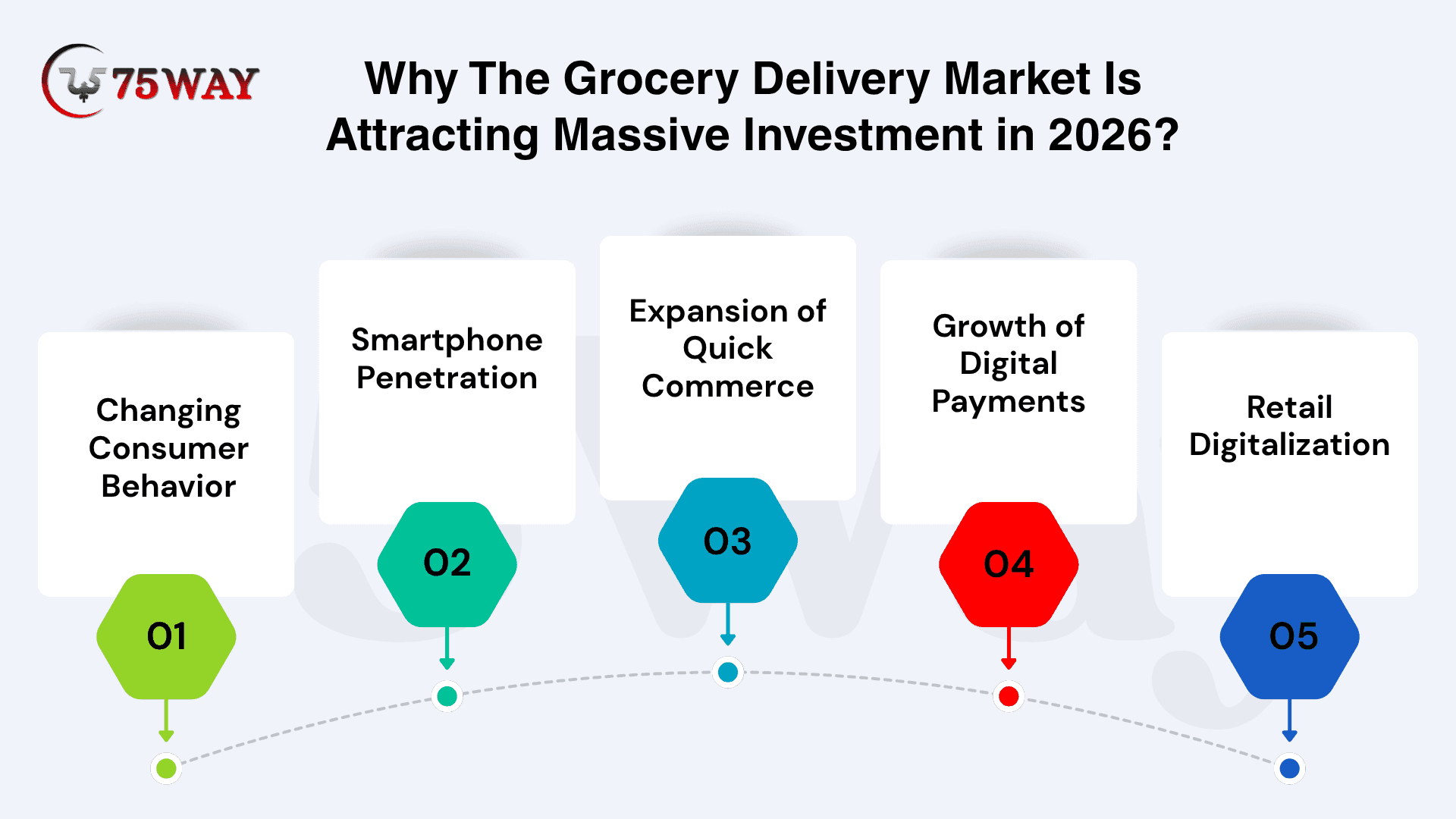
- Changing Consumer Behavior: Busy lifestyles have increased demand for doorstep grocery delivery. Customers prefer avoiding long checkout lines, traffic congestion, and multiple store visits.
- Smartphone Penetration: Mobile devices have made online grocery shopping accessible to a broader audience. Consumers can browse products, compare prices, place orders, and track deliveries directly from their smartphones.
- Expansion of Quick Commerce: Rapid delivery services have reshaped customer expectations. Many users now expect grocery deliveries within hours rather than days.
- Growth of Digital Payments: Secure payment gateways and digital wallets have simplified online purchasing, reducing checkout friction and increasing conversion rates.
- Retail Digitalization: Traditional grocery retailers are investing heavily in digital infrastructure to compete with technology-first delivery platforms.
These trends indicate that grocery delivery applications are becoming a long-term necessity rather than a temporary consumer preference.
Step-By-Step Process To Build A Grocery Delivery App Like Instacart
A successful grocery delivery app like Instacart requires a structured development approach that aligns business goals, user expectations, and operational workflows. The process involves market validation, feature planning, UI/UX design, technology selection, development, testing, and deployment. Each stage contributes to building a scalable platform, delivering a seamless grocery shopping experience.
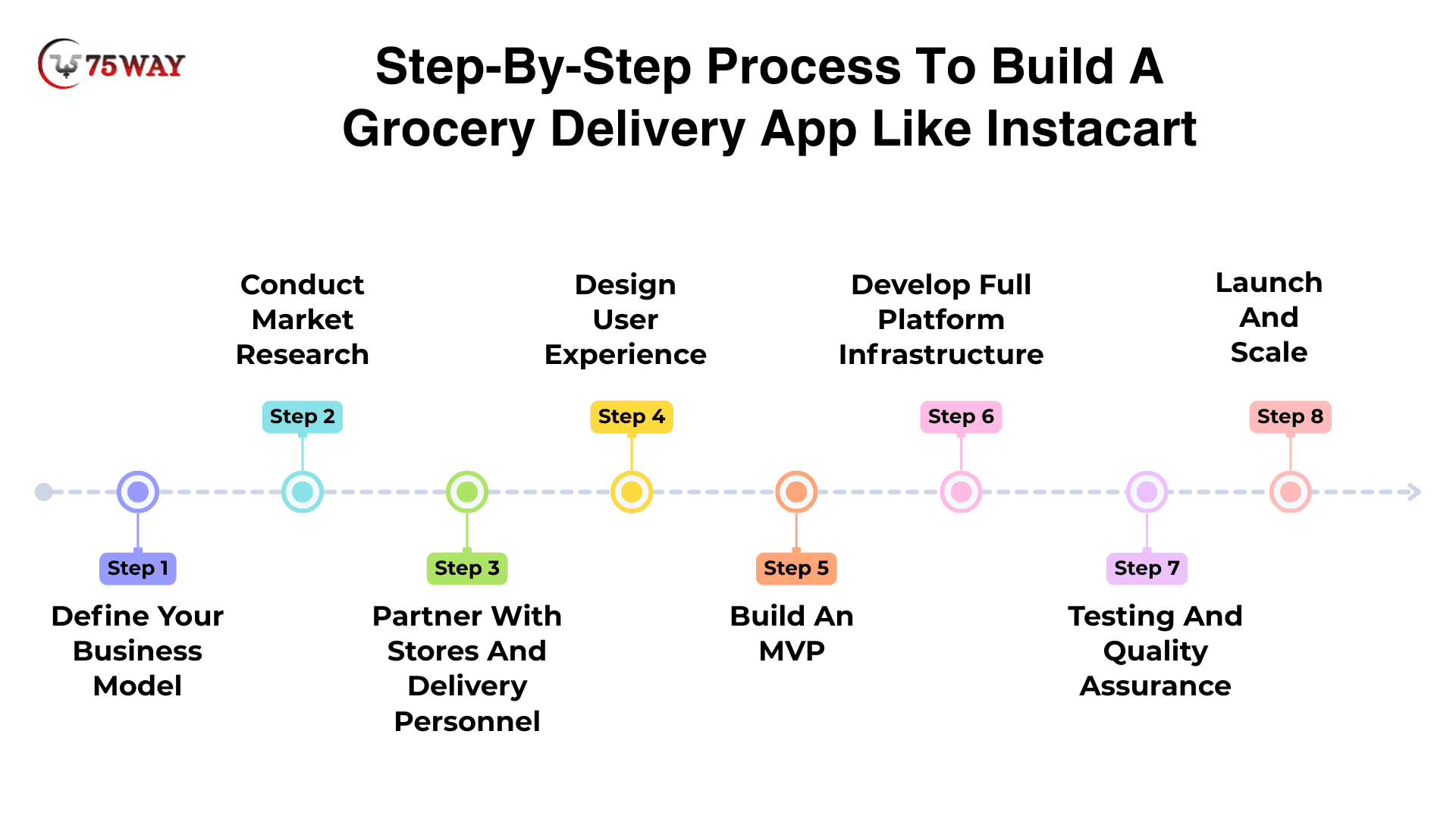
Step 1: Define Your Business Model
The development journey begins by determining your operational structure. Questions to answer include:
- Single store or multi-vendor marketplace?
- Subscription model or commission model?
- Local market or national expansion?
- Dedicated drivers or third-party logistics?
Business model decisions influence architecture, costs, and scalability. A clearly defined business model establishes the foundation for long-term platform success. It guides feature prioritization and operational planning decisions. Revenue generation strategies become easier to structure and optimize. Early clarity also reduces development risks and unnecessary investments.
Step 2: Conduct Market Research
Market research provides valuable insights into customer expectations, industry trends, and competitive positioning. It helps validate business assumptions before development begins. Understanding market dynamics reduces investment risks significantly. Strong research also reveals opportunities for differentiation, customer acquisition, and long-term growth within the grocery delivery sector.
- Customer Behavior: Analyze purchasing habits, shopping preferences, frequency patterns, and factors influencing grocery delivery platform adoption decisions.
- Competitor Offerings: Examine competitor features, strengths, weaknesses, service quality, and unique value propositions across target markets.
- Pricing Strategies: Evaluate delivery fees, subscriptions, commissions, discounts, and pricing structures influencing customer purchasing decisions.
- Delivery Expectations: Identify preferred delivery speeds, scheduling options, convenience factors, and service standards expected by customers.
- Regional Grocery Trends: Study local shopping patterns, consumer demands, popular products, and emerging grocery delivery opportunities.
Step 3: Partner With Stores And Delivery Personnel
Strong partnerships are essential for maintaining product availability, optimizing order fulfillment methods, and supporting reliable delivery operations. A well-established partner network strengthens service quality from the beginning. Establish relationships with:
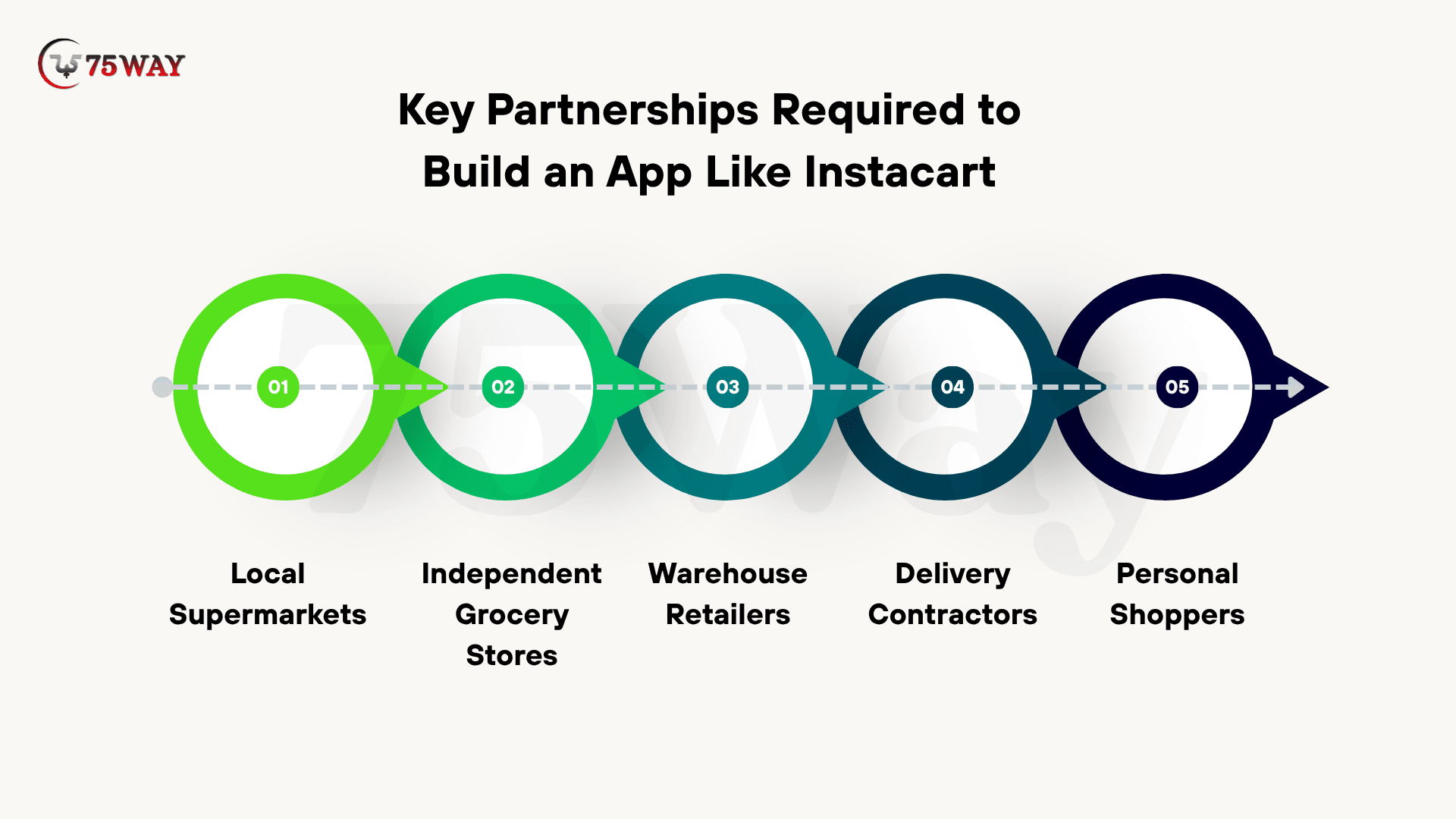
- Local Supermarkets: Connect with established grocery chains to access broad product inventories and attract recurring customer demand.
- Independent Grocery Stores: Partner with local retailers offering unique products, personalized service, and strong community presence.
- Warehouse Retailers: Collaborate with bulk inventory suppliers to support competitive pricing and large-volume grocery orders.
- Delivery Contractors: Engage delivery professionals capable of handling last-mile logistics across multiple service areas efficiently.
- Personal Shoppers: Recruit shoppers responsible for accurate item selection, order preparation, and customer-specific fulfillment requirements.
These partnerships form the foundation of platform growth.
Step 4: Build User-Centric Experiences For Better Engagement
A well-designed user experience improves engagement, retention, and overall platform usability. Every interaction should feel intuitive and convenient for different user groups. Clear navigation reduces friction throughout the ordering process. Strong UI/UX design directly influences customer satisfaction and conversion performance. Create wireframes and prototypes for:
- Customer Journeys: Map shopping experiences from product discovery through checkout, delivery tracking, and post-purchase interactions.
- Shopper Workflows: Design efficient fulfillment processes supporting item selection, substitutions, communication, and order completion activities.
- Driver Interfaces: Create streamlined delivery screens enabling navigation, status updates, route management, and proof-of-delivery submissions.
- Administrative Dashboards: Develop centralized management interfaces for monitoring operations, analytics, stores, users, and platform performance.
A simplified checkout experience often has the greatest impact on conversion rates.
Step 5: Build An MVP
The Minimum Viable Product (MVP) for the grocery app should focus on validating demand. Well-structured MVP development allows businesses to test assumptions before making larger investments. It helps identify user preferences and operational challenges early. Faster launches accelerate market validation and feedback collection. Insights gathered during this stage guide future product enhancements and scalability decisions.
Priority features include:
- Product catalog
- Cart
- Checkout
- Order management
- Delivery tracking
Key Steps To Build An MVP For Grocery Delivery App Are:
- Define Core Objectives: Identify primary business goals, target users, and essential functionalities required to validate market demand successfully.
- Prioritize Essential Features: Select only high-impact features supporting grocery ordering, fulfillment, and delivery operations during initial launch.
- Develop Functional Prototype: Create a working version enabling stakeholders to evaluate workflows, usability, and operational feasibility.
- Launch To Early Users: Release the MVP to a limited audience for gathering practical feedback and behavioral insights.
- Analyze And Improve: Evaluate user feedback, performance metrics, and operational challenges before planning future feature expansions.
Launching early provides valuable market feedback.
Step 6: Develop Full Platform Infrastructure
A scalable app development process begins after successful MVP validation and market acceptance. This stage focuses on scalability, performance optimization, and long-term business growth. A robust infrastructure supports higher-order volumes, expanding user bases, and multi-location operations. Businesses can expand functionality with:
- Loyalty Programs: Encourage repeat purchases through rewards, membership benefits, points systems, and customer retention initiatives.
- Advanced Analytics: Generate actionable insights from customer behavior, sales trends, operational performance, and business growth metrics.
- AI Recommendations: Deliver personalized product suggestions using purchasing history, preferences, and behavioral shopping patterns.
- Multi-Store Management: Manage multiple grocery locations through centralized controls, inventory oversight, and operational visibility.
- Marketing Automation: Automate campaigns, promotions, customer segmentation, and engagement workflows across various communication channels.
Step 7: Testing And Quality Assurance
Testing and quality assurance are critical for delivering a reliable grocery delivery platform. Even minor technical issues can negatively affect customer satisfaction, order completion rates, and brand reputation. A structured testing process helps identify vulnerabilities, performance bottlenecks, and usability concerns before launch. It ensures all workflows operate as intended under different conditions and device environments. Comprehensive testing includes:
- Functional testing
- Security testing
- Performance testing
- Usability testing
- Cross-device testing
A stable platform improves user retention.
Step 8: Launch And Scale Your Instacart-Like App
Following launch, continuous optimization becomes essential. The application should be published on both the Apple App Store and Google Play Store to maximize visibility and user acquisition opportunities. A successful launch strategy combines technical readiness, marketing efforts, user onboarding, and ongoing performance monitoring. Continuous improvements help businesses adapt to customer expectations and changing market conditions.
Key Steps To Launch Your Instacart-Like App Successfully
- Prepare App Store Assets: Create compelling app descriptions, screenshots, promotional visuals, and metadata for store submissions.
- Submit For Platform Approval: Publish the application on Google Play Store and Apple App Store, following platform guidelines.
- Execute Marketing Campaigns: Promote the launch through social media, paid advertising, partnerships, and customer referral initiatives.
- Monitor Performance Metrics: Track downloads, retention, engagement, and user feedback to guide future optimizations.
Focus areas include:
- User acquisition
- Retention
- Store expansion
- Feature enhancement
- Operational automation
Technology Stack Required To Build A Grocery Delivery App Like Instacart
Selecting the right technology stack directly impacts scalability, performance, security, and future expansion. Grocery delivery platforms handle thousands of concurrent users, real-time inventory updates, payment transactions, geolocation tracking, and logistics operations simultaneously. A modern technology stack typically includes:
- Frontend: React Native, Flutter, Swift, Kotlin
- Backend: Node.js, Python, .NET
- Database: PostgreSQL, MongoDB, MySQL
- Cloud Infrastructure: AWS, Microsoft Azure, Google Cloud
- Maps & Navigation: Google Maps API, Mapbox
- Payments: Stripe, PayPal, Razorpay
- Notifications: Firebase Cloud Messaging
- Analytics: Google Analytics, Mixpanel
- AI & Machine Learning: TensorFlow, OpenAI APIs, Vertex AI
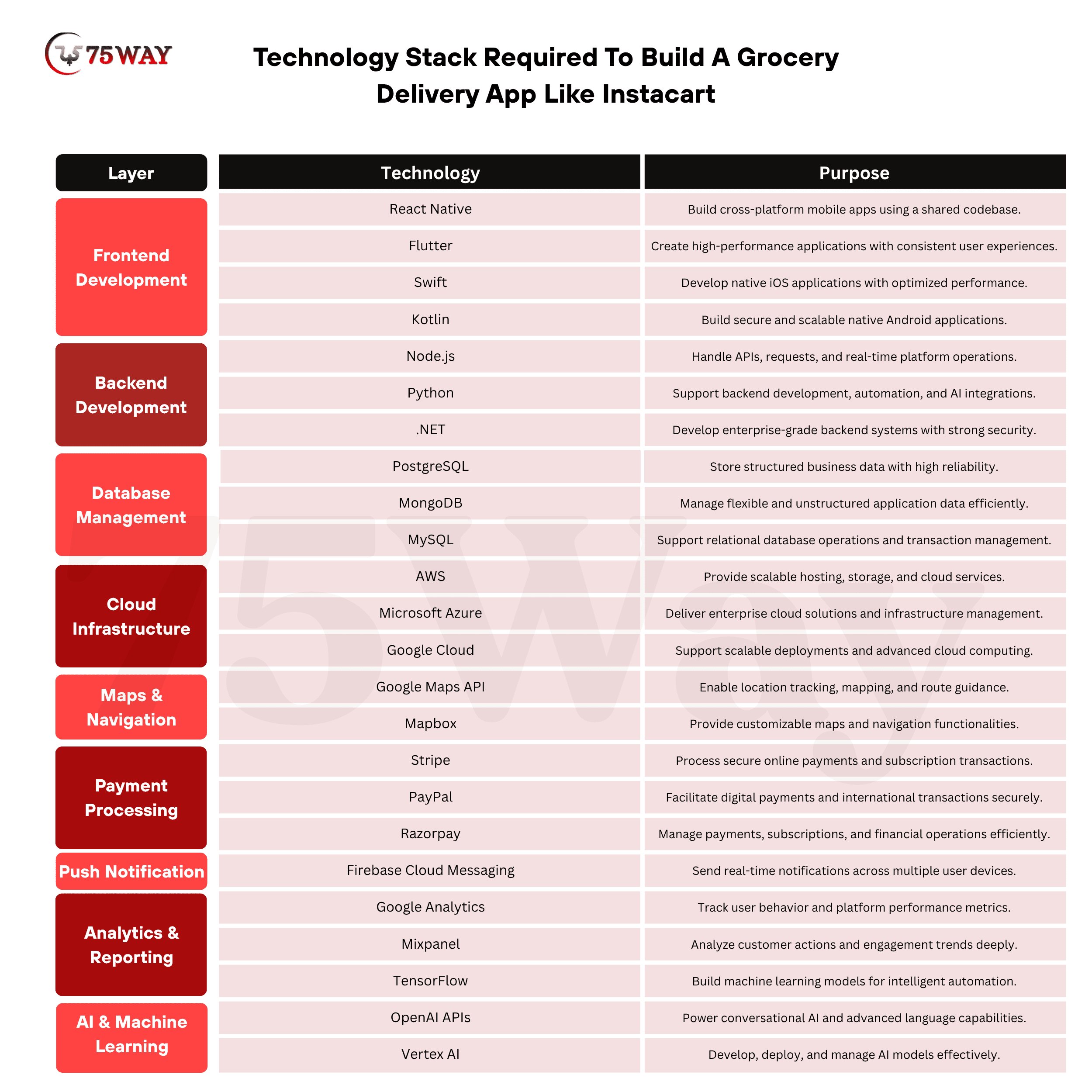
Businesses planning long-term growth should prioritize cloud-native architecture, microservices, and API-driven development to support future expansion without major redevelopment costs.
Understanding The Instacart Business Model
Before starting development, it is important to understand how Instacart generates value and what’s Instacart business model. Instacart operates as a marketplace connecting customers with grocery stores and delivery personnel. Customers browse products from multiple stores, place orders, and receive deliveries through personal shoppers and drivers. The platform earns revenue through:
- Delivery fees
- Service fees
- Membership subscriptions
- Retail partnerships
- Sponsored product listings
- Advertising revenue
- Markup strategies
- Data-driven retail insights
The strength of this model lies in its ability to create value for all participants within the ecosystem.
- Customers receive convenience
- Stores gain digital reach.
- Shoppers earn income.
- The platform generates recurring revenue streams.
Essential Components Required To Build An Instacart-Like App
A successful grocery delivery ecosystem typically consists of four interconnected applications. Each app serves a distinct purpose while contributing to a seamless grocery delivery experience for all stakeholders. Below, we define the key applications required to build an Instacart-like grocery delivery platform and their core functionalities.
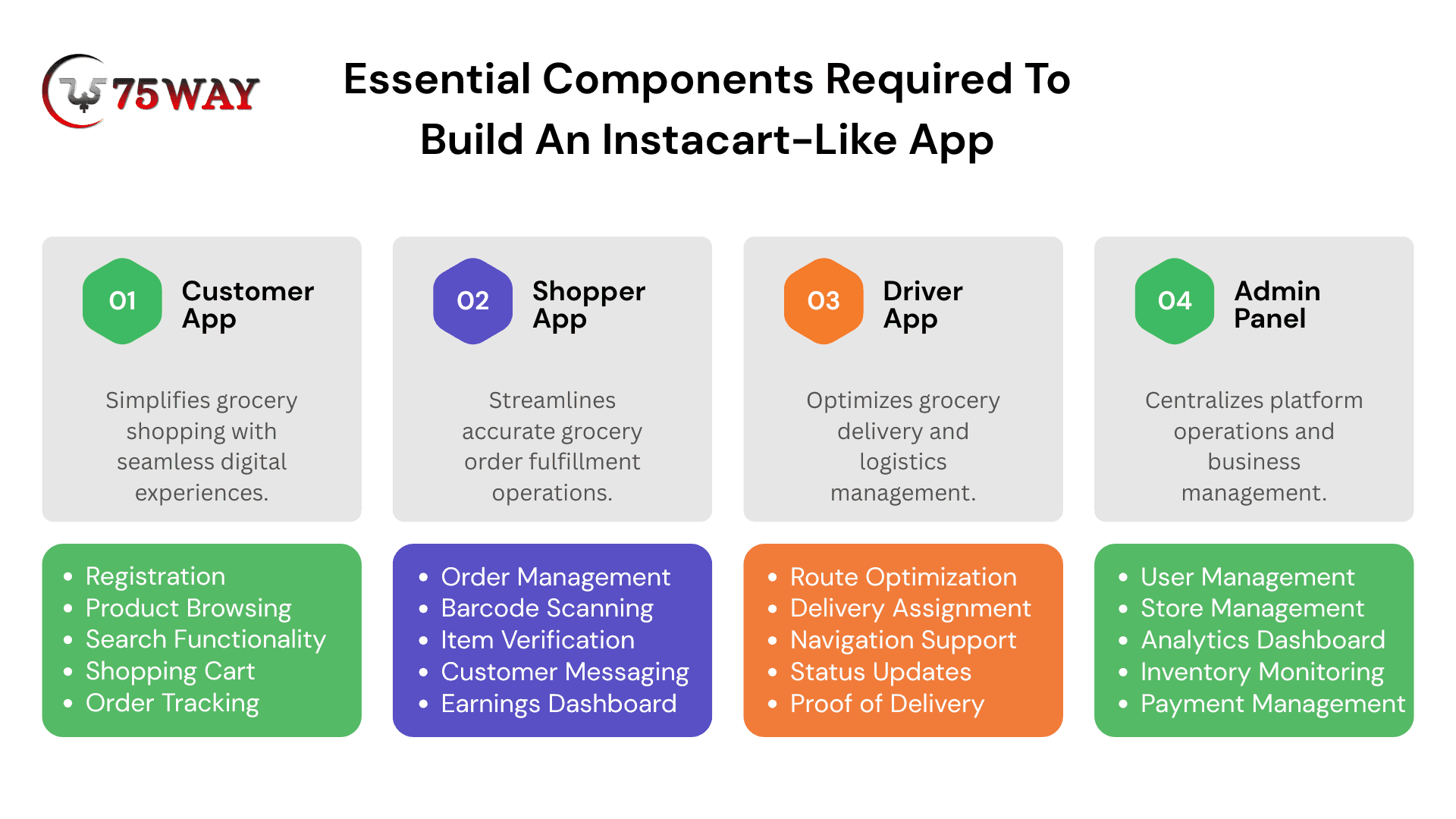
1. Customer App
The customer app serves as the foundation of the grocery delivery experience. It connects users with stores, products, and delivery services through a unified interface. Customers rely on this application throughout their shopping journey. User experience directly influences retention rates. Seamless navigation encourages repeat purchases.
- Registration and Login: Create secure customer accounts using email, phone numbers, social authentication methods, and verification processes.
- Product Browsing: Explore categorized grocery inventories with detailed descriptions, pricing information, images, and availability updates.
- Search Functionality: Find desired products quickly using keywords, filters, categories, brands, and personalized suggestions.
- Shopping Cart: Add selected products before checkout while reviewing quantities, pricing details, and promotions.
- Wishlist: Save preferred products for future purchases, simplifying repeat ordering and improving shopping convenience.
- Secure Checkout: Complete transactions safely using multiple payment methods with encrypted processing and fraud protection.
- Delivery Scheduling: Select convenient delivery time slots based on availability, preferences, and location requirements.
- Order Tracking: Monitor order progress through real-time updates from confirmation until successful doorstep delivery.
- Ratings and Reviews: Share shopping experiences and product feedback to help customers make informed purchasing decisions.
- Customer Support: Access assistance through chat, email, or call channels for order-related issue resolution.
2. Shopper App
The shopper app enables efficient order fulfillment within partner grocery stores. It acts as the bridge between customer orders and product collection activities. Accuracy and speed are essential for operational success. Shoppers depend on real-time information during fulfillment. Well-designed workflows reduce delays and errors.
- Order Management: View assigned orders, prioritize tasks, track progress, and manage fulfillment activities effectively.
- Barcode Scanning: Verify products accurately by scanning item barcodes during in-store shopping and selection.
- Item Verification: Confirm selected products match customer requests before packaging and order completion processes.
- Product Substitutions: Suggest suitable alternatives when requested products become unavailable during order fulfillment.
- Customer Messaging: Communicate directly with customers regarding substitutions, availability issues, and order clarifications.
- Inventory Confirmation: Check product availability instantly before adding items to completed customer orders.
- Earnings Dashboard: Track completed deliveries, incentives, commissions, bonuses, and overall income performance metrics.
3. Driver App
The driver app manages transportation and final delivery operations across the platform. It ensures grocery orders reach customers quickly and accurately. Delivery performance affects customer satisfaction levels. Drivers require optimized workflows and navigation support. Real-time updates help streamline logistics operations.
- Route Optimization: Calculate fastest delivery paths using traffic data, location insights, and route planning algorithms.
- Delivery Assignment: Receive delivery requests automatically based on proximity, availability, and operational requirements.
- Navigation Support: Access integrated maps and turn-by-turn directions for accurate destination guidance throughout deliveries.
- Delivery Status Updates: Share real-time delivery progress information with customers during transportation and arrival.
- Earnings Management: Monitor delivery income, bonuses, incentives, and payment history through centralized dashboards.
- Proof of Delivery: Capture signatures, photos, or confirmations verifying successful order handoff to customers.
- Communication Tools: Connect with customers and support teams regarding delivery updates or issue resolution.
4. Admin Panel
The admin panel serves as the centralized control system for platform operations. It provides complete visibility into users, orders, stores, and revenue activities. Administrators monitor performance through actionable insights. Operational decisions become easier with centralized management tools. This panel supports growth, governance, and business optimization.
- User Management: Manage customer, shopper, and driver accounts while monitoring activity and access permissions.
- Store Management: Oversee partner stores, product catalogs, onboarding processes, and operational performance metrics.
- Commission Management: Configure commission structures, payout calculations, and revenue-sharing models across platform participants.
- Analytics Dashboards: View business performance metrics, customer behavior trends, and operational insights through reports.
- Customer Support Tools: Resolve customer concerns, track tickets, and manage service quality across channels.
- Payment Management: Process transactions, monitor payouts, handle refunds, and oversee financial platform activities.
- Inventory Monitoring: Track stock availability across stores to reduce shortages and fulfillment disruptions.
- Marketing Controls: Launch promotions, discounts, campaigns, and loyalty initiatives targeting customer acquisition objectives.
- Reporting Systems: Generate detailed reports covering revenue, operations, customer engagement, and growth performance indicators.
Must-Have Features For Building A Like Instacart: A Successful Grocery App Solution
The success of a grocery delivery app depends heavily on delivering convenience, speed, and a seamless shopping experience. Modern consumers expect intuitive navigation and real-time visibility throughout the ordering process. The following features form the foundation of a competitive Instacart-like platform capable of attracting users, increasing retention, and driving long-term business growth.
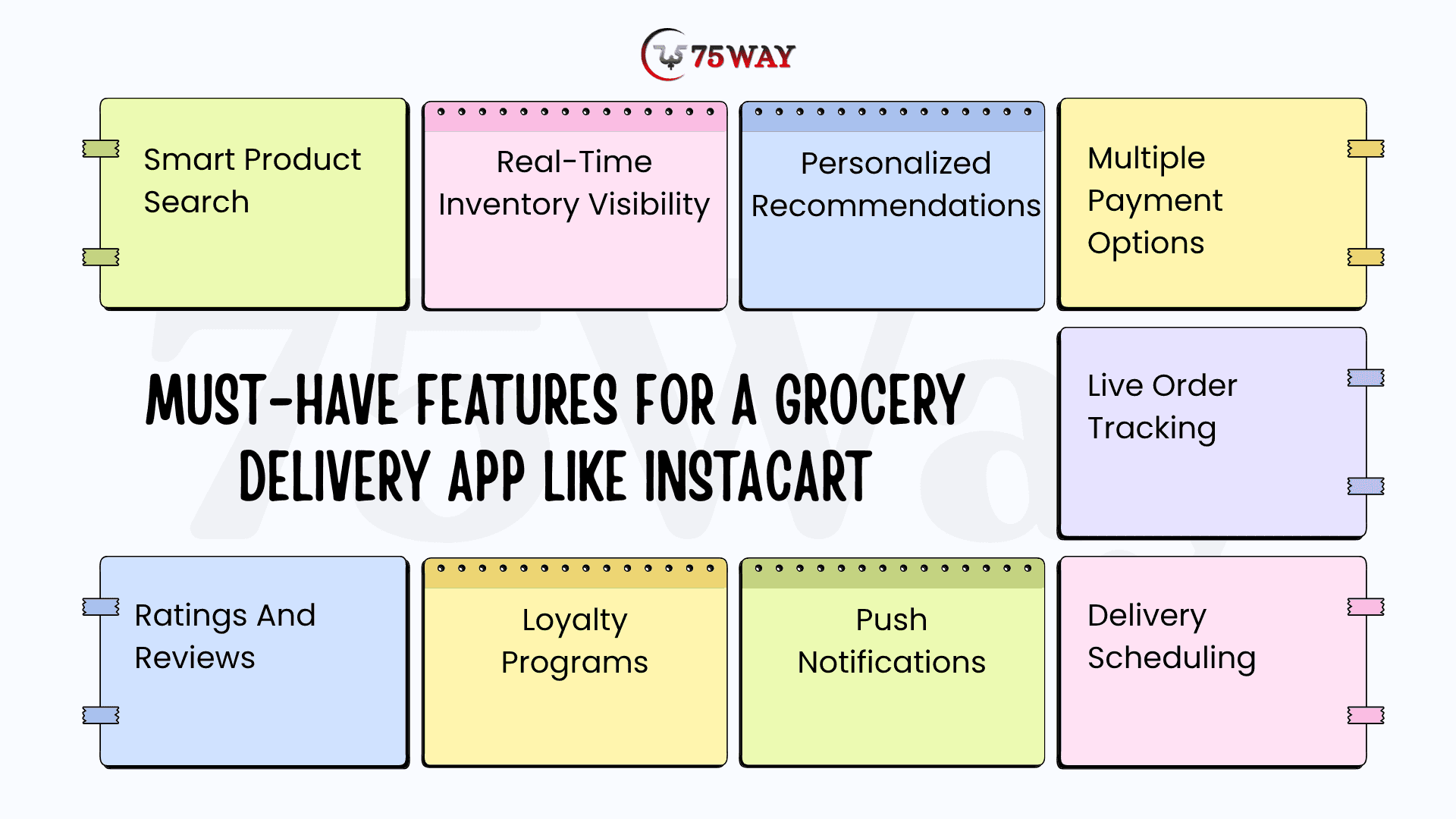
- Smart Product Search: Advanced search functionality helps customers locate products using keywords, filters, categories, and brands. Personalized suggestions improve discovery and accelerate purchasing decisions.
- Real-Time Inventory Visibility: Real-time inventory updates display accurate product availability across partnered grocery stores. This reduces customer disappointment and prevents avoidable order cancellations.
- Personalized Recommendations: Recommendation engines analyze shopping behavior to suggest relevant products and offers. Personalized experiences increase customer engagement and improve average order values.
- Multiple Payment Options: Flexible payment methods accommodate diverse customer preferences during checkout processes. Multiple options improve convenience and reduce cart abandonment rates.
- Live Order Tracking: Real-time tracking allows customers to monitor orders from placement until delivery. Increased transparency improves trust and minimizes customer support inquiries.
- Delivery Scheduling: Delivery scheduling enables customers to choose convenient delivery time slots. Flexible options improve satisfaction and accommodate varying lifestyle requirements.
- Push Notifications: Push notifications provide timely updates regarding orders, promotions, and deliveries. Continuous communication keeps customers informed throughout their shopping journey.
- Loyalty Programs: Loyalty programs reward customers for purchases and ongoing platform engagement. Incentives encourage repeat orders and strengthen long-term customer relationships.
- Ratings And Reviews: Ratings and reviews allow customers to share product experiences and feedback. User-generated insights improve purchasing confidence and support informed decisions.
AI Features For Instacart Clone App Development In 2026
Artificial intelligence is becoming a major competitive advantage for grocery delivery platforms. AI capabilities improve customer experiences, increase operational productivity, and create new revenue opportunities.
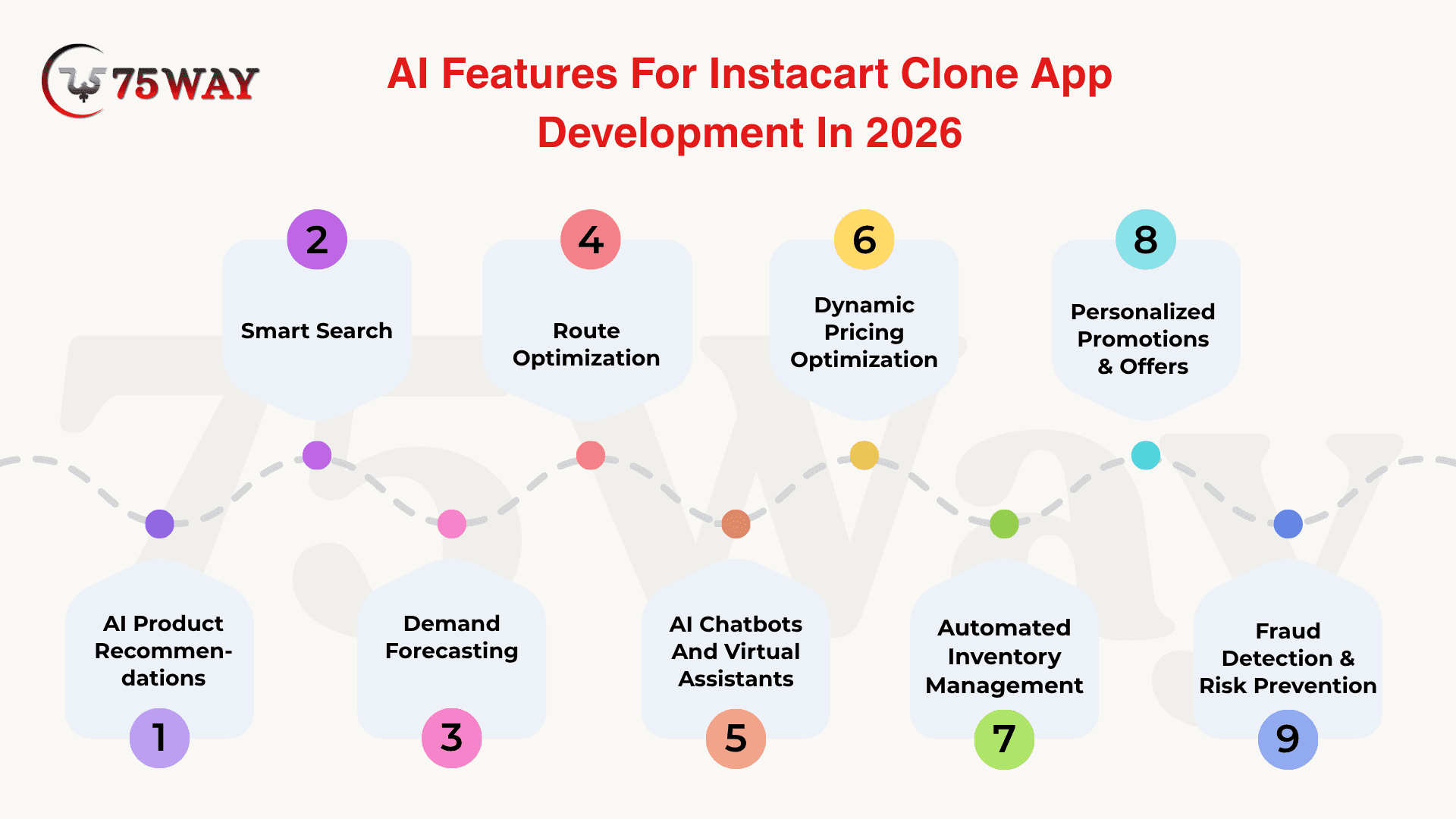
1. AI Product Recommendations: AI and machine learning algorithms analyze purchase history, browsing behavior, and seasonal trends to recommend products that customers are likely to buy. Benefits include:
- Higher average order values
- Improved customer engagement
- Increased repeat purchases
2. Smart Search: AI-powered search understands user intent rather than relying solely on keywords.
For example, a search for "healthy breakfast options" can return cereals, fruits, oats, and related products instead of exact keyword matches.
3. Demand Forecasting: AI models predict purchasing trends and inventory demand based on:
- Weather conditions
- Seasonal patterns
- Historical sales
- Local events
This helps stores reduce inventory shortages.
4. Route Optimization: AI grocery delivery apps like Instacart can dynamically calculate optimal delivery routes based on:
- Traffic conditions
- Delivery density
- Driver availability
- Delivery priorities
This reduces delivery times and fuel costs.
AI Chatbots And Virtual Assistants:AI chatbots and virtual assistants provide instant customer support throughout the shopping journey. They answer inquiries, resolve common issues, recommend products, and assist with order-related requests around the clock. Benefits include:
- 24/7 customer assistance
- Faster query resolution
- Reduced support costs
Dynamic Pricing Optimization: AI-powered grocery delivery apps analyze demand fluctuations, competitor pricing, inventory levels, and customer behavior patterns. Intelligent pricing adjustments help maximize revenue while maintaining market competitiveness. Benefits include:
- Improved profit margins
- Competitive pricing strategies
- Better inventory movement
Automated Inventory Management: AI integration in the Intacart clone app continuously monitors stock levels across partner stores and warehouses. Predictive inventory insights help reduce overstocking, stockouts, and inventory-related operational inefficiencies. Benefits include:
- Reduced inventory waste
- Better stock availability
- Improved operational planning
Personalized Promotions And Offers: Advanced algorithms create targeted discounts and promotional campaigns based on individual shopping behavior. Personalized offers improve conversion rates and encourage repeat purchases from existing customers. Benefits include:
- Higher conversion rates
- Increased customer loyalty
- Improved campaign performance
Fraud Detection And Risk Prevention: AI identifies suspicious transactions, unusual purchasing patterns, and fraudulent activities in real time. Early detection mechanisms help protect customers, merchants, and platform operations from financial risks. Benefits include:
- Enhanced transaction security
- Reduced financial losses
- Improved platform trustworthiness
In-House vs On-Demand vs Custom Grocery Delivery Apps: Which Model Is Right?
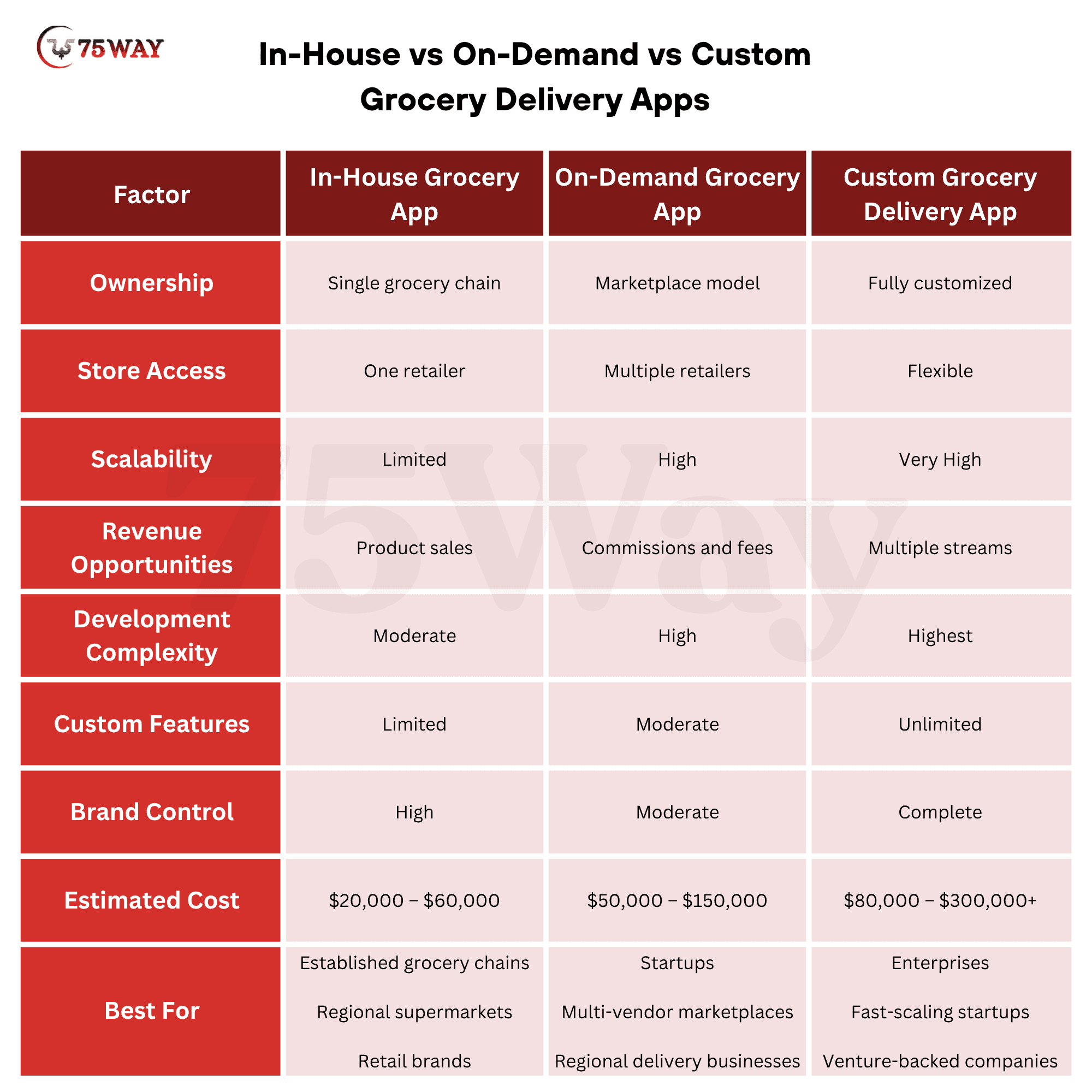
The primary difference between in-house, on-demand, and custom grocery delivery apps lies in ownership and business flexibility. In-house apps are built for a single grocery store or retail chain, on-demand apps connect multiple stores and customers through a marketplace model, while custom grocery delivery apps are fully tailored solutions designed around unique business requirements and growth objectives.
An in-house grocery delivery app gives retailers complete control over inventory, pricing, branding, and customer relationships. On-demand platforms operate similarly to Instacart by partnering with multiple grocery stores and generating revenue through commissions, delivery fees, and subscriptions. Custom mobile apps for grocery delivery can support either model while incorporating specialized features, integrations, workflows, and AI capabilities that align with specific operational goals, customer expectations, and long-term expansion strategies.
How Much Does It Cost To Develop An App Like Instacart?
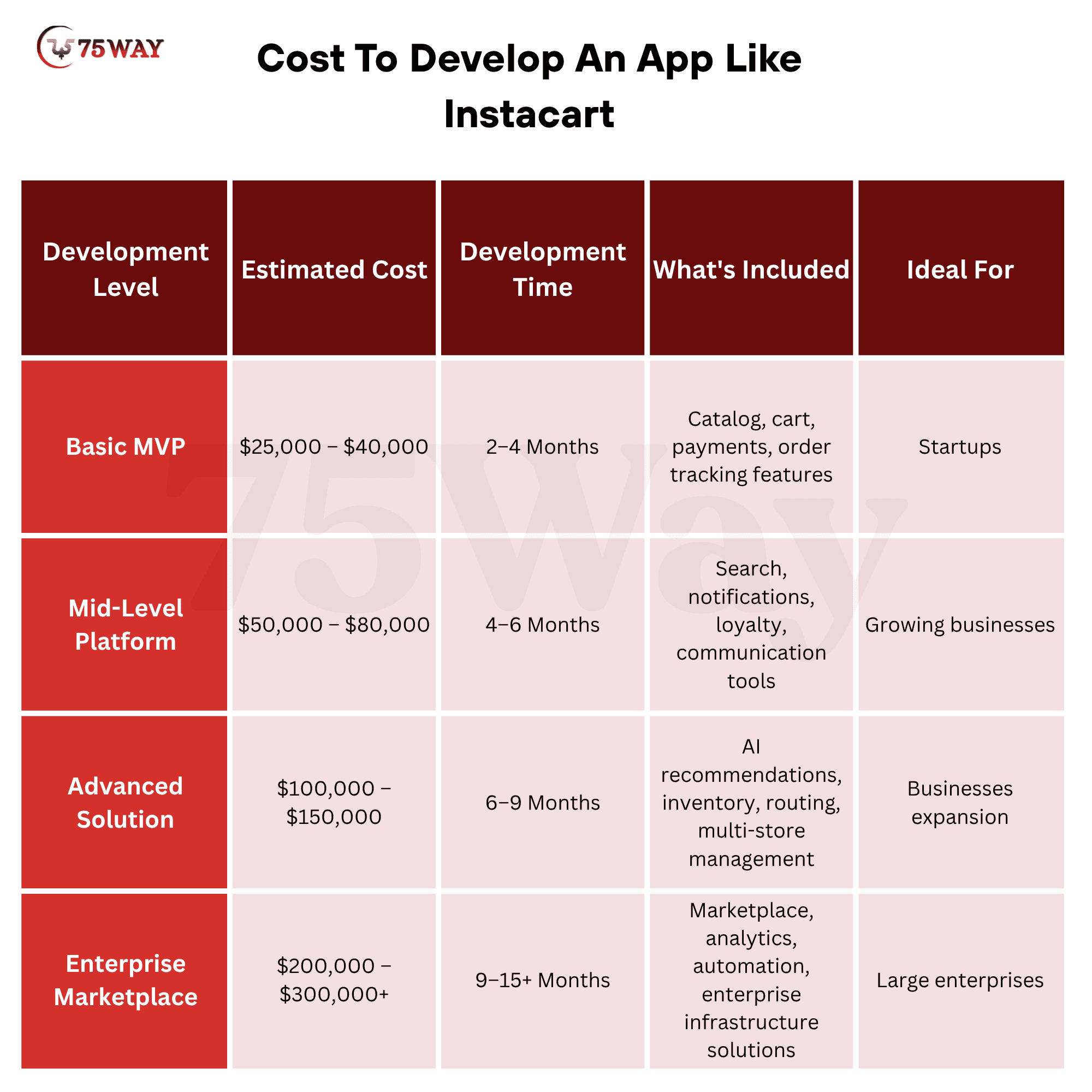
The cost of developing an Instacart-like grocery delivery app depends on factors such as feature complexity, scope, technology, integrations, and scalability requirements. On average, the cost to develop an app like Instacart ranges from $25,000 to $300,000+, depending on the application's functionality, customization level, and long-term business requirements.
- Basic MVP of Instacart-Like App Cost: $25,000 – $40,000
It includes core catalog, cart, payment integration, and basic order tracking for validation.
- Mid-Level Instacart-Like App Cost: $50,000 – $80,000
Personalized search, push notifications, geolocation tracking, loyalty features, and customer communication.
- Advanced Instacart-Like App Cost : $100,000 – $150,000
It includes AI recommendations, inventory synchronization, route optimization, and multi-store capabilities.
- Enterprise Marketplace Cost: $200,000 – $300,000+
Large-scale marketplace, advanced analytics, automation systems, and enterprise-grade infrastructure.
Instacart Clone App Development Cost Breakdown By Platform Components
Understanding component-level investments helps businesses allocate budgets more. Customer-facing applications generally receive the largest investment because they directly influence user acquisition and retention.
- Customer App & Website: $30,000 – $80,000
- Shopper App: $20,000 – $50,000
- Admin & Store Panel: $20,000 – $40,000
Instacart-Style Grocery Delivery App Development Cost By Project Stage
Every stage contributes to the overall budget.
- UI/UX Design: $5,000 – $15,000
- App Development: $30,000 – $80,000
- Backend & Admin Panel: $10,000 – $30,000
- API Integrations: $5,000 – $15,000 Payment gateways, maps, notifications, and third-party services.
- AI Capabilities: $10,000+
Factors Affecting Grocery Delivery App Development Cost
Grocery delivery app development costs vary based on business requirements, technical complexity, and scalability goals. Several factors influence the overall investment, including feature scope, platform selection, integrations, security requirements, development location, and long-term infrastructure needs.
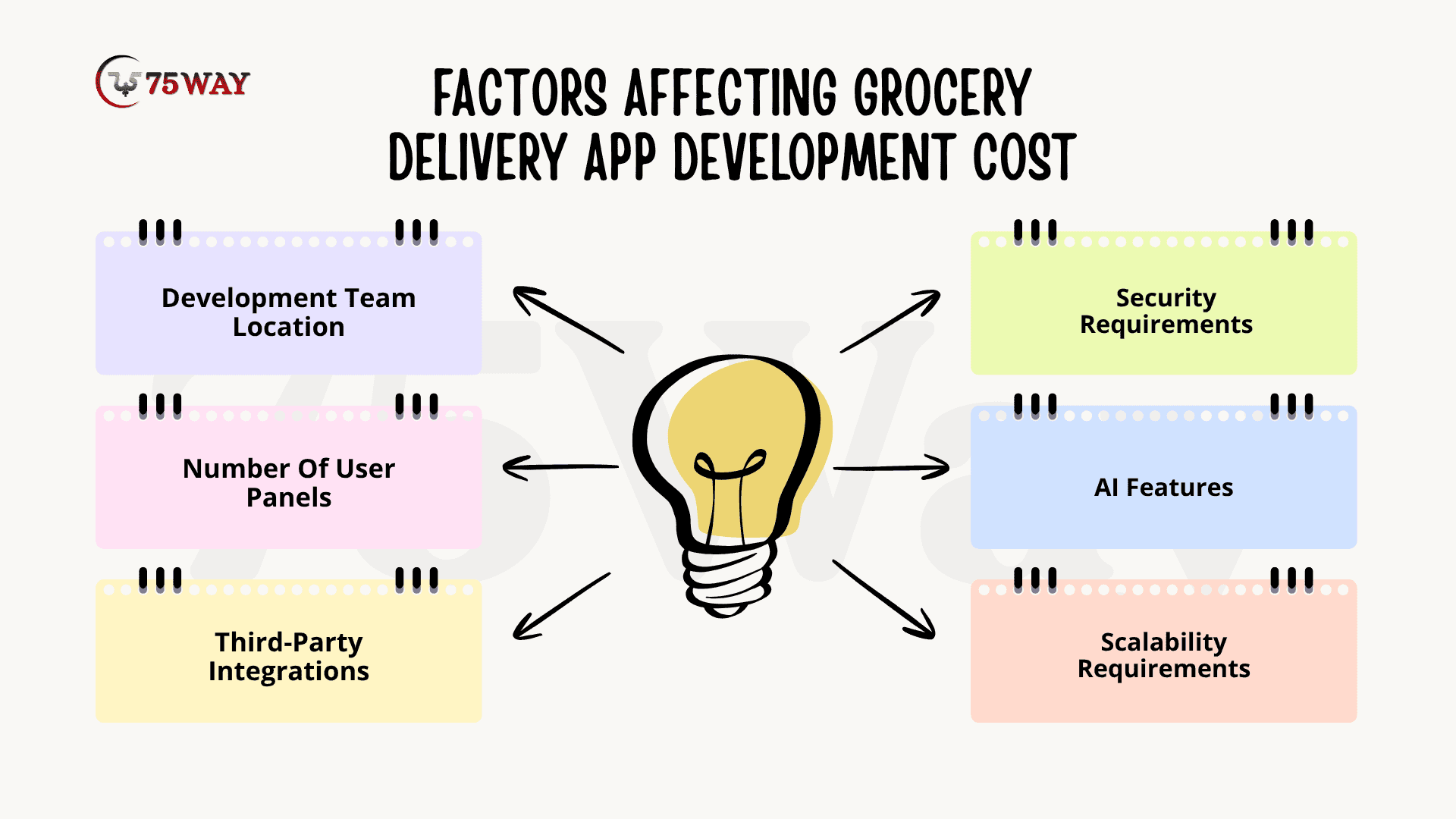
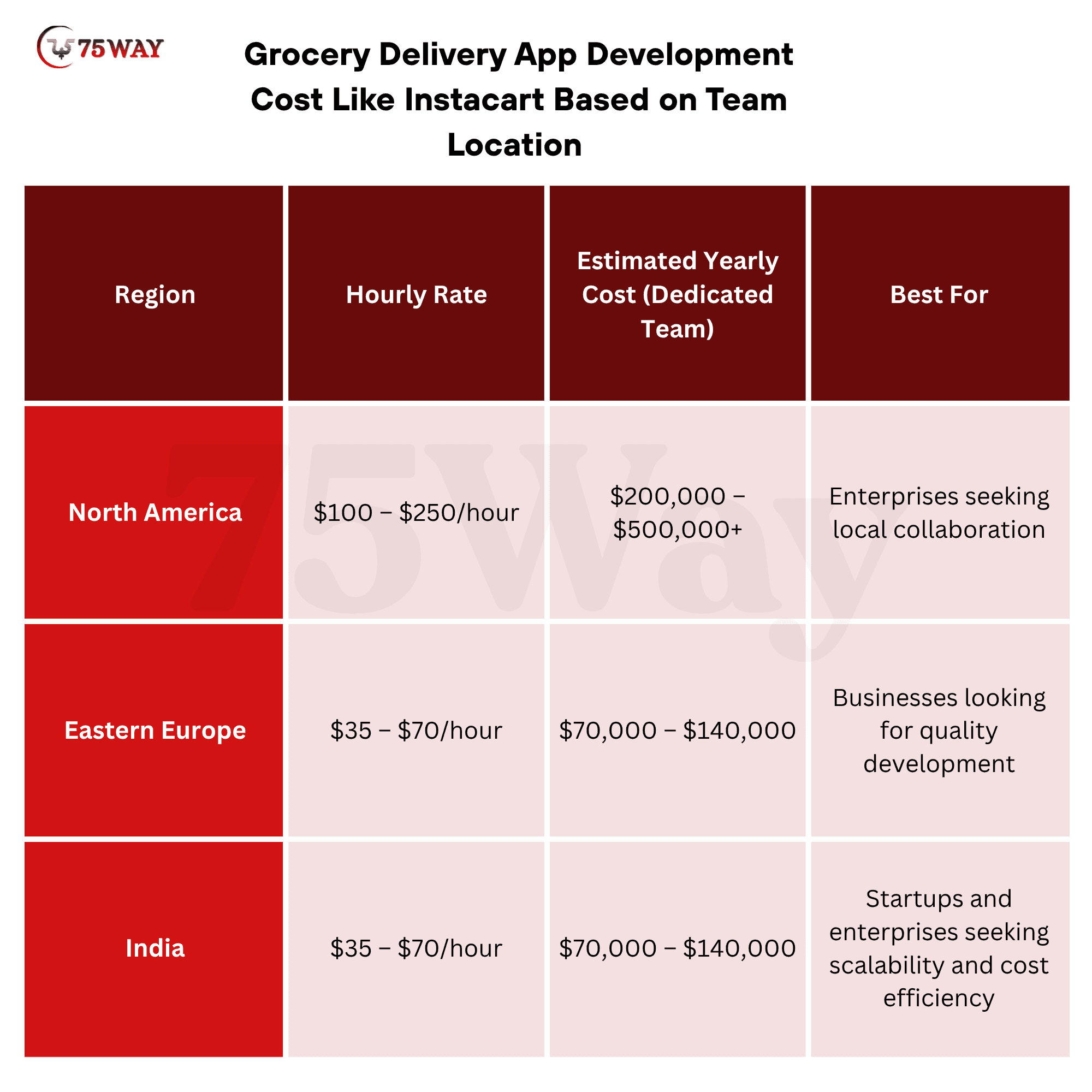
1. Development Team Location: Geographical location significantly impacts development budgets. Many businesses choose offshore or hybrid development models to optimize costs while maintaining quality.
- North America: $100 – $250/hour
- Eastern Europe: $35 – $70/hour
- India: $35 – $70/hour
2. Number of User Panels: Adding customer, shopper, driver, vendor, and admin applications increases development effort and complexity.
3. Third-Party Integrations: Integrating payment gateways, maps, inventory systems, CRM software, and analytics tools requires additional investment.
4. Security Requirements: Platforms handling payment information and customer data require stronger security architecture and compliance measures.
5. AI Features: Advanced AI implementations increase initial costs but often improve profitability through automation and personalization.
6. Scalability Requirements: Enterprise-level applications require more robust architecture capable of supporting future growth.
White-Label Vs Custom Grocery Delivery App Development For Instacart Clone
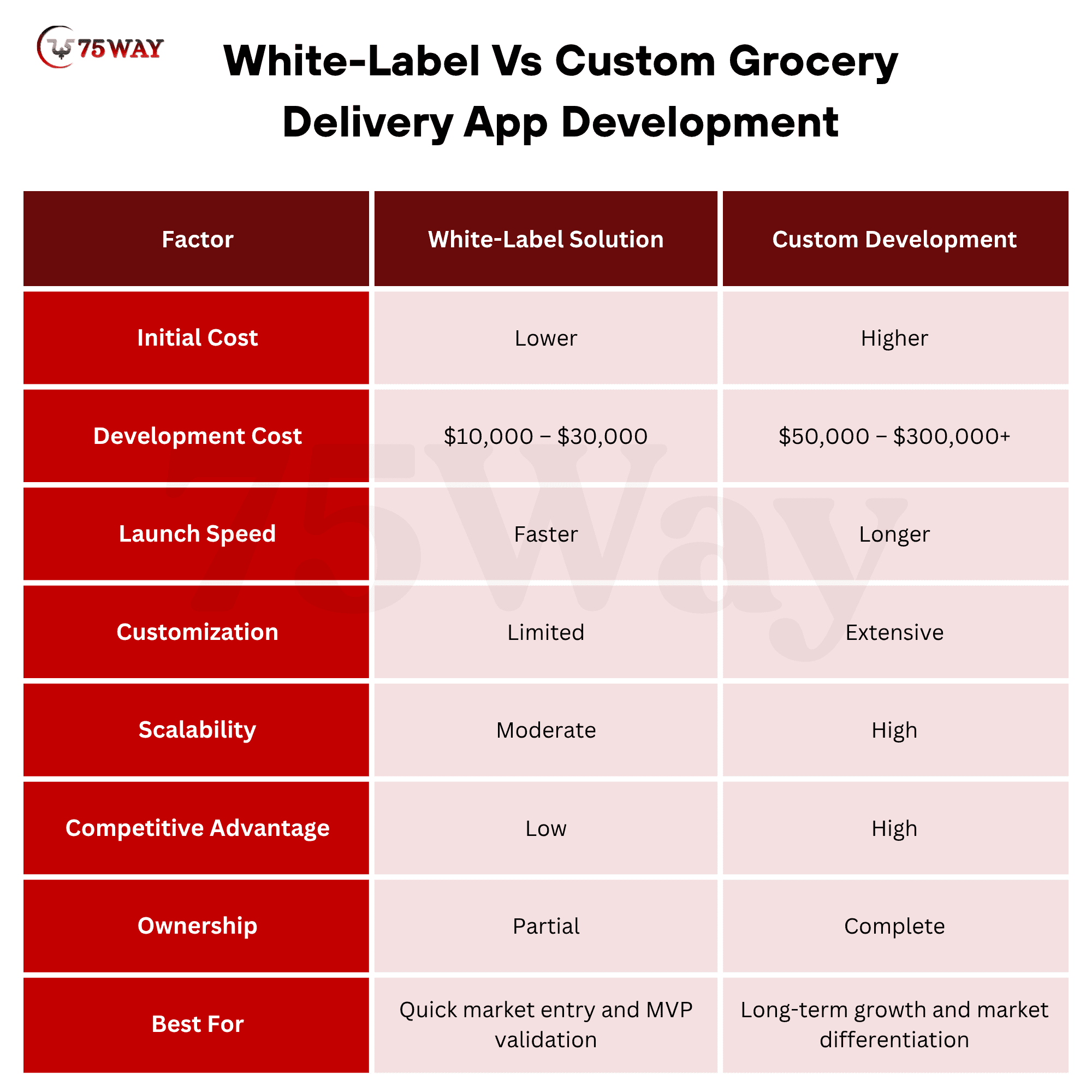
The primary difference between white-label and custom grocery delivery app development, offered by a mobile app development company, is flexibility, ownership, and scalability. White-label solutions use pre-built frameworks for faster deployment, while custom development creates a platform tailored entirely to specific business objectives and operational requirements.
White-label apps generally require lower upfront investment and shorter development timelines, making them suitable for businesses seeking quick market entry. Custom grocery delivery app development offers complete control over features, branding, integrations, and future scalability, making it the preferred option for companies focused on long-term growth and competitive differentiation. White-label Instacart clone solutions typically cost between $10,000 and $30,000 for a basic MVP, making them a faster and more affordable option for businesses seeking rapid market entry.
Monetization Strategies For Grocery Delivery App Like Instacart
A sustainable business model requires multiple revenue streams. Diversified monetization reduces dependency on a single income source and improves long-term profitability. The following strategies are commonly used by successful grocery delivery platforms.
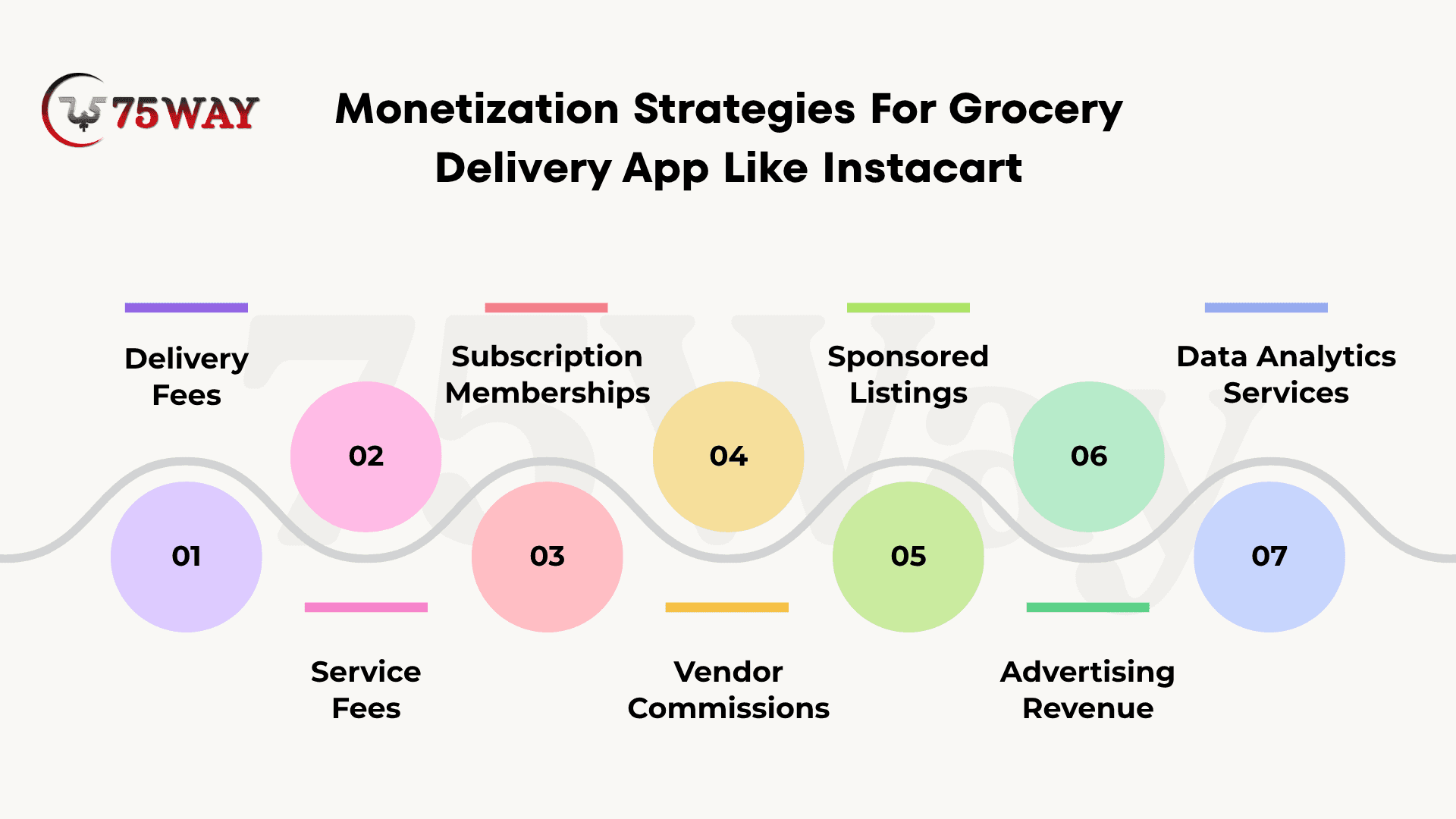
- Delivery Fees: Charging customers based on delivery distance, urgency, or order value remains one of the most common monetization approaches. Flexible fee structures help balance profitability with customer affordability.
- Service Fees: Platforms often add convenience or platform fees to every transaction. These charges contribute to operational costs and platform maintenance expenses.
- Subscription Memberships: Premium memberships can provide recurring revenue while enhancing customer loyalty. Members receive exclusive benefits that encourage frequent platform usage. Benefits may include: free delivery, priority support, exclusive discounts, and faster fulfillment
- Vendor Commissions: Retail partners pay commissions for orders generated through the platform. Commission-based revenue scales naturally as order volume increases.
- Sponsored Listings: Brands pay for premium visibility within search results and category pages. Enhanced placement opportunities help suppliers increase product exposure and sales.
- Advertising Revenue: Retail media networks have become highly profitable revenue channels for grocery platforms. Advertisers leverage customer purchase data to deliver targeted promotional campaigns.
- Data Analytics Services: Aggregated consumer insights can help retailers improve inventory planning and merchandising decisions. Data-driven intelligence creates additional value beyond transaction-based revenue streams.
Common Challenges In Grocery Delivery App Development
Despite the opportunities, businesses face several operational and technical challenges.
1. Inventory Accuracy
Outdated inventory information can result in customer dissatisfaction and canceled orders.
Solution: Implement real-time inventory synchronization between stores and the platform. This ensures customers always see accurate product availability during browsing and checkout.
2. Delivery Logistics
Managing deliveries during peak demand periods can become complex.
Solution: Use AI-powered route optimization and intelligent order allocation. This helps reduce delays and improve delivery efficiency even during high-demand windows.
3. Customer Retention
Acquiring users is only part of the challenge.
Solution: Introduce loyalty programs, personalized offers, and subscription memberships. These strategies encourage repeat purchases and long-term customer engagement.
4. Order Fulfillment Errors
Incorrect items negatively impact customer trust.
Solution: Barcode scanning, shopper verification workflows, and quality control processes. This minimizes picking errors and improves overall order accuracy.
5. Scalability Challenges
Rapid growth can place pressure on backend infrastructure.
Solution: Adopt cloud-native architecture from the beginning. This ensures the platform can scale smoothly without performance degradation during traffic spikes.
Future Trends For Creating Instacart-Style Grocery Delivery Apps
The grocery delivery industry continues to evolve rapidly. Several innovations are expected to shape the next generation of platforms.
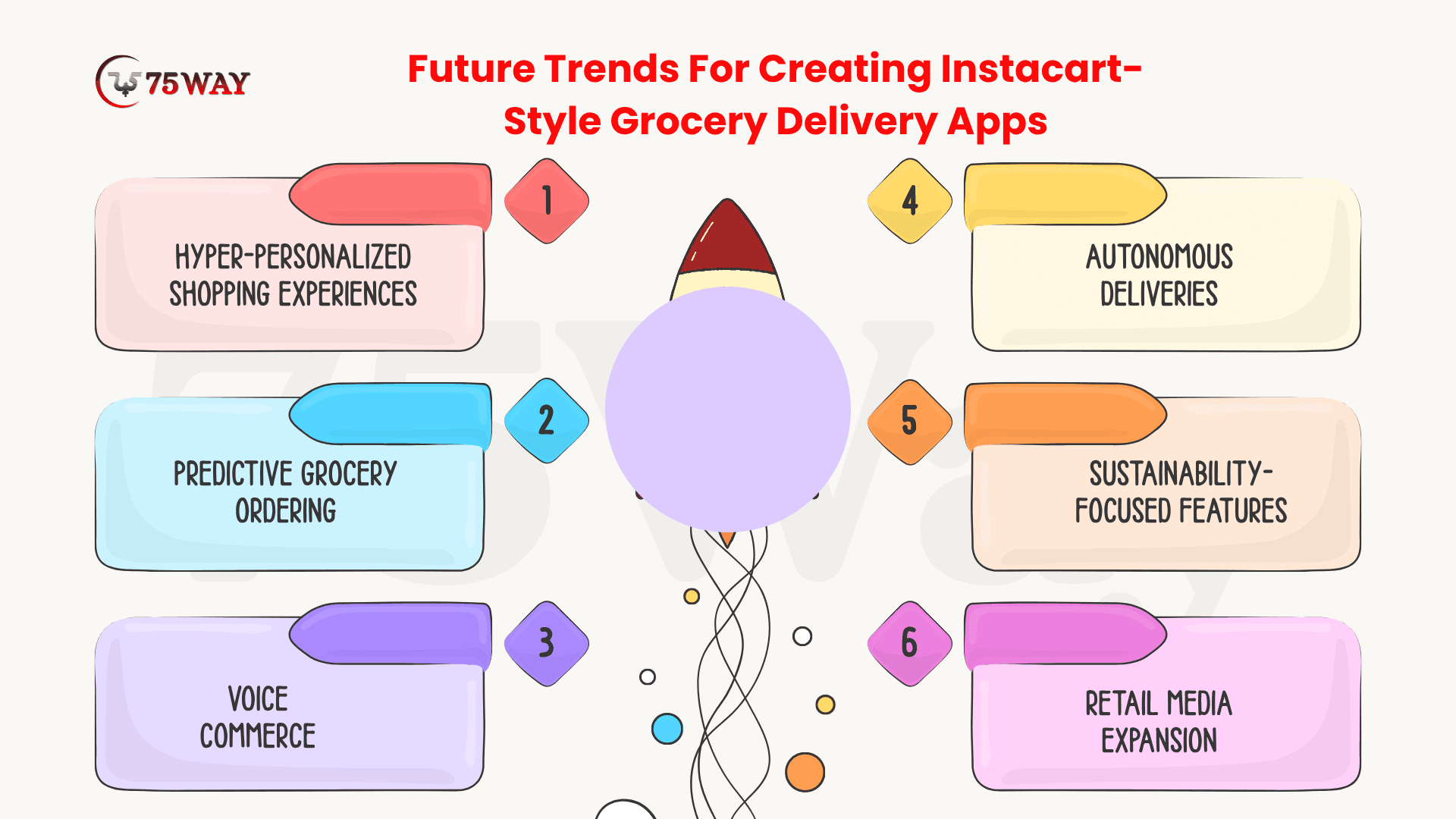
1. Hyper-Personalized Shopping Experiences: AI will increasingly tailor product recommendations, promotions, and shopping journeys to individual customer preferences.
2. Predictive Grocery Ordering: Future systems may automatically suggest replenishment orders based on purchasing habits.
3. Voice Commerce: Voice assistants will become more integrated into grocery purchasing experiences.
4. Autonomous Deliveries: Drone delivery and autonomous vehicles may become viable options in specific regions.
5. Sustainability-Focused Features: Consumers increasingly value environmentally responsible delivery options. Features may include:
- Eco-friendly delivery choices
- Carbon tracking
- Sustainable packaging preferences
6. Retail Media Expansion: Advertising within grocery delivery platforms is expected to become a significant revenue source.
Final Thoughts
Building a grocery delivery app like Instacart requires much more than creating a digital storefront. Successful platforms combine customer convenience, real-time logistics, intelligent inventory management, secure payments, and scalable technology infrastructure within a unified ecosystem. By selecting the right business model and focusing on long-term scalability, you can create competitive grocery delivery platforms capable of succeeding in an increasingly digital retail environment. Whether you're planning an MVP, a multi-vendor marketplace, or an enterprise-grade grocery ecosystem, partnering with a reliable grocery delivery app development company can dramatically reduce risks, accelerate launch timelines, and maximize return on investment.
Frequently Asked Questions (FAQs)
Can I Make My Own Food Delivery App?
Yes, you can build your own food delivery app. You’ll need a customer app, delivery/partner app, and admin panel, plus features like ordering, payments, and real-time tracking. With a clear business model and the right development team or no-code tools for MVP, you can launch and scale it successfully.
Can Grocery Delivery Apps Integrate With Existing POS Systems?
Yes. Modern grocery delivery platforms can connect with existing retail POS systems through APIs. This allows product catalogs, pricing information, and inventory levels to remain synchronized across both online and offline channels.
Is It Better To Launch With A Single Store Or Multiple Stores?
Launching with a single store often reduces operational complexity and development requirements. After validating demand and refining workflows, businesses can gradually expand into multi-store marketplace models.
Which Revenue Model Works Best For Grocery Delivery Startups?
Many startups combine delivery fees, vendor commissions, and subscription memberships. Diversifying revenue streams reduces dependency on a single source while improving overall profitability and long-term sustainability.
Can Grocery Delivery Apps Operate In Multiple Cities?
Yes. A scalable architecture allows businesses to manage multiple cities from a centralized admin panel. Geographic expansion becomes easier when logistics workflows and vendor onboarding processes are standardized.
How Important Is Real-Time Inventory Synchronization?
Accurate inventory visibility directly impacts customer satisfaction and order completion rates. Real-time synchronization reduces stock-related issues and helps create a more reliable shopping experience.