AI Summary
From salon startups to beauty marketplaces, this complete beauty service app development guide explains features, costs, AI trends, monetization, and everything needed to launch successfully in 2026. This guide highlights profitable business models and essential development strategies. Understand key features, AI innovations, and technology choices. Learn realistic development costs for 2026.
Key Takeaways
- Beauty services market continues growing through increasing consumer demand for home appointments.
- AI enhances beauty service apps with personalized recommendations, scheduling, and customer support.
- Marketplace models connect customers with verified beauty professionals and nearby salons.
- Seamless booking experiences improve customer satisfaction, retention, and long-term business profitability.
- Strategic planning and user-focused experiences drive successful beauty app launches and growth.
- Beauty service app development costs ranges between $10,000-$300,000depend on features, platform, and business goals.
If you're planning to build an on-demand beauty services app, you're entering a market where customer expectations are changing faster than ever. People no longer want to call salons, wait on hold, or adjust their schedules around limited appointment slots.
They expect to discover trusted beauty professionals, book appointments instantly, pay securely, and receive services wherever it's most convenient.
If your business can't deliver that experience, there's a good chance they'll choose a competitor that can. A well-planned beauty service app becomes a growth engine for the business, not just another mobile application.
In this guide, we'll walk you through everything a business owner should know before investing in on-demand beauty services app development. You'll learn the complete development process, features, and beauty service app development costs to expect in 2026.
What Is an On-Demand Beauty Services App?
Many business owners assume a beauty service app is simply an online appointment scheduler. In reality, that's only one part of the platform.
Think of it as your digital business ecosystem.
Your customers can discover services, compare professionals, check availability, book appointments, make secure payments, receive updates, and leave reviews, all in one place. Meanwhile, beauty professionals manage their schedules, accept bookings, update availability, and track earnings without endless phone calls or manual coordination.
For you, as the business owner, the platform serves as a central dashboard for managing customers, providers, payments, promotions, analytics, and day-to-day operations.
Instead of running your business through spreadsheets, WhatsApp messages, and phone calls, everything happens inside a connected system designed to improve efficiency and customer satisfaction.
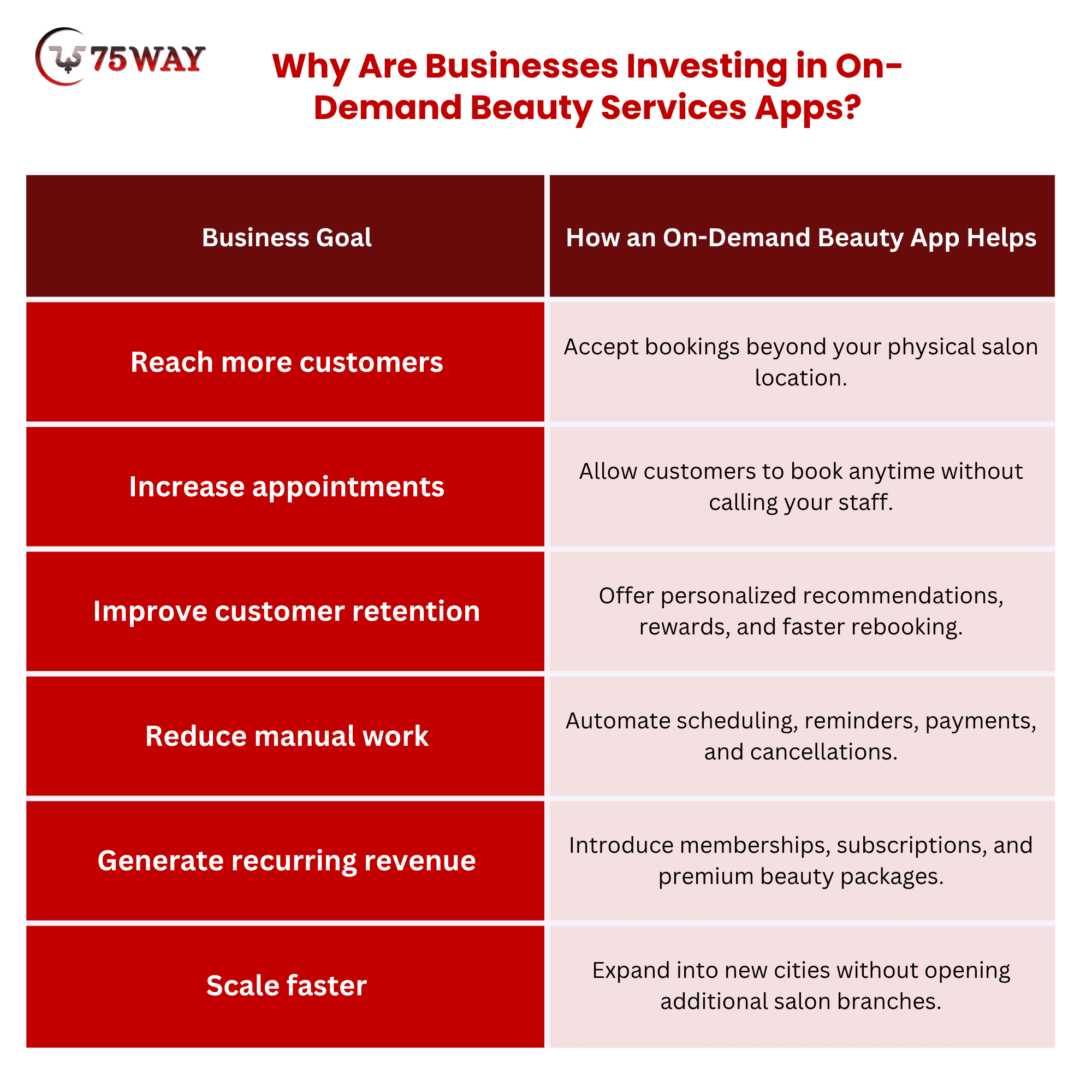
Why Are Businesses Investing in On-Demand Beauty Services Apps?
Let's start with a simple question.
Why are salons and beauty businesses investing thousands, or even millions, of dollars in mobile apps instead of opening another salon?
The reason is simple! People order groceries through apps, book taxis within minutes, schedule doctor appointments online, and even hire home cleaning services with a few taps.
Naturally, they expect the same convenience when booking a haircut, a makeup session, a massage, or a skincare treatment. If your business still depends only on phone calls or walk-in appointments, you're likely losing customers before the conversation even begins.
An on-demand beauty services app doesn't just make booking easier. It enables your business to serve more customers, streamline operations, and deliver a better experience for both clients and beauty professionals, all from a single platform.
Here's what businesses actually gain from investing in a beauty service app.
One thing we've noticed while working with service-based businesses is that customers rarely switch because another salon offers a slightly lower price. They switch because another business offers a better experience. Faster booking, transparent pricing, verified reviews, secure payments, and timely updates often influence buying decisions more than discounts.
That's exactly why companies like Urban Company, Booksy, and StyleSeat continue investing in their platforms. They're not competing only on beauty services. They're competing on convenience, trust, and customer experience.
If you're planning to build a beauty service app in 2026, think beyond appointment booking. The real opportunity is creating a digital platform that customers enjoy using and beauty professionals rely on every day.
Is Building a Beauty Service App Still Worth It in 2026? Market Insights
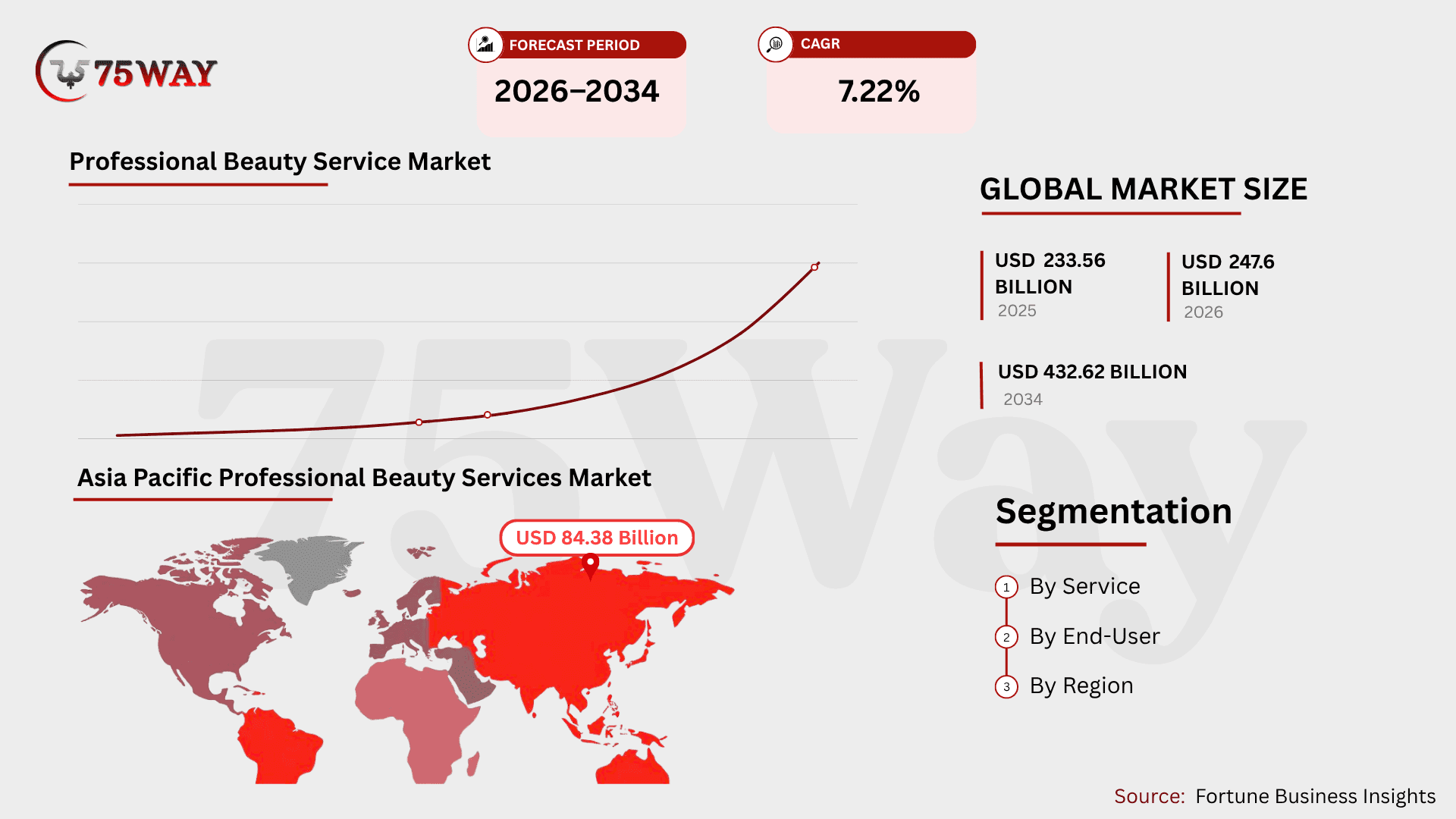
This is probably one of the first questions every founder asks. The short answer is yes, but only if you're solving a real business problem. Moreover, the beauty industry is becoming increasingly digital as customers prefer booking appointments, making payments, and discovering services through mobile apps. The market insights below highlight why beauty service app development is creating strong growth opportunities for businesses investing in digital experiences.
- The global beauty tech market is projected to grow from $87.1 billion in 2026 to $172.9 billion by 2030, at a CAGR of 17.9%, as reported in Grand View Research.
- The U.S. beauty tech market is expected to expand at a 16.0% CAGR from 2025 to 2030.
- The global professional beauty services market is forecast to grow from $247.6 billion in 2026 to $432.62 billion by 2034, registering a CAGR of 7.22%.
- The U.S. professional beauty services market is expected to reach $75.87 billion by 2032, as per Fortune Business Insights.
- Around 78% of customers prefer salons that offer mobile apps for appointment booking and reminders.
- Nearly 90% of Millennials and Gen Z expect salons to provide a dedicated mobile app.
- Digital appointment scheduling has increased by 22%, with approximately 65% of salons now using structured online booking systems.
How Beauty Service Platform Works?
A beauty service app connects customers, beauty professionals, and business administrators through one integrated platform. Each user has a dedicated dashboard with tools designed for their role, allowing bookings, service management, and business operations to run smoothly from start to finish. Here's how the entire process works.
Step 1: Customers Explore and Book Services
Customers browse available beauty services, compare professionals, check availability, choose a preferred time slot, and book appointments directly through the app. Secure online payments make the booking process fast and convenient.
Step 2: Beauty Professionals Manage Bookings
As soon as a booking request arrives, beauty professionals receive a notification. They can accept or decline appointments, update their availability, manage daily schedules, and change service statuses as they travel, arrive, and complete each appointment.
Step 3: Customers Track Their Appointment
After the appointment is confirmed, customers can track the beautician's arrival, receive real-time updates, communicate through the app when needed, and rate the service once the appointment is complete.
Step 4: Business Admin Oversees Operations
While appointments are taking place, administrators manage customers, beauty professionals, bookings, and platform activity from a centralized dashboard. They can also launch promotions, monitor revenue, and ensure day-to-day operations run.
Step 5: Data Drives Business Growth
Every booking, payment, review, and customer interaction generates valuable business insights. These analytics help identify popular services, measure professional performance, improve customer satisfaction, and support smarter business decisions as the platform continues to grow.
Different Types of On-Demand Beauty Services Mobile Apps You Can Build
Not every beauty business needs the same type of app. A salon with multiple locations has different goals than a startup building the next beauty marketplace, while an independent makeup artist needs a completely different platform. Before discussing features or development costs, decide what type of beauty service app best matches your business vision. The right choice depends on your target audience, services, and long-term growth plans.
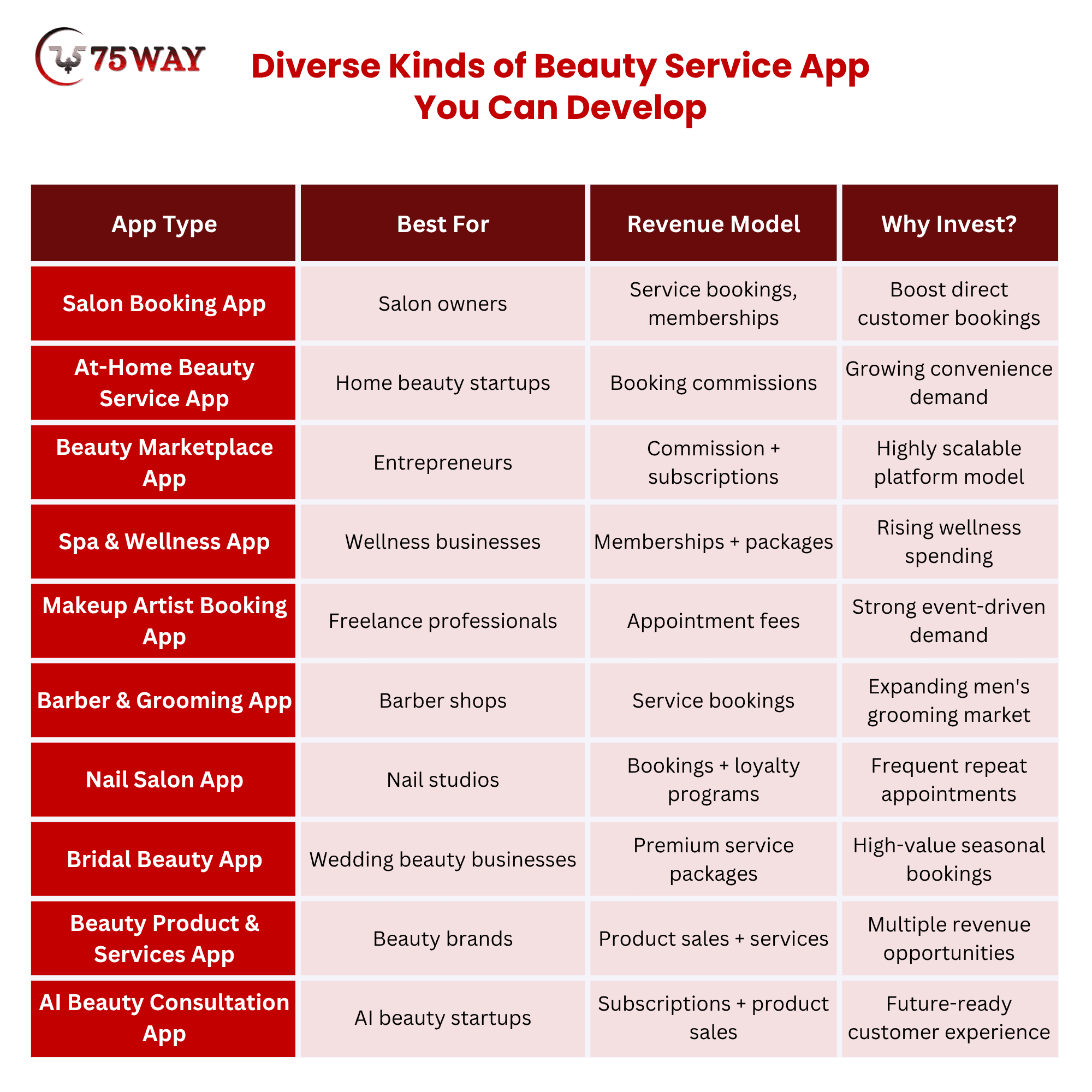
1. Salon Booking App
A salon booking app is designed for businesses that want customers to book appointments directly without relying on phone calls or third-party platforms. Customers can browse services, select their preferred stylist, choose an available time slot, make secure payments, and receive automated reminders.
Many successful salon businesses use branded booking apps to strengthen customer loyalty while reducing appointment management efforts.
Popular Example: Booksy is widely used by salons and barbershops, helping businesses manage appointments, payments, and customer relationships from one platform.
Best For: Salon owners, beauty clinics, spa businesses, salon chains
2. At-Home Beauty Service App
This model brings professional beauty services directly to the customer's location. Instead of visiting a salon, customers can book hairstylists, makeup artists, nail technicians, or estheticians to provide services at home, hotels, or workplaces.
As more consumers prioritize convenience, this category continues gaining popularity, especially in urban markets.
Popular Example:Glamsquad built its business around delivering beauty professionals directly to customers, making at-home beauty services mainstream in major cities.
Best For: Beauty startups, home-service brands, mobile beauty professionals
3. Beauty Marketplace App
A marketplace app connects customers with multiple salons and independent beauty professionals through one platform. Instead of promoting only your own services, you create a marketplace where customers compare providers, prices, ratings, and availability before booking.
This model offers significant growth potential because adding more providers also expands your service offerings.
Popular Examples: StyleSeat and Fresha allow customers to discover and book appointments with thousands of beauty professionals through a single platform.
Best For: Entrepreneurs building scalable beauty platforms
4. Makeup Artist Booking App
Some businesses focus exclusively on professional makeup services for weddings, fashion events, photoshoots, parties, and corporate occasions. These apps help customers find experienced makeup artists based on availability, portfolios, pricing, and verified reviews.
Because trust plays a major role, portfolios and customer ratings become key decision-making factors.
Popular Example: Many independent makeup artists use StyleSeat to showcase portfolios and manage bookings while building their personal brands.
Best For: Freelance makeup artists, beauty agencies, bridal businesses
5. Spa & Wellness App
Modern customers increasingly expect wellness services to be as accessible as beauty treatments. A spa and wellness app allows users to schedule massages, facials, aromatherapy, body treatments, and wellness packages while managing memberships and recurring appointments.
These platforms often focus on customer retention through personalized wellness plans and subscription programs.
Popular Example: Luxury spa businesses frequently use platforms like Mindbody to manage appointments, memberships, and client engagement.
Best For: Wellness centers, luxury spas, holistic therapy providers
6. Barber & Men's Grooming App
The men's grooming industry has grown rapidly over the past decade, creating demand for dedicated booking experiences. These apps help customers schedule haircuts, beard grooming, shaving, and premium grooming services while allowing barbers to manage appointments efficiently.
Many businesses also introduce loyalty rewards and memberships to encourage repeat visits.
Popular Example: Booksy is one of the most popular booking platforms among barbershops.
Best For: Barber shops, men's salons, grooming franchises
7. Nail Salon App
A nail salon app is designed specifically for businesses offering manicures, pedicures, nail art, gel extensions, and other specialized nail care services. Customers can browse technicians, view design portfolios, schedule appointments, and receive reminders before their visit. For business owners, the app helps reduce no-shows, manage staff schedules, and encourage repeat bookings through loyalty programs.
Popular Example: Many nail salons use Booksy to simplify appointment management and improve customer retention.
Best For: Nail salons, nail studios, and multi-location nail franchises.
8. Bridal Beauty App
Wedding beauty services require much more planning than regular appointments. A bridal beauty app allows brides to book makeup artists, hairstylists, skincare specialists, and trial sessions while managing complete wedding beauty schedules from one platform. Some businesses also offer group bookings for bridesmaids and family members.
Unlike traditional salon apps, bridal platforms often include consultation scheduling, package customization, and event-based booking management.
Popular Example: Glamsquad offers bridal beauty services in several U.S. markets, while many independent bridal beauty businesses operate through customized booking platforms.
Best For: Bridal beauty companies, luxury salons, wedding service providers, and makeup agencies.
9. Beauty Product & Services App
Many beauty brands are no longer separating services from product sales. Customers often purchase skincare products, cosmetics, or haircare items after receiving professional treatments. Combining both experiences in one application creates additional revenue opportunities while improving customer convenience.
For example, after booking a facial, the app can recommend skincare products used during the treatment, allowing customers to purchase them without leaving the platform.
Popular Example: Sephora combines beauty shopping, loyalty rewards, personalized recommendations, virtual consultations, and in-store beauty appointments through its mobile app.
Best For: Beauty brands, cosmetic retailers, salon chains, and omnichannel businesses.
10. AI Beauty Consultation App
Artificial intelligence is creating an entirely new category of beauty applications. Instead of simply booking appointments, these apps analyze skin conditions, recommend personalized treatments, provide virtual makeup try-ons, suggest suitable beauty products, and even help users visualize new hairstyles before making a decision.
For businesses, AI doesn't replace beauty professionals. It helps customers make more confident choices while increasing engagement and product sales.
Popular Example: YouCam Makeup and Perfect Corp. use AI and augmented reality to deliver personalized beauty experiences and virtual product testing.
Best For: Beauty technology startups, cosmetic brands, skincare companies, and businesses looking to differentiate through AI-powered experiences.
If your long-term vision is to expand into multiple cities and onboard independent beauty professionals, a marketplace app offers greater scalability than a single-salon booking app.
Quick Glance of Diverse Kinds of Beauty Salon App You Can Develop
Business Models For On-Demand Beauty Services Mobile App Development You Can Choose
After deciding what type of app you want to build, the next question is how your business will operate. This decision affects your development cost, platform architecture, revenue strategy, and future scalability. Choosing the wrong model can limit growth, while choosing the right one creates opportunities to expand without having to rebuild your platform later. Let's look at the most common business models.
- Single-Vendor Model
In this model, the app represents a single business. Every booking, payment, and customer interaction belongs to your salon or beauty brand. It's easier to launch, simpler to manage, and gives you complete control over branding and customer experience.
- Multi-Vendor Marketplace
Here, multiple salons and beauty professionals join your platform while customers choose who they want to book. Your business earns revenue by charging commissions, subscriptions, featured listings, or promotional packages. Although this model requires more planning, it offers the highest long-term growth potential.
- Aggregator Model
An aggregator doesn't employ beauticians directly. Instead, it partners with existing salons and professionals, helping customers discover and book services through one platform. Think of it as creating a trusted network rather than managing individual service providers yourself.
- Franchise Model
If your beauty brand operates through franchise partners, the app can centralize bookings while allowing each franchise to manage its own staff, schedules, and services. Customers enjoy a consistent experience regardless of location, while franchise owners maintain operational control.
- Hybrid Model
Several successful beauty businesses combine multiple approaches. For example, customers can book appointments at physical salon locations or request beauty professionals for home services through the same app. This flexibility helps businesses serve a broader audience without maintaining separate platforms.
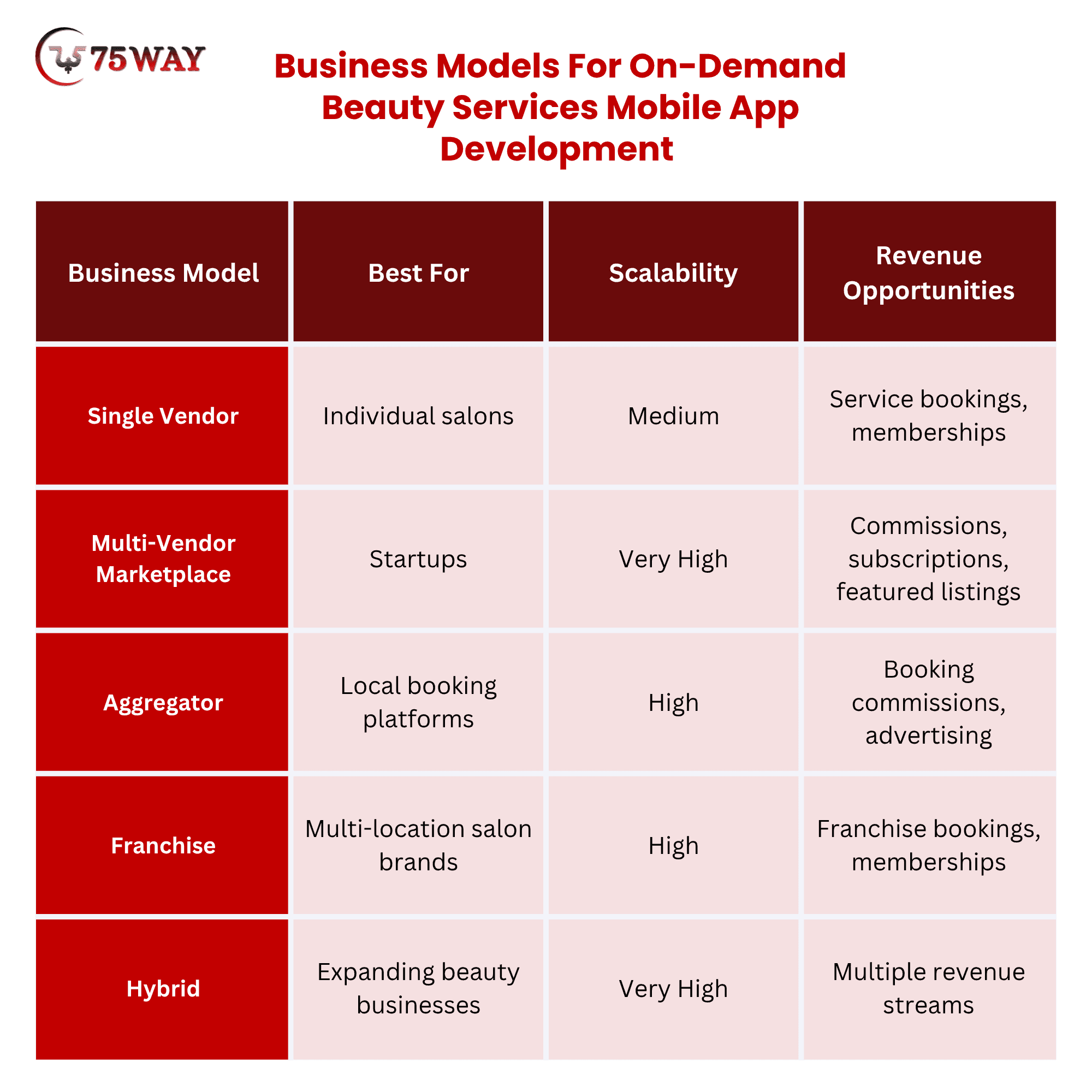
The best business model depends on where your business is today and where you want it to be in the next five years. If you're a salon owner, a single-vendor app may be enough to strengthen customer loyalty. But if your goal is to build the next major beauty marketplace, choosing a scalable multi-vendor or hybrid model from day one will save time, reduce redevelopment costs, and support long-term growth.
How to Develop an On-Demand Beauty Service App: Step-by-Step Process
A successful beauty service app starts with a clear development roadmap rather than writing code immediately. The comprehensive on-demand beauty services app development process below explains how businesses can build a salon app that is scalable, user-friendly, and ready for the market.
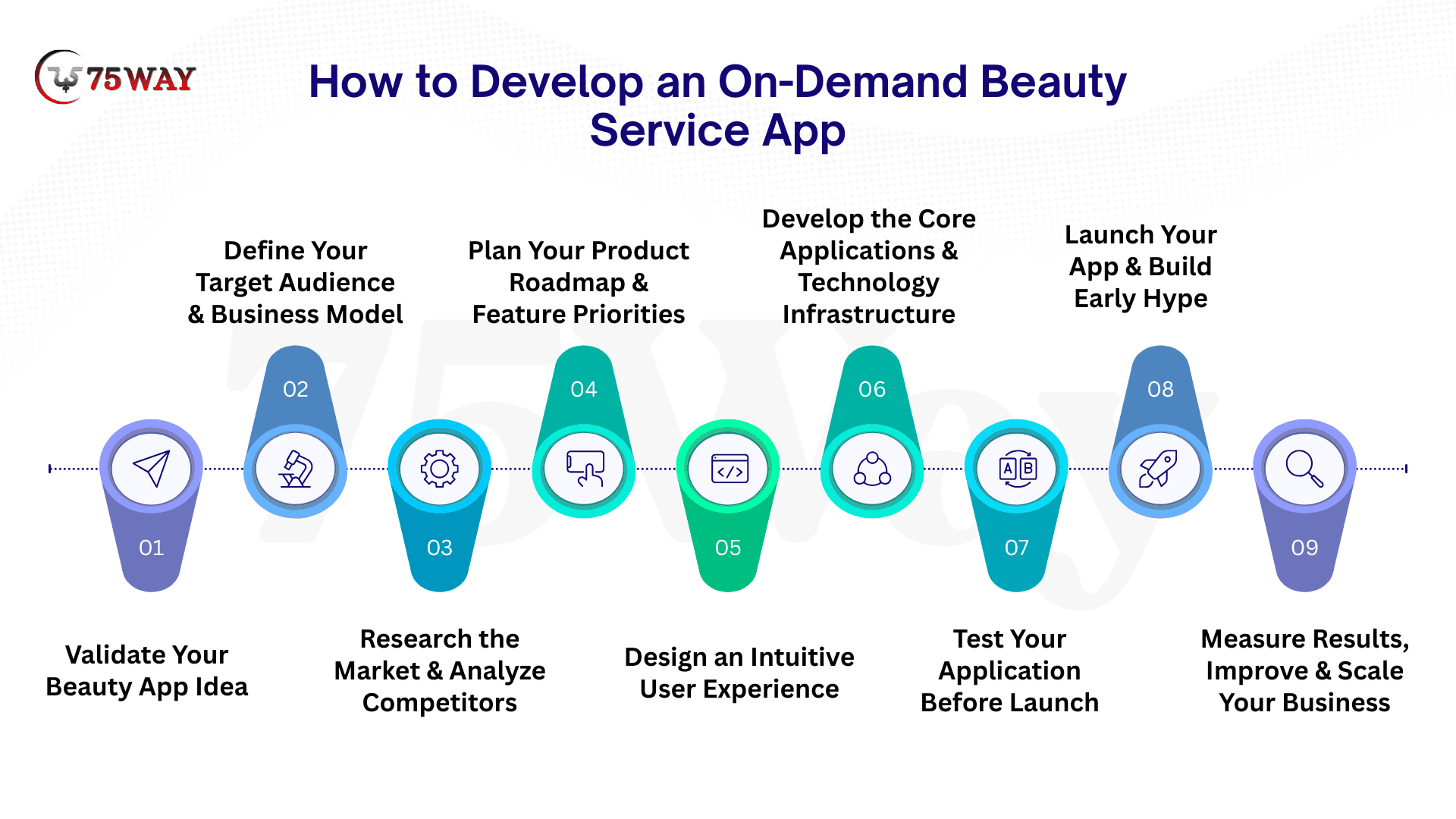
Step 1: Validate Your Beauty App Idea
Every successful application starts with solving a genuine business problem. Before investing your budget, validate whether your idea addresses an actual customer need instead of following market trends. Ask yourself what makes your application different and why users would choose it over existing alternatives.
During this stage, define your unique value proposition, identify the challenges your app will solve, and evaluate whether there is sufficient demand in your target market. A validated idea creates a stronger foundation for every decision that follows.
Things to Validate
- The problem your application will solve.
- The uniqueness of your business idea.
- Current market demand.
- Long-term growth opportunities.
- Your competitive advantage.
Step 2: Define Your Target Audience & Business Model
Once your idea is validated, identify exactly who your application is built for. Trying to serve everyone usually results in an unfocused product. Instead, choose a primary audience and design your application around their specific needs.
Potential Target Audiences
- Salon Owners: Businesses looking to increase direct bookings and reduce dependency on third-party marketplaces.
- Beauty Startups: Entrepreneurs building multi-vendor beauty marketplaces or home service platforms.
- Freelance Beauticians: Independent professionals who need appointment management, portfolio showcasing, and client acquisition.
- Spa & Wellness Centers: Businesses offering massages, skincare, wellness therapies, and premium experiences.
- Beauty Brands: Companies combining appointment booking with beauty product sales.
- Customers: Individuals looking for convenient, secure, and personalized beauty services.
After defining your audience, choose the business model that best supports your growth strategy.
Business Models to Consider
- Single Vendor
- Multi-Vendor Marketplace
- Aggregator
- Franchise
- Hybrid Model
Selecting the right audience and business model early prevents expensive redevelopment as your business grows.
Step 3: Research the Market and Analyze Competitors
Building a successful beauty application is easier when you understand what already exists in the market. Before planning features or estimating your budget, study competitors to identify customer expectations, industry standards, and opportunities that others have overlooked. The objective is not to copy another application but to create a solution that delivers greater value.
- Study Your Direct Competitors: Analyze beauty apps that offer services similar to your business. Evaluate how they handle bookings, payments, customer support, memberships, and loyalty programs.
- Review Customer Feedback: Read positive and negative reviews on the App Store, Google Play, Reddit, and industry forums. Customer complaints often reveal problems your application can solve more effectively.
- Compare Features: Identify which features have become standard across the industry and which capabilities can help your business stand out. This helps prioritize development without adding unnecessary functionality.
- Evaluate Their Revenue Strategy: Understand how competitors generate income through commissions, subscriptions, memberships, advertisements, premium listings, or product sales. Learning from proven business models helps you create a sustainable monetization strategy.
- Identify Market Gaps: Look for underserved customer segments, missing features, or pain points competitors have not addressed. These opportunities can become your strongest competitive advantage.
Instead of asking, "How can I build a similar app?",
Ask, "How can I create a better customer journey?" That mindset often separates successful beauty apps from average ones.
Step 4: Plan Your Product Roadmap and Feature Priorities
At this stage, you know who your audience is, what problem you are solving, and how your business will operate. Now it is time to convert that vision into a practical development roadmap. One of the biggest mistakes businesses make is trying to launch with every feature they can imagine. This usually increases costs, delays the launch, and creates a product that feels unnecessarily complicated. Instead, focus on building the right features at the right time.
Start by identifying the features your users cannot live without. For most beauty service apps, appointment booking, user registration, secure payments, provider management, and notifications should take priority over advanced capabilities.
Once your MVP is defined, organize your roadmap into different development phases.
- Phase 1
MVP Development: Include only the essential features required to launch your application and begin serving customers.
- Phase 2
Growth Features: Introduce loyalty programs, memberships, referral systems, promotional campaigns, and customer engagement tools after validating market demand.
- Phase 3
Advanced Innovation: Expand your application with AI-powered recommendations, virtual beauty consultations, predictive analytics, multilingual support, and business automation as your customer base grows.
Remember, your roadmap should remain flexible. Customer feedback after launch often reveals opportunities that no amount of planning can predict.
Step 5: Design an Intuitive User Experience
An attractive design may encourage users to download your application, but a simple and intuitive user experience determines whether they continue using it. Every interaction should feel natural, regardless of whether someone is booking a facial, managing appointments, or monitoring business performance.
Before creating high-fidelity designs, invest time in planning how users will move through the application. A confusing booking process, hidden navigation, or unnecessary screens can quickly discourage potential customers.
During the design phase, make sure your team validates the following:
- Customer Journey: Can users discover services, compare professionals, and complete bookings without confusion?
- Provider Workflow: Can beauty professionals easily manage appointments, update availability, and monitor earnings?
- Admin Dashboard: Does the dashboard provide quick access to bookings, revenue, customer management, and analytics?
- Visual Consistency: Are colors, typography, buttons, and icons consistent throughout the application?
- Accessibility: Can users of different age groups and technical abilities navigate the application comfortably?
Good design is not about making the application look modern. It is about helping every user complete their tasks with confidence and minimal effort.
Step 6: Develop the Core Applications and Technology Infrastructure
Once the design is finalized, development begins. Rather than building one application, your team is actually creating an entire digital ecosystem where customers, beauty professionals, and administrators interact through connected systems.
- Build the Customer Application: Develop the customer-facing application with features such as registration, appointment booking, payments, notifications, reviews, loyalty programs, and personalized recommendations. Every feature should encourage users to complete bookings quickly and return for future appointments.
- Develop the Beauty Professional Application: Create a dedicated application that allows beauticians to manage appointments, update schedules, accept bookings, communicate with clients, monitor earnings, and showcase their portfolios. Giving professionals the right tools helps maintain service quality and provider satisfaction.
- Create the Admin Dashboard: The admin panel should allow your team to oversee the entire business from one place. Include tools for managing customers, providers, services, commissions, payments, reports, promotional campaigns, and customer support.
- Integrate Essential Technologies: Your application should also connect with trusted third-party services that improve functionality and scalability. Essential integrations typically include payment gateways, GPS navigation, cloud storage, push notifications, SMS verification, analytics platforms, and AI services if personalization is part of your business strategy.
Step 7: Test Your Application Before Making It Public
Even the most well-designed application can lose customers if technical issues appear after launch. Thorough testing helps identify problems before they affect your reputation and customer satisfaction.
Before publishing your application, your quality assurance team should confirm the following:
- Can customers complete bookings without errors?
- Are payments processed securely under different scenarios?
- Do notifications arrive at the correct time?
- Can beauty professionals manage appointments without technical issues?
- Is sensitive customer information protected from unauthorized access?
- Does the application perform consistently across different devices and operating systems?
- Are loading speeds fast enough to provide a smooth user experience?
Testing is not simply about fixing bugs. It is about ensuring every user can trust your application from their very first interaction.
Step 8: Launch Your App and Build Early Hype
Publishing your application on the App Store and Google Play is only one milestone. A successful launch depends on the preparation you complete before customers ever download your app.
- Before Launch: Build anticipation by creating a landing page, collecting email subscribers, sharing product updates on social media, partnering with beauty influencers, and inviting selected users to test your application before the official release.
- Launch Week: Focus on maximizing visibility through app store optimization, public relations, referral campaigns, introductory discounts, and promotional offers. Early downloads, reviews, and ratings help improve marketplace visibility.
- After Launch: Continue monitoring customer feedback, respond to reviews, release improvements quickly, and maintain regular communication with your users. Businesses that remain active after launch usually achieve stronger long-term growth.
A successful launch is not measured by downloads alone. It is measured by how many users continue returning to your application.
Step 9: Measure Results, Improve, and Scale Your Business
Your first version should never be your final version. The most successful beauty applications continue evolving as customer expectations change and new technologies emerge.
Start by monitoring key business metrics such as booking volume, customer retention, revenue, provider activity, cancellation rates, and customer satisfaction. These insights help you understand which areas require improvement.
As your business grows, consider expanding in ways that create additional value instead of simply adding more features.
You may choose to:
- Expand into new cities or regions.
- Introduce additional beauty and wellness services.
- Launch subscription and membership programs.
- Integrate AI-powered beauty consultations and personalized recommendations.
- Sell beauty products alongside appointment booking.
- Build partnerships with salons, wellness centers, and corporate clients.
Growth should always be guided by customer behavior and business data rather than assumptions. Businesses that continuously optimize their application, listen to customer feedback, and invest in meaningful innovation are far more likely to build a lasting competitive advantage in the beauty industry.
Core Features Every On-Demand Beauty Salon App Development Should Include
Every feature inside a beauty service app influences how easily customers book services and how efficiently providers manage their daily work. Here are the essential capabilities every on-demand beauty service app should include to deliver a better user experience in 2026.
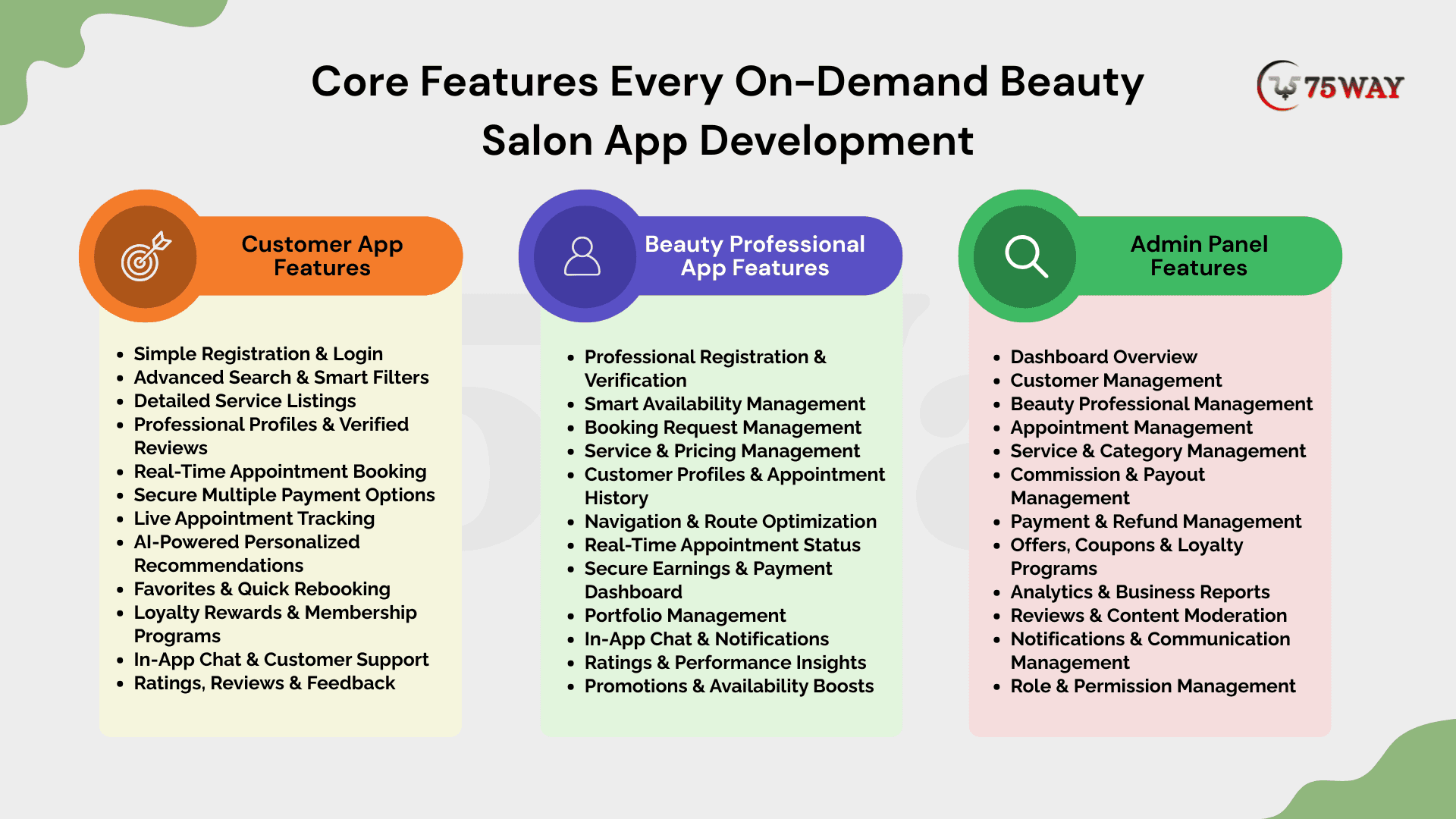
1) Customer App Features
- Simple Registration & Login: Make onboarding quick by allowing users to sign up using email, phone numbers, or social accounts. A smooth registration process reduces drop-offs and helps more visitors become active customers within minutes.
- Advanced Search & Smart Filters: Help users quickly find the right beauty service by filtering results based on service type, location, price, ratings, availability, and preferred beauty professional. Faster discovery often leads to faster booking decisions.
- Detailed Service Listings: Present every service with clear descriptions, pricing, duration, images, and preparation guidelines. Well-informed customers feel more confident booking appointments because they know exactly what to expect.
- Professional Profiles & Verified Reviews: Showcase beautician qualifications, certifications, work portfolios, customer ratings, and genuine reviews. Transparency builds trust and gives customers greater confidence before confirming a booking.
- Real-Time Appointment Booking: Allow customers to view live availability and reserve appointments instantly without making phone calls. Real-time scheduling reduces booking conflicts while making the entire process more convenient.
- Secure Multiple Payment Options: Support credit cards, debit cards, digital wallets, Apple Pay, Google Pay, and other trusted payment methods. Flexible payment choices reduce checkout abandonment and improve customer satisfaction.
- Live Appointment Tracking: Keep customers informed by showing booking confirmations, beautician arrival status, estimated arrival times, and service progress. Regular updates reduce uncertainty and improve the overall booking journey.
- AI-Powered Personalized Recommendations: Recommend beauty treatments, professionals, and packages based on previous bookings, preferences, seasonal trends, and purchase history. Personalized suggestions increase booking value while making every interaction feel more relevant.
- Favorites & Quick Rebooking: Allow users to save preferred beauticians, frequently booked services, and favorite salons. Returning customers can schedule appointments in seconds instead of repeating the entire booking process.
- Loyalty Rewards & Membership Programs: Encourage repeat bookings by offering reward points, referral bonuses, exclusive discounts, and membership benefits. Retaining existing customers is often more profitable than constantly acquiring new ones.
- In-App Chat & Customer Support: Give customers a simple way to communicate with beauty professionals or your support team before and after appointments. Quick assistance helps resolve questions faster and strengthens trust in your brand.
- Ratings, Reviews & Feedback: Encourage customers to share honest feedback after every appointment. Reviews help future users make informed decisions while giving your business valuable insights to improve service quality.
2) Beauty Professional App Features
Your beauty professionals are the backbone of your business. If managing appointments becomes frustrating or time-consuming, they will eventually move to another platform. Build an application that helps them accept more bookings, organize their schedules, communicate with clients, and monitor earnings without unnecessary administrative work.
- Professional Registration & Verification: Allow beauticians to register by submitting identity documents, certifications, licenses, and portfolios. A verified onboarding process increases customer confidence while maintaining service quality across your marketplace.
- Smart Availability Management: Give professionals complete control over their working hours, holidays, service locations, and break times. An updated calendar prevents double bookings and helps customers see only available appointment slots.
- Booking Request Management: Let beauticians review, accept, decline, or reschedule appointments directly from the application. Clear booking management keeps schedules organized and minimizes missed opportunities.
- Service & Pricing Management: Allow providers to add new beauty services, update pricing, create service packages, and adjust treatment durations whenever needed. This flexibility helps professionals respond to changing customer demand.
- Customer Profiles & Appointment History: Display previous bookings, preferred services, allergies, notes, and special requests before every appointment. Understanding customer preferences helps beauticians deliver more personalized services.
- Navigation & Route Optimization: For at-home beauty services, integrate GPS navigation to guide professionals to customer locations using the fastest available routes. Shorter travel times allow them to complete more appointments each day.
- Real-Time Appointment Status: Enable providers to update booking stages such as Accepted, On the Way, Service Started, and Completed. Keeping customers informed reduces unnecessary support requests and improves communication.
- Secure Earnings & Payment Dashboard: Give beauty professionals a dedicated dashboard to track completed bookings, commissions, payouts, incentives, bonuses, and payment history. Transparent financial records build trust and eliminate payment confusion.
- Portfolio Management: Allow beauticians to upload photos of their work, certifications, and customer transformations. A strong portfolio helps attract new clients and increases booking confidence.
- In-App Chat & Notifications: Enable direct communication with customers for appointment updates, preparation instructions, or special requests. Instant notifications also ensure providers never miss new booking opportunities.
- Ratings & Performance Insights: Display customer ratings, reviews, completed appointments, response time, and booking trends. These insights help professionals understand their strengths and identify areas for improvement.
- Promotions & Availability Boosts: Allow professionals to offer limited-time discounts, seasonal packages, or promotional deals during slower periods. This helps increase visibility, attract new customers, and maximize appointment bookings.
3) Admin Panel Features
While customers and beauty professionals interact with the application daily, the admin panel keeps the entire business running behind the scenes. It gives you complete visibility into bookings, payments, providers, customer activity, and overall business performance. A well-designed admin panel helps you make informed decisions without relying on spreadsheets or manual processes.
- Dashboard Overview: View key business metrics such as total bookings, active users, completed services, revenue, cancellations, and new registrations from one centralized dashboard. Instant visibility helps you monitor business performance at any time.
- Customer Management: Manage customer profiles, booking history, support requests, loyalty rewards, and account activity from one place. Having complete customer information makes it faster to resolve issues and improves overall service quality.
- Beauty Professional Management: Review applications, verify documents, approve registrations, suspend accounts when necessary, and monitor provider performance. Maintaining a trusted network of professionals protects your brand reputation.
- Appointment Management: Monitor every appointment in real time, track booking statuses, handle cancellations, and resolve scheduling conflicts before they affect customers or beauty professionals.
- Service & Category Management: Add new beauty services, update categories, modify pricing guidelines, and organize offerings based on changing market demand. Keeping your service catalog updated ensures customers always find relevant options.
- Commission & Payout Management: Configure commission structures, calculate provider earnings, process payouts, and generate financial reports automatically. Transparent payment management builds stronger relationships with service providers.
- Payment & Refund Management: Monitor all transactions, approve refunds, investigate failed payments, and maintain secure financial records. Proper payment controls reduce disputes and improve customer confidence.
- Offers, Coupons & Loyalty Programs: Launch promotional campaigns, create discount coupons, reward loyal customers, and introduce seasonal offers without requiring application updates. Flexible marketing tools help increase bookings throughout the year.
- Analytics & Business Reports: Track customer acquisition, repeat bookings, revenue trends, top-performing services, provider performance, and marketing results through detailed reports. These insights support smarter business decisions and future expansion plans.
- Reviews & Content Moderation: Monitor customer reviews, respond to complaints, remove inappropriate content, and identify recurring service issues before they affect your brand image.
- Notifications & Communication Management: Send booking confirmations, promotional announcements, service updates, reminders, and important alerts to customers and beauty professionals through a single communication center.
- Role & Permission Management: Assign different access levels to managers, customer support teams, finance staff, and operational administrators. Controlled access improves security while ensuring every team member sees only the information relevant to their responsibilities.
How AI Can Make Your On-Demand Beauty Service App Smarter?
A beauty service app becomes more intelligent when AI works behind the scenes to personalise experiences, automate operations, and improve service quality. The following AI-powered features show how businesses can deliver a smarter digital experience.
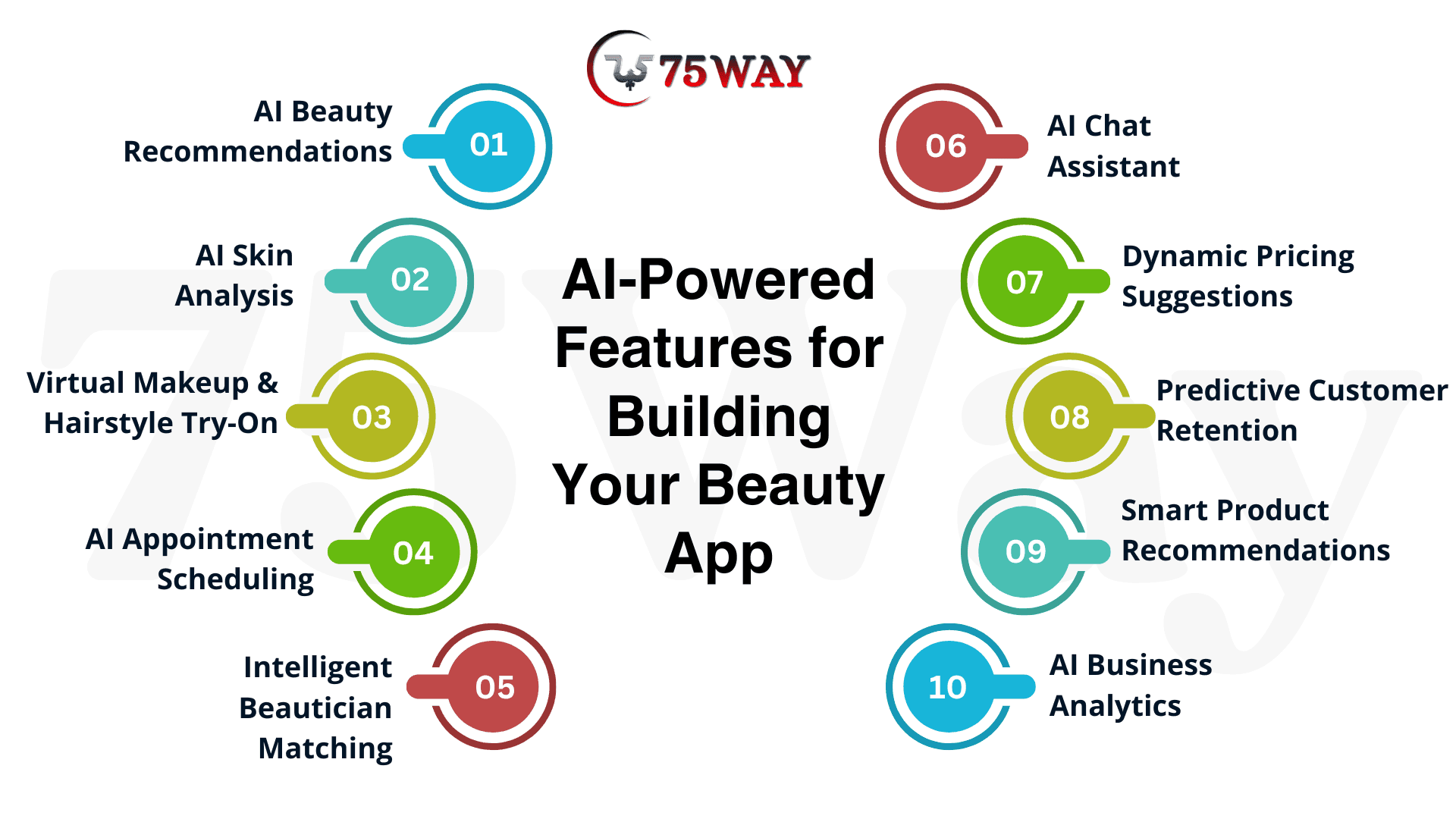
- AI Beauty Recommendations: Suggest treatments, beauty packages, and professionals based on customer preferences, booking history, skin concerns, and seasonal trends. Personalized recommendations encourage customers to explore additional services and increase average booking value.
- AI Skin Analysis: Allow users to upload a selfie so artificial intelligence can assess common skin concerns such as acne, dryness, pigmentation, or wrinkles. Based on the analysis, recommend suitable treatments and skincare services before customers book an appointment.
- Virtual Makeup & Hairstyle Try-On: Help customers visualize different makeup styles, hair colors, or hairstyles using augmented reality before making a booking. Seeing realistic results increases customer confidence and reduces decision hesitation.
- AI Appointment Scheduling: Automatically recommend the most suitable appointment slots based on customer preferences, beautician availability, travel time, and workload. Smart scheduling reduces conflicts while improving resource utilization.
- Intelligent Beautician Matching: Recommend the most suitable beauty professional by considering expertise, ratings, location, availability, language preferences, and previous customer feedback. Better matching often leads to higher satisfaction and repeat bookings.
- AI Chat Assistant: Provide instant answers to common questions about services, pricing, preparation guidelines, appointment changes, and booking status. A virtual assistant improves response times while reducing pressure on customer support teams.
- Dynamic Pricing Suggestions: Analyze demand, seasonal trends, appointment timings, and provider availability to recommend competitive pricing strategies. Businesses can maximize revenue during peak periods while attracting more bookings during slower hours.
- Predictive Customer Retention: Identify customers who have not booked recently and automatically trigger personalized offers, reminders, or loyalty rewards. Proactive engagement helps reduce customer churn and encourages repeat appointments.
- Smart Product Recommendations: Suggest skincare products, cosmetics, or beauty accessories that complement recently completed treatments. Combining services with product recommendations creates additional revenue opportunities.
- AI Business Analytics: Analyze booking trends, customer preferences, top-performing services, cancellation patterns, and provider performance to help business owners make better strategic decisions based on real data.
What’s On-Demand Beauty Service App Development Cost: Complete Pricing Breakdown
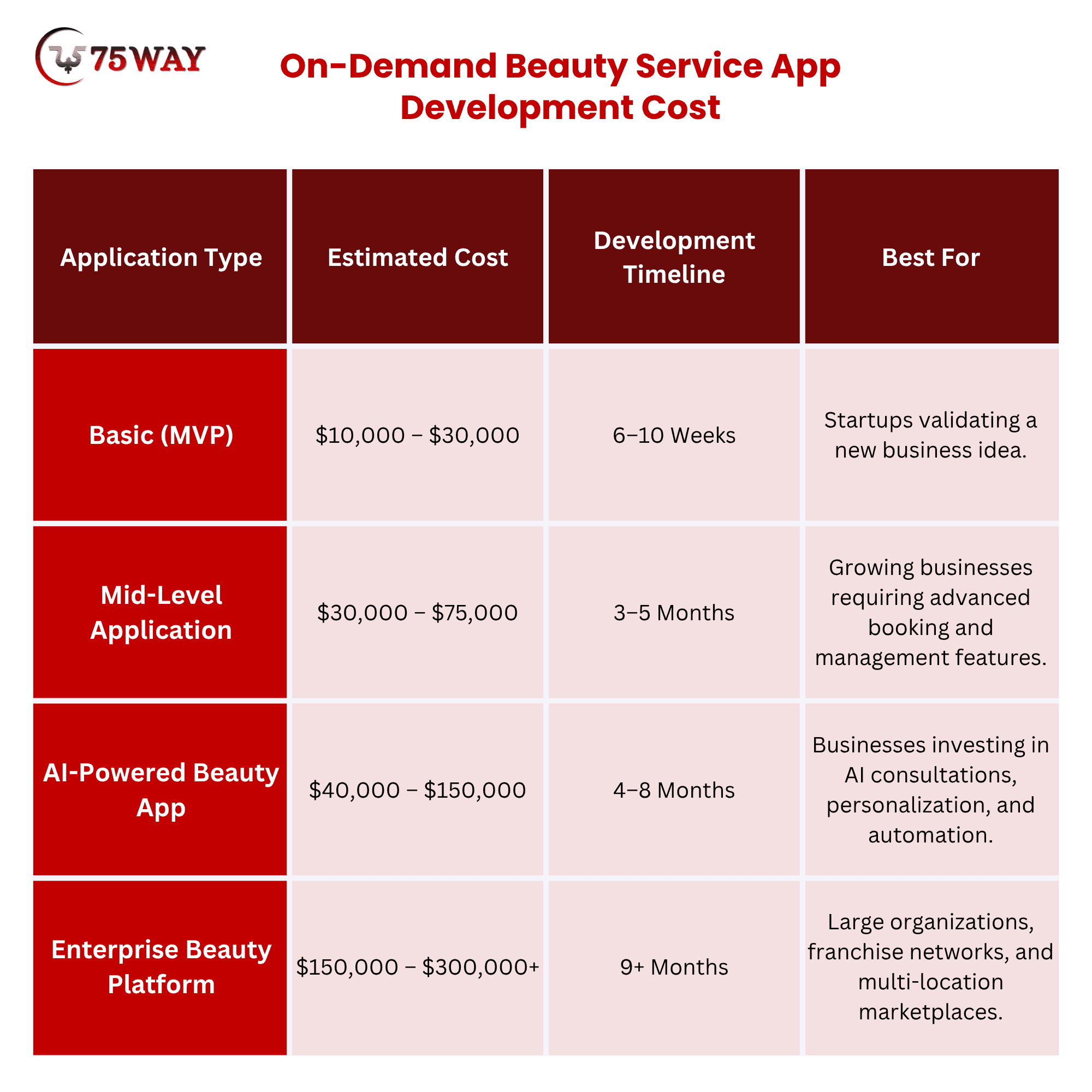
The overall cost depends on the complexity of your application and the features you plan to include. An average cost to create an on-demand beauty service app lies between $10,000-$300,000 or more, based on your project requirements, goals, features, and technologies.
Basic (MVP) Beauty App Development: If you are validating a new business idea, an MVP is the most practical starting point.
- Estimated Cost: $10,000-$30,000.
- Timeline: 6 to 10 weeks
Mid-Level Beauty App: Once your business begins growing, you may want features such as loyalty programs, memberships, provider dashboards, advanced reporting, and multiple payment methods.
- Estimated Cost: $30,000-$75,000
- Timeline: 3 to 5 months
AI-Powered Beauty App: Businesses looking to differentiate themselves through AI-powered skin analysis or intelligent appointment scheduling.
- Estimated Cost: $40,000-$150,000
- Timeline: 4 to 8 months
Enterprise Beauty Platform: Large salon chains, franchise businesses, and marketplace platforms that support thousands of users require enterprise beauty service apps.
- Estimated Cost: $150,000-$300,000+
- Timeline: 9-12+ months
Cost To Build On-Demand Beauty Sercives App by Development Stages
Rather than paying one fixed amount, your investment is distributed across several development stages. Each phase contributes to the quality, stability, and scalability of your final application.
- Market Research & Planning: $1,000 – $3,000
- Wireframes & UI/UX Design: $2,000 – $6,000
- Backend Development: $10,000 – $25,000
- Frontend Development: $8,000 – $22,000
- Third-Party Integrations: $2,000 – $8,000
- Quality Assurance & Testing: $3,000 – $8,000
- App Store Deployment: $1,000 – $3,000
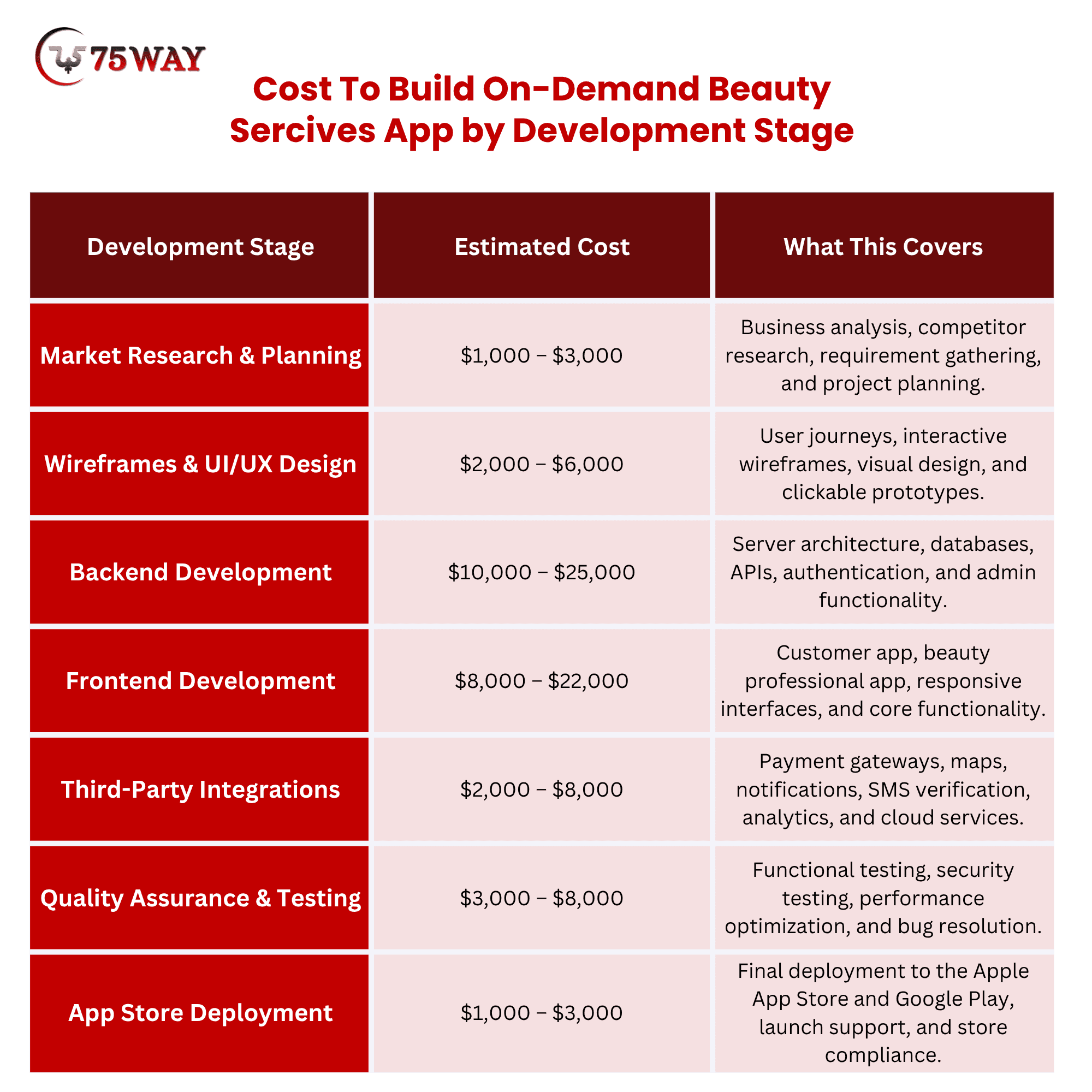
Although development represents the largest portion of your budget, investing in research, design, and testing often prevents costly changes after launch.
On-Demand Beauty Salon App Development Cost Based On Location
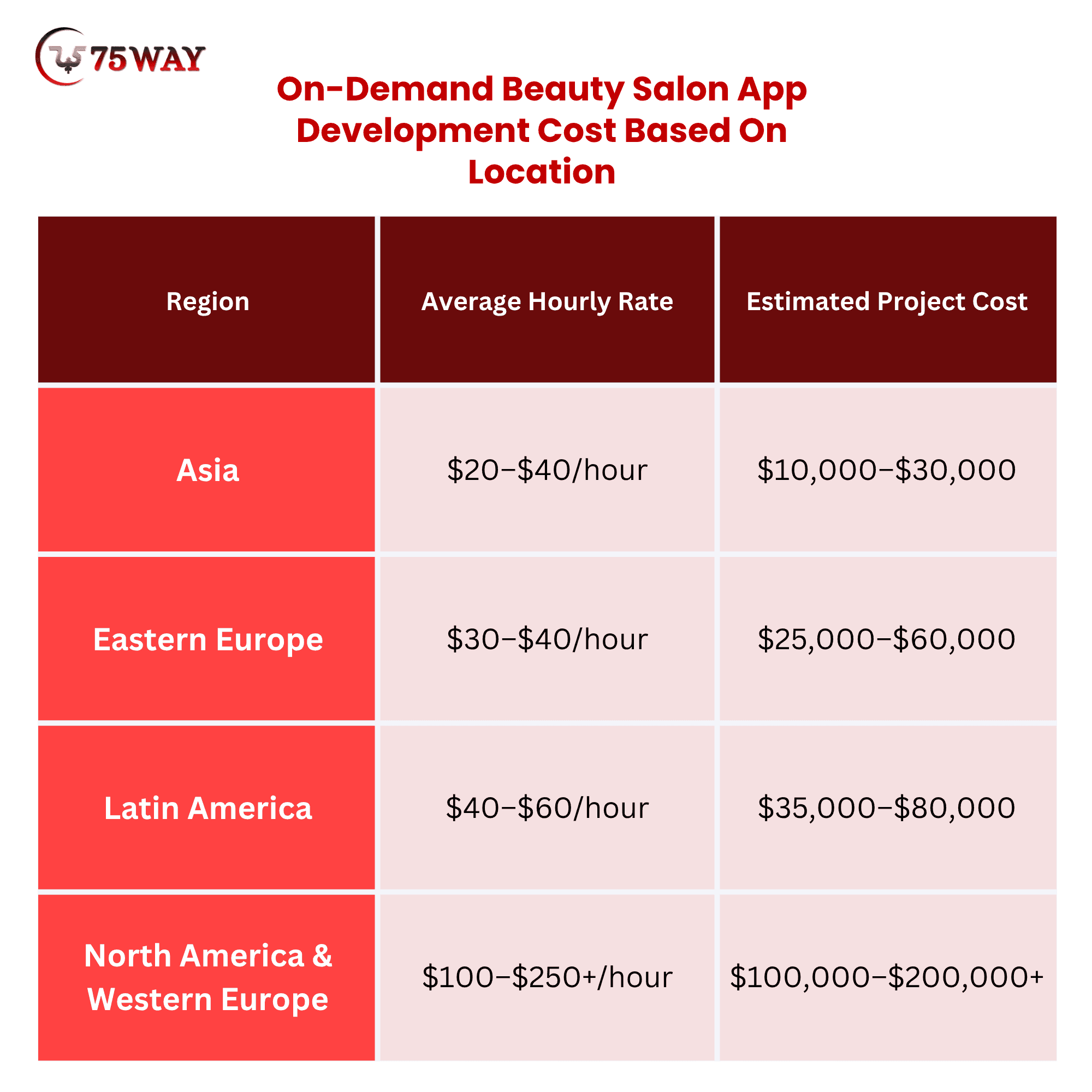
The location of your development partner has a significant impact on your overall budget. Hourly rates vary across regions because of differences in labor costs, market demand, and operating expenses. However, choosing the lowest hourly rate should never be your only priority.
- Asia: Development companies across Asia typically charge $20 to $40 per hour. This makes the region one of the most cost-effective choices for startups and growing businesses, with complete beauty app development projects generally ranging from $10,000 to $30,000.
- Eastern Europe: Development teams in Eastern Europe generally charge $30 to $40 per hour. Businesses benefit from strong technical expertise and competitive pricing, with most projects costing between $25,000 and $60,000.
- Latin America: Hourly rates usually range from $40 to $60, making this region attractive for North American companies seeking closer time-zone alignment. Most custom beauty applications cost between $35,000 and $80,000.
- North America & Western Europe: Companies in the United States, Canada, the United Kingdom, Germany, and other Western European countries generally charge $100 to $250+ per hour. As a result, feature-rich beauty platforms commonly require $100,000 to $200,000 or more, especially when extensive customization and enterprise integrations are involved.
What Factors Influence Beauty App Development Costs?
Even two beauty apps with similar features can have very different development costs. Your final investment depends on several technical and business decisions made throughout the project.
- Application Complexity: AI capabilities, AR virtual try-ons, multi-vendor support, and advanced analytics increase development effort.
- Platform Selection: Building for iOS, Android, or both platforms affects development time and budget.
- UI/UX Customization: Highly customized interfaces require more design and front-end development than template-based layouts.
- Third-Party Integrations: Payment gateways, maps, cloud storage, CRM systems, and AI services add implementation costs.
- Development Team Location: Regional hourly rates significantly influence the total project investment.
- Post-Launch Maintenance: Regular updates, feature enhancements, security patches, and technical support should be included in your long-term budget planning.
Tips To Reduce Cost of Building Beauty Services App
If you want to control development costs without compromising quality:
- Launch an MVP before investing in advanced functionality.
- Prioritize business-critical features for the first release.
- Use scalable technologies that support future expansion.
- Select an experienced development partner instead of choosing solely based on the lowest hourly rate.
- Improve the application through customer feedback rather than building every feature on day one.
Calculate Your On-Demand Beauty Service Application Development Cost
Every beauty app has different requirements, and the final investment depends on factors such as app type, features, platforms, integrations, and customization level. Use this calculator to get an approximate estimate based on your business requirements before starting development discussions.
Select Your App Type
- Single Salon App
- Multi-Vendor Beauty Marketplace
- At-Home Beauty Service App
- AI-Powered Beauty Platform
Choose Your Development Platform
- iOS App
- Android App
- iOS + Android App
Select Required Features
- User Registration & Profiles
- Appointment Booking
- Beauty Professional Dashboard
- Admin Panel
- Payment Integration
- Reviews & Ratings
- GPS Tracking
- Push Notifications
- AI Recommendations
- Virtual Beauty Consultation
- Loyalty Programs
Choose Your Design Level
- Basic UI Design
- Custom UI/UX Design
- Premium Interactive Design
Estimated Development Cost
Based on your selections, your estimated beauty app development cost will range between:
Estimated Cost = (Base App Type Cost + Selected Feature Cost + Platform Cost + Design Complexity Cost + AI/Advanced Technology Cost) × Development Location Factor
Cost Calculation Example
Example Requirement:
- App Type: At-Home Beauty Service Marketplace
- Platforms: iOS + Android
- Design: Custom UI/UX
- Features: Booking System + Payments + GPS Tracking + Reviews + Provider Dashboard
- AI Features: Not Included
- Development Location: Asia-Based Development Team
Calculation:
- Base Marketplace App Cost: $25,000
- iOS + Android Development: +$10,000
- Custom UI/UX Design: +$5,000
- Additional Features: +$15,000
Estimated Development Cost = $25,000 + $10,000 + $5,000 + $15,000
Final Estimate: $55,000
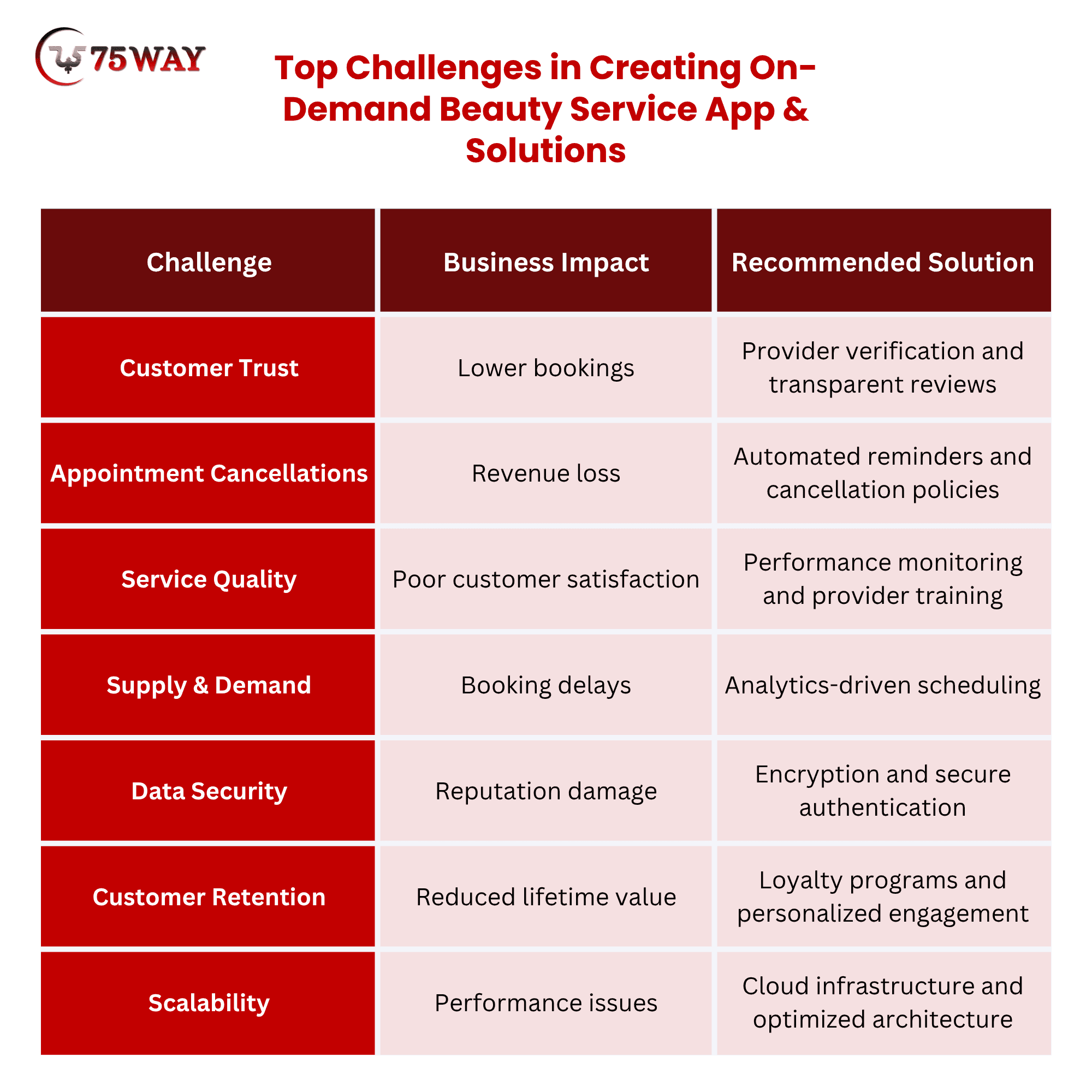
Top Challenges in Creating On-Demand Beauty Service App & How to Solve Them
Many beauty app ideas fail because businesses focus on adding more features instead of solving real operational challenges. From managing appointment cancellations to verifying beauty professionals, every obstacle directly affects customer satisfaction and long-term growth. Understanding these challenges before development begins helps you build a more reliable, scalable, and profitable beauty platform.
1. Building Customer Trust
Customers invite beauty professionals into their homes or trust them with personal grooming services. Without credibility, convincing first-time users to book through your application becomes difficult.
How to Solve It: Verify every beauty professional through identity checks, certifications, portfolios, and customer reviews. Display transparent pricing, secure payment options, and verified ratings to help customers book with confidence.
2. Managing Appointment Cancellations
Last-minute cancellations create scheduling gaps, reduce revenue, and frustrate both customers and beauty professionals. Frequent cancellations can also lower customer confidence in your service.
How to Solve It: Introduce cancellation policies, automated reminders, advance deposits, waitlists, and easy rescheduling options to reduce missed appointments while improving booking reliability.
3. Maintaining Service Quality
As your business expands, delivering a consistent customer experience across multiple beauty professionals becomes increasingly challenging.
How to Solve It: Monitor customer ratings, review feedback regularly, verify professional qualifications, and provide ongoing training to maintain consistent service standards.
4. Balancing Supply and Demand
Having too many customers without enough beauty professionals leads to long waiting times, while too many providers without enough bookings reduces engagement.
How to Solve It: Use booking analytics, demand forecasting, dynamic scheduling, and targeted provider onboarding to maintain a healthy balance between customer demand and service availability.
5. Protecting Customer Data
Beauty applications collect personal information, payment details, addresses, and booking history. Any security breach can damage customer trust and business reputation.
How to Solve It: Implement encrypted data storage, secure payment gateways, multi-factor authentication, regular security audits, and role-based access controls to safeguard sensitive information.
6. Retaining Customers After Their First Booking
Acquiring new users is often more expensive than retaining existing ones. Without a retention strategy, many customers book once and never return.
How to Solve It: Encourage repeat bookings through loyalty programs, personalized recommendations, referral rewards, membership plans, and timely appointment reminders.
7. Scaling Without Performance Issues
As bookings increase, your application must continue delivering fast response times without affecting reliability or user satisfaction.
How to Solve It: Build your application using scalable cloud infrastructure, optimize databases, monitor server performance, and design the architecture to support future growth from the beginning.
Best Technology Stack You Can Use To Craft Beauty Services App
The difference between a basic beauty booking app and a platform users trust often comes down to the technology powering it. The right stack supports everything from seamless user interactions to reliable backend operations as the platform grows.
Frontend Technologies
Frontend technologies are responsible for creating the visual interface users interact with, including booking screens, profiles, service listings, payments, and dashboards. The right frontend framework ensures fast performance and a consistent experience across mobile devices.
- Flutter: Develops cross-platform mobile applications using a single codebase, reducing development time and maintenance costs.
- React Native: Builds scalable Android and iOS applications with reusable components and faster updates.
- Swift: Creates high-performance native iOS applications with optimized device functionality.
- Kotlin: Supports secure and reliable Android application development with modern programming capabilities.
Backend Technologies
Backend technologies manage the core functionality of your beauty app, including user accounts, appointment scheduling, payments, notifications, databases, and business operations. A strong backend ensures your application remains stable as user demand increases.
- Node.js: Supports fast and scalable backend development with real-time application capabilities.
- Python: Enables AI integration, automation, analytics, and flexible backend development.
- Java: Provides reliable performance for enterprise-level applications with complex requirements.
- .NET: Offers secure and scalable backend solutions for business applications.
Database Technologies
Databases store and organize important information such as customer profiles, appointment history, payment records, service details, and provider availability. Choosing the right database improves data management and application performance.
- PostgreSQL: Manages structured business data with reliability and strong security features.
- MySQL: Provides a proven database solution for scalable application development.
- MongoDB: Handles flexible data structures for rapidly changing application requirements.
- Firebase Firestore: Enables real-time data synchronization for mobile applications.
Third-Party Integrations
Third-party integrations add essential functionality without building every service from scratch. They help improve payments, communication, location tracking, and customer engagement.
- Stripe / PayPal: Enables secure online payment processing.
- Google Maps: Supports location tracking, navigation, and service discovery.
- Firebase Cloud Messaging: Delivers push notifications for bookings and updates.
- Twilio: Provides SMS verification and communication features.
- SendGrid: Manages transactional and marketing email communication.
AI and Machine Learning Technologies
Artificial intelligence helps beauty businesses deliver personalized experiences, automate operations, and improve decision-making. AI features can be introduced based on business goals and customer requirements.
- OpenAI Models: Powers AI assistants, customer support, and personalized recommendations.
- TensorFlow: Supports machine learning models for analytics and prediction.
- Computer Vision: Enables AI skin analysis and image-based beauty assessments.
- Recommendation Engines: Suggests services, products, and professionals based on user behavior.
Cloud and DevOps Infrastructure
A reliable cloud and DevOps setup helps your beauty application maintain speed, security, and availability as the number of users and bookings increases.
- AWS: Provides scalable cloud hosting with secure infrastructure and global availability.
- Microsoft Azure: Offers enterprise cloud services with advanced security and AI capabilities.
- Google Cloud Platform: Delivers high-performance cloud computing with analytics and AI support.
- Docker: Simplifies application deployment across different environments.
- Kubernetes: Automates application scaling, deployment, and workload management.
Latest Trends Shaping On-Demand Beauty Service Apps in 2026
Remember when booking a beauty appointment meant calling a salon, waiting for confirmation, and adjusting your schedule around availability? That experience is quickly changing as on-demand beauty apps bring faster bookings, personalised services, and more convenience to customers in 2026. The trends below show what is shaping the next phase of digital beauty services.
- AI-Powered Recommendations: Uses customer preferences, booking history, and beauty needs to suggest personalized services and treatments.
- Virtual Beauty Consultations: Allows customers to connect with beauty experts remotely before selecting suitable treatments or services.
- AR Virtual Try-On: Helps users preview hairstyles, makeup looks, and beauty products before making decisions.
- At-Home Beauty Services: Enables customers to book professional beauty treatments conveniently at their preferred location.
- Subscription-Based Services: Creates recurring revenue through monthly plans, memberships, and exclusive customer benefits.
- AI Chatbots: Provides instant support for bookings, service queries, appointment changes, and customer assistance.
- Data-Driven Analytics: Helps businesses understand customer behavior, booking trends, and operational performance.
- Sustainable Beauty Solutions: Supports eco-friendly services, digital processes, and environmentally conscious customer choices.
- Voice-Based Booking: Allows users to search services and schedule appointments through voice commands.
- Personalized Loyalty Programs: Improves customer retention through customized rewards, offers, and engagement strategies.
Why 75way Is Better Choice To Build On-Demand Beauty Service Application?
"When a business approaches us with a beauty app idea, the first thing we discuss is not technology. We ask about the customers they want to serve, the services they want to offer, and the challenges they want to solve," explains our app development team at 75way Technologies.
We believe a successful beauty application starts with understanding the business behind it. Our team has worked on platforms where customers, beauty professionals, and administrators require completely different experiences, so we focus on creating solutions that work for all user types.
"One of the biggest mistakes we see businesses make is building too many features before understanding what customers actually need," our experts add. We help companies start with the right foundation and gradually introduce features such as AI recommendations, automated bookings, analytics, and personalized experiences as the platform grows.
For example, we helped a beauty service business streamline appointment management and improve customer engagement through a customized digital platform. With experience across planning, design, development, and optimization, we help businesses build beauty apps that are practical, scalable, and ready for real-world users.
Conclusion
To wrap up, developing an on-demand beauty service app requires more than just adding booking features. From choosing the right business model and understanding users to planning features, selecting technologies, estimating costs, and preparing for future trends, every decision impacts your app’s success. A well-planned beauty platform can help businesses improve customer experiences, support professionals, and create new opportunities in the growing beauty market. If you are ready to turn your idea into a scalable solution, connect with a trusted AI-powered app development agency to build your beauty app with the right strategy and technology.
Frequently Asked Questions (FAQs)
How Can Beauty Apps Help Increase Salon Revenue?
Beauty apps create additional booking channels, improve customer retention, and promote repeat services. They also help businesses analyze customer behavior to make better decisions.
Should A Beauty App Focus On One Service Category Or Multiple Services?
The choice depends on your business goals, market demand, and available providers. Starting with a focused category can help validate demand before expanding services.
How Can Businesses Ensure Customers Trust Beauty Professionals On The Platform?
Businesses can build trust through professional verification, customer reviews, service history, transparent pricing, and secure communication features. These elements encourage users to book confidently.
Can A Beauty App Expand Into Other Wellness Services Later?
Yes, a scalable beauty platform can later include wellness treatments, skincare services, fitness offerings, or beauty products. Flexible planning makes future expansion easier.
How Can Businesses Measure The Success of Their Beauty App?
Success can be measured through bookings, customer retention, provider activity, revenue growth, app engagement, and user satisfaction. These metrics show whether the platform is creating real business value.
How Can Beauty Apps Attract New Customers After Launch?
Beauty apps can attract users through referral programs, partnerships, social media campaigns, and targeted promotions. Consistent engagement strategies help build awareness and encourage first-time bookings.