Summary
AI agent development involves building intelligent systems powered by large language models that can reason, plan, use tools, and execute tasks autonomously. This guide explains core components, architecture, frameworks, and real-world applications. It also covers benefits, challenges, and the step-by-step creation process, helping beginners understand how AI agents transform automation and business workflows.
Quick Overview
- AI agent development costs range from $10,000 to $400,000+, depending on complexity.
- AI agents combine models, memory, tools, and planning for autonomy.
- Businesses use AI agents to automate workflows and boost productivity.
- Multi-agent systems improve scalability, accuracy, and task execution efficiency.
- Strong architecture and optimization ensure reliable and scalable AI agents.
Artificial Intelligence has rapidly evolved from simple rule-based automation systems into highly intelligent, decision-making digital entities capable of performing complex tasks with minimal human intervention. One of the most transformative advancements in this space is AI agent development solutions.
AI agents are not just chatbots or static automation scripts. They are dynamic systems powered by large language models, capable of reasoning, planning, using tools, and executing multi-step tasks autonomously. Businesses, startups, and enterprises are increasingly adopting agentic AI systems to streamline operations, improve productivity, and unlock new levels of automation.
This beginner’s guide will break down everything you need to know about AI agent development, including how they work, core components, architecture, frameworks, real-world applications, and how they are built step by step.
What is AI Agent?
An AI agent is a software system that can perceive its environment, process information, make decisions, and take actions to achieve a specific goal. At the core, AI agents combine large language models (LLMs) with reasoning capabilities and external tool integrations. Unlike traditional software programs that follow fixed instructions, AI agents are goal-driven and adaptive. They can:
- Interpret user instructions in natural language
- Break down complex tasks into smaller steps
- Use external tools and APIs
- Learn from context and previous interactions
- Execute workflows autonomously
What Is AI Agent Development?
AI agent development is the process of designing, building, training, and deploying intelligent autonomous systems that can perform tasks with minimal human supervision. These artificial intelligence systems are built using advanced technologies like large language models, which allow them to interpret natural language, reason through problems, and respond in a meaningful way. Unlike traditional software, AI agents are designed to behave more like autonomous digital assistants capable of adapting to different situations.
It involves combining several core components, such as agent architecture design, memory systems, tool integration through APIs, and reasoning or planning modules. AI agent developers also create orchestration workflows that control how the agent performs tasks step by step, along with testing and optimization to improve accuracy and performance. In simple terms, AI agent development is about building smart systems that can think, plan, and execute actions like an intelligent assistant.
How Do AI Agents Work?
AI agents operate through a structured loop that combines understanding, reasoning, execution, and continuous improvement to complete tasks autonomously with minimal human intervention and dynamic decision-making capability.
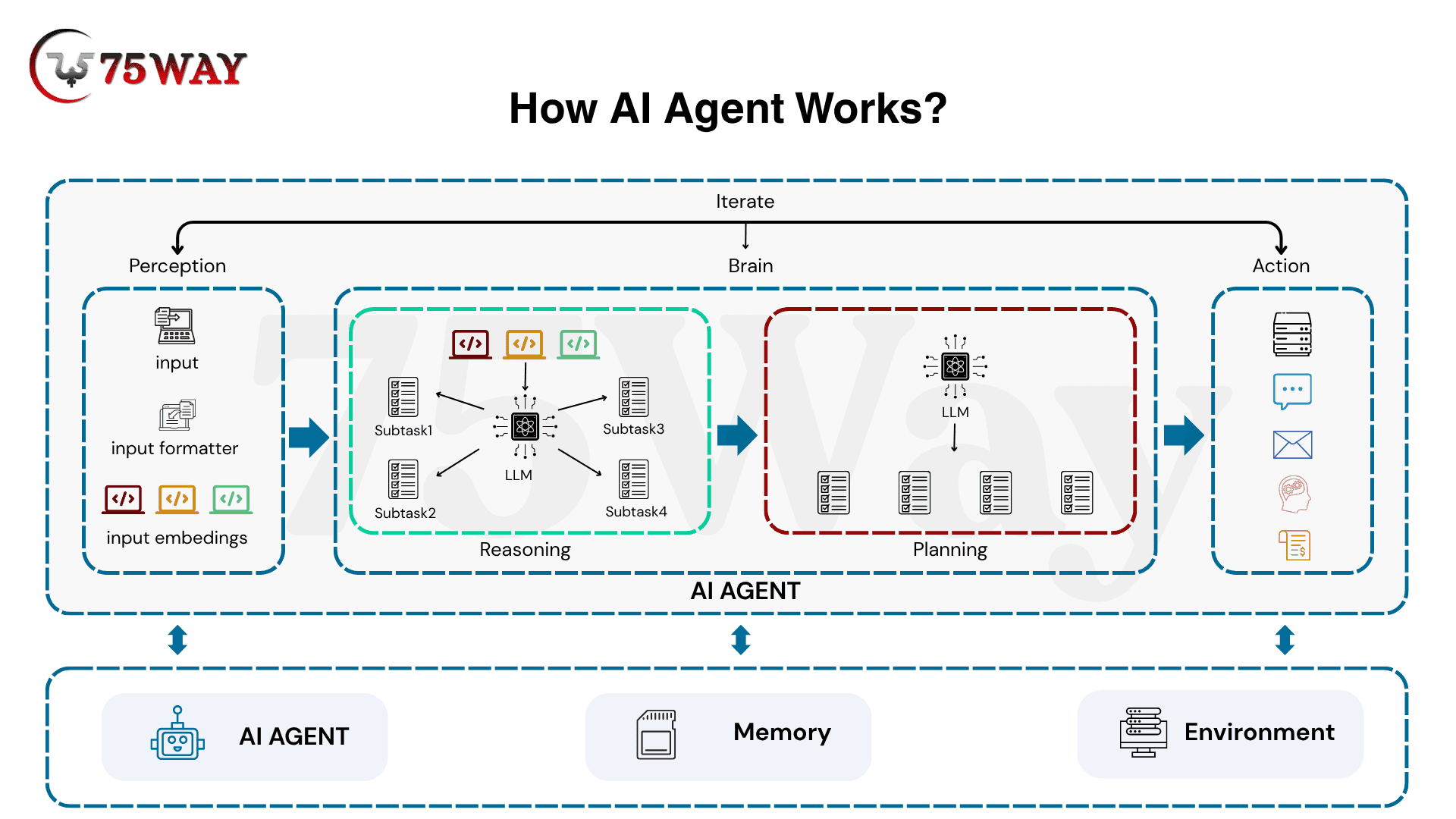
AI agents operate through a structured loop
1. Input Understanding: The agent receives a prompt or task such as: “Analyze customer feedback and generate insights.”
2. Reasoning and Planning: Then, it analyzes the goal and converts it into smaller, actionable stages for better accuracy and execution. The AI model breaks the task into steps:
- Collect data
- Process feedback
- Identify patterns
- Summarize insights
3. Tool Usage: The agent may use external tools:
- Databases
- APIs
- Web search systems
- Code execution environments
4. Execution: Each step is executed sequentially or in parallel, depending on the architecture. This ensures efficient task handling, allowing the AI agent to complete complex workflows faster while maintaining accuracy, consistency, and proper coordination between all processes.
5. Memory and Feedback: The agent stores context and improves responses based on prior interactions. This enables continuous learning, better personalization, and more accurate decision-making by using past experiences to refine future outputs and enhance overall performance over time.
This loop enables autonomous behavior and continuous task execution.
Core Components of AI Agent Development
The process to build AI agents from scratch depends on interconnected components enabling reasoning, planning, memory, and tool integration for autonomous intelligent decision-making systems.
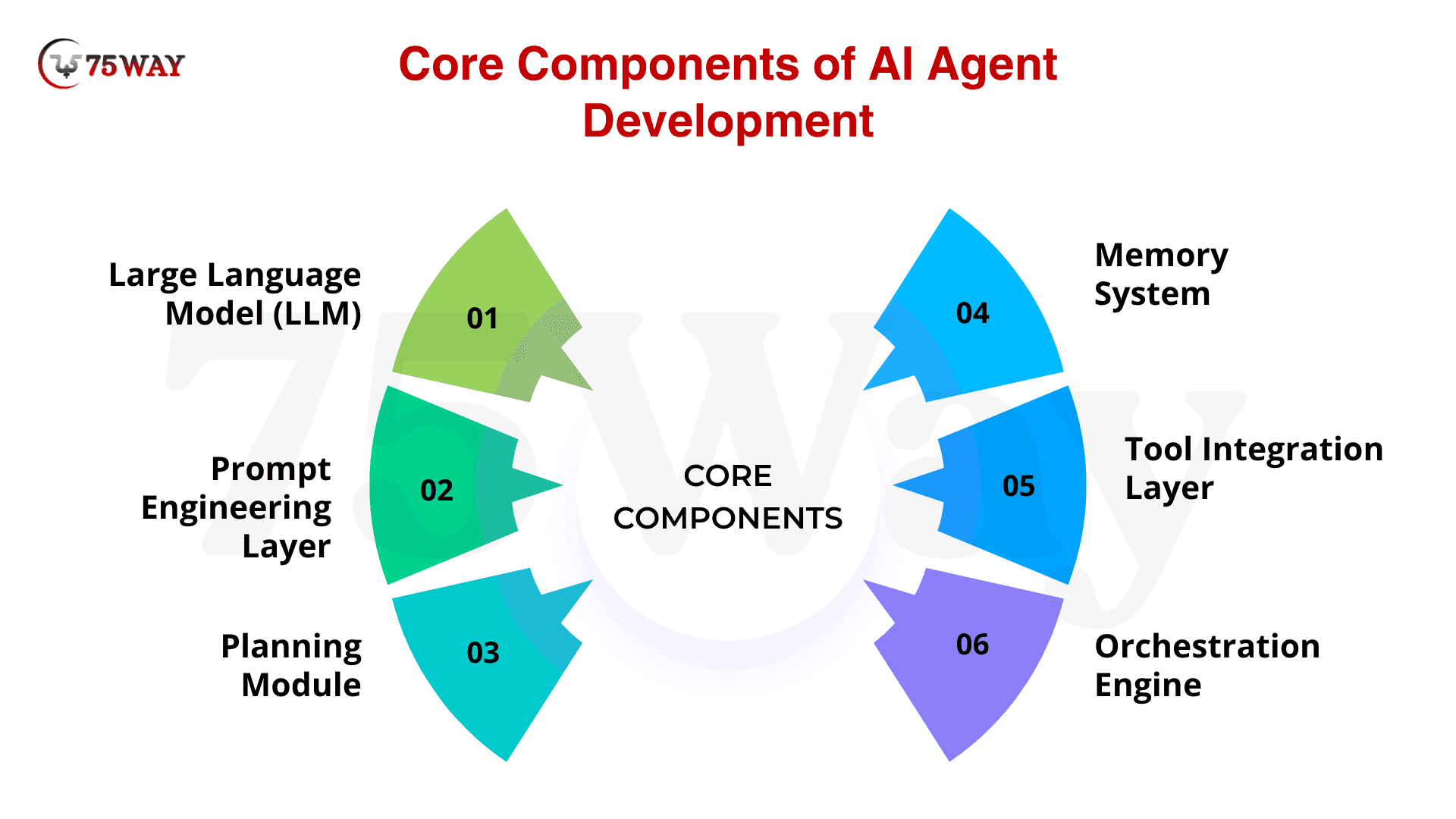
- Large Language Model (LLM)
The LLM acts as the brain of the agent, enabling reasoning, language understanding, contextual awareness, and intelligent decision-making capabilities. Popular models include transformer-based architectures capable of:
- Natural language understanding
- Code generation
- Context retention
- Instruction following
- Prompt Engineering Layer
Prompt engineering defines structured instructions that guide AI agents to produce accurate, reliable, and context-aware responses consistently. Well-designed prompts help:
- Improve reasoning accuracy
- Reduce hallucinations
- Guide step-by-step thinking
- Control output format
- Planning Module
The planning module helps AI agents decompose complex tasks into smaller, structured steps for efficient and logical execution. For example: Task: “Launch a marketing report.”
- Collect data
- Analyze engagement metrics
- Compare trends
- Generate a summary report
- Memory System
Memory enables AI agents to store, retrieve, and reuse contextual information for better personalization and improved decision-making over time. There are two main types:
- Short-Term Memory: Maintains context within a session.
- Long-Term Memory: Stores information across sessions using vector databases or storage systems.
- Tool Integration Layer
Tool integration allows AI agents to connect with external systems such as APIs, databases, and applications for real-world task execution. Common integrations include:
- APIs (payment systems, CRMs, analytics tools)
- Web search engines
- Databases
- File systems
- Code execution environments
- Orchestration Engine
The orchestration engine coordinates workflows, managing task execution order, tool usage, error handling, and output combination efficiently.It decides:
- Which step runs next
- When to call tools
- How to handle errors
- How to combine outputs
This is the control system of the AI agent.
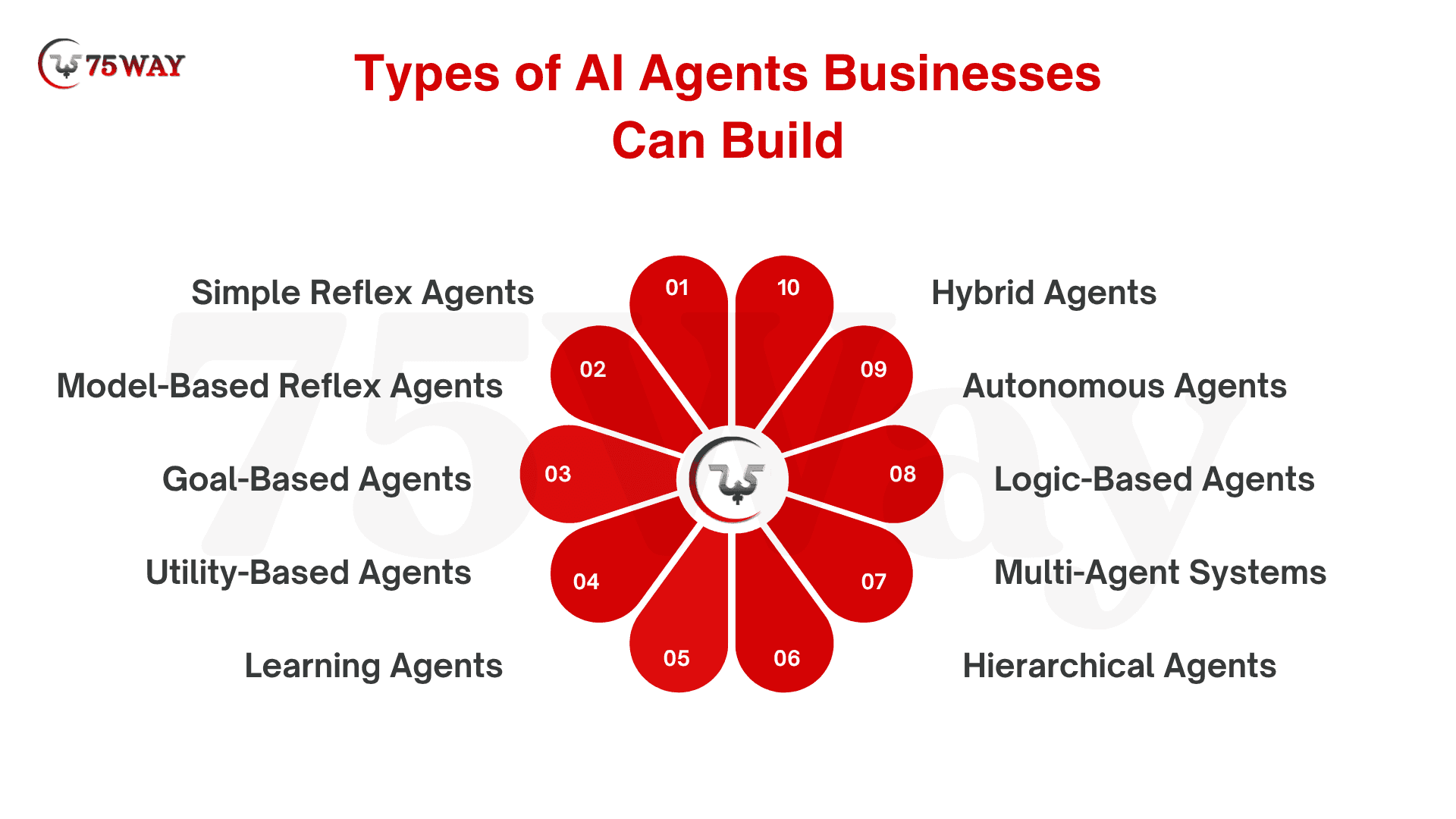
Types of AI Agents Businesses Can Build
AI agents come in different types based on intelligence, reasoning ability, and decision-making complexity. Each type serves specific business needs ranging from basic automation to advanced autonomous systems capable of learning, planning, and collaborating across complex digital environments.
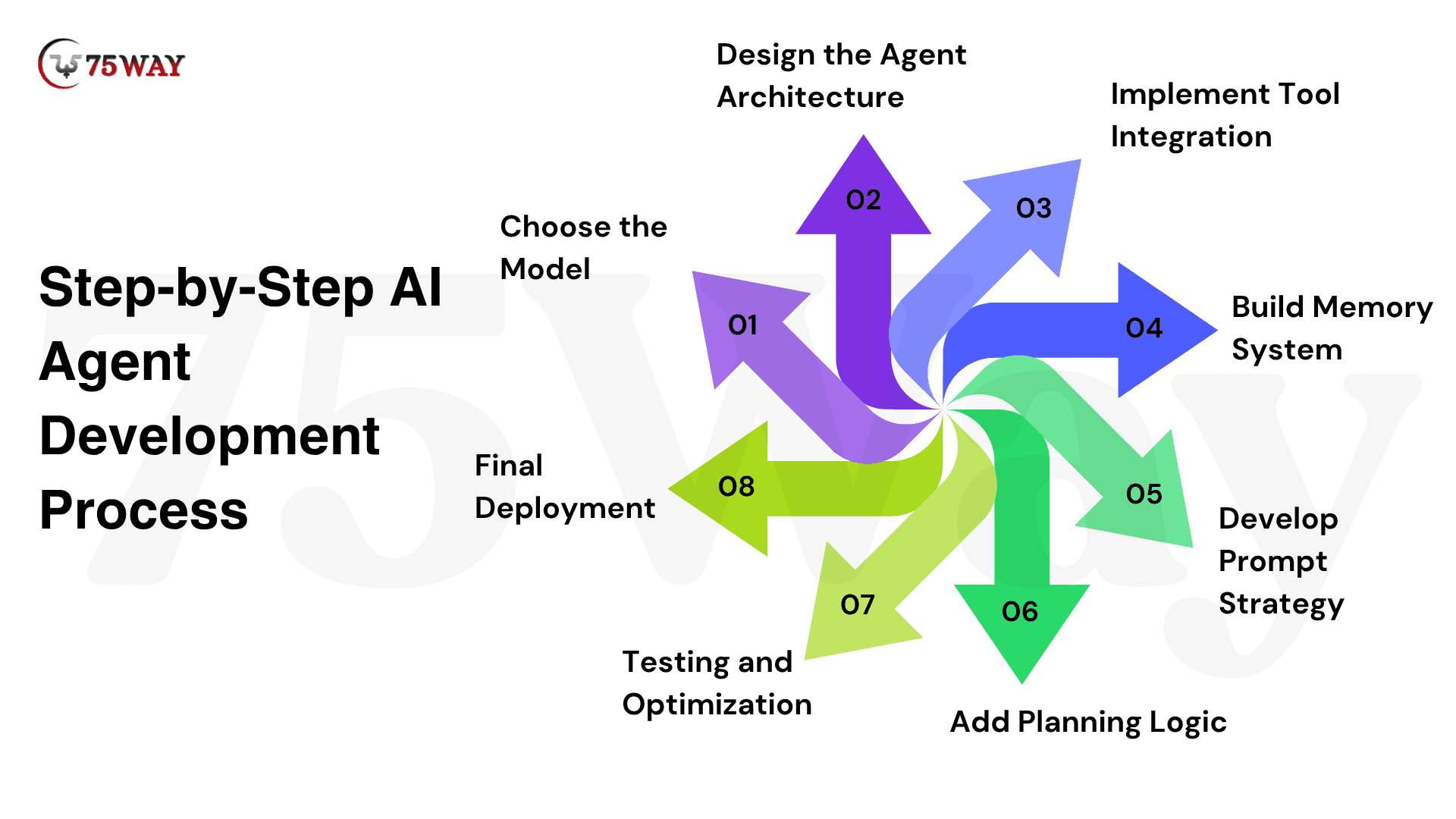
Step 1: Choose the Model
The AI agent development process begins with choosing the model because this decision sets the intelligence level for every next stage. Once the model is selected, it directly influences how the architecture will be designed to support its reasoning capacity and limitations.
After that, the same model determines what kind of tool integrations will be possible and how effectively external systems can be used. This choice also impacts how memory systems are structured to support contextual understanding. As the process continues, prompt strategy, planning logic, testing approach, and final deployment all depend on this initial model selection.
Step 2: Design the Agent Architecture
After selecting the model, the next step naturally becomes designing the agent architecture to organize how all components will work together. This architecture is shaped by the model’s capabilities, which determine how reasoning, memory, and tools will interact within the system.
Once the structure is defined, it directly guides how tool integrations will be implemented without breaking system flow. It also influences how memory is stored and accessed across workflows. As development progresses, this architecture becomes the backbone for prompt design, planning logic, testing structure, and final deployment consistency.
Step 3: Implement Tool Integration
Once the architecture is defined, tool integration is implemented to extend the model’s capabilities beyond text-based reasoning. This step connects external APIs and systems based on architectural rules to ensure smooth communication between components. After tools are integrated, they immediately enhance how memory systems store and retrieve real-time data.
This integration also supports a prompt strategy by enabling more actionable instructions. As the system evolves, planning logic depends heavily on these tools for execution, while testing ensures they function correctly before final deployment.
Step 4: Build Memory System
Following tool integration, the memory system is built to ensure the AI agent can retain and retrieve contextual information effectively. This memory design depends on both the model and available tools to store structured data.
Once memory is in place, it improves how prompts are interpreted by adding past context into reasoning. It also strengthens planning logic by enabling better decision-making based on history. During testing, memory consistency is validated, and in deployment, it ensures continuous learning and improved performance over time.
Step 5: Develop Prompt Strategy
After establishing memory, the prompt strategy is developed to control how the model communicates and processes instructions. This strategy uses stored memory and available tools to create structured, context-aware prompts. Once prompts are refined, they directly improve planning logic by guiding step-by-step execution more clearly.
This also ensures that tool integrations are triggered correctly during workflows. During testing, prompt behavior is evaluated for accuracy, and during deployment, it ensures consistent and reliable output generation across all user interactions.
Step 6: Add Planning Logic
With prompts defined, planning logic is introduced to structure how tasks are broken down and executed sequentially. This logic relies on memory for context and tools for execution, ensuring every step follows a structured path.
Once planning is active, it improves execution engine behavior by providing clear workflows. It also refines how prompts are interpreted in real scenarios. During testing, planning accuracy is verified, and during deployment, it ensures the agent consistently handles complex multi-step tasks without breaking workflow continuity.
Step 7: Testing and Optimization
After planning logic is implemented, testing and optimization begin to validate how all components work together in real conditions. This stage evaluates model behavior, architecture flow, tool execution, memory retrieval, and planning accuracy in a connected environment.
When issues are identified, prompts, tools, and logic are refined to improve system flow. This process directly strengthens deployment readiness by ensuring all parts work as one system. Continuous optimization ensures the agent becomes more stable, accurate, and efficient over time.
Step 8: Final Deployment
Once testing and optimization are complete, final deployment is carried out to launch the fully integrated AI agent system. This step depends on all previous stages working correctly, from model selection to planning logic. After deployment, the system operates in real-time environments using connected tools, memory, and reasoning modules.
Monitoring continues to track performance and identify improvements. As usage grows, updates are applied to maintain stability, ensuring the entire AI agent workflow remains consistent, scalable, and production-ready.
- Simple Reflex Agents: Simple reflex agents respond directly to inputs using predefined rules without memory or learning capability. They operate instantly based on current conditions, making them highly efficient but limited in adaptability, reasoning, and contextual understanding across dynamic environments. Best applied in rule-driven chatbots, instant alert mechanisms, and basic automation workflows.
- Model-Based Reflex Agents: Model-based reflex agents maintain an internal model of the environment, allowing them to handle situations where full information is not available. They use stored context to improve decision-making and respond more intelligently than simple reflex systems while still following structured rules. They are suitable for context-aware assistants, smart monitoring systems, and IoT-driven automation setups.
- Goal-Based Agents: Goal-based agents make decisions by evaluating different possible actions and selecting the one that helps achieve a defined objective. They rely on planning and search strategies to determine optimal paths, making them more flexible and strategic in execution. They are effective in task planning engines, workflow orchestration tools, and navigation-based applications.
- Utility-Based Agents: Utility-based agents evaluate multiple outcomes using a scoring system and choose the action that provides the highest overall benefit. They are designed to handle uncertainty by balancing trade-offs between different possibilities, ensuring optimal decision-making. These AI agents are commonly used in recommendation engines, pricing optimization models, and intelligent decision-support systems.
- Learning Agents: Learning agents improve their performance over time by analyzing feedback, patterns, and historical data. They continuously adapt to changing environments, refine predictions, and enhance decision-making accuracy through machine learning techniques and experience-based updates. They are widely applied in personalization engines, fraud detection systems, and predictive analytics platforms.
- Hierarchical Agents: Hierarchical agents operate in structured layers where high-level agents delegate tasks to lower-level agents for execution. This layered design improves scalability, coordination, and efficiency in managing complex workflows by breaking them into smaller, manageable components. Commonly implemented in enterprise automation systems, large-scale project coordination, and structured operational frameworks.
- Multi-Agent Systems: Multi-agent systems consist of multiple AI agents working together, each assigned specialized roles to achieve a common goal. These agents communicate, collaborate, and coordinate actions to solve complex problems more efficiently than a single-agent system. Frequently used in distributed AI environments, collaborative automation platforms, and simulation-based systems.
- Logic-Based Agents: Logic-based agents use formal logic and reasoning rules to make decisions based on structured knowledge representation. They rely on symbolic reasoning rather than statistical learning, ensuring precise and explainable outcomes in rule-driven environments. These agents are applied in expert systems, compliance automation, and rule-based decision engines.
- Autonomous Agents: Autonomous agents operate independently with minimal human intervention, capable of perceiving environments, making decisions, and executing actions on their own. They combine reasoning, planning, and tool usage to complete complex tasks end-to-end without constant supervision. These agents are used in self-operating systems, intelligent assistants, and fully automated digital workflows.
- Hybrid Agents: Hybrid agents combine multiple AI approaches, such as rule-based systems, machine learning models, and planning algorithms, to deliver more robust and flexible performance. They balance structured logic with adaptive intelligence, making them suitable for dynamic and complex environments. These agents are common in advanced enterprise systems, robotics applications, and intelligent automation platforms.
AI Agent Architecture: Complete System Overview
AI agent architecture is a structured system combining LLMs, memory, planning modules, tool integrations, and orchestration layers to enable autonomous decision-making, task execution, and adaptive intelligent workflow automation across applications. A typical AI agent architecture includes:
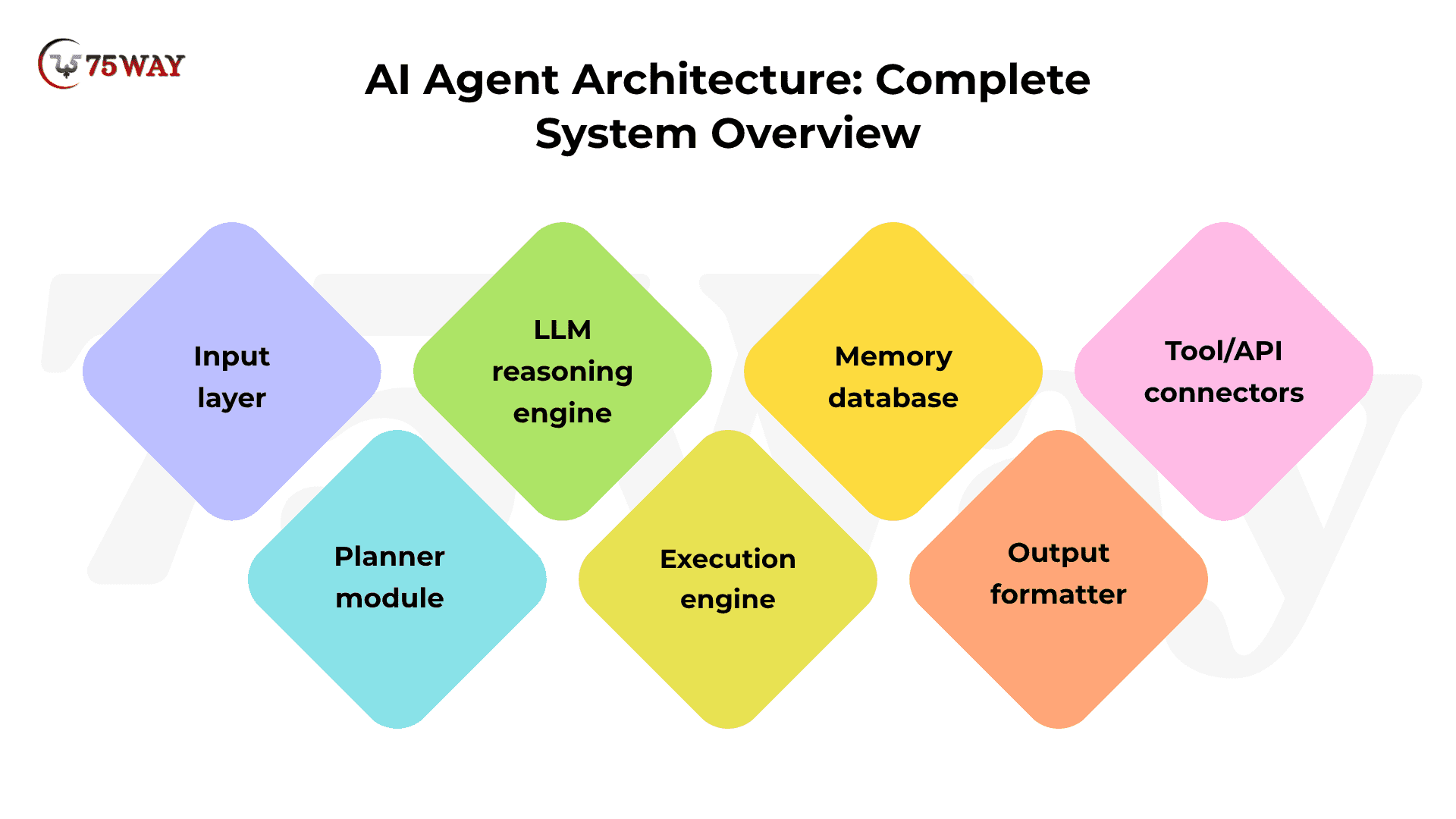
- Input Layer: Receives user prompts, events, or system triggers and converts them into structured inputs for processing. It initiates the AI agent workflow and defines the task scope clearly.
- LLM Reasoning Engine: Processes inputs using large language model capabilities to understand intent, generate reasoning steps, and produce intelligent responses. It acts as the core cognitive component of the AI agent system.
- Memory Database: Stores short-term and long-term contextual information, enabling agents to remember past interactions, retrieve relevant data, and maintain continuity across sessions for improved personalization and decision accuracy.
- Tool/API Connectors: Integrate external systems like databases, APIs, and third-party services, allowing the AI agent to fetch data, perform actions, and extend functionality beyond language model limitations effectively.
- Planner Module: Breaks complex tasks into smaller logical steps, defines execution strategies, and prioritizes actions to ensure structured problem-solving and efficient completion of multi-step workflows.
- Execution Engine: Carries out planned tasks by coordinating tools, APIs, and reasoning outputs, ensuring each step is executed correctly while managing dependencies, errors, and real-time adjustments.
- Output Formatter: Converts raw AI-generated results into structured, readable, and user-friendly outputs, ensuring responses are clear, consistent, and suitable for applications, reports, or user interactions.
Step-by-Step AI Agent Development Process
AI agent development follows a structured workflow involving requirement definition, model selection, system design, AI tool integration, memory implementation, planning logic, testing, and deployment. Each stage ensures the creation of scalable, intelligent, and autonomous systems capable of executing complex tasks with accuracy and efficiency.
AI Agent Market Overview: Size, Revenue, & Growth Insights
The AI agent market is experiencing explosive expansion driven by enterprise automation, advanced NLP, and increasing adoption of autonomous workflows across industries. The AI agents market is expected to expand rapidly, rising from approximately USD 7.84 billion in 2025 to around $52.62 billion by 2030. This growth reflects a strong compound annual growth rate of about 46.3%, driven by increasing adoption of intelligent automation, enterprise AI solutions, and autonomous digital systems across industries.
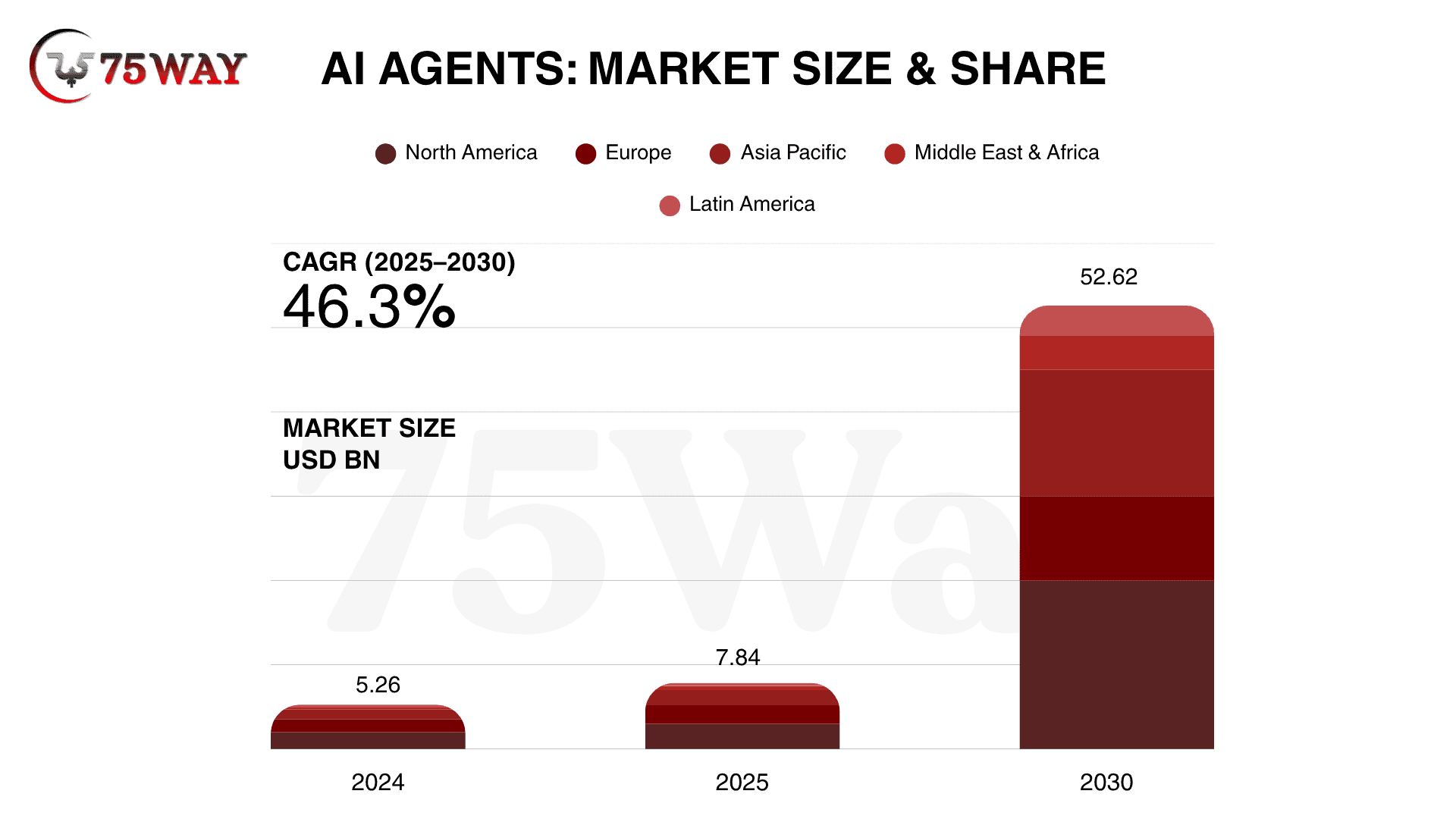
- Around 85% of organizations are either adopting or planning to deploy AI agents, aiming to enhance operational efficiency, cut costs by up to 35%, and accelerate revenue growth.
- By 2026, pre-built “horizontal” AI agents are expected to account for over 85% of the market, enabling businesses to implement solutions quickly without heavy coding requirements.
- North America holds the leading position with more than 39% market share, fueled by strong adoption across industries such as technology, finance, and healthcare.
Popular Frameworks for AI Agent Development
AI agent development is supported by several powerful frameworks that simplify building intelligent, autonomous systems. These tools provide prebuilt components for memory, reasoning, tool integration, and workflow orchestration. They help developers create scalable, production-ready AI agents faster while ensuring flexibility, modularity, and efficient system design. Different frameworks that simplify the development of AI agents are:
LangChain
A widely used framework for building LLM-powered applications. It supports:
- Chains
- Agents
- Tool integration
- Memory systems
AutoGen
A multi-agent system framework designed for collaboration between AI systems. It enables:
- Conversational agents
- Role-based workflows
- Automated task delegation
CrewAI
A framework focused on structured multi-agent collaboration. It allows developers to assign roles such as:
- Analyst
- Researcher
- Writer
- Executor
LlamaIndex
Specialized in connecting LLMs with data sources. It is widely used for:
- Retrieval augmented generation (RAG)
- Document-based AI systems
- Knowledge assistants
Real-World Use Cases of AI Agents
AI agents are transforming industries by automating workflows, improving decision-making, and enabling intelligent task execution across business operations and digital systems.
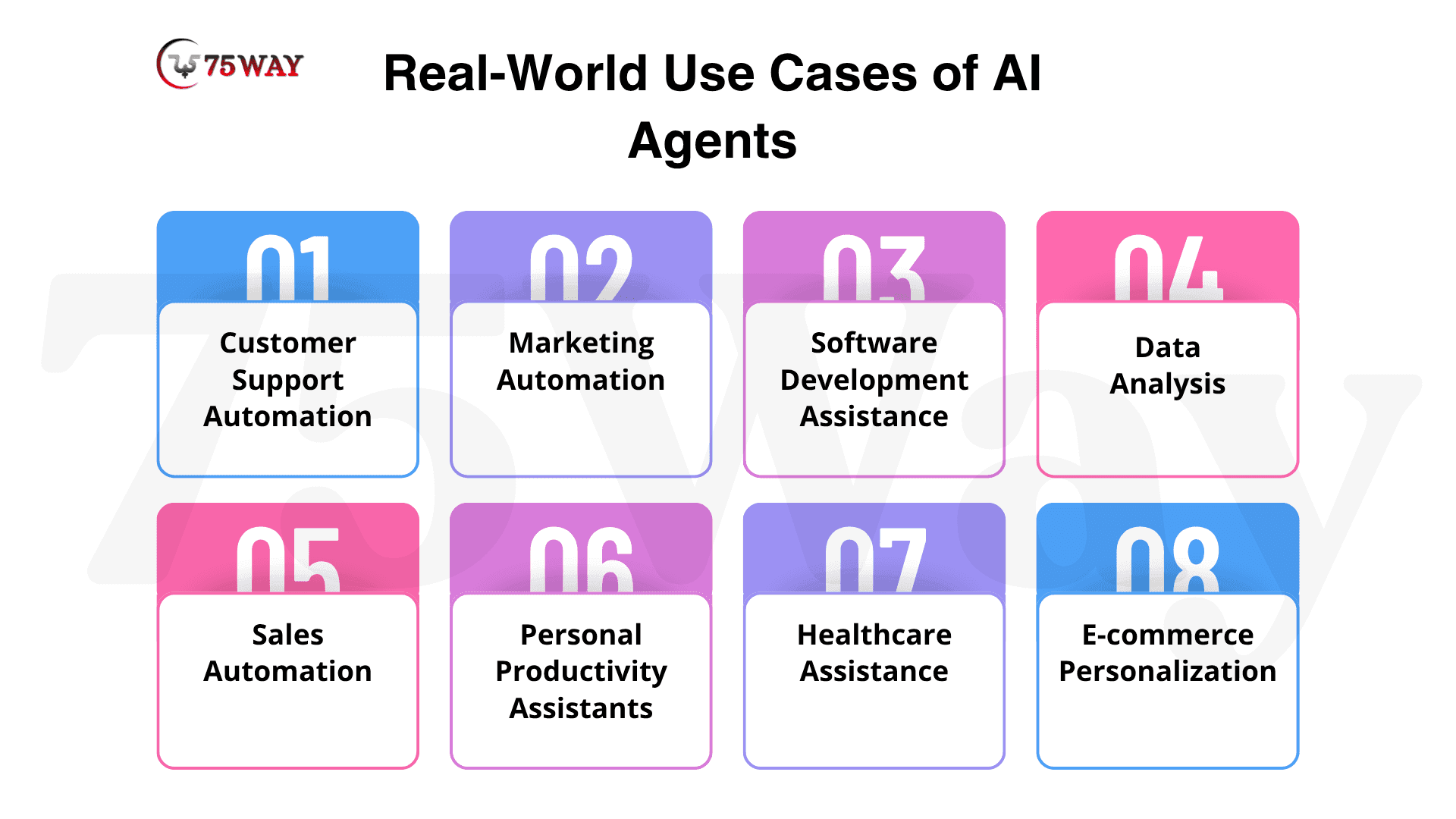
- Customer Support Automation: Customer service AI agents handle customer queries, resolve common issues, and provide instant responses without human intervention. These AI voice agents reduce response time, improve support efficiency, and maintain consistent service quality across multiple channels, ensuring customers receive accurate assistance at any time.
- Marketing Automation: Campaign creation, audience targeting, and content generation become easier as AI marketing agents analyze user behavior and engagement patterns. They optimize marketing performance, improve conversion rates, and eliminate repetitive manual tasks through intelligent, data-driven automation strategies.
- Software Development Assistance: Coding, debugging, and documentation tasks are accelerated through AI-driven support systems for developers. These agents enhance productivity, minimize errors, and speed up development cycles by offering intelligent suggestions and automated code generation capabilities.
- Data Analysis: Large datasets are processed to uncover patterns, trends, and actionable insights using intelligent systems. Businesses benefit from faster decision-making, improved forecasting, and a clearer understanding of complex data structures for strategic planning.
- Sales Automation: Lead qualification, customer engagement, and outreach management are streamlined using intelligent lead qualification agents. They improve conversion efficiency, reduce manual workload, and optimize sales pipelines through automated, data-driven decision-making processes.
- Personal Productivity Assistants: Task scheduling, reminders, and workflow management are simplified through intelligent automation tools. Users experience improved organization, better time management, and enhanced daily productivity through automated personal assistance systems.
- Healthcare Assistance: Patient monitoring, medical data interpretation, and diagnostic support are enhanced through intelligent AI healthcare agents. They reduce administrative burden, improve accuracy, and assist healthcare professionals in delivering faster and more effective care.
- E-commerce Personalization: Product recommendations, user behavior tracking, and shopping experience customization are powered by agentic AI ecommerce systems. They increase customer engagement, boost satisfaction, and drive higher sales through personalized and relevant suggestions.
Benefits of Building AI Agent Development
Building AI agents offers significant advantages for businesses by automating complex workflows, improving decision-making, and enhancing operational efficiency. These intelligent systems reduce manual effort, increase productivity, and enable scalable automation. They also help organizations deliver smarter, faster, and more personalized digital experiences.
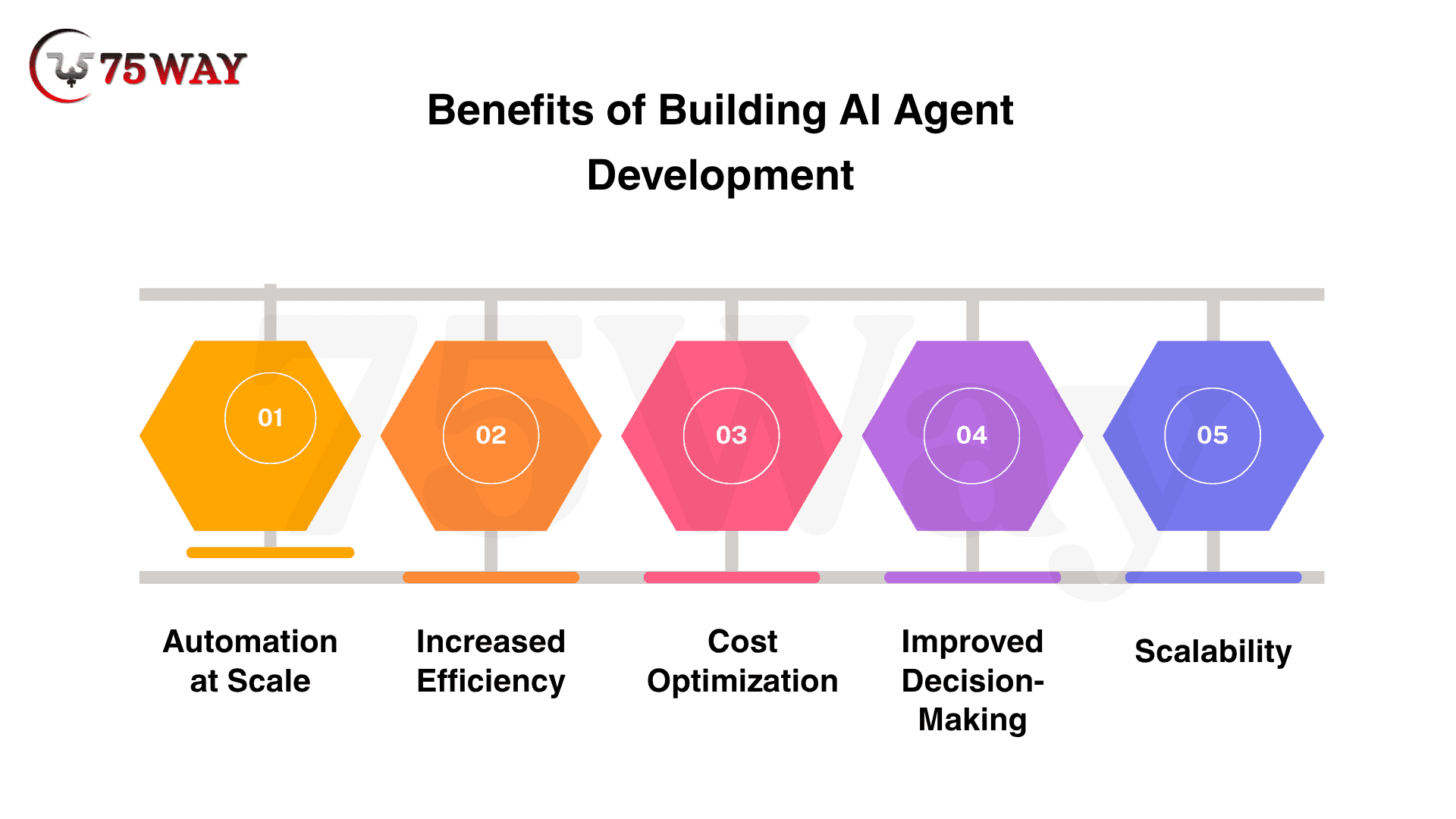
- Automation at Scale
AI agents enable large-scale automation by handling repetitive and complex tasks without continuous human involvement. They streamline workflows across multiple systems and departments efficiently. This reduces dependency on manual processes while ensuring consistent performance and faster task execution across operations.
- Increased Efficiency
Tasks are completed significantly faster as AI agents operate with minimal supervision and high processing speed. They eliminate delays caused by manual intervention and improve overall workflow continuity. This leads to higher productivity and smoother execution of business processes in real time.
- Cost Optimization
Businesses reduce operational expenses by minimizing the need for large human teams for repetitive tasks. AI agents optimize resource utilization and lower long-term costs associated with labor and manual management. This improves profitability while maintaining consistent service quality and output.
- Improved Decision-Making
AI agents analyze large volumes of data to generate meaningful insights and support informed decision-making. They identify patterns, trends, and anomalies that humans may miss. This leads to more accurate strategies and better business outcomes across various functions.
- Scalability
AI agent systems can easily handle increasing workloads without performance degradation. They adapt to growing business demands by scaling processes automatically. This ensures consistent efficiency and reliability even as operations expand significantly over time.
What’s AI Agent Development Cost?
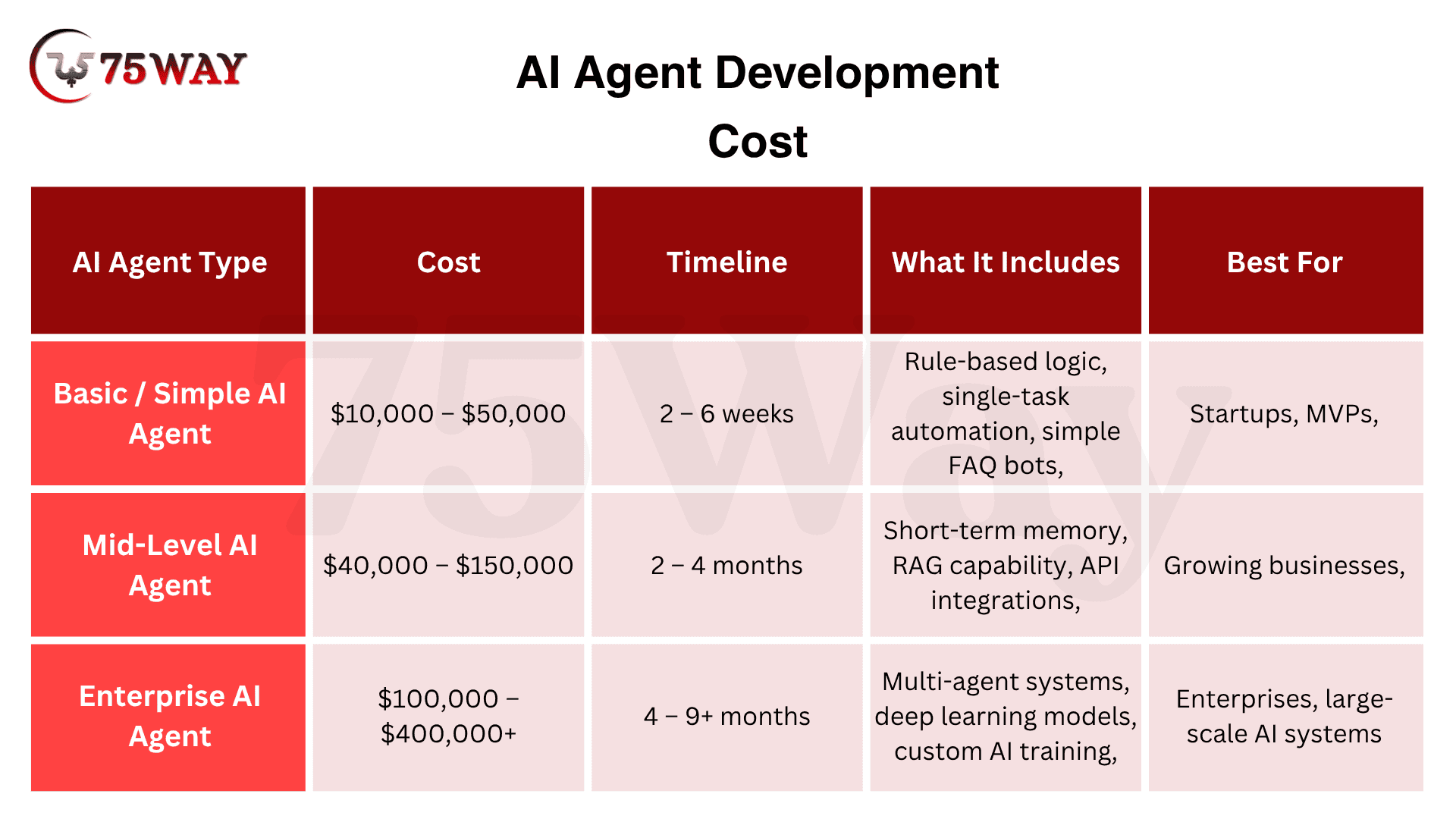
AI agent development cost varies widely depending on complexity, features, integrations, and scalability requirements. Simple AI agents with basic automation and limited tool integration typically start at lower budgets, while advanced systems with memory, planning, multi-agent workflows, and enterprise-grade integrations require significantly higher investment. On average, the cost of building AI agents ranges from $10,000 to $400,000+, with highly customized or large-scale solutions potentially exceeding this range. Factors such as model selection, infrastructure, API usage, data processing needs, and ongoing maintenance also heavily influence the overall development cost.
Basic / Simple AI Agent ($10,000 – $50,000)
Basic AI agents handle simple automation tasks like rule-based responses, basic chat support, and limited workflow execution. They require minimal integrations and are designed for small-scale use cases with low complexity and faster deployment timelines.
Mid-Level AI Agent ($40,000 – $150,000)
Mid-level AI agents include memory systems, tool integrations, and basic planning capabilities for more dynamic workflows. They support moderate complexity tasks, improve contextual understanding, and are suitable for growing businesses needing scalable automation solutions.
Enterprise AI Agent ($100,000 – $400,000+)
Enterprise AI agents are highly advanced systems with multi-agent collaboration, deep integrations, and robust planning and reasoning capabilities. They are built for large-scale operations requiring high performance, security, scalability, and continuous optimization across complex business environments.
Affordable Pre-Built AI Agents
Prebuilt AI agents are ready-made intelligent systems designed to perform specific tasks such as customer support, data analysis, sales outreach, or workflow automation without requiring development from scratch. They come with built-in models, preconfigured workflows, and integrations, making them faster to deploy and easier to scale for businesses that want quick AI adoption. These agents reduce development time, lower initial investment, and allow companies to start automation instantly while still offering customization options for specific business needs. Some AI marketplaces, such as 75AI Agent Store, deliver ready-made AI agents to automate your tasks. This platform allows you to build, customize, and launch diverse kinds of AI agents quickly.
Challenges in AI Agent Development & Solutions
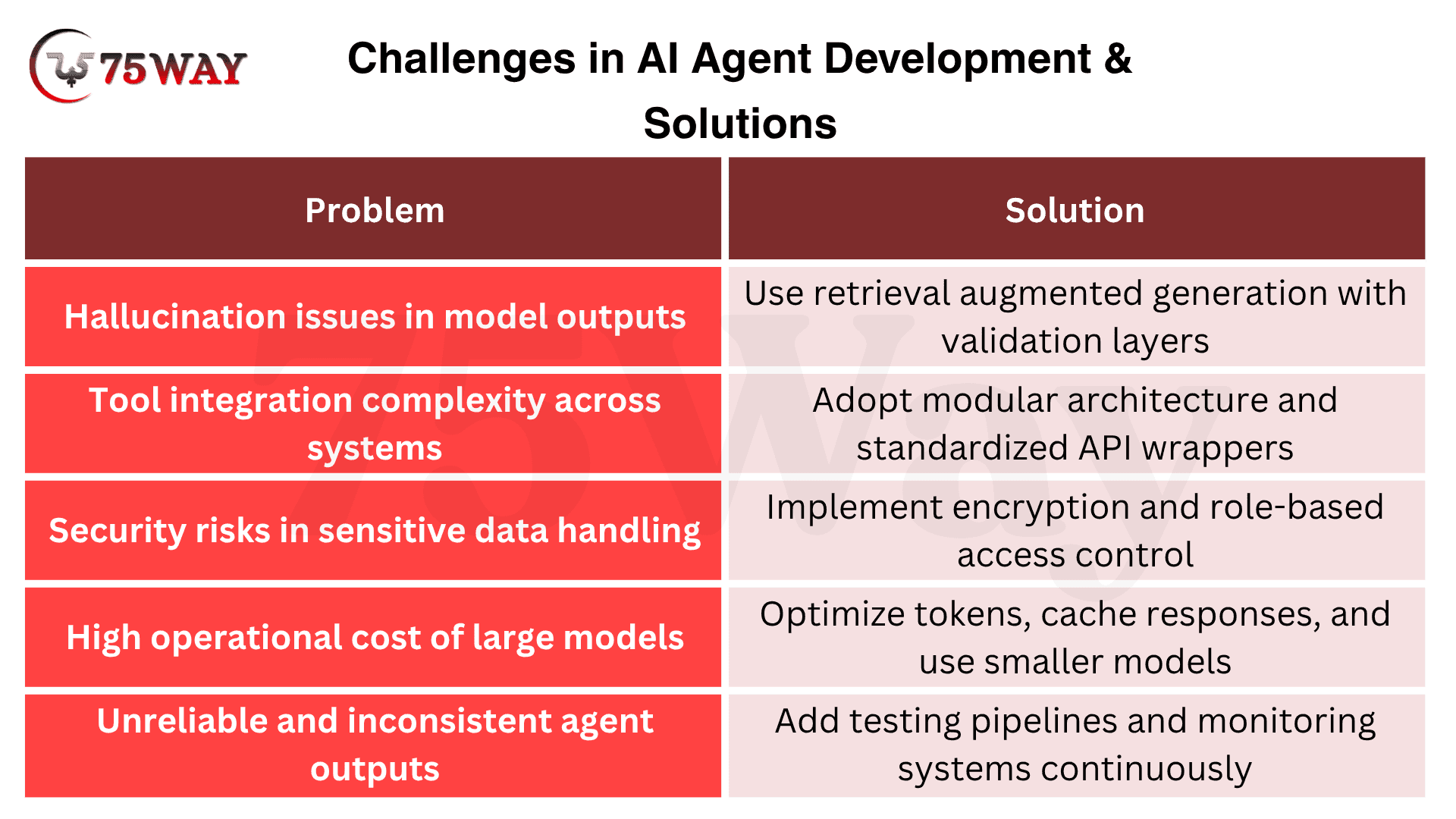
Despite their power, AI agents face challenges that can impact performance, reliability, and scalability in real-world applications.
- Hallucination Issues: Large language models can sometimes generate incorrect or misleading information, especially when they lack proper context or verified data sources. This can reduce trust, particularly in critical applications like healthcare, finance, or enterprise systems. To address this, techniques like retrieval-augmented generation, use of verified knowledge bases, and strong validation layers are implemented to ensure responses remain accurate and reliable.
- Tool Integration Complexity: AI agents often need to interact with multiple tools, such as APIs, databases, and third-party systems. Managing these connections can become complex and may lead to inefficiencies or integration errors if not handled properly. Using modular architecture, standardized API wrappers, and orchestration frameworks helps streamline communication between systems and ensures smooth, efficient workflows.
- Security Concerns: AI agents frequently handle sensitive data, which makes security a major concern in real-world applications. Without proper safeguards, there is a risk of data exposure or unauthorized access. Implementing encryption, secure authentication methods, and role-based access control ensures that data remains protected and interactions between systems stay secure.
- Cost Management: Running AI systems, especially those powered by large language models, can become expensive over time due to continuous usage and high computational requirements. This is particularly challenging for large-scale or real-time applications. Optimizing token usage, caching frequent responses, and using smaller models for simpler tasks can significantly reduce operational costs without affecting performance.
- Reliability: AI agents may sometimes produce inconsistent results due to variations in prompts, loss of context, or limitations of the model in handling complex tasks. This can impact user experience and system dependability. To improve reliability, businesses implement testing pipelines, fallback mechanisms, and continuous monitoring to ensure consistent performance and long-term stability.
Future of AI Agent Development
AI agents are expected to evolve into highly autonomous systems capable of:
- Running entire business workflows
- Managing digital ecosystems
- Acting as virtual employees
- Collaborating in multi-agent networks
The future will likely include fully autonomous digital organizations powered by AI agents.
Final Thoughts
AI agent development represents a major shift in how software systems are built and used. Instead of static applications, we now have intelligent systems capable of reasoning, planning, and executing complex tasks autonomously.
For beginners, understanding the core components, LLMs, memory systems, tool integration, and orchestration is the first step toward mastering this field. As the technology continues to evolve, AI agents will become central to automation, business intelligence, and digital transformation. Businesses that adopt AI agent systems early will gain a strong competitive advantage through efficiency, scalability, and intelligent automation.
If you are looking to build intelligent automation solutions tailored to your business needs, partnering with a trusted AI agent development company can help you design, develop, and deploy scalable AI agent systems. You can also avail ready-made AI agents to launch quickly.
Frequently Asked Questions
What Are The Core Components Of An AI Agent?
An AI agent consists of a reasoning model, memory system, planning module, tool integration layer, and orchestration engine. These components work together to understand tasks, make decisions, execute actions, and improve performance through continuous interaction and contextual learning from external systems and user inputs.
How Is An AI Agent Different From A Chatbot?
A chatbot provides predefined or limited responses, while an AI agent can reason, plan, and execute multi-step tasks. It interacts with tools, retains memory, and adapts dynamically. AI agents are goal-driven systems capable of autonomous decision-making rather than simple conversational interactions.
What Skills Are Needed For AI Agent Development?
AI agent development requires knowledge of machine learning, large language models, API integration, prompt engineering, and software architecture. Understanding data structures, vector databases, and orchestration frameworks is also important for building scalable, intelligent, and production-ready autonomous systems.
Can AI Agents Work Without Human Intervention?
AI agents can operate autonomously for defined tasks, but human oversight is still important for monitoring, optimization, and error handling. Fully autonomous systems are improving, but most real-world applications still rely on human supervision to ensure accuracy, safety, and alignment.
What Industries Benefit Most From AI Agents?
Industries such as customer service, marketing, finance, healthcare, e-commerce, and software development benefit significantly from AI agents. These systems improve efficiency, automate repetitive tasks, enhance decision-making, and enable scalable operations across data-heavy and process-driven environments.
What Are The Limitations Of AI Agents Today?
AI agents may face challenges like hallucination, inconsistent reasoning, high computational costs, and integration complexity. They also depend heavily on data quality and system design. Ensuring reliability, security, and accuracy remains a key focus in current AI agent development practices.
How Long Does It Take To Build An AI Agent?
The development time depends on complexity, features, and integrations. Simple AI agents may take a few weeks, while advanced multi-agent systems with tool integrations and memory can take several months. Proper planning, architectural design, and testing significantly influence timelines.
Why Is AI Agent Development Becoming Popular?
AI agent development is gaining popularity because it enables automation of complex workflows, reduces manual effort, and improves productivity. Businesses are adopting these systems to streamline operations, enhance decision-making, and build intelligent digital assistants capable of handling dynamic tasks efficiently.