Summary
Multi-agent system architecture enables multiple autonomous agents to collaborate, automate tasks, and solve complex problems efficiently. It combines intelligent decision-making, real-time adaptability, and scalable design to help businesses improve performance, reduce manual effort, and drive innovation.
Key Takeaways
- Multi-agent systems use autonomous agents to work collaboratively toward shared goals.
- Core components include agents, environment, communication, coordination, and knowledge base.
- Centralized, decentralized, and hybrid architectures offer different scalability and control benefits.
- Agents operate through perception, decision-making, action, learning, and feedback loops.
- AI, machine learning, and automation enhance system intelligence and efficiency.
- These systems improve scalability, flexibility, and overall business productivity.
Multi-agent systems are revolutionizing modern digital infrastructure. These systems consist of multiple intelligent agents working together seamlessly. Each agent operates independently while contributing to shared objectives. As a result, organizations achieve scalable and adaptive solutions.
Moreover, businesses rely on these AI agent development solutions to automate complex operations. They also reduce manual workload significantly. Therefore, many companies collaborate with an AI development company to implement advanced agent-based solutions.
Additionally, multi-agent systems improve responsiveness in dynamic environments. They adapt quickly to real-time changes. Consequently, they outperform traditional centralized architectures.
What is Multi-Agent System Architecture?
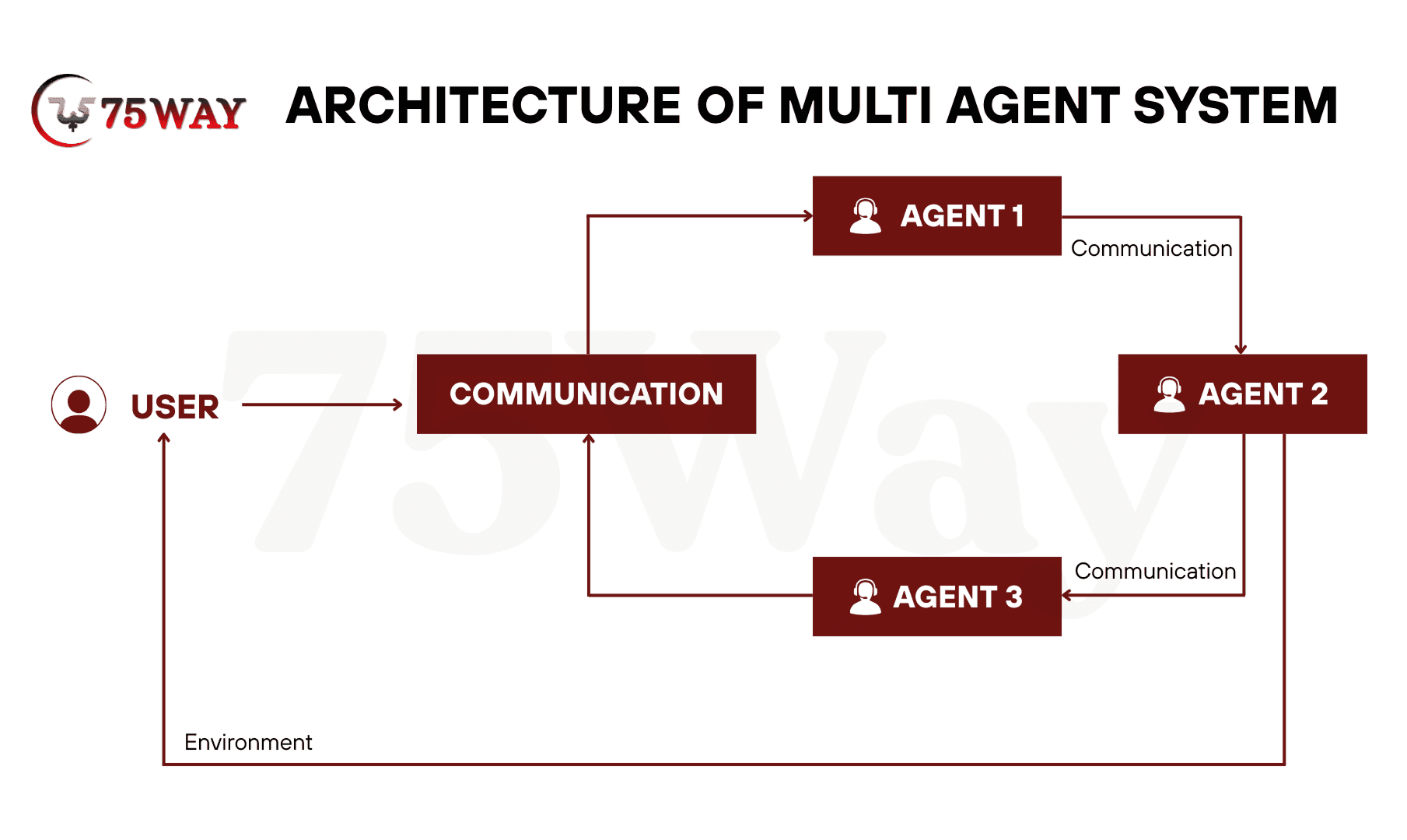
Multi-Agent System Architecture refers to a framework where multiple intelligent agents interact, collaborate, and coordinate with each other to perform tasks or solve complex problems. Each agent operates autonomously, meaning it can make decisions, learn from data, and act independently based on its environment and objectives.
In this architecture, agents communicate with one another to share information, delegate tasks, and achieve common goals more efficiently than a single system. These agents can be software-based (like AI bots) or part of distributed systems working across different environments.
Multi-agent systems are widely used in areas such as automation, robotics, supply chain management, and smart applications, where dynamic decision-making and scalability are essential. Their ability to adapt, self-organize, and collaborate makes them a key component of modern intelligent systems.
Core Components of Multi-Agent System Architecture
A strong multi-agent system architecture ensures seamless interaction, coordination, and communication among agents. Key components define how agents operate, share information, make decisions, and collaborate efficiently to achieve complex tasks in dynamic environments.
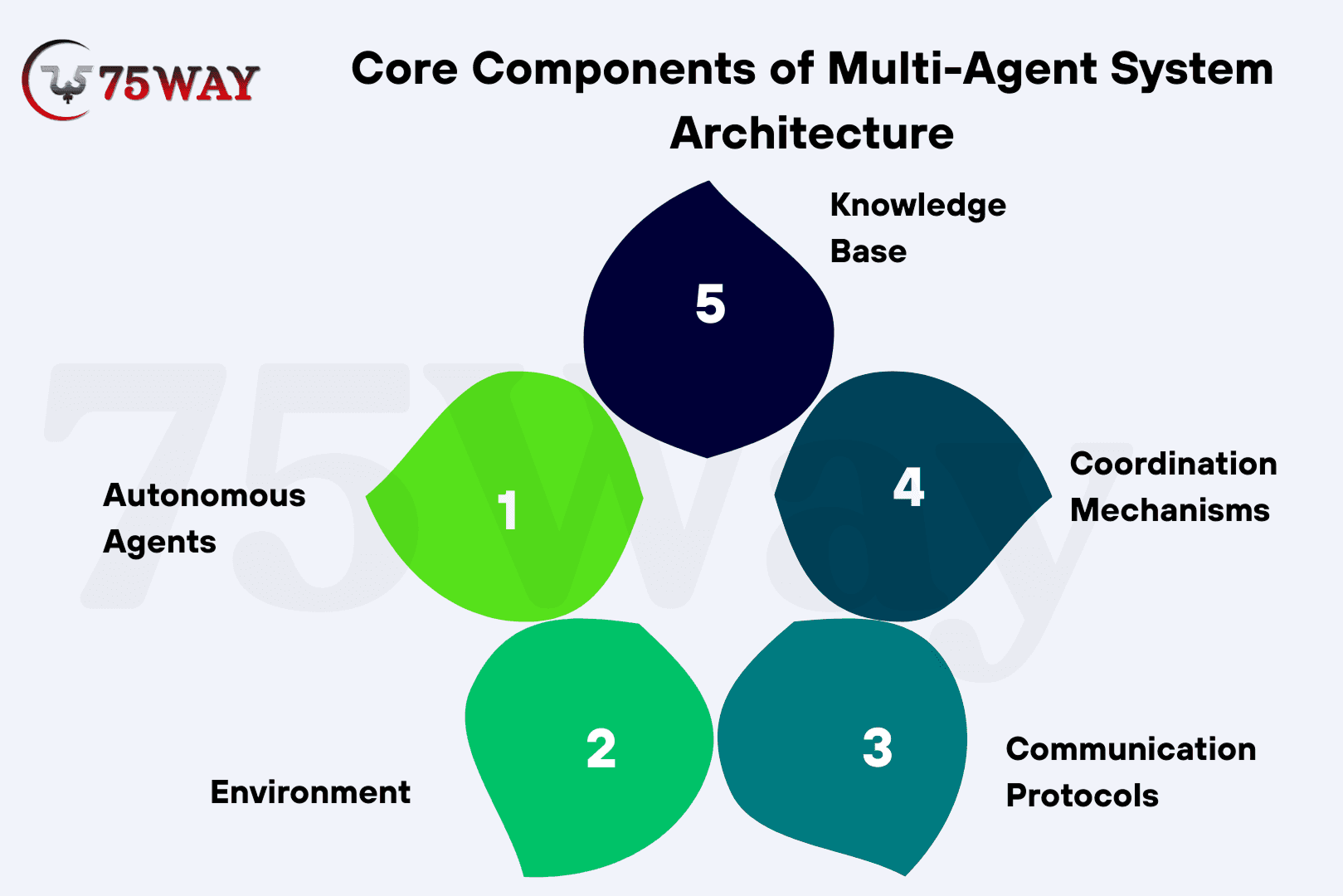
Autonomous Agents: Autonomous agents act as independent decision-makers. They observe their environment and respond accordingly. Furthermore, each agent operates with specific goals and capabilities. These agents also collaborate with others when required. As a result, system efficiency improves. Many businesses prefer to hire AI agent developers for building such intelligent ecosystems.
Environment: The environment represents the operational space for agents. It may include physical systems or digital platforms. For instance, cloud systems and databases act as environments. Moreover, the environment continuously provides input data. This data influences agent behavior. Therefore, adaptability becomes essential.
Communication Protocols: Agents rely on structured communication to coordinate actions. Protocols define how messages are exchanged. These rules ensure consistency and clarity. Furthermore, effective communication reduces system conflicts. It also improves overall performance. Consequently, agents collaborate efficiently.
Coordination Mechanisms: Coordination ensures agents align with shared goals. Mechanisms like cooperation and negotiation are vital. Therefore, redundant actions are minimized. In addition, coordination enhances resource utilization. It ensures smooth execution of tasks.
Knowledge Base: Agents rely on knowledge bases for decision-making. These include stored rules and historical data. Consequently, agents make informed choices.: Moreover, continuous learning improves system intelligence. This leads to better outcomes over time.
Types of Multi-Agent Architectures
Different multi-agent architectures are designed to address specific use cases and system requirements. Each architecture offers unique benefits in terms of coordination, scalability, and decision-making. Choosing the right type ensures efficient agent interaction, improved performance, and adaptability in solving complex, real-world problems across dynamic and distributed environments.
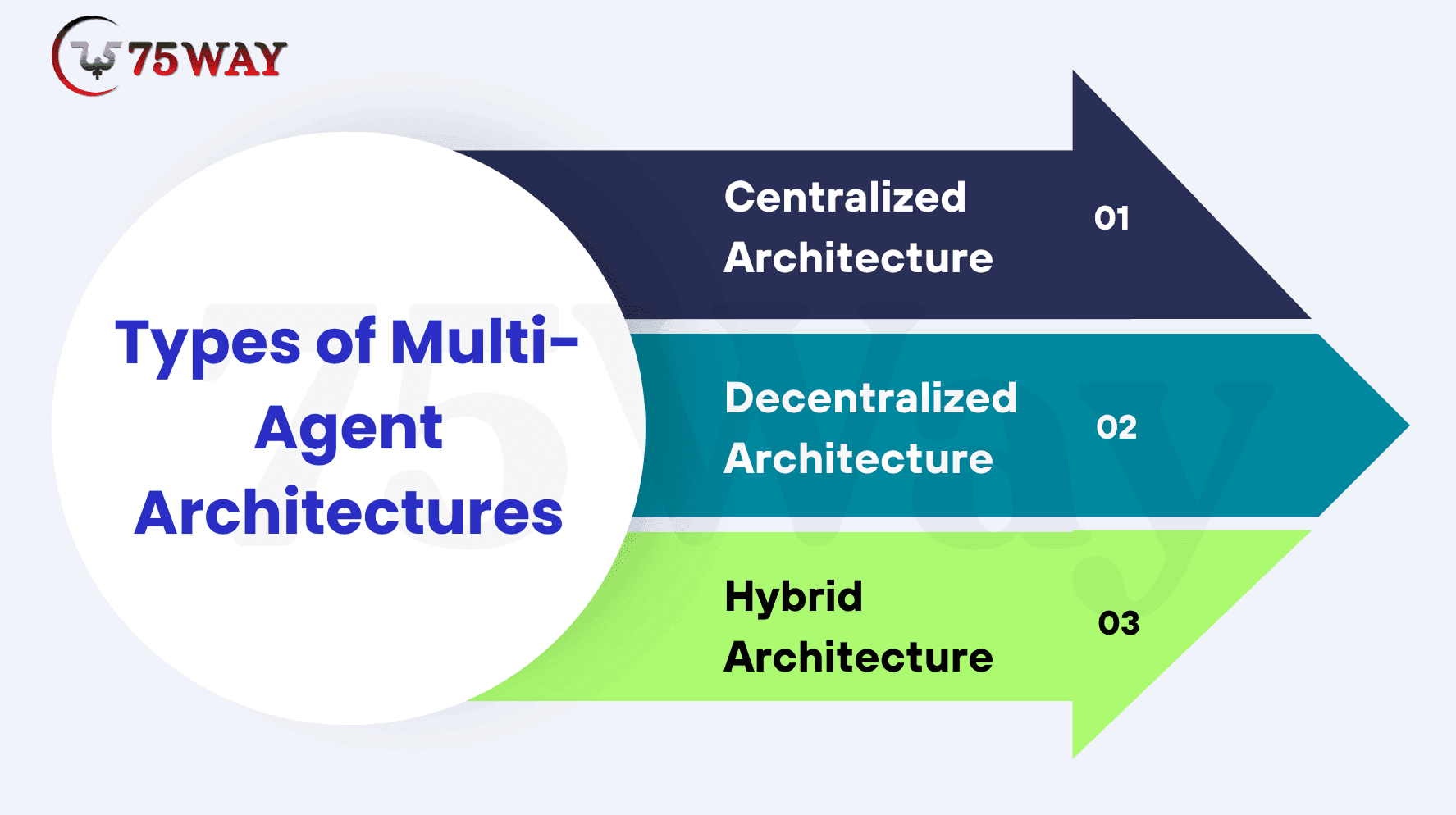
Centralized Architecture: Centralized systems rely on a single control unit. This unit manages all agents and processes. As a result, coordination becomes simple. However, scalability remains limited. Additionally, system failure risks increase significantly.
Decentralized Architecture: Decentralized systems distribute control among agents. Each agent makes independent decisions. Consequently, flexibility improves. Furthermore, these systems scale efficiently. Businesses often combine them with AI integration services for seamless implementation.
Hybrid Architecture: Hybrid systems combine centralized and decentralized models. They balance control with flexibility. Therefore, they support complex applications. Additionally, hybrid systems reduce risks while maintaining efficiency.
How Autonomous Agents Operate?
Autonomous agents follow structured processes. These processes enable intelligent and adaptive behavior.
Perception and Data Collection
Agents continuously gather data from their environment. Sensors, APIs, and databases provide real-time information. Consequently, agents remain informed. Moreover, accurate data enhances decision-making. Therefore, perception is critical.
Decision-Making Process
Agents analyze collected data using algorithms. They evaluate multiple outcomes before selecting actions. As a result, decisions remain effective. In addition, companies often consult an AI consulting company to design optimized decision frameworks.
Action Execution
Agents perform actions based on decisions. These actions influence systems and users. Therefore, execution must be precise. Furthermore, timely actions improve overall system performance.
Learning and Adaptation
Agents learn continuously from past outcomes. They refine strategies based on feedback. Consequently, performance improves over time. Moreover, adaptive systems respond better to uncertainties.
Feedback Mechanism
Feedback allows agents to evaluate results. They adjust behavior accordingly. As a result, efficiency increases. Additionally, feedback loops support long-term system optimization.
Advanced Technologies Powering Multi-Agent Systems
Modern technologies enhance multi-agent capabilities significantly. These innovations drive efficiency and intelligence.
Artificial Intelligence and Machine Learning
AI enables agents to make intelligent decisions. Machine learning improves accuracy over time. Consequently, systems become smarter. Many organizations rely on a machine learning development company to integrate advanced learning models.
Generative AI Integration
Generative AI enhances agent capabilities further. It enables content creation and predictive insights. As a result, agents perform complex tasks efficiently. Businesses often partner with a generative AI development company to implement such solutions.
Automation and Workflow Systems
Automation tools streamline agent operations. They reduce manual intervention significantly. Consequently, productivity increases. Organizations use AI automation services to build efficient workflows.
Data Science and Analytics
Data science plays a critical role in agent performance. It enables accurate predictions and insights. Therefore, agents make better decisions. Many companies adopt data science services to enhance system intelligence.
Core Benefits of Multi-Agent Systems
Multi-agent systems offer several advantages. These benefits drive adoption across industries.
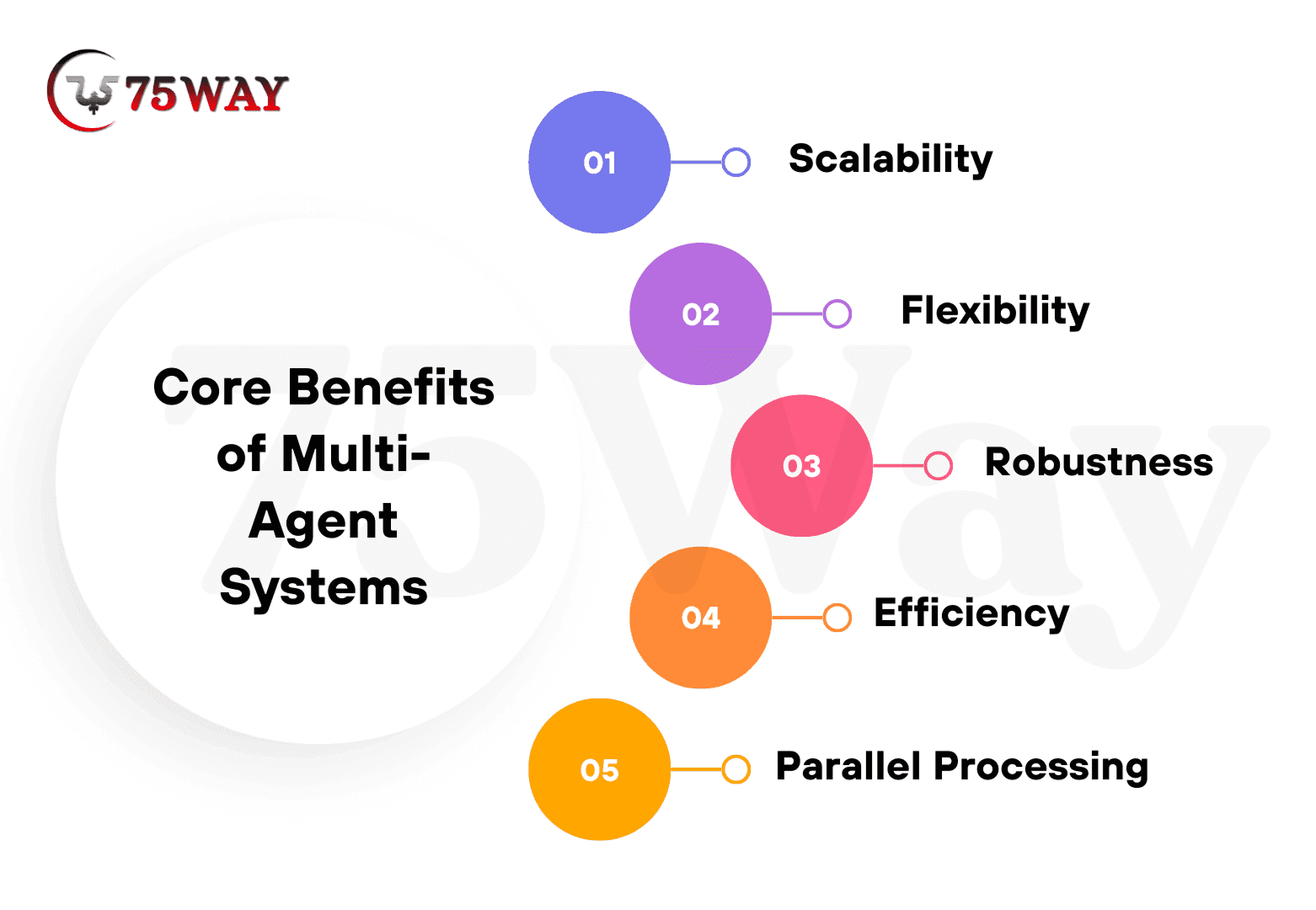
Scalability: Systems expand easily by adding new agents. Therefore, they handle increasing workloads efficiently. Moreover, scalability supports long-term growth strategies.
Flexibility: Agents adapt quickly to changing conditions. As a result, systems remain functional. Furthermore, flexibility enhances reliability.
Robustness: Failure of one agent does not affect the entire system. Consequently, operations continue smoothly. Additionally, redundancy improves resilience.
Efficiency: Agents divide tasks effectively. Therefore, processes complete faster. Moreover, resource utilization improves significantly.
Parallel Processing: Multiple agents work simultaneously. As a result, execution speed increases. Furthermore, productivity improves across operations.
Real-World Applications of Multi-Agent Systems
Multi-agent systems power various industries. Their adaptability makes them essential.
Smart Transportation Systems: Agents manage traffic flow and routing. They reduce congestion effectively. Consequently, travel becomes efficient. Moreover, real-time adjustments improve safety.
E-Commerce and Customer Experience: Agents analyze customer behavior and preferences. They optimize recommendations and pricing strategies. As a result, businesses increase revenue. Additionally, companies integrate systems with an AI chatbot development company to enhance user engagement.
Healthcare Systems: AI Agents assist in diagnosis and monitoring. They process large datasets quickly. Consequently, patient outcomes improve. Furthermore, automation reduces workload for healthcare professionals.
Robotics and Industrial Automation: Robots rely on multi-agent coordination. They perform tasks collaboratively in manufacturing. As a result, productivity increases. Moreover, businesses use AI software development services to build robust automation systems.
Financial Services: Agents monitor markets and execute trades. They respond instantly to changes. Consequently, financial decisions improve. Additionally, automation increases operational efficiency.
Smart Energy and IoT Systems: Agents manage energy distribution efficiently. They balance supply and demand dynamically. As a result, energy usage becomes optimized. Moreover, integration with IoT enhances system performance. Companies often collaborate with an IoT app development company for such implementations.
Challenges in Multi-Agent System Design
Despite their advantages, multi-agent systems face several challenges during design and implementation, including coordination complexity, communication overhead, and security concerns. Addressing these issues effectively ensures smoother collaboration, improved system performance, and more reliable outcomes in dynamic environments.
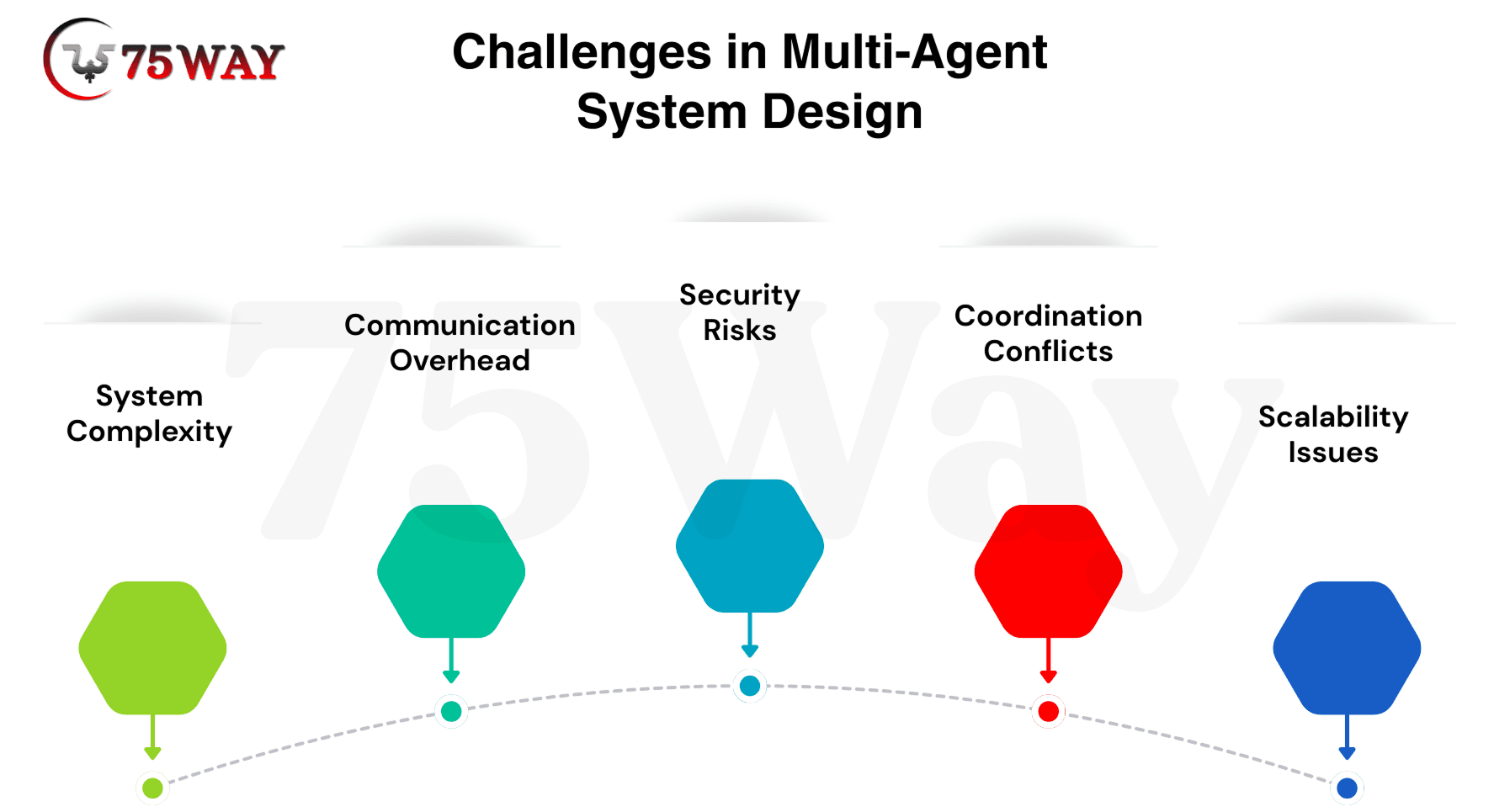
System Complexity: Designing multi-agent systems can become highly complex due to multiple agent interactions, decision layers, and dynamic environments. Therefore, adopting structured architecture, clear workflows, and expert planning ensures better system design, improved coordination, and efficient execution of tasks.
Communication Overhead: Excessive communication between agents can slow down system performance and increase latency. Consequently, implementing efficient communication protocols, prioritizing essential data exchange, and minimizing redundant interactions help optimize performance and ensure faster, smoother system operations.
Security Risks: Multi-agent systems are vulnerable to cybersecurity threats due to their distributed nature and data exchange processes. Therefore, implementing strong encryption, authentication mechanisms, and continuous monitoring ensures data protection, prevents unauthorized access, and maintains system integrity.
Coordination Conflicts: Agents within the system may have conflicting goals or priorities, leading to inefficiencies and disruptions. However, applying well-defined coordination strategies, conflict resolution mechanisms, and shared objectives ensures smooth collaboration and improves overall system effectiveness.
Scalability Issues: Poorly designed multi-agent systems may struggle to handle increasing workloads and expanding operations. Therefore, building a scalable architecture with flexible frameworks and resource optimization ensures the system can grow efficiently without compromising performance or reliability.
Future of Multi-Agent Systems And Beyond
The future of multi-agent systems is highly promising. Advancements in AI continue to drive innovation. Moreover, integration with edge computing improves real-time processing. Systems become faster and more efficient. Additionally, agent-based systems will play a key role in digital transformation. Businesses will rely heavily on automation. Furthermore, intelligent agents will handle complex tasks independently. They will require minimal human intervention.
Final Thoughts
Multi-agent system architecture is redefining how businesses approach intelligent automation and collaboration. By enabling autonomous agents to work together seamlessly, organizations can solve complex challenges with greater efficiency, accuracy, and speed. Its scalability and flexibility make it a powerful solution for businesses aiming to adapt and grow in a rapidly evolving digital landscape. As technology continues to advance, the adoption of multi-agent systems will accelerate, making it essential for businesses to understand and implement this innovation. Partnering with a reliable agentic AI development company can help you unlock the full potential of these systems and stay ahead of the competition. Get started today to transform your business with next-generation AI solutions.
Frequently Asked Questions
How Do Multi-Agent Systems Handle Dynamic And Unpredictable Environments?
Multi-agent systems adapt to dynamic environments by continuously collecting real-time data and adjusting their behavior accordingly. Their learning capabilities and decentralized decision-making allow them to respond quickly to changes without disrupting overall system performance.
Why Are Multi-Agent Systems Important For Digital Transformation?
Multi-agent systems play a key role in digital transformation by enabling intelligent automation and real-time decision-making. They help businesses streamline operations, improve responsiveness, and create adaptive systems that align with evolving market demands and technological advancements.
How Do Multi-Agent Systems Support Real-Time Collaboration?
Multi-agent systems enable real-time collaboration by allowing agents to communicate instantly and share relevant data. This coordination ensures tasks are executed efficiently, reduces delays, and improves overall system productivity in time-sensitive environments.
What Industries Benefit The Most From Multi-Agent Systems?
Industries such as logistics, manufacturing, energy, and smart cities benefit significantly from multi-agent systems. These systems enhance operational efficiency, optimize resource utilization, and enable intelligent automation in complex and large-scale environments.
How Do Multi-Agent Systems Improve System Reliability?
Multi-agent systems improve reliability by distributing tasks among multiple agents. If one agent fails, others continue functioning, ensuring uninterrupted operations. This decentralized approach enhances system resilience and minimizes the risk of complete system failure.
What Makes Multi-Agent Systems More Efficient Than Traditional Systems?
Multi-agent systems are more efficient because they enable parallel processing, decentralized control, and adaptive decision-making. These capabilities allow faster execution of tasks, better resource management, and improved performance compared to traditional centralized systems.