Summary
AI customer support systems enhance enterprise service models across the USA through automation, intelligent chatbots, and agentic workflows. This guide explores system architecture, development process, key features, implementation cost, compliance considerations, and real-world use cases, enabling businesses to design scalable, efficient, and intelligent customer service ecosystems powered by modern AI technologies.
Quick Overview
- AI customer support improves response speed and customer satisfaction.
- Enterprises adopt AI systems to reduce operational support costs.
- Modern systems combine chatbots, automation, and agentic AI workflows together.
- Data-driven insights help improve customer experience and decision-making processes.
- Scalable architecture is essential for enterprise-grade AI support systems.
Customer expectations in the United States have changed dramatically over the past decade. Businesses are now expected to deliver instant, personalized, and always-available support across multiple channels. This shift has accelerated the adoption of AI-powered customer support systems across industries including e-commerce, fintech, healthcare, SaaS, logistics, and telecom.
Organizations are increasingly leveraging artificial intelligence to automate responses, streamline workflows, reduce operational costs, and enhance customer satisfaction.
AI customer support systems today go far beyond basic chatbots. They integrate large language models, predictive analytics, natural language processing, and agentic AI frameworks that can independently handle queries, escalate issues, and resolve customer problems with minimal human intervention.
In this guide, we explore how businesses in the USA can build a modern AI customer support system in 2026, including system architecture, core features, technology stack, development process, cost structure, compliance considerations, and real-world implementation strategies.
What Is An AI Customer Support System?
An AI customer support system is an intelligent software platform designed to handle customer queries, complaints, and service requests using artificial intelligence technologies. Unlike traditional ticketing systems, AI-powered support platforms can:
- Understand natural language queries
- Respond instantly using trained models
- Automate repetitive support tasks
- Route complex issues to human agents
- Learn from historical interactions
These systems combine multiple technologies including:
- Natural Language Processing (NLP)
- Machine Learning models
- Large Language Models (LLMs)
- Workflow automation engines
- Knowledge base systems
The goal is to create a seamless support experience that reduces dependency on human agents while improving response accuracy and speed.
Why US Businesses Are Adopting AI Customer Support Agents in 2026?
Enterprises across the USA are rapidly shifting toward AI customer support agents and systems due to increasing customer expectations and operational challenges.
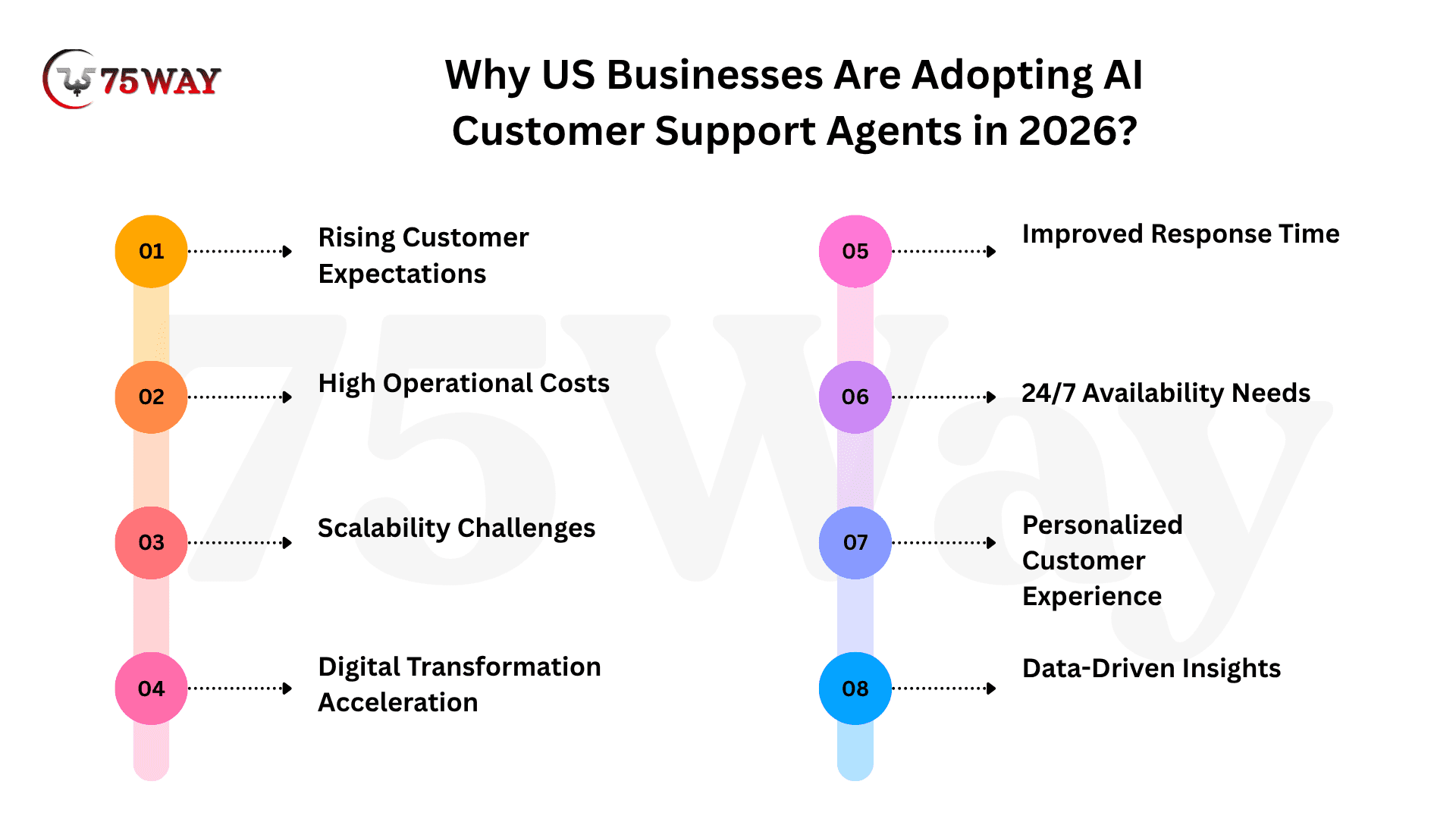
- Rising Customer Expectations: Customers now demand instant responses, 24/7 availability, personalized experiences, and seamless omnichannel support across platforms. Traditional support systems struggle to consistently meet these high expectations at scale.
- High Operational Costs: Human support teams involve salaries, training, infrastructure, and shift management expenses. AI customer support reduces long-term operational costs while maintaining consistent service quality and availability.
- Scalability Challenges: Businesses often face high ticket volumes during peak demand periods, leading to delays and dissatisfaction. AI systems handle unlimited queries simultaneously without additional staffing requirements.
- Digital Transformation Acceleration: Enterprises across the USA are rapidly adopting AI, cloud computing, and automation technologies. AI customer support is becoming a core component of digital transformation strategies.
- Improved Response Time: Customers expect immediate solutions to their queries across channels. AI systems provide real-time responses, significantly reducing waiting times and improving satisfaction levels.
- 24/7 Availability Needs: Modern businesses operate globally, requiring continuous support coverage. AI-powered systems ensure uninterrupted assistance without dependency on human shift schedules or working hours.
- Personalized Customer Experience: Customers expect tailored responses based on their behavior and history. AI systems analyze data to deliver personalized, context-aware support interactions at scale.
- Data-Driven Insights: AI support systems collect and analyze customer interaction data continuously. These insights help businesses improve products, services, and customer engagement strategies.
Types of AI-Powered Customer Support Solutions You Can Adopt
Different organizations implement AI support in different forms depending on business needs. As organizations continue to adopt digital transformation strategies, AI-driven support has become a core component of modern customer experience infrastructure.
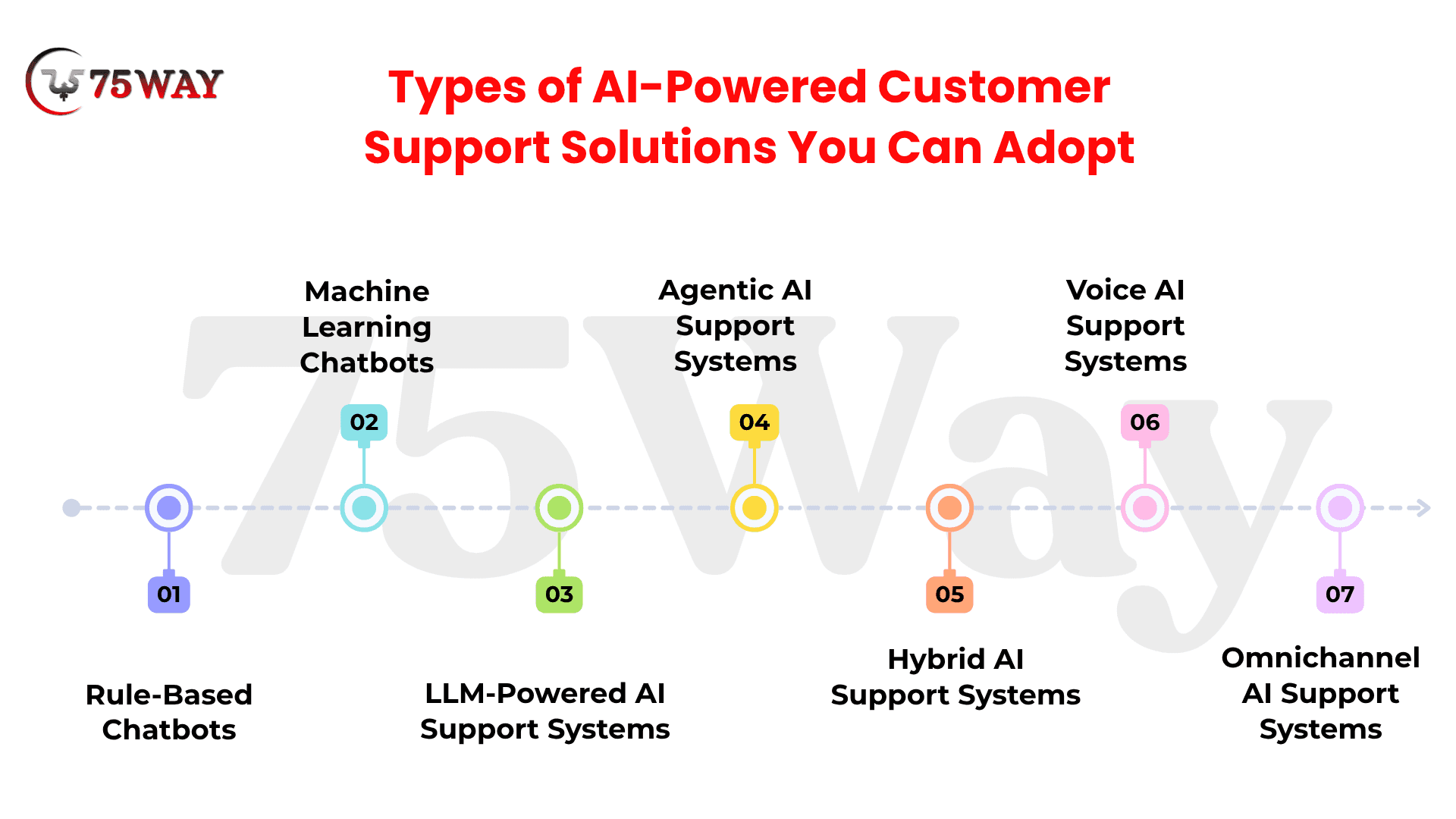
- Rule-Based Chatbots: Rule-based chatbots operate using predefined scripts, decision trees, and structured workflows. They are best suited for handling simple and repetitive customer queries such as FAQs and basic troubleshooting. These AI chatbots cannot understand complex intent but provide fast and consistent responses for standard use cases.
- Machine Learning Chatbots:Machine learning chatbots improve over time by learning from customer interactions and historical data. They can recognize user intent, understand context, and optimize responses based on patterns. This makes them more flexible and effective for handling moderately complex customer support scenarios.
- LLM-Powered AI Support Systems: LLM-based systems use large language models to generate human-like responses and manage complex conversations. They can understand context, handle multi-step queries, and support multilingual interactions. These systems significantly enhance customer experience by providing more natural and accurate communication.
- Agentic AI Support Systems: Agentic AI systems go beyond conversation by taking autonomous actions within business workflows. They can resolve tickets, update records, and coordinate across systems without human intervention. This represents the most advanced form of AI customer support automation.
- Hybrid AI Support Systems: Hybrid systems combine rule-based logic, machine learning, and LLM capabilities into a single framework. They balance accuracy, speed, and flexibility depending on query complexity. This approach is widely used by enterprises seeking both control and advanced AI capabilities.
- Voice AI Support Systems: Voice-based AI systems enable customers to interact using speech instead of text. They are commonly used in call centers for IVR automation, voice assistants, and hands-free support. These AI voice agent-powered systems improve accessibility and reduce wait times in customer service operations.
- Omnichannel AI Support Systems: Omnichannel AI systems provide consistent support across chat, email, social media, and messaging platforms. They unify customer interactions into a single system for better tracking and response management. This ensures a seamless customer experience across all communication channels.
Core Architecture Of AI Customer Support Systems
AI customer support systems are built using a layered architecture that combines user interaction channels, intelligent processing engines, structured knowledge bases, workflow automation, and analytics systems. Each layer works together to ensure fast responses, accurate understanding of customer queries, and efficient resolution of support requests at scale. This architecture enables businesses to deliver consistent, intelligent, and automated customer experiences across multiple platforms.
- User Interaction: This layer manages all customer-facing communication channels, including chat widgets, mobile apps, voice assistants, and messaging platforms, for seamless interaction.
- AI Processing: This layer processes user inputs using NLP, LLMs, intent classification, and sentiment analysis to understand queries accurately and generate relevant responses.
- Knowledge Base: This layer stores structured business information such as FAQs, policies, product details, and historical support tickets for accurate response generation.
- Workflow Automation: This layer automates business operations like ticket routing, escalations, CRM integration, and task execution to improve operational efficiency.
- Data & Analytics: This layer analyzes customer behavior, response performance, issue patterns, and agent productivity to generate actionable business insights.
Key Features of Building An AI Customer Support System
AI customer support systems offer advanced capabilities that go beyond traditional automation tools. These features help businesses improve response speed, reduce workload, and deliver consistent customer experiences across multiple channels.
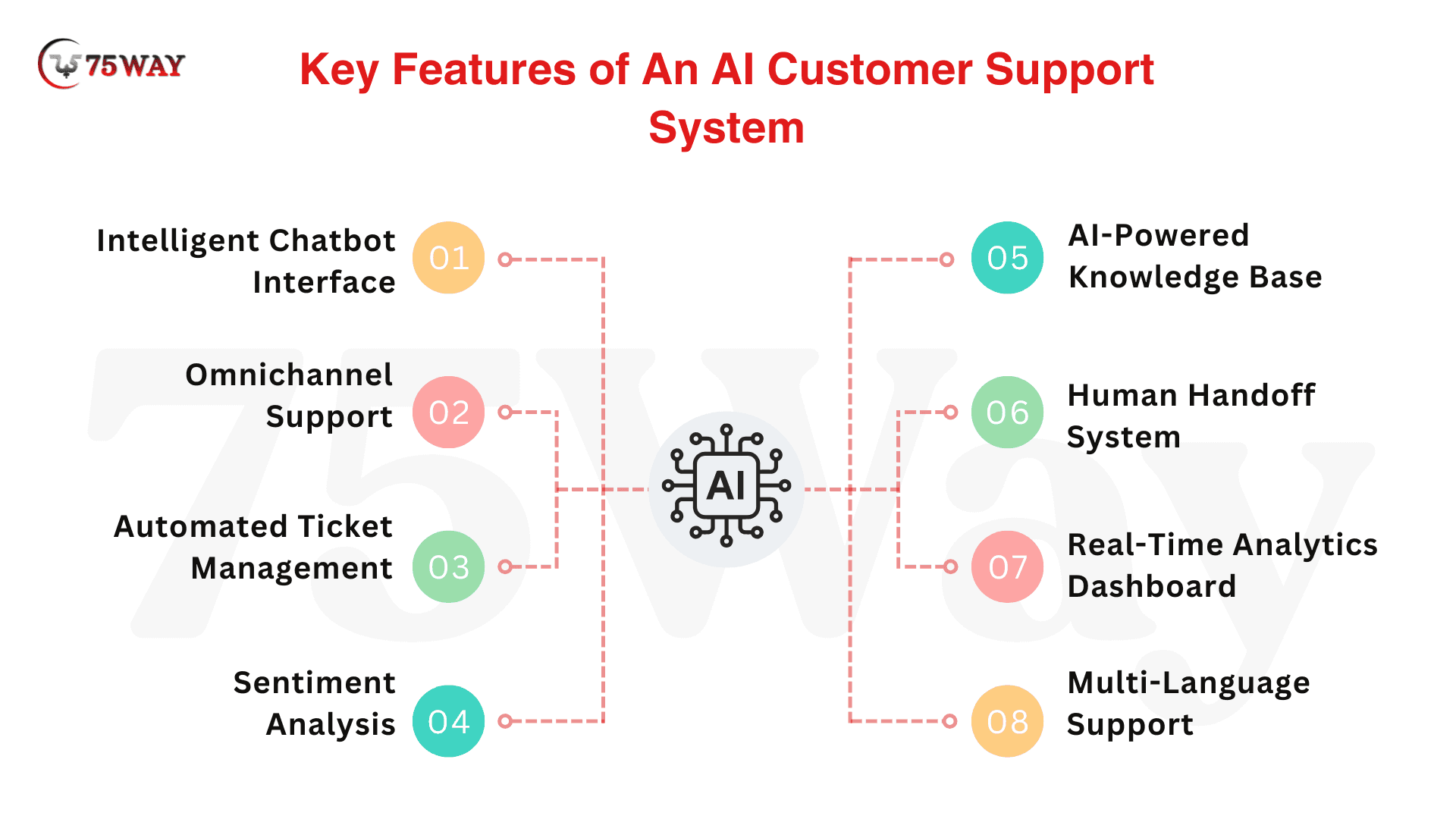
- Intelligent Chatbot Interface: Enables real-time conversations that instantly respond to customer queries across digital platforms. It improves engagement by delivering fast and context-aware responses.
- Omnichannel Support: Connects customer interactions across websites, apps, email, social media, and messaging platforms. This ensures a unified and consistent support experience everywhere.
- Automated Ticket Management: Automatically generates, classifies, and routes support tickets to the right departments. It improves efficiency and reduces manual workload for support teams.
- Sentiment Analysis: Identifies customer emotions such as frustration, urgency, or satisfaction from messages. This helps prioritize critical issues and improve response quality.
- AI-Powered Knowledge Base: Retrieves accurate answers from internal documents, FAQs, and historical data. It ensures consistent and reliable responses to customer queries.
- Human Handoff System: Transfers complex or sensitive cases from AI to human agents when needed. This ensures customers receive appropriate support without disruption.
- Real-Time Analytics Dashboard: Provides insights into customer behavior, ticket trends, resolution time, and AI performance. It helps businesses optimize support operations and decision-making.
- Multi-Language Support: Allows businesses to communicate with customers in multiple languages seamlessly. It improves accessibility and supports global customer engagement.
Step-by-Step Process To Build An AI Customer Support System In USA
A structured engineering and business approach is required to develop an enterprise-grade AI customer support system in the USA. Each stage contributes to system scalability, response accuracy, security, and overall customer experience. A well-planned process ensures reduced development risks, better AI performance, and reliable automation across customer support operations.
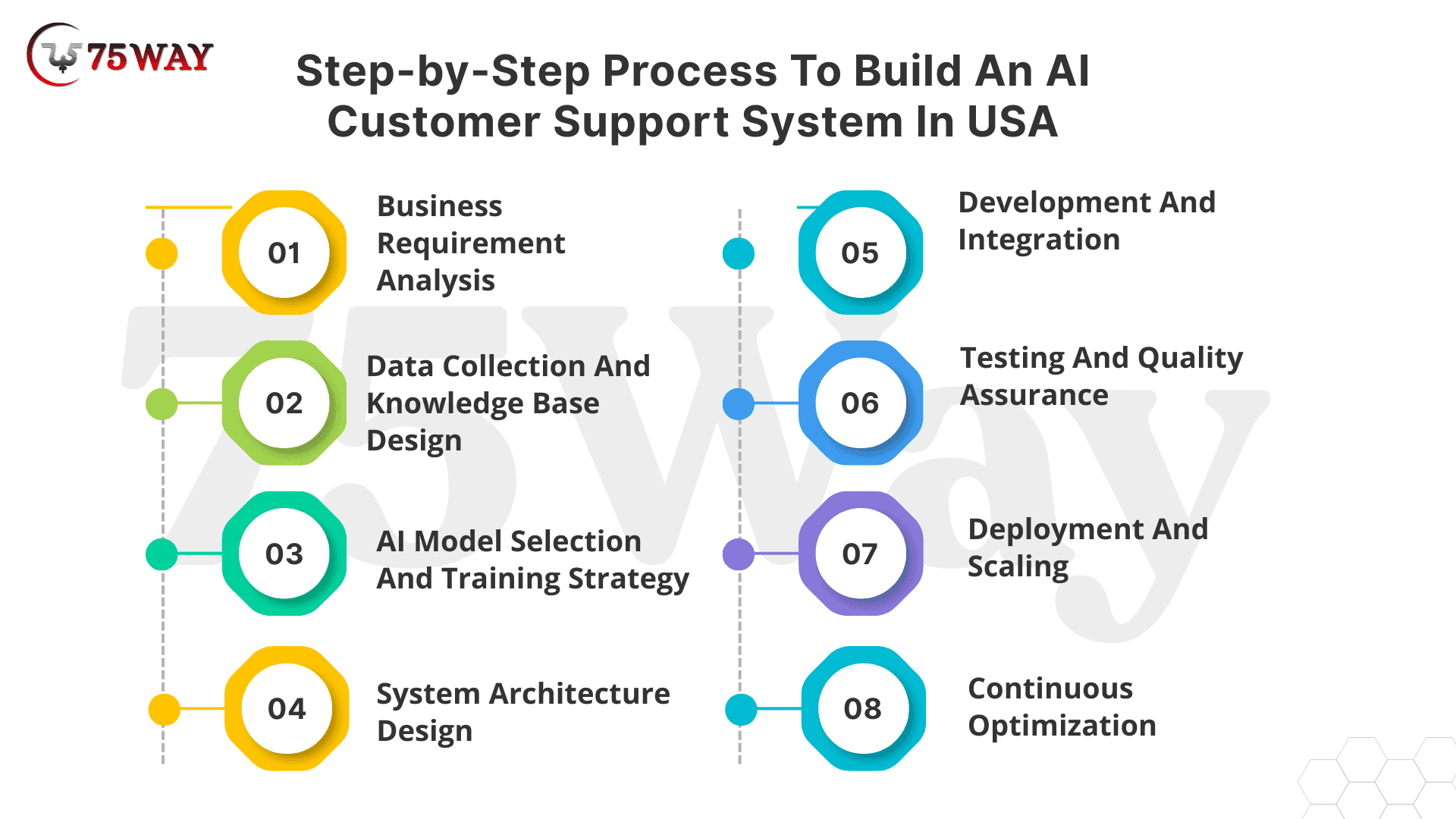
Step 1: Business Requirement Analysis
This step defines system goals by analyzing customer support channels, user journeys, automation needs, target industries, and expected ticket volumes. It ensures the AI system aligns with business objectives and reduces future redesign efforts through clear requirement planning and structured scope definition.
It also helps identify peak usage patterns and customer expectations across different regions. Stakeholders collaborate to prioritize features based on business value and operational impact. Proper documentation at this stage ensures smooth communication between technical and non-technical teams throughout development.
Step 2: Data Collection And Knowledge Base Design
Organizations gather structured data such as FAQs, product manuals, CRM logs, and historical tickets to build a strong knowledge base. This improves AI response accuracy, reduces irrelevant outputs, and ensures consistent, context-aware support across customer interactions.
Data cleaning and normalization are essential to remove inconsistencies and duplicates from datasets. Teams also categorize information into structured formats for faster AI retrieval. A well-maintained knowledge base directly improves system reliability and customer satisfaction.
Step 3: AI Model Selection And Training Strategy
This phase involves selecting pre-trained LLMs, fine-tuned models, or hybrid systems based on business needs. Training focuses on intent detection, sentiment analysis, entity recognition, and contextual understanding to improve system intelligence and response precision.
Model performance is evaluated using accuracy, latency, and relevance benchmarks. Continuous experimentation helps identify the most effective model configuration. Fine-tuning ensures better domain-specific understanding for enterprise use cases.
Step 4: System Architecture Design
A scalable architecture is designed with frontend interfaces, AI processing engines, workflow automation layers, databases, and APIs. Cloud-native infrastructure is commonly used in the USA to ensure high availability, performance, and seamless scalability for enterprise workloads.
Microservices architecture is often preferred for flexibility and modular development. Load balancing and distributed systems improve reliability under heavy traffic. Proper architecture design reduces downtime and improves system resilience.
Step 5: Development And Integration
Developers build chatbot interfaces, APIs, and AI engines while integrating CRM and helpdesk tools like Salesforce and Zendesk. Smooth integration ensures unified workflows and consistent customer experiences across all communication channels.
Version control and CI/CD pipelines are used to streamline development cycles. Third-party integrations are tested thoroughly to avoid data mismatches. Secure API connections ensure safe data exchange between systems.
Step 6: Testing And Quality Assurance
The system undergoes rigorous testing, including accuracy checks, load testing, security validation, and multi-channel performance testing. Continuous QA ensures reliability, scalability, and error-free customer interactions before deployment.
Edge cases are simulated to evaluate system behavior under unusual conditions. Automated testing tools help speed up validation cycles. Feedback from beta users is also incorporated to improve system performance.
Step 7: Deployment And Scaling
The solution is deployed on cloud platforms such as AWS, Azure, or Google Cloud with auto-scaling and monitoring systems. Proper deployment ensures uninterrupted service availability and stable performance during peak traffic conditions.
Monitoring tools track system health, response time, and error rates in real time. Rollback strategies are prepared in case of deployment issues. Scaling policies automatically adjust resources based on demand.
Step 8: Continuous Optimization
Post-launch optimization includes model retraining, conversation improvements, knowledge base updates, and performance tuning. Continuous learning helps the AI system evolve, improve accuracy, and deliver better customer support experiences over time.
User feedback is continuously collected to identify improvement areas. System logs are analyzed to detect inefficiencies and bugs. Regular updates ensure the platform remains competitive and aligned with evolving customer expectations.
Cost To Develop AI Customer Support System In USA 2026
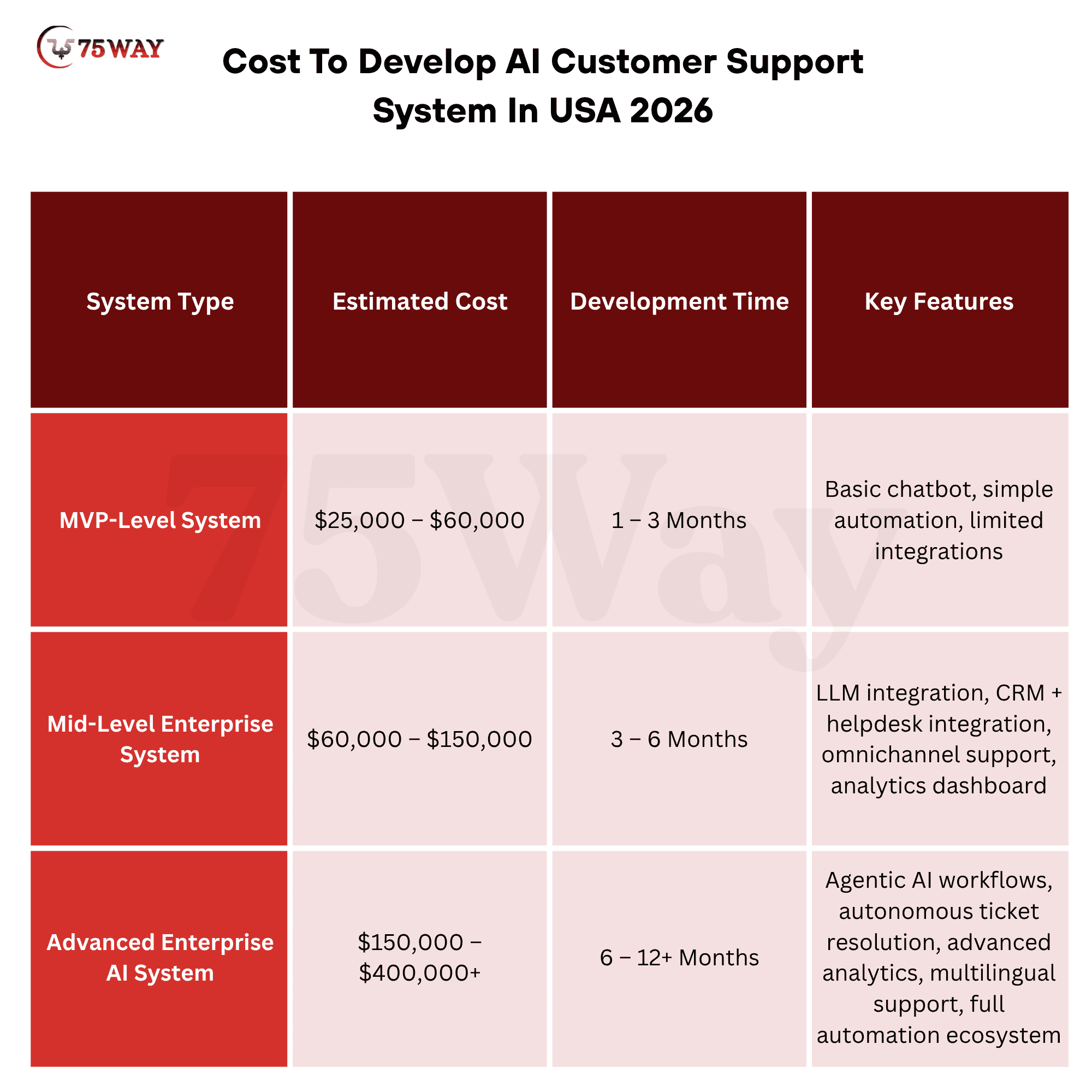
The cost of developing an AI customer support system in the USA varies depending on system complexity, AI capabilities, integrations, and scalability requirements. On average, businesses typically invest between $25,000 and $400,000+, depending on whether they are building a basic MVP solution or a fully advanced enterprise-grade AI automation system.
- MVP-Level System: $25,000 – $60,000
This system is designed for startups and small businesses needing basic AI customer support automation with limited features and simple chatbot functionality. It includes essential ticket handling, basic automation workflows, and minimal integrations to reduce initial development cost and speed up deployment for early-stage digital support operations.
- Mid-Level Enterprise System: $60,000 – $150,000
This system suits growing businesses requiring more advanced AI capabilities with stronger integrations and omnichannel support. It includes LLM-based chatbots, CRM and helpdesk integration, analytics dashboards, and improved automation. It balances performance, scalability, and cost efficiency for mid-sized enterprises aiming to enhance customer experience.
- Advanced Enterprise AI System: $150,000 – $400,000+
This is a full-scale AI-powered customer support solution for large enterprises with complex operational needs. It includes agentic AI workflows, autonomous ticket resolution, advanced analytics, multilingual support, and complete automation systems. It is built for maximum scalability, intelligence, and enterprise-grade reliability.
Key Factors Affecting Customer Support System Development Cost
- AI Complexity: More advanced models require higher compute and training costs.
- Integration Requirements: Systems connected with multiple platforms increase engineering effort.
- Data Volume: Large datasets require stronger infrastructure and processing pipelines.
- Security Standards: Enterprise-grade security (SOC2, HIPAA, CCPA) increases development scope.
- Scalability Needs: High-traffic systems require distributed cloud architecture.
Security And Compliance In USA For AI-Driven Customer Service Systems
Security and compliance are foundational elements of AI customer support systems in the USA, ensuring safe handling of sensitive customer data, regulatory adherence, and trust in enterprise operations. In 2026, businesses must follow strict standards such as SOC 2, CCPA, GDPR alignment, encryption protocols, and role-based access control to protect data integrity and prevent unauthorized access across AI-driven platforms.
- SOC 2 Compliance: SOC 2 ensures secure customer data handling, operational transparency, and strong internal controls for AI-driven support systems across enterprise environments.
- CCPA Compliance: CCPA protects California consumers by enforcing strict rules on data collection, usage, and user rights in digital platforms.
- GDPR Alignment (For Global Users): GDPR alignment ensures international compliance by safeguarding user privacy, consent management, and transparent data processing practices across regions.
- Data Encryption Standards: Data encryption protects sensitive information using end-to-end encryption, secure API gateways, and encrypted storage systems across all communications.
- Role-Based Access Control: RBAC restricts system access based on defined user roles, preventing unauthorized actions and strengthening overall system security architecture.
Conclusion
AI customer support systems are transforming how businesses in the USA manage customer interactions, operational efficiency, and service delivery. From intelligent chatbots to agentic AI workflows, organizations are moving toward fully automated, data-driven support ecosystems. In 2026, companies that adopt AI-powered customer service solutions will gain a strong competitive advantage through faster response times, reduced operational costs, and improved customer satisfaction. However, successful implementation requires the right combination of AI expertise, system architecture, integration strategy, and compliance readiness. Organizations that act early in this transformation will be better positioned to dominate customer experience leadership in their industry. Partner with a leading AI development company to design and develop a next-generation AI customer support system tailored to your business needs.
Frequently Asked Questions (FAQs)
Can AI Customer Support Systems Replace Human Agents?
AI systems can handle a large portion of customer queries, but human agents remain essential for complex emotional or high-stakes issues. The best approach is a hybrid model where AI manages routine tasks while humans handle critical escalations.
Do AI Support Systems Work For Small Businesses?
Yes, small businesses can benefit significantly from AI support tools. Even basic chatbot implementations can reduce response time, improve customer engagement, and lower operational costs without requiring large infrastructure investments or technical expertise.
How Secure Are AI Customer Support Platforms?
Modern AI support systems use encryption, secure APIs, access control, and compliance frameworks like SOC2 and CCPA. When properly designed, they offer enterprise-grade security suitable for sensitive customer interactions and regulated industries.
Can AI Systems Handle Multiple Languages?
Yes, advanced AI systems support multilingual communication using natural language processing models. This enables businesses to serve global customers effectively without hiring separate language-specific support teams for each region.
What Industries Benefit Most From AI Customer Support?
Industries such as e-commerce, SaaS, fintech, healthcare, logistics, and telecom benefit the most. These sectors handle high volumes of repetitive queries, making automation highly effective for cost reduction and service efficiency.
How Long Does It Take To Build An AI Support System?
Development timelines vary based on complexity. A basic system may take 6–10 weeks, while enterprise-grade solutions with agentic AI can take 3–6 months including testing, integration, and deployment phases.
Can AI Systems Integrate With Existing CRM Tools?
Yes, AI support systems can integrate with platforms like Salesforce, HubSpot, and Zendesk. These integrations allow seamless data flow, improved ticket management, and better customer relationship tracking across systems.
What Is The Future of AI Customer Support?
The future lies in agentic AI systems capable of autonomous decision-making, predictive support, and full workflow automation. These systems will significantly reduce human dependency while improving response speed and personalization.