Summary
AI agents for SaaS, ecommerce, and enterprises enhance autonomous decision-making, workflow automation, customer engagement, and intelligent process execution. The cost to build AI agent typically ranges from $5,000–$500,000+ depending on complexity and business objectives.
Quick Overview
- AI agent development costs range from $5,000–$500,000+.
- Development costs vary based on complexity, integrations, and autonomy levels.
- SaaS companies deploy agents across support, sales, and customer success.
- Ecommerce brands use AI agents for personalization and shopping assistance.
- Enterprise deployments require governance, security, compliance, and integrations
AI agents are everywhere in 2026. They are qualifying leads, answering customer questions, automating support tickets, managing workflows, processing documents, and even coordinating with other AI solutions to complete complex tasks.
What started as simple AI automation has quickly evolved into a major business investment across SaaS, ecommerce, healthcare, finance, logistics, and enterprise operations.
But before companies start building AI agents, one question comes up almost immediately: How much will it actually cost to create an AI agent?
The answer varies significantly. A basic AI agent may cost around $5,000–$30,000, while advanced enterprise-grade systems with multiple agents, integrations, memory layers, and autonomous workflows can exceed $500,000+. The final investment depends on factors such as functionality, AI models, integrations, deployment architecture, compliance requirements, and scalability goals.
Whether you are a SaaS startup looking to automate customer onboarding, an ecommerce brand building an AI shopping assistant, or an enterprise developing agentic AI-powered autonomous business workflows, understanding the cost structure is essential before making investment decisions.
In this guide, we break down AI agent development costs for SaaS, ecommerce, and enterprises in the USA in 2026, including pricing ranges, key cost factors, development timelines, hidden expenses, and strategies for maximizing ROI.
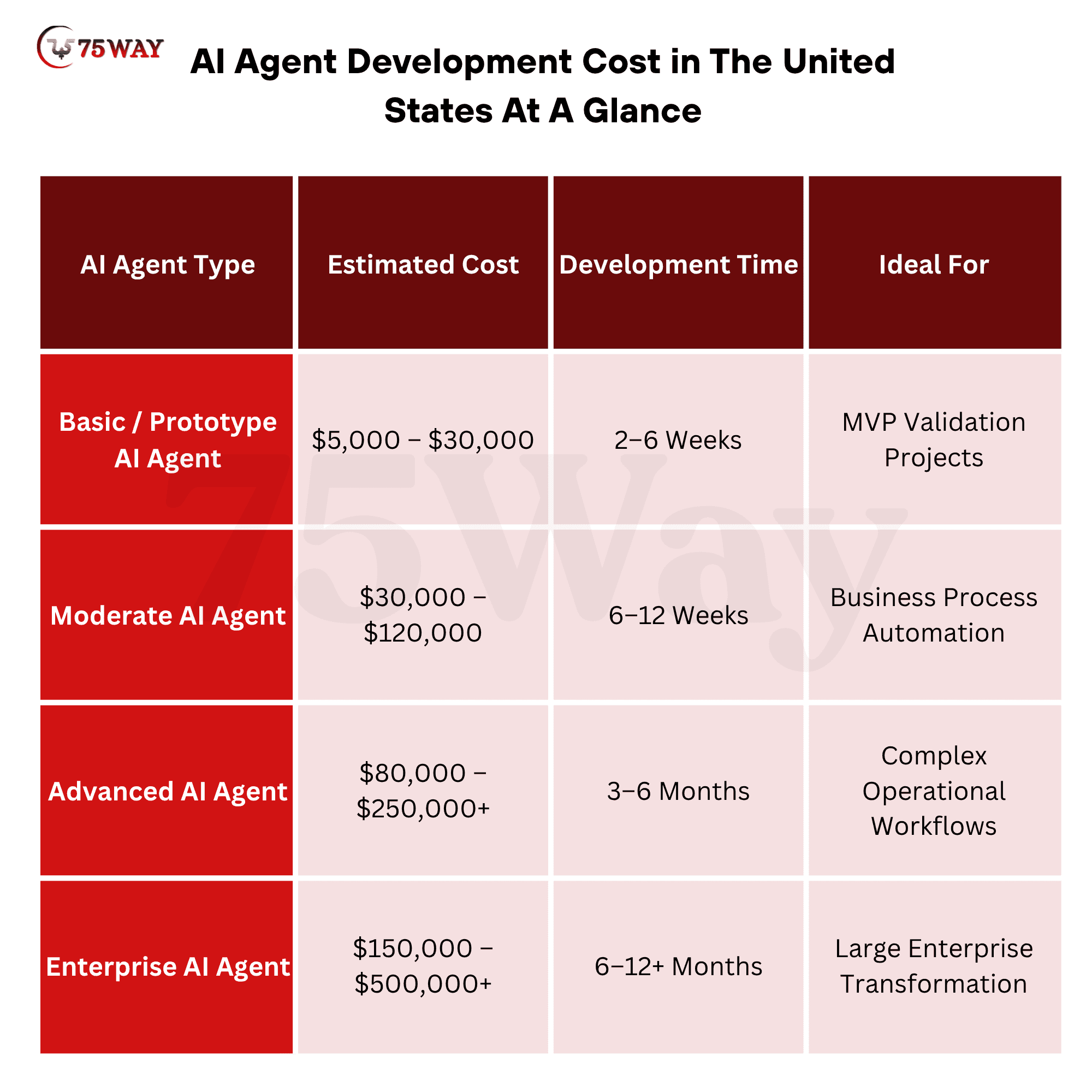
AI Agent Development Cost in The United States At A Glance
AI agent development costs vary significantly depending on complexity, integrations, autonomy levels, and business requirements. The following insights provide general estimates for AI agent development projects in the United States.
Basic/Prototype AI Agents: Just getting started with AI? This category focuses on simple automation, limited workflows, and essential integrations that help validate ideas before larger investments.
👉 Estimated cost to build a basic or prototype AI agent: $5,000–$30,000.
Mid-Level AI Agents: As business requirements grow, companies often need agents that can connect multiple systems, handle richer interactions, and automate routine operations more reliably.
👉 Estimated cost to build a mid-level AI agent: $30,000–$120,000.
Advanced AI Agents: Designed for organizations with complex processes, these agents support sophisticated decision-making, multi-step workflows, and deep integrations across business platforms.
👉 Estimated cost to build an advanced AI agent: $80,000–$250,000+.
Enterprise AI Agents: At the highest level, AI agents become strategic business assets, managing large-scale operations, compliance requirements, and cross-department workflows with enterprise-grade security.
👉 Estimated cost to build an enterprise AI agent: $150,000–$500,000+
Understanding AI Agent Pricing Models Based on Development Stages
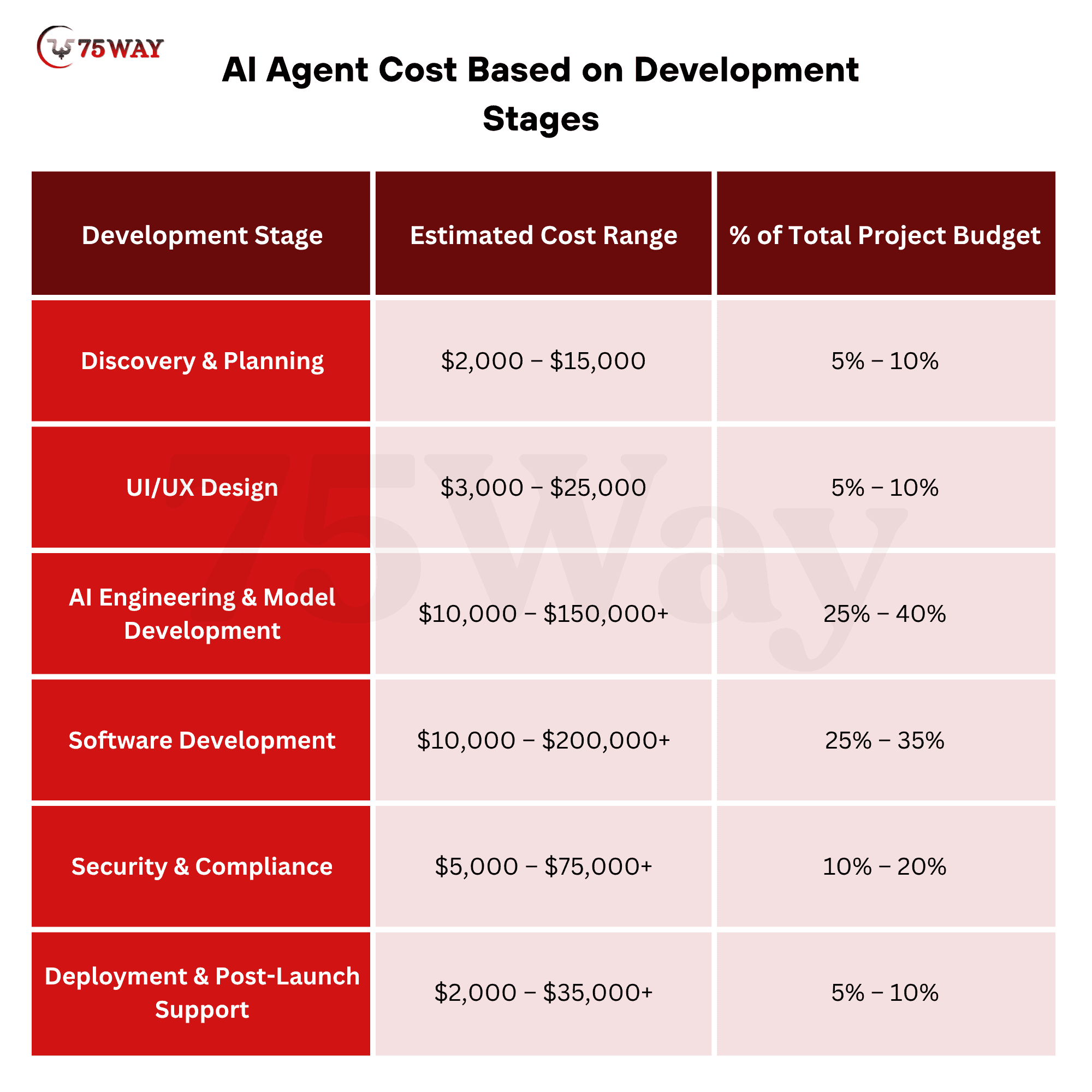
Before evaluating industry-specific AI agent development costs, it is important to understand where project budgets are allocated. Most AI agent projects involve multiple development stages, each contributing to the overall investment.
1. Discovery And Planning
Estimated Cost: $2,000–$15,000
Every successful AI agent project begins with thorough planning. During this phase, teams define business objectives, identify automation opportunities, evaluate technical requirements, and create an implementation roadmap.
Activities typically include:
- Requirements gathering
- Business process analysis
- Technical feasibility assessment
- AI strategy development
- Architecture planning
A strong discovery phase helps reduce costly development changes later.
2. Design And User Experience
Estimated Cost: $3,000–$25,000
User experience plays a major role in AI adoption. Whether the AI agent interacts with customers, employees, or business systems, intuitive workflows improve engagement and usability.
Key deliverables include:
- User journey mapping
- Conversation flow design
- Dashboard design
- Agent interaction planning
- Wireframes and prototypes
More advanced enterprise systems often require extensive UX research and testing.
3. AI Engineering
Estimated Cost: $10,000–$150,000+
AI engineering is usually the largest cost component of an AI agent project. This stage focuses on developing the intelligence layer that powers autonomous decision-making and workflow execution.
Major activities include:
- Large Language Model integration
- Prompt engineering
- Memory implementation
- Retrieval-Augmented Generation (RAG)
- Agent orchestration
- Tool integrations
- AI testing and optimization
Complex multi-agent systems require significantly higher investment during this phase.
4. Software Development
Estimated Cost: $10,000–$200,000+
Once the AI architecture is finalized, software development teams build the underlying platform and integrations.
This stage typically covers:
- Frontend development
- Backend development
- API creation
- Database implementation
- Workflow automation
- Third-party integrations
- Cloud infrastructure setup
Enterprise deployments often involve extensive integration with CRM, ERP, and internal business systems.
5. Security And Compliance
Estimated Cost: $5,000–$75,000+
Organizations operating in regulated industries must invest heavily in security and compliance frameworks.
Common requirements include:
- Role-based access controls
- Data encryption
- Audit logging
- Security monitoring
- SOC 2 readiness
- HIPAA compliance
- GDPR compliance
For healthcare, finance, and enterprise applications, this phase can become a major budget contributor.
6. Deployment And Support
Estimated Cost: $2,000–$35,000+
Launching an AI agent is only the beginning. Ongoing monitoring, maintenance, and optimization are essential for long-term performance.
Typical post-launch activities include:
- Cloud deployment
- Infrastructure monitoring
- Model updates
- Performance optimization
- Bug fixes
- Feature enhancements
- Technical support
Organizations should also budget for monthly operational expenses associated with AI model usage, cloud services, and system maintenance.
SaaS AI Agent Development Cost For Companies In USA
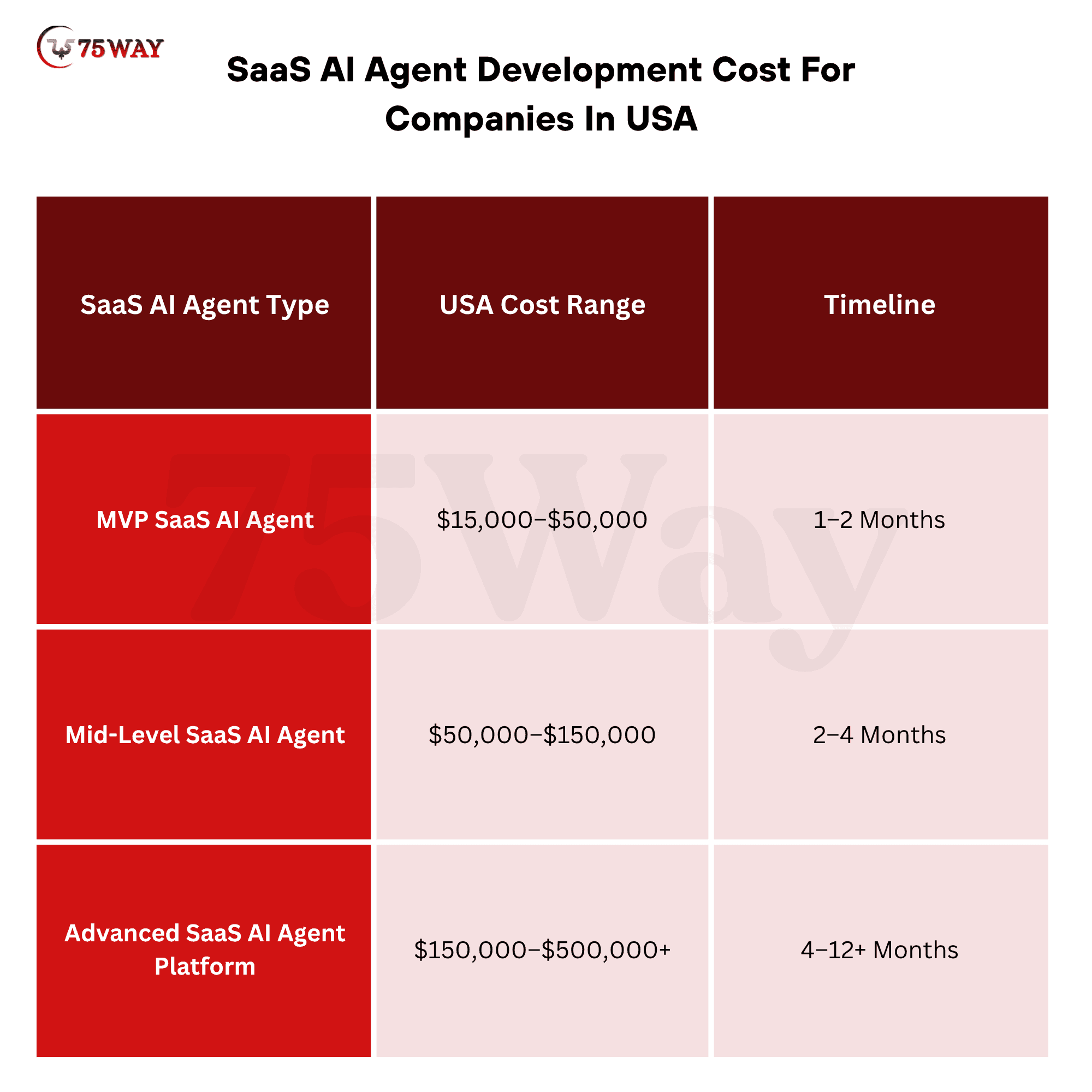
SaaS companies are among the fastest adopters of AI agents because they manage large volumes of customer interactions, onboarding activities, support requests, sales operations, and product engagement processes. AI agents help SaaS businesses automate repetitive workflows, improve customer experiences, and scale operations without proportionally increasing workforce costs. The cost to build AI SaaS agent typically ranges from $15,000 to $500,000+, depending on the number of integrations, level of autonomy, workflow complexity, and scalability requirements.
An MVP SaaS AI agent typically costs between $15,000 and $50,000 and can be developed within 1–2 months, making it suitable for validating product-market fit and testing core AI capabilities. A mid-level AI SaaS agent generally ranges from $50,000 to $150,000 with a development timeline of 2–4 months, offering more advanced workflows, integrations, and user interactions. For organizations building sophisticated AI-powered products, an advanced SaaS AI agent Platform can cost $150,000 to $500,000+ and require 4–9 months or longer to develop, depending on scalability requirements, multi-agent architecture, and enterprise-grade features.
Cost To Build AI SaaS Agents Based on Their Types
The type of AI agent you choose has a direct impact on development costs, implementation timelines, and overall business value. While some SaaS companies start with a single-purpose agent for customer support or sales automation, others invest in advanced multi-agent platforms that automate entire business functions.
- Customer Support AI Agents
Development Cost: $20,000–$75,000
Customer support AI agents are among the most widely adopted AI solutions in SaaS businesses. These agents help automate customer interactions, provide instant responses, retrieve information from knowledge bases, and reduce ticket volumes. Development costs depend on language model selection, channel integrations, conversation complexity, and escalation workflows. Businesses investing in customer support agents often achieve faster response times and improved customer satisfaction while reducing support overhead.
- Sales AI Agents For SaaS
Development Cost: $30,000–$100,000
Sales AI agents for SaaS help organizations automate lead management, customer engagement, and pipeline activities. These agents can analyze customer behavior, prioritize opportunities, schedule interactions, and support sales teams throughout the buying journey. Costs increase when integrating with CRM systems, revenue intelligence platforms, and predictive analytics tools. For SaaS businesses focused on growth, sales agents often generate measurable returns through increased conversion rates and productivity.
- Product Management AI Agents
Development Cost: $40,000–$150,000
Product management AI agents assist teams in analyzing customer feedback, monitoring product performance, identifying trends, and supporting roadmap decisions. These systems aggregate information from multiple sources and generate actionable insights that help teams prioritize development efforts. Costs vary based on data volume, analytics complexity, reporting requirements, and integration needs.
- Customer Success AI Agents
Development Cost: $30,000–$120,000
Customer success agents focus on retention, engagement, and account growth. These AI systems monitor customer activity, identify potential churn risks, analyze adoption patterns, and recommend actions to improve customer outcomes. Businesses that depend on recurring revenue often use these agents to maximize customer lifetime value and strengthen long-term relationships.
- Marketing AI Agents
Development Cost: $25,000–$100,000
Marketing AI agents support campaign execution, audience analysis, customer segmentation, and content personalization. They help businesses improve targeting accuracy, optimize campaign performance, and increase engagement across multiple channels. Development costs depend on data integrations, automation requirements, and the sophistication of predictive marketing capabilities.
- Revenue Operations AI Agents
Development Cost: $40,000–$125,000
Revenue operations AI agents provide visibility across sales, marketing, and customer success functions. These systems consolidate business data, identify performance trends, and generate forecasts that support strategic decision-making. Organizations seeking stronger alignment between departments often invest in revenue operations agents to improve reporting accuracy and business performance.
- Analytics AI Agents for SaaS
Development Cost: $35,000–$125,000
Analytics AI agents transform large volumes of business data into actionable insights. These systems continuously monitor key performance indicators, identify trends, generate reports, and provide recommendations for optimization. Costs vary according to reporting complexity, data sources, visualization requirements, and predictive capabilities.
- SaaS Multi-Agent Platforms
Development Cost: $150,000–$500,000+
Multi-agent platforms represent the most advanced category of SaaS AI solutions. Instead of relying on a single AI agent, these platforms deploy multiple specialized agents that collaborate across customer support, sales, marketing, customer success, product management, and operations.
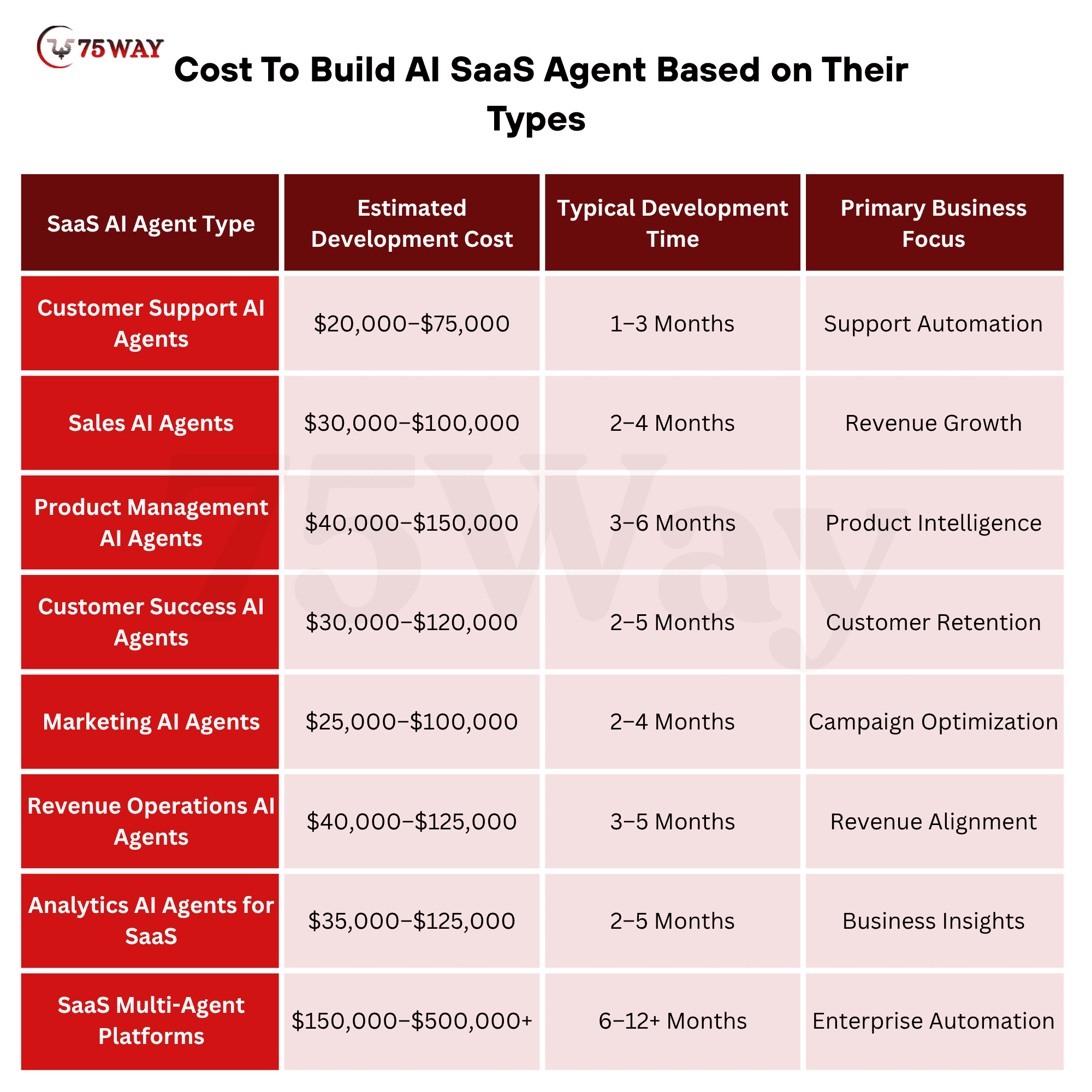
The development cost for AI SaaS agents increases significantly due to agent orchestration, governance frameworks, security requirements, and enterprise-grade integrations. Large SaaS organizations often choose multi-agent architectures to achieve end-to-end automation and business intelligence across the entire customer lifecycle.
Ecommerce AI Agent Development Cost For Retail Businesses In USA
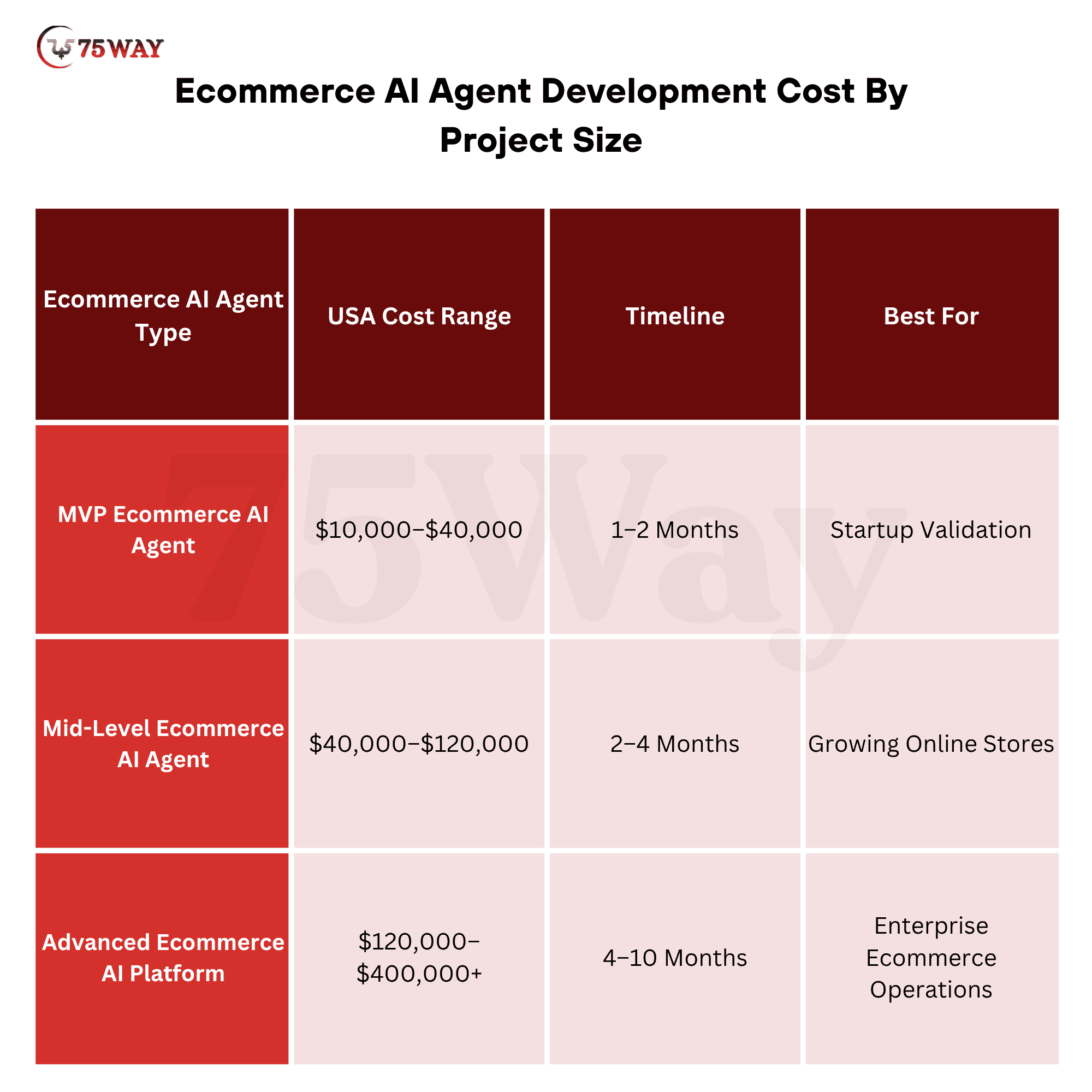
The ecommerce industry is rapidly adopting AI agents for retail to improve customer experiences, automate operational workflows, optimize inventory management, and increase revenue. Ecommerce AI agent development costs generally range from $10,000 to $400,000+, depending on platform complexity, integrations, data requirements, and automation goals.
MVP Ecommerce AI Agent: $10,000–$40,000
An MVP Ecommerce AI Agent is designed for businesses looking to validate AI capabilities without making a significant upfront investment. These solutions typically handle basic functions such as product recommendations, customer support automation, order tracking, and FAQ responses. With a development timeline of 1–2 months, MVP agents help ecommerce companies test customer adoption and gather valuable user feedback before scaling further.
Mid-Level Ecommerce AI Agent: $40,000–$120,000
As ecommerce operations grow, businesses often require AI agents with more advanced automation, integrations, and personalization capabilities. Mid-level solutions can connect with ecommerce platforms, CRM systems, inventory tools, and marketing software while supporting intelligent product recommendations, customer segmentation, and automated workflows. Most projects in this category require 2–4 months of development depending on integration complexity and customization requirements.
Advanced Ecommerce AI Agent Cost: $120,000–$400,000+
Advanced ecommerce AI agents are built for high-growth and enterprise ecommerce organizations seeking end-to-end AI-driven operations. These solutions often include multiple AI agents working together across customer service, personalization, inventory optimization, demand forecasting, marketing automation, and analytics. Due to the complexity of enterprise integrations, data infrastructure, and scalability requirements, development typically takes 4–10 months or longer, depending on business objectives and platform scope.
Category-Wise Cost To Build AI Ecommerce Agent
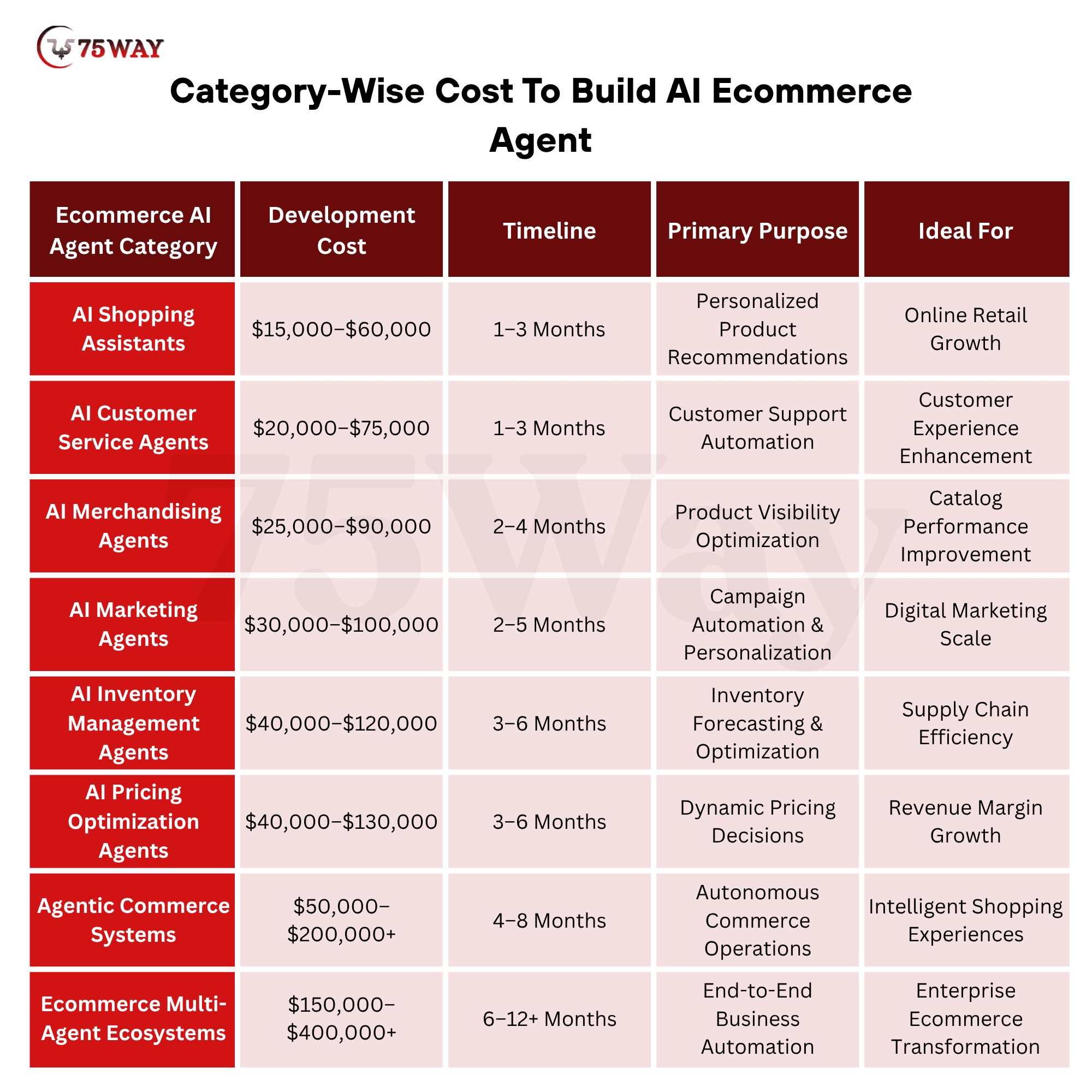
Not all ecommerce AI agents serve the same purpose, which is why development costs can vary significantly. The final investment depends on the agent's functionality, integrations, automation complexity, and business objectives.
- AI Shopping Assistants
Development Cost: $15,000–$60,000
AI shopping assistants are designed to improve the online buying experience by helping customers discover products, compare options, and make purchasing decisions faster. These agents analyze customer preferences, browsing behavior, and purchase history to deliver personalized recommendations in real time.
Development costs depend on product catalog size, recommendation engine complexity, personalization capabilities, and ecommerce platform integrations.
- AI Customer Service Agents
Development Cost: $20,000–$75,000
Customer support AI agents help ecommerce businesses automate customer interactions throughout the purchasing journey. These systems handle inquiries related to orders, shipping updates, refunds, returns, product information, and account management.
The overall investment varies based on communication channels, workflow complexity, multilingual capabilities, and backend integrations.
- AI Merchandising Agents
Development Cost: $25,000–$90,000
Merchandising AI agents help ecommerce businesses optimize product visibility and improve catalog performance. These agents analyze customer behavior, product demand, seasonal trends, and purchasing patterns to determine which products should receive greater visibility.
Costs are influenced by the number of SKUs, data sources, recommendation algorithms, and reporting requirements.
- Ecommerce AI Marketing Agents
Development Cost: $30,000–$100,000
Ecommerce marketing AI agents automate various aspects of digital marketing operations, including audience segmentation, campaign management, personalization, customer engagement, and performance analysis. These systems continuously evaluate customer behavior to identify opportunities for more relevant marketing activities.
Costs increase when businesses require advanced predictive analytics, omnichannel automation, customer journey orchestration, and integration with advertising platforms.
- AI Inventory Management Agents
Development Cost: $40,000–$120,000
Inventory management AI agents help businesses maintain optimal stock levels while reducing inventory-related costs. These systems analyze historical sales data, purchasing trends, supplier information, and seasonal fluctuations to generate inventory recommendations.
Organizations implementing inventory AI agents often achieve better stock availability and reduced operational inefficiencies.
- AI Pricing Optimization Agents
Development Cost: $40,000–$130,000
Pricing optimization agents continuously analyze market conditions, customer demand, competitor activity, and purchasing behavior to support dynamic pricing strategies. These systems help businesses maximize revenue while maintaining competitive positioning.
For ecommerce businesses operating in highly competitive markets, pricing optimization agents can significantly improve profitability and decision-making.
- Agentic Commerce Systems
Development Cost: $50,000–$200,000+
Agentic commerce systems represent the next generation of ecommerce automation. Unlike traditional AI tools that focus on individual tasks, these systems can autonomously manage multiple aspects of the customer journey, from product discovery and recommendations to personalized engagement and conversion optimization.
Development costs of agentic AI in ecommerce vary according to workflow complexity, autonomous decision-making capabilities, customer data infrastructure, and system integrations.
- Ecommerce Multi-Agent Ecosystems
Development Cost: $150,000–$400,000+
Multi-agent ecommerce ecosystems consist of multiple specialized AI agents working together across merchandising, marketing, customer service, pricing, inventory, and operations. Each agent performs a dedicated function while sharing information with other agents to improve overall business performance.
The development investment is significantly higher because these systems require advanced orchestration frameworks, enterprise-grade integrations, governance controls, security mechanisms, and continuous optimization.
Cost For Building Enterprise AI Agent By Project Size In 2026
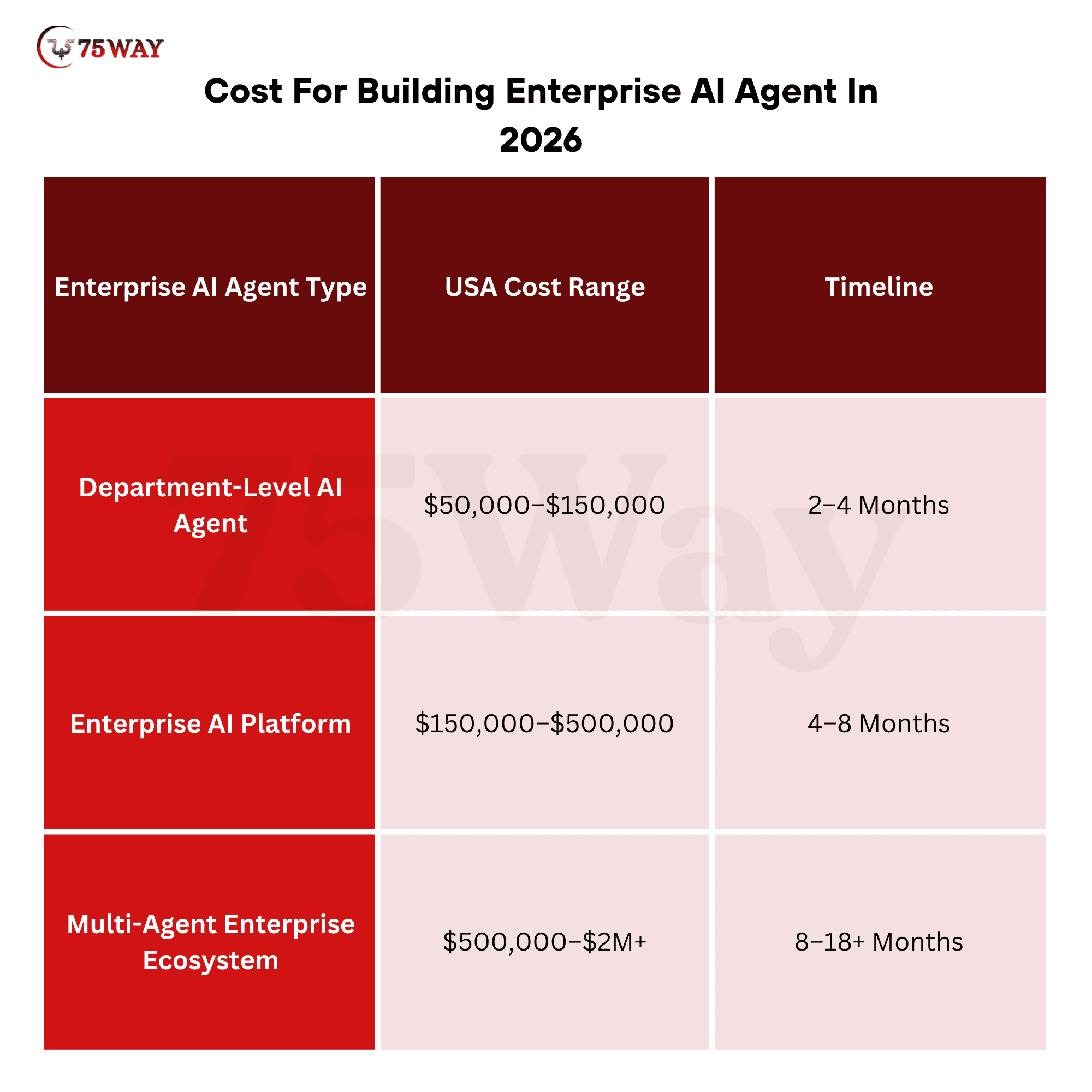
Enterprise AI projects generally require larger budgets, stronger governance frameworks, and advanced security controls. Enterprise AI agent development costs typically range from $50,000 to $800,000+, while large-scale multi-agent ecosystems can exceed $1 million depending on implementation scope and organizational requirements.
- Department-Level AI Agent: Typically costs between $50,000 and $150,000 with a development timeline of 2–4 months. Designed for a specific business function. Common use cases include sales, support, HR, and operations automation.
- Enterprise AI Agent: Usually requires an investment of $150,000–$500,000 and takes 4–8 months to develop. Supports multiple workflows and integrations. Built for scalability, governance, and cross-department automation.
- Multi-Agent Enterprise Ecosystem: Costs typically range from $500,000 to $2M+ with development timelines of 8–18+ months. Multiple AI agents collaborate autonomously. Ideal for complex enterprise-wide operations and intelligent decision-making.
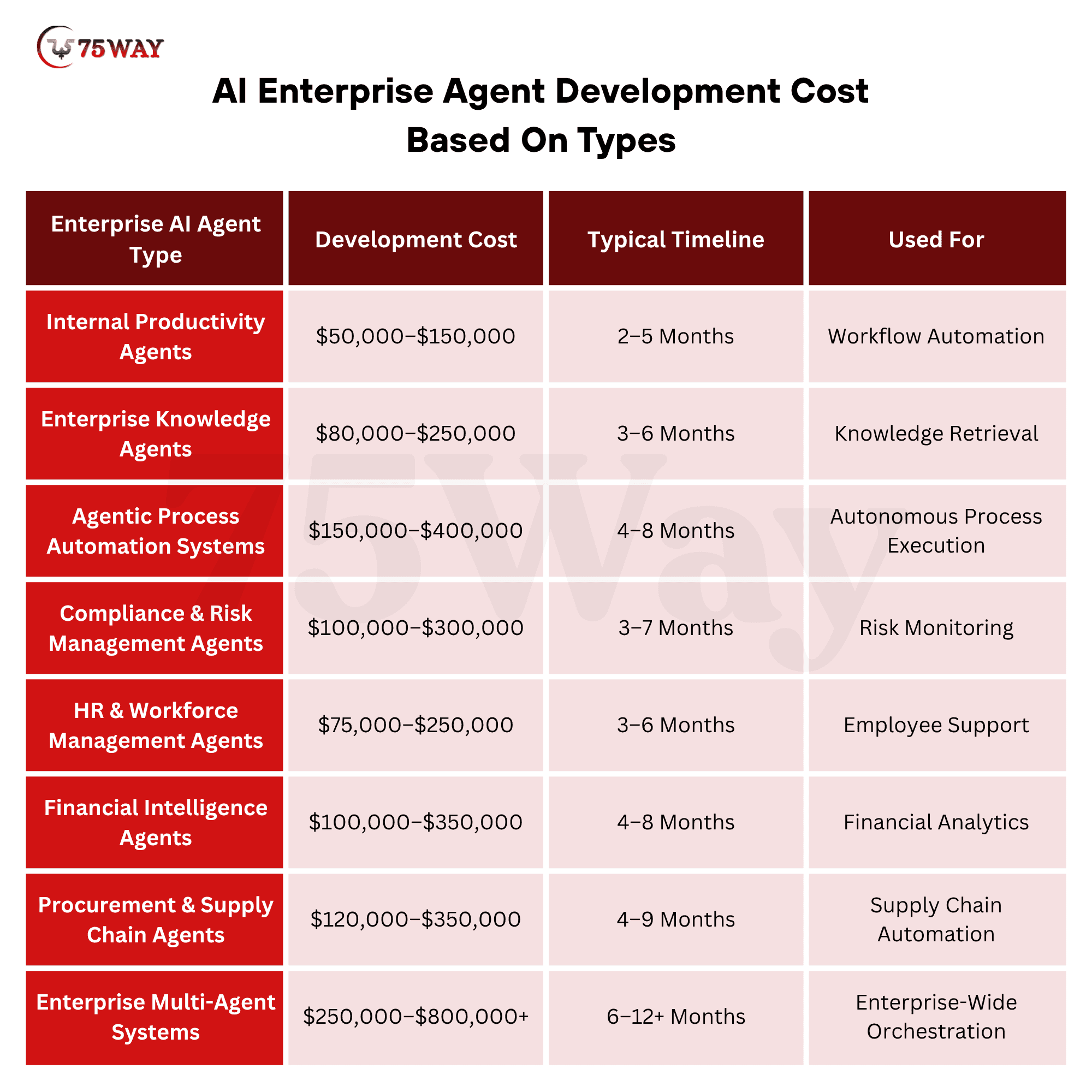
AI Enterprise Agent Development Cost Based On Types
From automating routine operations to managing enterprise-wide workflows, AI agents can play very different roles across organizations. As capabilities expand, so do development complexity, timelines, and overall investment requirements. The cost to build different kind sof AI enterprise agents is classified as:
- Internal Productivity Agents
Estimated Cost: $50,000–$150,000
Internal productivity agents help organizations automate repetitive administrative activities, streamline employee workflows, and improve access to business information. These AI systems are commonly deployed across departments to reduce manual effort and increase workforce productivity.
- Enterprise Knowledge Agents
Estimated Cost: $80,000–$250,000
Enterprise knowledge agents centralize and organize information spread across multiple systems, documents, databases, and communication channels. These agents help employees quickly access relevant information without manually searching through large volumes of content.
- Agentic Process Automation Systems
Estimated Cost: $150,000–$400,000
Agentic process automation systems move beyond traditional workflow automation by enabling AI agents to execute complex business processes autonomously. These systems can analyze situations, make decisions, coordinate actions across multiple applications, and complete multi-step workflows with minimal human intervention.
- Compliance And Risk Management Agents
Estimated Cost: $100,000–$300,000
Compliance and risk management agents help organizations monitor regulatory requirements, identify potential risks, track policy adherence, and generate compliance documentation. These AI compliance assurance agents are particularly valuable in highly regulated industries such as healthcare, finance, insurance, and legal services.
- HR And Workforce Management Agents
Estimated Cost: $75,000–$250,000
HR AI agents assist organizations with employee support, recruitment processes, onboarding activities, workforce planning, and internal communications. These systems can provide employees with instant access to policies, benefits information, training resources, and operational guidance.
- Financial Intelligence Agents
Estimated Cost: $100,000–$350,000
Financial intelligence agents help organizations analyze financial data, monitor spending patterns, support forecasting activities, and identify operational insights. These systems process large volumes of financial information to generate reports, recommendations, and predictive analysis.
- Procurement And Supply Chain Agents
Estimated Cost: $120,000–$350,000
Procurement and supply chain agents automate vendor management, purchasing workflows, inventory coordination, supplier analysis, and procurement decision-making. These AI systems help organizations optimize procurement operations while reducing inefficiencies across supply chains.
- Enterprise Multi-Agent Systems
Estimated Cost: $250,000–$800,000+
Enterprise multi-agent systems represent the most advanced category of AI agent deployment. These solutions consist of multiple specialized agents working together across departments, business units, and enterprise applications. Instead of operating independently, agents collaborate to share information, coordinate activities, and execute complex organizational workflows.
Factors Affecting Cost To Create AI Agents For SaaS, Retail, & Enterprises
While industry type plays an important role in determining project budgets, several technical and business factors have a direct impact on overall AI agent development costs. Understanding these cost drivers helps organizations create realistic budgets and avoid unexpected expenses during implementation.
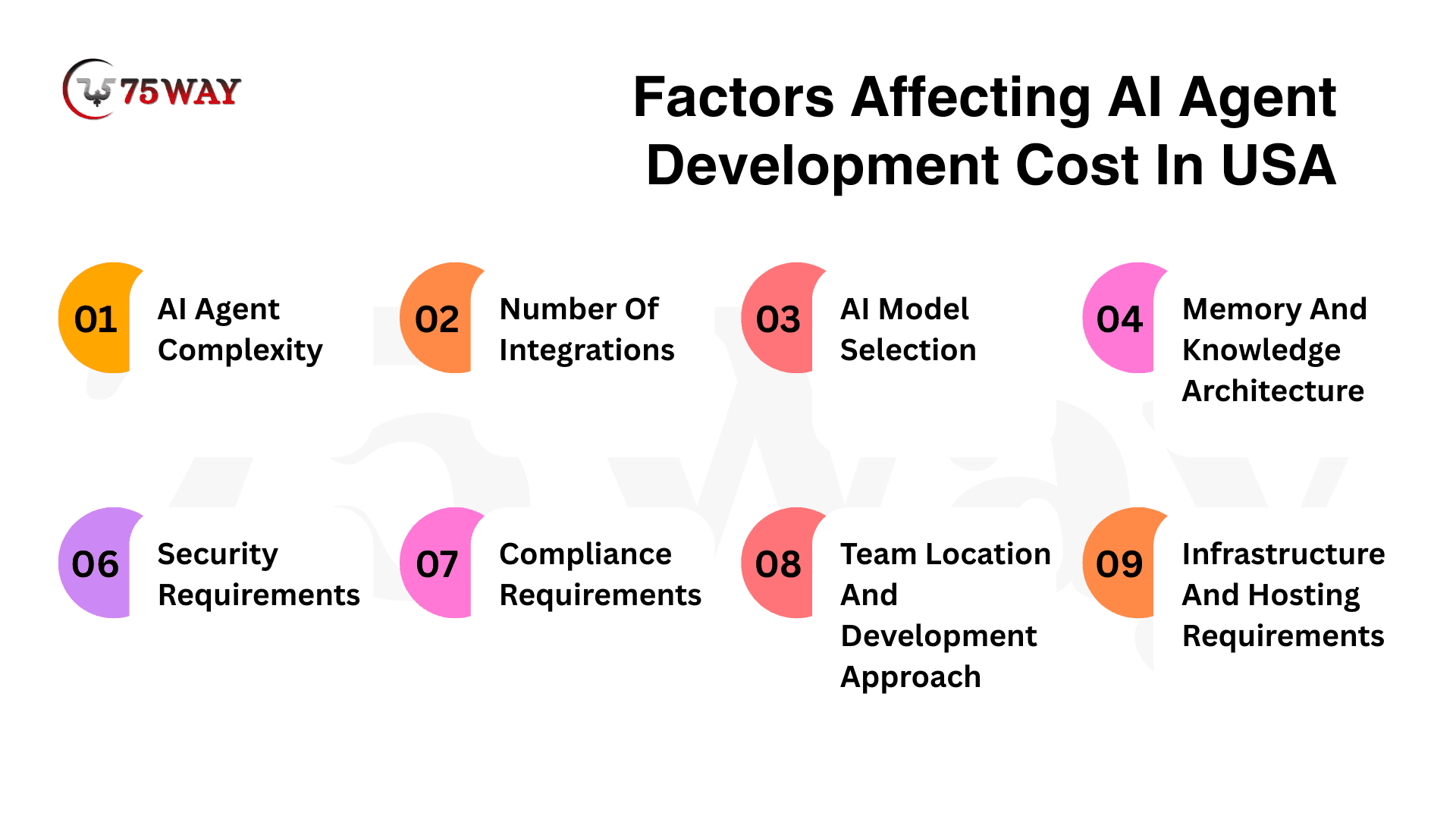
1. AI Agent Complexity
The sophistication of an AI agent is one of the largest factors affecting development costs. Basic agents typically perform simple tasks using predefined workflows and limited decision-making capabilities. Advanced agents support autonomous reasoning, long-term memory, multi-step execution, and dynamic decision-making. As agent intelligence increases, development effort, testing requirements, and infrastructure complexity also increase.
- Basic AI Agent: $5,000–$30,000
- Intermediate AI Agent: $30,000–$100,000
- Advanced AI Agent: $100,000–$300,000+
- Multi-Agent System: $250,000–$1M+
2. Number of Integrations
AI agents rarely operate as standalone systems. To deliver real business value, they often need to connect with CRM platforms, ERP systems, helpdesk software, ecommerce solutions, marketing tools, payment gateways, internal databases, and analytics platforms. While these integrations enable seamless data flow and workflow automation, each additional connection increases development effort, testing requirements, security considerations, and ongoing maintenance costs, directly impacting the overall investment needed to build and deploy the AI agent.
- 1–3 Integrations: $5,000–$20,000
- 4–10 Integrations: $20,000–$75,000
- Enterprise Integrations: $75,000–$250,000+
3. AI Model Selection
Estimated Cost Impact: $5,000–$100,000+
The choice of AI model plays a major role in determining both development costs and long-term operating expenses. Organizations can choose from proprietary large language models, open-source models, fine-tuned domain-specific models, or sophisticated multi-model architectures depending on their performance and business requirements. While basic implementations may require minimal customization, advanced deployments often involve model fine-tuning, evaluation frameworks, prompt engineering, guardrails, and performance optimization, increasing the overall investment required to build and maintain the AI agent.
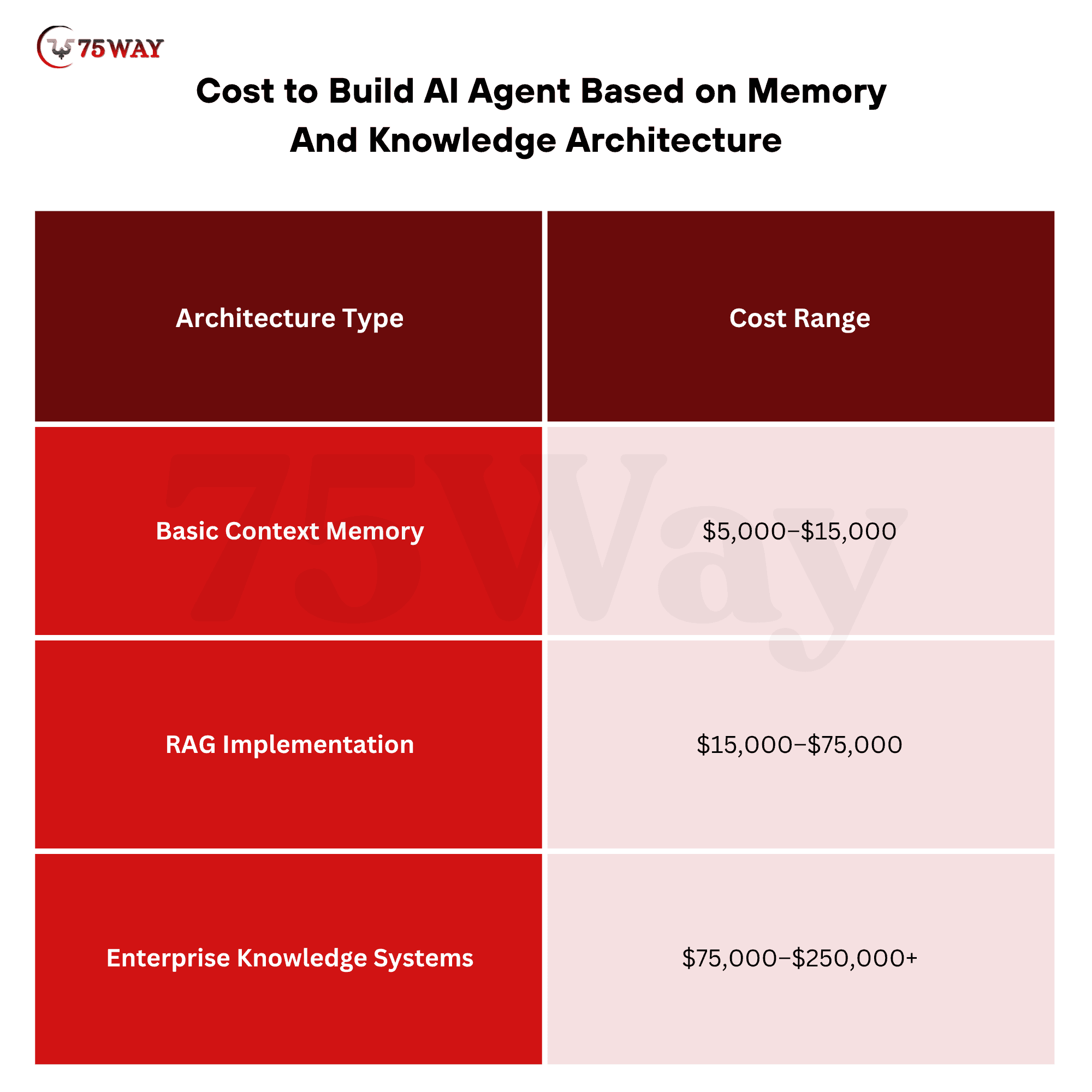
4. Memory And Knowledge Architecture
Many modern AI agents require memory systems to maintain context, access historical information, and retrieve knowledge from organizational data sources. Implementing capabilities such as:
- Vector databases
- Retrieval-Augmented Generation (RAG)
- Knowledge graphs
- Long-term memory systems
adds significant engineering effort and infrastructure requirements.
5. Security & Compliance Requirements: $25,000–$175,000+
Security and regulatory requirements can increase cost to craft AI agents for enterprises, SaaS, and retail. Organizations often need role-based access controls, encryption, audit trails, monitoring systems, secure APIs, and identity management, while compliance frameworks such as HIPAA, SOC 2, GDPR, PCI DSS, FINRA, and CCPA require additional documentation, testing, governance controls, auditing procedures, and ongoing monitoring to ensure regulatory adherence.
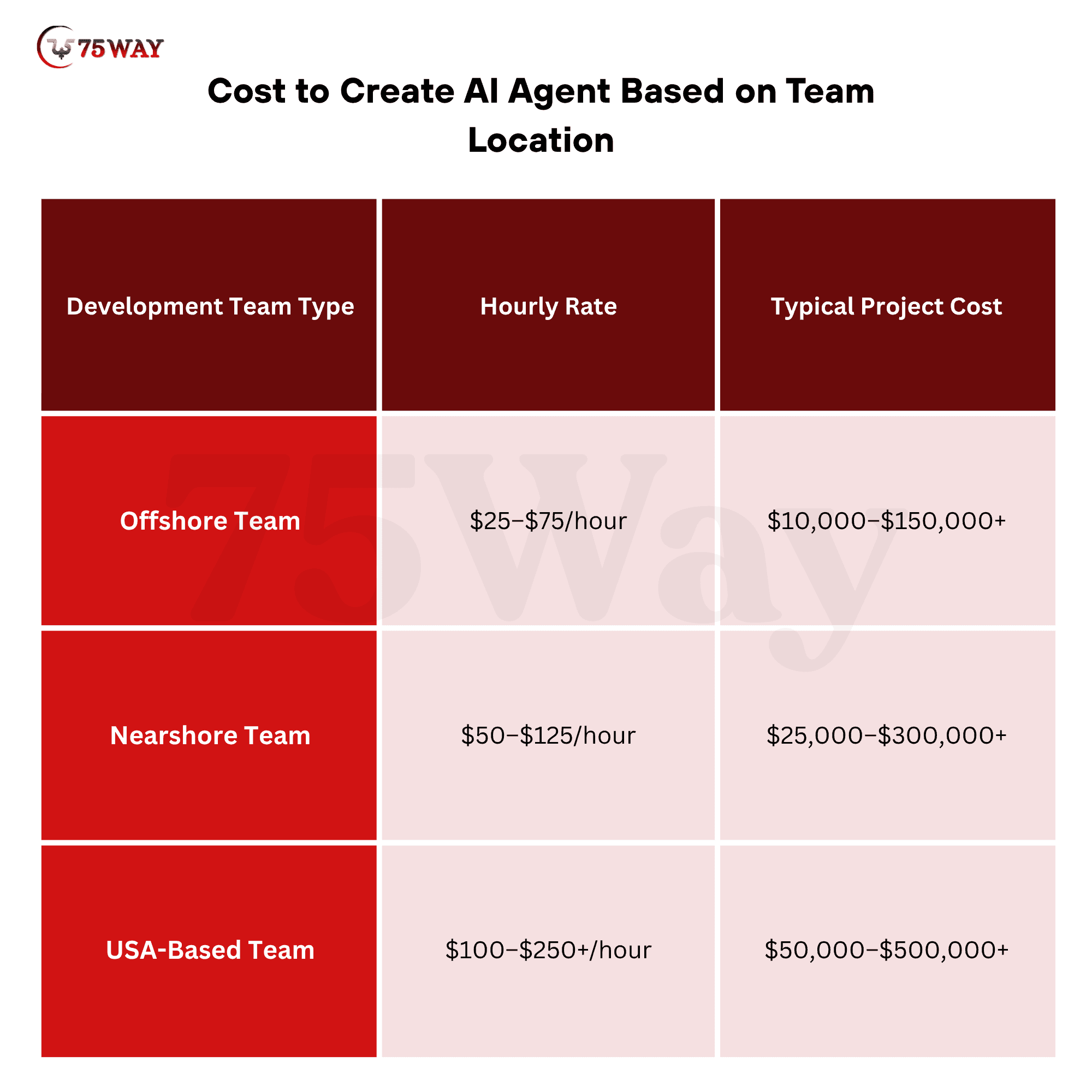
6. Team Location & Development Approach
The location of the development team has a major impact on total project cost.
- Offshore Team: $25–$75/hour
- Nearshore Team: $50–$125/hour
- USA-Based Team: $100–$250+/hour
7. Infrastructure & Hosting Requirements
Estimated Cost Impact: $5,000–$100,000+ annually
AI agents for enterprises, SaaS, and e-commerce require cloud infrastructure, GPU resources, storage systems, vector databases, monitoring tools, and security services. These ongoing operational expenses continue after deployment and directly impact long-term ownership costs.
Hidden Costs of AI Agent Development Most Businesses Ignore
Many organizations focus exclusively on development costs when budgeting an AI agent project. However, development represents only one part of the total investment. After deployment, businesses must account for operational expenses, infrastructure costs, maintenance requirements, and ongoing optimization efforts. Failing to plan for these expenses can lead to budget overruns and reduced ROI.
1. Large Language Model Usage Costs: Most AI agents rely on large language models for understanding requests and generating responses. Costs depend on users, conversation volume, and token consumption. High-usage deployments can generate significant recurring expenses.
- LLM Low Usage Cost: $100–$1,000
- LLM Medium Usage Cost: $1,000–$10,000
- LLM High Usage Cost: $10,000–$100,000+
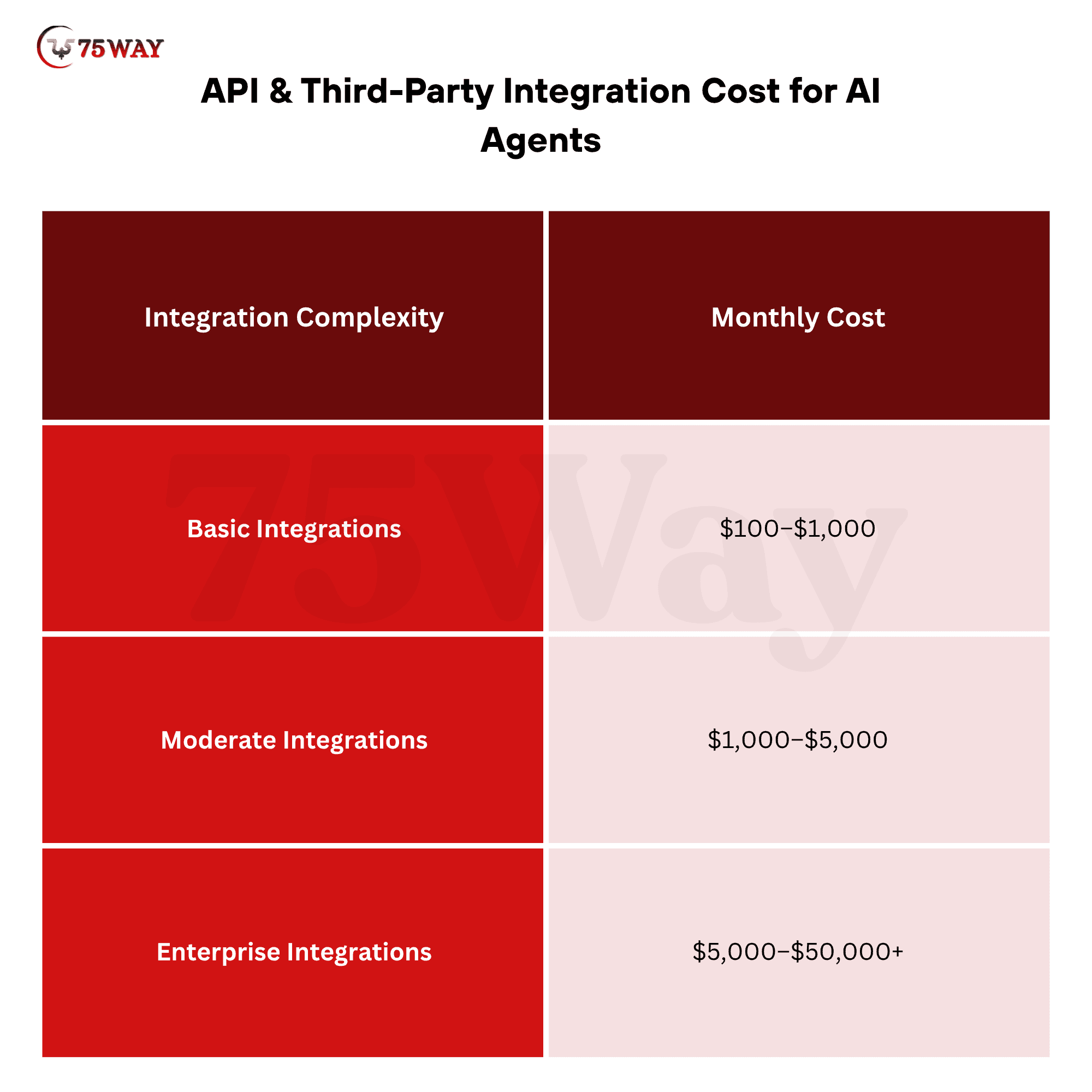
3. API & Third-Party Service Fees
AI agents often rely on external platforms to perform business functions and retrieve information. Common API-related expenses include CRM platforms, ERP systems, payment gateways, ecommerce platforms, communication services, data providers, and analytics tools that support AI agent functionality. As integrations increase, monthly software expenses also grow.
- Basic Integrations: $100–$1,000
- Moderate Integrations: $1,000–$5,000
- Enterprise Integrations: $5,000–$50,000+
4. Vector Database Costs
Many AI agents use Retrieval-Augmented Generation (RAG) architectures to access business knowledge and maintain contextual accuracy. This requires vector databases capable of storing and retrieving large amounts of information. Organizations building enterprise knowledge agents should budget separately for vector database infrastructure.
- Small Vector Database Costs: $50–$500
- Medium Vector Database Costs: $500–$5,000
- Enterprise Vector Database Costs: $5,000–$25,000+
5. Monitoring And Observability Platforms
AI agents require continuous monitoring to maintain performance, identify issues, and optimize outputs. Monitoring solutions help organizations track response quality, user interactions, and agent performance, etc. Without proper observability, businesses may struggle to identify performance bottlenecks and operational risks.
- Basic Monitoring: $100–$1,000
- Advanced Monitoring: $1,000–$10,000
- Enterprise Observability: $10,000–$50,000+
6. Maintenance And Support Costs
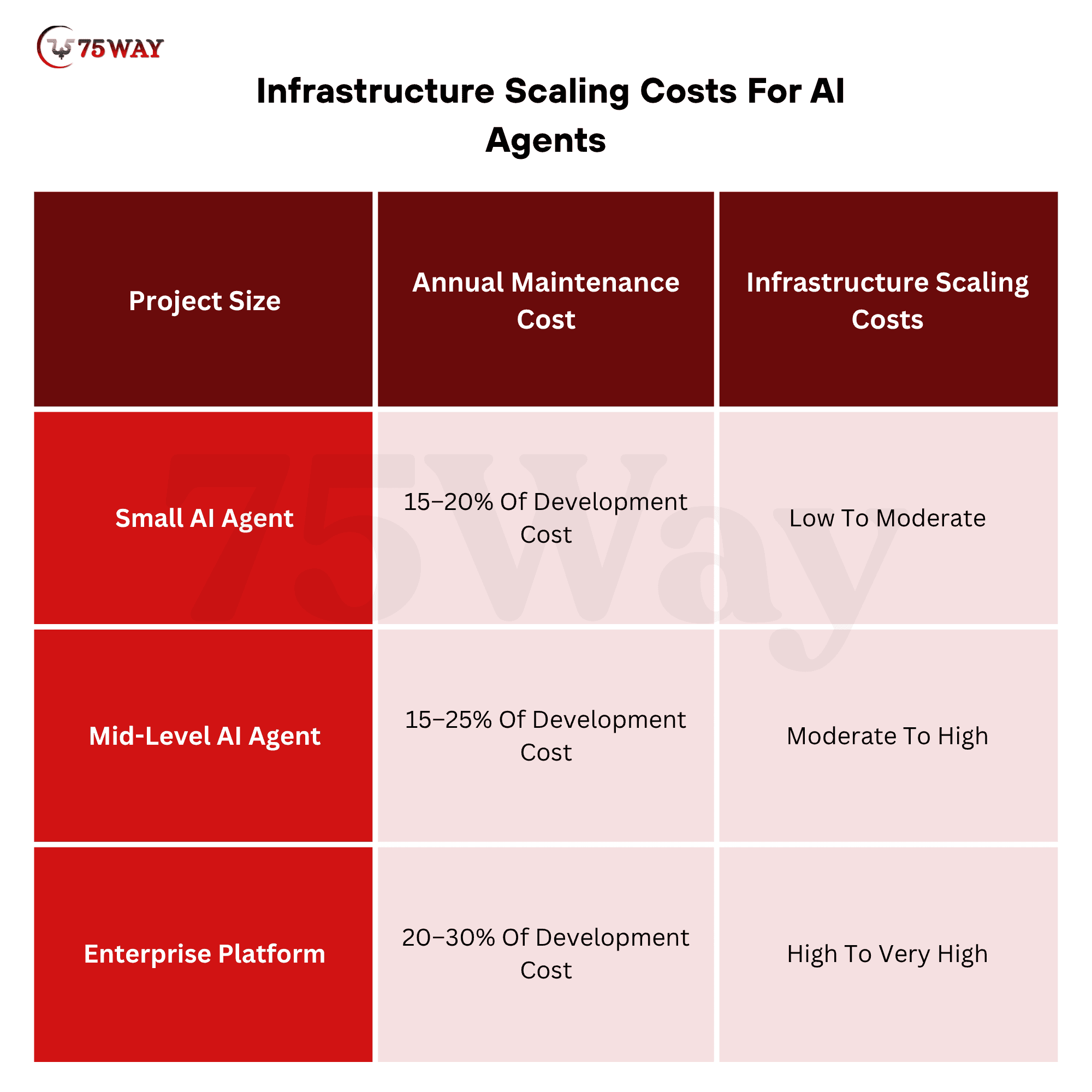
AI agents are not "set-and-forget" systems. As business requirements evolve, organizations must update workflows, improve prompts, optimize performance, and maintain integrations. Ongoing maintenance commonly includes bug fixes, workflow improvements, and integration updates. Most organizations allocate an annual maintenance budget after launch.
- Small AI Agent Maintenance Cost: 15–20%
- Mid-Level AI Agent Maintenance Cost: 15–25%
- Enterprise Platform Maintenance Cost: 20–30%

7. Model Retraining And Optimization
As user behavior changes and business data grows, AI agents require periodic optimization. Organizations pursuing high levels of accuracy often invest continuously in optimization initiatives.
- Basic Agent Optimization Cost: $5,000–$20,000
- Mid-Level Agent Optimization Cost: $20,000–$75,000
- Enterprise Agent Optimization Cost: $75,000–$250,000+
8. Infrastructure Scaling Costs
As adoption increases, AI agents consume more resources. Businesses often experience growth in cloud infrastructure, storage requirements, API consumption, and database capacity. The cost for infrastructure scaling are:
Monthly Operating Costs After Deploying AI Agent in Ecommerce, SaaS, & Enterprise Systems
Development is only the initial investment. You must also budget for ongoing operational expenses required to keep AI agents running. The following estimates represent average monthly operating costs for AI agent deployments in the USA.
- AI Agent Operating Cost for Startup: $200–$2,000/month
- AI Agent Operating Cost for Small Business: $2,000–$5,000/month
- AI Agent Operating Cost for Mid-Sized Business: $5,000–$15,000/month
- AI Agent Operating Cost for Enterprise: $15,000–$100,000+/month
Build Vs Buy: Which Approach Is More Cost-Effective?
One of the biggest decisions organizations face is whether to build a custom AI agent or purchase an existing platform. The answer depends on business goals, technical requirements, budget constraints, and long-term scalability needs.
1. Building A Custom AI Agent
Custom development provides complete control over functionality, integrations, workflows, and business logic.
Advantages
- Fully tailored solution
- Greater flexibility
- Strong competitive differentiation
- Better integration capabilities
- Full ownership of intellectual property
Limitations
- Higher upfront investment
- Longer implementation timeline
- Greater maintenance responsibilities
- Ongoing development requirements
Typical Cost:$15,000–$2M+
Custom AI agent development is generally preferred by organizations with unique operational requirements or complex workflows.
2. Purchasing An Existing AI Platform
Many businesses choose pre-built AI platforms to accelerate deployment and reduce implementation complexity.
Advantages
- Faster deployment
- Lower initial investment
- Reduced development effort
- Easier implementation
- Vendor-managed updates
Limitations
- Limited customization
- Subscription costs
- Vendor dependency
- Integration restrictions
- Reduced competitive differentiation
Typical Cost: $100–$20,000+ Per Month
Pre-built platforms work well for organizations seeking rapid adoption without extensive customization.
3. Hybrid AI Agent Strategy
Many organizations choose a hybrid approach that combines pre-built AI capabilities with custom development.
This strategy allows businesses to:
- Accelerate deployment
- Control costs
- Customize critical workflows
- Maintain flexibility
- Scale over time
For many companies in 2026, hybrid AI architectures provide the best balance between speed, cost, and long-term value.
Business ROI Benefits of Investing in AI Agents
While development cost is often the first consideration, business leaders ultimately evaluate AI investments based on return on investment. Companies across SaaS, ecommerce, and enterprise sectors are increasingly deploying AI agents because they deliver measurable business outcomes beyond simple automation. The ROI generated by AI agents typically comes from cost reduction, productivity improvements, revenue growth, customer retention, and operational scalability.
- Customer Support ROI
Customer support remains one of the highest-return use cases for AI agents. Traditional support teams often spend significant time handling repetitive inquiries, account questions, onboarding requests, and product-related issues. AI customer support agents can automate a substantial portion of these interactions while maintaining consistent service quality.
- Estimated Annual Savings for Startup: $10,000–$50,000
- Estimated Annual Savings for Mid-Sized Company: $50,000–$500,000
- Estimated Annual Savings for Enterprise: $500,000–$5M+
- Sales And Revenue Operations ROI
AI sales agents help sales teams focus on high-value opportunities by automating repetitive administrative tasks and lead management activities. These systems can continuously analyze customer interactions, prioritize prospects, and support revenue-generating workflows.
- Estimated Annual Savings for Startup: $20,000–$100,000
- Estimated Annual Savings for Mid-Sized Company: $100,000–$1M
- Estimated Annual Savings for Enterprise: $1M–$20M+
- Ecommerce ROI
Ecommerce and retail businesses frequently achieve strong returns through AI-powered personalization, customer engagement, pricing optimization, and shopping assistance. AI ecommerce agents help businesses improve customer experiences while maximizing revenue opportunities across the buying journey.
- Small Store: $10,000–$100,000
- Growing Brand: $100,000–$1M
- Enterprise Retailer: $1M–$50M+
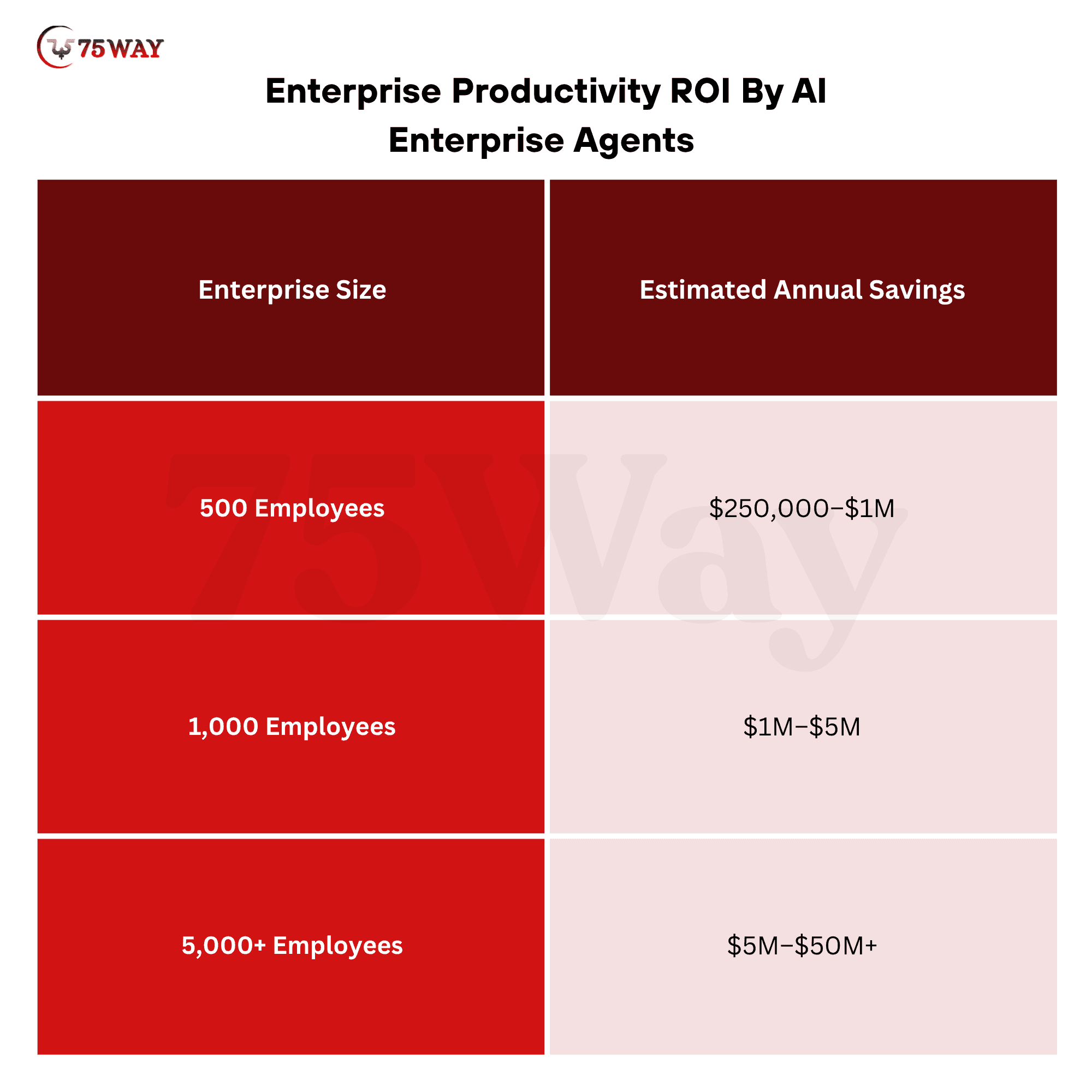
- Enterprise Productivity ROI
Large organizations often deploy AI agents to automate internal workflows, improve knowledge accessibility, and reduce manual effort across departments. Even small productivity gains can generate significant financial benefits when applied across thousands of employees.
How 75Way Helps Businesses Reduce AI Agent Development Costs?
One of the biggest reasons AI projects exceed budget is starting from scratch. At 75Way, we reduce development costs by using proven AI frameworks, pre-built agent architectures, reusable integrations, and ready-to-deploy components that eliminate hundreds of development hours. Instead of rebuilding common capabilities such as knowledge retrieval, workflow automation, agent orchestration, and API integrations, we accelerate delivery using tested foundations that lower both development time and implementation risk.
We also help businesses choose the most cost-effective technology stack for their goals. Not every project requires expensive enterprise models or complex multi-agent architectures. Our team evaluates requirements and recommends the right combination of OpenAI, Anthropic, Gemini, Llama, Mistral, RAG systems, vector databases, and cloud infrastructure to balance performance with cost. This approach helps organizations avoid unnecessary spending on AI model usage, infrastructure, and engineering resources.
For companies looking to launch faster, we offer ready-made AI agents for customer support, sales automation, customer success, ecommerce, knowledge management, marketing, analytics, and business operations. These pre-built solutions can be customized to specific workflows, reducing development costs by up to 50% while significantly shortening deployment timelines. The result is a production-ready AI agent that delivers business value faster and at a lower total investment.
Conclusion
AI agents are rapidly becoming a strategic investment for SaaS companies, ecommerce businesses, and enterprises seeking greater productivity, automation, and scalability. In 2026, development costs typically range from $5,000 to $500,000+, while large enterprise ecosystems can exceed $2 million depending on complexity, integrations, governance requirements, and operational scope. The right investment depends on business objectives, industry requirements, and long-term growth plans. Whether you're a SaaS company looking to automate customer success, an ecommerce brand seeking intelligent shopping experiences, connect with a reliable AI agent development company.
Frequently Asked Questions (FAQs)
What Is The Average AI Agent Development Cost In USA?
The average AI agent development cost in the USA typically ranges from $5,000 to $500,000+, depending on complexity, integrations, data architecture, and automation scope. Basic agents cost significantly less, while enterprise-grade multi-agent systems require higher investment due to advanced engineering and compliance requirements.
Why Do AI Agent Development Costs Vary So Much?
Costs vary because every AI agent is built differently. Factors such as business requirements, number of integrations, AI model selection, security standards, and workflow complexity significantly impact overall pricing. Enterprise systems with multiple departments and autonomous workflows naturally require higher investment.
How Much Does It Cost To Maintain An AI Agent After Deployment?
Ongoing maintenance typically costs between 15% and 30% of the initial development cost annually. This includes model updates, infrastructure scaling, performance optimization, monitoring tools, security patches, and workflow improvements to ensure long-term system reliability and accuracy.
Is It Cheaper To Build or Buy An AI Agent Solution?
Buying a pre-built AI agent is cheaper initially, with monthly costs ranging from $100 to $20,000+. However, custom-built AI agents offer better long-term ROI, scalability, and flexibility. Businesses often choose a hybrid approach to balance cost and customization.
Do AI Agents Require Continuous Training?
Yes, AI agents require continuous optimization to maintain accuracy and relevance. This includes updating knowledge bases, refining prompts, improving workflows, and retraining models based on new business data and user interactions over time.
Can AI Agents Integrate With Existing Business Systems?
Yes, modern AI agents can integrate with CRM platforms, ERP systems, helpdesk tools, ecommerce platforms, APIs, and internal databases. Integration capability is a key factor in overall development cost and determines how effectively the agent performs within business operations.