AI Summary
Online Travel Agency (OTA) app development in 2026 reflects a rapidly expanding digital travel ecosystem driven by real-time booking systems, API integrations, and AI personalization. OTA mobile app development costs range between $15,000 and $150,000+ in the USA market. Architecture, scalability, and monetization models define success across global travel platforms, shaping competitive digital travel marketplaces worldwide.
Quick Overview
- OTA apps require real-time integrations for flights, hotels, and travel services
- Development cost lies between $15,000 and $150,000+ based on features, APIs, and scalability needs
- USA OTA platforms demand high-performance architecture with secure payment systems
- AI-driven personalization improves booking conversions and enhances user travel experience
- Monetization relies on commissions, service fees, subscriptions, and advertising partnerships
Now entire travel booking experience could be completed in under a minute, without calling an agent or waiting for confirmations. The support engine working behind it is that online travel agency (OTA) apps have changed the travel industry in 2026.
Today’s travelers no longer rely on traditional agencies or offline bookings. They open a travel app, search for flights, compare hotel prices, explore holiday packages, and complete payments instantly, all in one seamless flow. In fact, platforms like Airbnb, Expedia, Booking.com, and Hopper have shown how digital-first travel app development solutions can dominate global markets by offering convenience at scale.
But here is the challenge: competition is intense. Every OTA platform is fighting for the same traveler attention, and users switch apps quickly if the experience is slow or confusing. That means businesses cannot just build a travel booking app anymore. They need intelligent, scalable, and highly personalized travel platforms.
So the real question is simple: how do you build an OTA app in 2026 that actually stands out, scales globally, and drives consistent revenue?
In this guide, we will break down everything step by step for OTA mobile app development, including features, architecture, technology stack, monetization strategies, development cost, and future trends shaping the OTA industry.
What Is An OTA App?
An online travel agency app is a digital platform that allows users to search, compare, and book travel services such as flights, hotels, car rentals, and travel packages through a unified system.
Unlike traditional travel agencies, OTA platforms operate in real time using API integrations with airlines, hotel providers, and global distribution systems. This ensures live pricing, instant availability, and automated booking confirmations.
Modern OTA apps also include artificial intelligence-based recommendation engines, dynamic pricing models, and multi-currency payment systems.
OTA Mobile App Growth in USA 2026: Market Size, Trends, and Forecast
The OTA industry in the United States continues to expand due to several macroeconomic and technological factors. Mobile-first booking behavior dominates travel consumption patterns, with users preferring instant booking experiences over traditional planning. AI-driven personalization is reshaping how users discover destinations, accommodations, and travel packages. Other facts are:
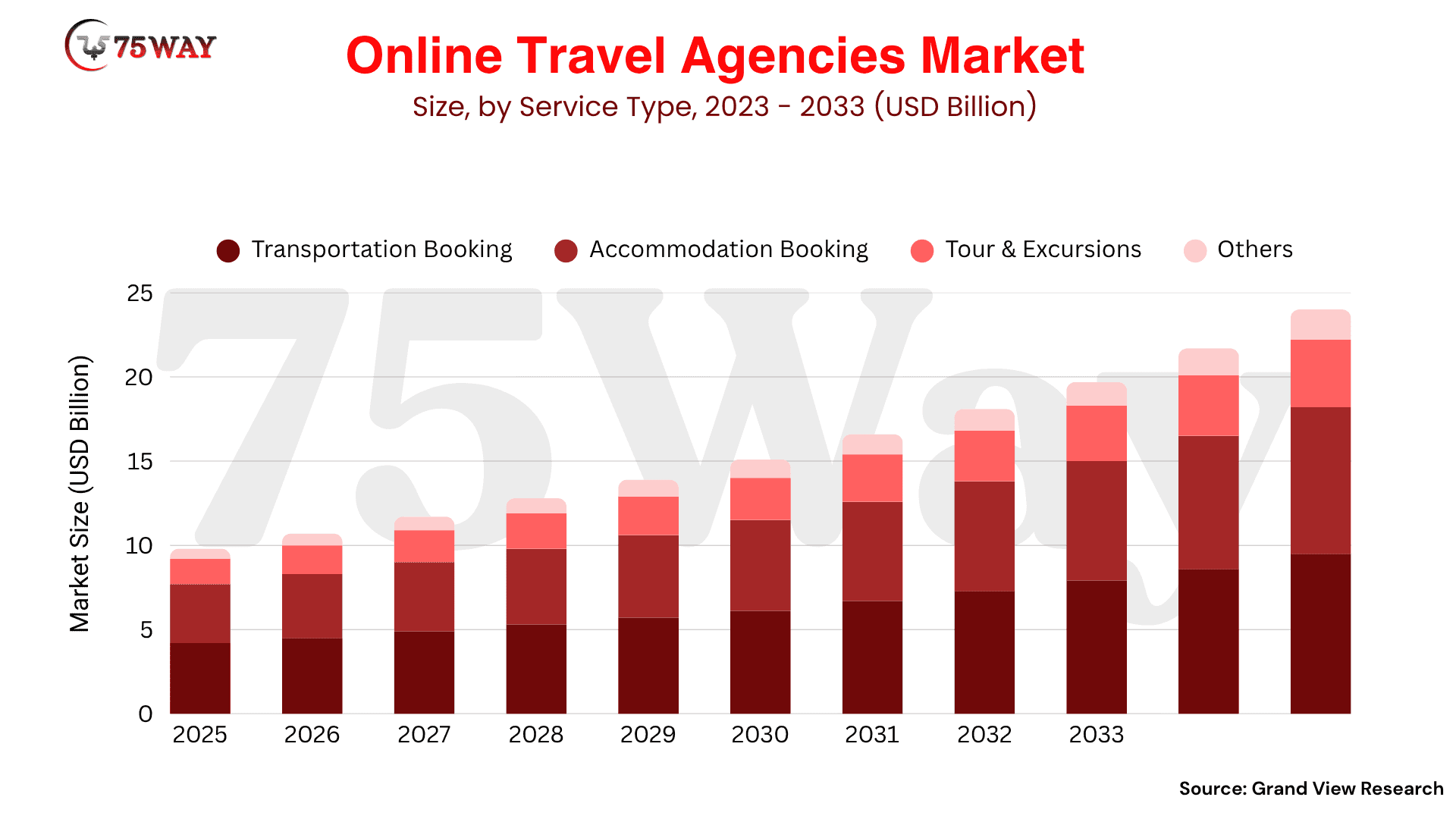
- The global online travel agency (OTA) market is projected to reach $1,316.67 billion by 2033, growing at a CAGR of 9.0%.
- Transportation booking remains the largest service segment, accounting for 41.23% of total revenue.
- Travelers aged 30–44 contributed the highest market share, representing 42.53% of revenue in 2025.
- Another industry forecast estimates the OTA market will reach $160.29 billion by 2034, expanding at a CAGR of 11.03%.
- Online travel booking platforms are supported by a global internet user base exceeding 5.4 billion people.
- More than 80% of travelers now use AI-powered trip planners and predictive pricing tools when booking travel.
- Nearly 45% of U.S. leisure travelers have an OTA app installed, compared to 39% who use dedicated hotel apps.
Essential Features Every Modern OTA Mobile App Must Have in 2026
Modern travel platforms must feel intuitive and always one step ahead of the traveler. Anything less leads to drop-offs, abandoned bookings, and lost revenue. The features and functionalities outlined below highlight what separates high-performing travel apps from outdated booking systems in today’s competitive digital travel landscape.
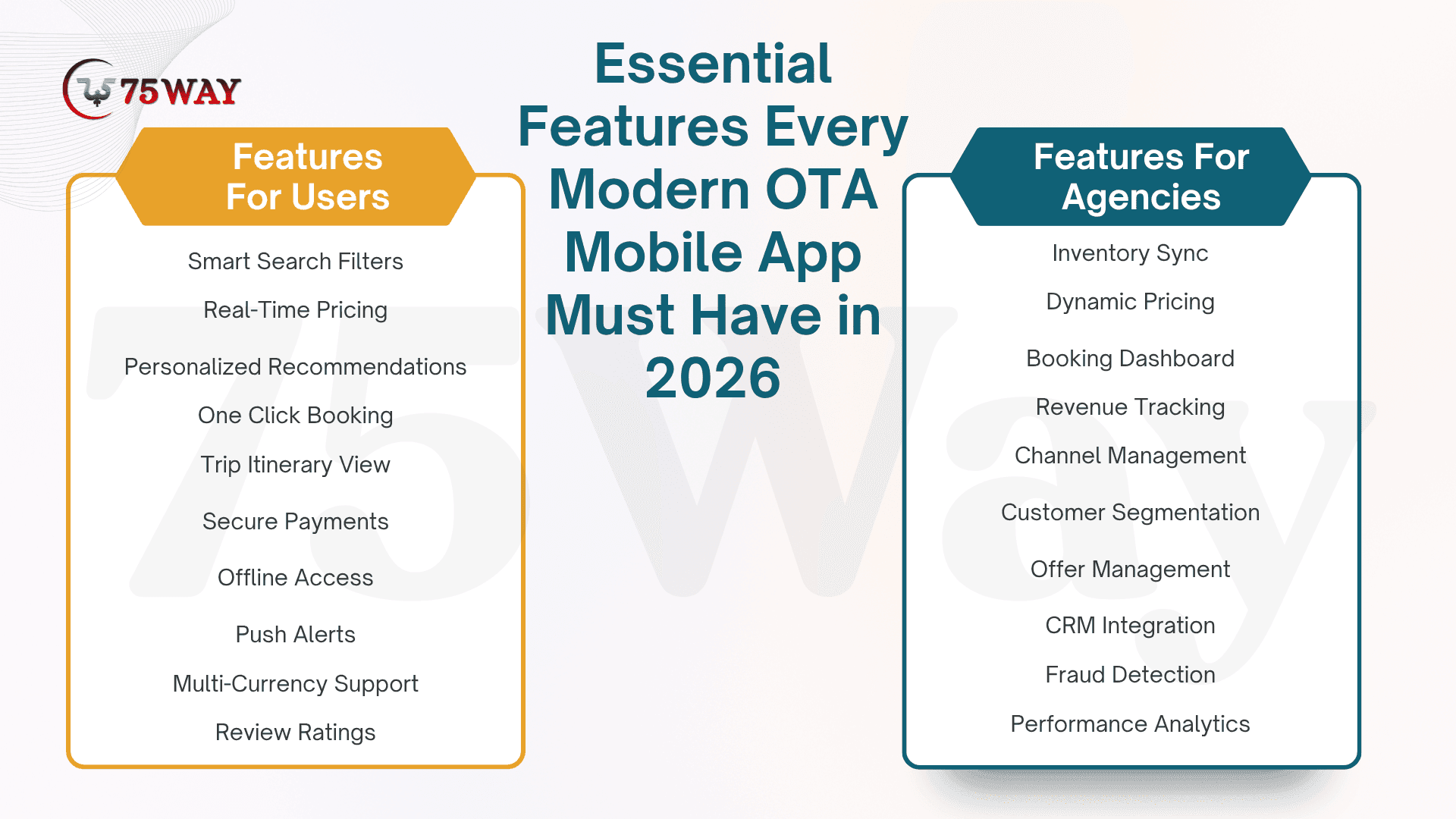
Features for Users
- Smart Search Filters: Smart search filters help travelers quickly refine options across flights, hotels, and packages based on budget, timing, location, and preferences. They reduce browsing time significantly. Users can compare multiple choices instantly. This improves decision-making speed and booking convenience.
- Real-Time Pricing: Real-time pricing ensures users always see updated fares and availability without delays or outdated information. It improves trust during booking decisions. Price fluctuations are reflected instantly. This reduces confusion and abandoned bookings during checkout.
- Personalized Recommendations: Personalized recommendations use user behavior, search history, and preferences to suggest relevant travel options. This creates a more tailored booking experience. It helps users discover better deals faster. It also increases engagement and conversion rates.
- One Click Booking: One click booking simplifies the entire checkout process by saving traveler details and payment information securely. Users can confirm bookings instantly. It removes repetitive form-filling steps. This significantly improves conversion speed and user satisfaction.
- Trip Itinerary View: Trip itinerary view brings all travel details like flights, hotels, and transfers into a single structured timeline. It helps users stay organized during travel. Updates are shown in real time. This improves clarity and the travel planning experience.
- Secure Payments: Secure payments ensure safe transactions through encrypted gateways and multiple payment options. Users can pay using cards, wallets, or regional methods. Fraud protection systems add safety layers. This builds trust and reduces transaction risk.
- Offline Access: Offline access allows users to view bookings, tickets, and itineraries without internet connectivity. It ensures uninterrupted access during travel. Essential details remain available anytime. This is especially useful for international trips.
- Push Alerts: Push alerts provide real-time notifications about booking confirmations, delays, gate changes, and offers. They keep users informed throughout their journey. Alerts are timely and relevant. This improves overall travel experience and engagement.
- Multi-Currency Support: Multi-currency support allows users to view and pay in their preferred currency. It removes confusion around conversions and hidden charges. Pricing becomes more transparent. This improves global usability and trust.
- Review Ratings: Review ratings help users make informed decisions based on verified traveler feedback. They provide insights into service quality and experience. Ratings improve transparency. This increases confidence in booking choices.
Features For Agencies
- Inventory Sync: Inventory sync ensures real-time updates of flights, hotels, and packages across all connected platforms. It prevents overbooking and inconsistencies. Data remains accurate across channels. This improves operational efficiency and reliability.
- Dynamic Pricing: Dynamic pricing automatically adjusts travel rates based on demand, seasonality, and competition. It helps agencies maximize revenue opportunities. Pricing updates happen in real time. This improves profitability and competitiveness.
- Booking Dashboard: The booking dashboard provides a centralized view of all reservations, cancellations, and modifications. It simplifies operational management for agencies. Data is organized clearly. This improves efficiency and reduces manual effort.
- Channel Management: Channel management distributes listings across multiple OTAs and platforms automatically. It ensures consistent availability and pricing everywhere. Updates happen instantly. This reduces manual coordination and errors.
- Revenue Tracking: Revenue tracking provides real-time insights into earnings, bookings, and financial performance. Agencies can monitor growth trends easily. Reports are visually structured. This supports better financial decision-making.
- Customer Segmentation: Customer segmentation groups users based on behavior, preferences, and booking history. It enables targeted marketing campaigns. Agencies can personalize offers effectively. This increases engagement and conversion rates.
- Offer Management: Offer management allows agencies to create and control discounts, promotions, and travel deals. Campaigns can be scheduled easily. It improves marketing flexibility. This helps attract more customers.
- CRM Integration:CRM integration connects customer data with sales and support systems seamlessly. It improves communication and tracking. Agencies can manage relationships better. This enhances customer retention and service quality.
- Fraud Detection: Fraud detection identifies suspicious transactions and booking activities in real time. It protects agencies from financial losses. Security systems continuously monitor data. This improves trust and platform safety.
- Performance Analytics: Performance analytics provides detailed insights into traffic, bookings, and conversion rates. Agencies can evaluate campaign effectiveness. Data-driven decisions become easier. This improves overall business performance.
Advanced AI Features For Building an Online Travel Agency Mobile App
Online travel booking has moved far beyond simple search and reservation systems. Modern users expect intelligent, adaptive, and highly personalized experiences that guide them from inspiration to booking in seconds. To stay competitive in 2026, OTA mobile apps must go beyond basic functionality and adopt advanced AI-driven capabilities that reshape how travelers plan and book their journeys.
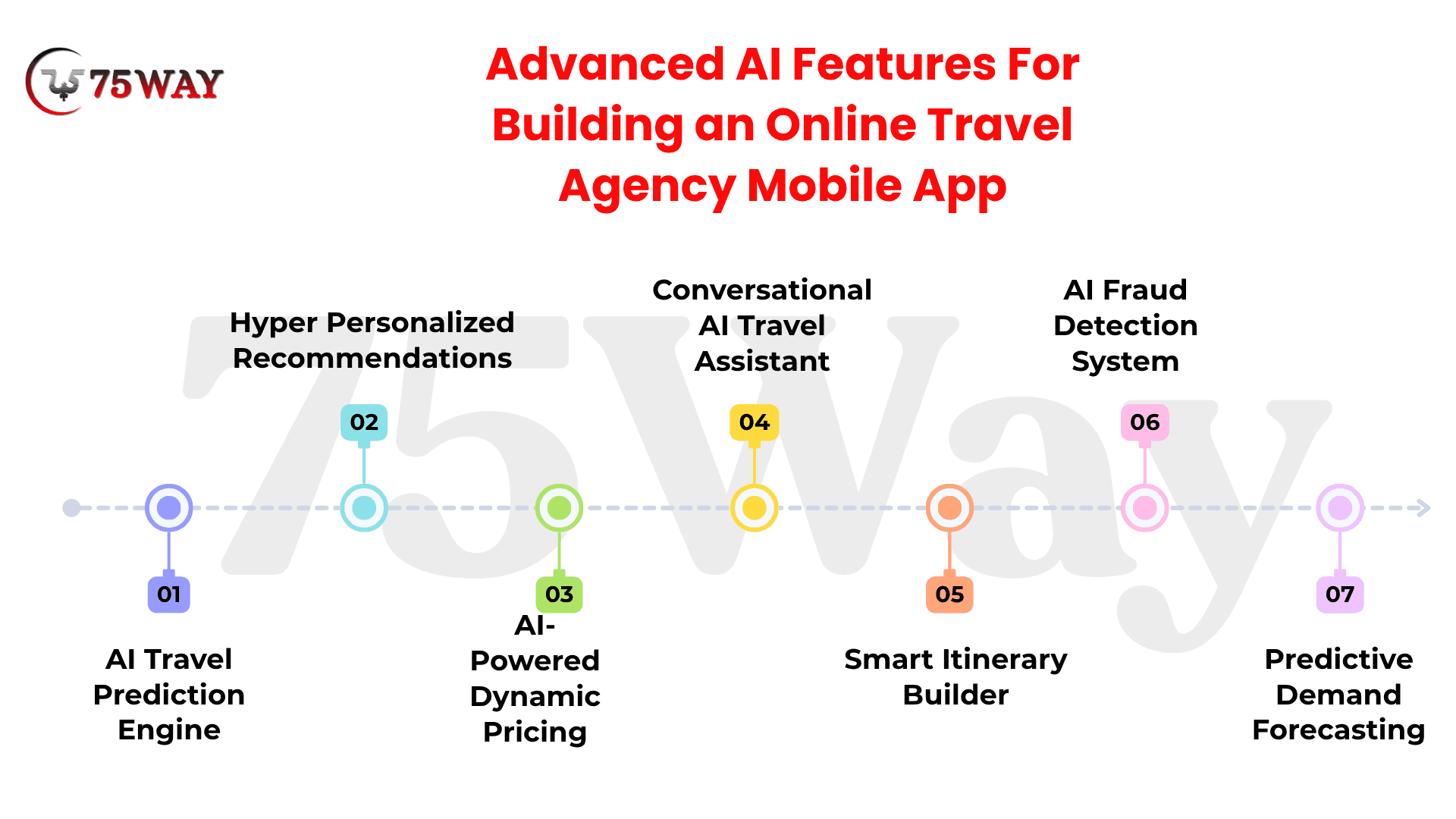
- AI Travel Prediction Engine: By analyzing user behavior, seasonal trends, and historical booking data, this system forecasts travel demand, pricing changes, and destination popularity. It helps users make smarter booking decisions while allowing platforms to optimize revenue and availability. It also reduces uncertainty in planning by identifying upcoming demand spikes. This improves both inventory control and forecasting accuracy.
- Hyper Personalized Recommendations: Deep learning models study preferences, past trips, and real-time intent signals to deliver highly tailored travel suggestions. Every user sees flights, hotels, and packages aligned with their interests, which increases engagement and conversions. Recommendations continuously evolve as user behavior changes. This makes the experience feel more intuitive and relevant.
- AI-Powered Dynamic Pricing: Fares are adjusted in real time based on demand shifts, competitor pricing, and market conditions. Travelers benefit from competitive rates while platforms maximize profitability through intelligent pricing decisions. Sudden demand surges and seasonal changes are handled automatically. This keeps pricing balanced across all channels.
- Conversational AI Travel Assistant: Users can search, compare, and book travel using natural language through chat or voice interactions. The system simplifies complex booking flows and provides instant support for planning and changes. It reduces the need for manual navigation across multiple screens. This makes the entire booking journey faster and smoother.
- Smart Itinerary Builder: Travel plans are automatically generated with flights, hotels, activities, and experiences aligned to user preferences. It adjusts dynamically based on delays, cancellations, or schedule changes. This ensures travelers always have updated and optimized plans. The experience becomes more seamless and stress-free.
- AI Fraud Detection System: Transactions are continuously monitored to detect suspicious activity, fake bookings, and payment anomalies. This protects both users and platforms from financial risks. Behavioral patterns are analyzed to identify threats early. It significantly reduces fraud and chargeback incidents.
- Predictive Demand Forecasting: Global travel trends and historical data are analyzed to predict booking spikes and seasonal demand. This helps OTAs manage pricing, inventory, and marketing strategies more efficiently. It also improves resource allocation during peak travel periods. The result is stronger operational stability and planning accuracy.
- AI Review Intelligence: Customer feedback is analyzed to extract sentiment, highlight key insights, and filter unreliable reviews. This helps travelers make better decisions and improves platform credibility. Fake or misleading reviews are automatically detected. It builds stronger trust across the ecosystem.
Types of OTA Apps Travel Businesses Can Develop
Different business models in the travel industry require different types of OTA applications to serve specific user needs and operational goals. Each type is designed with a unique focus, whether it is bookings, aggregation, corporate travel, or experience-driven services. Understanding these categories helps businesses choose the right direction for building a scalable and profitable travel platform.
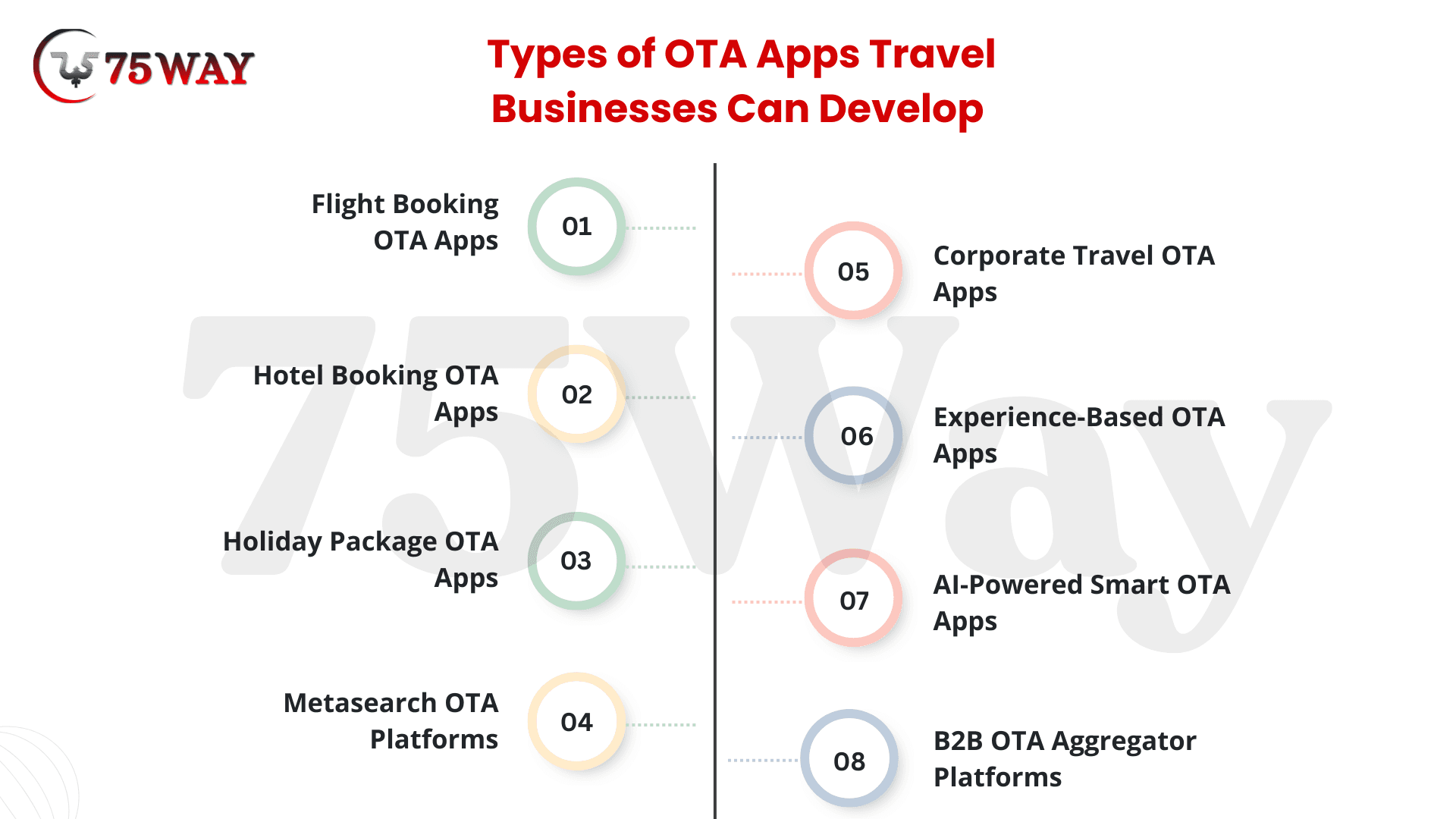
- Flight Booking OTA Apps
Flight booking travel apps allow users to search, compare, and book flights across multiple airlines in real time. They provide updated fares, seat availability, and instant confirmations. These platforms simplify air travel planning. They improve booking speed and user convenience.
- Hotel Booking OTA Apps
Hotel booking OTA apps help users find and reserve accommodations based on location, price, amenities, and ratings. They aggregate listings from multiple hotels for easy comparison. These platforms support dynamic pricing and reviews. They enhance decision-making and booking confidence.
- Holiday Package OTA Apps
Holiday package OTA apps combine flights, hotels, and activities into complete travel bundles. They allow users to book entire trips in one flow. These platforms often include customizable itineraries. They simplify travel planning and improve user experience.
- Metasearch OTA Platforms
Metasearch OTA platforms collect travel data from multiple providers and display price comparisons in one place. Users can evaluate different options before booking. These platforms redirect users to final booking sources. They increase transparency and cost efficiency.
- Corporate Travel OTA Apps
Corporate travel OTA apps manage business travel bookings, approvals, and expense tracking for organizations. They ensure policy compliance and centralized control. These platforms simplify employee travel management. They improve efficiency and cost control for companies.
- Experience-Based OTA Apps
Experience-based OTA apps focus on tours, activities, and local experiences like sightseeing and adventure sports. They help users discover and book activities at destinations. These platforms enhance trip personalization. They add value beyond basic travel bookings.
- AI-Powered Smart OTA Apps
AI-powered smart OTA apps use machine learning to deliver personalized recommendations and predictive pricing. They automate travel planning and improve user engagement. These platforms offer conversational booking experiences. They enhance convenience and decision accuracy.
- B2B OTA Aggregator Platforms
B2B OTA aggregator platforms connect travel suppliers, agencies, and resellers for bulk bookings and distribution. They manage inventory across multiple channels. These platforms support commission-based ecosystems. They enable scalable travel business operations.
How to Develop an OTA Mobile App for Travel Businesses?
Building an OTA platform is not just about coding an app—it’s about designing a full travel ecosystem that performs reliably under high traffic, real-time data loads, and constant user interactions. Each stage plays a critical role in shaping performance, scalability, and user experience. Decisions made early directly impact cost, speed, and long-term scalability of the platform.
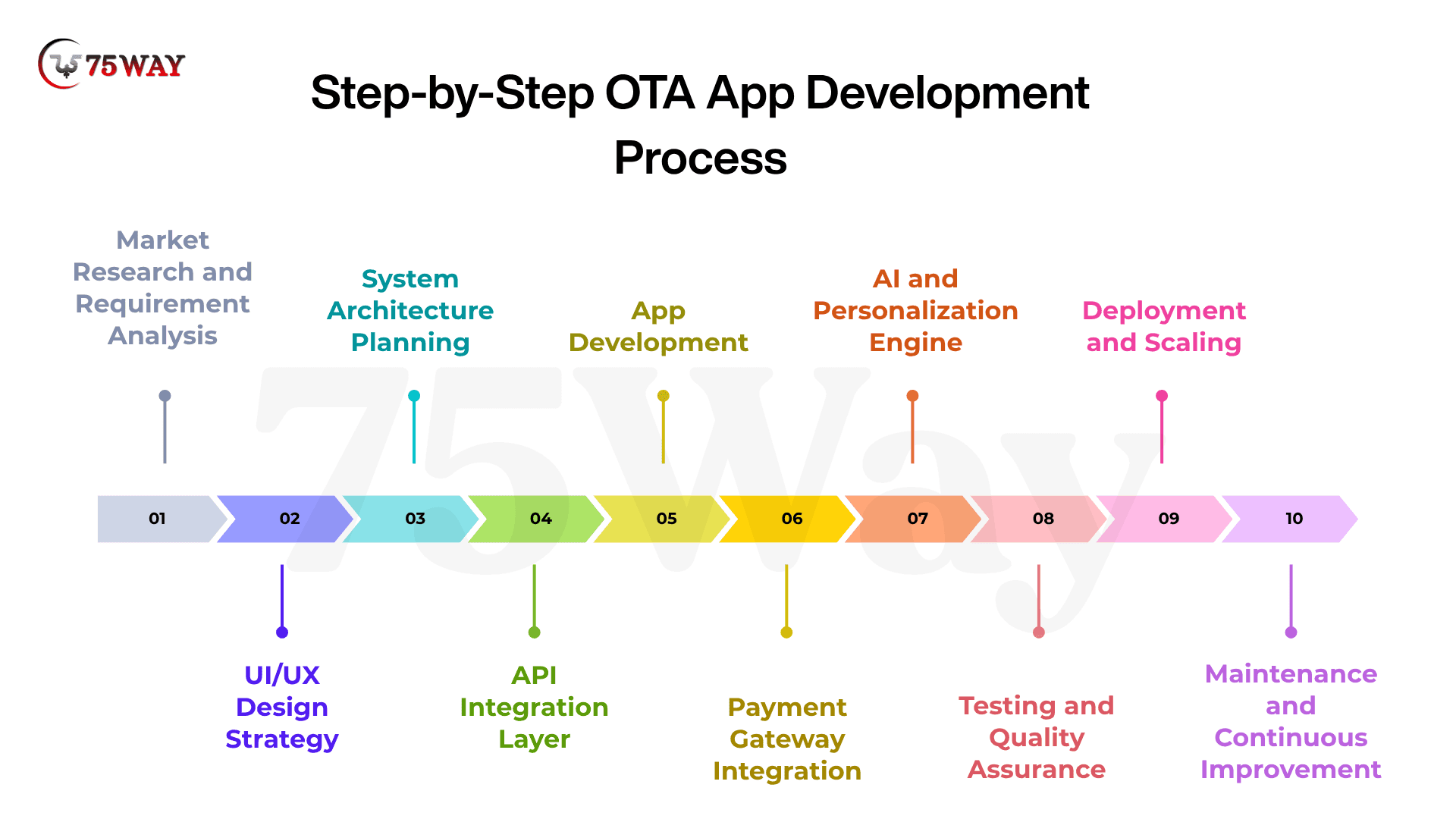
Step 1: Market Research and Requirement Analysis
This stage focuses on understanding traveler behavior, analyzing competitors, and defining the right revenue model for the platform. Clear requirement mapping at this stage helps reduce risks and avoids costly changes later in development.
It also identifies target geographies and seasonal demand patterns. Revenue models such as commission-based, subscription, or hybrid structures are evaluated. User pain points across existing OTA platforms are analyzed deeply. This helps define product-market fit early. Technical feasibility is also assessed to avoid over-engineering. Stakeholder alignment is finalized before design begins.
Step 2: UI/UX Design Strategy
Design plays a major role in conversion. The focus is on intuitive navigation, smooth booking flows, and visually engaging travel listings that make decision-making faster. Wireframes and prototypes are used to validate user journeys before development begins.
User psychology plays a key role in layout decisions. Mobile-first design is prioritized due to high smartphone usage in travel bookings. Color schemes and visual hierarchy guide user attention toward bookings. Micro-interactions improve engagement during browsing. Usability testing is conducted before final design approval.
Step 3: System Architecture Planning
A strong backend foundation is designed using scalable cloud infrastructure. Most OTA platforms rely on microservices architecture to ensure high availability, fault tolerance, and seamless handling of peak traffic loads.
Each service is designed to operate independently. Load distribution strategies are defined for peak travel seasons. Data consistency models are evaluated for booking accuracy. Database selection is aligned with transaction-heavy workloads. Security layers are embedded at the architecture level to prevent vulnerabilities.
Step 4: API Integration Layer
OTA systems depend heavily on third-party APIs for flights, hotels, payments, and travel data. A stable integration layer ensures real-time synchronization and prevents data mismatches across services.
Fallback mechanisms are implemented for API failures. Rate limiting strategies ensure system stability. Data normalization is required due to multiple provider formats. Caching mechanisms reduce API dependency load. Version control is maintained for all integrations.
Step 5: App Development Stage
The actual development phase brings the product to life using native or cross-platform frameworks. The goal is to ensure high performance, smooth user experience, and compatibility across devices.
Frontend and backend development run in parallel. Modular coding structure improves scalability. Performance optimization is prioritized from early stages. Offline functionality is added for travelers. Continuous integration pipelines accelerate deployment cycles.
Step 6: Payment Gateway Integration
Secure payment systems are integrated to support multiple currencies, fraud prevention mechanisms, and instant booking confirmations. This step is critical for building user trust and ensuring smooth transactions.
Multiple payment providers are often supported. Encryption standards ensure transaction safety. Refund and cancellation workflows are integrated. Regional payment methods improve global usability. Fraud detection tools monitor suspicious transactions.
Step 7: AI and Personalization Engine
AI modules are introduced to analyze user behavior and deliver personalized travel recommendations. Predictive insights help users discover better options while increasing platform engagement and conversions.
Machine learning models continuously improve recommendations. Real-time data enhances the accuracy of suggestions. User segmentation improves targeting. Behavioral tracking helps refine offers. AI also supports dynamic pricing optimization.
Step 8: Testing and Quality Assurance
Rigorous testing ensures the system performs reliably under different conditions. This includes security testing, performance testing, and load testing during peak traffic scenarios.
Automated testing reduces manual effort. Stress testing simulates high traffic conditions. Bug tracking systems ensure quick fixes. Security audits identify vulnerabilities. User acceptance testing validates real-world usability.
Step 9: Deployment and Scaling
Once tested, the application is deployed on cloud infrastructure with auto-scaling and load balancing capabilities. This ensures global accessibility and stable performance during traffic spikes.
CI/CD pipelines automate deployments. Multi-region hosting improves speed. Monitoring tools track system health. Scaling rules adjust resources dynamically. Downtime is minimized through redundancy systems.
Step 10: Maintenance and Continuous Improvement
Post-launch, continuous monitoring helps identify issues, improve performance, and roll out new features. Regular updates ensure the platform stays competitive and aligned with user expectations.
User feedback drives product updates. Performance metrics are tracked continuously. Security patches are applied regularly. New integrations are added over time. Feature enhancements keep the platform evolving.
Technology Stack Used To Build Online Travel Agency Platforms
At 75way, we don’t just focus on building OTA mobile apps—we also deliver high-performance web platforms that significantly improve visibility, traffic acquisition, and overall brand reach. In the travel industry, a strong web presence is just as important as a mobile app because most users still discover and compare travel options through search engines before booking.
That’s why we build responsive, SEO-optimized OTA websites alongside mobile applications. These web platforms are designed to rank on Google, attract organic traffic, and convert visitors into app users or direct bookings. This dual approach helps businesses reduce dependency on paid ads and build a sustainable inbound growth channel.
When it comes to technology selection, we prioritize platforms and frameworks that are cost-efficient, scalable, and easy to maintain for clients. For frontend development, we use technologies like React Native, Flutter, and React.js because they allow faster development with reusable components, reducing both development time and long-term maintenance costs. On the backend, Node.js, Java, and Python are chosen based on project complexity to ensure performance without unnecessary infrastructure overhead.
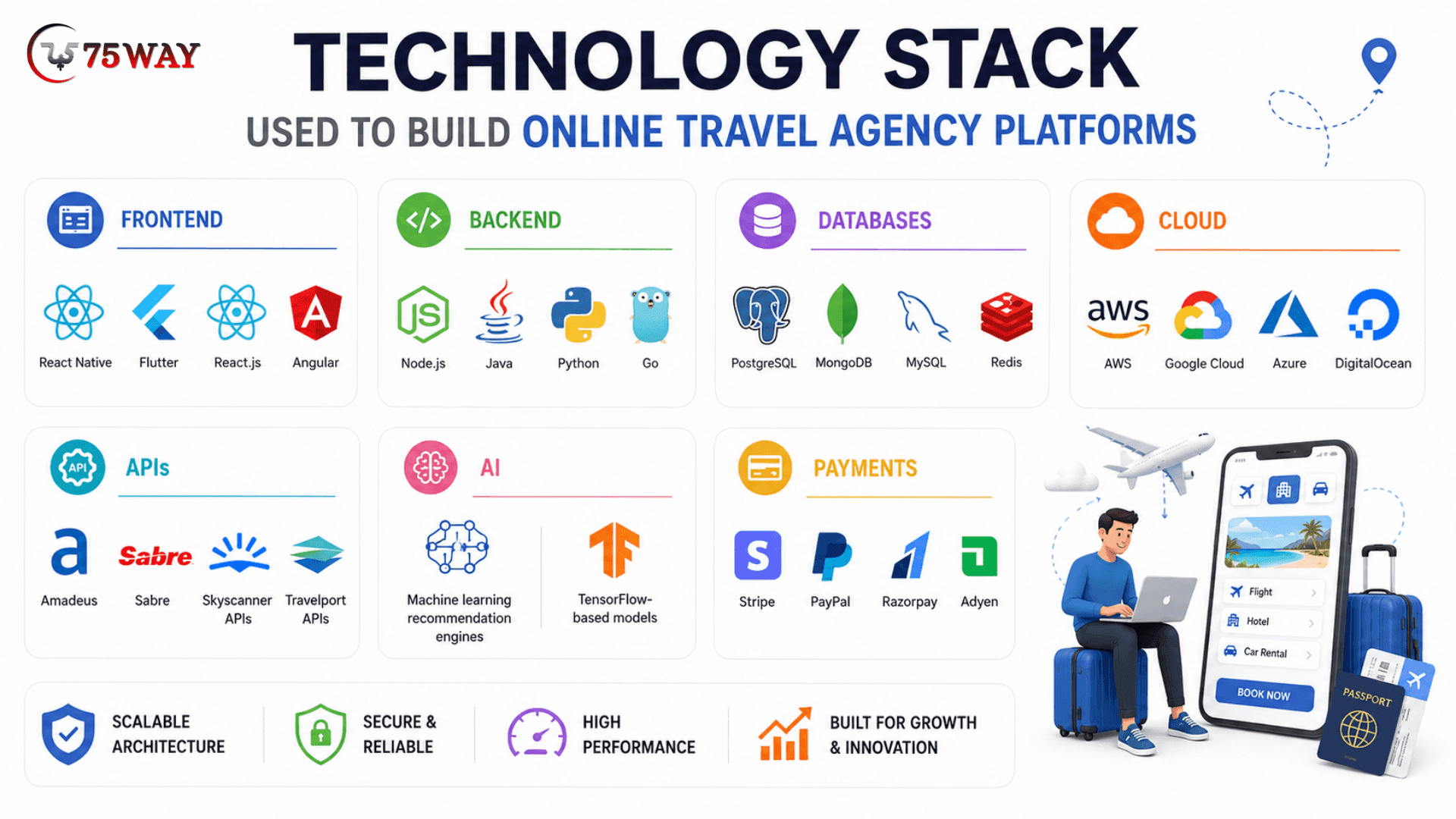
We also rely on cloud providers like AWS, Google Cloud, and Azure because they offer flexible pay-as-you-go pricing, meaning clients only pay for what they use instead of heavy upfront infrastructure investments. Similarly, APIs like Amadeus, Sabre, and Skyscanner are integrated because they provide ready-made travel data, eliminating the need to build expensive travel databases from scratch.
At 75way, every technology decision is made with one goal in mind: reducing development cost while maximizing scalability, performance, and long-term ROI. This approach ensures businesses get a powerful OTA ecosystem that is not only technically strong but also economically sustainable as they grow.
What’s the Cost for Online Travel Agency (OTA) App Development?
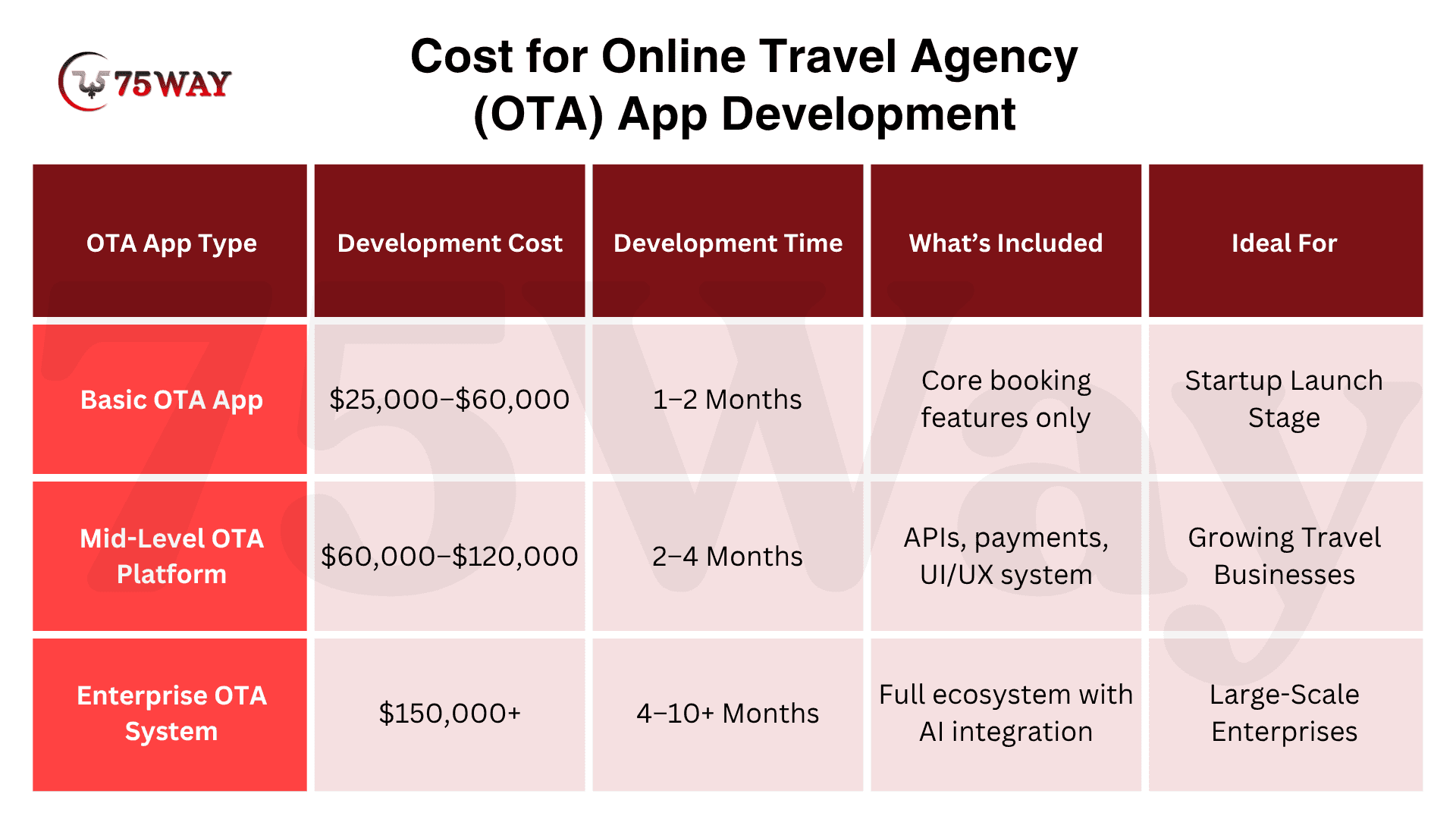
On average, OTA mobile app development cost ranges between $25,000–$150,000+, and may vary based on platform complexity, feature depth, third-party integrations, and overall system architecture. As the product scales from basic booking functionality to enterprise-grade travel ecosystems, both development effort and investment requirements increase accordingly.
Basic OTA apps typically range from $25,000 to $60,000 and include essential features such as flight and hotel search, basic booking functionality, and simple payment integration for early-stage product launches.
Mid-level OTA platforms generally range from $60,000 to $120,000 and offer more advanced capabilities like third-party API integrations and improved performance scalability for growing travel businesses.
Enterprise-grade OTA systems usually exceed $150,000+ and are built as full-scale travel ecosystems with advanced integrations, AI-driven personalization and highly scalable cloud architecture designed for large user volumes.
How to Monetize an AI-Powered Online Travel Agency (OTA) Platform Successfully in 2026?
OTA platforms are not just booking systems. They are structured revenue engines built on multiple monetization layers. The real profitability comes from combining several income streams rather than relying on a single model, which helps stabilize earnings even during seasonal travel fluctuations.
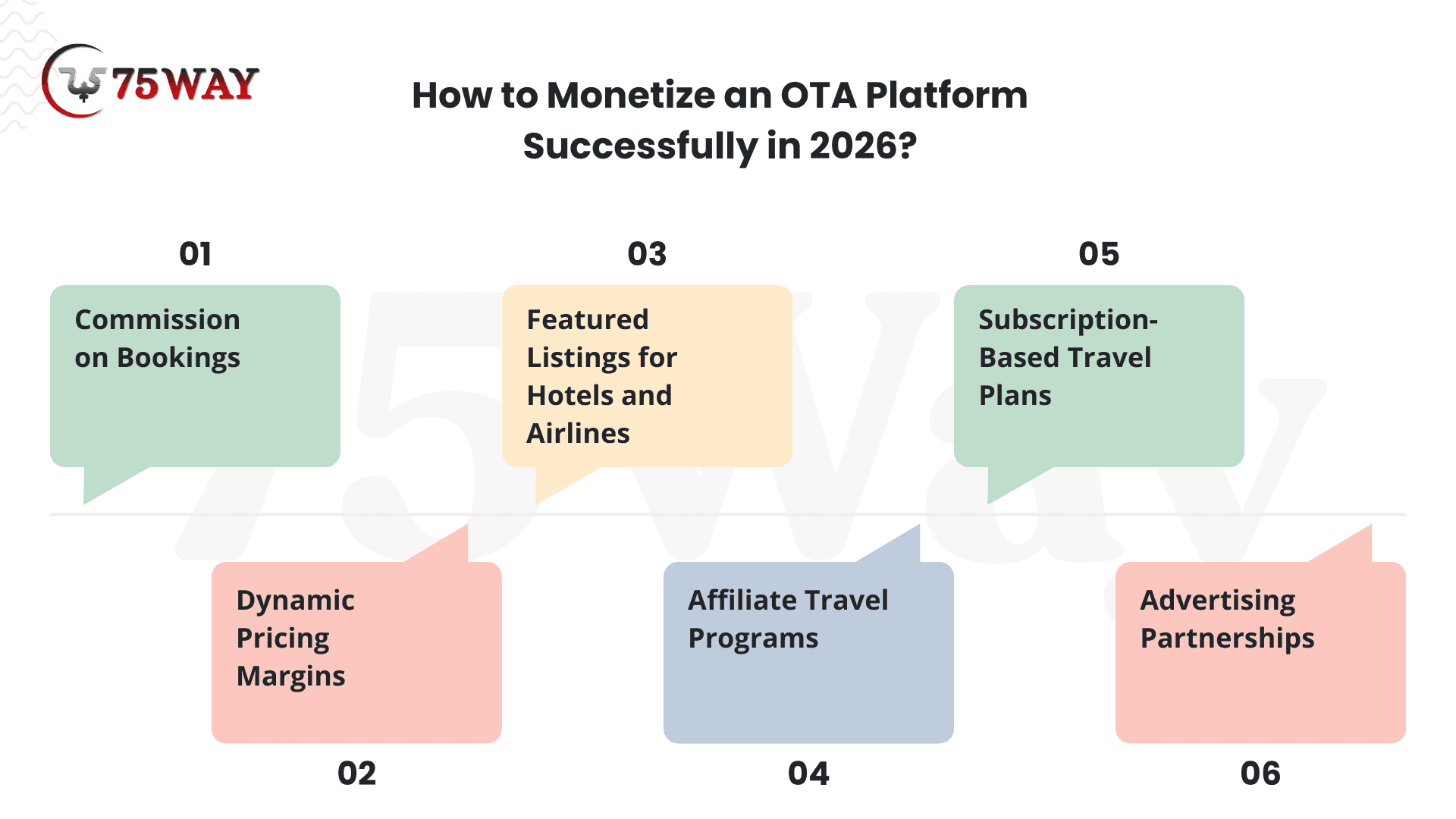
- Commission on Bookings: OTA platforms earn a percentage commission on every successful booking made through the system. For example, if a hotel booking is worth $200, the platform may earn a 10% commission, generating $20 per transaction. This model scales directly with user volume and booking frequency.
- Featured Listings for Hotels and Airlines: Travel providers pay to appear at the top of search results or highlighted sections. For example, a hotel may pay $500 per month to stay in premium visibility slots, increasing its chances of receiving more bookings while boosting OTA revenue.
- Subscription-Based Travel Plans: Users or businesses pay recurring fees for exclusive benefits such as discounted fares or priority support. For example, a subscription plan may cost $15/month per user, generating predictable recurring revenue for the platform.
- Advertising Partnerships: OTAs earn revenue by displaying ads from travel brands, insurance providers, or tourism boards. For example, a travel insurance company may pay $1,000 for a campaign banner targeting users booking international trips.
- Dynamic Pricing Margins: Platforms adjust travel prices slightly above supplier rates to earn profit margins. For example, if an airline ticket costs $300, the OTA may sell it for $310, earning a $10 margin per booking.
- Affiliate Travel Programs: OTAs earn commissions by referring users to partner services such as car rentals or experiences. For example, a car rental booking of $100 may generate a $5–$10 affiliate commission depending on the partner agreement.
What’s Next: How OTA App Development Is Transforming the Travel Industry
Travel booking is entering a new era where speed, intelligence, and personalization are becoming the core expectations rather than premium features. AI-powered OTA platforms are no longer just digital marketplaces. They are evolving into intelligent travel ecosystems that anticipate user needs, automate decisions, and deliver seamless end-to-end experiences.
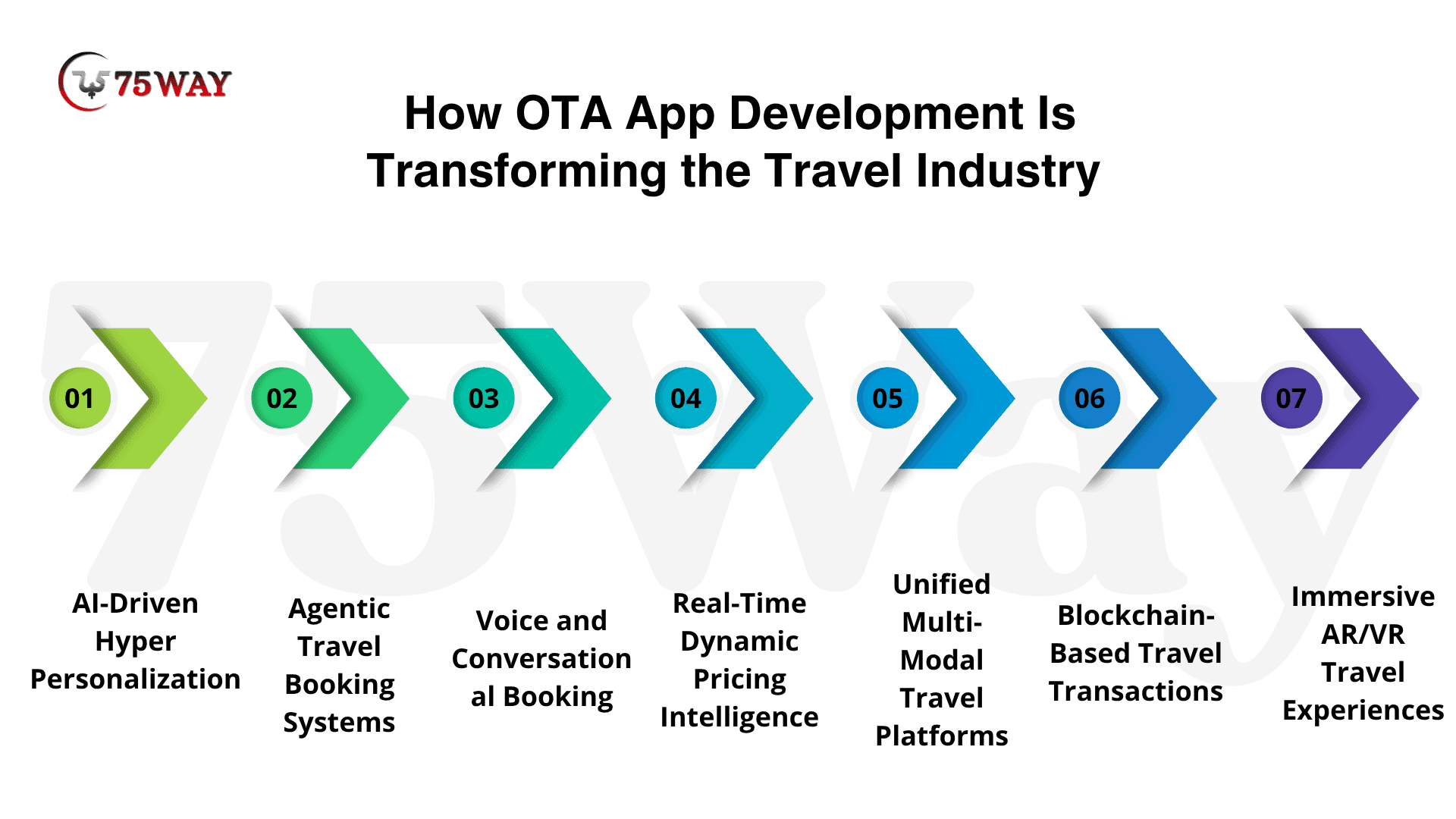
- AI-Driven Hyper Personalization: OTA platforms will increasingly rely on advanced AI models to understand user behavior, preferences, and intent in real time. Instead of showing generic listings, systems will dynamically curate flights, hotels, and packages tailored to each traveler, improving conversion rates and engagement.
- Agentic Travel Booking Systems: The next wave of OTA innovation will involve autonomous AI agents capable of planning, comparing, and booking entire trips with minimal user input. These agentic AI systems will act on behalf of users, handling complex travel decisions and reducing booking friction significantly.
- Voice and Conversational Booking: Users will shift from traditional search interfaces to voice AI agents and chat-based interactions. Conversational AI assistants will handle queries like “book a weekend trip to Dubai under $1000,” making travel planning faster and more natural.
- Real-Time Dynamic Pricing Intelligence: Pricing systems will become more adaptive, using AI to continuously adjust fares based on demand, competitor activity, and user behavior. This will help OTAs maximize revenue while offering users more competitive and transparent pricing.
- Unified Multi-Modal Travel Platforms: OTAs will expand beyond flights and hotels to integrate trains, buses, ride-sharing, and local experiences into a single ecosystem. This will allow users to plan complete door-to-door journeys within one platform.
- Blockchain-Based Travel Transactions:Blockchain technology will improve transparency in payments, loyalty programs, and booking verification. It will reduce fraud risks and create more secure, traceable travel transactions across global networks.
- Immersive AR/VR Travel Experiences: Augmented and virtual reality will allow users to explore destinations, hotels, and experiences before booking. This will enhance decision-making and reduce booking uncertainty, especially for premium travel packages.
How 75way Helps You Launch an Online Travel Agency App?
Launching an OTA platform is not just about building an app. It’s about creating a complete travel ecosystem. At 75way, we help businesses turn early-stage ideas into fully functional, revenue-ready travel platforms by combining strategy, design, development, and AI-powered automation. Our focus is always on reducing development risk while ensuring faster time-to-market.
We start by understanding your business model, target audience, and revenue strategy before writing a single line of code. Based on that, we design a scalable architecture using cost-efficient technologies like React Native, Node.js, and cloud-native infrastructure on AWS, Google Cloud, or Azure. This approach reduces both development cost and launch time.
Beyond development, we also help businesses grow after launch by implementing AI-driven personalization, SEO-optimized web platforms, and scalable backend systems that support long-term expansion. Our ready-made OTA modules, like booking engines, AI travel assistants, and recommendation systems, allow faster deployment while maintaining enterprise-level performance and security.
Recently, we worked with a travel startup, SkyRoute Travel Solutions, and built a full OTA platform including mobile apps, a web portal, and AI-powered recommendation and pricing systems. The solution was delivered in 14 weeks, reduced development costs by nearly 40%, and increased booking conversions by 2.5X within the first three months after launch.
Final Thoughts
Online travel agency mobile applications represent a high-growth digital opportunity in 2026, driven by evolving consumer expectations and advanced travel technologies. Businesses investing in scalable OTA platforms gain long-term competitive advantages through automation, personalization, and global accessibility. A well-designed OTA system integrates robust architecture, secure payment systems, and intelligent recommendation engines to deliver seamless travel experiences while maximizing revenue potential in highly competitive markets. Transform your OTA idea into a high-performance mobile application with expert guidance from a leading travel app development company.
Frequently Asked Questions (FAQs)
What Is OTA Mobile App Development In Travel Industry?
OTA mobile app development refers to building digital platforms that connect travelers with airlines, hotels, and travel services through integrated booking systems. These applications streamline travel planning, provide real-time availability, and enable secure payments while offering users a unified and convenient booking experience.
What Security Measures Are Needed For OTA Applications?
OTA apps require strong encryption protocols, secure payment gateways, fraud detection systems, and compliance with data protection standards. These measures protect sensitive user data, ensure transaction safety, and build trust between users and the travel platform.
Can Small Businesses Build OTA Platforms?
Yes, small businesses can develop OTA platforms using scalable architectures and third-party APIs. Starting with a minimum viable product allows gradual expansion. Cloud-based infrastructure helps reduce upfront costs while enabling future scalability as user demand increases.
What Are The Biggest Challenges In OTA App Development?
Major challenges include handling real-time data synchronization, managing high traffic during peak seasons, integrating multiple APIs, and ensuring system security. Maintaining consistent performance while scaling globally also requires advanced architecture and continuous monitoring systems.
How Does AI Improve OTA Mobile App Performance?
AI enhances OTA platforms by analyzing user behavior, search patterns, and booking history to deliver personalized travel recommendations. It also improves dynamic pricing, reduces search time, automates customer support, and increases conversion rates through predictive travel suggestions.
What Is The Difference Between OTA And Traditional Travel Agency Apps?
OTA apps operate digitally through real-time systems, offering instant booking, live pricing, and global accessibility. Traditional travel agencies rely on manual processes, limited inventory, and slower response times, making OTA platforms more efficient, scalable, and customer-friendly.