Summary
Hiring a custom AI agent developer enables businesses to automate conversations, streamline workflows, and enhance decision-making across departments. This guide explores benefits, use cases, development processes, costs, and how expert AI agent engineers build scalable solutions. It helps leaders understand how conversational AI improves efficiency, reduces operational burden, and drives long-term business growth through intelligent automation.
Quick Overview
- Custom AI agents automate workflows and reduce manual business operations
- The conversational AI market is projected to reach $49.80 billion by 2031.
- On average, AI agent development costs range between $4,000 and $150,000, depending on complexity.
- Hiring experienced developers ensures scalable and business-aligned AI agent solutions
- AI agents deliver measurable ROI through accuracy and cost reduction
- Strategic implementation of AI agents drives long-term digital transformation success
Every growing business reaches a point where manual processes begin slowing progress. Teams struggle to keep up with repetitive queries, fragmented workflows, and rising operational complexity.
This is where conversational AI automation begins to shift the equation. Instead of relying on human intervention for every interaction, businesses are now deploying intelligent AI agent development solutions that can understand, respond, and execute tasks with remarkable accuracy.
These systems answer questions anytime, connect systems, and enable faster decision-making. The real advantage lies in customization. Off-the-shelf tools rarely align with unique workflows or industry-specific requirements.
Custom AI agent developers to build agentic AI solutions tailored to business goals, ensuring seamless integration, scalability, and long-term adaptability. This guide explores how hiring AI agent developers can transform business operations through conversational automation.
What Is a Custom AI Agent?
A custom AI agent is an intelligent software system designed to interact, process information, and perform tasks based on specific business requirements. Unlike generic AI chatbots, these conversational AI agents are built with deeper contextual understanding, advanced logic, and integration capabilities.
They can handle complex workflows, such as lead qualification, customer support automation, internal process management, and data-driven decision-making. These agents leverage technologies, like natural language processing, machine learning, and automation frameworks to deliver accurate and relevant responses.
The key difference lies in adaptability. Custom agents evolve with business needs, learning from interactions and improving performance over time.
Why Businesses Are Adopting Conversational AI Agents?
Organizations are moving toward AI-driven automation because traditional systems cannot keep up with modern operational demands. Conversational AI voice agents provide a scalable solution that reduces dependency on manual intervention.
They enable real-time communication, faster response times, and consistent service delivery. More importantly, they free up human teams to focus on strategic tasks instead of repetitive activities. From startups to large enterprises, businesses are recognizing that conversational automation is not just an enhancement but a necessity for staying competitive.
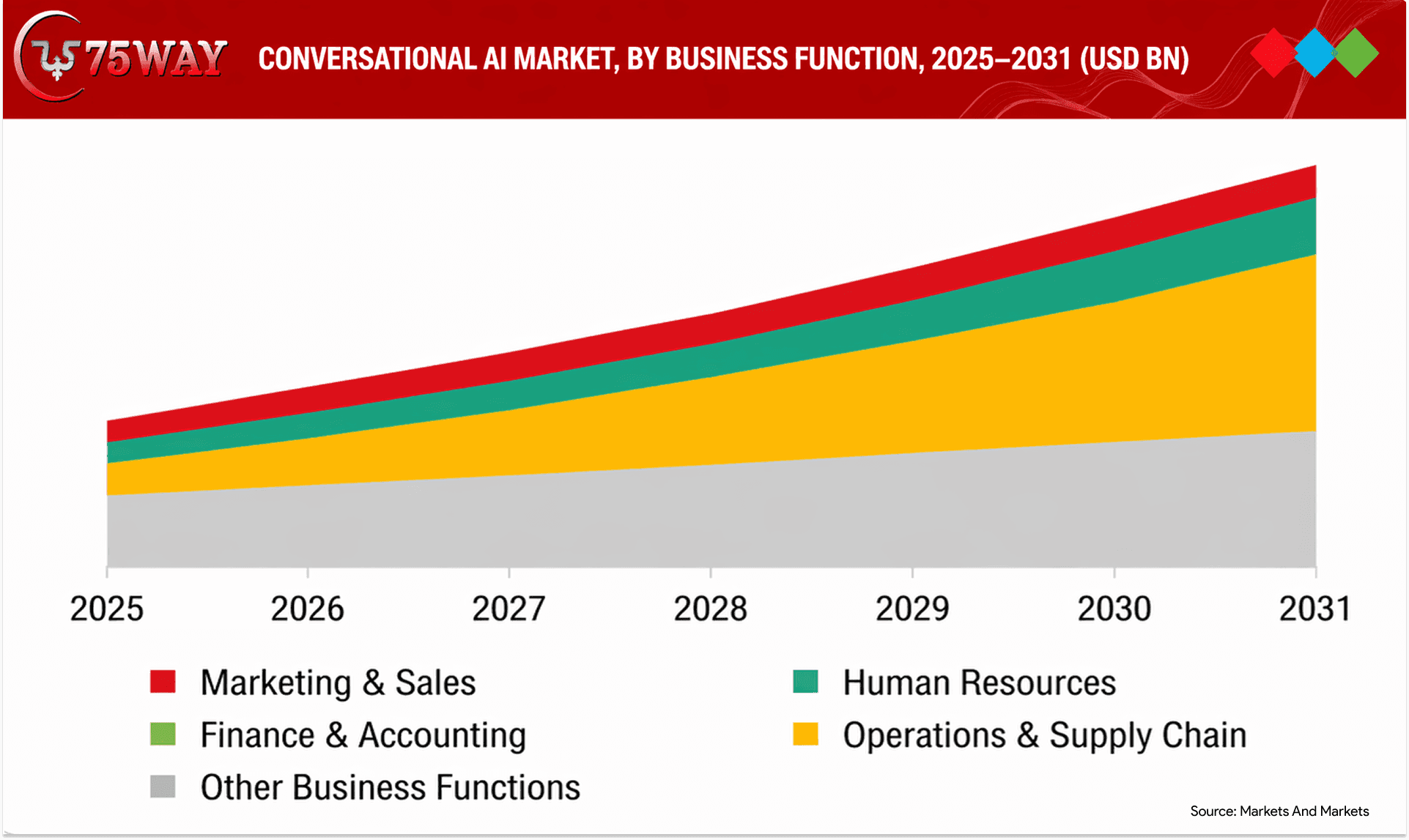
- The conversational AI market is expected to reach $49.80 billion by 2031, growing at a CAGR of 19.6%.
- Around 85% of consumers have interacted with an AI agent in the last three months.
- Nearly 89% of retailers are either using or evaluating AI projects, with 71% actively using generative AI.
- North America holds the largest regional share at 33.62% in the market.
Core Benefits of Hiring Custom AI Agent Developers
Modern businesses are under constant pressure to move faster, respond smarter, and operate leaner without compromising quality. This is where custom AI agent developers bring measurable value. Instead of forcing teams to adapt to rigid tools, these experts design intelligent systems that align with your workflows, goals, and growth plans. The result is not just automation, but a strategic shift in how operations function, decisions are made, and customer interactions are handled at scale.
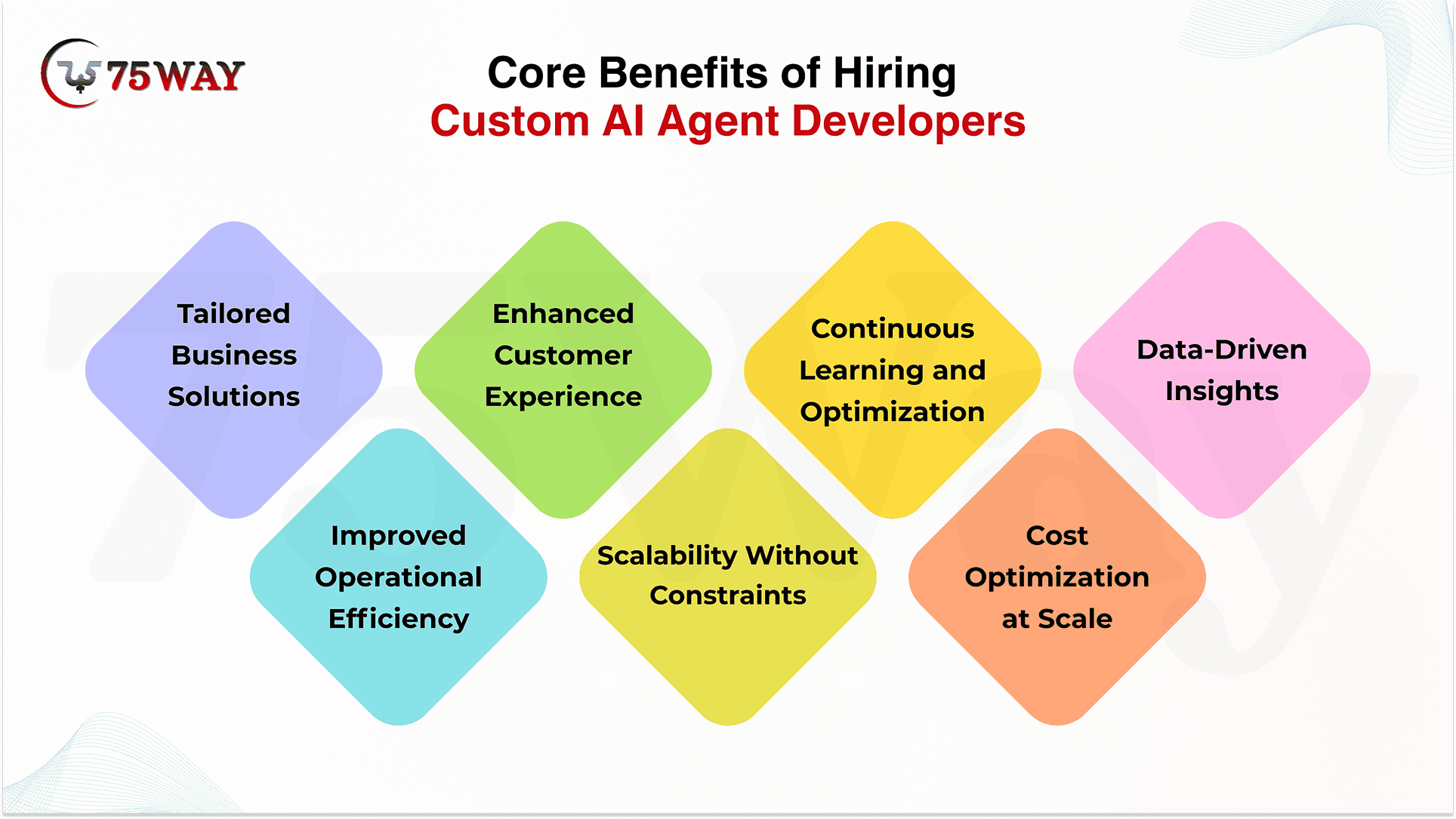
- Tailored Business Solutions
Custom AI voice agents are built specifically for your workflows, ensuring alignment with business objectives and operational needs. This level of personalization enhances efficiency and eliminates unnecessary complexity.
- Improved Operational Efficiency
Automation reduces manual workload, allowing teams to focus on high-value tasks. Processes that once took hours can now be completed within seconds.
- Enhanced Customer Experience
AI agents provide instant, accurate responses, ensuring customers receive consistent support at any time. This improves satisfaction and builds trust.
- Scalability Without Constraints
As business demands grow, AI agents can handle increased workloads without compromising performance. This ensures smooth scalability without additional strain on resources.
- Continuous Learning and Optimization
AI agents improve over time by learning from interactions and data patterns. This continuous learning capability allows businesses to enhance response accuracy and adapt to changing requirements.
- Cost Optimization at Scale
By automating repetitive tasks and reducing dependency on large operational teams, custom AI agents significantly lower long-term costs.
- Data-Driven Insights
Custom AI agents collect and analyze data from interactions, providing valuable insights that support better decision-making and strategy planning.
Key Use Cases Across Business Functions
Businesses today operate across multiple touchpoints where speed, accuracy, and consistency directly impact outcomes. Custom and pre-built AI agents actively support core functions by automating tasks, improving response quality, and enabling smarter workflows.
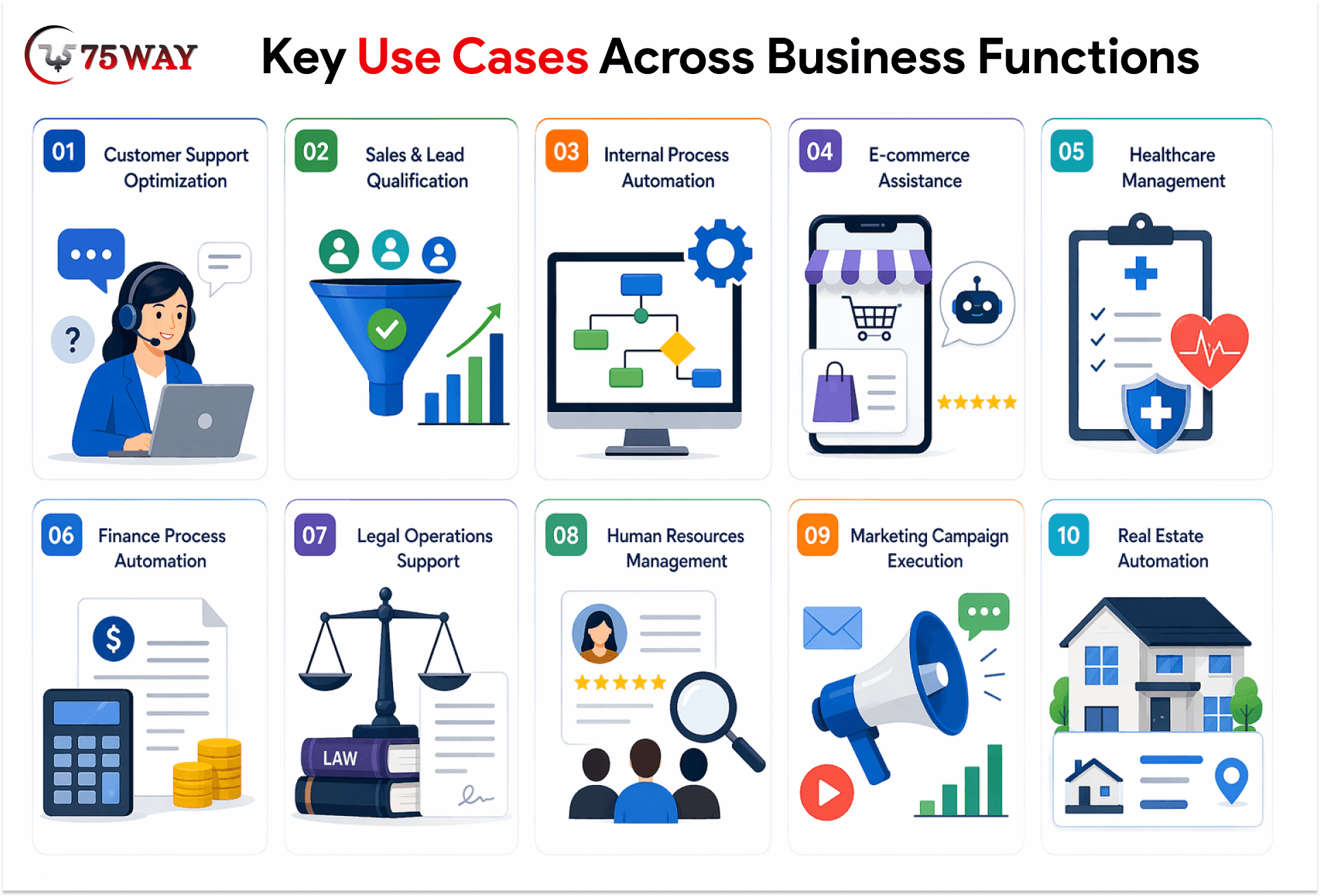
- Customer Support Optimization: BPO & customer support AI agents handle common queries, troubleshoot issues, deliver instant solutions, responses, and support across channels.
- Sales & Lead Qualification: Sales AI agents engage prospects, gather relevant data, and qualify leads efficiently, helping teams prioritize opportunities and improve overall conversions.
- Internal Process Automation: Streamline workflows across departments through automation, reduce manual tasks, enhance accuracy, and strengthen coordination between teams.
- E-commerce Assistance: Conversational AI in ecommerce guides users through product discovery and answers queries to boost engagement and increase conversions across digital storefronts.
- Healthcare Management: Support patient interactions, manage appointments, and handle records with conversational AI in healthcare to enhance communication.
- Finance Process Automation: Manage customer queries, assist transactions, handle compliance tasks with finance AI agents to increase accuracy, and maintain reliability.
- Legal Operations Support: Legal AI agents assist with document management, contract analysis, and client communication, reducing workload and enabling faster execution of legal processes.
- Human Resources Management: HR AI agents automate recruitment, onboarding, and employee queries, improve internal communication, and reduce administrative workload.
- Marketing Campaign Execution: Execute campaigns, automate engagement, and analyze data with marketing AI agents to improve targeting, personalization, and overall marketing performance outcomes.
- Real Estate Automation: AI agents for real estate manage property inquiries, schedule viewings, and qualify leads, helping professionals handle high volumes and close deals faster.
How Developers Build Custom AI Agents: A Complete Process
Agentic AI engineers follow a structured approach to build custom AI agents that align with business goals, integrate AI with systems, and deliver reliable performance. Each stage focuses on clarity, precision, and adaptability to support long-term operational success.
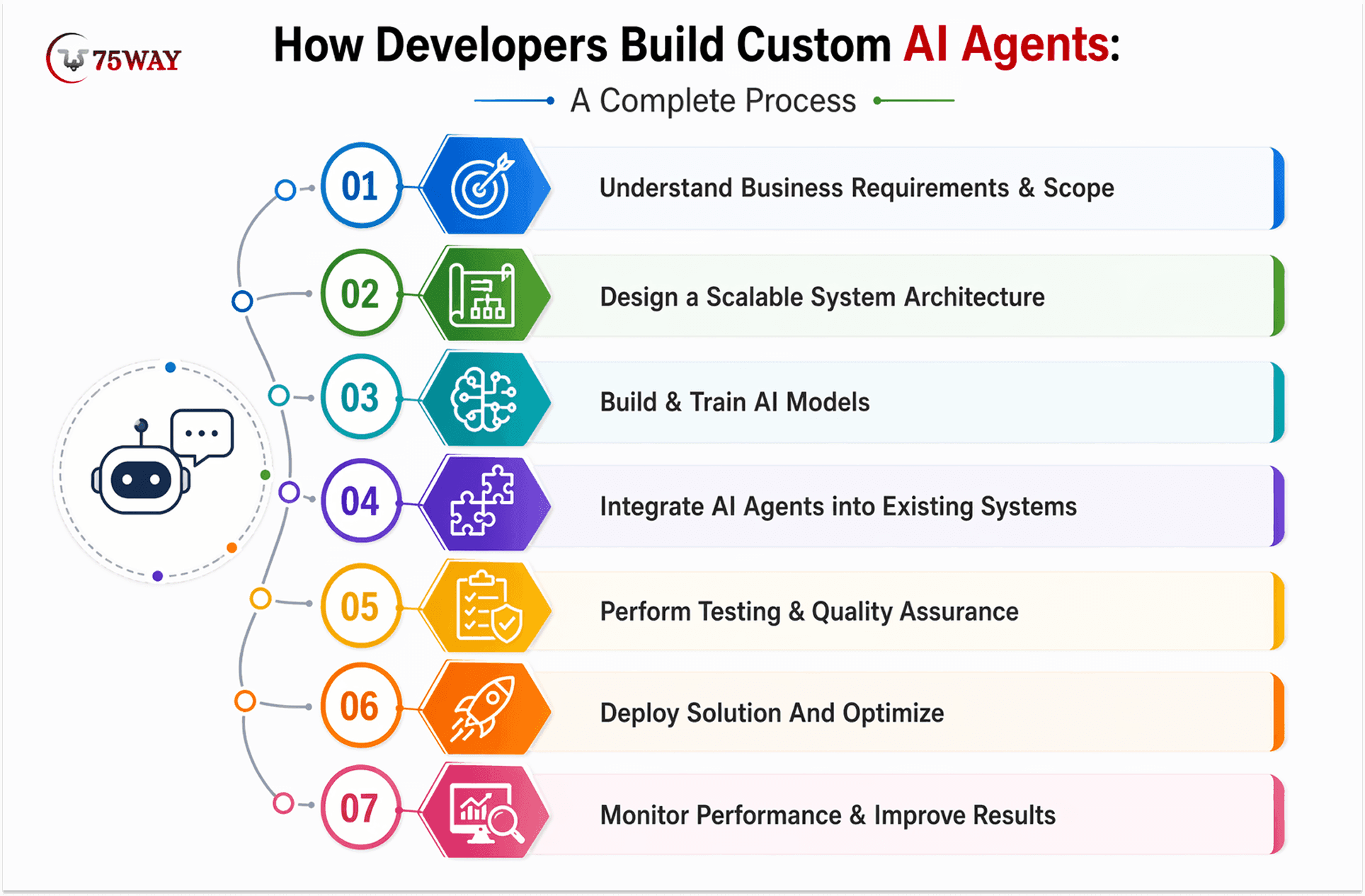
Step 1: Understand Business Requirements & Scope
Every successful AI agent begins with a clear understanding of how a business operates. Engineers work closely with stakeholders to map workflows, identify challenges, and define precise objectives, ensuring the solution aligns with real operational needs and delivers measurable value from the start.
- Business Goals: Define clear objectives, align agent capabilities with outcomes, and ensure every feature supports measurable business value.
- Workflow Mapping: Analyze existing processes, identify bottlenecks, and outline task flows to design automation aligned with real operations.
- User Intent: Capture user expectations, common queries, and interaction patterns to shape accurate and relevant conversational responses.
- Scope Definition: Set boundaries, prioritize features, and outline deliverables to prevent complexity while maintaining focus on essential functionalities.
Step 2: Design a Scalable System Architecture
A strong architecture lays the foundation for how the AI agent will perform under real-world conditions. Engineers define system components, data flow, and interaction layers to ensure the solution handles tasks smoothly without breakdowns or delays across different environments.
The design focuses on flexibility so the system can adapt as business needs evolve. Modular structures allow new features, integrations, or updates without rebuilding the entire solution, making long-term expansion practical and controlled.
Performance and reliability remain central during this stage. Engineers plan load handling, response speed, and system stability, so the AI agent delivers consistent output even during high demand or complex interaction scenarios.
Step 3: Build & Train AI Models
This stage focuses on creating intelligent models that power the AI agent’s decision-making and responses. Engineers use relevant datasets to shape understanding and context. Continuous training improves accuracy, enabling the system to deliver reliable, context-aware interactions over time.
- Collect high-quality datasets aligned with business use cases and objectives
- Clean and structure data to remove inconsistencies and improve model accuracy
- Train models using algorithms suited for language understanding and decision-making tasks
- Test outputs against scenarios to validate response quality and contextual understanding
- Refine models continuously using feedback and real interaction data for improvement
Step 4: Integrate AI Agents into Existing Systems
After building and training the model, the next step is to integrate the AI agent with core business platforms such as CRM, ERP, communication tools, and databases. Engineers ensure smooth data exchange, maintain consistency across systems, and align workflows without disrupting existing operations.
This stage focuses on compatibility, security, and performance across connected environments. Proper integration enables real-time updates, accurate information flow, and coordinated task execution, allowing the AI agent to operate as a fully embedded part of daily business functions.
Step 5: Perform Testing & Quality Assurance
After integration, thorough testing validates performance, accuracy, and reliability across real-world scenarios. AI agent experts evaluate responses, system behavior, and edge cases to ensure the AI agent functions as expected, handles complexity, and delivers consistent outcomes without errors or unexpected disruptions.
- Functional Testing: Verify each feature works correctly across workflows, ensuring accurate responses and proper execution of defined tasks.
- Performance Checks: Assess response speed, system load handling, and stability under varying usage conditions to confirm reliable operation.
- Accuracy Validation: Evaluate outputs against expected results to confirm contextual understanding and minimize incorrect or irrelevant responses.
- Edge Case Testing: Test uncommon scenarios and unexpected inputs to ensure the agent handles situations without failure or confusion.
- Security Review: Examine data handling, access controls, and system safeguards to protect sensitive information across all interactions.
- User Testing: Gather feedback from real users to identify gaps, refine interactions, and improve overall usability before final deployment.
Step 6: Deploy Solution And Optimize
Once testing confirms readiness, the AI agent moves into the live environment to handle real interactions and workflows. Engineers manage rollout, observe system behavior, and ensure smooth performance under actual business conditions from the very beginning.
Deployment marks the transition to continuous monitoring, where performance, response quality, and system stability are closely tracked. Insights from real usage help identify gaps, refine outputs, and maintain consistent operation as demand and complexity increase over time.
Ongoing optimization focuses on refining accuracy, updating workflows, and adapting to evolving business requirements. Regular improvements based on interaction data keep the AI agent responsive, reliable, and aligned with long-term operational goals without requiring major system changes.
Step 7: Monitor Performance & Improve Results
After deployment, continuous monitoring keeps the AI agent aligned with expected outcomes and real-world usage patterns. Engineers evaluate responses, track system behavior, and use insights from interactions to refine performance, strengthen accuracy, and support evolving business requirements over time.
- Track response accuracy across interactions and identify recurring performance patterns
- Analyze system metrics to detect gaps and refine output quality
- Review user feedback to adjust responses and improve interaction quality
- Observe system behavior under load to maintain stability and consistency
- Update models with new data to strengthen relevance and understanding
- Refine workflows based on insights to match changing business needs
How to Choose the Right AI Agent Development Partner?
Choosing the right AI agent development partner shapes project success, long-term scalability, and business impact. A reliable team aligns with goals, understands workflows, and delivers tailored solutions that integrate smoothly while supporting continuous improvement and operational growth.
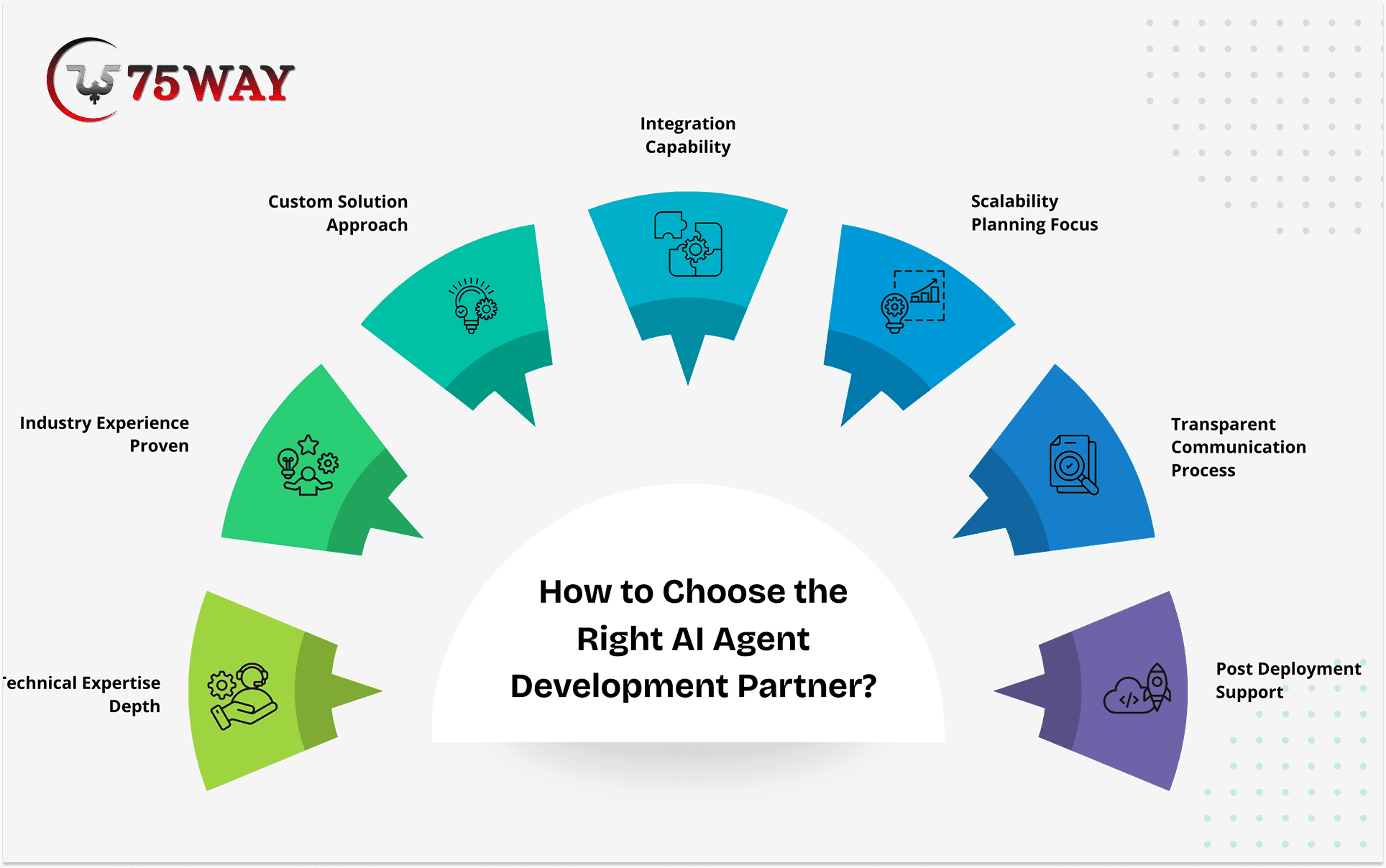
- Technical Expertise Depth: Assess knowledge in AI frameworks, machine learning models, and system design to ensure strong development capabilities.
- Industry Experience Proven: Evaluate past projects within similar domains to confirm understanding of workflows, compliance, and operational requirements.
- Custom Solution Approach: Ensure focus remains on tailored development aligned with business needs rather than relying on generic pre-built tools.
- Integration Capability: Check the ability to connect AI agents to existing systems such as CRM, ERP, and internal platforms.
- Scalability Planning Focus: Confirm architecture supports future growth, increasing workloads, and evolving requirements without major system redesign efforts.
- Transparent Communication Process: Review collaboration methods, reporting structure, and clarity in timelines to maintain alignment throughout development phases.
- Post Deployment Support: Verify ongoing maintenance, updates, and performance monitoring to ensure long-term reliability and continuous improvement.
What is The Cost To Hire Custom AI Agent Developers
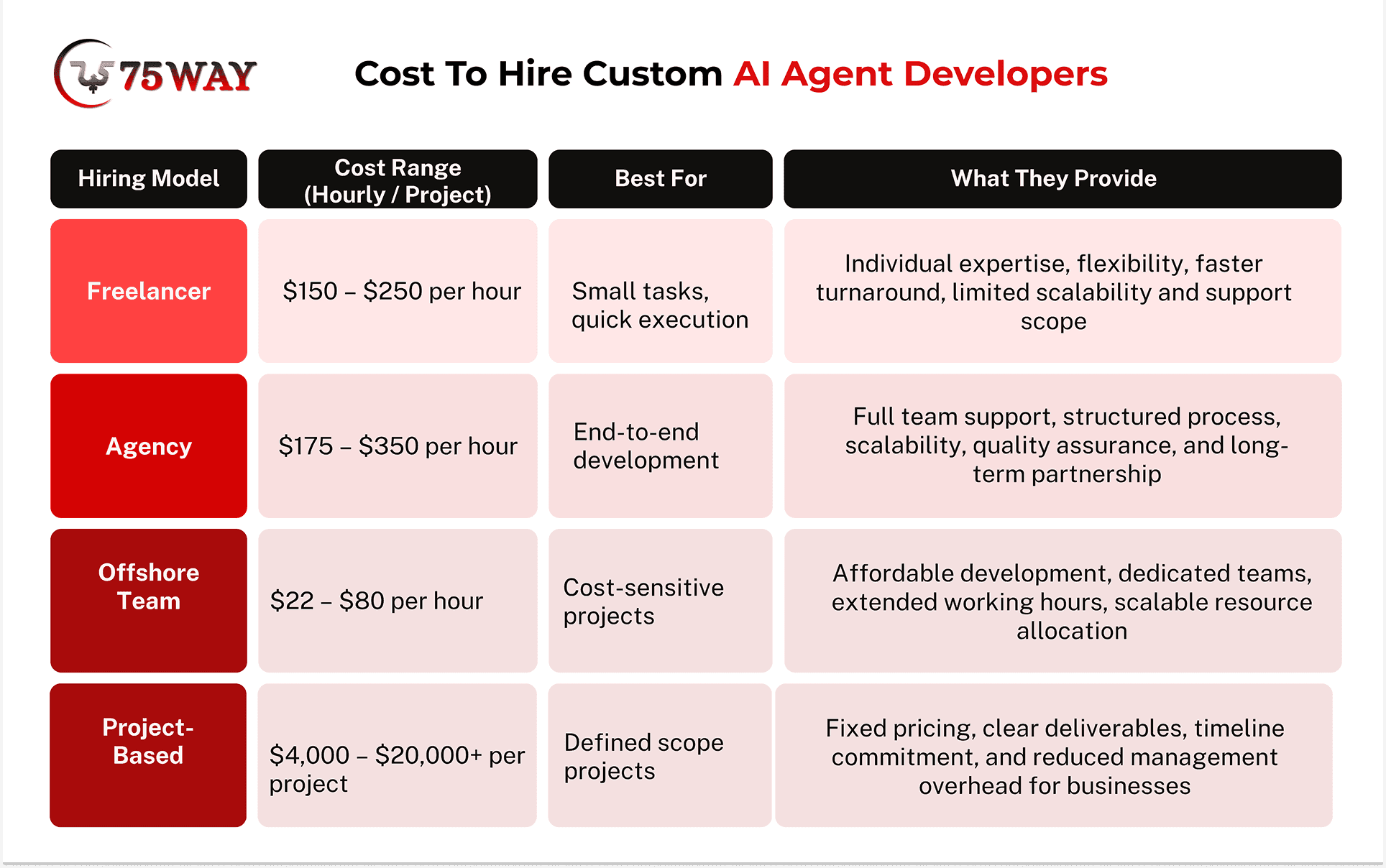
The cost of hiring custom AI agent developers varies based on expertise, engagement model, and project complexity. On average, hourly rates range between $22 and $350. Businesses can choose between freelancers, agencies, offshore teams, or fixed project pricing depending on scope, budget, and long-term requirements.
- AI Agent Freelancer Cost: $150–$250/hr
Experienced independent professionals offering high-quality, specialized development services.
- AI Agent Development Agency Cost: $175–$350/hr
Full-service teams providing end-to-end solutions with structured processes and premium delivery.
- Offshore AI Agent Team: $22–$80/hr
Cost-effective development teams delivering scalable solutions with global talent access.
- Project-Based AI Agent Cost: $4,000–$20,000+
Fixed-cost engagements based on a defined scope, ideal for small to mid-sized projects.
Factors Impacting The Cost of Hiring AI Agent Engineers
Several factors influence AI agent development cost, including complexity, features, integrations, expertise level, project scope, and scalability requirements.
1. Agent Complexity
- Cost of Simple AI Agent: $5,000 – $20,000
- Cost of Advanced AI Agent: $50,000 – $150,000+
Basic rule-based bots are affordable, while multi-agent, memory-driven systems require higher investment.
2. Development Phase
- AI Agent PoC Cost: $15,000 – $35,000
- AI Agent Full Product Cost: $60,000 – $150,000+
Start with a proof of concept, then scale to a production-grade deployment.
3. Core Development Cost: 35%–45% of total budget
Core development takes a major share, with infrastructure and integrations adding extra costs.
4. API Integrations Cost: $5,000 – $40,000
Connecting CRM or ERP systems significantly enhances functionality but increases overall cost.
5. RAG (Retrieval-Augmented Generation) Cost: $10,000 – $30,000
Enables intelligent data retrieval using vector databases for domain-specific responses.
6. LLM Customization Cost: $10,000 – $30,000 annually
Advanced model usage and training on proprietary data improve accuracy and performance.
7. Cloud Infrastructure Cost: $2,000 – $15,000 (initial setup)
Covers deployment, hosting, and CI/CD pipelines for smooth and scalable operations.
Challenges of Building Conversational AI Agent and How to Overcome Them
Building conversational AI agents involves technical, operational, and human challenges that can impact performance and adoption. Addressing these early with structured planning and expert guidance ensures smoother implementation and long-term success.
- Data Quality Issues: AI systems rely on accurate data. Poor data quality can impact performance. Ensuring clean and structured data is essential.
- Integration Complexity: Connecting AI agents with existing systems can be challenging. Working with experienced developers simplifies this process.
- User Adoption: Employees may resist change. Providing proper training and demonstrating benefits encourages adoption.
- Security Concerns: Handling sensitive data requires strong security measures. Implementing robust protocols ensures data protection.
Future of Conversational AI in Business Operations
The future of conversational AI lies in deeper personalization, improved contextual understanding, and seamless integration across platforms.
AI agents will become more proactive, anticipating user needs and providing solutions before issues arise. Businesses that invest in this technology today will be better positioned to adapt to evolving market demands.
Final Thoughts
Custom AI agent development is no longer a forward-looking investment. It has become a practical strategy for businesses aiming to streamline operations and improve efficiency. By automating conversations, organizations can reduce manual effort and deliver consistent experiences across every interaction.
The value lies in building solutions tailored to specific business needs rather than relying on generic tools. With the right development approach, AI agents can scale alongside business growth while continuously improving performance through data-driven learning.
Decision-makers who embrace conversational automation today position their organizations for stronger operational control, faster response cycles, and long-term competitive advantage. Partner with a trusted AI development company to unlock real business transformation.
Frequently Asked Questions (FAQs)
What Is A Custom AI Agent Developer?
A custom AI agent developer specializes in building intelligent systems tailored to specific business needs. These professionals design, develop, and deploy AI agents capable of handling conversations, automating workflows, and integrating with existing systems to improve operational efficiency and customer experience across different business functions.
How Do AI Agents Improve Business Operations?
AI agents automate repetitive tasks, streamline workflows, and provide instant responses to queries. This reduces manual workload, improves accuracy, and speeds up processes. By handling routine operations, they allow teams to focus on strategic activities that drive business growth and improve overall productivity.
Are Custom AI Agents Better Than Pre-Built Solutions?
Custom AI agents offer greater flexibility, scalability, and alignment with business processes. Unlike pre-built tools, they are designed to meet specific requirements, ensuring better performance and integration. This results in more efficient operations and a higher return on investment over time.
What Industries Benefit From AI Agent Development?
Industries such as healthcare, finance, retail, and technology benefit significantly from AI agent development. These systems automate processes, improve customer interactions, and enhance data management, making them valuable across sectors that require efficiency, accuracy, and scalable solutions.
How Long Does It Take To Develop A Custom AI Agent?
The development timeline depends on complexity, features, and integrations. Basic AI agents can be developed within weeks, while advanced systems may take several months. A structured development process ensures timely delivery without compromising quality and performance.
What Is The Cost Of Hiring AI Agent Developers?
The cost varies based on project scope, customization level, and required features. While initial investment may seem high, the long-term benefits, such as reduced operational costs and improved efficiency, make it a valuable investment for businesses seeking growth.
Can AI Agents Integrate With Existing Systems?
Yes, custom AI agents are designed to integrate seamlessly with existing platforms such as CRM, ERP, and communication tools. This ensures smooth data flow and enhances overall system functionality without disrupting current operations.
How Secure Are AI Agent Solutions?
AI agent solutions can be highly secure when developed with proper protocols. Implementing data encryption, access controls, and compliance measures ensures that sensitive information is protected while maintaining system reliability and performance.