Summary
Learn how to design and implement an agentic AI system that can plan, decide, and execute tasks autonomously. This covers core architecture, practical steps, real-world use cases, tools, challenges, and strategies to help startups automate workflows, improve efficiency, and scale operations with intelligent systems that deliver measurable business outcomes.
Key Takeaways
- Agentic AI enables autonomous decision-making, reducing human supervision and increasing business efficiency.
- Startups should define clear goals to align AI actions with desired outcomes.
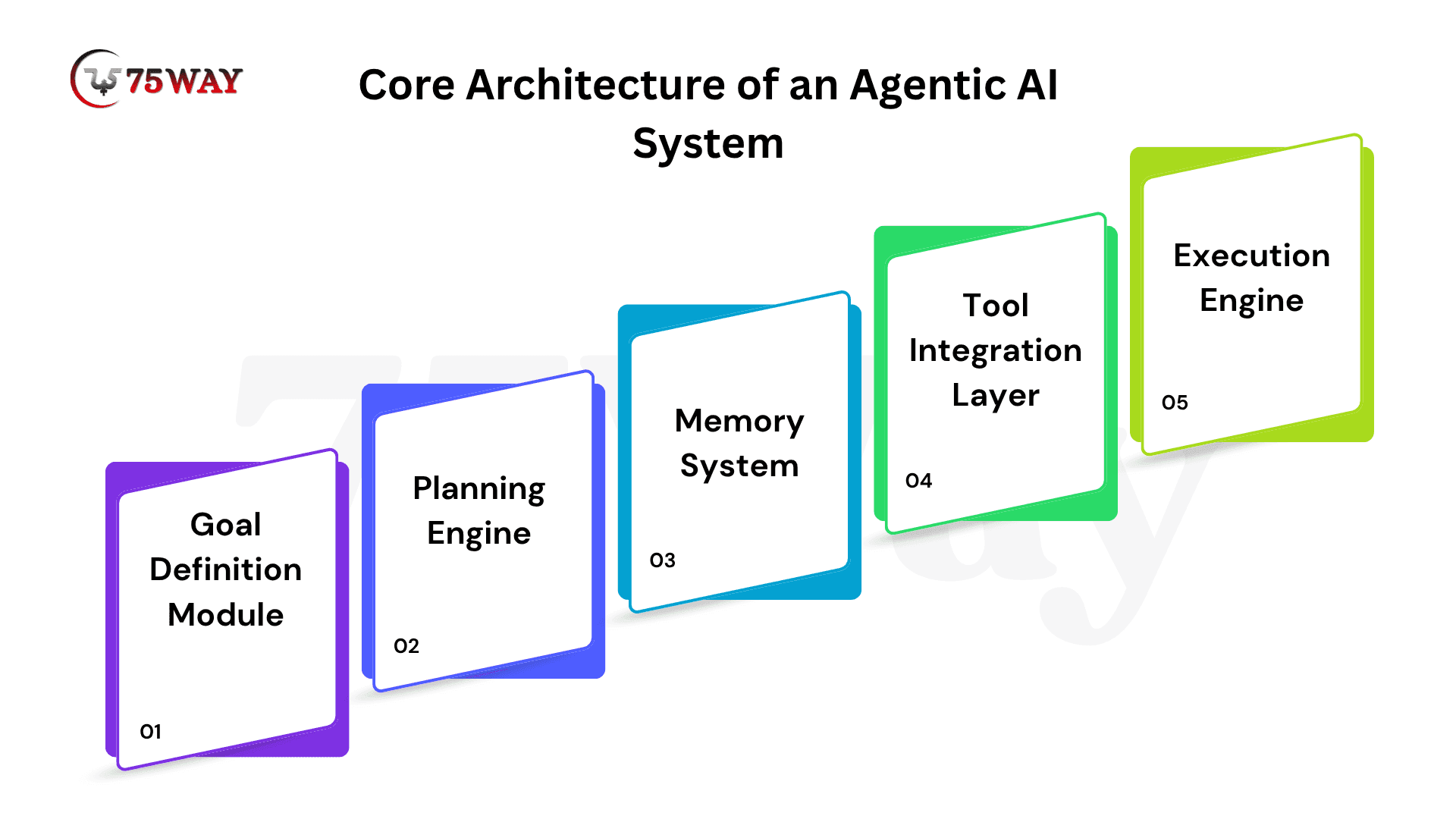
- Core architecture includes goal setting, planning, memory, tool integration, and the execution engine.
- Real-world use cases include sales automation, support, workflow, marketing, finance, and supply chain.
- Development cost ranges from $15,000 for prototypes to $400,000+ for enterprise systems.
- Companies using agentic AI report up to 35% higher operational efficiency and scalability.
Struggling to build an agentic AI system that actually works without constant human input? Most startups today are experimenting with AI. They build AI chatbots, automate workflows, and integrate APIs. Yet, despite all this effort, one problem remains constant. These systems still require continuous human involvement.
You still need someone to monitor outputs, fix errors, and guide decisions. This is where most AI implementations fall short. What businesses actually need is not just automation, but autonomy. They need autonomous agentic AI development solutions that can think, decide, and act independently.
This is exactly what an agentic AI system is designed to do. In this guide, you will learn how to build an agentic AI system from scratch, using a practical, business-focused approach that goes beyond theory and delivers real outcomes.
What is an Agentic AI System?
An agentic AI system is an advanced form of artificial intelligence that can independently plan, make decisions, and execute tasks with minimal human intervention.
Unlike traditional AI systems that simply respond to inputs, an agentic AI system operates with intent. It understands goals, breaks them into actionable steps, and continuously improves based on feedback. In simple terms, it is the difference between an assistant that answers questions and a system that completes tasks on its own.
Read Too: Managed IT Services for Manufacturing: Step-by-Step Guide for Businesses
Why Startups & Enterprises Are Moving Toward Agentic AI Systems?
Startups operate in highly competitive environments where efficiency, speed, and scalability directly impact growth. Traditional AI solutions often fail to meet these demands because they rely heavily on human supervision.
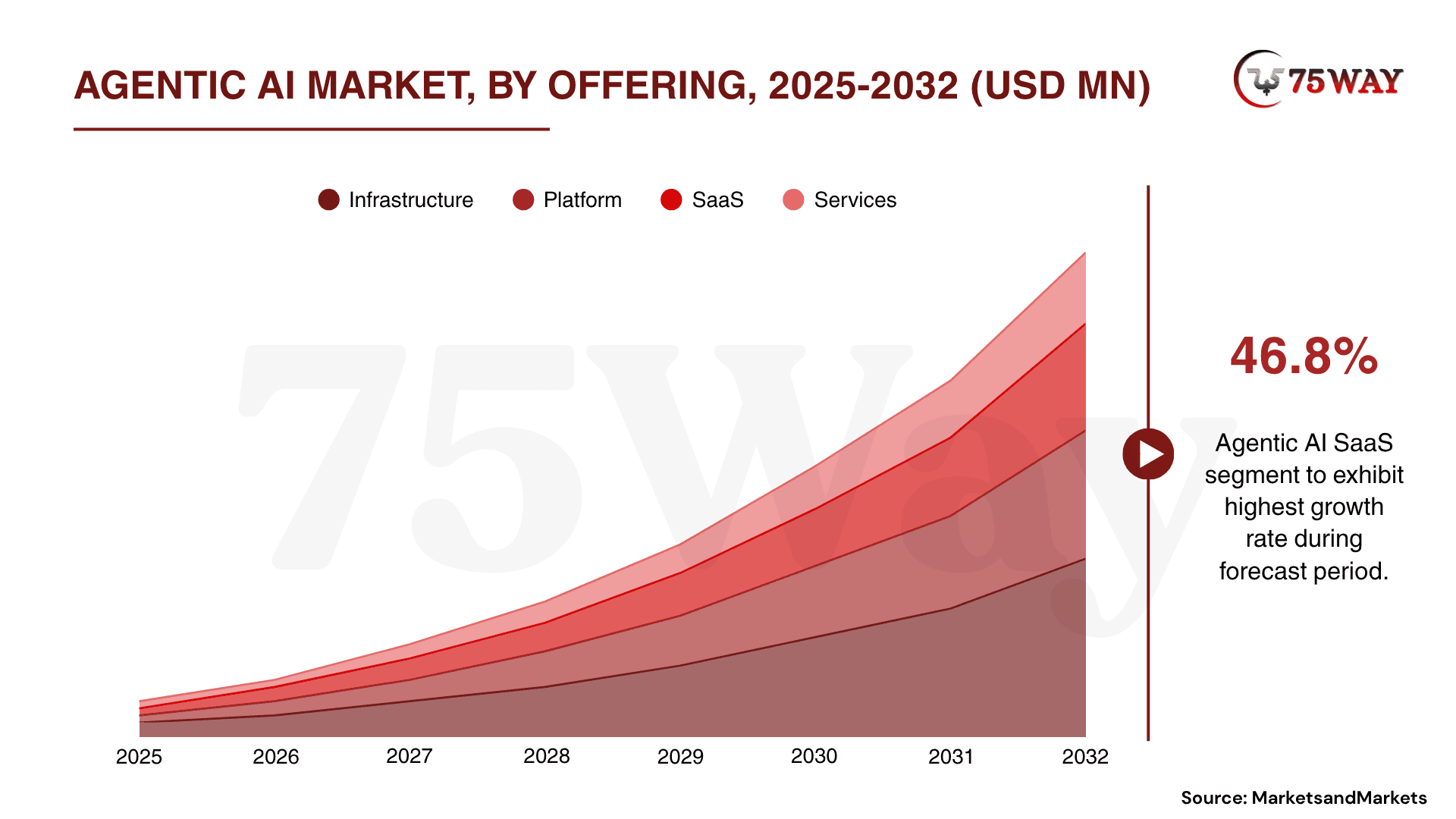
Agentic AI systems solve this by enabling businesses to automate not just tasks, but decision-making processes. They reduce operational costs by minimizing manual involvement. They improve efficiency by executing workflows without delays. They scale effortlessly because they are not limited by human capacity.
More importantly, they create a competitive advantage. While many businesses rely on reactive systems, agentic AI enables proactive operations. For example, instead of a support system that waits for customer queries, an autonomous agentic AI system can detect issues, resolve them, and follow up automatically.
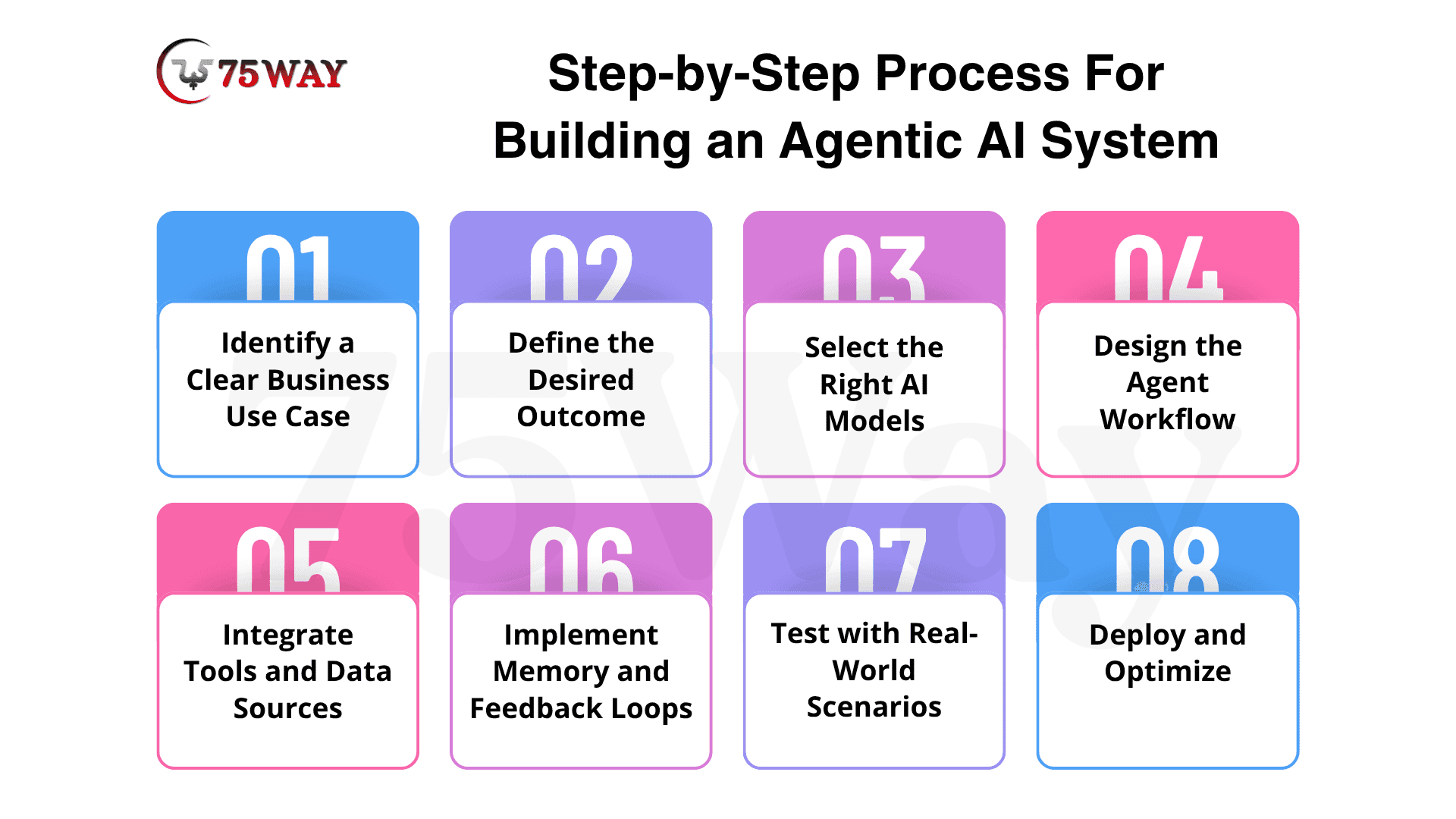
Step-by-Step Process For Building an Agentic AI System
A structured AI agentic development methodology is required to build an autonomous agentic AI system that aligns with real business goals. Start by defining the objective, then design the agent architecture, select suitable AI models, integrate necessary tools, implement memory and feedback loops, test with real scenarios, and deploy. This step-by-step process ensures scalable, autonomous AI that drives efficiency, decisions, and measurable outcomes.
Section:
Identify a Clear Business Use Case
Every successful agentic AI system begins with a problem that matters to the business. Founders notice areas where repetitive tasks consume time and resources, such as responding to customer queries or managing sales leads. These tasks slow growth and create room for error. By focusing on a meaningful task, AI can operate as a reliable partner that handles routine decisions. A system designed around one strong purpose develops patterns that increase accuracy and trust. This approach allows teams to focus on strategic actions while AI handles ongoing tasks.
- Pinpoint tasks that require frequent human decision-making.
- Select workflows with high operational or time costs.
- Identify areas with clear success metrics (for example, lead conversion, response time).
- Evaluate processes that can benefit from automation and learning.
- Prioritize use cases that align with overall business objectives and ROI.
Define the Desired Outcome
After identifying the specific business problem, the next focus is on measurable results that the AI system must achieve. Each task and capability of the agent should contribute to concrete improvements such as increasing lead conversion, enhancing customer engagement, or reducing operational costs. Outcomes provide direction for designing the workflows and decision-making logic.
Performance measurement connects system actions to business objectives, allowing assessment of progress and effectiveness. Every automated process, integration, and decision supports these results, creating a system that not only executes tasks but delivers meaningful impact. Tracking and adapting strategies over time reinforces long-term reliability and value.
Select the Right AI Models
After defining the desired outcomes, selecting AI models becomes critical to achieving them. Models must align with the business problem, the data available, and the workflows designed for the agent. Selection focuses on reliability, consistent performance, and scalability rather than unnecessary complexity. The right models allow the system to make decisions, act autonomously, and adapt to ongoing feedback, supporting measurable business growth.
- Model Compatibility: Confirm that the selected models are compatible with your data types and workflows to deliver accurate, context-aware outputs.
- Performance Metrics: Evaluate models based on accuracy, speed, and resource efficiency to maintain dependable operational results across all tasks.
- Scalability Options: Choose models capable of handling growth in user base, data volume, and complexity without sacrificing performance.
- Integration Ease: Ensure models can seamlessly connect with APIs, databases, and tools to support smooth automation and execution.
Design the Agent Workflow
After selecting suitable AI models, the agent’s workflow determines how it operates autonomously across tasks. The workflow connects data, reasoning, and execution into a continuous system. Each component interacts with memory, tools, and external systems to complete goals. Feedback is integrated at every step to refine decisions, enabling the agent to learn from outcomes while maintaining alignment with business objectives.
- Input Interpretation: The agent captures raw data from users, APIs, and databases and translates it into structured information ready for processing.
- Context Management: Memory layers and embeddings maintain situational context, allowing the agent to recall relevant information for decision-making.
- Reasoning Engine: AI models evaluate available options, predict outcomes, and prioritize actions based on objectives and historical data.
- Task Execution: Selected actions are performed automatically across connected platforms, workflows, and systems, achieving the intended outcomes.
- Outcome Feedback: Results of actions are tracked and analyzed, feeding back into the system to improve future decisions and learning efficiency.
Integrate Tools and Data Sources
The agent workflow defines how the system processes inputs, makes decisions, and executes actions. Connecting the AI to CRMs, APIs, databases, and other business platforms provides the tools and data required to carry out these tasks effectively. Each integration bridges the gap between planning and execution, enabling the agent to act on real-world information while remaining aligned with defined workflows and business objectives.
Seamless interaction with multiple systems strengthens the agent’s reasoning and decision-making. Data from these sources feeds directly into the AI models, supporting accurate actions and contextual awareness. Feedback from integrations continuously informs the system, improving decisions over time and creating a self-improving workflow that consistently delivers measurable business outcomes.
Implement Memory and Feedback Loops
Connections to tools and data sources provide the agent with the ability to act, but long-term effectiveness depends on memory and feedback mechanisms. Memory layers capture past interactions, decisions, and outcomes, allowing the system to reference historical data when processing new inputs. Integrating these loops into the workflow ensures that each action builds on previous experiences, helping the agent refine decisions and improve task execution over time.
Feedback loops strengthen learning by continuously comparing expected outcomes with actual results. Performance insights, user interactions, and system outputs feed into the AI models, which adjust their reasoning and predictions for future tasks. This cyclical learning approach creates a self-improving system that adapts to changing data and business conditions, maintaining accuracy, reliability, and relevance across all operations.
Test with Real-World Scenarios
The agentic AI system demonstrates its value when evaluated against actual business scenarios and diverse datasets. Real-world testing reveals how decisions, workflows, and integrations perform in practice. Edge cases and unusual inputs highlight gaps in reasoning or execution, providing insights for refinement. Continuous observation ensures the system adapts to varying situations and maintains reliable performance, supporting measurable business outcomes and long-term operational success.
- Typical tasks provide insight into agent performance under standard operational conditions.
- Rare edge cases reveal the system’s ability to handle unexpected situations.
- Output accuracy highlights differences between predicted results and actual outcomes.
- Workflow execution demonstrates the quality of interaction between models and connected tools.
- User observations contribute to system refinement and improved operational effectiveness.
Deploy and Optimize
Deployment marks the stage where the agentic AI system begins operating in real business environments. Performance monitoring provides insights into task execution, decision accuracy, and workflow integration. Continuous observation of system behavior allows identification of areas for refinement and adaptation. Adjustments based on feedback ensure the agent maintains alignment with business objectives and consistently delivers measurable outcomes, improving overall reliability and long-term impact.
Integration of monitoring tools and analytics supports proactive problem detection and performance enhancement. Data collected from daily operations feeds into memory and feedback loops, reinforcing learning and enabling the system to adapt to evolving workflows. This approach creates an AI solution that not only executes tasks but evolves alongside business needs to maximize efficiency, decision quality, and operational effectiveness.
Read More: How AI Agents Automate Sales, Support & Operations in US Companies
Core Architecture of an Agentic AI System
To build an effective agentic AI system, you must understand its core components. These components work together to enable autonomy and intelligence. Each component interacts with others to create a system capable of reasoning, acting, and learning. The architecture ensures that goals, workflows, data, and tools work in harmony, enabling the agent to make decisions, execute tasks, and improve performance over time.
Goal Definition Module
Every agentic system begins with a clearly defined goal. This module establishes what the system is trying to achieve. Without a clear goal, the system lacks direction. With a well-defined objective, it can align all decisions and actions accordingly.
Planning Engine
The planning engine acts as the brain of the system. It takes the defined goal and breaks it into smaller, manageable steps. It determines priorities, sequences actions, and adapts plans based on changing conditions.
Memory System
Memory is essential for intelligent behavior. An agentic AI system uses both short-term and long-term memory. Short-term memory helps it manage current tasks, while long-term memory allows it to learn from past interactions and improve over time.
Tool Integration Layer
This layer connects the AI system to external tools and platforms. It allows the system to interact with databases, APIs, and business applications. Without this integration, the system would remain isolated and unable to execute real-world actions.
Execution Engine
The execution engine is responsible for carrying out decisions. It performs tasks such as sending emails, updating records, or triggering workflows. This is where the system transitions from planning to action.
Discover More: How to Build AI Agents From Scratch? Step-By-Step Guide
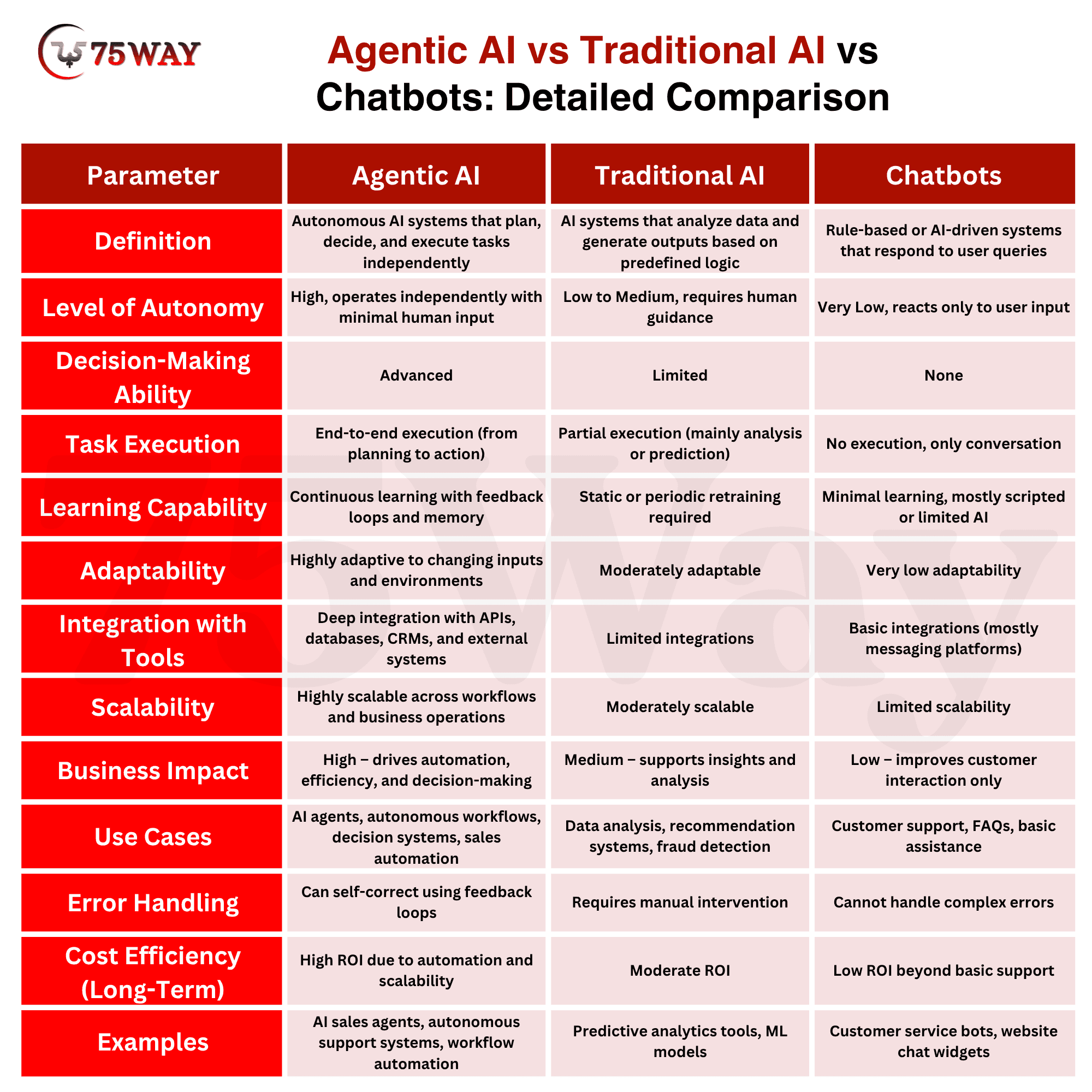
Agentic AI vs Traditional AI vs Chatbots: Detailed Comparison
Agentic AI differs from traditional AI and chatbots by offering full autonomy, decision-making capabilities, and task execution. While traditional AI focuses on analysis and chatbots handle conversations, agentic AI systems independently plan, act, and optimize workflows, making them ideal for business automation.
If you are aiming for complete automation along with intelligent decision-making and task execution, agentic AI becomes the most suitable choice. If your requirements focus on data analysis, generating insights, or predictive decision-making to support your strategy, traditional AI serves these purposes effectively. If your need is limited to handling basic customer interactions, answering common queries, or providing simple conversational support, chatbots remain a practical and efficient solution.
Real-World Use Cases of Agentic AI Systems
Agentic AI systems are transforming business operations by combining autonomy, intelligence, and real-time decision-making. Companies across industries are leveraging these systems to reduce manual work, optimize processes, and improve outcomes. The flexibility of agentic AI allows it to operate in diverse domains, from customer engagement to financial analysis, delivering measurable impact while continuously learning and adapting to changing business conditions. Diverse use cases of agentci AI systems are:
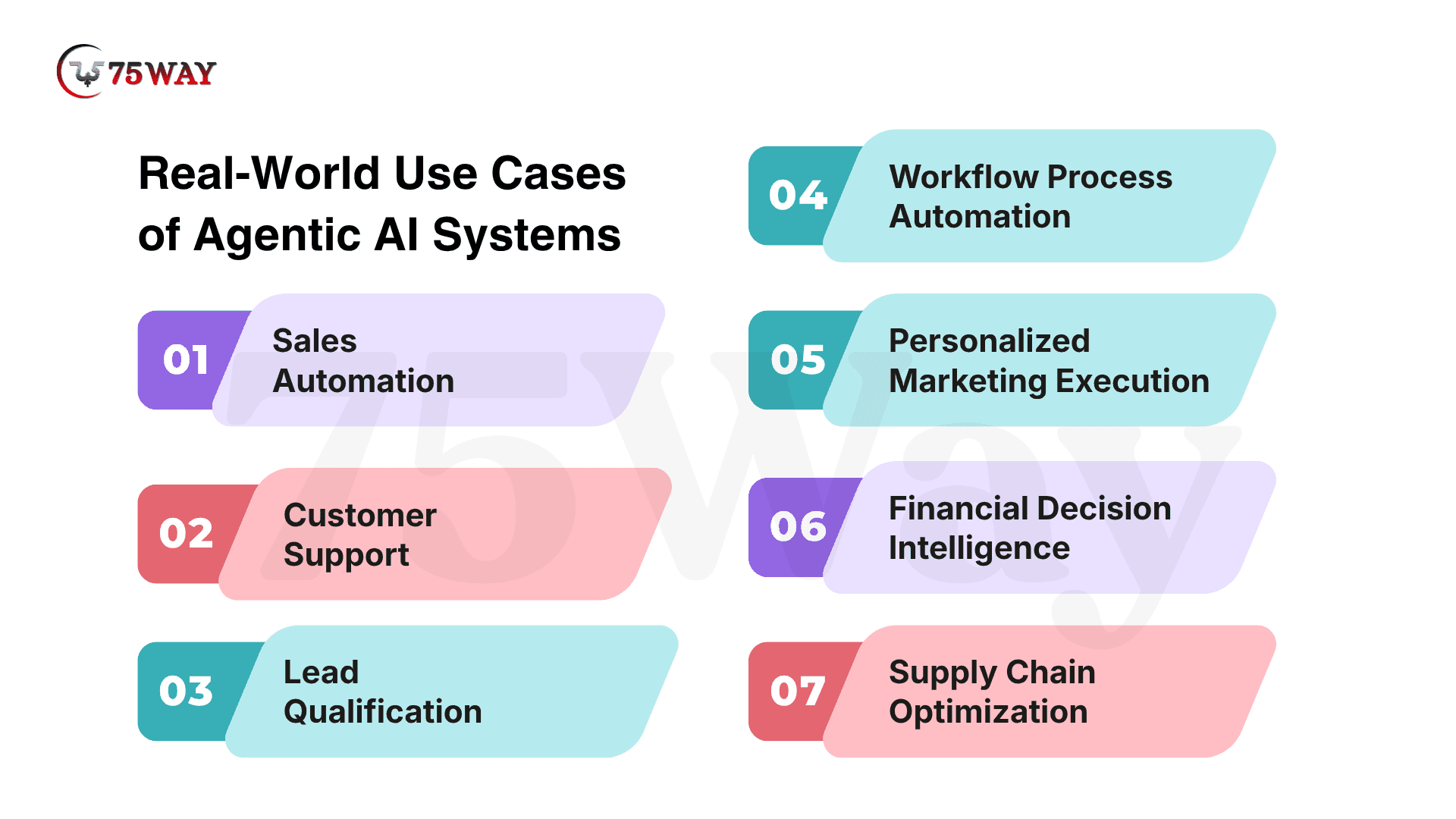
Sales Automation: Agentic AI solutions automatically qualify leads, manage follow-ups, and update pipelines. This reduces manual work, speeds up conversions, and allows sales teams to focus on high-value opportunities for better revenue outcomes.
Customer Support: The system handles routine inquiries, resolves common issues, and escalates complex cases to human agents. Consistent, timely responses improve customer satisfaction while freeing support teams for strategic tasks.
Lead Qualification: TheLLM-powered agentic AI system analyzes behavioral patterns, engagement metrics, and past interactions to score leads. High-value prospects are prioritized, allowing teams to focus resources on opportunities most likely to convert.
Workflow Process Automation: Repetitive internal processes are automated, from approvals to notifications. This reduces errors, saves time, and standardizes operations, enabling staff to focus on critical, strategic work across departments.
Personalized Marketing Execution: Agentic AI creates tailored campaigns by analyzing user data in real time. Messages are optimized for engagement, targeting the right audience, channel, and timing to maximize conversions and ROI.
Financial Decision Intelligence: The system evaluates financial data, predicts trends, and recommends optimal actions. Businesses can make informed budgeting, investment, and risk decisions with greater accuracy and reduced operational risk.
Supply Chain Optimization: The scalable agentic AI development solutions predict demand, monitor inventory, and optimize logistics routes. Supply chains become proactive, reducing costs, avoiding stockouts, and ensuring smoother, faster delivery across multiple touchpoints.
Read Too: How to Build A Social Media App Like Upscrolled: 2026 Playbook
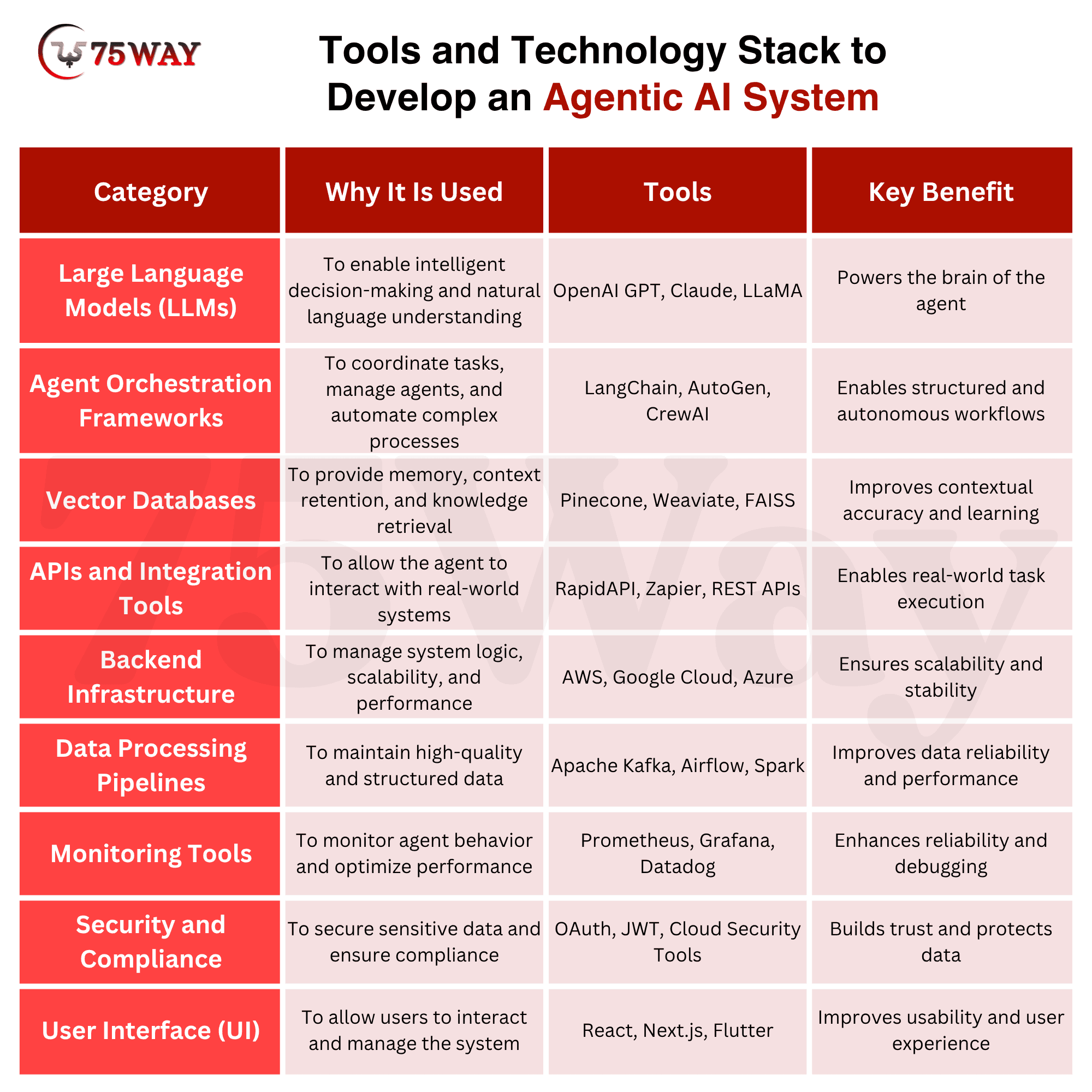
Tools and Technology Stack to Develop an Agentic AI System
The development of Agentic AI systems rely on a combination of LLMs, orchestration frameworks, vector databases, APIs, backend infrastructure, and monitoring tools. This stack enables autonomous decision-making, real-world task execution, memory retention, seamless integration, and continuous learning, forming a reliable, scalable system that drives measurable business outcomes efficiently.
Large Language Models (LLMs): LLMs form the intelligence of the agent, interpreting inputs, reasoning, and generating outputs. They enable decision-making, planning, and communication by understanding context, learning from data, and adapting actions to achieve business goals autonomously and accurately.
Agent Orchestration Frameworks: These frameworks coordinate multiple AI models, tools, and workflows. They manage task prioritization, execution sequences, and multi-step processes, ensuring the agent operates cohesively and completes complex objectives with autonomy and reliability.
Vector Databases: Vector databases store embeddings and semantic representations of data, enabling memory, context retention, and fast similarity searches. They allow the agent to recall previous interactions, maintain situational awareness, and make informed, context-driven decisions over time.
APIs and Integration Tools: APIs connect the agentic AI system to external systems, platforms, and databases. They allow real-world task execution, data exchange, and operational interactions, transforming decisions into actionable outcomes across business workflows and tools.
Backend Infrastructure: The backend manages logic, data flow, and processing for the agent. Cloud servers, microservices, and storage handle scalability, reliability, and computational requirements, enabling smooth operation and uninterrupted AI functionality across workflows.
Data Processing Pipelines
Data pipelines collect, clean, transform, and structure incoming information for the agent. They ensure high-quality inputs, streamline workflows, and maintain accuracy, enabling AI models to make precise predictions and informed decisions.
Monitoring Tools
Monitoring systems track performance, detect errors, and provide actionable insights. They observe workflows, execution accuracy, and system health, helping maintain reliability, optimize operations, and support continuous improvement for autonomous agents.
Security and Compliance
Security and compliance tools protect sensitive data, manage access, and enforce regulations. They build trust, prevent breaches, and guarantee that AI operations follow legal, organizational, and industry standards for safe deployment.
User Interface (UI): The UI layer allows humans to interact with the agent, monitor workflows, and provide inputs. Dashboards and interfaces make system outputs understandable, actionable, and accessible for effective decision-making and management.
Read More: Top AI Agent Development Companies in USA in 2026
Challenges in Building Agentic AI Systems: How to Overcome?
Building an agentic AI system involves addressing technical, operational, and strategic challenges. Each obstacle impacts performance, reliability, and business value, but careful planning, architecture design, and process management allow organizations to overcome these hurdles while achieving measurable outcomes. You must anticipate these challenges early to make your system robust, adaptable, and capable of delivering autonomous decision-making.
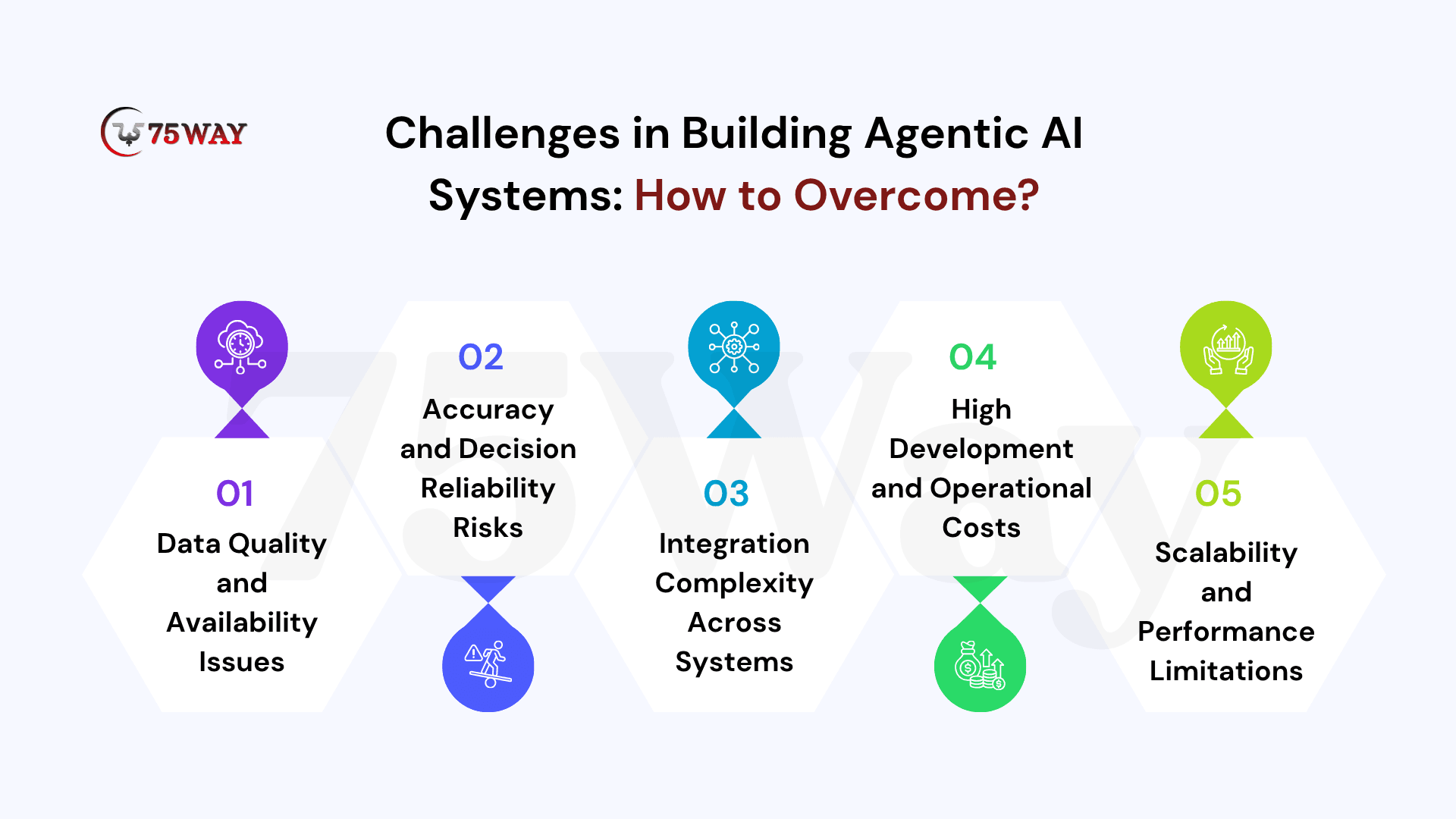
Data Quality and Availability Issues: Incomplete or inconsistent data can undermine AI decisions and reduce system reliability. You can benefit from structured, accurate, and relevant datasets, as they allow the models to learn effectively, improving prediction quality and supporting consistent decision-making across your workflows. Reliable data helps you trust that the agent operates accurately and produces actionable insights.
Accuracy and Decision Reliability Risks: Flawed reasoning or incorrect outputs can erode trust in the system. You can maintain decision consistency and operational safety by implementing validation layers and fallback mechanisms. Continuous monitoring gives you early insight into errors, enabling adjustments that keep performance reliable even under changing conditions.
Integration Complexity Across Systems: Agentic AI systems often need to interact with multiple tools and platforms to execute tasks. You must simplify integration by using modular architectures and standardized connectors, enabling workflows to operate smoothly. This approach allows you to translate decisions into real-world outcomes without interruptions.
High Development and Operational Costs: Developing complex systems may require significant investment. You can manage costs by starting with a focused use case, validating the value before scaling. Gradual expansion lets you enhance capabilities and outcomes without compromising performance or efficiency.
Scalability and Performance Limitations: Growing workloads can challenge system performance if not planned for. You ensure consistent speed and accuracy by designing for scalability from the start, allowing the agent to adapt seamlessly as operations expand and evolve over time.
Explore More: Hire AI Engineer To Build An Advanced Chatbot & AI Receptionist Platform
What is Agentic AI Development Cost?
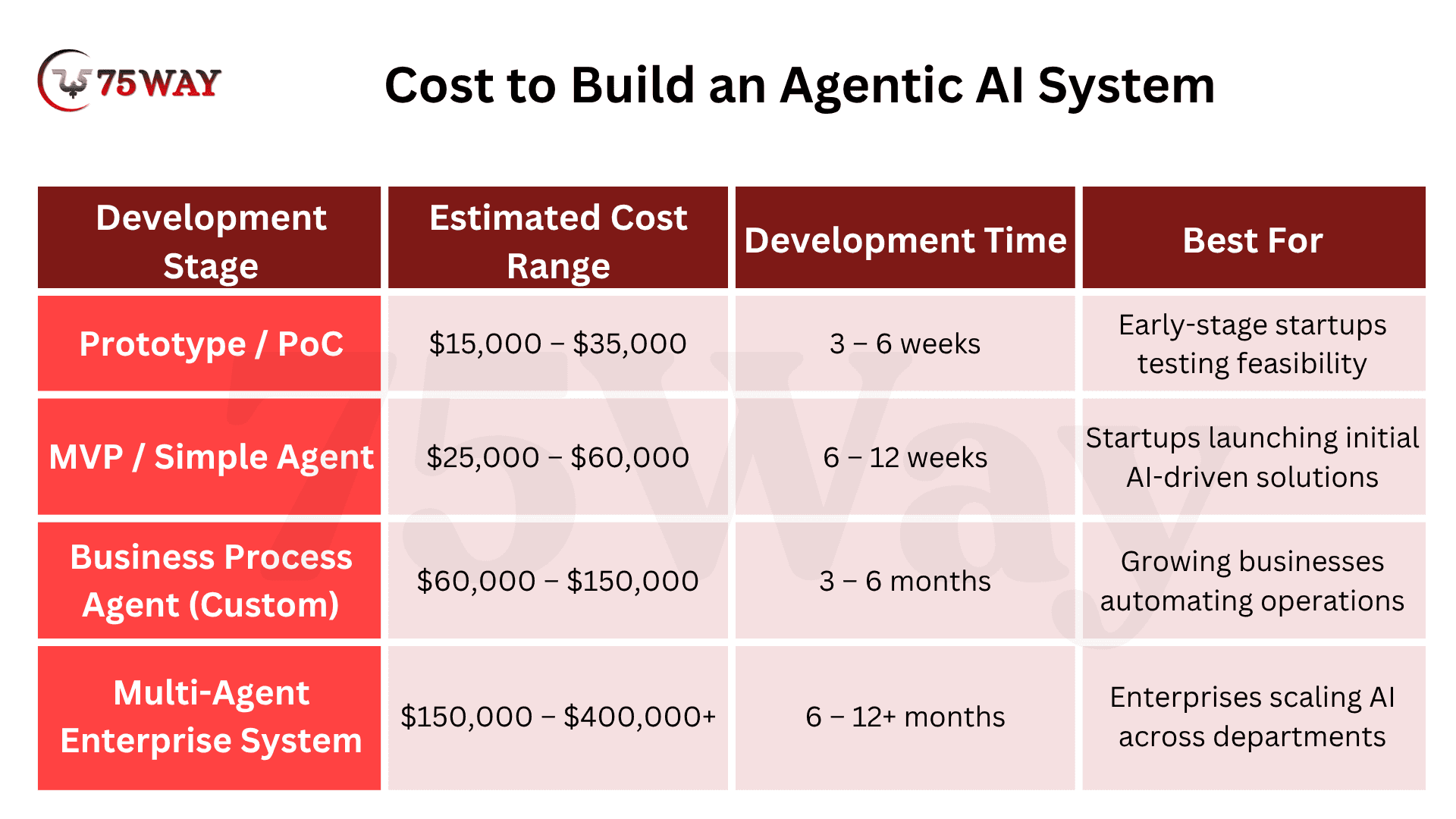
The cost of developing an agentic AI system depends on its complexity, features, and scale. You can start with a prototype or proof of concept, which requires a smaller investment and helps test feasibility. Launching an MVP allows you to validate market demand and initial solutions, while custom business process agents involve more advanced development suited for growing operations. Enterprise-level systems require significant investment but deliver large-scale automation and long-term ROI. Starting small, validating quickly, and scaling strategically ensures optimal results and cost efficiency.
Prototype / Proof of Concept (PoC): $15,000 – $35,000
A Prototype or PoC provides early-stage startups an opportunity to test feasibility and validate ideas. The development typically takes 3 to 6 weeks, offering quick insights into the potential of agentic AI and helping teams understand workflows and decision-making capabilities before committing to larger investments.
MVP / Simple Agent: $25,000 – $60,000
An MVP or Simple Agent allows startups to launch initial AI-driven solutions while validating market demand. Development usually spans 6 to 12 weeks, giving teams enough time to integrate essential workflows, test user interactions, and assess the system’s real-world effectiveness.
Business Process Agent Cost: $60,000 – $150,000
Custom Business Process Agents are designed for growing businesses seeking advanced automation of operations. Development typically takes 3 to 6 months, enabling deeper integration with existing systems, more complex task execution, and optimization of decision-making across business processes.
Multi-Agent Enterprise System Cost: $150,000 – $400,000+
Multi-Agent Enterprise Systems support large-scale deployment, allowing enterprises to scale AI across departments. Implementation generally requires 6 to 12+ months, covering complex workflows, memory systems, tool integrations, and long-term automation. This investment provides significant ROI through operational efficiency and reduced manual workload.
Read More: AI Automation Vs AI Agents: A Complete Guide
Final Thoughts
Agentic AI systems are transforming how businesses operate, enabling autonomous decision-making, workflow automation, and actionable insights. By following a structured process, from identifying a use case to deployment, memory integration, and real-world testing, you can build a system that delivers measurable results, adapts over time, and scales with your operations. Understanding the architecture, tools, challenges, and costs ensures informed decisions and optimized investment in AI technology. To explore the possibilities of automation and smart workflows, you can schedule a live consultation with our agentic AI development company.
Frequently Asked Questions (FAQs)
How Is Agentic AI Different From Generative AI?Agentic AI focuses on autonomous decision-making, task execution, and real-world workflow integration, while generative AI primarily creates content or predicts outputs based on patterns. Agentic AI acts independently, combining reasoning with action to deliver measurable business outcomes.
Can Startups Build Agentic AI Systems?Yes, startups can develop agentic AI systems by starting with prototypes or MVPs. Structured planning, clear goals, and incremental development allow early-stage companies to test feasibility and scale solutions cost-effectively.
What Industries Benefit The Most From Agentic AI?Industries relying on repetitive decision-making, complex workflows, or real-time analytics benefit the most. Examples include finance, logistics, customer support, marketing, healthcare, and supply chain management, where automation improves efficiency and accuracy.
What Are The Key Components of An Agentic AI System?Core components include goal definition, planning engine, memory system, tool integration layer, and execution engine. Together, these elements enable autonomous reasoning, real-time action, continuous learning, and seamless workflow execution.
How Does Agentic AI Improve Business Automation?Agentic AI reduces manual effort, streamlines processes, and optimizes decisions by executing tasks autonomously. This increases productivity, ensures consistency, and allows teams to focus on strategic, high-value work.
How Secure Are Agentic AI Systems For Business Use?Security measures such as encryption, access control, compliance frameworks, and monitoring tools protect sensitive data. Properly implemented systems minimize risks while maintaining reliability, privacy, and operational integrity.
Can Agentic AI Systems Replace Human Employees Completely?Agentic AI complements human roles rather than fully replacing them. It handles repetitive or data-driven tasks, while humans provide strategic oversight, creativity, and contextual decision-making that AI cannot replicate.