Summary
Agentic AI transforms business operations through autonomous decision-making, workflow automation, intelligent task execution, and adaptive learning systems. Enterprises adopt it to reduce operational costs, improve efficiency, enhance customer experiences, and scale faster. In 2026, it becomes a core driver of digital transformation across industries including healthcare, fintech, retail, logistics, and SaaS ecosystems.
Quick Overview
- Agentic AI enables autonomous decision-making across systems
- Businesses reduce operational costs through intelligent automation
- Customer experience improves with real-time adaptive responses
- Enterprise workflows become faster and less dependent on humans
- Competitive advantage increases through scalable AI-driven systems
Across industries, a new wave of automation is reshaping how work gets done, and Agentic AI is leading that transformation. Businesses in 2026 are actively redesigning operations around it. What started as simple AI chatbots and predictive models has now evolved into intelligent systems that can plan tasks, take actions, and manage entire workflows with minimal human input. And honestly, if you are a founder or a business owner, the shift is hard to ignore.
Agentic AI solutions are creating a real breakthrough. Instead of just responding to commands, these systems can think through objectives, break them into steps, interact with external tools, collaborate with other agents, and continuously improve outcomes in real time.
It feels less like software support and more like having an always-active digital workforce inside the organization. From SaaS and ecommerce platforms to healthcare apps and logistics companies, businesses are already shifting toward autonomous AI-driven solutions. Not because it is trendy, but because it is becoming necessary to stay competitive.
So what exactly makes Agentic AI so powerful, and why are businesses investing in it so aggressively in 2026? This blog explores the benefits of Agentic AI, why businesses are investing in it in 2026, real-world use cases, ROI impact, and how it is reshaping enterprise operations globally.
What Is Agentic AI?
Agentic AI refers to autonomous AI systems that can:
- Understand goals
- Plan multi-step actions
- Use external tools or APIs
- Make decisions independently
- Adapt based on outcomes
Unlike traditional AI models that respond to prompts, Agentic AI behaves like a digital worker capable of executing entire workflows. For example, instead of just suggesting a marketing plan, an AI agent can research competitors, generate content, schedule posts, analyze performance, and optimize campaigns automatically.
Why Businesses Are Investing In Agentic AI In 2026?
Businesses are adopting Agentic AI due to increasing demands for speed, efficiency, and scalability. Key drivers include:
- Rising operational costs
- Need for real-time decision-making
- Shortage of skilled labor in tech roles
- Demand for hyper-personalized customer experiences
- Competitive pressure from AI-first startups
- Expansion of digital ecosystems
Agentic AI Market Size & Revenue Growth Insights
Companies that fail to adopt autonomous AI systems risk falling behind more agile, AI-driven competitors.
Market Growth & Forecast
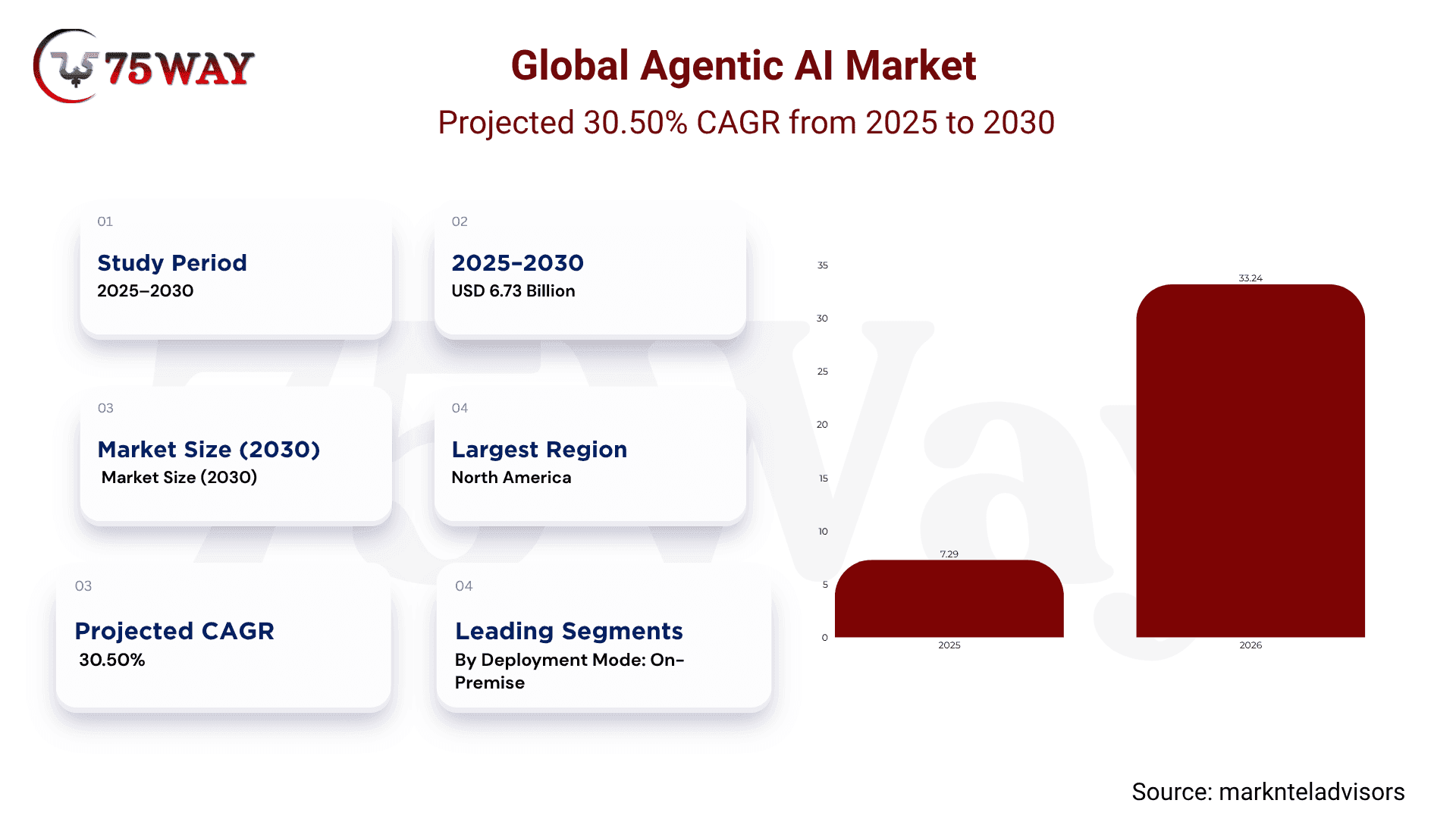
- The global agentic AI market was valued at USD 7.29 billion in 2025 and is projected to reach USD 139.19 billion by 2034, growing at a CAGR of 40.50%.
- Another industry projection estimates the global agentic AI market will reach USD 33.24 billion by 2030, growing at a CAGR of around 30.50%.
Regional Market Insights
- North America leads the global agentic AI market with a 33.60% market share.
- It remains the largest regional market, valued at USD 2.45 billion in 2025, fueled by early adoption of generative and agentic AI technologies.
- Europe ranks as the second-largest market, valued at USD 2.31 billion in 2025, supported by strong regulations and rising AI investments.
Industry Leaders & Technology Performance
- Major companies driving the agentic AI industry include Microsoft, IBM Corporation, NVIDIA Corporation, and Anthropic.
- Autonomous AI platforms achieve an average task completion rate of 75%, while advanced systems like Devin AI can complete up to 86% of tasks autonomously.
Core Benefits of Agentic AI For Businesses in 2026
Agentic AI is transforming modern enterprises by enabling autonomous systems that can think, decide, and act with minimal human intervention. Businesses are adopting these intelligent agents to improve efficiency, reduce operational complexity, and unlock new levels of scalability across departments.
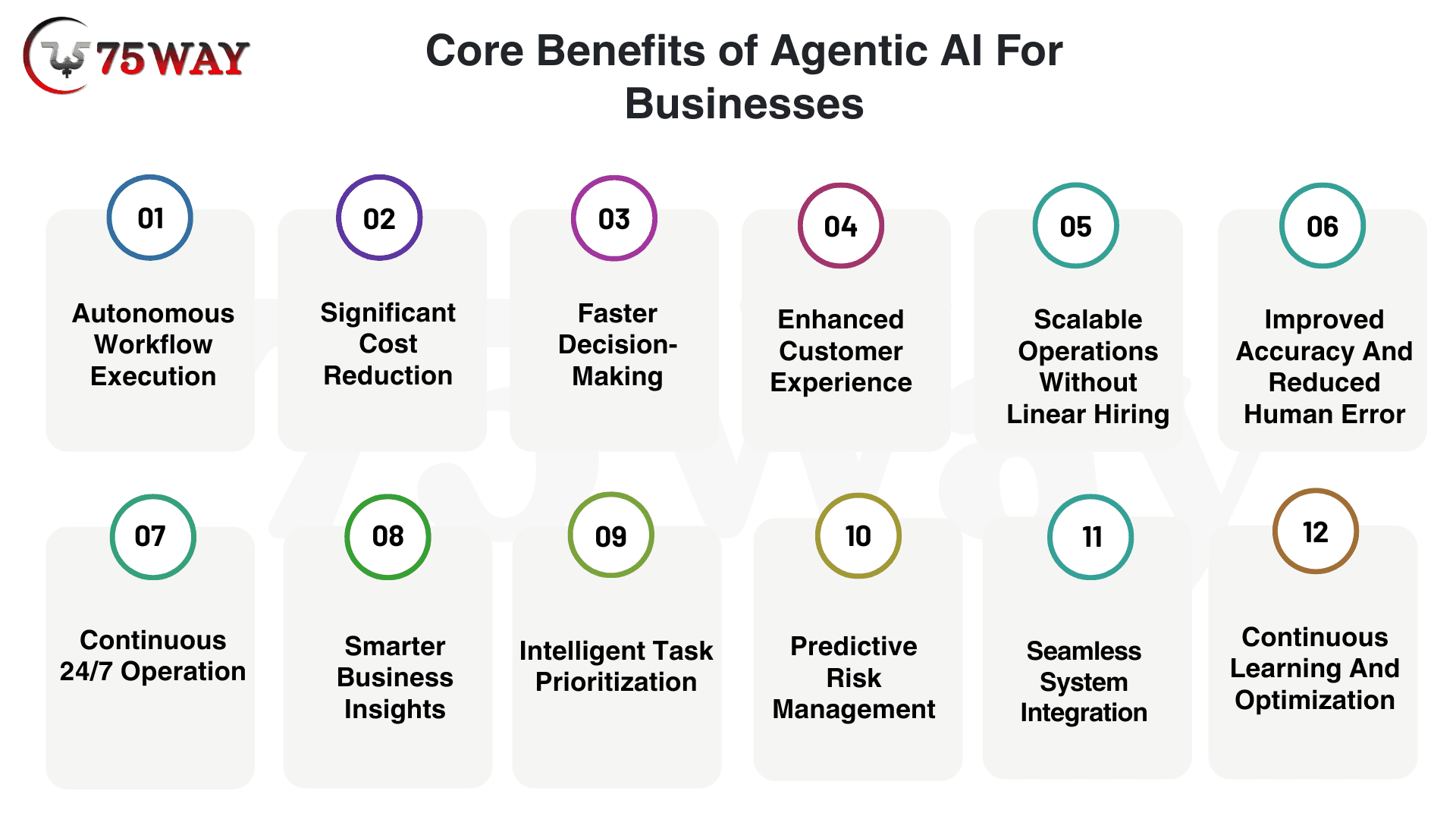
1. Autonomous Workflow Execution
Agentic AI systems can independently execute multi-step workflows without human supervision. It also improves coordination across departments by reducing dependency on manual task handling. This includes:
- Data collection
- Analysis
- Decision-making
- Action execution
- Reporting
This reduces dependency on manual coordination between teams.
2. Significant Cost Reduction
One of the strongest benefits is operational cost savings. It also allows companies to reallocate budgets toward innovation and growth initiatives. Businesses reduce spending on:
- Manual labor
- Repetitive administrative tasks
- Customer support teams
- Data processing roles
Agentic AI solutions perform these tasks continuously without fatigue or downtime.
3. Faster Decision-Making
Agentic AI processes large volumes of data in real time and takes immediate action based on insights. It also improves responsiveness in rapidly changing business environments. This helps businesses:
- Respond to market changes instantly
- Optimize pricing dynamically
- Improve supply chain responsiveness
- Detect risks early
Speed becomes a major competitive advantage.
4. Enhanced Customer Experience
Autonomous AI agents provide personalized, real-time interactions across channels. It also ensures consistent service quality across all customer touchpoints. Examples include:
- Smart AI chatbots & assistants
- Personalized recommendations
- Automated issue resolution
- Predictive support responses
This leads to higher customer satisfaction and retention rates.
5. Scalable Operations Without Linear Hiring
Traditional business growth requires proportional hiring. Agentic AI breaks this model. It also enables rapid scaling without increasing operational complexity. Companies can scale:
- Customer support
- Marketing operations
- Sales workflows
- Data analytics
without increasing headcount at the same rate.
6. Improved Accuracy And Reduced Human Error
AI agents follow structured logic and data-driven decisions, reducing operational inconsistencies. It also strengthens compliance and reporting accuracy. This improves reliability across business systems.
7. Continuous 24/7 Operation
Unlike human teams, Agentic AI systems operate continuously. It also ensures uninterrupted service delivery across global time zones. This benefits:
- Global businesses
- E-commerce apps and platforms
- SaaS companies
- Customer support systems
No downtime means uninterrupted productivity.
8. Smarter Business Insights
Agentic AI continuously analyzes data and generates actionable insights. It also improves forecasting accuracy for business planning. This helps organizations:
- Identify new revenue opportunities
- Optimize marketing strategies
- Improve product decisions
- Forecast demand patterns
Data becomes a real-time strategic asset.
9. Intelligent Task Prioritization
Agentic AI automatically prioritizes tasks based on urgency, impact, and business value. It also helps teams focus on high-value activities instead of routine operations. Key advantages include:
- Improved workflow efficiency
- Better resource allocation
- Faster execution of critical tasks
- Enhanced team productivity
- Reduced operational delays
10. Predictive Risk Management
AI agents identify potential risks before they escalate into major issues. It also supports proactive decision-making in uncertain environments. Main benefits include:
- Early risk detection
- Reduced operational losses
- Improved business stability
- Stronger compliance control
11. Seamless System Integration
Agentic AI connects multiple tools, APIs, and platforms into unified workflows. It also reduces operational silos across departments. Core outcomes include:
- Better data synchronization
- Unified business operations
- Reduced manual coordination
- Faster system communication
12. Continuous Learning And Optimization
AI systems improve over time through feedback loops and data exposure. It also enhances long-term efficiency and decision accuracy across operations. It offers:
- Self-improving performance
- Higher decision accuracy
- Continuous process optimization
- Better adaptation to changing conditions
- Increased operational intelligence
Industry-Wise Agentic AI Transforming Global Business Operations
Agentic AI reshapes modern industries by automating workflows, improving decision systems, and enabling intelligent operations at scale. Businesses across sectors adopt AI-driven agents to enhance productivity and customer experience. This transformation strengthens efficiency, reduces costs, and unlocks new growth opportunities across global markets.
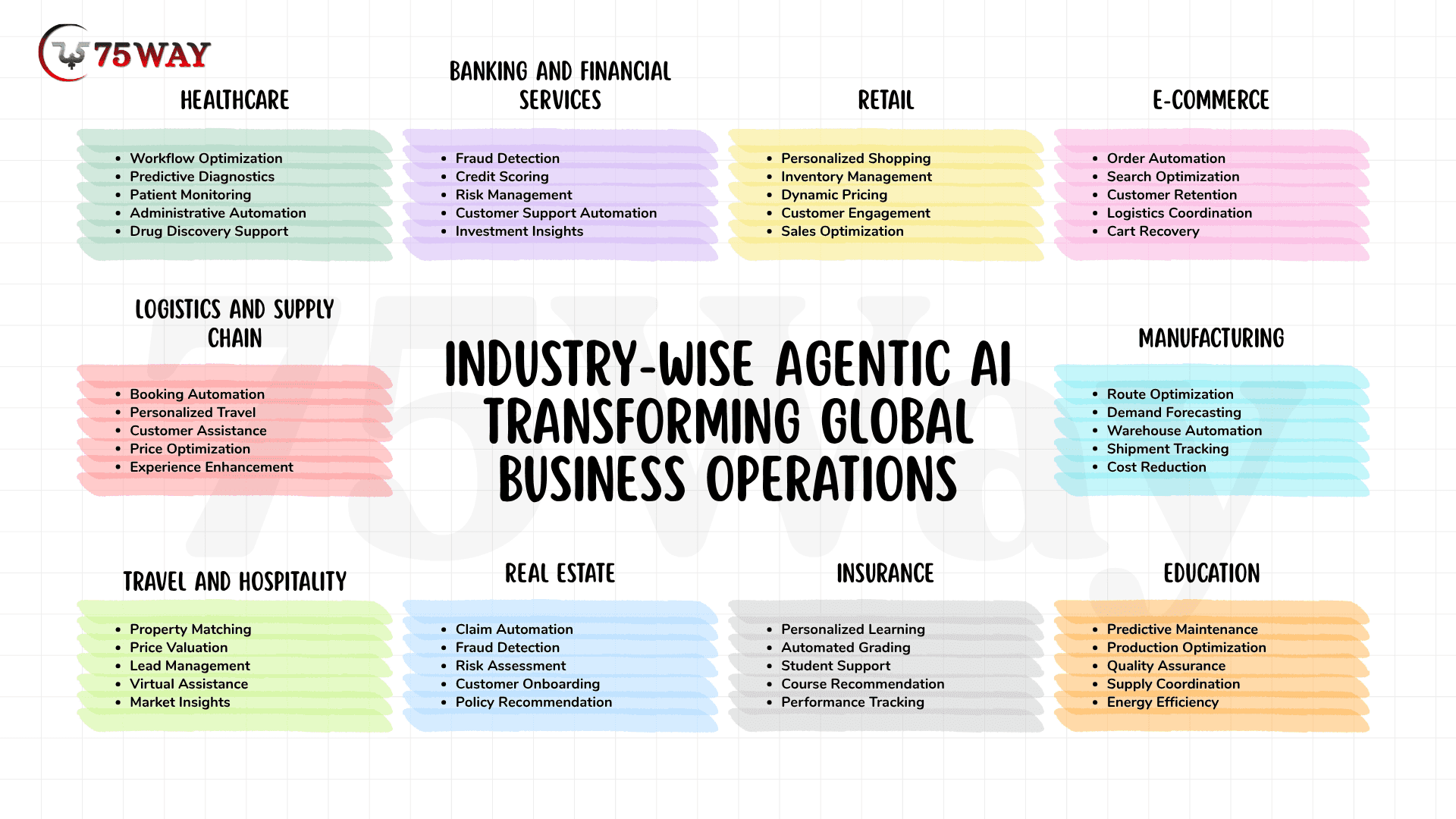
1. Healthcare
Agentic AI in healthcare improves patient care by automating diagnostics, managing medical records, and supporting clinical decision workflows. It enhances hospital efficiency and reduces administrative burden significantly.
- Workflow Optimization: Streamline hospital operations by automating scheduling, reporting, and patient management processes
- Predictive Diagnostics: Analyze medical data to identify diseases early and improve treatment accuracy
- Patient Monitoring: Track real-time patient health data for proactive medical intervention
- Administrative Automation: Reduce paperwork by automating documentation and record handling systems
- Drug Discovery Support: Accelerate pharmaceutical research using AI-driven molecular analysis models
2. Banking And Financial Services
Financial institutions use Agentic AI for fraud detection, risk management, and customer service automation. Agentic AI in banking improves decision accuracy and strengthens compliance systems.
- Fraud Detection: Identify suspicious transactions instantly using behavioral and pattern analysis systems
- Credit Scoring: Evaluate customer creditworthiness using predictive financial data models
- Risk Management: Detect financial risks early and support proactive mitigation strategies
- Customer Support Automation: Provide instant assistance through AI-powered virtual banking agents
- Investment Insights: Generate data-driven recommendations for portfolio optimization and trading decisions
3. Retail
Retail businesses leverage Agentic AI for personalized shopping experiences, inventory control, and sales optimization. It improves customer engagement and revenue generation.
- Personalized Shopping: Deliver customized product recommendations based on user behavior analysis
- Inventory Management: Optimize stock levels using predictive demand forecasting systems
- Dynamic Pricing: Adjust product prices in real time based on market demand
- Customer Engagement: Improve interaction through intelligent chat and recommendation systems
- Sales Optimization: Increase revenue using AI-driven upselling and cross-selling strategies
4. E-Commerce
E-commerce platforms use Agentic AI to automate order processing, customer support, and product discovery systems. It enhances conversion rates and operational speed.
- Order Automation:Agentic AI in ecommerce processes and manages customer orders without manual intervention
- Search Optimization: Improve product discovery through intelligent search algorithms
- Customer Retention: Increase repeat purchases using personalized engagement strategies
- Logistics Coordination: Optimize delivery workflows and reduce shipping delays
- Cart Recovery: Re-engage users through automated abandoned cart strategies
5. Logistics And Supply Chain
Agentic AI improves logistics efficiency by optimizing routes, forecasting demand, and managing supply chain operations. It reduces delays and operational costs.
- Route Optimization: Calculate efficient delivery paths using real-time traffic data
- Demand Forecasting: Predict supply needs using historical and seasonal data analysis
- Warehouse Automation: Improve inventory handling through intelligent system coordination
- Shipment Tracking: Provide real-time visibility into delivery progress
- Cost Reduction: Minimize operational expenses through automated logistics planning
6. Manufacturing
Manufacturing companies adopt Agentic AI to improve production efficiency, maintenance, and quality control. It enhances operational reliability and reduces downtime.
- Predictive Maintenance: Detect equipment failures before they occur using sensor data
- Production Optimization: Improve manufacturing efficiency through automated process control
- Quality Assurance: Identify defects using AI-powered inspection systems
- Supply Coordination: Align raw material supply with production schedules
- Energy Efficiency: Reduce power consumption using intelligent monitoring systems
7. Education
Education platforms use Agentic AI for personalized learning, automated grading, and student engagement. It improves learning outcomes and teaching efficiency.
- Personalized Learning: Adapt study material based on student performance and behavior
- Automated Grading: Evaluate assignments and exams using intelligent assessment systems
- Student Support: Provide instant academic assistance through AI tutors
- Course Recommendation: Suggest relevant learning paths based on skill level
- Performance Tracking: Monitor student progress using analytics dashboards
8. Insurance
Insurance companies use Agentic AI assistants for claim processing, fraud detection, and customer onboarding. It enhances accuracy and reduces processing time.
- Claim Automation: Process insurance claims quickly using AI-driven validation systems
- Fraud Detection: Identify false claims through pattern recognition models
- Risk Assessment: Evaluate policy risks using predictive analytics tools
- Customer Onboarding: Simplify registration through automated verification workflows
- Policy Recommendation: Suggest suitable insurance plans based on user profiles
9. Real Estate
Real estate businesses use Agentic AI for property recommendations, valuation, and client management. It improves decision-making and sales efficiency.
- Property Matching: Suggest properties based on buyer preferences and behavior
- Price Valuation: Estimate property value using market data analysis
- Lead Management: Automate customer inquiries and follow-up processes
- Virtual Assistance: Provide AI-based property consultation services
- Market Insights: Analyze real estate trends for investment decisions
10. Travel And Hospitality
Travel companies use Agentic AI for booking automation, personalization, and customer support. It improves user experience and operational efficiency.
- Booking Automation: Manage reservations and ticketing without manual intervention
- Personalized Travel: Recommend destinations based on user preferences
- Customer Assistance: Provide real-time travel support through AI agents
- Price Optimization: Adjust travel prices based on demand trends
- Experience Enhancement: Improve guest satisfaction through personalized services
Final Remarks
Agentic AI represents a major shift in how businesses operate, moving from manual execution to autonomous intelligent systems. In 2026, companies are investing in AI agents to improve efficiency and reduce operational costs. Organizations that adopt Agentic AI early gain a significant competitive advantage through automation, scalability, and smarter operations. As industries continue evolving, Agentic AI will become a foundational layer of digital business infrastructure rather than an optional enhancement. If you want to integrate Agentic AI into your business operations, connect with a leading agentic AI development company to design, build, and scale intelligent AI agent systems tailored to your enterprise needs.
Frequently Asked Questions (FAQs)
How Does Agentic AI Improve Business Productivity?
Agentic AI improves productivity by automating multi-step workflows such as data processing, customer support, and reporting. It reduces manual effort, speeds up execution, and allows teams to focus on strategic and high-value business activities instead of repetitive tasks.
What Are The Main Benefits Of Agentic AI For Enterprises?
The main benefits include cost reduction, automation of complex processes, faster decision-making, improved customer experience, and scalable operations. Enterprises use Agentic AI to optimize performance while minimizing dependency on human labor for routine tasks.
Which Industries Are Adopting Agentic AI The Fastest?
Industries like fintech, healthcare, e-commerce, logistics, and SaaS are adopting Agentic AI rapidly. These sectors rely heavily on automation, real-time data processing, and customer interaction, making AI agents highly valuable for scaling operations.
Is Agentic AI Better Than Traditional AI Systems?
Yes, Agentic AI is more advanced than traditional AI because it can execute complete workflows instead of just providing responses. It combines reasoning, planning, and action execution, making it suitable for end-to-end business automation.
What Are The Risks of Using Agentic AI In Business?
Risks include data security concerns, integration complexity, and a lack of proper governance. Without proper controls, autonomous systems may produce errors or unintended actions, making oversight and monitoring essential for safe implementation.
How Much Does It Cost To Implement Agentic AI Solutions?
The cost varies based on complexity and use case. Small implementations may start at a lower range, while enterprise-grade AI agent systems require higher investment. However, most businesses see strong ROI through automation and cost savings.