
AI Summary
Learn the complete white-label taxi app development process for 2026, from planning and customization to deployment. Discover expert insights, timelines, costs, and best practices to launch a scalable ride-hailing platform faster.
Quick Overview
- White-label taxi app development process requires a strategic roadmap to reduce cost & timelines
- Proper requirement planning minimizes revisions, delays, and unexpected costs.
- Strategic customization creates distinctive user experiences while maintaining architecture.
- Third-party integrations strengthen booking, payments, navigation, and operational management capabilities.
- Comprehensive testing identifies usability, security, and performance issues before launch.
Launching a taxi business today is no longer just about having drivers on the road. It is about delivering an app experience that customers enjoy using. The challenge for most businesses is not deciding whether to build an AI-powered taxi booking app, but how to launch one quickly without spending months on development or investing heavily in building everything from scratch.
That is why, many ride-hailing startups, taxi operators, fleet owners, and mobility businesses now choose white-label taxi app development solutions. A white-label platform gives you a faster route to market, but success still depends on following the right development process.
From defining your business model and customizing the platform to integrating payments, testing, and launching, every step plays an important role. In this guide, we break down the complete white-label taxi app development process so you know exactly what it takes to build and launch a successful taxi platform in 2026.
Why Businesses Prefer To Build White-Label Taxi App In 2026?
Companies are choosing ready-made ride-hailing platforms because they reduce development time, lower costs, and simplify market entry. Below are the key reasons driving adoption across startups and transportation providers in 2026.
- Faster Market Entry: Speed matters in the ride-hailing industry, where delayed launches often mean lost customers. White-label taxi apps eliminate months of core development, allowing businesses to introduce branded services while competitors are still building their platforms.
- Lower Development Investment: Building every feature from the ground up demands substantial time, engineering resources, and budget. These solutions reduce upfront costs, giving businesses more flexibility to invest in branding, marketing, and future product enhancements.
- Complete Brand Ownership: A recognizable brand creates lasting customer confidence in a competitive transportation market. White-label platforms let businesses personalize every customer touchpoint, delivering an experience that feels entirely their own.
- Easier Business Expansion: Business growth rarely stops after launching in one city. A scalable white-label platform supports regional expansion, additional ride services, and larger fleets without disrupting existing operations.
- Reliable Technology Foundation: Strong software begins with technology that has already proven its reliability in real-world operations. Instead of solving basic infrastructure challenges, businesses can dedicate more attention to customer experience and operational improvements.
- Continuous Platform Improvements: Customer expectations, operating systems, and mobility technologies continue evolving every year. Regular platform updates introduce new capabilities, strengthen security, and keep taxi applications performing at their best long after launch.
Quick Read:Top Taxi App Development Agencies for On-Demand Solutions
Complete White-Label Taxi App Development Process Explained 🏆
A well-defined process to create a white-label taxi app improves collaboration between business stakeholders, designers, developers, testers, and deployment teams. It minimizes costly revisions, shortens implementation timelines, and establishes a stable foundation for continuous improvements after launch.
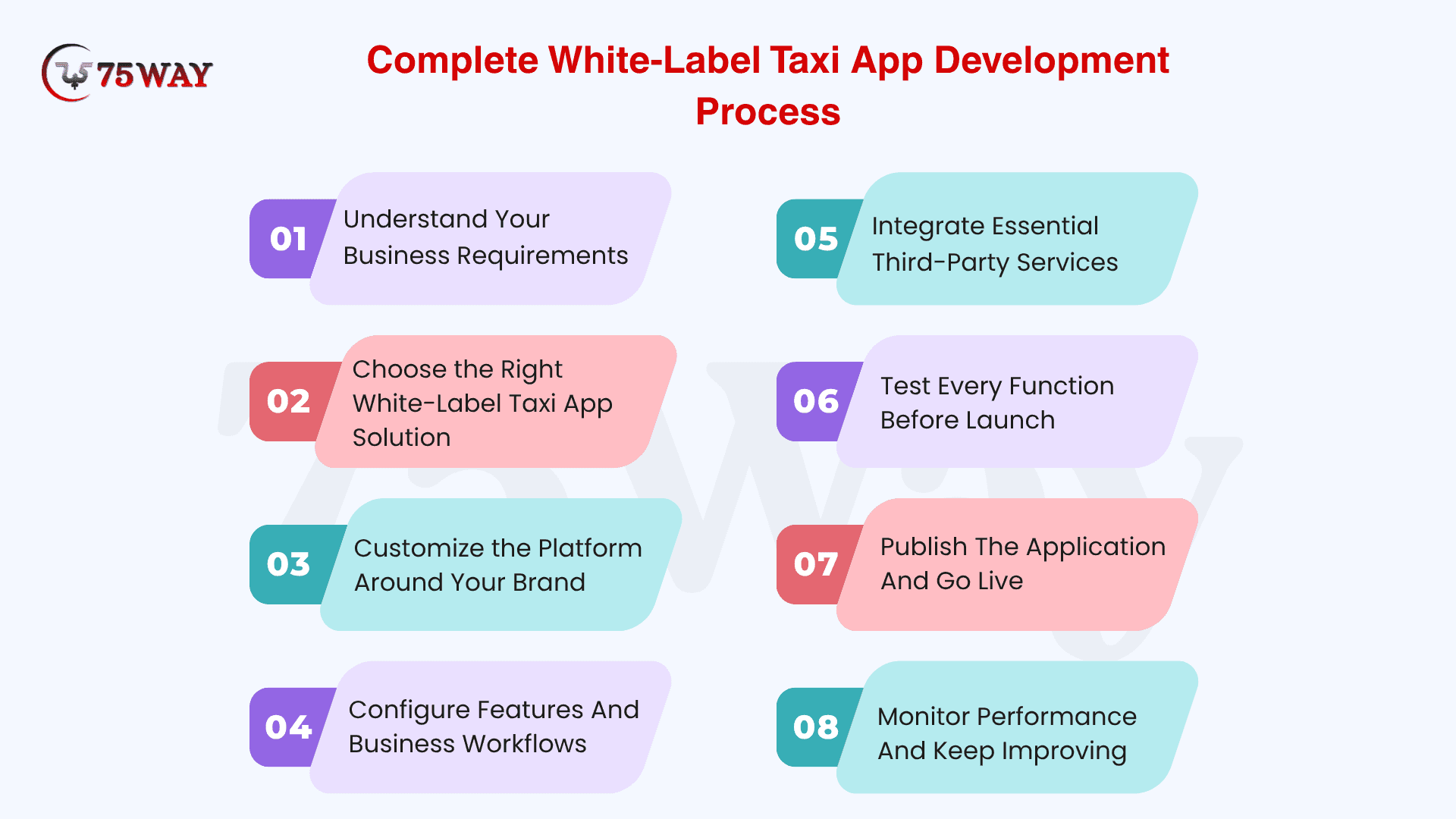
Step 1: Understand Your Business Requirements
Every taxi business works differently. Some operate within a single city, while others manage intercity rides, airport transfers, corporate bookings, or rental services. That's why the development process always begins with understanding your business before making any technical decisions.
At this stage of taxi app development process, the team spends time learning about your business model, customers, daily operations, and future plans. Instead of jumping straight into design or coding, they identify the features your platform actually needs. This avoids paying for unnecessary functionality and helps build an application that supports your business from day one.
For example, if your goal is to launch a local taxi service, the platform requirements will be very different from those of a company planning to manage hundreds of drivers across multiple cities. Defining these expectations early makes the remaining development stages much smoother.
During this phase, the team generally works on:
- Understanding your business goals and long-term vision.
- Identifying your target audience and service locations.
- Deciding the ride categories you'll offer, such as standard, luxury, rental, or airport transfers.
- Planning pricing methods, commission structure, and promotional campaigns.
- Listing the features required for passengers, drivers, and administrators.
- Studying competitors to identify opportunities that can improve your service.
Once these discussions are complete, everyone involved has a clear direction. Designers know what to create, developers know what to build, and business owners know exactly what to expect throughout the project.
Step 2: Choose the Right White-Label Taxi App Solution
Not every white-label taxi platform offers the same level of flexibility. Some only allow basic branding changes, while others let you customize features, pricing rules, user flows, and business logic. Choosing the right solution at the beginning saves both time and money later.
Instead of selecting a platform because it's the cheapest or promises the fastest delivery, evaluate whether it can support your business as it grows. Think beyond today's requirements. You may start with one city now, but your business could expand into multiple cities or even different transportation services in the future.
This is also the stage where the development team reviews the platform's technology, security standards, and customization capabilities. The goal is to find a solution that fits your business, not the other way around.
When evaluating a white-label taxi platform, consider these factors:
- Check whether it supports your business model and operational requirements.
- Review the available features for passengers, drivers, and administrators.
- Confirm whether new features can be added as your business grows.
- Verify compatibility with payment gateways, maps, SMS, and notification services.
- Understand the licensing model, ownership terms, and ongoing support.
- Ask about future updates, maintenance, and technical assistance.
- Evaluate platform performance during high booking volumes.
- Discuss customization possibilities before finalizing the project.
A well-chosen platform becomes a strong foundation for your taxi business. It reduces future redevelopment work and gives your team the flexibility to introduce new services without rebuilding the application from scratch.
Step 3: Customize the Platform Around Your Brand
A white-label taxi app shouldn't look like every other ride-hailing application in the market. Customers should recognize your business the moment they open the app. That's why branding goes far beyond changing the logo or selecting a new color palette.
During this stage, developers and designers personalize the application to reflect your brand identity while making the booking experience simple and intuitive. Every screen, button, and interaction is refined to match your business style and improve usability.
The customization process also includes configuring the workflows your business follows. For example, if you provide airport transfers, rental bookings, or scheduled rides, those services should be easy for customers to find and book.
This stage usually includes:
- Adding your company logo, colors, and visual identity.
- Designing a clean and user-friendly interface.
- Customizing passenger, driver, and admin applications.
- Setting ride categories and booking options.
- Configuring languages and currencies for target markets.
- Personalizing notifications, emails, and promotional banners.
- Creating an easy booking journey with fewer unnecessary steps.
- Aligning the app's appearance with your website and marketing materials.
A polished, easy-to-use application builds trust from the first interaction. When customers can book rides quickly without confusion, they're more likely to return and recommend your service to others.
Step 4: Configure Features And Business Workflows
Once the platform is branded, it's time to shape how your taxi business will actually operate. This stage connects your business requirements with the application's functionality. Instead of adding every available feature, the development team configures the ones that support your daily operations and customer experience.
Think of it as setting the rules for your platform. How will customers book rides? How are fares calculated? Can drivers accept or reject requests? Will users schedule rides in advance? Every decision made here directly affects how smoothly your business runs after launch.
The objective isn't to build a feature-heavy application. It's to build one that feels simple, fast, and reliable for every user.
During this stage, the development team typically:
- Configure ride booking and cancellation workflows.
- Set fare calculation rules, taxes, and surge pricing.
- Create ride categories based on your services.
- Enable scheduled bookings and rental packages, if required.
- Configure promo codes, referral rewards, and loyalty programs.
- Define driver registration and approval processes.
- Set commission structures and payout methods.
- Customize booking notifications and ride status updates.
A well-configured workflow reduces manual work for your team while giving passengers and drivers a smooth, hassle-free experience.
Read Too: Essential Features Every White-Label Taxi App Development Should Have in 2026
Step 5: Integrate Essential Third-Party Services
A taxi app doesn't work in isolation. It relies on several external services to perform important tasks like navigation, payments, communication, and notifications. That's why integrating trusted third-party tools is a crucial part of the development process.
Choosing the right integrations improves reliability and saves time compared to building these services from scratch. At the same time, every integration must work seamlessly with the platform to avoid delays, payment failures, or inaccurate ride tracking.
Some of the most common integrations include:
- Google Maps or similar services for live location tracking and navigation.
- Payment gateways to support secure online transactions.
- SMS services for OTP verification and booking updates.
- Push notifications to keep users informed about ride status.
- Email services for invoices, receipts, and account communication.
- Analytics tools to monitor application performance and user behavior.
- Customer support platforms for handling user queries.
- Social login options for faster registration.
Every integration is tested carefully to confirm it performs reliably under different conditions. Even a small issue with maps or payments can affect the overall user experience.
Step 6: Test Every Function Before Launch
No matter how well an application is designed, it should never be published without thorough testing. Even minor issues can frustrate users, generate negative reviews, and affect customer trust during the first few weeks after launch.
Testing isn't limited to finding bugs. It verifies that every feature performs as expected across different devices, operating systems, and network conditions. Developers, testers, and business stakeholders work together to review the platform from every user's perspective.
The quality assurance team usually checks:
- Ride booking and cancellation functionality.
- Driver allocation and trip management.
- GPS accuracy and real-time tracking.
- Online payments and wallet transactions.
- Registration, login, and profile management.
- Push notifications and SMS delivery.
- Application speed and overall responsiveness.
- Compatibility across Android and iOS devices.
- Security checks to protect user information.
Any issues discovered during testing are resolved before the application moves to the deployment stage. This reduces the chances of unexpected problems after launch and creates a better first impression for users.
Step 7: Publish The Application And Go Live
After testing is complete, the application is prepared for release. This involves more than uploading files to the App Store or Google Play. Every store has its own review guidelines, privacy requirements, and submission standards that must be met before approval.
The development team prepares all the required assets, reviews the application against platform policies, and completes the publishing process. Once approved, the app becomes available for users to download.
Before launch, the team usually completes the following tasks:
- Prepare App Store screenshots and descriptions.
- Configure privacy policies and legal documents.
- Generate production builds for Android and iOS.
- Perform final security and performance checks.
- Submit applications for store review.
- Monitor approval status and address review feedback.
- Verify that all live services are working correctly.
A successful launch is an important milestone, but it's only the beginning of your app's journey. The real success depends on how well the platform performs after customers start using it.
Step 8: Monitor Performance And Keep Improving
Launching your white-label taxi app is not the final step. Customer expectations change, operating systems receive updates, and competitors continue introducing new features. To stay ahead, your application needs regular improvements based on real user feedback and business performance.
After launch, the development team monitors key metrics to understand how people interact with the app. This data helps identify opportunities to improve the booking experience, introduce new features, and support future business growth.
Post-launch activities often include:
- Tracking bookings, cancellations, and customer retention.
- Monitoring application speed and server performance.
- Collecting reviews from passengers and drivers.
- Releasing bug fixes and security updates.
- Adding new features based on market demand.
- Optimizing the platform for business expansion.
- Updating the application for the latest Android and iOS versions.
- Improving performance through regular maintenance.
The most successful taxi apps aren't the ones with the longest feature list. They're the ones that continue evolving with customer needs. Treat your application as a growing business asset, and it will continue delivering value long after its initial launch.
Technology Stack Used In Developing White-Label Taxi App Development
The performance, scalability, and reliability of a white-label taxi application largely depend on the technology stack used during development. Choosing the right technologies helps deliver a smooth booking experience, secure transactions, real-time tracking, and stable performance as the business grows. While the exact stack varies by project requirements, the following technologies are widely used to build modern taxi applications.
- Flutter: Build a single mobile application for Android and iOS, reducing development time while maintaining a consistent user experience.
- React Native: Another cross-platform framework used to create responsive mobile applications with a shared codebase.
- Swift: Develop high-performance native iOS applications with seamless integration into the Apple ecosystem.
- Kotlin: Create native Android applications with improved speed, stability, and long-term maintainability.
- Node.js: Power the backend to manage bookings, user accounts, ride requests, and real-time communication.
- Laravel: Handle APIs, admin panel functionality, business logic, and database operations securely.
- MongoDB/PostgreSQL: Store customer profiles, booking history, driver information, payments, and application data.
- Google Maps API: Support live location tracking, route optimization, distance calculation, and navigation.
- Firebase: Deliver push notifications, authentication, analytics, and cloud-based application services.
- Stripe/PayPal/Razorpay: Process secure online payments, refunds, and digital wallet transactions.
- Socket.IO: Enable real-time communication between passengers, drivers, and the admin panel for instant ride updates.
- AWS / Google Cloud: Host the application infrastructure with scalable servers, storage, and backup services.
Common Mistakes To Avoid During AI-Driven White-Label Taxi Mobile App Creation
Even the best taxi app idea can fall short if critical decisions are overlooked during development. Avoiding the common mistakes below will help you build a scalable, reliable, and AI-powered platform that delivers a better experience for both riders and drivers.
- Skipping Business Planning
Many businesses start discussing features before defining their goals. Without a clear understanding of your target audience, pricing strategy, service area, and revenue model, developers have to make assumptions that may not match your expectations.
A better approach: Spend time defining your business objectives before development begins. A well-planned roadmap reduces revisions throughout the project.
- Choosing A Platform Based Only On Price
The lowest-priced solution isn't always the best investment. Some platforms limit customization, lack regular updates, or don't support future expansion.
A better approach: Compare customization options, scalability, security, technology stack, and post-launch support, not just the initial price.
- Trying To Add Every Feature At Once
It's tempting to include every feature available. However, adding unnecessary functionality often makes the application more complex, increases development time, and creates a confusing user experience.
A better approach: Launch with features that directly support your business model. Additional capabilities can always be introduced in future updates.
- Ignoring Driver Experience
Passengers aren't the only users of your application. Drivers interact with the platform every day, and a complicated driver app can affect ride acceptance, response times, and service quality.
A better approach: Design a simple, intuitive interface that helps drivers manage bookings, navigation, and earnings with minimal effort.
- Underestimating Testing
Some businesses see testing as the final checkbox before launch. In reality, it's one of the most important stages in the entire project.
A small issue in payments, GPS tracking, or notifications can quickly turn into negative reviews after launch.
A better approach: Test the application on different devices, operating systems, and network conditions before publishing.
- Delaying Post-Launch Improvements
Launching your app isn't the finish line. Customer expectations evolve, competitors introduce new features, and technology keeps changing.
Businesses that stop investing after launch often struggle to retain users over time.
A better approach: Regularly monitor customer feedback, analyze app performance, and release updates that improve the overall experience.
Being aware of these common mistakes helps you make informed decisions throughout the development journey and increases the chances of launching a stable, customer-friendly taxi application.
Explore More:AI Taxi Booking Agent: How to Scale Taxi Business Operations in 2026?
Wrap Up
To conclude, building a successful white-label taxi app is about following the right process, not simply customizing an existing platform. Every stage from planning and platform selection to branding, integrations, testing, and post-launch improvements contributes to a better user experience and smoother business operations. Taking time to make informed decisions early helps reduce future challenges while creating a scalable foundation for growth. Looking for a reliable taxi app development company? Partner with experienced experts to build a secure, fully branded taxi solution tailored to your business goals.
Frequently Asked Questions (FAQs)
Can A White-Label Taxi App Support Multiple Business Models?
Yes, modern white-label taxi platforms can be configured for different business models, including traditional taxi services, airport transfers, car rentals, corporate transportation, bike taxis, and chauffeur services. The available options depend on the platform's customization capabilities and your specific business requirements.
Can Existing Taxi Operators Switch To A White-Label Platform?
Absolutely, existing taxi businesses can migrate to a white-label platform while retaining their branding and operational workflows. Depending on the project scope, customer records, driver information, booking history, and business settings can often be transferred to the new system with proper planning.
Does A White-Label Taxi App Support Multiple Languages And Currencies?
Yes, various enterprise-grade white-label solutions allow businesses to add multiple languages and currencies, making it easier to serve customers across different regions. This capability is especially valuable for companies planning to expand into international or multilingual markets.
Can New Features Be Added After The App Is Launched?
Yes, a scalable white-label platform is designed to evolve with your business. Features such as loyalty programs, subscription plans, AI-based ride recommendations, advanced analytics, or additional transportation services can be introduced through future updates without rebuilding the entire application.
Is It Possible To Manage Multiple Cities From One Admin Panel?
Yes, several white-label taxi platforms include centralized dashboards that allow administrators to manage drivers, bookings, pricing, reports, and customer support across multiple cities from a single interface. This simplifies daily operations as the business expands.
Which Security Measures Protect User And Payment Data?
Modern taxi applications use encrypted communication, secure authentication, role-based access controls, protected payment gateways, and regular security updates to safeguard customer information. Additional measures may include two-factor authentication, fraud monitoring, and secure cloud hosting.