AI Summary
An AI agent for salons and spas can automate appointment booking, client communication, reminders, follow-ups, and routine questions around the clock. This guide explains AI agent capabilities, benefits, features, implementation, costs, integrations, use cases, and strategies for improving bookings, customer experience, and client retention.
Key Takeaways
- AI agents automate salon bookings, rescheduling, cancellations, reminders, and client communication.
- Salons can provide 24/7 appointment assistance without expanding front-desk staffing.
- AI-powered personalization can support stronger client engagement and repeat bookings.
- Automated reminders and follow-ups can help reduce missed appointments and cancellations.
- AI agents can answer common questions about services, prices, availability, and policies.
A client deciding at 9 PM, “I need a haircut this weekend.” If they cannot book until your salon opens tomorrow, they may forget, put it off, or book somewhere else. For a salon owner, that is a small moment that can quietly cost you a real appointment.
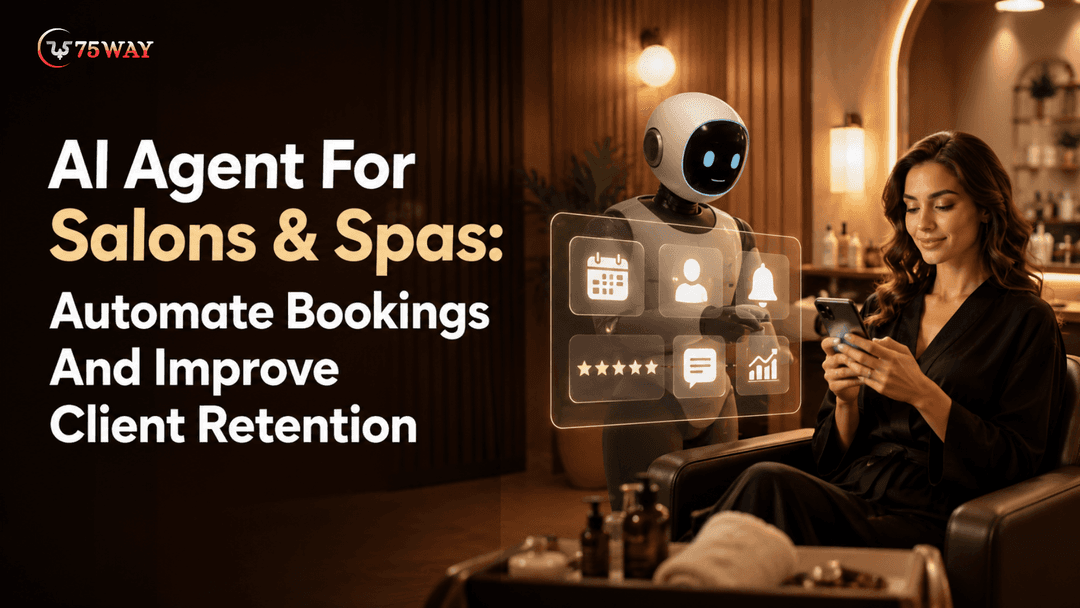
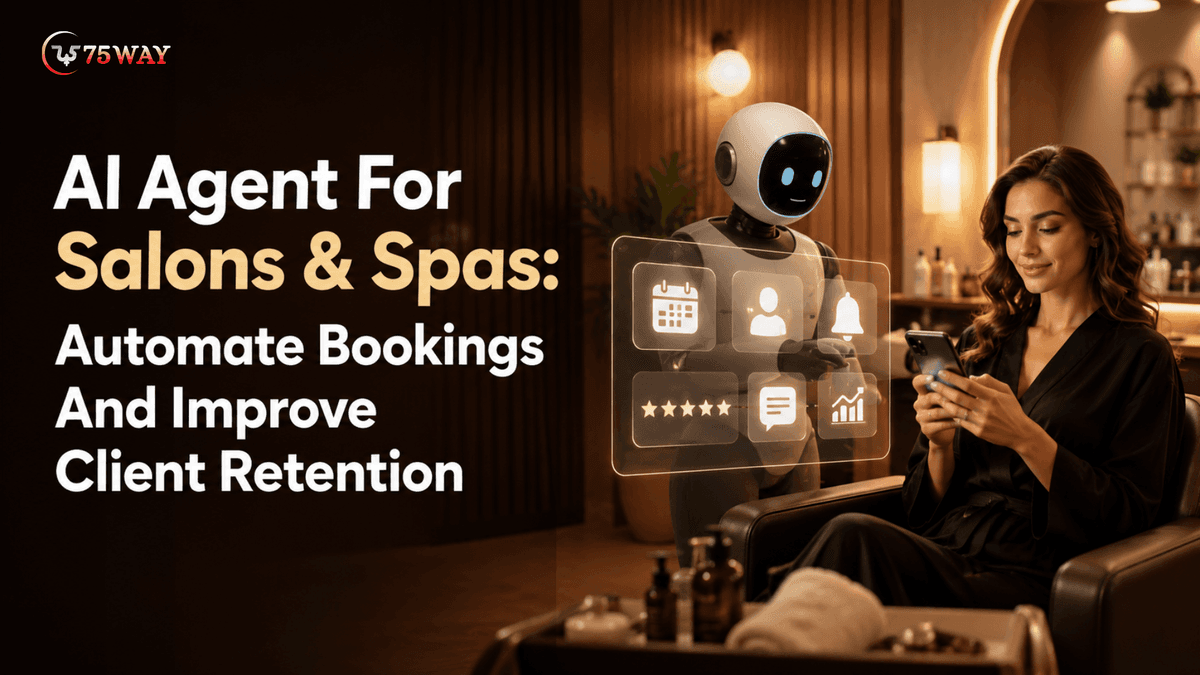
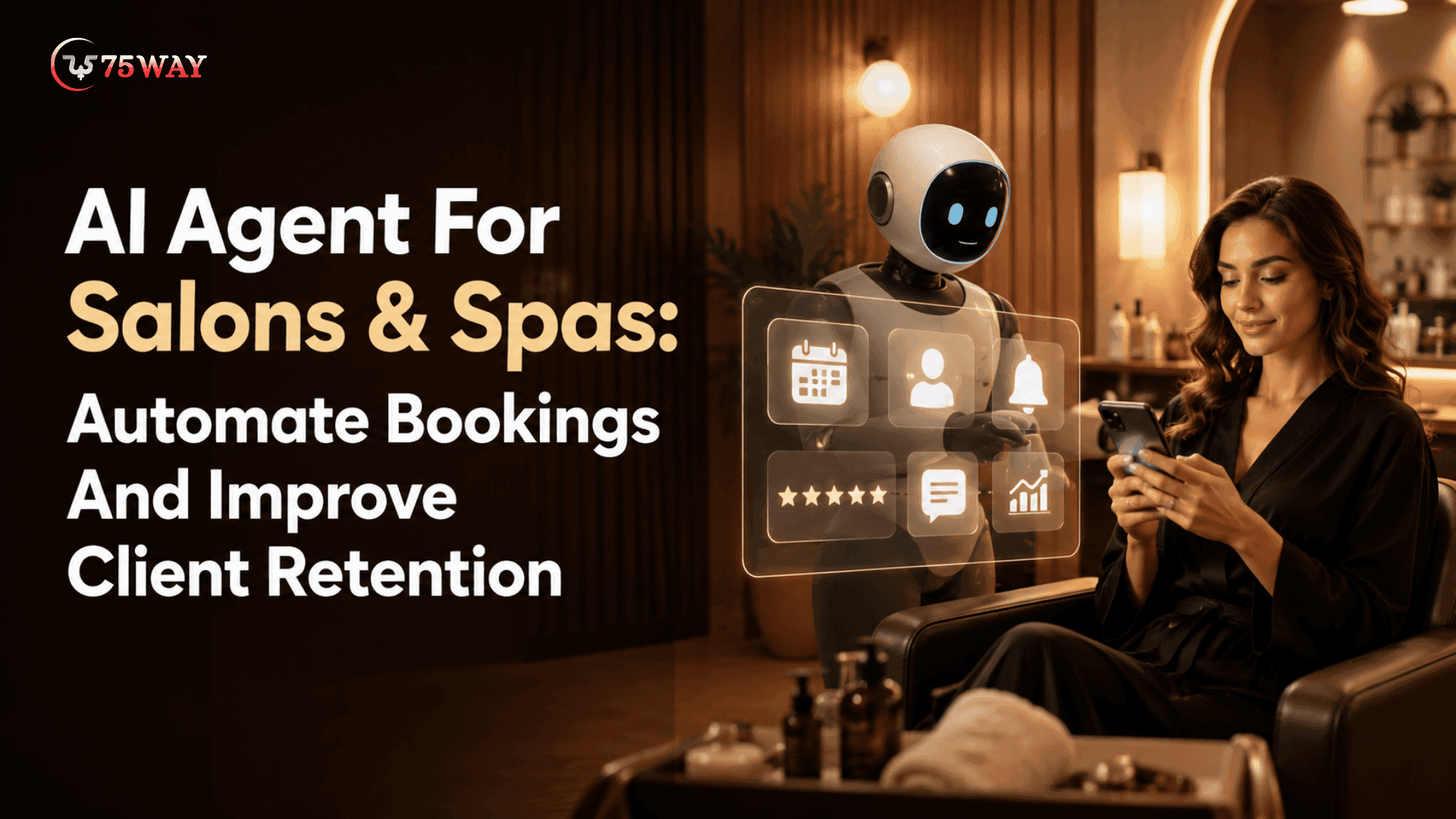
That’s where a need for AI automation becomes clear, helping salons capture bookings even after business hours. An AI agent for a salon and spa gives you a way to handle those moments even when nobody is sitting at the front desk. It can talk to clients, check available slots, book or move appointments, answer questions about services and pricing, send reminders, and take care of the repetitive back-and-forth your team deals with every day.
But the bigger win is what happens after the appointment. Your salon AI specialist can follow up with a client, remember what they booked last time, remind them when it is probably time to return, or suggest a service that makes sense for them. Those small interactions can help a one-time booking become a regular client relationship.
For salon and spa owners, that makes an AI salon agent less about replacing the front desk and more about giving the business an always-available assistant. This guide looks at where an AI agent development solution fits into your booking and retention workflow, what it can automate, and how businesses can put it to work without losing the personal experience clients expect.
What Is An AI Agent For Salons And Spas?
An AI agent for salons and spas is a software system that can understand client requests, communicate naturally, and take actions such as booking, rescheduling, confirming, and following up on appointments.
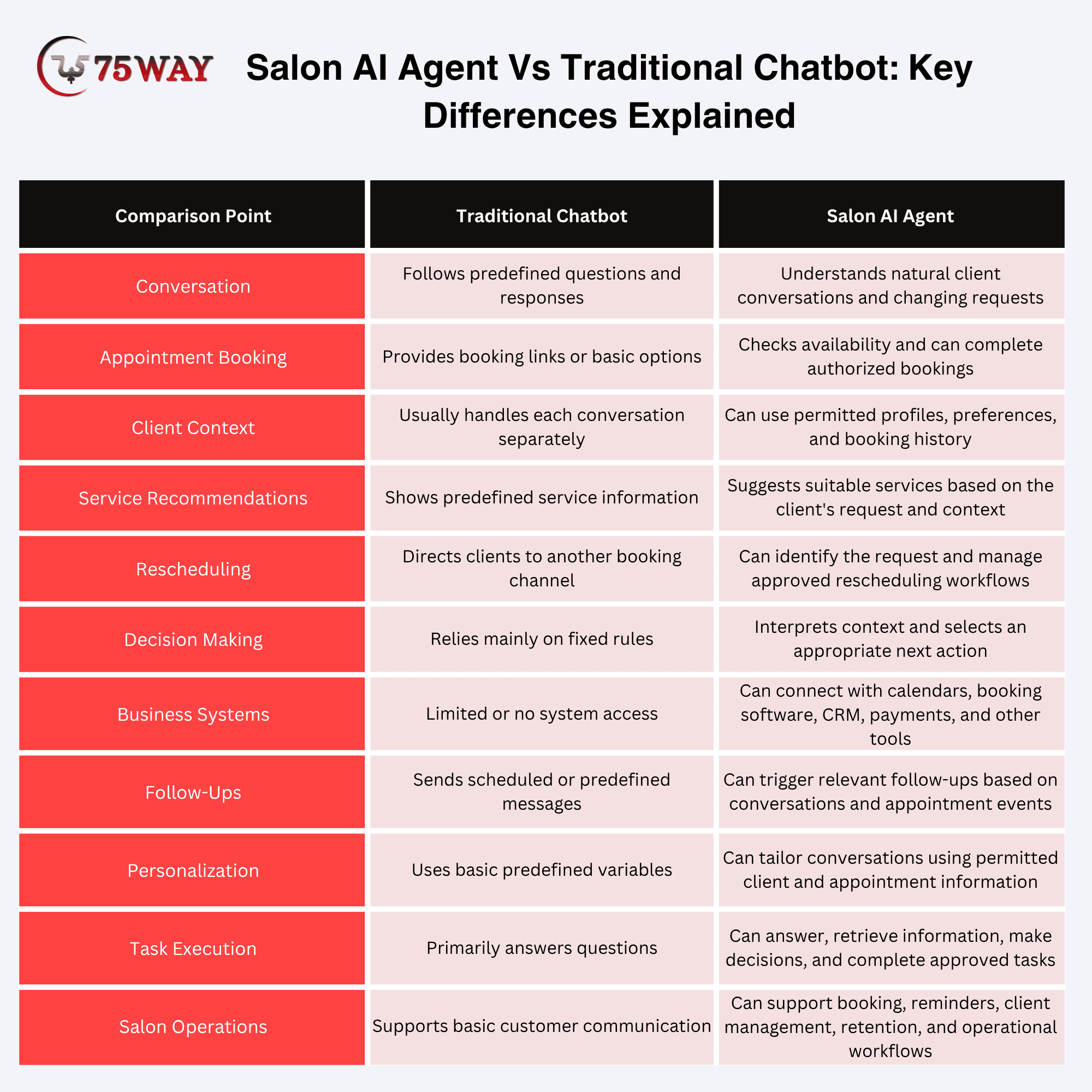
Unlike a basic chatbot that mainly provides predefined answers, an AI agent can connect with business systems, access relevant information, make decisions within defined rules, and complete tasks on behalf of staff.
For a salon or spa, this means clients can interact with an AI booking agent for salons through a website, mobile app, messaging channel, or other supported interface. The agent can identify what the client needs, check available services and appointment slots, collect required details, and complete the booking without requiring a receptionist to handle every interaction manually.
How Does a Salon AI Agent Differ From A Traditional Chatbot?
A traditional chatbot generally responds to predefined questions using fixed conversation paths. An AI agent can go further by combining conversation with business actions. For example, a client might say:
“I need a haircut and balayage sometime Saturday afternoon.”
An AI receptionist for salons can understand the request, identify the required services, check availability, consider the expected appointment duration, offer suitable slots, confirm the client's choice, and create the appointment when connected to the salon's scheduling system.
The same agent could later answer questions about preparation, send appointment reminders, handle rescheduling, and initiate a follow-up after the service.
Salon AI Agent Vs Traditional Chatbot: Key Differences Explained
How Does An AI Agent For Salons Work?
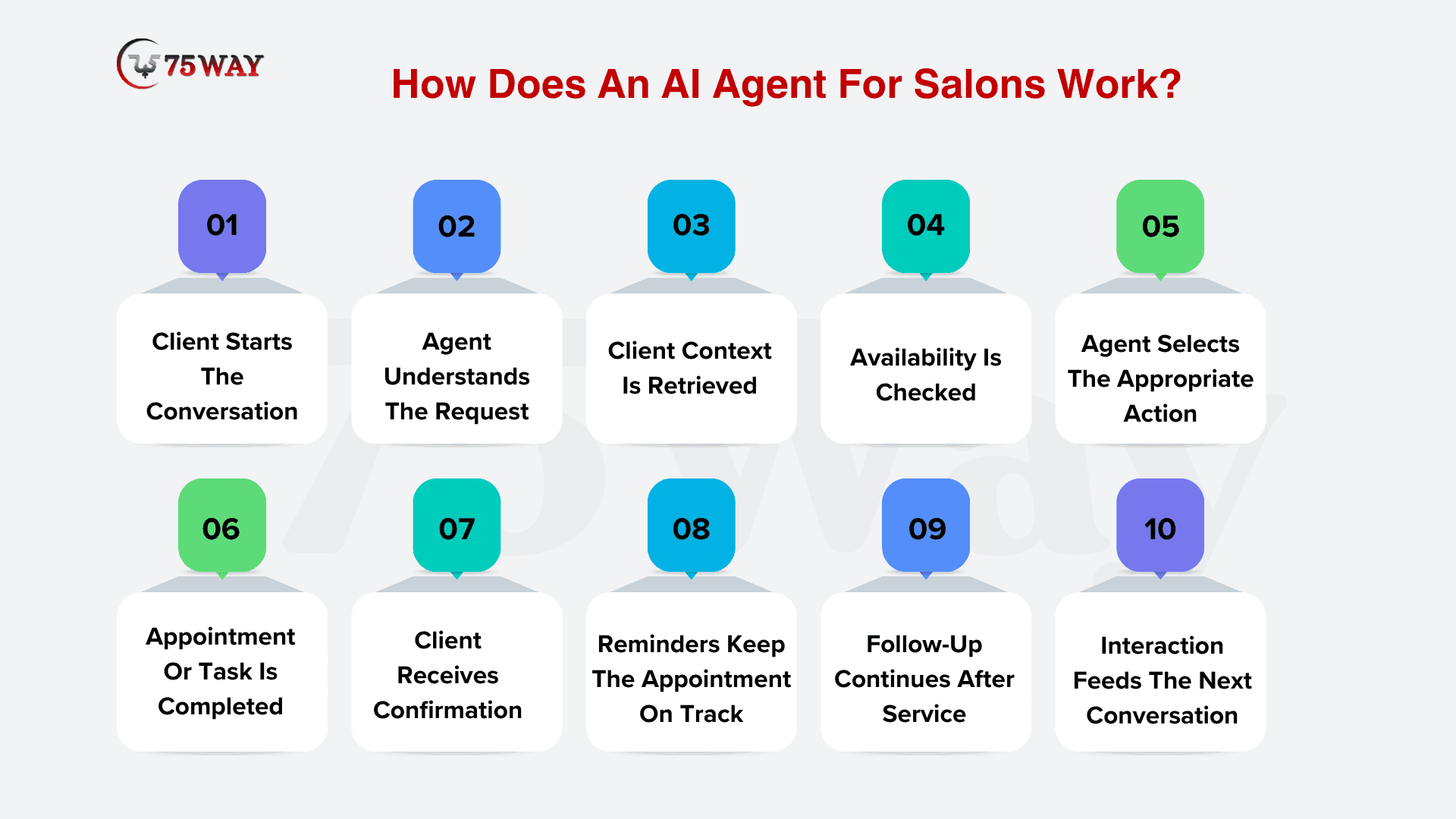
An AI agent for salons works like a digital front desk that can handle conversations, understand what clients need, check connected salon systems, and take approved actions. Instead of treating every message as a separate request, the agent can carry the conversation from the first inquiry through booking, reminders, follow-ups, and future appointments.
1. Client Starts The Conversation
The journey begins when a client sends a message through the salon's website, app, WhatsApp, social channel, or another connected platform. They might ask about a service, request an appointment, check availability, ask about pricing, or simply say, “I need a haircut this Saturday.”
2. Agent Understands The Request
The agent interprets the client's message instead of relying only on fixed keywords. It can identify whether the person wants to book, reschedule, cancel, ask a question, check a service, or speak with someone from the salon.
3. Client Context Is Retrieved
For returning clients, the agent can retrieve permitted information such as previous appointments, preferred services, selected stylist, or relevant account details. This gives the conversation context, while access to personal information remains governed by the salon's permissions and privacy controls.
4. Availability Is Checked
Once the request is clear, the agent checks the connected booking system for suitable options. It can consider service duration, staff availability, working hours, existing appointments, and other configured scheduling rules before presenting available choices.
5. Agent Selects The Appropriate Action
The next step depends on what the client actually needs. The agent may recommend a suitable service, offer available slots, answer a routine question, prepare a rescheduling option, or escalate the conversation when the request falls outside its permitted capabilities.
6. Appointment Or Task Is Completed
After receiving the required confirmation, the agent can carry out the authorized action. This could mean creating an appointment, updating a booking, cancelling a slot, recording a request, or sending the conversation to a human team member for approval.
7. Client Receives Confirmation
The client receives a clear confirmation containing the relevant appointment or request details. Depending on the salon's workflow, this can include the service, date, time, assigned professional, location, and other information the client needs before arriving.
8. Reminders Keep The Appointment On Track
The conversation does not have to end after booking. Automated reminders can be sent before the appointment, helping clients remember upcoming visits and giving them an opportunity to make permitted changes before the scheduled time.
9. Follow-Up Continues After Service
After the appointment, the agent can support appropriate follow-up communication, such as checking whether the client needs assistance, sharing aftercare information approved by the salon, requesting feedback, or helping with the next booking.
10. Interaction Feeds The Next Conversation
The completed interaction can be recorded in connected salon systems so future conversations have relevant context. Over time, this creates a more connected client journey where booking history, preferences, communication, and follow-up activity can support more personalized interactions.
Essential Advanced Features For Salon AI Agent Development
A useful AI agent for salons and spas should do more than answer questions. Its value comes from connecting conversations with calendars, customer records, service information, and follow-up workflows so that everyday client interactions can move forward without unnecessary staff intervention.
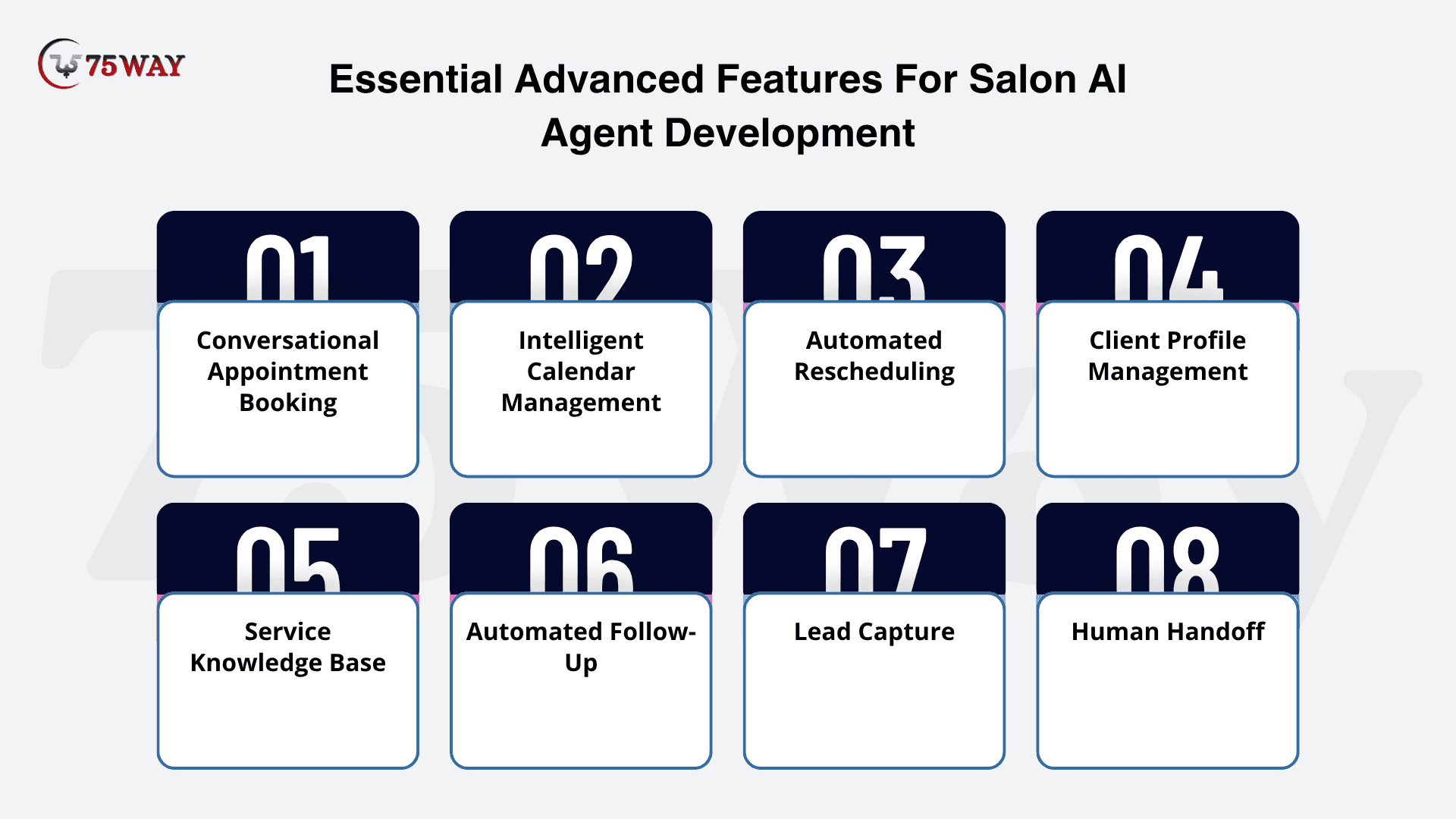
- Conversational Appointment Booking: Clients can describe what they need in their own words rather than navigating a rigid booking form. The agent can understand the requested service, preferred timing, staff preference, and other booking details before moving the conversation toward an available appointment.
- Intelligent Calendar Management: An AI agent can work with the salon's scheduling system to understand which slots are actually available. It can consider existing appointments, service duration, staff schedules, and configured booking rules before presenting suitable options to the client.
- Automated Rescheduling: A client does not need to start the booking process again simply because their plans have changed. The agent can understand the rescheduling request, check alternative slots, apply configured policies, and update the appointment when the action is authorized.
- Client Profile Management: Every returning client interaction does not have to begin from zero. With appropriate permissions, the system can maintain relevant profile details, booking history, preferences, and communication records, giving the agent useful context for future conversations.
- Service Knowledge Base: Clients often ask questions before deciding whether to book. A connected knowledge base allows the agent to provide reliable information about services, pricing, duration, policies, locations, operating hours, preparation requirements, and other details approved by the business.
- Automated Follow-Up: The conversation can continue after the appointment instead of ending at confirmation. Depending on the salon's workflows, the agent can send feedback requests, post-service messages, rebooking prompts, reminders, or other appropriate communications at defined times.
- Lead Capture: Not every visitor is ready to make an appointment during the first conversation. The agent can collect relevant contact information and understand the person's service interest, preferred timing, or other requirements so the salon has useful context for future follow-up.
- Human Handoff: Automation should have a clear path to human support when a situation becomes too complex. An AI receptionist for salons can recognize complaints, unusual requests, sensitive conversations, or uncertain questions and transfer them with relevant context so the client does not have to repeat everything.
How To Build An AI Agent For Salon And Spa: Comprehensive Development Roadmap
Building an AI agent for salon and spa centers involves more than connecting an LLM to a chat window. The system needs to understand how the business handles appointments, services, staff schedules, client communication, and follow-ups, while knowing exactly when it can act and when a human should take over.
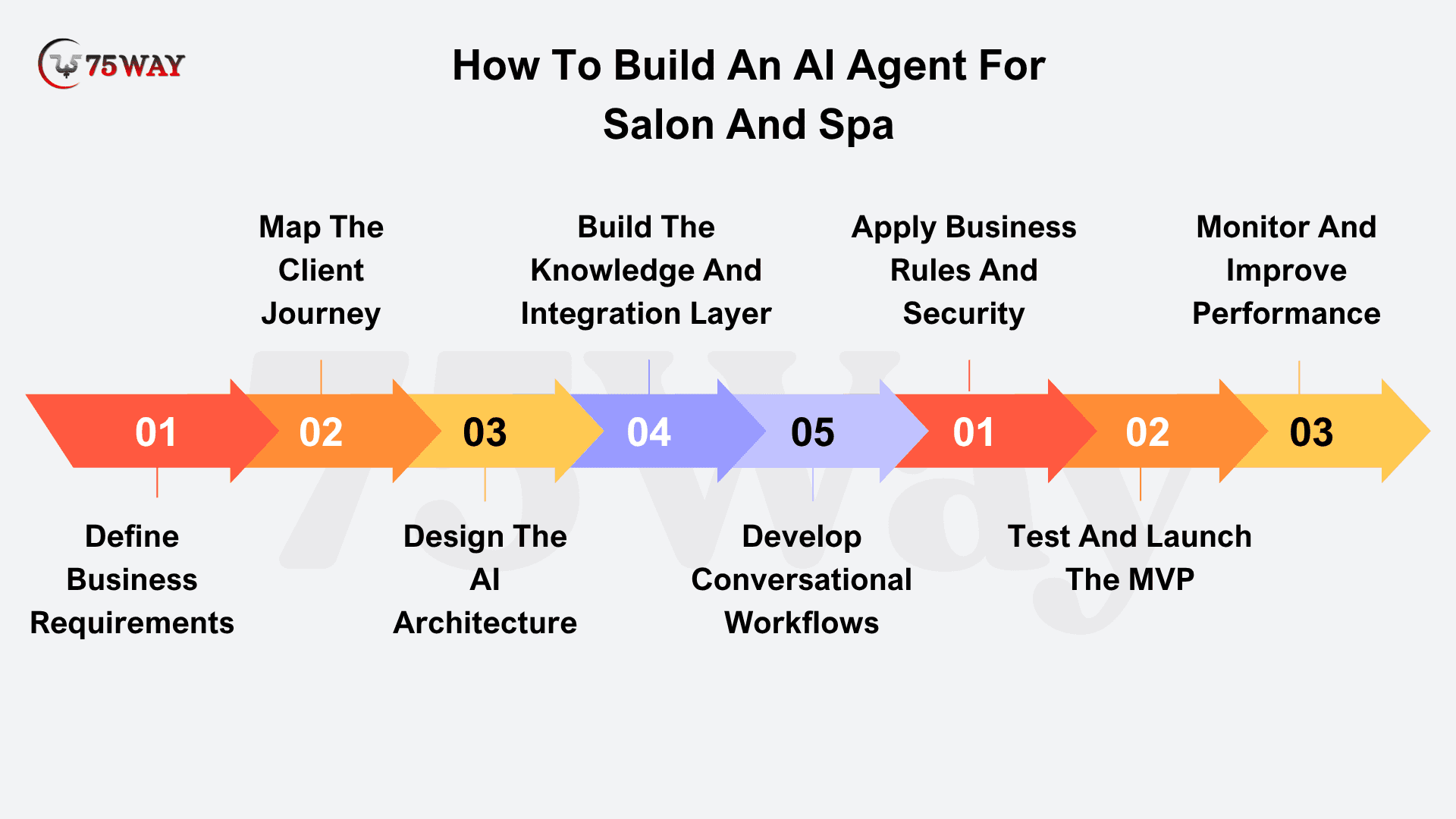
Phase 1: Define Business Requirements
Begin with the business problems that are worth solving rather than starting with AI capabilities. Identify whether the priority is appointment handling, client inquiries, lead capture, reminders, rebooking, retention, or a combination of these workflows.
Clarify the target customers, services, booking process, business hours, staff availability, cancellation policies, communication channels, and escalation requirements. This gives the development team a practical scope and prevents unnecessary automation from complicating the first release.
Phase 2: Map The Client Journey
The agent should fit naturally into the way clients already interact with the salon or spa. Map the journey from the first inquiry through service discovery, availability checks, booking, confirmation, reminders, appointment completion, feedback, and future rebooking.
At each stage, decide what the agent can handle independently and where staff involvement adds value. This creates a clear boundary between automated conversations and human-led interactions.
Phase 3: Design The AI Architecture
The underlying architecture determines how well the agent can understand conversations and perform real tasks. Depending on the business, the solution may combine an LLM, retrieval system, business rules, workflow orchestration, APIs, conversation memory, and human-handoff mechanisms.
A single-location salon with straightforward booking rules may need a relatively lightweight setup, while a multi-location spa with memberships, multiple staff calendars, and complex services may require a more sophisticated architecture.
Phase 4: Build The Knowledge And Integration Layer
An AI agent needs reliable information before it can give useful answers or take meaningful action. Create an approved knowledge base covering services, prices, durations, staff information, locations, policies, memberships, packages, preparation instructions, and frequently asked questions.
Connect this information with appointment software, CRM systems, calendars, payment platforms, or other relevant business tools. The agent can then work with current business data instead of relying on outdated information or making assumptions.
Phase 5: Develop Conversational Workflows
Turn typical client requests into practical workflows rather than rigid scripts. A client might ask, “Do you have anything for a facial tomorrow evening?” and expect the agent to understand the service, date, preferred timing, and next action without repeating the same information.
Create workflows for booking, rescheduling, cancellations, service questions, reminders, waitlists, lead capture, and follow-ups. Each workflow should define what information is required, what tools the agent can use, and what outcome should be produced.
Phase 6: Apply Business Rules And Security
AI should not be allowed to improvise decisions that could affect bookings, payments, customer accounts, or salon policies. Define rules for cancellation windows, deposits, appointment durations, staff-specific services, membership eligibility, working hours, holidays, and escalation conditions.
At the same time, protect customer information through appropriate authentication, authorization, encryption, access controls, audit logging, and data-retention practices. The exact safeguards should reflect the business's systems, data, and applicable requirements.
Phase 7: Test And Launch The MVP
Before introducing the agent to customers, test it against realistic salon conversations rather than relying only on standard questions. Include ambiguous service requests, conflicting appointments, last-minute cancellations, unavailable staff, pricing questions, membership queries, complaints, and requests that require human assistance.
Once the core workflows perform reliably, launch with a focused MVP covering the highest-value use cases. Starting small makes it easier to observe real interactions, identify gaps, and improve the experience before expanding automation.
Phase 8: Monitor And Improve Performance
The agent's development does not end when it goes live. Monitor completed bookings, conversion rates, abandoned conversations, response quality, human handoffs, rescheduling success, repeat bookings, no-shows, and client feedback.
These insights reveal where conversations break down or where additional automation could create value. Regularly updating the knowledge base, workflows, permissions, integrations, and AI behavior allows the agent to become more useful as the salon or spa grows.
How Can AI-Powered Salon Management Agents Help Salons And Spas?
For a salon or spa, the front desk can quickly become a traffic jam of calls, messages, booking questions, cancellations, and follow-ups. An AI agent for salon and spa businesses can take care of much of this repetitive communication while staff stay focused on clients receiving services.
The bigger opportunity goes beyond booking automation. With the right integrations and permissions, the same AI system can support communication, retention, lead management, reminders, and day-to-day customer interactions throughout the client journey.
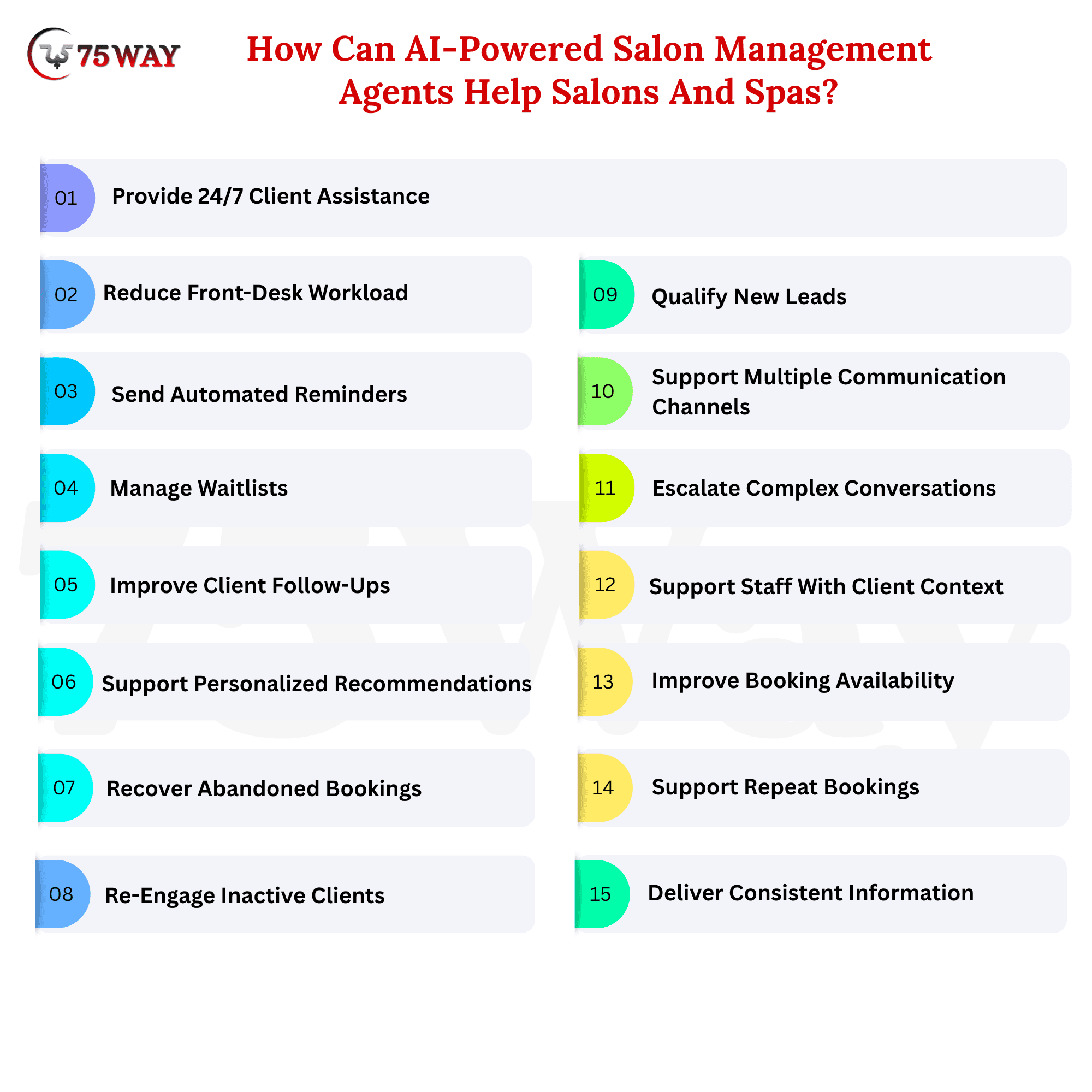
- Provide 24/7 Client Assistance
The perfect booking opportunity does not always arrive during opening hours. An AI agent for salons and spas can answer routine questions and handle supported appointment requests during evenings, weekends, holidays, or other periods when reception staff are unavailable.
- Reduce Front-Desk Workload
Receptionists should not have to repeat the same answers throughout the day. An AI salon assistant can handle routine questions about services, prices, opening hours, locations, preparation requirements, availability, and booking policies, giving staff more time for in-person clients.
- Send Automated Reminders
A confirmed appointment can easily get buried in a client's busy schedule. Automated reminders can keep the visit visible while giving clients an opportunity to review their appointment details or make permitted changes before arriving.
- Manage Waitlists
A cancellation does not have to mean an empty appointment slot. When availability opens up, the salon AI agent can identify suitable clients on the waitlist and contact them according to configured rules, helping businesses recover otherwise unused appointment capacity.
- Improve Client Follow-Ups
The relationship should not end when a service is completed. An AI agent for spa businesses can support post-appointment conversations, collect feedback, answer routine follow-up questions, and encourage appropriate future visits based on the salon's communication strategy.
- Support Personalized Recommendations
A returning client should not receive the exact same suggestions as someone visiting for the first time. With appropriate permissions, an AI-powered salon assistant can consider preferences, previous bookings, and conversation context to suggest relevant services, packages, or future appointments.
- Recover Abandoned Bookings
A client may start discussing an appointment and then disappear before completing it. Where appropriate consent and messaging rules are in place, the AI system can follow up with relevant context and make it easier for the client to continue the conversation.
- Re-Engage Inactive Clients
Some clients simply stop returning without giving the salon a clear reason. An AI agent for salon customer retention can identify customers who have been inactive for a business-defined period and support personalized outreach instead of sending identical messages to the entire customer base.
- Qualify New Leads
Not every inquiry is ready to become a booking immediately. An AI salon receptionist can understand what a prospective client wants, ask relevant questions about their preferred service and timing, and pass useful information into the booking workflow or to the appropriate team member.
- Support Multiple Communication Channels
Clients may discover a salon through its website but prefer continuing the conversation through messaging or mobile channels. Depending on the implementation, an AI agent for salon and spa operations can support conversations across websites, SMS, mobile apps, messaging platforms, and other connected channels.
- Escalate Complex Conversations
Smart automation also needs to recognize its boundaries. Complaints, sensitive situations, unusual requests, or questions outside the approved knowledge base can be transferred to an appropriate employee instead of forcing clients through an unhelpful automated exchange.
- Support Staff With Client Context
When an employee takes over a conversation, they should not have to ask the client to explain everything again. The AI system can provide relevant messages, appointment details, client information, and the reason for escalation so staff can continue the conversation with proper context.
- Improve Booking Availability
A client who waits too long for an answer may move to another salon. Faster responses, availability checks, and conversational assistance can help businesses respond while customer intent is still high, particularly during busy reception periods.
- Support Repeat Bookings
One appointment can become the start of a longer client relationship. An AI agent for salon and spa businesses can support timely reminders about future visits, present suitable booking options, and make repeat appointments easier without relying entirely on manual outreach.
- Deliver Consistent Information
Clients should receive the same accurate information regardless of when or where they ask. Connected to approved business knowledge, an AI customer service agent for salons can provide consistent answers about services, pricing, operating hours, cancellation policies, preparation requirements, and other frequently requested details.
Real-World Use Cases of AI Agent For Salons And Spas Across Businesses
An AI agent can become part of several moments in the salon or spa customer journey, from the first service inquiry to post-appointment communication. Its role can vary according to booking volume, service mix, customer expectations, and the level of automation a business wants to introduce.
- New Client Booking
A prospective client may ask about a service, price, duration, availability, and suitable timing within the same conversation. An AI booking agent for salons can understand these requirements, collect necessary details, check connected schedules, and complete the appointment when authorized.
This creates a smoother first interaction because the client does not have to move between separate pages or wait for reception to answer every question. Complex requests can still be passed to staff with the conversation context attached.
- Returning Client Rebooking
A returning customer already has a relationship with the business, so asking them to repeat basic information can make rebooking unnecessarily tedious. With appropriate permissions, the AI agent can use previous booking information to understand the client's request and help arrange another suitable appointment.
The conversation can also support timely reminders when a client may be ready to return. Rather than sending the same generic message to everyone, the salon can configure communication around its services, timing rules, and customer preferences.
- Last-Minute Slot Filling
A cancellation can leave a valuable slot sitting unused on the schedule. Instead of waiting for another customer to discover that availability, the AI agent can identify eligible waitlisted clients and contact them when an appropriate appointment becomes available.
The outreach can include relevant service, timing, and booking information, allowing interested clients to respond quickly. This gives salons a practical way to turn unexpected cancellations into potential bookings.
- Service Discovery Assistance
Many customers know what they want to achieve but have no idea which salon service matches that goal. An AI agent can ask relevant questions, understand the client's requirements, and explain suitable options using the salon's approved service information.
This can make service discovery feel more like a conversation than browsing through a long menu. When professional judgment is required, the agent can direct the client toward a qualified staff member instead of presenting uncertain recommendations.
- Pre-Appointment Question Handling
Questions about preparation, appointment duration, arrival times, cancellation policies, locations, and what to expect can consume considerable front-desk time. An AI receptionist for salons can provide approved answers whenever clients need them.
Because these questions often arise outside normal working hours, automated assistance can also prevent clients from waiting until the next business day. Staff can remain available for situations that genuinely require personal attention.
- Spa Treatment Guidance
Spa customers may describe how they want to feel or what type of experience they are looking for rather than naming a specific treatment. The AI agent can understand their stated preferences and explain relevant treatments according to the spa's approved recommendations.
The distinction between service information and professional advice should remain clear. Where a client's situation requires qualified assessment, the conversation can move to an appropriate professional rather than relying on automated suggestions.
- Appointment Reminder Automation
A busy client can easily forget an appointment even after confirming it days earlier. Automated reminders can keep the booking visible through supported communication channels at predefined intervals.
The reminder can also make the next action obvious, allowing clients to confirm attendance or request an eligible change. This creates a more organized appointment experience while reducing avoidable communication around upcoming visits.
- Post-Service Client Follow-Up
The customer journey continues after the service ends. An AI receptionist for spas can check in with clients, collect feedback, answer routine follow-up questions, and direct concerns to staff when a personal response is needed.
Positive experiences can naturally lead toward future engagement, while negative feedback can reach the right employee before it becomes a larger issue. This gives businesses another opportunity to strengthen client relationships beyond the appointment itself.
- Inactive Client Re-Engagement
Some clients gradually disappear from the booking calendar without actively deciding to leave. An AI agent can identify customers who have not returned within a business-defined period and support permission-based outreach designed around the salon's communication strategy.
Instead of sending identical promotions to every inactive customer, businesses can use relevant context to make messages more useful. Clients can then receive a simple path toward exploring services or arranging another appointment.
- Membership Support Automation
Memberships and prepaid packages can create additional questions for both clients and front-desk teams. An AI agent can explain approved information about plans, remaining services, renewal details, eligibility, and relevant booking options.
For customers, this provides quicker access to information without searching through previous messages or documents. For staff, it reduces repetitive questions while keeping more complicated account or payment matters available for human review.
Cost To Build An AI Agent For Salons And Spas Operation Automation
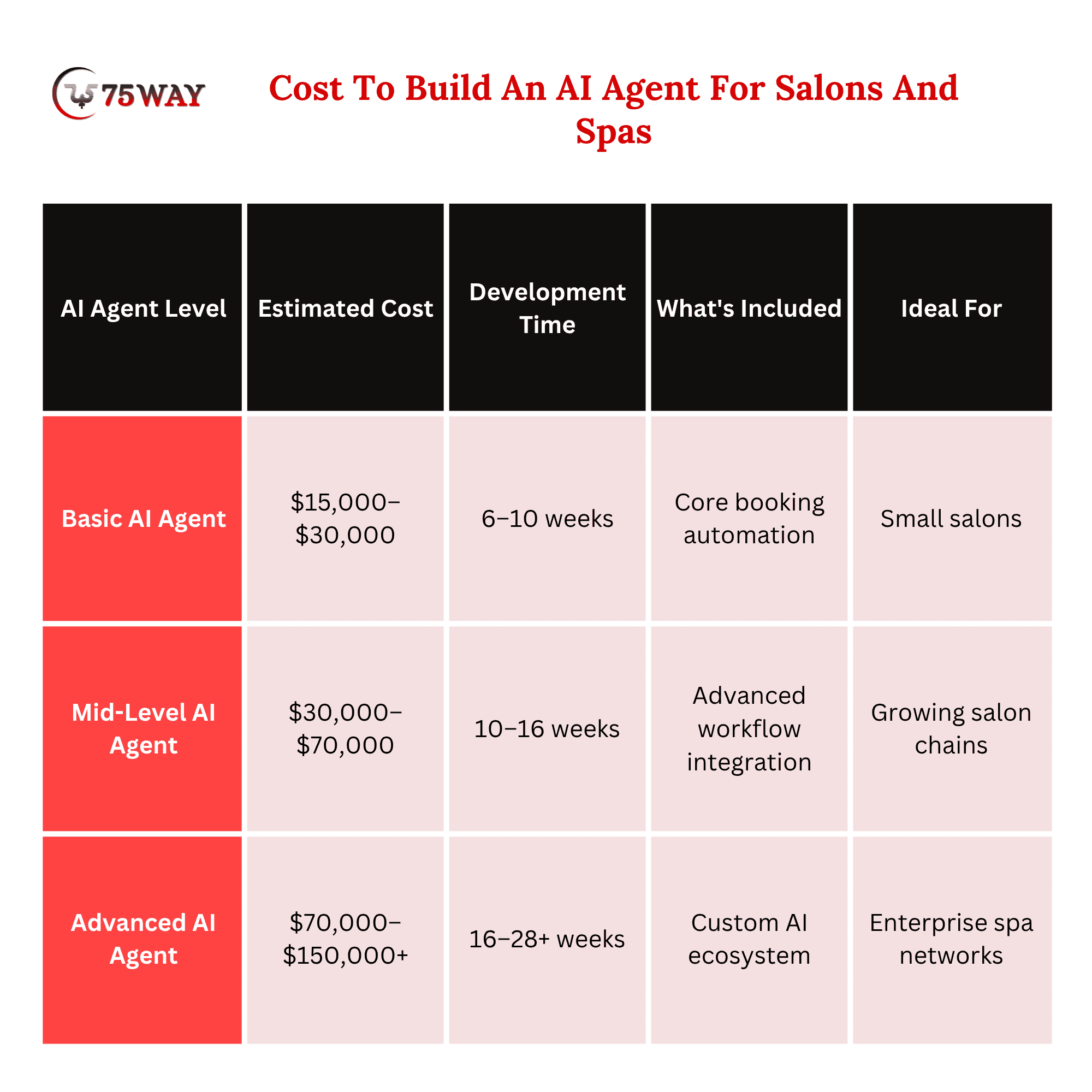
The cost to build an AI agent for salons and spas typically ranges from $15,000 to $150,000+, depending on the AI capabilities, integrations, and business scale. A simple booking-focused agent costs less than an enterprise solution connected to multiple salon systems, CRM platforms, payment services, voice channels, and advanced analytics.
- Basic AI Agent: $15,000–$30,000
A basic solution is suitable for salons that want to automate routine client communication and appointment workflows without building a highly customized AI platform.
Ideal for: Small salons, independent spas, and MVP launches.
- Mid-Level AI Agent: $30,000–$70,000
A mid-level solution can connect the AI agent with existing business systems and automate more of the client journey.
Ideal for: Growing salons, spa chains, and multi-location businesses.
- Advanced AI Agent: $70,000–$150,000+
An advanced platform is designed for businesses requiring sophisticated automation, personalization, multiple integrations, and larger-scale operations.
Ideal for: Salon groups, spa chains, franchises, and enterprise businesses.
Spa AI Agent Development Cost Based On Stage
The overall budget is also influenced by individual development stages while creating an AI-powered spa agent.
- Discovery & Planning: $3,000–$8,000
Includes business analysis, workflow mapping, technical requirements, AI use-case identification, integration planning, and development roadmap.
- UI/UX Design: $4,000–$10,000
Covers conversational interface design, client booking flows, admin screens, dashboards, prototypes, and user experience planning.
- AI & Backend Development: $15,000–$50,000
Includes AI integration, conversation workflows, business rules, backend APIs, database architecture, authentication, and automation logic.
- Integration Development: $5,000–$25,000
Covers scheduling software, CRM, calendars, payment systems, SMS, email, analytics, and other required third-party integrations.
- Testing & Quality Assurance: $4,000–$12,000
Includes functional testing, conversational testing, integration testing, security checks, performance testing, and real-world workflow validation.
- Deployment & Launch: $2,000–$7,000
Includes cloud configuration, production deployment, monitoring setup, domain or channel configuration, and launch preparation.
- Post-Launch Maintenance: $5,000–$20,000+ annually
Covers bug fixes, AI workflow improvements, API updates, security maintenance, monitoring, and future enhancements.
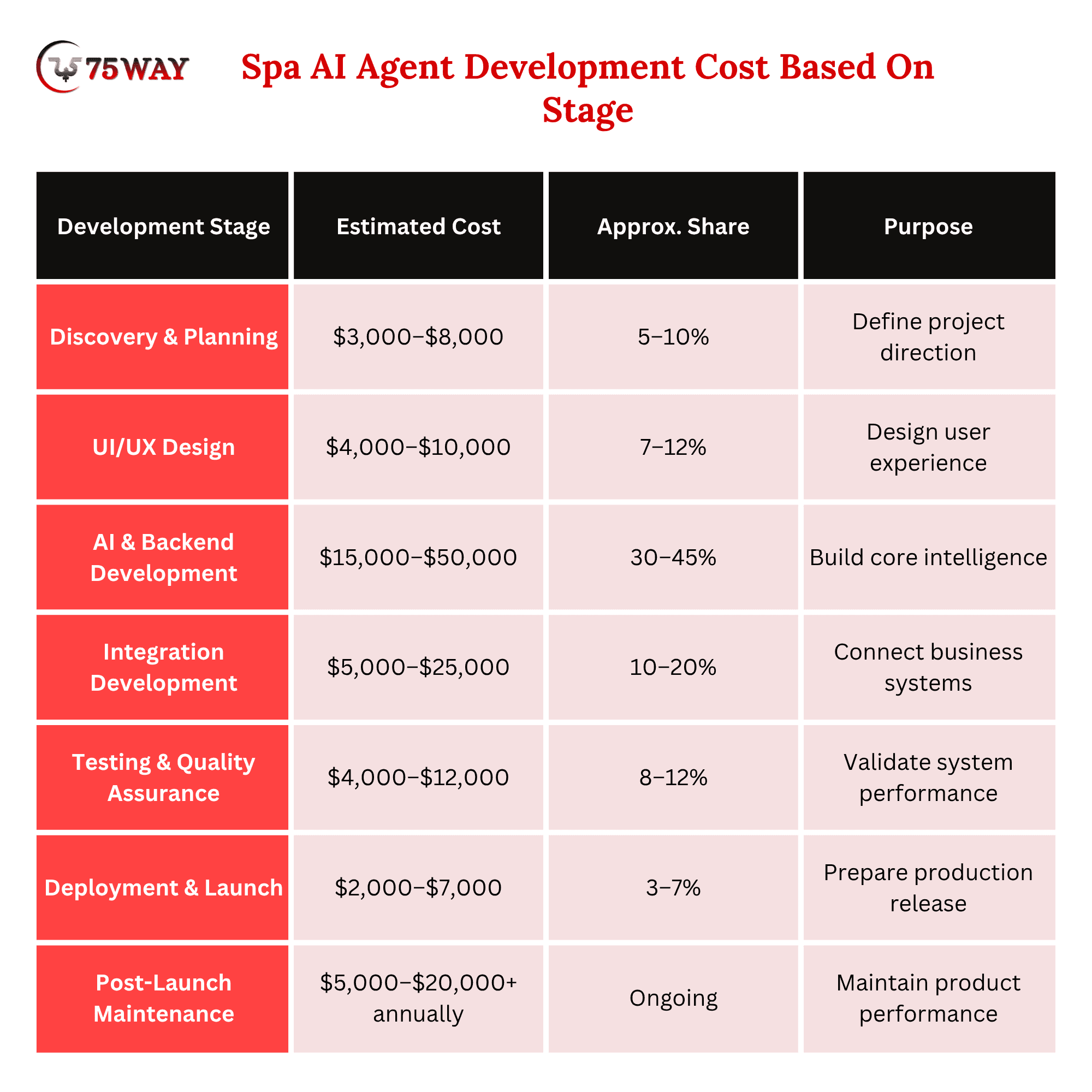
The final salon and spa AI agent development cost depends heavily on whether the business already has scheduling software, CRM systems, APIs, customer databases, and communication infrastructure.
What Affects AI Agent Development Cost?
- AI Complexity: A simple FAQ and booking assistant requires less development than an agent capable of complex reasoning, personalization, voice conversations, and multi-step workflows.
- Number of Integrations: Each external system adds development, testing, authentication, maintenance, and potential API costs.
- Communication Channels: Website chat is generally simpler than supporting multiple messaging channels and voice-based conversations.
- Customization: Custom workflows, dashboards, business rules, and client experiences increase development effort.
- Number of Locations: A single salon has fewer operational requirements than a platform supporting multiple branches, staff schedules, service catalogs, and location-specific rules.
- Retention Automation: Advanced rebooking, segmentation, personalized outreach, memberships, and lifecycle campaigns require additional workflow and data capabilities.
- AI Usage: Ongoing model usage, API calls, voice processing, messaging, hosting, and third-party services create recurring operational expenses after development.
Why Salon & Spa Businesses Adopt AI Assistants: Key Benefits
AI salon and spa agents can help salons and spas reduce repetitive administrative work, respond to clients faster, capture more appointment opportunities, and maintain communication after services. Their value becomes stronger when automation is connected to actual booking, customer management, and retention workflows.
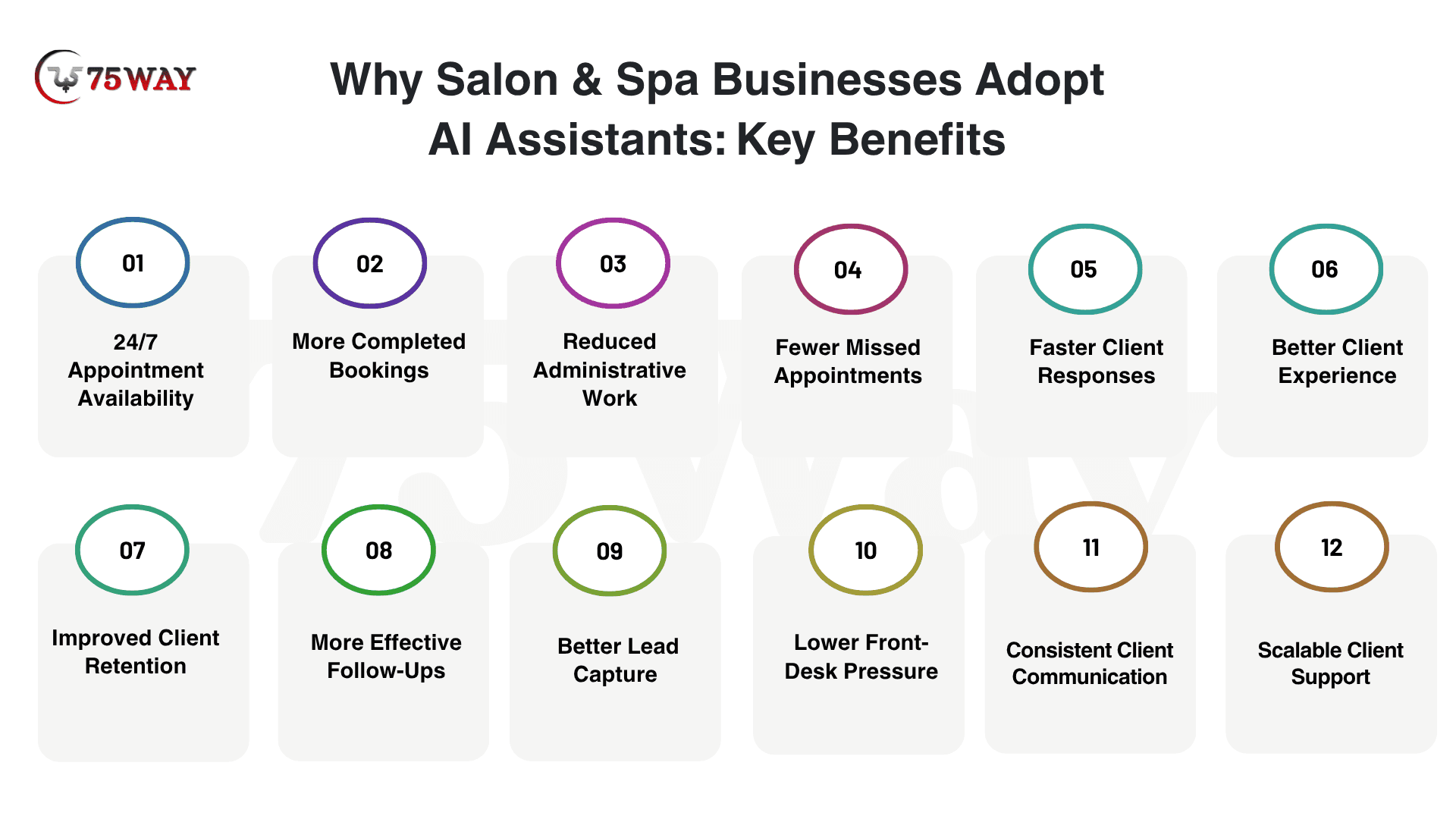
1. 24/7 Appointment Availability
Clients do not always decide to book during business hours. An AI agent can answer booking requests and support appointment workflows when reception staff are unavailable.
2. More Completed Bookings
An AI booking agent for salons can respond immediately when a prospective client asks about availability. Reducing the waiting time between interest and booking can help prevent potential clients from abandoning the conversation.
3. Reduced Administrative Work
Staff can spend less time answering repetitive questions, confirming appointments, managing basic schedule changes, and sending routine reminders.
This allows reception teams to dedicate more attention to clients who require personal assistance.
4. Fewer Missed Appointments
Automated reminders can help clients remember upcoming appointments and provide an easy way to confirm or request changes.
The exact impact depends on the salon's reminder strategy, client behavior, and communication channels.
5. Faster Client Responses
Clients can receive immediate answers to common questions about services, prices, hours, availability, locations, and policies instead of waiting for staff to respond.
6. Better Client Experience
A conversational AI receptionist for salons can give clients a simpler way to get information and complete routine tasks without navigating complicated menus or waiting on hold.
7. Improved Client Retention
AI can continue communicating after the appointment through feedback requests, rebooking prompts, membership reminders, and other appropriate follow-ups.
This supports a broader salon client retention strategy rather than focusing only on acquiring new customers.
8. More Effective Follow-Ups
Manual follow-ups can be difficult when staff have many appointments and administrative responsibilities.
An AI salon agent can automate predefined follow-up workflows while allowing businesses to personalize messages according to client information and business rules.
9. Better Lead Capture
Potential clients who ask questions but are not ready to book can still provide relevant information that helps the business follow up later.
This can prevent valuable inquiries from being lost simply because staff were unavailable at the time.
10. Lower Front-Desk Pressure
During busy periods, reception teams may have to manage phone calls, walk-ins, payments, questions, and appointments simultaneously.
An AI salon receptionist can absorb suitable routine conversations while staff focus on higher-priority in-person interactions.
11. Consistent Client Communication
An AI salon assistant can use approved business information to provide consistent answers about services, prices, policies, opening hours, and appointment procedures.
This reduces dependence on individual employees remembering every detail.
12. Scalable Client Support
A growing salon may receive significantly more client conversations without being able to increase front-desk staffing at the same rate.
An AI salon booking automation agent can support a larger volume of routine interactions without requiring a separate employee for every conversation.
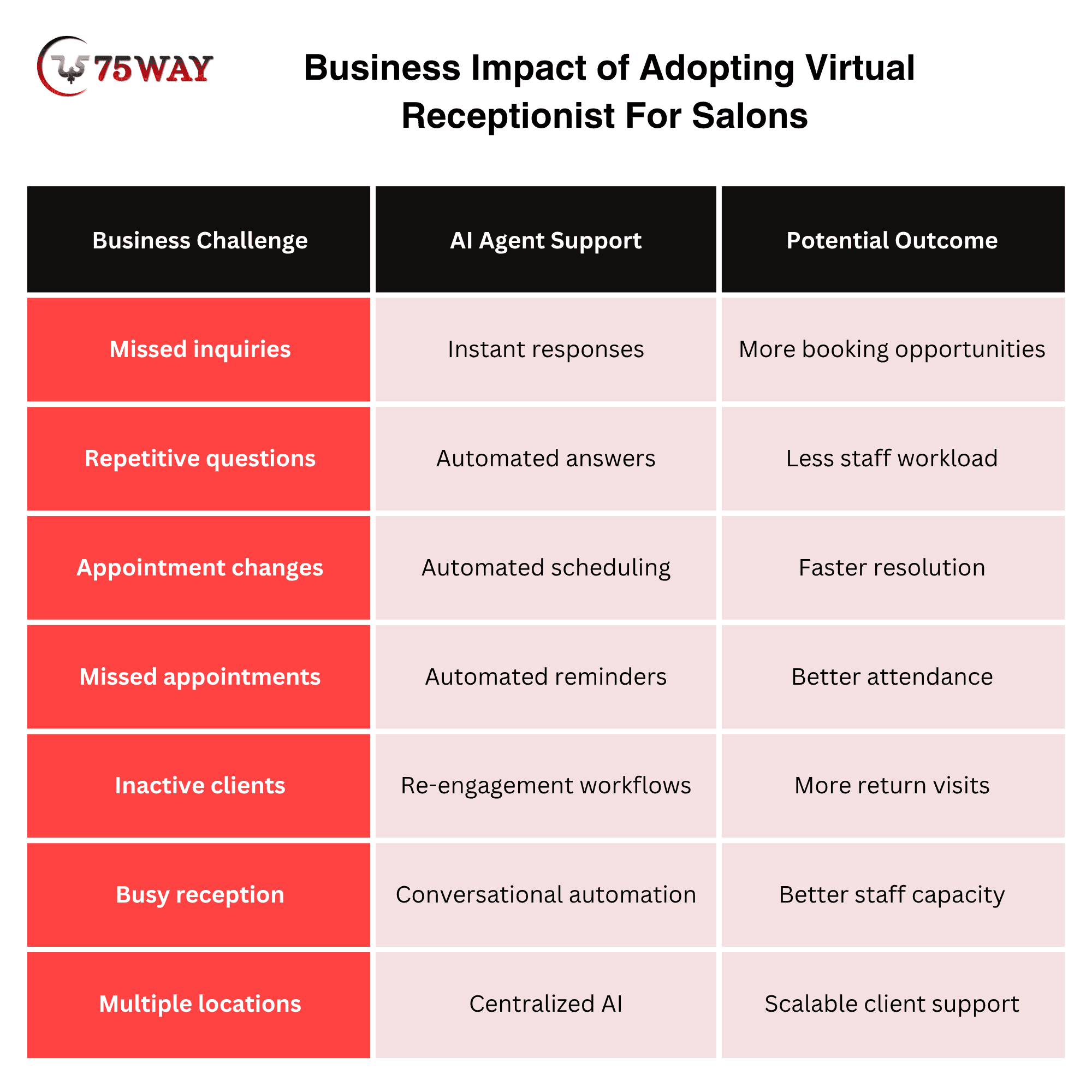
Business Impact of Adopting Virtual Receptionist For Salons
A salon can lose business simply because nobody was available to answer a call while the team was busy with clients. A virtual receptionist can keep those conversations moving by handling bookings, questions, reminders, and routine requests without adding another person to the front desk. The business impact of this approach is explored below.
How To Improve Client Retention With An AI Salon Agent
An AI salon agent can support salon and spa client retention by staying connected with customers before, during, and after appointments. Instead of relying only on staff-initiated follow-ups, businesses can create automated client journeys based on appointment activity, preferences, and engagement.
- Personalized Rebooking: The AI agent can remind clients about future appointments based on their previous services, preferred timing, and salon-defined rebooking intervals.
- Post-Appointment Follow-Ups: After a service, the agent can check whether the client needs assistance, collect feedback, and provide an easy path to schedule another appointment.
- Inactive Client Outreach: Businesses can create workflows for clients who have not returned within a defined period, encouraging them to reconnect without requiring staff to manually identify every inactive customer.
- Service Reminders: Clients can receive timely reminders about recurring services, maintenance appointments, memberships, or packages based on business-approved schedules.
- Personalized Recommendations: An AI agent can use permitted client preferences and booking history to suggest relevant services instead of sending identical promotional messages to everyone.
- Birthday And Milestone Messages: Salons can configure personalized messages around birthdays, membership milestones, or other customer events when appropriate and supported by available customer information.
- Membership Engagement: For businesses offering memberships, the AI agent can remind clients about available benefits, upcoming renewals, unused services, and eligible appointment options.
- Waitlist Re-Engagement: When a preferred appointment becomes available, the AI agent can contact eligible waitlisted clients and help them secure the opening quickly.
- Feedback Collection: Automated post-service conversations can ask clients for feedback and identify issues that may otherwise remain unnoticed by management.
- Review Requests: Satisfied clients can be invited to leave reviews through appropriate channels, while negative feedback can be routed toward internal support for resolution.
- Abandoned Booking Recovery: If a client starts a booking conversation but does not complete it, the agent can send a suitable follow-up rather than allowing the potential appointment to disappear.
- Client Preference Recognition: When permitted, the AI can remember relevant preferences such as preferred services, staff members, or appointment timing, making future interactions more convenient.
Final Thoughts
An AI agent for salons and spas can turn routine client communication into a more connected, automated experience. From appointment booking and rescheduling to reminders, follow-ups, service questions, and re-engagement, AI can support both daily operations and long-term client relationships.
The real value comes from connecting the agent with scheduling software, CRM systems, communication channels, and business workflows so it can take meaningful actions rather than simply answer questions.
Salons and spas can start with a focused booking and communication MVP, measure results, and gradually introduce personalization, retention automation, and advanced capabilities as their needs grow. To automate bookings and strengthen client relationships, you can partner with a renowned AI agent development agency to build your salon AI assistant for beauty services.
Frequently Asked Questions (FAQs)
Can an AI Agent Replace A Salon Receptionist?
An AI salon agent can handle many repetitive front-desk tasks, but human staff remain valuable for complex requests, complaints, exceptions, and personalized in-person client experiences.
Will Clients Know They Are Talking To An AI Agent for Salon?
Businesses can clearly disclose when clients interact with AI and provide an easy option to reach staff. Transparent communication can help maintain trust throughout conversations.
Can Salon AI Agent Understand Different Ways Clients Describe Services?
Yes, modern AI agents can interpret natural-language requests and variations in wording. They can map conversational requests to the salon’s approved services and workflows.
Can AI Salon Assistant Handle Multiple Clients Simultaneously?
Yes, an AI system can manage multiple conversations concurrently without placing clients on hold. Capacity depends on the architecture, communication channels, integrations, and expected conversation volume.
Can AI Agent Work With Existing Salon Software?
Yes, integration is possible when the existing platform provides suitable APIs or supported connection methods. The agent can then access relevant scheduling, customer, and business information.
Can AI Agents Support Multiple Salon Locations?
Yes, a centralized AI agent can support multiple branches while applying location-specific services, schedules, staff availability, pricing, and policies according to configured business rules.