AI Summary
Breathing app development involves designing guided breathing exercises, personalized sessions, progress tracking, reminders, and calming user experiences. This guide explains the development process, essential features, costs, monetization, challenges, and launch considerations for businesses building breathing apps.
Key Takeaways
- Breathing apps provide guided exercises through structured digital wellness experiences.
- Personalization can help users choose routines matching their goals and preferences.
- Smooth animations and synchronized audio or haptic feedback are central to the product experience.
- Wearable integration can extend breathing exercises beyond the phone and support shorter, context-based sessions.
- Development costs range from $ 15,000 to $ 250,000+, depending on features, platforms, and integrations.
A user may come to a breathing app with just one goal: “Give me something I can follow right now.” If the app makes that first session difficult to find or follow, there is a good chance they will close it before experiencing its value.
That makes simplicity one of the biggest product challenges. The mobile app development solution needs clear breathing patterns, well-timed visual or audio guidance, easy session controls, and enough personalization to make the experience useful without turning it into another complicated dashboard.
As the product grows, you may also introduce progress tracking, reminders, subscriptions, personalized routines, wearable integrations, and other features. Each addition needs to support the core experience rather than distract from it.
If you are planning to build a breathing app, this guide takes you through the process from idea and feature planning to UI/UX design, technology, the process of wearable app development for breathwork therapy, testing, launch, and cost considerations, so you can turn the concept into a product people can comfortably use every day.
What Is A Breathing App?
A breathing app is a digital wellness application that guides users through structured breathing exercises using visual cues, audio instructions, timers, animations, and personalized routines. Users can typically select a breathing technique, follow an inhale-and-exhale pattern, complete a session, and track their practice over time.
Unlike a simple timer, a modern breathing app can create a more guided and interactive experience. Depending on its purpose, it may offer different breathing patterns, session lengths, reminders, progress tracking, educational content, personalization, and audio guidance.
What Is Breathing App Development?
Breathing app development is the process of designing and building a mobile or digital wellness application that guides users through structured breathing exercises.
Unlike a basic timer, a breathing app coordinates several elements at the same time. The application may control breathing intervals, display visual cues, play instructions or background audio, trigger haptic feedback, record sessions, recommend routines, and adapt the experience according to user preferences.
The simplest version might guide a user through:
Inhale → Hold → Exhale → Hold → Repeat
A more advanced product can support multiple breathing patterns, customized session durations, guided programs, progress analytics, personalized recommendations, wearable devices, subscriptions, and connected wellness experiences.
That distinction matters for founders. Building a timer is relatively straightforward; building a reliable breathing platform requires product strategy, mobile engineering, content, data architecture, UX design, and ongoing optimization.
Why Invest In Building Breathing & Meditation Management App?
The value of a breathing and meditation app comes from turning occasional wellness sessions into an ongoing digital experience. Businesses can build around guided routines, personalized programs, progress features, and premium content while creating multiple paths to recurring revenue. The main investment opportunities behind this model are covered below.
- Build A Focused Wellness Product: Breathing can become the central experience rather than another feature buried inside a broader meditation or wellness application.
- Serve Different Wellness Audiences: The product can target consumers, athletes, professionals, coaches, wellness programs, or other audiences with distinct breathing needs.
- Create Repeat-Use Habits: Short breathing sessions can fit naturally into daily routines, giving users practical reasons to return at different points throughout the day.
- Develop Personalized Experiences: Users can receive breathing sessions based on their selected goals, preferred duration, experience level, routine, or personal preferences.
- Enter Corporate Wellness: Businesses can use breathing experiences as part of employee wellness initiatives, workplace breaks, focus routines, or broader digital wellbeing programs.
- Complement Fitness And Recovery: A breathing app can sit alongside fitness products by supporting pre-workout routines, post-exercise recovery, cooldowns, or structured recovery experiences.
- Explore Sleep-Focused Solutions: Breathing routines can become part of a nighttime wellness experience designed around relaxation, bedtime routines, and guided sessions before sleep.
- Extend Into Wearable Experiences: Connected wearables can create opportunities for guided breathing experiences using device interactions, reminders, session tracking, and other supported capabilities.
- Build Subscription Revenue: Premium breathing programs, personalized routines, advanced tracking, exclusive content, and structured programs can create opportunities for recurring revenue.
- Differentiate Through Technology: AI personalization, adaptive routines, voice guidance, wearable connectivity, progress insights, and habit-building features can give a breathing product a stronger identity than a basic timer app.
Breathwork Therapy App Market Size & Revenue Opportunities In USA
Breathing apps are moving beyond simple guided exercises into a broader digital wellness opportunity, giving businesses multiple ways to build recurring user relationships. The U.S. market signals make this category worth examining before investing in development. The market size, growth trajectory, and revenue opportunities are explored below.
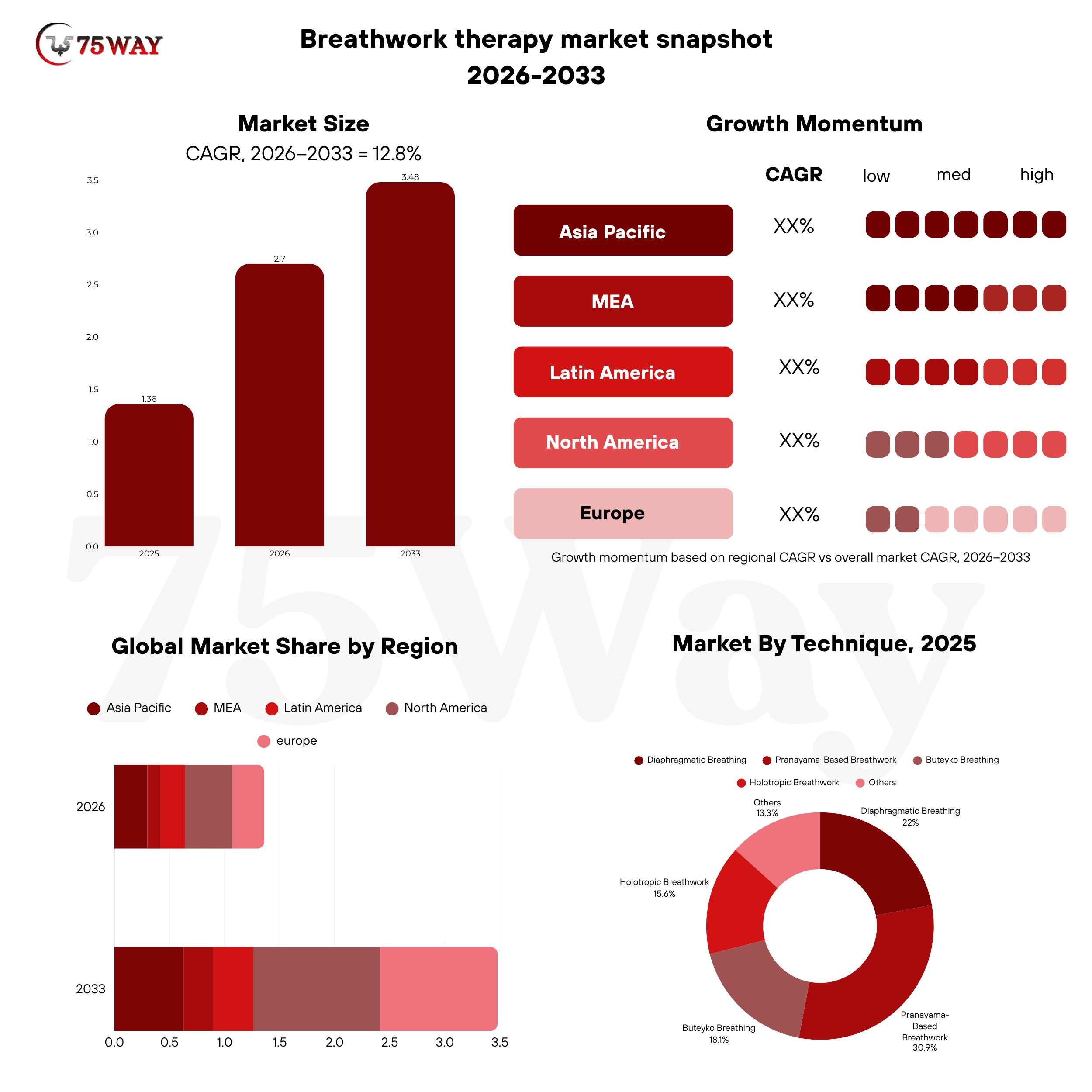
- The global breathwork therapy market is projected to grow from $1.5 billion in 2026 to $3.4 billion by 2033, at a CAGR of 12.8%.
- North America leads the breathwork therapy market, accounting for 36.8% of global revenue.
- Stress and anxiety management is the leading therapy type, holding a 35.5% market share.
- In-person sessions represent the largest delivery segment, with a 34.7% market share.
- Diaphragmatic breathing leads among breathing techniques, accounting for 32.6% of the market.
- The global meditation management apps market is expected to grow from $2.7 billion in 2026 to $7.0 billion by 2033, at a CAGR of 14.7%.
How To Develop A Breathing App: Step-By-Step Methodology
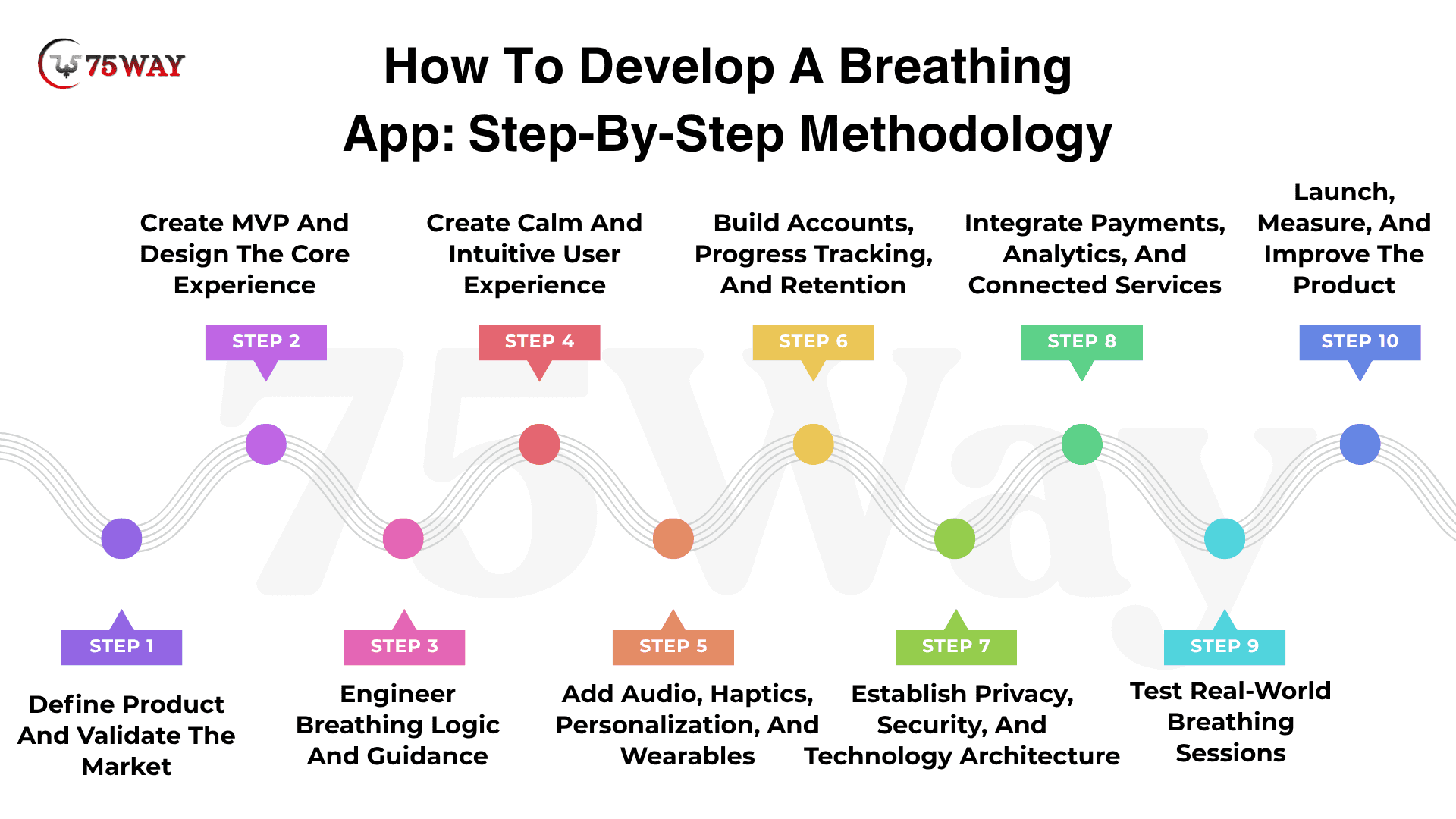
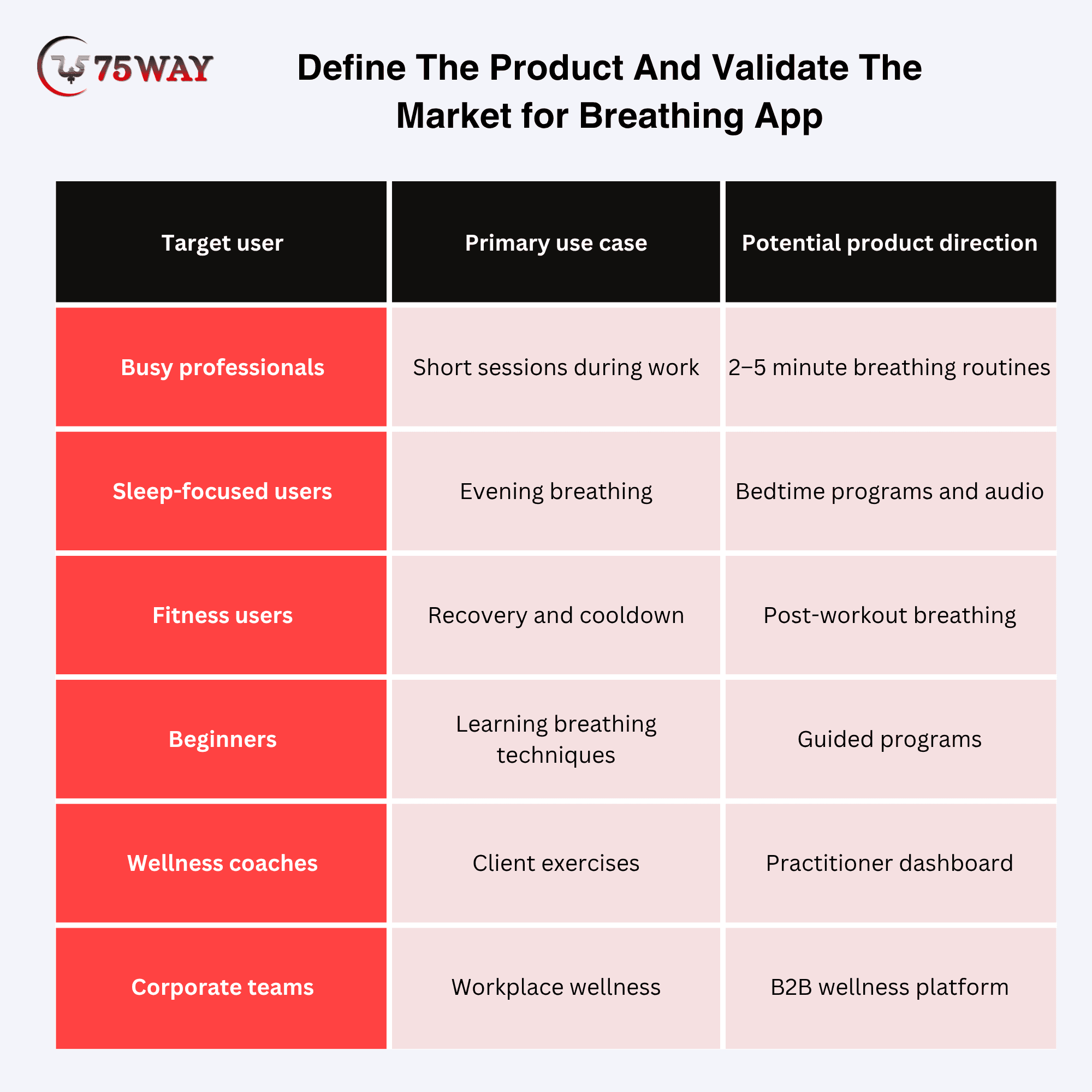
Step 1: Define The Product And Validate The Market
Start with a specific user and a specific reason they would open the app. “A breathing app for everyone” is difficult to position, design, and monetize, whereas a product for busy professionals, sleep-focused users, fitness enthusiasts, beginners, or corporate wellness programs gives the development team a much clearer direction.
Before development begins, study competing breathing, meditation, mindfulness, sleep, and wellness products. For additional inspiration, explore these best apps for self-improvement to understand how different apps support personal growth, habit building, and everyday wellness. Review their pricing, onboarding, breathing techniques, session lengths, personalization, subscriptions, reviews, and retention mechanics. Pay particular attention to negative reviews because repeated complaints about complicated navigation, poor audio, repetitive content, or aggressive subscriptions can reveal opportunities for differentiation.
Step 2: Create The MVP And Design The Core Experience
Once the market direction is clear, decide what the first release genuinely needs to prove. The MVP should be large enough to deliver a complete breathing experience but focused enough to avoid spending heavily on features that have not been validated.
A practical MVP can include:
- User onboarding
- Breathing exercise library
- Guided breathing sessions
- Custom breathing timer
- Visual breathing animation
- Audio guidance
- Haptic feedback
- Session history
- Basic progress tracking
- Push notifications
- User profile
- Subscription functionality
The central question should be: Will users repeatedly return to this breathing experience? That question is more valuable than simply asking how many features can fit into the first release.
Step 3: Engineer The Breathing Logic And Guidance
The breathing engine should be treated as a reusable product component rather than a collection of individual timers. Each breathing pattern can define inhale duration, holds, exhale duration, cycles, total session length, audio cues, and haptic feedback.
For example:
- Inhale: 4 seconds
- Hold: 4 seconds
- Exhale: 6 seconds
- Hold: 2 seconds
- Repeat: 8 cycles
This structure makes it easier to introduce new techniques, customize sessions, and eventually support personalized recommendations without rebuilding the core logic.
The guidance layer should remain synchronized with that engine. Visual animations, spoken instructions, sounds, and haptics should all respond to the same underlying breathing phases.
Step 4: Create A Calm And Intuitive User Experience
A breathing app has a different UX priority from a typical utility application because the interface itself becomes part of the user's experience. Once a session starts, unnecessary buttons, information, and decisions can distract from the breathing rhythm.
A typical session screen can include:
- Current phase
- Visual breathing guide
- Countdown
- Session progress
- Current breathing pattern
- Pause control
- Exit control
- Audio settings
- Haptic settings
For example:
- Inhale — 4 seconds
- Hold — 4 seconds
- Exhale — 6 seconds
The visual element should make the rhythm understandable without requiring users to continuously read instructions.
Step 5: Add Audio, Haptics, Personalization, And Wearables
Once the core experience is stable, sensory guidance and personalization can make sessions feel more responsive. Audio can provide spoken instructions, breathing cues, ambient sounds, music, or nature sounds, while haptics can signal transitions between breathing phases.
Personalization can use permitted information such as:
- Previous sessions
- Preferred session duration
- Frequently used exercises
- Selected goals
- Time of day
- Session completion
- User preferences
AI can later support personalized recommendations, conversational guidance, habit suggestions, content discovery, and user segmentation. However, AI should have a clear product purpose rather than being added simply as a marketing feature.
Wearable integration can extend the experience to devices such as Apple Watch, Wear OS products, and supported fitness trackers. Depending on the strategy, this may include short sessions, haptic cues, heart-rate information, and session synchronization. It is usually better treated as an expansion unless wearables are central to the product from launch.
Step 6: Build Accounts, Progress Tracking, And Retention
A persistent account system allows users to carry their experience across devices and gives the application a foundation for long-term engagement. Depending on the business model, profiles can store goals, preferred exercises, completed programs, saved sessions, streaks, notification preferences, and subscription status.
Progress tracking can turn individual breathing sessions into an ongoing habit.
Useful metrics may include:
- Sessions completed
- Total breathing minutes
- Weekly activity
- Favorite exercises
- Program completion
- Session frequency
The experience should remain supportive rather than overly competitive. A wellness product should encourage healthy engagement without making users feel pressured by excessive streaks, rankings, or performance comparisons.
Step 7: Establish Privacy, Security, And Technology Architecture
Privacy requirements should be considered before development rather than added immediately before launch. This becomes particularly important when the application connects with wearables or collects behavioral, mood, or health-related information.
Consider:
- Data minimization
- Encryption
- Secure authentication
- Access controls
- Consent management
- Data deletion
- Secure API communication
- Third-party SDK review
- Analytics controls
- Privacy policy
- Terms of service
The technology stack should then reflect the actual product requirements.
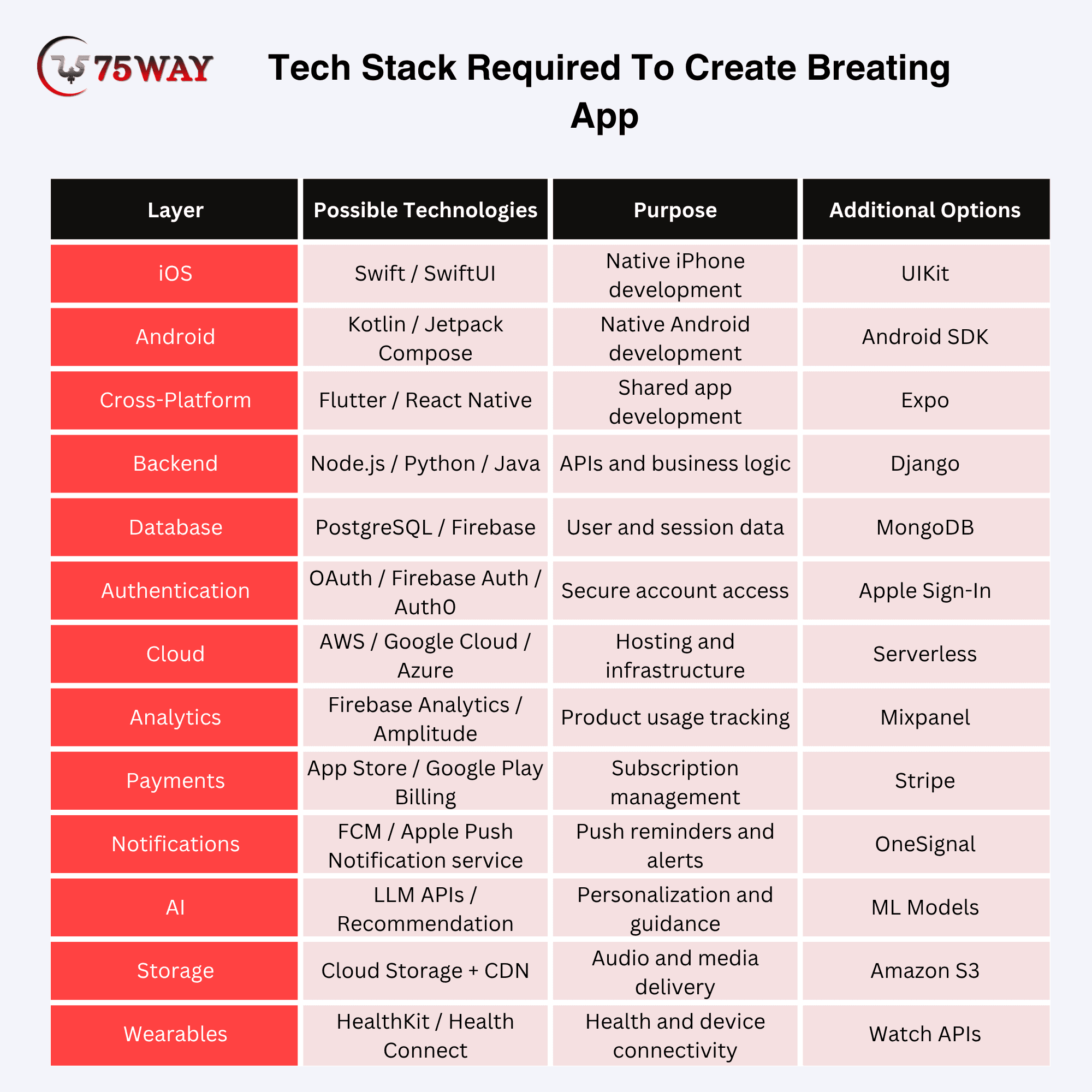
If the product moves into regulated digital-health territory, appropriate legal and compliance guidance should be obtained before making medical claims or processing sensitive health information.
Step 8: Integrate Payments, Analytics, And Connected Services
The commercial and operational infrastructure should connect with the application before launch. Subscription products may require App Store and Google Play billing, while other business models may need different payment or account structures.
Analytics should also be configured around meaningful product questions rather than collecting every possible event.
Track areas such as:
- Session starts
- Session completion
- Exercise selection
- Feature usage
- Subscription activity
- Notification engagement
- User retention
- Conversion behavior
Additional integrations can include cloud services, wearable platforms, recommendation systems, content delivery networks, authentication providers, and other services required by the product architecture.
Step 9: Test Real-World Breathing Sessions
Testing should cover more than buttons, screens, and API responses. A breathing app can technically function while still delivering a poor experience if its audio, animation, haptic feedback, and timer fall out of synchronization.
Test scenarios should include:
- Starting and stopping sessions
- Pausing and resuming
- Switching applications
- Locking the screen
- Receiving calls
- Connecting headphones
- Losing network connectivity
- Changing audio volume
- Enabling or disabling haptics
- Running long sessions
- Background operation
- Different device sizes
- Different operating-system versions
- Battery-saving modes
- Subscription states
Animation synchronization deserves particular attention. If the screen instructs the user to inhale while the audio signals exhalation, the application's primary function becomes confusing regardless of how polished the rest of the interface looks.
Step 10: Launch, Measure, And Improve The Product
A breathing app should be treated as an evolving product rather than a project that ends when it reaches the App Store. Start with a controlled launch, observe how users actually interact with sessions, and use that information to improve content, onboarding, personalization, and retention.
Acquisition Metrics
- App store conversion rate
- Cost per acquisition
- Organic installs
- Landing-page conversion
- Trial starts
Retention Metrics
- Day-1 retention
- Day-7 retention
- Day-30 retention
- Repeat session frequency
- Subscription renewal
Revenue Metrics
- Trial-to-paid conversion
- Monthly recurring revenue
- Average revenue per user
- Customer acquisition cost
- Lifetime value
- Churn
The most important KPI depends on the business model. A subscription breathing app may prioritize retention and paid conversion, while a B2B wellness platform may focus more heavily on organizational activation, employee engagement, contract value, and renewals.
Advanced Features To Include In Custom Breathing App Development
A breathing app can evolve in stages, beginning with essential session functionality and gradually introducing personalization, engagement tools, integrations, and advanced intelligence as the product matures.
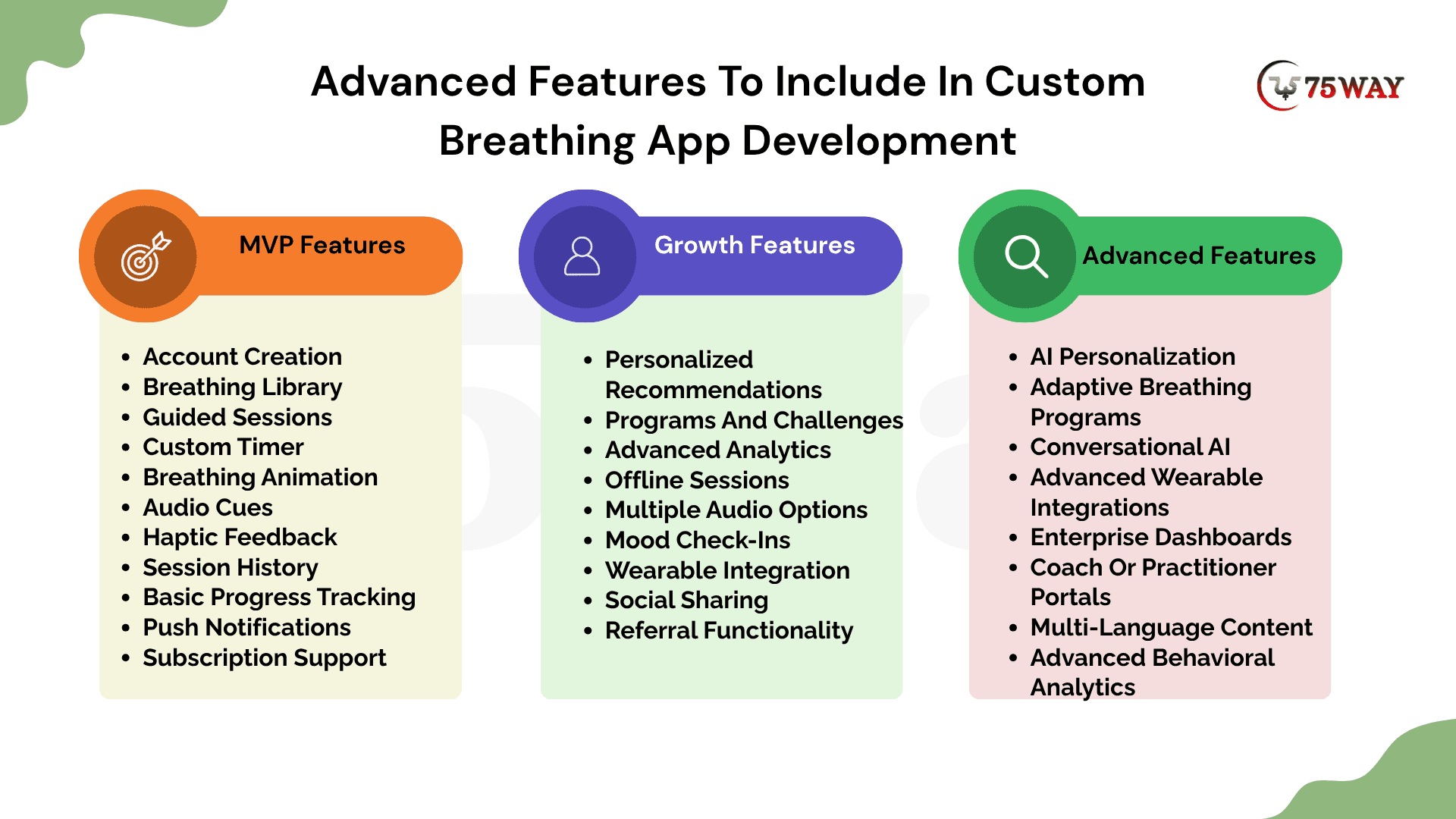
MVP Features for Breathing App Development
- Account Creation: Users can create secure profiles to save preferences, track activity, and access their breathing routines across supported devices.
- Breathing Library: A structured library helps users discover different breathing techniques, session formats, and guided exercises based on their needs.
- Guided Sessions: Guided sessions take users through breathing phases with clear instructions, helping them follow each exercise without constantly checking the screen.
- Custom Timer: Users can adjust session length and breathing intervals, creating routines that fit their available time and preferred breathing patterns.
- Breathing Animation: Animated visual cues show when to inhale, hold, and exhale, making breathing rhythms easier to follow throughout each session.
- Audio Cues: Optional spoken instructions and sound signals provide additional guidance, allowing users to follow sessions without relying entirely on visual cues.
- Haptic Feedback: Subtle vibrations can signal breathing-phase changes, giving users tactile guidance when they prefer minimal visual or audio interaction.
- Session History: The app records completed sessions, allowing users to review previous activity and understand how regularly they practice.
- Basic Progress Tracking: Simple progress indicators help users monitor completed sessions, total practice time, and routine frequency without overwhelming them with unnecessary metrics.
- Push Notifications: Timely reminders can encourage users to maintain breathing routines while giving them control over notification frequency and preferences.
- Subscription Support: Subscription functionality enables businesses to offer premium exercises, programs, content, and other paid experiences through supported payment systems.
2. Growth Features for Custom Breathing App Development
- Personalized Recommendations: The app can recommend breathing sessions based on permitted preferences, previous activity, selected goals, and demonstrated engagement patterns.
- Programs And Challenges: Structured programs and challenges can turn individual exercises into longer journeys, giving users milestones that encourage continued participation.
- Advanced Analytics: Detailed analytics can reveal session frequency, completion behavior, engagement trends, and other product metrics useful for users and business teams.
- Offline Sessions: Selected sessions can remain accessible without internet connectivity, allowing users to practice during travel, commutes, or areas with limited network access.
- Multiple Audio Options: Different voices, ambient sounds, and background options let users personalize the atmosphere and choose guidance that suits their preferences.
- Mood Check-Ins: Users can record their mood around sessions, creating optional context that can support personalized recommendations and longer-term engagement insights.
- Wearable Integration: Compatible wearables can deliver selected breathing sessions, haptic cues, or activity synchronization when those capabilities support the product strategy.
- Social Sharing: Users can share selected milestones or achievements with others, creating optional social engagement without requiring private activity to become publicly visible.
- Referral Functionality: Referral tools can encourage existing users to invite others, helping businesses generate additional acquisition opportunities through their established customer base.
3. Innovative Features For AI-Powered Breathing App Development
- AI Personalization: AI can analyze permitted behavioral signals and preferences to recommend more relevant sessions, content, routines, and engagement experiences.
- Adaptive Breathing Programs: Adaptive programs can modify recommendations or selected session parameters according to user inputs, product rules, and defined personalization strategies.
- Conversational AI: A conversational interface lets users ask natural-language questions about exercises, routines, content, and app functionality without navigating multiple menus.
- Advanced Wearable Integrations: Deeper wearable connectivity can support richer breathing experiences by using compatible device capabilities, synchronization, and contextual interactions.
- Enterprise Dashboards: Organizations can access appropriate aggregated engagement information through dashboards designed for workplace wellness programs and organizational breathing initiatives.
- Coach Or Practitioner Portals: Authorized professionals can manage relevant programs, assign exercises, review appropriate activity information, and communicate with participating users through dedicated interfaces.
- Multi-Language Content: Multiple language options make breathing instructions, exercises, and educational content accessible to users across different regions and language preferences.
- Advanced Behavioral Analytics: Behavioral analytics can uncover broader engagement patterns, helping product teams identify retention opportunities and improve future personalization and feature decisions.
Real-World AI Use Cases For Breathwork App Development
Artificial intelligence can strengthen a breathing app when it is connected to a clear user need rather than added simply for novelty. Its role can extend from recommending relevant sessions and organizing content to understanding usage patterns and creating more personalized experiences.
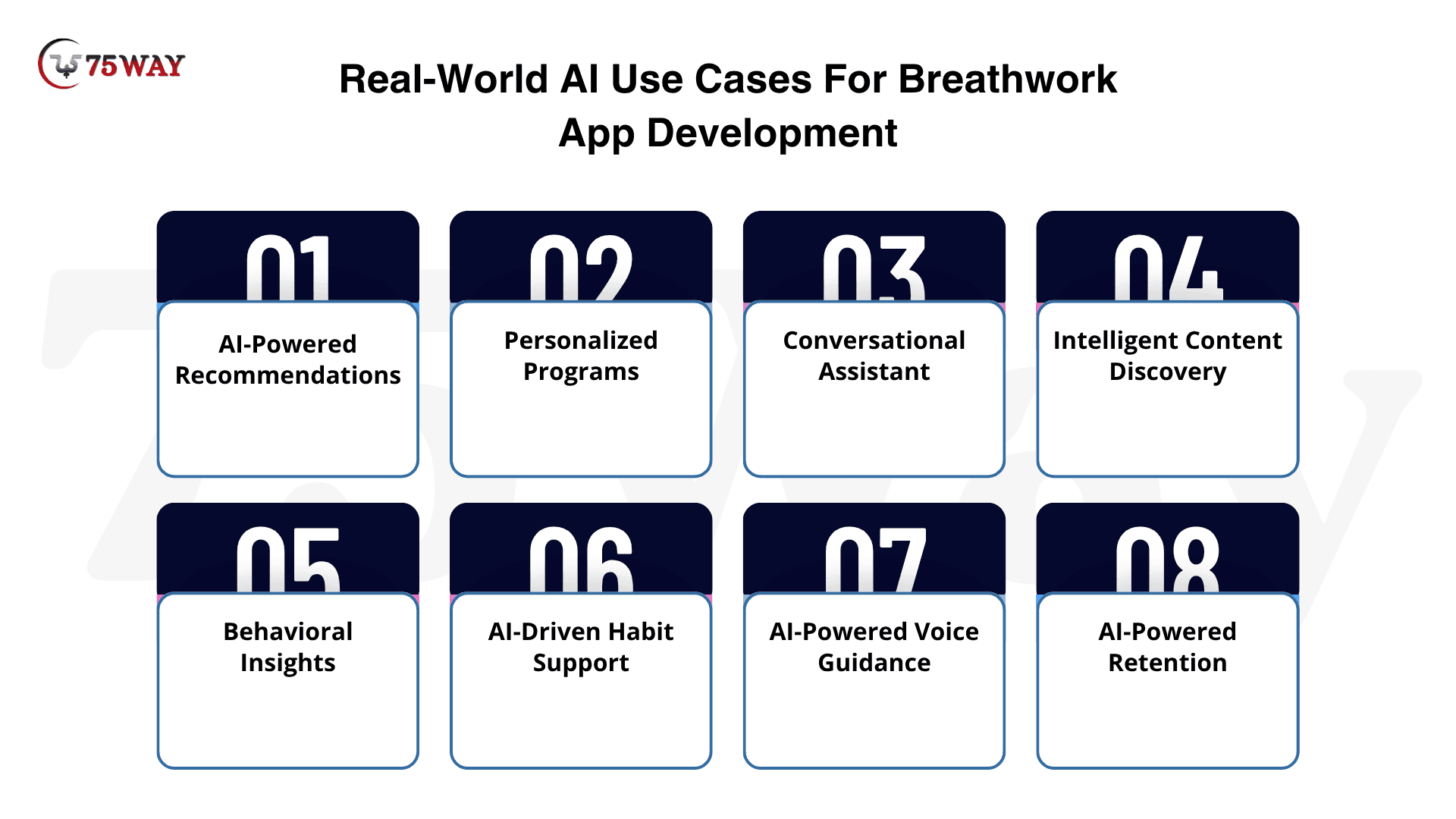
- AI-Powered Recommendations
The recommendation engine can evaluate permitted signals such as previous sessions, selected goals, preferred durations, and content interactions to suggest breathing exercises that fit individual preferences.
Over time, recommendations can become more relevant as the system learns which sessions users complete, save, repeat, or skip. This creates a more personalized content experience without requiring users to search through the entire library.
- Personalized Programs
AI can help assemble existing breathing exercises into structured routines based on user-selected goals, available time, experience level, and predefined product rules.
For example, a user interested in short evening sessions could receive a suitable sequence of existing exercises. The system can adjust future recommendations based on completed sessions and changing preferences rather than generating unsupported health guidance.
- Conversational Assistant
A conversational assistant can give users a natural way to discover sessions, understand breathing techniques, find app features, and navigate the content library through everyday questions.
The assistant should rely on approved app information and clearly defined boundaries. If users ask medical or clinical questions outside the product's intended scope, the system should avoid presenting unsupported recommendations or professional advice.
- Intelligent Content Discovery
AI agents in breathing apps can classify and organize breathing content according to attributes such as duration, technique, difficulty, audio style, language, and other approved metadata.
This classification can make search and recommendations more useful as the content library grows. Instead of manually assigning every content tag, teams can use AI-assisted classification with appropriate review and validation processes.
- Behavioral Insights
Machine learning can identify patterns within permitted product activity, including frequently selected session times, completion behavior, popular exercises, and sessions users commonly abandon.
These insights can help product teams improve onboarding, content organization, reminders, and retention strategies. Any behavioral analysis should use appropriate privacy controls, data minimization, transparency, and user consent.
- AI-Driven Habit Support
AI-powered breathwork apps help identify suitable opportunities for optional reminders by considering user preferences and previous engagement patterns. This can make habit-support messages more relevant than sending the same notification to every user.
The system can also identify when reminders appear ineffective and help refine communication strategies based on product-defined rules. Users should retain meaningful control over notifications, personalization, and how their activity data is used.
- AI-Powered Voice Guidance
AI-powered voice guidance can make breathing sessions feel more natural by delivering spoken instructions that respond to the selected exercise, session phase, and user preferences.
The experience can support different voices, languages, pacing styles, and guidance levels, giving users greater control over how they follow sessions. Voice generation should remain aligned with approved breathing content and product boundaries.
- AI-Powered Retention
AI can identify engagement patterns that indicate when users are becoming less active, such as declining session frequency, unfinished routines, or reduced interaction with recommended content.
Based on predefined retention rules, the system can trigger relevant reminders, suggest suitable sessions, or surface previously enjoyed content. These interactions should remain permission-based and avoid excessive messaging that could negatively affect the user experience.
How Much Does It Cost To Develop A Breathing App?
The cost to develop a breathing app typically ranges from $15,000 to $250,000+, depending on the app’s features, design complexity, platforms, integrations, and development team. A simple MVP with guided breathing sessions can stay near the lower end, while AI personalization, wearable connectivity, advanced analytics, and enterprise functionality can push the budget significantly higher.
Basic MVP: $15,000 – $35,000
A basic breathing app is suitable for startups that want to validate their concept before investing in advanced functionality.
This option works well when the primary objective is to test user demand, engagement, and the initial monetization model without building a large technology ecosystem.
Mid-Range App: $35,000 – $75,000
A mid-range breathing app adds a more polished user experience and greater personalization.
This level is generally more appropriate for businesses planning a commercial consumer application rather than a basic proof of concept.
Advanced Or Enterprise App: $85,000 – $250,000+
An advanced breathing platform can include AI-powered recommendations, adaptive breathing programs, wearable integrations, advanced analytics, and integrations with external health or fitness ecosystems.
The final cost can exceed $250,000 when the product requires multiple platforms, extensive proprietary content, complex integrations, advanced AI, enterprise infrastructure, or substantial compliance and security requirements.
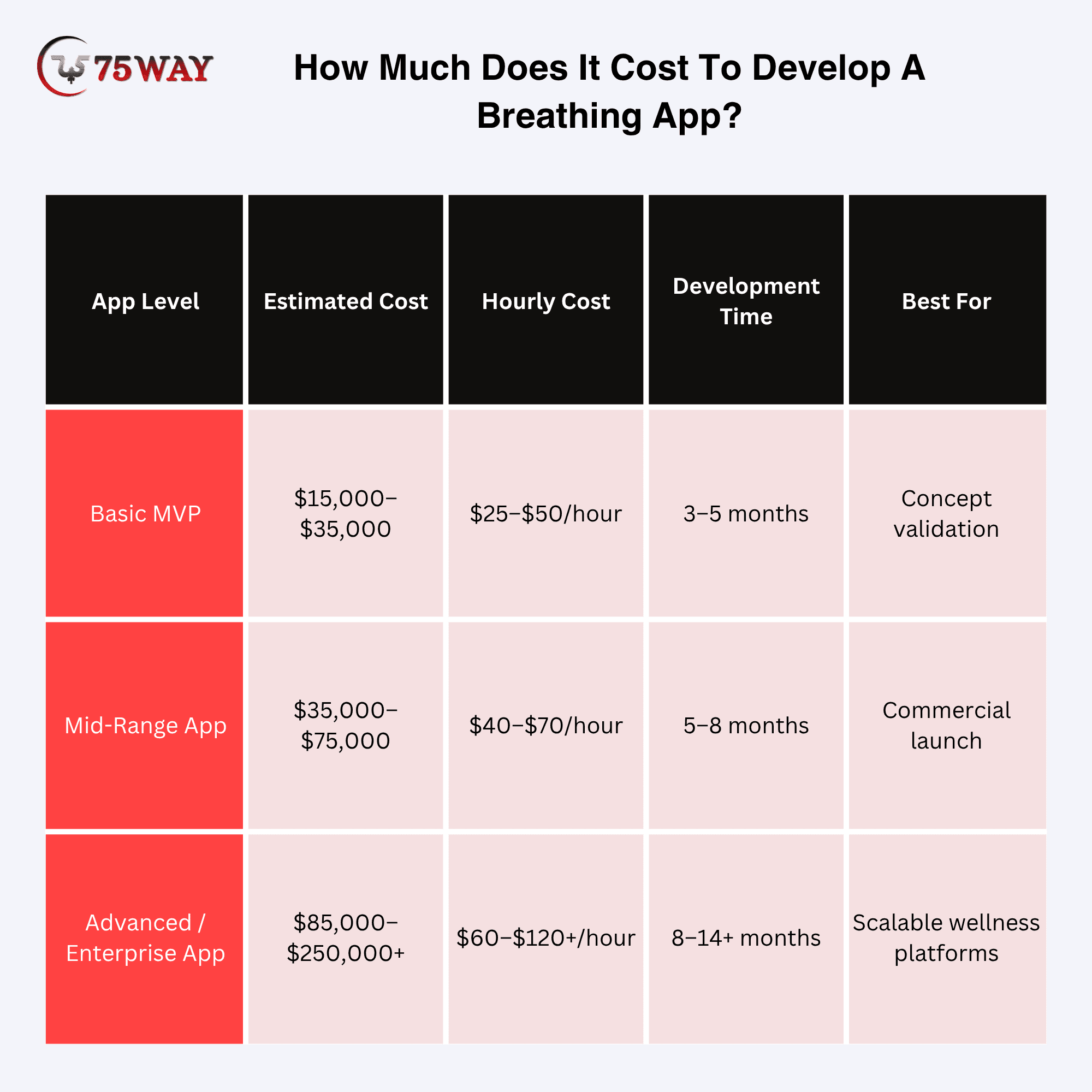
Breathing App Development Cost By Development Stage
The overall budget is also distributed across several development activities. Understanding these individual costs can help founders estimate where their investment will go.
- Discovery And Planning: $1,500 – $5,000
For a breathing app, discovery should also define the breathing patterns, session logic, personalization requirements, content structure, and future integration requirements.
- UI/UX Design: $3,000 – $10,000
The design budget can increase when the application requires custom animation systems, illustrations, motion design, or extensive personalization.
- Core Development: $10,000 – $40,000+
Building both native iOS and Android applications separately can increase the budget compared with a well-designed cross-platform approach.
- Testing And QA: $3,000 – $8,000+
QA can cover functional testing, device compatibility, performance testing, security checks, subscription flows, accessibility, interruptions, background behavior, and operating-system compatibility.
- Deployment And Launch: $1,000 – $3,000+
Additional marketing, content production, advertising, legal, and ongoing operational costs should be budgeted separately.
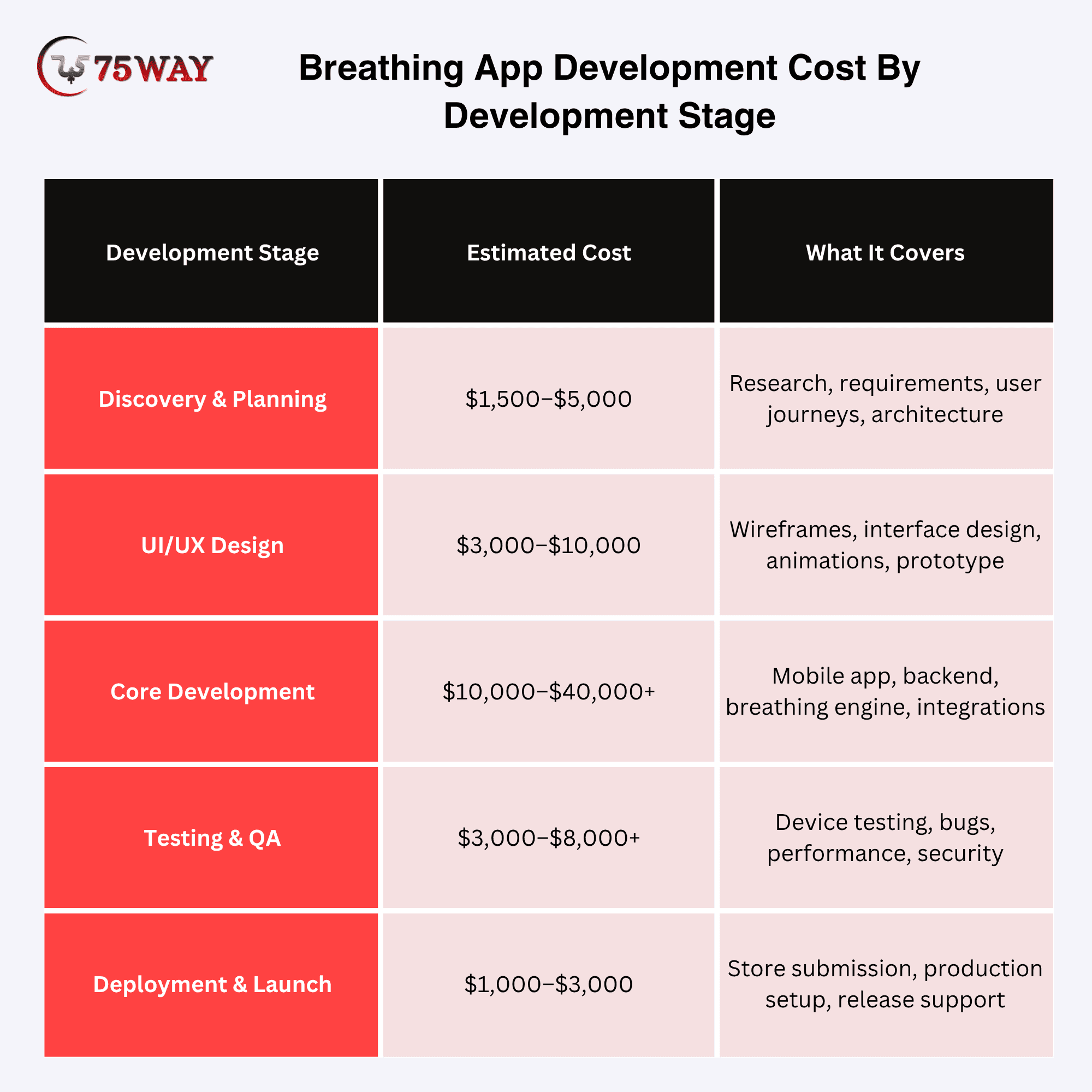
These figures are planning estimates. Actual costs vary according to scope, technology, team structure, location, and integration requirements.
Location-Wise Cost To Hire Breathing App Development Partner
Where your development team is located can significantly influence the total budget. Hourly rates are only one factor; experience with mobile wellness products, technical expertise, communication, project management, and quality assurance can also affect the final cost.
North America: $40,000 – $250,000+
Development teams in the US and Canada commonly have higher hourly rates, but businesses may benefit from closer time-zone alignment, communication, and experience serving North American consumers and enterprises.
A basic MVP may fall around $40,000–$80,000, while a complex application can reach $120,000–$250,000 or more.
Western Europe And UK: $25,000 – $150,000
Development teams in the UK and Western Europe generally operate at mid-to-high hourly rates. A basic breathing application may cost approximately $25,000–$50,000, while complex products can reach $80,000–$150,000 depending on functionality and team composition.
Eastern Europe: $15,000 – $90,000
Eastern European development teams can offer a lower hourly rate while providing access to experienced mobile and backend developers. Basic applications may cost around $15,000–$30,000, while more complex products can range from $50,000–$90,000.
Asia: $5,000 – $50,000+
India and other Asian development markets generally offer lower hourly rates. A basic breathing app may start around $5,000–$15,000, while a complex product can cost approximately $20,000–$50,000 or more.
However, comparing vendors solely by hourly rate can be misleading. The quality of architecture, UX, testing, project management, security, and post-launch support can have a much greater impact on the long-term cost of ownership.
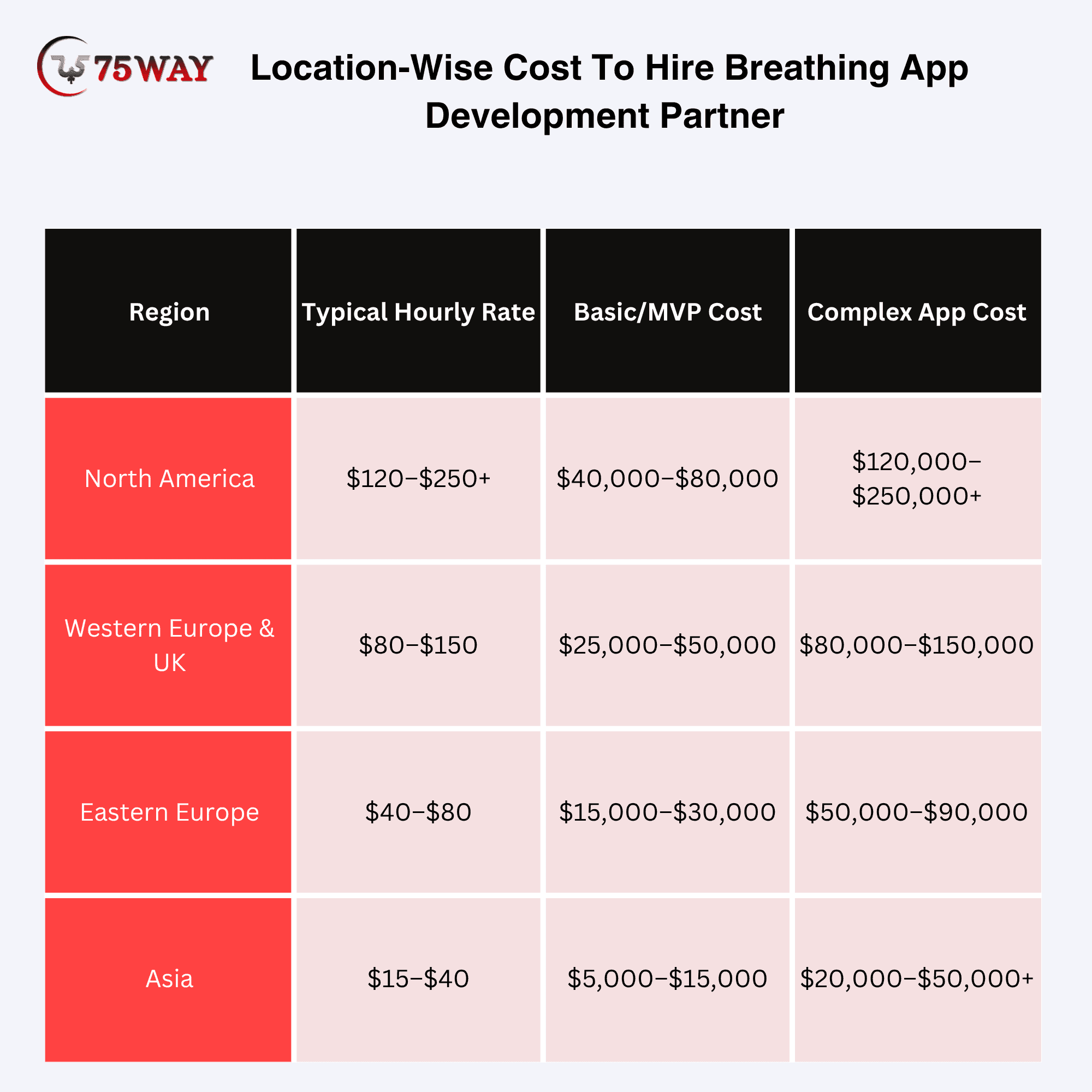
Regional figures are broad planning ranges, not standardized market prices. Vendor experience, project scope, technology, and contract structure can materially change the estimate.
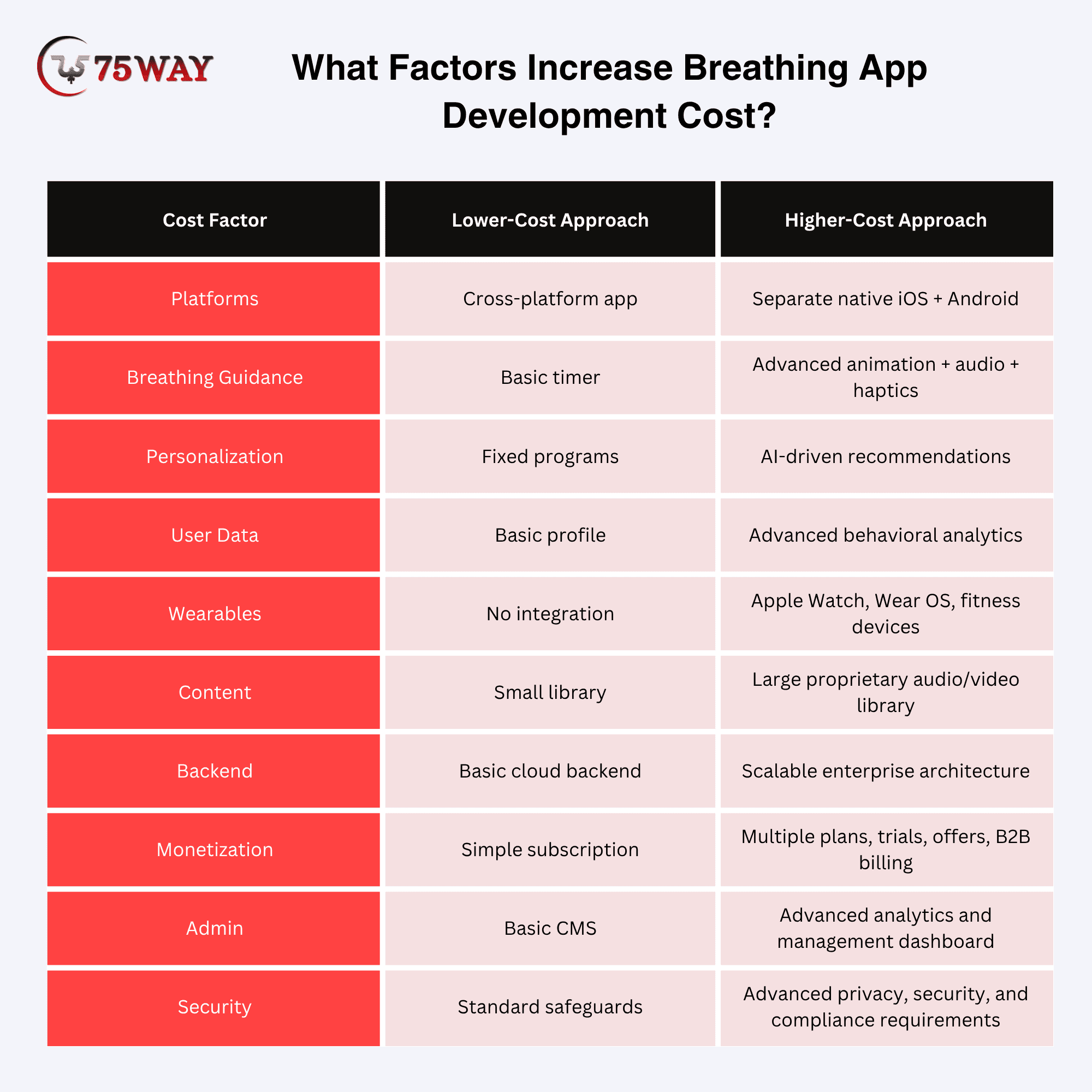
What Factors Increase Breathing App Development Cost?
Several product decisions can move the project from a basic MVP into a much larger investment.
- Number of Platforms: Supporting iOS, Android, web, or wearables increases development effort because each platform requires dedicated testing, optimization, and maintenance.
- UI/UX Complexity: A simple breathing interface costs less, while personalized journeys, animations, dashboards, and accessibility requirements increase design and development work.
- Breathing Engine: Complex breathing patterns, customizable cycles, session controls, timing logic, and synchronization require additional engineering and thorough device testing.
- Animation Requirements: Advanced visual breathing guides, transitions, interactive effects, and synchronized animations demand specialized development and performance optimization across devices.
- Audio Production: Professional voiceovers, background sounds, multilingual guidance, audio mixing, and synchronized cues can significantly increase content production and integration costs.
- Content Library: Larger libraries require additional breathing programs, exercise variations, instructional content, metadata, localization, content management, and ongoing updates.
- Backend Architecture: Scalable backends with user accounts, subscriptions, analytics, synchronization, cloud storage, and administrative systems require greater infrastructure and engineering investment.
- AI Functionality: AI recommendations, personalization, conversational assistants, behavioral analysis, and adaptive programs increase costs through model integration, data processing, testing, and monitoring.
- Wearable Integrations: Supporting smartwatches and fitness devices requires additional APIs, synchronization logic, platform-specific development, device testing, and ongoing compatibility maintenance.
What Should You Budget For Your Breathing App?
For most startups, $15,000–$35,000 can be a reasonable starting range for a focused breathing MVP. If your goal is to launch a polished consumer product with accounts, personalization, progress tracking, subscriptions, and richer content, a $35,000–$75,000 budget provides more room for product depth.
For an enterprise-grade product with AI, wearables, advanced analytics, and multiple user roles, planning for $85,000–$250,000+ is more realistic.
The important point is that the cheapest development quote is not necessarily the lowest-cost option. Poor architecture, weak testing, limited scalability, or inadequate security can create additional expenses when the application begins acquiring users.
For founders, the better question is not “What is the cheapest way to build a breathing app?”
It is:
“What is the smallest investment that can validate my target audience, core experience, retention model, and monetization strategy?”
How Long Does It Take To Custom Breathing Application Development?
A focused MVP can often take approximately 3–5 months, while a larger product can take 6–12 months or longer. A typical development schedule may look like:
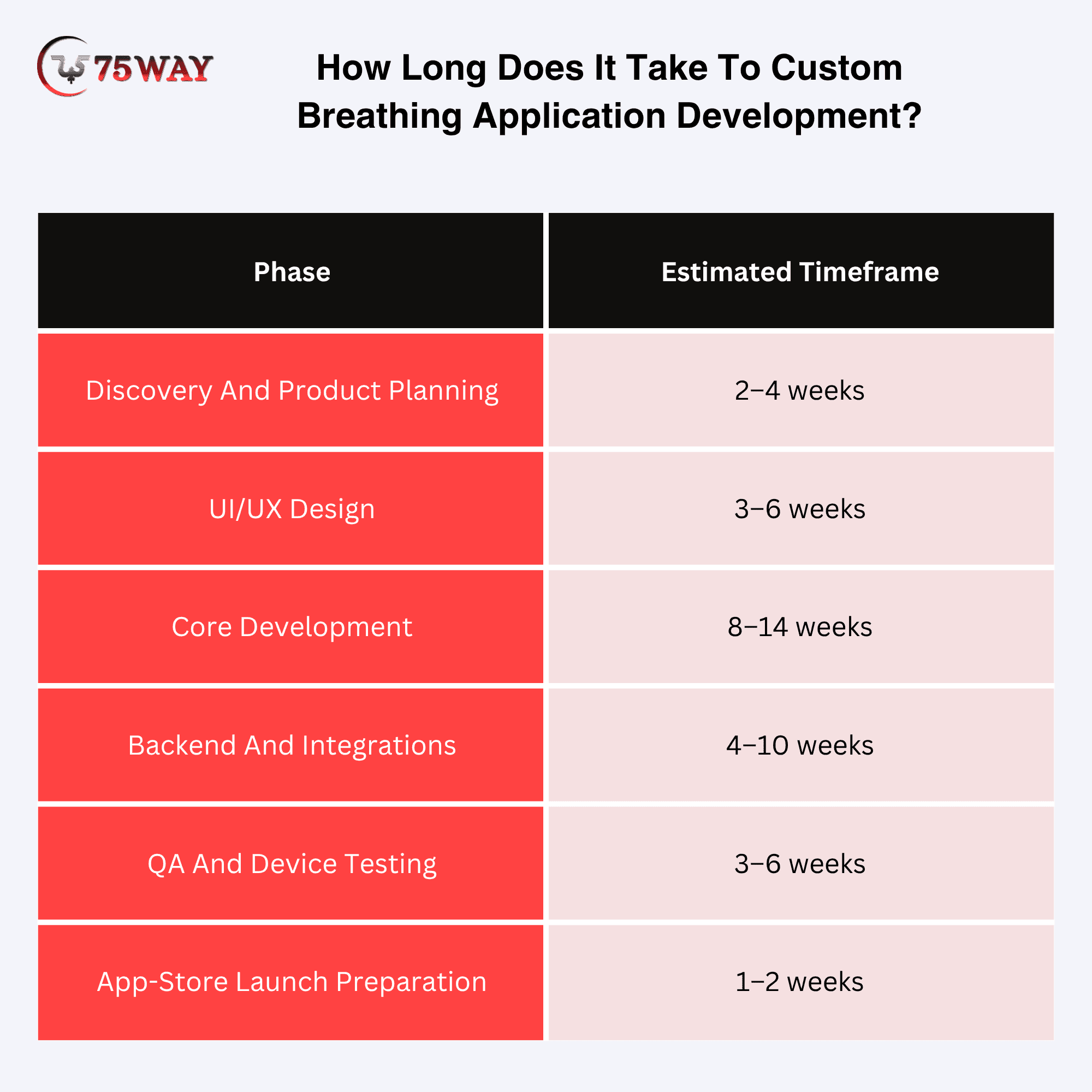
Several activities can run in parallel, so the total timeline is not simply the sum of every phase. Adding AI, wearables, complex content systems, enterprise functionality, or extensive personalization can increase both development time and testing requirements.
How To Reduce Breathing & Meditation App Development Cost?
You can reduce breathing and meditation app development costs without compromising the core user experience by controlling scope, reusing technology, and delaying expensive features until real user demand is validated.
- Start With A Focused MVP
Build only the core experience needed to test whether users engage with your breathing and meditation product before expanding the feature set.
- Choose Cross-Platform Development
Flutter or React Native can help reduce duplicated development work when the app needs both iOS and Android versions.
- Use Existing AI APIs
Instead of developing proprietary AI models, integrate suitable third-party models for recommendations, conversational assistance, or content discovery where appropriate.
- Launch With Curated Content
Begin with a focused library of high-quality breathing exercises and meditation sessions rather than producing hundreds of audio tracks before launch.
- Use Ready-Made Integrations
Payment, authentication, analytics, notifications, cloud storage, and other standard services can often be integrated instead of developed from scratch.
- Delay Wearable Development
Apple Watch, Wear OS, and fitness-device integrations can add considerable development and testing requirements. Introduce them after the core app gains traction.
- Prioritize Reusable Components
Create reusable session controls, audio players, animations, content structures, and UI components so future features require less development effort.
- Keep Personalization Rule-Based Initially
Start recommendations with user preferences, session history, and predefined rules before investing in complex machine-learning personalization.
- Limit Platform Scope
Launch on the platform where your target audience is strongest, then expand to additional platforms once the product demonstrates demand.
- Use Phased Development
Divide development into MVP, growth, and advanced stages so expensive capabilities such as adaptive programs, AI assistants, advanced analytics, and enterprise dashboards are added when they have a clear business purpose.
The key is not simply choosing the cheapest development option. A better approach is to spend first on the features that influence user retention and monetization, then use real product data to decide where additional investment makes sense.
Revenue Models: How Do Breathing Apps Make Money?
The right monetization model depends on who the app serves, how often users engage, and whether the product focuses on consumer wellness, professional use, or business programs.
- Subscription Model: A subscription model can provide recurring revenue by offering premium breathing programs, personalized recommendations, advanced tracking, exclusive content, or additional wellness features.
For example, an app could charge $9.99/month or $59.99/year for access to its premium experience.
- Freemium Model: Freemium lets users experience the core product without paying while placing selected content or advanced capabilities behind a subscription.
For example, users could access 10 free breathing sessions and upgrade to a $7.99/month plan for the complete library and personalization features.
- One-Time Purchase Model: A lifetime purchase can work well for smaller, focused breathing applications where users prefer paying once instead of maintaining a subscription.
For instance, the app could offer lifetime access for $39.99, generating upfront revenue from each paying customer.
- In-App Purchases Model: Individual programs, guided courses, sound packs, or specialized content can be sold separately inside the app.
For example, a $4.99 sleep breathing program or $2.99 premium sound pack can create additional revenue without requiring users to purchase the entire premium library.
- B2B Wellness Model: Businesses can purchase breathing and meditation access for employees as part of workplace wellness initiatives.
A company with 100 employees might pay $5 per employee per month, creating $500 in monthly recurring revenue from one organizational account.
- Coach Or Practitioner Platform Model: A professional-focused platform can charge coaches, therapists, wellness practitioners, or instructors for tools that help them manage clients and deliver structured programs.
For example, a practitioner plan priced at $49/month could provide client management, assigned exercises, progress tracking, and branded programs.
For subscription-based products, retention matters more than simply increasing the number of pricing tiers. If users do not return regularly, even a well-designed $9.99/month plan will struggle to generate sustainable revenue.
Common Mistakes To Avoid When Building A Breathing App & Solutions
A breathing app can have polished visuals and plenty of exercises yet still struggle if the core experience feels confusing or distracting. Small product decisions around guidance, timing, personalization, and user flow can make a bigger difference than expected. The common mistakes and practical solutions are covered below.
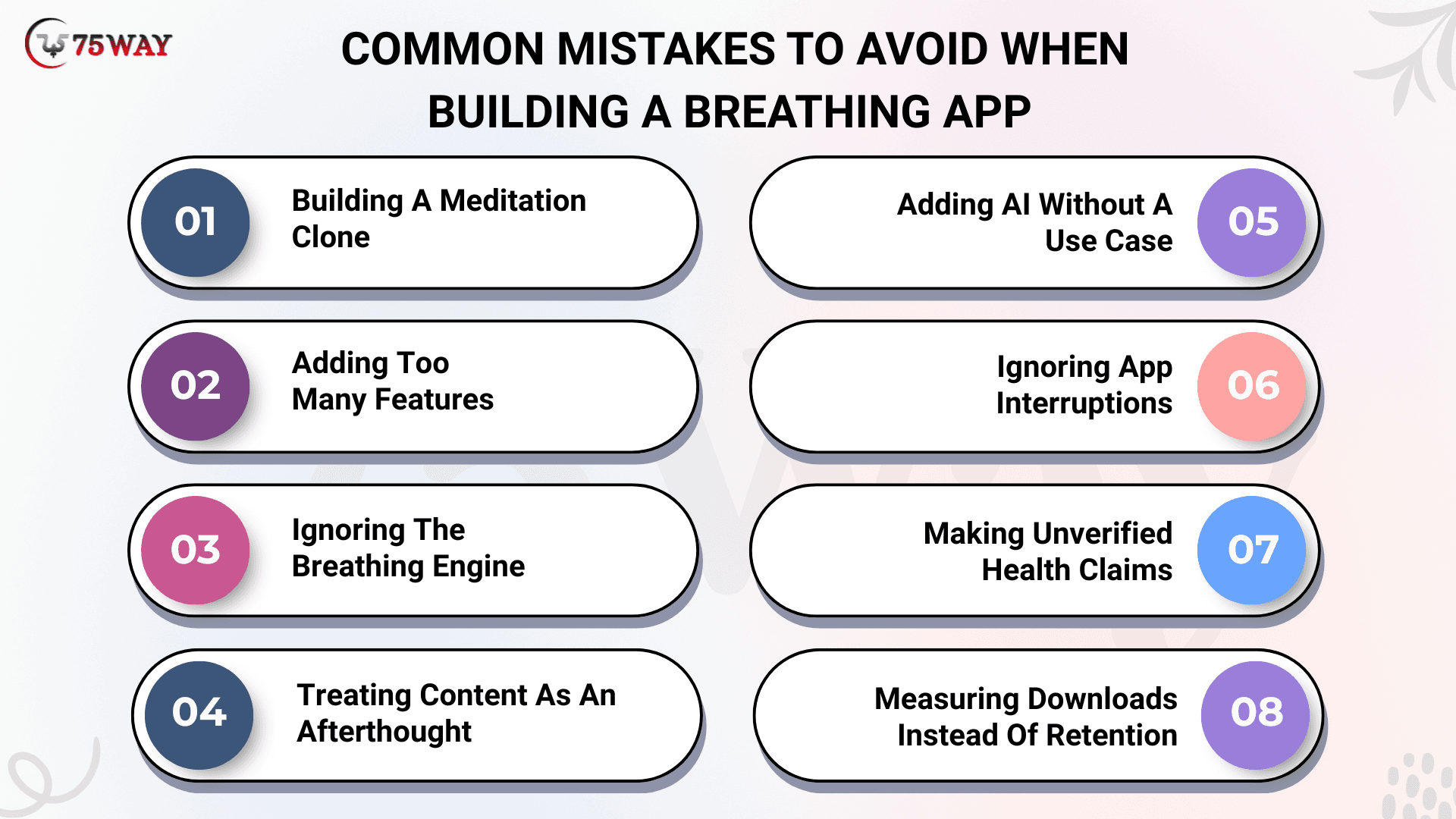
1. Building A Meditation Clone
A breathing app needs a distinct value proposition rather than simply reproducing features already offered by established meditation platforms.
Solution: Identify a specific audience, breathing-related need, or experience gap, then build the product around that differentiation.
2. Adding Too Many Features
A large feature list can increase development costs, complicate navigation, and delay launch without proving that users actually need those capabilities.
Solution: Prioritize the core breathing experience first, validate user behavior, and introduce additional functionality based on real usage data.
3. Ignoring The Breathing Engine
The timing, transitions, and synchronization between visual, audio, and haptic guidance directly influence how smoothly users can follow each breathing session.
Solution: Treat the breathing engine as a core product component and test its timing, pause, resume, background, and interruption behavior across devices.
4. Treating Content As An Afterthought
Voice recordings, soundscapes, breathing instructions, programs, and session structures can strongly influence whether users find the experience engaging and worth returning to.
Solution: Plan content production alongside product development, including quality standards, content organization, recording requirements, localization, and future updates.
5. Adding AI Without A Use Case
Adding an AI assistant or recommendation system simply because AI is popular can increase development and operating costs without creating meaningful user value.
Solution: Connect AI to a measurable requirement such as personalized recommendations, content discovery, conversational assistance, or engagement improvement.
6. Ignoring App Interruptions
Calls, notifications, Bluetooth changes, headphones, screen locking, battery-saving modes, and background behavior can unexpectedly interrupt breathing sessions.
Solution: Test real-world interruption scenarios and ensure sessions can pause, resume, synchronize, and recover without losing the user's progress.
7. Making Unverified Health Claims
Marketing breathing exercises as treatments or making unsupported health promises can create credibility, compliance, and regulatory concerns for wellness applications.
Solution: Keep claims aligned with available evidence and the intended use of the product, and seek appropriate professional guidance before entering regulated digital-health territory.
8. Measuring Downloads Instead Of Retention
High download numbers may look promising, but they do not show whether users actually complete sessions or return to the app regularly.
Solution: Track retention, session completion, repeat usage, subscription conversion, churn, and engagement patterns to understand whether the product delivers lasting value.
What Should Your Breathing App Development Roadmap Look Like?
For most startups, I would recommend the following roadmap:
Phase 1 — Validate
Define the target user, use case, business model, competitors, core breathing experience, and MVP.
Phase 2 — Design
Create the breathing-session UX, visual language, onboarding, content structure, and prototype.
Phase 3 — Build
Develop the breathing engine, mobile application, backend, accounts, analytics, payments, and essential integrations.
Phase 4 — Test
Test breathing synchronization, animations, audio, haptics, interruptions, devices, subscriptions, accessibility, privacy, and performance.
Phase 5 — Launch
Release the MVP, monitor acquisition and retention, collect user feedback, and identify friction points.
Phase 6 — Expand
Add personalization, AI, wearables, advanced analytics, new content, enterprise functionality, or other capabilities based on validated demand.
This approach reduces the risk of spending heavily on features before knowing which behaviors actually drive retention.
How To Make A Breathing Mobile Application Stand Out In The Market
A breathing app can stand apart without competing on feature volume. The stronger approach is to define a specific audience, understand its daily routine, and create an experience that solves a particular need better than generic wellness products.
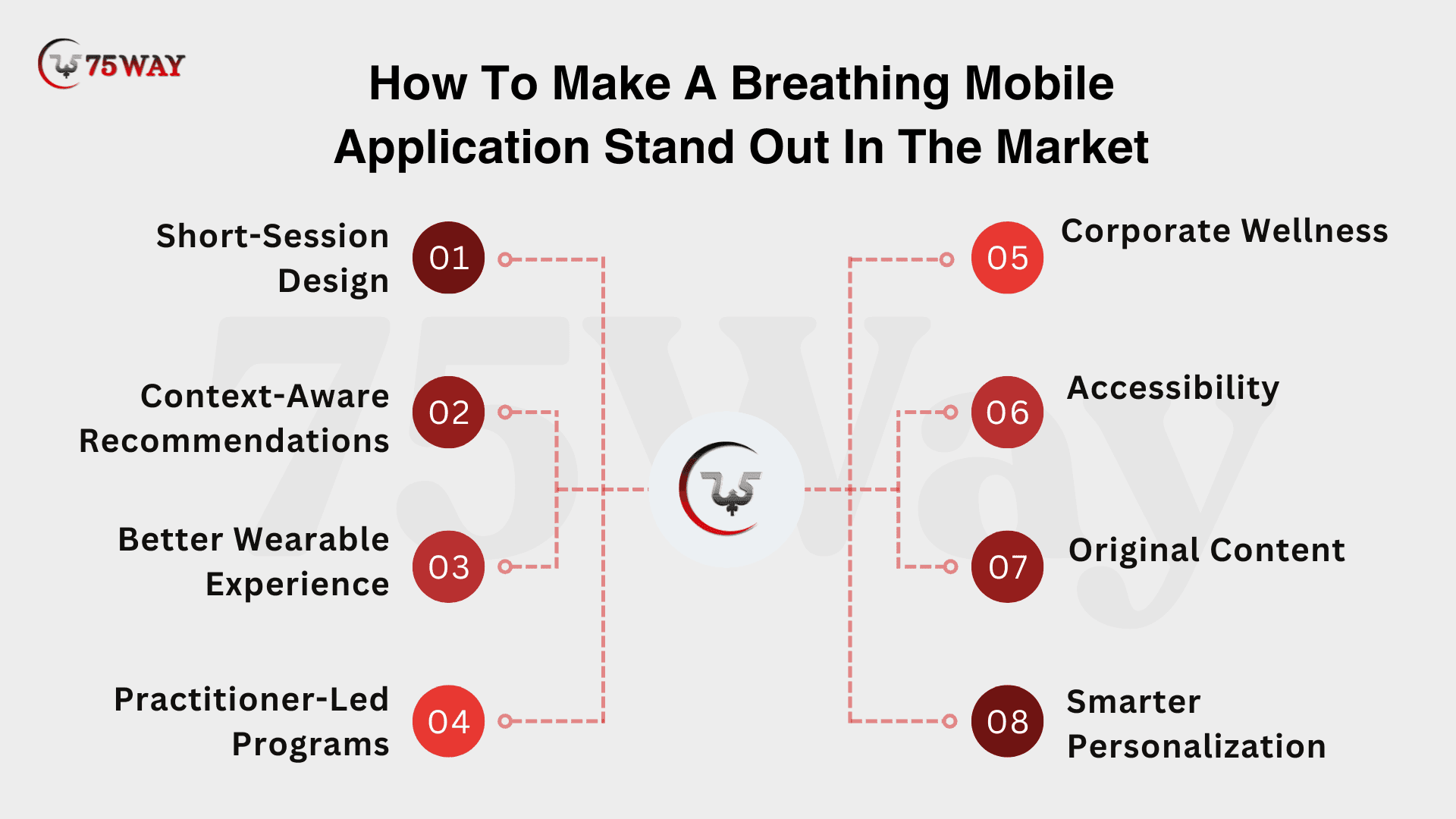
- Short-Session Design
Design the experience around users who have only a few minutes available during busy parts of the day. Short, clearly structured sessions can make the product easier to use during work breaks, before meetings, commutes, or other brief moments.
- Context-Aware Recommendations
Personalize session discovery around situations selected by the user, such as bedtime, morning routines, work breaks, or post-workout recovery. Recommendations can consider preferences, previous activity, session duration, and content interaction without making unsupported health assumptions.
- Better Wearable Experience
A wearable-focused experience can remove the need to repeatedly reach for a smartphone during a breathing session. Wrist-based guidance can support visual cues, haptic signals, session controls, and progress synchronization where compatible device capabilities allow.
- Practitioner-Led Programs
Expert-designed programs can give the app more structure than a basic library of breathing exercises. Practitioners can contribute guided routines, educational material, and progressive programs while the platform provides appropriate tools for delivering and organizing that content.
- Corporate Wellness
A business-focused breathing platform can serve organizations rather than individual consumers alone. Features such as employee access, organization-level administration, engagement reporting, privacy-conscious analytics, and curated programs can support workplace wellness initiatives.
- Accessibility
Accessibility should be considered throughout the experience rather than added after development. Adjustable text, sufficient visual contrast, screen-reader support, clear controls, audio alternatives, haptic guidance, and simple navigation can make sessions easier for users with different needs.
- Original Content
Proprietary breathing programs, instructional material, voice guidance, soundscapes, and educational resources can create a recognizable identity for the app. Original content also gives businesses greater control over quality, positioning, updates, and premium offerings.
- Smarter Personalization
Personalization can extend beyond recommending popular sessions by considering user-selected goals, preferred duration, completed routines, and engagement patterns. With appropriate consent and privacy controls, these signals can help create a more relevant experience without turning the app into an unnecessarily complex system.
How To Choose A Breathing App Development Company?
A breathing app demands a development partner who understands the experience behind the technology. Instead of judging companies by hourly rates or generic portfolios, look for proven wellness or health-app expertise and ask how they would handle breathing-session logic, synchronized animations, audio, haptics, subscriptions, analytics, wearable connectivity, and privacy. Their answers should demonstrate practical knowledge of how users actually interact with a breathing app, not just familiarity with mobile development.
The right partner should also bring product thinking to the table. They should help separate must-have MVP capabilities from expensive future additions, identify technical risks before development begins, explain ownership and maintenance terms clearly, and build a roadmap around your commercial goals. A company that challenges unnecessary assumptions and suggests better ways to deliver the intended experience can become far more valuable than a vendor that simply agrees to build everything on your initial feature list.
Breathing App Development Services You Can Avail
A breathing app can be built as a focused wellness product or expanded into a broader meditation, fitness, or digital wellness platform. The development approach can be tailored around your target audience, monetization model, content strategy, and desired level of personalization.
1. Custom Breathing App Development
Build a purpose-specific breathing app with guided exercises, breathing timers, animations, audio, haptics, progress tracking, subscriptions, and personalized user journeys.
2. AI-Powered Breathing App Development
Add AI capabilities for personalized session recommendations, content discovery, conversational assistance, behavioral insights, and adaptive user experiences where they provide genuine product value.
3. Meditation & Wellness App Development
Extend breathing functionality into a broader wellness application with meditation programs, sleep content, mindfulness routines, relaxation exercises, and habit-building experiences.
4. Wearable Breathing App Development
Create companion experiences for Apple Watch and Wear OS, allowing users to access breathing guidance, haptic cues, session controls, and supported health or activity data.
5. Breathing App UI/UX Design
Design a calm, accessible interface where animations, timing, audio, haptics, and navigation work together without distracting users from the breathing experience.
6. Breathing Engine Development
Develop the underlying session engine to manage breathing phases, custom patterns, timers, pauses, repetitions, transitions, and synchronized sensory guidance across supported devices.
7. Breathing App Integration Services
Connect the application with subscription billing, analytics, cloud services, authentication, health platforms, wearable APIs, notifications, and other third-party systems required by the product.
8. Breathing App Maintenance & Support
Continue improving the application after launch through performance monitoring, bug fixes, OS compatibility updates, security maintenance, AI workflow improvements, and feature enhancements.
How 75way Supports End-To-End Breathing App Development For Businesses?
75way Technologies approaches breathing app development as a product-building exercise rather than simply putting a timer and meditation library inside a mobile interface. Our team can help shape the concept, define the MVP, design the breathing experience, build the session engine, integrate audio and haptics, and add AI or wearable capabilities where they genuinely support the product.
From the first product discussion to post-launch improvements, 75way can support the complete development journey. The focus stays on creating an app that is technically reliable, easy to use, privacy-conscious, and aligned with your business model. Whether you are launching a focused breathing product, expanding into meditation and wellness, or building a more personalized AI-powered experience.
Final Thoughts
Breathing app development is ultimately a product-design challenge supported by mobile technology. The strongest products combine a simple breathing experience with reliable timing, thoughtful UX, useful personalization, strong content, privacy-conscious architecture, and a business model that encourages long-term value.
For a startup, the safest route is usually to validate one clear audience and use case first, launch a focused MVP, measure real user behavior, and expand only when the data supports the next investment.
If you are planning to build a breathing app, you can hire a veteran healthcare mobile app development company that helps you turn the concept into a product roadmap.
Frequently Asked Questions
How Much Does It Cost To Develop A Breathing App?
A breathing app can cost approximately $25,000–$50,000 for a focused MVP and $100,000–$200,000 or more for an advanced platform with AI, wearables, personalization, and enterprise capabilities.
Can AI Be Added To A Breathing App?
Yes. AI can support personalized recommendations, content discovery, conversational assistance, behavioral insights, and adaptive experiences when these capabilities provide a clear user benefit.
Should I Build A Breathing App For iOS or Android First?
Choose the platform based on your target audience and distribution strategy. If both markets are important, cross-platform development can reduce duplicated engineering effort, although some native capabilities may still require platform-specific work.
Can A Breathing App Integrate With Apple Watch or Wear OS?
Yes. Wearable integrations can provide short breathing sessions, haptic guidance, progress synchronization, and access to selected device data, depending on platform capabilities and permissions.
Is A Breathing App Considered A Medical App?
Not automatically. A breathing app can operate as a general wellness product, but its regulatory obligations can change depending on its intended use, claims, data practices, and functionality. Legal and regulatory review is recommended before making medical claims.