
Summary
White-label taxi app development enables businesses to launch branded ride-hailing platforms rapidly using pre-built systems. It reduces cost, accelerates market entry, and supports scalable operations with driver apps, passenger apps, and admin panels. Entrepreneurs gain faster revenue opportunities, operational control, and customizable mobility solutions aligned with modern digital transportation demand.
Quick Overview
- White-label taxi apps reduce development time and accelerate market entry
- Global taxi app market expected to reach $468.4 billion at 7% CAGR by 2033.
- Pre-built systems allow full branding customization without complex coding efforts
- Ride-hailing platforms become scalable with integrated driver and passenger modules
- Cost-effective development model supports startups entering mobility markets
- Cost to create a white-label taxi app lies between $2,000-$75,000+
Want to launch your own ride-hailing app in USA without spending years building everything from scratch? White-label taxi app development is a powerful solution for faster market launch.
No doubt, the ride-hailing space has already been dominated by major players in US, but the real opportunity now lies in how quickly new businesses can enter the market and scale. The problem is, building a full taxi booking platform from zero is expensive, time-consuming, and technically complex. And this is where most startups get stuck.
But, white-label taxi app development is changing that equation completely. Instead of building everything from scratch, businesses can now launch a fully functional, branded ride-hailing app using ready-made, scalable software solutions. These solutions come with passenger apps, driver apps, and admin dashboards already built, allowing companies to focus more on operations and growth rather than core app development challenges.
So the question is simple: how to build a white-label taxi app and scale a successful ride-hailing business in 2026? This guide explores white-label taxi app development in depth, including architecture, core features, benefits, and business model insights for scalable ride-hailing success.
What Is White-Label Taxi App Development?
White-label taxi app development refers to a ready-made ride-hailing software solution that businesses can rebrand and launch under their own identity. The platform already includes essential modules such as passenger booking systems, driver management tools, GPS tracking, and payment integration. Research shows that these platforms replicate proven ride-hailing models while reducing time-to-market significantly compared to custom builds. The system generally includes:
- Passenger mobile application
- Driver mobile application
- Admin control panel
- Dispatcher system
- Backend infrastructure
This structure allows businesses to focus on branding, operations, and customer acquisition instead of engineering complexity.
How White-Label Taxi Apps Work?
A white-label taxi system operates through a connected ecosystem where each user type plays a specific role.
- Passengers request rides through a mobile app, which matches them with nearby drivers using GPS-based algorithms.
- Drivers receive ride requests in real time and can accept or reject them based on availability.
- The admin panel manages fleet distribution, pricing rules, commissions, and analytics.
This synchronized system ensures smooth ride allocation, reduced waiting time, and improved operational flow. The architecture is designed for scalability, allowing businesses to expand to new cities without rebuilding infrastructure.
Taxi App Market Growth in USA: Size, Trends, and Revenue Potential
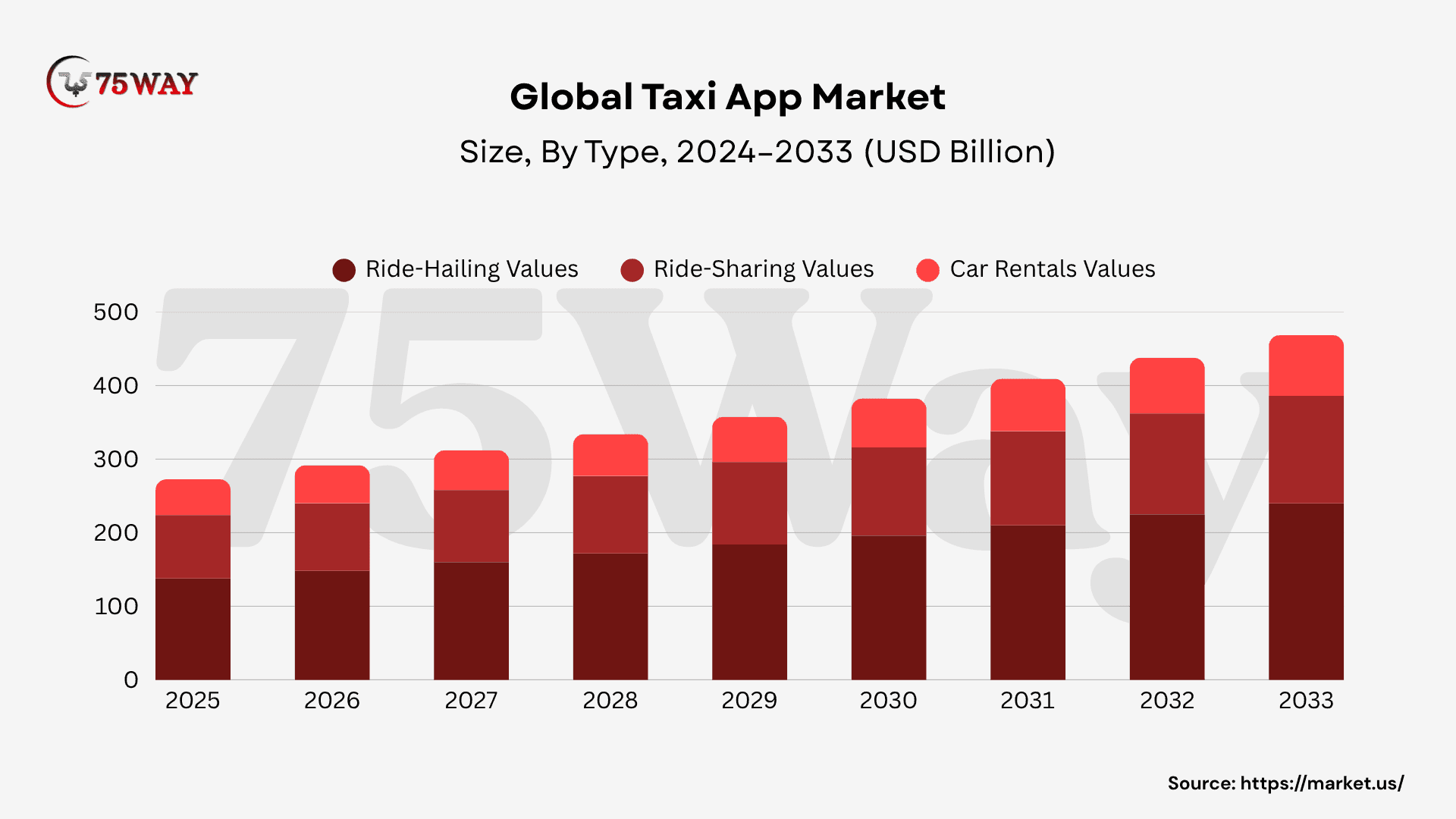
- The global taxi app market is projected to reach USD 468.4 billion by 2033, growing at a CAGR of 7%.
- The ride-hailing and taxi app industry currently serves nearly 2 billion active users worldwide.
- Industry forecasts estimate the taxi app market will grow from USD 238.1 billion in 2023 to USD 468.4 billion by 2033.
- Ride-hailing remains the dominant segment, accounting for 52% of the total market share in 2023.
- Android platforms lead the taxi app ecosystem with a 65% market share, driven by strong smartphone adoption.
- Individual users represent the largest customer segment, contributing 78% of the total market demand for taxi apps.
What Makes White-Label Taxi Apps a Smart Business Investment?
As competition in the ride-hailing industry continues to intensify, businesses need solutions that minimize risks while maximizing growth opportunities. White-label taxi apps provide a cost-effective and scalable way to enter the market without the challenges associated with building a platform from scratch.
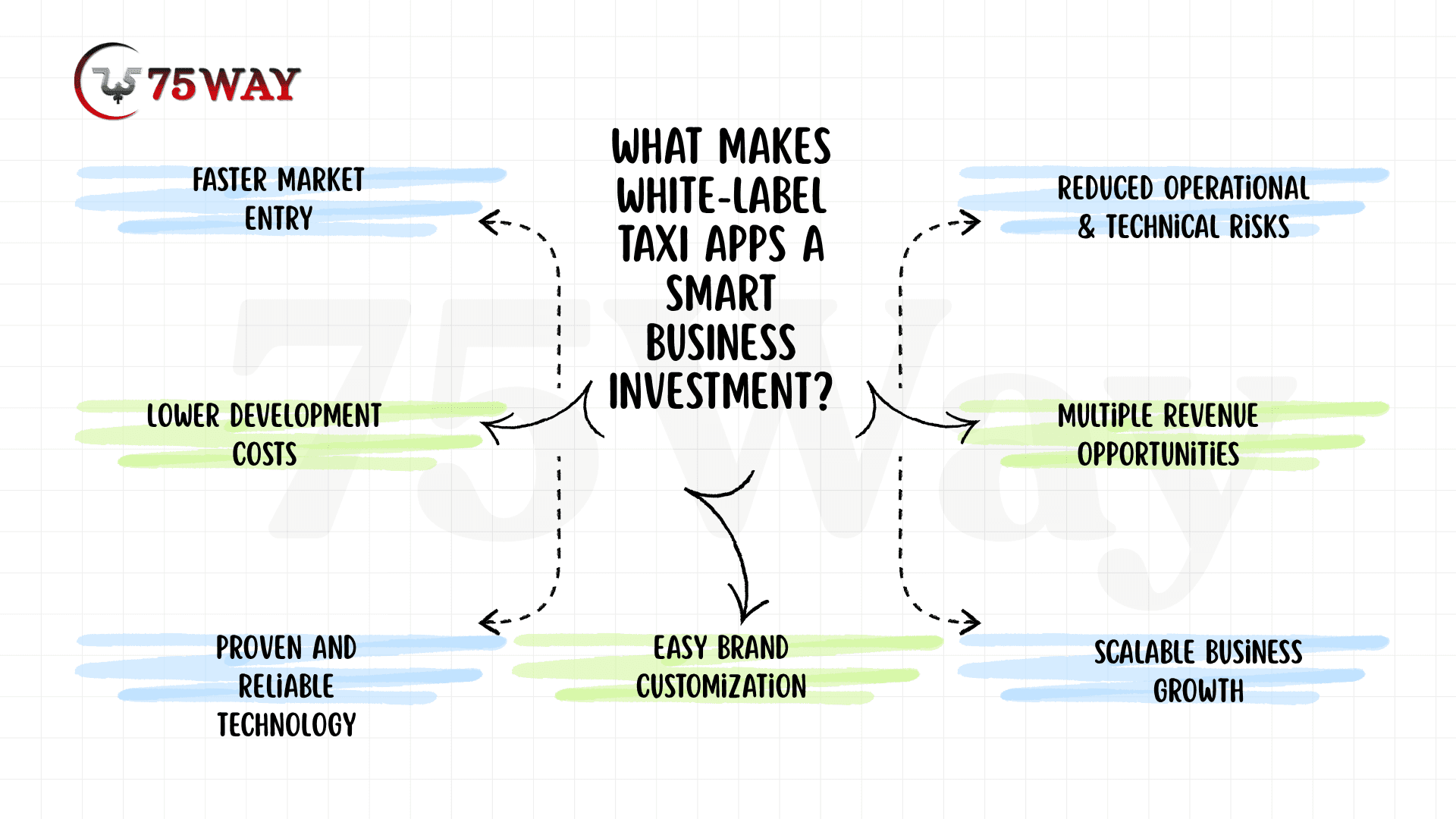
- Faster Market Entry: White-label taxi apps come with pre-built features, tested workflows, and ready-to-deploy infrastructure. Businesses can launch their services significantly faster and begin acquiring customers without lengthy development cycles.
- Lower Development Costs: Building a taxi platform from scratch requires substantial investments in design, development, testing, and maintenance. White-label solutions reduce upfront expenses while delivering enterprise-grade functionality at a fraction of the cost.
- Proven Technology: Since white-label platforms are already tested across multiple use cases, businesses benefit from stable performance and reduced technical risks. This reliability ensures smoother operations and better user experiences.
- Easy Brand Customization: Companies can customize logos, colors, themes, features, and business settings according to their brand identity. This flexibility helps create a unique market presence while leveraging an established technology foundation.
- Scalable Business Growth: Modern white-label taxi platforms are designed to support growing user bases, expanding fleets, and increasing ride volumes. Businesses can scale operations efficiently without rebuilding their technology infrastructure.
- Multiple Revenue Opportunities: Beyond ride commissions, businesses can generate revenue through subscriptions, surge pricing, advertising partnerships, corporate transportation services, and driver onboarding fees. These diverse income streams improve profitability.
- Reduced Operational & Technical Risks: Managing a custom-built platform often involves ongoing technical challenges and maintenance requirements. White-label solutions provide continuous updates, support, and security enhancements, allowing businesses to focus on growth rather than software management.
Core Modules Behind a Successful White-Label Taxi Platform
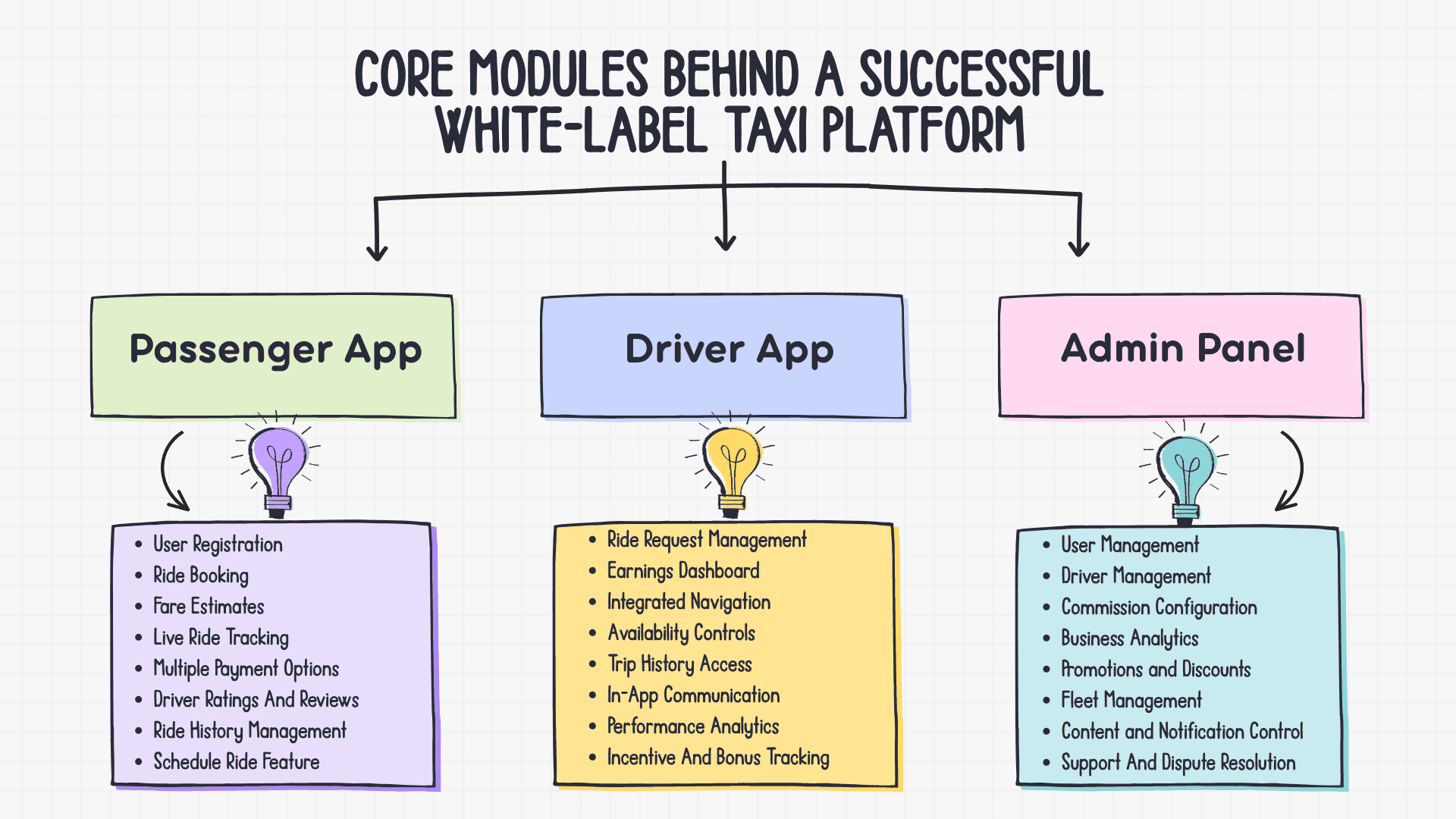
A successful white-label taxi platform relies on three interconnected modules that ensure seamless operations across the entire ride-hailing ecosystem. The passenger app delivers a convenient booking experience, the driver app empowers drivers to manage rides efficiently, and the admin panel provides complete operational control. Together, these modules create a scalable, user-friendly, and revenue-generating platform capable of supporting growing transportation businesses.
1. Passenger/Customer/Rider App
The rider app serves as the customer-facing component of a white-label taxi platform. A well-designed passenger app focuses on convenience, safety, and user experience to improve customer satisfaction, retention, and ride bookings.
- User Registration: Quick registration enables passengers to create accounts using email, phone numbers, or social logins. It simplifies onboarding and reduces booking friction.
- Ride Booking: Passengers can request rides within seconds by selecting pickup and destination locations. The streamlined process enhances convenience and user satisfaction.
- Fare Estimates: Real-time fare calculations provide transparent pricing before booking confirmation. This helps users make informed decisions and improves trust.
- Live Ride Tracking: GPS-enabled tracking allows passengers to monitor driver locations in real time. It improves safety, transparency, and ride visibility.
- Multiple Payment Options: Users can pay through cards, wallets, UPI, or cash methods. Flexible payments improve convenience and transaction completion rates.
- Driver Ratings & Reviews: Passengers can rate drivers and share ride experiences after trip completion. Feedback helps maintain service quality standards.
- Ride History Management: Users can access previous rides, invoices, and trip details anytime. It simplifies expense tracking and repeat bookings.
- Schedule Ride Feature: Passengers can pre-book rides for future dates and times. Advanced scheduling improves convenience and trip planning flexibility.
2. Driver App
The driver app is designed to help drivers efficiently manage ride operations and maximize earnings. By streamlining daily operations, this app enhances productivity, improves service quality, and ensures a smooth transportation experience.
- Ride Request Management: Drivers receive and manage ride requests through an intuitive interface. Quick acceptance improves response times and earnings opportunities.
- Earnings Dashboard: A centralized dashboard displays daily, weekly, and monthly earnings insights. Financial transparency helps drivers track performance effectively.
- Integrated Navigation: Built-in navigation guides drivers through optimized routes in real time. Efficient routing reduces travel delays and fuel consumption.
- Availability Controls: Drivers can switch availability status according to their working schedules. Flexible controls support better work-life balance.
- Trip History Access: Drivers can review completed rides and historical trip details easily. The feature simplifies performance monitoring and record management.
- In-App Communication: Secure communication tools connect drivers and passengers without exposing personal information. This improves coordination and privacy protection.
- Performance Analytics: Drivers can monitor ratings, acceptance rates, and trip statistics. Actionable insights help improve service quality consistently.
- Incentive & Bonus Tracking: Drivers can view rewards, incentives, and bonus achievements instantly. Transparent tracking encourages greater platform engagement.
3. Admin Panel
The admin panel acts as the central management hub of the entire taxi platform. Through real-time monitoring and data-driven insights, the admin panel helps businesses optimize operations, improve decision-making, and support long-term platform growth.
- User Management: Administrators can monitor, verify, and manage passenger accounts from one dashboard. Centralized controls improve operational efficiency.
- Driver Management: The system enables driver onboarding, verification, and performance monitoring processes. It helps maintain service standards and compliance.
- Commission Configuration: Businesses can customize commission structures according to operational requirements. Flexible pricing models support sustainable revenue generation.
- Business Analytics: Comprehensive analytics provide insights into rides, revenue, user behavior, and growth trends. Data-driven decisions improve business outcomes.
- Promotions and Discounts: Admins can launch promotional campaigns and discount offers effortlessly. Strategic incentives help attract and retain customers.
- Fleet Management: Businesses can monitor vehicle information, status, and utilization rates centrally. Better fleet visibility improves resource allocation.
- Content and Notification Control: Administrators can manage announcements, notifications, and customer communications efficiently. Consistent messaging enhances user engagement.
- Support & Dispute Resolution: The panel enables rapid resolution of customer complaints and ride disputes. Effective support strengthens platform credibility and trust.
How To Build White-Label Taxi Apps: Complete Development Process
Developing a white-label taxi app involves much more than applying a brand logo to an existing solution. To create a market-ready ride-hailing platform, businesses must customize the software, configure operational workflows, integrate essential services, and optimize the platform for scalability. A structured development process ensures the final product aligns with business objectives, customer expectations, and long-term growth plans.
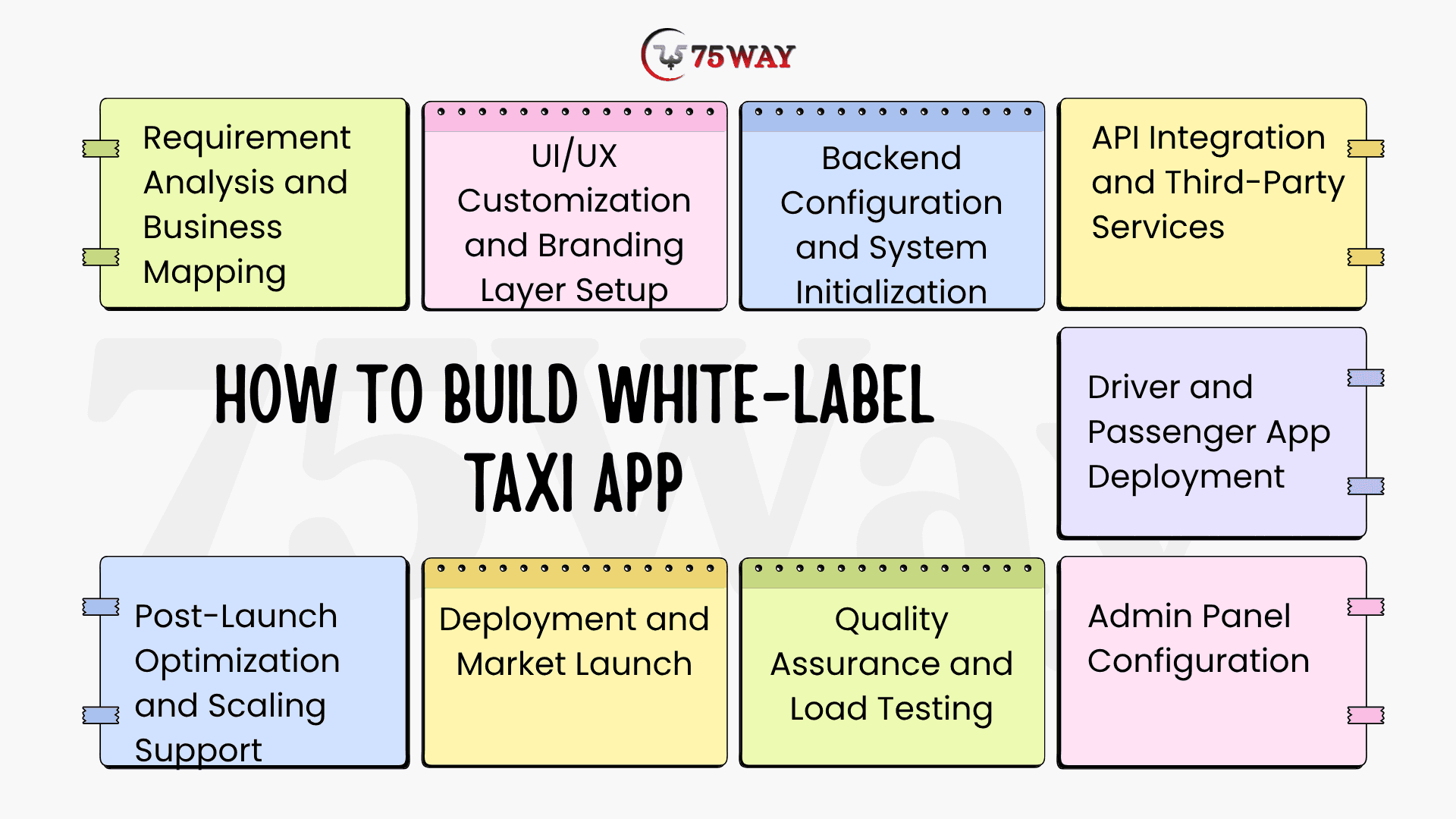
1. Requirement Analysis and Business Planning
Every successful taxi platform begins with a comprehensive understanding of business objectives and market requirements. During this phase, development teams analyze the target audience, operating regions, fleet structure, pricing models, and service categories. Businesses must determine whether they will offer standard taxi services, luxury rides, corporate transportation, airport transfers, or multi-service mobility solutions.
This discovery process helps define feature requirements, operational workflows, revenue models, and customer experience goals. A well-planned strategy minimizes development challenges and creates a strong foundation for future growth.
- Market and competitor analysis
- Business model evaluation
- Feature requirement gathering
- Revenue strategy planning
- Service area identification
- Fleet structure planning
2. UI/UX Customization and Brand Identity Development
Once the business strategy is finalized, the platform is customized to reflect the company's unique brand identity. Although white-label solutions provide a pre-built framework, visual customization is essential for creating a distinctive presence in the marketplace.
Developers modify app interfaces, color schemes, typography, icons, navigation structures, and customer touchpoints. The goal is to create an intuitive experience that feels native to the brand while maintaining simplicity and usability across devices.
A well-designed interface improves customer engagement, increases booking completion rates, and strengthens brand recognition, ultimately contributing to higher user retention and long-term business growth.
3. Backend Configuration and Core System Setup
The backend serves as the operational foundation of the entire taxi platform. During this stage, developers configure servers, databases, dispatch engines, authentication systems, and fare management modules to support daily operations.
Critical business logic such as ride allocation, driver matching, pricing calculations, route optimization, and trip management is also configured. A strong backend infrastructure ensures the platform remains reliable, secure, and capable of handling increasing ride volumes.
4. Third-Party API Integration
Modern taxi applications depend on several external services to deliver real-time functionality. Integrating these services correctly is essential for creating a seamless experience for passengers, drivers, and administrators.
- Navigation and Mapping Services: GPS tracking, route optimization, estimated arrival times, and real-time driver locations are powered through mapping integrations.
- Payment Gateway Integration: Secure payment systems enable passengers to pay using credit cards, debit cards, digital wallets, UPI, and other preferred methods.
- Communication Services: SMS alerts, push notifications, ride confirmations, and booking updates keep users informed throughout their journey.
- Cloud And Storage Solutions: Cloud infrastructure supports data storage, application scalability, backup management, and overall platform performance.
These integrations work together to create a reliable and efficient ride-hailing ecosystem.
5. Driver and Passenger App Deployment
Once the core system is configured, the passenger and driver applications are prepared for deployment. Both applications undergo optimization to ensure smooth performance across various devices and operating systems.
The passenger app focuses on ride booking convenience, payment processing, and trip tracking, while the driver app supports ride management, navigation, earnings monitoring, and communication. Cross-platform technologies such as Flutter or React Native are often used to accelerate deployment while maintaining consistent performance.
6. Admin Panel Configuration
The admin panel acts as the command center of the entire taxi platform. It provides business owners with complete visibility into daily operations, user activities, financial performance, and service quality.
Through the dashboard, administrators can:
- Manage passengers and drivers
- Monitor live ride activities
- Configure pricing and commission structures
- Track revenue and business performance
- Launch promotions and discount campaigns
- Review customer feedback and support requests
A properly configured admin panel helps businesses make informed decisions and maintain operational efficiency.
7. Quality Assurance and Performance Testing
Before launch, the platform undergoes extensive testing to identify and resolve any issues that could affect user experience or operational reliability. This phase is critical for ensuring platform stability under real-world conditions.
Testing typically includes:
- Functional Testing: Verifies that all features operate as intended across passenger, driver, and admin applications.
- GPS And Location Accuracy Testing: Ensures accurate driver tracking, route calculations, and navigation performance.
- Payment Security Verification: Confirms secure transaction processing and protection of sensitive user information.
- Load And Stress Testing: Evaluates platform performance during peak traffic conditions and high ride volumes.
Comprehensive testing reduces technical risks and improves customer confidence in the platform.
8. Deployment and Market Launch
After successful testing, the platform is deployed to the production environment and prepared for public release. Applications are submitted to the Google Play Store and Apple App Store while backend services are hosted on scalable cloud infrastructure.
At this stage, monitoring systems are activated to track application performance, user behavior, ride activity, and system health. A carefully managed launch helps businesses establish a strong first impression among customers and drivers.
9. Post-Launch Optimization and Scaling Support
Launching the platform is only the beginning of the growth journey. Continuous monitoring and optimization are necessary to maintain performance, improve user satisfaction, and support expanding operations.
As the business grows, developers may introduce new features, improve system performance, strengthen security measures, and optimize infrastructure to accommodate increasing user demand. Expansion into new cities, integration of advanced analytics, and implementation of AI-powered automation can further enhance operational efficiency and competitiveness.
A long-term optimization strategy ensures the platform remains scalable, reliable, and prepared for future business opportunities.
Tools & Technology Stack To Build White-Label Taxi Apps
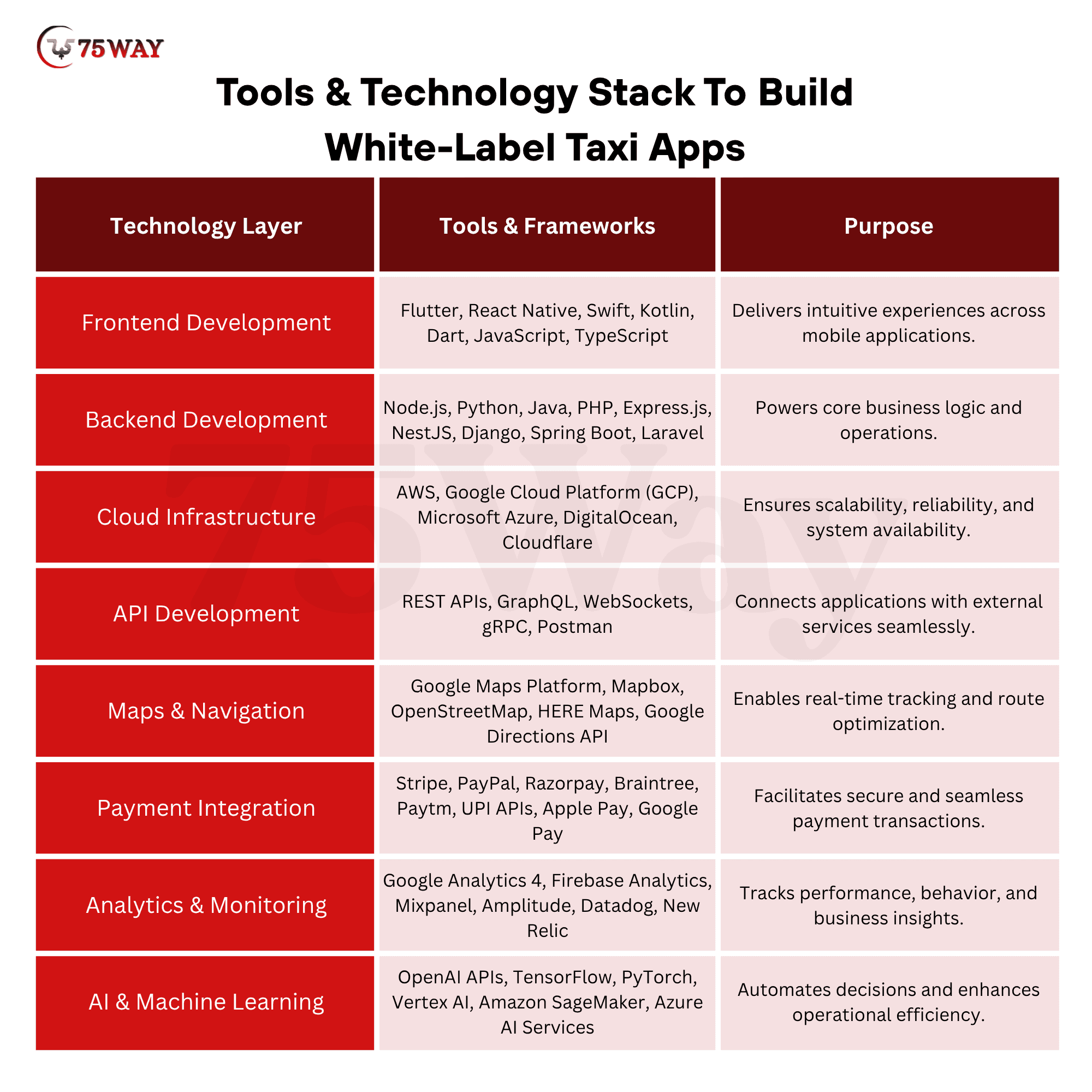
A robust technology stack is the foundation of every successful white-label taxi platform. A strong technical foundation ensures performance, scalability, and reliability. Key components include:
- Frontend Development: Flutter, React Native, Swift, Kotlin, Dart, JavaScript, TypeScript
- Backend Development: Node.js, Python, Java, PHP, Express.js, NestJS, Django, Spring Boot, Laravel
- Cloud Infrastructure: AWS, Google Cloud Platform (GCP), Microsoft Azure, DigitalOcean, Cloudflare
- API Development: REST APIs, GraphQL, WebSockets, gRPC, Postman
- Maps & Navigation: Google Maps Platform, Mapbox, OpenStreetMap, HERE Maps, Google Directions API
- Payment Integration: Stripe, PayPal, Razorpay, Braintree, Paytm, UPI APIs, Apple Pay, Google Pay
- Analytics & Monitoring: Google Analytics 4, Firebase Analytics, Mixpanel, Amplitude, Datadog, New Relic
- AI & Machine Learning: OpenAI APIs, TensorFlow, PyTorch, Vertex AI, Amazon SageMaker, Azure AI Services
Real-time tracking and dispatch systems rely on GPS-based algorithms and event-driven architecture to match drivers.
Must-Have Features in a White-Label Taxi App Solution
Today's ride-hailing businesses require more than basic booking and ride management capabilities. To stay competitive, increase customer retention, improve operational efficiency, and maximize revenue, modern taxi platforms must incorporate advanced features that enhance both user experience and business performance. The following capabilities can strengthen the value proposition of a white-label taxi app solution.
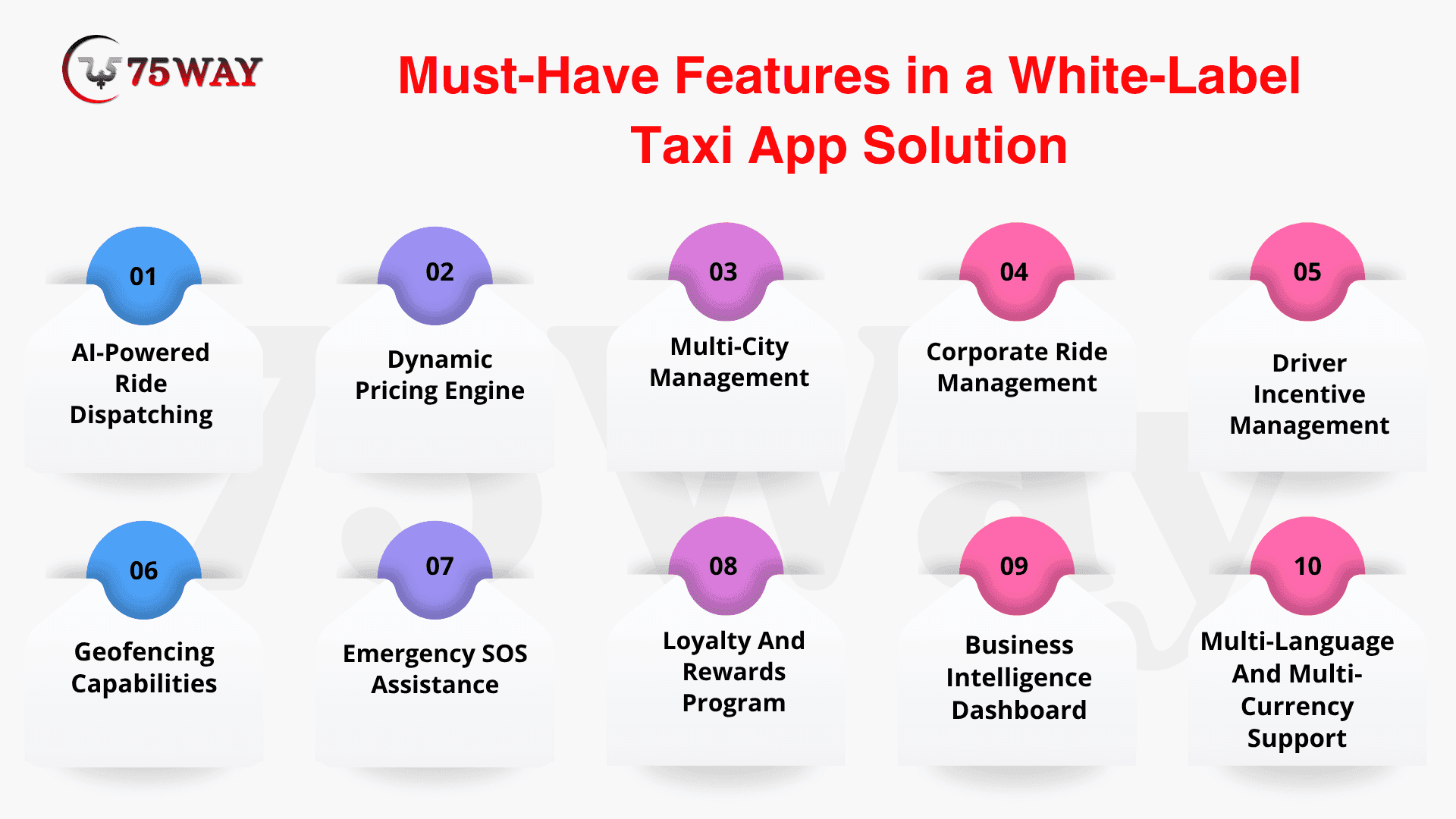
- AI-Powered Ride Dispatching: Intelligent algorithms automatically assign rides to the most suitable drivers based on location, availability, and traffic conditions. This improves operational efficiency and reduces passenger wait times.
- Dynamic Pricing Engine: The system adjusts fares automatically according to demand, supply, traffic conditions, and peak hours. Smart pricing helps maximize revenue and fleet utilization.
- Multi-City Management: Businesses can manage operations across multiple cities through a unified platform. Centralized control simplifies expansion and operational oversight.
- Corporate Ride Management: Dedicated corporate accounts enable businesses to manage employee transportation. Automated billing and reporting streamline corporate travel administration.
- Driver Incentive Management: Administrators can create customized reward programs based on performance metrics and ride completion targets. Incentives improve driver engagement and retention.
- Geofencing Capabilities: Virtual geographic boundaries allow businesses to define service zones and operational areas. Geofencing supports location-based pricing and service restrictions.
- Emergency SOS Assistance: Built-in emergency support features provide instant access to safety assistance during rides. Enhanced protection increases user confidence and platform trust.
- Loyalty And Rewards Program: Customers earn points, discounts, or rewards based on ride frequency and spending patterns. Loyalty initiatives encourage repeat bookings and long-term retention.
- Business Intelligence Dashboard: Advanced reporting tools deliver actionable insights into revenue, customer behavior, driver performance, and operational trends. Data-driven decisions support sustainable growth.
- Multi-Language And Multi-Currency Support: The platform accommodates users from different regions through localized experiences. Global accessibility helps businesses expand into diverse markets.
White-Label Taxi App Vs Custom Taxi App Development: A Comparison
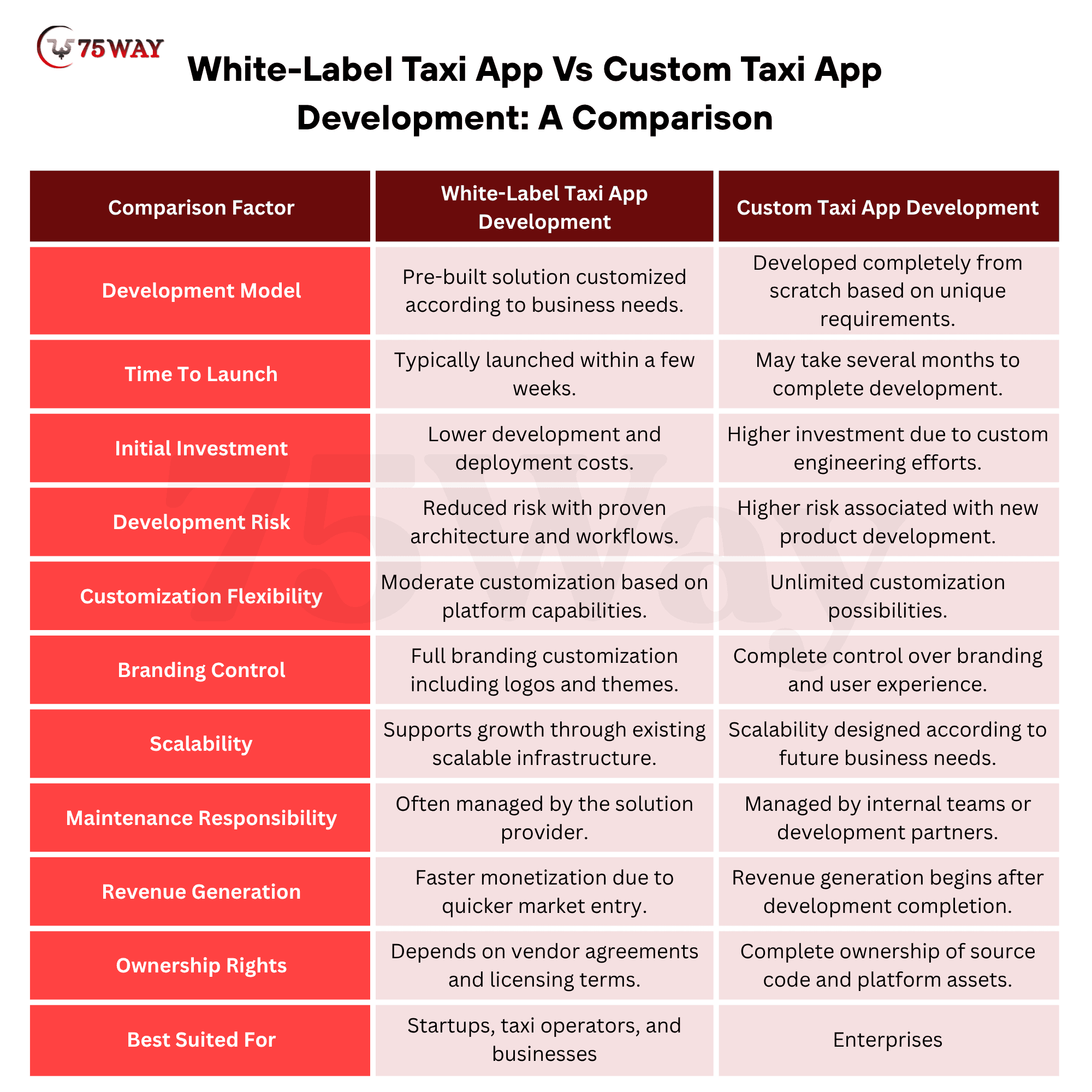
Choosing between white-label taxi app development and custom taxi app development is one of the most important decisions for businesses entering the ride-hailing industry. Both approaches offer unique advantages, but the right choice depends on business goals, budget, timeline, scalability requirements, and customization needs.
White-label taxi app development provides a ready-made solution that can be customized with a company's branding, business rules, and selected features. Since the core platform is already built and tested, businesses can launch their services quickly while minimizing development costs and technical risks. This approach is particularly suitable for startups, taxi operators, and entrepreneurs seeking faster market entry.
Custom taxi app development, on the other hand, involves building a platform entirely from scratch according to specific business requirements. It offers complete control over design, functionality, integrations, and scalability. While custom development provides unmatched flexibility, it typically requires a higher investment, longer development cycles, and dedicated technical resources for maintenance and upgrades.
For businesses focused on rapid deployment and cost efficiency, a white-label solution often delivers the fastest path to market. However, organizations with highly unique operational models or complex mobility requirements may benefit from a custom-built platform designed around their long-term vision.
Which Option Should You Choose: Ready-Made or Custom Taxi App Creation
If your primary goal is to launch quickly, reduce development costs, validate your business model, and start generating revenue faster, white-label taxi app development is often the most practical choice. It provides a proven foundation while allowing sufficient customization to establish a unique brand presence.
On the other hand, if your business requires highly specialized workflows, proprietary technologies, advanced integrations, or a completely differentiated user experience, custom taxi app development offers greater flexibility and long-term control. Although it requires more time and investment, it can deliver a unique competitive advantage in the market.
For most startups and growing transportation businesses, a white-label taxi app provides the ideal balance between speed, affordability, scalability, and functionality.
Understanding the Business Model Behind White-Label Taxi Apps
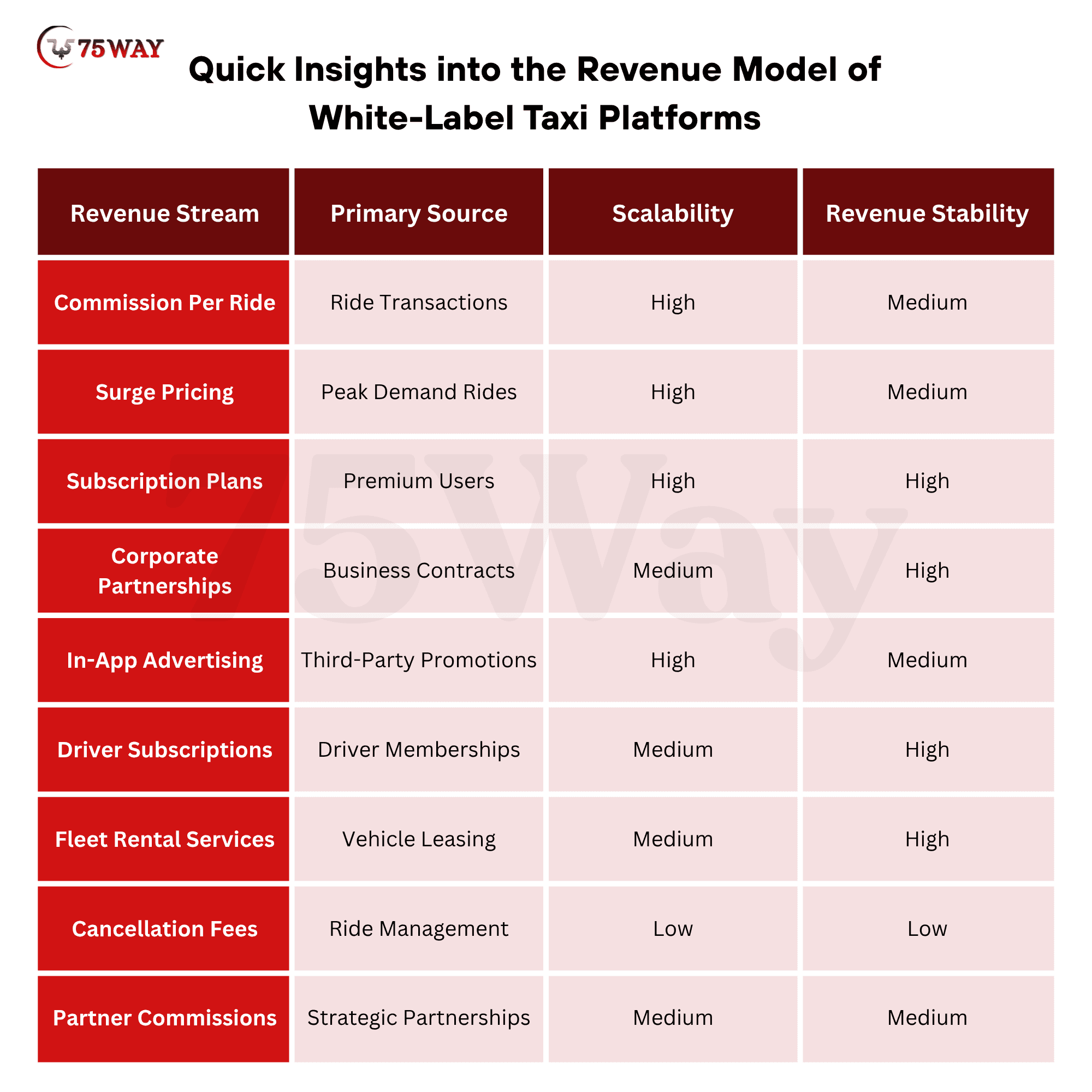
A well-designed white-label taxi platform creates multiple revenue streams beyond basic ride commissions. Modern ride-hailing businesses focus on diversified monetization strategies that improve profitability, reduce dependency on a single income source, and support long-term business growth. By combining transactional, subscription-based, and partnership-driven revenue models, operators can maximize returns while maintaining competitive pricing for users.
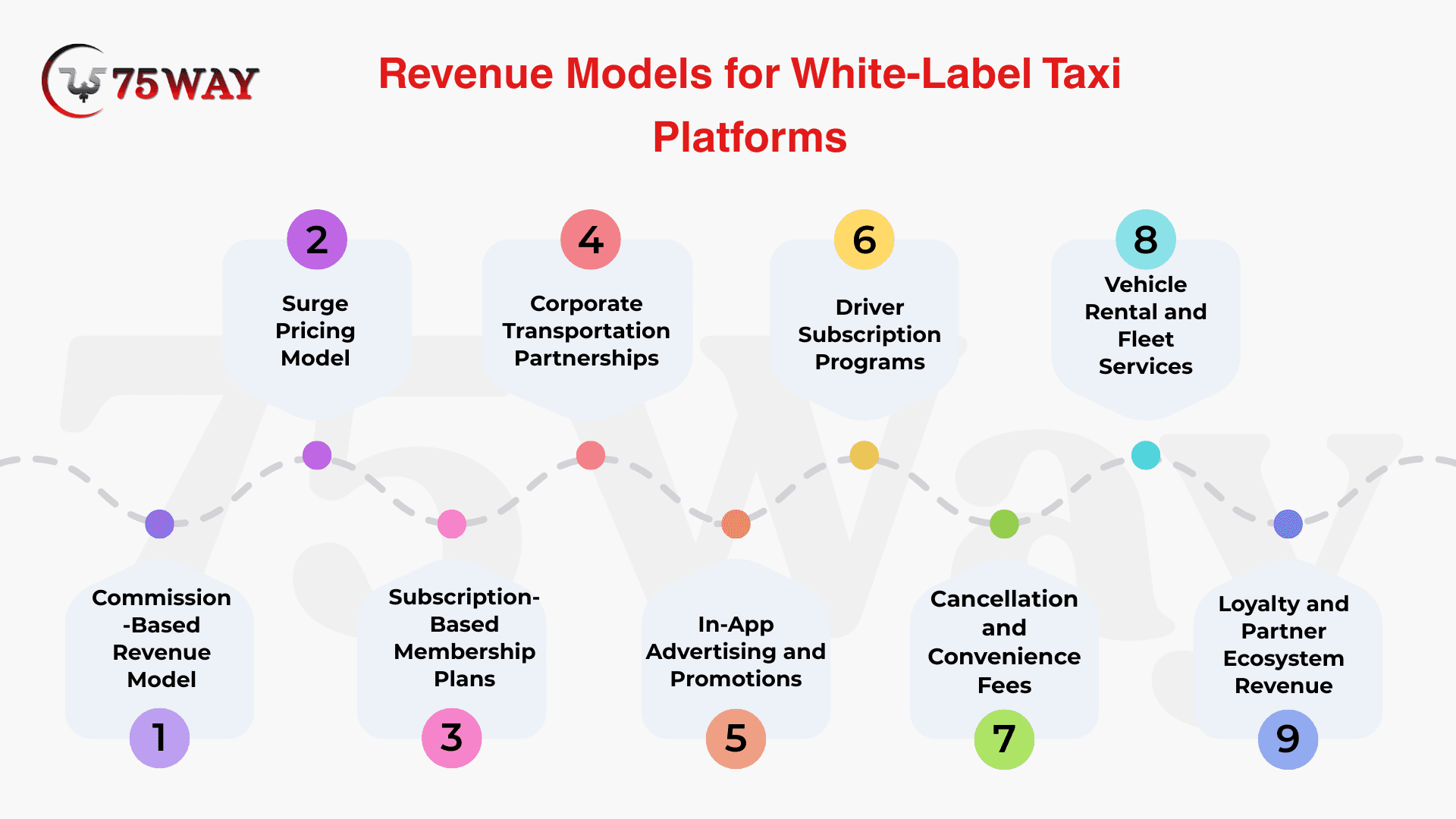
- Commission-Based Revenue Model
The commission model is the primary source of income for most taxi platforms. Businesses earn a percentage of every completed ride while drivers receive the remaining fare amount. Depending on the market, service category, and operational strategy, commissions typically range between 15% and 25%.
This model scales naturally as ride volume increases, making it one of the most sustainable revenue streams for ride-hailing businesses.
- Surge Pricing Model
Demand for transportation often fluctuates based on weather conditions, traffic congestion, holidays, special events, and peak commuting hours. Surge pricing automatically adjusts ride fares according to real-time demand and driver availability.
By increasing prices during high-demand periods, businesses can improve fleet utilization, encourage driver participation, and generate higher revenue from each ride.
- Subscription-Based Membership Plans
Many taxi businesses offer premium subscription programs that provide users with exclusive benefits such as discounted fares, priority ride access, reduced cancellation fees, and loyalty rewards.
Subscription plans create predictable recurring revenue while encouraging customer retention and increasing long-term platform engagement.
- Corporate Transportation Partnerships
Corporate transportation services represent a valuable business-to-business revenue opportunity. Companies often require reliable transportation solutions for employee commutes, airport transfers, client travel, and business events.
Long-term corporate contracts provide stable revenue streams, higher booking volumes, and stronger business predictability compared to individual ride transactions.
- In-App Advertising and Promotions
Taxi applications can monetize their user base by offering advertising opportunities to local businesses, restaurants, hotels, entertainment venues, and retail brands. Sponsored listings, promotional banners, and featured offers create additional income without directly impacting ride pricing.
As the platform's user base grows, advertising can become a significant supplementary revenue source.
- Driver Subscription Programs
Instead of charging ride commissions, some platforms offer subscription-based plans for drivers. Drivers pay a fixed weekly or monthly fee to access the platform and receive unlimited ride opportunities.
This model provides predictable revenue for operators while allowing drivers to retain a larger portion of their earnings.
- Vehicle Rental and Fleet Services
Many ride-hailing businesses generate additional revenue by renting vehicles to drivers who do not own their own cars. Fleet leasing programs can include insurance, maintenance, and vehicle management services.
This approach creates an additional income stream while helping expand the available driver network.
- Cancellation and Convenience Fees
Platforms may charge cancellation fees when passengers cancel rides after a specified time period. Additional convenience charges can also be applied for premium services, priority bookings, or special ride categories.
Although these fees represent a smaller revenue source, they contribute to overall profitability and operational efficiency.
- Loyalty and Partner Ecosystem Revenue
White-label taxi platforms can partner with hotels, airlines, travel agencies, event organizers, and local businesses to offer integrated transportation services. Revenue is generated through referral commissions, partnership agreements, and bundled service offerings.
Such collaborations help expand customer reach while creating mutually beneficial business relationships.
Quick Insights into the Revenue Model of White-Label Taxi Platforms
White-Label Taxi App Development Cost: Complete Pricing
The cost to build a white-label taxi mobile app ranges between $2,000-$75,000+ based on its requirements. However, the final investment depends on several factors, including customization requirements, platform complexity, integrations, scalability needs, and ongoing support services. One of the biggest advantages of white-label taxi app development is its cost efficiency compared to building a ride-hailing platform from scratch.
- A basic white-label taxi app solution may require $2,000 – $10,000, with minimal branding and configuration.
- A mid-level white-label taxi app solution can be developed within a range of $10,000 – $30,000
- An enterprise-grade white-label taxi platform needs $30,000 – $75,000+. It often involves advanced customization, third-party integrations, AI capabilities, multi-city operations, and enhanced security measures.
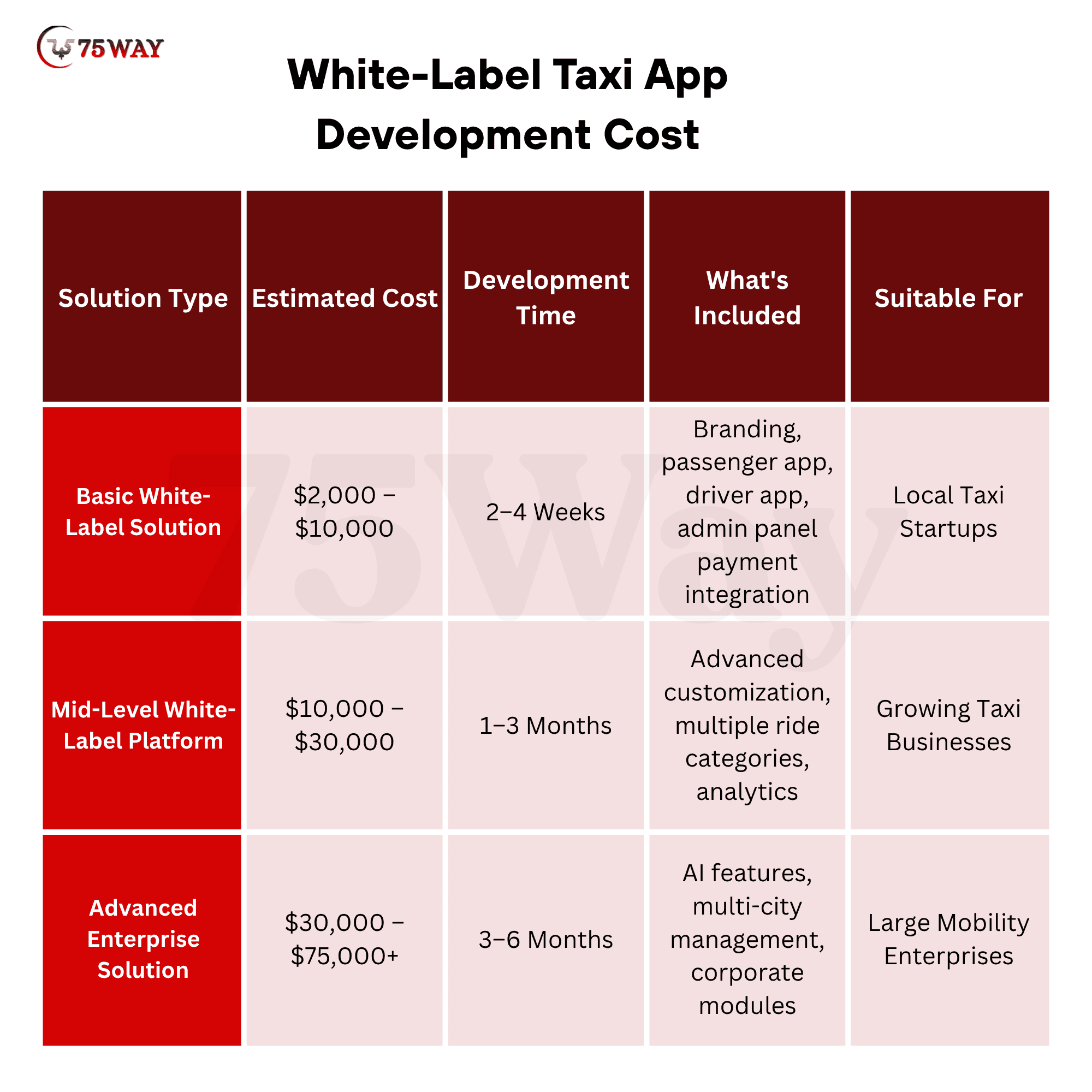
Understanding the major cost components helps businesses plan their budgets and avoid unexpected expenses during implementation.
Cost of White-Label Taxi App Based On Development Stages
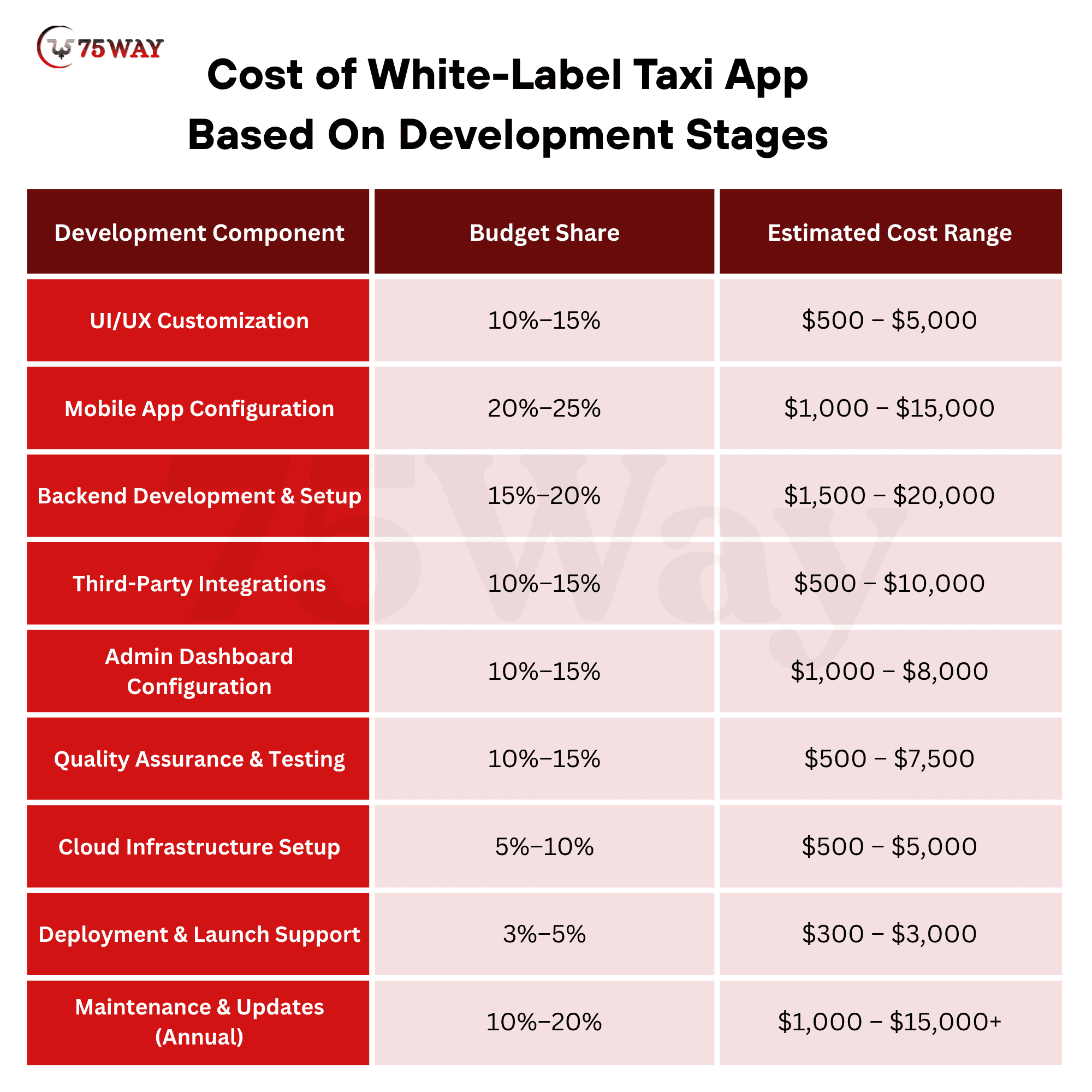
The overall cost of a white-label taxi app is distributed across multiple development stages, from interface customization and backend configuration to testing and deployment. Understanding where the budget is allocated helps businesses prioritize investments and plan their technology roadmap more.
- UI/UX Customization: $500 – $5,000
Brand-specific interface design and user experience customization.
- Mobile App Configuration: $1,000 – $15,000
Passenger and driver app setup, customization, and optimization.
- Backend Development & Setup: $1,500 – $20,000
Server configuration, business logic, databases, and ride management systems.
- Third-Party Integrations: $500 – $10,000
Payment gateways, maps, notifications, communication, and external services.
- Admin Dashboard Configuration: $1,000 – $8,000
Business management, analytics, driver monitoring, and operational controls.
- Quality Assurance & Testing: $500 – $7,500
Functional testing, security validation, and performance optimization.
- Cloud Infrastructure Setup: $500 – $5,000
Hosting, storage, scalability, backups, and system reliability.
- Deployment & Launch Support: $300 – $3,000
App store publishing, server deployment, and launch assistance.
- Maintenance & Updates: $1,000 – $15,000+
Ongoing support, bug fixes, feature enhancements, and security updates.
Major Factors Influencing Development Costs Are:
- Customization Requirements: The level of UI/UX modifications, feature additions, and workflow changes directly impacts development effort and overall project costs.
- Platform Complexity: Applications supporting multiple ride categories, advanced pricing models, fleet management, and corporate transportation services typically require higher investments.
- Third-Party Integrations: Payment gateways, mapping services, SMS providers, analytics tools, and cloud services add implementation and operational costs.
- Multi-Platform Deployment: Launching applications across Android, iOS, and web platforms requires additional testing, optimization, and maintenance efforts.
- Scalability Requirements: Businesses planning multi-city or large-scale operations often require stronger infrastructure and performance optimization.
- Maintenance And Support: Ongoing updates, security enhancements, bug fixes, and feature improvements contribute to long-term operational expenses.
Best Practices To Launch A White-Label Taxi App
Deploying a white-label taxi app is not just about launching the platform. It is about creating a sustainable foundation for long-term growth. Even the most feature-rich solution can struggle if businesses overlook operational planning, user experience, and performance optimization. Following proven deployment practices helps reduce risks, improve customer satisfaction, and maximize return on investment.
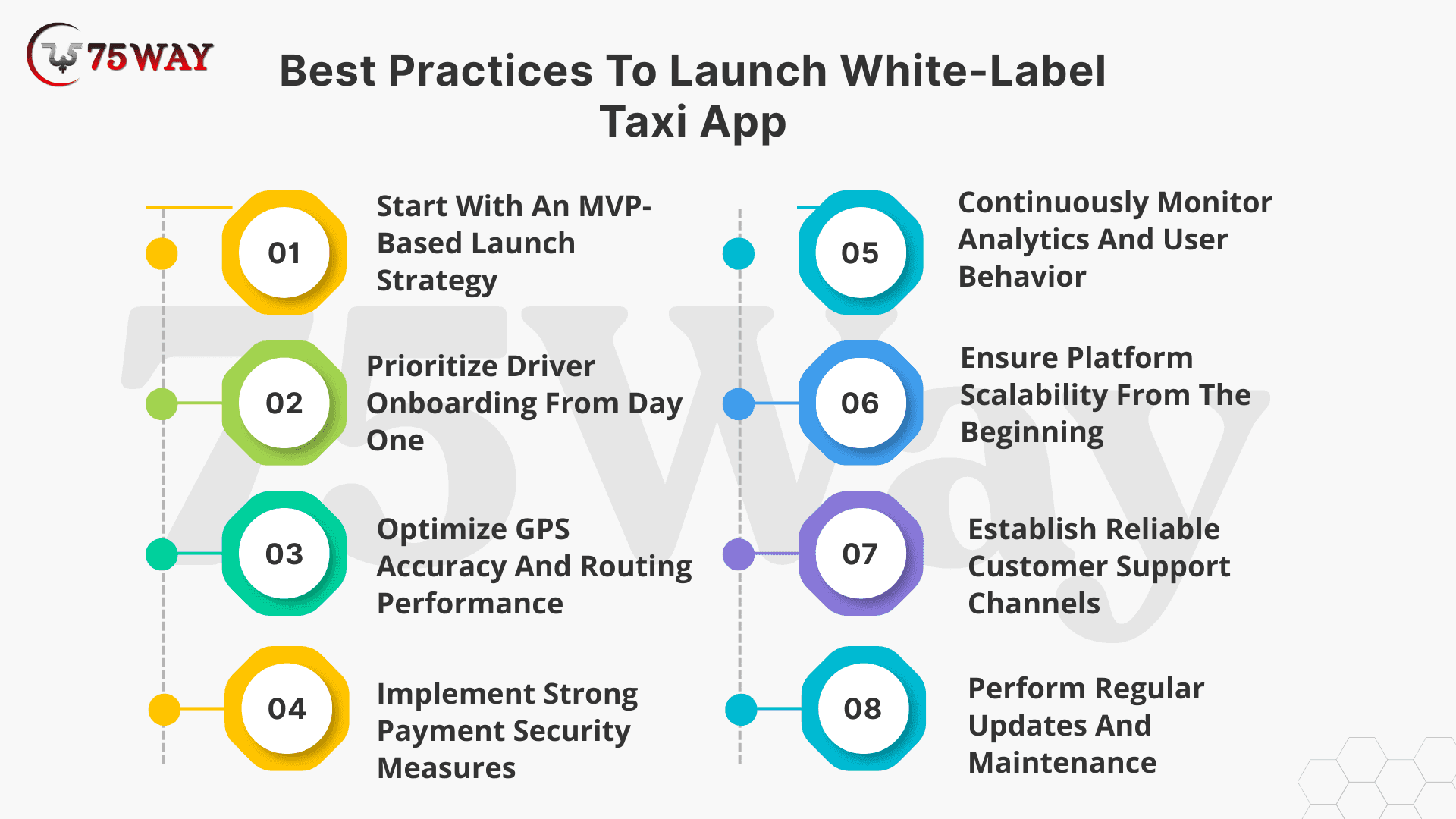
1. Start With An MVP-Based Launch Strategy
Launching with a Minimum Viable Product (MVP) allows businesses to enter the market quickly while validating their business model with real users. Instead of introducing every possible feature at launch, companies can focus on core functionalities and gather valuable customer feedback.
An MVP approach reduces development costs, accelerates market entry, and helps prioritize future enhancements based on actual user behavior and business needs.
2. Prioritize Driver Onboarding From Day One
A taxi platform can only succeed when there is a sufficient supply of active drivers. Businesses should establish clear onboarding processes, verification systems, incentive programs, and support mechanisms to attract and retain quality drivers.
Building a strong driver network early helps reduce ride wait times, improve service availability, and create a better customer experience from the beginning.
3. Optimize GPS Accuracy And Routing Performance
Location tracking is one of the most critical components of a ride-hailing platform. Accurate GPS functionality ensures efficient driver-passenger matching, precise route calculations, and reliable arrival estimates.
Regular testing and optimization of navigation systems help minimize delays, reduce operational inefficiencies, and improve overall ride experiences for both passengers and drivers.
4. Implement Strong Payment Security Measures
Secure transactions play a major role in building customer trust. Payment systems should include encrypted processing, fraud detection mechanisms, secure authentication methods, and compliance with industry security standards.
A reliable payment infrastructure protects sensitive financial information while reducing transaction failures and chargeback risks.
5. Continuously Monitor Analytics And User Behavior
Successful taxi businesses rely on data-driven decision-making. Monitoring key metrics such as ride completion rates, booking trends, customer retention, driver performance, and revenue growth helps identify opportunities for improvement.
Analytics provide valuable insights that support smarter business decisions, improved operational efficiency, and stronger customer engagement.
6. Ensure Platform Scalability From The Beginning
Many taxi businesses focus only on immediate launch requirements and overlook future growth needs. Planning for scalability early allows the platform to support increasing user volumes, larger fleets, and expansion into new service areas without major infrastructure changes.
A scalable architecture reduces future development costs and ensures consistent performance during periods of rapid growth.
7. Establish Reliable Customer Support Channels
Customer support directly impacts user satisfaction and retention. Providing multiple support channels, including in-app assistance, live chat, email support, and dispute resolution systems, helps address issues quickly and maintain positive customer relationships.
Fast and effective support strengthens brand reputation and encourages repeat usage.
8. Perform Regular Updates And Maintenance
The ride-hailing industry evolves rapidly, making continuous platform improvements essential. Regular updates help enhance security, improve performance, introduce new features, and maintain compatibility with evolving operating systems and third-party services.
Ongoing maintenance ensures the platform remains competitive, reliable, and aligned with changing customer expectations.
By combining a phased launch strategy, strong driver acquisition efforts, secure payment systems, data-driven optimization, and scalable infrastructure, businesses can significantly improve their chances of building a successful and sustainable taxi platform. These best practices not only support operational stability but also contribute to higher customer retention, stronger revenue growth, and long-term market competitiveness.
Final Thoughts
White-label taxi app development has redefined how mobility businesses enter and scale in the ride-hailing industry. By eliminating the need for building complex systems from scratch, it allows entrepreneurs to focus on branding, customer acquisition, and revenue generation. With faster deployment cycles, lower costs, and proven technical frameworks, it has become a strategic choice for startups and enterprises alike. Businesses that adopt this model gain a competitive advantage in rapidly evolving transportation markets. To launch your own ride-hailing platform, reach out to a leading white-label taxi app development company to build a fully branded, scalable, and revenue-ready mobility solution tailored to your business goals. Start your journey today and transform your idea into a high-performing taxi booking platform that captures market demand and drives consistent growth.
Frequently Asked Questions (FAQs)
Can White-Label Taxi Apps Be Customized For Unique Business Models?
Yes, white-label taxi apps can be tailored to support different business models, including ride-sharing, corporate transport, and luxury taxi services. Custom branding, feature adjustments, and regional configurations are typically available.
How Long Does It Take To Launch A White-Label Taxi App?
Most white-label taxi apps can be launched within two to six weeks depending on customization level, feature requirements, and integration complexity across platforms and payment systems.
Are White-Label Taxi Apps Suitable For Small Startups?
Yes, startups benefit significantly from white-label solutions due to low cost, quick deployment, and reduced technical complexity. It allows rapid testing of market demand with minimal investment.
What Technologies Are Used In White-Label Taxi App Development?
Common technologies include React Native, Flutter, Node.js, AWS cloud infrastructure, GPS APIs, and secure payment gateways like Stripe or Razorpay for seamless transactions.
Do White-Label Taxi Apps Support Multiple Payment Options?
Yes, most platforms support multiple payment methods such as credit cards, debit cards, digital wallets, and cash payments depending on regional requirements and integrations.
Is It Possible To Scale A White-Label Taxi App To Multiple Cities?
Yes, white-label systems are designed for scalability, allowing businesses to expand operations across cities and regions with minimal backend modifications.