Summary
This guide explains the way AI taxi booking agents help taxi businesses scale efficiently by automating ride requests, dispatching drivers, optimizing routes, and improving customer experience. It covers architecture, features, workflow automation, and real-world benefits of AI-driven mobility systems that reduce operational costs and increase fleet utilization.
Quick Overview
- AI taxi agents automate taxi booking and dispatch workflows
- Fleet utilization improves through intelligent ride allocation
- Operational costs reduce with reduced manual coordination
- Customer experience improves with faster ride response
- Real-time optimization increases business scalability
Running a taxi business has never been simple. Behind every successful ride lies a complex system of booking management, driver coordination, route optimization, customer communication, and real-time dispatching. When demand increases, these operations often become harder to manage, leading to delays, inefficiencies, and rising operational costs.
This is where AI taxi booking agents are changing everything.
These intelligent systems automate the entire booking lifecycle, from ride request to driver assignment and route optimization, while continuously learning from data to improve efficiency. They don’t just support operations. These AI agents in taxi booking app solutions actively manage them.
This guide explains what AI taxi booking agents are, how they work, their architecture, features, and how they help taxi businesses scale. It also explores how these systems improve customer experience while reducing operational workload for businesses.
What Is an AI Taxi Booking Agent?
An AI taxi booking agent is an intelligent automation system designed to manage and coordinate taxi operations with minimal human intervention. It handles core functions such as ride booking requests, driver allocation, route optimization, pricing adjustments, customer communication, and fleet management. Instead of relying on manual dispatching, it centralizes these processes into a unified digital system.
Unlike traditional dispatch systems, AI taxi booking agents use machine learning, predictive analytics, and real-time data processing to make operational decisions automatically. This allows taxi businesses to shift from manual coordination models to fully automated operations, improving speed, efficiency, and overall service reliability.
Why Taxi Businesses Need AI Agents For Ride Hailing?
Taxi businesses need AI agents for ride sharing solutions because modern mobility demand is highly dynamic and requires instant coordination between riders, drivers, and systems. Manual operations struggle to maintain speed, accuracy, and cost efficiency during peak and unpredictable demand situations. AI automation helps streamline operations, reduce delays, and improve overall service reliability.
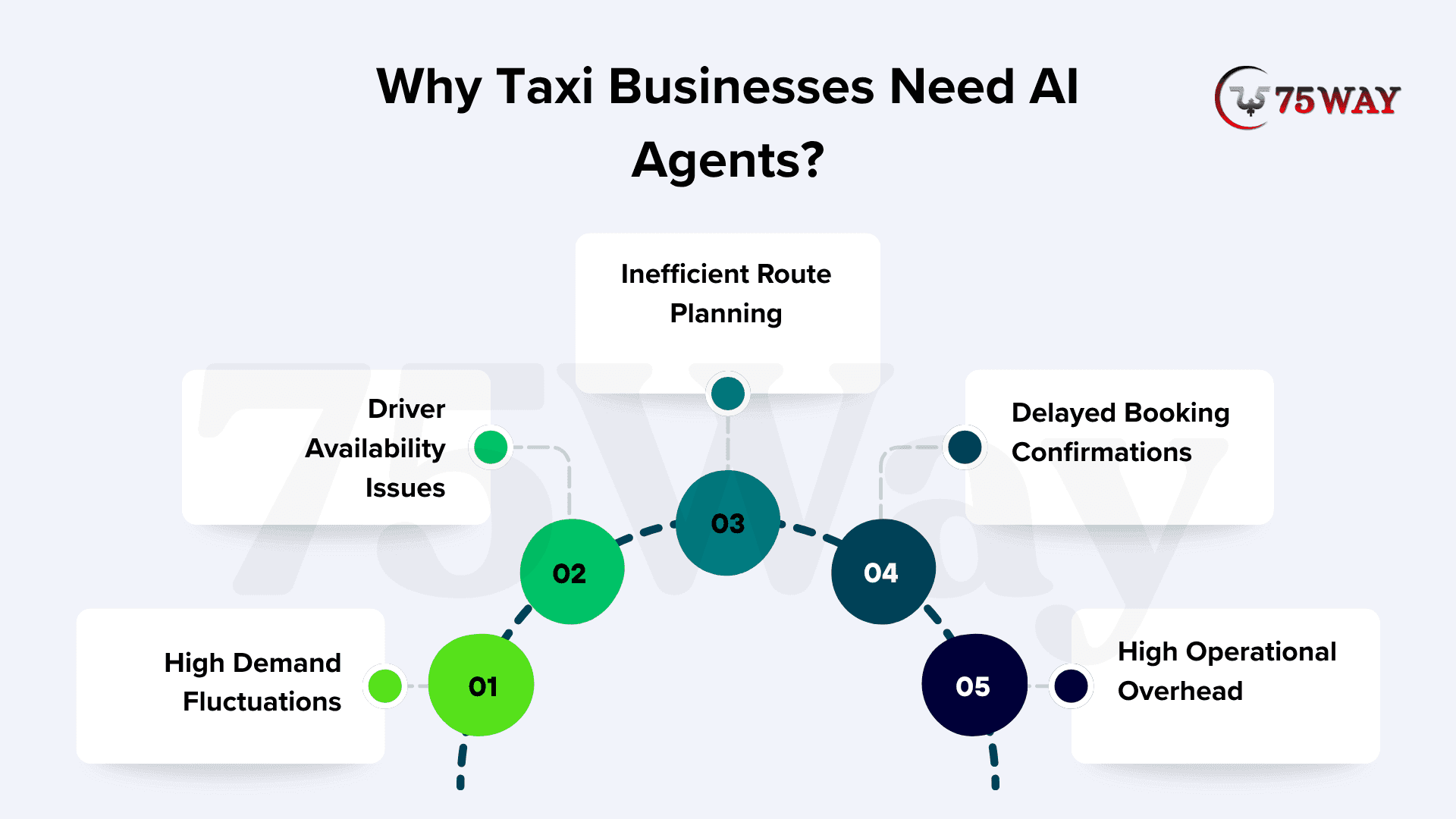
- High Demand Fluctuations: Taxi demand changes rapidly during peak hours, events, and weather conditions. AI agents dynamically adjust supply allocation and pricing strategies in real time for better demand management efficiency.
- Driver Availability Issues: Managing driver availability manually often leads to delays and idle resources. AI systems track active drivers in real time and assign rides based on proximity and availability.
- Inefficient Route Planning: Traditional routing systems fail to adapt to real-time traffic changes. AI agents optimize routes using live traffic data to reduce travel time and fuel consumption.
- Delayed Booking Confirmations: Manual dispatch often slows ride confirmation during high demand. AI agents instantly match riders with nearby drivers for faster booking confirmations.
- High Operational Overhead: Manual coordination requires large teams, increasing operational costs. AI automation reduces dependency on human dispatchers and improves overall cost efficiency.
How AI Taxi Booking Agent Solutions Scale Taxi Business Operations
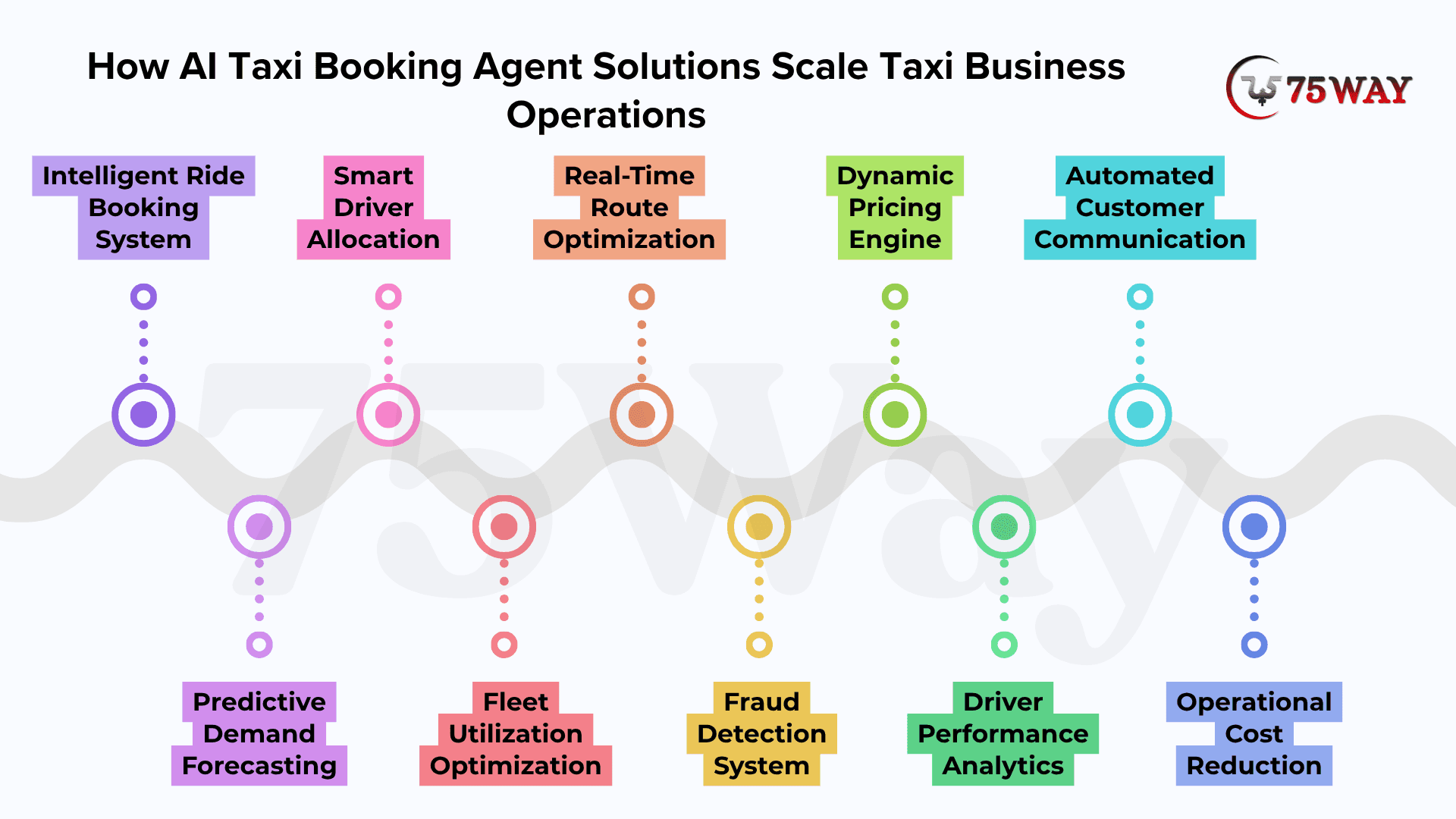
AI taxi booking agent solutions help taxi companies scale efficiently by automating ride management, improving decision-making, and optimizing resource allocation. These systems reduce manual workload while increasing speed, accuracy, and customer satisfaction across all operational layers. They ensure smooth coordination between passengers, drivers, and backend systems in real time.
1. Intelligent Ride Booking System
AI agents for taxi businesses process ride requests instantly from mobile apps, websites, voice assistants, and chatbots, ensuring fast and accurate booking handling. It validates user requests automatically and assigns the most suitable driver without human intervention. This improves booking speed, reduces errors, and enhances customer experience.
- Mobile apps
- Websites
- Voice assistants
- Chatbots
2. Smart Driver Allocation
AI agent for taxi booking assigns drivers based on location, availability, ratings, and proximity to ensure maximum efficiency. It eliminates random allocation and improves matching accuracy between riders and drivers. This results in reduced waiting time and better utilization of driver resources.
- Driver location
- Traffic conditions
- Ride distance
- Driver ratings
3. Real-Time Route Optimization
AI taxi booking agent continuously analyzes live traffic data, road conditions, and historical trip patterns to identify optimal routes. It dynamically adjusts routes during trips to avoid delays and congestion. This ensures faster travel time and improved fuel efficiency for drivers.
- Traffic patterns
- Road conditions
- Historical trip data
- Live navigation updates
4. Dynamic Pricing Engine
Agentic AI taxi booking solutions adjust fare pricing automatically based on demand fluctuations, time of day, traffic levels, and driver availability. It ensures balanced supply and demand across the platform while maximizing revenue. This helps maintain profitability during both peak and off-peak hours.
- Demand spikes
- Time of day
- Traffic conditions
- Driver availability
5. Automated Customer Communication
AI voice agent for taxi booking handles all customer interactions, such as booking confirmations, driver updates, delay alerts, and ride completion notifications. It ensures passengers stay informed throughout their journey without needing human support agents. This significantly reduces operational support workload and improves communication efficiency.
- Booking confirmations
- Driver arrival updates
- Delay notifications
- Ride completion alerts
6. Predictive Demand Forecasting
AI agent for taxi booking analyzes historical ride data and external factors like weather and events to predict future demand. It helps businesses prepare for driver availability in advance for peak conditions. This improves operational planning and reduces service delays.
- Historical trip trends
- Weather patterns
- Local events
- Peak hour analysis
7. Fleet Utilization Optimization
An AI taxi booking agent monitors vehicle usage and ensures optimal distribution of rides across the fleet. It reduces driver idle time and increases overall ride efficiency. This leads to better revenue generation per vehicle.
- Vehicle availability
- Ride distribution
- Idle time tracking
- Fleet balancing
8. Fraud Detection System
AI taxi agents detect unusual booking patterns, fake rides, and suspicious transactions in real time. It protects both passengers and drivers from fraudulent activities. This improves platform trust and operational security.
- Suspicious bookings
- Payment anomalies
- Fake ride detection
- Behavior analysis
9. Driver Performance Analytics
AI agents for the taxi booking solution track driver performance based on ratings, ride completion time, and customer feedback. It helps identify high-performing drivers and areas needing improvement. This improves overall service quality and customer satisfaction.
- Rating analysis
- Trip completion speed
- Customer feedback
- Performance scoring
10. Operational Cost Reduction
AI taxi booking agents reduce dependency on manual dispatch teams and call centers by automating core processes. It minimizes human errors and streamlines daily operations. This significantly lowers overall operational costs while improving efficiency.
- Reduced manpower needs
- Automated dispatching
- Lower support costs
- Efficient operations scaling
Architecture of Agentic AI Taxi Booking System
An AI taxi booking system is designed using a layered architecture that separates responsibilities across different components for better scalability and performance. Each layer works together to process user requests, make intelligent decisions, and execute real-time ride operations. This structure ensures smooth coordination between users, drivers, and backend intelligence systems.
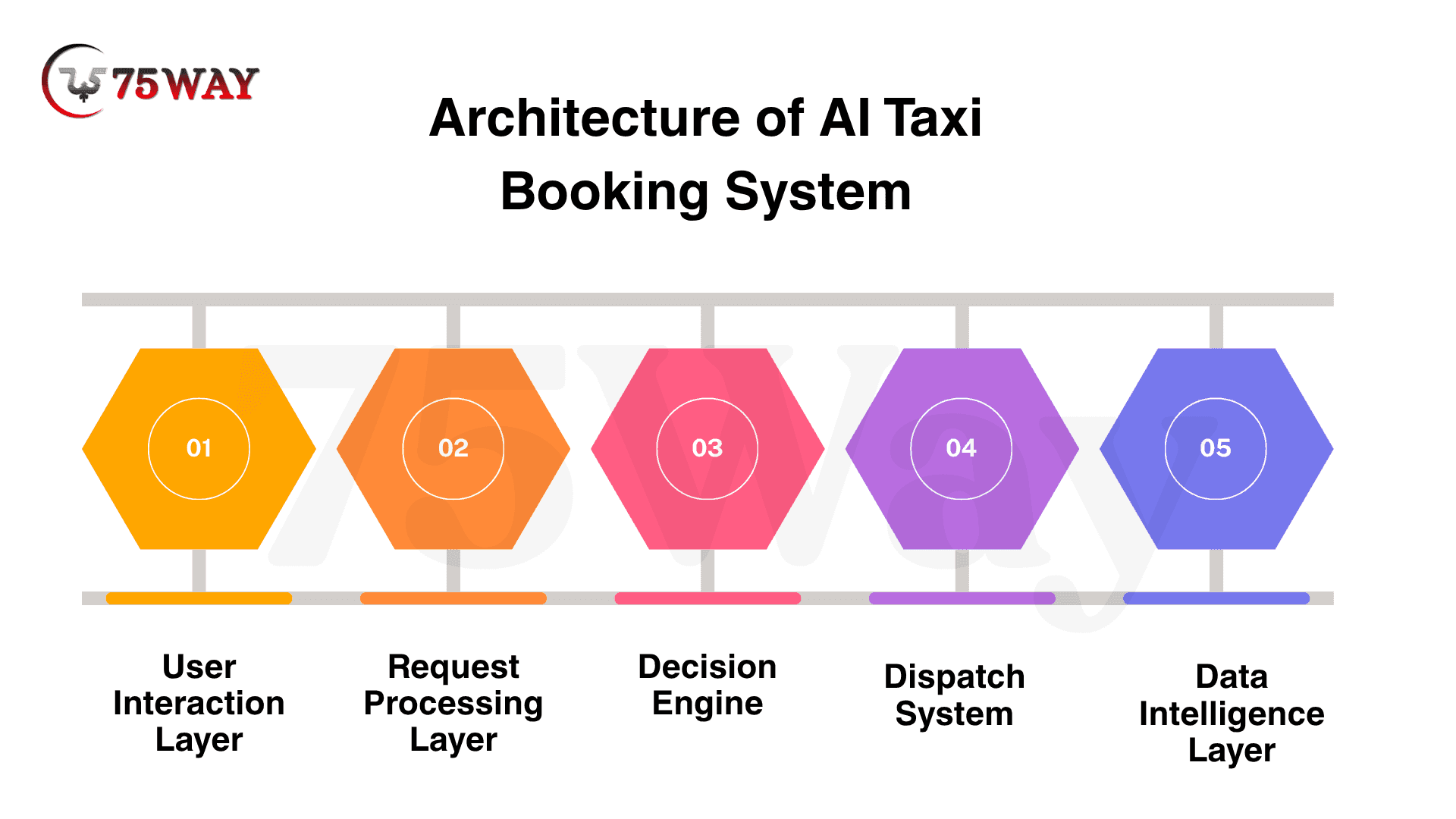
- User Interaction Layer: Customers use mobile apps, websites, or chat interfaces to book rides, track drivers, and receive updates. It ensures seamless communication between users and the system across multiple platforms. This layer focuses on delivering a simple, fast, and user-friendly booking experience.
- Request Processing Layer: This layer interprets incoming ride requests and validates essential details such as pickup location, destination, and timing. It ensures that all inputs are accurate and complete before moving forward. It also filters invalid or incomplete requests to maintain system efficiency and reliability.
- Decision Engine: The decision engine acts as the core intelligence unit of the system, responsible for assigning drivers, optimizing routes, and calculating dynamic pricing. It uses real-time data and algorithms to make fast and accurate decisions. This layer directly impacts efficiency, cost, and user satisfaction.
- Dispatch System: The dispatch system communicates instructions to drivers in real time based on decisions made by the engine. It ensures drivers receive ride details, pickup locations, and navigation updates instantly. This layer maintains synchronization between system decisions and on-ground execution.
- Data Intelligence Layer: This layer collects and analyzes trip data, user behavior, and operational metrics for continuous system improvement. It uses machine learning models to identify patterns and optimize future decisions. Over time, it enhances the accuracy, efficiency, and predictive capabilities of the entire platform.
Step-by-Step Workflow of AI Taxi Agent
The workflow of an AI taxi booking agent follows a structured sequence that ensures every ride request is handled efficiently from initiation to completion. It combines real-time data processing, intelligent decision-making, and automated communication to manage bookings, driver allocation, routing, and tracking seamlessly. This end-to-end automation improves speed, accuracy, and reliability across the entire ride experience.
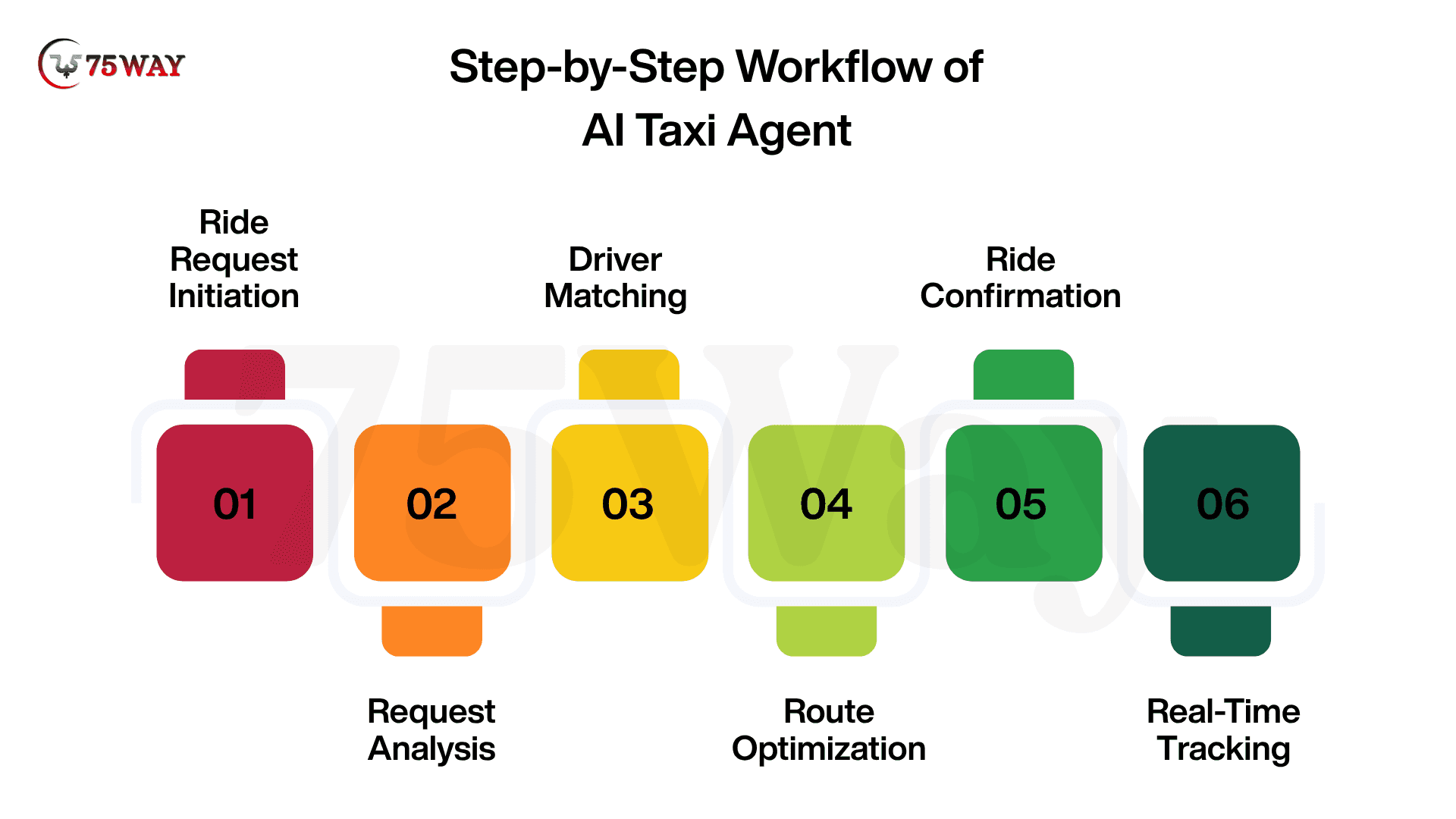
Step 1: Ride Request Initiation
The workflow begins when the user submits a ride request through an app, website, or chatbot interface. The system captures all essential trip details in real time and passes them forward for processing. This initiates a continuous flow where every next step depends on this input.
Step 2: Request Analysis
Once the request is received, AI analyzes pickup location, destination, and urgency to understand trip requirements. It validates the input data and prepares structured information for decision-making. This analyzed output is forwarded directly to the driver-matching system for execution.
Step 3: Driver Matching
Using the processed request data, the system selects the most suitable driver based on proximity, availability, and performance metrics. Real-time data ensures accurate allocation without delays or conflicts. The selected driver information is then passed to the routing engine for trip planning.
Step 4: Route Optimization
After driver assignment, AI calculates the fastest and most efficient route using live traffic and historical data. It continuously refines the route based on changing road conditions. The optimized route is shared with both the driver and the dispatch system for execution.
Step 5: Ride Confirmation
Once routing and driver allocation are finalized, the system sends an instant ride confirmation to the user with complete driver details. This ensures transparency and readiness for pickup. The confirmation connects the user directly to the real-time tracking system.
Step 6: Real-Time Tracking
During the ride, the system continuously tracks driver movement and updates the user with live status. It ensures synchronization between driver activity, system monitoring, and user visibility. This final stage completes the workflow while feeding data back into the system for future optimization.
Technology Stack Required To Build AI Taxi Agent
Building an AI taxi agent requires a combination of frontend interfaces, backend systems, AI integration layers, databases, and scalable cloud infrastructure working together seamlessly. These technologies ensure real-time ride processing, intelligent decision-making, and reliable system performance under high demand.
- Frontend: Handle user interaction for booking rides, tracking drivers, and receiving updates using React, Flutter, or Angular frameworks. It ensures a smooth UI/UX experience across mobile apps and web platforms with real-time responsiveness and intuitive navigation design.
- Backend: It manages core system logic, including ride processing, driver allocation, and request handling using Node.js, Python (FastAPI), or Java Spring Boot. It ensures secure communication between the frontend, AI systems, and databases, enabling a smooth operational flow.
- AI Integration: AI integration powers intelligent decision-making, such as route optimization, pricing, and driver matching using OpenAI APIs, TensorFlow, or PyTorch models. It enables predictive analytics and real-time automation for efficient taxi operations.
- Database: Database stores user data, ride history, driver information, and transaction records using PostgreSQL, MongoDB, or MySQL systems. It ensures fast data retrieval, scalability, and reliable storage for high-volume real-time operations.
- Infrastructure: Infrastructure supports deployment and scalability using AWS, Google Cloud Platform, or Microsoft Azure with Docker and Kubernetes. It ensures high availability, load balancing, and GPU support for AI processing workloads.
Benefits of Adopting AI Taxi Booking Agent Development Solutions
AI taxi booking agents significantly improve operational efficiency, reduce costs, and enhance customer satisfaction by automating core transportation workflows. They help taxi businesses scale faster while maintaining consistent service quality and real-time coordination across drivers, riders, and systems.
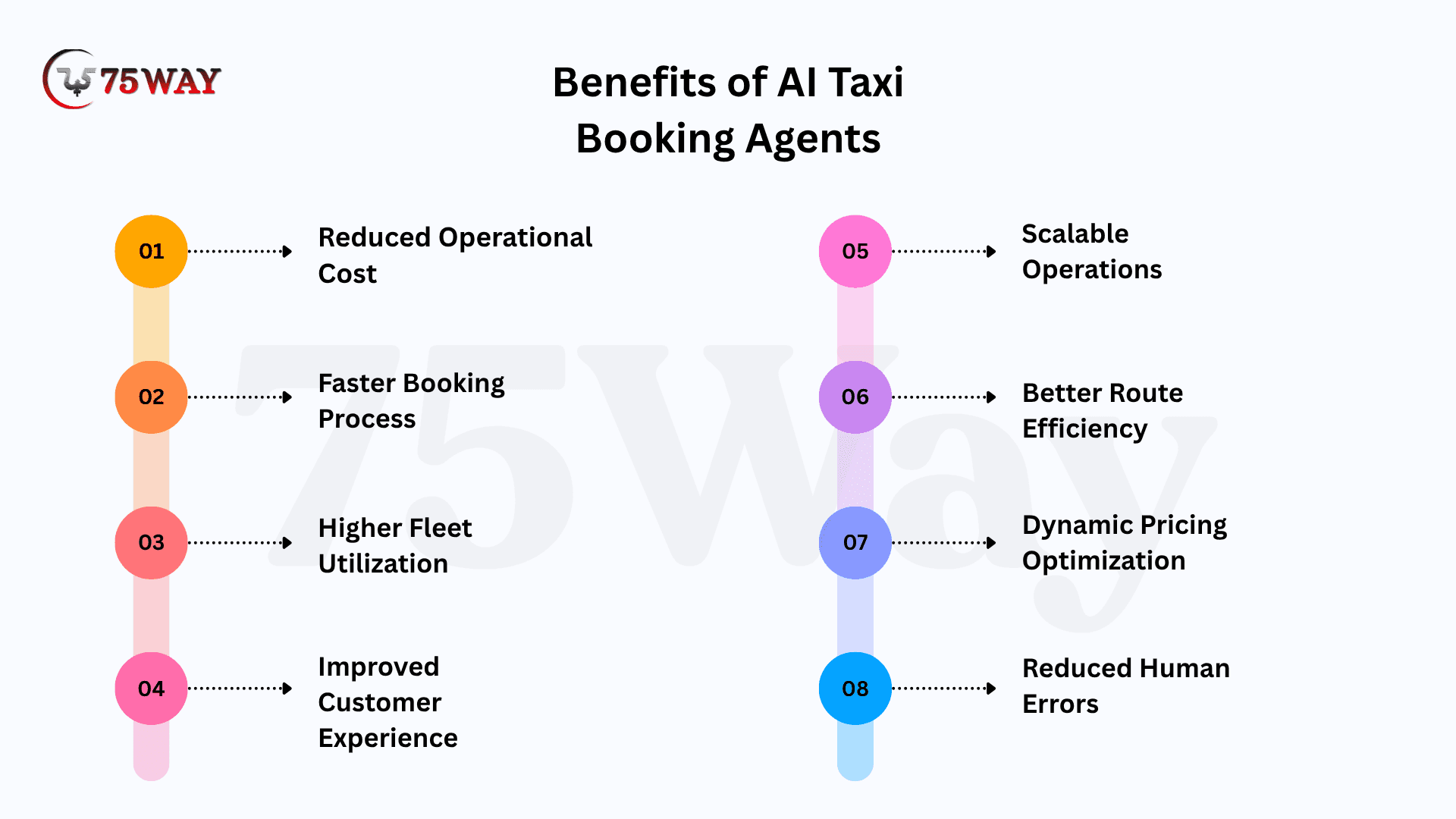
- Reduced Operational Cost: AI agents for taxi businesses minimize dependency on manual dispatch teams and call centers by automating booking and allocation processes. This leads to lower staffing expenses and more efficient resource utilization.
- Faster Booking Process: Instant ride allocation and confirmation reduce waiting time for users and improve service speed. This creates a smoother and more responsive booking experience.
- Higher Fleet Utilization: AI taxi booking agent intelligently assigns rides based on driver availability and location, reducing idle time. This ensures maximum use of available vehicles across the fleet.
- Improved Customer Experience: Real-time updates, accurate ETAs, and seamless communication improve trust and satisfaction. Customers receive consistent and transparent ride information throughout the journey.
- Scalable Operations: Taxi businesses can handle increasing demand without significantly expanding the manual workforce. AI systems adapt easily to higher ride volumes and growing fleets.
- Better Route Efficiency: Optimize routes using live traffic and historical data to reduce travel time. This helps drivers complete more rides in less time.
- Dynamic Pricing Optimization: Adjust fares based on demand, traffic, and availability to maximize revenue. This ensures balanced pricing during both peak and off-peak hours.
- Reduced Human Errors: Eliminate manual mistakes in booking, dispatching, and data entry processes. This improves overall system accuracy and operational reliability.
Final Thoughts
From booking requests to driver allocation and route optimization, AI taxi booking agents ensure faster, smarter, and more cost-effective operations. Taxi businesses that adopt AI-driven systems gain a significant advantage through improved fleet utilization, reduced operational overhead, and enhanced customer satisfaction. As urban mobility continues to grow, traditional manual dispatch systems will struggle to keep up with demand. AI agents provide a scalable and future-ready solution that enables taxi companies to expand without proportional increases in operational complexity. This shift marks the beginning of a fully automated transportation ecosystem where intelligence drives every ride decision. Building such systems today typically requires the support of a reliable AI development company to ensure the architecture, integrations, and scalability are handled correctly from the start.
Frequently Asked Questions (FAQs)
What Types of Businesses Can Use AI Taxi Booking Systems?
AI taxi booking systems can be used by ride-hailing companies, private taxi fleets, logistics providers, and corporate transport services. They help streamline bookings, reduce manual coordination, and improve overall transportation efficiency across different operational models.
Do AI Taxi Systems Work in Low-Internet Areas?
AI taxi systems require stable internet connectivity for real-time tracking, booking, and dispatching functions. However, some offline fallback features can store requests temporarily and sync data once connectivity is restored to maintain basic operations.
How Do AI Taxi Systems Handle Peak Demand?
During peak demand, AI systems dynamically allocate available drivers, adjust pricing, and optimize routing to balance supply and demand. This ensures faster ride confirmations and reduces customer waiting times even during high-traffic conditions.
Can AI Taxi Systems Integrate With Existing Apps?
Yes, AI taxi systems can integrate with existing mobile apps, websites, and third-party platforms through APIs. This allows businesses to upgrade their current infrastructure without rebuilding their entire application ecosystem from scratch.
What Skills Are Needed To Manage AI Taxi Platforms?
Managing AI taxi platforms requires knowledge of system operations, basic data understanding, and familiarity with digital dashboards. Technical teams may need expertise in cloud infrastructure, APIs, and AI model integration for advanced configurations.
Are AI Taxi Systems Expensive To Maintain?
Maintenance costs depend on scale, usage, and cloud infrastructure requirements. While initial setup may be higher, AI systems often reduce long-term operational costs by minimizing manual labor and improving efficiency across transportation workflows.
How Do AI Taxi Systems Improve Driver Experience?
AI systems improve driver experience by ensuring fair ride allocation, reducing idle time, and optimizing routes. This leads to better earnings consistency and less time wasted waiting for ride assignments or inefficient dispatching.
Can AI Taxi Systems Support Multiple Cities?
Yes, AI taxi systems are designed for scalability and can operate across multiple cities simultaneously. They adapt to regional demand patterns, traffic conditions, and pricing models while maintaining centralized control and performance monitoring.