Summary
AI agents automate business operations across industries by automating workflows, improving decision-making, and enhancing customer experiences. This guide explores top enterprise use cases, including sales automation, customer support, HR, finance, marketing, and operations. Businesses increasingly adopt AI agents to reduce costs, scale faster, and improve productivity across digital ecosystems.
Quick Overview
- AI agents automate complex business workflows across multiple departments.
- Enterprises use AI agents to improve customer experience and response speed.
- Sales and marketing teams rely on AI for lead generation and conversion.
- HR and recruitment processes are becoming highly automated and intelligent.
- Finance operations benefit from automated billing, fraud detection, and reporting.
- AI agents significantly reduce operational costs while increasing scalability.
Businesses across the world are rapidly shifting toward intelligent automation powered by AI agents. AI agents are capable of reasoning, decision-making, learning from data, and interacting with multiple systems simultaneously. This makes them significantly more powerful than rule-based AI automation tools or static workflows.
Organizations in the United States, Europe, and Asia are actively integrating AI agents into their digital infrastructure to improve efficiency, reduce operational costs, and accelerate business growth. From startups to Fortune 500 enterprises, AI agent development solutions are transforming how businesses operate, communicate, and scale.
Moreover, the rise of large language models, machine learning systems, and API-connected ecosystems has made AI agents more accessible and scalable than ever before. Businesses can now deploy domain-specific agents tailored for marketing, sales, customer service, HR operations, and financial management.
In this complete guide, we explore the top AI agent use cases for startups and large businesses in 2026, how enterprises are applying them across industries, real-world applications, implementation strategies, and future opportunities in AI-driven automation ecosystems.
What Are AI Agents In Business?
AI agents are intelligent software systems designed to perform tasks, make decisions, and interact with users or other systems autonomously. In modern business environments, they act like digital workers that can understand inputs, process information, and execute workflows without constant human supervision, making operations faster and more efficient.
These systems combine multiple advanced technologies such as machine learning, natural language processing, automation workflows, API integrations, and data-driven decision engines. Unlike traditional bots that follow fixed rules, AI agents continuously learn from data, adapt to changing conditions, and improve their performance over time, making them highly valuable for scalable business automation.
Read More:What Is an AI Agent? How It Helps Modern Businesses in 2026
Essential AI Agent Use Cases Every Business Should Adopt In 2026
AI agents are now being widely used across industries to automate operations, improve customer interactions, and make faster data-driven decisions. Businesses are adopting them to reduce manual workload, increase efficiency, and streamline daily workflows across sales, marketing, support, and internal operations in 2026.
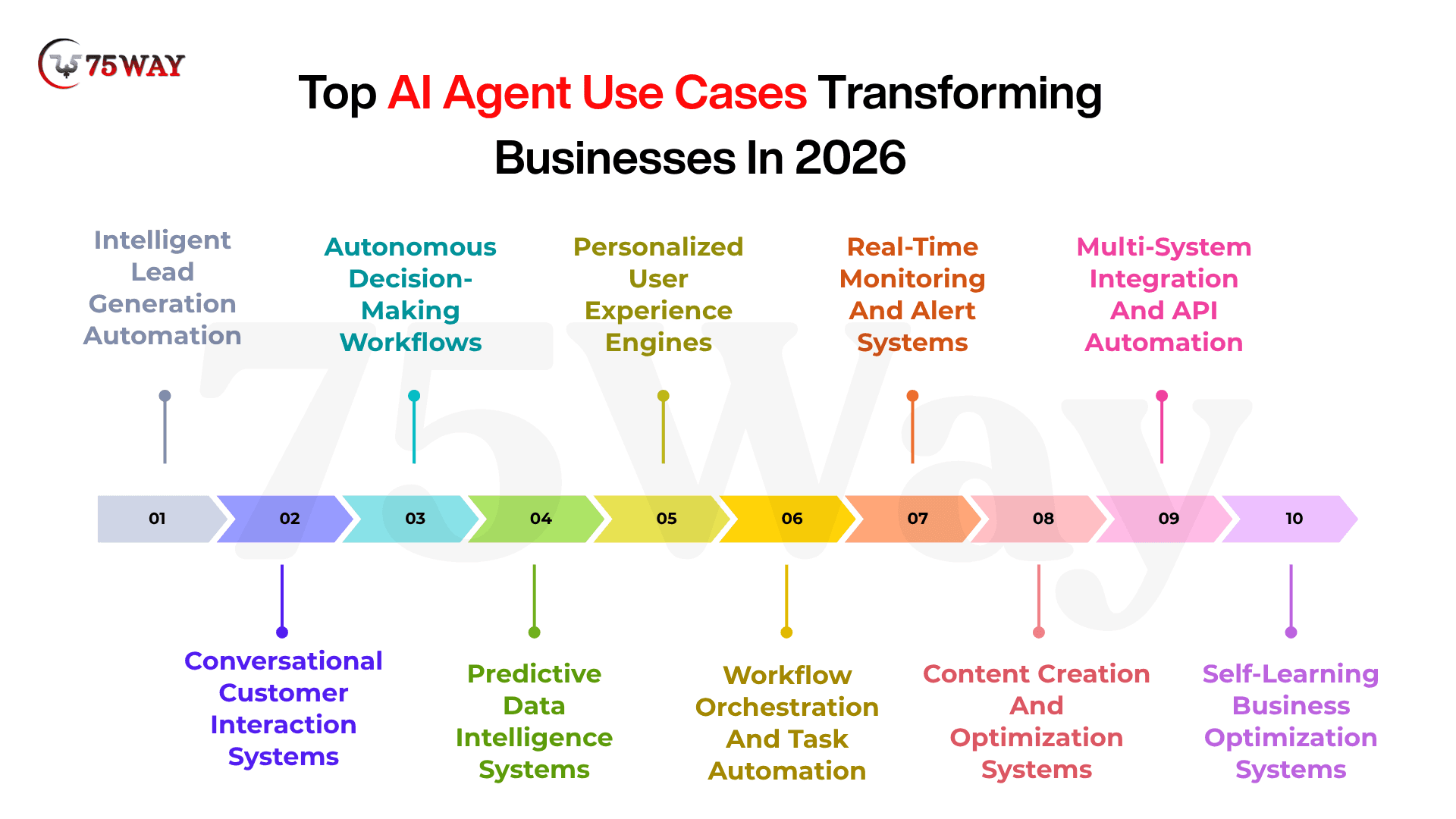
1. Intelligent Lead Generation Automation
Intelligent lead generation AI agents enable businesses to identify, attract, and qualify potential customers using data-driven intelligence systems. They improve targeting accuracy and reduce manual prospecting effort significantly across digital acquisition channels.
- Prospect Identification: AI systems analyze user behavior patterns across websites, ads, and platforms to identify high-intent prospects. These systems continuously track engagement signals and segment audiences based on conversion probability. Businesses receive refined lead pools ready for outreach and engagement.
- Lead Scoring Models: Predictive algorithms assign scores to leads based on engagement, demographics, and behavioral signals. Lead scoring AI agent helps prioritize high-value prospects before sales outreach begins. Companies reduce wasted effort and focus only on conversion-ready opportunities.
- Automated Outreach Sequences: AI systems generate personalized email and messaging campaigns based on user intent and timing. These sequences adjust automatically depending on response behavior. Businesses achieve higher engagement rates without manual intervention.
- Conversion Optimization Tracking: Systems continuously monitor lead behavior through funnel stages to identify drop-off points. AI suggests adjustments to messaging or targeting strategy. This improves conversion efficiency across campaigns.
- CRM Synchronization: AI tools automatically update customer relationship systems with enriched lead data and interaction history. This ensures sales teams always work with updated insights. Manual data entry requirements are significantly reduced.
- Intent Signal Detection: AI detects buying signals such as repeated visits, content engagement, and product interest. These signals help businesses time outreach perfectly. Conversion probability increases through timely engagement.
- Performance Analytics: Systems provide real-time dashboards showing lead performance and campaign effectiveness. Businesses can adjust strategies based on live insights. This enables continuous improvement in acquisition efficiency.
2. Conversational Customer Interaction Systems
Conversational AI voice agents enable businesses to interact with customers through intelligent, context-aware communication interfaces. These systems improve engagement speed and provide instant responses across multiple digital platforms globally.
- 24/7 Response Automation: AI systems handle customer queries at all hours without human involvement. They provide instant answers to common questions and support requests. This ensures uninterrupted customer engagement and satisfaction.
- Contextual Conversation Memory: Systems remember previous interactions to provide personalized responses. This creates more human-like engagement experiences across sessions. Customers receive consistent support without repeating information.
- Multilingual Communication Support: AI systems translate and respond in multiple languages instantly. They are also extending multilingual experiences to their content by using AI dubbing to translate videos, create natural voiceovers, and make their messages accessible to audiences across different languages. Communication barriers are significantly reduced across markets.
- Sentiment Detection: Systems analyze tone and emotion in customer messages to adjust responses accordingly. Negative sentiment triggers escalation workflows automatically. This improves customer experience management.
- Query Routing Intelligence: AI directs complex queries to appropriate departments or human agents. This reduces resolution time and improves operational efficiency. Customers reach the right support channel faster.
- Self-Service Assistance: Systems guide users through troubleshooting steps without human support. This reduces dependency on service teams. Customers resolve issues independently with structured guidance.
- Engagement Personalization: AI tailors responses based on user history and preferences. This improves customer satisfaction and retention rates. Engagement becomes more relevant and targeted.
3. Autonomous Decision-Making Workflows
Autonomous decision systems enable businesses to execute operational decisions using real-time data analysis and predefined intelligence rules. These systems reduce human dependency in repetitive decision-making processes.
- Real-Time Data Processing: AI systems analyze incoming data streams instantly for decision triggers. Businesses respond faster to operational changes. This improves reaction speed significantly.
- Rule-Based Automation Logic: Systems execute predefined business rules without human intervention. This ensures consistency in decision execution. Operational errors are significantly reduced.
- Predictive Outcome Modeling: AI simulates potential outcomes before decisions are executed. This reduces risk in business operations. Companies make more informed strategic choices.
- Exception Handling Systems: AI detects anomalies and escalates only unusual cases. Routine decisions are handled automatically. This reduces workload on management teams.
- Dynamic Workflow Adjustment: Systems modify workflows based on changing conditions. Businesses remain flexible in real-time environments. Operational efficiency improves continuously.
- Decision Prioritization Engines: AI ranks decisions based on urgency and business impact. High-priority actions are executed first. This improves resource allocation.
- Audit Trail Tracking: Every automated decision is recorded for compliance and analysis. Businesses maintain transparency in operations. Regulatory requirements are easier to manage.
4. Predictive Data Intelligence Systems
Predictive intelligence systems analyze historical and real-time data to forecast future business outcomes. These systems help organizations make proactive decisions instead of reactive responses.
- Trend Forecasting Models: AI identifies emerging patterns from historical datasets. Businesses anticipate market changes earlier. Strategic planning becomes more accurate.
- Behavior Prediction Engines: Systems analyze user activity to predict future actions. This improves personalization strategies. Engagement rates increase significantly.
- Demand Forecasting Systems: AI predicts product or service demand fluctuations. Businesses optimize inventory and resources accordingly. Operational efficiency improves.
- Risk Prediction Models: Systems identify potential business risks before they occur. This reduces financial and operational losses. Companies improve stability.
- Performance Analytics Engines: AI evaluates operational performance continuously. Businesses identify improvement areas faster. Decision-making becomes data-driven.
- Revenue Forecast Systems: AI estimates future revenue based on historical patterns. This improves financial planning accuracy. Businesses manage growth more effectively.
- Anomaly Detection Systems: AI identifies unusual patterns in datasets. This helps prevent fraud or operational failures. Early alerts improve response time.
5. Personalized User Experience Engines
Personalized user experience engines help businesses deliver tailored digital interactions based on real-time user behavior and historical engagement patterns. They improve retention, conversions, and satisfaction by dynamically adapting content, layout, and recommendations to individual user needs across platforms.
- Behavioral Personalization: Track user clicks, navigation paths, and interaction time to understand intent. Then adjusts content and interface dynamically for better engagement and reduced drop-offs.
- Dynamic Content Adaptation: Change website or app content instantly based on user behavior and context. Ensures each visitor sees highly relevant information that improves conversions and engagement outcomes.
- Recommendation Systems: Suggest products, services, or content using past behavior and preferences. This increases discovery speed and drives higher engagement, retention, and overall platform monetization.
- Journey Optimization: Analyze user funnels and remove friction points across digital journeys. This improves task completion rates, such as purchases, signups, and lead generation processes.
- Predictive User Intent: Forecast next user actions based on behavioral patterns and engagement signals. Businesses proactively guide users, improving conversion accuracy and reducing drop-off chances.
- Adaptive Interface Design: Modify UI elements like layout, navigation, and buttons based on user type. This improves usability and ensures smoother digital experiences across different audience segments.
- Engagement Scoring Systems: Assign engagement scores based on user activity and interaction quality. Businesses prioritize high-value users for marketing, retention, and personalized communication strategies.
6. Workflow Orchestration And Task Automation
Workflow orchestration systems automate and coordinate multiple business tasks across platforms, teams, and tools in a unified flow. They eliminate manual coordination, reduce delays, and improve operational efficiency through intelligent task sequencing and execution.
- Task Sequencing Automation: Organizes tasks automatically based on dependencies and priority rules. This ensures smooth execution flow and eliminates delays caused by manual task handling.
- Cross-Platform Coordination: Connects multiple business tools and systems into a unified workflow. Data moves automatically between platforms, eliminating silos and improving operational efficiency across departments.
- Process Trigger Automation: Starts workflows automatically when specific business events occur. This removes manual intervention and ensures faster response times across critical operational processes.
- Resource Allocation Optimization: Assigns tasks based on availability, workload, and priority. This improves productivity, reduces employee overload, and ensures efficient utilization of organizational resources.
- Error Detection And Recovery: Identifies workflow failures and automatically triggers corrective actions. This reduces downtime, maintains continuity, and ensures stable business operations at scale.
- Approval Workflow Automation: Automates routine approvals using predefined business rules and logic. This reduces decision bottlenecks and significantly accelerates internal approval cycles.
- Performance Workflow Analytics: Tracks workflow efficiency and identifies delays or inefficiencies in real time. Businesses use insights to continuously optimize operational performance.
7. Real-Time Monitoring And Alert Systems
Real-time monitoring systems continuously track business operations, system performance, and user behavior to detect anomalies instantly. They enable faster decision-making by generating immediate alerts for risks, failures, and opportunities across digital environments.
- Live Data Monitoring: Continuously track incoming system and business data in real time. This provides instant visibility and enables faster response to operational changes.
- Anomaly Detection Alerts: Identify unusual patterns in user behavior or system activity instantly. Alerts help prevent fraud, system failures, and operational disruptions effectively.
- Performance Threshold Tracking: Monitor KPIs against predefined benchmarks continuously. This ensures early detection of performance drops and maintains consistent business goal alignment.
- Security Threat Detection: Detect suspicious activity and cyber threats in real time. This protects sensitive business data and prevents potential breaches before escalation.
- System Health Monitoring: Track infrastructure, servers, and applications continuously for performance issues. This minimizes downtime and ensures high system reliability.
- User Behavior Tracking: Analyze user interactions to identify engagement patterns and friction points. This helps improve product experience and optimize customer journeys.
- Operational Alert Systems: Send instant alerts for critical business events or failures. This ensures faster response times and reduces operational risks.
8. Content Creation And Optimization Systems
Content systems help businesses generate, optimize, and distribute high-quality digital content at scale using AI. They ensure content is SEO-optimized, personalized, and performance-driven to maximize engagement, visibility, and conversions across channels. Content systems help businesses generate, optimize, and distribute high-quality digital content at scale using AI. They ensure content is SEO-optimized, personalized, and performance-driven to maximize engagement, visibility, and conversions across channels. Many organizations also outsource seo services to complement these systems, improving search rankings, expanding online reach, and driving sustainable growth.
- Automated Content Generation: Creates blogs, emails, and marketing content automatically using business inputs. This reduces manual effort while maintaining consistent content output at scale.
- SEO Content Optimization: Improves keyword usage, structure, and readability for better search rankings. This increases organic traffic and improves long-term content visibility.
- Content Personalization: Tailors content based on user segments, behavior, and preferences. This improves engagement rates and increases conversion performance across digital platforms.
- Multi-Channel Distribution: Multi-Channel Distribution: Automatically publishes content, including assets used for creating video campaigns, across websites, social media, and email channels.
- Performance Content Analytics: Tracks engagement, clicks, and conversions for all content pieces. This helps businesses refine strategies and improve overall content effectiveness.
- Creative Variation Generation: Produces multiple content variations for testing different messaging approaches. This improves A/B testing efficiency and increases marketing performance outcomes.
- Content Gap Analysis: Identifies missing topics and weak content areas in strategy. This improves SEO coverage and strengthens overall domain authority.
9. Multi-System Integration And API Automation
Integration systems connect multiple business tools, databases, and platforms into a unified digital ecosystem. They eliminate manual data transfer, ensure real-time synchronization, and improve operational efficiency across all systems.
- API Connectivity Automation: Automatically connects different software systems using APIs. This enables seamless data exchange and eliminates manual integration efforts completely.
- Cross-System Data Sync: Ensures real-time consistency of data across all connected platforms. This prevents duplication errors and maintains high data accuracy.
- Workflow Integration Engines: Links multiple business workflows into a single connected system. This improves coordination and ensures smooth cross-department operations.
- Third-Party Tool Automation: Integrates external tools like CRMs and payment systems automatically. This reduces setup time and improves scalability across business environments.
- Event-Based Integration Triggers: Activates system integrations based on specific business events. This ensures faster automation and reduces dependency on manual processes.
- Data Transformation Systems: Converts data formats between different systems for compatibility. This ensures seamless communication across diverse platforms and tools.
- Unified Dashboard Systems: Combines data from multiple systems into a single interface. This improves visibility and supports faster, data-driven decision-making.
Read Too:How to Build a Multi-Agent AI Lead Generation and Outreach System?
10. Self-Learning Business Optimization Systems
Self-learning systems continuously improve business performance by analyzing outcomes and adapting strategies automatically. They evolve over time without manual intervention, making businesses more intelligent, efficient, and adaptive.
- Continuous Learning Models: Continuously improve accuracy by learning from new data inputs. This ensures system intelligence grows steadily over time.
- Adaptive Strategy Optimization: Automatically adjusts business strategies based on performance outcomes. This improves efficiency and eliminates ineffective approaches dynamically.
- Feedback Loop Learning: Uses customer and system feedback to refine outputs continuously. This improves accuracy and enhances user satisfaction over time.
- Autonomous Process Improvement: Identifies inefficiencies and optimizes workflows without human input. This reduces operational waste and increases productivity across systems.
- Predictive Adjustment Systems: Anticipates future changes and adapts systems proactively. This helps businesses stay ahead of market shifts and risks.
- Performance Reinforcement Learning: Strengthens successful actions and reduces ineffective ones. This improves decision quality and overall system performance over time.
- Decision Evolution Engines: Continuously evolves decision-making logic using historical data. This strengthens long-term intelligence and improves strategic business outcomes.
Explore More: Hire Custom AI Agent Developer: Conversational Automation for Business Operations
Advanced AI Agent Use Cases Across Industries And Markets
AI agents are transforming industries by automating repetitive tasks, improving decision-making, and enhancing customer experiences at scale. From healthcare to real estate, businesses are using AI-driven systems to reduce operational workload and deliver faster, more personalized services across every touchpoint.
1. Healthcare
Healthcare AI agents support clinical workflows by assisting doctors, managing patient interactions, and improving operational efficiency. Agentic AI in healthcare helps reduce manual workload while improving patient outcomes through real-time monitoring and intelligent automation.
- Patient Support: AI agents handle patient queries, provide medical guidance, and offer 24/7 assistance for basic healthcare needs. This improves accessibility and reduces hospital support load significantly.
- Diagnostics Assistance: Systems analyze symptoms, medical history, and reports to assist doctors in faster and more accurate diagnosis. This reduces human error and speeds up clinical decision-making.
- Appointment Scheduling: AI automates booking, rescheduling, and reminders for patient appointments. This reduces administrative burden and improves hospital workflow efficiency.
- Monitoring Systems: AI continuously tracks patient vitals using connected devices and alerts medical staff during emergencies. This enables faster response and improved patient safety outcomes.
Read Too:AI Agent Development for Dental Clinic Admin Tasks & Management
2. Ecommerce & Retail
AI agents in ecommerce and retail improve customer experience, optimize inventory, and increase sales conversions through personalized recommendations and automated support systems.
- Customer Personalization: AI analyzes user behavior and purchase history to deliver personalized product recommendations. This increases engagement and improves conversion rates significantly.
- Inventory Tracking: Systems monitor stock levels in real time and predict demand trends. This helps retailers avoid stockouts and overstocking issues efficiently.
- Automated Sales Assistance: AI agents guide customers through product selection and purchasing decisions. This improves customer experience and boosts overall sales performance.
3. Banking & Finance
Banking and finance AI agents improve security, streamline onboarding, and provide intelligent financial guidance for customers across digital banking platforms.
- Fraud Detection: AI monitors transactions in real time to detect suspicious activity and prevent financial fraud. This strengthens banking security and reduces financial risks.
- Customer Onboarding: Systems automate identity verification and account setup processes. This reduces onboarding time and improves customer experience significantly.
- Financial Advisory Systems: AI provides personalized investment and financial planning recommendations. This helps customers make smarter financial decisions based on data insights.
Education
Education AI agents enhance learning experiences by personalizing content, automating assessments, and supporting students with real-time guidance.
- Personalized Learning: AI agent adapts learning materials based on student performance and progress. This improves understanding and learning outcomes effectively.
- Grading Automation: Systems evaluate assignments and exams automatically using predefined criteria. This reduces teacher workload and improves grading consistency.
- Student Support: AI provides instant answers to student queries and academic assistance. This ensures continuous learning support outside classroom hours.
Real Estate
AI agents for real estate streamline property discovery, improve lead management, and enhance client communication for faster deal closures.
- Real Estate Lead Qualification: AI evaluates and filters potential buyers or renters based on intent and behavior. This helps agents focus on high-quality leads.
- Property Matching:AI property management agents recommend properties based on user preferences and budget. This improves search efficiency and customer satisfaction.
- Client Communication:Conversational AI for real estate handles follow-ups, inquiries, and scheduling for property visits. This improves responsiveness and increases conversion rates.
Read More:
How To Implement AI Agents In Your Business?
Implementing AI agents in business requires a structured, connected approach where each stage builds directly on the previous one. This ensures the system evolves smoothly from identifying problems to deploying fully functional automation that continuously improves over time.
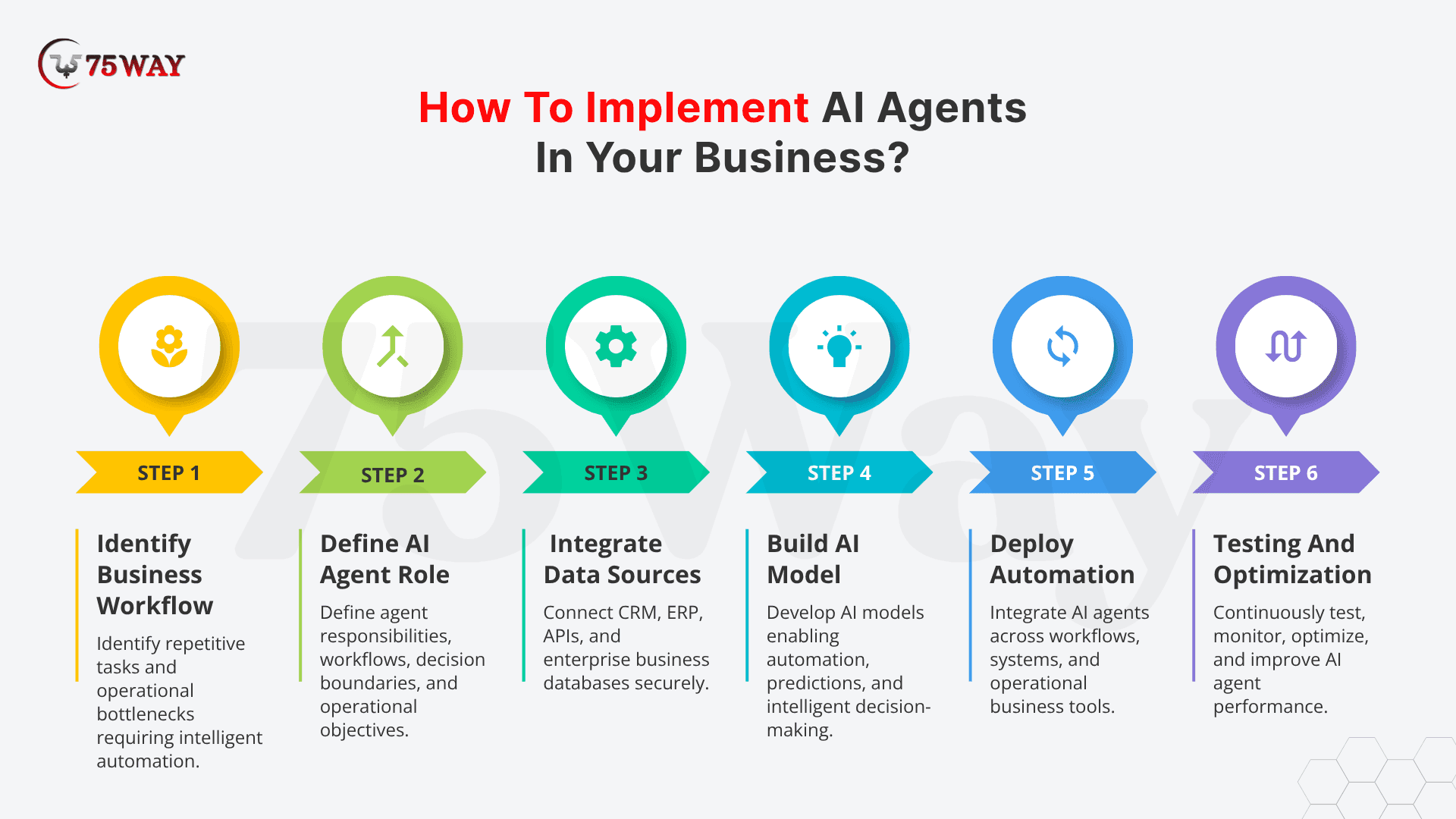
Step 1: Identify Business Workflow
Start by identifying repetitive, time-consuming, or high-volume tasks that slow down operations. This step sets the foundation for everything else by clearly defining where AI automation will create maximum business impact and efficiency gains.
Step 2: Define AI Agent Role
After identifying workflows, define the exact role of the AI agent, including tasks, inputs, outputs, and decision boundaries. This ensures the agent is designed specifically to solve the selected business workflow efficiently and without ambiguity.
Step 3: Integrate Data Sources
Once the AI role is defined, connect relevant data sources like CRM, ERP, and databases to provide real-time and historical information. This enables the AI agent to make informed, context-aware decisions based on accurate business data.
Step 4: Build AI Model
With data in place, develop or configure AI models that process information, generate insights, and support decision-making. This layer transforms raw data into actionable intelligence that powers the AI agent’s core functionality.
Step 5: Deploy Automation
After the AI model is ready, integrate it with business workflows, APIs, and operational tools for real execution. This step ensures the AI agent actively performs tasks across systems without manual intervention.
Step 6: Testing And Optimization
Finally, test the entire system in real scenarios and continuously monitor performance for accuracy and reliability. Insights from testing are used to refine earlier stages, improving overall efficiency and long-term scalability.
Know In Depth:AI Agent Development: A Step-by-Step Guide For Beginners
Final Remarks
To conclude, AI agents are no longer experimental tools—they are becoming the backbone of modern digital business operations. From healthcare and banking to retail and education, their ability to automate workflows, personalize experiences, and make real-time decisions is changing how companies operate at scale. The top use cases of AI agents clearly show one thing: businesses that rely on manual processes will struggle to compete in 2026. Speed, accuracy, and automation are now basic expectations, not advantages. As adoption grows, AI agents will keep evolving into smarter, self-learning systems that reshape entire industries. If you are planning to implement these solutions, connect with an AI development company to get started right.
Frequently Asked Questions (FAQs)
What Are AI Agents In Business Automation?
AI agents are intelligent software systems that perform business tasks autonomously using machine learning, natural language processing, and automation workflows. They help organizations manage customer support, sales, HR, finance, and operations with minimal human intervention while improving efficiency and accuracy.
How Do AI Agents Improve Business Efficiency?
AI agents improve efficiency by automating repetitive tasks, reducing manual workload, and speeding up decision-making processes. They process large datasets in real time, manage workflows, and interact with customers or systems autonomously, allowing businesses to operate faster and more effectively across multiple departments.
Are AI Agents Replacing Human Jobs?
AI agents are not fully replacing jobs but transforming job roles. They handle repetitive and time-consuming tasks while allowing employees to focus on strategic, creative, and decision-making activities. This shift increases productivity and creates new opportunities in AI supervision and system management.
What Skills Are Required To Implement AI Agent Systems In Businesses?
Implementing AI agent systems requires skills in machine learning, API integration, data engineering, workflow automation, and cloud architecture. Knowledge of natural language processing and prompt engineering is also important. Businesses often rely on specialized development teams to design scalable, secure, and intelligent AI-driven operational systems.
Can AI Agents Work With Existing Business Software?
Yes, AI agents are designed to integrate with existing business software without requiring full system replacement. They connect through APIs, middleware, and automation layers to enhance CRM, ERP, and communication tools. This allows businesses to improve efficiency while maintaining their current digital infrastructure.
Are AI Agent Systems Suitable For Small And Medium Businesses?
Yes, AI agent systems are highly suitable for small and medium businesses due to their scalability and cost efficiency. SMBs can start with lightweight automation solutions and gradually expand capabilities as their operations grow, making AI adoption flexible and financially manageable.