AI Summary
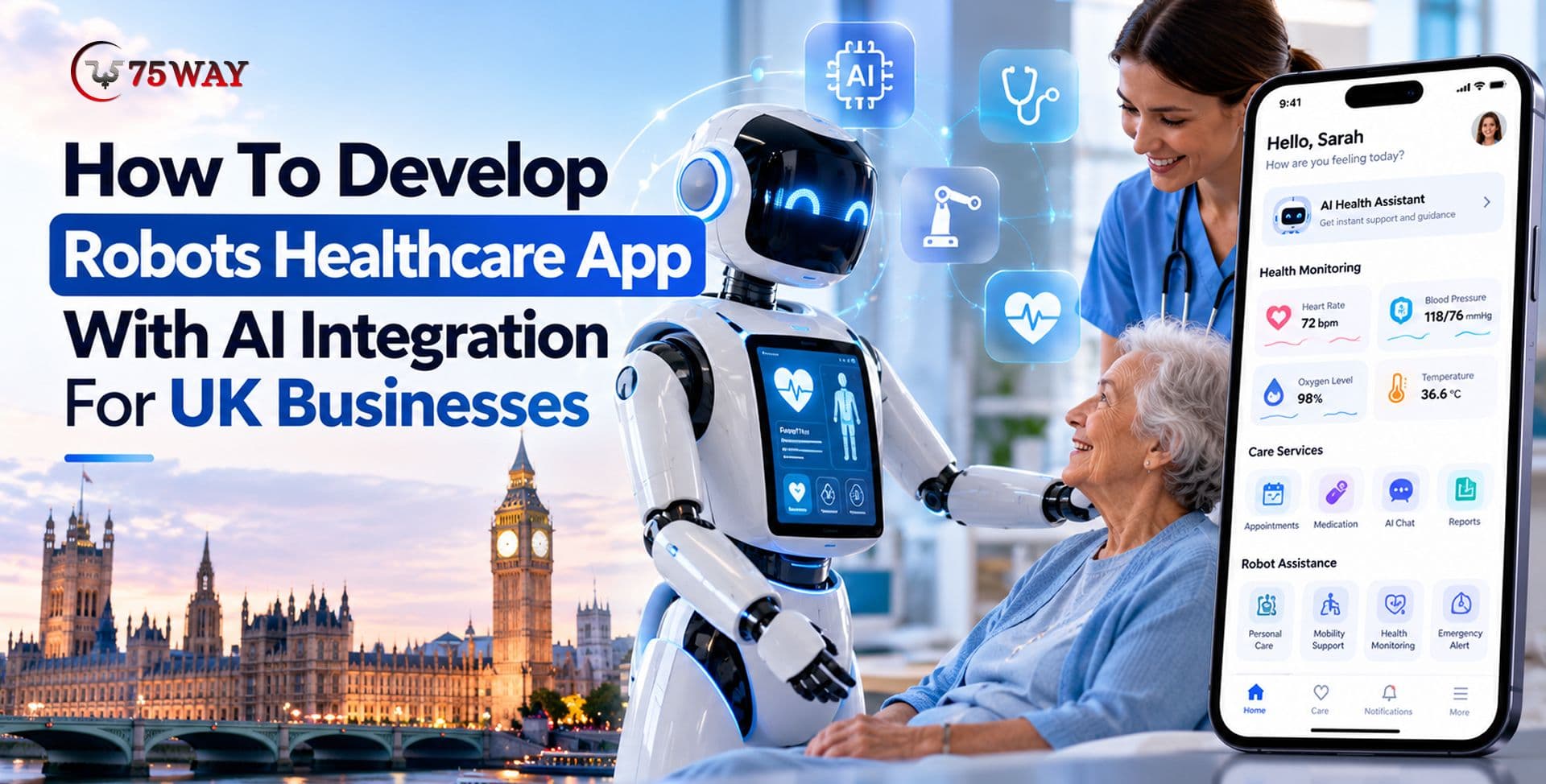
Healthcare robotics is opening new opportunities for businesses ready to combine intelligent software with real-world care. This guide explains how to develop a robots healthcare app with AI integration. You will explore practical robot applications, technology choices, and development stages.
Key Takeaways
- The UK medical service robots market is projected to reach $196.2 million by 2033.
- Healthcare robotics app development can cost £30,000–£300,000+, depending on complexity.
- AI integration enables perception, anomaly detection, predictive maintenance, and workflow assistance.
- Robust architecture connects robot hardware, AI services, applications, and healthcare systems.
- UK compliance, clinical safety, rigorous testing, and human oversight shape deployment readiness.
Thinking about building a healthcare robotics app in the UK? If you’re a healthcare provider or business owner, you’ve probably wondered how robotic technology could make patient care easier and reduce the pressure on medical staff.
Once that’s clear, you can decide which features to build, how the robots healthcare app development solution will communicate with robotic hardware, and what healthcare professionals need from the interface. For the UK market, safety, data protection, clinical validation, and applicable regulatory requirements also deserve attention from the outset.
That might sound like a lot to manage, but a clear development roadmap makes the process easier to understand. In this guide, we’ll cover the essential stages of healthcare robotics app development, from initial planning to deployment and ongoing maintenance.
Quick Answer: What Is A Healthcare Robotics App With AI Integration?
A healthcare robotics app with AI integration is a software application that connects healthcare professionals, patients, robotic devices, and intelligent software services through a shared interface. Depending on the intended use, it may help staff monitor robots, review sensor data, manage tasks, receive alerts, or access AI-generated insights.
The application does not necessarily control every robot movement directly. A typical solution may include several connected components:
- User Interface: A web dashboard or mobile application for clinicians, technicians, patients, and administrators.
- Backend Services: APIs, authentication, permissions, databases, and workflow management.
- Robot Integration Layer: Communication with supported robot interfaces, telemetry feeds, or device management systems.
- AI Services: Computer vision, anomaly detection, predictive analytics, or other models appropriate to the use case.
- Healthcare Integrations: Approved connections to electronic health records, scheduling platforms, or other clinical systems.
Consider a rehabilitation clinic that uses robotic equipment during physiotherapy sessions. The application might let therapists review session data, monitor equipment status, and track patient progress. AI could identify patterns in the collected data, but clinical interpretation would still require validation and professional oversight.
The important distinction is that the application, the AI model, and the robot's control system serve different purposes. A successful product must define how those components communicate and what happens when one of them fails.
Business Opportunities To Build Robot-Powered Healthcare App in UK Market
The growing use of robotics in healthcare creates new possibilities for businesses developing specialized software for medical environments. Entrepreneurs can explore healthcare apps that connect robotic devices with hospital management systems, support equipment monitoring, or help healthcare teams coordinate robotic operations. Here are the key business opportunities to consider when planning a robot-powered healthcare app in the UK.
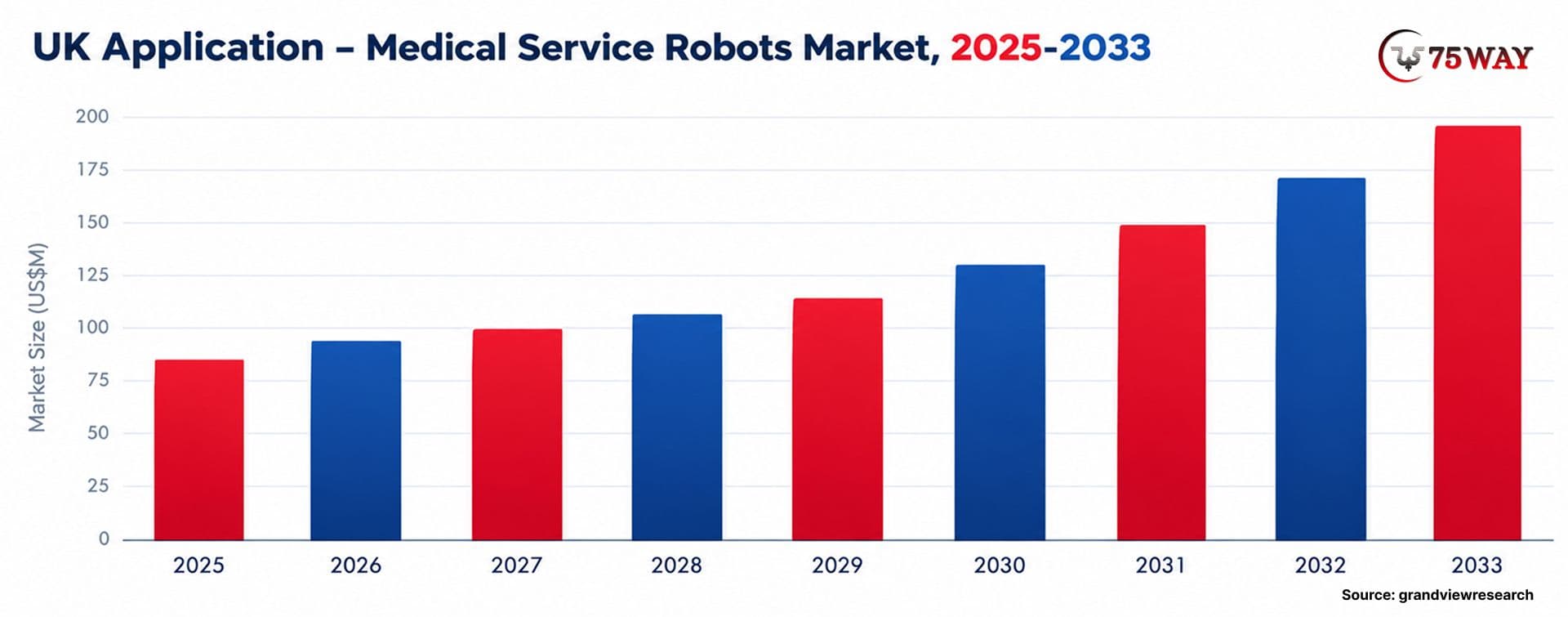
- The UK Medical Robots Market was valued at $212.2 million in 2024 and is forecast to reach $449.5 million by 2029, growing at a 16.2% CAGR.
- The UK medical service robots market is projected to generate US$196.2 million in revenue by 2033, registering a 12.64% CAGR.
- The UK accounted for 5.5% of the global medical service robots market revenue.
- Within Europe, Germany’s medical service robots market is expected to lead the region in revenue by 2033.
AI-Powered Healthcare Robotics App Development Process: A Complete Process
A successful healthcare robotics app brings robotic technology and healthcare workflows together to solve real problems. From choosing the right use case to integrating robotic hardware, protecting patient data, and meeting UK regulatory requirements, every development decision matters. Let’s explore the key steps to build a healthcare robotics app from concept to launch.
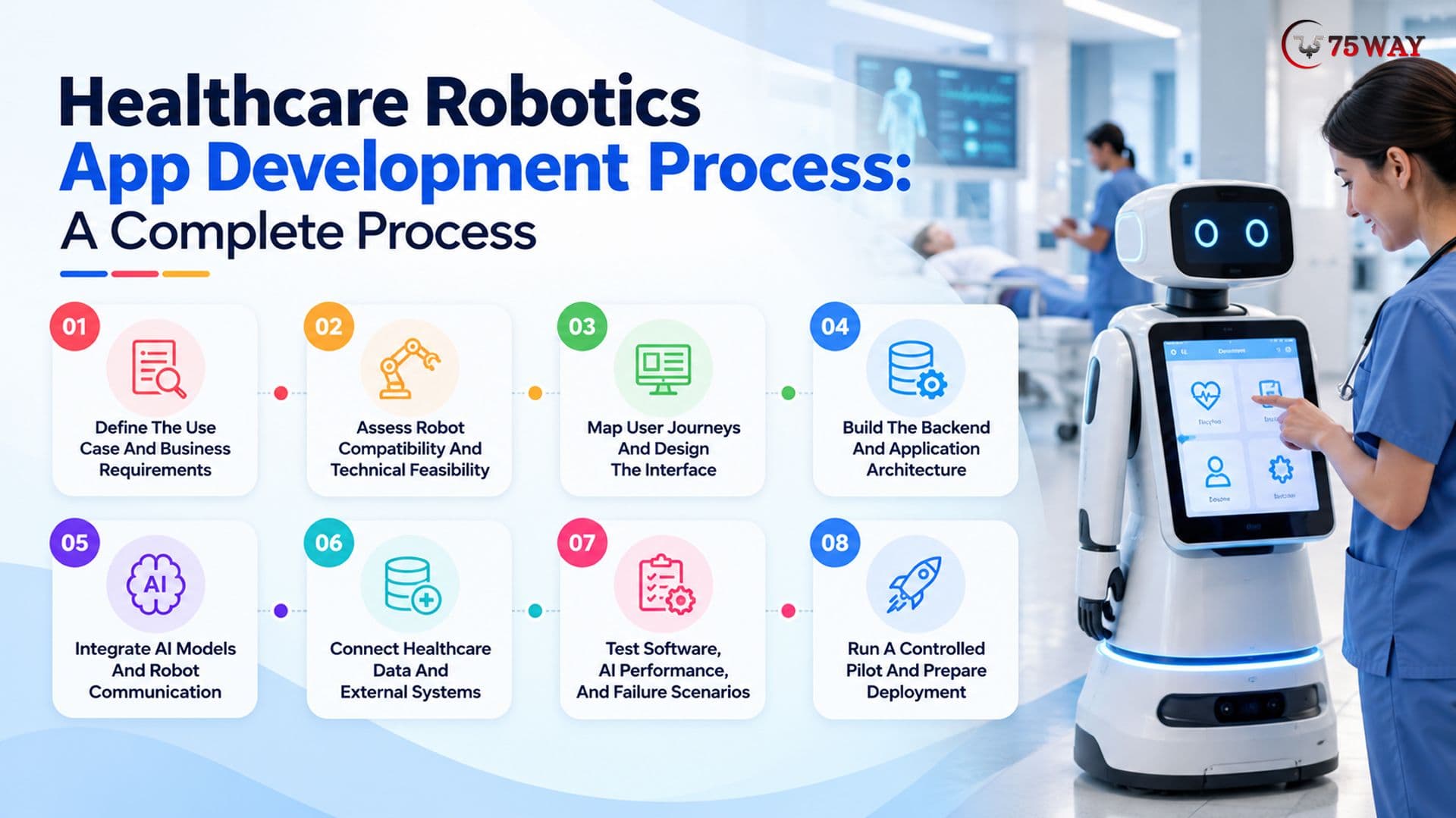
Step 1: Define The Use Case And Business Requirements
A successful healthcare robotics app starts with a clear business problem and a specific outcome. Your team needs to understand who will use the app, which robot it will support, and how it will improve healthcare operations.
- Identify the primary healthcare challenge
- Define users and their responsibilities
- Confirm robot models and compatibility
- Map existing systems and workflows
- Set measurable goals and acceptance criteria
For example, a startup developing a hospital delivery application might initially support one robot model and one hospital workflow. That boundary makes integration easier to evaluate and prevents the first release from expanding into a complete hospital automation platform.
Step 2: Assess Robot Compatibility And Technical Feasibility
Robot compatibility deserves early attention because it can determine whether the project is practical within the proposed budget and timeline.
The development team should establish which interfaces the manufacturer supports, what data the robot exposes, and whether authorised commands can be sent through a documented SDK, API, or robotics middleware. The team must also understand hardware limitations, network requirements, communication protocols, and any restrictions on third-party software.
A robot that exposes useful telemetry through a documented interface may be relatively straightforward to connect. A proprietary system with limited documentation, restricted access, or additional hardware requirements may need substantially more engineering work.
The feasibility assessment should confirm:
- Which robot models and firmware versions are supported.
- Which readings, events, and commands are available.
- Whether a simulator or development kit is available.
- How the system behaves when connectivity is interrupted.
- Which hardware, vendor licences, and testing facilities are required.
Deliverable: A technical feasibility report with integration risks, dependencies, and a recommended architecture.
Step 3: Map User Journeys And Design The Interface
The application must make sense to users during a busy workday. A dashboard that looks attractive but hides device faults, creates confusing alerts, or requires too many steps will not solve the underlying problem.
Design separate user journeys for the relevant roles. A technician may need a device health screen and maintenance history, while a clinician may need session information and a clear view of alerts requiring review.
The UX/UI team should develop wireframes, interactive prototypes, and usability test scenarios before committing to the full interface. Accessibility, readable status indicators, error messages, and confirmation steps for consequential actions should be considered from the outset.
For safety-sensitive functions, the design should make the current system state clear and distinguish between a confirmed event, an AI-generated suggestion, and information that requires human review.
Step 4: Build The Backend And Application Architecture
Once the workflows and interfaces are defined, the engineering team can design the backend services, database structure, APIs, and access controls.
- Design backend services for robot communication and management
- Structure databases for users, devices, tasks, and telemetry
- Develop APIs for applications and healthcare system integrations
- Set access controls based on user roles and permissions
- Plan real-time updates and background processing tasks
- Implement encryption, monitoring, recovery, and secure software updates
Step 5: Integrate AI Models And Robot Communication
AI integration should solve a specific problem that conventional software cannot adequately address, rather than serve as a marketing feature.
A computer vision model might interpret approved camera inputs, while an anomaly detection model could identify unusual telemetry patterns. A natural-language interface might help staff retrieve approved operational information, provided that access permissions and output limitations are properly managed.
The development team must decide whether to use a pretrained model, adapt an existing model, or develop a custom one. That decision depends on available data, performance requirements, privacy constraints, validation needs, and the consequences of incorrect predictions.
Robot communication requires separate engineering attention. The application should validate incoming data, handle timeouts, distinguish between confirmed and pending commands, and record failures. Any commands affecting safety-critical movement must remain within the robot's approved control and safety architecture.
The AI service should not bypass established safety mechanisms. A model output may inform an authorised workflow, but consequential actions need appropriate validation and controls.
Step 6: Connect Healthcare Data And External Systems
A robotics application may need to connect with patient records, scheduling software, identity systems, or hospital operational platforms. These integrations should be selected according to the intended workflow rather than added simply because an API is available.
The team must establish which information is necessary, how records are matched, who can access them, and how errors or conflicting updates are handled. Data mapping and validation are especially important when systems use different identifiers, formats, or definitions.
Where NHS integration is planned, the project may need additional work around interoperability, supplier requirements, technical assurance, and information governance. Those dependencies should be identified before the development timeline is finalised.
Step 7: Test Software, AI Performance, And Failure Scenarios
Testing must confirm the application works as intended under normal conditions and when things go wrong.
Functional testing checks the user interface and workflows. Integration testing verifies communication between the application, AI services, robot interfaces, and external systems. Security testing assesses permissions, vulnerabilities, and data protection controls.
AI testing should use suitable evaluation data and operating conditions. A model that performs well in a controlled demonstration may behave differently with unfamiliar environments, noisy sensors, poor lighting, or incomplete inputs.
The team should test scenarios such as:
- A robot loses network connectivity during an assigned task.
- Sensor readings are missing, delayed, or outside expected ranges.
- An AI service becomes unavailable or produces an uncertain result.
- A user attempts an action without the required permission.
- An integration sends duplicate or inconsistent records.
- A software update introduces an unexpected behaviour.
The acceptance criteria should be agreed before testing begins. A successful demonstration alone does not establish that a healthcare robotics application is safe or ready for real-world use.
Step 8: Run A Controlled Pilot And Prepare Deployment
A pilot helps the team evaluate the application in a defined environment before expanding its use. The pilot scope should identify the participating users, supported robot models, permitted workflows, success measures, and escalation procedures.
Operational measures may include task completion, device availability, alert accuracy, and time to resolve faults. Any clinical measures require appropriate definitions and oversight.
The team should train users, prepare support procedures, establish monitoring, and document how issues will be reported and resolved. A rollback plan is also important when a release affects a connected robot or a critical workflow.
Deployment does not end the development process. Model performance, security vulnerabilities, device compatibility, user feedback, and changing regulatory requirements may all require future updates.
Quick Read: Healthcare Mobile App Development: Strategy and Best Practices
Types of Healthcare Robotics Apps UK Hospitals Can Build With AI Integration
You can launch different healthcare robotics apps based on the problem you want to solve, the robot's capabilities, and the role AI will play. From automating hospital deliveries to supporting rehabilitation and remote patient monitoring, each application requires different features, integrations, and safety measures.
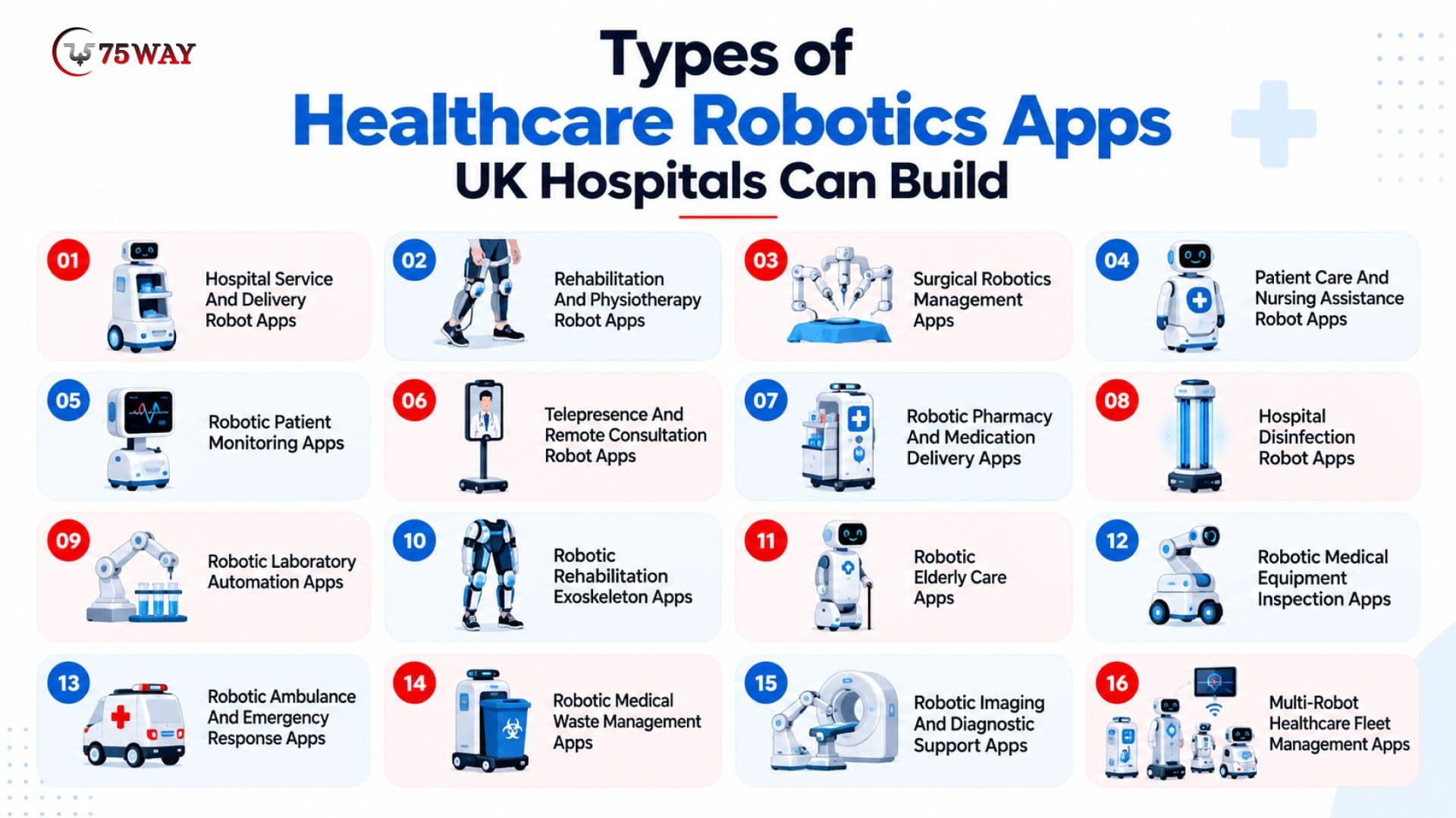
1. Hospital Service And Delivery Robot Apps
Hospital service robot apps help healthcare facilities manage robots that transport medicines, medical supplies, meals, and equipment. Robotics hospital apps can assign delivery tasks, monitor robot locations, track battery levels, and alert staff when tasks are delayed.
AI can support route planning, obstacle detection, task prioritization, and predictive maintenance, depending on the robot's capabilities.
2. Rehabilitation And Physiotherapy Robot Apps
Rehabilitation robot apps support physiotherapists and patients during movement training, recovery exercises, and assisted therapy sessions. Features can include session scheduling, movement tracking, progress reports, and therapist dashboards.
AI can analyze movement patterns and session data to help therapists assess progress, provided the models are validated for their intended use.
3. Surgical Robotics Management Apps
Surgical robotics applications can help authorized clinical teams access device status, manage approved workflows, review operational information, and monitor system readiness. Their functionality depends on the surgical robot and its supported interfaces.
AI integration requires careful assessment when software influences clinical decisions or surgical actions. Safety-critical functions must remain within validated control systems and appropriate clinical oversight.
4. Patient Care And Nursing Assistance Robot Apps
These apps support robots designed to assist with selected patient care activities, reminders, routine interactions, and care coordination. Staff may use the application to manage tasks, review alerts, and monitor robot availability.
AI can support conversational interactions or workflow assistance, but patient-facing outputs need appropriate safeguards, accessibility considerations, and human escalation options.
5. Robotic Patient Monitoring Apps
Robotic patient monitoring apps connect supported robots and monitoring devices with dashboards that display permitted observations, device status, and alerts. Healthcare professionals can use them to review incoming information and identify readings that require attention.
AI may flag unusual patterns or prioritize alerts for review. The application must distinguish between an AI-generated warning and a clinically confirmed finding.
6. Telepresence And Remote Consultation Robot Apps
Telepresence robot apps allow authorized healthcare professionals to interact with patients or colleagues remotely through compatible robotic systems. Features may include video communication, remote navigation within approved limits, appointment coordination, and session management.
AI can support speech transcription, accessibility features, or meeting summaries where appropriate. Privacy controls and restrictions on remote movement are important considerations in clinical environments.
7. Robotic Pharmacy And Medication Delivery Apps
These medicine delivery applications help pharmacies and healthcare facilities coordinate compatible robots used for medication handling, inventory movement, or internal delivery. Features may include task queues, inventory records, delivery status, and exception reporting.
AI can help forecast demand, identify inventory patterns, or flag discrepancies. Medication verification, dispensing safeguards, and authorized access must remain clearly defined.
8. Hospital Disinfection Robot Apps
Disinfection robot apps help facilities schedule cleaning tasks, monitor device status, record completed cycles, and track maintenance requirements. Depending on the robot, the app may show operational status and flag incomplete or interrupted tasks.
AI can help with route planning, operational analytics, and predictive maintenance. The software should not treat a completed robot cycle as proof of effective disinfection without suitable validation.
9. Robotic Laboratory Automation Apps
Laboratory robotics applications coordinate compatible robots for sample handling, preparation, testing workflows, or moving laboratory materials. They can manage task queues, track sample identifiers, record equipment status, and flag processing errors.
AI may support image analysis, anomaly detection, or workflow optimization. Key design considerations include sample traceability, data integrity, and integration with laboratory information management systems.
10. Robotic Rehabilitation Exoskeleton Apps
Exoskeleton applications support the monitoring and management of compatible wearable robotic systems used in rehabilitation or mobility assistance. Depending on the device, features may include session configuration, movement records, device status, and therapist review.
AI can analyze movement patterns or assist with progress assessment. Any adaptive assistance or movement-related decisions must remain within the device's validated capabilities and appropriate safety controls.
11. Robotic Elderly Care Apps
Elderly care robotics apps support compatible robots used for reminders, social interaction, routine assistance, and selected monitoring activities. Care teams may use dashboards to manage reminders, review permitted activity information, and coordinate follow-up.
AI can support natural-language interaction and personalized reminders, but the application should protect personal information and provide clear escalation options when a person needs human assistance.
12. Robotic Medical Equipment Inspection Apps
These applications help healthcare engineering teams manage robots or robotic systems used to inspect equipment, infrastructure, or selected clinical environments. Features may include inspection scheduling, image records, fault reports, and maintenance histories.
AI-based image analysis can flag visible defects or unusual patterns for further inspection. A qualified technician should verify findings before consequential maintenance decisions are made.
13. Robotic Ambulance And Emergency Response Apps
Emergency response robotics apps can support compatible robots used for supply transport, remote observation, or assistance in selected emergency environments. The application may provide task coordination, location information, device status, and communication with authorized responders.
AI may help prioritize operational tasks or analyze approved sensor inputs. Emergency workflows need reliable communication, clear responsibility, and appropriate fallback procedures when the system becomes unavailable.
14. Robotic Medical Waste Management Apps
These apps help healthcare facilities coordinate robots that transport medical waste along approved routes. Features may include collection scheduling, route status, container tracking, task completion records, and maintenance alerts.
AI can help optimize collection schedules and identify recurring operational bottlenecks. Access restrictions, contamination controls, and route safety must reflect the facility's waste-handling procedures.
15. Robotic Imaging And Diagnostic Support Apps
Applications in this category connect compatible robotic medical imaging equipment or robotic positioning systems with workflows for authorized healthcare professionals. They may manage examination scheduling, equipment status, image transfer, and review workflows.
AI can support selected image-processing or analysis tasks where appropriate. Software intended to interpret medical images or influence diagnosis requires careful evaluation of its medical-device status and clinical validation requirements.
16. Multi-Robot Healthcare Fleet Management Apps
A fleet management app coordinates multiple compatible robots across a hospital, laboratory, or healthcare facility. It can assign tasks, monitor device availability, manage charging schedules, and show fleet-wide performance.
AI can help prioritize tasks, predict congestion, and allocate resources based on operational requirements. The application must account for different robot capabilities, communication failures, and permissions across the fleet.
Read Too: Top AI Agent Developers for Healthcare Industry in 2026
Essential Features For Building A Healthcare Robotics App
The right features determine whether a healthcare robotics app solves practical problems or simply adds complexity. From remote monitoring and system integration to activity logs and security controls, each function should serve a clear clinical or operational need. Here are the major features to consider when developing a healthcare robotics app for the UK market.
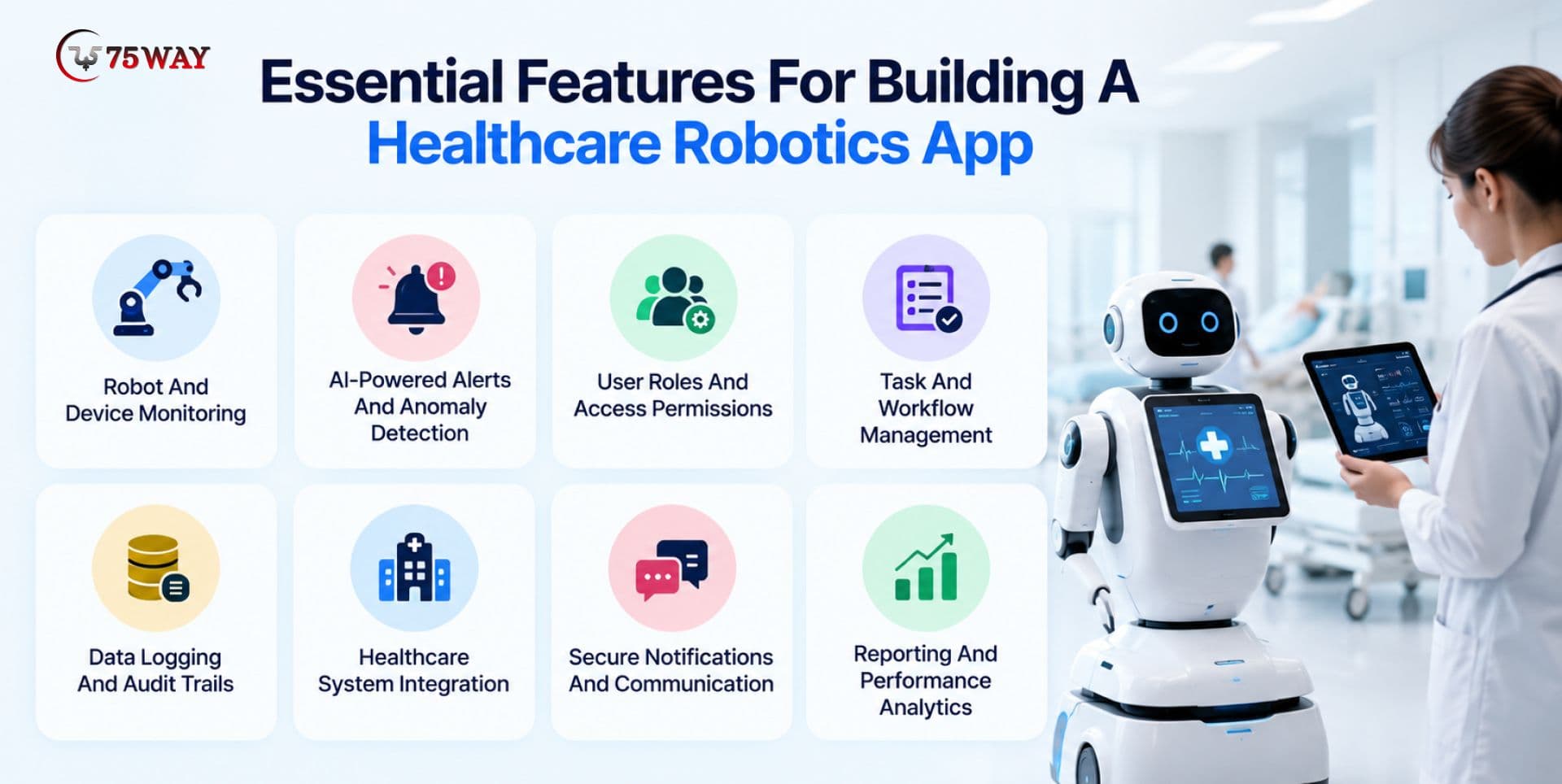
- Robot And Device Monitoring
A monitoring dashboard should show the operational information users need, such as device status, battery levels, connectivity, active tasks, and reported faults.
Real-time updates may be necessary, but the interface should also show when information was last received so users don't mistake stale data for a live reading.
- AI-Powered Alerts And Anomaly Detection
AI models can flag unusual sensor readings, unexpected equipment behaviour, or patterns that deserve further investigation. When possible, the application should explain why an alert appeared, record relevant events, and provide an appropriate review or escalation path.
An alert should not automatically be treated as a confirmed diagnosis or equipment failure. The model's limitations and the consequences of incorrect alerts must be assessed before deployment.
- User Roles And Access Permissions
Clinicians, technicians, administrators, and patients need different access levels. Role-based permissions should determine who can view sensitive information, change settings, acknowledge alerts, or issue authorised commands.
A well-designed permissions system also prevents users from accessing functions that fall outside their responsibilities.
- Task And Workflow Management
Hospital service robots may need task assignment, delivery status, priority handling, and exception reporting. Rehabilitation systems may instead need appointment scheduling and session management.
The application should reflect the intended healthcare setting's workflow rather than force every user through the same interface.
- Data Logging And Audit Trails
The system should record relevant user actions, device events, system errors, and AI outputs where appropriate. These records help teams investigate incidents, understand operational patterns, and establish what happened when a problem occurred.
Retention periods, access permissions, and the information captured in each log should follow the product's security and compliance requirements.
- Healthcare System Integration
Some applications need to exchange information with electronic health records, appointment systems, or other clinical platforms. Integration can involve APIs, supported interoperability standards, data mapping, identity management, and agreement on which system owns each record.
FHIR may be appropriate for certain healthcare data exchanges, but the actual integration approach depends on the target system and the information being shared.
- Secure Notifications And Communication
The application may notify staff about robot downtime, completed tasks, unusual readings, or pending reviews. Notifications should reach the right person without exposing unnecessary patient information on lock screens, emails, or unsecured channels.
The escalation process should also define what happens when a notification is missed or cannot be delivered.
- Reporting And Performance Analytics
Operational reports can show task completion rates, equipment availability, downtime, alert volumes, and other relevant metrics. Clinical performance measures require additional care because their meaning depends on the patient population, measurement method, and intended use.
Clear reporting helps business owners evaluate whether the application solves the problem that justified the investment.
Discover More:Best Healthcare App Development Firms for Startups and Enterprises
Robust Technology Stack For Healthcare Robotics Mobile App Development
The technology stack should align with product requirements, existing robot interfaces, team capabilities, and the deployment environment. No single programming language or cloud platform is automatically the best choice for every healthcare robotics project.
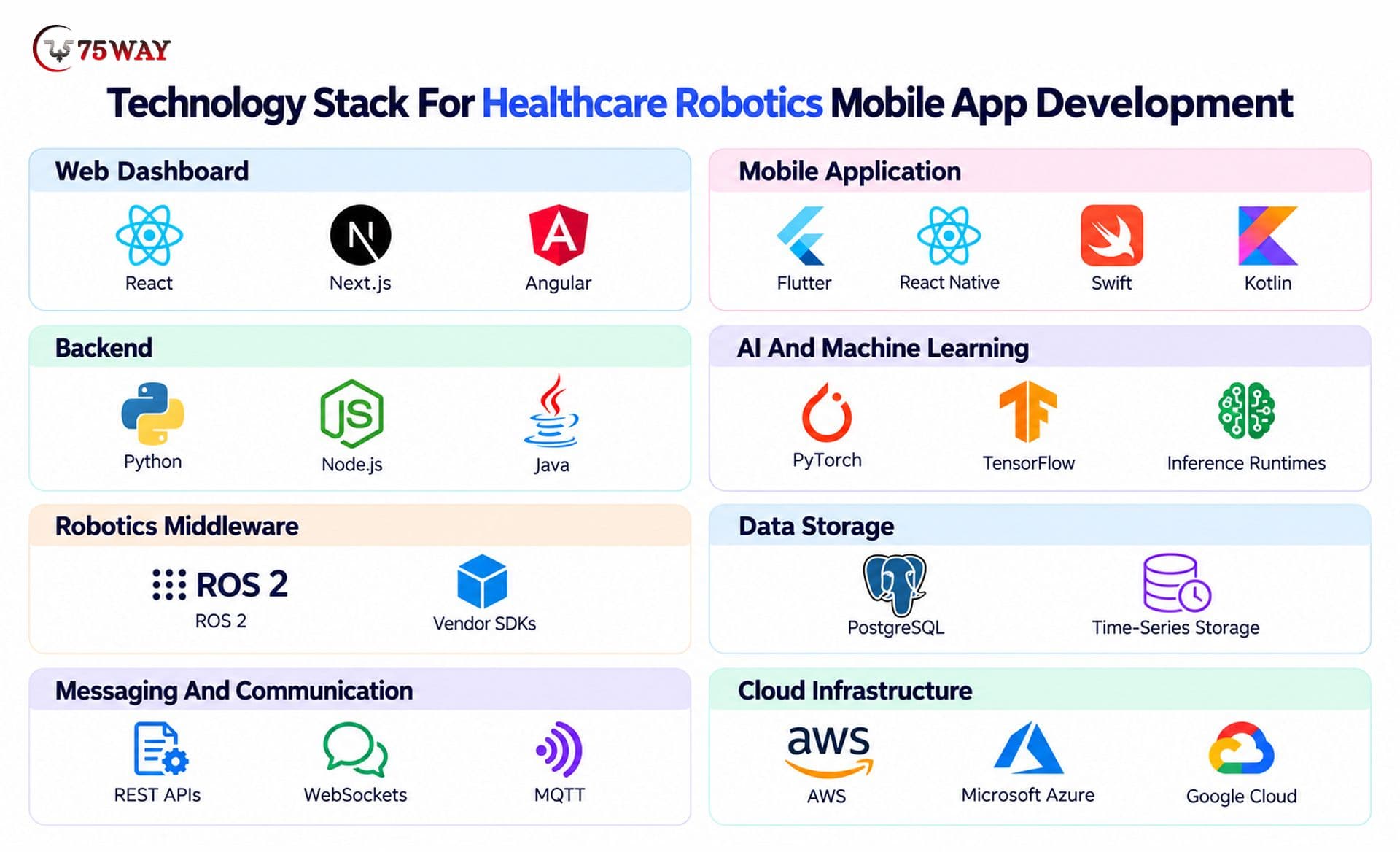
Web Dashboard: React, Next.js, Angular
- Build interactive dashboards to monitor robots and manage workflows.
- Prioritize accessibility, responsive layouts, and long-term maintainability.
Mobile Application: Flutter, React Native, Swift, Kotlin
- Develop mobile apps for remote monitoring and task management.
- Choose frameworks based on device capabilities and target platforms.
Backend: Python, Node.js, Java
- Build APIs for robot communication, user management, and workflows.
- Select technologies based on integration needs and team expertise.
AI And Machine Learning: PyTorch, TensorFlow, Suitable Inference Runtimes
- Develop AI models for anomaly detection and predictive maintenance.
- Choose runtimes based on model complexity and deployment constraints.
Robotics Middleware: ROS 2, Where Supported And Appropriate
- Connect compatible robots with application services and control systems.
- Verify robot compatibility before selecting middleware and communication protocols.
Data Storage: PostgreSQL, Suitable Time-Series Storage
- Store user records, robot telemetry, tasks, and audit logs.
- Choose storage based on data volume, retention, and access requirements.
Messaging And Communication: REST APIs, WebSockets, MQTT, Vendor SDKs
- Exchange commands, telemetry, and status updates across connected systems.
- Select protocols based on latency, reliability, and supported interfaces.
Infrastructure: AWS, Microsoft Azure, Google Cloud Or Suitable Edge Infrastructure
- Deploy application services according to security and availability requirements.
- Evaluate cloud and edge options against operating costs and connectivity needs.
For instance, Python may suit AI services and data processing, while a web application may use React and a backend may use Node.js. ROS 2 can support certain robotics architectures, but its suitability depends on the robot and the manufacturer's supported integration model.
The more important decision is how these technologies fit together. A well-selected stack should support reliable communication, clear security boundaries, manageable operating costs, and the testing required by the intended use.
What Is The Cost To Build Robots Healthcare App in United Kingdom
Average healthcare robotics app development costs range from £30,000 to £300,000+, depending on the robot integration requirements, AI capabilities, healthcare system connections, testing scope, and regulatory obligations.
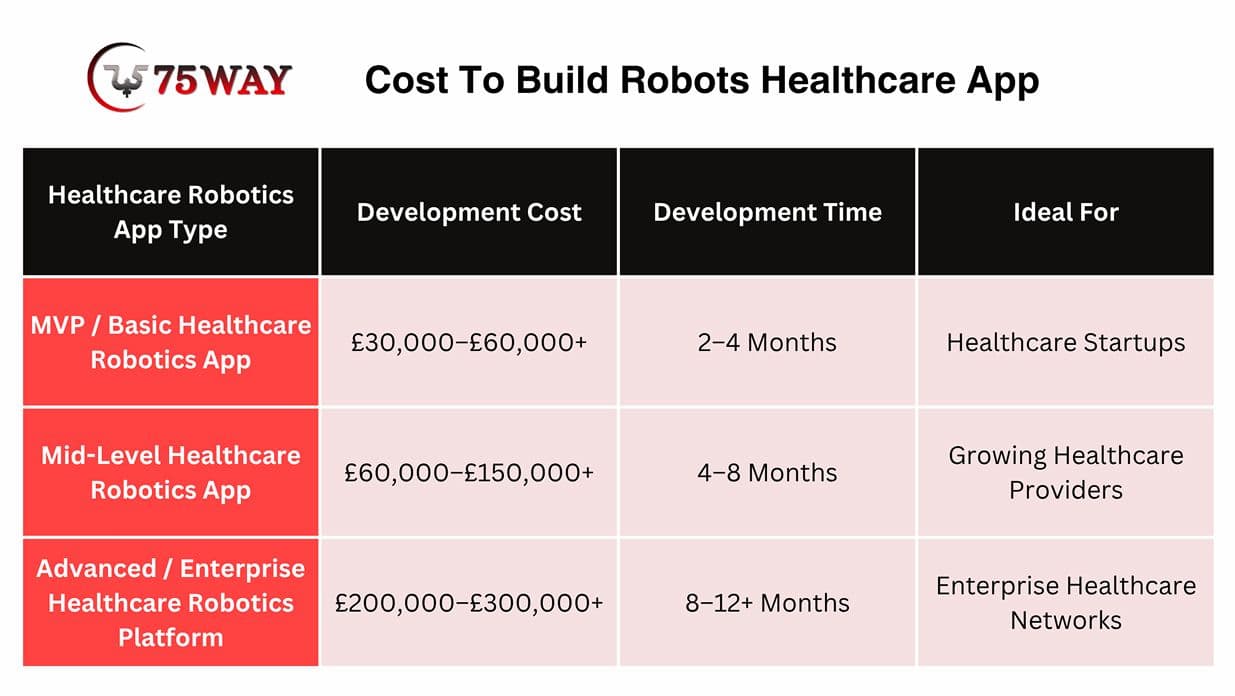
1. MVP / Basic Healthcare Robotics App: £30,000–£60,000+
- Covers a basic web or mobile interface, user authentication, and an operator dashboard.
- Includes a simple robot telemetry connection or a limited manual-control interface where supported.
- Provides core data logging and basic device status monitoring.
Timeline: 2–4 months.
2. Mid-Level Healthcare Robotics App: £60,000–£150,000+
- Supports multiple user roles, such as clinicians, patients, technicians, and administrators.
- Includes real-time robot or sensor feedback, notifications, and more advanced workflow management.
- Adds suitable AI capabilities, database synchronization, and selected EHR/EMR integrations.
- Provides stronger security controls and more extensive integration testing.
Timeline: 4–8 months.
3. Advanced / Enterprise Healthcare Robotics Platform: £200,000–£300,000+
- Supports advanced AI analytics and carefully controlled autonomous or semi-autonomous workflows where the robot permits them.
- Includes deeper healthcare interoperability, multi-system architecture, and extensive monitoring.
- Covers comprehensive security testing, resilience planning, and relevant safety and regulatory evidence.
- Supports complex deployment requirements, multiple device types, or larger operational environments.
Timeline: 8–14+ months.
Read Too: How Much Does Healthcare App Development Cost in 2026?
Stage-Wise Cost To Build A Healthcare Robotics App
A stage-wise budget helps you understand where the investment goes and which decisions can affect the final quotation. The ranges below represent indicative planning estimates, and the actual allocation will depend on whether the project needs custom AI, hardware integration, clinical validation, or extensive external-system connections.
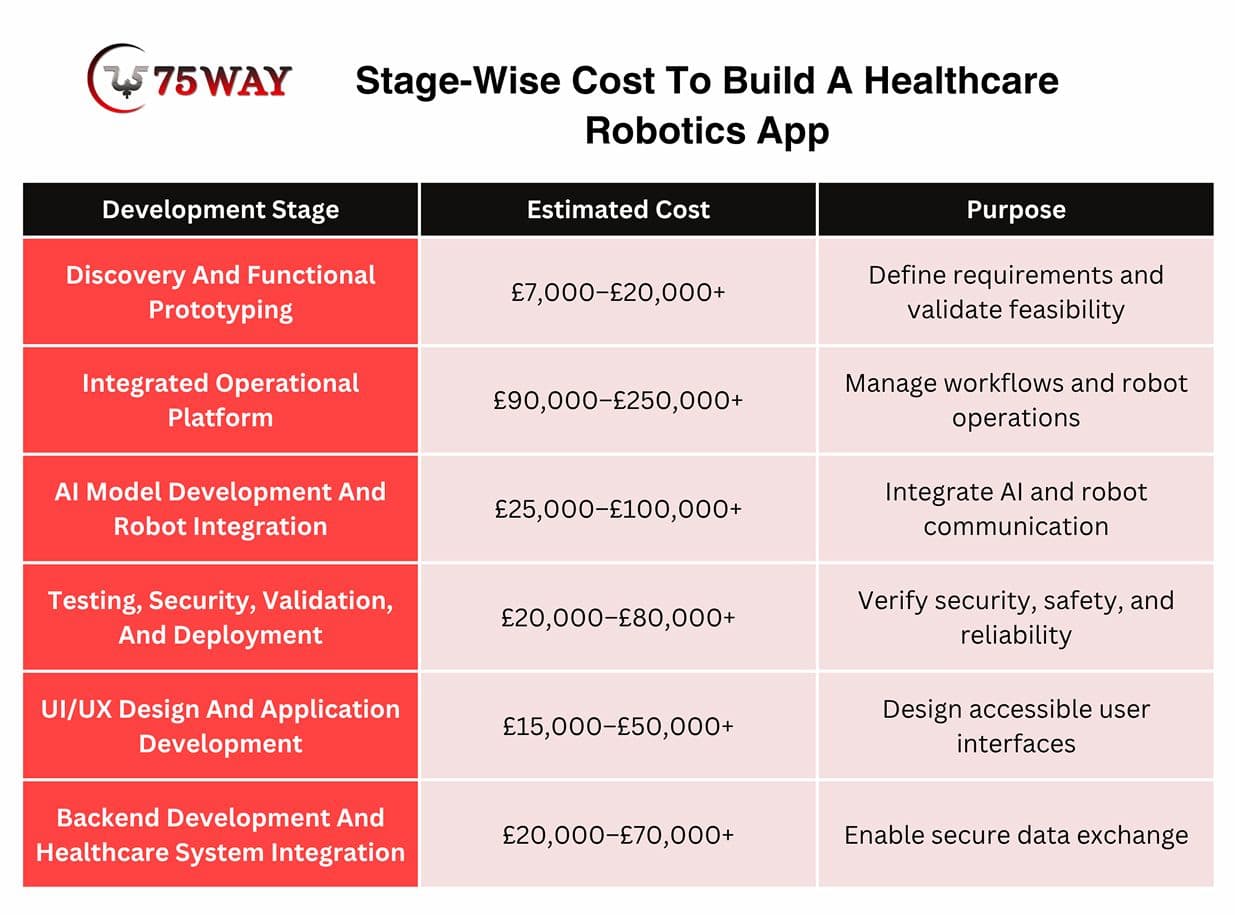
Stage-Wise Cost To Build A Healthcare Robotics App
1. Discovery and Functional Prototyping: £7,000–£20,000+
- Covers requirements gathering, stakeholder interviews, workflow mapping, and technical feasibility.
- Includes initial architecture planning, risk identification, and a testable prototype.
2. Integrated Operational Platform: £90,000–£250,000+
- Covers multiple workflows, advanced permissions, reporting, and system integrations.
- Includes more extensive robot telemetry, healthcare data exchange, and operational monitoring.
3. AI Model Development And Robot Integration: £25,000–£100,000+
- Covers model selection, adaptation or custom development, and integration with the application.
- Includes robot interface development, telemetry processing, model evaluation, and relevant performance testing.
4. Testing, Security, Validation, And Deployment: £20,000–£80,000+
- Covers integration testing, security assessments, failure-scenario testing, and deployment preparation.
- Includes relevant documentation, user training, monitoring setup, and additional clinical or regulatory validation where required.
5. UI/UX Design & Application Development: £15,000–£50,000+
- Covers user research, interface design, dashboards, and mobile application development.
- Includes accessible layouts, workflow implementation, and usability testing.
6. Backend Development & Healthcare System Integration: £20,000–£70,000+
- Covers backend services, databases, APIs, authentication, and access controls.
- Includes integration with healthcare systems, notifications, and secure data exchange.
Discover More: How AI in Healthcare Reduces Costs & Boosts Hospital ROI in 2026?
What Other Factors Can Increase The Cost of Building Robots Healthcare App?
Several decisions can materially change the budget:
- Robot Hardware: Unsupported devices, proprietary interfaces, or manufacturer licensing can increase integration costs.
- AI Complexity: Custom models, specialist datasets, and extensive evaluation require more time than straightforward model integration.
- Healthcare Interoperability: EHR/EMR connections and NHS-related requirements may involve additional technical and assurance work.
- Safety Requirements: Higher-risk intended uses can require more extensive risk analysis, validation, and documentation.
- Infrastructure: Cloud hosting, edge devices, monitoring, support, and maintenance contribute to ongoing costs.
- Deployment Scale: Supporting multiple hospitals, robot models, or locations adds configuration and operational complexity.
A discovery engagement should separate the initial development budget from recurring infrastructure, licensing, maintenance, and future model updates. That distinction gives business owners a more realistic picture of the total cost of ownership.
Read Too: AI Healthcare Sales Agent: An In-Depth Guide For Healthcare Service Providers
UK Healthcare Compliance & Safety Measures to Create Robot-based Healthcare App
Healthcare robotics applications can process sensitive information or influence activities that affect patient safety. UK businesses should therefore consider privacy, security, clinical risk, and relevant regulatory obligations before development moves too far.
UK GDPR And Data Protection
The team should identify what personal data the application needs, why it is being processed, who can access it, and how long it should be retained. Health information requires particular care, including an appropriate lawful basis and applicable condition for processing special-category data.
Technical safeguards may include encryption, access controls, audit logs, secure authentication, data minimization, and appropriate retention policies. A data protection impact assessment may be necessary where the proposed processing is likely to create a high risk to individuals.
MHRA And Medical-Device Considerations
Not every application used in a hospital is a medical device. Its regulatory position depends on its intended purpose, functionality, claims, and role in diagnosis, treatment, monitoring, or other regulated activities.
Software that influences clinical decisions or performs a medical purpose may fall within medical-device requirements. The development team should assess the intended use early and obtain appropriate specialist advice where needed.
NHS DTAC And Interoperability
Businesses planning to supply digital products to NHS organisations may need to address the relevant assurance and procurement requirements. The NHS Digital Technology Assessment Criteria (DTAC) covers areas including clinical safety, data protection, technical security, interoperability, and usability and accessibility.
DTAC does not replace every other legal, clinical, or procurement obligation. The actual requirements depend on the product and the intended deployment setting.
Clinical Safety And Human Oversight
The team should identify foreseeable hazards, define who reviews alerts and establish how the system behaves when data or AI outputs cannot be trusted. Relevant clinical safety standards, such as DCB0129 and DCB0160, may apply in NHS contexts depending on the supplier's and deploying organisation's responsibilities.
The final safety approach must match the product's intended purpose and risk profile. A maintenance dashboard and an application that supports treatment decisions are not equivalent projects.
Common Mistakes To Avoid During Custom Healthcare Robotics App Development
A promising healthcare robotics app idea can quickly become complicated if the development process misses important details. Poor hardware integration, unclear requirements, and inadequate safety testing can affect reliability and delay the launch. Let’s look at the common development mistakes you should avoid to build a more dependable healthcare robotics solution.
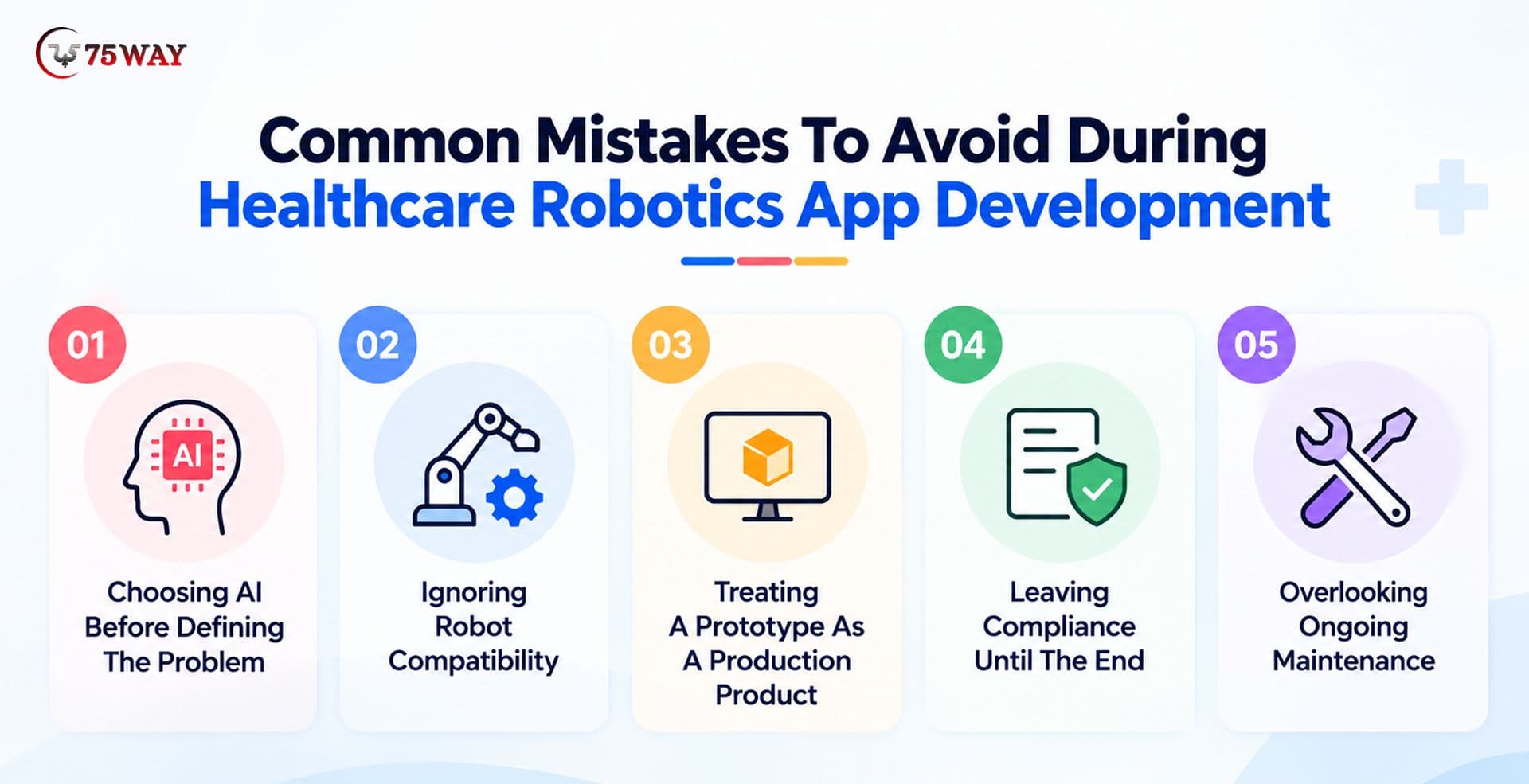
1. Choosing AI Before Defining The Problem
AI should address a measurable need, not exist simply to make the product sound innovative. Start with the workflow, identify the limitations of conventional software, and introduce AI only where it adds practical value.
Solution: Define the business problem first, establish measurable success criteria, and select AI capabilities that support specific operational or clinical needs.
2. Ignoring Robot Compatibility
A promising interface cannot overcome an unsupported robot API or restricted hardware access. Confirm manufacturer documentation, available SDKs, communication protocols, and licensing before committing to the architecture.
Solution: Verify hardware compatibility, test available APIs and SDKs, and confirm manufacturer permissions before finalizing the technology stack.
3. Treating A Prototype As A Production Product
A clickable prototype can demonstrate a concept, but it does not prove reliable robot connectivity, secure data handling, or safe operational performance. Define the additional engineering and validation required before real-world use.
Solution: Create a clear roadmap from prototype to production, including integration testing, security checks, failure scenarios, and any required safety validation.
4. Leaving Compliance Until The End
Considering privacy, clinical safety, and medical-device requirements late can lead to expensive changes. Assess the intended purpose and relevant obligations during discovery, then update the assessment as the product evolves.
Solution: Review UK GDPR, applicable MHRA requirements, and relevant NHS standards early, and involve qualified compliance and clinical safety specialists as needed.
5. Overlooking Ongoing Maintenance
Robot firmware changes, API updates, new security vulnerabilities, and model performance issues can affect a deployed application. Include monitoring, support, patching, and version management in the long-term operating plan.
Solution: Budget for ongoing technical support, security patches, robot firmware compatibility checks, performance monitoring, and AI model reviews throughout the product lifecycle.
How 75way Technologies Can Help Develop A Healthcare Robotics App
Healthcare robotics requires application engineering, AI integration, system connectivity, and careful planning. The right development partner should help you translate a business requirement into a technically feasible product, identify integration risks, and establish a practical delivery roadmap.
At 75way Technologies, our software development, AI, mobile application, and IoT capabilities provide a foundation for evaluating these requirements. The proposed scope should determine which specialist robotics expertise, hardware access, clinical input, and external partners are needed for your particular project.
Our development approach can cover:
- Product Discovery: Define business goals, user requirements, technical feasibility, and project scope.
- UX/UI Design of Healthcare Robotics App: Create interfaces for clinicians, technicians, patients, and administrators.
- Software Engineering: Develop the application, backend services, APIs, and data management capabilities.
- AI Integration in Healthcare Robotics App: Evaluate appropriate models and integrate them with suitable validation and oversight.
- Robot Connectivity in App: Assess supported interfaces and implement the required communication layer.
- Testing And Deployment: Plan functional, integration, security, and risk-based testing before release.
A useful first step is a project discovery discussion covering your robot type, intended use, AI requirements, integration needs, and target deployment environment. That conversation can establish a realistic scope, budget, and timeline without promising capabilities before technical feasibility has been confirmed.
Conclusion
Healthcare robotics app development requires more than an AI model and a user interface. The right solution connects robot hardware, application software, AI services, and healthcare workflows through an architecture that supports security, reliability, and appropriate human oversight.
A clear use case should guide every major decision, from selecting the robot interface and AI capabilities to defining testing requirements and estimating costs. For UK healthcare businesses, considering data protection, clinical safety, interoperability, and applicable medical-device obligations early can prevent expensive later changes.
Planning a healthcare robotics app? Discuss your requirements with a trusted healthcare app development company.
Frequently Asked Questions (FAQs)
How Long Does It Take To Develop A Healthcare Robotics App?
A basic healthcare robotics app may take 2–4 months, a mid-level application 4–8 months, and a complex enterprise platform 8–14+ months. Actual timelines depend on robot integration, AI development, testing, and regulatory requirements.
How Much Does Healthcare Robotics App Development Cost In The UK?
A basic application may cost £30,000–£60,000+, a mid-level solution £60,000–£150,000+, and an advanced enterprise platform £200,000–£300,000+. Bespoke robotics or extensive validation can increase the total.
Can AI Control Healthcare Robots Autonomously?
Some robots support autonomous or semi-autonomous functions, but these depend on the hardware, approved control architecture, and intended use. Safety-critical commands require safeguards, validation, and oversight, not unrestricted AI-generated instructions.
Do Healthcare Robotics Apps Need MHRA Approval?
Not every healthcare robotics application requires medical-device authorization. The applicable requirements depend on the software's intended purpose and functionality, including whether it performs a regulated medical purpose or influences clinical decisions.
How Can A Healthcare Robotics App Connect With NHS Systems?
Integration may involve supported APIs, interoperability standards such as HL7 FHIR, identity management, and data mapping. The project must also assess the relevant NHS assurance, information governance, and procurement requirements for its intended deployment.
Can A Startup Begin With An MVP?
Yes. A startup can begin with one clearly defined workflow, a limited number of users, and a supported robot interface. The MVP should have explicit acceptance criteria and an appropriate safety and validation plan before operational use.