Summary
The development process of EV navigation apps like ABRP uses AI-powered route optimization, battery prediction models, charger availability mapping, and real-time traffic data to plan efficient EV travel. These systems analyze energy consumption, elevation, speed, and charging stops to reduce range anxiety while improving long-distance electric vehicle mobility experiences through intelligent forecasting and cloud-based computation.
Quick Overview
- ABRP-like apps focus on EV energy-aware navigation, not standard GPS routing.
- Battery prediction models calculate real-time energy consumption during travel.
- AI optimizes charging stops based on distance, terrain, and availability.
- Integration with charger networks improves long-distance EV reliability.
- Cloud-based systems process complex route and energy calculations.
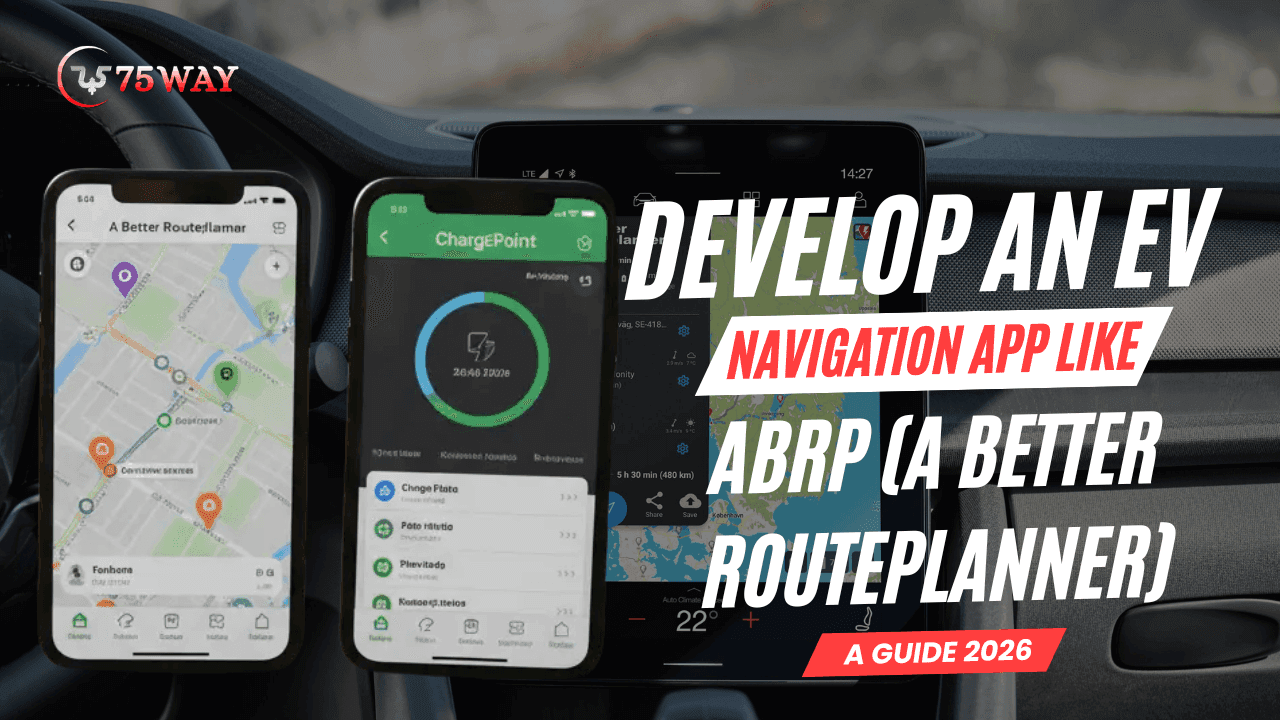
Electric vehicle adoption is accelerating globally, but one major challenge continues to limit long-distance EV travel range anxiety. A Better Routeplanner (ABRP) has become one of the most recognized solutions in this space by offering advanced EV route planning capabilities that go far beyond standard GPS navigation. Instead of simply providing directions, ABRP calculates energy consumption, predicts battery depletion, identifies optimal charging stops, and dynamically adjusts routes based on real-time conditions.
Modern EV navigation applications combine artificial intelligence, machine learning, cloud computing, and real-time data integrations to deliver highly accurate travel predictions for electric vehicles. These systems help drivers plan efficient journeys, minimize charging delays, and optimize energy usage across long distances.
This guide explains how to develop an EV navigation app like ABRP in 2026, covering features, architecture, AI models, data systems, APIs, monetization strategies, development cost, and future trends shaping EV route intelligence platforms.
What Is An ABRP-Like EV Navigation App?
An ABRP-style EV navigation app is an intelligent route planning system designed specifically for electric vehicles. It goes beyond traditional navigation by calculating travel routes based on battery range, charging station availability, and real-time energy consumption. The system continuously adjusts routes to ensure drivers reach their destination without running out of charge, making long-distance EV travel more predictable and stress-free.
Unlike standard mapping tools, these apps prioritize energy-aware navigation instead of simple distance-based routing. They focus on identifying optimal charging stops, estimating battery usage for each segment of the journey, and accounting for factors like terrain, driving speed, and weather conditions to improve accuracy and reliability.
Why Businesses Build EV Navigation App Like ABRP?
The shift toward electric mobility is rapidly changing how people travel, and EV drivers now expect intelligent navigation systems that understand battery limitations, charging availability, and energy efficiency. Businesses are building ABRP-like platforms to solve real-world EV travel problems while tapping into a fast-growing electric mobility ecosystem driven by global sustainability goals and infrastructure expansion.
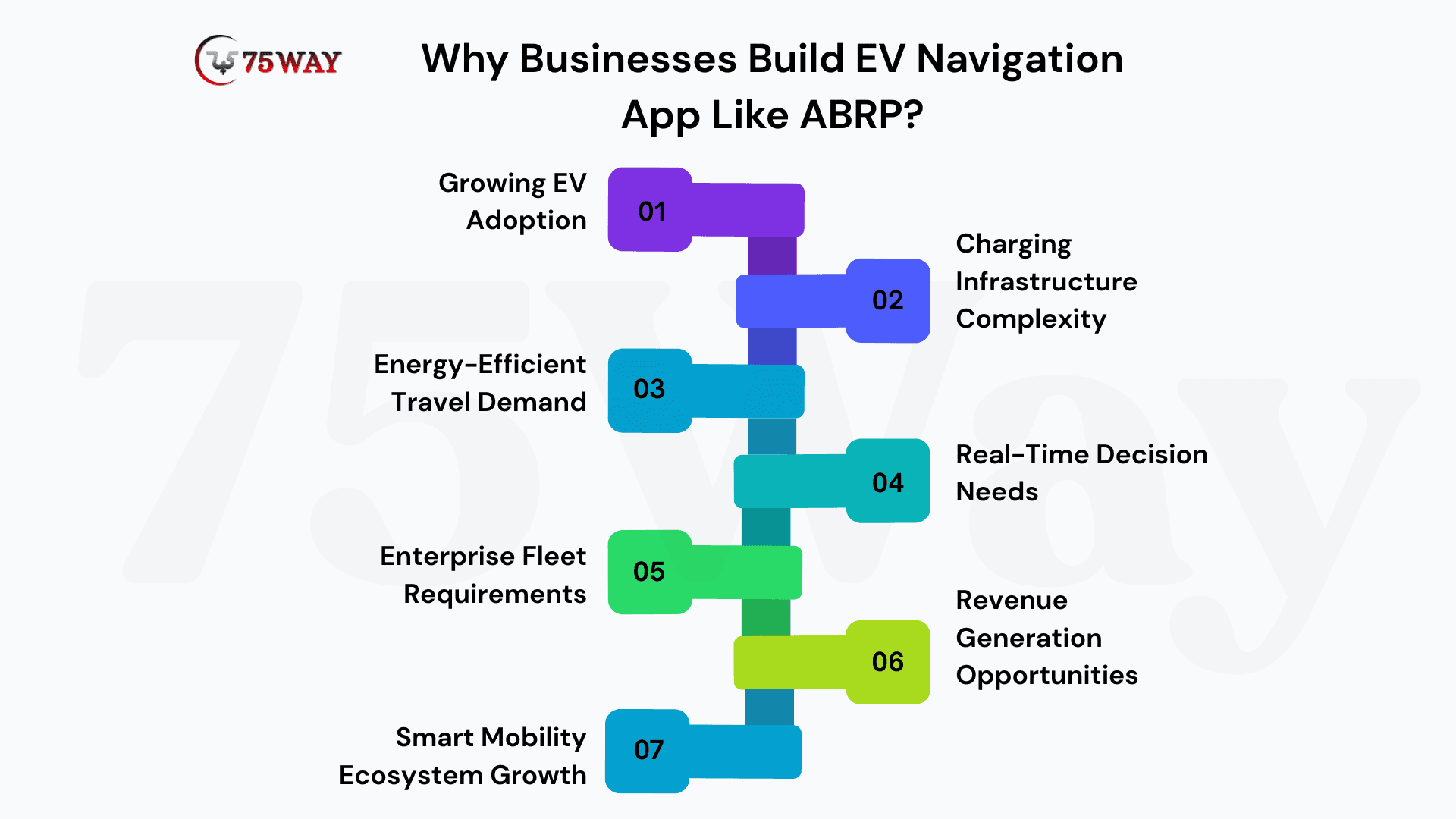
- Growing EV Adoption: The increasing adoption of electric vehicles worldwide is driving strong demand for smart navigation systems that can accurately support battery-based travel planning and charging.
- Charging Infrastructure Complexity: As charging networks expand, users need intelligent systems that can locate, compare, and optimize charging stops across multiple providers and networks.
- Energy-Efficient Travel Demand: EV drivers want routes that minimize battery consumption while maximizing travel range, making energy-based navigation a key requirement.
- Real-Time Decision Needs: Traffic, weather, and charger availability constantly change, requiring dynamic routing systems that update travel plans instantly for better accuracy.
- Enterprise Fleet Requirements: Logistics and mobility companies need EV-specific navigation tools to manage fleet routes, reduce charging costs, and improve operational efficiency.
- Revenue Generation Opportunities: EV navigation apps offer monetization through subscriptions, advertising, charging partnerships, and data analytics services.
- Smart Mobility Ecosystem Growth: Governments and cities are investing in smart transportation systems, creating opportunities for integrated EV navigation platforms within urban mobility networks.
Step-By-Step Process To Build ABRP-Style App
Building an ABRP-style EV navigation platform requires a tightly connected system where vehicle energy modeling, routing intelligence, real-time data, and AI prediction work together as one continuous ecosystem. Each phase naturally feeds into the next, ensuring the app can accurately calculate battery usage, optimize routes, and adapt to changing road and charging conditions in real time for a seamless EV driving experience.
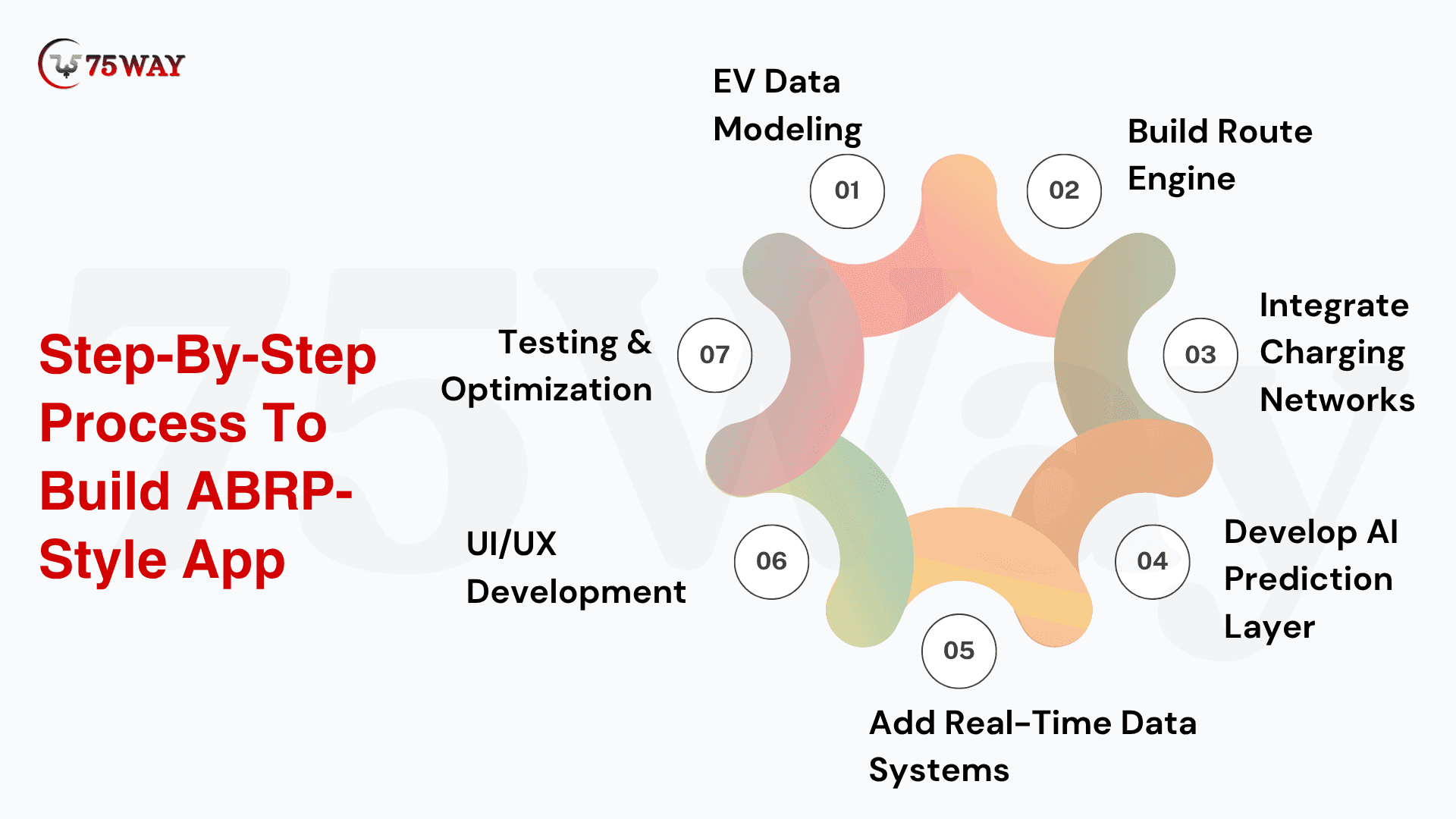
Step 1: EV Data Modeling
Everything begins with understanding how electric vehicles actually consume energy in real-world conditions. This involves defining battery capacity behavior, charging curves, efficiency variations, and vehicle-specific performance patterns. Once this energy logic is structured properly, it becomes the foundation for all routing and prediction systems built later in the platform.
Step 2: Build Route Engine
Using the defined EV behavior model, the next layer focuses on creating an intelligent routing system that goes beyond distance-based navigation. Instead of simply finding the shortest path, it calculates energy-efficient routes while considering terrain, speed, and battery limitations, ensuring every journey is realistically achievable for EV drivers.
Step 3: Integrate Charging Networks
With routing logic in place, the system then connects to external charging networks through APIs to bring real-time station data into the platform. This enables accurate identification of available chargers, pricing details, and compatibility information, allowing routes to include practical and accessible charging stops along the journey.
Step 4: Develop AI Prediction Layer
Once live charging data is available, AI models are introduced to refine accuracy by predicting battery consumption and travel requirements. These models learn from historical trips, driver behavior, and environmental conditions, continuously improving how the system estimates range and charging needs for each route.
Step 5: Add Real-Time Data Systems
To make navigation truly dynamic, real-time inputs such as traffic conditions, weather updates, and GPS signals are integrated into the system. This allows routes to adjust instantly when external factors change, ensuring drivers always receive the most efficient and up-to-date travel guidance.
Step 6: UI/UX Development
After the intelligence layer is ready, attention shifts to presenting all this complex data in a simple and user-friendly interface. The design focuses on clarity, showing battery status, charging stops, and route updates in a way that drivers can quickly understand without distraction during travel.
Step 7: Testing & Optimization
Finally, the entire system is validated through real-world testing to ensure accuracy in routing, battery prediction, and charging recommendations. Continuous optimization fine-tunes performance so the platform remains reliable, efficient, and scalable as user demand and EV adoption continue to grow.
Core Features of Building EV Navigation App Like ABRP
EV navigation apps like ABRP are built to intelligently plan electric vehicle journeys using real-time battery data, charging infrastructure, traffic conditions, and energy consumption models. These systems ensure drivers always get optimized routes, accurate range predictions, and reliable charging stop suggestions for stress-free long-distance EV travel experiences.
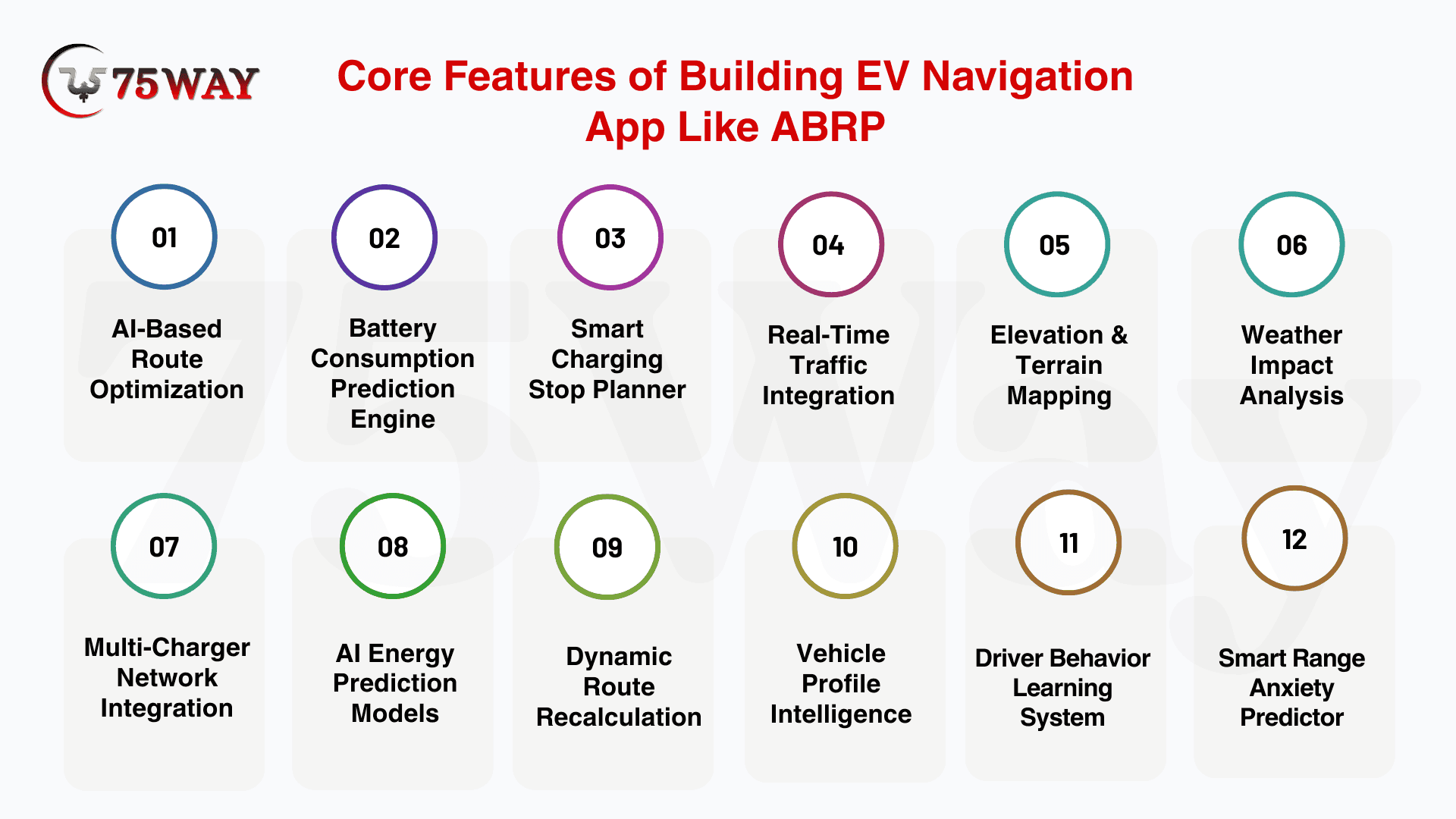
- AI-Based Route Optimization: Calculates the most energy-efficient driving route using traffic conditions, distance, terrain data, and speed-based adjustments for improved EV travel accuracy.
- Battery Consumption Prediction Engine: Estimates energy usage based on driving behavior, road conditions, weather changes, and remaining battery to ensure accurate destination reach prediction.
- Smart Charging Stop Planner: Suggests optimal charging stations along routes by analyzing battery level, charger speed, availability, and expected waiting time.
- Real-Time Traffic Integration: Adjusts navigation dynamically using live traffic updates, congestion data, accidents, and road construction information for smoother travel.
- Elevation & Terrain Mapping: Evaluates uphill and downhill routes to estimate energy consumption and regenerative braking impact for better range accuracy.
- Weather Impact Analysis: Considers temperature, wind resistance, and rainfall effects to adjust EV range predictions and improve route planning precision.
- Multi-Charger Network Integration: Connects with platforms like ChargePoint, EV Connect, Open Charge Map, and Tesla Superchargers for wider charging accessibility.
- AI Energy Prediction Models: Uses machine learning to forecast energy consumption based on driving patterns, vehicle type, terrain conditions, and historical trip data.
- Dynamic Route Recalculation: Continuously updates navigation when battery levels drop, traffic changes, or charging stations become unavailable during travel.
- Vehicle Profile Intelligence: Stores EV model data, battery capacity, and charging behavior to improve route accuracy and energy estimation.
- Driver Behavior Learning System: Learns driving habits such as acceleration, speed, and efficiency patterns to personalize route and energy predictions.
- Smart Range Anxiety Predictor: Warns drivers in advance when battery depletion risk or charger scarcity zones are detected along planned routes.
Tech Stack To Build EV Navigation Platform Like ABRP
An ABRP-style EV navigation platform requires a highly integrated technology stack that combines mobile development, backend systems, AI-driven prediction models, real-time data processing, and scalable cloud infrastructure. Each layer works together to ensure accurate route planning, energy consumption prediction, charging integration, and seamless user experience across devices and regions.
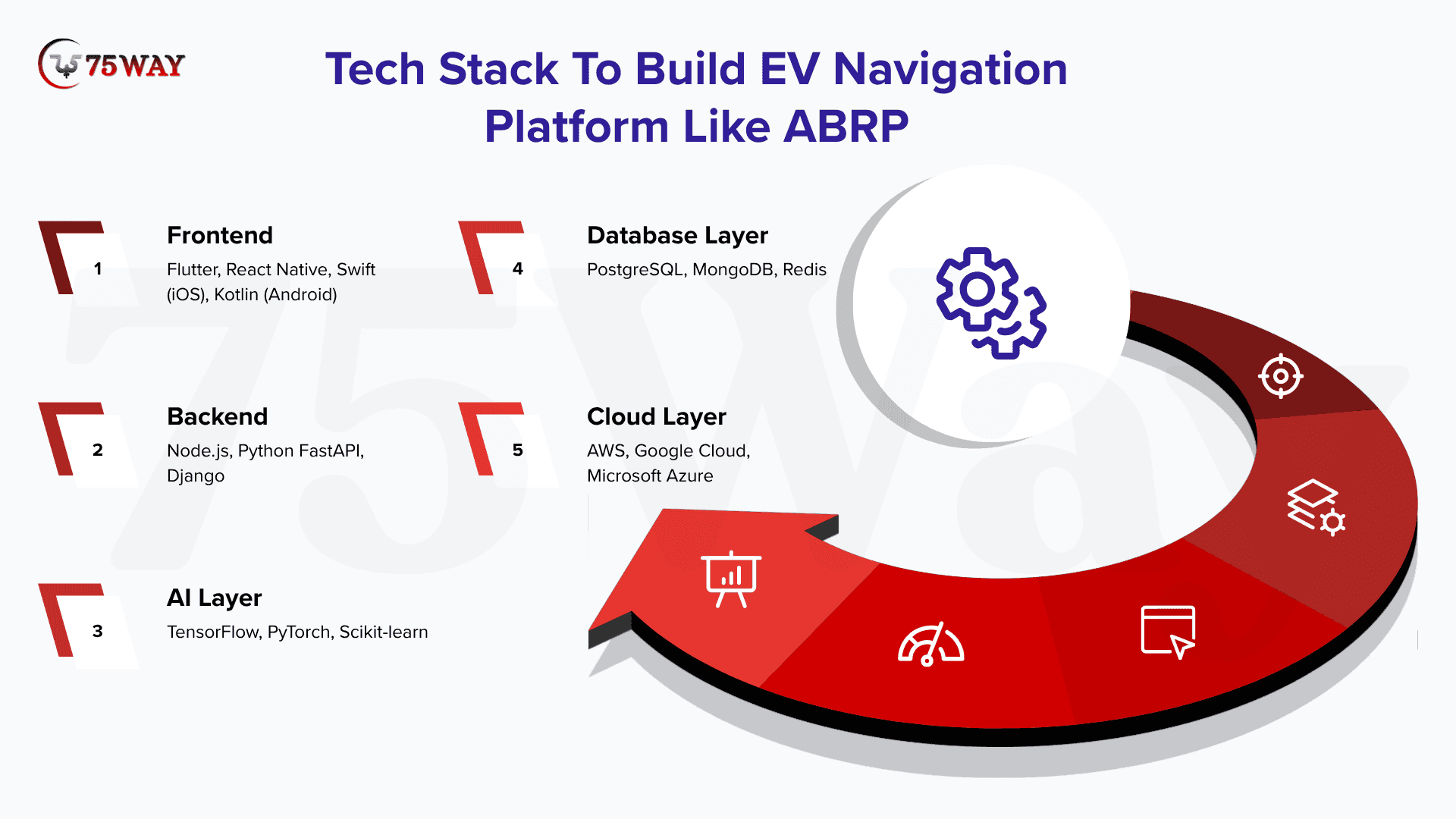
- Frontend: Flutter, React Native, Swift (iOS), and Kotlin (Android) are used to build cross-platform and native mobile applications. These technologies ensure smooth UI performance, real-time navigation updates, interactive maps, and a consistent user experience across different devices.
- Backend: Node.js, Python FastAPI, and Django handle server-side logic, API management, data processing, and real-time communication. This layer ensures efficient handling of routing requests, charging data, user sessions, and system integrations with high scalability and performance.
- AI Layer: TensorFlow, PyTorch, and Scikit-learn power machine learning models for battery prediction, energy consumption forecasting, route optimization, and driver behavior analysis. This layer enables intelligent decision-making and adaptive navigation capabilities.
- Database Layer: PostgreSQL, MongoDB, and Redis manage structured data, real-time caching, and high-speed query processing. These databases store vehicle profiles, trip history, charging data, and live navigation updates.
- Cloud Layer: AWS, Google Cloud, and Azure provide scalable infrastructure for hosting applications, managing real-time data streams, supporting AI workloads, and ensuring high availability across global EV navigation systems.
What’s The Cost To Build EV Navigation App Like ABRP?
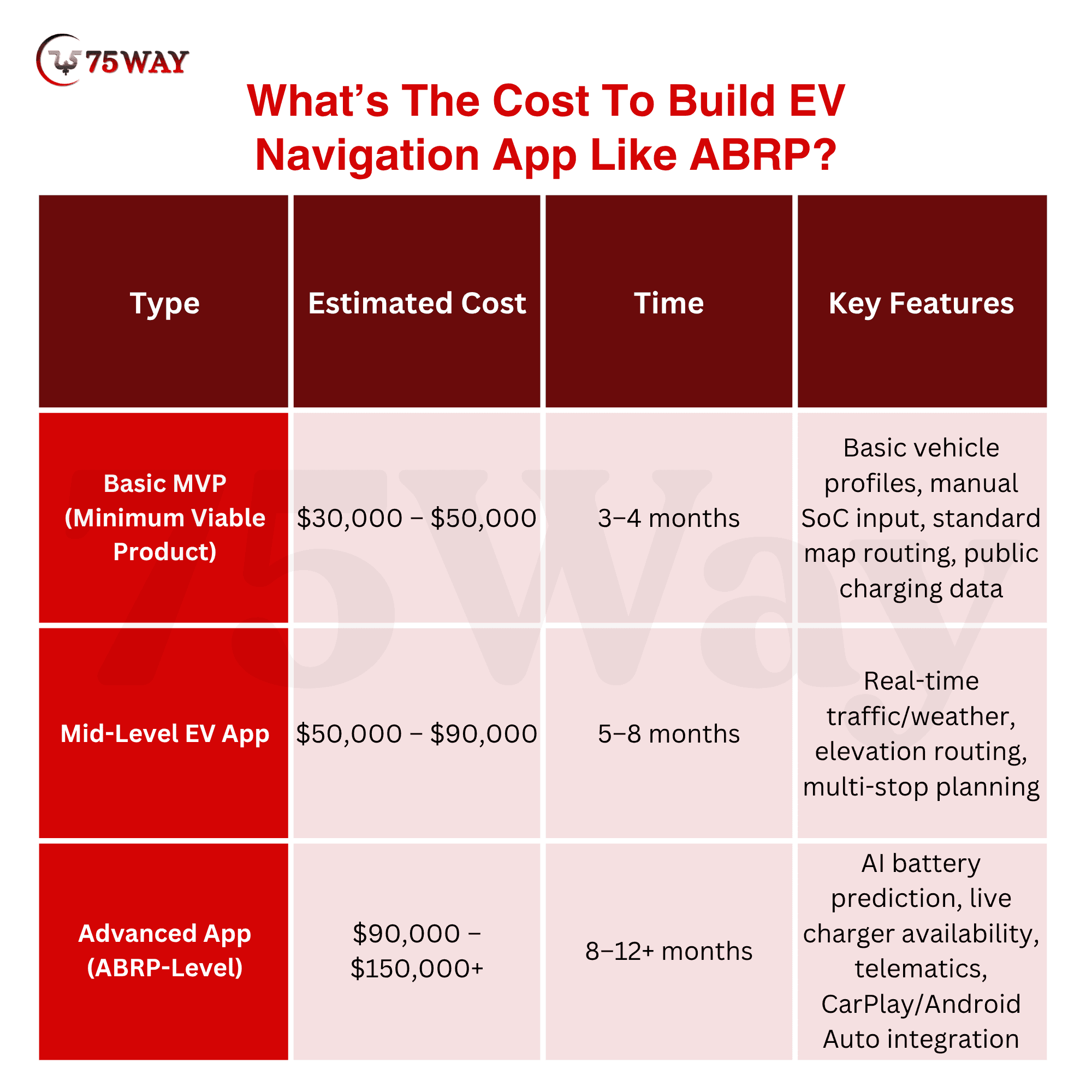
The cost of ABRP-style EV navigation app development varies based on features, real-time integrations, AI capabilities, and hardware connectivity.
- The basic MVP typically costs around $30,000 – $50,000 and focuses on essential EV routing features with manual battery inputs and basic charger data.
- The mid-level EV app, costing around $50,000 – $90,000, introduces real-time traffic, weather integration, and smarter multi-stop route planning.
- The advanced ABRP-level app, ranging from $90,000 – $150,000+, includes AI-powered battery prediction, live charger availability, deep vehicle telematics, and full integration with Apple CarPlay and Android Auto for a complete smart EV navigation experience.
Challenges In Building EV Navigation Platforms Like ABRP
Developing an ABRP-style EV navigation system comes with several technical and operational challenges because it depends heavily on real-time data, complex vehicle modeling, and high-performance AI systems. These challenges directly impact accuracy, scalability, and system reliability, making careful engineering and continuous optimization essential for long-term success.
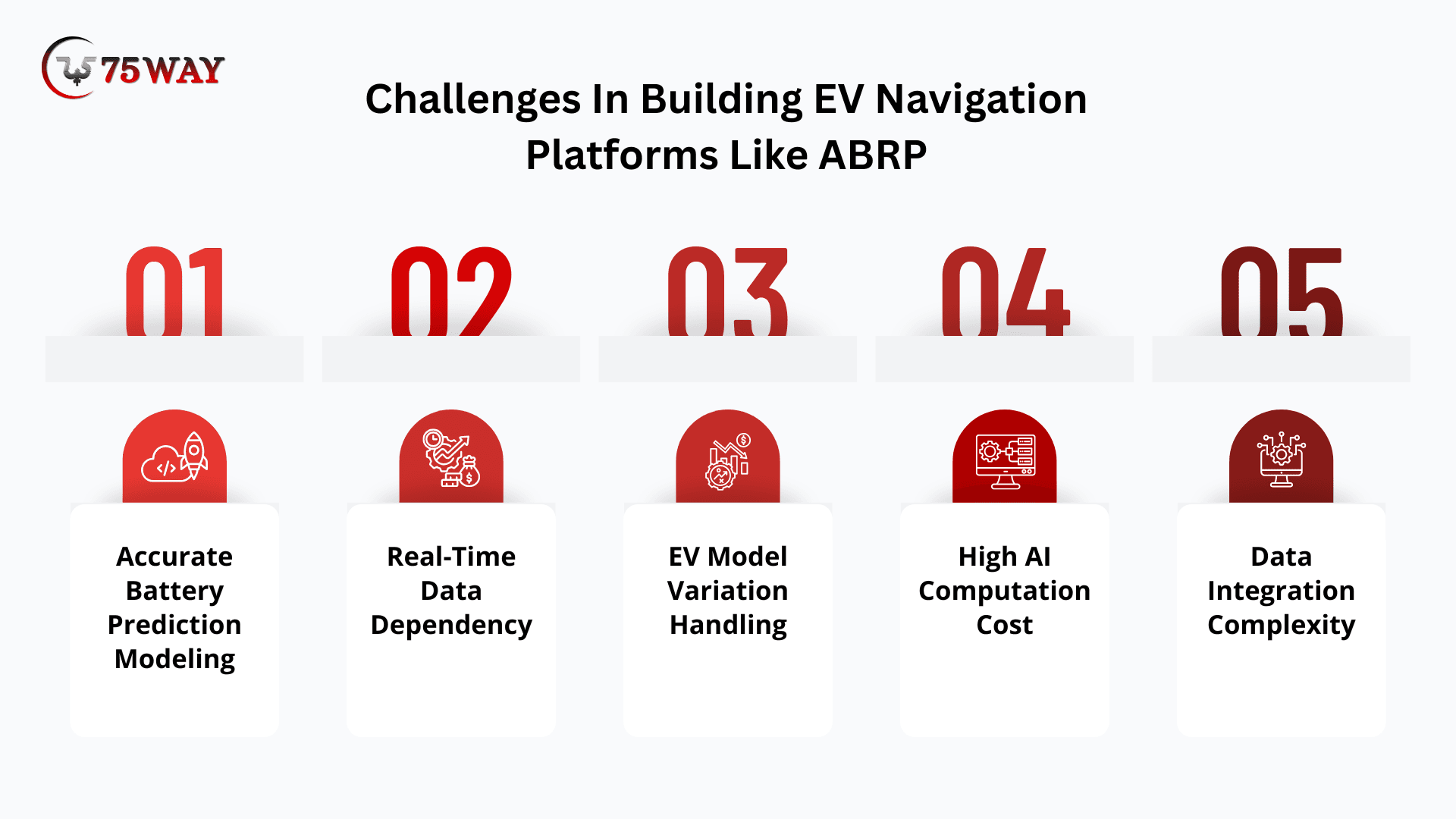
- Accurate Battery Prediction Modeling: One of the biggest challenges is accurately predicting EV battery consumption because it varies based on driving behavior, terrain, speed, and environmental conditions, making consistent modeling extremely complex.
- Real-Time Data Dependency: The system relies heavily on live inputs such as traffic, weather, and charging station availability, and any delay or data failure can significantly impact route accuracy and user experience.
- EV Model Variation Handling: Different EV brands and models have unique battery capacities, charging curves, and efficiency levels, making it difficult to build a universal prediction system that works accurately for all vehicles.
- High AI Computation Cost: AI models used for route optimization and energy prediction require heavy computation power, increasing infrastructure costs and demanding scalable cloud resources for real-time performance.
- Data Integration Complexity: Integrating multiple external APIs such as charging networks, mapping services, and weather systems, creates complexity in synchronization, data consistency, and system reliability.
Wrap Up
EV navigation platforms like ABRP are transforming electric mobility by enabling intelligent, energy-aware route planning that eliminates range anxiety and improves long-distance EV travel efficiency. These systems go beyond traditional GPS by integrating AI-driven battery prediction, charging stop optimization, real-time traffic data, and environmental analysis. Building such an application in 2026 requires advanced AI models, cloud computing, and EV telemetry integration to ensure accuracy and scalability. Businesses investing in EV navigation technology can unlock new opportunities in smart mobility, fleet optimization, and energy intelligence. Connect with a leading EV navigation app development company to build future-ready EV route planning solutions that drive innovation and market leadership.
Frequently Asked Questions (FAQs)
What Makes EV Navigation Apps Different From Traditional GPS Apps?
EV navigation apps focus on energy consumption, battery status, and charging stops. Unlike traditional GPS apps, they optimize routes based on vehicle range, charging availability, and energy efficiency for electric mobility.
Can EV Navigation Apps Work Without Internet Connectivity?
Limited offline functionality is possible, such as saved routes and cached maps. However, real-time battery prediction, charger availability updates, and traffic-based optimization require active internet connectivity.
How Do EV Navigation Apps Calculate Battery Consumption?
They use AI models that analyze vehicle type, speed, terrain, weather, and driving behavior. These factors help estimate energy usage and predict remaining battery at each point in the journey.
Are EV Navigation Apps Useful For Long-Distance Travel?
Yes, they are highly effective for long-distance EV travel. They plan charging stops, reduce range anxiety, and ensure drivers reach destinations with optimized energy usage and minimal delays.
Do EV Navigation Apps Support Different EV Models?
Yes, advanced platforms support multiple EV models by storing battery capacity, efficiency curves, and charging behavior. This ensures accurate predictions across different manufacturers and vehicle types.
Can EV Navigation Apps Integrate With Charging Networks?
Yes, they integrate with multiple charging networks through APIs. This allows real-time charger availability, pricing data, and compatibility checks for better route planning and charging decisions.