Summary
Looking to develop an Agentic AI solution in 2026? This guide explores architecture, frameworks, implementation stages, infrastructure, costs, deployment, security, integrations, and future opportunities. Businesses adopting autonomous AI agents achieve faster execution and scalable digital ecosystems.
Quick Overview
- Agentic AI systems automate complex workflows across multiple enterprise operations.
- Multi-agent orchestration improves decision-making accuracy and task execution speed.
- Memory-driven AI agents deliver contextual interactions across customer environments.
- Autonomous AI agents reduce repetitive workloads while increasing organizational productivity and responsiveness.
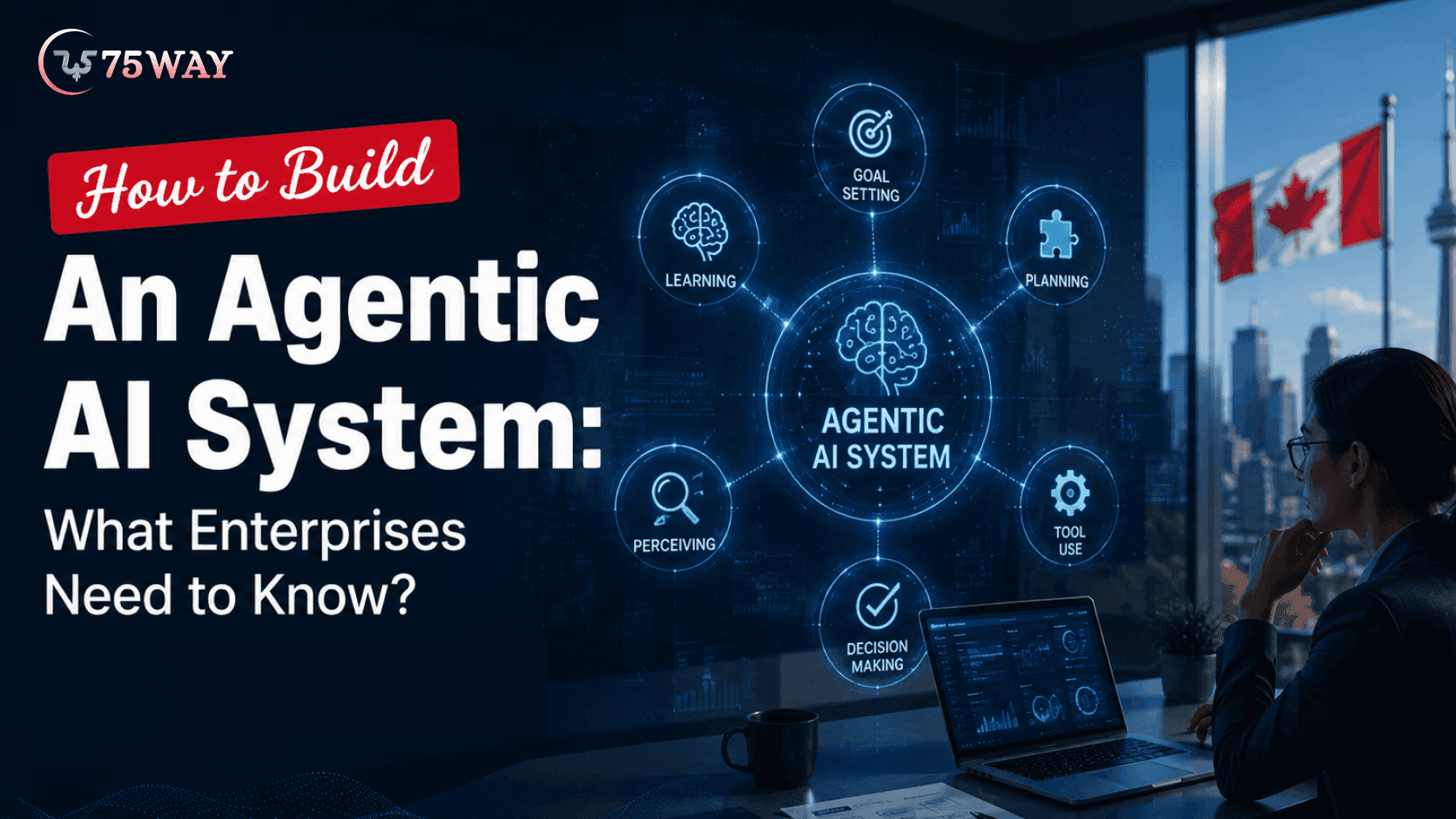
Ever wondered why some companies suddenly operate twice as fast with smaller teams? The reason is that enterprises are now deploying advanced autonomous systems, like agentic AI. Unlike traditional AI models that respond to isolated prompts, Agentic AI systems perform actions, interact with external tools, analyze contextual information, and coordinate with multiple AI agents.
In 2026, startups and enterprises are actively building AI-powered solutions and ecosystems where multiple agents collaborate autonomously. Even the technology leaders, including OpenAI, Google, Microsoft, and NVIDIA, are adopting enterprise AI with autonomous reasoning capabilities.
But developing Agentic AI systems requires more than coding expertise. It requires a complete architecture, an orchestration layer, a memory framework, and an infrastructure stack.
This comprehensive guide explores the complete process of building an Agentic AI system in 2026, including architecture planning, development stages, deployment strategies, costs, and monetization opportunities. Let’s dive in.
What Is An Agentic AI System?
Agentic AI systems are advanced autonomous AI environments capable of performing tasks, analyzing goals, coordinating workflows, and making decisions with minimal human involvement. Unlike traditional AI systems that only respond to prompts, Agentic AI operates proactively by planning actions, adapting dynamically, and refining outputs continuously.
These systems combine technologies like Large Language Models (LLMs), Retrieval-Augmented Generation (RAG), vector databases, workflow automation engines, multi-agent orchestration, reinforcement learning, and API integrations. Together, these technologies enable AI agents to retain memory, retrieve knowledge, automate workflows, and collaborate across complex tasks.
The main objective of Agentic AI systems is to create intelligent AI ecosystems that function similarly to human operational teams. These platforms can independently execute workflows, coordinate multiple agents, and optimize decision-making across industries like healthcare, finance, logistics, cybersecurity, and enterprise automation.
Why Businesses Are Investing in Agentic AI Solutions in 2026?
The adoption of Agentic AI systems continues to accelerate because businesses require scalable AI automation with intelligent decision-making capabilities. These platforms reduce manual workloads and improve productivity through intelligent workflow automation and autonomous decision-making.
- Rising Operational Complexity: Handle large-scale repetitive workflows and maintain accuracy and responsiveness. Agentic AI reduces operational bottlenecks by orchestrating autonomous workflows.
- Increased Demand for Personalization: Customers expect contextual interactions across websites, mobile apps, support channels, and ecommerce platforms. These systems analyze behavioral patterns and deliver personalized recommendations.
- Cost Optimization: Operational expenses continue increasing globally. Businesses seek intelligent automation models that reduce manual dependencies while improving productivity. Agentic AI systems lower repetitive operational workloads.
- Faster Decision-Making: Process massive data streams rapidly and identify opportunities, risks, and operational trends faster than traditional systems.
- 24/7 Autonomous Operations: Operate without interruptions and support customer engagement and backend processes globally.
Agentic AI Market Size & Growth Rate in 2026
The global enterprise agentic AI market is projected to reach $24.50 billion by 2030, growing at a CAGR of 46.2% from 2025 to 2030.
- North America leads the enterprise agentic AI industry, contributing over 39% of the global revenue share.
- The agentic AI market is expected to expand from $9.89 billion in 2026 to $57.42 billion by 2031, registering a CAGR of 42.14%.
- IBM estimates that up to 1 billion AI agents could be operating across enterprises by the end of 2026.
- The global agentic AI market is forecasted to reach nearly $196.6 billion by 2034, advancing at a CAGR of 43.8% during the forecast period.
Step-by-Step Process to Build an Agentic AI System
Agentic AI development requires a structured roadmap, scalable architecture, and intelligent workflow coordination for successful enterprise deployment. Multiple technologies work together across interconnected operational layers. Strategic implementation of each stage improves automation capabilities and decision-making performance.
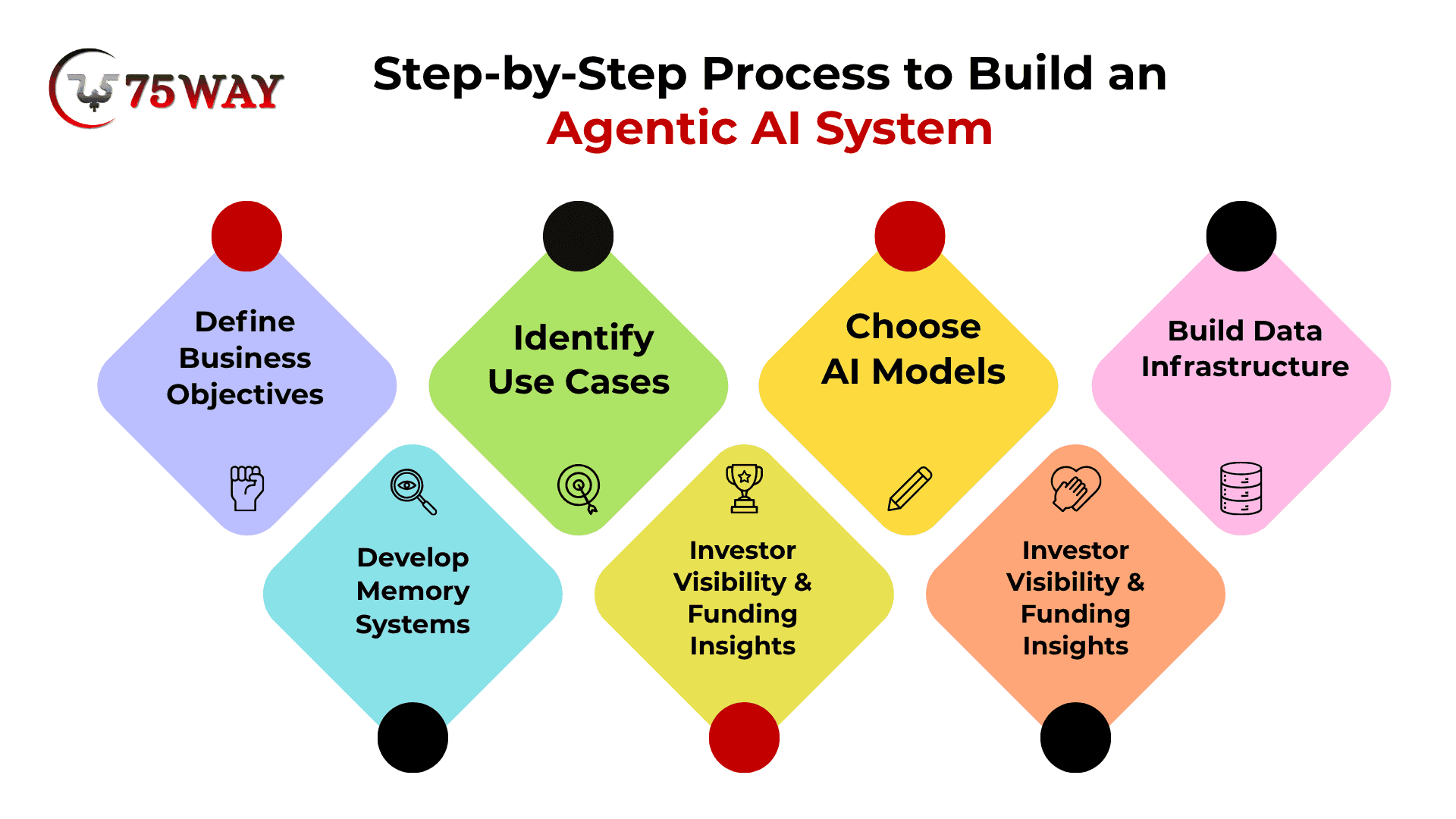
Phase 1: Define Business Objectives
Before building an Agentic AI system, businesses must clearly identify the operational problems they want to solve. Well-defined objectives help organizations focus development efforts, improve implementation efficiency, and align AI capabilities with measurable business outcomes. Questions to evaluate:
- Which workflows require automation?
- Which departments face operational inefficiencies?
- Which tasks involve repetitive decision-making?
- Which customer interactions require contextual intelligence?
Without defined objectives, AI systems become technically complex but commercially ineffective.
Phase 2: Identify Use Cases
After defining business objectives, organizations must identify practical use cases where Agentic AI can deliver measurable operational value. Selecting high-impact applications helps businesses improve ROI, reduce implementation risks, and accelerate enterprise AI adoption effectively. Popular Agentic AI applications include:
- AI customer support
- Intelligent sales automation
- AI healthcare assistants
- Supply chain management
- AI recruitment systems
- AI financial analysis
- Enterprise workflow automation
Start with a limited set of high-impact use cases before expanding system capabilities.
Phase 3: Choose AI Models
AI models act as the reasoning foundation of Agentic AI systems, influencing decision-making quality, contextual intelligence, and workflow automation capabilities. Selecting suitable models helps businesses improve scalability, response accuracy, and long-term enterprise AI adaptability. You must evaluate:
- Response accuracy
- Hallucination frequency
- Context handling
- Latency
- Fine-tuning capabilities
- Infrastructure compatibility
Different AI models provide varying advantages depending on business requirements, deployment strategies, customization needs, and infrastructure limitations. Careful model selection helps organizations balance performance, scalability, operational reliability, and enterprise AI implementation costs. Open-source and proprietary models both offer unique advantages.
Phase 4: Build Data Infrastructure
After selecting AI models, businesses must establish a strong data infrastructure capable of supporting autonomous reasoning, contextual intelligence, and real-time workflow execution. AI systems depend heavily on structured and unstructured data pipelines to process enterprise information accurately and maintain operational continuity across interconnected environments.
Modern Agentic AI infrastructures commonly include data warehouses, vector databases, cloud storage systems, streaming architectures, knowledge repositories, and API gateways working together within unified ecosystems. Weak or fragmented data architecture often creates unreliable outputs, inconsistent workflows, delayed responses, and poor enterprise AI performance at scale.
Phase 5: Develop Memory Systems
As Agentic AI systems handle increasingly complex workflows, memory architecture becomes essential for maintaining contextual continuity and intelligent personalization. Strong memory systems help AI agents retain historical knowledge, understand behavioral patterns, and improve decision-making quality across long-term enterprise interactions and operational processes.
- Episodic Memory: Stores historical interactions, workflow events, and sequential experiences for contextual reasoning across future enterprise operations.
- Semantic Memory: Retains factual knowledge, organizational information, concepts, and structured intelligence supporting accurate AI-driven enterprise decision-making processes.
- Operational Memory: Maintains active workflow context, task states, temporary instructions, and real-time execution-related enterprise operational information.
- User Interaction History: Tracks conversations, behavioral patterns, preferences, and engagement history to improve personalized AI responses and experiences.
Memory-driven systems deliver significantly better user experiences.
Phase 6: Create Workflow Orchestration
Once memory systems are established, businesses must create orchestration layers that coordinate AI agents, workflows, decision logic, and operational execution processes. Workflow orchestration enables Agentic AI ecosystems to manage complex enterprise tasks systematically while maintaining operational accuracy, scalability, and intelligent task coordination across interconnected environments.
- Task Routing: Directs tasks toward appropriate AI agents, systems, or workflows based on operational requirements and contextual priorities.
- Dependency Management: Coordinates workflow dependencies to execute tasks without conflicts, interruptions, or operational inconsistencies across systems.
- Retry Mechanisms: Automatically reprocess failed tasks or interrupted workflows to maintain operational continuity and execution reliability.
- Escalation Rules: Transfers unresolved tasks, high-risk scenarios, or critical workflows toward specialized agents or human supervisors.
- Human Approval Layers: Introduces human verification checkpoints before executing sensitive actions, strategic decisions, or high-impact operational workflows.
- Error Handling Systems: Detects workflow failures, operational disruptions, and execution anomalies while triggering corrective automation responses.
This layer acts as the operational brain of the ecosystem.
Phase 7: Integrate External Tools
After workflow orchestration is established, Agentic AI systems must connect with external enterprise platforms to execute real-world operational tasks effectively. External integrations allow AI agents to access business data, automate workflows, process transactions, and coordinate actions across interconnected digital ecosystems.
Modern Agentic AI systems commonly integrate with CRMs, ERPs, ecommerce platforms, payment gateways, analytics tools, and communication systems through APIs and middleware architectures. These integrations significantly expand AI functionality by enabling real-time automation, cross-platform coordination, operational visibility, and enterprise-wide workflow intelligence.
Phase 8: Implement Security And Governance
As Agentic AI systems gain access to enterprise workflows, customer information, and operational data, security and governance become critical implementation priorities. Strong governance frameworks help organizations maintain compliance, reduce operational risks, and protect sensitive business environments from unauthorized access or AI-related vulnerabilities.
Critical security measures include:
- Role-based access control
- Data encryption
- Audit logging
- Compliance monitoring
- AI output validation
- Threat detection systems
These security layers help businesses monitor AI activities, secure enterprise infrastructure, and maintain visibility across autonomous workflows and decision-making processes. Governance systems also establish accountability mechanisms that support responsible AI deployment across enterprise environments.
Core Components Of An Agentic AI System
Building a scalable Agentic AI system requires a strong architectural foundation that enables autonomous decision-making, contextual memory retention, intelligent coordination, and workflow execution. These core components work together to create AI ecosystems capable of functioning similarly to human operational teams across enterprise environments.
1. AI Agent Layer: This layer contains autonomous AI agents responsible for executing specialized tasks independently. Different agents manage operations like customer support, analytics, workflow automation, scheduling, cybersecurity monitoring, and content generation. Examples include:
- Customer support agents
- Analytics agents
- Workflow management agents
- Scheduling agents
- Security monitoring agents
- Content generation agents
Each agent specializes in specific operational objectives.
2. Memory Systems: Memory systems enable contextual continuity by storing interactions, behavioral patterns, organizational knowledge, and workflow history. These infrastructures help AI agents maintain context across conversations, tasks, and long-term enterprise operations.
3. Short-Term Memory: Short-term memory stores temporary interactions, recent conversations, immediate instructions, and active workflow context. This enables AI systems to maintain real-time continuity during ongoing tasks and operational processes.
4. Long-Term Memory: Long-term memory retains historical knowledge, user preferences, behavioral patterns, and enterprise data over extended periods. This improves personalization, decision-making accuracy, and contextual intelligence continuously across workflows. Vector databases commonly support memory infrastructures. Popular technologies include:
- Pinecone
- Weaviate
- ChromaDB
- Milvus
Large Language Models Powering Agentic AI
Large Language Models serve as the reasoning engines behind autonomous AI systems. Popular enterprise-grade models include:
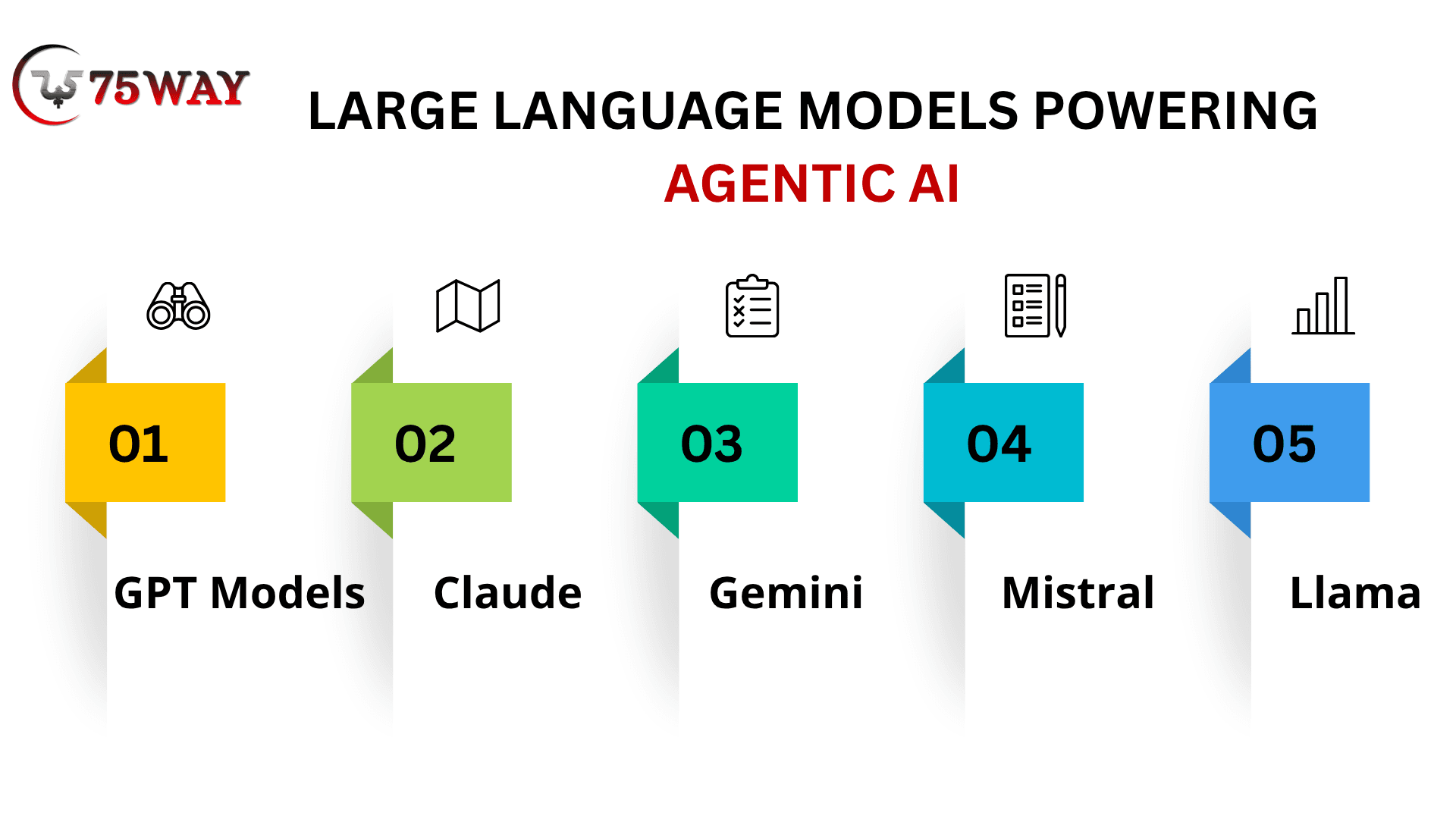
- GPT Models: Advanced language models supporting reasoning, automation, content generation, workflow orchestration, and enterprise conversational intelligence applications globally.
- Claude: AI model optimized for safe reasoning, contextual understanding, enterprise assistance, long-document analysis, and intelligent workflow management.
- Gemini: Multimodal AI model supporting reasoning, data analysis, automation, content understanding, and cross-platform enterprise productivity workflows efficiently.
- Mistral: Open-weight AI model delivering efficient reasoning, scalable deployment flexibility, fast inference performance, and enterprise AI customization capabilities.
- Llama: Meta-developed language model enabling open-source AI development, autonomous workflows, scalable reasoning systems, and enterprise AI experimentation.
These models interpret objectives, generate outputs, analyze context, and coordinate actions. Businesses select models based on:
- Accuracy requirements
- Deployment preferences
- Privacy compliance
- Infrastructure costs
- Fine-tuning flexibility
- Multimodal capabilities
Multi-Agent Orchestration Architecture
Enterprise AI ecosystems often involve multiple collaborating agents rather than single-agent systems. Single AI agents struggle managing complex enterprise workflows independently. Multi-agent architectures divide responsibilities across specialized AI units. For example:
- One agent handles customer onboarding
- Another processes payments
- Another monitors fraud risks
- Another manages delivery logistics
Thesemodelscoordinate communication between agents, APIs, databases, and workflows. Popular orchestration frameworks include:
- LangChain: Framework enabling AI agents to integrate tools, memory systems, APIs, workflows, and external enterprise data sources.
- CrewAI: Multi-agent orchestration framework supporting collaborative autonomous AI teams managing specialized enterprise tasks and operational workflows.
- AutoGen: Microsoft-developed framework enabling autonomous AI agent collaboration, conversation management, workflow automation, and intelligent task coordination systems.
- Semantic Kernel: Enterprise AI orchestration framework integrating language models, memory systems, plugins, APIs, and contextual reasoning capabilities.
- Haystack: Open-source framework supporting retrieval-augmented generation, document search, AI pipelines, and enterprise knowledge management applications.
Robust Technology Stack Used To Build Agentic AI System
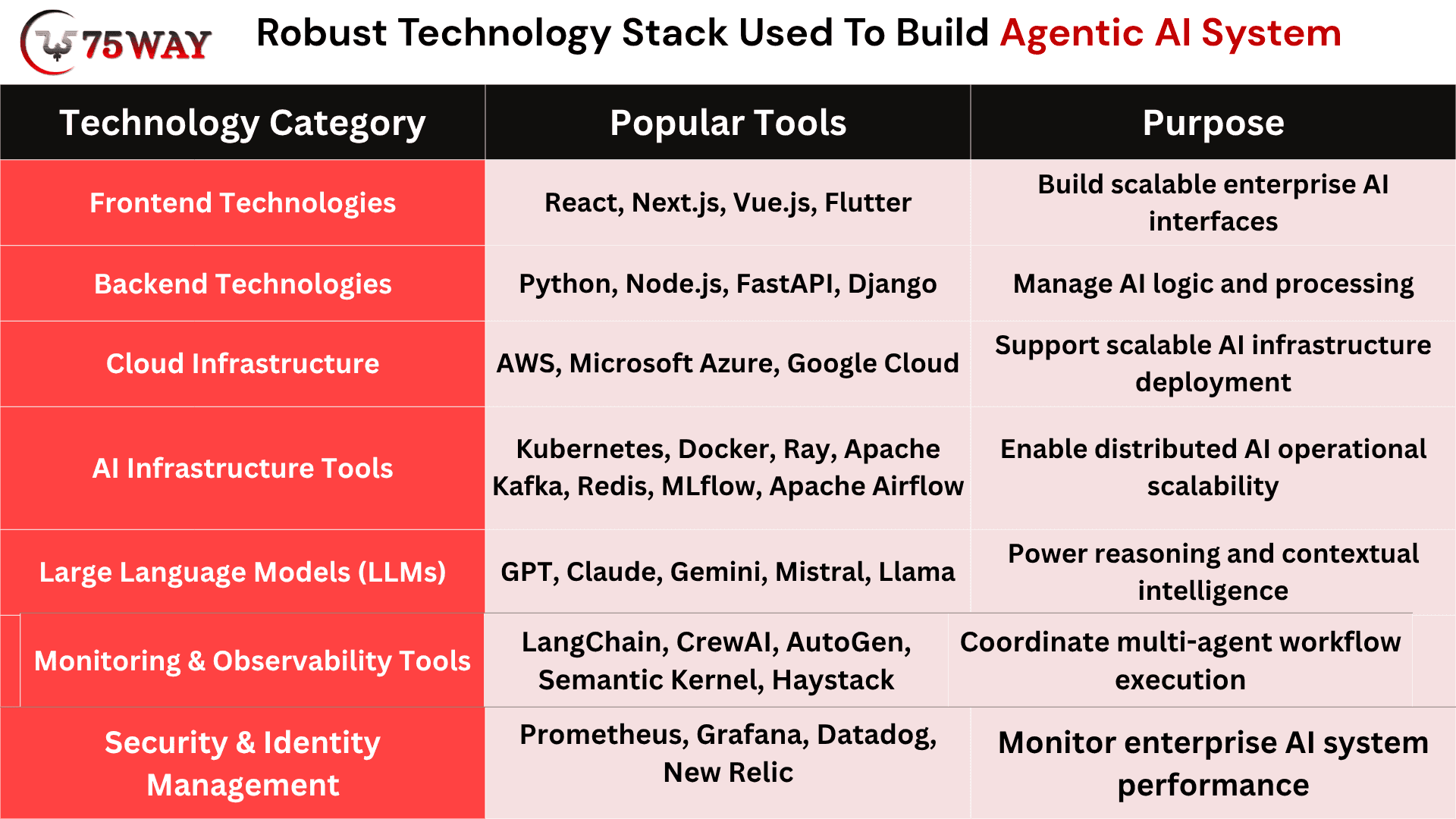
Building scalable Agentic AI systems requires a modern technology stack for real-time processing, distributed AI operations, and enterprise scalability. The right technologies help businesses improve system performance, infrastructure flexibility, and long-term operational reliability.
- Frontend Technologies: Popular frontend technologies include React, Next.js, Vue.js, and Flutter. These frameworks support scalable AI interfaces, enterprise dashboards, workflow visibility, and responsive cross-platform user experiences.
- Backend Technologies: Backend systems commonly use Python, Node.js, FastAPI, and Django for enterprise AI infrastructure development and workflow automation environments.
- Cloud Infrastructure: Major cloud providers include AWS, Microsoft Azure, and Google Cloud for enterprise AI scalability, GPU processing, infrastructure monitoring, and storage management.
- AI Infrastructure Tools: Popular AI infrastructure technologies include Kubernetes, Docker, Ray, Apache Kafka, Redis, MLflow, and Apache Airflow for scalable distributed AI ecosystems.
- Large Language Models (LLMs): Large Language Models commonly include GPT, Claude, Gemini, Mistral, and Llama for reasoning, automation, and contextual enterprise AI operations.
- Workflow Orchestration Frameworks: Workflow orchestration frameworks commonly use LangChain, CrewAI, AutoGen, Semantic Kernel, and Haystack for multi-agent coordination and enterprise automation.
- Monitoring & Observability Tools: Monitoring systems commonly use Prometheus, Grafana, Datadog, and New Relic for infrastructure visibility, anomaly detection, and enterprise AI performance monitoring.
- Security & Identity Management: Security infrastructures commonly use OAuth 2.0, Okta, Auth0, and HashiCorp Vault for authentication, access control, and enterprise governance.
Industries Rapidly Adopting Agentic AI-Powered Solutions
Agentic AI adoption is rapidly expanding across industries as businesses seek autonomous systems to improve operational efficiency, streamline workflows, and enhance customer experiences. These intelligent AI ecosystems help organizations manage complex enterprise processes with real-time adaptability.
- Healthcare: Healthcare organizations use Agentic AI systems for diagnostics, patient communication, workflow automation, and clinical operational efficiency.
- Ecommerce: Ecommerce businesses deploy AI agents for personalized shopping experiences, inventory optimization, dynamic pricing, and automated support.
- Finance: Financial institutions implement Agentic AI for fraud detection, compliance monitoring, forecasting, and intelligent financial decision-making operations.
- Logistics: Logistics companies use AI agents for route optimization, warehouse automation, shipment tracking, and supply chain forecasting systems.
- Manufacturing: Manufacturing industries use Agentic AI for predictive maintenance, production optimization, quality monitoring, and industrial automation workflows.
- Retail: Retail businesses deploy AI agents for customer engagement, demand forecasting, inventory tracking, and personalized shopping recommendations.
- Cybersecurity: Cybersecurity organizations use AI agents for threat detection, anomaly monitoring, risk assessment, and automated incident response operations.
- Education: Educational institutions implement Agentic AI to deliver personalized learning experiences, support students, automate administrative processes, and enable performance analytics.
- Real Estate: Real estate companies use AI systems for property recommendations, lead qualification, market analysis, and customer communication automation.
What’s The Cost of Building an Agentic AI System in 2026?
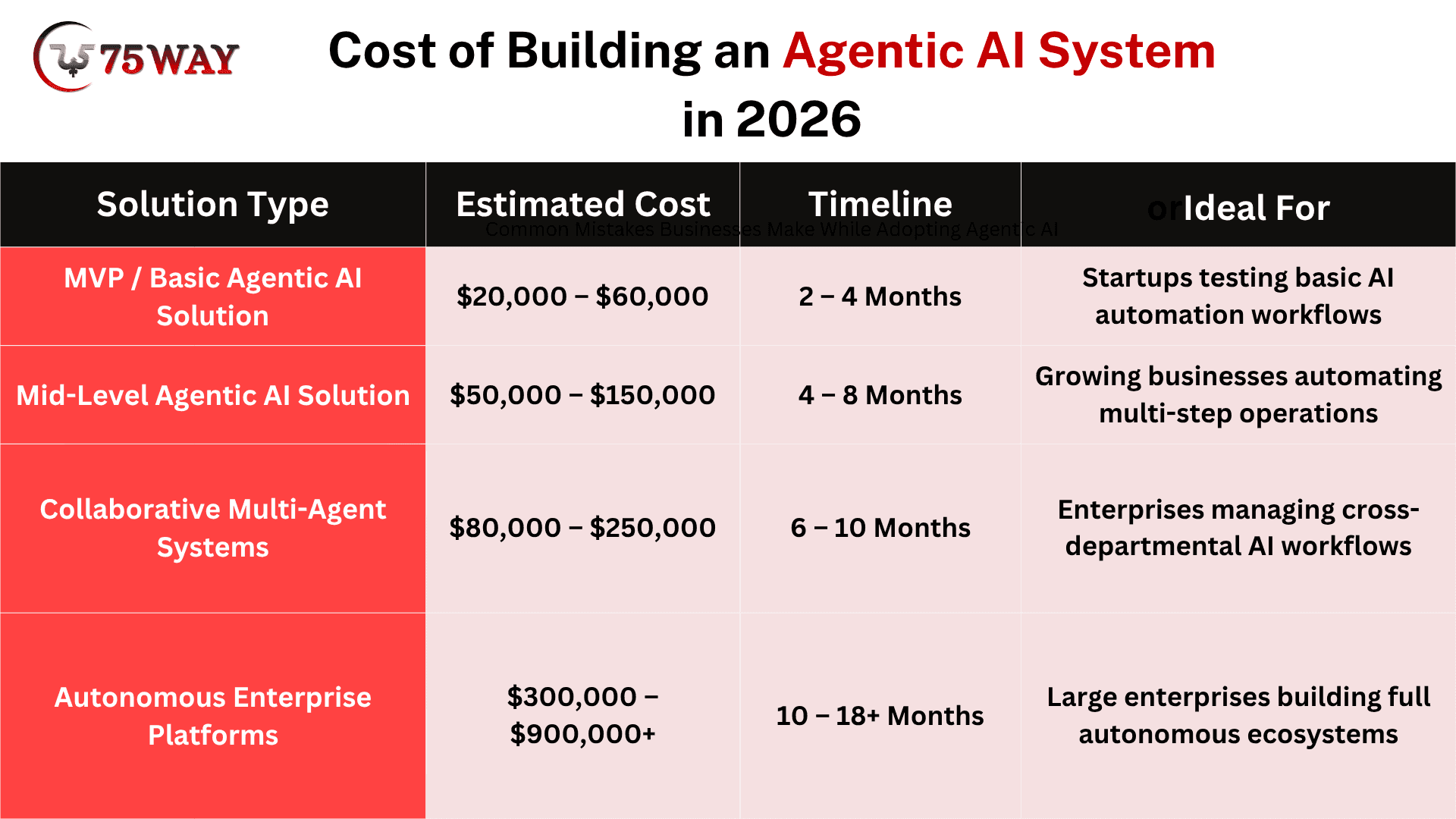
The cost of developing an Agentic AI system depends heavily on automation complexity, AI model capabilities, infrastructure scale, memory architecture, and enterprise integration requirements. An average cost to build an agentic AI system lies between $20,000–$900,000+. Businesses typically invest according to operational goals, scalability expectations, and the number of autonomous AI agents required across workflows.
- MVP/Basic Agentic AI Solution: $20,000 – $60,000
Handle simple, single-domain automations across 1-2 internal systems like CRM or email.
- Mid-Level Agentic AI Solution: $50,000 – $150,000
Support advanced workflow automation, contextual memory, enterprise integrations, and intelligent multi-step operational task execution.
- Collaborative Multi-Agent Systems: $80,000 – $250,000
Specialized agents interact collaboratively to solve complex cross-departmental workflows and enterprise operational challenges.
- Autonomous Enterprise Platforms: $300,000 – $900,000+
Enterprise-scale ecosystems for autonomous decision-making and large-scale orchestration.
Agentic AI Development Cost Based On Development Stages
- Discovery and Planning: $5,000 – $15,000
- Data Acquisition and Preparation: $10,000 – $70,000
- Model Setup, Orchestration, and Training: $10,000 – $100,000
- API, System Integration, and Orchestration: $20,000 – $50,000
- Testing, Validation, and Fallback Setup: $5,000 – $15,000
- Deployment and Infrastructure: $5,000 – $30,000
Factors Influencing Cost To Develop an Agentic AI System
- AI model complexity: Determines training depth, reasoning capability, accuracy requirements, and computational resources needed for enterprise AI system performance.
- Infrastructure scale: Defines cloud capacity, distributed systems, processing power, storage requirements, and scalability needs for large enterprise AI operations.
- Integration requirements: Involves connecting APIs, enterprise tools, databases, and third-party systems for seamless workflow automation and data exchange.
- Security Standards: Encryption, access controls, compliance frameworks, monitoring systems, and protection against data breaches and AI vulnerabilities.
- Customization levels: Reflect the extent of tailored workflows, domain-specific training, feature personalization, and enterprise-specific AI behavior adaptation needs.
- Deployment environments: Cover cloud, on-premise, hybrid setups, GPU clusters, and infrastructure configurations for running AI systems. For GPU-backed deployments, comparing cloud GPU pricing across different GPU models and providers can help teams estimate recurring compute costs before scaling AI workloads in production.
Human-In-The-Loop Systems Considered To Create Agentic AI Solutions
Despite increasing automation, human oversight remains essential for ensuring safe, accurate, and compliant enterprise AI operations across critical workflows.
- Decision Approvals: AI-generated decisions in high-impact scenarios require human approval to prevent costly or irreversible errors. This ensures accountability in enterprise operations and maintains organizational control over automated actions.
- Quality Validation: Human reviewers assess AI outputs for accuracy, relevance, and contextual correctness before deployment. It improves system reliability and ensures enterprise-grade standards are consistently maintained across workflows.
- Risk Management: Humans evaluate AI decisions to identify financial, operational, or ethical risks that automated systems may overlook. It strengthens system safety and reduces the likelihood of critical failures in production environments.
- Compliance Review: Regulatory and legal experts examine AI outputs to ensure alignment with industry standards and policies. It helps organizations avoid violations and maintain compliance across multiple jurisdictions.
- Sensitive Operational Workflows: Human supervision is used in areas such as finance, healthcare, and security, where precision is critical. It ensures high-risk actions are executed responsibly and with appropriate judgment.
Future Trends Shaping Agentic AI in 2026 & Beyond
Future advancements will focus on improving collaboration between AI agents, expanding multimodal understanding, and building decentralized infrastructures that support real-time decision-making at scale. These trends will redefine how businesses automate operations, interact with data, and deliver customer experiences across industries.
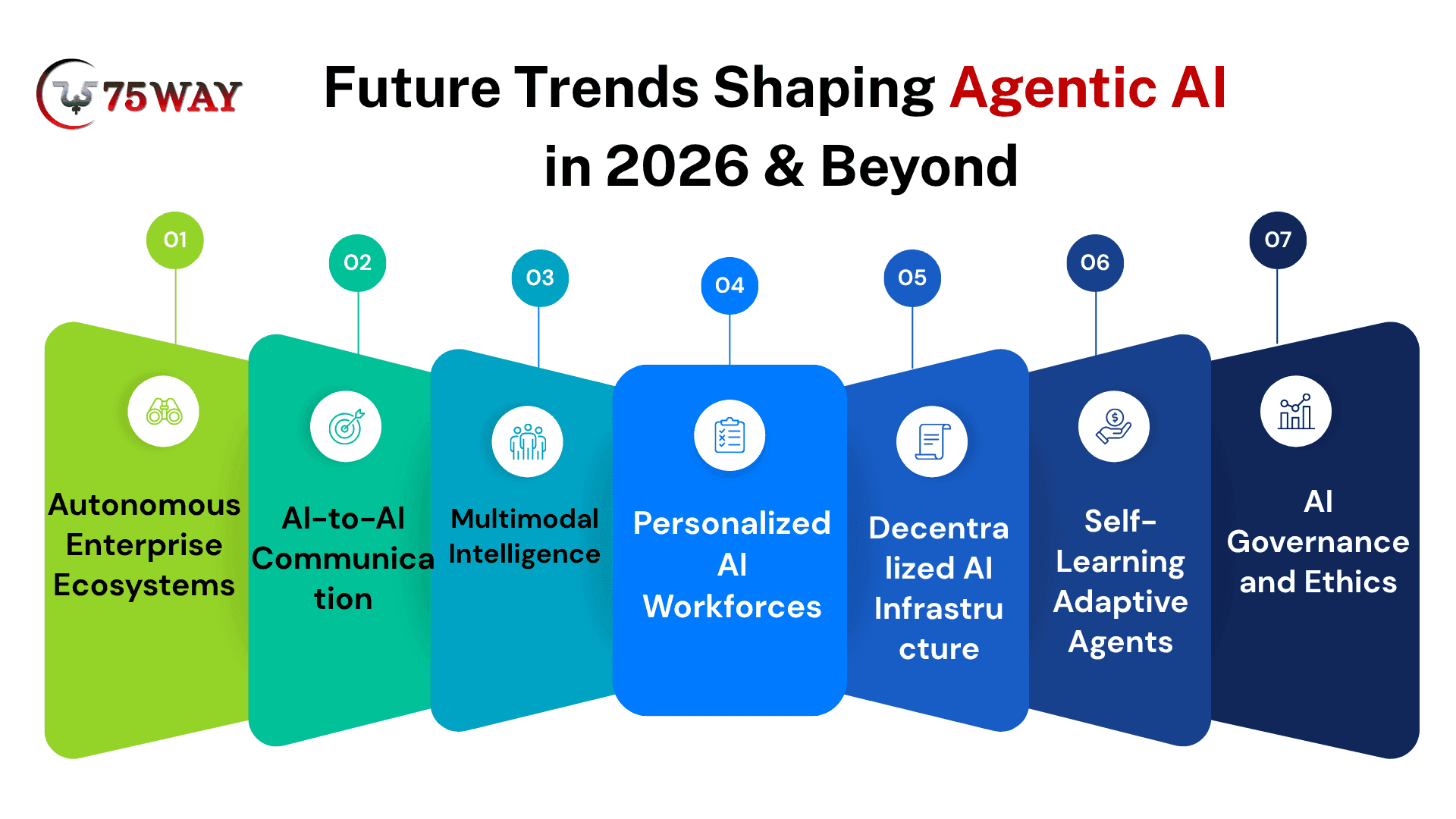
- Autonomous Enterprise Ecosystems: Businesses are increasingly adopting fully interconnected AI systems where multiple agents operate across departments. This enables end-to-end automation of workflows with minimal human intervention and higher operational efficiency.
- AI-to-AI Communication: Future AI systems will enable agents to collaborate directly with each other across platforms. This improves coordination, reduces latency, and allows autonomous problem-solving without human involvement.
- Multimodal Intelligence: AI agents will process text, images, voice, video, and sensor data simultaneously. This enhances contextual understanding and enables more accurate and human-like decision-making.
- Personalized AI Workforces: Organizations will deploy customized AI agents tailored to specific business functions and user behaviors. This increases productivity, personalization, and domain-specific operational efficiency.
- Decentralized AI Infrastructure: Edge computing and decentralized architectures will distribute AI processing closer to data sources. This improves privacy, reduces latency, and enhances system scalability.
- Self-Learning Adaptive Agents: Future AI systems will continuously learn from interactions, feedback, and outcomes. This enables ongoing improvement in accuracy, efficiency, and decision-making capabilities over time.
- AI Governance and Ethical Frameworks: As AI autonomy increases, businesses will implement stronger governance models to ensure transparency, accountability, and ethical compliance in automated decision-making systems.
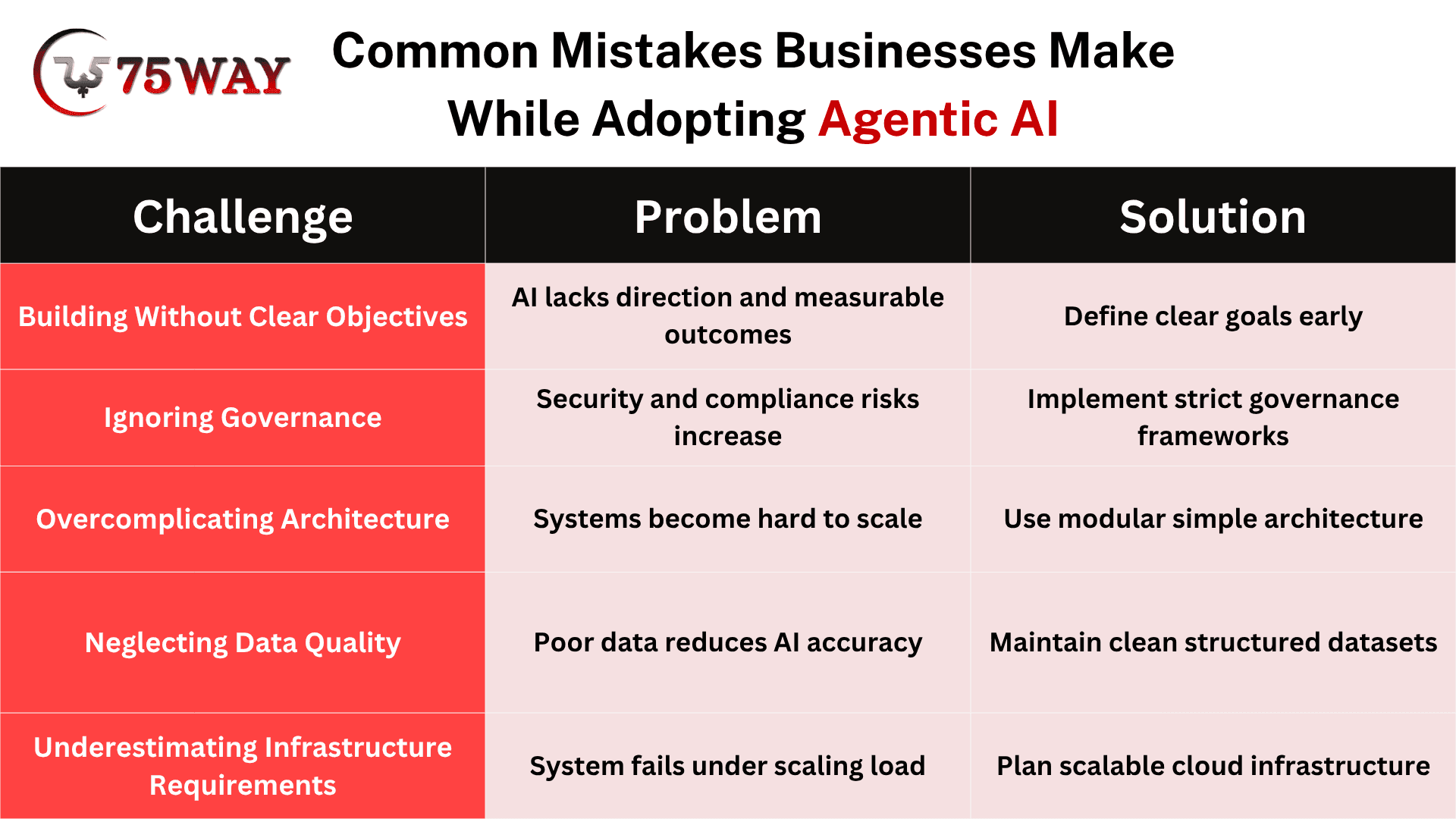
Common Mistakes Businesses Make While Adopting Agentic AI
Many organizations struggle with Agentic AI adoption because they overlook foundational planning, governance, and infrastructure requirements. These mistakes often lead to poor performance, high costs, and systems that fail to deliver real business value at scale.
- Building Without Clear Objectives: Companies often deploy AI systems without defining measurable goals or use cases. Without clear direction, AI initiatives become fragmented and fail to deliver meaningful business impact.
- Ignoring Governance: Lack of governance leads to security risks, compliance issues, and uncontrolled AI behavior. This exposes organizations to regulatory challenges and operational vulnerabilities across systems.
- Overcomplicating Architecture: Overly complex system designs make scaling, debugging, and maintenance difficult. Simpler modular architectures improve flexibility, performance, and long-term system sustainability.
- Neglecting Data Quality: Poor-quality or unstructured data significantly reduces AI accuracy and reliability. Clean, well-structured data pipelines directly improve model performance and decision-making accuracy.
- Underestimating Infrastructure Requirements: Many businesses fail to plan for scalability, leading to performance bottlenecks and system failures. Proper infrastructure planning ensures smooth scaling and stable enterprise-grade performance.
Best Practices for Successful Agentic AI Development
Successful Agentic AI development requires a strategic approach focused on scalability, governance, and continuous optimization. Businesses must prioritize high-impact workflows, strong infrastructure, and secure systems to achieve long-term AI success.
- Start With High-Impact Workflows
Begin with operational bottlenecks delivering measurable ROI quickly. This ensures faster value realization and builds confidence in AI adoption across enterprise teams.
- Prioritize Scalable Infrastructure
Cloud-native architecture supports future expansion efficiently. It ensures systems handle increasing workloads without performance degradation or operational disruptions.
- Invest in Monitoring Systems
Continuous monitoring improves reliability and operational visibility. It helps detect anomalies early and ensures consistent system performance across workflows.
- Build Strong Security Frameworks
Enterprise AI systems require advanced governance and access controls. This protects sensitive data and ensures compliance with industry regulations.
- Optimize Continuously
AI systems improve through iterative learning and performance analysis. Regular optimization enhances accuracy, efficiency, and long-term operational effectiveness.
- Align AI With Business Strategy
AI initiatives must directly support business goals to ensure measurable impact. Strategic alignment improves ROI and ensures sustainable enterprise adoption.
Why Businesses Need To Hire A Trusted Agentic AI Development Agency?
Building enterprise-grade Agentic AI systems requires deep expertise across AI engineering, infrastructure design, security implementation, data pipelines, cloud deployment, workflow orchestration, and compliance management. A reliable agentic AI development agency, such as 75way Technologies, brings proven frameworks, technical expertise, and scalable architectures that help businesses avoid costly trial-and-error development cycles.
The skilled AI agent developers reduce implementation risks and enhance deployment timelines by leveraging pre-built components, optimized workflows, and industry best practices. This ensures faster time-to-market, improved system reliability, and better alignment with enterprise objectives from the early stages of development.
Organizations without specialized expertise often face challenges such as scalability limitations, unstable automation workflows, integration failures, and operational inefficiencies. Partnering with a trusted AI development agency helps overcome these barriers while ensuring secure, scalable, and high-performing AI systems built for long-term enterprise success.
Final Remarks
Agentic AI systems are redefining enterprise automation, intelligent operations, and digital scalability in 2026. Businesses adopting autonomous AI ecosystems gain significant competitive advantages through faster decision-making, personalized engagement, reduced operational overhead, and scalable workflow orchestration.
A successful development strategy depends on strategic planning, scalable infrastructure, memory-driven architectures, orchestration frameworks, governance systems, and continuous optimization. Businesses that prioritize these foundations position themselves for long-term operational growth and successful digital transformation.
Transform your business with autonomous agentic AI systems now. Connect with a prominent agentic AI development company to build future-ready Agentic AI solutions that drive efficiency, innovation, and enterprise growth.
Frequently Asked Questions (FAQs)
Does Agentic AI Replace Human Employees?
Agentic AI primarily augments operational capabilities instead of replacing entire workforces. Businesses use AI agents for repetitive workflows, data processing, monitoring, scheduling, and automation tasks.
Which Industries Generate the Highest ROI From Agentic AI?
Organizations in ecommerce, healthcare, finance, logistics, retail, SaaS, manufacturing, and telecommunications frequently experience improved productivity and reduced operational costs.
What Data Is Required To Train Agentic AI Systems?
Training requires enterprise data such as workflows, customer interactions, system logs, and domain knowledge. High-quality structured data directly improves intelligence and operational accuracy.
How Do Agentic AI Systems Handle Errors or Failures?
Systems use retry logic, fallback mechanisms, and monitoring alerts. Critical failures are escalated to humans to maintain operational stability and reliability.
Is Cloud Infrastructure Mandatory For Agentic AI Development?
Cloud platforms provide scalability, compute power, and flexibility for enterprise AI systems. Hybrid and on-premise setups are also possible depending on compliance needs.
What Makes Agentic AI Different From Chatbots?
Chatbots handle conversational responses to user queries. Agentic AI executes autonomous workflows, makes decisions, and completes multi-step enterprise tasks across systems.