AI Summary
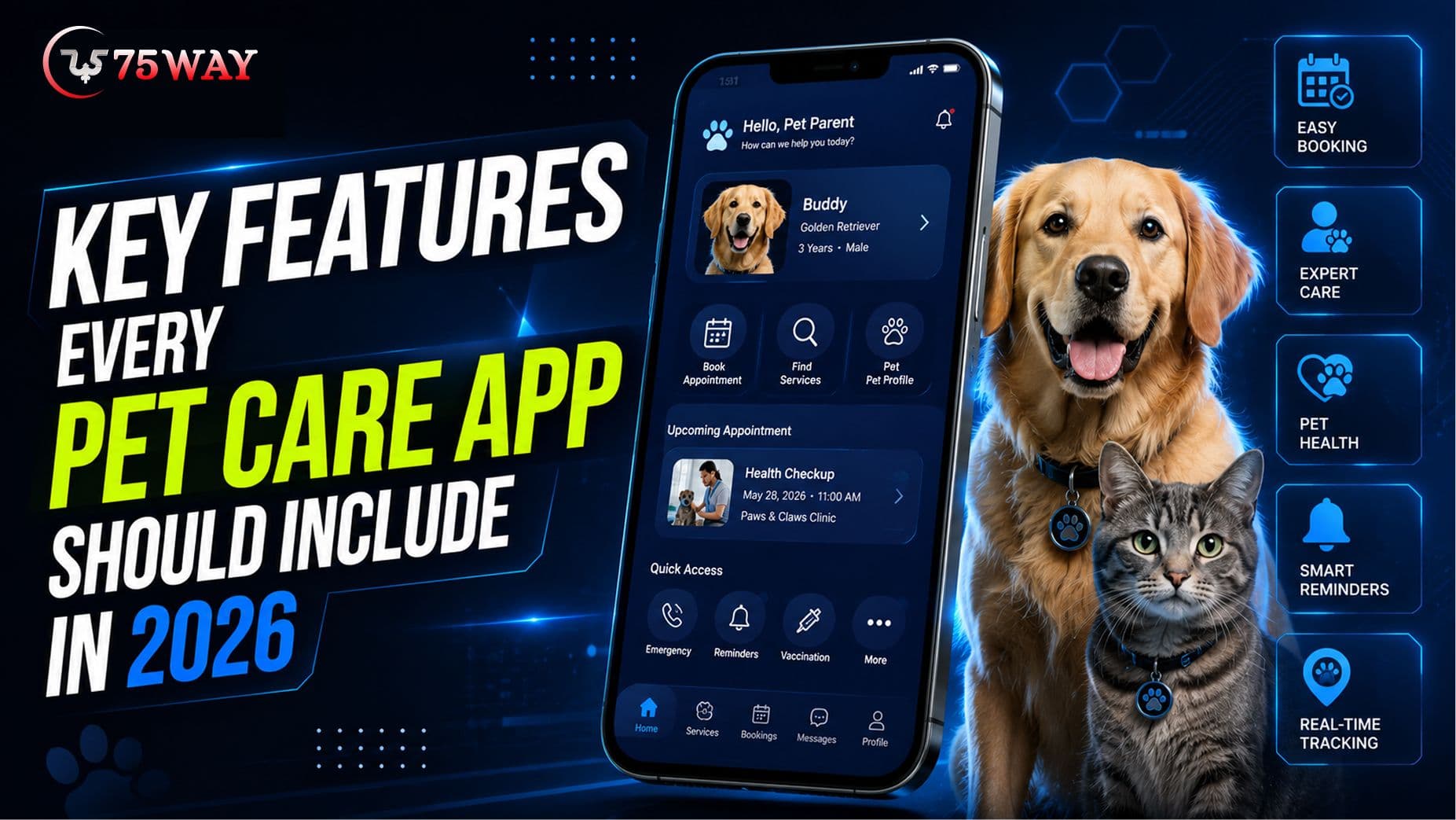
A successful pet delivery app needs more than product browsing and checkout. Essential features should simplify pet-specific shopping, delivery tracking, and customer support, while advanced capabilities improve personalization and retention. This guide explains the key features businesses should prioritize when developing a pet delivery app in 2026.
Key Takeaways
- Pet profiles centralize important information for personalized and convenient pet care management.
- Health records help owners organize vaccinations, medications, visits, allergies, and treatments.
- Appointment booking connects pet owners with veterinarians and care providers seamlessly.
- AI features can deliver personalized guidance while supporting human veterinary oversight.
- GPS tracking improves pet safety through location monitoring and geofencing alerts.
A pet owner books a vet appointment, orders medicine, finds a groomer, or simply keeps track of their pet’s care. They should not have to jump between different services or make repeated calls just to manage basic needs. Those small moments of uncertainty can decide whether a customer trusts your app enough to place the next order.
If you are building a pet care mobile app for your business, your features need to solve situations customers actually face. That means making recurring food purchases easier, handling urgent medicine orders, offering convenient delivery slots, managing product substitutions, and keeping customers informed from warehouse to doorstep.
The challenge grows when your veterinary care app development solution connects pet owners with vets, groomers, trainers, pharmacies, and other care providers. Your app needs the right systems to keep appointments, provider availability, payments, pet profiles, records, and voice AI for communication connected without creating unnecessary work for your team.
This guide explores the features worth prioritizing in pet healthcare app development in 2026 and how they can improve the owner experience while helping businesses build stronger customer relationships and recurring revenue.
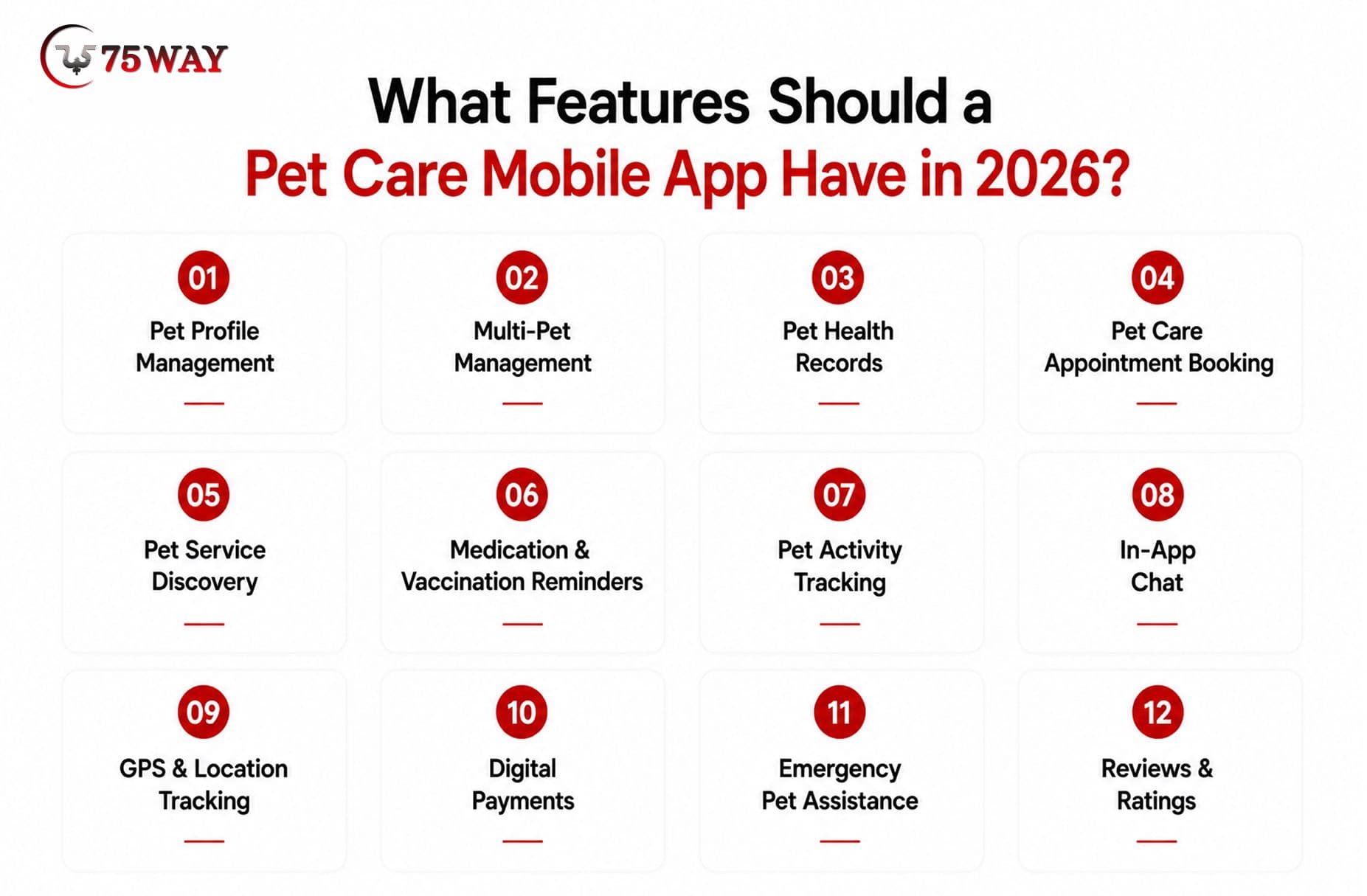
What Features Should a Pet Care Mobile App Have in 2026?
A useful pet care app should answer a simple question for owners: “Can I manage my pet’s care without making five different calls?” Booking, records, reminders, consultations, and provider communication can bring those needs together. The features of your veterinary app that make this possible in 2026 are covered below.
- Pet Profile Management
Pet owners can create individual profiles containing names, breeds, ages, weights, medical information, dietary preferences, behavioral details, and other care-related information. A complete profile gives the app a central source of pet information that can be referenced across different services.
Owners can also update profiles as their pets grow or their care requirements change. For multi-service platforms, approved veterinarians and pet-care providers can access relevant information when needed, helping them deliver more personalized and informed services.
- Multi-Pet Management
Pet owners with multiple animals should be able to manage every pet from one account without creating separate profiles. Each pet can have its own information, appointments, health records, reminders, service history, preferences, and care requirements.
This feature becomes particularly valuable for families managing different breeds, ages, medical needs, or dietary routines. A well-organized multi-pet interface can also make repeat bookings easier because owners can select the relevant pet without repeatedly entering the same information.
- Pet Health Records
A pet care app can maintain a centralized digital record containing vaccination history, allergies, prescriptions, diagnoses, medical documents, treatment details, and previous veterinary visits. Keeping these records together gives owners quick access to important information when arranging care.
With appropriate permissions, veterinarians and authorized providers can access relevant records during appointments or services. This can reduce repeated information collection and give care professionals better context when making service or treatment decisions.
- Pet Care Appointment Booking
Appointment booking allows pet owners to find suitable veterinarians or service providers, view availability, select services, and reserve convenient time slots directly through the app. The booking journey should remain simple, especially when users need care quickly.
The feature can also support appointment confirmations, rescheduling, cancellations, calendar synchronization, and automated reminders. For businesses, centralized booking reduces manual scheduling work while giving them better visibility into upcoming appointments and provider availability.
- Pet Service Discovery
A service discovery feature can help owners find veterinarians, groomers, walkers, sitters, trainers, boarding facilities, and other pet-care professionals based on location and service requirements. Search filters can narrow results by availability, service type, pricing, ratings, and distance.
This feature is particularly important for marketplace-based pet care apps because customers need an easy way to compare providers before making a decision. Detailed service profiles can also display qualifications, experience, operating hours, reviews, and available services.
- Medication & Vaccination Reminders
Medication and vaccination reminders help pet owners stay aware of recurring healthcare responsibilities. The app can send notifications for medications, vaccinations, routine checkups, treatments, grooming appointments, and other scheduled care activities.
Owners can set recurring schedules and receive alerts before an important date arrives. For veterinary-focused applications, reminders can also encourage follow-up appointments or recommended treatments, helping create a more organized long-term care routine.
- Pet Activity Tracking
Activity tracking can help owners monitor walks, exercise, feeding, sleep, and other wellness-related activities through manually entered information or connected devices. This gives owners a clearer view of everyday routines instead of relying entirely on memory.
For platforms supporting wearables or connected pet devices, activity information can be collected automatically where compatible. Over time, this data can contribute to personalized wellness insights and help owners identify meaningful changes in their pet's normal activity patterns.
- In-App Chat
This pet care app feature allows pet owners to communicate directly with veterinarians, groomers, walkers, sitters, trainers, and other authorized service providers. Conversations can be connected to specific appointments or service requests, making communication easier to manage.
The feature can support text messages, images, documents, and service-related updates depending on the business model. Keeping communication inside the platform also creates a centralized interaction history that can help providers and customers refer back to previous conversations.
- GPS & Location Tracking
GPS functionality can support several pet-care scenarios, including tracking a dog walk, monitoring a service provider's arrival, following a pet delivery, or sharing a relevant service location. Real-time visibility can reduce uncertainty during services where location matters.
For walking, transportation, or delivery businesses, location tracking can provide route visibility and estimated arrival information. Geofencing can also trigger notifications when a pet or service provider enters or leaves a predefined area, where the use case requires it.
- Digital Payments
Digital payments allow customers to pay for veterinary appointments, grooming, boarding, walking, sitting, deliveries, products, memberships, and other eligible services directly within the application. Supporting multiple payment methods can make checkout more convenient for different customer preferences.
A complete payment workflow can include transaction confirmation, digital receipts, refunds, payment history, promotional discounts, and provider payouts. Businesses can also connect payment records with bookings and invoices, creating a more organized financial workflow.
- Emergency Pet Assistance
An emergency assistance feature can give owners quicker access to nearby veterinary hospitals, emergency clinics, urgent-care providers, or other relevant resources when unexpected situations occur. Location-based discovery can help users identify appropriate options without manually searching across multiple platforms.
The feature can also display emergency contact information, directions, operating status where available, and important pet details. It should clearly communicate that emergency guidance does not replace professional veterinary assessment when immediate medical attention is required.
- Reviews & Ratings
Reviews and ratings allow customers to evaluate completed services and share feedback about veterinarians, groomers, walkers, sitters, trainers, delivery partners, or other providers. Ratings can help prospective customers compare providers before selecting a service.
For businesses, feedback can highlight service-quality issues and identify consistently strong providers. A well-designed review system can include verified bookings, written reviews, rating categories, provider responses, and moderation tools to maintain useful and trustworthy marketplace information.
Important Features For Pet Service Provider Apps
A busy pet-care professional needs more than a calendar to manage clients and services. Provider apps should make it easier to control availability, access pet information, handle bookings, collect payments, and stay connected with owners. The features that support these needs are discussed below.
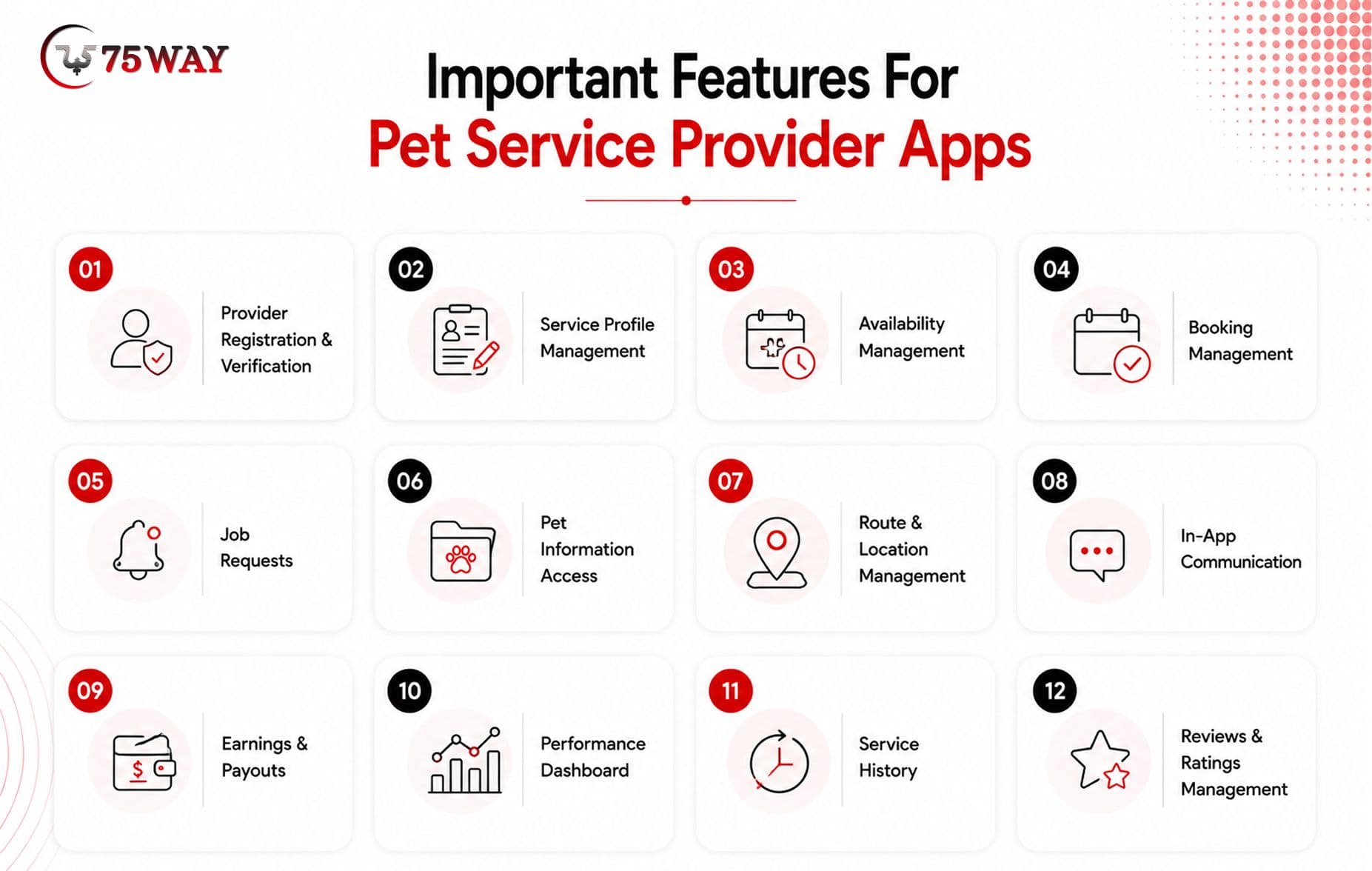
- Provider Registration & Verification: A simple onboarding process collects business details, licenses, qualifications, identification, and required documents.
The platform can review these details before approving a provider. Customers gain more confidence when professionals are verified. Approved providers can update credentials as their business grows.
- Service Profile Management: A detailed profile gives professionals space to present their services, prices, experience, operating areas, and working hours. Customers can browse this information before making a decision.
Photos, reviews, policies, and service details add useful context. A well-presented profile can also help providers attract more suitable bookings.
- Availability Management: Providers can set working hours, breaks, blocked dates, and appointment limits from one calendar. Customers see available slots without having to contact the provider first.
Schedule changes can be updated whenever needed. This helps prevent double bookings, unnecessary cancellations, and avoidable scheduling confusion.
- Booking Management: A central dashboard keeps upcoming, pending, completed, and cancelled appointments organized.
Each booking can show the pet, selected service, customer details, location, timing, and special instructions. Professionals can quickly review what each appointment requires. That makes preparation easier and reduces misunderstandings before the service begins.
- Job Requests: New service requests can reach professionals directly through the application.
Each request can include the service type, pet requirements, location, preferred timing, and customer notes. Professionals can accept suitable jobs or decline those they cannot handle. Instant alerts also help prevent valuable booking opportunities from being overlooked.
- Pet Information Access: Important details such as breed, age, behavior, allergies, and medical considerations can be available before a service.
This information gives professionals a better understanding of the pet they will handle. Access should depend on appropriate customer permissions. The added context can support safer and more personalized care.
- Route & Location Management: GPS and mapping tools can help professionals reach customer locations without switching between different applications.
Estimated arrival times can also be calculated from current location and route conditions. This feature is valuable for walkers, sitters, and mobile groomers. Customers can receive clearer updates about provider arrival.
- In-App Communication: Built-in messaging gives customers and professionals an easy way to discuss appointments.
They can clarify pet instructions, arrival times, service requirements, or unexpected changes before the visit. Keeping conversations inside the platform makes communication easier to follow. Relevant messages can also remain connected to the booking.
- Earnings & Payouts: A financial dashboard can show earnings from completed services in a clear format.
Professionals can check commissions, refunds, pending balances, and previous payouts whenever needed. Transparent records make income easier to understand. Automated payouts can also reduce repetitive financial administration for the platform.
- Performance Dashboard: Professionals can review bookings, completed services, cancellations, ratings, reviews, and earnings from one dashboard.
These numbers provide a quick picture of how their work is performing. Trends can reveal popular services or areas needing improvement. Platform owners can also use this information to maintain service quality.
Features For Veterinarians In Modern Pet Care Apps
A pet care app becomes far more useful when veterinarians have their own workspace instead of simply receiving appointment requests. The right features can help them manage consultations, pet records, follow-ups, communication, and everyday practice tasks from one place.
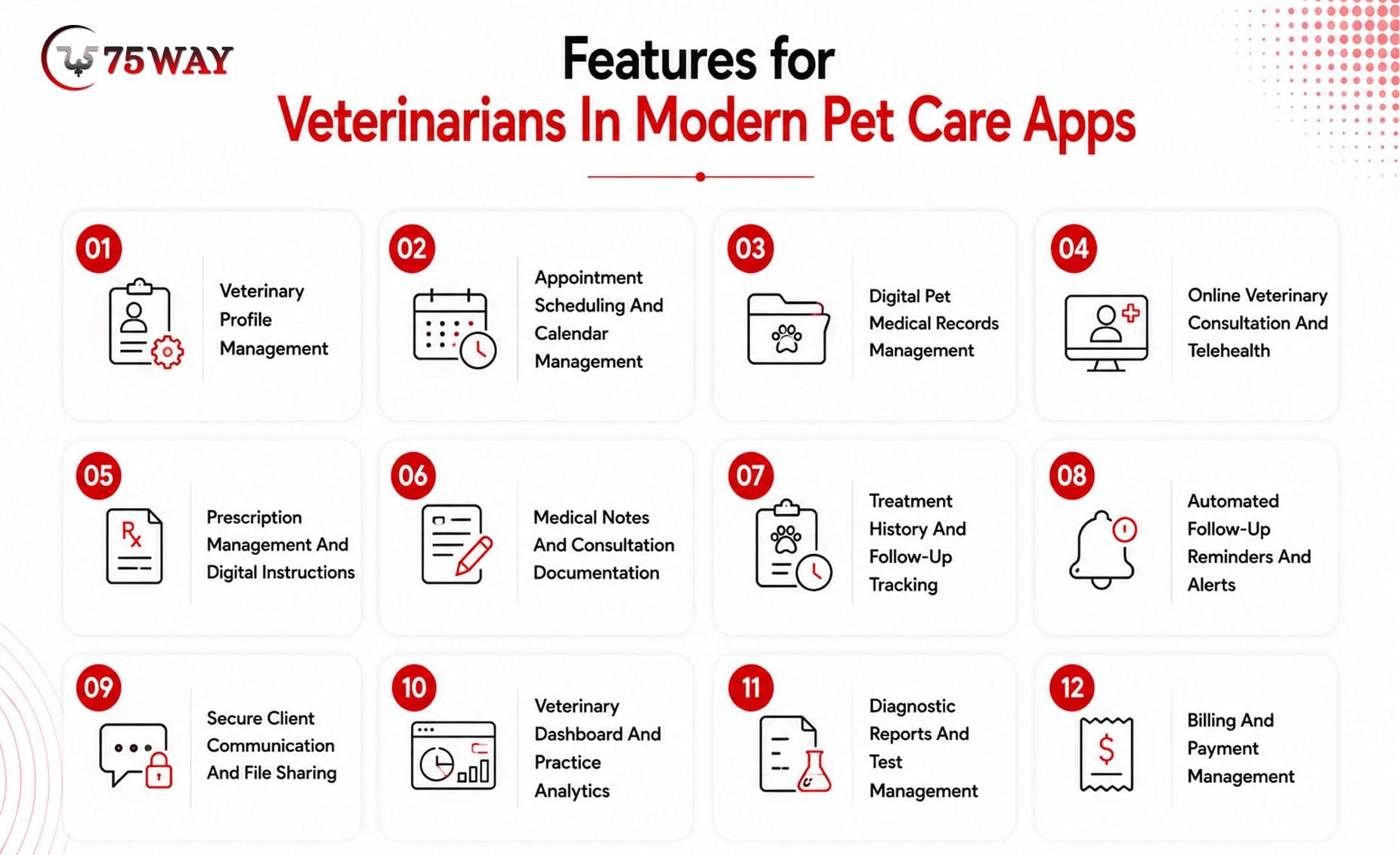
- Veterinary Profile Management
A professional profile gives veterinarians space to highlight qualifications, specialties, experience, clinic details, consultation options, and working hours. Pet owners can review these details before choosing a professional.
Verified credentials can add another layer of confidence. It also helps customers find a veterinarian suited to their pet's specific needs.
- Appointment Scheduling And Calendar Management
A centralized calendar makes it easier to manage consultations, follow-ups, cancellations, and available hours. Pet owners can choose open slots without lengthy calls or messages.
Automated confirmations can keep everyone updated. Reminders can also help reduce missed appointments and make the daily schedule easier to manage.
- Digital Pet Medical Records Management
Important health information can stay connected to each pet instead of being scattered across paperwork and messages. Veterinarians can review diagnoses, vaccinations, prescriptions, allergies, test results, treatment notes, and uploaded documents.
Proper access controls protect this information. Having the history available can also make future consultations more informed.
- Online Veterinary Consultation And Telehealth
Some situations can be handled through a remote conversation rather than an immediate clinic visit. Video, audio, and chat options can support suitable consultations, follow-ups, and general guidance.
Veterinarians can assess the information shared by the owner and decide what happens next. The app should still make clear when an in-person examination is necessary.
- Prescription Management And Digital Instructions
After a consultation, veterinarians can provide prescriptions, dosage details, treatment schedules, and medication instructions digitally.
Owners can return to these instructions whenever they need them. Clear information can reduce confusion around treatment. It can also connect with medication reminders so important doses are less likely to be forgotten.
- Medical Notes And Consultation Documentation
Veterinarians can record symptoms, observations, diagnoses, recommendations, and treatment plans immediately after a consultation. These notes build a useful history for future visits.
Authorized team members can refer to previous entries when continuing care. A structured record also reduces the need to reconstruct earlier consultations from memory.
- Treatment History And Follow-Up Tracking
Every consultation, procedure, medication, and treatment can form part of the pet's ongoing care history. Veterinarians can review what has already been done before recommending the next step.
Follow-up tasks can be scheduled within the system. This makes long-term care easier to monitor, particularly for pets requiring recurring treatment.
- Automated Follow-Up Reminders And Alerts
Vaccinations, follow-up visits, medication reviews, and diagnostic tests can easily slip a pet owner's mind. Scheduled reminders can send timely notifications before important care milestones.
Veterinary teams can set these alerts after relevant appointments. Regular reminders can encourage owners to stay on top of recommended care.
- Secure Client Communication And File Sharing
A secure messaging area gives veterinarians and pet owners a convenient place to discuss appointments, treatment instructions, and follow-up questions.
Relevant images, documents, or reports can also be shared when appropriate. Keeping communication within the platform makes conversations easier to trace. Permission controls should restrict sensitive information to authorized users.
- Veterinary Dashboard And Practice Analytics
A dedicated dashboard can bring appointments, patient records, active cases, follow-ups, cancellations, revenue, and other operational information together. Veterinarians can quickly see what needs attention during the day.
Practice managers can also identify busy periods and service trends. These insights can support better scheduling, staffing, and overall practice management.
Pet Care Admin Panel Features For Complete Animal Healthcare Operations Control
Running a pet care platform involves much more than managing bookings. An admin may need to approve a new veterinarian in the morning, resolve a payment issue later, check provider availability, and review business performance by the end of the day. These features give the admin team the control needed to handle those everyday situations from one place.
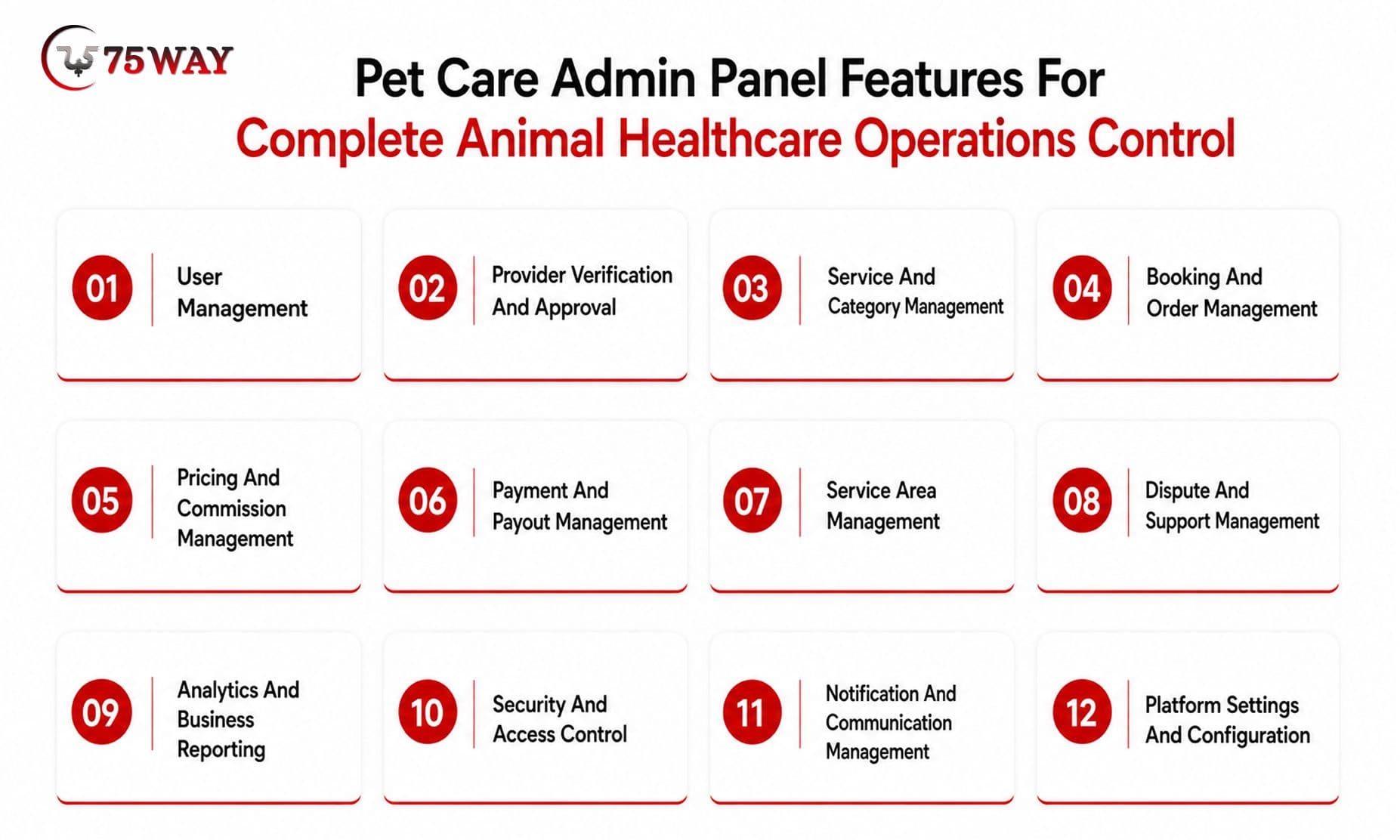
- User Management: As more people join the platform, keeping track of every account can become difficult.
You can view pet owners, veterinarians, groomers, walkers, and other users, update account details, manage access, or suspend accounts when necessary. This keeps the platform easier to manage as its user base grows.
- Provider Verification And Approval: Not every professional should appear on the platform immediately after registration. Admins can check licenses, certifications, identity documents, and business details before approving an account.
They can also follow up on missing information or expired credentials, helping customers find professionals who meet the platform's requirements.
- Service And Category Management: Pet care businesses often add new services as customer needs change.
Founders can create categories, update service descriptions, change prices, and remove outdated offerings without waiting for a development team. This keeps the service catalog aligned with what the business actually provides.
- Booking And Order Management: A booking dashboard gives the operations team a quick view of what is happening across the platform.
They can check pending requests, provider assignments, cancellations, rescheduling, and completed services. If a customer reports a problem, the admin can open the booking and see the details needed to investigate it.
- Pricing And Commission Management: Pricing can vary between services, locations, providers, and promotional campaigns. Admins can configure service charges, platform commissions, taxes, discounts, and additional fees from the backend.
This gives the business room to experiment with different pricing models without rebuilding the application.
- Payment And Payout Management: Money moving through the platform needs close attention. Admins can check customer payments, failed transactions, refunds, provider earnings, commissions, and pending payouts from one place.
When a payment does not go through or a refund needs review, the financial team has the relevant transaction information readily available.
- Service Area Management: A mobile groomer may cover one city, while a pet sitter may serve several nearby neighborhoods.
Admins can define these service boundaries and connect providers with the areas they actually cover. Customers can then discover services that are realistically available at their location.
- Dispute And Support Management: Problems are bound to arise when customers and providers interact.
A customer may question a charge, report a missed appointment, or request a refund. Admins can review the booking, payment details, messages, and service history before deciding what action is appropriate.
- Analytics And Business Reporting: Numbers become useful when they answer real business questions.
Admins can see which services receive the most bookings, when demand is highest, which providers are most active, and where cancellations are increasing. These insights can guide decisions about marketing, staffing, pricing, and expansion.
- Security And Access Control: An admin account should not give every employee access to everything. Finance staff may need payment information, while support teams may only need customer and booking details.
Role-based permissions, authentication, and activity logs can control access and create a clearer record of important administrative actions.
Advanced Features Transforming Pet Care Apps For Businesses In 2026
Basic booking and profile features can handle everyday pet care needs, but newer platforms are going further. Smart automation, connected devices, digital health records, and personalized experiences can make the app more useful between appointments, not just when a service is being booked.
1. AI-Powered Pet Care Assistant
Owners often have small care questions that come up between appointments. A built-in AI assistant can help them find general information, organize pet details, discover relevant services, and understand when professional advice may be worth seeking. The experience should remain informational rather than acting as a replacement for a veterinarian.
2. AI-Assisted Symptom Guidance
A pet owner may notice something unusual but not know what information matters. The app can organize the symptoms entered by the owner and provide general guidance about possible next steps or relevant resources.
AI in veterinary care solutions should clearly explain its limitations and avoid presenting automated suggestions as a veterinary diagnosis.
3. Tele-Veterinary Consultation
Not every concern requires an immediate trip to a clinic. Video calls, audio consultations, and secure chat can give owners access to veterinarians for suitable questions, follow-ups, and general guidance.
Scheduling, consultation notes, shared files, and escalation options can keep the entire interaction connected within the platform.
4. Wearable And IoT Integration
Smart collars and other connected devices can bring useful information into the pet's profile. Depending on the device, owners may track activity, location, movement, sleep, or other available metrics.
Seeing this information alongside regular care records can give owners a more complete picture of their pet's daily routine.
5. Smart Health Alerts
Important care tasks can easily get missed during a busy day. Smart alerts can remind owners about medication, vaccinations, appointments, activity patterns, or other configured care requirements.
The goal is to provide timely information without sending unnecessary warnings or creating the impression that an alert represents a medical diagnosis.
6. Personalized Care Recommendations
A Labrador puppy and an older indoor cat will not have the same care requirements. The app can use information such as age, breed, preferences, service history, routines, and available activity data to make recommendations more relevant.
Owners should also have control over personalization and notification preferences.
7. Digital Pet Medical ID
During an unexpected situation, finding important pet information quickly can make a real difference.
A digital medical ID can keep allergies, medications, vaccinations, conditions, veterinarian details, and emergency contacts together. Owners can share selected information when needed while keeping sensitive records protected through appropriate access controls.
8. Geofencing And Lost-Pet Alerts
A connected tracking device can create a virtual boundary around a home, park, or other familiar area.
If the pet moves beyond that boundary, the owner can receive an alert. The platform can also support lost-pet reports and notification workflows, giving owners another tool for responding quickly.
9. Predictive Health Insights
A pet's routine can sometimes reveal changes that are difficult to notice day by day.
When enough reliable data is available, the application can identify unusual changes in activity, movement, or recorded patterns with AI-driven predictive analytics. Such insights should encourage owners to seek professional advice rather than making unsupported health conclusions.
10. Automated Care Plans: Managing medication, grooming, feeding, exercise, vaccinations, and appointments separately can become confusing.
A personalized care plan can bring these recurring tasks into one schedule and send reminders at the right time. Owners get a clearer routine, while relevant providers can coordinate assigned tasks when the platform supports shared care.
MVP Features Vs Advanced Features of Pet Care App: What Comes First?
Not every pet care app needs every feature at launch. An MVP should focus on the functions required to validate the business model, attract early users, and deliver the core service experience. Advanced capabilities can be introduced after customer behavior, operational needs, and market demand become clearer.
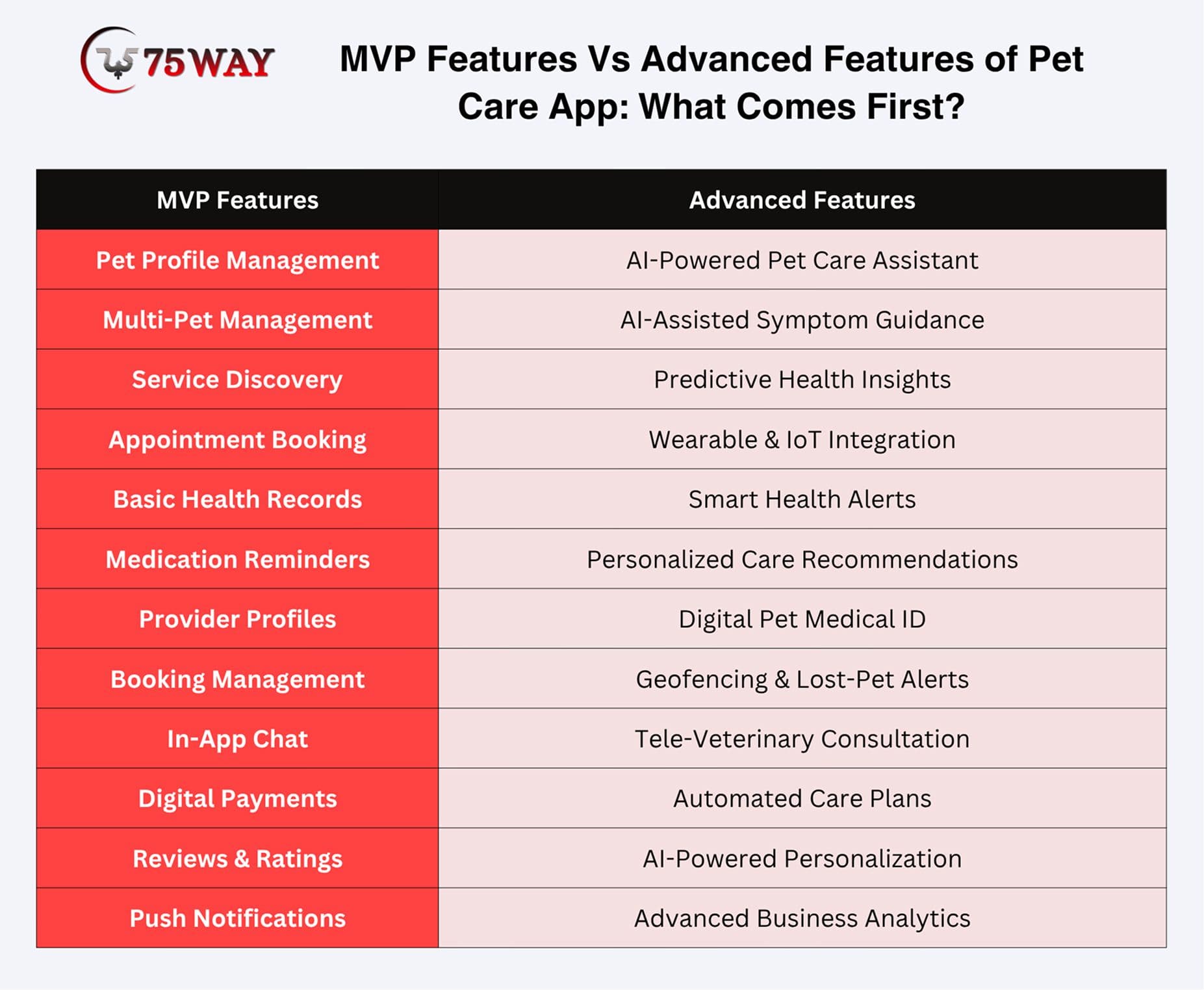
The MVP of the pet care app should establish the core customer journey, allowing owners to create pet profiles, discover relevant services, book appointments, communicate with providers, make payments, and receive important notifications. These capabilities provide enough functionality to test demand without creating unnecessary development complexity.
On the other hand, advanced features can be introduced after the core platform demonstrates traction and the business understands its users. AI, connected devices, predictive insights, tele-veterinary capabilities, and automated care plans can then add differentiation, personalization, and new opportunities for customer engagement.
How These Features Improve Pet Delivery Operations
A pet delivery app should do more than accept orders. The right features can make the entire journey easier to manage, from the moment a customer places a request to the point when the pet, product, or service reaches its destination.
- Faster Order Processing
Manual calls and repeated messages can slow down even simple delivery requests. Online booking, saved customer details, digital payments, and live availability let customers place orders with fewer steps. Providers receive the necessary information right away, helping businesses confirm and process more requests without adding the same amount of manual work.
- Accurate Delivery Tracking
Customers naturally want to know where their order or delivery partner is, especially when timing matters. GPS tracking can show the current location and estimated arrival time during an active delivery. The same information helps dispatch teams monitor routes and respond when a driver faces delays or changes course.
- Better Provider Coordination
Delivery partners need more than a new job notification to complete an order properly. A provider dashboard can show the assigned request, customer details, location, timing, and special instructions in one place. Availability and scheduling tools also make it easier for businesses to assign jobs based on who is free and nearby.
- Fewer Missed Deliveries
A wrong address or forgotten appointment can turn a straightforward delivery into a costly second attempt. Customer profiles can store delivery information, while reminders and status notifications keep both sides informed. Providers can also see access instructions or other important notes before arriving, reducing avoidable delivery problems.
- Improved Customer Communication
Waiting without knowing what is happening can quickly frustrate customers. Booking confirmations, status updates, push notifications, and in-app messaging can keep them informed throughout the delivery. If a delay occurs, the customer can receive an update instead of repeatedly contacting support to ask when the delivery will arrive.
- Personalized Delivery Experiences
Pet-related orders often come with details that matter, such as feeding preferences, recurring requirements, delivery instructions, or information about the pet. A saved profile means customers do not have to enter the same details repeatedly. With appropriate permissions, relevant information can also help providers handle individual orders more carefully.
- Streamlined Payment Management
Customers can complete payments without switching to another platform or relying on manual payment confirmation. On the business side, orders, refunds, invoices, commissions, and provider payouts can remain connected to the same transaction record. This gives finance teams a clearer picture of where each payment stands.
- Better Operational Visibility
Once bookings, deliveries, customers, providers, and payments are managed digitally, businesses can see what is happening across their operations. Admin reports can reveal busy delivery periods, frequent cancellations, delayed orders, and high-demand areas. These insights help managers decide where more providers, better scheduling, or process changes may be needed.
How To Prioritize Features For Your Pet Delivery App?
A strong feature list is not about adding everything customers might want. It is about deciding what the app needs first, what can follow, and what should wait until there is real demand. A connected prioritization process helps you move from customer needs to a practical development roadmap.
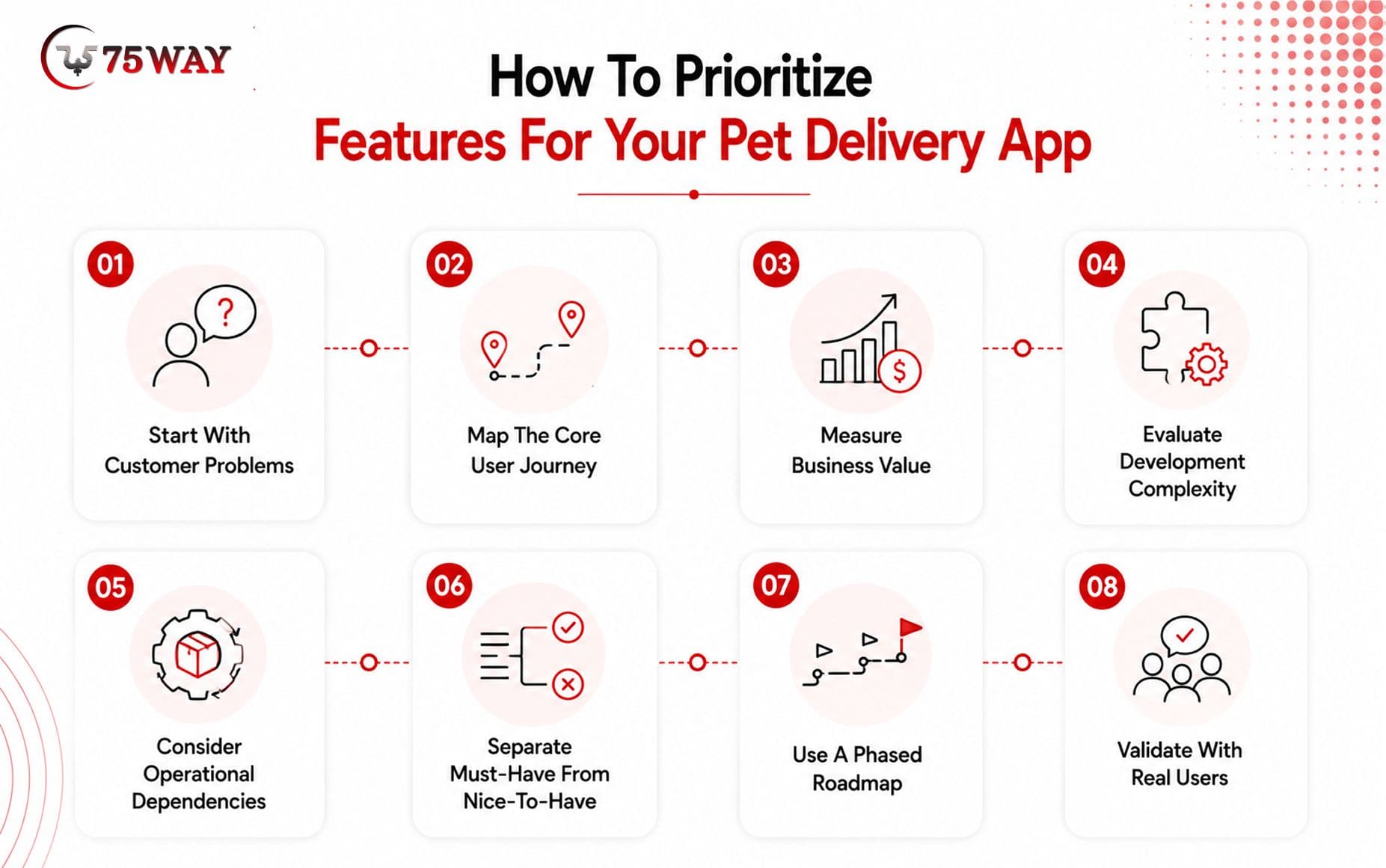
Phase 1 - Start With Customer Problems
First, understand where customers face friction when ordering pet products or arranging deliveries. Look at common complaints, abandoned orders, repeated support questions, and delivery issues.
These findings give you a starting point because the most important features should solve problems customers actually experience.
Phase 2 - Map The Core User Journey
Once the main problems are clear, place them across the complete customer journey. Consider product discovery, selection, checkout, payment, delivery, tracking, communication, and post-order support.
This step shows which problems affect critical stages and prevents you from prioritizing features without understanding where they fit.
Phase 3 - Measure Business Value
With the user journey mapped, evaluate what each potential feature can contribute to the business. Ask whether it can increase orders, encourage repeat purchases, reduce support work, improve delivery performance, or strengthen customer satisfaction.
Features with a clear connection to important business outcomes can then move higher on the roadmap.
Phase 4 - Evaluate Development Complexity
Business value alone is not enough to determine priority. Next, consider how difficult each feature will be to develop, integrate, test, and maintain.
A feature with strong value and manageable complexity may be a better early investment than an expensive capability whose benefits are still uncertain.
Phase 5 - Consider Operational Dependencies
The complexity review should also identify features that depend on other parts of the application. For example, automatic delivery assignment requires provider profiles, availability, location tracking, and booking workflows.
Understanding these dependencies helps you arrange features in the order they need to be built.
Phase 6 - Separate Must-Have From Nice-To-Have
After reviewing value, complexity, and dependencies, divide the feature list into clear priority levels.
Core ordering, payments, delivery coordination, and customer communication may be essential for the first release. More advanced capabilities can remain on the later roadmap until the foundation is ready.
Phase 7 - Use A Phased Roadmap
These priorities can then be converted into development phases. The MVP should contain the features required to operate the core business model. The next phase can improve retention and operational control.
Later releases can introduce AI recommendations, IoT connectivity, predictive insights, and deeper personalization when they have a clear purpose.
Phase 8 - Validate With Real Users
The roadmap should continue to evolve after launch. Customer feedback, provider feedback, support requests, order data, and analytics reveal whether your original assumptions were correct.
Those findings can guide the next feature cycle, helping you invest in improvements that reflect actual usage rather than assumptions made during planning.
How To Choose Pet Care App development Features Based On Your Business Model
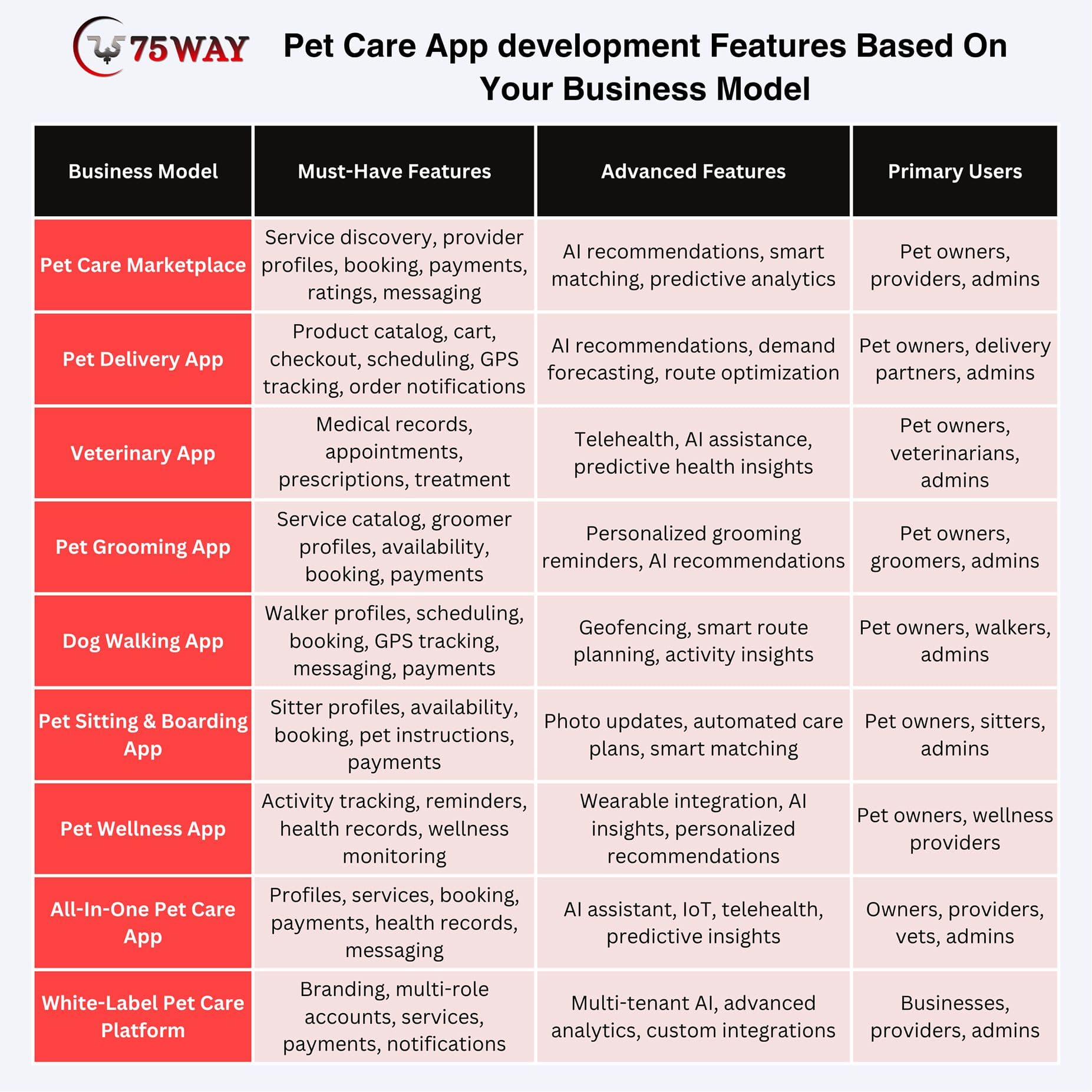
The right pet care app features depend heavily on what your business sells, who uses the platform, how services are fulfilled, and where revenue comes from. A veterinary platform needs different capabilities from a pet marketplace or delivery-focused application.
- Pet Care Marketplace
A marketplace connecting owners with multiple providers should prioritize service discovery, provider profiles, availability, booking, ratings, payments, messaging, location features, and provider management. These capabilities create the foundation for connecting customer demand with available pet-care professionals.
- Pet Delivery App
A delivery-focused business should emphasize product browsing, pet profiles, cart and checkout, payment processing, delivery scheduling, GPS tracking, order notifications, address management, and delivery partner workflows. Inventory and fulfillment integrations may become important as order volume increases.
- Veterinary App
Veterinary businesses should prioritize digital medical records, appointment scheduling, prescriptions, consultation management, treatment history, follow-up reminders, secure communication, and telehealth where appropriate. Advanced healthcare features should be designed around professional workflows and applicable regulatory requirements.
- Pet Grooming App
Grooming businesses can focus on service catalogs, groomer profiles, availability calendars, appointment booking, pet profiles, pricing, reminders, payments, reviews, and before-and-after service records. Recurring appointment functionality can also support customers who maintain regular grooming schedules.
- Dog Walking App
Walking platforms should emphasize provider profiles, availability, booking, GPS route tracking, walk status updates, in-app communication, pet instructions, payments, ratings, and service history. Safety-oriented location visibility can become particularly valuable when owners are not physically present during the service.
- Pet Sitting And Boarding App
These platforms need detailed pet profiles, sitter or facility profiles, availability, booking, pricing, messaging, location information, care instructions, payments, reviews, and service updates. Photo sharing and scheduled status updates can provide owners with greater visibility during longer stays.
- Pet Wellness App
Wellness-focused applications can prioritize activity tracking, medication reminders, vaccination schedules, health records, personalized recommendations, wearable integrations, educational content, and progress monitoring. Advanced analytics can later help personalize wellness experiences based on available user and pet data.
- All-In-One Pet Care Platform
Businesses combining healthcare, grooming, walking, boarding, delivery, and other services require a broader ecosystem. These platforms need multi-role accounts, centralized pet profiles, provider management, booking, payments, communication, location services, health records, analytics, and scalable administrative controls.
- White-Label Pet Care Platform
Businesses offering pet-care technology to multiple brands should prioritize configurable branding, multi-tenant architecture, role management, customizable services, payment settings, notifications, integrations, and centralized administration. This model allows different businesses to operate their branded experiences without maintaining completely separate technology platforms.
A feature should earn its place on the roadmap because it supports a specific customer need, operational requirement, or revenue objective. Building features simply because competitors offer them can increase development costs without necessarily improving your product or business performance.
Why Reach 75way For Pet Care App Development?
75way Technologies helps veterinary care businesses turn their pet-care concept into a scalable application built around their specific customer journey and business model. Their app development process covers customer-facing functionality, provider workflows, veterinary capabilities, administrative controls, third-party integrations, payments, location services, notifications, and advanced technologies such as AI and IoT.
Rather than treating every pet care app as the same product, 75way can help prioritize features according to whether the platform focuses on veterinary care, pet services, delivery, wellness, or a broader marketplace model.
This approach helps businesses start with practical MVP capabilities, validate their concept, and progressively introduce advanced features as customer demand and operational requirements grow.
Wrap Up
The best pet care app features are the ones that solve genuine customer needs while supporting the workflows behind the business. Advanced features such as AI assistance, tele-veterinary consultations, wearable integrations, predictive insights, and personalized care can create greater differentiation as the platform matures. Businesses should prioritize features according to their target users, revenue model, service operations, and growth strategy rather than copying every capability available in competing applications. A phased roadmap can help control complexity while creating room for future innovation. To build a feature-rich pet care app, reach a trusted healthcare app development company to turn your concept into a scalable digital solution.
Frequently Asked Questions (FAQs)
Can A Pet Care App Support Multiple Services?
Yes, one application can combine veterinary care, grooming, walking, boarding, sitting, deliveries, and wellness services. Separate user roles and workflows can keep each service organized.
Can AI Be Added To A Pet Care App?
Yes, AI can support care questions, recommendations, customer assistance, personalization, and administrative workflows. AI should complement professional veterinary care rather than present itself as a replacement.
Can A Pet Care App Integrate Wearable Devices?
Yes, compatible wearable devices can provide activity, location, sleep, movement, and other available information. Integration depends on device compatibility, available APIs, data quality, and the intended application functionality.
Can Pet Care Apps Offer Veterinary Consultations Online?
Yes, applications can support suitable veterinary consultations through video, audio, or messaging. Telehealth functionality should follow applicable professional, legal, privacy, and veterinary requirements for the intended market.
How Can A Pet Care App Generate Revenue?
Revenue models can include service commissions, subscriptions, booking fees, product sales, memberships, provider plans, advertising, and premium features. The appropriate model depends on the platform's customers and business structure.
How Should Businesses Decide Which Pet Care Features To Build First?
Businesses should prioritize features according to customer needs, business value, operational dependencies, technical complexity, and revenue potential. An MVP can validate the core concept before advanced capabilities are introduced.