AI Summary
AI software development in Dubai costs AED 25,000–AED 140,000+, depending on business goals, technical complexity, and development scope. This guide explores pricing factors, implementation stages, ongoing expenses, and ways to evaluate development proposals.
Key Takeaways
- AI software development in Dubai costs AED 25,000–AED 140,000+, depending on complexity.
- The UAE AI market could reach $11,249.9 million by 2031.
- Data preparation, integrations, and AI models significantly influence development budgets.
- Arabic support, PDPL compliance, and hosting affect Dubai project requirements.
The cost of developing AI software in Dubai typically starts at AED 25,000 and can exceed AED 140,000, depending on the application's complexity, AI capabilities, integrations, data requirements, and deployment environment.
A basic AI-powered feature requires a smaller investment than a custom enterprise platform with multiple AI models, automated workflows, and advanced security.
For Dubai businesses, the more important question is not simply how much AI software costs, but what the investment will deliver.
A startup developing an AI-powered MVP has different requirements from a retail company automating customer support or an enterprise implementing predictive analytics across its operations.
This guide explains AI software development costs in Dubai, project-wise budgets, technical cost drivers, development expenses, and practical ways to plan your investment before approaching a development company.
Quick Answer: How Much Does AI Software Development Cost in Dubai, UAE?
AI software development in Dubai costs approximately AED 25,000–AED 140,000+ for the project categories covered in this guide. However, this is a planning range rather than a fixed market rate or an upper limit for enterprise development.
The final investment depends on whether you are integrating an existing AI model, developing a custom machine learning solution, building a generative AI application, or creating an enterprise-grade AI platform.
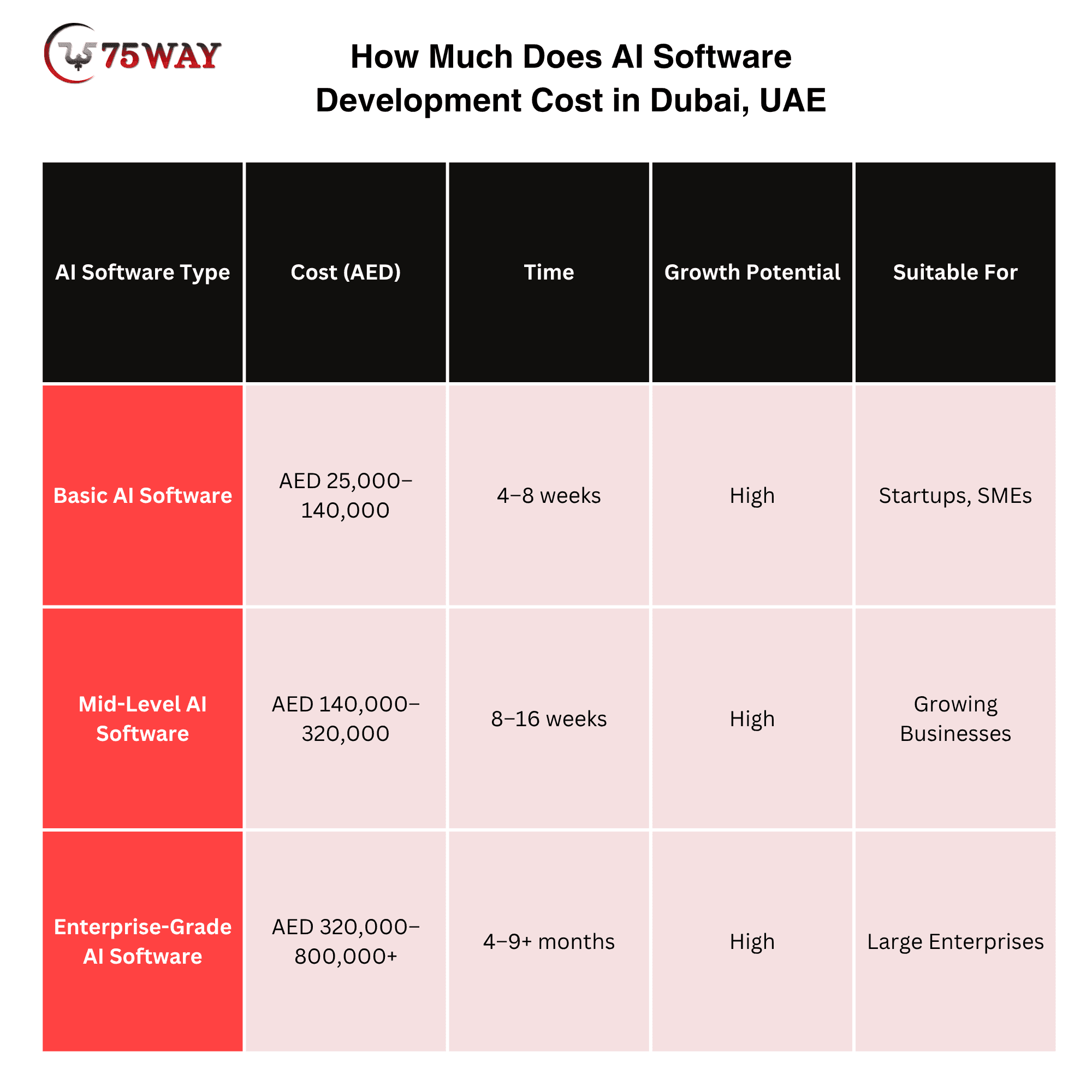
1. Basic AI Software Cost: AED 25,000 – AED 140,000 ($6,800 – $38,100 USD)
Scope: Simple AI applications using existing models and APIs.
- Conversational chatbots for basic customer support.
- FAQ assistants answering common customer enquiries automatically.
- Lightweight machine learning models for basic scoring.
Timeline: 4–8 weeks
2. Mid-Level AI Software Cost: AED 140,000 – AED 320,000 ($38,100 – $87,100 USD)
Scope: AI applications involving advanced workflows and integrations.
- Predictive analytics for data-driven business decisions.
- RAG systems connecting AI with business databases.
- Multi-system automation integrating existing business applications.
Timeline: 8–16 weeks
3. Enterprise-Grade AI Software Cost: AED 320,000 – AED 800,000+ ($87,100 – $217,700+ USD)
Scope: Complex AI platforms supporting enterprise-scale operations.
- Custom AI models for specialized business requirements.
- Multi-agent systems automating complex enterprise workflows.
- Advanced analytics with enterprise-wide data integrations.
Timeline: 4–9+ months
How to Calculate the Cost of Building AI Software?
You can calculate the cost of building AI software by adding the expenses associated with development, AI implementation, infrastructure, integrations, testing, and deployment.
Total Cost = (Development Hours × Hourly Rates) + Additional Expenses
Where:
- Development Hours: Total hours required for each development activity.
- Hourly Rates: Charges per hour for developers, designers, and AI engineers.
- Additional Expenses: AI APIs, cloud hosting, software licenses, integrations, and deployment.
Suppose a Dubai-based business wants to develop AI software with the following requirements:
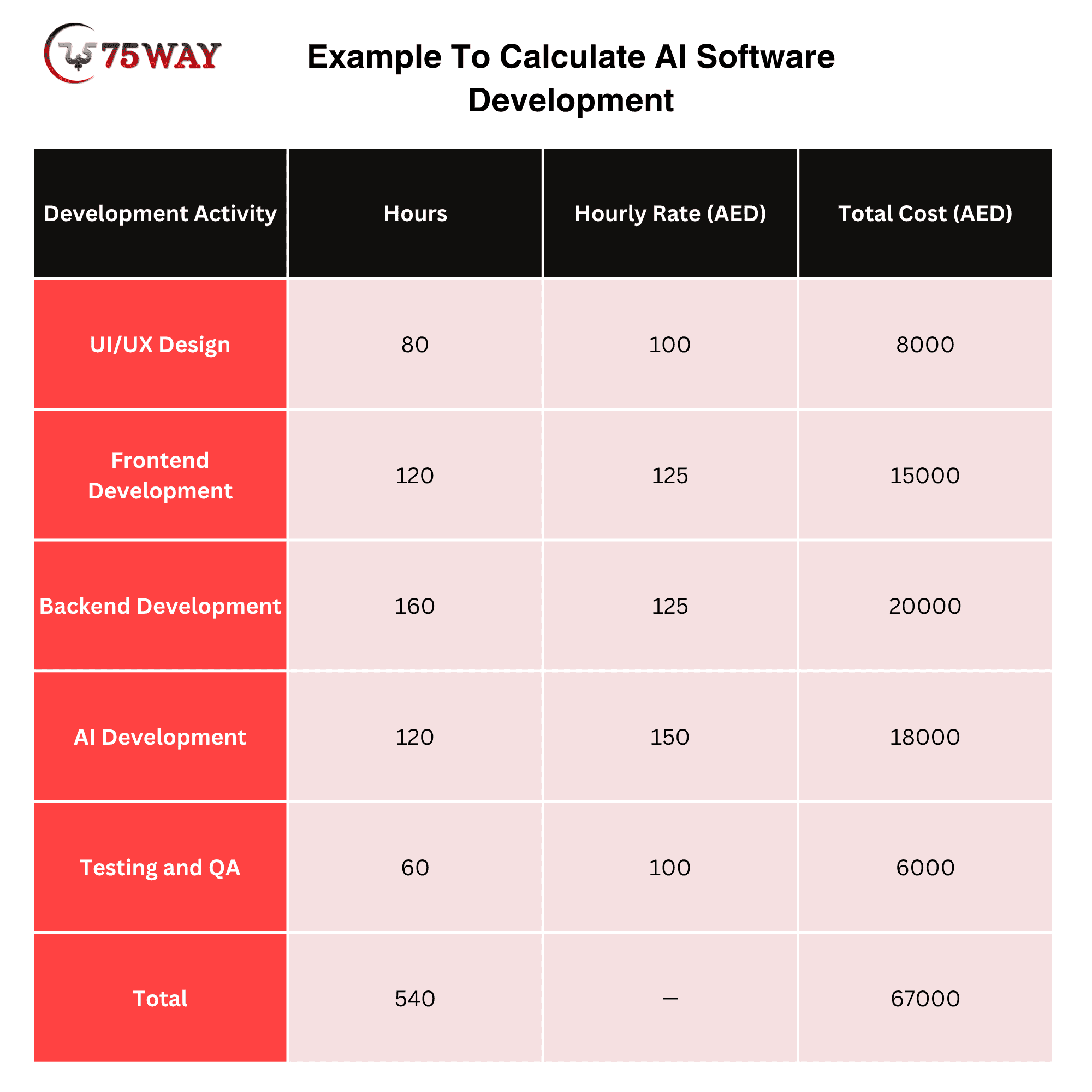
Additional Expenses:
- AI API and software licenses: AED 5,000
- Cloud hosting and deployment: AED 3,000
- Third-party integrations: AED 5,000
Final Calculation:
Total Cost = AED 67,000 + AED 5,000 + AED 3,000 + AED 5,000
Estimated AI Software Development Cost = AED 80,000
Stage-Wise Cost of Building AI Software in Dubai, UAE
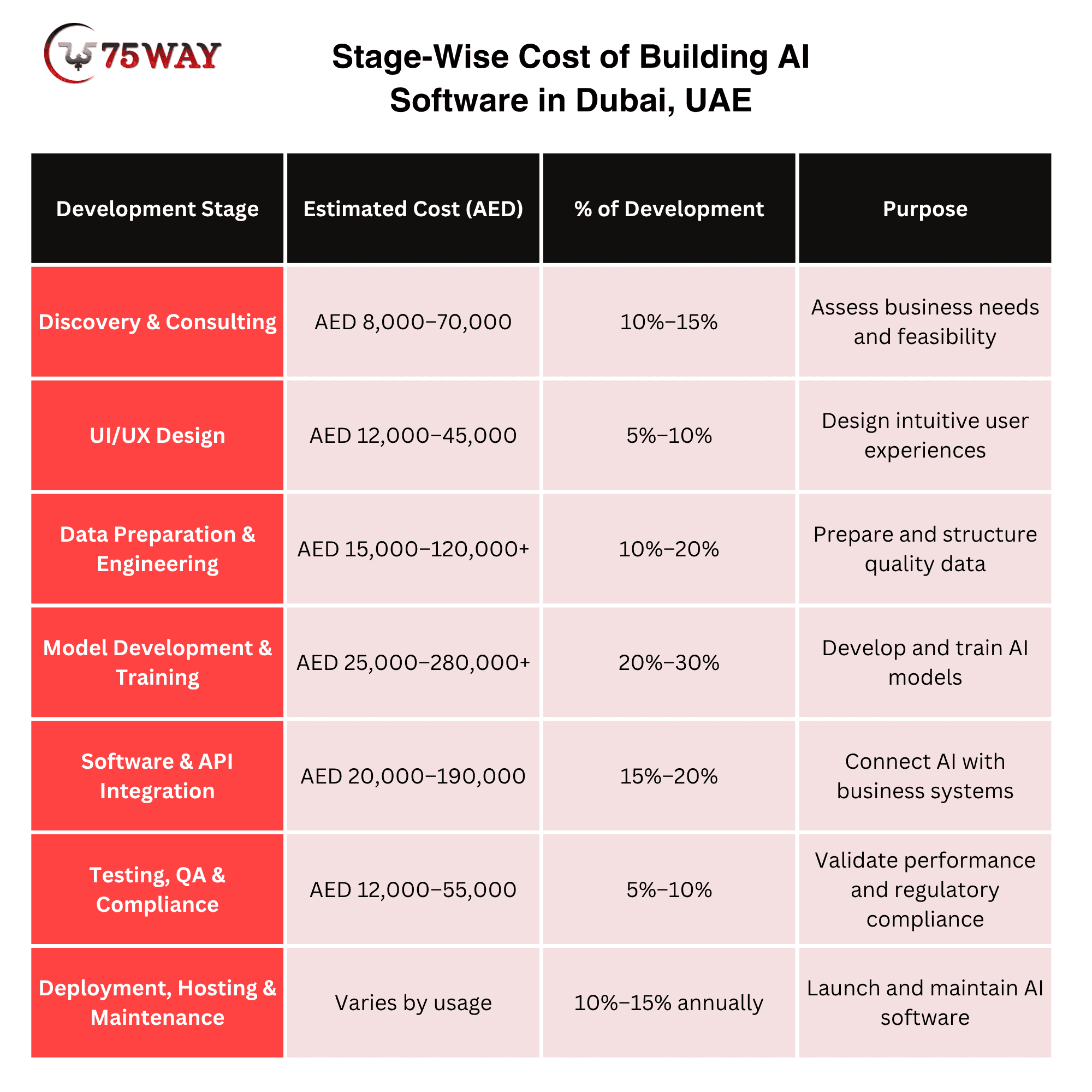
Wondering where your AI software development budget actually goes? In Dubai, the cost is spread across multiple stages, including business analysis, solution design, data preparation, AI development, testing, and deployment. Let's break down the estimated cost of each stage so you can understand how the overall project budget is calculated.
1. Discovery & Consulting Stage: AED 10,000–AED 75,000
- Evaluates business requirements, feasibility, and data readiness.
- Establishes project scope, objectives, and compliance needs.
2. UI/UX Design Stage: AED 12,000–AED 45,000
- Creates wireframes, user journeys, and prototypes.
- Defines intuitive interfaces for target users.
3. Data Preparation & Engineering Stage: AED 15,000–AED 120,000+
- Collects, cleans, labels, and structures datasets.
- Prepares quality data for reliable AI development.
4. Model Development & Training Stage: AED 25,000–AED 280,000+
- Selects, customizes, or trains suitable AI models.
- Includes fine-tuning, prompt engineering, and RAG development.
5. Software & API Integration Stage: AED 20,000–AED 190,000
- Connects AI models with business applications.
- Integrates databases, CRMs, ERPs, and third-party APIs.
6. Testing, Quality Assurance & Compliance Stage: AED 12,000–AED 55,000
- Tests model accuracy, security, and reliability.
- Checks compliance with applicable UAE regulations.
7. Deployment, Hosting & Ongoing Maintenance Stage: Varies by usage
- Deploys AI software on suitable cloud infrastructure.
- Covers monitoring, updates, retraining, and ongoing support.
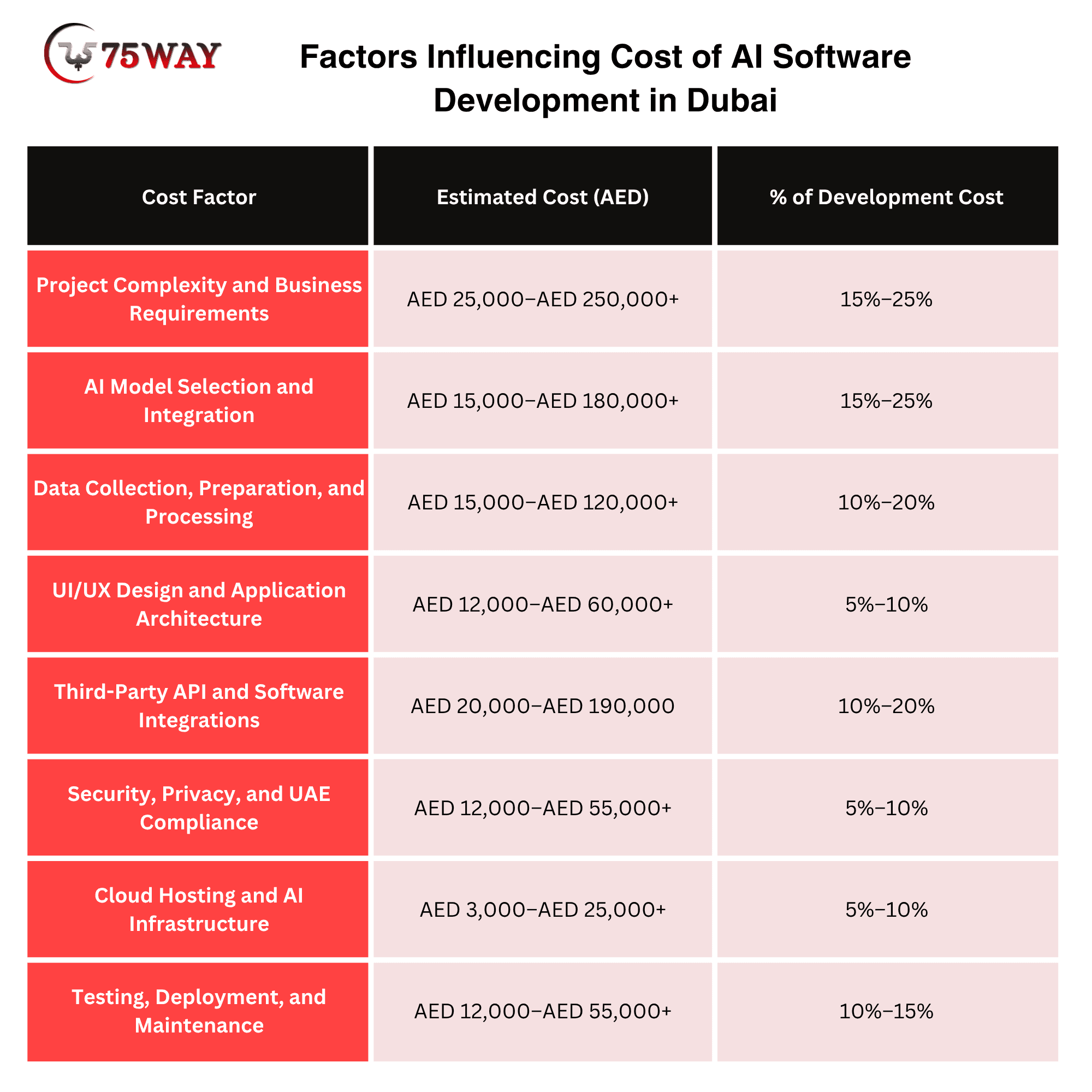
What Factors Affect AI-Powered Software Development Costs in Dubai?
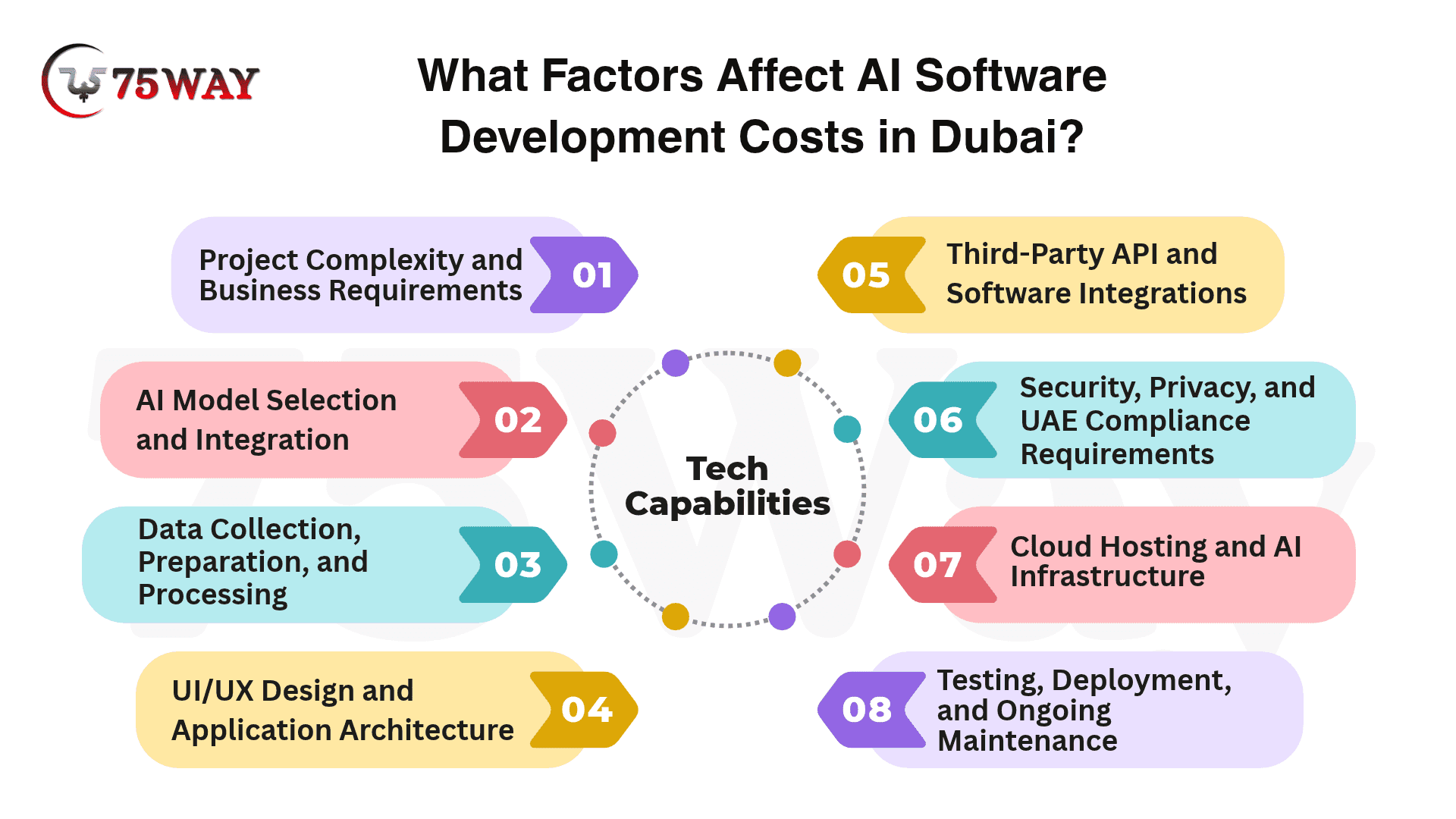
Planning an AI software project in Dubai requires more than setting aside a development budget. The final cost depends on what you want the software to do, how much data it needs, which AI capabilities it uses, and how it connects with existing systems. Here's a closer look at the key factors that can increase or reduce your development expenses.
1. Project Complexity and Business Requirements
Project complexity directly affects development hours, technical resources, and overall investment. A basic chatbot requires less work than an enterprise AI platform with multiple workflows and automated decision-making.
- Basic: Chatbots and automated text generation.
- Medium: AI-powered CRM and document processing.
- High: Predictive analytics and multi-agent platforms.
Estimated Cost Impact: AED 25,000–AED 250,000+.
2. AI Model Selection and Integration
The choice between existing AI models and custom-developed models affects development costs and infrastructure requirements.
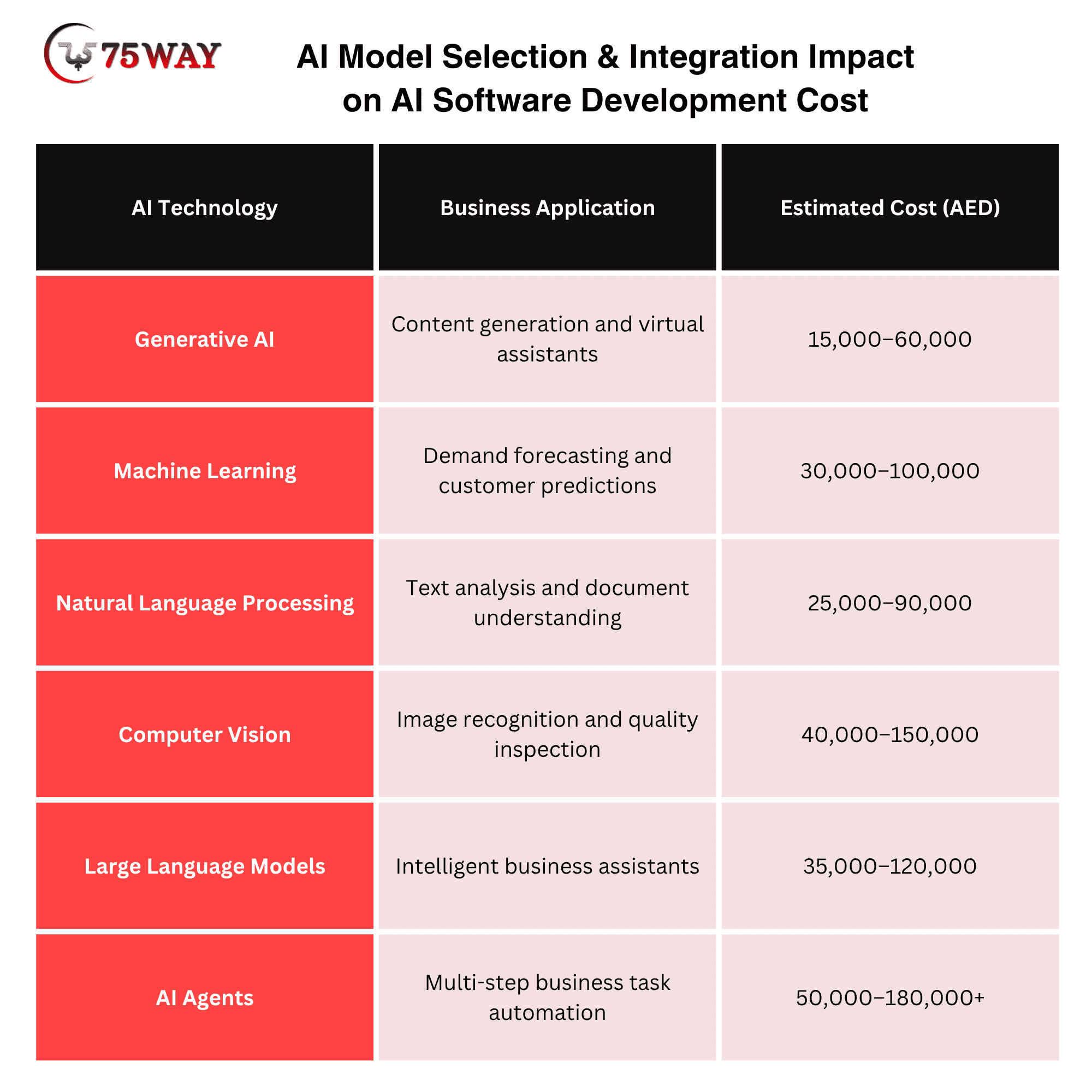
Integrating an existing model through an API generally costs less initially than training a custom model. However, API usage, customization, and infrastructure add ongoing expenses.
Estimated Cost Impact: AED 15,000–AED 180,000+
3. Data Collection, Preparation, and Processing
AI applications need relevant, well-structured data to generate useful outputs. Data scattered across spreadsheets, CRM platforms, documents, and legacy databases requires additional preparation.
The process may involve:
- Data collection and consolidation.
- Cleaning, labeling, and categorization.
- Duplicate removal and normalization.
- Dataset validation and transformation.
- Data pipeline development.
For example, a Dubai retailer developing demand forecasting software may need to combine sales and inventory records from multiple branches before training its model.
Estimated Cost Impact: AED 15,000–AED 120,000+
4. UI/UX Design and Application Architecture
The application's interface determines how customers, employees, and administrators interact with AI features. Custom dashboards, user permissions, and complex workflows require additional design and development.
Major requirements include:
- User research and wireframing.
- Interactive prototypes and dashboards.
- Admin panels and user permissions.
- Frontend and backend architecture.
- Responsive web and mobile interfaces.
Estimated Cost Impact: AED 12,000–AED 60,000+
5. Third-Party API and Software Integrations
AI applications often connect with existing business systems to retrieve information, automate tasks, and update records.
Common integrations include:
- CRM and ERP platforms.
- Payment and accounting systems.
- WhatsApp Business services.
- Cloud storage and databases.
- Maps and location APIs.
For example, an AI sales assistant connected to a CRM can retrieve customer records, update lead status, and schedule follow-ups automatically.
Estimated Cost Impact: AED 20,000–AED 190,000
6. Security, Privacy, and UAE Compliance Requirements
Businesses handling customer, financial, or employee information need appropriate security measures. Compliance requirements depend on the industry, data handled, and applicable UAE regulations.
Key requirements may include:
- Data encryption and secure authentication.
- Role-based access controls.
- Audit logs and activity monitoring.
- Data retention and deletion policies.
- Security assessments and compliance checks.
The UAE Personal Data Protection Law, Federal Decree-Law No. 45 of 2021, establishes requirements for personal data processing and privacy protection.
Estimated Cost Impact: AED 12,000–AED 55,000+
7. Cloud Hosting and AI Infrastructure
AI software requires infrastructure for application hosting, data storage, model execution, and user requests. Costs depend on processing volume, model size, and expected traffic.
Common expenses include:
- Cloud hosting and application servers.
- Database storage and backups.
- GPU computing, when required.
- AI model API consumption.
- Monitoring and disaster recovery.
A chatbot using an external AI API may need modest infrastructure, while an image-processing platform may require substantial GPU resources.
Estimated Cost Impact: AED 3,000–AED 25,000+
8. Testing, Deployment, and Ongoing Maintenance
AI software needs functional testing and AI-specific evaluation before launch. Developers must assess output quality, model accuracy, security, and performance under real business conditions.
The process may include:
- Functional and integration testing.
- AI output quality evaluation.
- Accuracy and performance testing.
- Security and load testing.
- Production deployment and monitoring.
- Model updates and retraining.
Estimated Cost Impact: AED 12,000–AED 55,000
Hidden Costs of Developing AI Software in Dubai
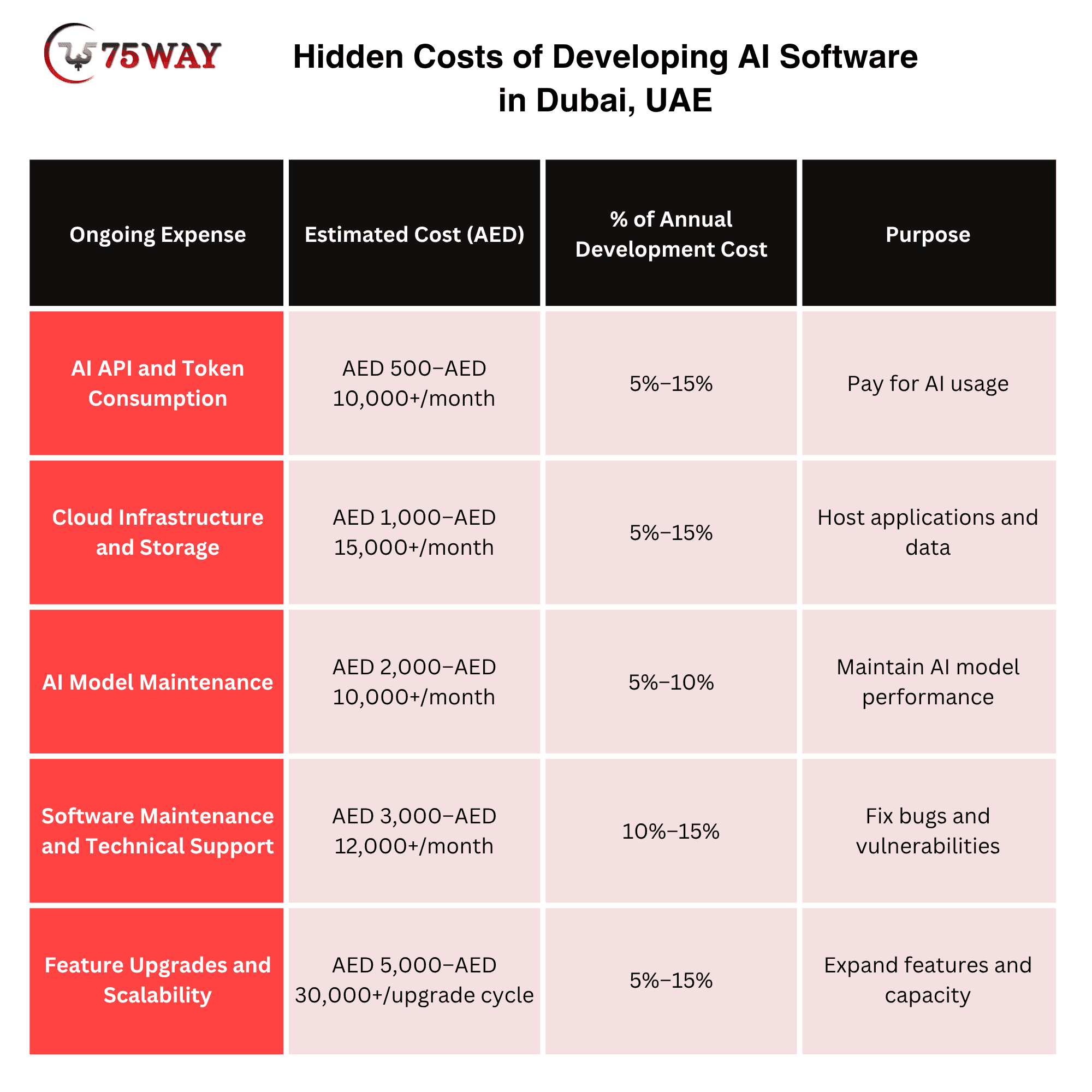
The initial development quotation does not always represent the complete cost of owning AI software. Businesses sometimes overlook recurring expenses associated with model usage, cloud infrastructure, data processing, security, and application maintenance. These expenses should be included in the financial plan before development begins.
1. AI API and Token Consumption
Businesses using external AI models pay according to API usage, including input and output tokens, model selection, and provider-specific charges.
For example, an AI customer support application processing thousands of conversations may incur higher monthly API expenses than an internal assistant used by a small team.
Estimated Cost: AED 500–AED 10,000+ per month.
2. Cloud Infrastructure and Storage
Cloud expenses include application hosting, databases, storage, networking, and computing resources. Applications processing large datasets or running resource-intensive AI workloads may require additional infrastructure.
Estimated Cost: AED 1,000–AED 15,000+ per month.
3. AI Model Maintenance
AI systems require monitoring to identify inaccurate responses, output quality changes, and performance issues. Businesses may also need prompt improvements, retrieval updates, model evaluations, and occasional model upgrades.
Estimated Cost: AED 2,000–AED 10,000+ per month.
4. Software Maintenance and Technical Support
After launch, applications need bug fixes, security patches, compatibility updates, database maintenance, and technical support. The budget depends on application complexity and support requirements.
Estimated Cost: AED 3,000–AED 12,000+ per month.
5. Feature Upgrades and Scalability
As the business grows, the application may need additional user roles, integrations, AI capabilities, and infrastructure. Planning for these improvements early can reduce expensive architectural changes later.
Estimated Cost: AED 5,000–AED 30,000+ per upgrade cycle.
Cost To Hire AI Software Engineer in Dubai, United Arab Emirates (UAE)
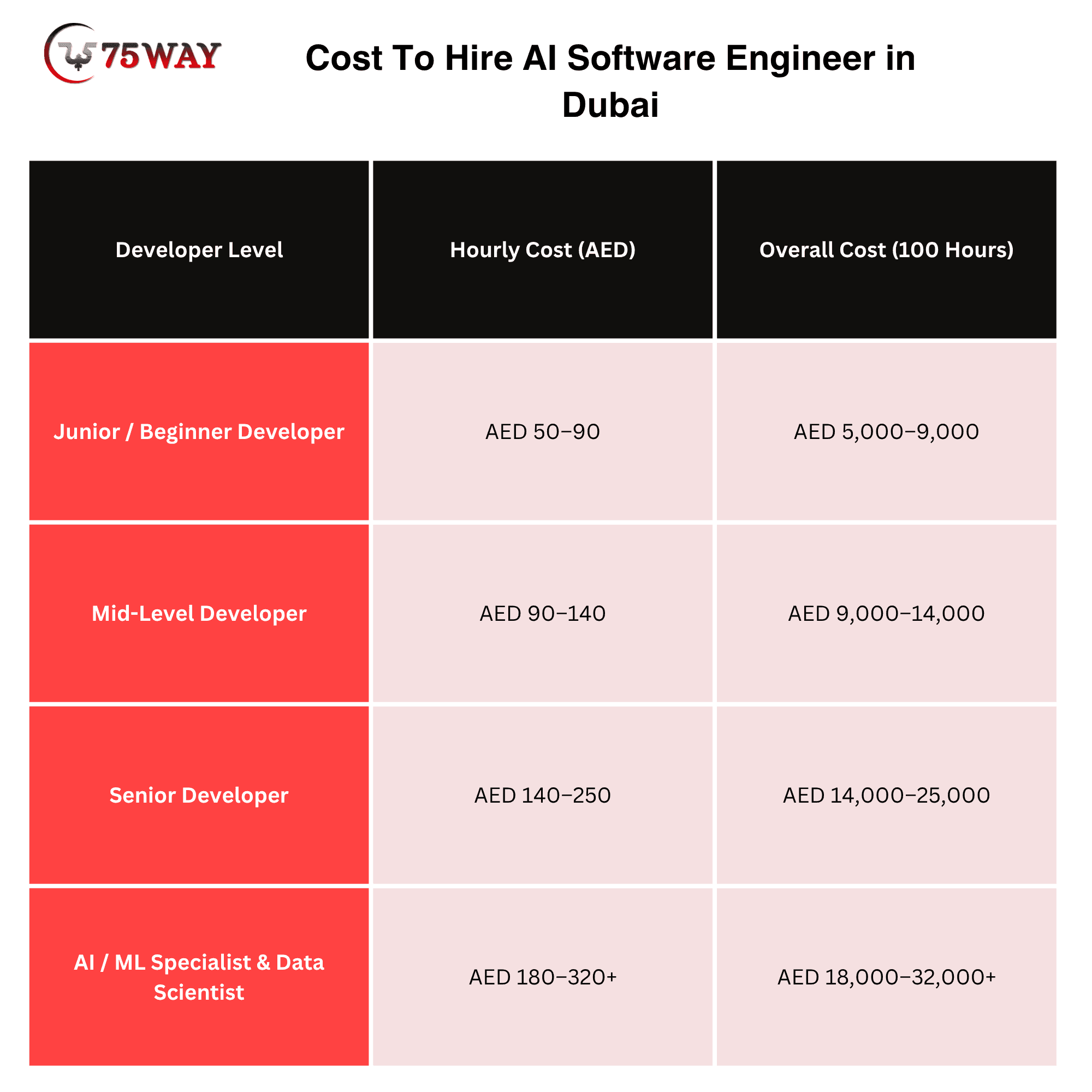
The cost of hiring an AI software engineer in Dubai can vary depending on the skills your project demands. An engineer specializing in machine learning, generative AI, or large language models may have different compensation expectations based on experience and expertise. Here's a breakdown of the hiring costs and factors to consider when planning your budget.
1. Junior/Beginner AI Software Developer: AED 50–90 per hour
- Handles basic coding and frontend development tasks.
- Supports testing, debugging, and routine maintenance.
2. Mid-Level AI Software Developer: AED 90–140 per hour
- Develops backend features and API integrations.
- Manages database operations and application functionality.
3. Senior AI Software Developer: AED 140–250 per hour
- Designs software architecture and complex workflows.
- Leads development, optimization, and technical decisions.
4. AI/ML Specialist & Data Scientist: AED 180–320+ per hour
- Builds, trains, and fine-tunes AI models.
- Handles data engineering and model performance evaluation.
How Does Dubai's Business Environment Influence AI Software Development Costs?
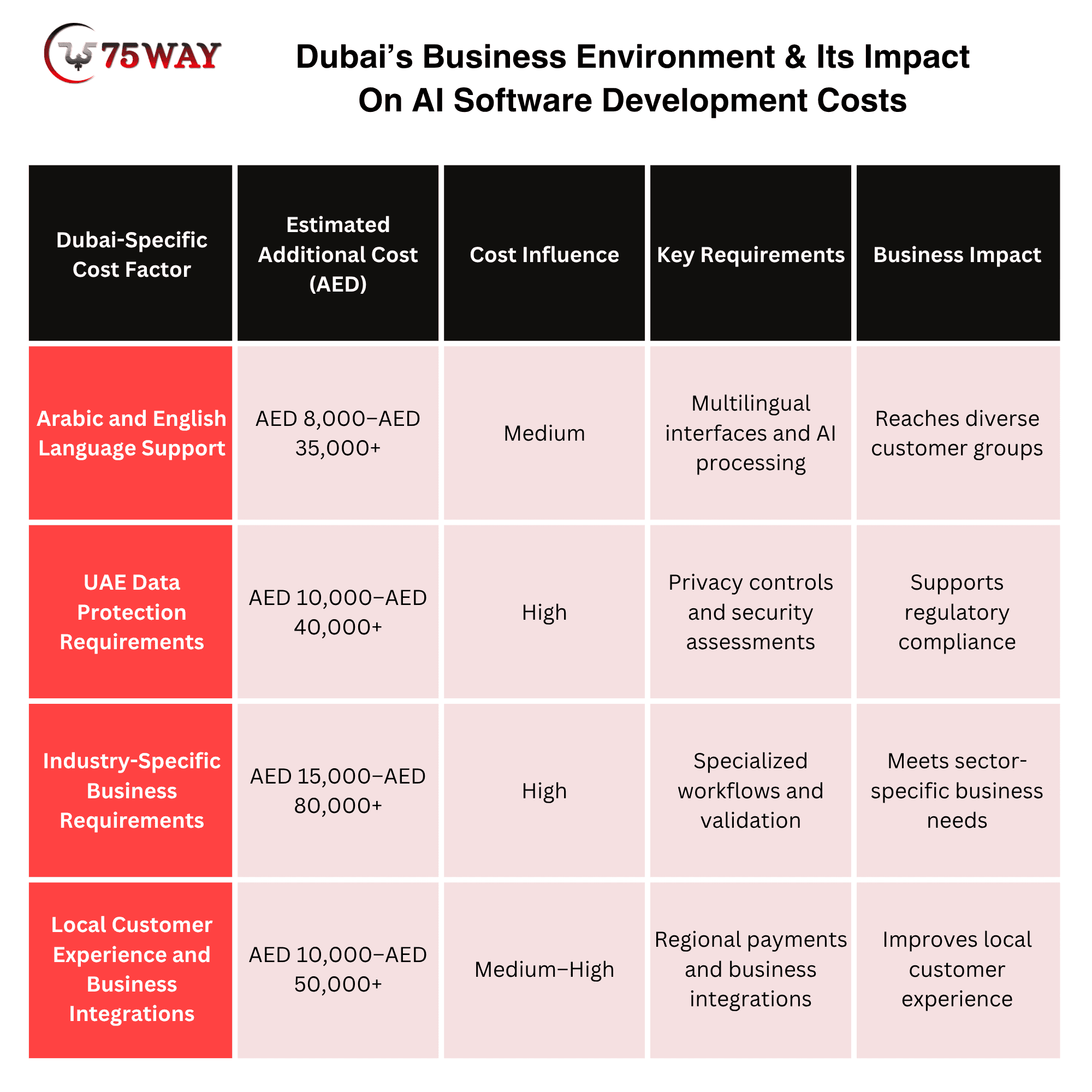
Dubai's business landscape creates different opportunities and cost considerations for companies planning AI software projects. Your budget may vary depending on the industry, availability of AI talent, operational requirements, data regulations, and technology partnerships. Understanding these local influences can help you estimate development expenses more realistically.
1. Arabic and English Language Support
Dubai businesses frequently serve customers who communicate in both Arabic and English. Applications may require multilingual interfaces, language detection, translation workflows, and AI models that understand both languages.
Arabic support can also involve right-to-left layouts, dialect variations, text rendering, and additional language testing.
For example, a real estate chatbot may need to answer property enquiries in Arabic and English.
Estimated Additional Cost: AED 8,000–AED 35,000+.
2. UAE Data Protection Requirements
Businesses processing personal information should assess the UAE Personal Data Protection Law and identify the requirements applicable to their operations.
This may involve:
- Data collection and consent workflows.
- User access permissions.
- Data storage and retention policies.
- Third-party AI service assessments.
- Data transfer arrangements.
- Security and audit requirements.
Some industries may also need to follow additional regulatory frameworks.
Estimated Additional Cost: AED 10,000–AED 40,000+, depending on compliance requirements and security complexity.
3. Industry-Specific Business Requirements
AI software requirements vary across industries. Retail businesses may need demand forecasting, logistics companies may require route optimization, and financial organizations may prioritize transaction monitoring.
Industry-specific workflows, integrations, and validation requirements can increase development time.
Estimated Additional Cost: AED 15,000–AED 80,000+, depending on industry complexity and specialized functionality.
4. Local Customer Experience and Business Integrations
Applications targeting Dubai customers may require regional payment services, local business systems, communication platforms, and customized customer support workflows.
For example, an AI-powered commerce application may need payment integration, multilingual recommendations, order tracking, and automated customer support.
Estimated Additional Cost: AED 10,000–AED 50,000+, depending on the number and complexity of integrations.
Read More: Top 50 Startup Business Ideas In Dubai For Entrepreneurs
1What Type of AI Software Do You Want to Develop?
Single choice2Which AI Features Do You Need?
Multiple choice3Which Platform Do You Want to Target?
Single choice4What Is Your Expected AI Software Development Budget?
Single choiceHow to Develop AI Software Within Your Budget: A Practical Approach
A limited budget doesn't mean you have to put your AI software idea on hold. The key is to focus on essential features, choose suitable AI technologies, and avoid spending on capabilities your business doesn't need yet. Here's a practical approach to planning and developing AI software while keeping your budget under control.
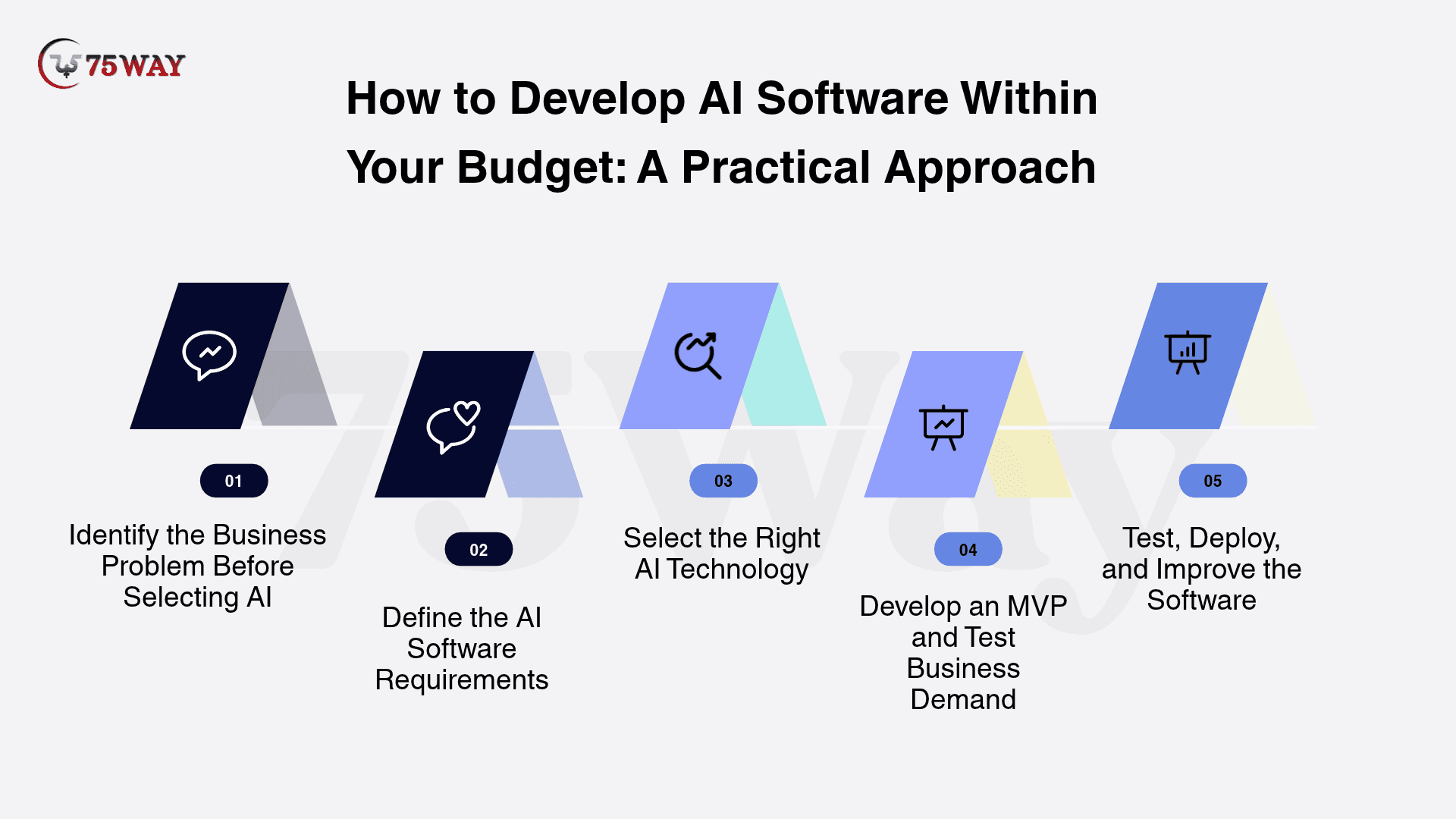
Step 1. Identify the Business Problem Before Selecting AI
Start by identifying the business operation that needs improvement.
Do not begin by selecting a popular AI model or deciding that your application needs an AI agent.
Instead, identify where your business experiences:
- Repetitive manual work.
- High customer support volumes.
- Delayed business decisions.
- Poor demand forecasting.
- Fragmented business information.
- Time-consuming document processing.
For example, a Dubai-based property management company may spend considerable time answering repetitive tenant enquiries.
An AI assistant that retrieves information from approved property documents and answers common questions may solve this problem without requiring an extensive enterprise AI platform.
Budget advantage: A clearly defined business problem prevents unnecessary development and keeps the initial project scope manageable.
Step 2. Define the AI Software Requirements
Once the problem is identified, translate it into functional and technical requirements.
The development team should establish:
- Target users and user roles.
- Essential application features.
- Required AI capabilities.
- Data sources and availability.
- Third-party integrations.
- Security requirements.
- Expected user volume.
- Performance expectations.
At this stage, distinguish between essential MVP features and functionality that can be introduced later.
Budget advantage: A documented scope makes quotations easier to compare and reduces the possibility of expensive scope changes.
Step 3. Select the Right AI Technology
Not every business application requires a custom AI model.
The development team should evaluate whether an existing model, an open-source solution, a fine-tuned model, or a custom machine learning approach is suitable.
For example:
- Existing AI APIs are useful for chatbots, text generation, and summarization.
- RAG architectures are useful when AI needs to retrieve answers from company documents.
- Machine learning models are suitable for forecasting and predictive analysis.
- Computer vision is useful for image recognition and visual inspection.
- AI agents are suitable for controlled, multi-step workflows involving different tools.
The decision should consider accuracy, data sensitivity, operating costs, integration requirements, and future scalability.
Budget advantage: Choosing an appropriate model prevents businesses from paying for complex AI infrastructure when an existing service can satisfy the requirement.
Step 4. Develop an MVP and Test Business Demand
Build the smallest practical version of the application that can solve the primary business problem.
For example, an AI-powered recruitment platform may initially include:
- Candidate registration.
- Resume uploading.
- AI-based resume parsing.
- Basic candidate matching.
- Recruiter dashboard.
- Application management.
Advanced analytics, automated interview scheduling, and additional integrations can be introduced after validating the initial product.
Test the MVP with actual users and measure whether it improves the intended business process.
Budget advantage: An MVP limits initial investment while providing evidence for future development decisions.
Step 5. Test, Deploy, and Improve the Software
Before launching, test the complete application under realistic business conditions.
AI testing should evaluate more than whether a model produces an answer. It should examine whether the output is accurate, relevant, grounded in appropriate information, and safe for the intended workflow.
After deployment, monitor:
- Application performance.
- AI response quality.
- User adoption.
- API consumption.
- Error rates.
- Operating expenses.
- Business outcomes.
Use these observations to prioritize improvements instead of adding features without evidence of demand.
Budget advantage: Continuous evaluation helps identify unnecessary expenses and ensures that future investment addresses actual business requirements.
How Can You Reduce AI Software Development Costs Without Compromising Quality?
High development costs don't always guarantee better AI software, just as a lower budget doesn't have to mean poor quality. Your spending depends on how you plan the project, select technologies, manage development resources, and approach testing. These cost-saving strategies will help you make informed decisions without compromising the final solution.
1. Start With One High-Value AI Use Case
Avoid developing several unrelated AI features simultaneously.
Select the business problem with the clearest financial or operational benefit and build around it.
2. Use Existing AI Models Where Suitable
Integrating an existing model can reduce initial development effort compared with building and training a custom model.
However, evaluate its accuracy, privacy terms, usage charges, and suitability before selecting it.
3. Prepare Your Business Data Early
Organized, accessible data reduces the time developers spend cleaning and restructuring information.
Identify the necessary databases, documents, APIs, and data owners before development starts.
4. Prioritize MVP Features
Separate essential functionality from optional enhancements.
Launch the core application first, evaluate its performance, and introduce additional features based on user feedback.
5. Use Modular Software Architecture
A modular architecture allows developers to introduce new AI capabilities without rebuilding the entire application.
This is particularly useful for startups planning to expand their products over time.
6. Define Integrations Before Development
Identify all required third-party services and confirm their API capabilities, authentication requirements, and pricing.
Late integration decisions can create additional development work.
7. Establish Clear Project Milestones
Divide the project into discovery, design, development, testing, and deployment milestones.
Review deliverables at each stage to identify scope changes and technical issues before they become expensive.
Questions to Ask Before Hiring an AI Software Development Partner in Dubai
A few direct questions can help you understand whether a company can deliver your proposed solution.
- Have you developed an AI application with similar business requirements?
- Will you integrate an existing AI model or develop a custom model?
- How will you evaluate the accuracy and reliability of AI outputs?
- What happens if the selected AI provider changes its pricing or API?
- How will you protect business and customer information?
- Which development activities are included in the quotation?
- Are cloud hosting, API usage, and maintenance charged separately?
- What support will be available after deployment?
A useful comparison tip: Ask shortlisted companies to quote against the same feature list, integration requirements, acceptance criteria, and maintenance expectations. This makes their proposals much easier to evaluate.
Final Thoughts
AI software development in Dubai is a business investment that requires careful planning, not simply a technology purchase. With budgets starting around AED 25,000 and increasing beyond AED 140,000, businesses need to evaluate their objectives, AI requirements, data readiness, integrations, and long-term operating expenses before development begins.
The right approach is to identify a valuable business problem, select suitable AI technologies, prioritize essential features, and build a scalable application around measurable outcomes.
For startups, SMEs, and enterprises, a well-defined development roadmap can prevent unnecessary spending while creating opportunities for automation, better customer experiences, and business growth.
Planning to develop AI software for your business in Dubai? Connect with an experienced AI development firm in Dubai, UAE, to discuss your requirements, explore suitable technologies, and receive a project-specific cost estimate.
Frequently Asked Questions (FAQs)
How Much Does It Cost to Build Custom AI Software in Dubai?
Custom AI software development in Dubai can cost AED 25,000–AED 140,000+, depending on functionality, AI model selection, data requirements, integrations, and application complexity. Enterprise platforms involving advanced AI capabilities may require substantially larger budgets.
How Long Does It Take to Develop AI Software?
AI software development can take approximately 4–16 weeks for smaller applications and MVPs. Complex enterprise platforms may require 4–8 months or longer, depending on architecture, integrations, data preparation, and testing requirements.
Is It Cheaper to Integrate an Existing AI Model or Build a Custom AI Model?
Integrating an existing AI model is generally more affordable initially because businesses can use established AI services without training a model from scratch. Custom model development may be necessary when specific accuracy, domain knowledge, data control, or performance requirements cannot be met through existing solutions.
Can Startups Develop AI Software With a Limited Budget?
Yes. Startups can begin with a focused AI MVP that addresses one important business problem. Using existing AI models, prioritizing essential features, and limiting initial integrations can help control development expenses while validating market demand.
Does Arabic Language Support Increase AI Software Development Costs in Dubai?
Yes. Arabic language support can require additional multilingual model evaluation, right-to-left interface design, translation workflows, and language-specific testing. The additional cost depends on whether the application needs basic translation or advanced Arabic conversational capabilities.