Summary
Healthcare app development typically costs between $40,000 and $300,000+ depending on complexity and features. This guide explains key cost factors, development stages, hidden expenses, and smart strategies to optimize budgets, helping businesses build secure, scalable, and high-performing healthcare applications efficiently.
Quick Overview
- Healthcare app development costs vary widely based on features, complexity, integrations, and compliance requirements.
- Average healthcare app cost ranges between $40,000 and $300,000+ as per project scope.
- Advanced features like AI, IoT, and blockchain significantly increase overall healthcare app development costs.
- AI healthcare app development costs typically range between $90,000 and $300,000+.
- Choosing the right technologies and team improves efficiency, scalability, and long-term performance outcomes.
Healthcare today looks very different from what it was just a few years ago. What once required in-person visits, paper files, and long waiting times can now be handled in minutes through a mobile app. From booking consultations to tracking health data in real time, digital tools are quietly becoming part of everyday medical decisions.
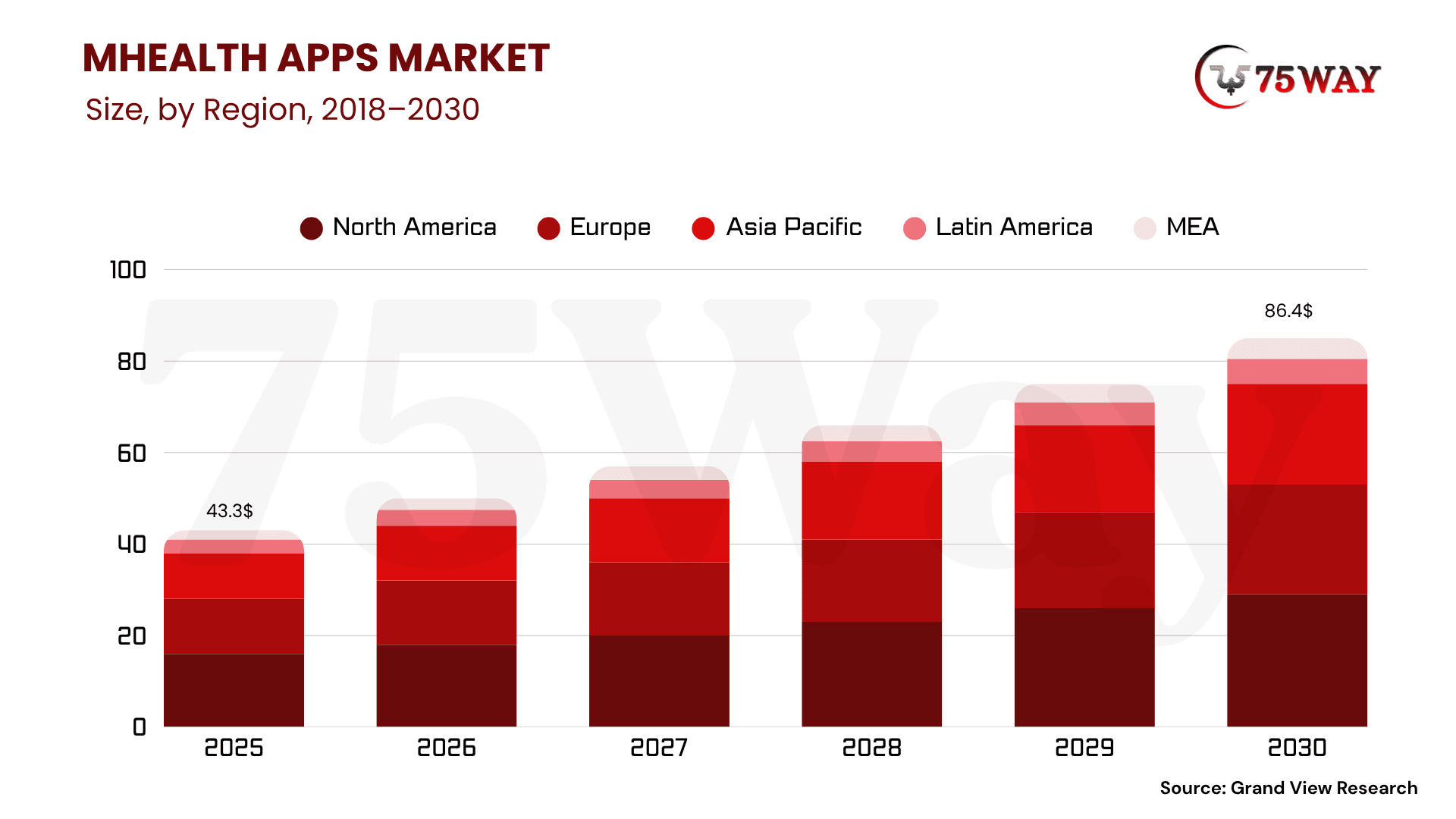
The major reason behind this change is the rapid adoption of digital healthcare platforms. The global mHealth apps market is projected to reach $86.37 billion by 2030, expanding at a 14.8% CAGR. As healthcare systems evolve toward data-driven and patient-centric models, healthcare app development solutions become essential infrastructure rather than optional tools.
For founders, startups, and healthcare innovators, this expansion brings both opportunity and complexity. While demand is accelerating, building a healthcare application is no longer a simple software exercise. It requires an end-to-end engineering approach. This leads to the most critical question: “What does it actually cost to build a healthcare mobile app?”
The answer is not fixed. On average, healthcare app development can range anywhere between $40,000 and $500,000+, depending on your needs. This cost may vary based on multiple variables, such as feature depth, regulatory requirements, and scalability goals. This comprehensive cost guide helps you understand this cost structure in detail before making any investment decisions.
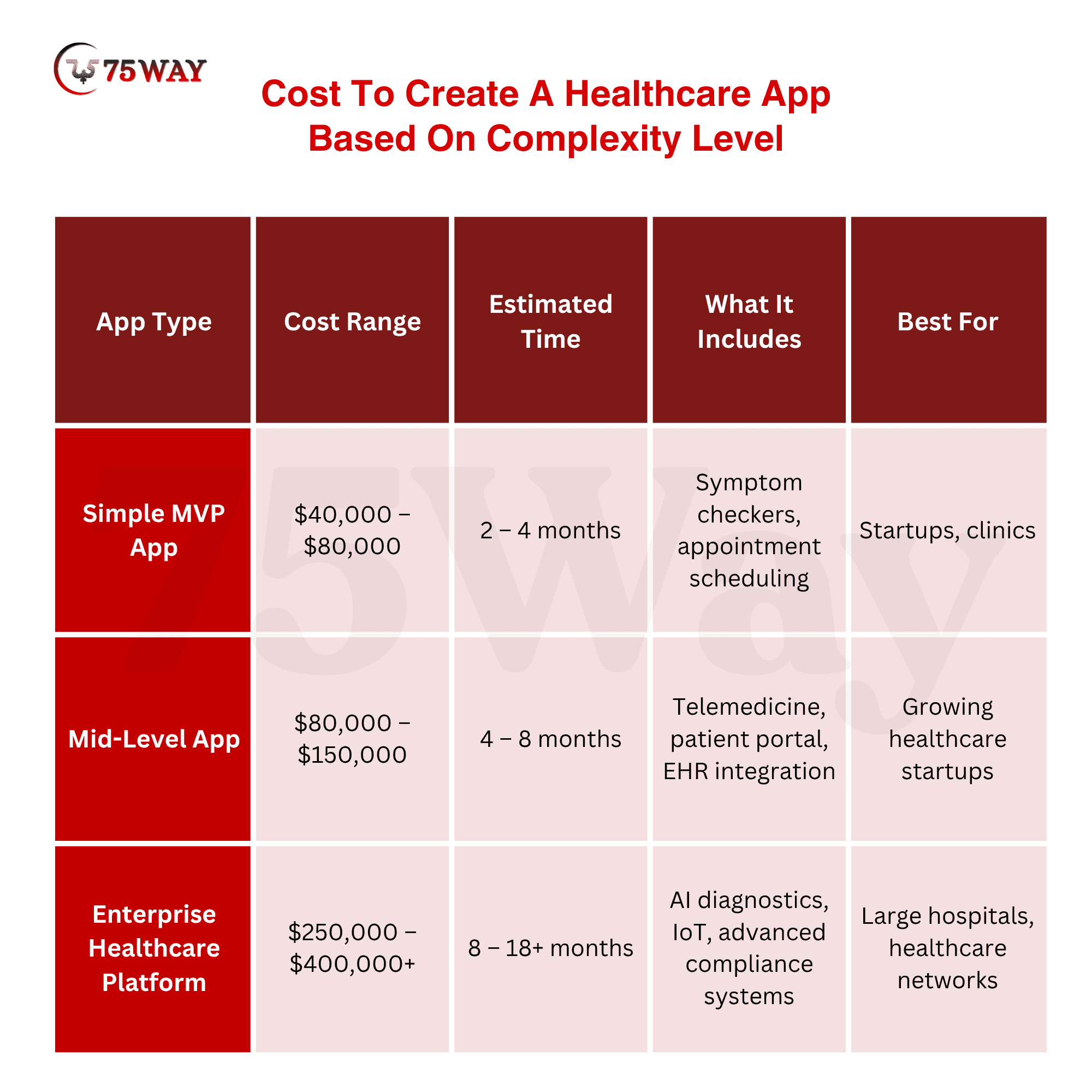
Cost To Create A Healthcare App Based On Complexity Level
The complexity of a healthcare app plays a big role in shaping both development time and cost. Simply put, the more features and intelligence you add, the more investment it requires.
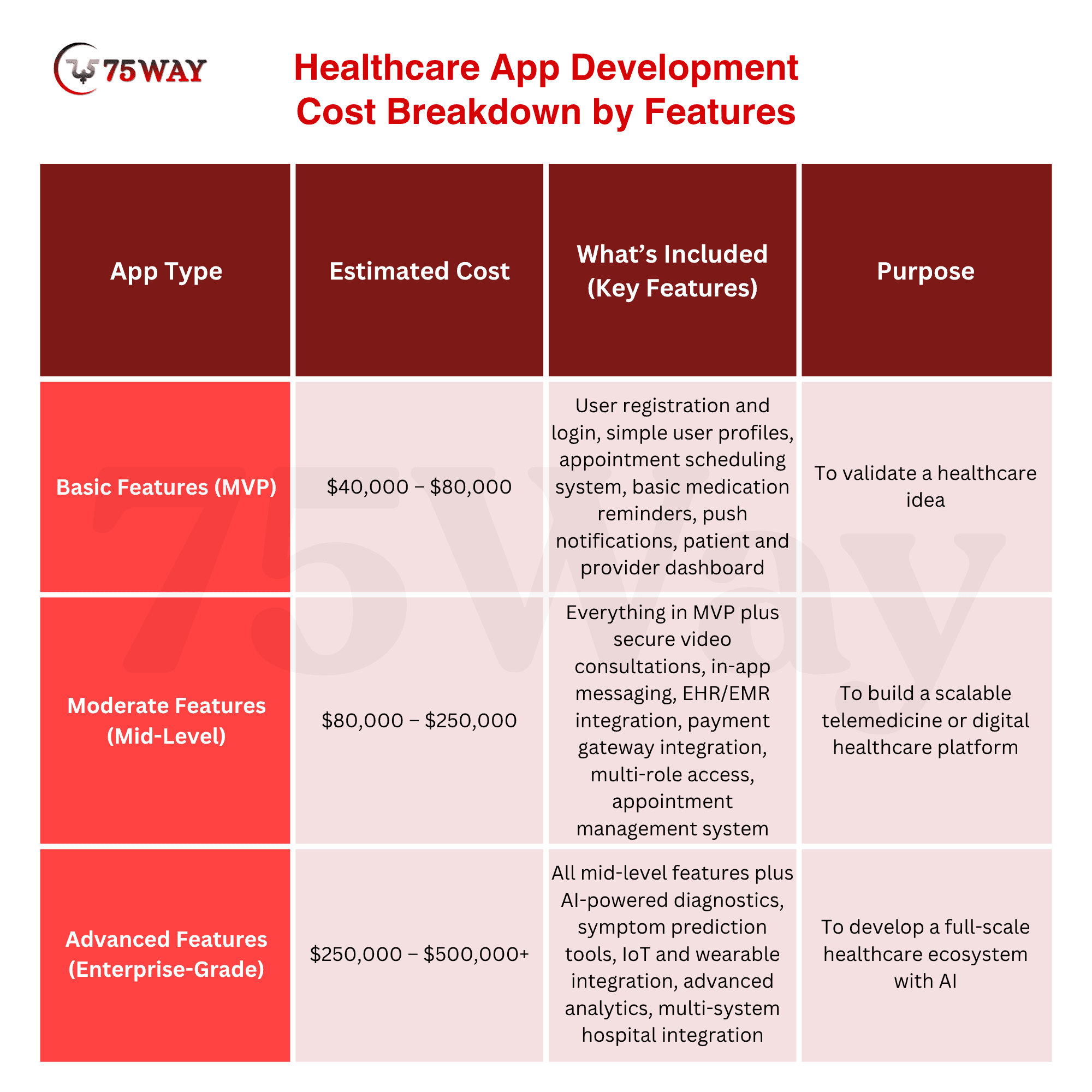
Simple Healthcare App Cost: A simple app with basic features like user profiles, appointment booking, or health reminders is usually more affordable, typically around $40,000 – $80,000.
Mid-Level Healthcare App Cost: A mid-level app goes a step further with things like telemedicine, patient portals, or remote monitoring, and generally falls in the $80,000 – $150,000 range.
Enterprise Healthcare App Cost: When you move to an enterprise healthcare platform, things become much more advanced. AI-driven tools, EHR integration, and secure cloud systems all come into play, pushing the cost to around $250,000 – $400,000+.
In the end, it all comes down to one thing: the more advanced the solution, the higher the build complexity and investment.
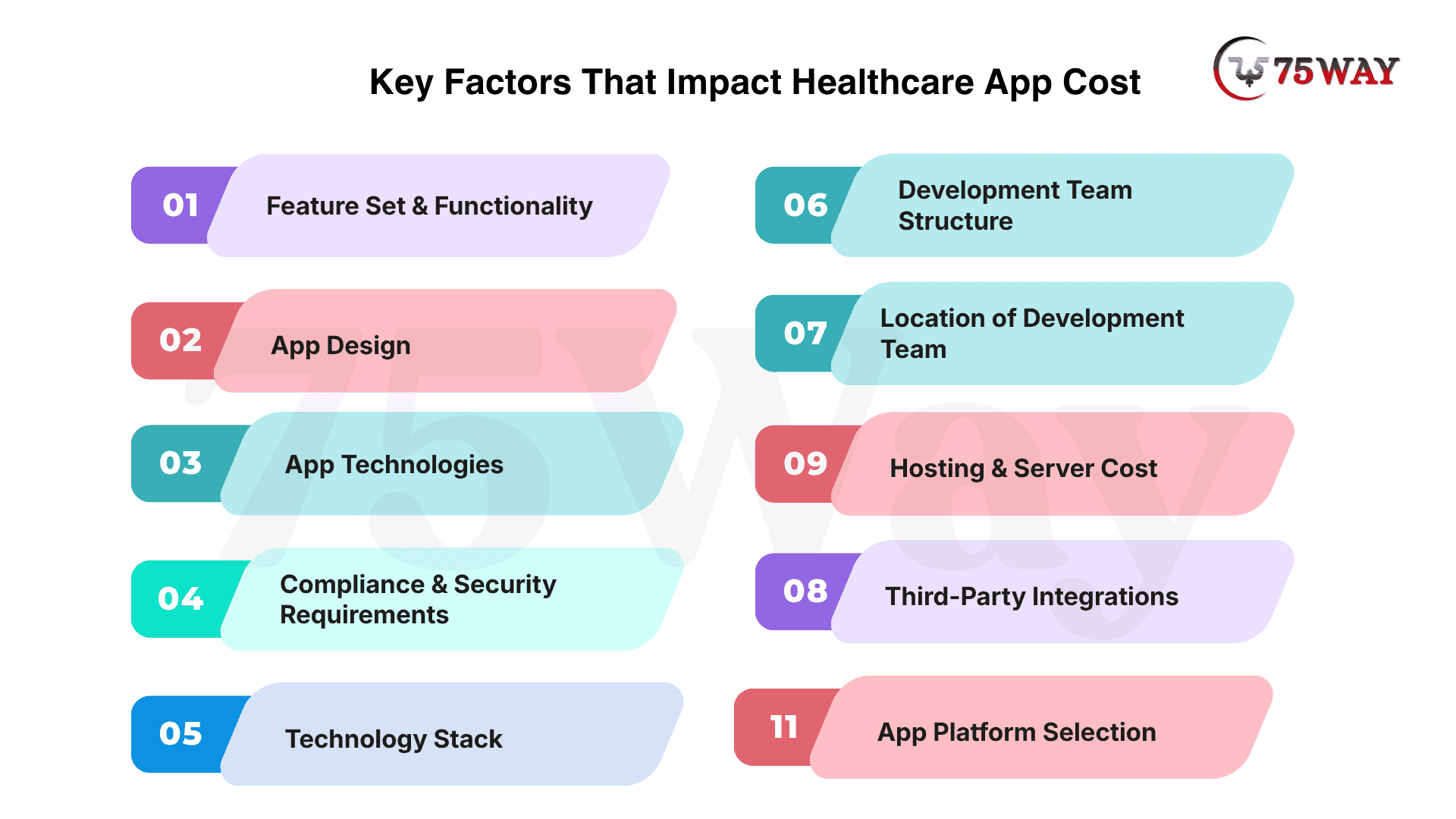
Key Factors That Impact Healthcare App Cost
The cost of a healthcare app is not determined by development hours and hourly rates alone. While these two form the base of any estimate, several other factors directly influence how much time, effort, and technical expertise the project will require.
In simple terms, mHealth app development is a layered process in which every feature, integration, and technical decision adds to the overall complexity. This is why the cost can vary significantly from one project to another, even if the basic idea looks similar on the surface. Understanding these factors in advance helps in setting a more realistic budget and reduces unexpected cost variations during development.
1. Feature Set & Functionality
The range of features in your app is one of the most important factors influencing the overall cost of healthcare application development. Simple functionality is usually more cost-effective to build, such as appointment booking, user profiles, and basic health-tracking features.
However, as you introduce more advanced capabilities, the cost increases noticeably. Features like AI-driven analytics, video consultations, real-time monitoring, or blockchain-based payment systems require more development time, stronger infrastructure, and higher technical expertise. Here is an estimate of healthcare app development pricing based on complexity:
2. mHealth App Design Cost
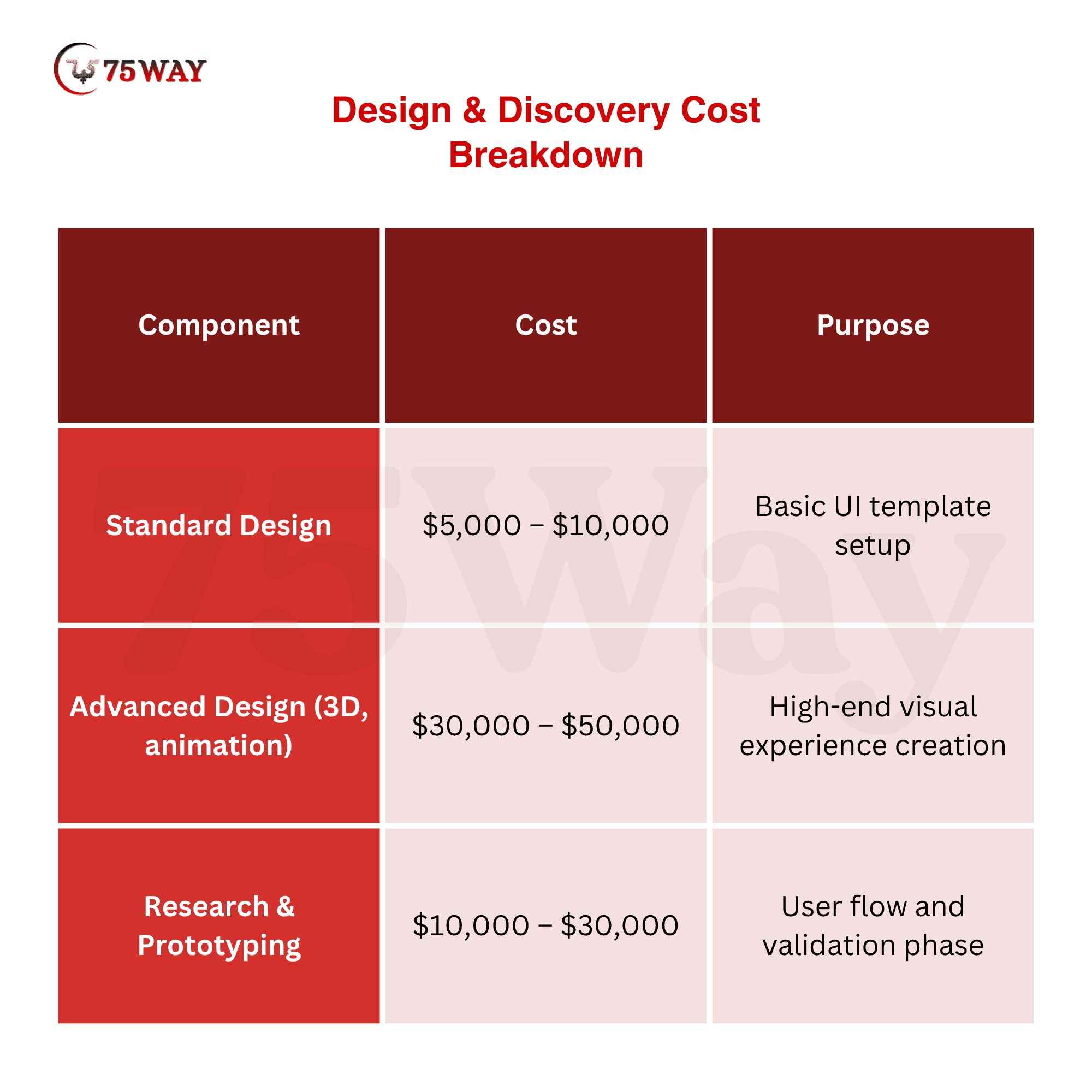
The UI/UX design is the core of any healthcare app, as it directly shapes how users interact with the product. A simple, intuitive design makes the app easier to navigate, especially for users such as elderly patients who may have limited technical experience.
- Standard Design costs $5,000–$10,000 and focuses on basic UI layouts.
- Advanced Design (3D, animation) costs $30,000–$50,000 and delivers highly interactive, visually rich interfaces with modern design elements.
- Research & prototyping costs $10,000–$30,000 and includes user research, wireframing, and testing ideas before final development.
3. App Technologies
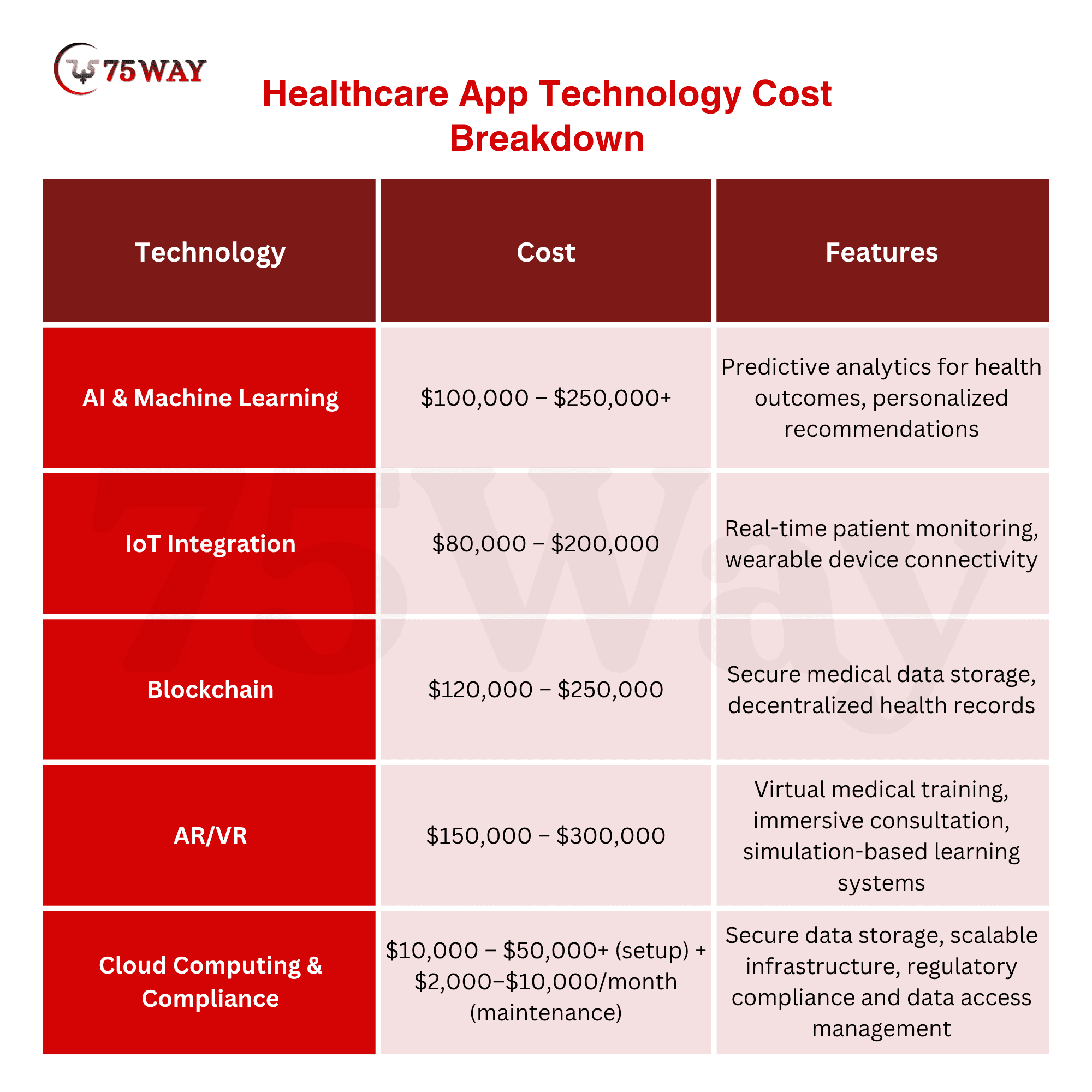
The use of advanced technologies such as AI, IoT, Blockchain, AR/VR, and Cloud computing significantly impacts the overall cost of healthcare app development. Although these technologies improve functionality, intelligence, and user experience, they also demand greater development effort, specialized skills, and more time to implement. Each technology adds a different layer of complexity, which directly affects budgeting and implementation planning.
Artificial Intelligence & ML
The cost of developing an AI-powered healthcare app generally ranges from $100,000 to $250,000+, depending on the level of intelligence and the amount of data processing.
- Predictive health insights and early diagnosis support
- Personalized treatment recommendations based on patient data
- Automated clinical decision support systems
IoT Integration
An IoT-enabled healthcare app usually costs between $80,000 and $200,000, mainly based on the number of connected devices and real-time monitoring complexity.
- Continuous tracking of patient vitals through wearables
- Real-time health data collection and syncing
- Instant alerts for abnormal medical conditions
Blockchain
A blockchain-based healthcare solution typically falls in the $120,000 to $250,000 range due to its strong focus on security and distributed architecture.
- Secure, tamper-proof medical record storage
- Decentralized access to patient data
- Safe and transparent healthcare transactions
AR/VR
The cost of AR/VR healthcare applications is usually between $150,000 and $300,000, depending on the level of immersion and simulation detail required.
- Virtual medical training environments
- Interactive patient consultation experiences
- Surgical and procedural simulation systems
Cloud Computing
Cloud-based healthcare systems generally start from $10,000 to $50,000+, with additional monthly maintenance costs based on usage and scale.
- Scalable storage for large medical datasets
- Secure remote access to patient records
- High availability and system reliability
4. Compliance & Security Requirements
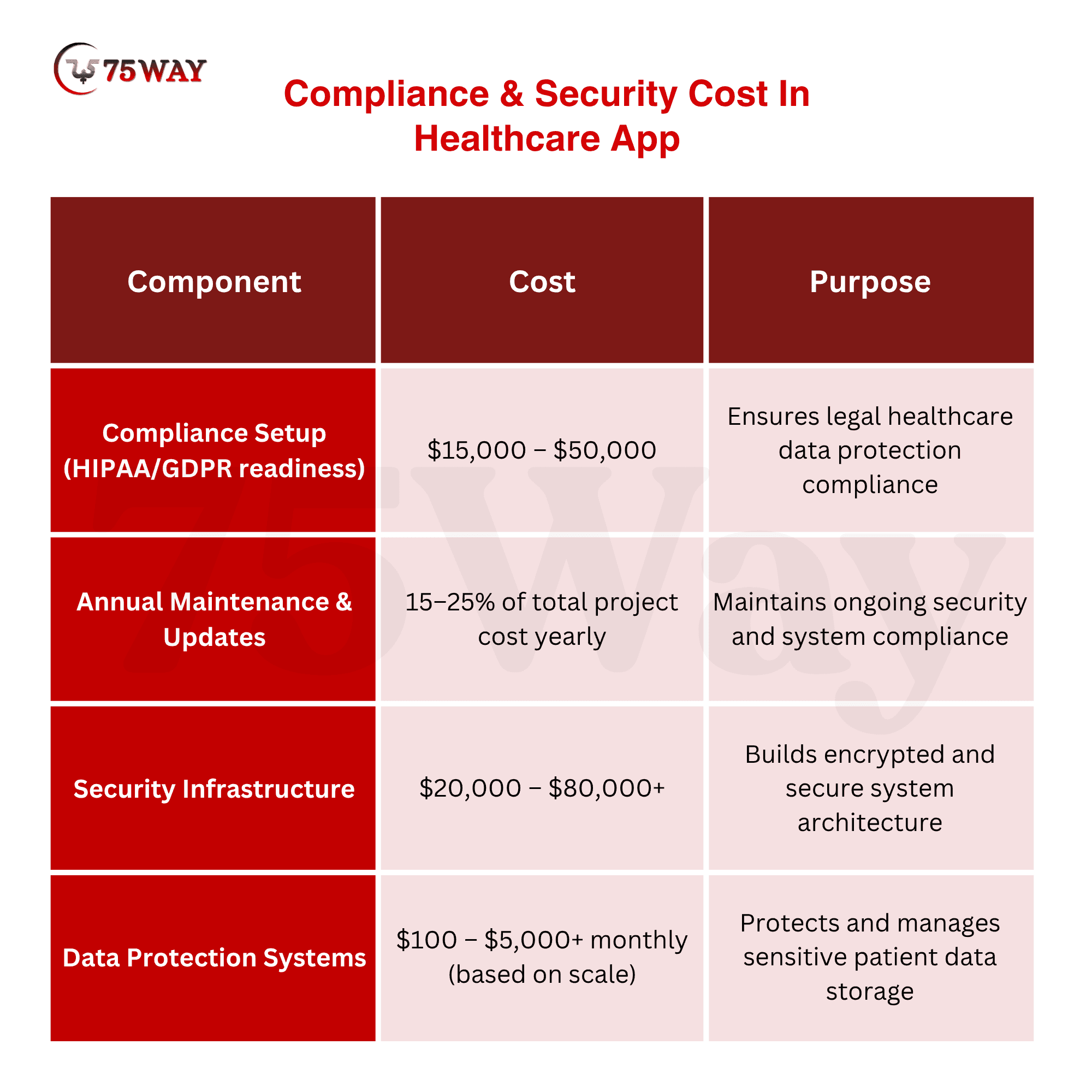
From the very beginning of development, security must be integrated into the system design. This increases both initial and ongoing costs because critical protections need to be built and maintained continuously.
Whether it is for an emergency hospital system or medical spa software, compliance and security are essential when developing healthcare applications. Ensuring your app complies with regulations such as HIPAA, GDPR, and other healthcare data protection laws is essential. It is not only about avoiding legal penalties but also about building long-term trust with patients who share sensitive medical information.
- Compliance Setup (HIPAA/GDPR readiness): The cost ranges from $15,000 – $50,000, covering regulatory alignment, documentation, and security readiness.
- Annual Maintenance & Updates: This typically accounts for 15–25% of the total project cost per year, ensuring ongoing compliance and security improvements.
- Security Infrastructure: Building a secure architecture costs around $20,000–$80,000+, depending on encryption, access controls, and system security.
- Data Protection Systems: Monthly expenses range from $100 – $5,000+, based on data volume, storage needs, and system scale.
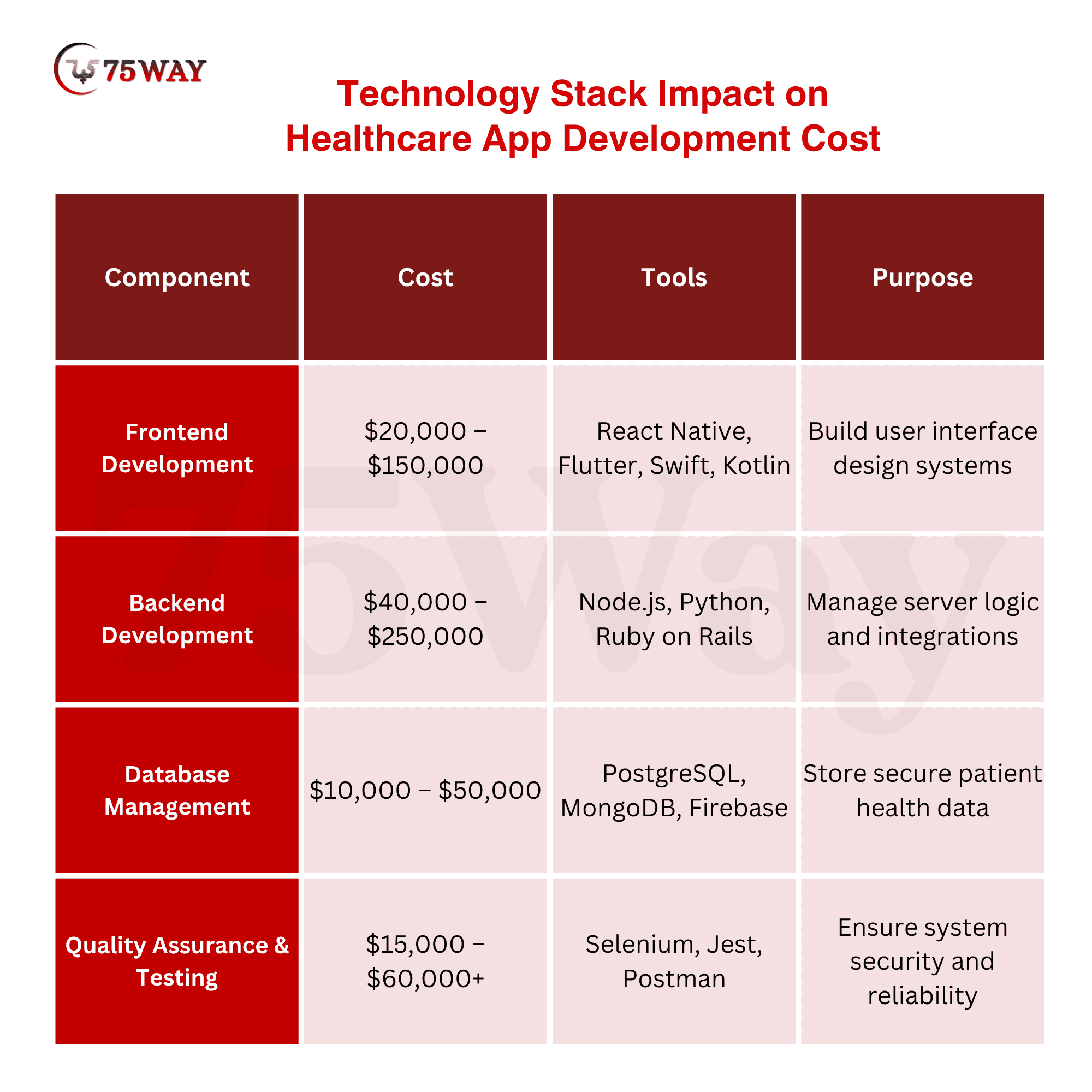
5. Technology Stack
The technology stack plays a major role in determining both the development timeline and overall cost of a healthcare application. More advanced and specialized technologies require higher expertise, stronger security implementation, and longer development cycles.
- Frontend Development (UI/UX): The cost to create an intuitive and responsive healthcare interface typically ranges between $20,000 – $150,000, depending on design complexity and platform support.
- Backend Development: Building a secure and scalable server-side system usually costs around $40,000 – $250,000, based on API depth, integrations, and performance needs.
- Database Management: Setting up and maintaining a secure healthcare data system generally falls between $10,000 – $50,000, depending on storage size and encryption requirements.
- Quality Assurance & Testing: Ensuring app stability, security, and compliance typically requires an investment of $15,000 – $60,000+, depending on testing depth and automation level.
6. Healthcare App Platform Cost & Timeline Breakdown
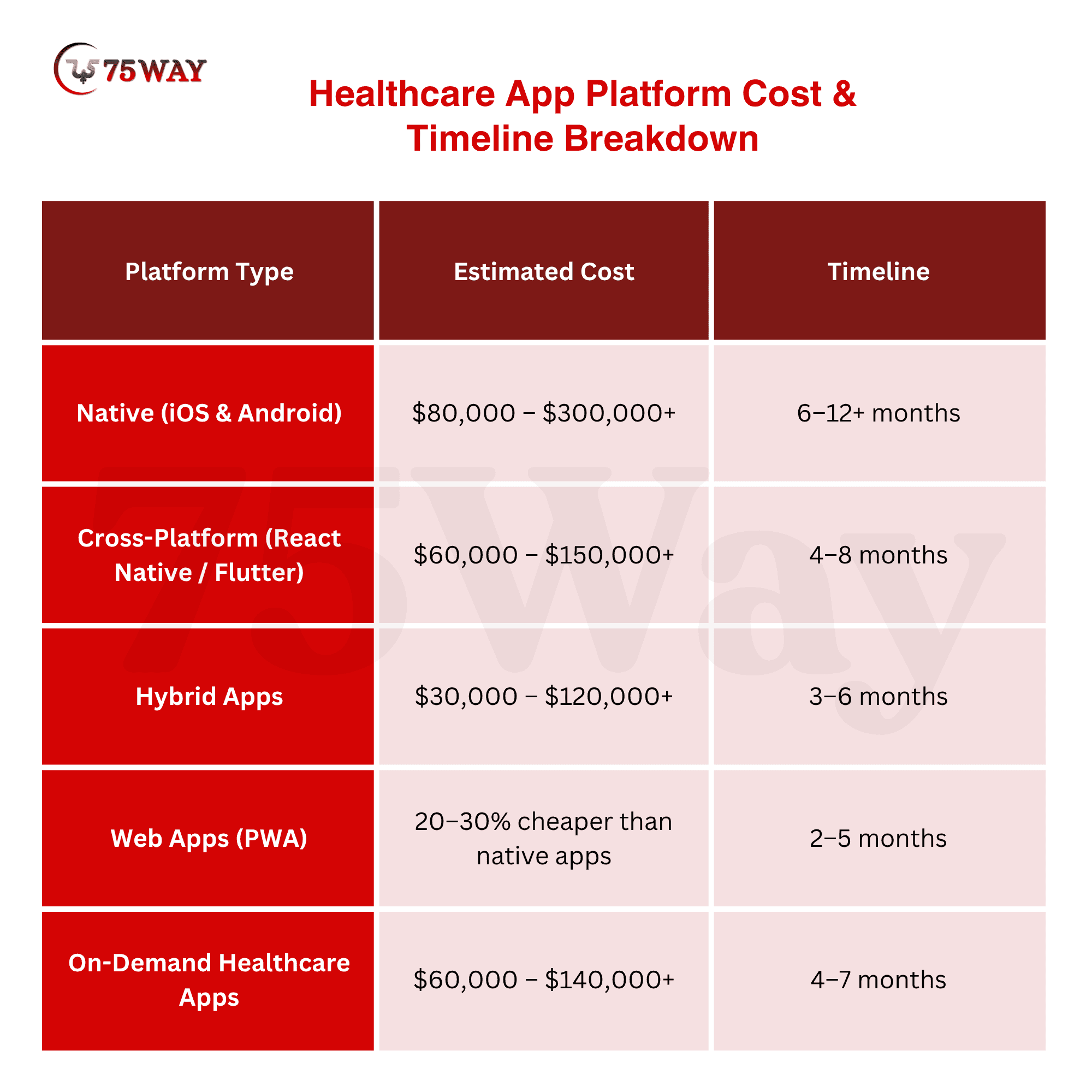
The selection of a platform significantly influences both the cost and the reach of a healthcare application. Native apps, web apps, cross-platform solutions, and hybrid apps differ in development approach, performance capability, and overall investment needed. This choice is usually guided by available budget, target audience size, and long-term scalability plans.
- Native (iOS & Android)
The cost to develop native healthcare apps is $80,000 – $300,000+. These apps require separate development for iOS and Android, which increases time, effort, and overall investment.
- Cross-Platform (React Native / Flutter)
The cost to build cross-platform healthcare apps is $60,000 – $150,000+. This approach uses a single codebase for both platforms, reducing development time and cost.
- Hybrid Apps
The cost to create hybrid healthcare apps ranges from $30,000 – $120,000+. These apps combine web and native technologies, making them faster and more affordable to build.
- Web Apps (PWA)
Web-based healthcare apps are typically 20–30% cheaper than native apps. They run directly in browsers without installation, reducing development and maintenance costs.
- On-Demand Healthcare Apps
The cost to build on-demand healthcare applications typically ranges from $60,000 – $140,000+. These apps focus on real-time service delivery, such as instant doctor booking, emergency consultations, and home healthcare requests.
7. Hosting & Server Cost To Build A Health & Wellness App
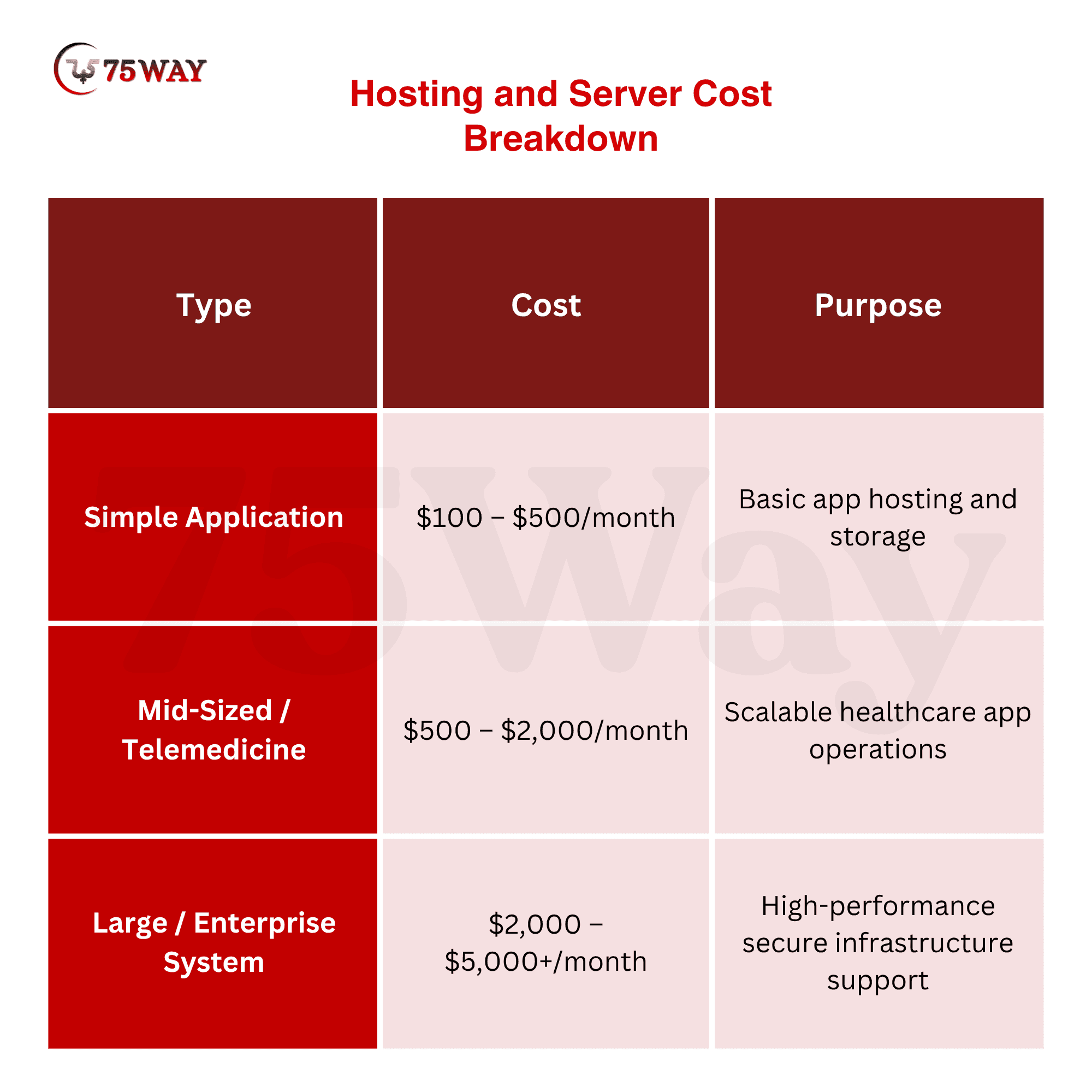
The hosting and server costs for a healthcare app depend on data volume, user traffic, and scalability requirements and lie between $100 –$5,000+/month. Secure cloud infrastructure is essential to ensure compliance, protect patient data, and maintain reliable performance.
- Secure cloud hosting with scalable resources
- Compliance-ready infrastructure for healthcare apps
- Data encryption and storage management systems
- High availability with performance optimization
The cost to host a simple healthcare app typically ranges from $100 – $500/month, covering basic storage and limited traffic handling. A mid-sized or telemedicine platform usually costs around $500 – $2,000/month, supporting real-time consultations and growing user demand. A large enterprise healthcare system can range from $2,000 – $5,000+/month, as it requires high scalability, advanced security, and heavy data processing capabilities.
8. Development Team Structure
The size of your development team directly influences the overall cost and speed of healthcare app development. A smaller team may reduce upfront expenses, but usually takes longer to deliver the final product. In contrast, a larger team with specialized roles can speed up development but increases total project cost due to higher resource allocation.
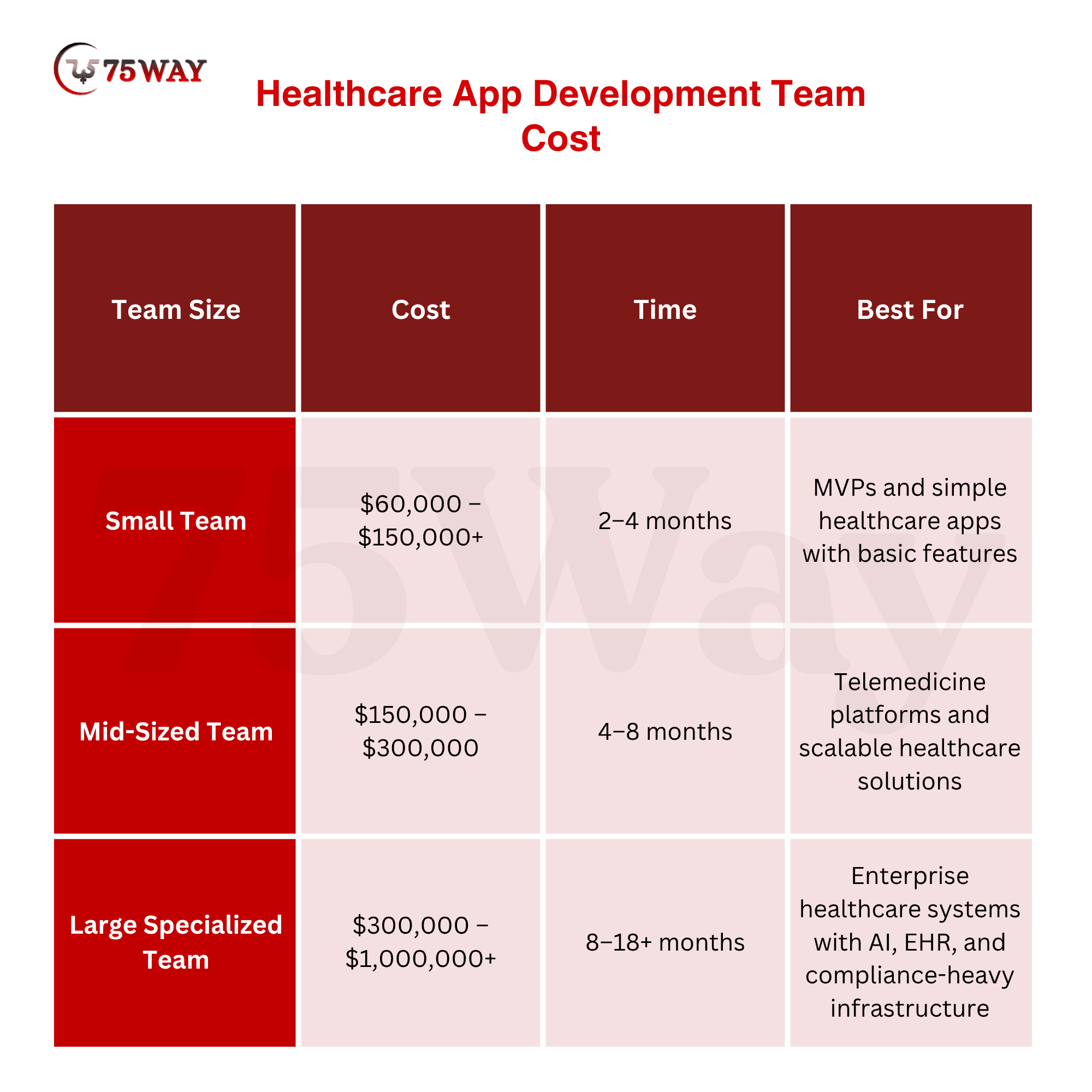
A typical healthcare app development team includes a project manager to oversee execution, developers for iOS, Android, and backend systems, UI/UX designers for user experience, QA engineers for testing and quality control, and security specialists to ensure compliance and data protection. Here is an estimate of cost based on team size and structure:
- Small Team: The cost usually ranges from $60,000 – $150,000+, commonly used for MVPs and basic healthcare apps with limited features.
- Mid-Sized Team: The cost generally falls between $150,000 – $300,000, offering a balanced structure with faster delivery.
- Large Specialized Team: The cost can range from $300,000 to $1,000,000+, designed for enterprise-level healthcare systems that involve AI, EHR integrations, IoT devices, and strict regulatory compliance.
9. Cost To Develop a Health App Based on Location
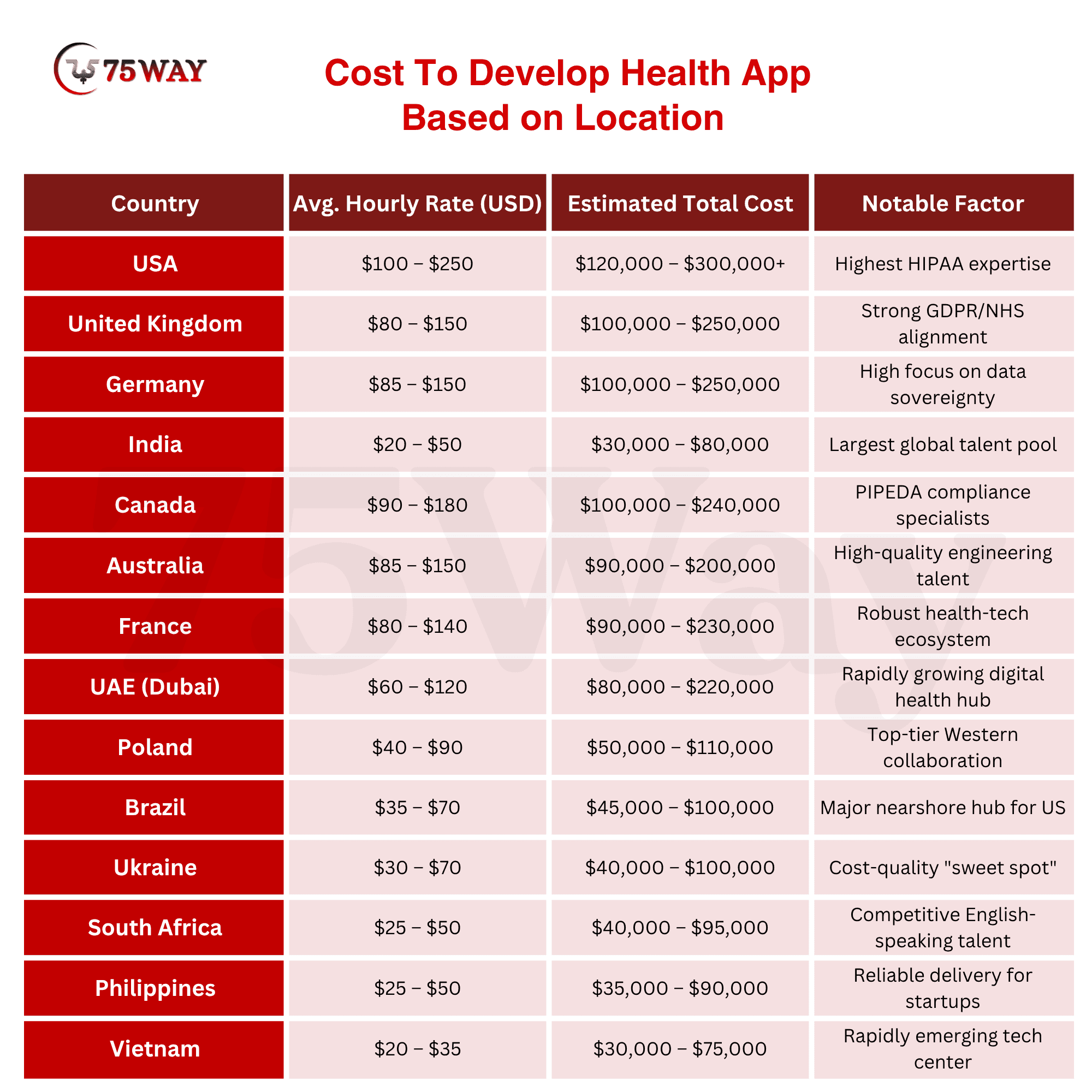
Healthcare app development costs vary significantly across locations and geographical areas due to differences in developer expertise, labor rates, and market demand. Location plays a key role in determining hourly pricing and overall project budget.
- USA: $100 – $250 per hour for skilled healthcare developers
- United Kingdom: $80 – $150 per hour for professional development teams
- Germany: $85 – $150 per hour for high-quality engineering services
- India: $20 – $50 per hour for cost-effective development solutions
- Canada: $90 – $180 per hour for experienced healthcare developers
- Australia: $85 – $150 per hour for skilled technical development teams
- France: $80 – $140 per hour for reliable software engineering services
- UAE (Dubai): $60 – $120 per hour for growing tech expertise
- Poland: $40 – $90 per hour for affordable European development talent
- Brazil: $35 – $70 per hour for emerging software development market
- Ukraine: $30 – $70 per hour for strong engineering expertise globally
- South Africa: $25 – $50 per hour for budget-friendly development options
- Philippines: $25 – $50 per hour for economical outsourcing services globally
- Vietnam: $20 – $35 per hour for highly affordable development teams
10. Third-Party Integration Cost Impact on Healthcare App Creation Cost
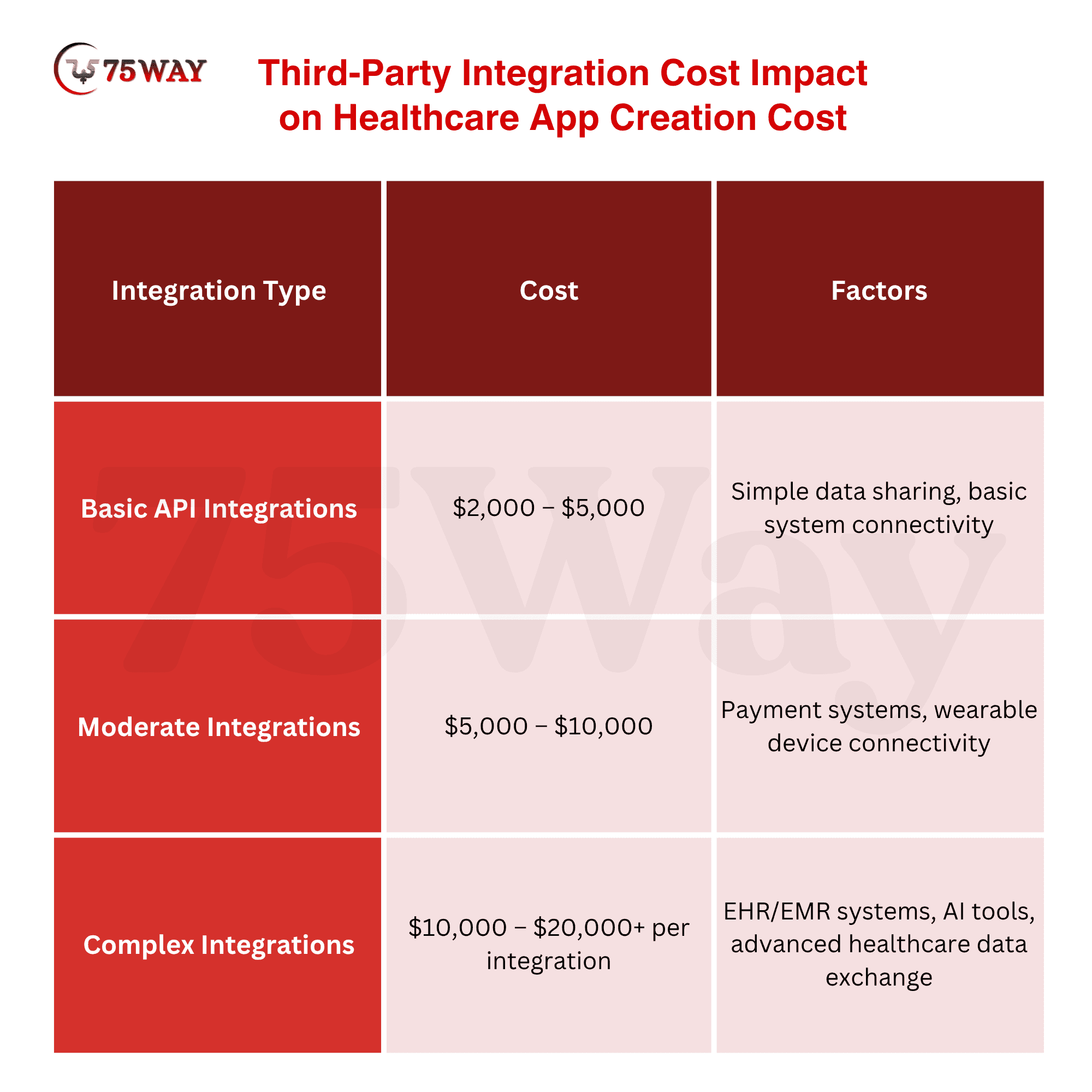
API integrations play a key role in healthcare applications by enabling seamless data exchange between systems, improving functionality, and supporting connected digital healthcare workflows.
- Basic API Integrations: The cost typically ranges from $2,000 – $5,000 for simple data sharing between systems.
- Moderate Integrations: The cost usually falls between $5,000 – $10,000 for payment systems and wearable device connectivity.
- Complex Integrations: The cost can range from $10,000 to $20,000+ per integration for advanced systems such as EHRs, EMRs, and AI-based tools.
Total Integration Investment: $20,000 – $50,000 for a complete healthcare system setup, depending on complexity and number of integrations required.
Why Healthcare App Development Costs Go Higher Than Expected?
Healthcare app budgets are often shaped by more than just development, design, and integrations. Several less obvious factors quietly add to the overall cost and can significantly impact your final investment if not planned early. Understanding these hidden elements helps create a more realistic and stress-free budgeting approach.
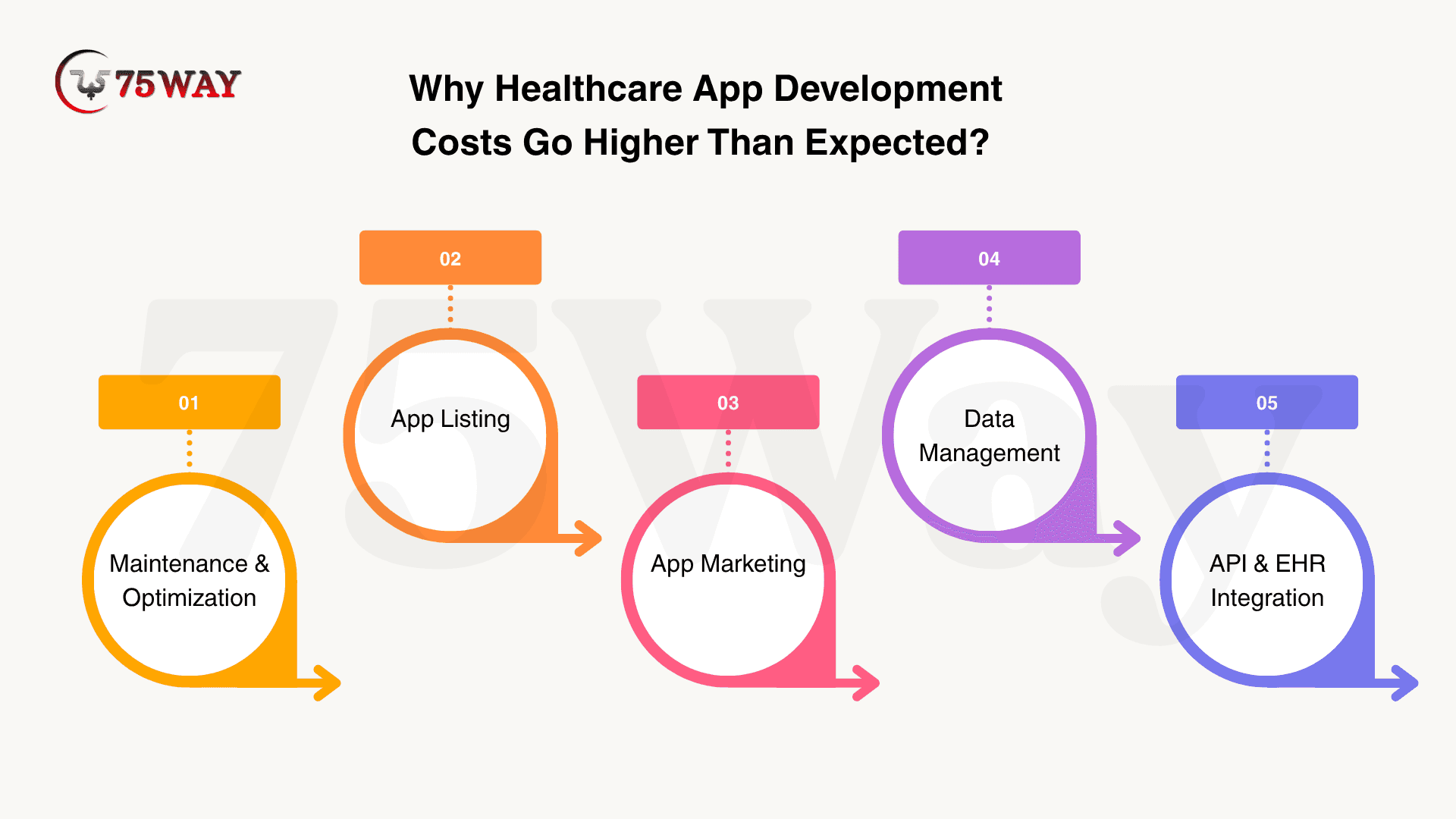
1. Healthcare App Maintenance Cost Breakdown
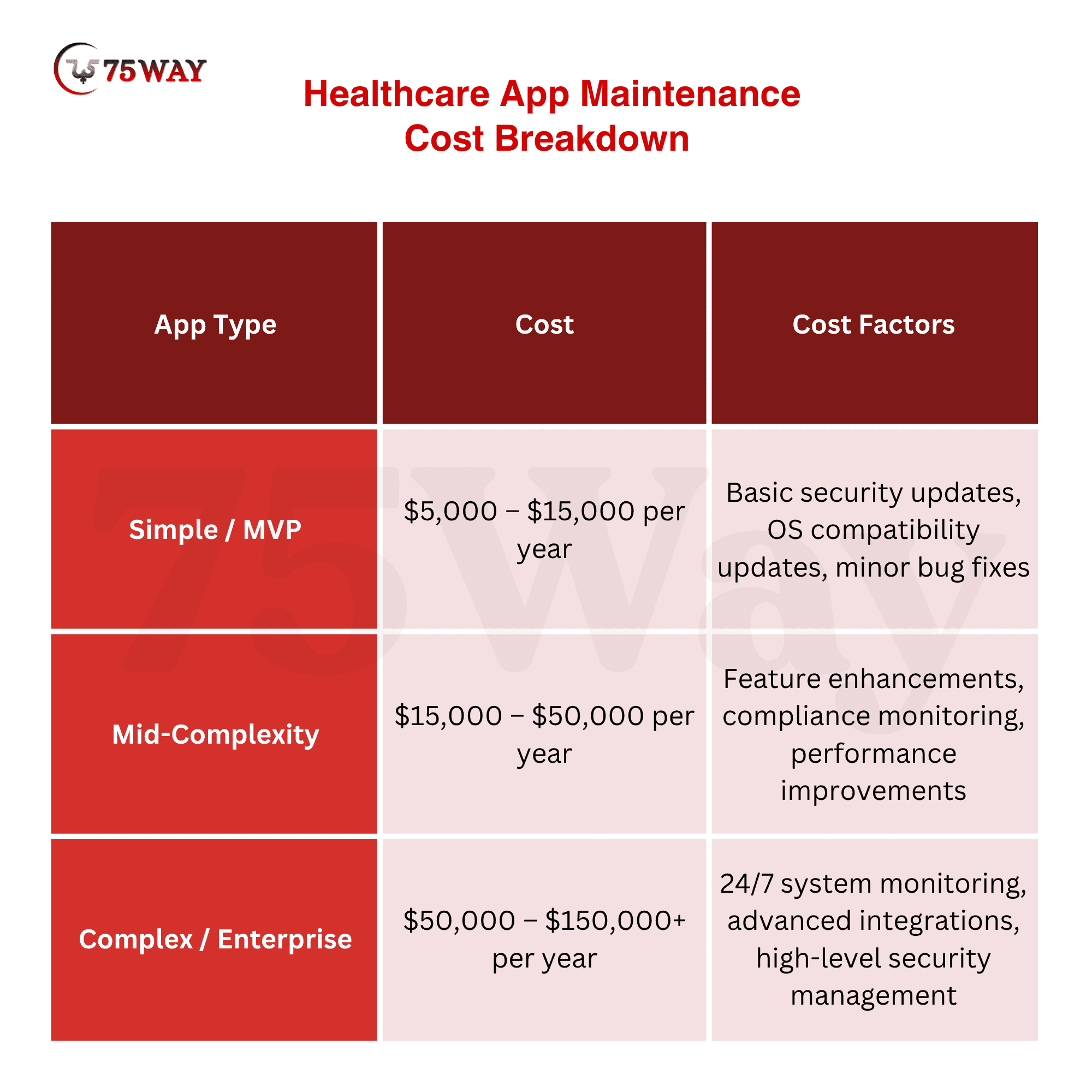
Launching a healthcare app is not the final step. Continuous maintenance and post-launch support are essential to keep the application stable, secure, scalable, and compliant with healthcare standards. Ongoing expenses typically range between $5,000 – $150,000+ per year
include routine maintenance and system upgrades to ensure smooth performance and long-term reliability.
- Fixing bugs and releasing updates for new features
- Strengthening security to protect against evolving cyber threats
- Updating compatibility with the latest mobile operating systems
- Improving features based on user feedback for a better experience
2. App Listing Costs
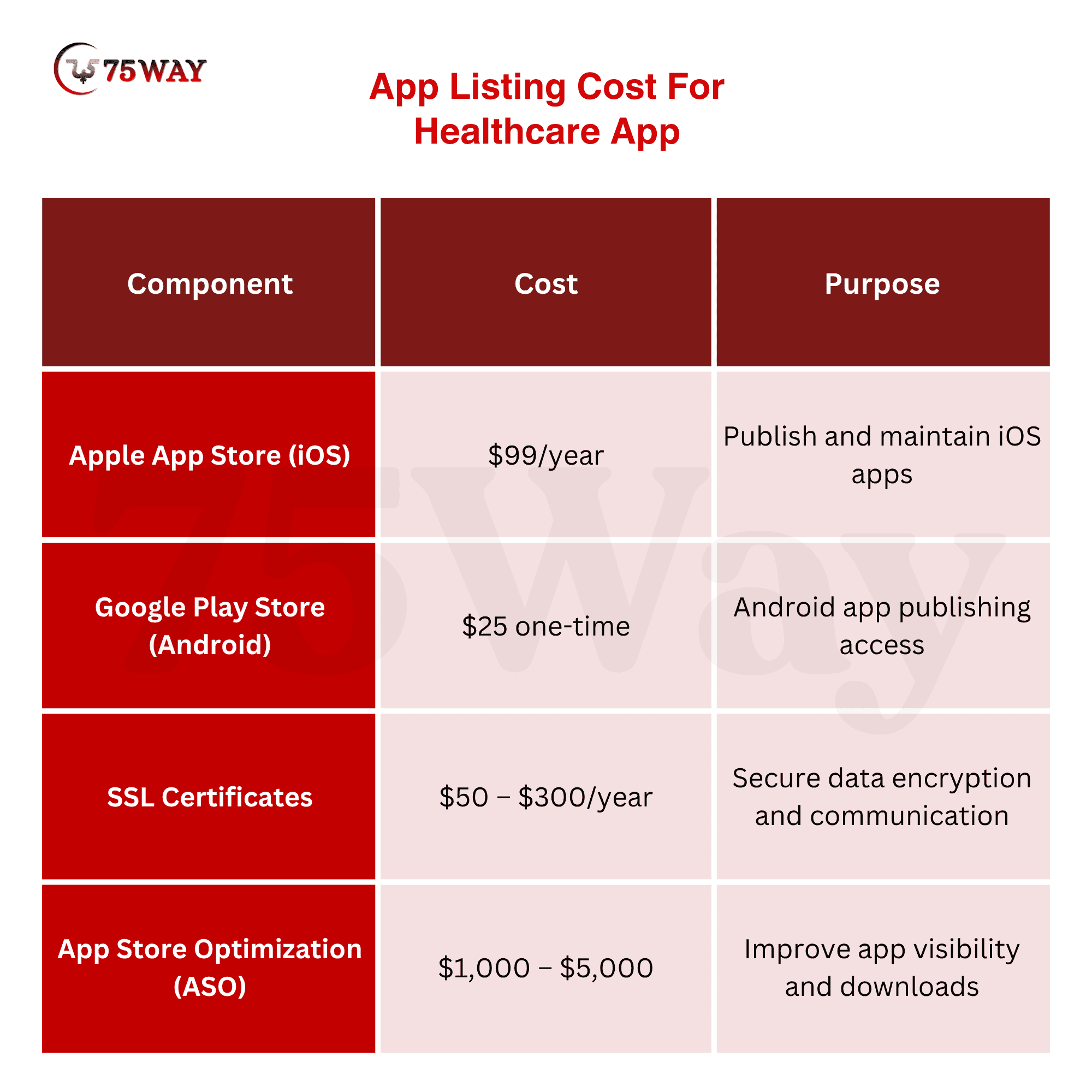
Publishing a healthcare app is not free and involves multiple mandatory and optional costs. These expenses ensure your app is securely listed, discoverable, and compliant with platform requirements. Along with store registration, additional costs like security certificates and visibility optimization also play an important role in a successful launch.
- Apple App Store (iOS): The cost is $99 per year for an individual or organization developer account to publish and maintain apps on iOS.
- Google Play Store (Android): The cost is a one-time fee of $25 to register and publish apps on the Android platform.
- SSL Certificates: The cost ranges from $50 – $300 per year, ensuring secure data encryption and safe user communication.
- App Store Optimization (ASO): The cost typically ranges from $1,000 – $5,000, helping improve visibility, rankings, and downloads in app stores.
3. Healthcare App Marketing Cost
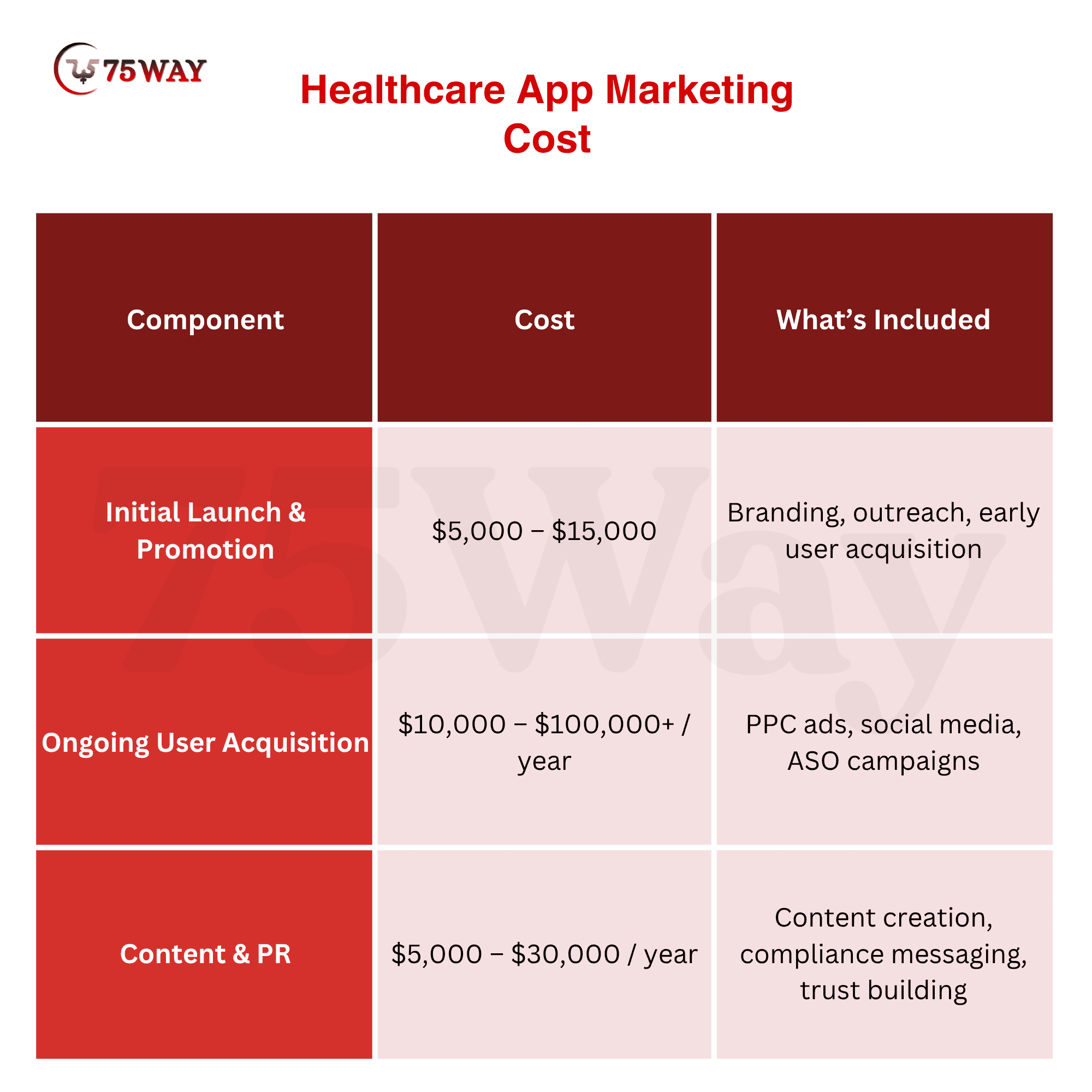
Marketing plays a crucial role in the success of a healthcare app because even a well-built product needs visibility, trust, and user acquisition strategies to grow in a competitive market. These costs vary based on scale, channels used, and growth goals.
- Initial Launch & Promotion: $5,000 – $15,000 for early outreach and branding efforts.
- Ongoing User Acquisition: $10,000 – $100,000+ yearly for ads and ASO campaigns.
- Content & PR: $5,000 – $30,000 yearly for trust-building content and healthcare PR.
4. Data Management and Storage
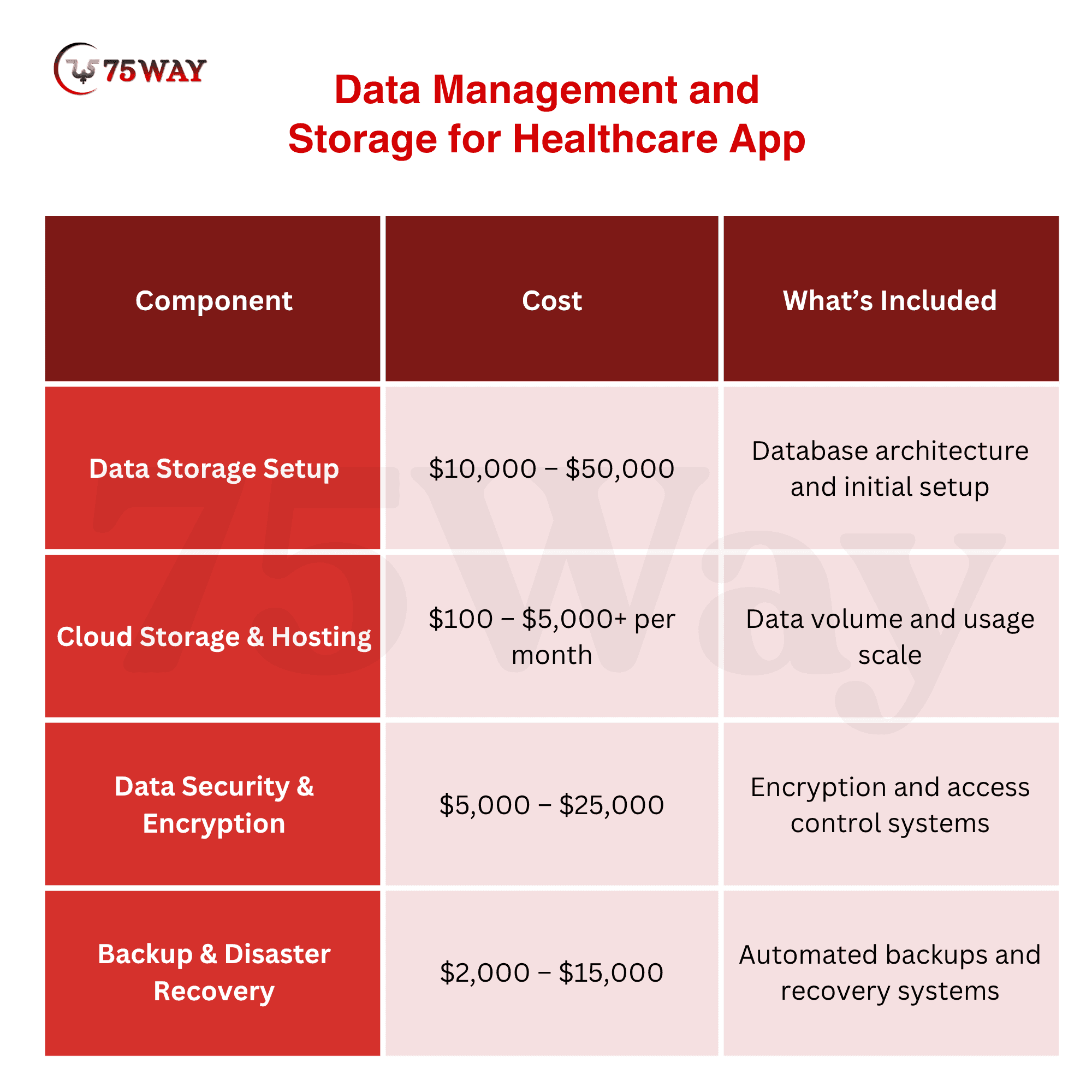
Healthcare apps require secure and scalable data storage systems to handle sensitive patient records, medical history, and real-time health data. Costs depend on data volume, security level, and infrastructure scalability needs.
- Data Storage Setup: $10,000 – $50,000 for building secure database architecture and initial configuration.
- Cloud Storage & Hosting: $100 – $5,000+ per month based on data size and usage scale.
- Data Security & Encryption: $5,000 – $25,000 for implementing encryption, access control, and protection layers.
- Backup & Disaster Recovery: $2,000 – $15,000 for automated backups and system recovery planning.
5. API & EHR Integration
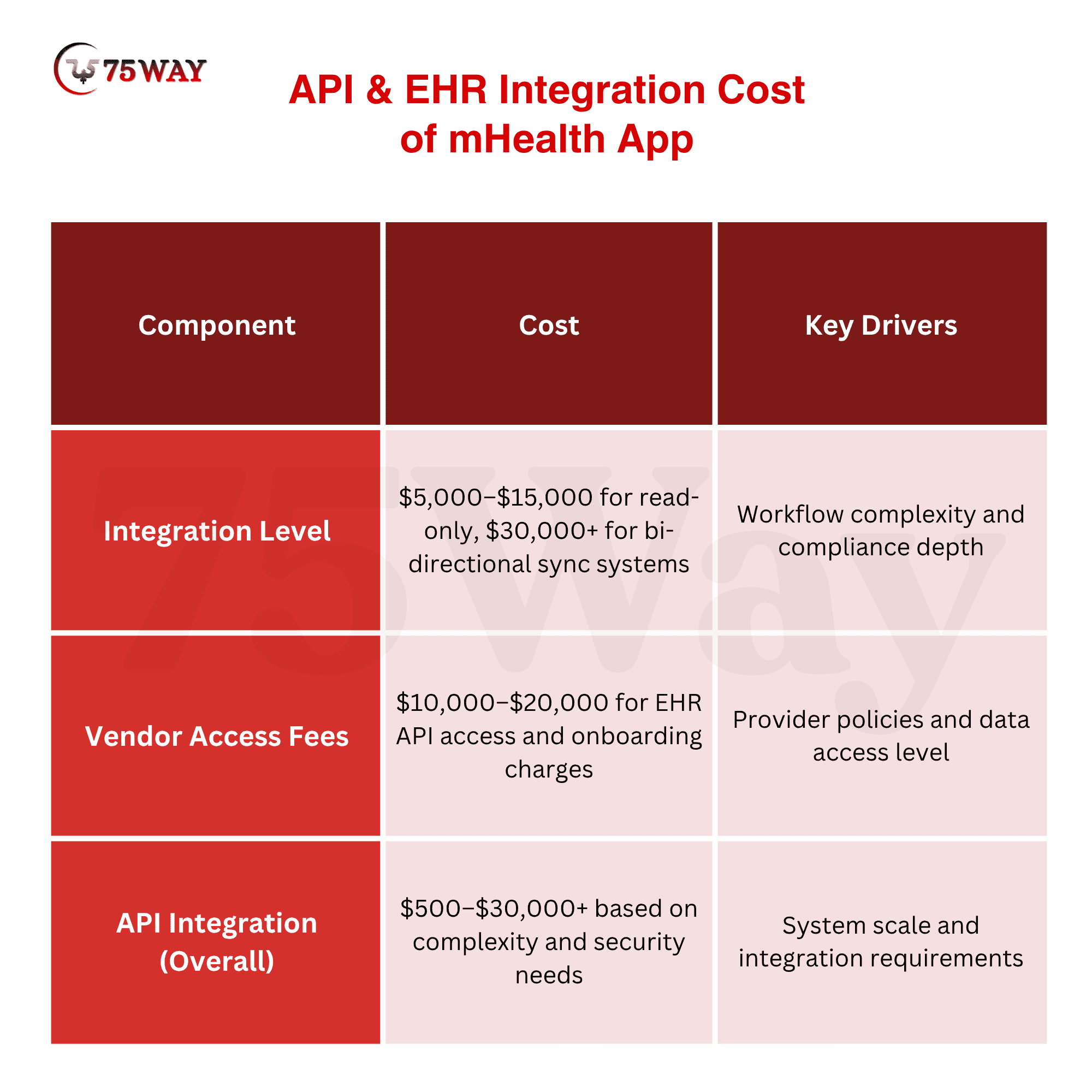
Healthcare app integrations, especially with EHR systems, significantly impact overall development cost due to strict security standards, vendor restrictions, and complex data exchange requirements.
- EHR/EMR integration needs API knowledge, compliance, and thorough testing.
- Payment gateways require PCI compliance and secure transaction processing.
- Wearable and IoT integration increases sync complexity and error handling.
Cost Breakdown
- Integration Level: $5,000–$15,000 for read-only, $30,000+ for bi-directional sync systems.
- Vendor Access Fees: $10,000–$20,000 for EHR API access and onboarding charges.
- API Integration (Overall): $500–$30,000+ based on complexity and security needs.
How to Calculate the Cost of Healthcare App Development
Estimating the cost of a healthcare app primarily depends on two main factors: the total number of development hours required and the development team's hourly rate. When these two elements are clear, it becomes much easier to arrive at a realistic overall cost estimate. You can compute the cost to create an mHealth application as:
Total Cost = Development Hours × Hourly Rate
Let’s understand with an example. If a healthcare app development team charges around $40 per hour and the project requires about 2,500 hours of work, then the estimated cost comes to approximately $100,000. This is just the core development cost and does not include post-launch support, feature updates, or compliance-related audits, which are especially important in healthcare applications.
Now, let’s take another example for better clarity. If a more advanced healthcare platform requires 3,500 hours of development at a higher rate of $60 per hour, the estimated cost would rise to around $210,000. This increase usually reflects added complexity such as integrations, advanced security layers, or AI-driven features.
In simple terms, once you understand the relationship between time, expertise, and complexity, estimating healthcare app costs becomes much more predictable and practical.
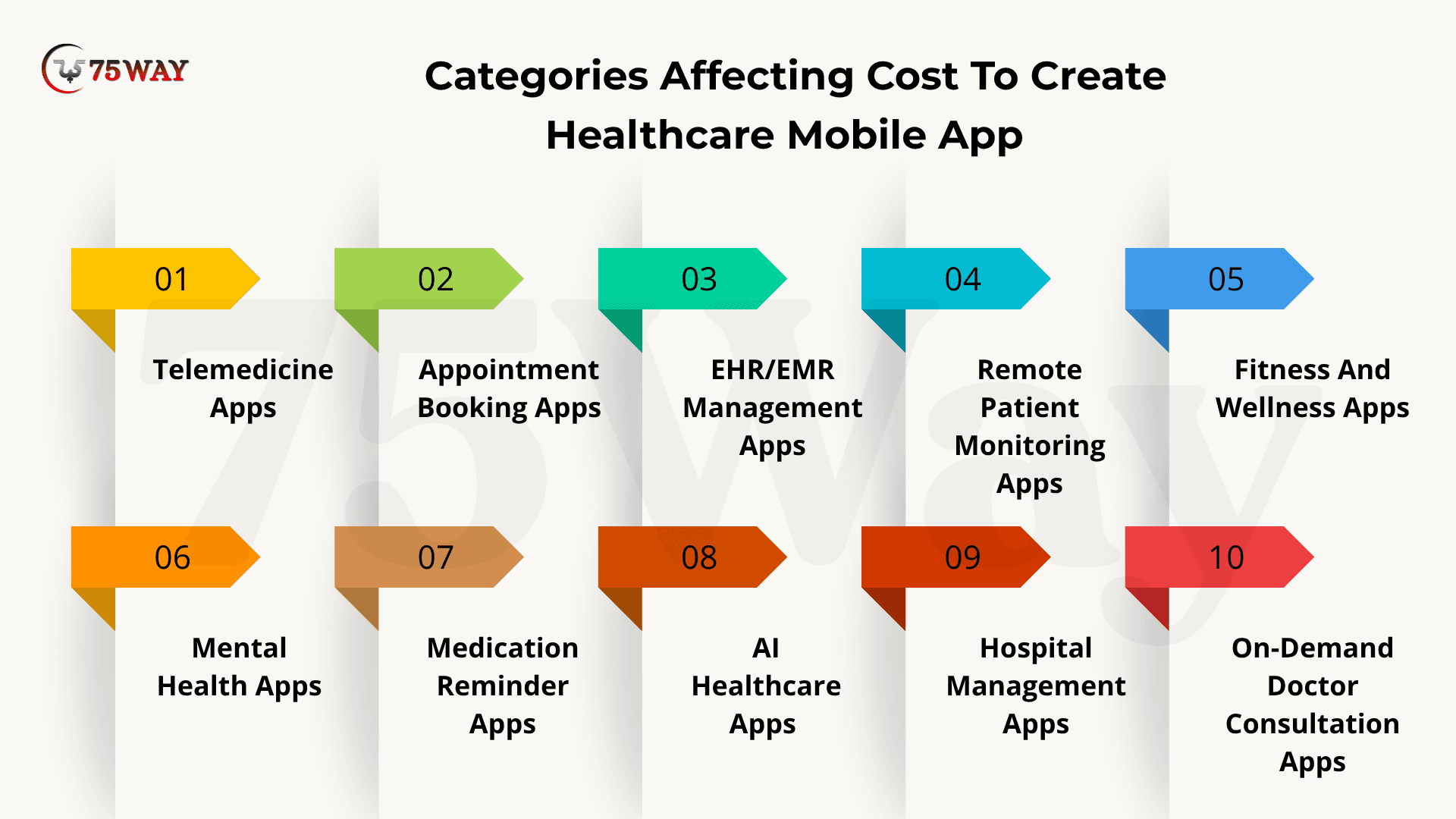
Cost To Create Healthcare Mobile App Based On Its Category
One of the most important things to understand in healthcare app development is that cost is never fixed. It changes based on the type of app you are planning to build. Each category comes with different goals, feature sets, technical complexity, and compliance requirements, which directly influence the overall investment.
1. Telemedicine Apps
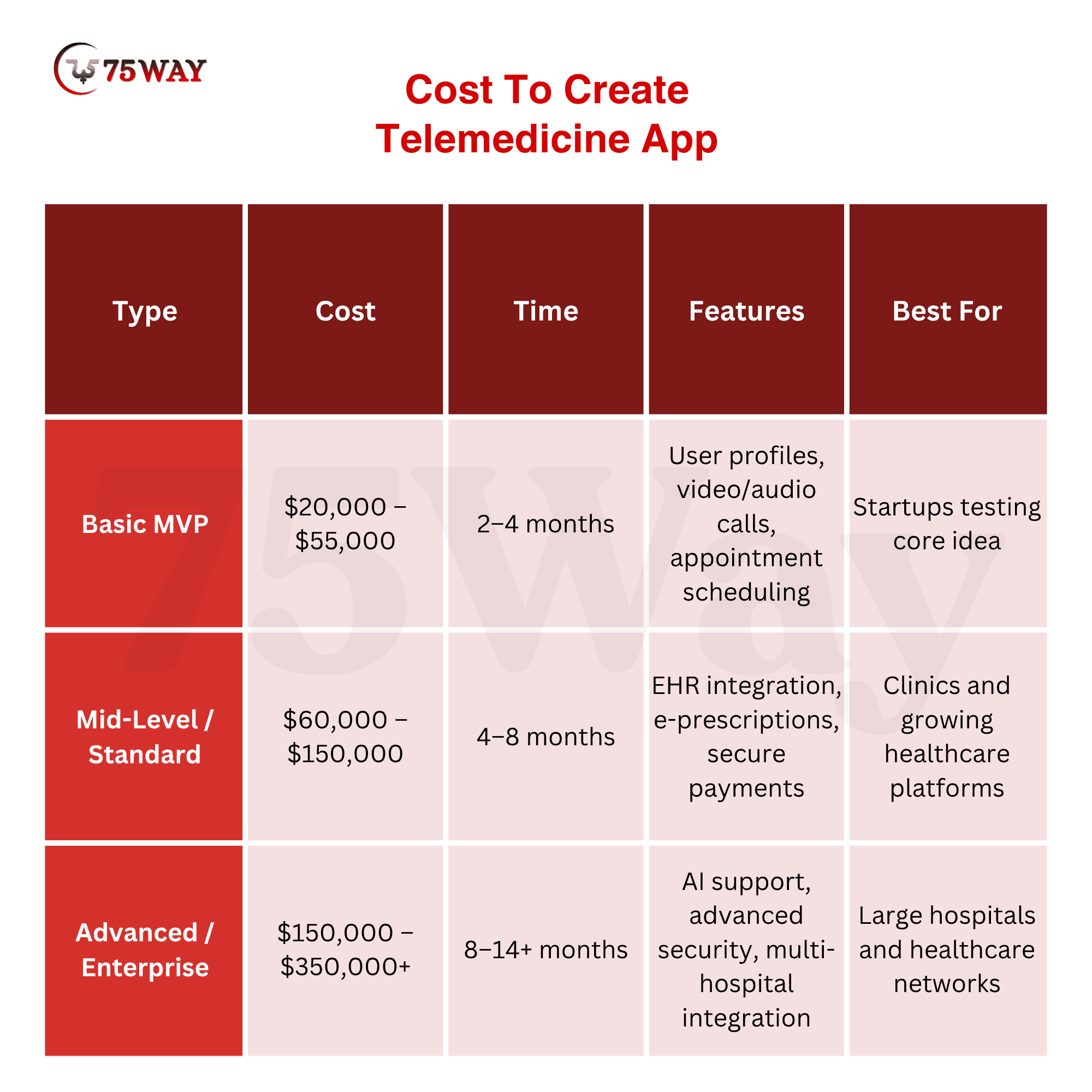
A telemedicine app is a healthcare solution that allows patients to consult doctors remotely through video, audio, or chat. It enables virtual appointments, reduces hospital visits, and provides quick access to medical care from anywhere.
- Basic/MVP Telemedicine Apps: The cost to build a basic telemedicine MVP ranges from $20,000 – $55,000, with a development timeline of 2–4 months.
- Mid-Level Telemedicine Apps: The cost to develop a standard telemedicine app falls between $60,000 – $150,000, typically requiring 4–8 months of development.
- Advanced Telemedicine Apps: The cost for a full-scale enterprise telemedicine platform ranges from $150,000 – $350,000+, with a longer timeline of 8–14+ months due to complex features and integrations.
2. Appointment Booking App
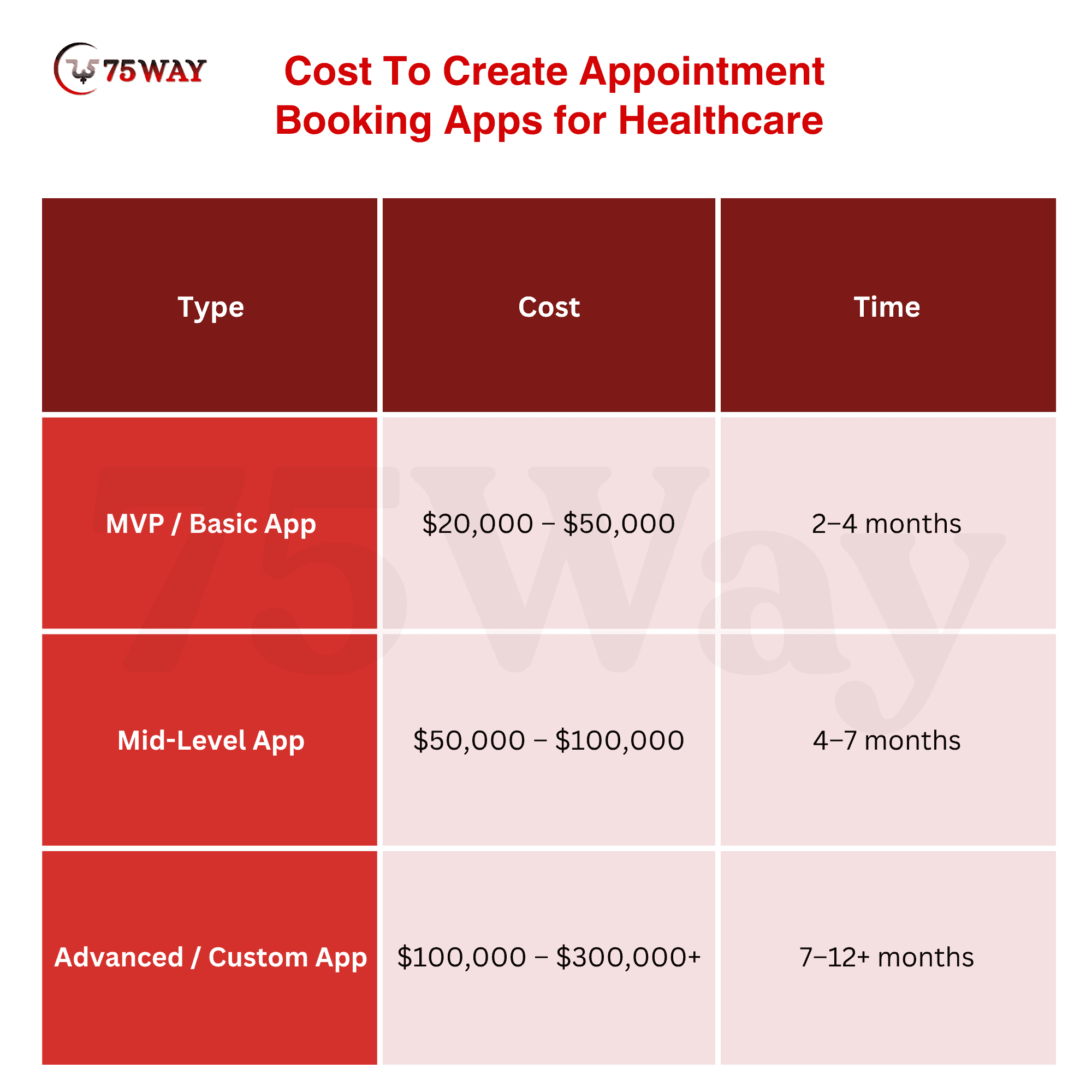
An appointment booking app for healthcare solutions allows patients to schedule, reschedule, and manage doctor appointments digitally. It reduces manual workload for clinics, improves patient convenience, and streamlines hospital scheduling systems.
The complexity of features like real-time availability, payments, and integrations directly impacts overall development cost.
- MVP / Basic Appointment Booking App: The cost to develop a basic appointment booking app ranges from $20,000 – $50,000, with a development timeline of 2–4 months.
- Mid-Level Appointment Booking App: The cost to build a mid-level appointment system typically falls between $50,000 – $100,000, requiring around 4–7 months of development.
- Advanced Appointment Booking App: The cost for a fully custom appointment booking platform ranges from $100,000 – $300,000+, with a longer timeline of 7–12+ months due to advanced features and integrations.
3. EHR/EMR Management Apps
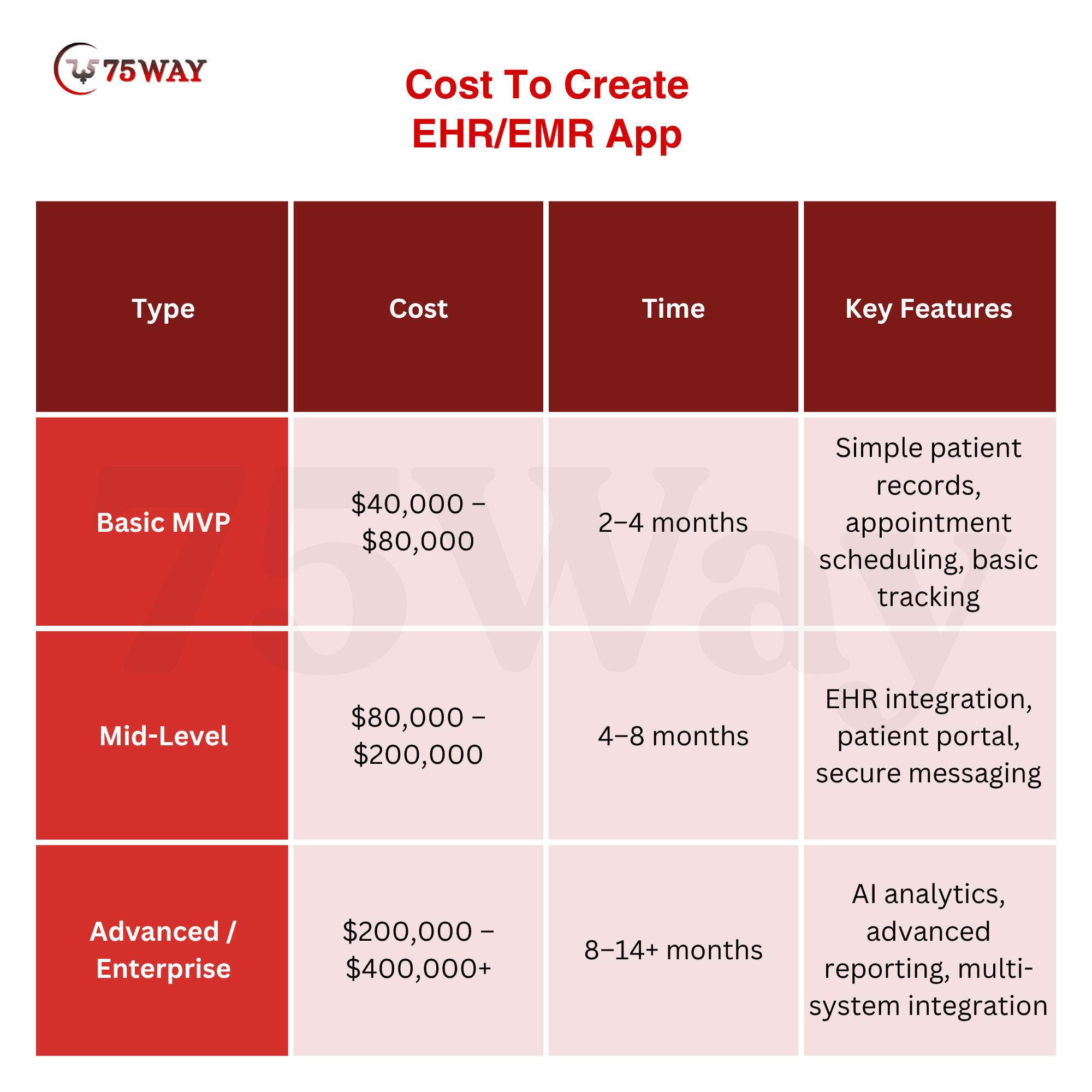
An EHR/EMR management app is a powerful healthcare solution that brings patient medical records into a secure digital system, making them easy to store, manage, and access anytime. It helps healthcare providers work more efficiently by enabling safe data sharing, smooth patient tracking, and better coordination across medical teams.
- Basic MVP EHR/EMR App: The cost to build a basic EHR/EMR app ranges from $40,000 – $80,000, with a timeline of 2–4 months, focused on simple scheduling and patient tracking features.
- Mid-Level EHR/EMR App: The cost to develop a mid-level system typically falls between $80,000 – $200,000, requiring around 4–8 months, and includes EHR integration, patient portals, and secure messaging.
- Advanced / Enterprise EHR/EMR App: The cost for a full-scale enterprise EHR/EMR platform ranges from $200,000 – $400,000+, with a development timeline of 8–14+ months, supporting AI analytics and multi-system integration.
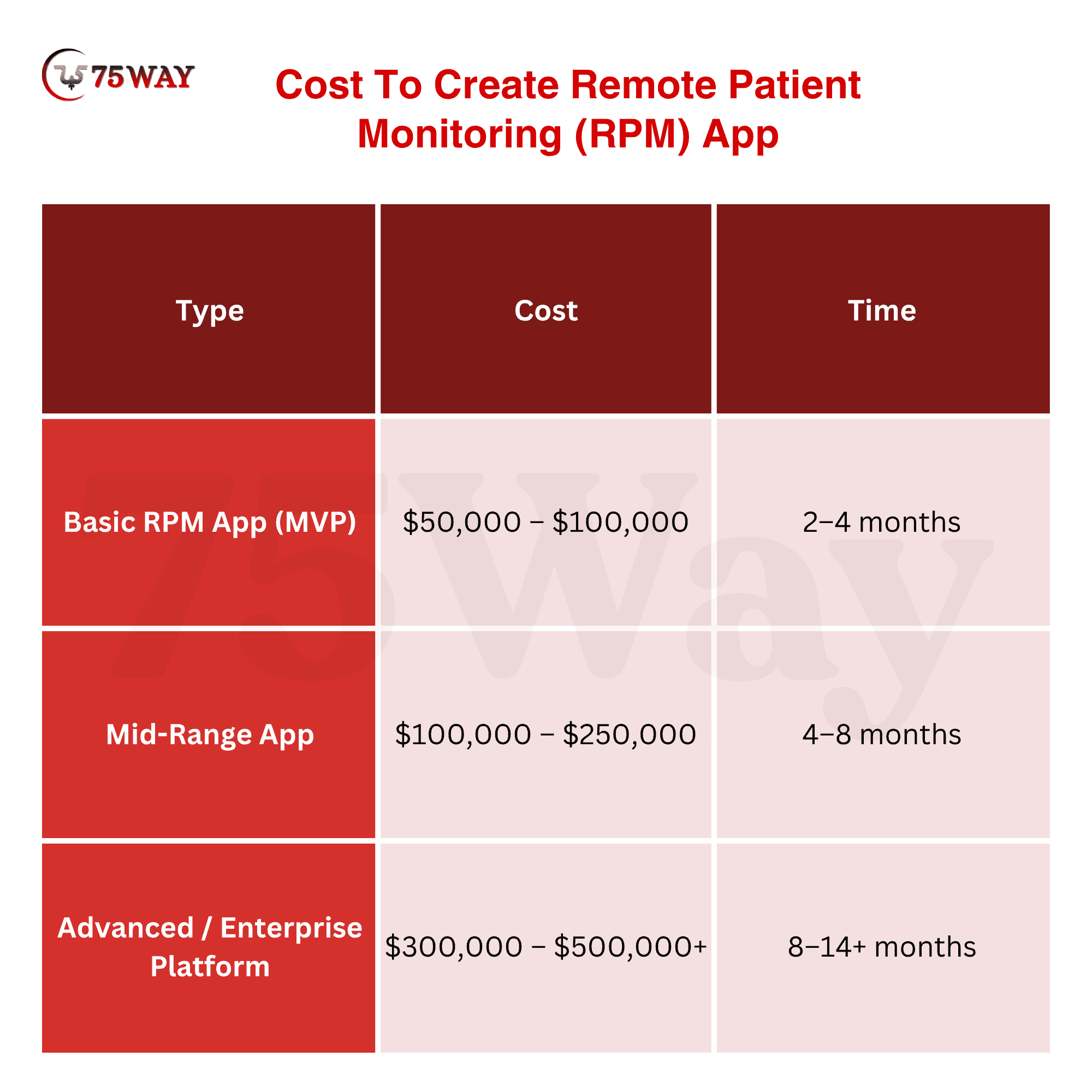
4. Remote Patient Monitoring (RPM) App
The RPM app enables doctors to track patients’ health data in real time using connected devices like wearables or medical sensors. It helps improve chronic care management, reduces hospital visits, and enables early detection of health risks through continuous monitoring.
- Basic RPM App (MVP): The cost to develop a simple RPM solution ranges from $50,000 – $100,000, focusing on basic patient monitoring, mobile app access, and a provider dashboard.
- Mid-Range RPM App: The cost to build a more advanced RPM system typically falls between $100,000 – $250,000, including IoT device integration, real-time data syncing, and EHR connectivity.
- Advanced / Enterprise RPM App: The cost for a full-scale RPM platform ranges from $300,000 – $500,000+, supporting AI-based analytics, multiple device integration, and strict healthcare compliance.
5. Fitness And Wellness Apps
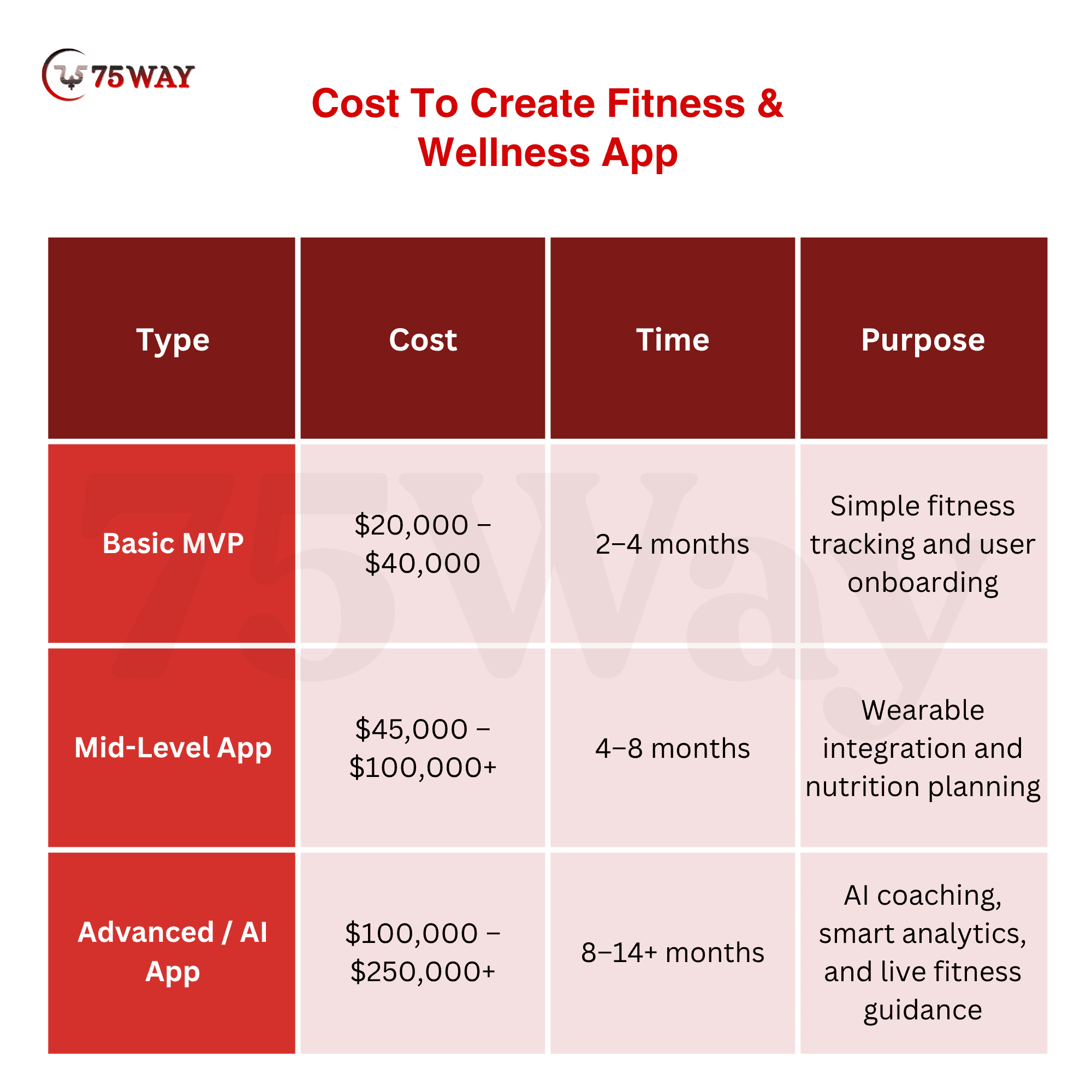
A fitness and wellness app helps users track health, build habits, and stay motivated through personalized digital guidance.
- Basic MVP Fitness & Wellness App: The cost ranges from $20,000 – $40,000, focusing on core tracking, user registration, and basic profiles.
- Mid-Level Fitness & Wellness App: The cost typically falls between $45,000 – $100,000+, including wearable sync, nutrition plans, and social engagement features.
- Advanced/AI Fitness & Wellness App: The cost ranges from $100,000 – $250,000+, offering AI coaching, computer vision tracking, and live streaming capabilities.
6. Mental Health Apps
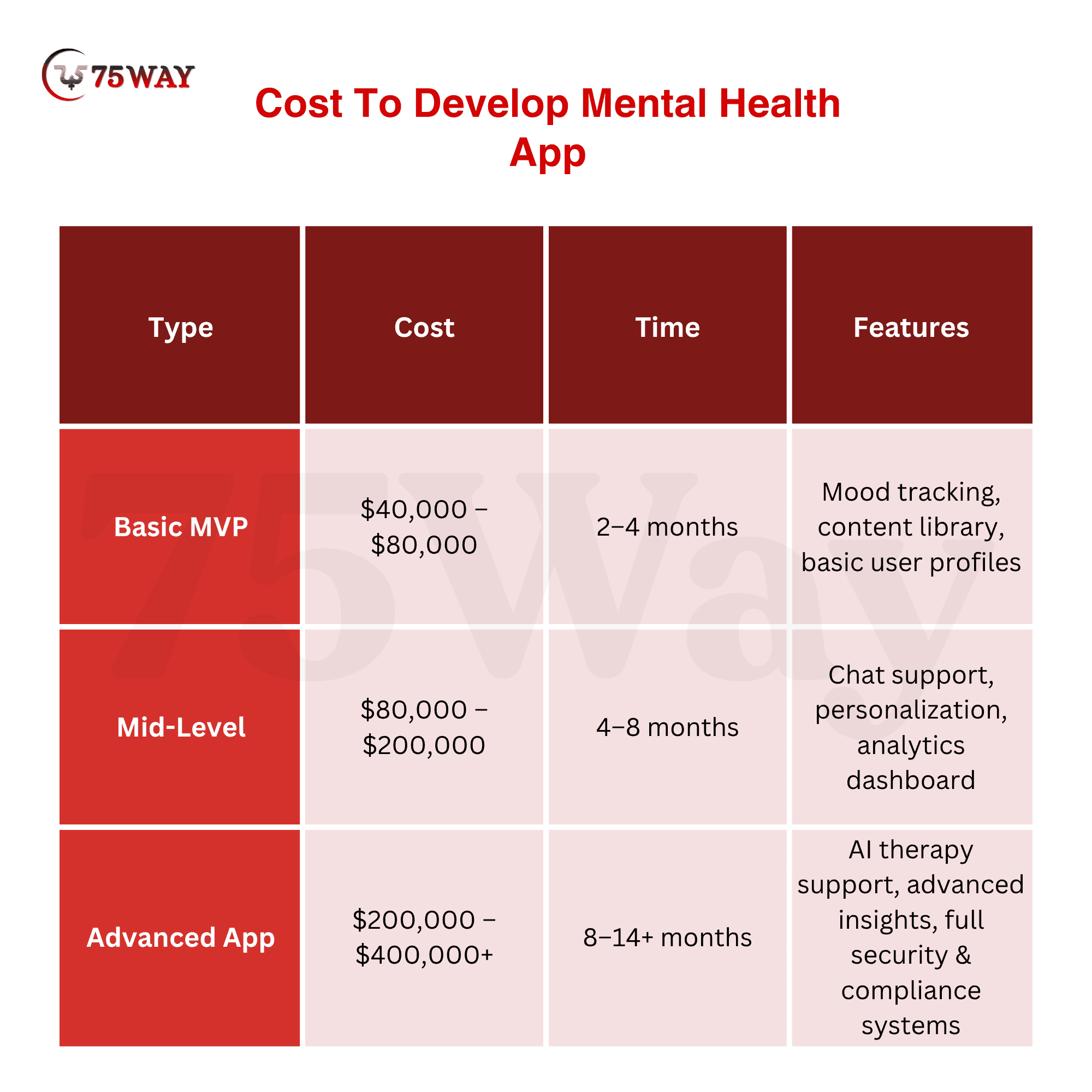
A mental health app is like a supportive digital companion that helps users manage stress, track emotions, and improve emotional well-being through guided tools, personalized insights, and accessible mental health resources anytime.
- Basic MVP Mental Health App: The cost to build a basic mental health app ranges from $40,000 – $80,000, with a development timeline of 2–4 months.
- Mid-Level Mental Health App: The cost to develop a mid-level mental health app typically falls between $80,000 – $200,000, requiring around 4–8 months of development.
- Advanced Mental Health App: The cost for an advanced mental health platform ranges from $200,000 – $400,000+, with a timeline of 8–14+ months due to complex features, security, and AI-driven capabilities.
7. Medication Reminder Apps
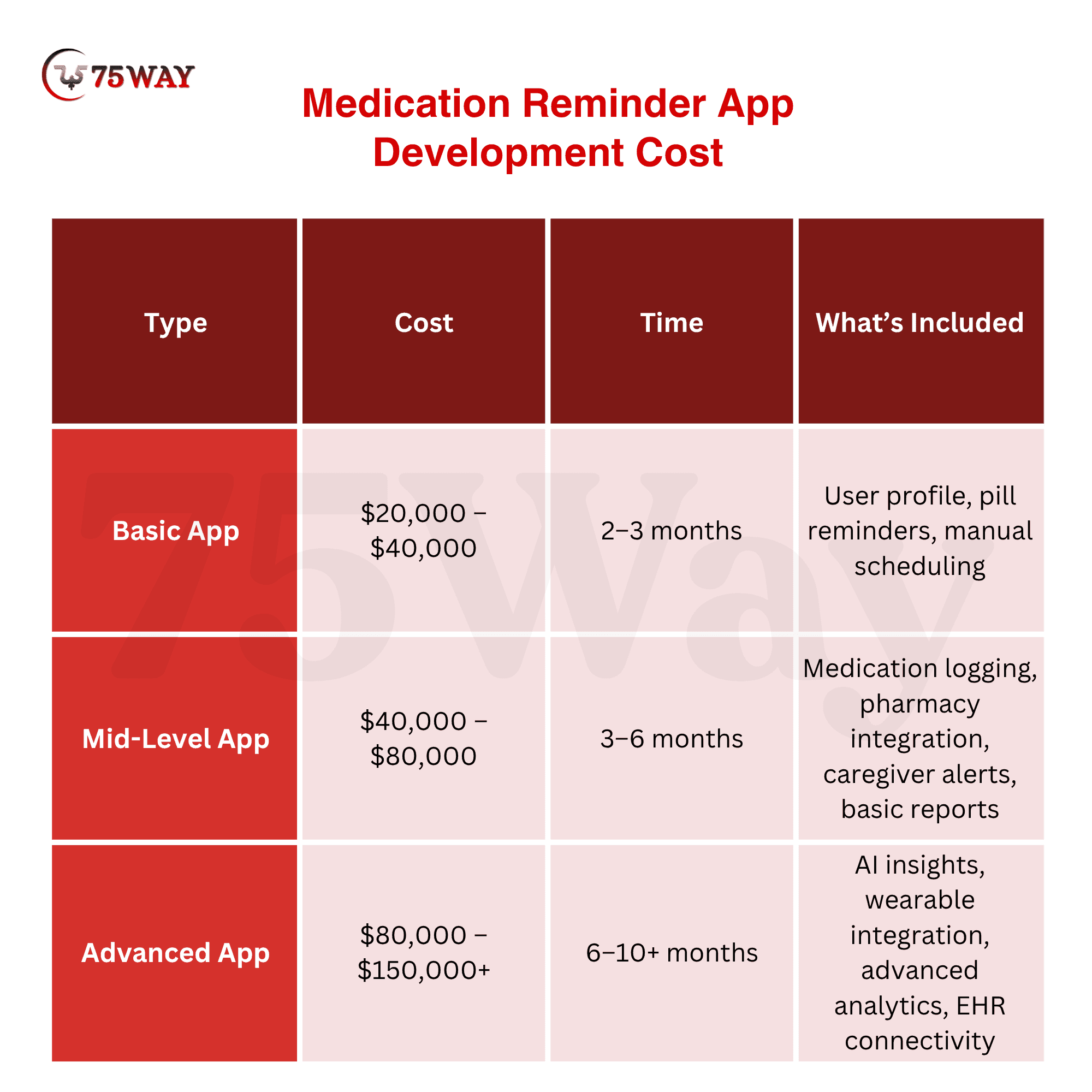
A medication reminder app helps patients take medicines on time by sending alerts, tracking dosage schedules, and improving adherence to prescriptions. It reduces missed doses, supports caregivers, and enhances overall treatment effectiveness through simple digital reminders and smart tracking features.
- Basic Medication Reminder App Cost: $20,000 – $40,000
- Mid-Level Medication Reminder App Cost: $40,000 – $80,000
- Advanced Medication Reminder App Cost: $80,000 – $150,000+
8. AI Healthcare Apps
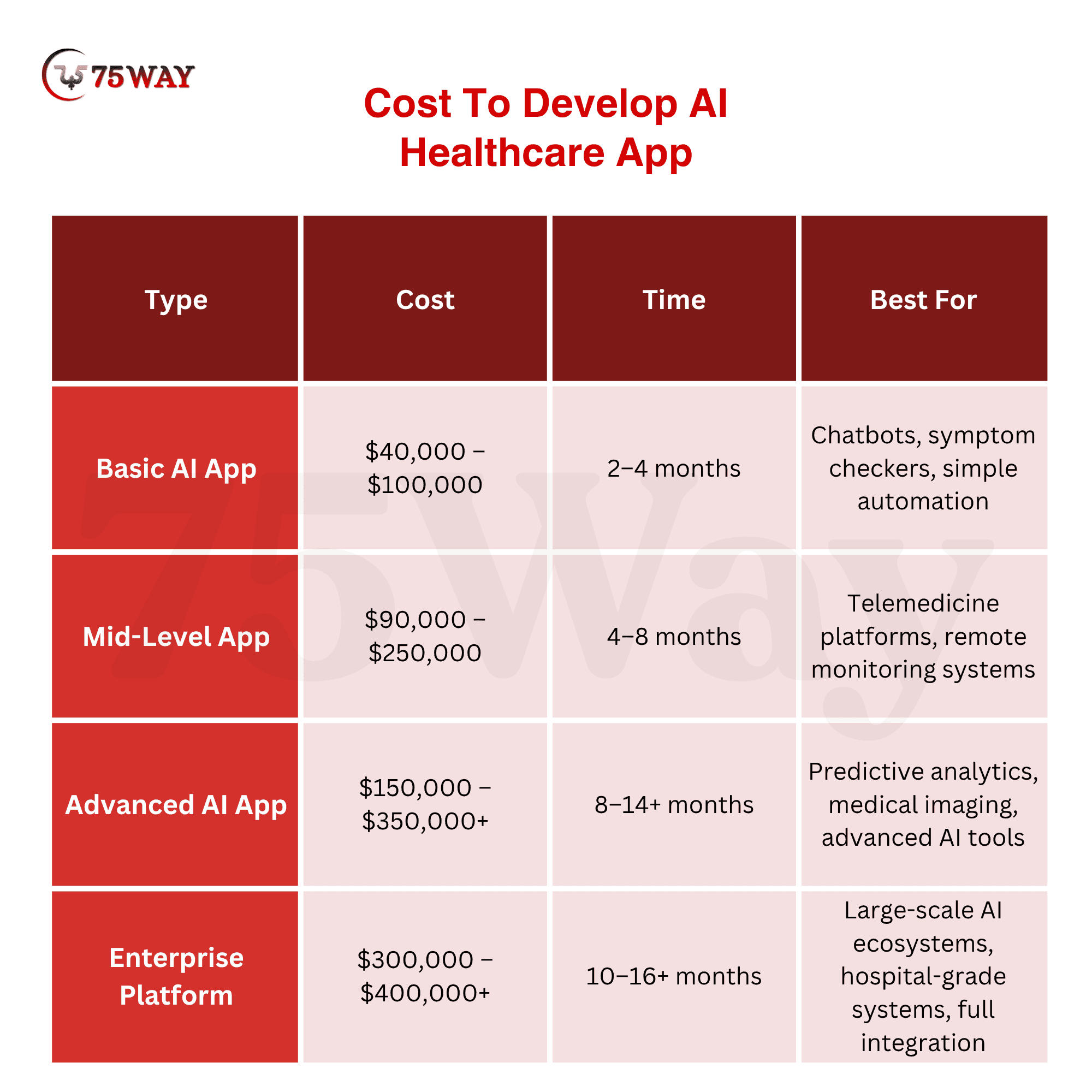
AI healthcare apps use artificial intelligence to improve diagnosis, automate patient interactions, and support smarter clinical decisions. These applications range from simple chatbots and symptom checkers to advanced systems capable of predictive analytics, medical imaging analysis, and real-time patient monitoring.
- The cost to build AI healthcare apps typically starts at $40,000–$100,000 for basic chatbot or symptom-tracking solutions. For clinics that only need lightweight patient communication like appointment reminders, FAQs, and rescheduling, there are no-code options like SendPulse's WhatsApp chatbot for healthcare that starts at $12 per month, though it won't offer the deeper EHR integration or diagnostic capabilities of a purpose-built app.
- It ranges from $90,000 to $250,000 for a mid-level telemedicine or remote-monitoring platform.
- The cost ranges from $150,000 to $350,000+ for advanced AI systems such as predictive analytics and medical imaging tools.
- Enterprise-grade AI healthcare platforms can cost $300,000–$400,000+, depending on scale, compliance, and infrastructure needs.
9. Hospital Management Apps
A hospital management app brings all hospital operations into one connected system, making daily work much smoother for both staff and patients. It helps manage everything from patient registration and appointments to medical records, billing, and internal communication in a more organized way.
What really changes its cost is how advanced the system is: simple setups stay more affordable. Adding integrations, automation, and multi-department workflows increases both development effort and timeline.
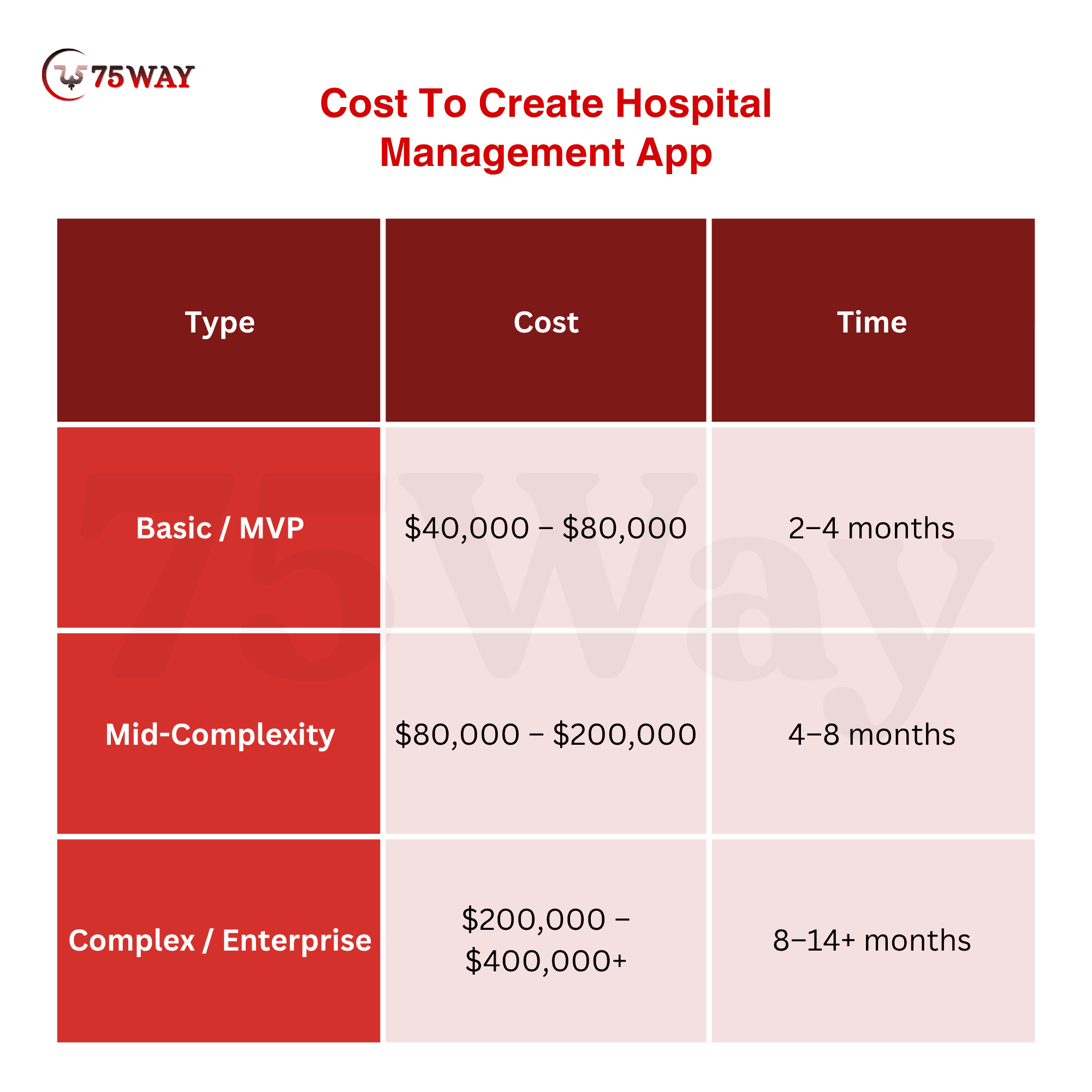
The cost also depends on where the development team is based. Hourly rates typically range from $40 – $150+ per hour, with higher rates for specialized healthcare developers and lower rates for offshore teams, directly influencing overall project budget and delivery speed.
10. On-Demand Doctor Consultation Apps
An on-demand app for doctor consultation simply makes healthcare more accessible by connecting patients with doctors in just a few taps. Instead of waiting in long queues or traveling to clinics, users can quickly book appointments and consult doctors through video or chat whenever needed.
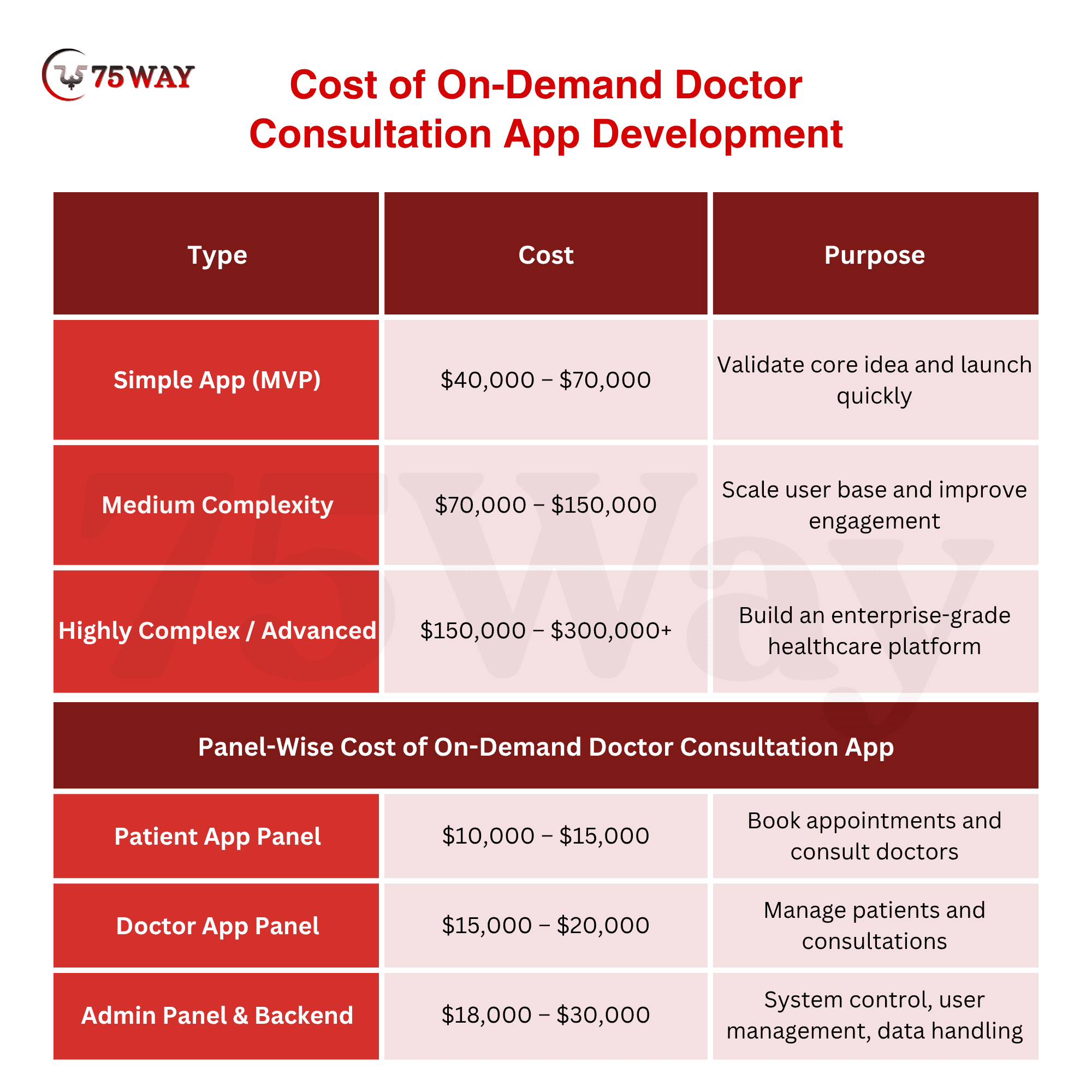
- Simple Doctor Consultation App: $40,000 – $70,000
- Medium Doctor Consultation App: $70,000 – $150,000
- Highly Complex Doctor Consultation App: $150,000 – $300,000+
Development Cost Breakdown by Panel of Doctor Consultation App
- Patient App Panel: $10,000 – $15,000
- Doctor App Panel: $15,000 – $20,000
- Admin Panel & Backend: $18,000 – $30,000
In-house Vs Outsourcing For Healthcare App Development
Building a healthcare app always starts with a big decision: should you develop it in-house or outsource to experts? Both options can work, but the right choice often depends on your budget, timeline, and the level of expertise you need.
If you choose an in-house team, you get full control over the project, but it usually comes with higher costs, longer hiring time, and the need to manage multiple specialists internally. On the other hand, outsourcing allows you to quickly access a ready team of experienced developers who already understand healthcare systems and compliance standards.
That is why many businesses prefer outsourcing. It brings speed, cost efficiency, and specialized knowledge together. The key is choosing an app development partner with strong experience in healthcare apps and a deep understanding of regulations such as HIPAA and GDPR.
Cost Breakdown
- In-house Development
The cost typically ranges from $200,000 – $400,000+ per year, covering salaries, benefits, office space, equipment, and a full dedicated team (PM, UI/UX, developers, QA).
- Outsourcing Development
- The cost for an MVP usually ranges from $30,000 – $90,000, offering significant savings of 50–70% compared to in-house development, especially with offshore teams.
- Developer rates typically range from $20 – $35/hour in India and $30 – $50/hour in Eastern Europe, depending on expertise and project complexity.
How to Develop a Healthcare Mobile App and Estimate Costs by Stages?
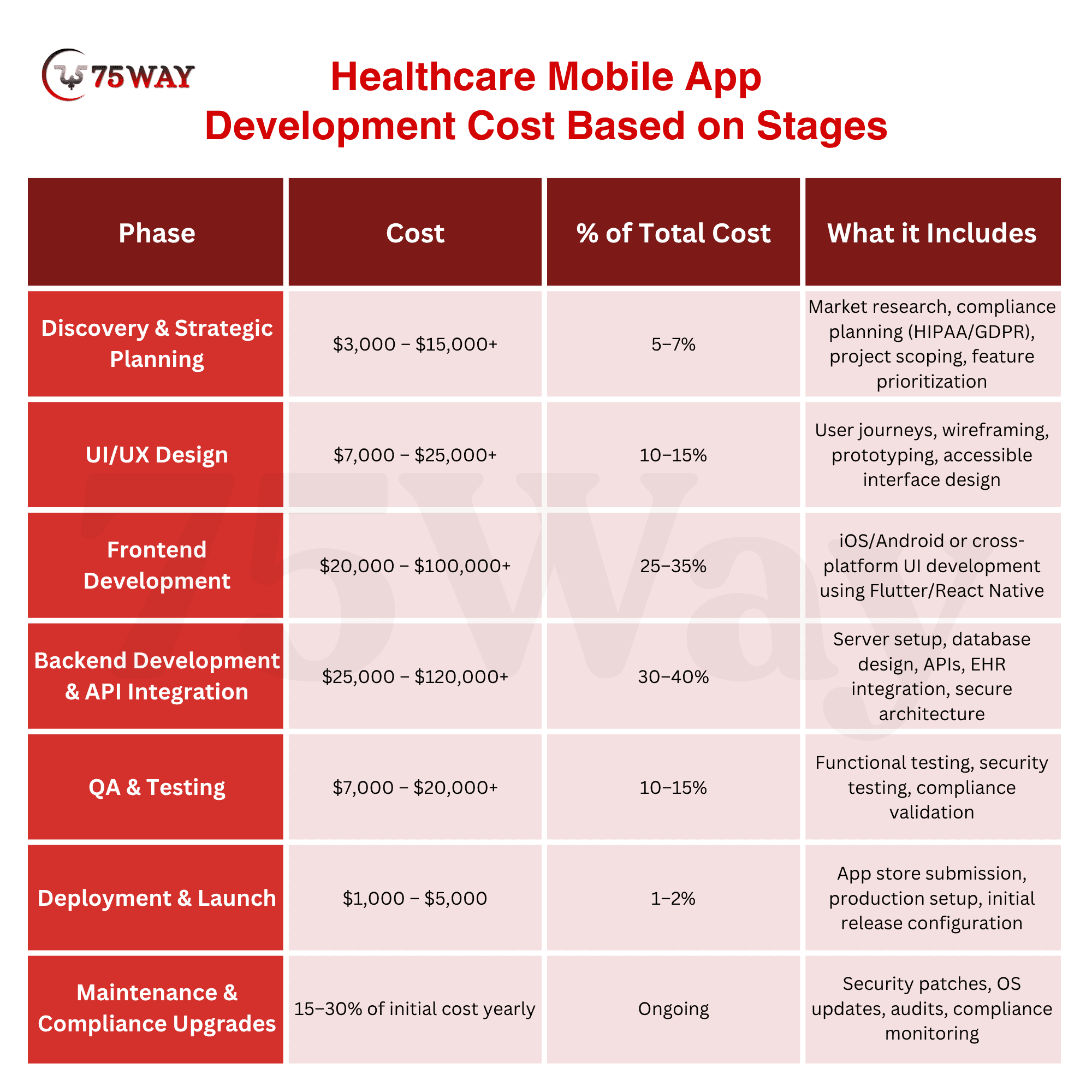
Developing a healthcare mobile app becomes much clearer when you break it into stages. Instead of guessing a total cost, you can understand how each phase, planning, design, development, testing, and launch, adds to the budget. This step-by-step view helps you make smarter decisions and control costs more effectively throughout the process.
1. Discovery & Strategic Planning
This is where everything starts taking shape. You and the team define the core idea, study the market, understand user needs, and map out compliance requirements so the app is built on a clear, risk-free foundation.
Estimated Cost: $3,000 – $15,000+
2. UI/UX Design
Here, the idea starts feeling real. Designers focus on how the app will look and feel, building smooth user journeys and simple interfaces so patients and doctors can use it without confusion or effort.
Estimated Cost: $7,000 – $25,000+
3. Frontend Development
This stage brings the design to life. Developers build the screens users interact with, making sure everything works smoothly across mobile devices while keeping the experience fast, responsive, and intuitive.
Estimated Cost: $20,000 – $100,000+
4. Backend Development & API Integration
Think of this as the brain of your app. It manages data, security, server logic, and integrations with systems like EHRs, ensuring everything runs securely and in sync behind the scenes.
Estimated Cost: $25,000 – $120,000+
5. QA & Testing
Before users ever see the app, it undergoes rigorous testing. This step checks for bugs, performance issues, and security gaps so the final product works reliably in real healthcare environments.
Estimated Cost: $7,000 – $20,000+
6. Deployment & Launch
This is the go-live moment. The app is submitted to app stores, servers are activated, and everything is configured so users can start accessing the platform without interruptions.
Estimated Cost: $1,000 – $5,000
7. Maintenance & Compliance Upgrades
After launch, the journey continues. Regular updates, security fixes, and compliance monitoring ensure the app stays stable, secure, and aligned with evolving healthcare standards.
Estimated Cost: 15–30% of the initial cost yearly
How to Reduce Healthcare Application Development Costs?
Now that you have a clear idea of healthcare app development costs. But, here a question arises, “How to minimize costs in healthcare app development?” It is equally important to understand how to optimize those expenses without compromising quality. With the right approach, you can control budget, avoid unnecessary features, and still build a strong, scalable product. Here are strategies that you can use.
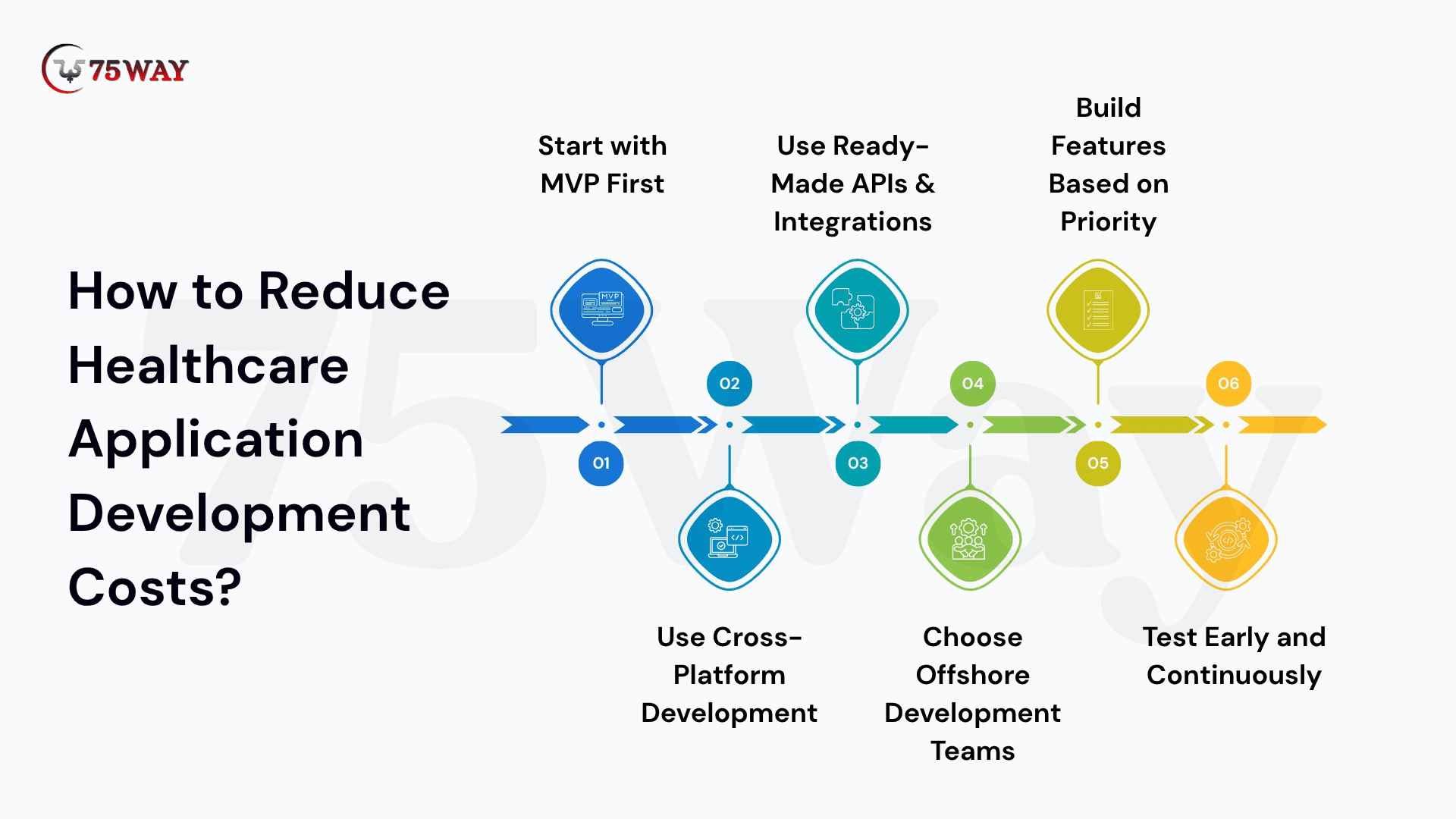
1. Start with MVP First
The biggest cost mistake happens when teams try to build everything at once. Starting with an MVP helps you launch faster, test real user behavior, and invest only in what actually works in the market. It keeps your focus on validation instead of unnecessary development.
- Cost Reduction: ~25%–45%
- Time Reduction: ~30%–50%
2. Use Cross-Platform Development
Instead of building and maintaining separate apps for Android and iOS, a single codebase can handle both platforms. This approach reduces duplication, speeds up development, and makes long-term updates much easier, especially in healthcare apps where frequent feature improvements and compliance updates are common.
- One app works across multiple platforms
- Faster development and deployment cycle
- Simplified updates and maintenance process
Cross-platform development helps cut costs by about 30%–40%. It also reduces development time by around 25%–40%, making app building faster and more budget-friendly.
3. Leverage Pre-Built APIs & Integrations
Healthcare apps do not need to rebuild essential systems like payments, notifications, or medical record syncing from scratch. Instead, using ready-made and trusted APIs allows developers to focus more on core features while maintaining stability and reliability in the system.
This approach also reduces backend complexity significantly and speeds up development. By leveraging existing healthcare integrations, teams can save both time and effort while improving overall efficiency.
- Cost Reduction: ~15%–35%
- Time Reduction: ~20%–35%
4. Choose the Right Development Team Model
Your team structure directly impacts cost efficiency. Offshore or hybrid teams often provide the same quality at a much lower cost compared to fully in-house setups, especially for long-term projects.
- It reduces overall development cost by nearly 40%–70%
- Cuts total project delivery time by around 15%–30%.
5. Prioritize Features Based on Impact
Not every feature adds equal value. Focusing on high-impact features first ensures better ROI and avoids spending time on functionalities users may not even use.
- Launch with core value features
- Delay advanced enhancements
This strategy minimizes overall development cost by approximately 20%–50%. Also, the total project development time is decreased by nearly 20%–40%.
6. Implement Continuous Testing Early
Fixing issues late in development is always more expensive. Early and continuous testing helps detect problems sooner, reducing rework and improving overall product stability.
- Reduce Cost: ~10%–30%
- Decrease Time: ~15%–25%
Monetization Strategies: How To Generate Revenue from a Healthcare App?
Turning a healthcare app into a revenue-generating product is all about choosing the right monetization model based on your users and services. Here are the most effective strategies you can use:
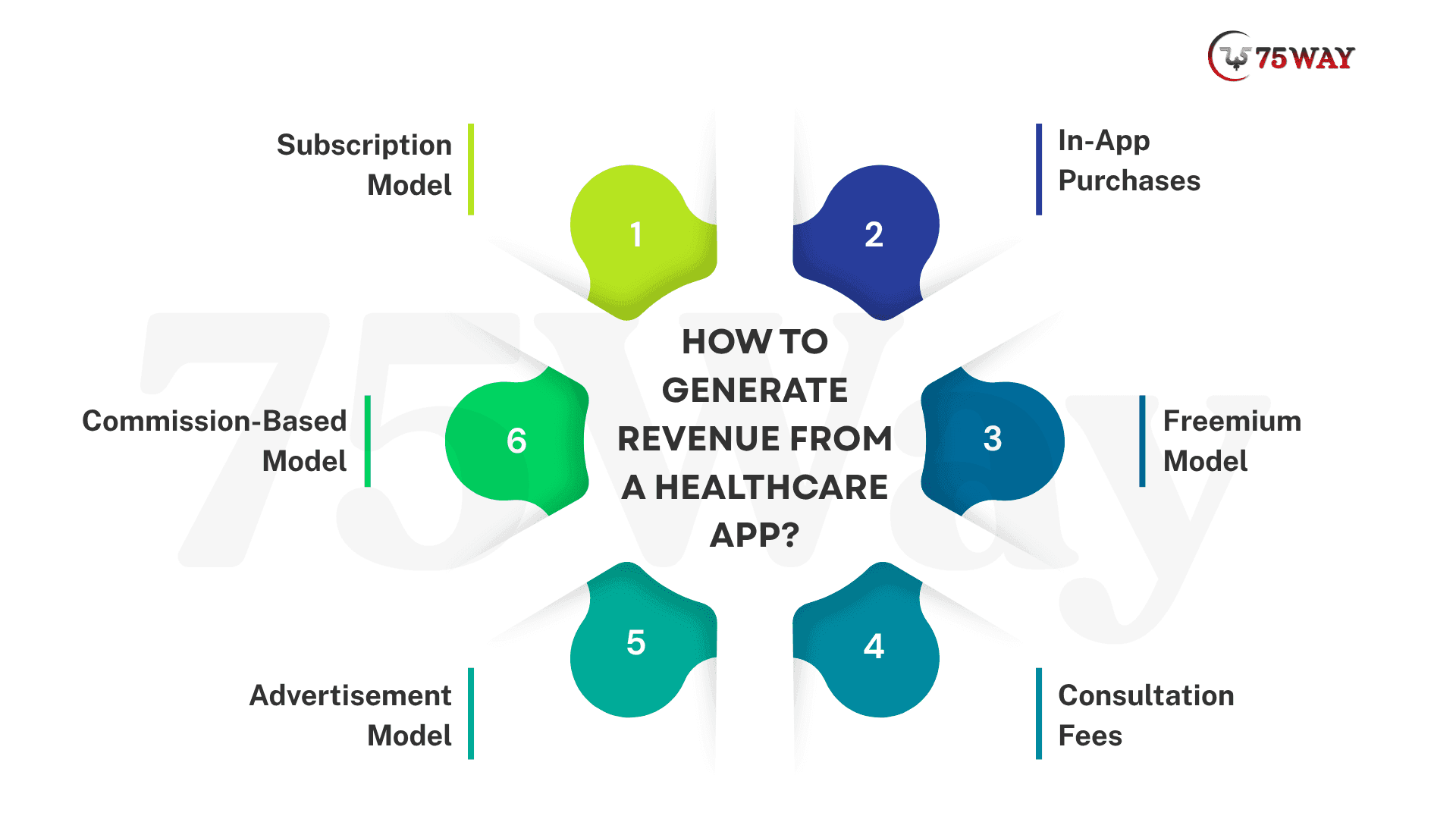
- Subscription Model: Offer users access to premium features, expert consultations, or advanced insights through monthly or yearly plans. This model ensures recurring revenue while providing continuous value, especially for telemedicine, mental health, and wellness-based healthcare applications.
- In-App Purchases: Allow users to buy specific services such as one-time doctor consultations, personalized health plans, or premium content. This flexible model works well for users who prefer paying only for what they need without long-term commitments.
- Freemium Model: Provide basic features for free while charging for advanced functionalities like AI insights, detailed reports, or personalized recommendations. This approach helps attract a large user base and gradually converts free users into paying customers.
- Consultation Fees: Charge users for each doctor consultation conducted through the app. This is a direct and effective monetization method for telemedicine platforms, where users pay per session for professional medical advice or follow-up consultations.
- Advertisement Model: Generate revenue by displaying relevant healthcare ads from pharmacies, insurance providers, or wellness brands. When implemented carefully, ads can create an additional income stream without disrupting the overall user experience.
- Commission-Based Model: Partner with healthcare providers, pharmacies, or diagnostic labs and earn a commission on every booking or transaction made through the app. This model aligns revenue growth with user activity and platform service usage.
Final Thoughts
Healthcare app development typically costs between $40,000 and $300,000+, depending on features, complexity, integrations, and compliance requirements. From planning and design to development, testing, and post-launch maintenance, every stage contributes to the final investment. The key is making smart decisions, prioritizing features, choosing the right tech stack, and optimizing resources to balance cost and quality effectively. With the right strategy and expert guidance, businesses can build secure, high-performing solutions. At 75way Technologies, as a trusted healthcare app development company, we help you build cost-effective healthcare apps without compromising the quality.
Frequently Asked Questions (FAQs)
How Does Scalability Planning Affect Long-Term Costs?
Planning for scalability early helps avoid expensive rework later. Without a scalable architecture, apps may struggle to handle increased user volume or data volume, requiring a redesign. Investing in scalable infrastructure upfront may seem costly, but it reduces long-term expenses and ensures smooth performance as the application grows.
What Role Does Data Security Play In Cost Optimization?
Strong data security prevents costly breaches, legal penalties, and reputation damage. While implementing encryption, secure storage, and authentication adds initial effort, it minimizes long-term risks. Investing in security early reduces unexpected expenses and ensures compliance, making it a critical factor in sustainable healthcare app development.
How Do Third-Party Dependencies Impact Project Budget?
Relying on third-party tools or APIs can simplify development but introduces dependency risks. Pricing changes, service limitations, or downtime can increase costs later. Careful selection of reliable providers and proper integration planning helps balance convenience with long-term cost stability and performance reliability.
Why Is User Experience Important For Cost Efficiency?
A well-designed user experience reduces confusion, errors, and support requests. Poor UX leads to frequent redesigns and updates, increasing costs. Investing in intuitive design early improves user adoption, reduces rework, and ensures smoother operations, ultimately saving both development and post-launch expenses.
How Does Team Communication Affect Overall Development Cost?
Inefficient communication leads to misunderstandings, delays, and repeated work, increasing project expenses. Clear communication channels, regular updates, and proper documentation ensure alignment between stakeholders and developers. This reduces errors, speeds up delivery, and helps maintain budget control throughout the development lifecycle.
What Impact Does Technology Selection Have On Cost Management?
Choosing the right technology stack affects development speed, maintenance, and scalability. Complex or outdated technologies can increase costs due to limited support and higher maintenance needs. Selecting modern, well-supported tools ensures smoother development, reduces technical debt, and helps manage long-term project expenses effectively.