Summary
This guide defines the core strategic benefits of AI in business. It also outlines essential AI tools, key performance indicators (KPIs) to measure success, and practical implementation insights tailored for founders and business leaders. Whether you are exploring AI adoption or optimizing existing systems, this blog provides a structured roadmap to leverage AI for measurable ROI and competitive advantage in a rapidly evolving business landscape.
Key Overview:
- AI adoption can increase operational efficiency by up to 40% across industries.
- AI enables data-driven decision-making that improves forecasting accuracy and profitability.
- Intelligent automation reduces operational costs while boosting workforce productivity.
- Hyper-personalization enhances customer experience, retention, and lifetime value growth.
- Strategic AI implementation strengthens risk management, compliance, and cybersecurity resilience.
- Measuring clear KPIs ensures sustainable ROI and long-term competitive advantage
Growth in today’s business landscape no longer depends solely on size. Market leaders build advantage through intelligence. Artificial Intelligence has become a decisive factor in stronger revenue performance, more accurate forecasting, disciplined cost control, and deeper customer insights. Companies that integrate AI automation into core operations often move with greater confidence during uncertainty because decisions rely on real-time data rather than assumptions.
Sustainable business expansion now requires predictive capability, operational discipline, and structured innovation. This guide explores the strategic benefits of AI, practical adoption models, measurable performance indicators, and governance considerations that support long-term business strength.
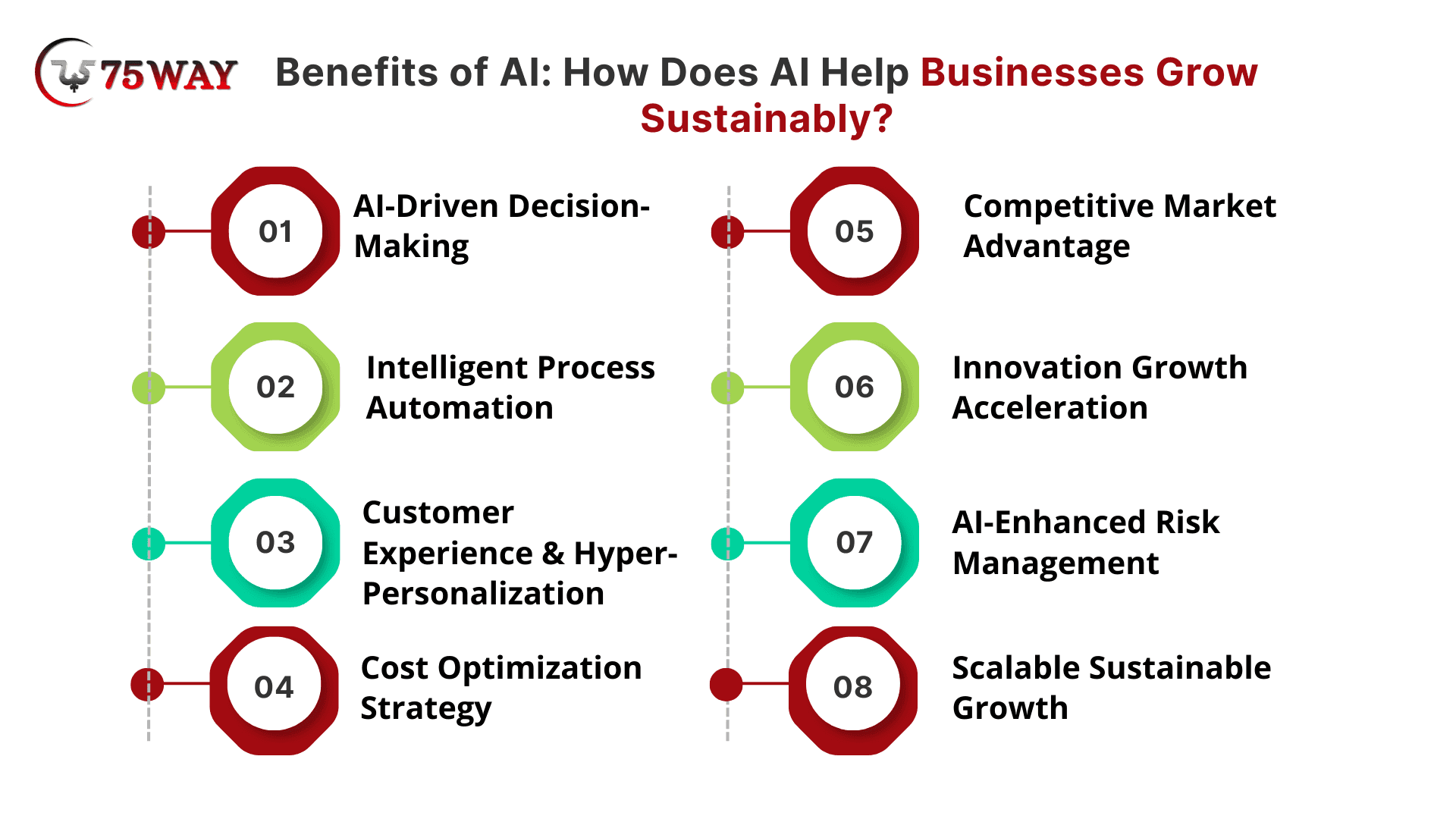
Benefits of AI: How Does AI Help Businesses Grow Sustainably?
AI solutions help businesses grow sustainably by improving efficiency, enhancing decision-making, reducing risks, and enabling scalable innovation. Instead of reactive management, organizations gain predictive intelligence, automated precision, and measurable growth acceleration that supports long-term profitability and resilience in dynamic markets.
AI-Driven Decision-Making
AI-driven decision-making transforms raw business data into structured intelligence that supports confident leadership action. Instead of relying on fragmented reports or instinct alone, organizations gain continuous insight into performance trends, financial signals, and customer behavior. Stronger analytical depth improves forecasting accuracy, capital allocation discipline, and long-term strategic planning across competitive markets.
- Real-Time Analytics: Sales teams require immediate visibility into performance metrics across sales, operations, and customer engagement. Real-time advanced analytics consolidate data streams into unified dashboards that reflect live business conditions. Faster awareness reduces exposure to financial loss and strengthens responsiveness during market fluctuations.
- Predictive Business Forecasting: Revenue planning benefits from structured machine learning models that analyze historical transactions, demand cycles, and behavioral signals. Improved forecasting accuracy strengthens budgeting discipline and investment confidence. Data-backed projections reduce financial uncertainty and support sustainable expansion planning.
- Behavioral Pattern Recognition: Customer engagement patterns often reveal early indicators of churn or opportunity. AI analyzes transaction records, browsing activity, and service interactions to uncover hidden behavioral signals. Early detection supports proactive retention strategies and targeted growth initiatives.
- Strategic Scenario Modeling: Capital allocation decisions carry measurable risk exposure. Scenario modeling tools simulate multiple growth paths, pricing strategies, and cost conditions before implementation. Structured evaluation supports informed leadership decisions and protects long-term financial performance.
- Executive Decision Support: Data volume can overwhelm leadership discussions. AI-powered decision systems convert complex analytics into structured executive summaries aligned with board priorities. Focused insight improves strategic alignment and strengthens cross-department coordination.
Intelligent Process Automation
This process integrates artificial intelligence models with operational workflows to reduce manual dependency and improve execution accuracy. Organizations gain structured oversight across administrative functions, supply networks, equipment performance, and inventory cycles. Stronger operational control supports cost discipline, productivity growth, and long-term scalability in competitive business environments.
- Workflow Task Automation: Administrative workflows often rely on repetitive data handling, approvals, and documentation processes that slow productivity. AI-driven automation systems standardize these tasks across finance, human resources, procurement, and customer service departments. Consistent rule-based execution reduces processing delays, limits human error, and strengthens internal compliance standards.
- Supply Chain Optimization: AI assistants evaluate procurement timelines, transportation routes, supplier reliability metrics, and regional demand signals to improve inventory movement accuracy. Data-backed insights support better coordination between production, warehousing, and distribution networks. Improved supply chain visibility reduces stock imbalances, limits delivery disruptions, and protects customer satisfaction across expanding markets.
- Predictive Equipment Maintenance: Operational continuity depends on equipment reliability across manufacturing, logistics, and infrastructure-intensive industries. AI models analyze sensor readings, historical maintenance logs, and usage intensity patterns to identify early signs of mechanical wear. Preventive scheduling based on predictive analysis reduces unexpected downtime and protects revenue continuity.
- Smart Inventory Management: Inventory planning influences cash flow stability and service quality standards. AI systems align stock levels with demand forecasts, seasonal patterns, and purchasing behavior trends. Data-driven allocation reduces excess storage costs and prevents revenue loss caused by stock shortages. Structured inventory intelligence supports better working capital management and strengthens financial resilience during market fluctuations.
- Operational Performance Monitoring: Consistent performance tracking remains essential for operational excellence. AI platforms consolidate production metrics, service response times, quality control data, and financial indicators into centralized reporting systems. Early detection of inefficiencies allows corrective measures before performance gaps widen. Leadership teams gain measurable insight into productivity trends, resource utilization, and departmental accountability across the organization
Customer Experience & Hyper-Personalization
Customer expectations have evolved beyond basic service delivery. Modern consumers expect relevant interactions, immediate responses, and personalized engagement across every touchpoint. Artificial Intelligence enables businesses to understand behavioral patterns, anticipate preferences, and deliver tailored experiences at scale. Organizations that integrate AI into customer experience strategies build deeper relationships and differentiate themselves in competitive markets through consistent, data-informed engagement.
- AI Chatbot Support: Customer engagement begins with accessibility. AI chatbot systems provide immediate responses across websites, mobile applications, and messaging platforms, reducing waiting time and service bottlenecks. Consistent interactions strengthen brand reliability and capture valuable behavioral data to support deeper personalization in future touchpoints.
- Personalized Product Recommendations: Data collected through chatbot interactions and browsing activity feeds recommendation engines. These systems analyze purchase history, search behavior, and engagement frequency to suggest relevant products or services. Personalized recommendations increase conversion rates, encourage repeat purchases, and directly contribute to measurable revenue growth.
- Customer Sentiment Analysis: Beyond transactions, emotional perception influences long-term loyalty. Sentiment analysis tools evaluate reviews, social media conversations, and customer support exchanges to identify satisfaction trends or dissatisfaction signals. Early insight enables corrective action, protecting brand reputation and strengthening retention strategies.
- Behavioral Journey Mapping: Sentiment data combined with interaction history reveals the complete customer journey. AI maps touchpoints across awareness, consideration, purchase, and post-purchase stages to identify friction areas. Structured journey visibility improves experience design and reduces abandonment across digital channels.
- Targeted Marketing Campaigns: Customer journey insights and behavioral signals refine marketing precision. AI enhances audience segmentation, timing optimization, and content relevance to align outreach with customer intent. Focused targeting increases engagement rates, improves acquisition efficiency, and supports sustained growth in competitive markets.
Cost Optimization Strategy
Sustained profitability depends on disciplined cost control across operations, marketing, and infrastructure. Artificial Intelligence strengthens financial oversight by identifying inefficiencies, reducing waste, and aligning spending with measurable outcomes. Structured cost intelligence protects margins and supports scalable growth without compromising performance or service quality.
- Labor Cost Reduction: Workforce expenses represent a significant portion of operational budgets. AI-driven automation handles repetitive administrative functions, data processing, and routine analysis tasks with consistent accuracy. Productivity increases as employees focus on strategic initiatives, allowing organizations to scale output without proportional expansion in staffing costs.
- Operational Error Minimization: Manual processing introduces billing discrepancies, reporting inaccuracies, and compliance risks that affect financial stability. AI validation systems monitor transactions, reconcile datasets, and flag inconsistencies in real time. Reduced error frequency protects revenue integrity and strengthens internal financial discipline.
- Smart Budget Forecasting: Accurate budgeting supports sustainable expansion planning. Predictive cost modeling evaluates historical spending patterns, seasonal fluctuations, and operational demand signals. Structured analysis improves expense forecasting reliability, enabling leadership teams to allocate resources with greater confidence and financial control.
- Customer Acquisition Optimization: Marketing investments require a measurable return. AI analyzes audience behavior, campaign engagement metrics, and conversion patterns to refine targeting strategies. Improved segmentation reduces wasted advertising spend and strengthens cost-per-acquisition performance across digital channels.
- Infrastructure Cost Efficiency: Technology infrastructure expenses increase with business growth. AI solutions monitors system usage, server demand, and cloud resource consumption to align capacity with real-time needs. Optimized allocation prevents overspending and supports scalable digital operations with controlled expenditure
Competitive Market Advantage
In saturated markets, growth belongs to businesses that anticipate change rather than react to it. AI strengthens competitive positioning by transforming raw market signals into strategic intelligence. From competitor tracking to demand forecasting, data-driven clarity enables faster, smarter, and more confident decision-making.
- Competitor Intelligence Monitoring: Sustainable market positioning begins with visibility. AI continuously analyzes competitor pricing models, product updates, campaign activity, and customer feedback patterns. Structured intelligence highlights performance gaps and strategic opportunities, allowing businesses to adjust proactively rather than respond defensively.
- Real-Time Trend Analysis: Consumer preferences shift quickly across digital platforms. AI monitors search behavior, social engagement, and purchase patterns to detect emerging trends early. Timely insights guide product improvements, feature development, and content strategies aligned with evolving audience expectations.
- Consumer Demand Forecasting: Accurate demand prediction reduces operational uncertainty. AI evaluates historical sales data, seasonal fluctuations, and market signals to estimate future consumption patterns. Clear projections support inventory planning, workforce allocation, and pricing strategies that maintain profitability and service consistency.
- Faster Market Entry: Speed influences competitive advantage. AI accelerates product research, feasibility analysis, and performance testing through automated data processing. Shorter development cycles enable faster launches, allowing businesses to capture market opportunities before competitors establish dominance.
- Strategic Positioning: Long-term differentiation depends on precision. AI consolidates market data, consumer insights, and competitor benchmarks to refine messaging and value propositions. Data-backed positioning strengthens brand clarity, builds trust, and secures sustainable visibility within competitive industries
Innovation Growth Acceleration
Business growth depends on continuous innovation supported by structured intelligence. Artificial Intelligence transforms experimentation into measurable progress by accelerating research, validating ideas, and refining product performance. Integrated data analysis enables organizations to reduce uncertainty, shorten innovation cycles, and maintain consistent advancement in competitive environments.
- AI-Powered Research: Innovation begins with informed discovery. AI processes large volumes of market data, competitor activity, and consumer behavior patterns to identify unmet needs and opportunity gaps. Accelerated research reduces manual analysis time while improving the accuracy of product and service development decisions.
- Rapid Product Prototyping: Innovation begins with informed discovery. AI processes large volumes of market data, competitor activity, and consumer behavior patterns to identify unmet needs and opportunity gaps. Accelerated research reduces manual analysis time while improving the accuracy of product and service development decisions.
- Feature Performance Optimization: After launch, improvement becomes data-dependent. AI analyzes user interaction metrics, engagement duration, and feature adoption rates to identify enhancement priorities. Structured insights guide iterative upgrades that strengthen usability, increase retention, and align product performance with evolving customer expectations.
- Data-Driven Ideation: Performance analytics naturally inform future innovation. AI uncovers behavior trends, purchase triggers, and usage patterns that reveal new service opportunities. Evidence-based ideation reduces guesswork, ensuring that upcoming offerings are aligned with verified market demand and measurable growth potential
AI-Enhanced Risk Management
Business stability depends on the ability to anticipate threats before they escalate. AI strengthens risk management frameworks by combining predictive intelligence, automated monitoring, and real-time alerts. Structured data evaluation reduces uncertainty, protects financial assets, and reinforces operational resilience across complex business environments.
- Fraud Detection Systems: Financial integrity begins with proactive surveillance. AI-powered transaction monitoring tools analyze behavioral patterns, spending anomalies, and irregular activity signals in real time. Early detection minimizes financial loss, prevents unauthorized access, and strengthens trust in digital payment and transaction ecosystems.
- Cybersecurity Threat Prediction: Digital transformation increases exposure to evolving cyber risks. AI-driven threat intelligence models evaluate network traffic, system vulnerabilities, and unusual access behavior to identify potential security breaches. Predictive alerts enable faster mitigation, reducing downtime and safeguarding sensitive business data.
- Regulatory Compliance Monitoring: Compliance management requires constant oversight. AI automates regulatory tracking by monitoring policy updates, audit trails, and reporting requirements across jurisdictions. Continuous compliance evaluation reduces legal exposure, prevents penalties, and ensures operational processes remain aligned with evolving industry standards.
- Financial Risk Assessment: Investment and credit decisions demand analytical precision. AI-based predictive modeling evaluates historical performance, market volatility indicators, and credit behavior patterns. Data-backed risk assessment improves capital allocation decisions while minimizing exposure to uncertain financial outcomes.
- Operational Risk Alerts: Operational continuity depends on early intervention. AI-powered monitoring systems detect supply chain disruptions, system inefficiencies, and performance deviations before escalation. Proactive alerts enable rapid corrective action, reducing productivity losses and maintaining service reliability
Scalable Sustainable Growth
Long-term success requires expansion that is both controlled and adaptable. AI enables organizations to scale operations, diversify revenue, and optimize resource deployment without destabilizing cost structures. Integrated analytics create a foundation for predictable, sustainable growth in dynamic market environments.
- Business Model Scalability: Growth often strains traditional operational frameworks. AI-powered infrastructure automates workflows, manages data loads, and optimizes system performance as demand increases. This intelligent scalability allows businesses to expand output and customer reach without proportional rises in operational expenses.
- Revenue Stream Diversification: Sustainable growth depends on diversified income sources. AI analyzes customer behavior, purchase patterns, and market gaps to identify new monetization opportunities. Data-backed insights support the development of complementary products, subscription models, and value-added services aligned with verified demand.
- Resource Allocation Efficiency: Capital efficiency strengthens profitability. AI evaluates demand forecasts, operational metrics, and performance indicators to guide precise allocation of financial and human resources. Strategic deployment reduces waste, maximizes returns, and ensures investments align with measurable growth objectives.
- Long-Term Growth Planning: Strategic expansion requires forward-looking clarity. AI integrates predictive modeling, scenario simulation, and market trend analysis to support structured planning. Data-driven projections reduce uncertainty and provide leadership teams with measurable pathways for sustainable development.
- Adaptive Strategy Execution: Markets evolve rapidly, demanding responsive decision-making. Continuous AI-powered analytics monitors performance indicators and environmental changes in real time. Agile adjustments based on live data strengthen competitiveness, ensuring strategic initiatives remain aligned with shifting market conditions.
Read Too: Best AI Development Companies in United States in 2026
Why Businesses Must Adopt AI Solutions?
Businesses must adopt AI solutions to remain competitive, efficient, and future-ready in rapidly evolving markets. AI assistants and AI-powered software enhance decision-making accuracy, automate complex processes, reduce operational costs, improve customer experiences, and uncovers growth opportunities. Without AI-driven intelligence, organizations risk slower innovation, reduced profitability, and declining market relevance.
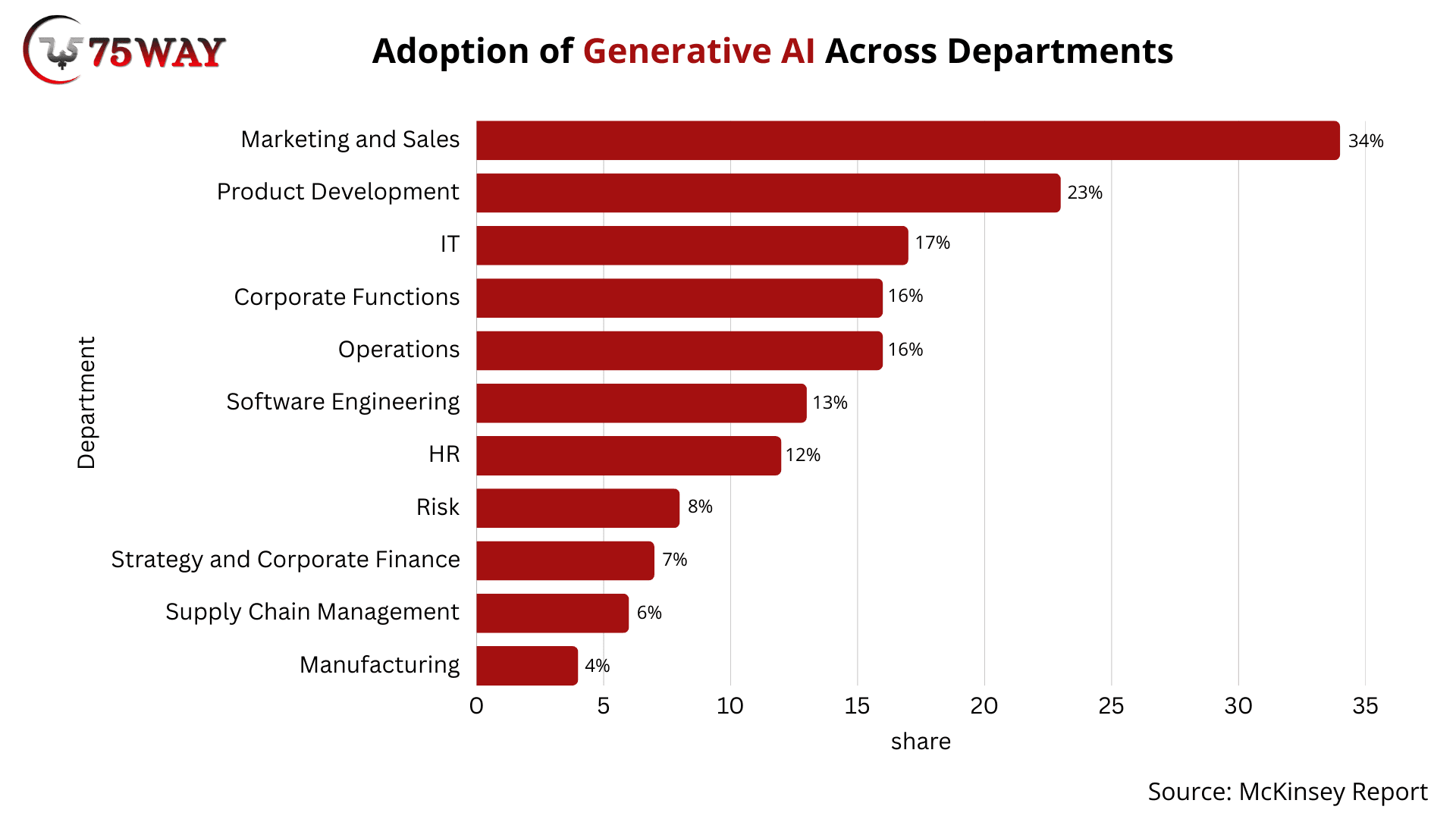
- The artificial intelligence industry is projected to grow at a 27.67% compound annual growth rate, reaching an estimated $826.73 billion by 2030, according to the Statista Market Report.
- Around 65% of businesses currently use AI to enhance workflows and automate repetitive tasks, as highlighted in the McKinsey report.
- Nearly 89% of small businesses now leverage AI tools to streamline operations and improve productivity.
- The technology industry shows the highest AI adoption at 77%, followed by the finance sector at 64% and education at 63%.
- Approximately 53% of C-suite executives actively use generative AI in their daily work, particularly across marketing, product innovation, and software development.
Explore More: AI App Development Partner for Health and Wellness Startup
Strategic Framework for Consistent Business Growth
A structured AI framework aligns technology adoption with measurable growth outcomes. Sustainable impact requires defined objectives, reliable data infrastructure, governance discipline, workforce readiness, scalable deployment, and performance tracking. Organizations that integrate these pillars experience stronger adoption success and measurable long-term ROI.
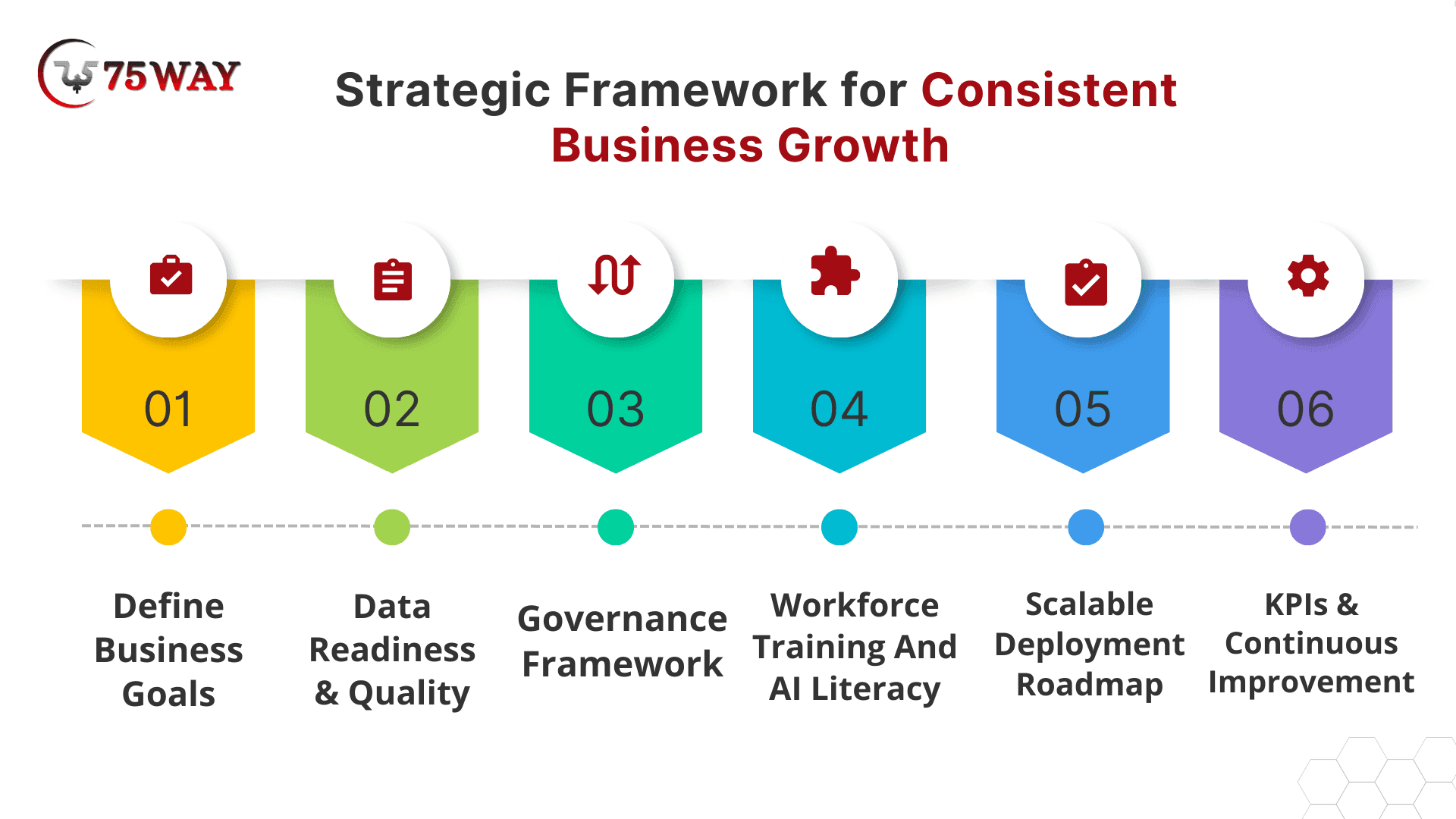
Define Business Goals: Set measurable growth objectives aligned with revenue expansion, cost control, and customer retention priorities. Clear financial targets guide AI investment decisions, create accountability, and strengthen competitive positioning within the United States business environment.
Data Readiness & Quality: Establish reliable, accurate, and validated datasets across departments. Consistent data standards improve forecasting precision, reduce analytical bias, strengthen regulatory alignment, and build executive trust in AI-driven operational insights.
Governance Framework: Create structured oversight with defined accountability, documented policies, and audit visibility. Strong governance protects data integrity, reduces regulatory exposure, and supports ethical AI deployment aligned with United States compliance standards.
Workforce Training & AI Literacy: Develop practical training programs and clear usage guidelines for employees. Organizational readiness increases confidence in adoption, reduces operational resistance, and ensures responsible AI integration into daily workflows.&
Scalable Deployment Roadmap: Design a phased launch plan with defined milestones and budget checkpoints. Controlled deployment minimizes disruption, manages financial risk, and aligns implementation with long term enterprise growth objectives.
KPIs & Continuous Improvement: Define performance indicators tied to revenue impact, cost efficiency, and customer retention. Continuous measurement supports strategic refinement, protects investment value, and sustains measurable business growth outcomes.
Get More Insights: How to Build IoT Apps in 2026: A Guide for Startups, Founders & Business Owners
Best AI Tools for Startups & Growing Enterprises
Startups and scaling enterprises can benefit from targeted AI tool selection aligned with operational priorities. Strategic investment across analytics, automation, marketing, and visualization platforms strengthens measurable business outcomes
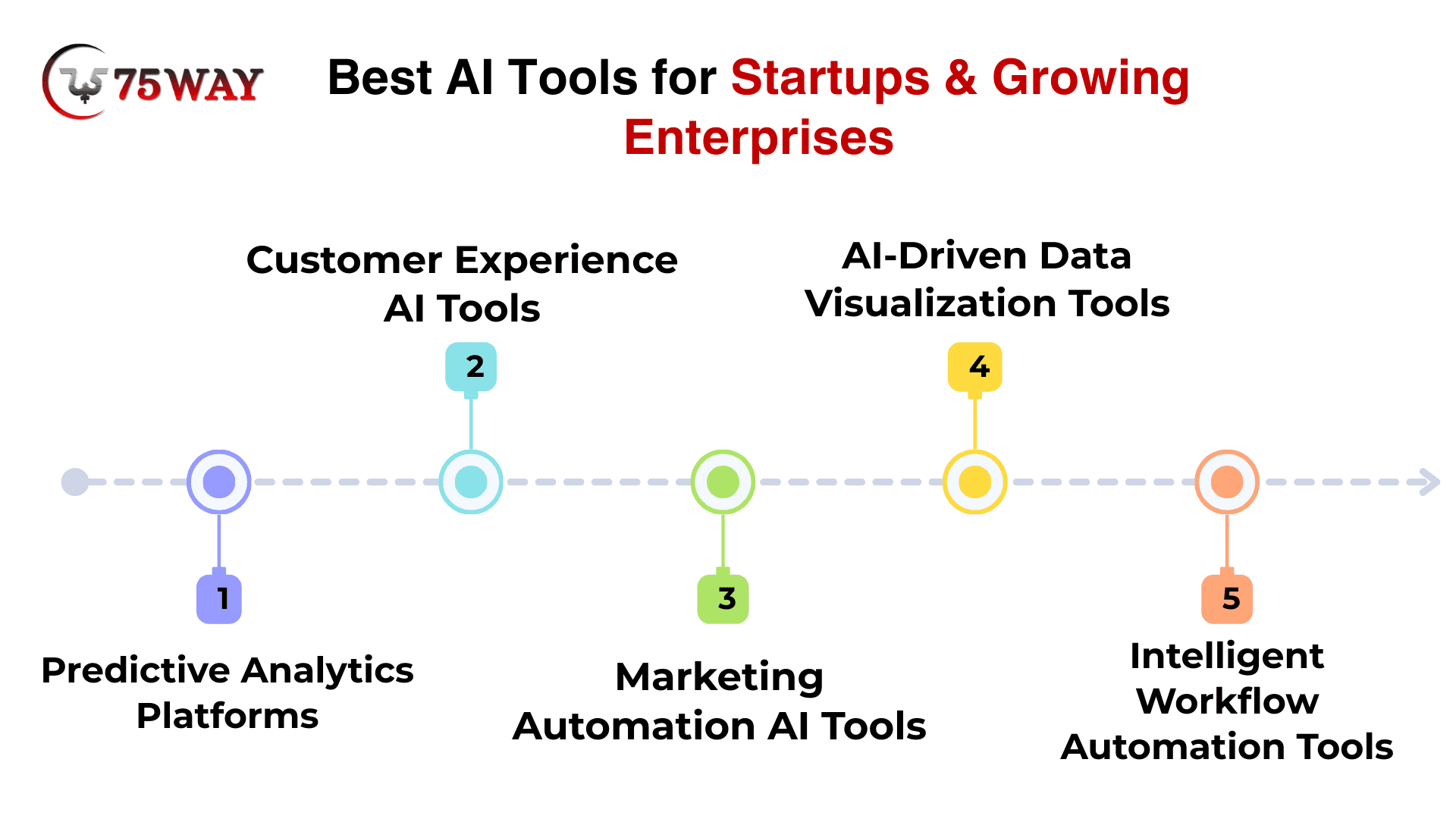
Predictive Analytics Platforms: AI-driven data analytics tools use machine learning models and statistical algorithms to forecast demand patterns, revenue performance, and operational outcomes. These tools process structured and unstructured data to generate projections that support financial planning, inventory control, and long-term growth strategy decisions.
Customer Experience AI Tools: Customer support AI tools include AI chatbots, conversational assistants, AI voice agents, sentiment analysis systems, and personalization engines. These solutions manage customer interactions across websites, mobile apps, and contact centers, enabling faster responses, behavior-based recommendations, and improved engagement consistency throughout the customer journey.
Marketing Automation AI Tools: Marketing automation AI tools analyze behavioral data to refine audience segmentation, campaign timing, and content personalization. These systems support lead scoring, email automation, predictive targeting, and performance tracking, allowing marketing teams to increase conversion rates and strengthen return on advertising investment.
Intelligent Workflow Automation Tools: Workflow automation tools rely on robotic process automation, intelligent document processing, and task orchestration systems to reduce repetitive manual work. These RPA and AI workflow automation systems streamline approvals, reporting, compliance checks, and data entry functions, improving operational control and reducing administrative overhead.
AI-Driven Data Visualization Tools: Data visualization tools convert complex business data into interactive dashboards and executive-level reports. These platforms integrate financial, operational, and customer metrics into unified views that support strategic planning, performance monitoring, and informed leadership discussions.
Learn More: How To Develop A Mobile App in 2026: Complete Guide
Key Performance Indicators & Business Metrics You Should Track
Structured performance indicators validate AI investment impact across revenue growth, cost savings, customer engagement, and operational improvement. Leadership teams across the United States rely on measurable benchmarks to evaluate financial returns, efficiency gains, and long-term strategic stability.
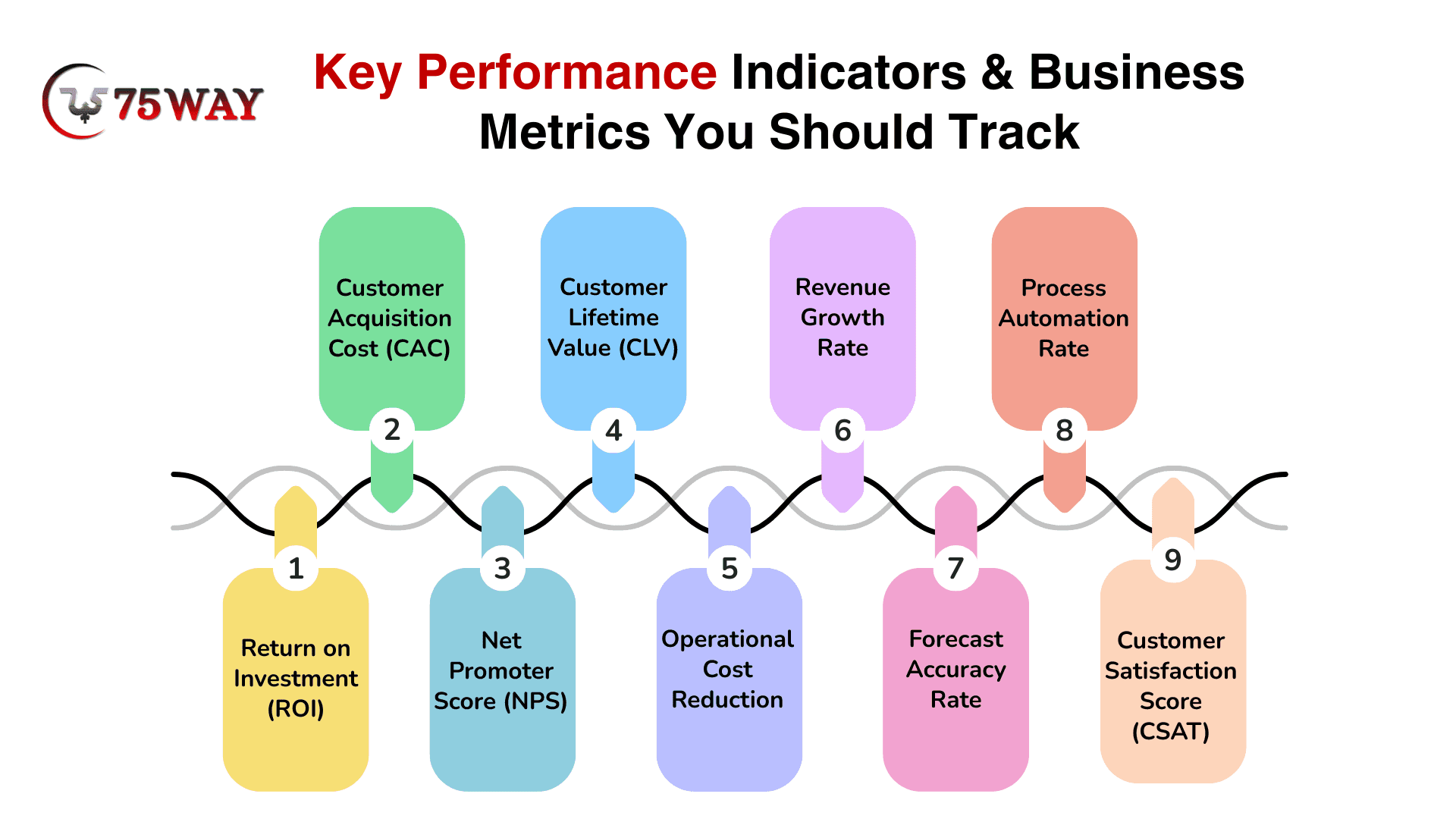
Return on Investment (ROI): It measures financial return compared to total AI implementation and operational costs. Executive teams apply this metric to assess profitability impact, justify capital allocation, and validate enterprise-level technology investment performance.
Customer Acquisition Cost (CAC): This parameter is used for evaluating marketing efficiency and budget utilization. Revenue teams monitor this metric to determine the average spending required to convert new customers and to optimize campaign targeting strategies.
Customer Lifetime Value (CLV): It estimates long-term revenue contribution per customer relationship. Strategy leaders compare this metric with acquisition cost to assess sustainable profitability and retention strength.
Operational Cost Reduction: This metric tracks measurable decreases in administrative, staffing, and process expenses. Finance departments review this metric to validate automation savings and productivity improvements.
Revenue Growth Rate: This parameter is utilized for measuring year over year increase in total revenue performance. Leadership applies this indicator to evaluate market expansion, sales momentum, and competitive positioning.
Forecast Accuracy Rate: It is helpful to assess predictive model precision in revenue and demand projections. Planning teams monitor this metric to improve budget stability and the reliability of resource allocation.
Process Automation Rate: It determines the percentage of workflows handled through AI systems. Operations teams rely on this metric to evaluate efficiency scaling and labor optimization impact.
Customer Satisfaction Score (CSAT): It is essential to compute the customer feedback on service quality and experience. Support and service departments track this indicator to maintain retention and improve engagement outcomes.
Net Promoter Score (NPS): This metric measures customer loyalty and likelihood of referral. Growth teams apply this metric to measure brand advocacy strength and long-term relationship stability.
Read Too: Dating App Development Cost in 2026: A Complete Guide
Final Thoughts
Artificial Intelligence now functions as core business infrastructure across competitive United States markets. Strategic alignment between AI systems and revenue growth, cost control, customer retention, and operational efficiency strengthens long term stability. Structured governance frameworks, reliable datasets, workforce AI literacy, and phased deployment roadmaps protect enterprise value while reducing financial exposure. Organizations prepared to scale responsibly secure stronger margins and long-term relevance. Partner with a trusted AI development company and schedule your free strategy consultation today to unlock measurable growth opportunities.
Frequently Asked Questions (FAQs)
How Does AI Improve Productivity?
AI improves productivity through workflow automation, predictive task management, intelligent data processing, and decision support systems. Repetitive administrative tasks shift to automated systems, error rates decline, and employees focus on revenue-generating activities. Operational speed increases while resource utilization becomes more efficient across departments.
Can Startups Implement AI Without Big Budgets?
Startups can adopt AI through cloud-based platforms, subscription tools, and modular deployment strategies. Phased implementation reduces upfront capital requirements while focusing on high-impact use cases such as customer support automation or marketing analytics. Strategic prioritization enables measurable gains without enterprise-level spending.
What Risks Come With AI Adoption?
AI adoption involves data privacy exposure, regulatory compliance gaps, integration challenges, and model bias concerns. Weak governance structures increase legal and reputational risk. Structured oversight, documented policies, workforce training, and continuous monitoring reduce operational uncertainty and strengthen responsible deployment practices.
How Long Does It Take To See ROI From AI?
ROI timelines depend on implementation scope, data maturity, and operational alignment. Automation-focused projects may deliver measurable cost savings within months, while advanced predictive modeling initiatives often require longer evaluation cycles. Clear KPIs and phased rollout planning accelerate visibility into financial returns.
What Are The Strategic Benefits Of AI In Business?
The core advantages of artificial intelligence tools include improved decision accuracy, scalable operations, enhanced customer personalization, cost efficiency, and faster innovation cycles. Data-driven forecasting strengthens planning stability, while automation supports sustainable growth without proportional increases in resources. Long-term competitiveness improves through continuous analytical refinement.
Which Industries Benefit Most From AI Implementation?
Healthcare, financial services, retail, manufacturing, logistics, and technology sectors experience significant gains from AI integration. Use cases include fraud detection, predictive maintenance, supply chain optimization, demand forecasting, and personalized customer engagement. High-data-volume industries often realize the strongest measurable impact