Summary
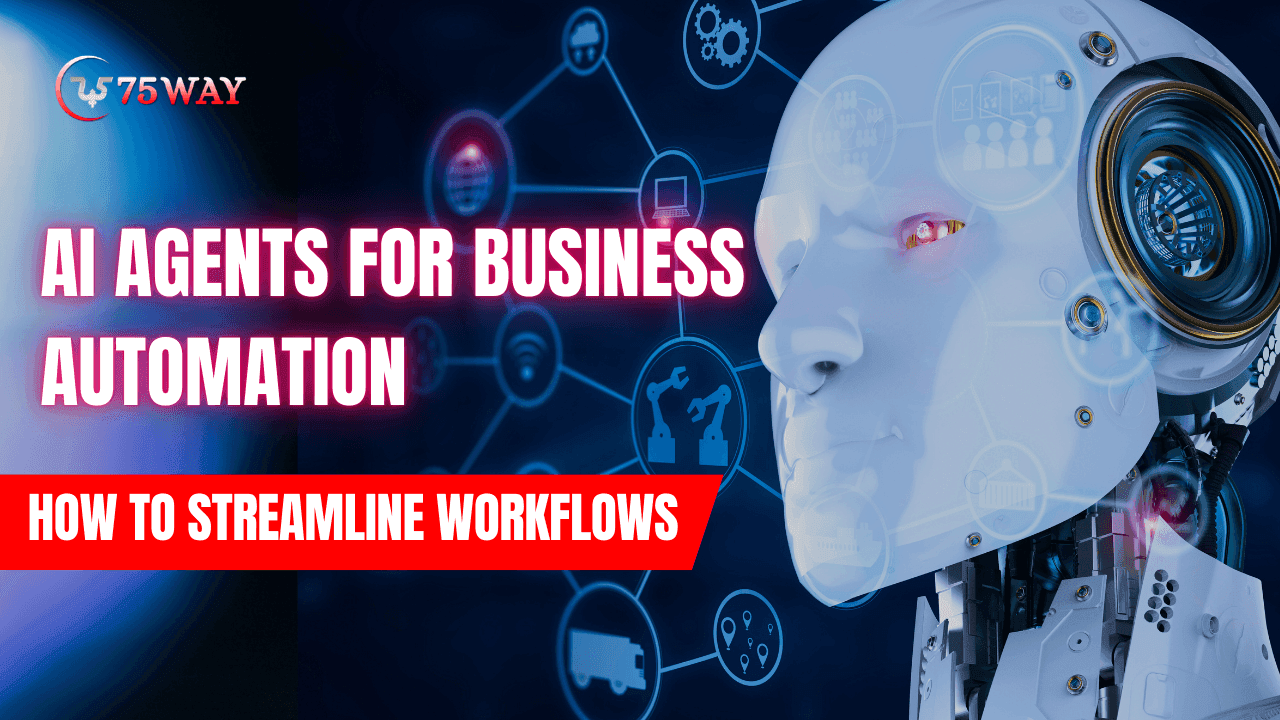
AI agents for business automation help organizations streamline workflows, reduce operational costs, and boost productivity. By leveraging machine learning, NLP, and decision-making systems, these intelligent agents automate repetitive tasks, enhance customer experiences, and improve data-driven decisions. With continuous learning and integration across departments, businesses can scale efficiently, optimize operations, and stay competitive in a fast-paced digital environment.
Quick Overview
- The AI agents market is projected to $220.9 billion by 2035, reflecting a strong CAGR of 36.55%.
- AI agents automate repetitive tasks, increasing efficiency and freeing employees for strategic work.
- Machine learning and NLP enable intelligent decision-making across business workflows.
- AI-powered automation reduces operational costs, minimizing errors and optimizing resource usage consistently.
- AI agents enhance customer experience through 24/7 support and personalized interactions.
- Continuous learning ensures AI agents adapt, improve performance, and scale operations.
Businesses today are rapidly embracing automation to stay competitive, reduce costs, and improve efficiency. One of the most powerful innovations driving this shift is the rise of AI agents. With advanced AI agent development solutions, companies can now automate complex workflows, handle repetitive tasks, and deliver faster outcomes. Organizations are also choosing to build AI agents from scratch to meet their unique operational needs, ensuring flexibility and scalability across departments like customer service, sales, and operations.
AI agents go beyond traditional automation by combining machine learning, natural language processing, and decision-making capabilities. They can analyze data, interact with users, and continuously improve their performance over time. From managing customer interactions to optimizing internal processes, AI agents are transforming how businesses operate. This blog explores how AI agents streamline workflows, boost productivity, and create smarter, more efficient business environments.
What is AI Automation?
AI automation refers to the use of artificial intelligence technologies to perform tasks with minimal human intervention. It combines machine learning, data analytics, and natural language processing to analyze information, make decisions, and execute actions efficiently. Businesses use AI automation to streamline operations, reduce errors, and improve productivity. Modern systems often include AI chatbots and agents that handle customer interactions, answer queries, and provide instant support. Additionally, AI voice agent development solutions enable organizations to automate voice-based communication, allowing systems to understand speech and respond naturally. This makes processes faster, more scalable, and enhances overall user experience.
How AI Agents Work for Business Automation?
AI agents power business automation by combining machine learning, natural language processing, and data analytics to perform tasks with minimal human intervention. They collect and analyze data, learn patterns, and make intelligent decisions to improve efficiency and accuracy. Businesses use AI agents in customer support, marketing, and operations. AI voice agents further enhance automation by handling calls, understanding speech, and delivering real-time responses. Overall, AI agents reduce workload, save costs, and boost productivity across industries.
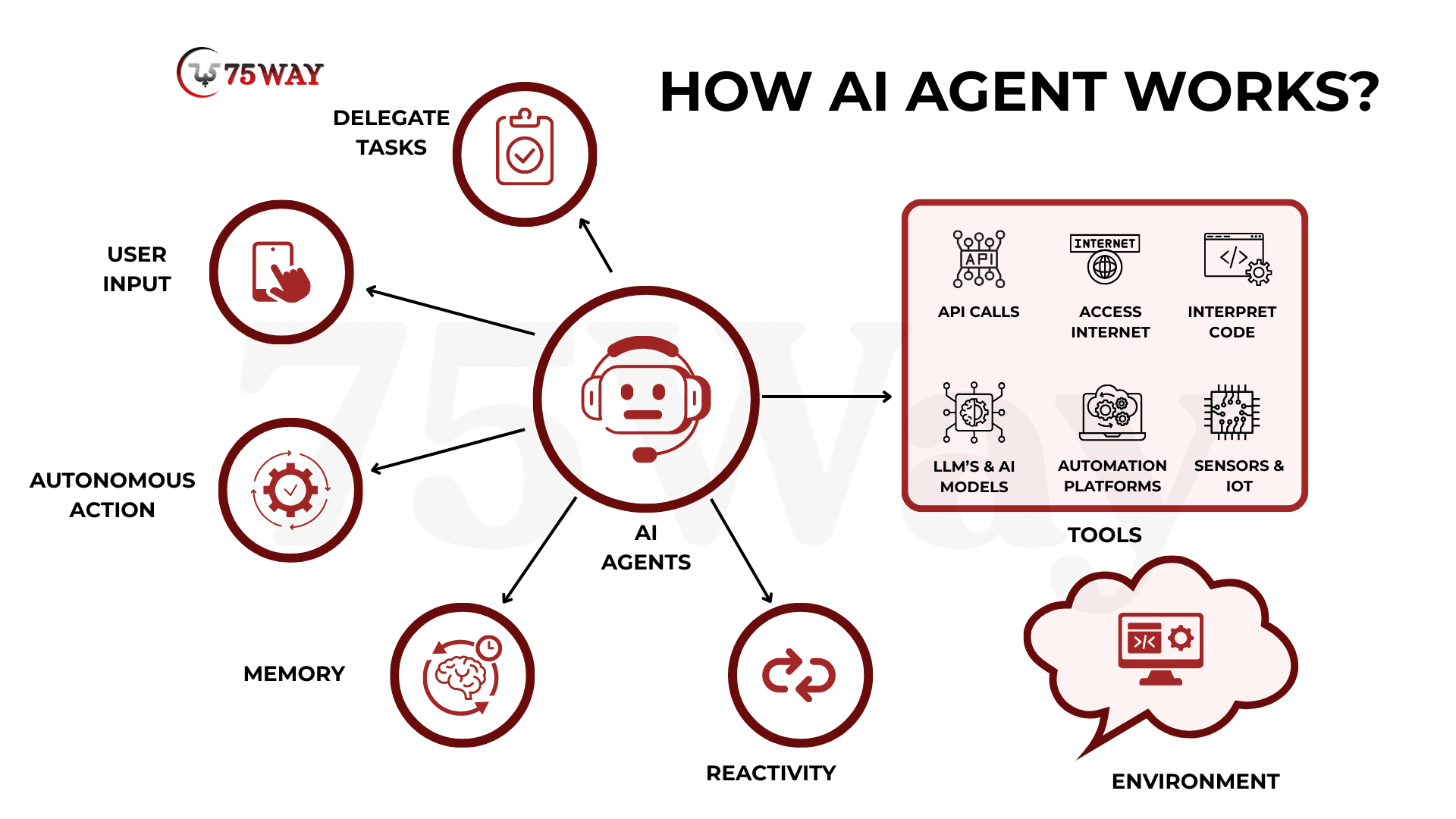
Data Collection Process: AI agents begin by collecting data from multiple business sources, such as CRM systems, websites, emails, customer interactions, and sensors. This data may be structured or unstructured. The system cleans, filters, and organizes it to maintain accuracy. High-quality data helps AI agents understand business operations, enabling better predictions, automation, and more reliable decision-making across workflows.
Pattern Recognition Models: AI agents analyze collected data to identify patterns, trends, and user behaviors. These models detect anomalies, recurring activities, and customer preferences. By recognizing patterns, AI agents can anticipate future actions, personalize experiences, and optimize operations. This is especially useful in fraud detection, recommendation systems, and forecasting, helping businesses make proactive and data-driven decisions.
Machine Learning Algorithms: Machine learning enables AI agents to learn from historical and real-time data without explicit programming. These algorithms continuously improve as more data is processed. Using supervised, unsupervised, and reinforcement learning, AI agents can predict outcomes, optimize workflows, and automate complex tasks. This makes systems smarter, more adaptive, and capable of handling evolving business requirements efficiently.
Natural Language Processing: Natural language processing (NLP) allows AI agents to understand, interpret, and respond to human language. It processes both text and speech to detect intent, sentiment, and context. This capability powers chatbots, virtual assistants, and email automation. NLP enhances communication, enabling more natural interactions between users and systems while improving response accuracy and customer engagement.
Decision-Making Systems: AI agents use decision-making systems to analyze data and determine the best possible actions. These systems combine rules, predictive analytics, and real-time inputs to automate responses. Whether routing customer queries, approving transactions, or triggering workflows, AI agents ensure quick, consistent, and accurate decisions, reducing human dependency and improving overall operational efficiency.
AI Voice Agents: AI voice agents automate voice-based communication using speech recognition, NLP, and text-to-speech technologies. They can handle customer calls, answer questions, and provide support in real time. These agents reduce workload on human teams, improve response times, and deliver consistent service, making them highly valuable in call centers and customer support environments.
Task Automation Workflow: AI agents streamline workflows by automating repetitive and rule-based tasks such as data entry, scheduling, lead tracking, and customer service. They follow predefined triggers and actions to execute tasks efficiently. This reduces manual effort, minimizes errors, and ensures consistency, allowing businesses to focus on strategic activities and improve overall productivity.
Continuous Learning Improvement: AI agents continuously improve by learning from new data, feedback, and outcomes. They update their models to enhance performance, accuracy, and adaptability. This ongoing learning process ensures that automation evolves with changing business needs and market trends, helping organizations stay competitive while maintaining efficient and optimized operations over time.
How To Build & Launch AI Agent To Automate Your Business?
Building and launching an AI agent for business automation involves a structured approach that combines strategy, technology, and continuous improvement. From identifying goals to deployment and optimization, businesses can create intelligent systems that streamline workflows, enhance productivity, and deliver better customer experiences while reducing manual effort and operational costs.
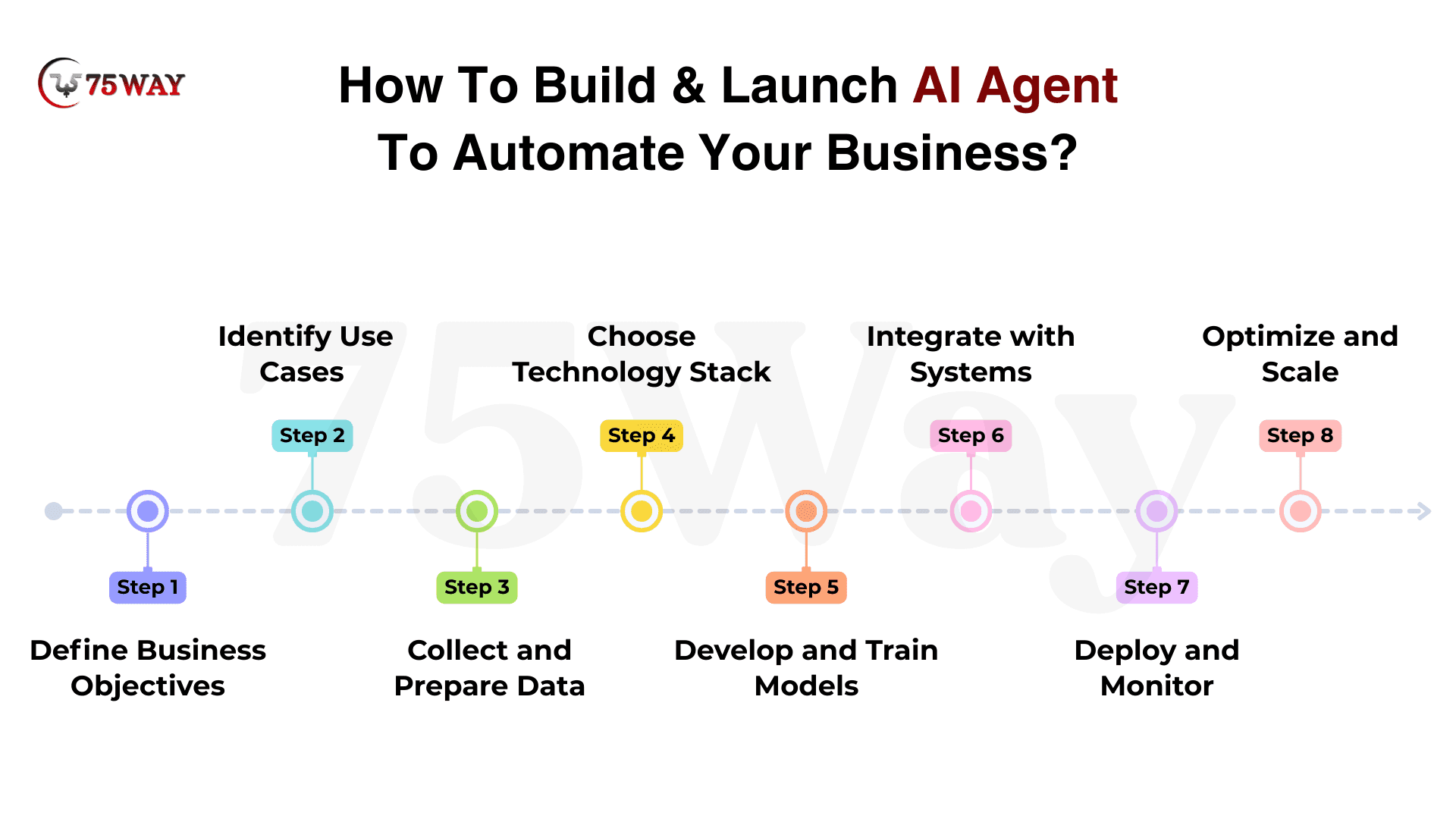
Step 1: Define Business Objectives
The first step in building an AI agent is identifying clear business goals. Determine what problems you want to solve, such as automating customer support, improving lead generation, or streamlining operations. Clearly defined objectives help align AI development with business needs and ensure measurable outcomes.
Additionally, setting key performance indicators (KPIs) is crucial. These metrics help evaluate the success of the AI agent after deployment. A well-defined objective ensures that the AI solution delivers value, improves efficiency, and supports long-term business growth effectively.
Step 2: Identify Use Cases
After defining objectives, identify specific use cases where AI agents can be applied. This may include automating repetitive tasks, handling customer queries, or managing workflows. Prioritizing high-impact use cases ensures better return on investment and faster results.
It is also important to analyze feasibility and complexity. Some use cases may require advanced AI capabilities, while others can be implemented quickly. Choosing the right use cases helps businesses start small, scale efficiently, and achieve quick wins.
Step 3: Collect and Prepare Data
Data is the foundation of any AI agent. Businesses must collect relevant data from sources like CRM systems, websites, and customer interactions. The quality of data directly impacts the performance and accuracy of the AI system.
Once collected, data must be cleaned, organized, and labeled properly. Removing inconsistencies and ensuring accuracy helps train reliable models. Well-prepared data enables AI agents to make better predictions and automate tasks effectively.
Step 4: Choose Technology Stack
Selecting the right technology stack is essential for building a robust AI agent. This includes choosing programming languages, frameworks, AI models, and cloud platforms. The right tools ensure scalability, flexibility, and performance.
Businesses should also consider integration capabilities with existing systems. A compatible and future-ready tech stack allows seamless deployment, easier maintenance, and long-term success of the AI solution.
Step 5: Develop and Train Models
In this stage, AI models are developed and trained using prepared data. Machine learning algorithms help the agent learn patterns, make predictions, and automate tasks. Training involves feeding data and refining models for accuracy.
Continuous testing and validation are important to ensure performance. Fine-tuning models improves results and reduces errors. A well-trained AI agent can handle real-world scenarios efficiently and deliver consistent outcomes.
Step 6: Integrate with Systems
Once the AI agent is ready, it must be integrated with existing business systems like CRM, ERP, or communication platforms. Integration ensures that the AI agent can access data and perform tasks seamlessly.
Proper APIs and workflows should be established to enable smooth interaction. This step ensures that the AI agent works within the business ecosystem and delivers real-time automation benefits without disrupting operations.
Step 7: Deploy and Monitor
Deployment involves launching the AI agent in a live environment where it interacts with real users or systems. Businesses should start with controlled environments to test performance and minimize risks.
Monitoring is equally important after deployment. Tracking performance, user interactions, and system behavior helps identify issues and areas for improvement. Continuous monitoring ensures the AI agent operates efficiently and meets business goals.
Step 8: Optimize and Scale
After deployment, continuous optimization is required to improve performance. AI agents should be updated regularly with new data and feedback to enhance accuracy and efficiency over time.
As the system matures, businesses can scale the AI agent to handle more tasks, users, or departments. This ensures maximum value from automation and supports long-term growth and innovation across the organization.
Benefits of AI-Powered Automation In Your Business
AI-powered automation helps businesses improve efficiency, reduce operational costs, and save valuable time by automating repetitive tasks. It increases accuracy, minimizes human errors, and accelerates workflows across departments like customer service, sales, and operations. With AI workflow automation, companies can streamline complex processes and ensure seamless task execution. Additionally, agentic AI in business automation enables intelligent agents to make autonomous decisions, adapt to changing conditions, and optimize performance. Combined with chatbots, intelligent workflows, and AI voice agents, businesses can scale operations, boost productivity, and make smarter, data-driven decisions.
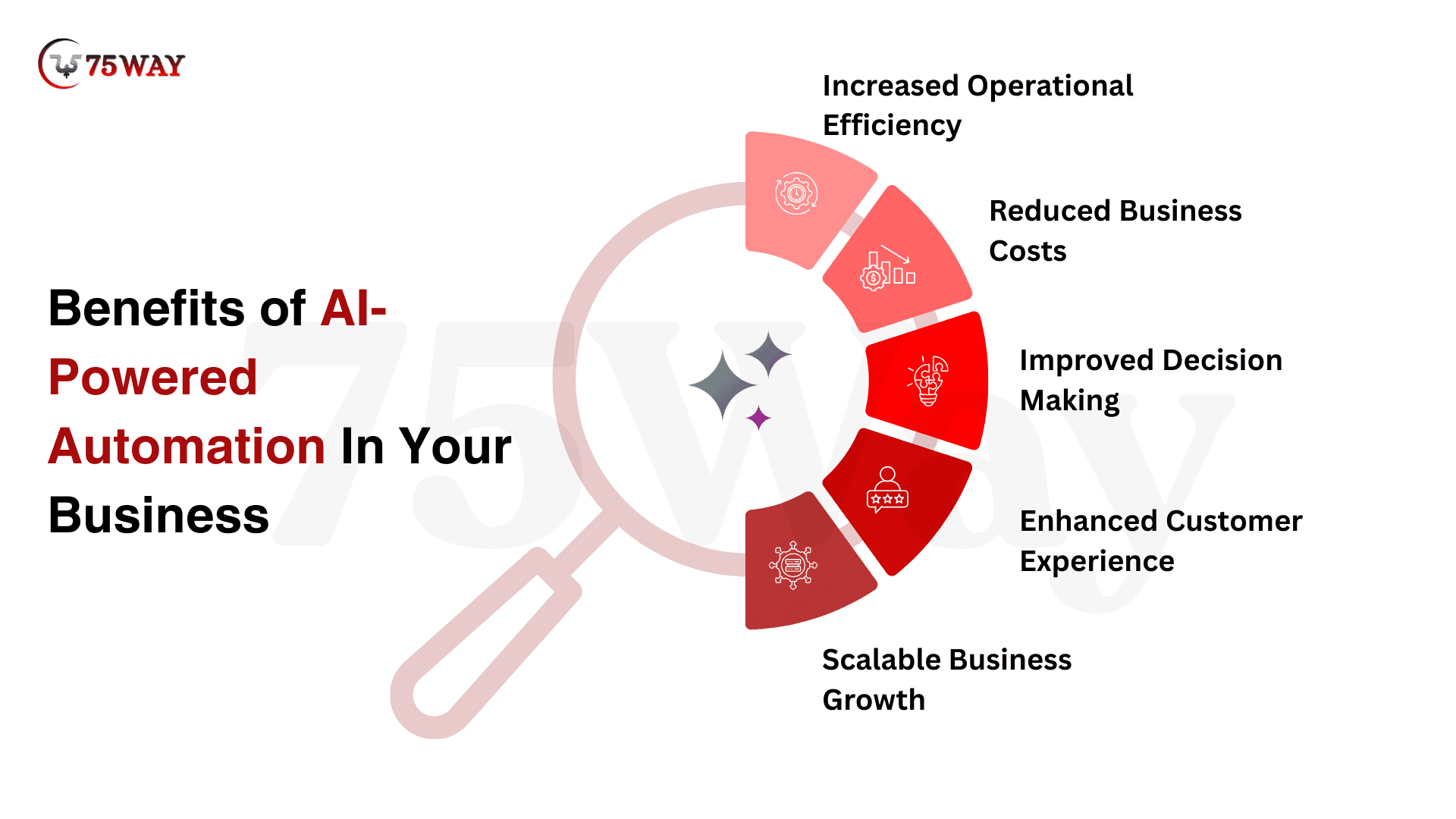
Increased Operational Efficiency: AI-powered automation streamlines repetitive tasks and optimizes workflows, allowing businesses to operate faster and more effectively. It reduces manual effort, eliminates bottlenecks, and ensures consistent performance, enabling teams to focus on strategic activities and improving overall productivity across departments.
Reduced Business Costs: By automating routine processes, businesses can significantly cut labor and operational costs. AI reduces the need for manual intervention, minimizes errors, and lowers resource usage. This cost efficiency allows companies to allocate budgets more effectively and invest in growth and innovation. For small businesses facing deeper financial or operational pressure, automation may form part of a broader recovery plan. When efficiency measures alone are not enough, small business restructuring can help reorganize debts, operations, and resources more sustainably.
Improved Decision Making: AI systems analyze large volumes of data in real time, providing valuable insights and predictions. This helps businesses make informed decisions quickly and accurately. With data-driven strategies, organizations can reduce risks, identify opportunities, and improve overall business performance.
Enhanced Customer Experience: AI automation improves customer interactions through faster responses, personalized communication, and 24/7 support. Tools like chatbots and AI voice agents ensure consistent service quality. This leads to higher customer satisfaction, better engagement, and stronger long-term relationships.
Scalable Business Growth: AI automation allows businesses to scale operations without significantly increasing costs or resources. It handles increased workloads efficiently, supports expansion into new markets, and maintains performance consistency. This scalability helps businesses grow sustainably while adapting to changing demands and opportunities.
Why Businesses Should Adopt AI Agents for Automation?
Businesses should adopt AI agents to automate repetitive tasks, boosting efficiency, reducing operational costs, and improving accuracy. AI agents can work 24/7, handle large volumes of data, and make real-time decisions, enabling faster workflows. They also enhance customer experiences through instant responses and personalization. By minimizing human error and freeing up employees for strategic work, AI-driven automation helps businesses stay competitive, scalable, and future-ready in an increasingly digital and fast-paced market environment.
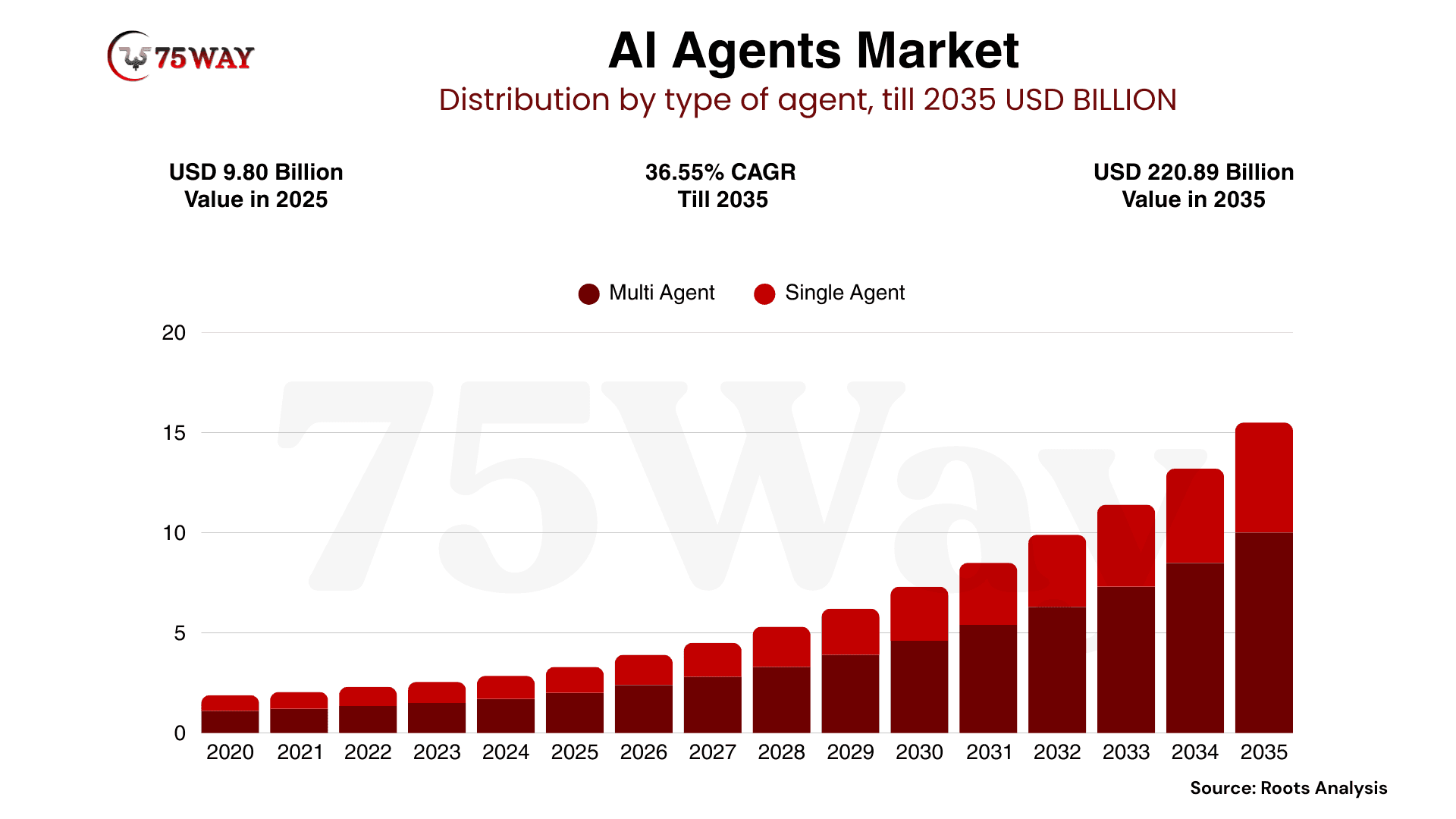
- The global AI agents market is projected to grow from $9.8 billion in 2025 to $220.9 billion by 2035, reflecting a strong CAGR of 36.55%, according to the Root Analysis report.
- North America currently leads the AI agents market, accounting for the largest global revenue share of 39.63%.
- The market is also expected to surpass $300 billion by 2035, with a projected CAGR of 36% to 60%.
- According to PwC, around 79% of organizations surveyed have already adopted AI agents in their operations.
Real World Use Cases of AI Agent For Business Automation
AI automation is widely used across industries to streamline operations and improve efficiency. Businesses leverage it for customer support, marketing campaigns, data processing, and workflow management. It enables faster decision-making and reduces manual workload. Companies also use AI agents to make outbound calls for lead generation, appointment scheduling, and customer follow-ups. Additionally, AI automation powers chatbots, recommendation systems, and predictive analytics, helping organizations deliver personalized experiences, increase productivity, and scale operations effectively while maintaining accuracy and consistency.
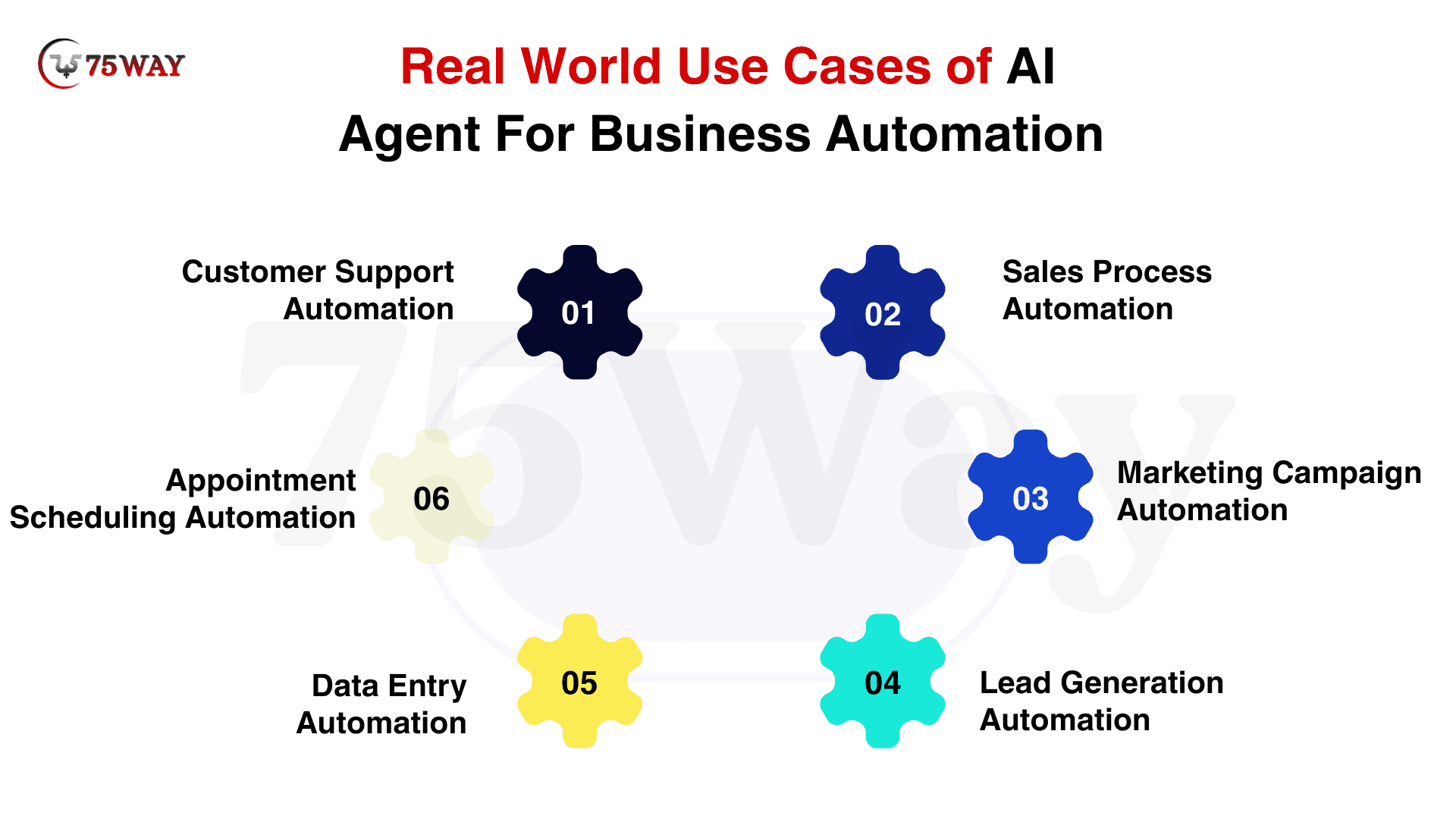
Customer Support Automation: AI agents handle customer queries through chatbots and voice assistants, providing instant responses, resolving issues, and offering 24/7 support, improving satisfaction while reducing workload on human support teams.
Sales Process Automation: AI agents automate sales tasks like follow-ups, lead nurturing, and pipeline management. They analyze customer data, suggest actions, and help teams close deals faster while improving overall sales efficiency.
Marketing Campaign Automation: AI agents manage and optimize marketing campaigns by analyzing user behavior, segmenting audiences, and delivering personalized content. This improves engagement, increases conversions, and ensures better return on marketing investments.
Lead Generation Automation: AI agents identify potential customers by analyzing data and behavior patterns. They qualify leads, initiate conversations, and even perform outreach, helping businesses generate high-quality leads consistently and efficiently.
Data Entry Automation: AI agents automate repetitive data entry tasks by extracting, processing, and updating information across systems. This reduces manual errors, saves time, and ensures accurate and consistent data management across business operations.
Appointment Scheduling Automation: AI agents automate scheduling by coordinating calendars, sending reminders, and confirming bookings. They interact with customers in real time, reducing missed appointments and improving efficiency for both businesses and clients.
Challenges of Deploying AI Agent For Workflow Automation
AI workflow automation offers significant benefits, but it also comes with challenges. Businesses often face integration issues with existing systems, data quality limitations, and high initial implementation costs. Managingvirtual AI assistants requires proper training, monitoring, and continuous updates to ensure accuracy. Additionally, coordinating multi-agent systems can be complex, as multiple AI agents must work together seamlessly without conflicts. Security, data privacy, and lack of skilled expertise further add to the challenges, making careful planning and strategy essential for successful automation adoption.
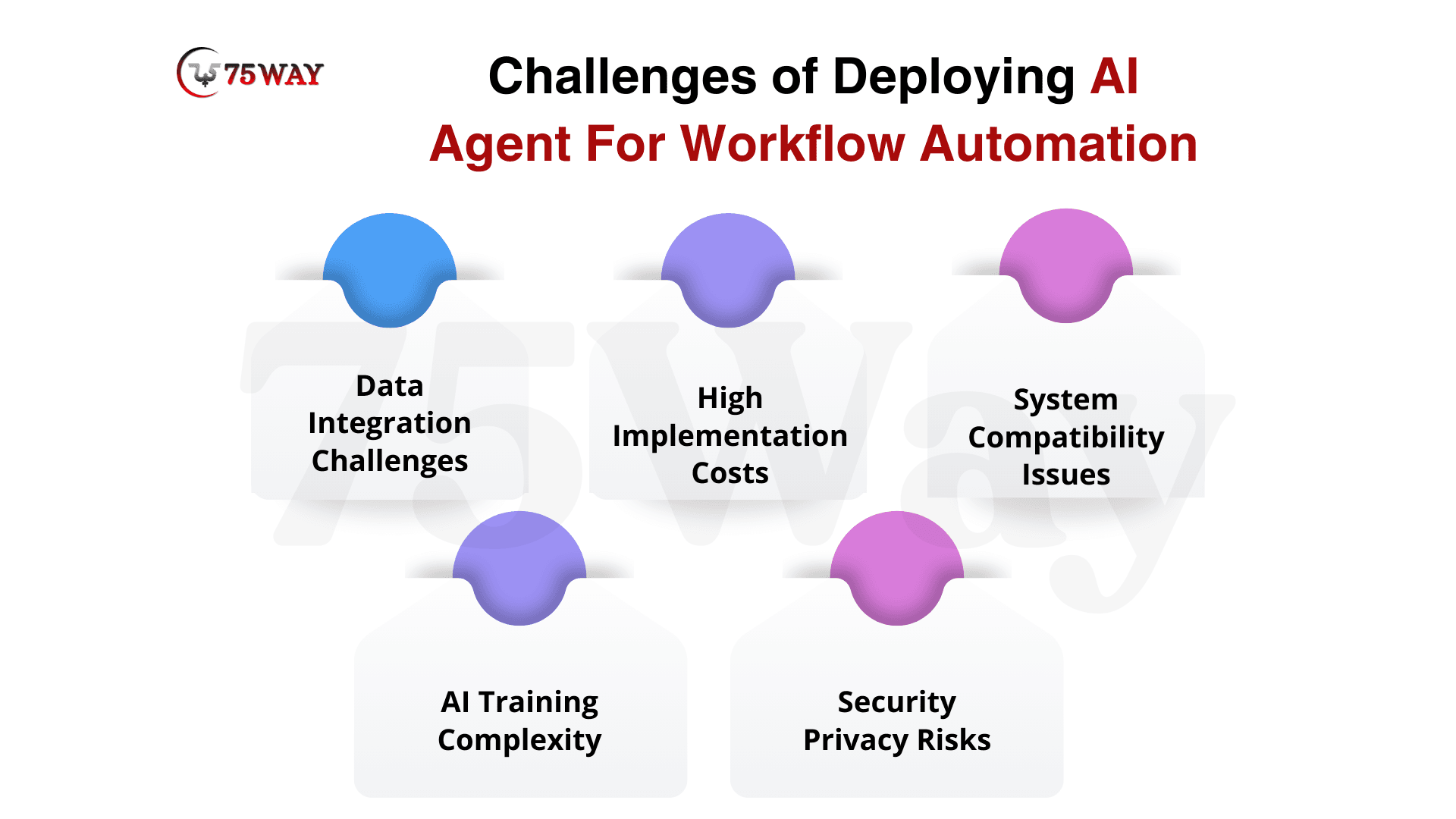
Data Integration Challenges: Integrating data from multiple sources like CRM systems, databases, and third-party tools can be complex. Inconsistent formats and poor data quality can affect AI performance and limit automation effectiveness.
High Implementation Costs: AI automation requires initial investment in technology, infrastructure, and skilled professionals. Costs for development, deployment, and maintenance can be high, making it challenging for small and medium businesses.
System Compatibility Issues: Existing legacy systems may not easily integrate with modern AI solutions. Compatibility issues can slow down implementation, require additional customization, and increase time and cost for successful automation deployment.
AI Training Complexity: Training AI models requires large datasets, continuous monitoring, and fine-tuning. Ensuring accuracy and performance can be complex, especially when dealing with dynamic business environments and evolving user behaviors.
Security Privacy Risks: AI systems handle sensitive business and customer data, increasing risks related to data breaches and privacy violations. Proper security measures, compliance, and data protection strategies are essential for safe automation implementation.
Limitations and Considerations
AI automation offers powerful advantages, but it also has limitations and requires careful consideration. It depends heavily on data quality, and poor or biased data can lead to inaccurate outcomes. Implementation can be complex, requiring skilled expertise, proper infrastructure, and ongoing maintenance. AI systems may lack human judgment in sensitive situations, underscoring the importance of oversight. Businesses must also consider security, privacy, and ethical concerns when handling data. Additionally, integrating AI with existing systems can be challenging. To succeed, organizations should plan strategically, monitor performance continuously, and ensure a balance between automation and human involvement
Conclusion
AI agents are transforming business automation by streamlining workflows, improving efficiency, and enabling smarter decision-making. From data collection to continuous learning, these intelligent systems help businesses automate complex tasks, reduce costs, and enhance customer experiences. While challenges and limitations exist, strategic implementation and proper management can unlock their full potential. As highlighted throughout this blog , adopting AI agents is no longer optional but essential for staying competitive. Businesses that embrace AI-driven automation today will be better positioned to scale, innovate, and succeed in the future digital landscape.
Frequently Asked Questions (FAQs)
What's The Difference Between AI Automation And AI Agents?
Traditional automation follows fixed rules, if X happens, do Y. AI agents, however, make contextual decisions based on data patterns and environmental changes. Whilst automation handles repetitive tasks efficiently, agents can adapt their approach based on outcomes, essentially creating dynamic workflows that improve over time without constant reprogramming.
How Long Does It Typically Take To Implement AI Agents?
Implementation timelines vary considerably. Simple agent deployments for document processing or email triage might launch within 4-6 weeks. More complex implementations involving multiple systems and decision-making frameworks typically require 3-6 months. Research from Merge.dev indicates that organizations that invest in proper planning and pilot programmes achieve 40% faster deployment times than those that rush to production.
Do AI Agents Replace Human Workers?
In practice, AI agents augment rather than replace human capabilities. They handle high-volume, pattern-based tasks whilst humans focus on strategic decisions requiring emotional intelligence and creativity. A common pattern is for agents to manage initial customer queries or data entry, and to escalate complex situations to human team members who can provide nuanced judgment.
What Security Concerns Should Businesses Address?
Key considerations include data access controls, audit trails for agent decisions, and failsafe mechanisms for high-stakes actions. Implementing proper authentication protocols and limiting agents to specific operational boundaries helps maintain security whilst enabling automation benefits.