Summary
AI sales agents have become a powerful force in e-commerce, automating customer engagement, product recommendations, lead qualification, and sales assistance. These intelligent systems operate around the clock, helping businesses increase conversions, reduce operational costs, improve customer experiences, and scale revenue generation. Growing AI adoption continues to reshape digital commerce and online buying journeys.
Quick Overview
- AI sales agents automate customer interactions throughout the purchasing journey.
- Personalized recommendations enhance conversions and shopping experiences.
- Businesses reduce sales support costs while improving customer engagement levels.
- Real-time assistance helps recover abandoned carts and boost revenue.
- AI agents integrate with e-commerce platforms, CRMs, and marketing tools.
Thousands of online stores in the USA compete for customer attention, making it increasingly difficult to convert visitors into buyers. While attracting traffic remains important, the real challenge lies in engaging customers, answering questions, and guiding them toward purchasing decisions.
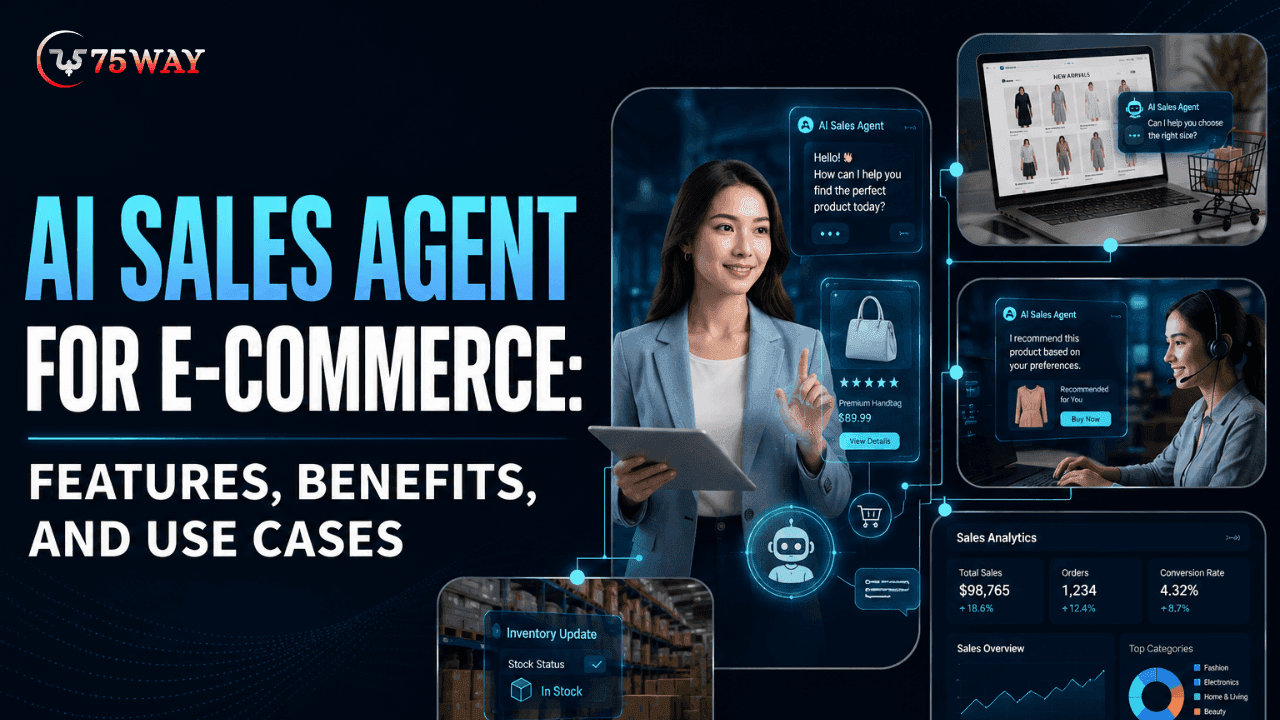
But advanced technologies like artificial intelligence change this landscape through sales AI agents for ecommerce. These solutions can interact with customers, recommend products, answer questions, nurture prospects, and support purchasing decisions without human intervention. Rather than functioning as basic chatbots, AI sales agents in ecommerce operate as virtual sales representatives capable of understanding context, customer intent, and buying behavior.
In this guide, we explore AI sales agents for e-commerce, including their features, benefits, development process, technology stack, business applications, implementation strategies, costs, and future impact on online retail in the United States.
What Is an AI Sales Agent for E-commerce?
An AI sales agent is an intelligent software system that helps e-commerce businesses automate customer interactions, support purchasing decisions, recommend relevant products, and drive sales through artificial intelligence. Acting as a virtual sales representative, these systems engage shoppers throughout their buying journey, from initial product discovery to final purchase completion.
Unlike traditional chatbots that rely on predefined rules and scripted responses, AI sales agents leverage technologies such as machine learning, natural language processing (NLP), conversational AI, and behavioral analytics to understand customer intent and deliver highly personalized interactions. They can analyze customer preferences, browsing behavior, purchase history, and real-time conversations to provide context-aware assistance that feels more natural and relevant.
AI sales agents perform a wide range of sales and customer engagement tasks, including:
- Understanding customer intent and preferences
- Answering product-related questions instantly
- Recommending relevant products based on behavior
- Handling customer objections during the buying process
- Guiding shoppers toward purchase decisions
- Recovering abandoned shopping carts
- Qualifying leads for sales teams
- Supporting upselling and cross-selling opportunities
- Providing personalized promotions and offers
- Assisting customers across multiple communication channels
By combining automation with intelligent decision-making, AI sales agents help businesses deliver faster responses, improve customer experiences, increase conversion rates, and generate more revenue without expanding support or sales teams. In essence, they function as always-available digital sales representatives that engage customers, nurture buying intent, and support business growth around the clock.
Key Reasons E-commerce Brands Are Embracing Sales AI Agents in USA
The rapid growth of online shopping has transformed customer expectations and intensified competition across the e-commerce industry. Today's consumers expect instant responses and personalized recommendations. AI sales agents address these challenges by providing intelligent, automated customer engagement at scale.
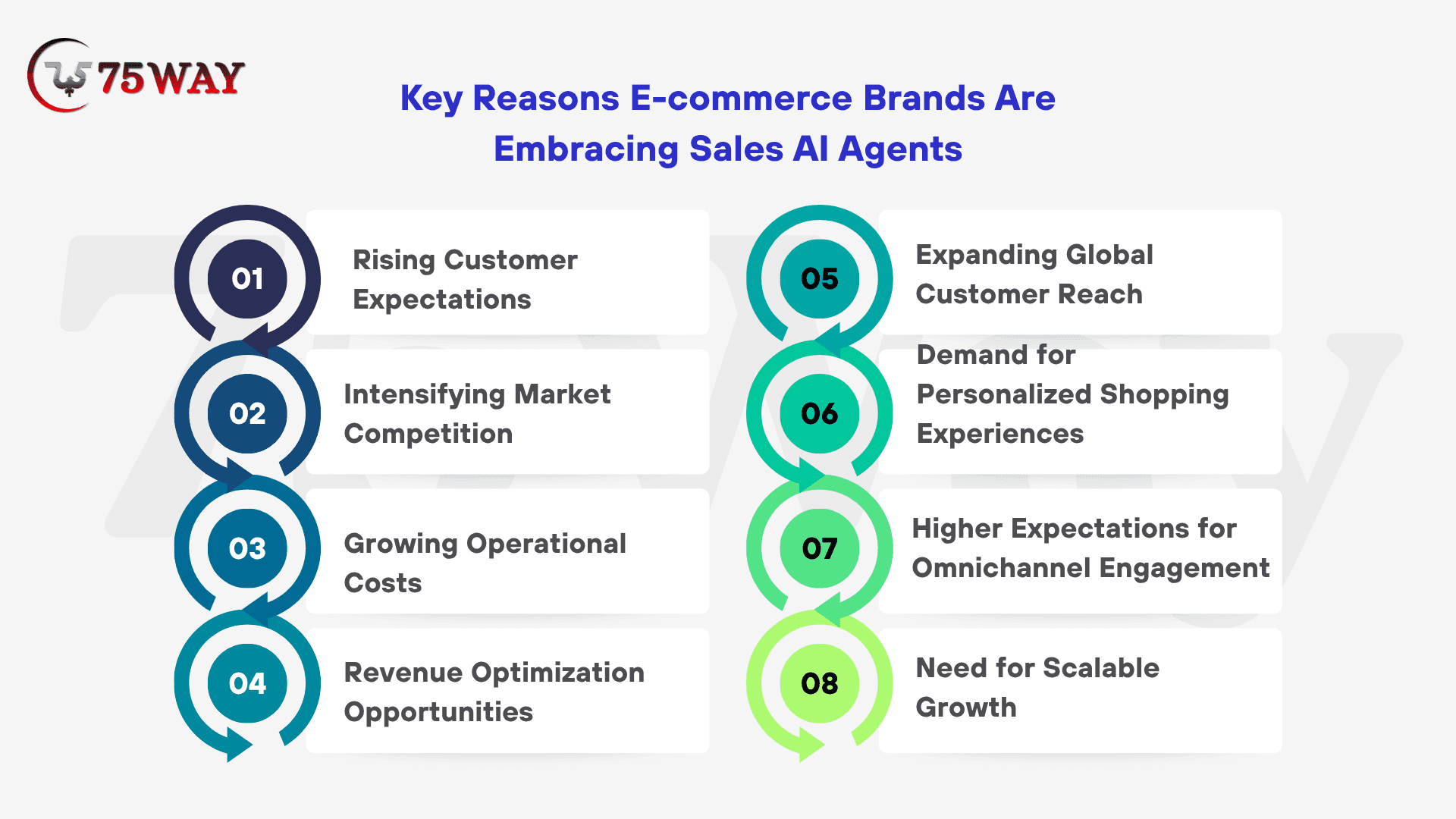
- Rising Customer Expectations
Modern consumers expect immediate assistance when researching products, comparing options, or making purchasing decisions. Delayed responses often lead to lost sales opportunities and customer frustration.
Sales AI agents in e-commerce platforms provide instant, personalized interactions that help shoppers find relevant products, receive answers quickly, and move smoothly through the buying journey.
- Intensifying Market Competition
The e-commerce landscape has become increasingly competitive, making customer experience a key differentiator. Businesses that offer faster support and more personalized engagement often gain an advantage over competitors.
Agentic AI in ecommerce sales helps brands stand out by delivering consistent customer interactions, proactive assistance, and tailored product recommendations at every stage of the purchasing process.
- Growing Operational Costs
As customer inquiries increase, businesses often face higher staffing, training, and support expenses. Scaling human sales teams to meet growing demand can significantly impact profitability.
AI sales agents automate repetitive sales and support tasks, enabling businesses to handle larger customer volumes while controlling operational costs and improving efficiency.
- Revenue Optimization Opportunities
Many potential sales are lost when customers leave websites without receiving assistance or guidance. Sales AI agents proactively engage visitors, answer questions, and recommend products that align with their interests.
By identifying purchase intent and encouraging action at the right moment, these systems help improve conversion rates, increase average order values, and generate additional revenue.
- Expanding Global Customer Reach
E-commerce businesses increasingly serve customers across multiple countries and time zones. Maintaining round-the-clock sales support through human teams alone can be difficult and expensive.
AI agents for sales of retail and ecommerce provide continuous assistance 24/7, ensuring customers receive timely responses regardless of their location or shopping time.
- Demand for Personalized Shopping Experiences
Customers are more likely to purchase when recommendations align with their interests and preferences. Generic product suggestions often fail to create meaningful engagement.
AI sales agents for retail analyze browsing behavior, purchase history, and customer interactions to deliver personalized recommendations that improve shopping experiences and boost sales performance.
- Higher Expectations for Omnichannel Engagement
Consumers interact with brands through websites, mobile apps, social media platforms, messaging channels, and email. Maintaining consistent communication across these touchpoints is increasingly important.
Retail AI sales agents can operate across multiple channels simultaneously, providing unified and consistent customer experiences wherever shoppers choose to engage.
- Need for Scalable Growth
Business growth often leads to higher inquiry volumes, larger product catalogs, and more complex customer journeys. Managing this expansion efficiently requires scalable solutions.
Ecommerce AI sales agents enable businesses to support thousands of customer interactions simultaneously without compromising response quality, making them an effective tool for sustainable growth.
As e-commerce continues to evolve, AI sales agents are becoming essential for businesses seeking to improve customer engagement, streamline operations, and maximize revenue opportunities. Their ability to combine personalization, automation, and continuous availability makes them a valuable asset in today's highly competitive digital marketplace.
How Do Ecommerce AI Sales Agents Work in Retail Operations?
AI sales agents analyze customer behavior, understand intent, deliver personalized recommendations, and guide shoppers toward purchasing decisions in real time. The process begins when a customer interacts with a website, mobile application, social media platform, or messaging channel. From that moment, the AI continuously collects and analyzes data to provide relevant assistance and improve sales outcomes.
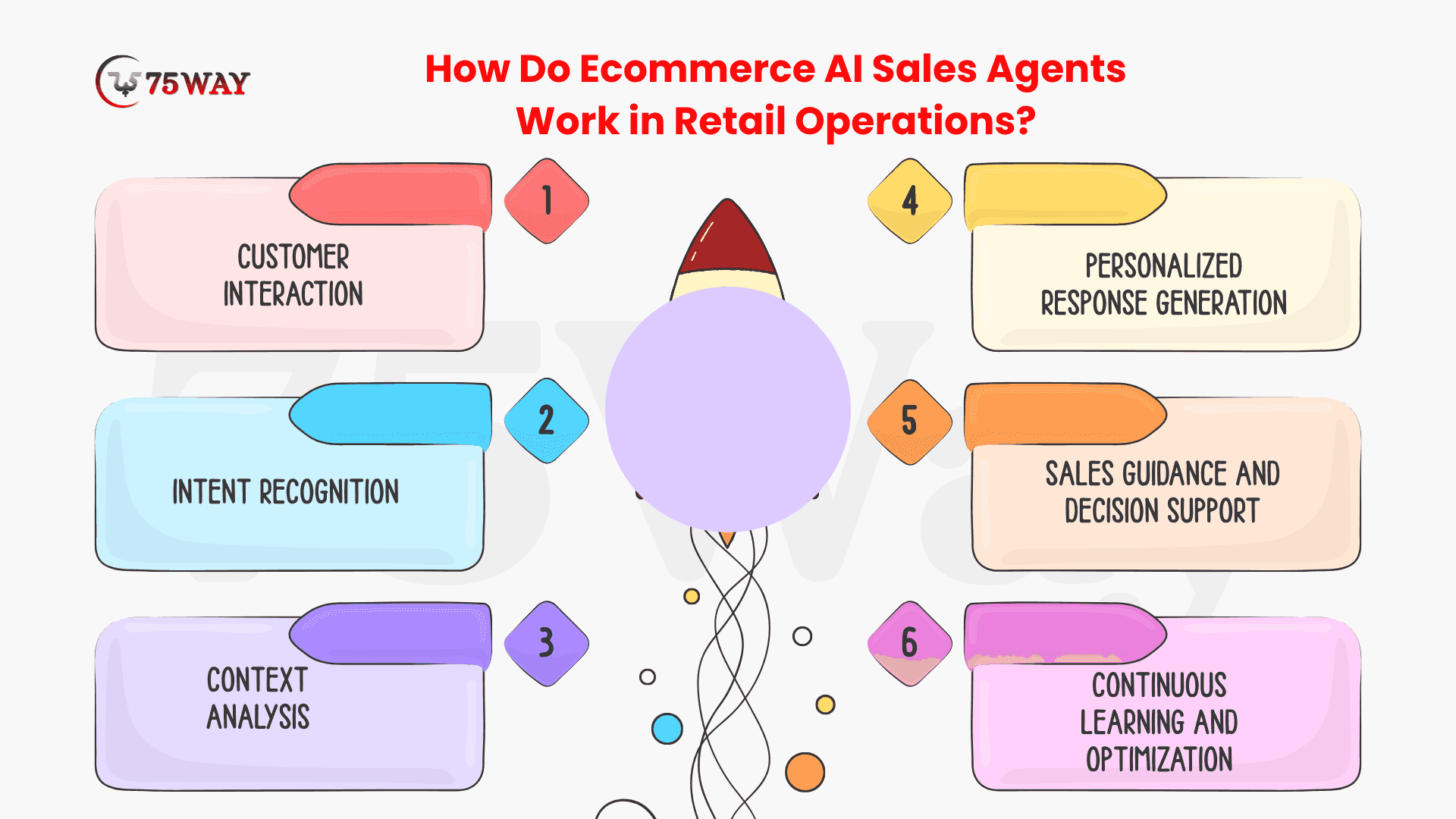
1. Customer Interaction
The journey starts when a visitor engages with a business through a digital touchpoint. This interaction may involve asking product-related questions, browsing categories, searching for items, or requesting assistance during the purchasing process.
AI sales agents can operate across multiple channels, ensuring customers receive consistent support regardless of where they initiate the conversation.
2. Intent Recognition
Once an interaction begins, the AI analyzes customer messages, search queries, browsing behavior, and engagement patterns to determine what the customer is trying to achieve.
For example, the system can identify whether a visitor is researching products, comparing options, seeking recommendations, looking for support, or showing strong purchase intent. Understanding intent enables the AI to provide more accurate and relevant assistance.
3. Context Analysis
After identifying customer intent, the AI evaluates additional contextual information to personalize the interaction. This may include browsing history, purchase records, preferred product categories, geographic location, device type, and previous conversations.
By combining these data points, the system develops a deeper understanding of customer preferences and purchasing behavior.
4. Personalized Response Generation
Using the information gathered during intent and context analysis, the AI generates tailored responses designed to address customer needs. These responses may include:
- Product recommendations
- Feature comparisons
- Pricing information
- Promotional offers
- Inventory availability
- Purchase guidance
Personalized interactions create more engaging shopping experiences and increase the likelihood of conversion.
5. Sales Guidance and Decision Support
Beyond answering questions, AI sales agents actively assist customers throughout the decision-making process. They help shoppers compare products, overcome objections, identify suitable options, and complete purchases with confidence.
By providing timely recommendations and relevant information, the AI reduces purchasing friction and helps move customers closer to conversion.
6. Continuous Learning and Optimization
One of the most powerful capabilities of AI sales agents is their ability to learn from every interaction. The system continuously analyzes customer responses, purchasing outcomes, engagement patterns, and feedback to improve future performance.
Over time, this learning process enables the AI to deliver more accurate recommendations, better conversations, stronger personalization, and improved sales effectiveness.
Inside an AI Sales Agent in Ecommerce: Core Components for Retail Success
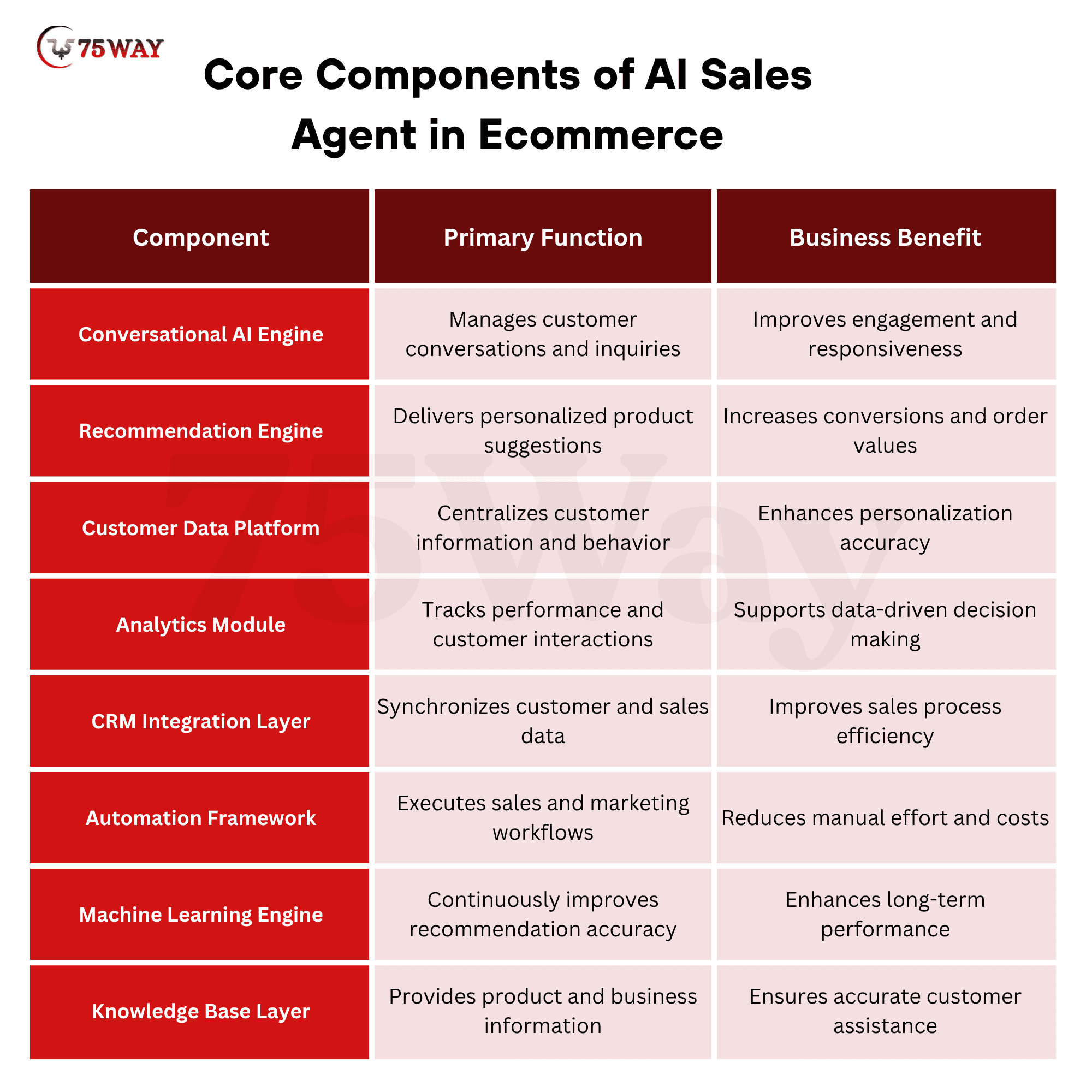
An AI sales agent relies on multiple interconnected technologies that work together to deliver personalized customer experiences, automate sales activities, and improve conversion outcomes. Each component plays a specific role in understanding customer behavior, generating intelligent responses, and supporting the overall sales process. When combined, these technologies create a scalable system capable of engaging customers throughout their buying journey.
- Conversational AI Engine: The conversational AI engine serves as the communication layer of the system. It enables the AI sales agent to understand customer queries, interpret context, and generate human-like responses using natural language processing (NLP) and large language models. This component allows businesses to provide instant assistance, answer questions, and maintain meaningful conversations across websites, mobile apps, and messaging platforms.
- Recommendation Engine: The recommendation engine analyzes customer behavior, browsing patterns, purchase history, and product preferences to suggest relevant products and services. By delivering personalized recommendations in real time, this component helps increase customer engagement, improve shopping experiences, and boost average order values.
- Customer Data Platform (CDP): A customer data platform acts as the central repository for customer information. It collects and organizes data from multiple sources, including website visits, purchases, conversations, support interactions, and marketing campaigns. Having a unified customer profile enables the AI sales agent to deliver more accurate personalization and context-aware recommendations.
- Analytics and Performance Module: The analytics module monitors customer interactions, engagement levels, conversion rates, revenue contributions, and sales performance metrics. These insights help businesses understand customer behavior, evaluate campaign effectiveness, identify opportunities for improvement, and make data-driven decisions.
- CRM Integration: CRM integration connects the AI sales agent with customer relationship management systems used by sales and marketing teams. This synchronization ensures that customer information, conversations, lead status, and purchasing activities remain updated across all business systems. Seamless CRM connectivity improves collaboration between automated systems and human sales teams.
- Automation Framework: The automation framework executes predefined workflows and business processes without manual intervention. It can trigger follow-up messages, abandoned cart reminders, promotional campaigns, lead nurturing sequences, and customer retention initiatives. Automation enables businesses to engage customers consistently while reducing operational workloads.
- Machine Learning Engine: The machine learning engine continuously analyzes customer interactions and sales outcomes to improve system performance over time. It identifies patterns, predicts customer behavior, and refines recommendations based on new data. This component helps the AI sales agent become more accurate, effective, and personalized with every interaction.
- Knowledge Base Layer: The knowledge base stores product information, pricing details, inventory status, policies, FAQs, and business-specific content. The AI agent accesses this information to provide accurate and contextually relevant responses. A well-maintained knowledge layer ensures customers receive reliable information throughout their shopping journey.
Critical Features of High-Performing E-commerce AI Sales Agents
The effectiveness of a retail and ecommerce AI sales agent depends largely on the features it offers. Modern e-commerce businesses require more than automated conversations. They need intelligent systems capable of understanding customer behavior, personalizing interactions, and actively driving conversions. The following features are essential for maximizing customer engagement, sales performance, and revenue growth.
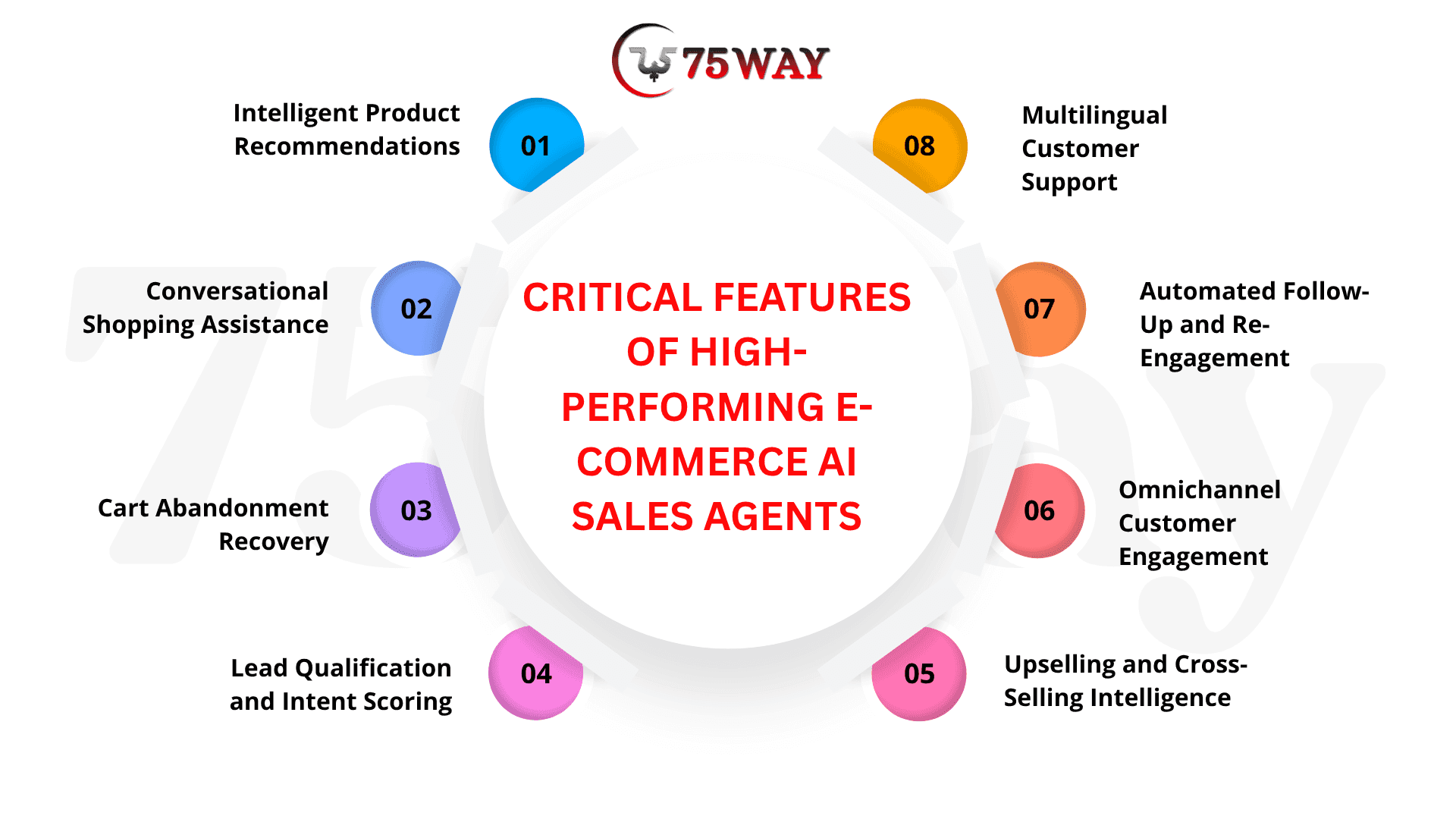
1. Intelligent Product Recommendations
AI sales agent for ecommerce analyzes browsing behavior, purchase history, customer preferences, and real-time interactions to recommend products that align with individual interests. Personalized recommendations help customers discover relevant products while increasing the likelihood of conversion.
- Higher average order value
- Increased customer satisfaction
- Improved product discovery
- Better conversion rates
2. Conversational Shopping Assistance
Ecommerce AI shopping assistants provide real-time support throughout the buying journey. Instead of forcing customers to search manually, the system guides them toward suitable products based on their needs and preferences.
Capabilities
- Product comparisons
- Feature explanations
- Purchase guidance
- Inventory availability checks
3. Cart Abandonment Recovery
Many shoppers leave products in their carts without completing purchases. Retail AI sales agents identify these opportunities and proactively engage customers through personalized recovery campaigns.
Recovery Actions
- Automated reminder messages
- Personalized product suggestions
- Limited-time discount offers
- Purchase assistance prompts
4. Lead Qualification and Intent Scoring
Not every visitor is ready to purchase immediately. AI agents for retail sales evaluate customer behavior and engagement signals to identify high-intent prospects that deserve greater sales attention.
Qualification Factors
- Purchase intent signals
- Product engagement levels
- Budget indicators
- Interaction history
5. Upselling and Cross-Selling Intelligence
Retail AI agent for sales identifies opportunities to recommend premium alternatives or complementary products during the purchasing process. These suggestions are based on customer interests and buying behavior.
- Smartphone + accessories
- Laptop + protection plans
- Fitness equipment + memberships
- Camera + additional lenses
6. Omnichannel Customer Engagement
Customers interact with brands across multiple platforms. Retail AI sales agents for e-commerce maintain consistent conversations and personalized experiences regardless of where interactions occur.
Supported Channels
- Websites
- Mobile applications
- Facebook Messenger
- Email and SMS
7. Automated Follow-Up and Re-Engagement
The sales process does not end after the first interaction. Sales AI agents for e-commerce continue nurturing prospects and existing customers through automated follow-up campaigns designed to encourage future purchases.
- Product reminders
- Promotional notifications
- Loyalty program offers
- Customer reactivation campaigns
8. Multilingual Customer Support
Global e-commerce businesses often serve customers from multiple countries and regions. AI agents for ecommerce sales can communicate in different languages, helping businesses deliver personalized support without expanding multilingual support teams.
By eliminating language barriers, businesses can improve customer experiences, increase international sales opportunities, and support global expansion strategies
How E-commerce AI Sales Agents Are Developed and Deployed?
Developing an AI sales agent requires a structured approach that combines artificial intelligence, customer data, AI automation workflows, and business objectives. A successful implementation goes beyond chatbot development. The following process outlines the key stages involved in building and deploying a high-performing AI sales agent for e-commerce businesses.
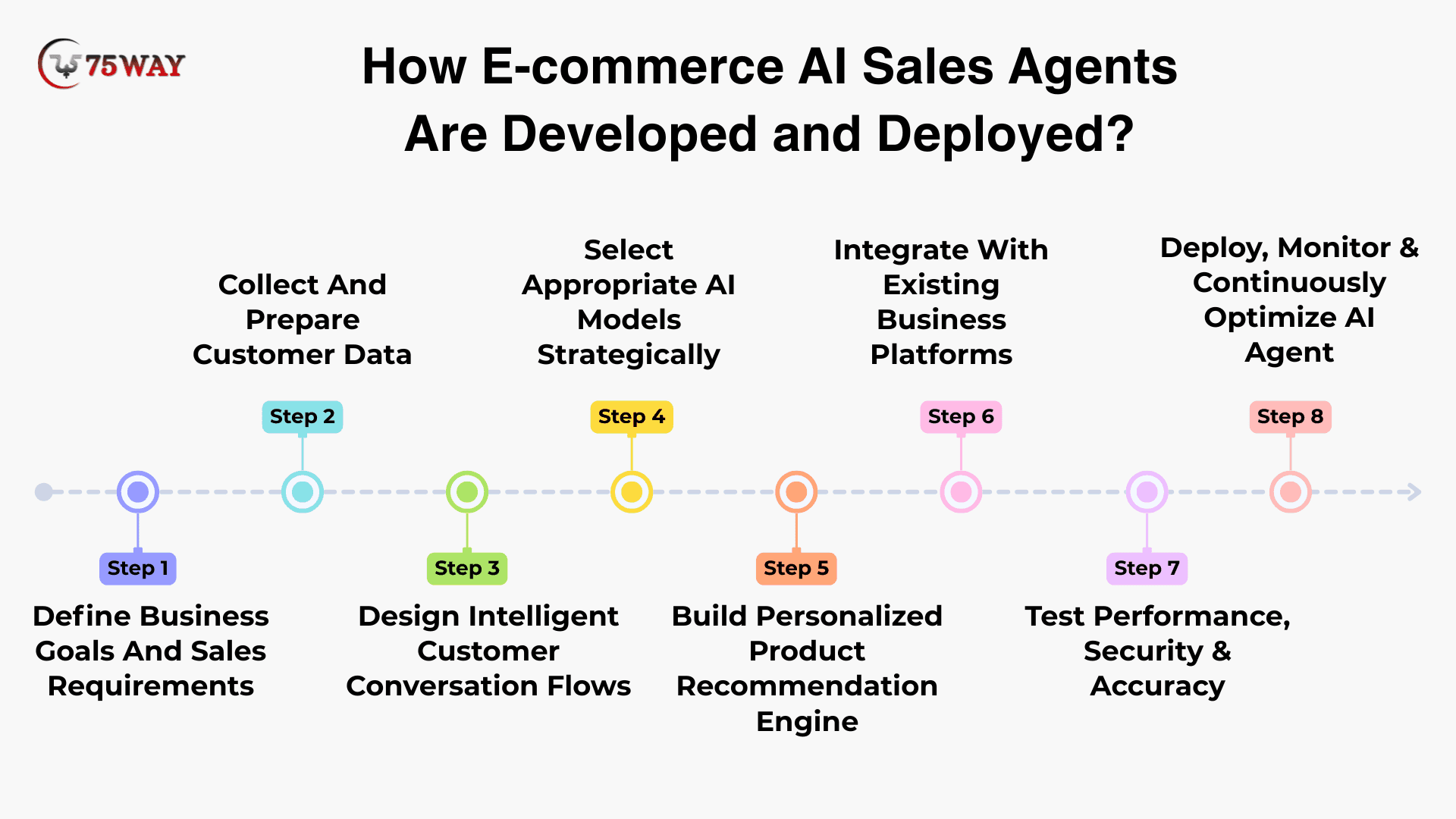
Step 1: Define Business Goals And Sales Requirements
The development process begins with understanding the business objectives the AI sales agent is expected to achieve. Teams analyze customer journeys, sales workflows, product catalogs, support requirements, and revenue goals to establish a clear implementation strategy.
This phase also identifies which sales activities should be automated, which customer segments require personalization, and which communication channels the AI will support. A well-defined strategy ensures development efforts align with business outcomes and customer expectations.
Step 2: Collect And Prepare Customer Data
Data serves as the foundation of every AI-powered sales system. To generate accurate recommendations and meaningful interactions, the AI requires access to structured and high-quality business data.
Common data sources include:
- Product catalogs
- Customer conversations
- Purchase history
- CRM records
- Marketing campaign data
- Website behavior analytics
Data cleansing, normalization, and organization improve model performance and enable more effective personalization capabilities.
Step 3: Design Intelligent Customer Conversation Flows
Before training AI models, businesses must design how customers will interact with the system. Conversation architects create interaction paths that guide users through product discovery, evaluation, and purchasing stages.
These conversational workflows typically cover:
- Product recommendation journeys
- Customer onboarding flows
- Objection handling scenarios
- Checkout assistance sequences
- Post-purchase engagement paths
Well-designed conversation flows create smoother customer experiences while increasing conversion opportunities.
Step 4: Select Appropriate AI Models Strategically
The next step involves choosing the technologies that will power customer interactions and decision-making capabilities. Model selection depends on business goals, complexity requirements, and desired levels of personalization.
Common AI technologies include:
- Large Language Models (LLMs)
- Natural Language Processing (NLP) systems
- Predictive analytics models
- Intent recognition engines
- Customer segmentation algorithms
The selected models determine how effectively the AI understands customer requests and generates relevant responses.
Step 5: Build Personalized Product Recommendation Engine
The recommendation engine is one of the most valuable components of an AI sales agent. This system analyzes customer behavior, preferences, and purchasing patterns to suggest products most likely to generate conversions. Various recommendation approaches may be used depending on business needs:
- Collaborative filtering
- Content-based recommendations
- Behavioral analytics
- Hybrid recommendation models
A well-optimized recommendation engine improves product discovery, increases average order value, and enhances customer satisfaction.
Step 6: Integrate With Existing Business Platforms
For maximum effectiveness, the AI sales agent must connect with the tools and systems already used by the business. Integration enables real-time access to customer information, inventory data, transactions, and sales activities. Common platform integrations include:
- Shopify
- WooCommerce
- Magento
- BigCommerce
- Salesforce
- HubSpot
- Zoho CRM
- Stripe
Seamless integration creates a unified ecosystem that supports personalized customer engagement across all touchpoints.
Step 7: Test Performance, Security & Accuracy
Before deployment, the AI sales agent undergoes comprehensive testing to validate performance, reliability, and security. This stage ensures the system can operate effectively under real-world conditions.
Testing areas often include:
- Response accuracy validation
- Recommendation quality assessment
- User experience testing
- Security verification
- Load and scalability testing
Thorough testing helps identify issues early and improves overall system quality before launch.
Step 8: Deploy Monitor & Continuously Optimize AI Agent
Once testing is complete, the AI sales agent is deployed across selected customer engagement channels. However, deployment is only the beginning of the optimization journey.
Development teams continuously monitor performance metrics such as conversion rates, engagement levels, recommendation effectiveness, and customer satisfaction scores. Insights gathered from ongoing usage help refine conversation flows, improve recommendations, strengthen personalization strategies, and maximize business results over time.
A continuous optimization approach ensures the AI sales agent evolves alongside customer behavior, market trends, and business growth objectives.
How AI Sales Agents In Ecommerce Improve Customer Engagement and Sales?
AI sales agents in ecommerce help achieve these goals by combining automation, personalization, and intelligent decision-making throughout the buying journey. From increasing sales opportunities to reducing operational costs, these systems deliver measurable business benefits that directly impact growth and profitability.
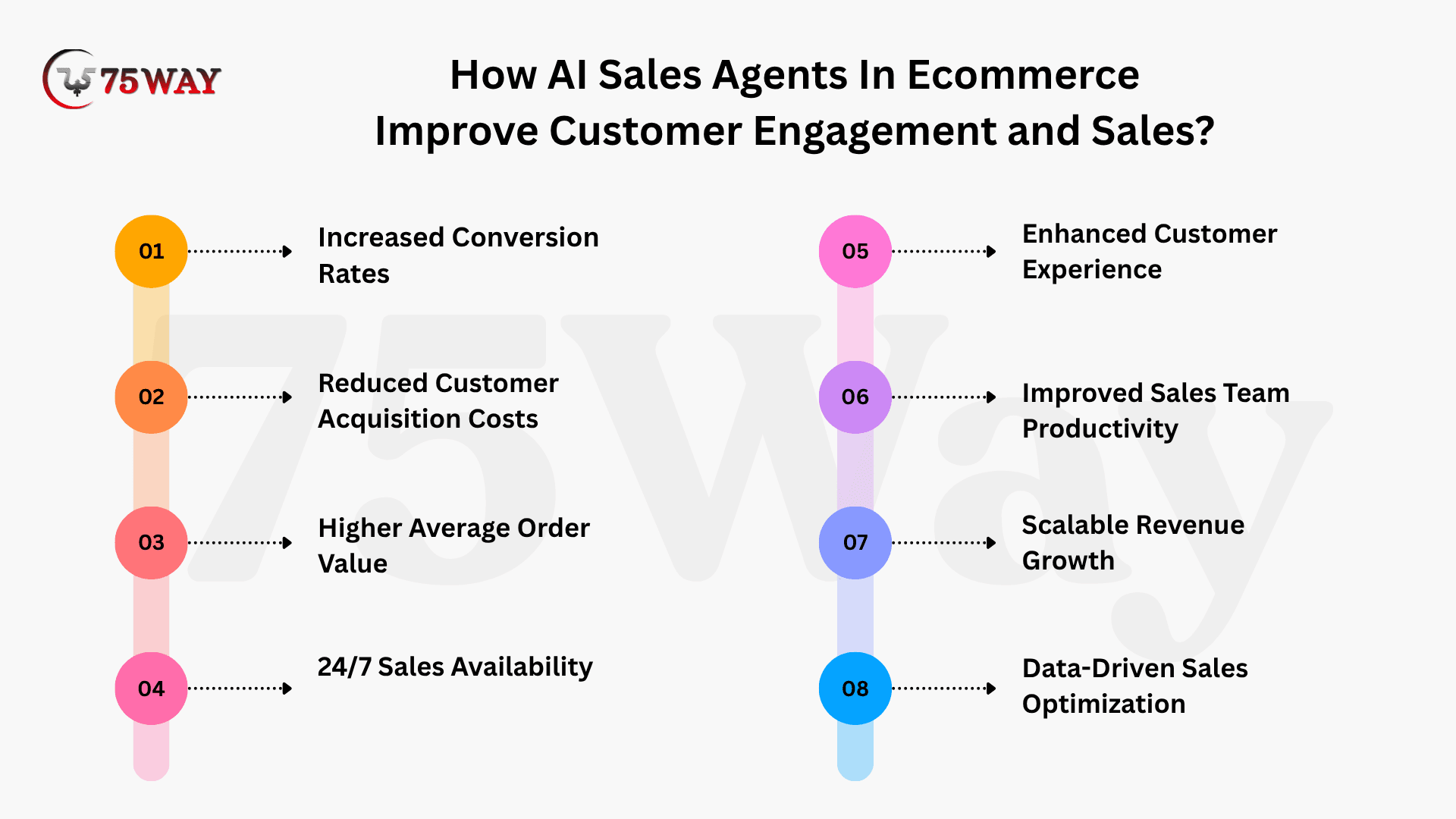
- Increased Conversion Rates: Retail AI sales agents provide personalized recommendations and instant assistance throughout the buying journey. Faster responses and relevant guidance help customers make purchasing decisions.
- Reduced Customer Acquisition Costs: Improved conversion efficiency enables businesses to generate more sales from existing website traffic. This reduces reliance on costly advertising campaigns and acquisition efforts.
- Higher Average Order Value: Intelligent recommendations encourage customers to purchase complementary products, upgrades, or premium alternatives. This increases transaction value while enhancing overall shopping experiences.
- 24/7 Sales Availability: Ecommerce AI sales agents remain available around the clock without operational interruptions. Continuous support helps businesses serve customers across multiple time zones.
- Enhanced Customer Experience: Instant responses, personalized interactions, and proactive assistance improve customer satisfaction. Better shopping experiences encourage repeat purchases and long-term customer loyalty.
- Improved Sales Team Productivity: Automates repetitive sales and support tasks that consume valuable time. Human teams can focus on strategic opportunities and high-value customer interactions.
- Scalable Revenue Growth: Engage thousands of customers without additional staffing requirements. Businesses can scale operations while maintaining consistent service quality.
- Data-Driven Sales Optimization: Analyzes customer behavior, engagement patterns, and purchasing trends. These insights help businesses refine strategies and improve overall sales performance.
Transforming Operations Through AI Agents For Ecommerce Sales
AI agents in ecommerce are reshaping how e-commerce businesses manage sales operations. Instead of relying on traditional static catalogs or manual support teams, businesses now use intelligent systems that guide customers through complex buying journeys and increase conversion opportunities across multiple industries.
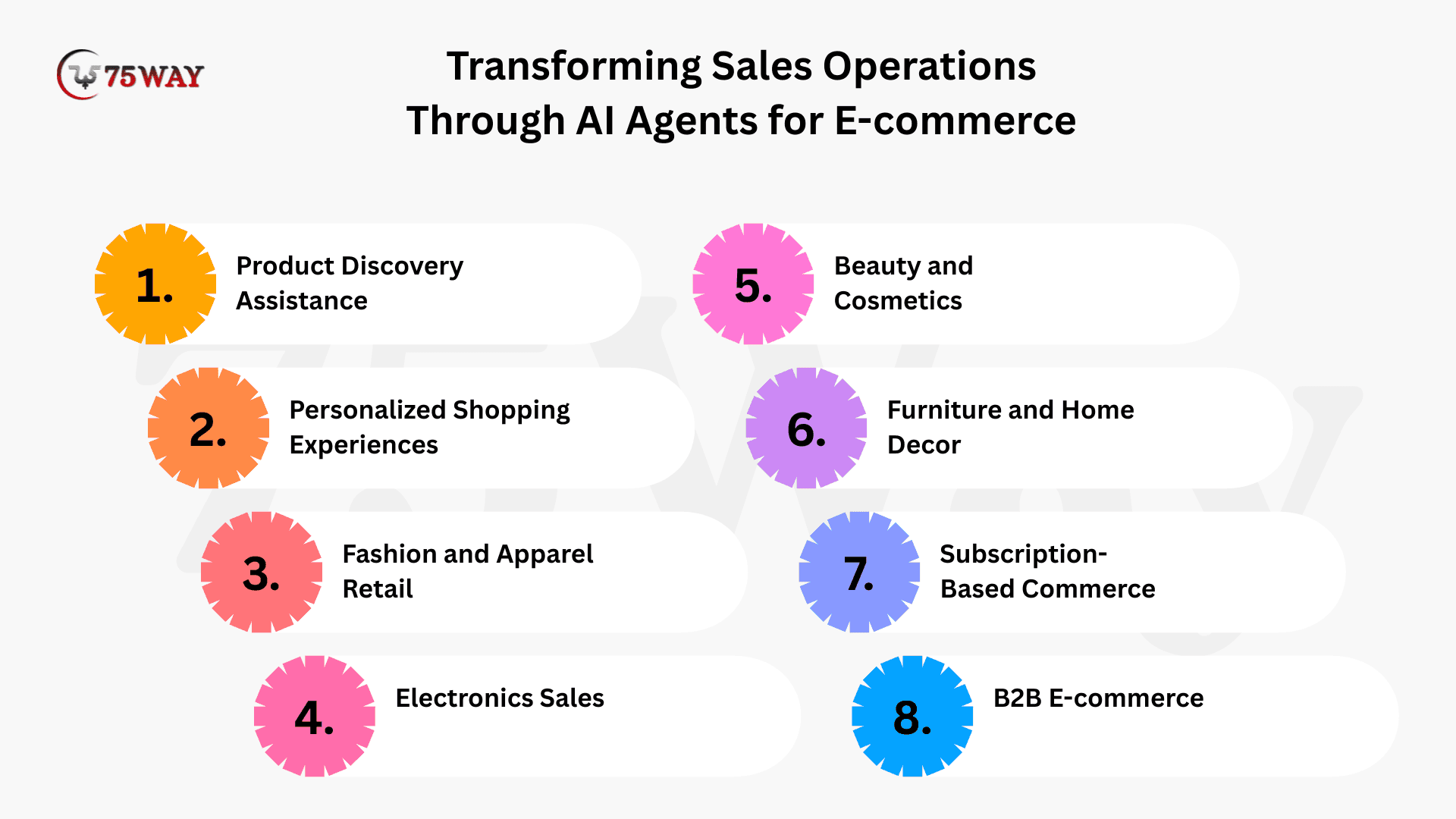
- Product Discovery Assistance: AI sales assistants simplify the product discovery process by helping customers navigate large and complex catalogs more efficiently. Instead of manually searching through hundreds or thousands of listings, users receive guided assistance based on their intent and preferences.
- Personalized Shopping Experiences: Modern AI systems analyze customer behavior, browsing patterns, purchase history, and preferences to deliver tailored shopping experiences. Each interaction is dynamically adjusted based on individual interests.
- Fashion and Apparel Retail: In the fashion industry, AI sales agents function as virtual stylists. They recommend outfits, suggest complementary accessories, guide size selection, and highlight seasonal collections based on user preferences and trends.
- Electronics Sales: Electronics purchasing often involves technical specifications and product comparisons. AI sales agents assist customers by explaining features, comparing models, and ensuring compatibility with existing devices or systems.
- Beauty and Cosmetics: In the beauty sector, ecommerce AI sales agents provide highly personalized recommendations based on skin type, tone, product preferences, and past purchases. They also suggest skincare routines and cosmetic combinations, helping customers build complete beauty solutions rather than isolated product purchases.
- Furniture and Home Decor: AI agent for ecommerce plays a key role in helping customers visualize and select furniture based on room size, layout, color schemes, and interior design preferences. By offering context-aware recommendations, the AI improves decision-making and reduces the risk of unsuitable purchases.
- Subscription-Based Commerce: For subscription-based businesses, AI sales agents encourage recurring purchases and membership upgrades by analyzing usage patterns and customer engagement levels.
- B2B E-commerce: In B2B environments, AI sales agents support lead qualification, account-based selling, and bulk purchasing decisions. They help businesses identify high-value prospects, provide product documentation, and streamline negotiation processes.
By integrating AI sales agents into different e-commerce verticals, businesses can enhance customer experiences, increase operational efficiency, and unlock new revenue opportunities across both consumer and enterprise markets.
Difference Between E-commerce AI Sales Agent And Traditional Sales Support
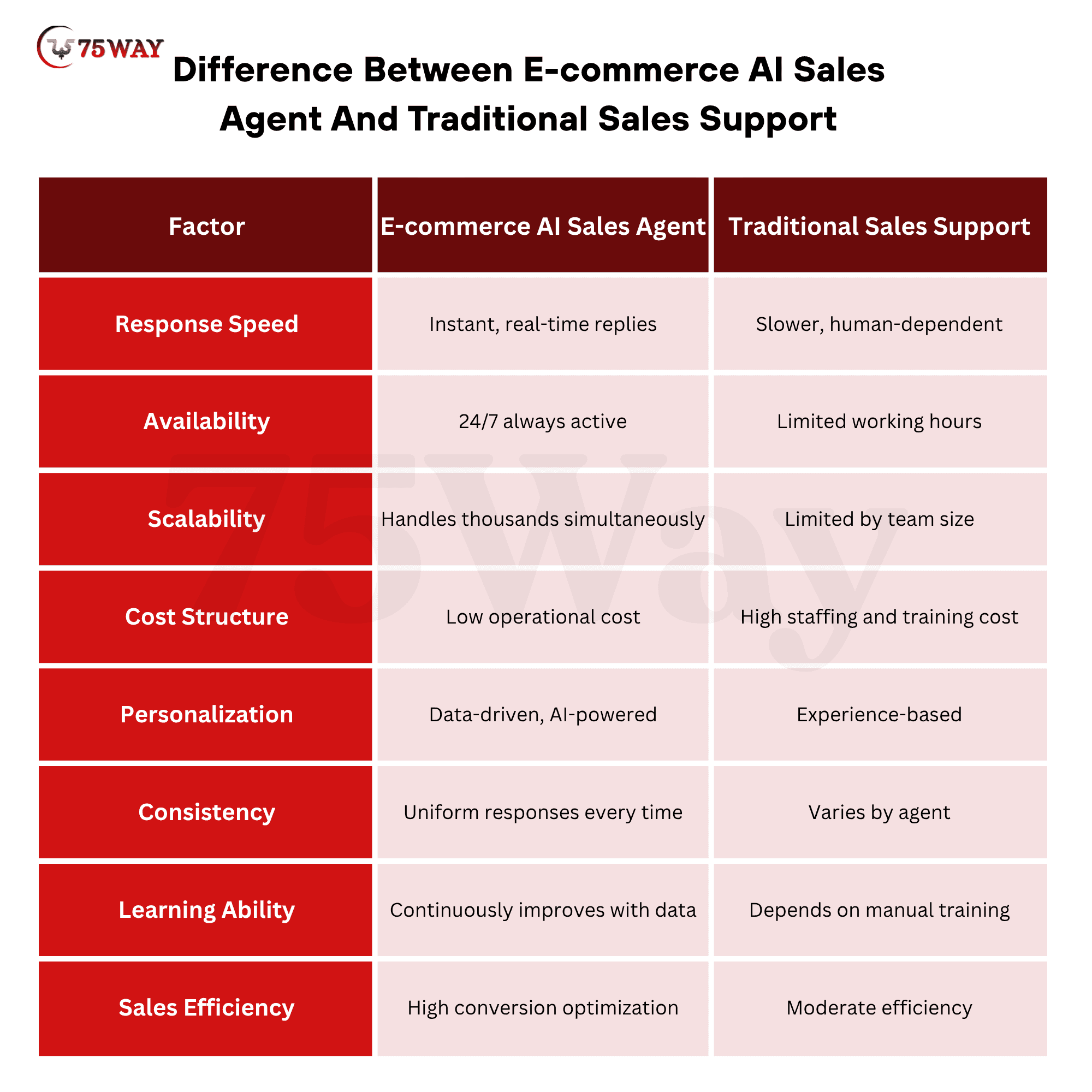
E-commerce AI sales agents differ from traditional sales support primarily in speed, scalability, cost efficiency, and personalization. AI sales agents automate customer interactions using artificial intelligence, delivering instant, data-driven responses and recommendations 24/7. In contrast, traditional sales support depends on human agents who operate within limited hours, handle fewer customers at a time, and rely on personal experience rather than real-time data analysis. As a result, AI systems are more scalable and consistent, while human support is more limited but better suited for complex emotional or high-touch interactions.
Cost of Building Sales AI Agent In Ecommerce & Retail
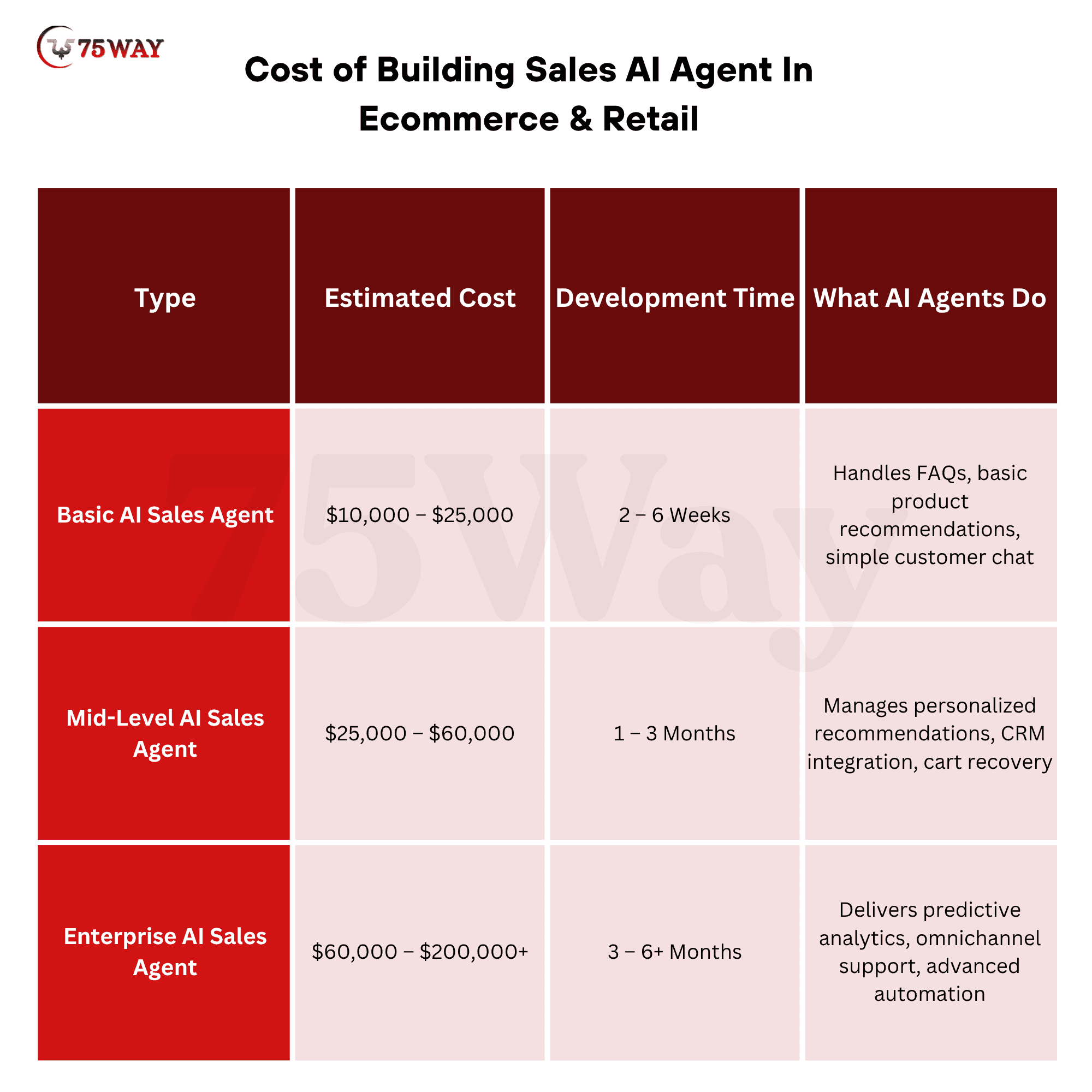
The cost of developing an AI sales agent ranges between $10,000–$200,000+ depending on multiple factors such as feature complexity, integrations, data requirements, and scalability needs. Businesses that require basic conversational automation can build systems at a lower cost, while advanced enterprise-grade AI agents require deeper learning capabilities.
Basic AI Sales Agent Cost: $10,000 – $25,000
Basic AI sales agents typically include simple conversational flows, product recommendations, FAQ handling, and limited integrations. These solutions are suitable for small e-commerce businesses that want to automate customer support and improve response time without advanced personalization or analytics capabilities.
Mid-Level AI Sales Agent Cost: $25,000 – $60,000
Mid-level solutions offer more advanced capabilities such as behavior-based recommendations, CRM integration, cart abandonment recovery, and multi-channel communication. These systems are designed for growing businesses that require better personalization, improved conversion optimization, and stronger automation workflows.
Enterprise AI Sales Agent Cost: $60,000 – $200,000+
Enterprise-grade AI sales agents include advanced machine learning models, deep personalization engines, omnichannel engagement, predictive analytics, multilingual support, and large-scale system integrations. These solutions are built for high-traffic e-commerce platforms and global enterprises that need scalable, intelligent, and highly optimized sales automation systems.
Future of AI Sales Agents in E-commerce
AI sales agents are rapidly evolving beyond customer support and recommendation functions. Future capabilities may include:
- Advanced predictive selling
- Hyper-personalized customer journeys
- Autonomous sales execution
- Voice commerce support
- Emotional sentiment analysis
- Dynamic pricing recommendations
- Real-time inventory optimization
As AI technologies mature, sales agents will become increasingly central to digital commerce strategies.
Final Remarks
AI sales agents are reshaping the future of e-commerce by combining intelligent automation, personalized customer engagement, and scalable sales support within a single solution. From product discovery and cart recovery to lead qualification and upselling, these systems help businesses create more meaningful customer interactions while increasing revenue opportunities. They also reduce dependency on large support teams by handling repetitive queries with speed and consistency. Over time, they continuously learn from customer behavior to improve accuracy and performance. This makes them a long-term growth asset for modern digital commerce businesses. If you want to build an AI sales agent for your e-commerce business, you can hire a trusted AI agent development company.
Frequently Asked Questions (FAQs)
Can AI Sales Agents Work Alongside Human Sales Teams?
Yes. AI sales agents handle repetitive interactions, lead qualification, customer inquiries, and product recommendations. Human representatives can focus on complex negotiations, relationship building, and high-value opportunities. This collaborative approach improves productivity, customer satisfaction, and overall sales performance while maintaining personalized support where human expertise adds greater value.
How Long Does AI Sales Agent Implementation Typically Take?
Implementation timelines depend on complexity, integrations, customization requirements, and data readiness. Basic deployments may take several weeks, while enterprise-level solutions involving multiple systems, advanced personalization, and custom workflows can require several months for development, testing, and deployment.
Can AI Sales Agents Support Multiple Product Categories?
Yes. AI sales agents can manage extensive product catalogs across various categories. Through recommendation engines and contextual understanding, they provide relevant suggestions regardless of whether the business sells fashion, electronics, furniture, beauty products, industrial supplies, or other merchandise.
Can AI Sales Agents Be Integrated With Existing E-commerce Platforms?
Yes, modern AI sales agents are designed to integrate with popular e-commerce platforms, CRM systems, marketing automation tools, payment gateways, and analytics solutions. Integration enables seamless data flow, consistent customer experiences, and improved visibility across sales and marketing operations.
Can AI Sales Agents Increase Repeat Purchases?
Yes, AI sales agents increase repeat purchases through personalized follow-ups and targeted product recommendations. They re-engage customers using behavioral insights and purchase history.
Do AI Sales Agents Work On Mobile Apps And Websites?
Yes, AI sales agents integrate seamlessly into both mobile apps and websites. They deliver consistent conversational experiences across all digital customer touchpoints.
Is Coding Required To Use AI Sales Agents?
No coding is required for most platforms. Businesses can configure workflows, integrations, and responses using user-friendly dashboards and setup tools.
Can AI Sales Agents Improve Marketing Campaign Performance?
Yes, AI sales agents enhance marketing campaigns by capturing intent data and qualifying leads. They also guide users toward higher-converting products.