
Summary
Scaling SaaS platforms to 100,000+ users requires cloud-native architecture, microservices design, optimized databases, load balancing, caching strategies, and continuous monitoring. Strong DevOps pipelines, horizontal scaling, and security frameworks ensure stability under high traffic. Businesses achieve sustainable growth through modular systems, performance optimization, and infrastructure designed for long-term expansion.
Quick Overview
- SaaS scalability depends on distributed architecture and cloud-native infrastructure design
- Microservices enable modular development and independent system scaling capabilities
- Database optimization prevents performance bottlenecks under high user loads
- Load balancing ensures stable performance during traffic spikes and growth
- DevOps automation improves deployment speed, reliability, and system stability
Building a product for 1,000 users is fundamentally different from supporting 100,000 active users across multiple regions, devices, and real-time interactions. As user demand grows, systems begin to face serious challenges such as slow response times, database overload, and infrastructure breakdowns.
To scale a SaaS platform to 100K+ users requires more than just strong coding practices. It demands a well-planned system architecture, cloud-native infrastructure, distributed services, optimized databases, and automated DevOps pipelines. Every layer of the system, from frontend performance to backend scalability, must be engineered for growth.
This guide explains the complete engineering, architecture, and scaling approach required to build SaaS platforms capable of handling 100K+ users in 2026. It also covers infrastructure design, performance optimization, deployment strategies, and real-world scalability considerations.
Step-by-Step Process to Scale a SaaS Platform to 100K+ Users in 2026
Expanding a SaaS platform to 100,000+ users requires cloud-native architecture, microservices design, optimized databases, caching layers, load balancing, and DevOps automation. These elements work together to maintain performance, handle increasing traffic, and support long-term growth without system breakdown or downtime under heavy usage conditions.
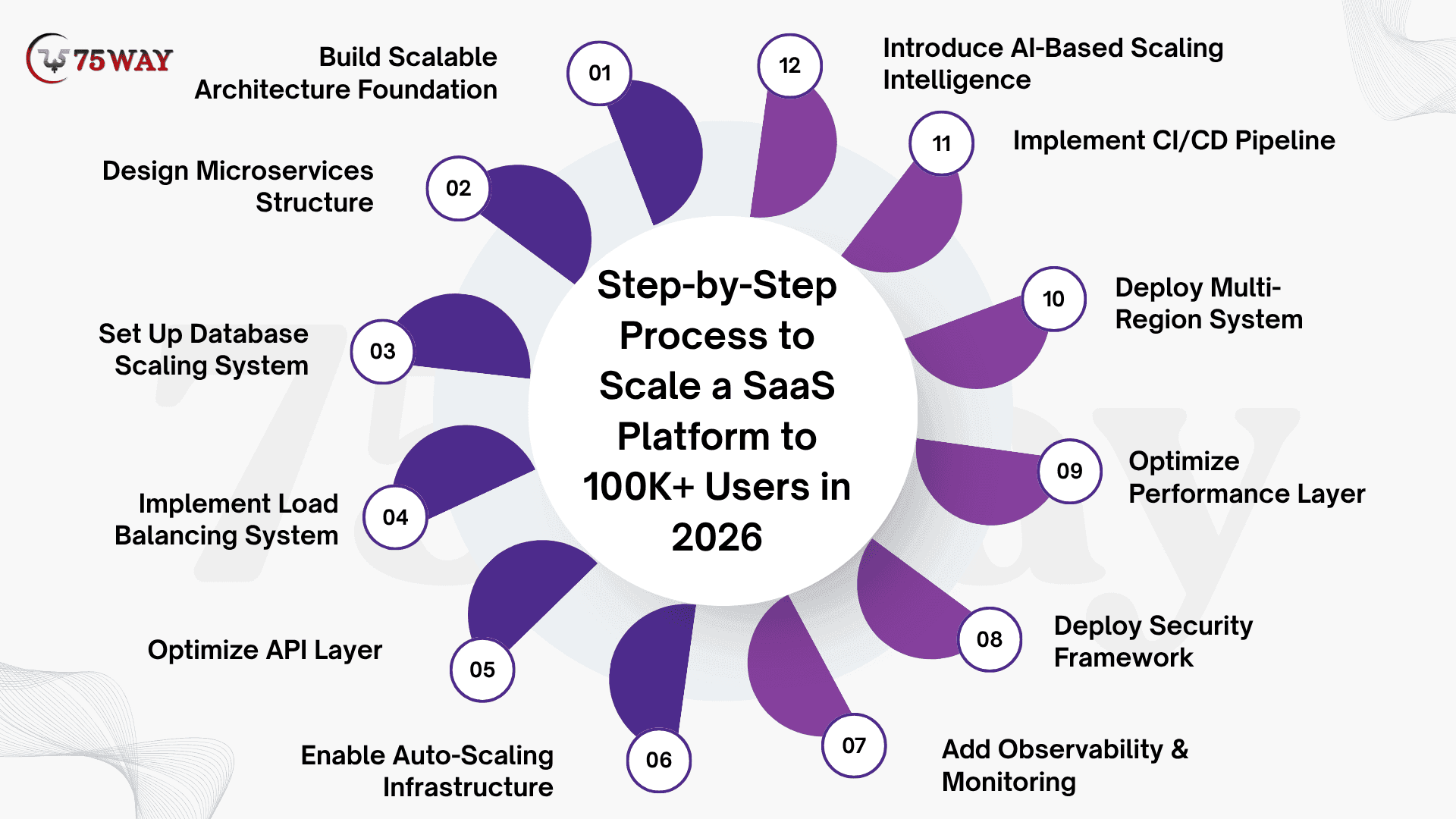
Step 1: Build Scalable Architecture Foundation
Start by designing a cloud-native architecture instead of a monolithic structure. This ensures the SaaS platform is built to handle growth from the beginning without performance degradation.
Key actions include selecting a reliable cloud provider such as AWS, Azure, or Google Cloud, setting up containerized environments using Docker and Kubernetes, and building a stateless backend so any server can handle requests without dependency on local memory.
This foundation allows horizontal scaling, fault tolerance, and smooth handling of traffic spikes without system failure.
Step 2: Design Microservices Structure
Microservices architecture divides the SaaS platform into independent functional units such as authentication, billing, notifications, analytics, and user management.
Each service operates separately, which means it can be developed, deployed, and scaled independently. If one service fails, it does not affect the entire system.
This structure improves system resilience, accelerates deployment cycles, and enables targeted scaling based on demand for each service.
Step 3: Set Up Database Scaling System
Database scalability is essential for handling high user volumes and large data loads efficiently.
This includes implementing database sharding to distribute data across multiple servers, setting up read and write replication to balance query loads, and combining SQL and NoSQL databases based on use cases.
A Redis caching layer is also used to reduce database calls and improve response speed. Together, these techniques ensure high performance under heavy traffic conditions.
Step 4: Implement Load Balancing System
Load balancing ensures that incoming user traffic is evenly distributed across multiple servers.
Global load balancers route traffic based on location, server capacity, and performance conditions. Geo-based routing improves speed by directing users to the nearest server.
Auto traffic distribution prevents any single server from becoming overloaded, improving system stability and reducing downtime during peak usage periods.
Step 5: Optimize API Layer
APIs form the communication backbone of a SaaS platform, so they must be highly optimized for speed and scalability.
This involves reducing unnecessary payload size, implementing pagination for large datasets, and using GraphQL where flexible data fetching is required.
Rate limiting is added to prevent abuse and maintain system stability under high request volumes. Optimized APIs ensure fast response times even during peak traffic.
Step 6: Enable Auto-Scaling Infrastructure
Auto-scaling allows the system to dynamically adjust resources based on real-time demand.
Horizontal scaling adds more servers when traffic increases, while vertical scaling increases the capacity of existing servers.
Policy-based scaling triggers automatically respond to CPU usage, memory load, or request volume. This ensures consistent performance without manual intervention.
Step 7: Add Observability & Monitoring
Observability systems provide real-time visibility into platform performance and health.
This includes monitoring logs, tracking performance metrics, and analyzing error rates across the system.
Advanced setups also use AI-based anomaly detection to identify unusual behavior patterns early, helping teams fix issues before they impact users.
Step 8: Deploy Security Framework
Security is critical when scaling SaaS platforms to large user bases.
A zero-trust architecture ensures every request is verified, while end-to-end encryption protects data in transit and at rest.
Role-based access control limits system access based on user roles, and regular penetration testing identifies vulnerabilities before they are exploited.
Step 9: Optimize Performance Layer
Performance optimization ensures fast and smooth user experiences across devices and regions.
CDN integration reduces latency by serving content from nearby locations. Lazy loading improves page speed by loading content only when needed.
Code splitting and frontend optimization reduce application load time and improve overall responsiveness.
Step 10: Deploy Multi-Region System
A multi-region setup improves global performance by distributing infrastructure across different geographic locations.
Geo-routing directs users to the nearest available server, reducing latency. Data replication ensures consistency and availability across regions.
This setup is essential for SaaS platforms targeting global audiences with consistent performance expectations.
Step 11: Implement CI/CD Pipeline
CI/CD pipelines automate the process of building, testing, and deploying software updates.
Continuous integration ensures code changes are tested automatically, while continuous deployment pushes updates to production safely.
A rollback system allows quick recovery in case of failures, ensuring stability during rapid development cycles.
Step 12: Introduce AI-Based Scaling Intelligence
AI-driven scaling systems predict traffic patterns and optimize resource allocation automatically.
Traffic forecasting helps anticipate peak usage periods, while auto resource allocation adjusts computing power accordingly.
Anomaly detection identifies performance issues in real time, enabling proactive system optimization and improved platform reliability at scale.
Security Architecture for SaaS Platforms at Scale
Security becomes a core foundation when scaling SaaS platforms beyond 100,000 users because attack surface, data exposure, and integration points increase significantly. A scalable SaaS system must be built on a zero-trust security model, meaning no user, device, or service is trusted by default.
Key security layers include:
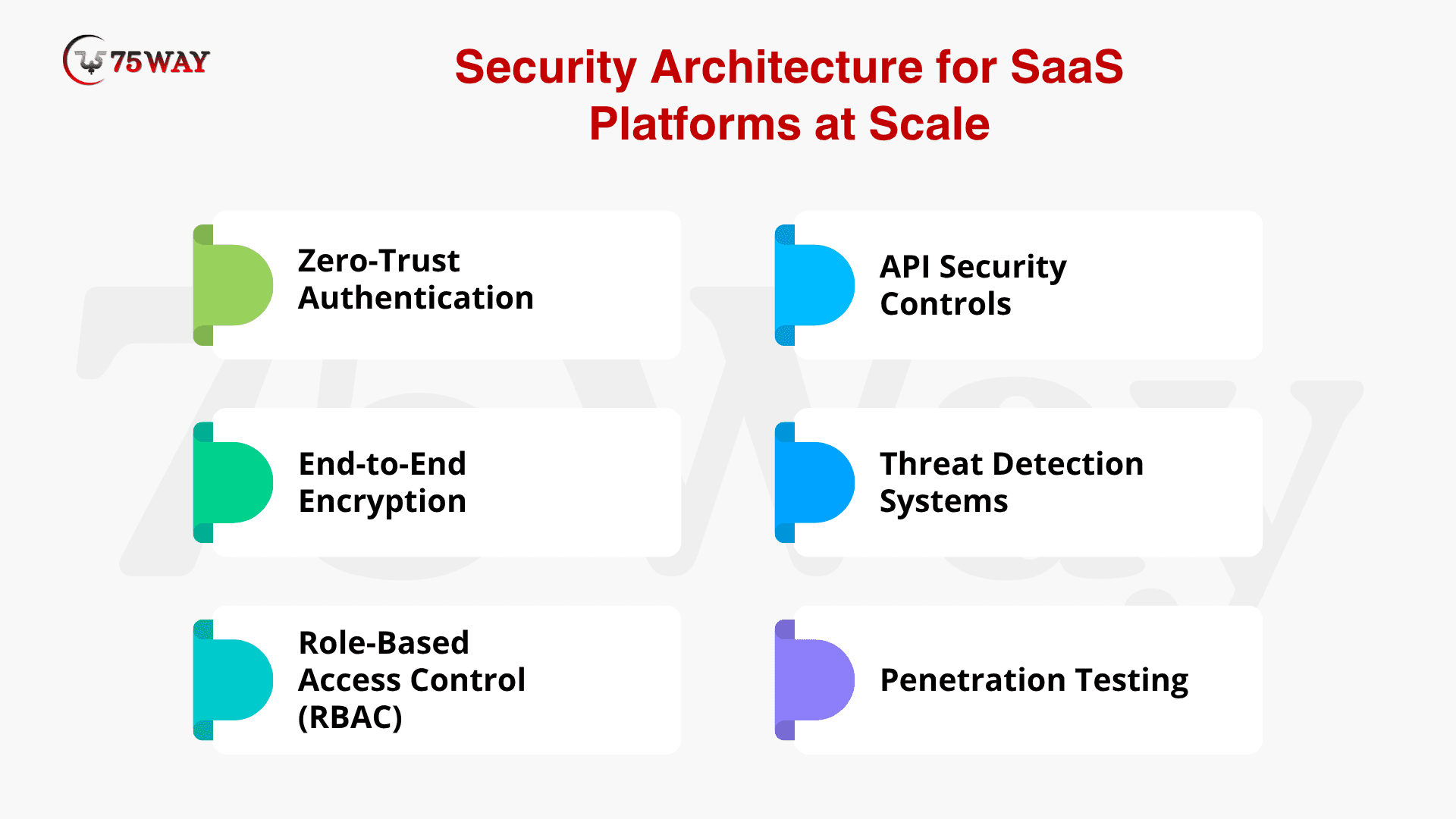
- Zero-Trust Authentication
- Prevents unauthorized internal and external access
- Every request is verified before access is granted
- End-to-End Encryption
- Encrypts data during transfer and storage
- Protects sensitive user and business information
- Role-Based Access Control (RBAC)
- Access permissions assigned based on user roles
- Limits exposure of critical system functions
- API Security Controls
- Token-based authentication (JWT, OAuth)
- Rate limiting to prevent abuse and attacks
- Threat Detection Systems
- Continuous vulnerability scanning
- Real-time intrusion detection monitoring
- Penetration Testing
- Simulated attacks to identify system weaknesses
- Helps strengthen security before production exposure
A strong security architecture ensures compliance readiness, user trust, and long-term platform stability under scale.
Performance Optimization Strategy for High-Traffic SaaS
Performance optimization plays a critical role in maintaining stability, speed, and reliability across high-traffic SaaS platforms. It directly influences user satisfaction, conversion rates, and long-term system scalability under growing demand conditions. Efficient optimization ensures seamless application behavior even during peak usage periods.
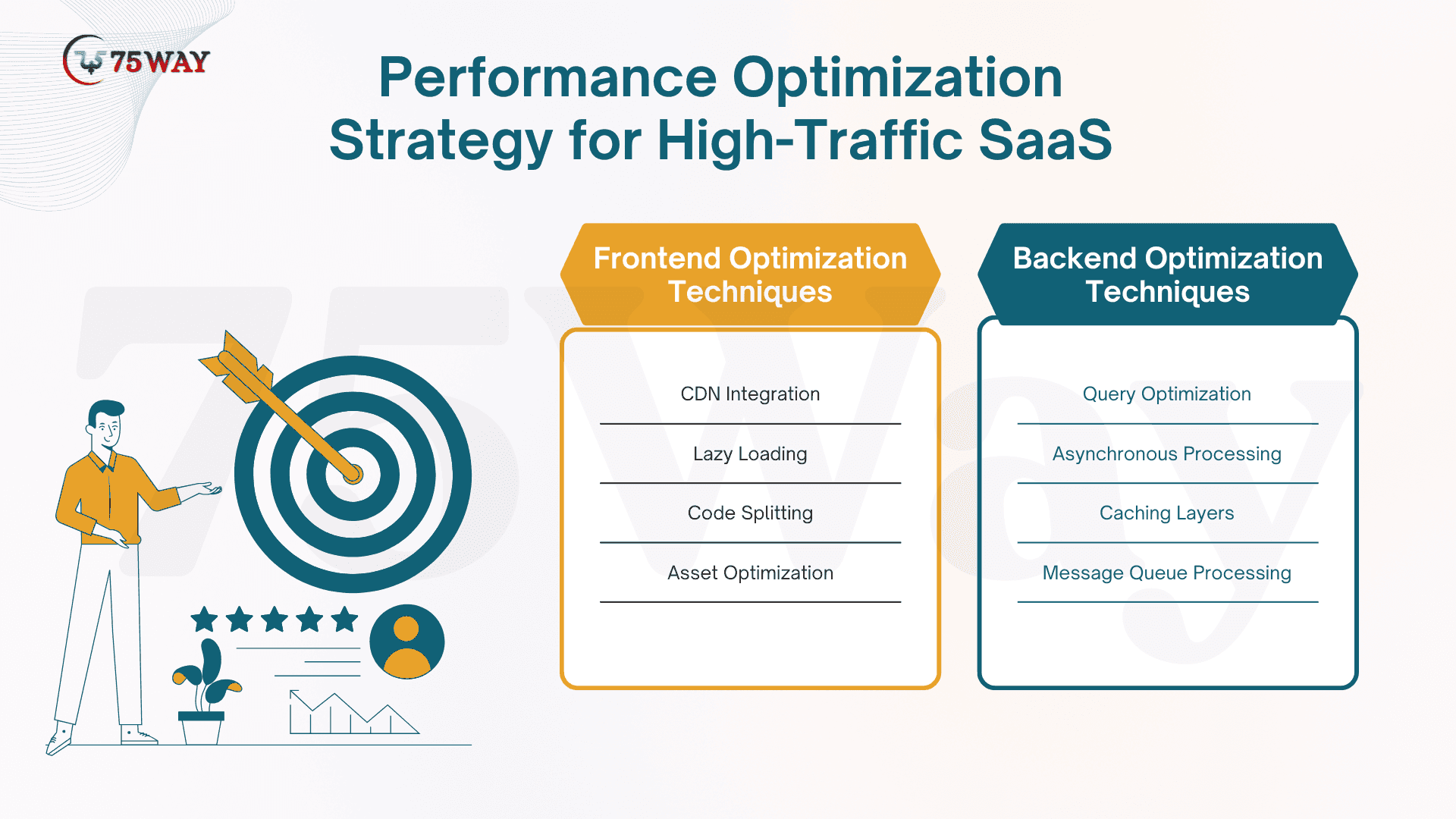
Frontend Optimization Techniques
- CDN Integration: Content is delivered through globally distributed servers positioned closer to end users, which significantly reduces latency and improves page response speed. This approach enhances overall reliability and ensures smooth performance during high-traffic conditions across different regions.
- Lazy Loading: Only essential visible elements are loaded first, while remaining content is fetched as users scroll or interact. This technique improves initial rendering speed, reduces unnecessary data usage, and creates a faster, more responsive interface for SaaS applications.
- Code Splitting: Large application bundles are broken into smaller modules that load independently based on user interaction. This reduces initial load time, improves navigation speed, and ensures smoother performance in complex SaaS platforms handling heavy user activity.
- Asset Optimization: Images, scripts, and static resources are compressed and streamlined to reduce file size and bandwidth usage. This results in faster loading times, lower server load, and improved overall performance efficiency under high-traffic SaaS environments.
Backend Optimization Techniques
- Query Optimization: Database queries are structured to minimize execution time and reduce unnecessary data retrieval, improving overall system responsiveness. Proper indexing, query planning, and efficient joins help maintain stable performance even under high concurrent user loads.
- Asynchronous Processing: Tasks are executed in the background without blocking the main application flow, allowing faster user interactions. This approach improves system responsiveness, reduces wait times, and supports smooth handling of large-scale operations in SaaS environments.
- Caching Layers: Frequently accessed data is stored in temporary memory systems to reduce repeated database calls. This significantly improves response speed, lowers server load, and enhances overall application performance during high-traffic usage scenarios.
- Message Queue Processing: Incoming requests are managed through message queues that decouple system components and balance workload efficiently. This ensures smooth task execution, prevents system overload during traffic spikes, and improves reliability by processing high-volume operations asynchronously in a controlled manner.
Scalable Multi-Region Deployment Strategy for High-Traffic SaaS
Multi-region architecture is essential for SaaS platforms targeting global users and high availability requirements. It distributes infrastructure across multiple geographic locations to reduce latency, improve reliability, and maintain consistent performance for users accessing the system from different regions.
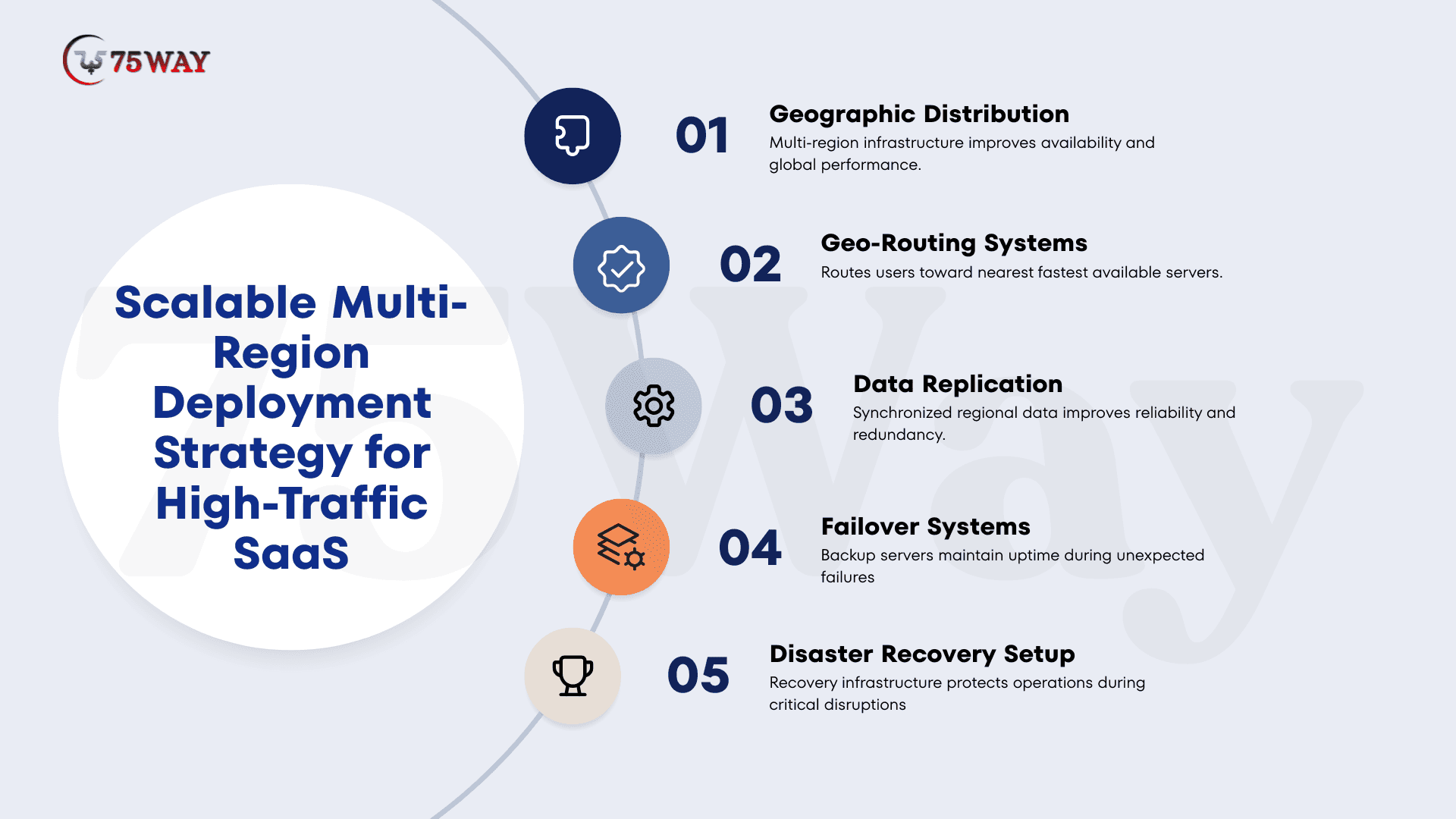
- Geographic Distribution: Infrastructure is deployed across multiple global regions instead of relying on a single data center. This reduces system dependency on one location, improves availability, and ensures better performance for users across international markets.
- Geo-Routing Systems: User requests are automatically directed to the nearest available server based on location and network conditions. This minimizes response time, reduces latency, and delivers faster application performance across globally distributed SaaS users.
- Data Replication: Data is continuously synchronized across multiple regions to maintain consistency and redundancy. This ensures backup reliability, improves fault tolerance, and allows seamless data access even if one region experiences issues.
- Failover Systems: Traffic is automatically redirected to backup servers when primary systems fail or become unavailable. This maintains uninterrupted service availability, reduces downtime risks, and ensures a stable user experience during unexpected outages.
- Disaster Recovery Setup: Backup infrastructure is maintained to restore systems during critical failures or catastrophic events. It ensures business continuity, protects data integrity, and enables rapid recovery with minimal operational disruption.
Multi-region systems are essential for maintaining performance consistency across international user bases.
CI/CD Automation for Scalable SaaS Delivery
CI/CD pipelines enable SaaS platforms to scale development and deployment without introducing instability. They streamline software delivery through automation, improving speed, reliability, and system consistency.
1. Continuous Integration (CI): Code changes are tested and validated before merging into the main branch. This improves code quality and reduces integration issues during development cycles.
- Code changes automatically tested before merging
- Detects bugs early in the development cycle
- Ensures stable codebase consistency
2. Continuous Deployment (CD): Approved code updates are automatically released into production environments. This accelerates feature delivery and reduces manual deployment risks across systems.
- Automated deployment to production environments
- Faster feature releases
- Reduced manual errors
3. Supporting Infrastructure
- Docker Containers: Applications run in standardized environments across all stages of development and production. This ensures consistency and eliminates environment-related deployment issues.
- Kubernetes Orchestration: Containerized services are automatically managed and scaled based on system demand. This supports high availability and efficient resource utilization across infrastructure.
- Rollback Mechanisms: The system can instantly revert to previous stable versions when deployment issues occur. This minimizes downtime and protects platform stability during failures.
How To Scale SaaS Product With Artificial Intelligence Solutions?
Artificial intelligence enables SaaS platforms to scale intelligently by analyzing system behavior, predicting demand patterns, and optimizing infrastructure in real time. AI SaaS solutions reduce manual intervention while improving performance, reliability, and cost efficiency across global applications. This approach helps SaaS businesses manage rapid user growth without compromising system stability or user experience.
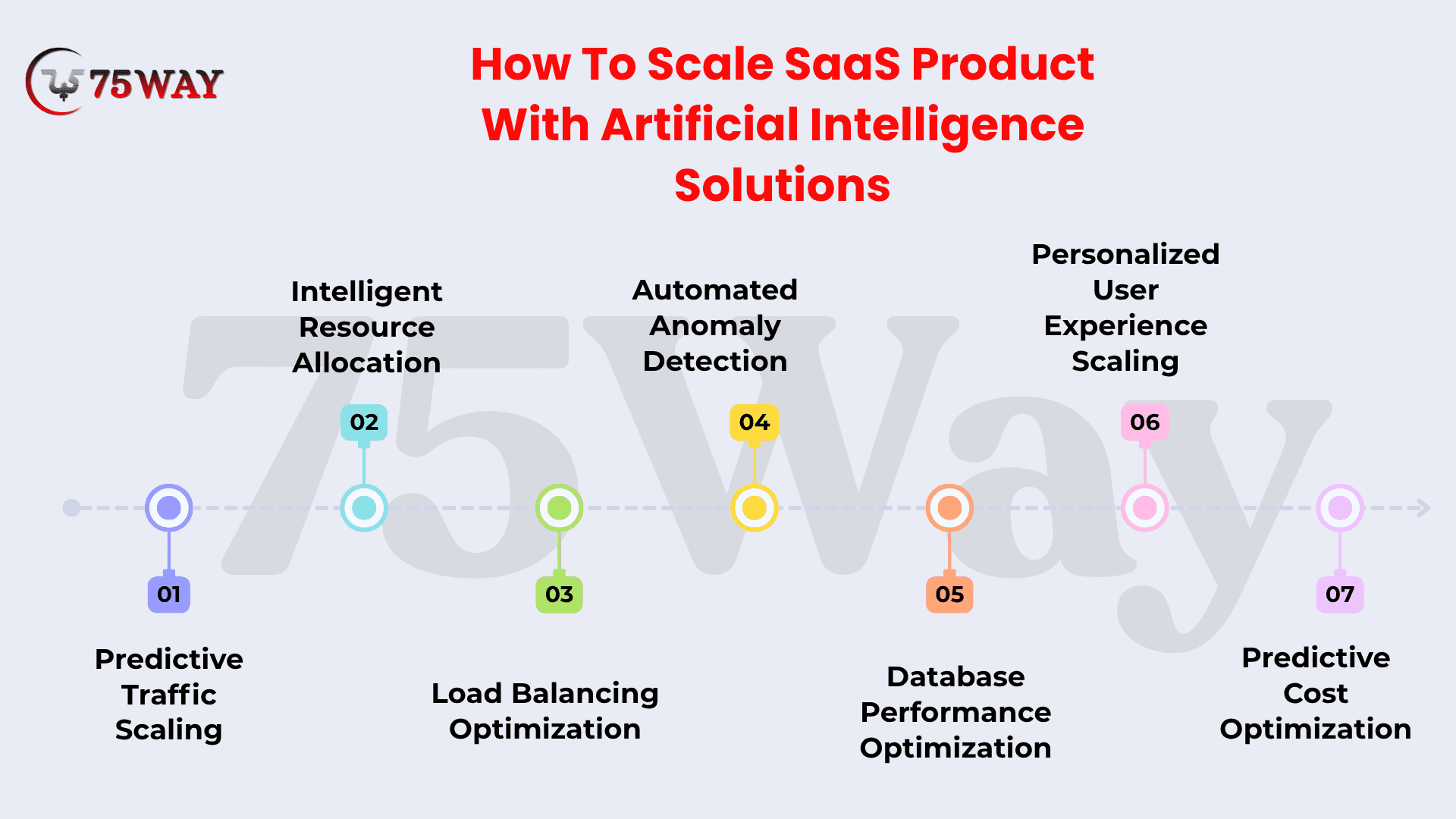
1. Predictive Traffic Scaling
Machine learning analyzes historical usage patterns to forecast future traffic spikes with accuracy. It prepares infrastructure in advance to handle demand surges. This reduces downtime risks during peak usage periods. System resources are allocated proactively for stability.
2. Intelligent Resource Allocation
System resources are distributed dynamically based on real-time workload demands. Critical services receive priority computing power during high usage. This prevents resource wastage and improves operational efficiency. Overall system performance remains stable under varying loads.
3. Load Balancing Optimization
Traffic is routed to servers with optimal performance and lowest latency. Routing decisions are continuously adjusted based on system conditions. This ensures faster response times for end users. Platform stability improves across distributed environments.
4. Automated Anomaly Detection
System behavior is continuously monitored to identify irregular patterns and performance issues. Early detection prevents system failures and downtime. Alerts trigger corrective actions before users are impacted. This improves reliability and operational resilience.
5. Database Performance Optimization
Query execution paths, indexing strategies, and caching mechanisms are optimized automatically. This reduces database load and improves response speed. High concurrency environments perform efficiently without bottlenecks. Data access remains consistent under heavy traffic conditions.
6. Personalized User Experience Scaling
User interactions are analyzed to deliver customized interface experiences and features. This increases engagement and platform retention rates. Interfaces adapt dynamically based on usage patterns. User satisfaction improves across large-scale deployments.
7. Predictive Cost Optimization
Infrastructure usage is analyzed to identify unnecessary resource consumption patterns. Optimization strategies reduce cloud spending without affecting performance. This ensures balanced cost and scalability management. Businesses achieve better ROI on infrastructure investments.
Common Mistakes to Avoid While Building & Scaling SaaS And Solutions
Many SaaS platforms fail during scaling due to architectural, infrastructure, and operational gaps. These mistakes usually appear during early product development and become critical bottlenecks as user demand increases. Identifying and correcting them early significantly improves system stability, performance, and long-term scalability.
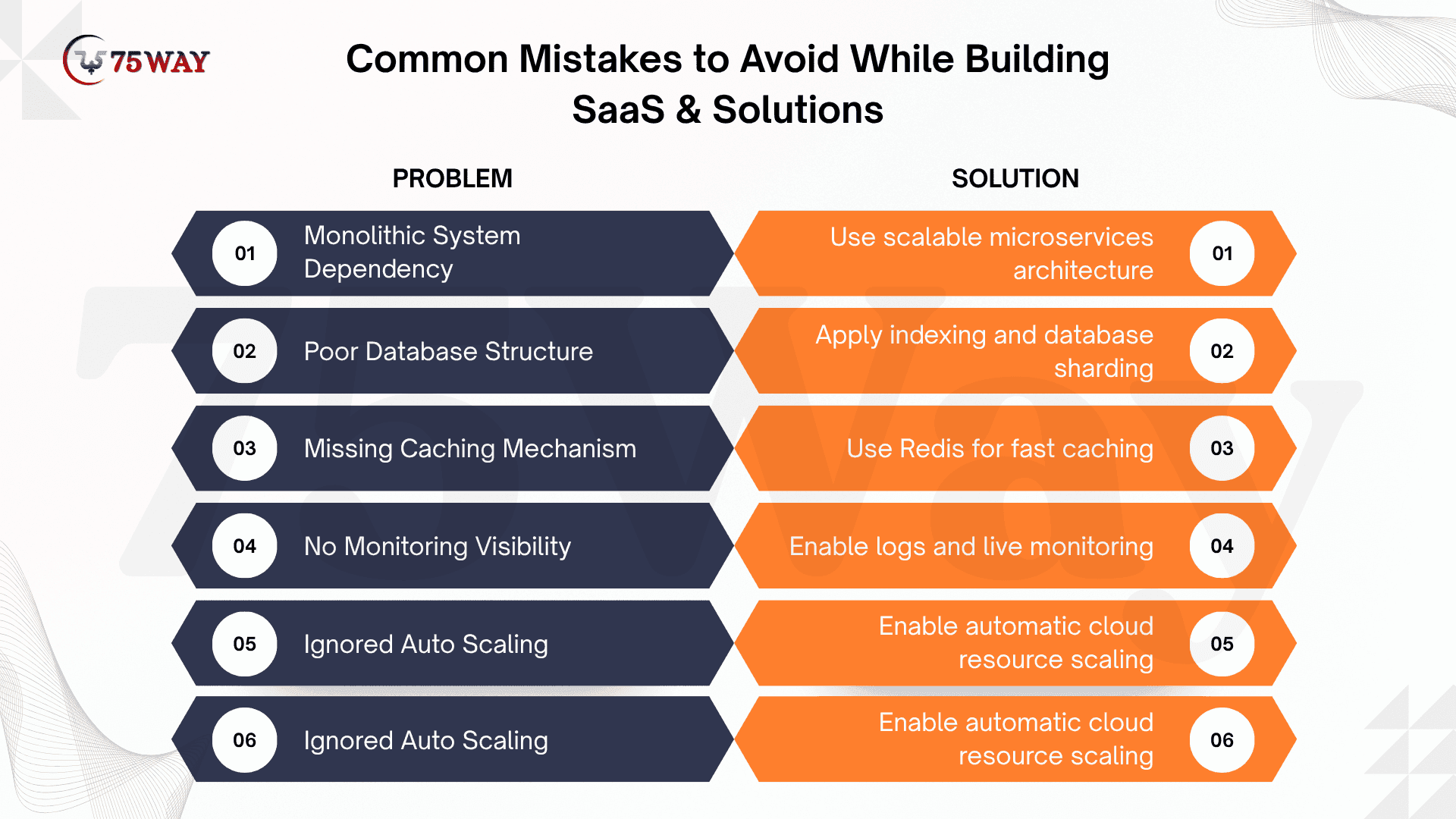
- Monolithic Architecture Dependency
Systems built as a single unified codebase become difficult to scale as user demand grows. Any small change impacts the entire application, reducing flexibility and increasing deployment risks. This structure also creates a single point of failure under high traffic conditions.
Solution: Break the system into microservices to enable independent scaling and deployment of each module.
- Poor Database Design
Improper database structuring leads to slow queries and inefficient data retrieval. As user volume increases, these issues create serious bottlenecks that degrade overall system performance. In extreme cases, it can cause application crashes during peak load periods.
Solution: Use indexing, sharding, and replication strategies to improve query speed and scalability.
- No Caching Strategy
Without caching mechanisms, every request directly hits the database, increasing server load significantly. This slows down response times and reduces application efficiency under heavy traffic. It also creates unnecessary strain on backend infrastructure.
Solution: Implement Redis or in-memory caching to reduce database dependency and improve response speed.
- Lack of Monitoring Systems
Without proper monitoring tools, system issues remain undetected until they affect users. This delays response to failures and increases downtime risks. It also reduces visibility into system health and performance trends.
Solution: Deploy observability tools like logs, metrics, and tracing systems for real-time monitoring.
- Ignoring Auto-Scaling
Without auto-scaling mechanisms, infrastructure cannot adapt to sudden traffic spikes. This results in system overload, slow performance, and potential crashes. It limits the platform’s ability to handle unpredictable user growth effectively.
Solution: Enable cloud-based auto-scaling policies to dynamically adjust resources based on demand.
- Overlooking API Optimization
Inefficient APIs increase response time and create unnecessary server load. Poorly optimized endpoints slow down user interactions and reduce system efficiency. This becomes more critical as concurrent user activity increases.
Solution: Optimize APIs using pagination, payload reduction, and rate limiting for better performance.
Future Trends in SaaS Scalability 2026 and Beyond
SaaS architecture is rapidly evolving toward fully automated, intelligence-driven, and distributed systems. Future scalability models focus on reducing human dependency while increasing system adaptability, speed, and resilience. These innovations are redefining how SaaS platforms handle growth, performance, and global user demand.
- Serverless Architecture: Infrastructure management is eliminated as cloud providers automatically handle provisioning and scaling. Systems adjust instantly based on workload demand without manual configuration. This reduces operational complexity and improves deployment speed for SaaS platforms.
- Edge Computing: Data processing is moved closer to end users through distributed edge locations. This significantly reduces latency and improves real-time application responsiveness. It enhances performance for globally distributed SaaS applications.
- AI-Native SaaS Systems: Applications are built with intelligence embedded at the core of system architecture. These systems can predict user behavior and automate operational decisions. This improves scalability, personalization, and infrastructure efficiency.
- Self-Healing Infrastructure: Automatically detects failures and initiates corrective actions without manual intervention. This improves system reliability and reduces downtime significantly. It ensures continuous service availability even during unexpected disruptions.
- Event-Driven Ecosystems: Components react in real time to events instead of continuous polling. This improves responsiveness, modularity, and system efficiency under load. It allows better scalability for complex SaaS workflows.
Wrap Up
To summarize, a scalable SaaS platform is not defined by feature richness but by architectural strength, infrastructure planning, and the ability to maintain consistent performance under real-world demand. Systems built with cloud-native design, modular services, optimized databases, and automated deployment pipelines are far better positioned to handle continuous growth without instability or downtime. As user expectations rise in 2026, scalability becomes a core requirement rather than an optional enhancement for any SaaS product aiming for long-term success. If you want to build a high-performance SaaS product, connect with a trusted SaaS development company to design scalable, reliable, and future-ready software built for growth.
Frequently Asked Questions (FAQs)
How Does SaaS Improve Business Operations?
SaaS improves operations by reducing infrastructure costs and enabling remote access. It also allows faster updates and seamless collaboration across distributed teams.
What Makes A SaaS Product Successful In Market?
Successful SaaS products solve real user problems with simplicity and reliability. Strong user experience and consistent performance drive long-term adoption and retention.
Why Is User Retention Important In SaaS Growth?
User retention ensures predictable revenue and sustainable growth. High retention reduces acquisition costs and improves lifetime customer value significantly over time.
How Do SaaS Companies Generate Revenue?
SaaS companies generate revenue through subscription models like monthly or yearly plans. Some also use usage-based pricing or tiered feature access systems.
What Role Does Customer Support Play In SaaS Success?
Customer support ensures users can resolve issues quickly and continue using the platform. Strong support increases trust and reduces churn rates.
How Do SaaS Platforms Handle Product Updates?
SaaS platforms deliver updates automatically without user installation. This ensures all users receive the latest features and security improvements instantly.