Summary
US enterprises in 2026 adopt artificial intelligence across development, operations, and infrastructure to lower expenses and improve productivity. AI automation replaces repetitive engineering tasks, cloud usage becomes optimized, and predictive systems reduce waste. Businesses gain stronger scalability, faster delivery cycles, and improved financial control through intelligent, data-driven operational transformation across digital ecosystems.
Quick Overview
- AI reduces operational overhead with AI automation, prediction, and optimization.
- US companies prioritize AI-driven cloud cost control for scalable infrastructure management.
- Development cycles accelerate through AI-assisted coding and testing frameworks.
- Predictive analytics improves decision-making and reduces financial inefficiencies.
- DevOps pipelines become autonomous, minimizing human intervention and deployment risks.
Cutting costs has become a constant focus for US companies in 2026, especially when everything from labor expenses to customer expectations keeps going up.
Most businesses are no longer trying to “grow at any cost” like before. Instead, the focus has shifted toward efficiency, finding smarter ways to run daily operations without increasing overhead. And honestly, this is where things are changing pretty fast.
Artificial Intelligence is quietly becoming part of everyday business operations. Not in a flashy way, but in very practical areas like customer support, sales follow-ups, invoice processing, supply chain planning, and even internal reporting.
You can already see this shift in action across major US companies. For example, Amazon uses AI and robotics heavily in its fulfillment centers to optimize inventory handling and reduce warehouse operating costs.
What makes this shift interesting is that companies are not just using AI to work faster. They are using it to actually cut unnecessary costs and reduce dependency on large teams.
So instead of asking whether AI is useful anymore, the real conversation in 2026 is about how deeply it is already embedded in cost-saving strategies across US businesses.
This guide explores the complete ecosystem of AI-driven cost reduction in 2026, including development automation, predictive analytics, operational intelligence, and enterprise adoption frameworks that are shaping the future of scalable digital business.
Role of Artificial Intelligence in Businesses in United States
Artificial Intelligence plays a transformative role in businesses across the United States by reshaping how organizations operate, compete, and scale. Companies use AI to automate repetitive tasks, analyze large volumes of data, and improve decision-making across departments such as marketing, finance, operations, and customer service. This shift allows enterprises to reduce operational costs, increase productivity, and respond faster to market changes. AI-powered tools such as predictive analytics, machine learning systems, and intelligent automation platforms are becoming essential components of modern business infrastructure.
In addition to operational efficiency, AI is driving innovation and competitive advantage for US businesses by enabling personalized customer experiences and smarter business strategies. Organizations leverage AI to understand consumer behavior, forecast demand, optimize supply chains, and enhance product development cycles. It also supports real-time insights that help leaders make data-driven decisions with greater accuracy. As adoption continues to grow, AI is becoming a core driver of digital transformation, helping businesses evolve into more agile, intelligent, and scalable enterprises.
AI Adoption Rate & Market Insights in USA
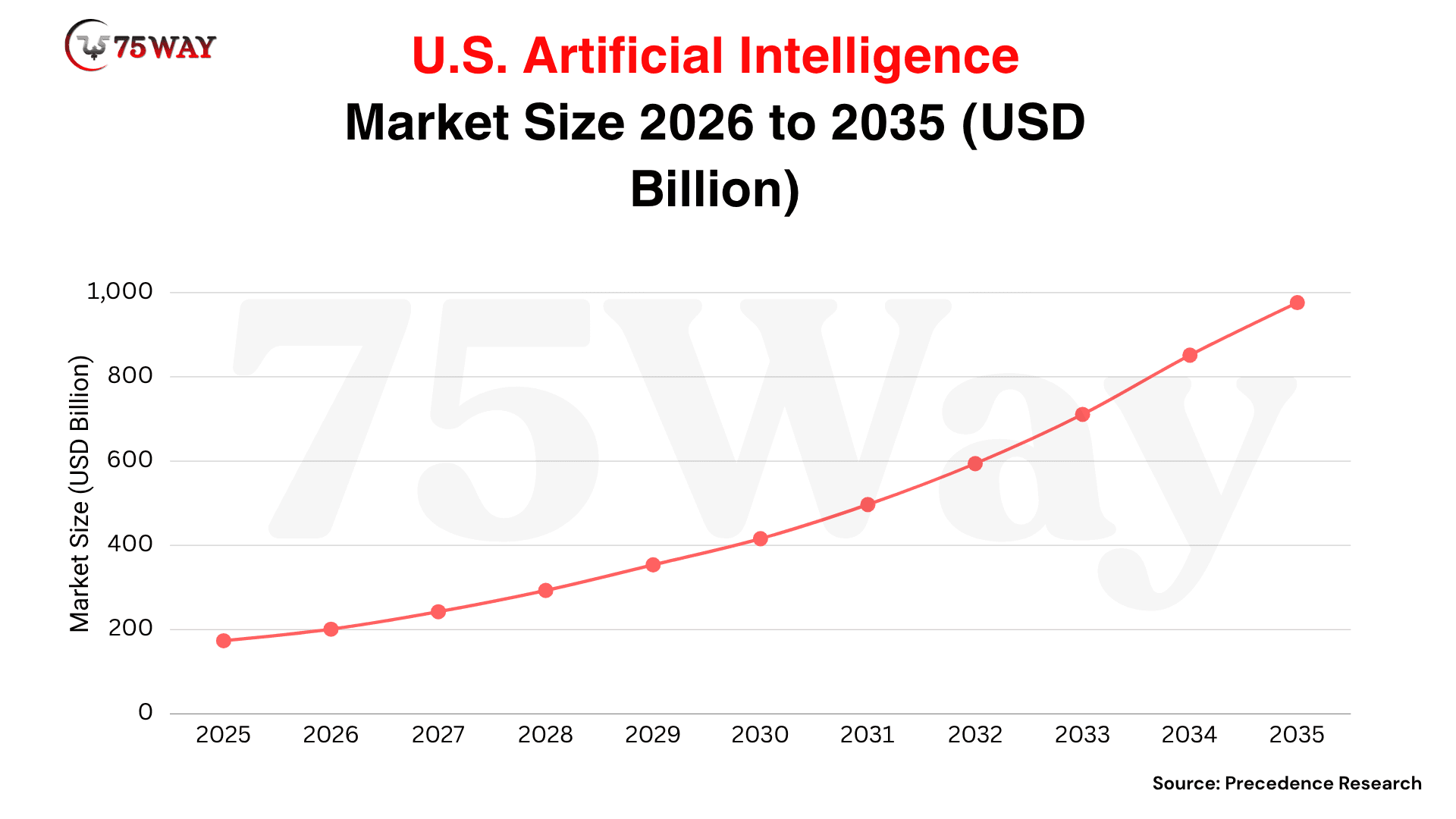
- According to Forbes, the global AI market is projected to reach $1,339 billion by 2030, reflecting rapid industry expansion.
- AI is expected to contribute a 21% net boost to the U.S. GDP by 2030, highlighting its growing economic impact.
- The artificial intelligence market is currently valued at around $74 billion and is expanding at an annual growth rate of nearly 30%.
- The United States remains the world’s largest AI market and is projected to generate over $414 billion in revenue, according to Statista.
- The AI sector continues to grow at approximately 30% annually, while generative AI is forecasted to accelerate even further through 2030.
- Businesses using AI in contact centers report operational cost reductions of nearly 30%, especially in retail and consumer packaged goods industries.
- According to Precedence Research, the services segment led the market in 2025, accounting for a 39.52% share.
How AI Is Transforming Enterprise Cost And Operations In 2026?
Artificial intelligence is reshaping enterprise operations by reducing costs, automating workflows, and improving decision-making across departments. Businesses are adopting AI-driven systems to enhance efficiency, optimize resources, and scale faster in highly competitive markets.

1. Evolution of AI in Enterprise Cost Structures
The role of enterprise AI solutions has evolved from support tool to core operational engine. Earlier systems required manual configuration and oversight, but modern AI frameworks operate with adaptive intelligence.
Businesses now use AI to analyze cost patterns across departments, identify inefficiencies in real time, and recommend structural adjustments that reduce waste.
Instead of static budgeting models, organizations are adopting dynamic AI-based financial systems that continuously learn from operational data.
This shift allows enterprises to respond faster to market changes while maintaining tighter control over spending behavior across engineering, marketing, and infrastructure layers.
2. AI-Driven Software Development Transformation
Software development remains one of the highest cost centers for US companies. AI agents and automated system is reshaping this domain by reducing manual effort across coding, debugging, and architecture design. AI-assisted development tools now generate production-level code structures, reducing dependency on large engineering teams. Developers focus more on system design and logic refinement rather than repetitive implementation.
Automated code review systems also identify inefficiencies early in the development cycle, reducing long-term maintenance costs. This transformation leads to shorter development cycles, lower labor expenses, and faster product iteration capabilities.
3. Intelligent Cloud Cost Optimization Systems
Cloud infrastructure often represents a significant portion of enterprise spending. AI introduces real-time optimization mechanisms that adjust resource allocation dynamically.
Instead of relying on fixed provisioning, AI systems analyze usage patterns and scale resources based on predictive demand models. Underutilized servers are automatically decommissioned, while high-demand services receive immediate scaling support.
This prevents resource over-provisioning, which is one of the leading causes of unnecessary cloud expenditure in traditional systems. Enterprises using AI-based cloud optimization report substantial reductions in monthly infrastructure costs.
4. Automated Quality Assurance and Testing Intelligence
Quality assurance processes have traditionally been time-consuming and resource-intensive. AI introduces intelligent testing frameworks capable of simulating large-scale user interactions. These systems automatically generate test cases based on application behavior, reducing dependency on manual QA teams.
AI-driven testing also identifies edge-case failures that traditional methods often overlook. As a result, organizations experience fewer production failures, lower rollback costs, and reduced post-release maintenance overhead.
5. AI-Powered DevOps and Continuous Delivery Systems
DevOps pipelines have become increasingly autonomous through AI integration. Modern systems can now predict deployment risks before release and take preventive actions. AI monitors system behavior during deployment and identifies anomalies that may lead to failure.
If instability is detected, automated rollback mechanisms restore previous stable versions without human intervention. This reduces downtime-related losses and improves deployment confidence across engineering teams.
6. Predictive Business Intelligence for Operational Savings
Predictive intelligence is one of the most impactful applications of AI in cost reduction strategies. Enterprises now rely on AI systems that forecast demand trends, customer behavior, and operational bottlenecks.
These insights allow businesses to allocate resources more strategically and avoid unnecessary spending. Instead of reacting to problems, organizations proactively adjust operations based on predictive signals generated by AI models.
7. Workforce Optimization Through AI Augmentation
AI is reshaping workforce structures across US companies. Rather than replacing employees, organizations are redistributing tasks between humans and intelligent systems. Routine administrative tasks, reporting, and monitoring functions are increasingly handled by AI systems.
This allows human teams to focus on strategic decision-making, innovation, and complex problem-solving. The result is a leaner organizational structure with improved productivity per employee.
8. AI in Customer Operations and Support Systems
Customer support is another major operational cost area undergoing transformation. AI-powered support systems and customer support agents now handle a large percentage of customer queries without human intervention.
These systems learn from historical interactions and continuously improve response accuracy. Escalations to human agents occur only in complex or sensitive cases, significantly reducing support overhead costs.
9. Data Infrastructure Optimization Using AI
Data storage and processing costs have grown significantly with enterprise expansion. AI systems optimize data pipelines by identifying redundant storage, compressing inactive datasets, and improving query performance.
This reduces both storage expenses and computational costs associated with large-scale data operations. Organizations benefit from faster data access and lower infrastructure expenditure.
10. Security Automation and Risk Cost Reduction
Security breaches and vulnerabilities represent significant financial risks for enterprises. AI-driven security systems continuously monitor network activity, identify suspicious behavior, and respond to threats in real time.
Automated threat detection reduces dependency on large security teams while minimizing potential breach-related losses. This proactive approach strengthens enterprise resilience and reduces long-term risk exposure.
11. Financial Forecasting and Budget Optimization
AI-based financial systems analyze historical spending patterns and forecast future operational expenses. These models help organizations allocate budgets more accurately and prevent overspending.
Financial teams gain better visibility into cost drivers across departments, improving strategic decision-making. This leads to more disciplined financial planning and reduced resource wastage.
12. Strategic Impact on US Business Competitiveness
AI-driven cost reduction is not only a financial strategy but also a competitive advantage. Companies that adopt AI earlier gain faster scalability, improved margins, and stronger adaptability in dynamic markets.
This creates a widening gap between AI-enabled enterprises and traditional organizations. Over time, AI adoption becomes a determining factor in long-term business survival and growth.
Best Practices For Successful AI Cost Optimization
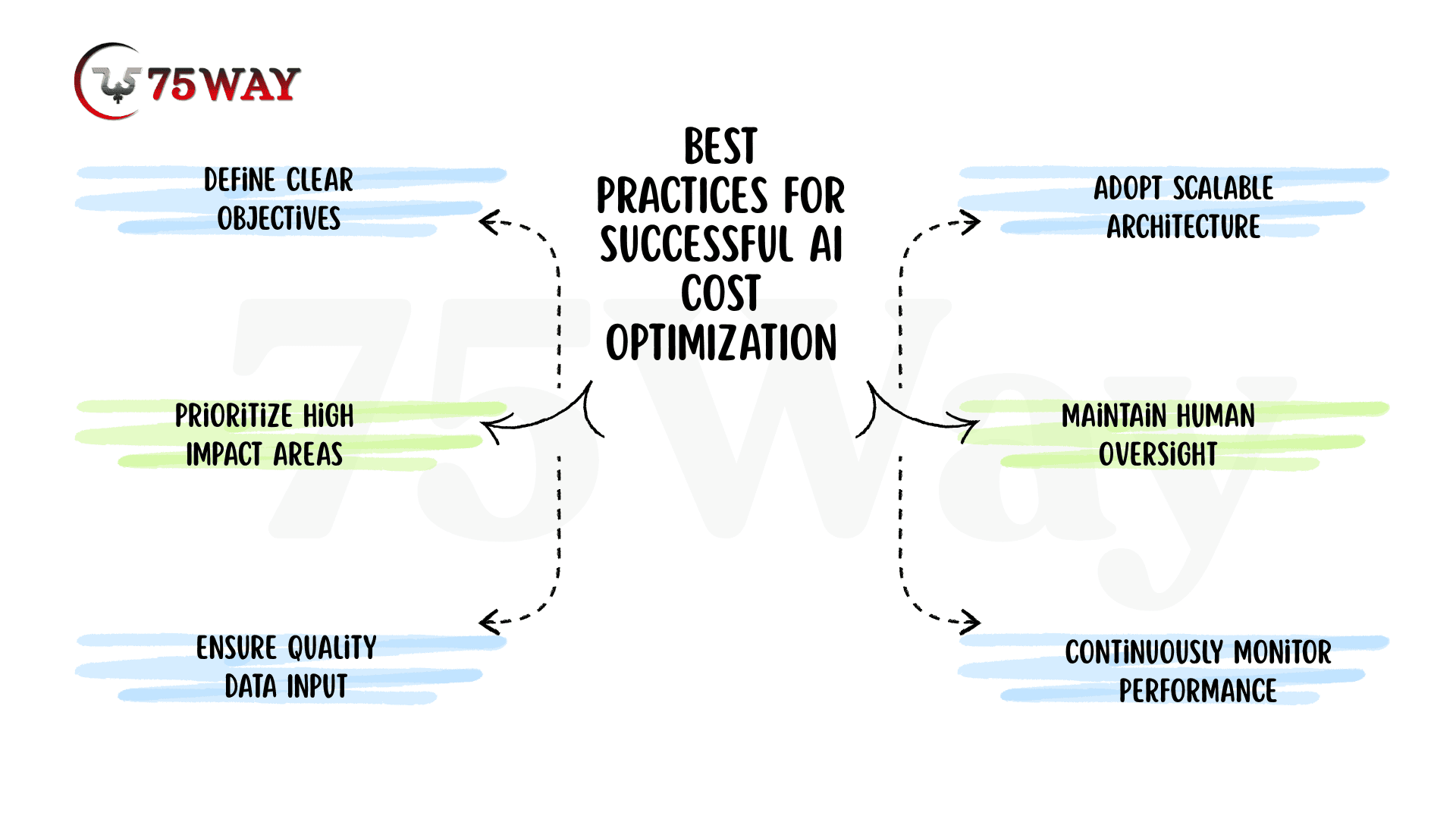
Adopting artificial intelligence for cost optimization requires a structured and strategic approach rather than random implementation. Enterprises achieve stronger financial results when AI systems are aligned with business goals, data quality standards, and operational workflows. A disciplined execution framework ensures maximum efficiency, reduced waste, and sustainable long-term savings across departments.
Step 1: Define Clear Objectives
Organizations must begin by identifying specific cost areas where AI will be applied, such as cloud usage, staffing, or operations. Clear objectives help align AI models with measurable business outcomes. This ensures resources are not wasted on unnecessary automation. It also improves tracking of ROI and performance impact.
Step 2: Prioritize High-Impact Areas
Businesses should focus AI implementation on departments with the highest operational costs. This typically includes IT infrastructure, customer support, and software development. Prioritizing these areas ensures faster financial returns and visible improvements. It also builds internal confidence in AI adoption strategies.
Step 3: Ensure Quality Data Input
AI systems depend heavily on accurate and structured data for reliable output. Poor data quality can lead to incorrect predictions and financial inefficiencies. Enterprises must invest in data cleaning, integration, and governance practices. This improves decision accuracy and strengthens cost optimization outcomes.
Step 4: Adopt Scalable Architecture
AI solutions should be designed with scalability in mind to support future business growth. Flexible architectures allow enterprises to expand usage without redesigning systems. This reduces long-term infrastructure costs and implementation complexity. It also ensures consistent performance under increasing workloads.
Step 5: Maintain Human Oversight
Even advanced AI systems require human supervision to ensure accuracy and ethical usage. Human oversight helps validate AI decisions and prevents critical errors in sensitive operations. It also ensures alignment with business strategy and compliance requirements. This balance improves reliability and trust in AI systems.
Step 6: Continuously Monitor Performance
AI solutions must be regularly evaluated to ensure they deliver expected cost benefits. Continuous monitoring helps identify inefficiencies, model drift, or outdated assumptions. Businesses can refine algorithms based on real-time performance insights. This leads to sustained optimization and long-term operational savings.
Final Remarks
Artificial intelligence has become a core driver of enterprise transformation in 2026, reshaping how US companies manage operational costs across development, infrastructure, security, and business functions. Organizations that integrate AI into daily workflows achieve stronger efficiency, reduced waste, and improved financial control. This shift is not limited to technology teams but extends across entire business ecosystems, creating long-term structural advantages. Companies that delay adoption risk falling behind in speed, scalability, and profitability as AI-native competitors continue to optimize operations continuously. Partner with a trusted AI development agency to build intelligent systems that reduce operational costs, improve scalability, and accelerate business growth through advanced AI-driven transformation strategies.