Summary
This blog explains AI agent development costs by type, industry, and complexity level, ranging from $8,000 to $500,000+. It covers pricing factors, hidden expenses, development stages, and real-world examples. Businesses can optimize costs by planning smartly, adopting scalable architecture, and making strategic development choices to build efficient, high-performing AI solutions.
Quick Overview
- AI agent costs range widely from $8,000 to $500,000+, depending on complexity.
- Advanced systems require a higher investment in training, integration, and scaling.
- Hidden costs such as cloud, APIs, and retraining significantly impact the overall budget.
- Choosing the right development model reduces cost while maintaining quality output.
- Strategic planning ensures better ROI across all AI agent investment levels.
Every startup founder today is trying to answer one critical question: how to automate business with smart tools or AI agents without overspending or building the wrong system.
The fact is, AI agents are now actively used for customer support automation, workflow execution, business decision-making, and operational efficiency across modern digital businesses.
However, what most resources fail to clearly explain is that AI agent development is not a standardized product with fixed pricing. It is a highly variable engineering investment shaped by complexity, intelligence level, and business requirements.
While basic agentic AI systems can be developed for a few thousand dollars, these solutions are typically limited in scope and real-world business impact. Organizations aiming for meaningful automation, scalable systems, and intelligent decision-making generally require significantly higher investment.
In most real-world applications, AI agent development costs range from $8,000 to $500,000+, depending on system complexity, level of autonomy, AI model architecture, data requirements, and integration depth. In advanced enterprise environments, especially those involving multi-agent systems and real-time reasoning capabilities, costs can exceed this range.
This guide provides a structured cost breakdown of an AI agent so founders, startups, and enterprises can make informed investment decisions with clarity rather than assumptions or market hype.
AI Agent Development Cost Breakdown by Complexity Level
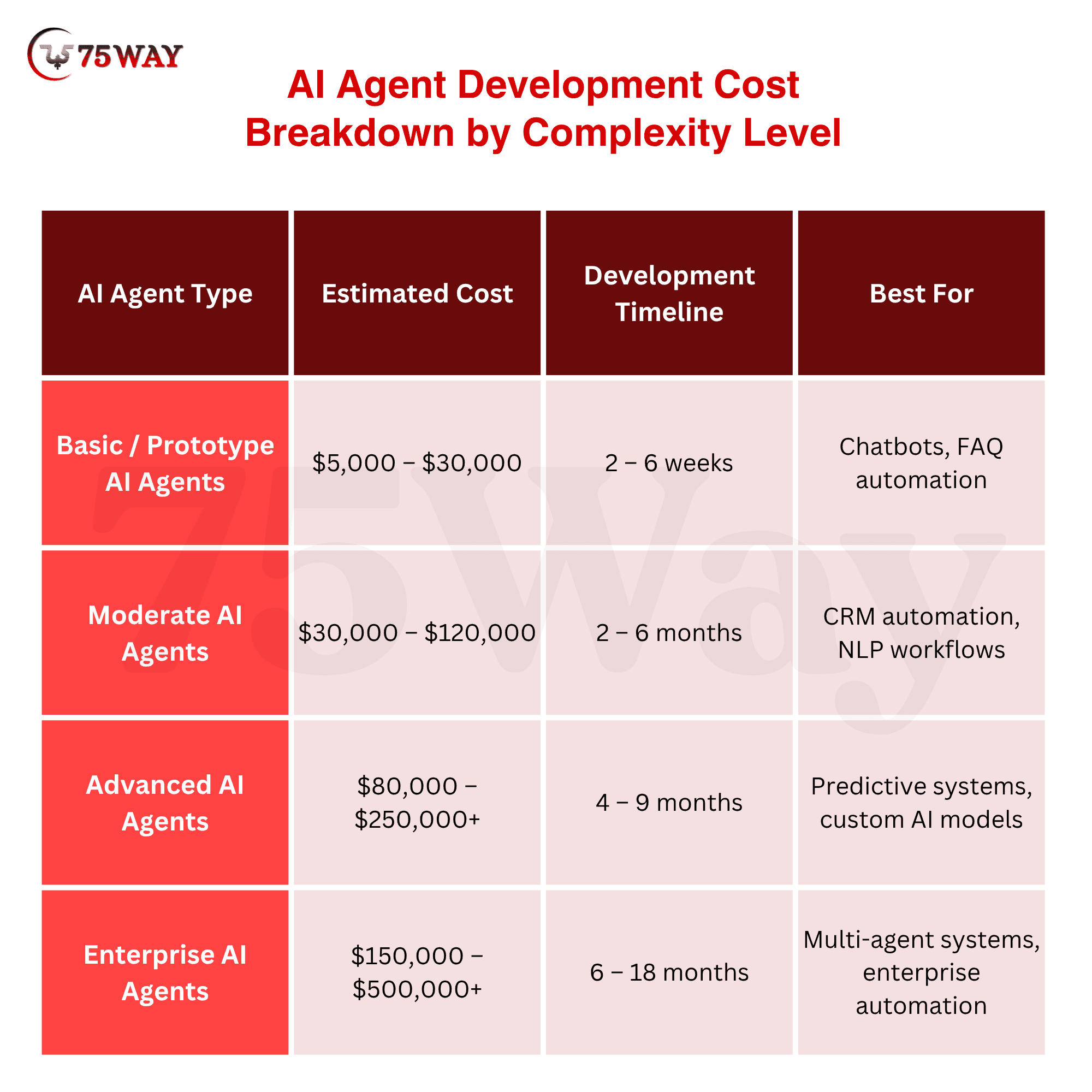
AI agent development cost varies significantly based on system complexity, intelligence level, integration depth, and enterprise requirements. Each category represents a different level of automation capability, technical sophistication, and business impact, directly influencing overall development timelines and investment range.
- Basic / Prototype AI Agents: $8,000 – $30,000
Covers simple AI agents with limited functionality, basic automation, and minimal integrations, ideal for testing concepts or launching early-stage prototypes quickly.
- Moderate AI Agents: $30,000 – $80,000
Includes more capable agents with improved logic, integrations, and performance, suitable for businesses needing reliable automation and better user interaction.
- Advanced AI Agents: $80,000 – $250,000+
Delivers highly intelligent agents with complex workflows, advanced learning capabilities, and seamless integrations tailored for specialized and high-performance use cases.
- Enterprise AI Agents: $150,000 – $500,000+
Designed for large-scale deployment with full customization, high security, compliance, and robust infrastructure to support mission-critical business operations
Development Costs of Various Types of AI Agents in 2026
AI agents differ widely in terms of complexity, functionality, and overall intelligence. Some are designed to follow predefined rules and perform simple automation tasks, while others can learn, adapt, and make data-driven decisions over time. Because of these variations, the cost of developing AI agents is directly influenced by their capabilities, system integrations, and level of intelligence.
Additionally, the choice of AI agent use case or business application plays a strategic role in determining the overall investment required, as different applications demand different levels of development effort and technical sophistication.
Below is a structured cost breakdown of diverse kinds of AI agents across basic, mid-level, and advanced categories.
1. Reactive (Simple Reflex) AI Agent Development Costs
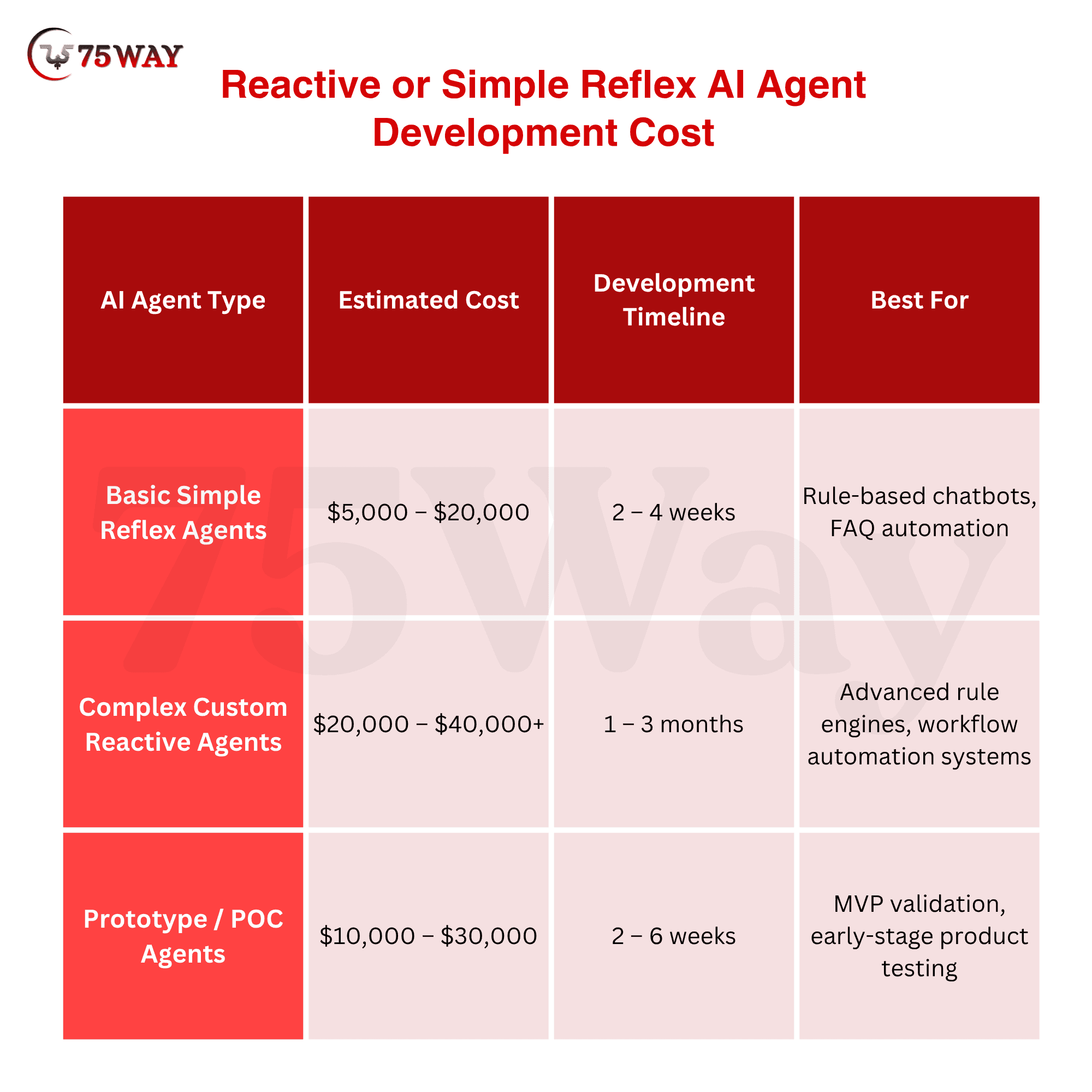
Reactive or simple reflex AI agents operate based on predefined rules and immediate inputs without memory, learning capability, or long-term contextual understanding. These agents are commonly used for basic automation tasks such as rule-based chatbots, simple decision systems, and structured response workflows. Because of their limited intelligence and minimal integration requirements, they are the most cost-effective type of AI agents to develop. However, even within reactive systems, costs vary depending on the level of customization, integration complexity, and whether the solution is a basic prototype or a more advanced rule-engine system.
- Basic Simple Reflex Agents: $5,000 – $20,00
Rule-based agents handle simple inputs with predefined logic and minimal adaptability.
- Complex Custom Reactive Agents: $20,000 – $40,000+
Advanced reactive agents process dynamic inputs with customized logic for specific use cases.
- Prototype / POC Agents: $10,000 – $30,000
Built to validate ideas, test feasibility, and demonstrate core AI functionality quickly.
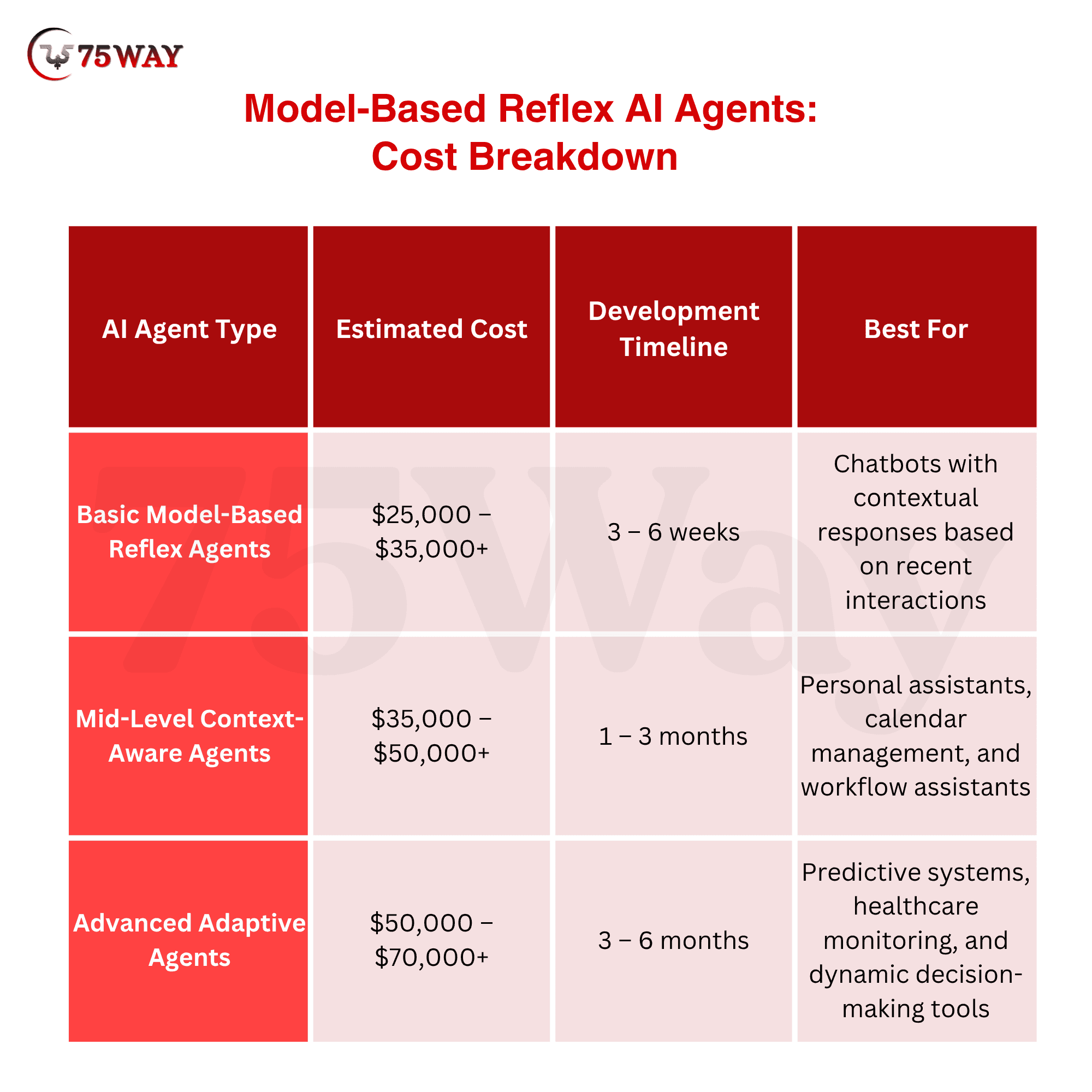
Model-Based Reflex AI Agents: Cost Breakdown
Model-based reflex AI agents maintain an internal representation of their environment, allowing them to make more informed decisions based on historical interactions and contextual understanding. Unlike simple reactive systems, these agents can track past inputs and adjust responses accordingly, making them suitable for more dynamic and intelligent business applications. As complexity increases, development cost rises due to requirements such as data handling, contextual modeling, and machine learning integration.
- Basic Model-Based Reflex Agents: $25,000 – $35,000+
Agents using internal state models to make decisions beyond immediate inputs.
- Mid-Level Context-Aware Agents: $35,000 – $50,000+
Agents understand context and history to deliver more accurate, relevant responses.
- Advanced Adaptive Agents: $50,000 – $70,000+
Highly dynamic agents that learn, adapt, and improve performance based on data.
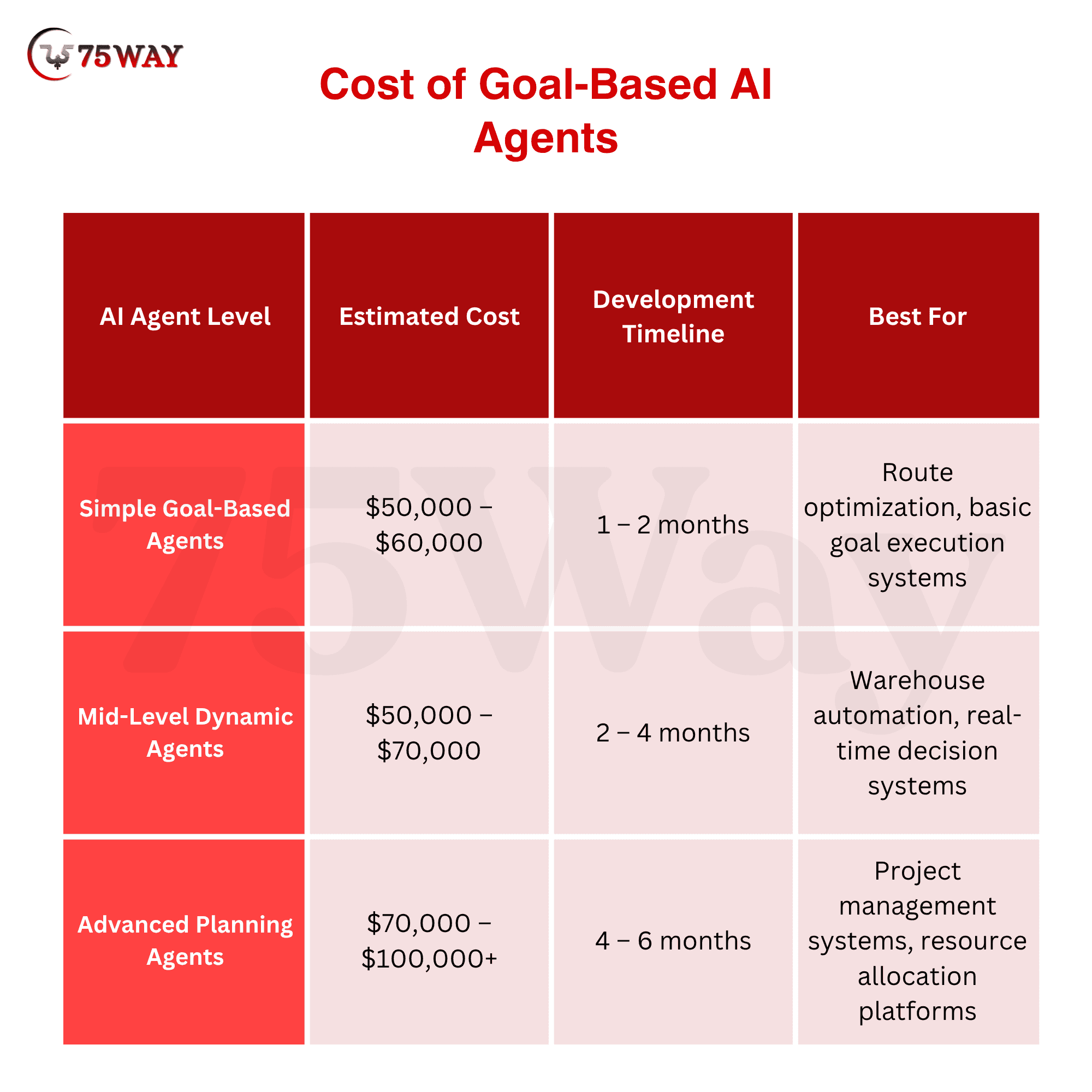
Goal-Based AI Agents: Development Cost Overview
Goal-based AI agents are designed to evaluate multiple possible actions and select the most optimal path to achieve a defined objective. Unlike reactive or model-based systems, these agents focus on planning, decision optimization, and outcome-driven execution. As a result, development costs vary depending on the level of intelligence, real-time adaptability, and depth of goal optimization required for the system.
- Simple Goal-Based Agents: $50,000 – $60,000
Agents designed to achieve defined goals using basic decision-making and planning.
- Mid-Level Dynamic Goal-Based Agents: $50,000 – $70,000
Agents adapting to changing conditions with flexible logic and improved decision processes.
- Advanced Planning Goal-Based Agents: $70,000 – $100,000+
Agents performing complex planning, multi-step reasoning, and optimized goal execution strategies.
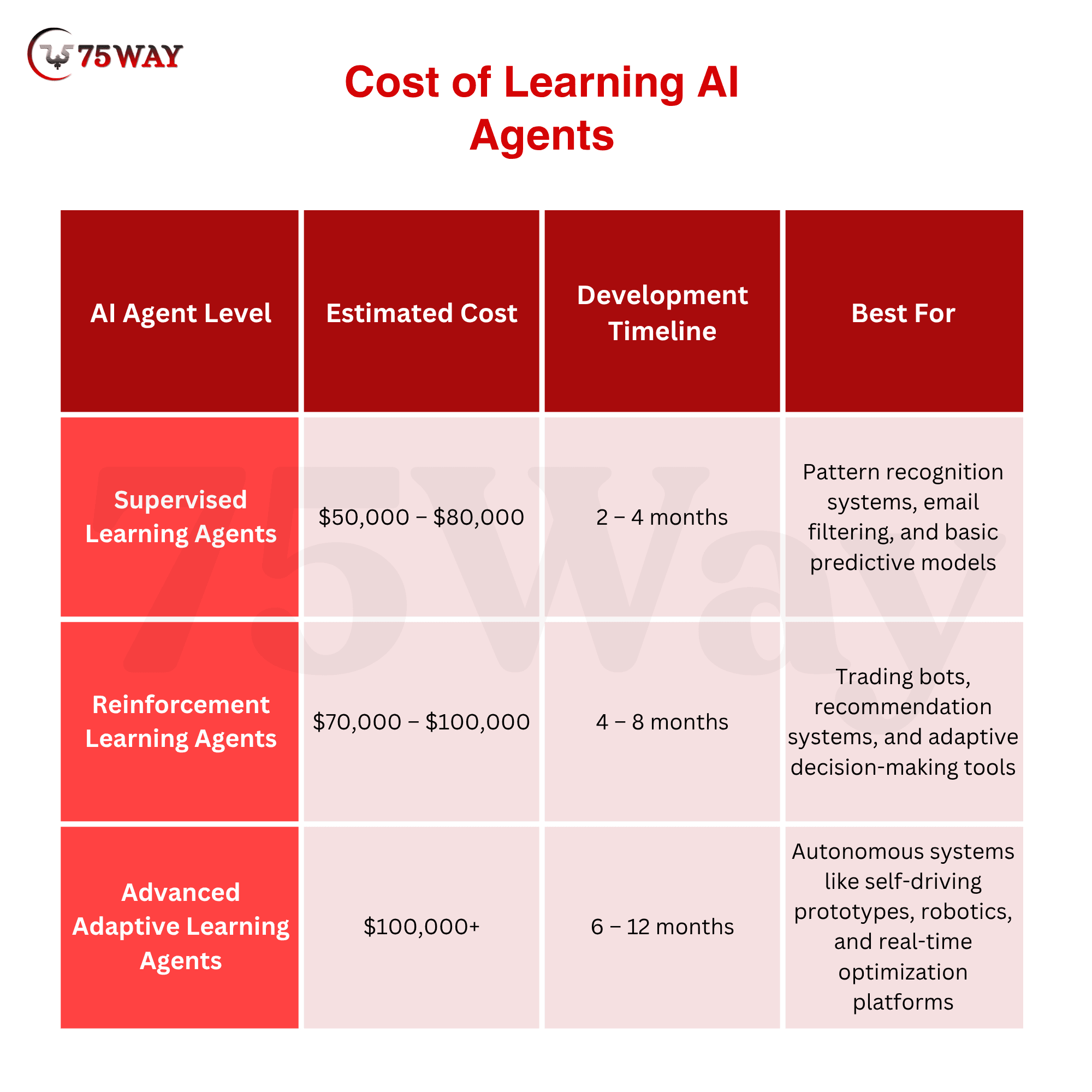
Cost of Learning Agents
Learning agents are advanced AI systems that improve their performance over time by learning from experience, feedback, and new data. Unlike rule-based or goal-based systems, these agents continuously adapt their behavior using techniques such as supervised learning and reinforcement learning. This makes them highly suitable for dynamic environments where patterns change frequently, and decision accuracy improves with exposure.
- Supervised Learning Agents: $50,000 – $80,000
Agents are trained on labeled datasets to make accurate predictions and decisions.
- Reinforcement Learning Agents: $70,000 – $100,000
Agents learn through rewards and feedback to optimize actions over time.
- Advanced Adaptive Learning Agents: $100,000+
Agents are continuously evolving with data, improving performance through self-learning capabilities.
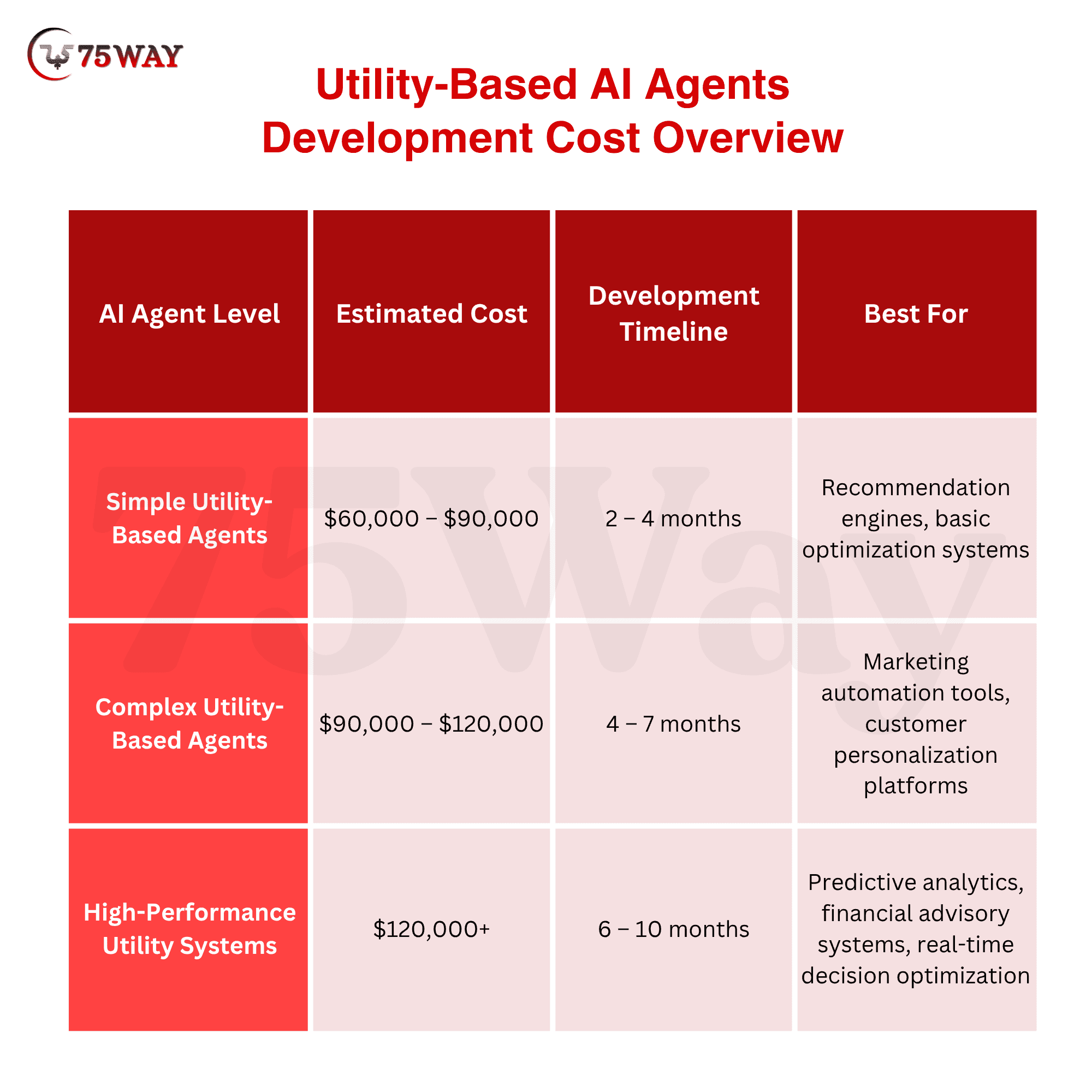
Utility-Based AI Agents Development Cost Overview
Utility-based AI agents make decisions by evaluating multiple possible actions and selecting the one that delivers the highest overall value based on a defined utility function. Unlike simpler agent types, utility-based systems require advanced decision modeling, real-time data processing, and predictive intelligence, which increases both development complexity and cost.
- Simple Utility-Based Agents: $60,000 – $90,000
Agents make decisions by evaluating outcomes to maximize utility in simple environments.
- Complex Utility-Based Agents: $90,000 – $120,000
Agents handling multiple variables and trade-offs to optimize decisions in dynamic scenarios.
- High-Performance Utility Systems: $120,000+
Advanced systems delivering optimal decisions using complex models and large datasets
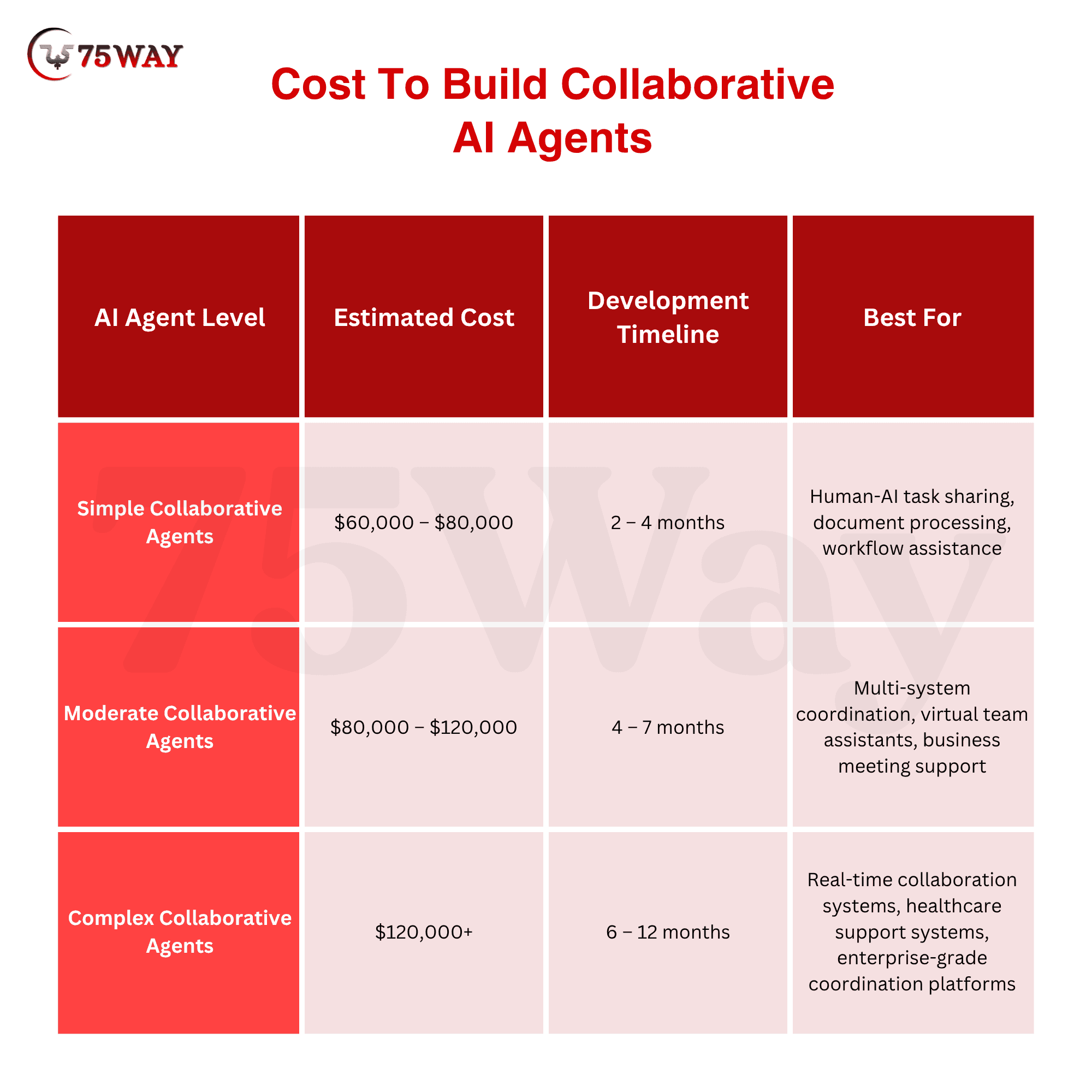
Cost To Build Collaborative AI Agents
Collaborative AI agents are designed to work alongside humans, teams, or other AI systems to improve coordination, decision-making, and task execution. Collaborative agents require multi-system integration, communication frameworks, and human-AI interaction design, which increases overall development complexity and cost.
- Simple Collaborative Agents: $60,000 – $80,000
These AI Agents work together on basic tasks with limited coordination and shared goals.
- Moderate Collaborative Agents: $80,000 – $120,000
Agents are coordinating effectively with shared data, improving teamwork and task efficiency.
- Complex Collaborative Agents: $120,000+
Advanced multi-agent systems enabling seamless collaboration, decision-making, and large-scale task execution.
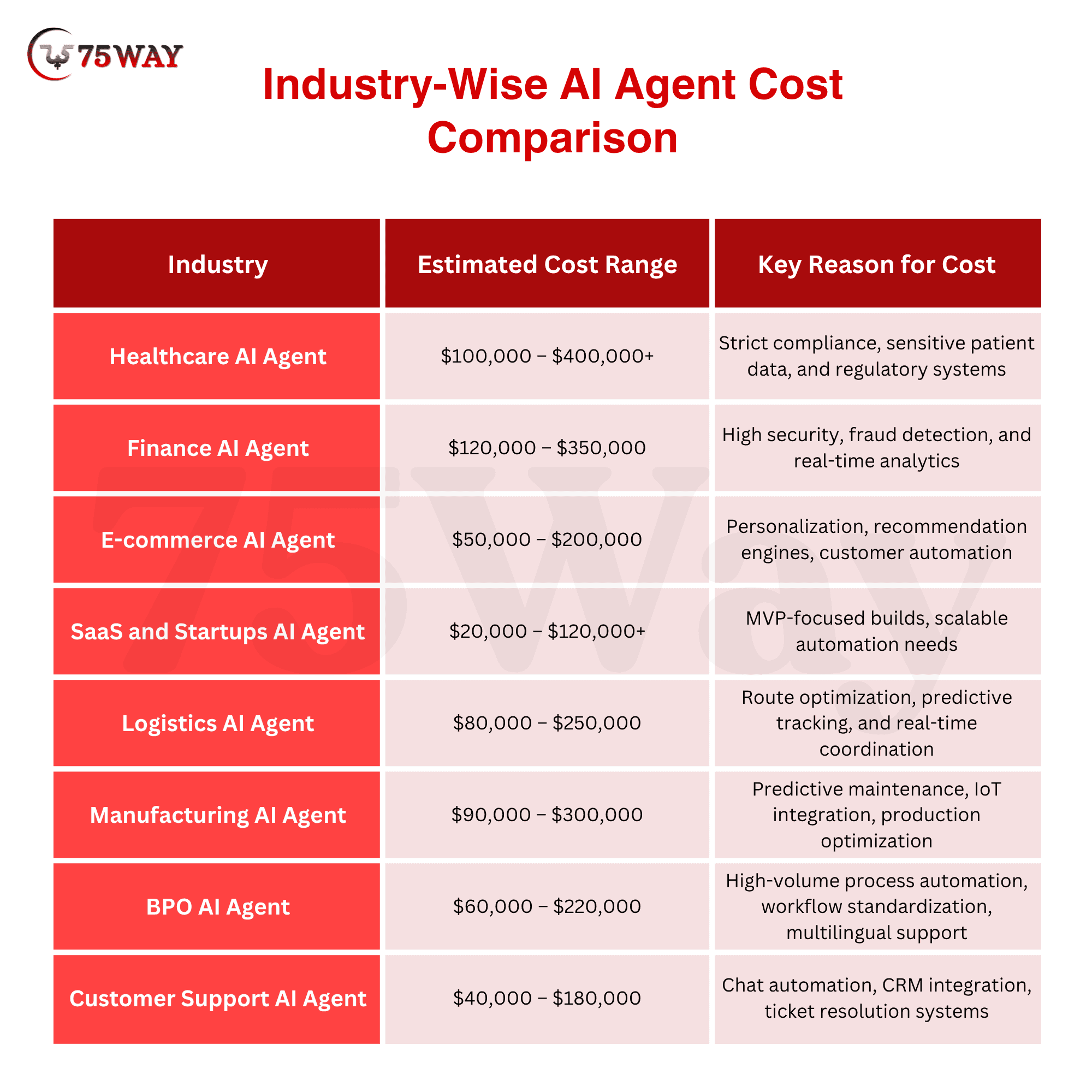
Cost For Developing Industry-Specific AI Agent
AI agent development cost varies significantly across industries due to differences in compliance requirements, data sensitivity, integration complexity, and scalability needs. Sectors such as healthcare and finance require highly secure and regulation-compliant systems, which increase development effort and overall investment. In contrast, industries like SaaS and startups often focus on MVP-level automation, making their initial development comparatively more cost-effective.
- Healthcare AI Agent: $100,000 – $400,000+
Healthcare AI agents are built for diagnostics, patient data processing, and streamlining complex healthcare operations.
- Finance AI Agent: $120,000 – $350,000
Finance AI agents focus on fraud detection, risk assessment, and enabling smarter financial decision-making systems.
- E-commerce AI Agent: $50,000 – $200,000
Ecommerce AI agents enhance user experience through recommendations, behavior tracking, and personalized shopping journeys.
- SaaS and Startups AI Agent: $20,000 – $120,000+
Designed to automate workflows, improve analytics, and support scalable growth for businesses.
- Logistics AI Agent: $80,000 – $250,000
Optimizes delivery routes, manages supply chains, and improves real-time tracking capabilities.
- Manufacturing AI Agent: $90,000 – $300,000
Drives efficiency with predictive maintenance, automation, and improved production line performance.
- BPO AI Agent: $60,000 – $220,000
BPO AI agents handle repetitive processes, boost productivity, and enhance operational efficiency in outsourcing tasks.
- Customer Support AI Agent: $40,000 – $180,000
Customer support AI agents deliver instant responses and automate interactions.
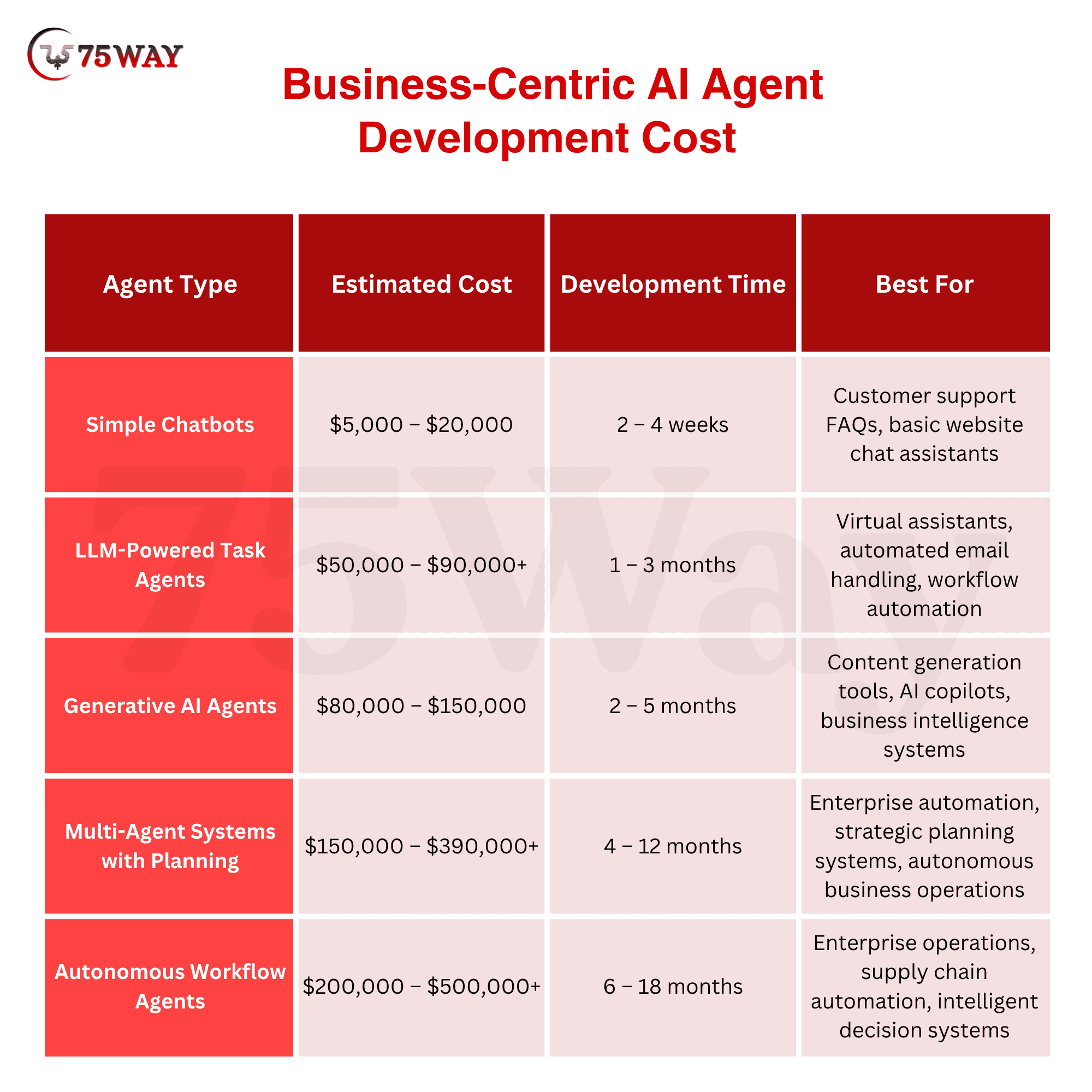
Business-Centric AI Agent Development Cost
These AI agent categories reflect how artificial intelligence is actively being applied in real-world business environments today. From basic conversational systems to advanced LLM-powered architectures and collaborative multi-agent frameworks, each type is designed to solve specific operational challenges depending on business complexity, automation goals, and required intelligence level. Below is a structured overview of the typical cost of building each modern AI agent type.
- Simple Chatbots: $5,000 – $20,000
Simple AI chatbots are designed for basic interactions, handling FAQs, rule-based responses, customer support, and simple automation tasks.
- LLM-Powered Task Agents: $50,000 – $100,000
Leverages large language models for task automation, workflow assistance, natural language processing, and intelligent response generation.
- Generative AI Agents: $80,000 – $150,000
Creates dynamic content, text generation, data insights, personalization, and AI-driven creative outputs for businesses.
- Multi-Agent Systems with Planning: $150,000 – $400,000+
Enables multi-agent collaboration, task planning, decision-making, distributed systems, and complex workflow execution.
- Autonomous Workflow Agents: $200,000 – $500,000+
Supports end-to-end automation, autonomous decision-making, process optimization, scalability, and minimal human intervention.
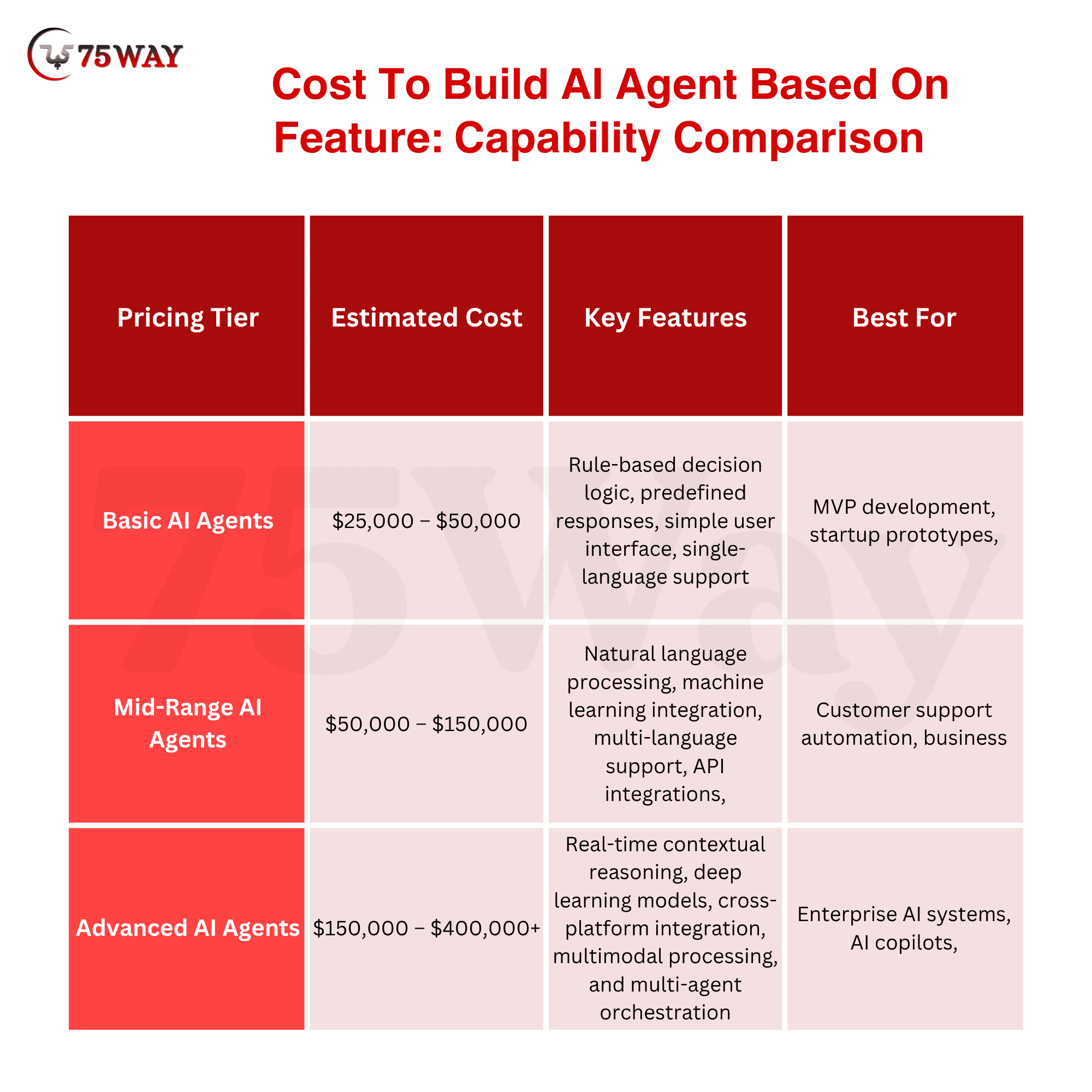
Cost To Build AI Agent Based On Feature: Capability Comparison
AI agents vary significantly in capability depending on their development cost and complexity level. Lower-cost solutions typically focus on basic automation and predefined responses, while higher-tier investments unlock advanced intelligence, reasoning, and autonomous decision-making. Therefore, it is important to evaluate what features are realistically available at each pricing stage before selecting a development budget. This helps businesses align expectations with actual system capabilities and avoid underpowered or overbuilt solutions.
Major Factors That Affect AI Agent Development Costs
The cost of developing an AI agent is not fixed, as it depends on multiple technical, operational, and business-related factors. While complexity, customization, data requirements, system integration, model training, and ongoing maintenance are commonly considered, several additional elements also play a significant role in determining the final investment. These include infrastructure choices, scalability needs, security requirements, and the level of intelligence expected from the system. Together, these factors shape the overall development effort and directly impact the cost of AI agent development services.
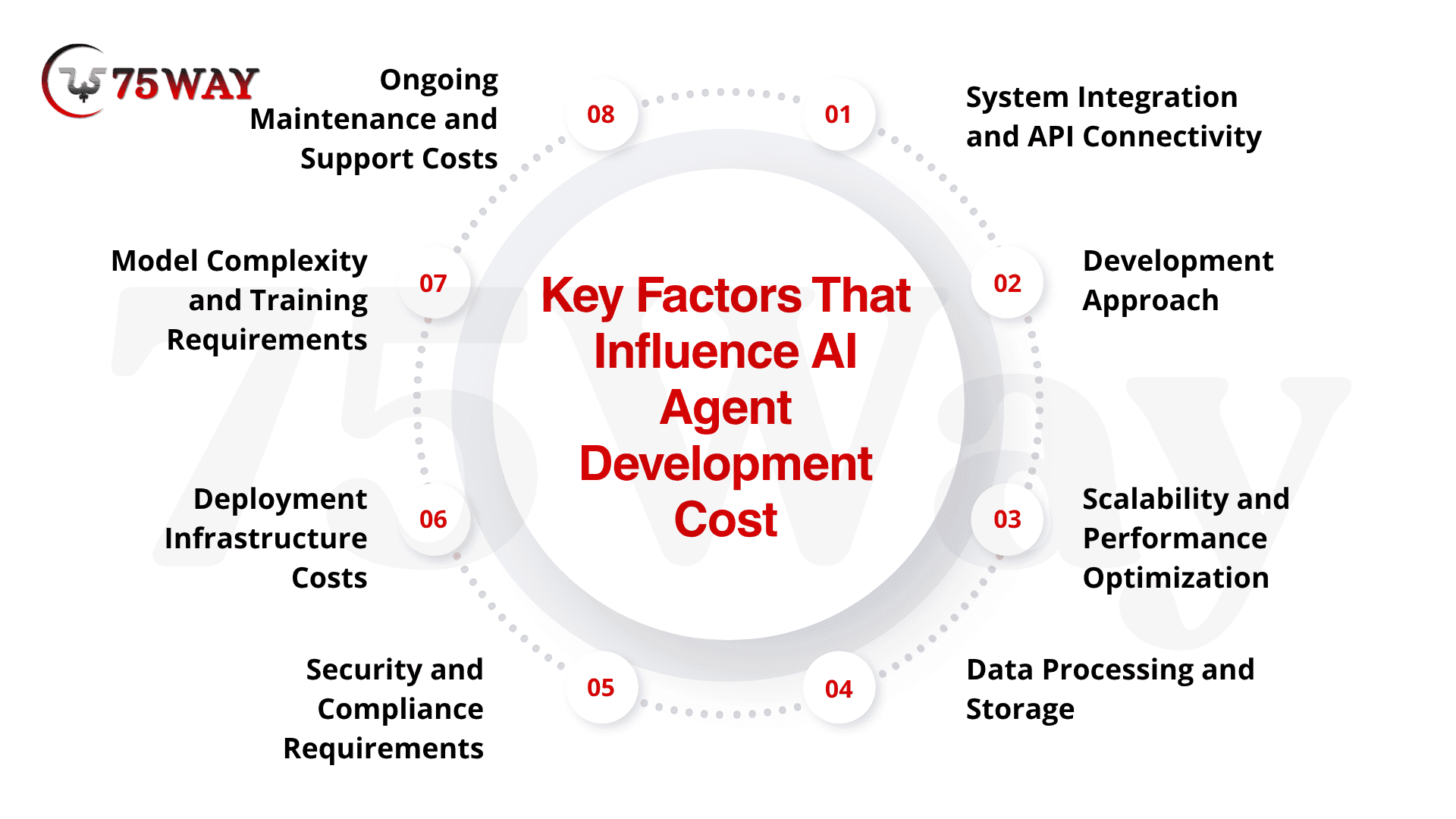
1. System Integration
System integration costs range from $10,000 to $120,000, depending on API complexity and external system dependencies.
- Number of third-party APIs integrated
- Depth of CRM/ERP connectivity
- Real-time data synchronization needs
- Legacy system compatibility challenges
System integration costs can be managed effectively by prioritizing only essential third-party APIs and avoiding unnecessary system dependencies in the initial phase. Using modular architecture and standardized APIs reduces complexity and future rework.
2. Development Approach
Development approach cost ranges from $15,000 to $100,000 based on architecture choice, team structure, and methodology used.
- Agile vs waterfall development model
- In-house team vs outsourced agency
- Use of prebuilt AI frameworks
- Level of custom engineering required
These costs can be optimized by selecting the right approach based on project scope and maturity. Startups can reduce expenses by using hybrid development models that combine prebuilt AI frameworks with selective custom engineering.
3. Scalability Optimization
Scalability optimization cost ranges from $20,000 to $150,000, depending on traffic load handling and system expansion needs.
- Cloud infrastructure selection (AWS, Azure, GCP)
- Auto-scaling and load-balancing setup
- Performance tuning for high traffic
- Distributed system architecture design
Scalability costs can be controlled by adopting a cloud-based infrastructure with auto-scaling features instead of investing heavily in fixed server capacity. Businesses should design systems that scale on demand rather than over-provisioning resources at the beginning.
4. Data Management
Data processing and storage costs range from $10,000 to $90,000, depending on volume, structure, and real-time handling needs.
- Data collection and preprocessing complexity
- Storage type (cloud vs on-premise)
- Real-time vs batch processing requirements
- Data security and redundancy systems
These costs can be optimized by using structured data collection strategies and eliminating unnecessary data storage. Leveraging cloud storage solutions with pay-as-you-use models helps reduce upfront investment.
5. Security Compliance
Security and compliance costs range from $20,000 to $200,000, depending on regulatory requirements and system sensitivity level.
- GDPR, HIPAA, or industry compliance needs
- Encryption and secure data transmission
- Authentication and access control systems
- Threat detection and monitoring systems
You can manage these costs by adopting industry-standard security frameworks instead of building custom systems from scratch. Early-stage projects should focus only on required compliance levels rather than full enterprise-grade certifications.
6. Deployment Infrastructure
Deployment infrastructure cost ranges from $10,000 to $80,000 based on the hosting environment and system availability requirements.
- Cloud vs on-premise deployment choice
- Server configuration and setup
- Continuous deployment pipeline setup
- Monitoring and uptime management
Deployment costs can be reduced by using managed cloud services that handle server maintenance, monitoring, and scaling automatically. Instead of building complex deployment pipelines, businesses should use CI/CD tools and platform-as-a-service solutions.
7. Model Engineering
Model complexity and training costs range from $25,000 to $250,000, depending on AI model size and learning requirements.
- Pre-trained vs custom model development
- Training dataset size and quality
- Fine-tuning and optimization cycles
- Computational resource requirements
Fine-tuning existing models for specific use cases is significantly more cost-effective than full model training. Optimizing training cycles, using smaller datasets initially, and leveraging efficient compute resources also help reduce overall expenses.
8. Maintenance Support
Ongoing maintenance costs range from $5,000 to $40,000 per month, depending on system updates and performance monitoring needs.
- Bug fixing and performance updates
- Model retraining and improvements
- Infrastructure monitoring and scaling
- Feature upgrades and system enhancements
Maintenance costs can be minimized by designing systems with strong initial architecture and automated monitoring tools. Regular but scheduled updates instead of constant changes help reduce operational load. Businesses can also lower long-term expenses by implementing self-healing systems.
Hidden Costs in AI Agent Development You Should Know
Many AI agent projects appear cost-predictable during planning, but once deployed, additional technical and operational requirements surface. These are not always visible in the initial development phase, yet they become critical as user traffic increases, data volume grows, and the system starts handling real-world workloads.
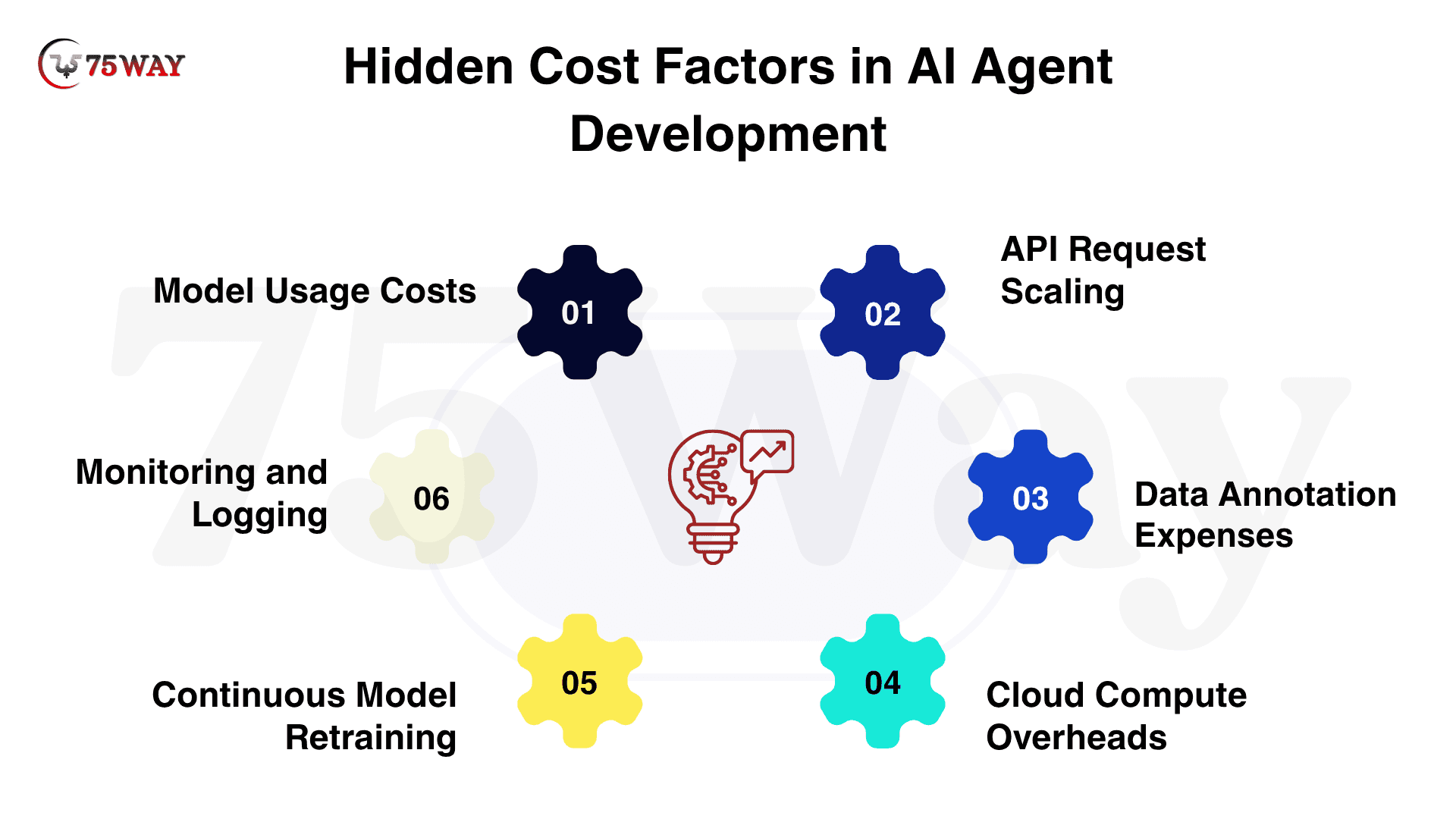
- Model Usage Costs
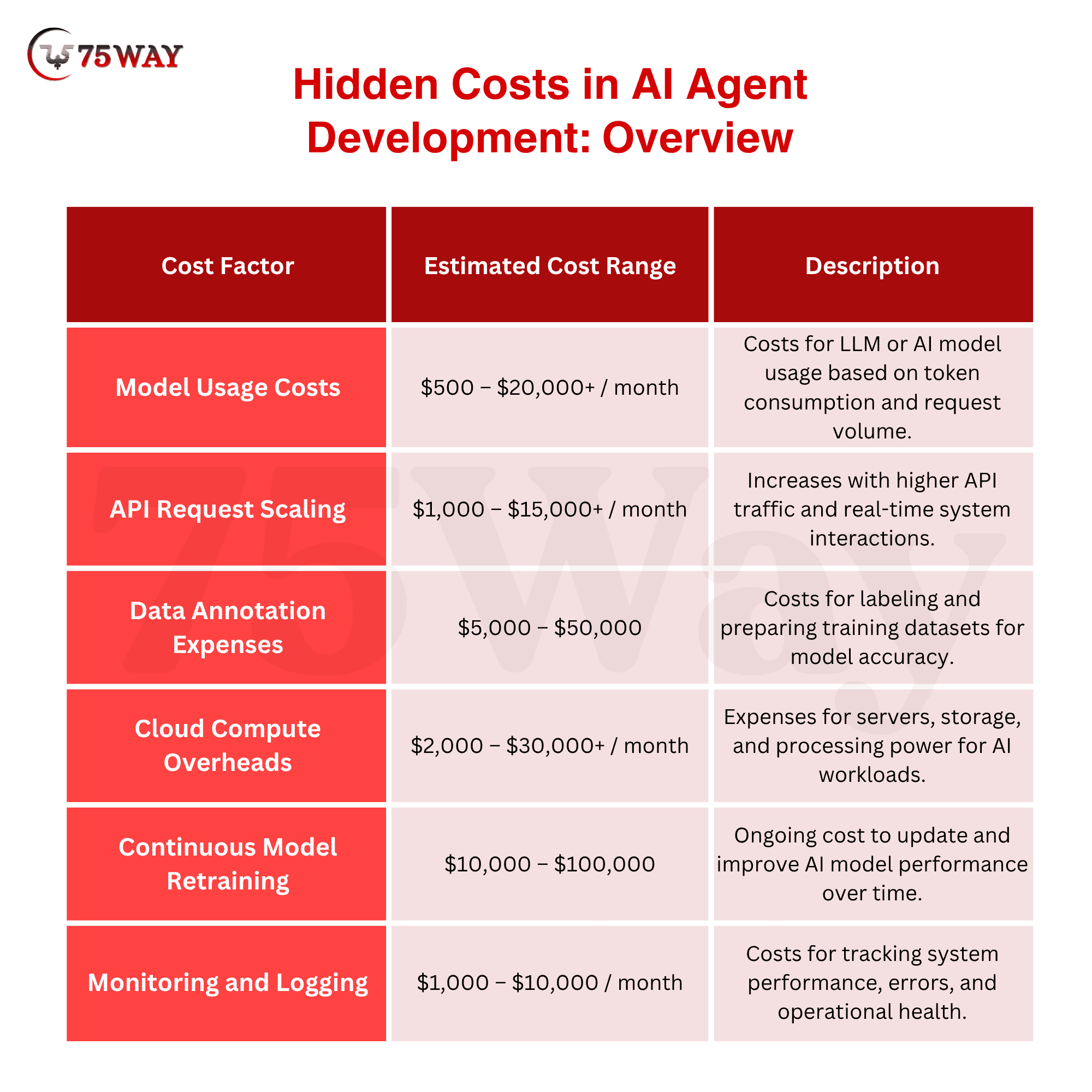
Model usage costs typically range from $500 to $20,000+ per month, depending on token consumption, model type, and request volume. These expenses arise from using LLM APIs or hosted AI models that charge based on processing input and output data. Businesses should optimize prompts, reduce redundant calls, and select cost-efficient models to control ongoing usage expenses.
- API Request Scaling
API request scaling costs generally range from $1,000 to $15,000+ monthly as system traffic increases. These costs grow when AI agents handle high-frequency interactions or real-time processing across multiple services. Efficient rate limiting, caching strategies, and optimized backend architecture help reduce unnecessary API calls and maintain stable operational expenses.
- Data Annotation Expenses
Data annotation costs usually range from $5,000 to $50,000, depending on dataset size and labeling complexity. High-quality labeled data is essential for training accurate AI models. Costs increase when domain-specific expertise is required. Using semi-automated labeling tools and pre-trained datasets can significantly reduce manual annotation efforts and overall expenses.
- Cloud Compute Overheads
Cloud compute costs typically range from $2,000 to $30,000+ per month based on workload intensity and infrastructure setup. These expenses include server usage, GPU processing, and storage. Optimizing resource allocation, using auto-scaling systems, and selecting cost-effective cloud providers help manage compute overheads without affecting performance.
- Continuous Model Retraining
Model retraining costs range from $10,000 to $100,000, depending on training frequency and dataset updates. AI agents require periodic retraining to maintain accuracy and relevance. Costs increase with complex models and large datasets. Efficient retraining schedules and incremental learning techniques help reduce unnecessary computational expenses.
- Monitoring and Logging
Monitoring and logging costs typically range from $1,000 to $10,000 monthly, according to system scale and data retention needs. These processes ensure system health, performance tracking, and error detection. Using lightweight logging frameworks and optimizing data retention policies helps reduce storage and operational costs over time.
AI Agent Software Cost Breakdown Using Real-World Examples
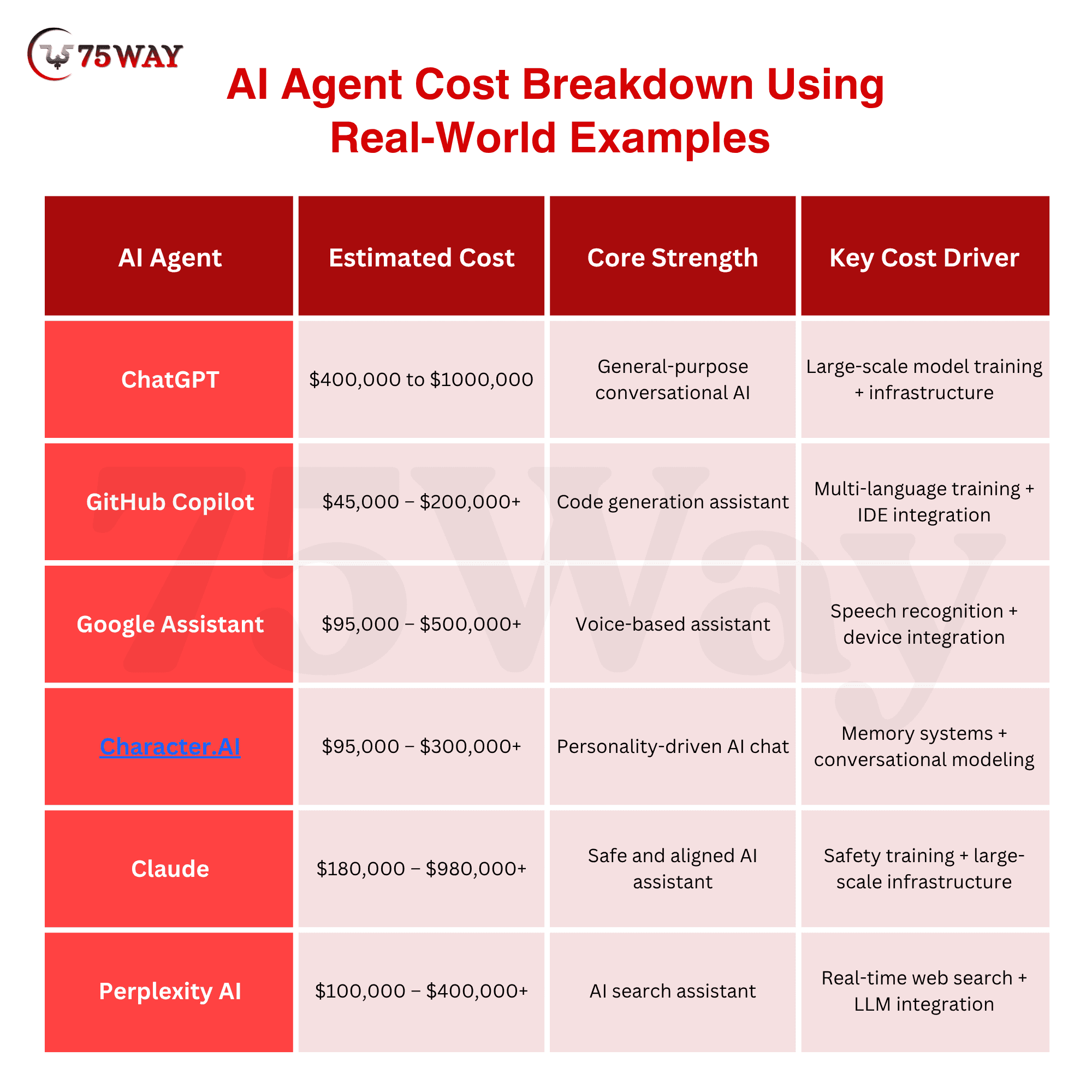
Real-world AI agents demonstrate how development cost varies dramatically based on scale, architecture, and intended use case. Systems like ChatGPT, GitHub Copilot, Google Assistant, Character.AI, Claude, and Perplexity AI are built using advanced machine learning models, large-scale data processing, and complex infrastructure setups. Their costs range from hundreds of thousands to multi-million dollars, depending on factors.
1. ChatGPT-like AI Agent Cost: $500,000 to $1000,000
ChatGPT is a large-scale conversational AI system developed using advanced large language models trained on massive datasets and powerful computing infrastructure. Its high development cost comes from extensive training cycles, continuous model improvements, and the need to support millions of users simultaneously. Additional expenses include infrastructure scaling, safety alignment, and long-term system maintenance.
2. GitHub Copilot Like AI Agent Cost: $50,000 to $200,000+
GitHub Copilot is an AI-based coding assistant that helps developers write, complete, and understand code more efficiently within development environments. The cost of building such a system is influenced by large-scale multilingual code training, IDE integration complexity, and continuous updates to improve contextual accuracy and developer experience.
3. Google Assistant Like AI Agent Cost: $100,000 to $500,000+
Google Assistant is a voice-enabled AI system designed to understand spoken commands and interact with multiple devices and services. Its development requires advanced speech recognition, natural language understanding, and deep integration across ecosystems, along with ongoing improvements in response accuracy and system performance.
4. Character.AI Like AI Agent Cost: $100,000 to $300,000+
Character.AI is built to create interactive digital personalities that can engage in conversations, role-play scenarios, and maintain contextual memory. The development cost is driven by conversational AI modeling, personalization systems, and scalable infrastructure designed to support highly interactive and engaging user experiences.
5. Claude Like AI Agent Cost: $200,000 to $1,000,000+
Claude is a safety-focused conversational AI system designed to provide helpful, reliable, and aligned responses. Its development involves advanced model training, reinforcement learning from human feedback, and robust safety mechanisms, along with high infrastructure costs for stable, secure deployment at scale.
6. Perplexity AI Like AI Agent Cost: $100,000 to $400,000+
Perplexity AI is an AI-powered search assistant that combines large language models with real-time web data retrieval to deliver accurate, source-backed answers. Its development cost is driven by search integration systems, real-time data processing, API connectivity, and continuous optimization for response accuracy and freshness.
AI Agent Development Process: How Each Stage Affects Cost
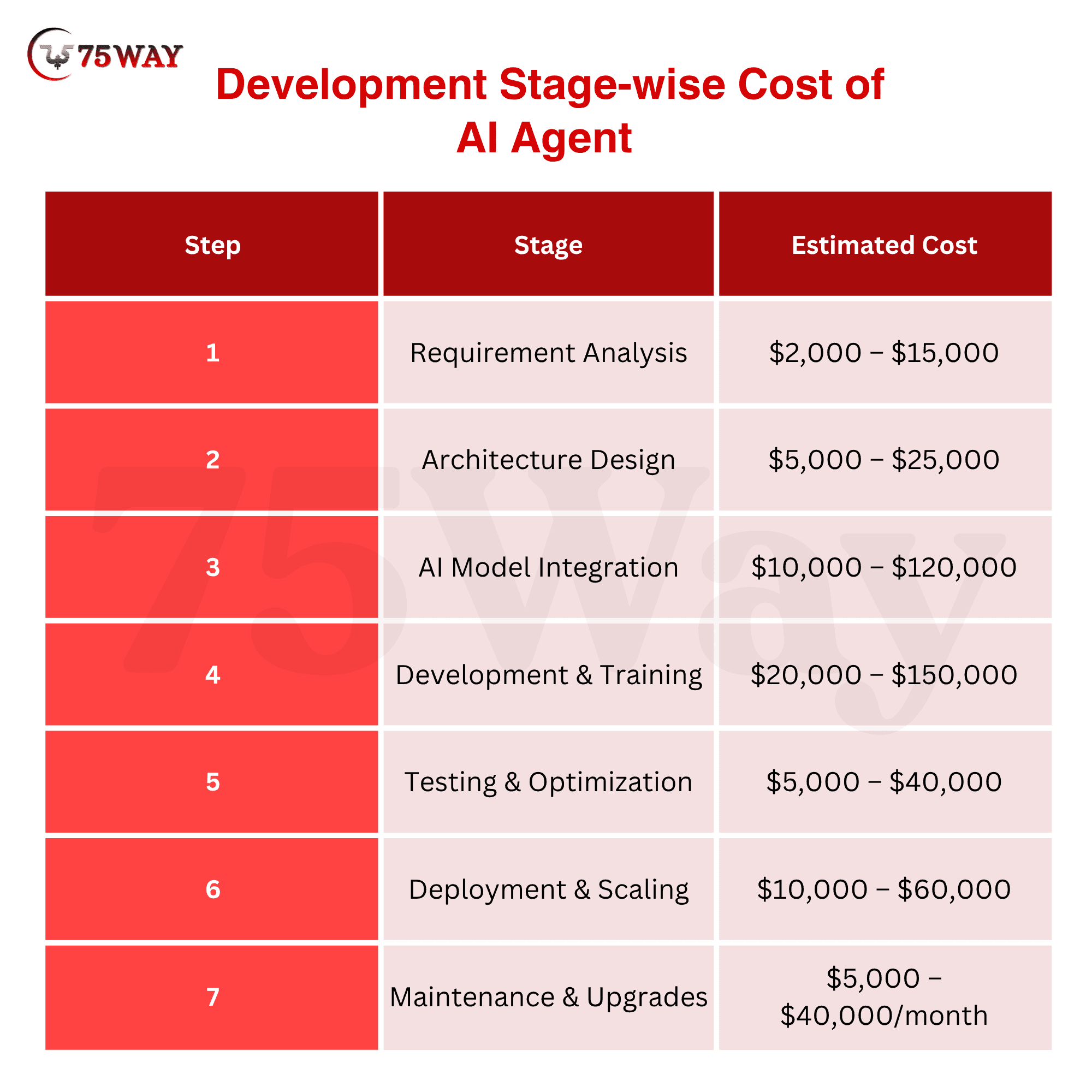
AI agent development follows a structured lifecycle in which each phase directly contributes to the overall cost, timeline, and system quality. Understanding these stages helps businesses estimate investment more accurately and avoid unexpected budget increases during execution.
Step 1: Requirement Analysis
Estimated Cost: $2,000 – $15,000
This phase defines business objectives, use cases, and the functional scope of the AI agent. Clear requirements reduce development risks and prevent scope changes later. It directly impacts final cost by determining system complexity, integrations, and the intelligence level needed for successful implementation.
Step 2: Architecture Design
Estimated Cost: $5,000 – $25,000
Architectural design involves planning the system structure, database flows, APIs, and a scalability framework. It ensures the AI agent can handle future growth efficiently. Poor architecture increases long-term costs, while strong design reduces maintenance costs, improves performance, and enables seamless system expansion.
Step 3: AI Model Integration
Estimated Cost: $10,000 – $120,000
This stage includes integrating large language models or custom AI models into the system. Costs vary based on model selection, fine-tuning requirements, and API usage. It is one of the most expensive phases due to computational and engineering complexity.
Step 4: Development & Training
Estimated Cost: $20,000 – $150,000
This is the core development phase where AI logic, workflows, and training processes are built. It requires significant engineering effort, dataset preparation, and iterative model improvements. Complexity and feature depth heavily influence both cost and development timeline.
Step 5: Testing & Optimization
Estimated Cost: $5,000 – $40,000
Testing ensures the AI agent performs accurately, securely, and efficiently under real-world conditions. This includes bug fixing, performance tuning, and output validation. Optimization improves reliability and reduces long-term operational issues after deployment.
Step 6: Deployment & Scaling
Estimated Cost: $10,000 – $60,000
This phase involves launching the AI agent on cloud infrastructure and preparing it for real user traffic. Scaling ensures system stability under load, while the deployment setup includes CI/CD pipelines, monitoring tools, and hosting configuration to maintain continuous availability.
Step 7: Maintenance & Upgrades
Estimated Cost: $5,000 – $40,000 per month
Ongoing maintenance ensures the AI agent remains functional, up to date, and optimized. It includes bug fixes, model updates, performance monitoring, and feature enhancements. Regular upgrades are essential to maintain accuracy, security, and long-term system efficiency.
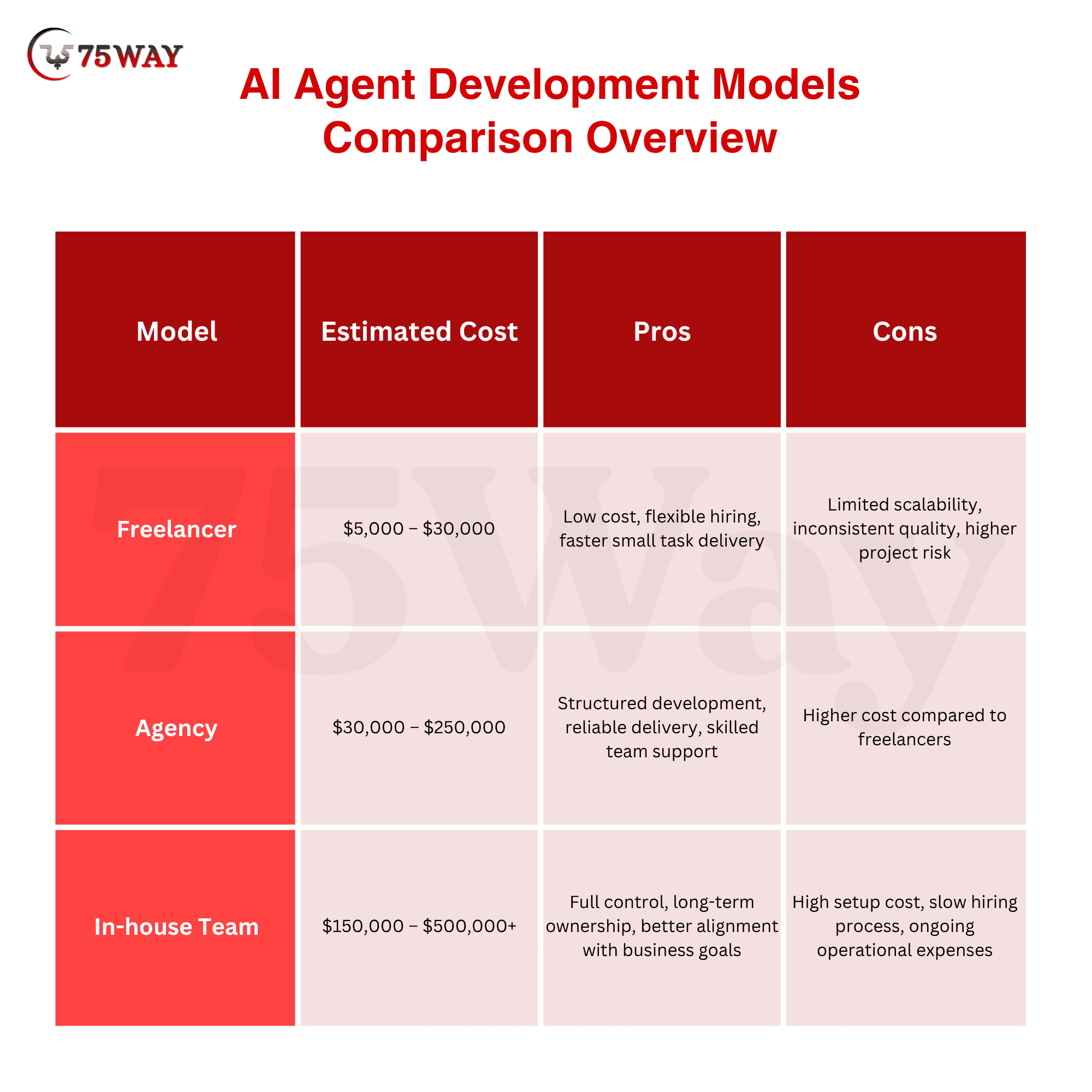
Development Models Comparison Overview
Choosing the right development model for AI agent development significantly impacts overall cost, scalability, and long-term performance. Businesses typically choose between freelancers, agencies, and in-house teams based on budget availability, project complexity, and the level of control required over the development process. Each model has distinct advantages and limitations, influencing not only initial development costs but also maintenance, execution speed, and system reliability. Understanding these differences helps organizations make informed decisions aligned with both technical needs and financial constraints.
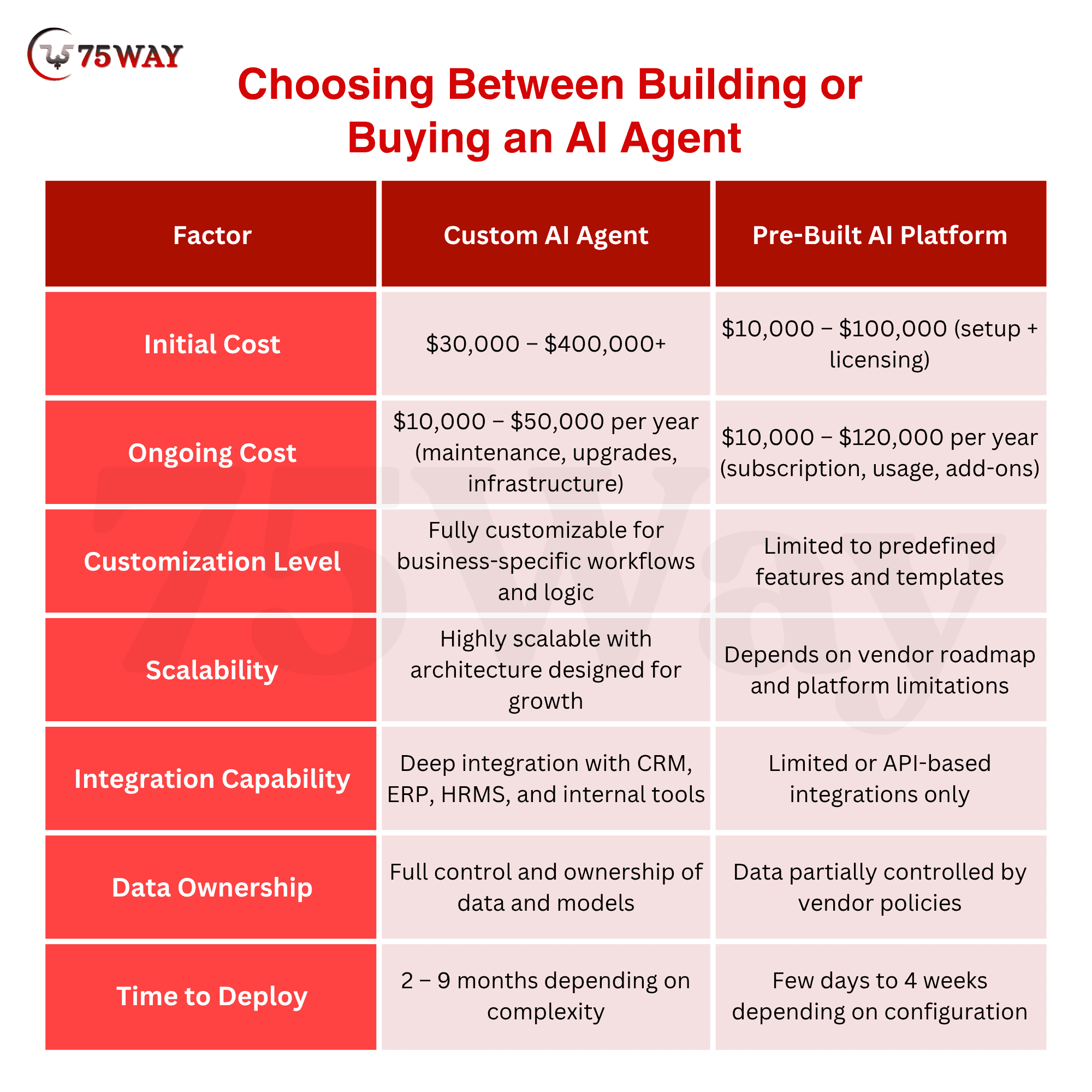
Choosing Between Building or Buying an AI Agent Explained
Deciding between building a custom AI agent or buying a pre-built solution depends on your business complexity, budget, scalability needs, and long-term control requirements. Custom development offers full flexibility and deep integration with internal systems, making it ideal for advanced and evolving use cases. On the other hand, pre-built platforms provide faster deployment and lower upfront cost but come with limitations in customization and scalability. The right choice depends on whether your priority is long-term ownership or quick implementation with lower initial investment.
Practical Strategies to Reduce AI Agent Development Cost
Managing the cost to build an AI agent requires a smarter engineering and planning approach rather than simple budget cuts. The most effective cost savings come from reducing technical complexity early, selecting reusable components, and building systems that scale gradually rather than over-engineering from the start. Businesses that adopt a phased development strategy often achieve better ROI while maintaining performance quality and flexibility. Below are proven strategies that help control AI agent development costs while ensuring long-term stability and scalability.
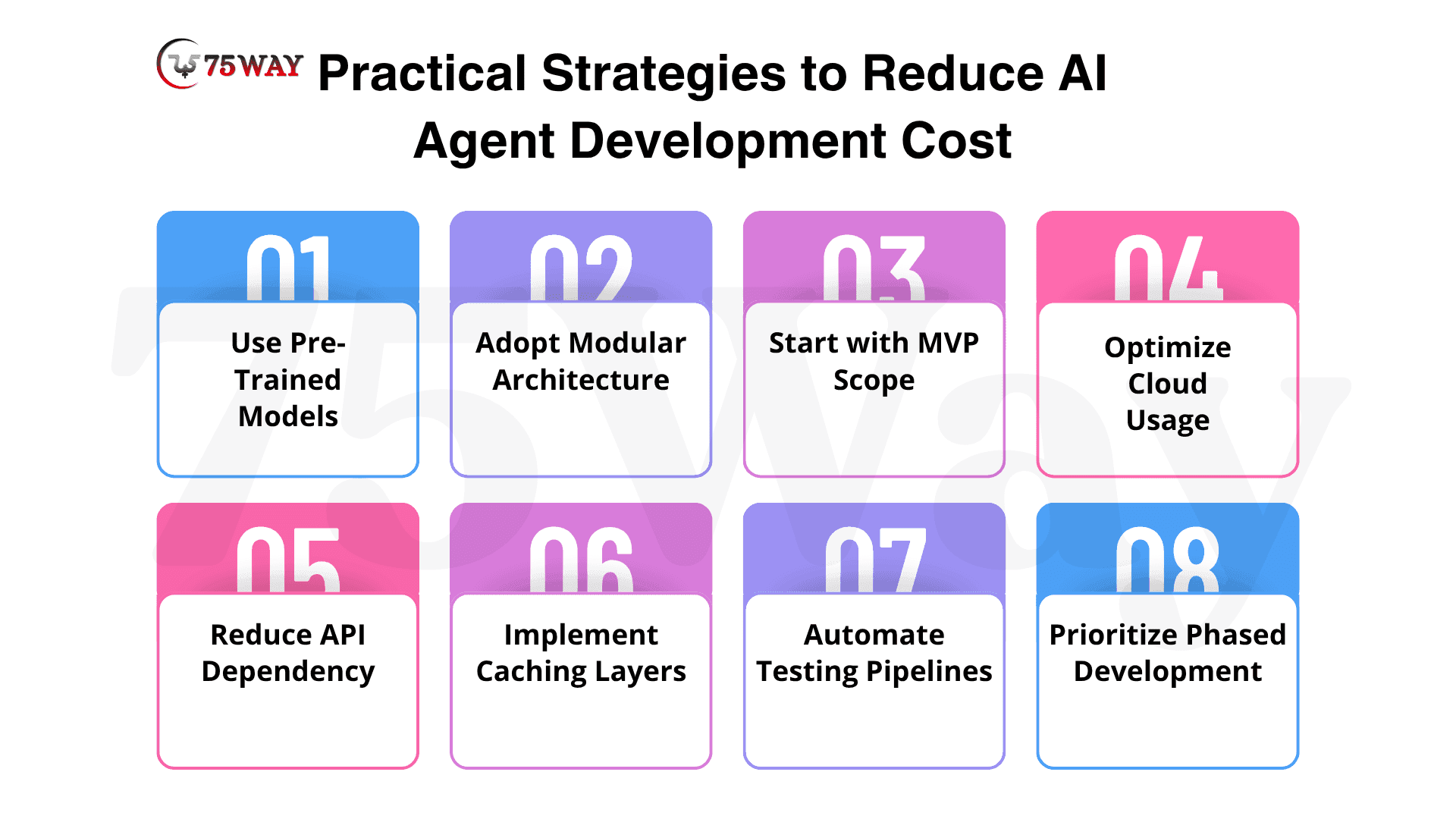
- Use Pre-Trained Models
Pre-trained models reduce development costs by eliminating the need to train from scratch. Businesses can fine-tune existing models for specific use cases, saving time, compute resources, and engineering effort while still achieving high-quality AI performance and faster deployment cycles.
- Adopt Modular Architecture
Modular architecture helps reduce costs by breaking the AI system into reusable components. This approach allows teams to develop, update, and scale individual modules independently, minimizing redevelopment efforts and improving long-term maintainability and cost efficiency across complex AI agent systems.
- Start with MVP Scope
Starting with a minimum viable product ensures only essential features are built initially. This reduces upfront investment, accelerates time-to-market, and allows businesses to validate ideas before committing to full-scale AI agent development and additional, costly enhancements.
- Optimize Cloud Usage
Cloud cost optimization involves selecting efficient compute resources, using auto-scaling, and shutting down idle services. This prevents unnecessary infrastructure expenses while ensuring AI agents maintain performance under varying workloads without overpaying for unused server capacity or storage.
- Reduce API Dependency
Minimizing reliance on third-party APIs helps control recurring operational costs. Businesses can replace frequent API calls with cached responses or in-house models, reducing long-term expenses while improving system speed, reliability, and independence from external service limitations.
- Implement Caching Layers
Caching frequently used data reduces repeated computations and API requests, significantly lowering operational costs. It improves response speed, reduces server load, and enhances overall system efficiency, especially in high-traffic AI agent applications with repetitive query patterns.
- Automate Testing Pipelines
Automated testing reduces manual QA effort and development delays. It helps identify bugs early, reduces rework costs, and ensures consistent system performance, making AI agent development faster, more reliable, and significantly more cost-efficient over the entire lifecycle.
- Prioritize Phased Development
Phased development spreads investment over time by building AI agents in stages. This allows businesses to evaluate performance at each phase, control financial risk, and make data-driven improvements without committing large budgets upfront for full system deployment.
Why Businesses Trust 75way for Budget-Friendly AI Agent Development Solutions?
Companies are increasingly focused on finding AI development partners that deliver strong performance without inflating costs. 75way Technologies has built its reputation by helping businesses adopt AI agent solutions that are both technically robust and financially sustainable. This balance of quality and affordability is a key reason organizations continue to rely on its expertise.
One of the core strengths lies in its structured development approach, where every stage is carefully planned with clear cost visibility. From initial requirement gathering to final deployment, businesses gain a transparent view of timelines, resources, and investment needs. This eliminates uncertainty and helps startups and enterprises avoid unexpected expenses during the development lifecycle.
Beyond development, 75way focuses on building scalable and cost-efficient autonomous AI agent systems that support long-term growth. By using optimized architectures, reusable components, and efficient cloud strategies, solutions are designed to evolve with business needs while keeping operational costs under control. This ensures companies can expand their AI capabilities without facing unnecessary financial pressure.
Final Remarks
AI agent development is a strategic investment rather than a fixed-cost product, and understanding its pricing structure is essential for making informed business decisions. From simple rule-based systems to advanced autonomous and multi-agent architectures, costs vary based on complexity, integrations, data requirements, and long-term scalability needs. Businesses that clearly define their objectives and choose the right development approach can significantly optimize both initial and ongoing expenses. If you are looking to build cost-effective AI agents tailored to your business needs, you can partner with an experienced AI agent development company to make a difference.
Frequently Asked Questions (FAQs)
Can AI Agent Development Cost Increase After Deployment?
Yes, AI agent development costs can increase after deployment due to additional integrations, new feature requirements, higher user demand, model upgrades, security enhancements, and continuous performance optimisation.
Is Fine-Tuning An AI Model Included In AI Agent Development Cost?
Fine-tuning may or may not be included depending on the project scope. It usually adds cost because it requires quality datasets, model training, evaluation, testing, and ongoing improvements.
Does The Number of Users Impact AI Agent Development Cost?
Yes, user volume can influence development costs, especially for enterprise AI agents requiring higher infrastructure capacity, faster response times, advanced security, and scalable cloud architecture.
Are AI Agent APIs Included In The Development Cost?
API costs are generally separate from development expenses. AI model usage, third-party services, cloud infrastructure, and external platform fees depend on the tools and technologies selected for the project.
How Much Does It Cost To Integrate An AI Agent With Existing Software?
The integration cost depends on the complexity of existing systems, APIs, data sources, security requirements, and the number of platforms involved, such as CRM, ERP, or business applications.
Is It Cheaper To Build A Single AI Agent or A Multi-Agent System?
A single AI agent usually costs less because it handles specific tasks. Multi-agent systems require additional architecture, coordination logic, testing, and communication workflows, making them more complex to develop.