Summary
Explore AI agents in software development, covering core concepts, architecture, tools, workflows, benefits, challenges, and future trends. It explains how intelligent agents automate coding, testing, debugging, and deployment, helping developers build faster, reduce errors, and improve productivity while transforming traditional software engineering into an AI-driven, collaborative ecosystem.
Quick Overview
- AI agents automate coding, testing, debugging, and deployment efficiently.
- They enhance developer productivity by handling repetitive software development tasks.
- Multi-agent systems enable collaboration across complex software engineering workflows.
- AI tools reduce errors and improve overall code quality significantly.
- Human developers remain essential for creativity, architecture, and decision-making.
- Future development will rely on autonomous AI-driven software ecosystems.
Software development has entered a new era in which intelligent systems are no longer just assisting developers but are actively participating in building, testing, and optimizing applications. These intelligent systems, known as AI agents, are transforming traditional workflows into autonomous, adaptive, and highly efficient development ecosystems.
An AI agent development solution is a software entity that can perceive its environment, reason about tasks, make decisions, and execute actions to achieve specific goals. In software development, these agents can write code, debug errors, generate tests, optimize performance, and even manage deployment pipelines.
The integration of AI agents is reshaping how developers think about productivity, scalability, and innovation. Instead of replacing developers, these systems amplify human capabilities, reducing repetitive work and enabling focus on high-level problem-solving and architecture design.
This guide explores AI agent solutions for software development, including core concepts, architecture, tools, workflows, benefits, challenges, and future trends.
What Are AI Agents in Software Development?
AI agents are autonomous or semi-autonomous systems designed to perform software engineering tasks with minimal human intervention. Unlike traditional automation tools, AI agents can reason, adapt, and improve over time.
In software development, an AI agent typically:
- Understands natural language instructions
- Breaks down tasks into smaller steps
- Writes and refines code
- Identifies bugs and fixes them
- Runs tests and validates output
- Interacts with other tools and APIs
Modern AI agents are powered by large language models (LLMs), reinforcement learning systems, and tool-using frameworks.
Core Concepts Behind AI Agents
Understanding AI agents requires familiarity with a few foundational concepts.

1. Autonomy
AI agents operate independently within defined boundaries. They can make decisions without continuous human input.
2. Perception
Agents gather information from inputs such as code repositories, APIs, logs, and documentation.
3. Reasoning
They analyze data, identify patterns, and determine the best action to complete tasks.
4. Action Execution
Agents perform tasks such as writing code, running scripts, or triggering CI/CD pipelines.
5. Memory
Advanced agents maintain short-term and long-term memory, enabling them to recall past actions and improve performance over time.
6. Tool Usage
AI agents integrate with external tools like IDEs, APIs, and testing frameworks.
Types of AI Agents in Software Development
AI agents can be categorized based on functionality and complexity.
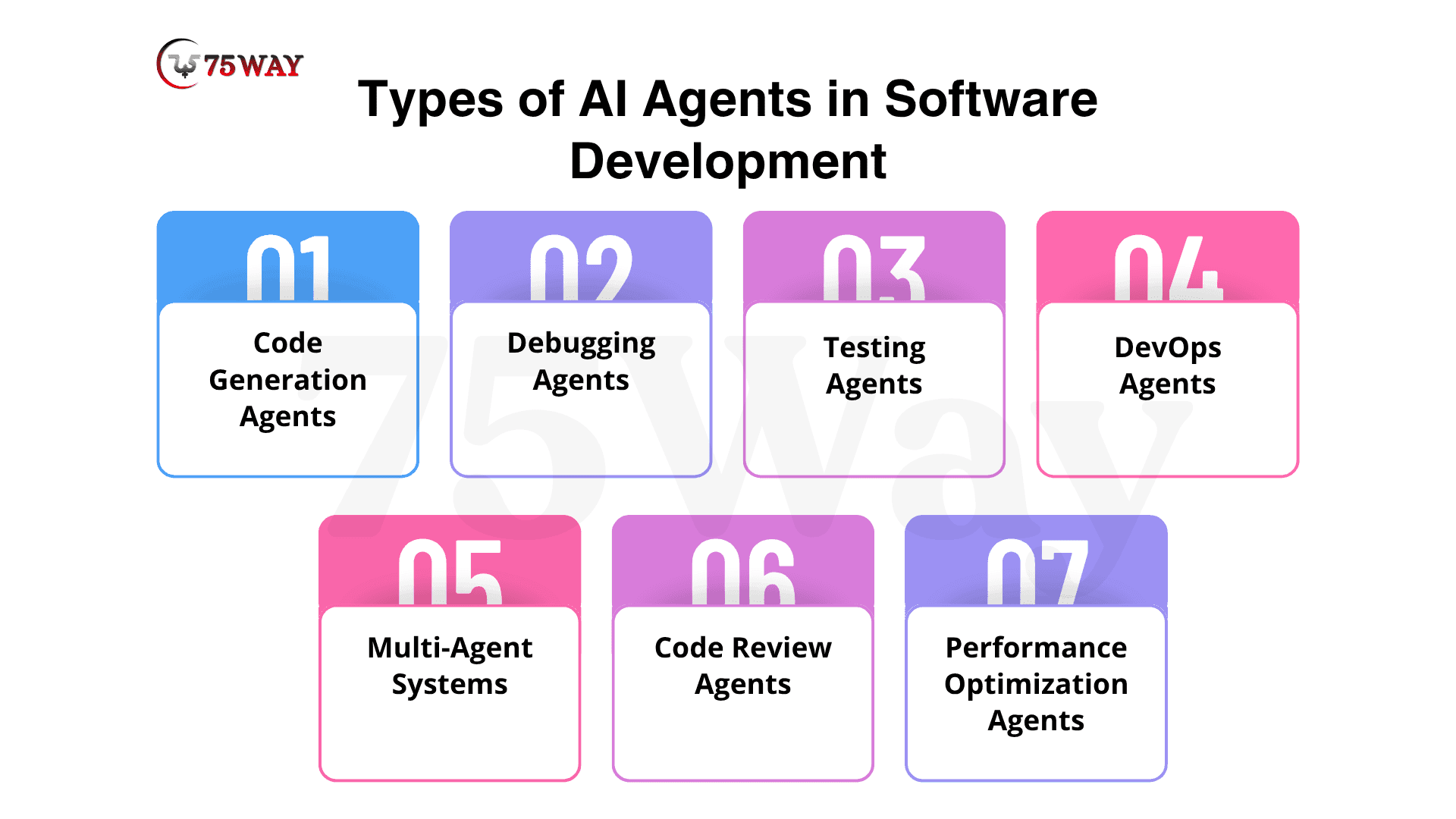
- Code Generation Agents
These agents generate code from natural language prompts. They help developers build applications faster by producing boilerplate code, functions, and modules.
- Debugging Agents
These systems analyze logs, detect errors, and suggest fixes automatically.
- Testing Agents
They generate unit tests, integration tests, and even simulate edge cases.
- DevOps Agents
These agents manage deployment pipelines, monitor infrastructure, and optimize system performance.
- Multi-Agent Systems
In advanced setups, multiple AI agents collaborate to complete complex software projects. One agent may design architecture, while another handles testing and another manages deployment.
- Requirement Analysis Agents
These agents interpret business requirements, convert user stories into technical specifications, and help teams define project scope more accurately and efficiently.
- Code Review Agents
They automatically review source code, detect vulnerabilities, suggest optimizations, and ensure coding standards and best practices are consistently followed across projects.
- Performance Optimization Agents
These systems analyze application performance, identify bottlenecks, and recommend improvements to enhance speed, scalability, and overall system efficiency in production environments.
AI Agent Architecture in Software Development
A typical AI agent architecture includes several layers:
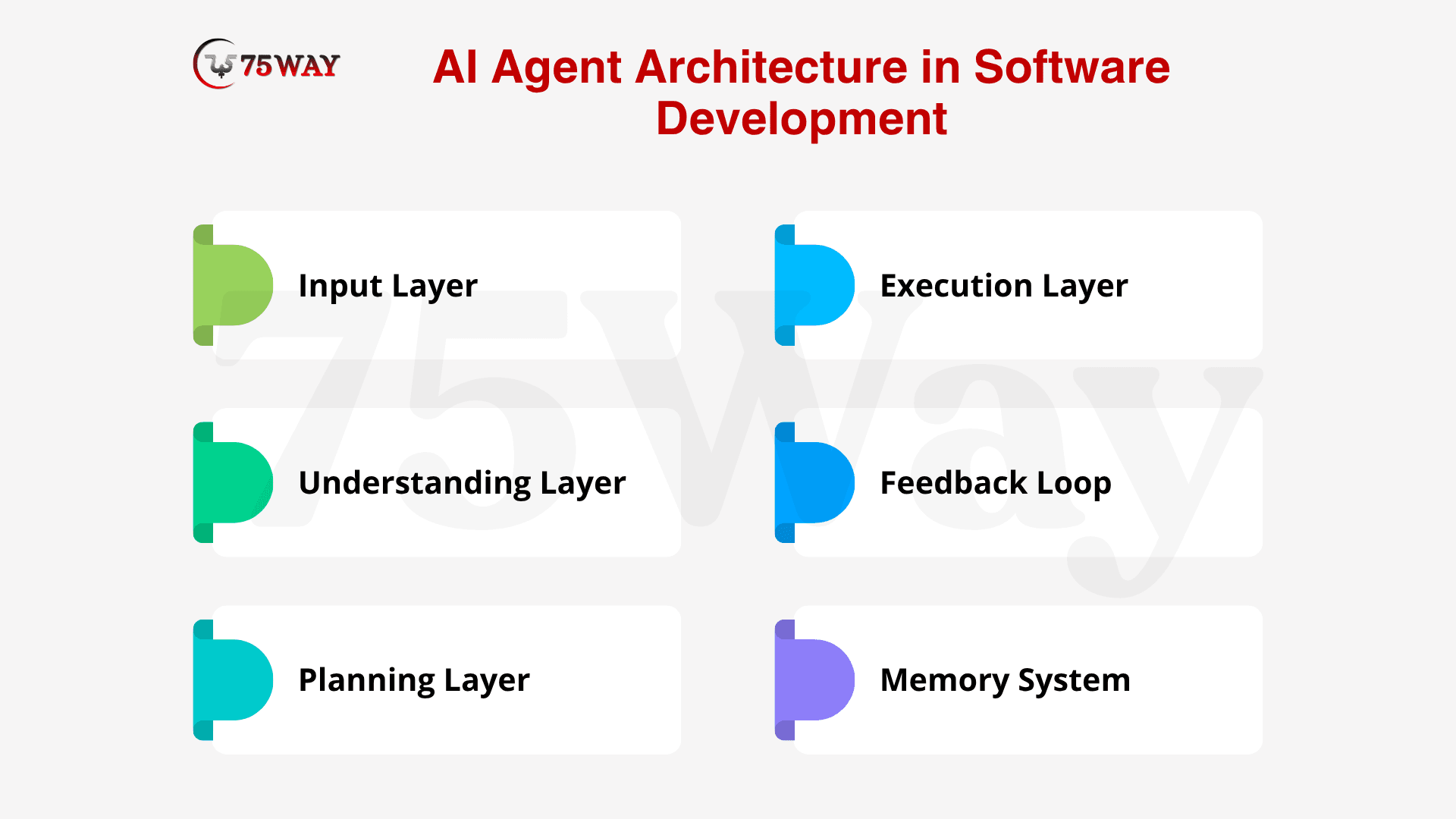
1. Input Layer
Receives instructions in natural language or structured format.
2. Understanding Layer
Uses machine learning models to interpret user intent and break down tasks.
3. Planning Layer
Creates step-by-step execution plans.
4. Execution Layer
Performs actions such as coding, testing, or API calls.
5. Feedback Loop
Evaluates results and improves future actions.
6. Memory System
Stores context, code history, and past decisions.
Modern frameworks such as GitHub Copilot demonstrate how AI-assisted development can be embedded directly into IDE workflows.
Tools Used in AI Agent Development
AI agents rely on a powerful ecosystem of tools and platforms.
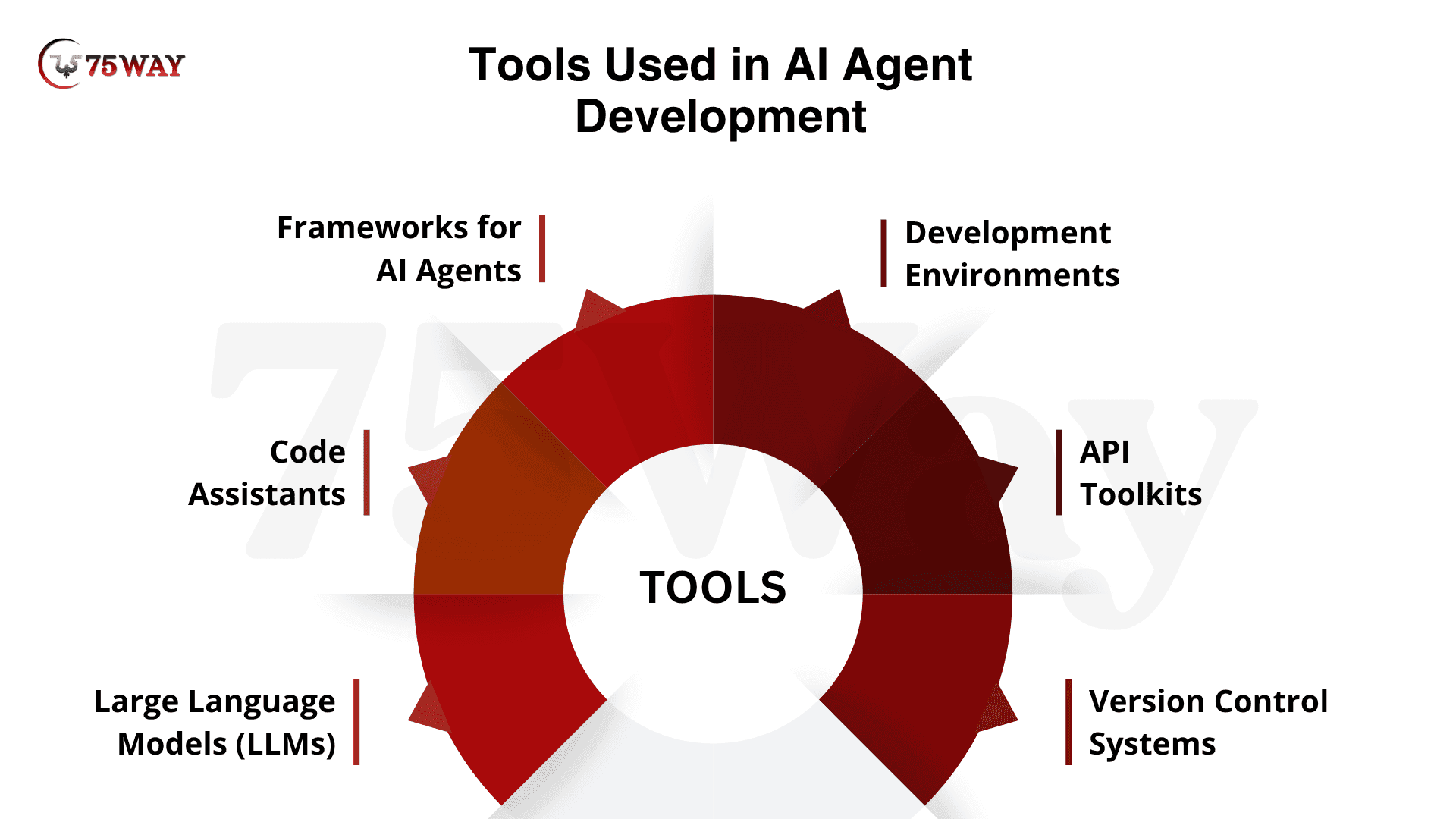
1. Large Language Models (LLMs)
LLMs form the brain of AI agents. They interpret instructions and generate responses.
Popular examples include models from OpenAI.
2. Code Assistants
Tools like GitHub Copilot help developers write and complete code faster.
3. Frameworks for AI Agents
Frameworks provide structure for building agents:
- LangChain
- AutoGPT-style systems
- Semantic Kernel by Microsoft
4. Development Environments
AI agents integrate with IDEs like Visual Studio Code to assist in real time.
5. API Toolkits
Agents use APIs to fetch data, execute code, and interact with external systems.
6. Version Control Systems
Systems like Git are essential for tracking changes made by AI agents.
How AI Agents Work in Software Development Lifecycle
AI agents integrate into every phase of software development.
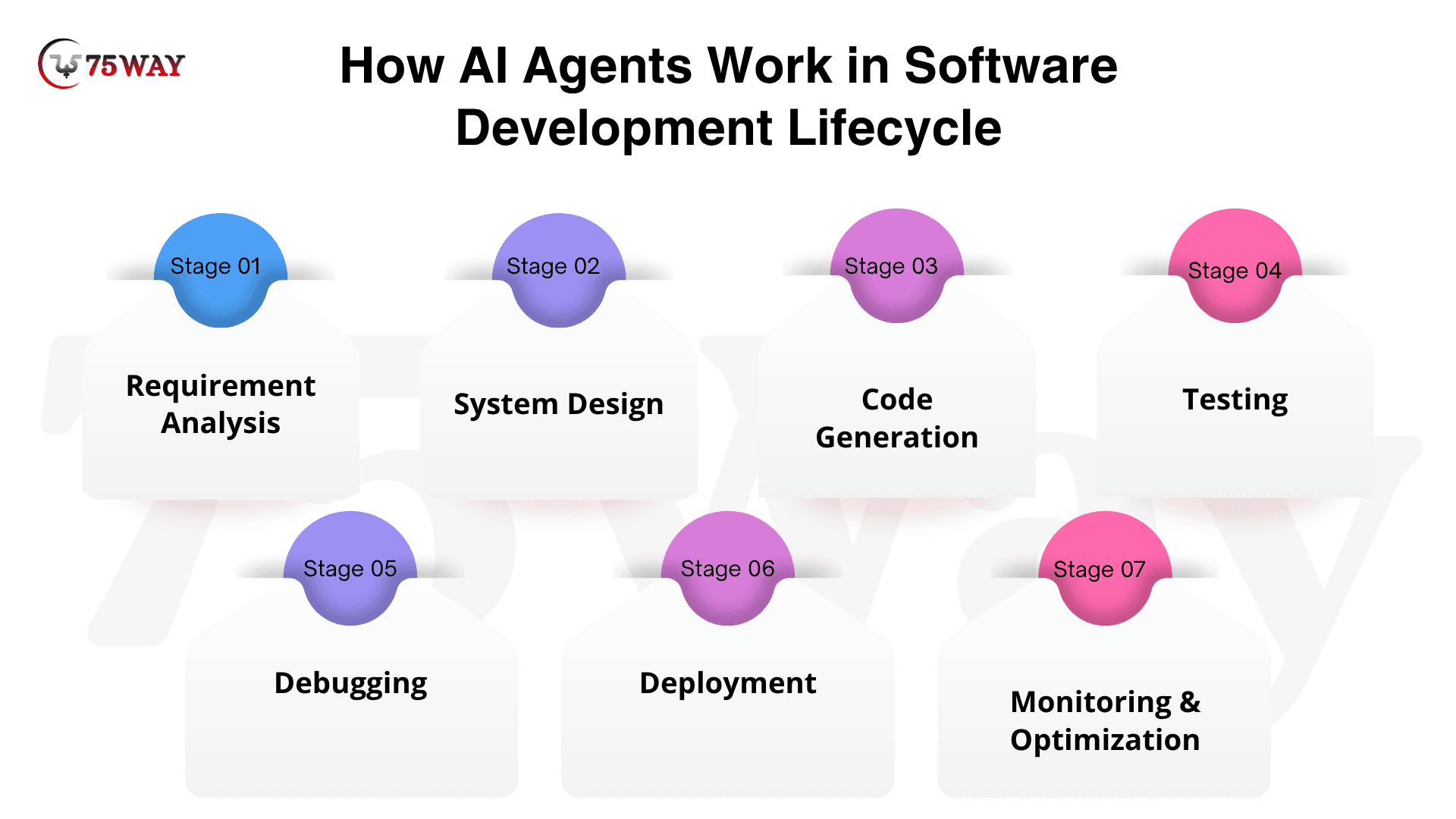
Stage 1: Requirement Analysis
AI agents analyze user stories, business goals, and product requirements to transform them into clear technical specifications. They help development teams understand project scope, identify dependencies, and eliminate ambiguity early in the lifecycle, ensuring that the foundation of the software is accurate, structured, and aligned with business objectives.
Stage 2: System Design
At this stage, AI agents assist architects by recommending optimal system architectures, database structures, and technology stacks. They evaluate scalability, performance, and security needs while suggesting efficient design patterns. This ensures the software is built on a strong, future-ready foundation that supports long-term growth and adaptability.
Stage 3: Code Generation
AI agents generate functional code for APIs, modules, and user interfaces based on predefined requirements. They speed up development by reducing repetitive coding tasks and providing optimized, error-free code suggestions. This helps developers focus on logic, innovation, and complex problem-solving rather than routine implementation work.
Stage 4: Testing
During testing, AI agents automatically create unit tests, integration tests, and edge case scenarios. They simulate real-world usage to detect bugs and inconsistencies early. This improves software reliability, reduces manual testing effort, and ensures higher quality releases with fewer post-deployment issues.
Stage 5: Debugging
AI agents analyze logs, stack traces, and system behavior to quickly identify errors and performance issues. They suggest potential fixes and root causes, significantly reducing debugging time. This allows developers to resolve issues faster and maintain system stability throughout the development lifecycle.
Stage 6: Deployment
AI agents automate CI/CD pipelines, manage release cycles, and monitor deployments in real time. They ensure smooth production releases by detecting failures early and rolling back changes if necessary, improving system reliability and minimizing downtime during software updates.
Stage 7: Monitoring & Optimization
After deployment, AI agents continuously monitor application performance, user behavior, and system health. They identify bottlenecks, propose improvements, and automatically optimize resources. This ensures long-term efficiency, scalability, and consistent application performance in dynamic production environments.
Benefits of AI Agents in Software Development
AI agents are transforming software development by improving speed, efficiency, and code quality. They automate repetitive tasks, reduce errors, accelerate delivery cycles, and enable developers to focus on innovation and complex problem-solving effectively.

- Increased Productivity: AI agents handle repetitive coding tasks, enabling developers to focus on complex logic, architecture, and innovation.
- Faster Development Cycles: AI automation accelerates coding, testing, and deployment processes, enabling teams to deliver software projects significantly faster than traditional methods.
- Reduced Errors: AI agents detect bugs early in development, improving code quality, reducing debugging time, and ensuring more stable software releases.
- Cost Efficiency: Automation reduces dependency on large development teams, lowering overall project costs while maintaining productivity and software development quality standards.
- Enhanced Collaboration: Multi-agent systems enable parallel workflows, with different agents handling coding, testing, and deployment, improving coordination and accelerating overall development.
- Continuous Learning: AI agents continuously learn from data and feedback, improving accuracy, performance, and decision-making across future software development tasks consistently.
- Improved Code Quality: AI agents enforce coding standards, detect vulnerabilities, and suggest optimizations, ensuring cleaner, more maintainable, and production-ready software code.
- Better Resource Utilization: AI optimizes resource allocation across development processes, ensuring efficient use of computing power, developer time, and infrastructure costs effectively.
Challenges of AI Agents in Building Software
Despite their advantages, AI agents face several limitations.

- Context Limitations: AI agents may struggle to maintain a full understanding across large and complex codebases, leading to incomplete or inconsistent outputs in development workflows.
- Hallucinations: AI models can sometimes generate incorrect, irrelevant, or non-functional code, which requires careful human review and validation before implementation.
- Security Risks: Automatically generated code may introduce vulnerabilities if security best practices are not properly followed during AI-assisted development processes.
- Dependency on Data Quality: The effectiveness of AI agents heavily depends on input data quality; poor or incomplete data leads to inaccurate or unreliable results.
- Lack of Human Creativity: AI agents cannot fully replicate human innovation, intuition, and problem-solving required for complex architectural and product decisions in software development.
Real-World Use Cases of AI Agents
AI agents are transforming software development by accelerating delivery, improving efficiency, and reducing manual effort across product engineering and deployment stages.

Enterprise Application Development: AI agents help large organizations build scalable enterprise applications by automating coding, suggesting architecture, and handling testing and integration. This reduces development time while improving system reliability and performance in complex business environments.
Startup MVP Creation: Startups use AI agents to quickly build minimum viable products by generating code, designing basic architecture, and automating testing. This enables faster idea validation and reduces time-to-market for new digital products.
Automated Testing Pipelines: AI agents create, execute, and maintain automated test cases across environments. This ensures consistent software quality, reduces manual testing efforts, and detects bugs early in the development lifecycle.
Code Refactoring: AI agents analyze legacy codebases and recommend optimized structures. They improve readability, performance, and maintainability while reducing technical debt and helping modernize applications without disrupting functionality.
DevOps Automation: AI agents manage CI/CD pipelines, cloud infrastructure, and deployment processes. They enable smooth releases, real-time monitoring, and automated scaling for improved operational efficiency and system reliability.
Requirement Analysis and Planning: AI agents convert business requirements and user stories into structured technical specifications. This helps teams design architecture, define workflows, and plan implementation more efficiently and accurately.
Performance Monitoring and Optimization: AI agents continuously monitor application performance, identify bottlenecks, and suggest improvements. This ensures systems remain scalable, efficient, and deliver consistent user experiences under varying workloads.
AI Agent Workflow: Complete Process
A typical workflow for building a feature using AI agents:
- Developer provides requirement in natural language
- AI agent breaks task into sub-tasks
- Code generation agent writes modules
- Testing agent validates functionality
- Debugging agent fixes issues
- Deployment agent pushes to production
This workflow significantly reduces manual effort while increasing accuracy.
AI Agent Frameworks and Ecosystem
The ecosystem of AI agent development is rapidly growing.
Popular Frameworks:
- LangChain
- AutoGen by Microsoft
- LlamaIndex
- CrewAI
Supporting Platforms:
- Cloud computing platforms
- API marketplaces
- Code repositories
- Model hosting platforms
These tools collectively enable scalable AI agent deployment.
Future of AI Agents To Develop Software
The future of AI agents in software development is highly promising, with advancements enabling greater automation, smarter decision-making, faster development cycles, and improved collaboration between developers and intelligent AI systems.
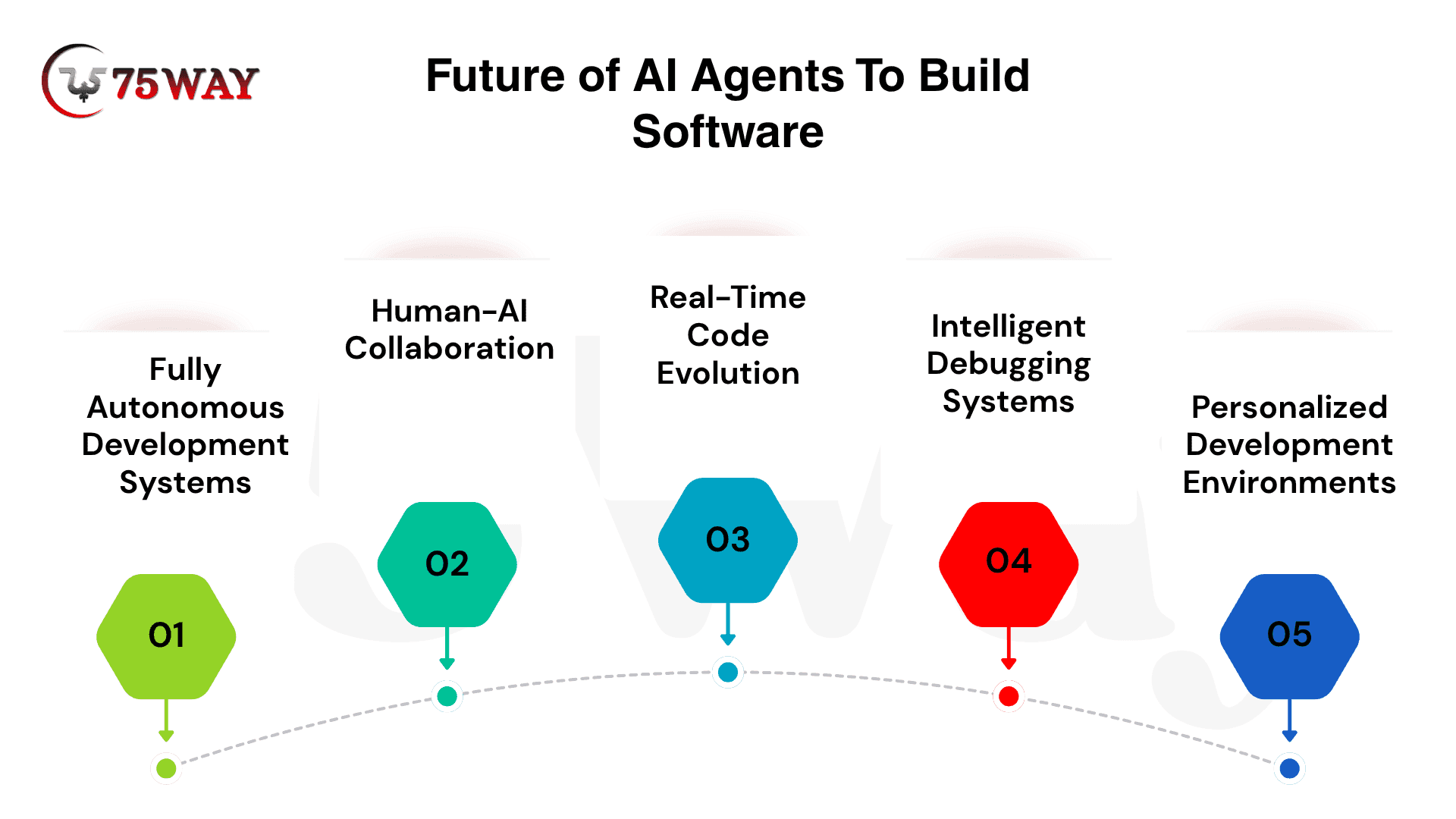
- Fully Autonomous Development Systems: AI agents will independently manage entire software projects, handling planning, coding, testing, and deployment.
- Human-AI Collaboration: Developers will transition into supervisory roles, guiding AI agents while focusing on architecture, strategy, and innovation.
- Real-Time Code Evolution: Applications will continuously adapt and improve based on user feedback, usage patterns, and performance data.
- Intelligent Debugging Systems: AI will instantly detect, analyze, and fix software errors, significantly reducing debugging time and improving reliability.
- Personalized Development Environments: AI will customize IDEs based on individual developer preferences, coding style, and productivity patterns.
Best Practices for Using AI Agents
Using AI agents effectively in software development requires a balanced approach that combines automation with human oversight. Proper implementation ensures better accuracy, security, and long-term performance of AI-driven systems.
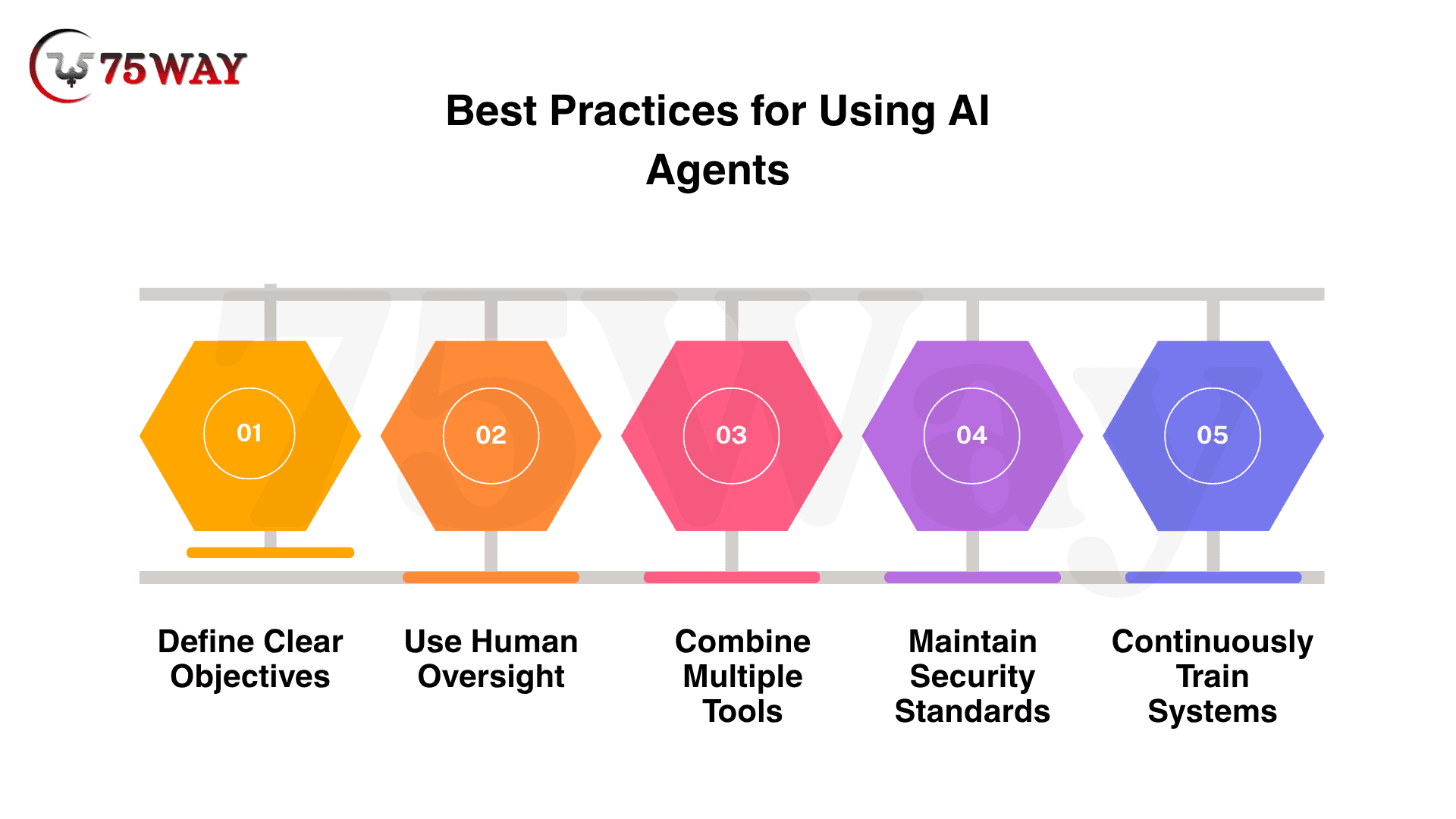
- Define Clear Objectives: Provide structured, specific, and well-documented instructions to AI agents to ensure accurate outputs aligned with project requirements and avoid ambiguity in development tasks and workflows.
- Use Human Oversight: Always review AI-generated code carefully before deployment to ensure correctness, maintain quality standards, and prevent potential functional or logical errors in production systems effectively.
- Combine Multiple Tools: Avoid relying on a single AI agent or framework; instead, integrate multiple tools to improve accuracy, reduce bias, and enhance overall development efficiency and flexibility.
- Maintain Security Standards: Validate all AI-generated code for vulnerabilities, enforce security best practices, and ensure compliance with industry regulations to protect applications from potential threats and risks.
- Continuously Train Systems: Improve AI agent performance by using feedback loops, updating datasets, and refining models regularly to enhance accuracy, adaptability, and long-term development effectiveness.
Conclusion
AI agents are fundamentally reshaping software development by introducing a new level of intelligence, automation, and adaptability across the entire development lifecycle. From requirements analysis and system design to coding, testing, debugging, and deployment, these systems enable faster, more efficient, and more scalable workflows than traditional approaches.
Ultimately, AI agents represent the next major leap in software development, transforming it from a manual, step-by-step process into an intelligent, collaborative, and continuously evolving ecosystem. If you are planning to transform your business with intelligent automation, partnering with a trusted AI agent development company can help you design, build, and deploy custom AI-powered solutions tailored to your goals.
Frequently Asked Questions
How Do AI Agents Improve Software Development Efficiency?
AI agents improve efficiency by automating repetitive coding tasks, generating test cases, and assisting in debugging. This allows developers to focus on complex logic, architecture design, and innovation, significantly reducing development time and improving overall software delivery speed and quality.
What Skills Are Required To Work With AI Agents In Development?
Working with AI agents requires knowledge of programming languages, understanding of machine learning concepts, API integration skills, and familiarity with DevOps practices. Developers should also know how to review AI-generated code and ensure proper validation and optimization.
Can AI Agents Replace Software Developers Completely?
AI agents cannot fully replace software developers because they lack creativity, strategic thinking, and deep problem-solving abilities. They are best used as assistants that enhance productivity, reduce manual effort, and support developers in building better software solutions efficiently.
How Do AI Agents Handle Complex Software Projects?
AI agents handle complex projects by breaking tasks into smaller modules, generating code, and assisting with testing and debugging. However, human supervision is still essential to ensure architectural correctness, system integration, and alignment with business requirements and goals.
What Are The Risks Of Using AI In Software Development?
Risks include generating incorrect or insecure code, dependency on poor-quality data, and potential misinterpretation of requirements. Without proper human oversight, AI agents may introduce vulnerabilities or inefficiencies that can impact system stability and performance.
How Can Developers Get Started With AI Agents?
Developers can start by experimenting with AI coding tools, integrating APIs, and learning prompt engineering techniques. Gradually, they can incorporate AI agents into real projects, focusing on testing, validation, and improving workflows for better productivity and results.