Summary
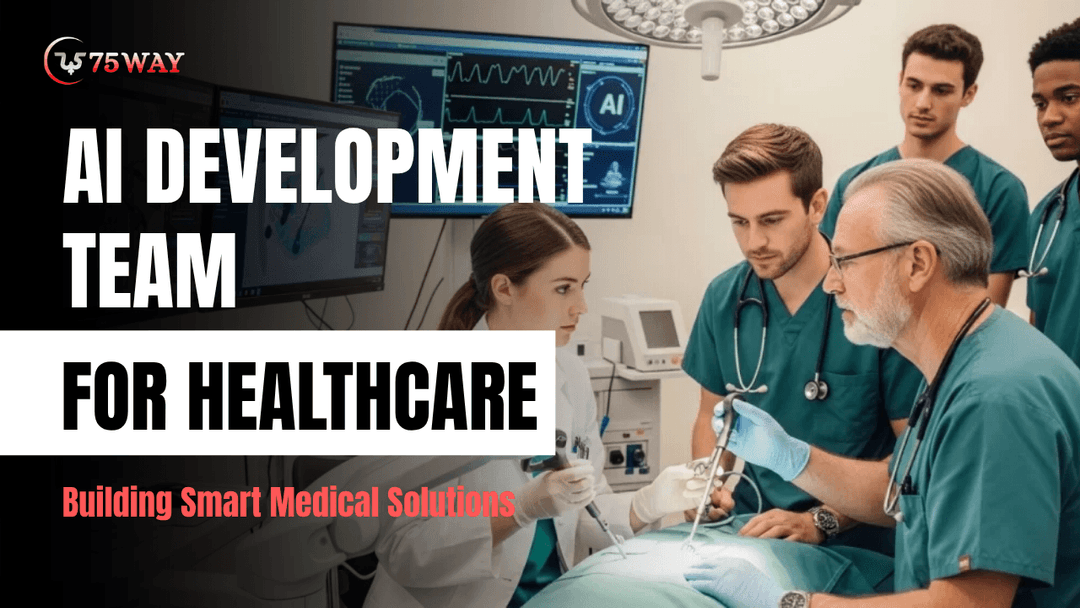
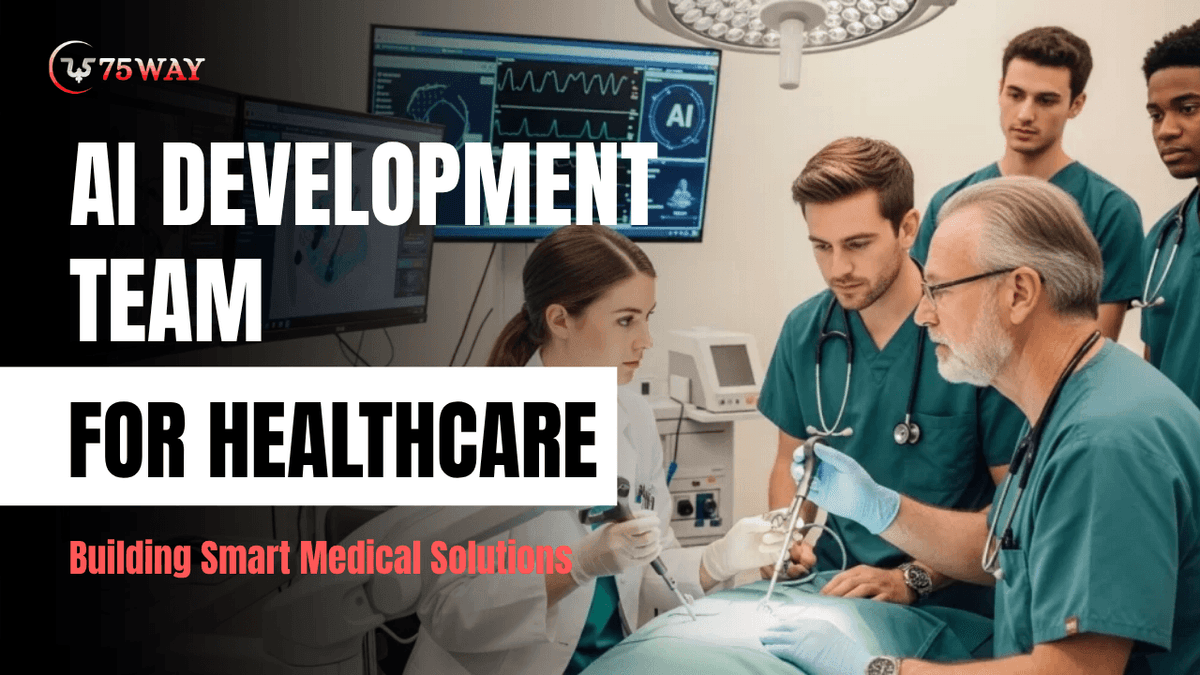
Healthcare industry transformation accelerates through AI development teams designing intelligent medical systems. Hospitals adopt automation, predictive analytics, and digital patient engagement tools. Clinical workflows improve through data-driven intelligence, enhancing diagnosis accuracy, operational speed, and care delivery. Demand rises for specialized AI engineering teams shaping next-generation healthcare ecosystems globally.
Quick Overview
- AI development teams modernize healthcare systems with automation
- Patient care improves through intelligent predictive health systems
- Hospitals adopt AI-driven diagnostics and workflow optimization tools
- Medical data becomes actionable through advanced machine learning models
- Administrative burden reduces significantly with smart healthcare automation
Healthcare organizations are no longer viewing AI as an experimental tool but as a core operational requirement. From patient management systems to diagnostic assistance platforms, AI in healthcare is becoming deeply embedded in clinical and administrative operations.
This shift has created a strong demand for specialized talent capable of designing, developing, and deploying intelligent healthcare solutions. Organizations are increasingly choosing to hire dedicated AI development team to build systems that improve accuracy, reduce operational delays, and enhance patient care outcomes.
Unlike generic software development, healthcare AI requires deep domain understanding, regulatory awareness, and precision engineering. This makes specialized AI development teams essential for building scalable healthcare solutions.
This blog explains why hiring an AI development team for healthcare is critical, how these teams build smart medical solutions, key use cases across the healthcare industry, and the long-term impact of AI-driven healthcare transformation.
Why Healthcare Requires Dedicated AI Developers in 2026?
Healthcare in 2026 is becoming increasingly digital, data-driven, and automation-focused, requiring specialized AI expertise to manage complex systems safely and effectively. Dedicated AI developers are essential to build secure, compliant, and intelligent healthcare solutions that handle patient data, automate clinical workflows, and improve overall care delivery without compromising accuracy or trust.
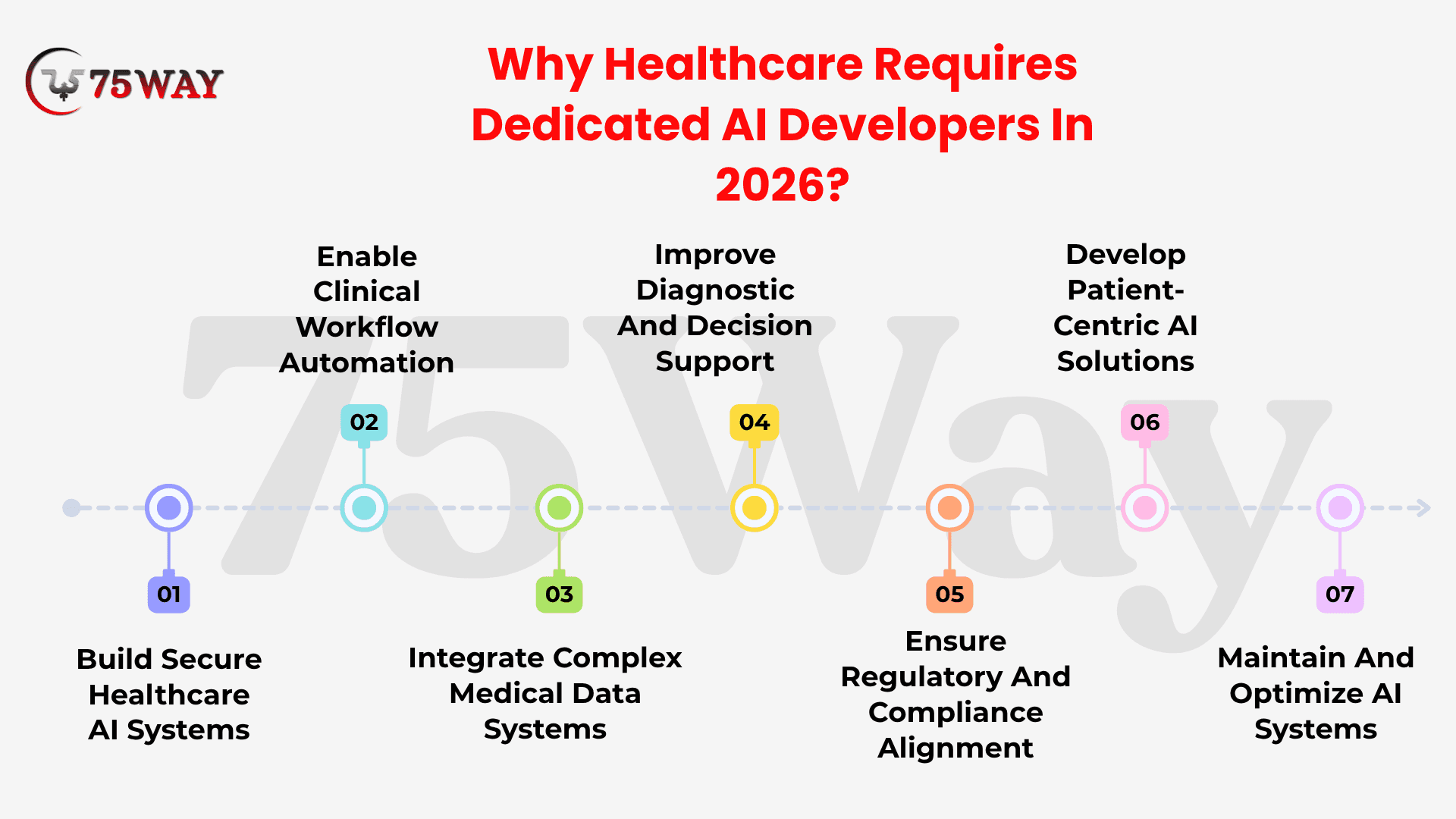
- Build Secure Healthcare AI Systems: Healthcare AI developers design systems with strong security layers to protect sensitive patient data. This ensures compliance with regulations, prevents data breaches, and maintains trust between patients, providers, and digital healthcare platforms.
- Enable Clinical Workflow Automation: Dedicated developers create automation systems for appointment scheduling, patient triage, and record management. This reduces administrative burden on healthcare staff and allows medical professionals to focus more on patient care.
- Integrate Complex Medical Data Systems: Healthcare environments involve multiple systems like EHR, CRM, and diagnostic tools. AI developers ensure seamless integration between these platforms, enabling smooth data exchange and unified patient records.
- Improve Diagnostic And Decision Support: AI developers build models that assist doctors with diagnostics and treatment recommendations. This enhances decision-making accuracy and helps in early detection of diseases through advanced data analysis.
- Ensure Regulatory And Compliance Alignment: Healthcare systems must follow strict regulations such as HIPAA or GDPR. Dedicated AI developers ensure all AI solutions meet compliance requirements, reducing legal risks and maintaining ethical data usage standards.
- Develop Patient-Centric AI Solutions: Developers focus on building AI systems that improve patient experience through personalized communication, faster responses, and better access to healthcare services, increasing overall satisfaction and engagement.
- Maintain And Optimize AI Systems: Healthcare AI systems require ongoing updates, monitoring, and optimization. Dedicated developers ensure models remain accurate, efficient, and aligned with evolving medical standards and real-world healthcare needs.
Role of Artificial Intelligence (AI) Development Teams In Healthcare Innovation
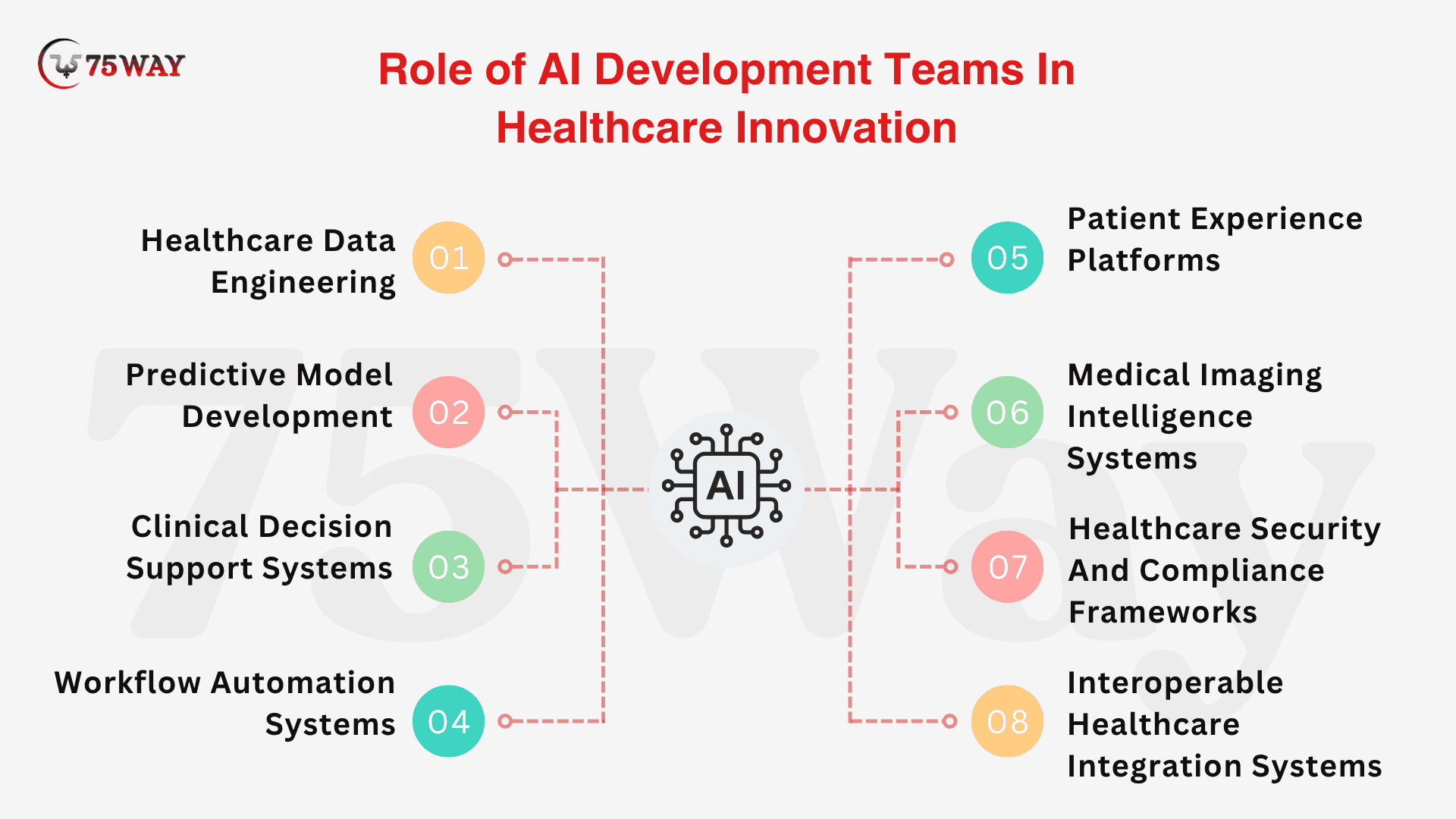
AI teams act as the backbone of digital healthcare transformation. Their role extends beyond coding into system architecture, compliance alignment, and clinical workflow optimization, ensuring that healthcare systems become more intelligent, efficient, and patient-centric.
- Healthcare Data Engineering
Teams design systems that collect, clean, and structure patient data for meaningful analysis. This ensures high-quality datasets that support accurate insights, better reporting, and improved clinical decision-making across healthcare platforms.
- Predictive Model Development
Machine learning models are built to predict disease risks, patient readmission chances, and treatment outcomes. These models help healthcare providers identify risks early and improve preventive care strategies.
- Clinical Decision Support Systems
AI tools assist doctors by providing real-time insights based on patient history and medical patterns. This improves diagnostic accuracy and supports faster, evidence-based clinical decisions.
- Workflow Automation Systems
Administrative tasks such as appointment scheduling, billing, and reporting are automated. This reduces operational burden on healthcare staff and improves overall efficiency in hospital management systems.
- Patient Experience Platforms
AI chatbots and applications enhance patient communication and engagement. They provide instant responses, personalized guidance, and continuous support throughout the healthcare journey.
- Medical Imaging Intelligence Systems
AI teams develop medical imaging systems that analyze medical images such as X-rays, MRIs, and CT scans. This improves detection accuracy, speeds up diagnosis, and supports radiologists in identifying abnormalities early.
- Healthcare Security And Compliance Frameworks
Teams implement strong security systems to protect patient data and ensure compliance with regulations like HIPAA and GDPR. This reduces risks and builds trust in digital healthcare ecosystems.
- Interoperable Healthcare Integration Systems
AI developers create systems that connect hospitals, labs, pharmacies, and insurance providers. This ensures seamless data exchange and enables a unified healthcare ecosystem for better coordination and patient care.
Key Components AI Engineers Develop For Smart Healthcare Solutions
AI engineers play a crucial role in building intelligent healthcare systems that improve diagnosis, patient care, and operational efficiency. These components work together to create connected, data-driven healthcare ecosystems that support better clinical decisions and enhanced patient outcomes.
- Electronic Health Intelligence Systems: Modern healthcare platforms integrate AI into electronic health records to enhance decision-making. These systems organize patient data, identify patterns, and provide actionable insights that help doctors make faster and more accurate clinical decisions.
- AI-Powered Diagnostic Tools: AI disease diagnosis tools analyze medical images, lab reports, and patient symptoms to assist in early and accurate diagnosis. They reduce human error, speed up evaluation processes, and support healthcare professionals in identifying critical conditions at an early stage.
- Remote Patient Monitoring Systems: AI-driven monitoring systems track patient vitals in real time using wearable and connected devices. This enables continuous health tracking, early detection of abnormalities, and timely medical intervention without requiring constant hospital visits.
- Conversational Healthcare Assistants: Virtual healthcare assistants and conversational AI in healthcare help patients book appointments, check symptoms, and receive medical guidance. They improve accessibility, reduce hospital workload, and provide instant support to patients across digital platforms.
- Predictive Healthcare Analytics: These systems use AI to forecast disease outbreaks, patient risk levels, and hospital resource requirements. This helps healthcare providers prepare in advance, optimize resource allocation, and improve overall healthcare planning and response.
Benefits of Hiring AI Developers To Create Medical Systems
Hiring AI developers for medical systems enables healthcare organizations to build intelligent, secure, and scalable digital solutions that improve patient care, streamline operations, and enhance clinical efficiency. These experts design systems that support doctors, reduce manual workload, and enable data-driven decision-making across healthcare environments.
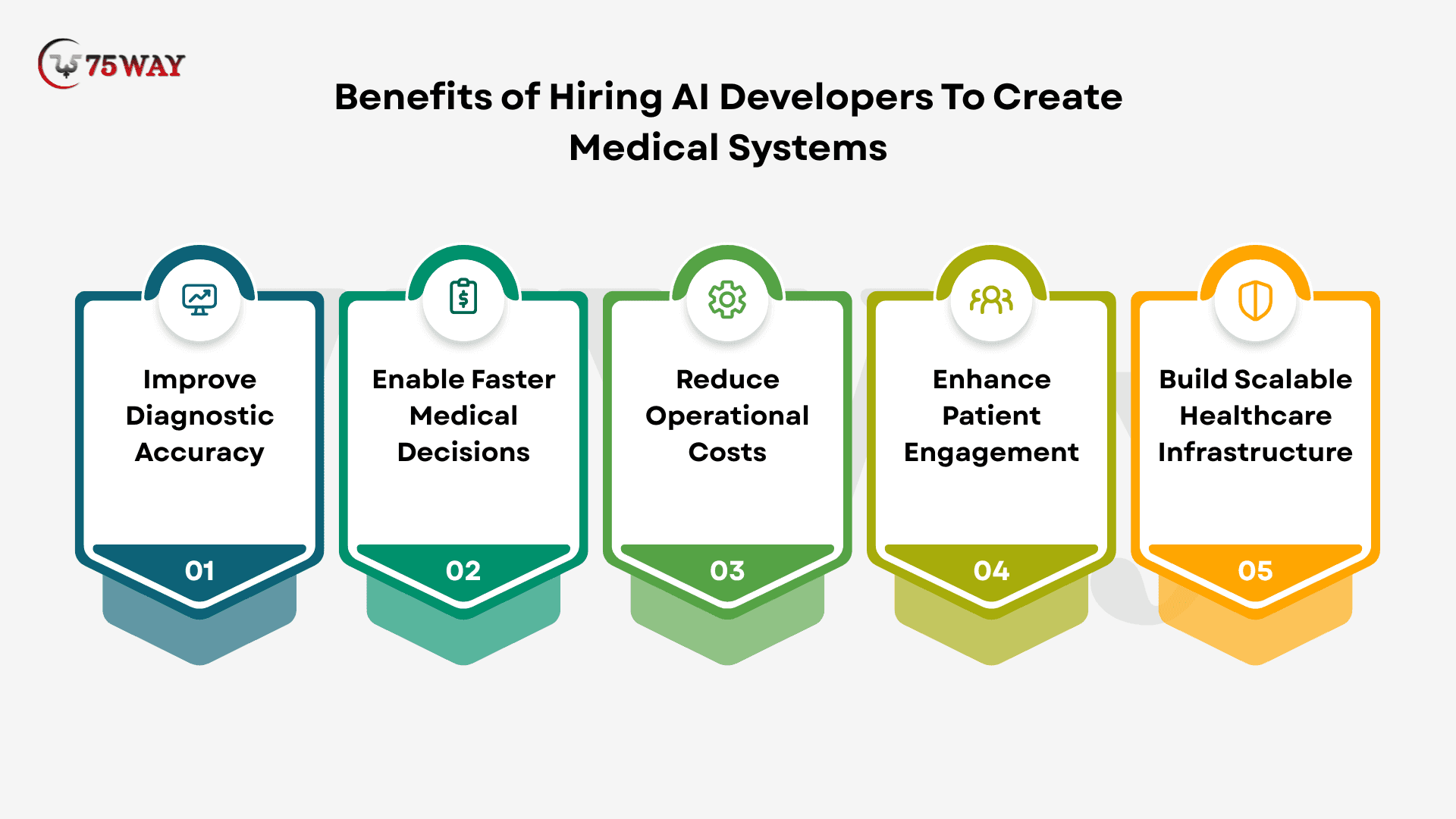
- Improve Diagnostic Accuracy
AI developers build models that reduce human error in diagnosis by analyzing medical data with high precision. This leads to earlier detection of diseases, improved clinical outcomes, and more reliable treatment recommendations for patients.
- Enable Faster Medical Decisions
AI-powered systems provide real-time insights from patient data, helping healthcare professionals make quicker and more informed treatment decisions. This improves emergency response times and overall patient care efficiency.
- Reduce Operational Costs
Automation of administrative and clinical workflows reduces the need for large manual teams. This lowers operational expenses while improving efficiency in scheduling, reporting, and patient management systems.
- Enhance Patient Engagement
AI-driven communication tools improve interaction between patients and healthcare providers through chat systems, reminders, and personalized updates. This leads to better patient satisfaction and stronger healthcare relationships.
- Build Scalable Healthcare Infrastructure
AI systems are designed to handle increasing volumes of patient data and hospital demand. This ensures long-term scalability, allowing healthcare organizations to grow without performance limitations or system breakdowns.
How To Hire AI Development Teams For Custom AI Projects?
Hiring the right AI development team is essential for building scalable, secure, and high-performing AI solutions. A structured hiring approach ensures businesses select experts who understand technical requirements, industry needs, and long-term scalability goals for custom AI projects.
1. Define Project Requirements Clearly
Start by outlining your AI project goals, use cases, expected outcomes, and technical needs. Clearly defining requirements helps attract the right development teams and ensures alignment between business objectives and technical execution from the beginning of the engagement.
2. Evaluate Technical Expertise And Stack Knowledge
Assess the team’s proficiency in AI frameworks, programming languages, and tools like machine learning libraries, cloud platforms, and data engineering systems. Strong technical expertise ensures the team can build reliable, scalable, and production-ready AI solutions.
3. Review Portfolio And Case Studies
Examine previous projects, especially those related to your industry or similar AI use cases. A strong portfolio demonstrates practical experience, problem-solving ability, and the capability to deliver successful real-world AI implementations.
4. Assess Industry Understanding And Domain Knowledge
Choose teams that understand your industry, whether healthcare, e-commerce, or finance. Domain expertise ensures better decision-making, relevant feature development, and more effective AI solutions tailored to specific business challenges.
5. Check Communication And Collaboration Process
Effective communication is critical for complex AI projects. Ensure the team provides clear updates, follows structured workflows, and collaborates efficiently with your internal stakeholders throughout the development lifecycle.
6. Evaluate Scalability And Support Capabilities
Select teams that offer long-term support, system maintenance, and scalability planning. This ensures your AI solution continues to perform effectively as your business grows and requirements evolve over time.
Cost of Hiring AI Development Team For Healthcare
The cost of hiring an AI development team for healthcare varies based on project complexity, regulatory requirements, data sensitivity, and the level of AI integration needed. Healthcare AI systems often require advanced security, compliance adherence, and scalable architecture, which significantly impacts overall development cost.
- Small Healthcare AI Projects: $25,000 – $60,000
Suitable for basic healthcare solutions such as appointment scheduling systems, simple chatbots, and patient inquiry automation with limited integrations and minimal AI capabilities.
- Mid-Level Healthcare AI Systems: $60,000 – $150,000
Includes AI-powered workflows, EHR/CRM integration, patient data processing, and automated follow-up systems. Ideal for clinics and growing healthcare providers needing structured digital transformation.
- Advanced Healthcare AI Platforms: $150,000 – $300,000+
Designed for hospitals and enterprise healthcare networks requiring predictive analytics, real-time monitoring, diagnostic assistance, and multi-system integration with high scalability.
- Enterprise-Grade AI Healthcare Solutions: $300,000 – $1,000,000+
Built for large hospital chains and global healthcare systems with advanced AI models, regulatory compliance frameworks, real-time decision support systems, and fully integrated digital healthcare ecosystems.
Final Thoughts
Healthcare is entering a new era where artificial intelligence is becoming a core foundation of clinical and operational systems. Organizations that invest in an experienced AI development team for healthcare are positioning themselves ahead of traditional providers by enabling smarter diagnostics, faster workflows, and more accurate, data-driven decision-making across the entire care journey. As hospitals, clinics, and digital health platforms grow more complex, reliance on specialized AI expertise is no longer optional. To build next-generation intelligent healthcare solutions, contact a trusted AI development company or collaborate with a leading grocery delivery app development company to design scalable digital platforms. Leverage a specialized AI development team for healthcare to streamline operations, enhance patient care, and future-proof your healthcare business in 2026.
Frequently Asked Questions (FAQs)
What Does An AI Development Team Do In Healthcare?
An AI development team builds intelligent systems for hospitals, clinics, and health platforms. They design predictive models, automation tools, and patient engagement systems. These solutions improve diagnosis accuracy and streamline healthcare operations.
Why Is AI Important In Modern Healthcare Systems?
AI improves decision-making, reduces manual workload, and enhances patient care quality. It enables faster diagnosis, predictive analytics, and efficient workflows. Healthcare providers gain better outcomes through data-driven intelligence and automation technologies.
How Do AI Teams Improve Patient Care In Hospitals?
AI teams develop systems that analyze patient data and support clinical decisions. These tools help doctors identify risks early and recommend treatments. Patient experience improves through faster responses and personalized healthcare interactions.
What Technologies Do Healthcare AI Developers Use?
Healthcare AI developers use machine learning, deep learning, NLP, and cloud computing. They also work with EHR systems and data pipelines. These technologies help build scalable, secure, and intelligent healthcare applications.
Can AI Be Used For Disease Prediction In Healthcare?
Yes, AI models analyze medical history, symptoms, and diagnostic data to predict diseases. These predictions help in early detection and preventive care. Healthcare providers can plan treatments more effectively using AI insights.
Is Healthcare AI Safe For Patient Data Handling?
Healthcare AI systems are built with encryption, access control, and compliance standards. They follow regulations like HIPAA and GDPR. These measures protect patient data and ensure secure digital healthcare environments.