Summary
Agentic AI empowers businesses to automate complex workflows, make autonomous decisions, and continuously optimize operations. By leveraging intelligent learning, adaptive agents, and multi-step execution, organizations can improve efficiency, reduce costs, enhance customer experiences, and scale effectively. Understanding features, use cases, and implementation strategies helps companies adopt agentic AI responsibly while maximizing operational impact.
Key Takeaways
- Agentic AI automates workflows, reducing human effort and increasing business efficiency.
- It enables autonomous decision-making, adapting to changing environments without requiring manual intervention.
- Continuous learning improves performance, ensuring AI optimizes tasks and predicts outcomes accurately.
- By 2028, 33% of enterprise applications will include agentic AI systems.
- Real-world applications include customer support, marketing, supply chain, and financial process automation.
- Following structured implementation ensures smooth adoption, measurable results, and scalable AI operations.
Businesses in 2026 face increasing pressure to make smarter decisions while managing complex workflows. You know, what’s the reason? Obviously, the traditional systems. These systems often fall short, leaving teams overwhelmed with repetitive tasks and delayed processes. This is where agentic AI development solutions are changing the game, enabling systems to act autonomously, learn from outcomes, and optimize operations without constant human oversight.
Startups and enterprises are turning to these autonomous agentic AI systems to streamline processes, enhance productivity, and stay competitive in rapidly evolving markets. By leveraging agentic AI, businesses can reduce operational bottlenecks and focus on high-impact initiatives rather than routine tasks.
By 2028, one-third of enterprise software applications are expected to integrate agentic AI, with systems handling 15% of daily work decisions autonomously. Moreover, Guardian agents are projected to capture 10–15% of the agentic AI market by 2030, highlighting the growing adoption of autonomous AI systems worldwide.
Here, a question arises, “What is agentic AI?” “How does it help businesses?” And in this guide, we will define each and every aspect of agentic AI, how it evolved, its key features, real-world business use cases, benefits for startups and enterprises, differences from other AI types, challenges and risks, and a practical implementation framework.
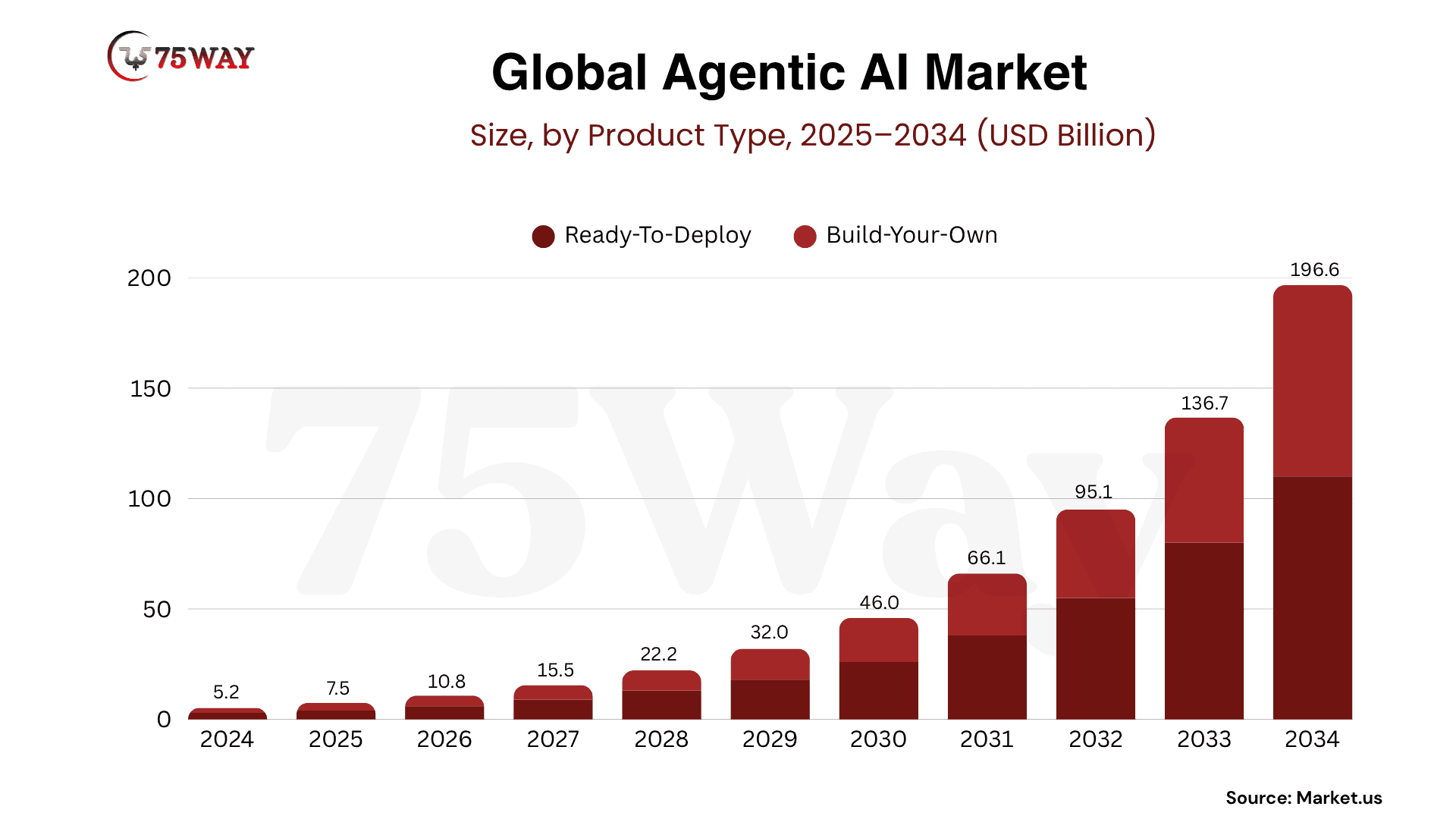
What is Agentic AI?
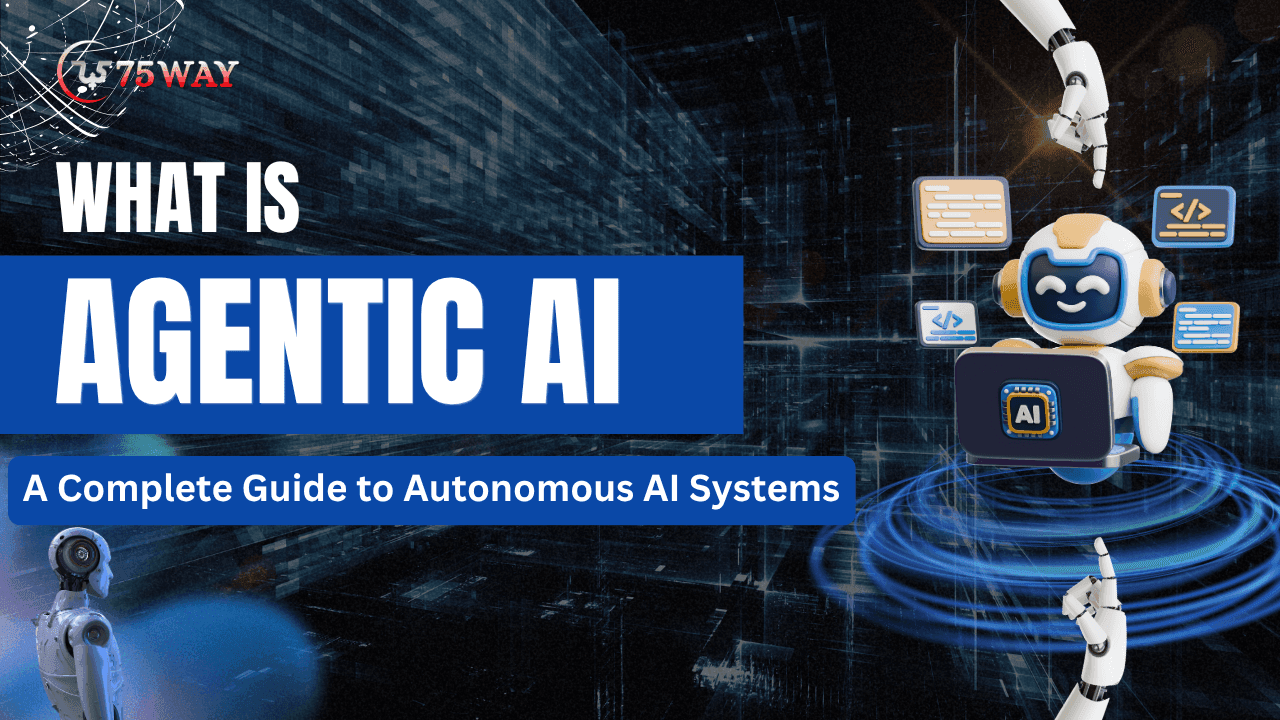
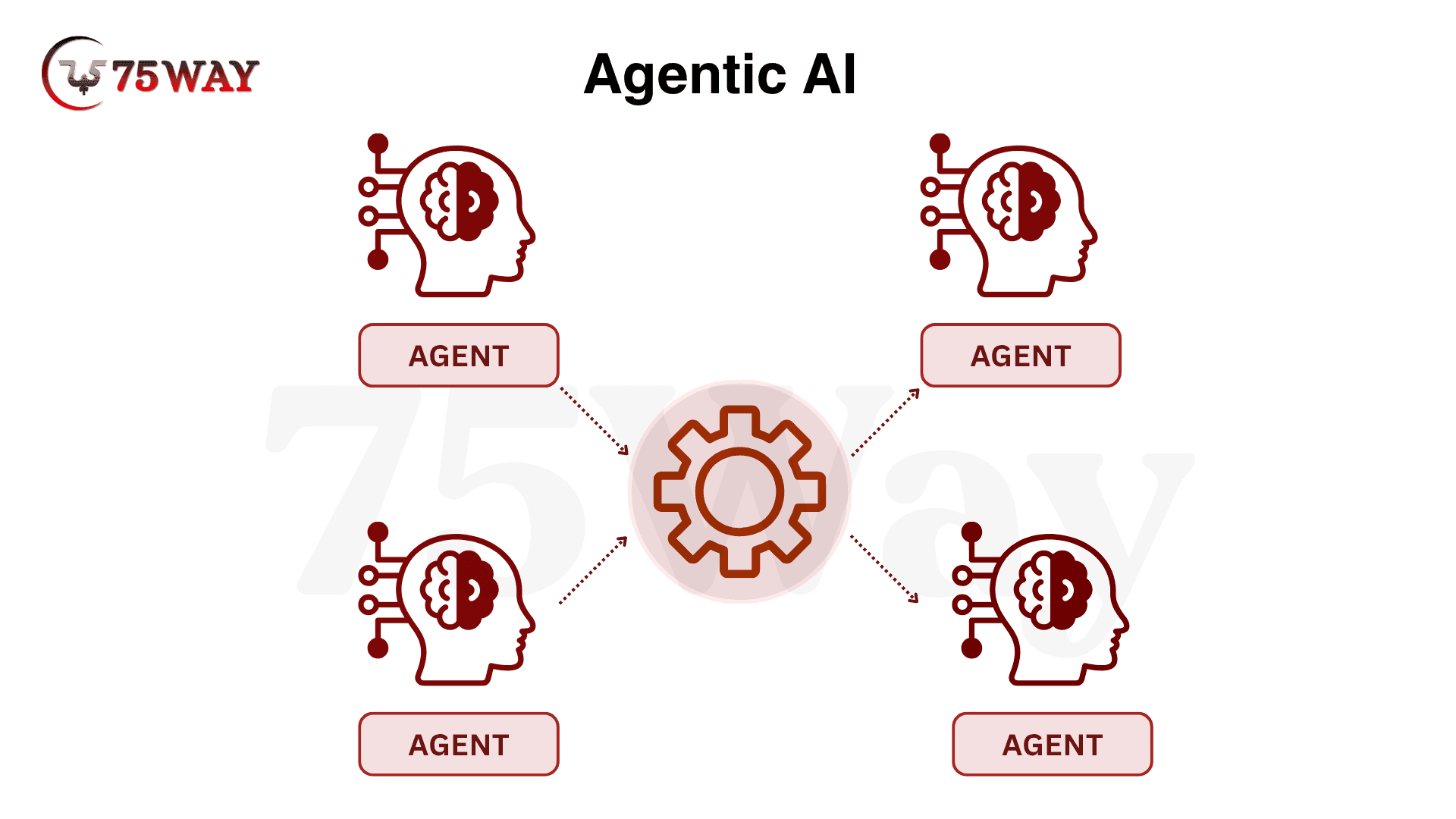
Agentic AI refers to advanced autonomous systems designed to perceive their environment, reason about complex situations, act toward achieving specific goals, and continuously learn from outcomes without requiring constant human supervision. Unlike traditional automation, which follows rigid rules, or AI agents, which typically handle single tasks, agentic AI can independently execute multi-step workflows, make decisions, and adapt dynamically to changing conditions. This capability allows businesses to streamline operations, reduce human errors, and focus on high-value strategic activities.
In simple terms, it is a digital assistant in a company that automatically manages customer support. It reads customer queries, decides which solutions to provide, assigns tasks to the right teams if needed, and learns from every interaction to improve future responses. Just like how a human assistant gets better with experience, agentic AI continually adapts, making operations smarter, faster, and more efficient across business functions.
The Evolution of Agentic AI: From Concept to Reality
Agentic AI evolved from early rule-based systems to advanced autonomous systems capable of independent decision-making, learning, and task execution. Key milestones include machine learning, generative AI, multi-agent collaboration, and goal-oriented automation. Today, agentic AI operates across industries, optimizing workflows, reducing human intervention, and enabling businesses to make smarter, faster, and more efficient decisions.
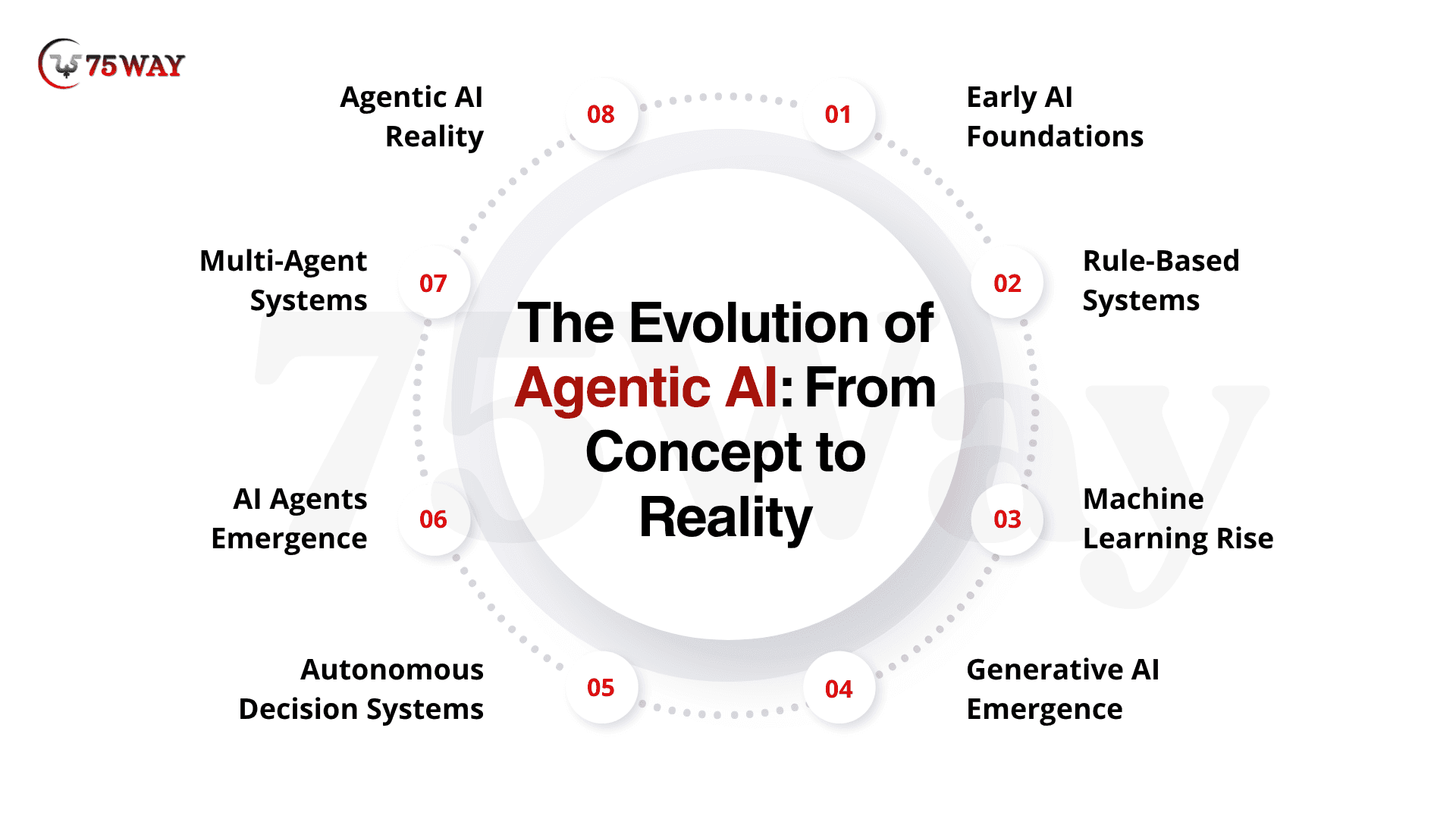
Early AI Foundations: Agentic AI began with foundational research aimed at simulating human reasoning using basic algorithms and logic. These early experiments established the theoretical principles for intelligent machines, setting the stage for practical systems capable of automating simple tasks.
Rule-Based Systems: Building on early AI theories, rule-based systems emerged, using predefined “if-then” logic to automate repetitive decisions. While efficient for narrow tasks, their rigidity highlighted the need for AI agents that could adapt and learn from changing environments and complex data.
Machine Learning Rise: To overcome rigid rules, machine learning allowed systems to identify patterns and make predictions from data. This shift enabled AI to improve its performance over time, laying the foundation for more adaptive and context-aware intelligent systems.
Generative AI Emergence: Machine learning led to generative AI development, which could create content, text, images, and code by learning from existing datasets. This stage expanded AI’s role from analysis to creation, demonstrating the potential for autonomous problem-solving in diverse applications.
Autonomous Decision Systems: The ability to generate solutions evolved into autonomous decision systems, where AI could select actions independently based on context and predictions. These systems reduced human supervision, managed multi-step workflows, and marked the transition toward fully independent operations.
AI Agents Emergence: From autonomous decision systems, building an AI agent appeared as specialized, semi-autonomous entities capable of handling defined tasks within larger environments. They could interact with users, other systems, or data sources, offering modularity and improved flexibility for complex operations.
Multi-Agent Systems: AI agents began collaborating in multi-agent systems, coordinating tasks and sharing knowledge across environments. This collaboration enhanced problem-solving capabilities, scalability, and efficiency, creating a networked intelligence capable of handling more complex and dynamic business challenges.
Agentic AI Reality: Finally, agentic AI emerged as fully autonomous systems that perceive, reason, act, and learn independently. Combining multi-agent collaboration, adaptive learning, and goal-oriented decision-making, agentic AI now optimizes workflows, reduces human intervention, and drives strategic outcomes across industries.
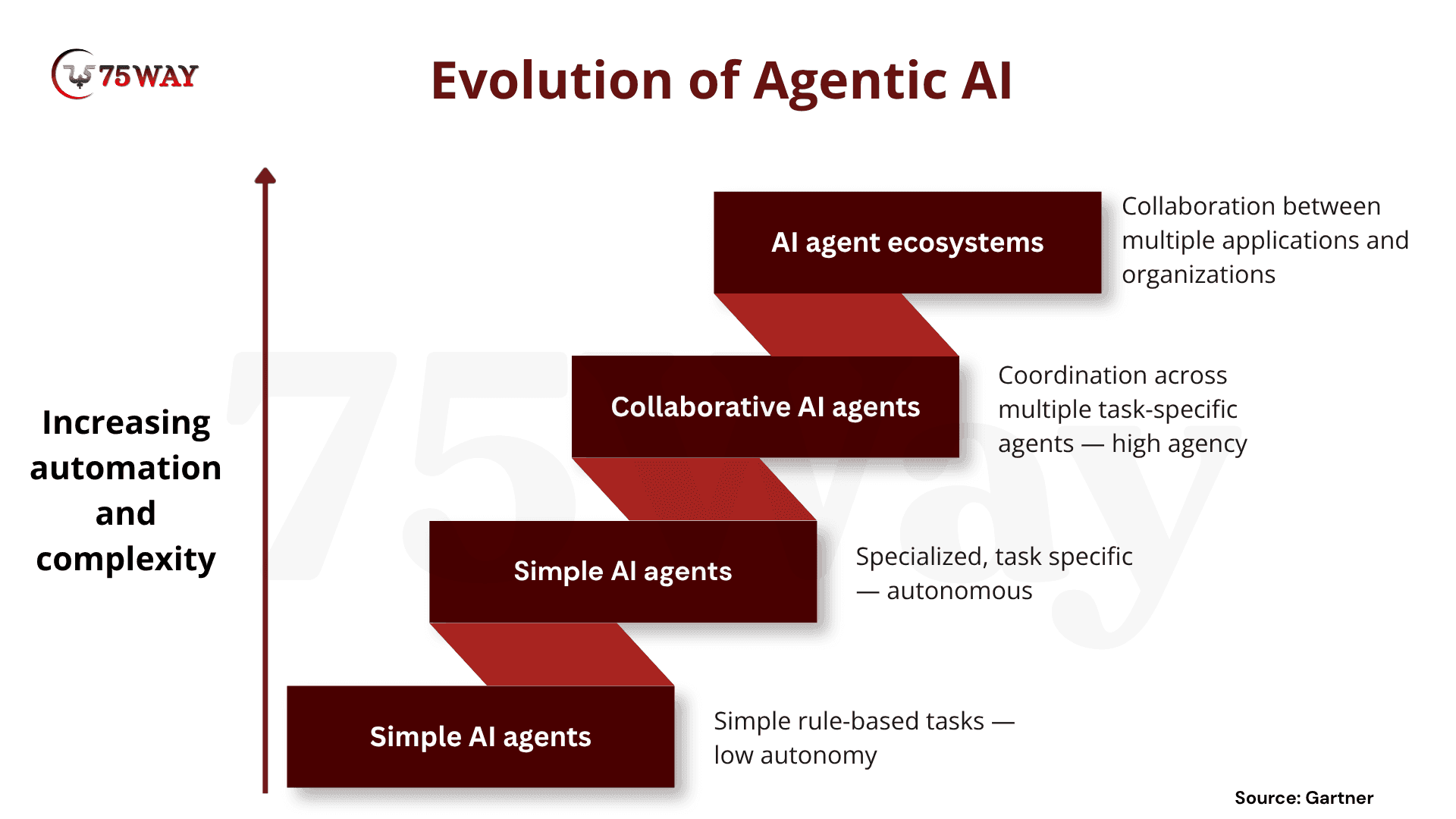
Agentic AI Vs AI Agents: How is Agentic AI Different from AI Agents?
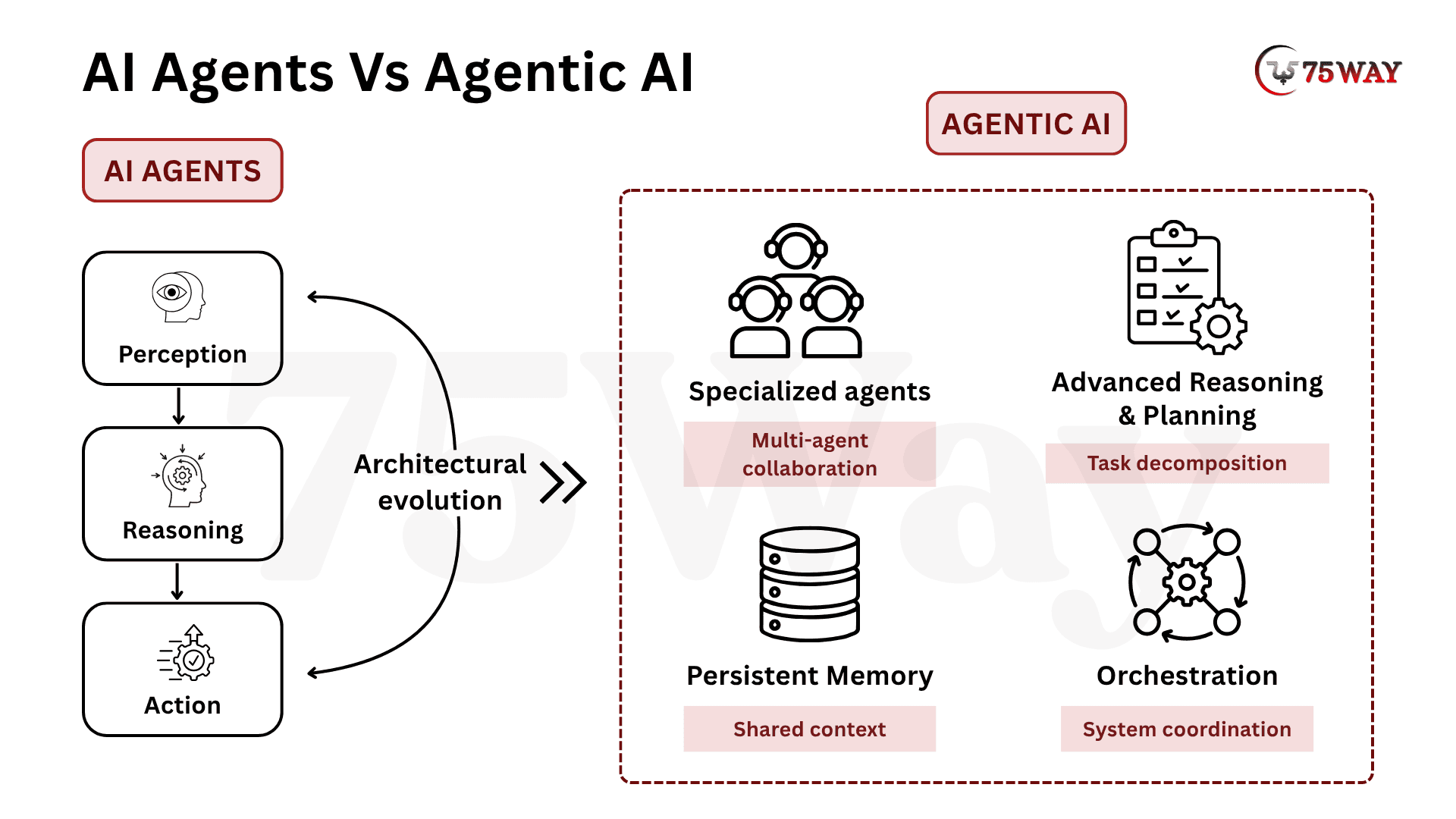
Agentic AI differs from AI agents by being fully autonomous, goal-driven, and capable of multi-step decision-making and learning. Unlike AI agents, which perform specific tasks with limited autonomy, agentic AI can plan, adapt, collaborate with other agents, and optimize workflows independently, delivering smarter, faster, and more scalable business solutions.
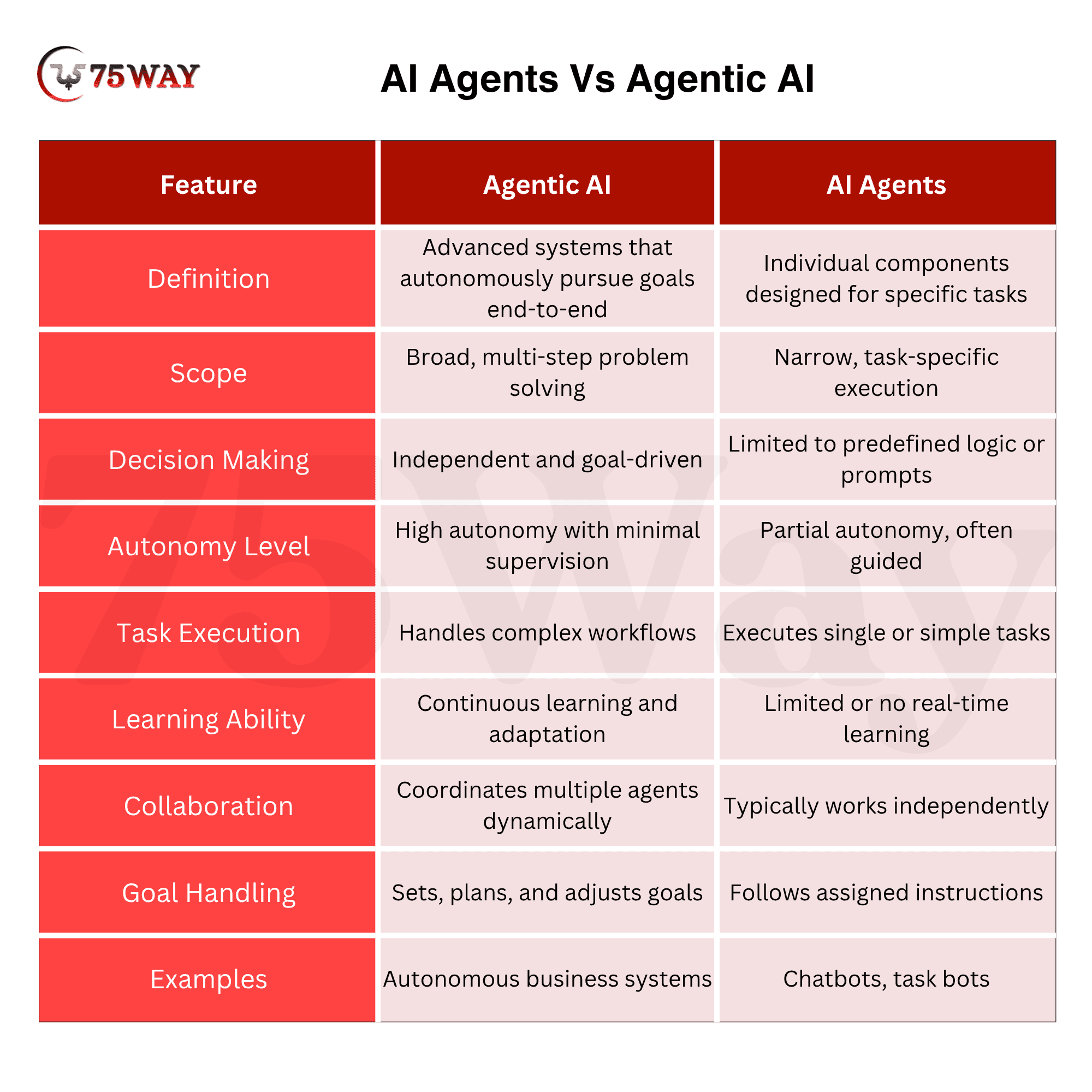
Decision Making: Agentic AI makes independent, goal-driven decisions, analyzing complex situations and determining the best course of action across multiple steps. In contrast, AI agents operate within predefined parameters, following set instructions or logic without adapting to changing circumstances.
Autonomy Level: Agentic AI operates with high autonomy, requiring minimal human supervision to manage complex workflows. AI agents, however, have limited autonomy, often needing guidance or manual intervention to complete tasks correctly.
Task Execution: Agentic AI can handle multi-step, end-to-end workflows and dynamically adjust actions based on outcomes. On the contrary, AI agents focus on single or simple tasks and execute them sequentially without broader contextual awareness.
Learning Ability: Agentic AI continuously learns and adapts from data and outcomes, improving its decisions over time. On the other hand, AI agents have minimal or no learning capabilities, performing repetitive tasks without real-time improvement.
Collaboration: Agentic AI can coordinate with multiple agents or systems dynamically, enabling teamwork and complex problem-solving. In contrast, AI agents typically function independently, with little to no interaction with other agents or systems.
Goal Handling: Agentic AI sets, plans, and adjusts goals autonomously to achieve desired outcomes. On the contrary, AI agents only follow assigned instructions or predefined objectives without the ability to redefine or optimize goals.
Essential Features of Agentic AI Systems You Should Know
Agentic AI systems combine intelligence, autonomy, and adaptability to optimize business operations. Key features include autonomous decision-making, goal orientation, context awareness, adaptive learning, task planning, multi-agent coordination, real-time responses, and continuous improvement. Together, these capabilities enable businesses to streamline workflows, reduce human intervention, and achieve smarter, faster, and more scalable results across complex environments.
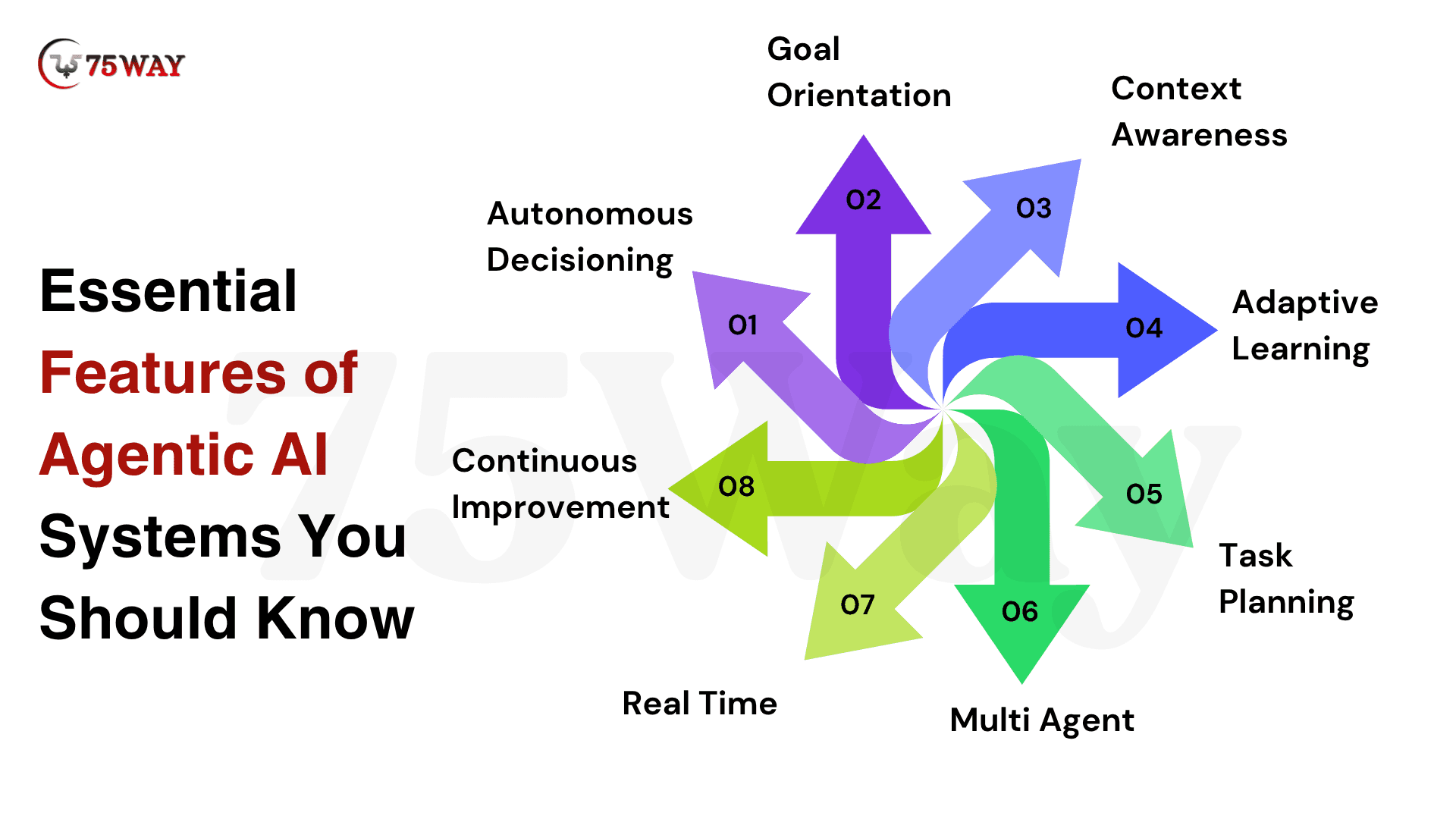
Autonomous Decisioning: Agentic AI independently analyzes data, evaluates multiple options, and executes actions without human intervention, enabling faster, smarter decisions. This reduces operational bottlenecks and ensures reliable outcomes across complex workflows.
Goal Orientation: The system prioritizes objectives, plans strategically, and adjusts actions to achieve desired outcomes. It ensures alignment with business goals while continuously improving performance and results.
Context Awareness: Agentic AI interprets environmental, operational, and situational factors to make informed decisions. Understanding context ensures responses are relevant, effective, and aligned with real-world scenarios.
Adaptive Learning: The system continuously learns from past actions, outcomes, and patterns. This adaptive behavior refines strategies over time, improving decision-making and operational efficiency.
Task Planning: Agentic AI sequences, schedules, and manages tasks efficiently across workflows. It optimizes resources, timelines, and dependencies while minimizing human supervision.
Multi-Agent Coordination: The system coordinates multiple agents, enabling collaboration and shared intelligence. This enhances problem-solving capabilities and scalability across departments or interconnected systems.
Real-Time Responses: Agentic AI responds instantly to changes in data, processes, or environment. Real-time responsiveness ensures timely actions and decisions that remain relevant and effective.
Continuous Improvement: The system monitors outcomes, identifies inefficiencies, and proactively adjusts strategies. Continuous optimization drives long-term performance enhancement and operational excellence.
Discover Real Business Use Cases of Agentic AI
Agentic AI will autonomously resolve 80% of common customer service issues without human intervention by 2029, as stated by Gartner. It automates business operations by autonomously handling complex workflows, reducing human intervention, and optimizing outcomes. From automating customer support to streamlining finance, sales, and supply chains, it enables businesses to improve efficiency, accuracy, and scalability while freeing teams to focus on strategic priorities.
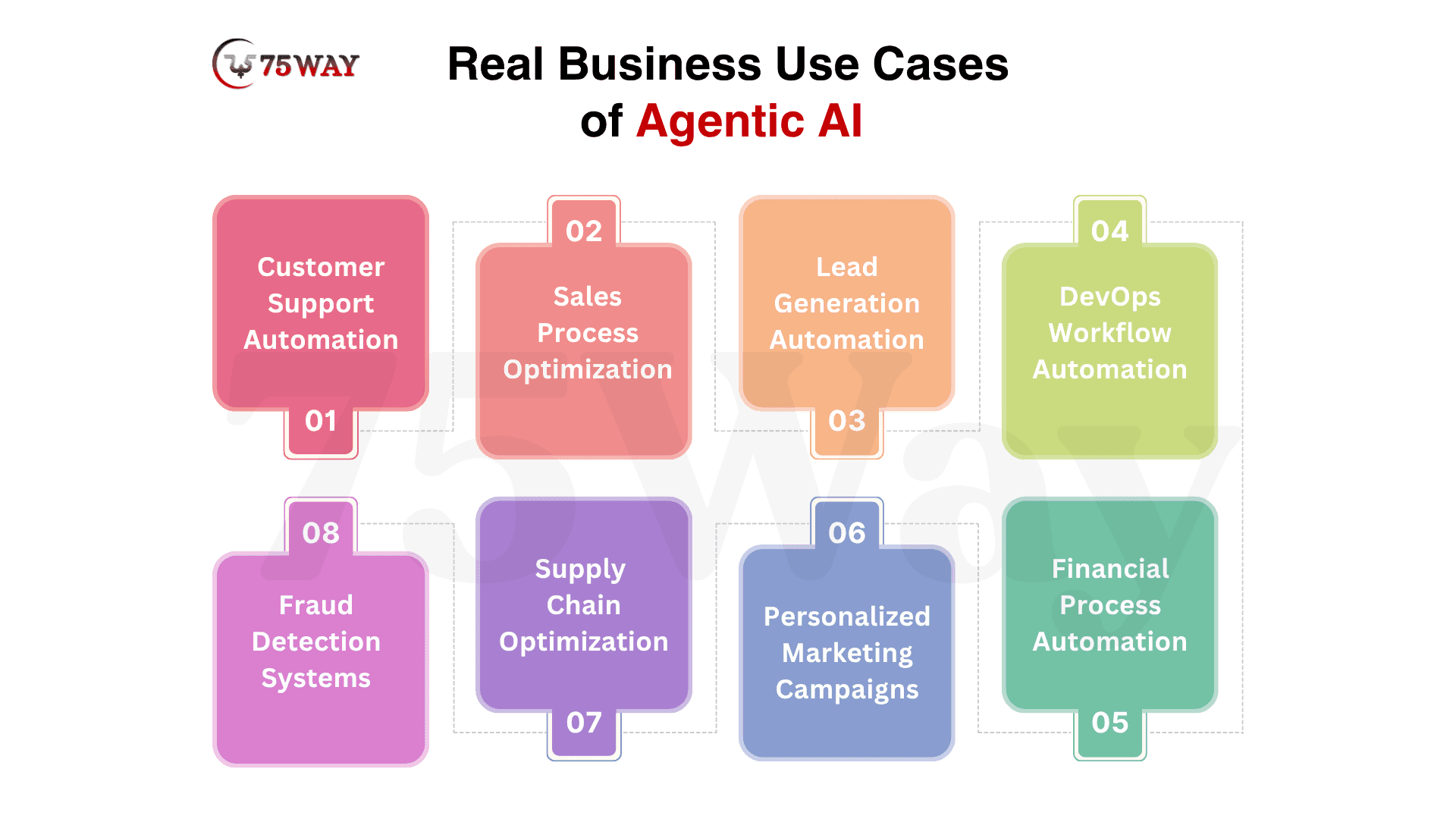
Customer Support Automation: Agentic AI can autonomously handle inquiries, resolve complaints, and provide real-time assistance. By learning from interactions, it improves response quality, reduces wait times, and enhances overall customer satisfaction.
Sales Process Optimization: The system identifies leads, prioritizes prospects, and recommends follow-ups. It streamlines sales workflows, predicts customer needs, and increases conversion rates by automating repetitive sales tasks intelligently.
Lead Generation Automation: Agentic AI analyzes market data, identifies potential clients, and qualifies leads automatically. This reduces manual effort, accelerates pipeline growth, and ensures focus on high-value prospects.
DevOps Workflow Automation: The AI monitors development pipelines, deploys updates, and detects errors autonomously. By optimizing workflows and minimizing manual interventions, it ensures faster, more reliable software delivery.
Fraud Detection Systems: Agentic AI identifies suspicious patterns and potential fraud in real time. It continuously learns from new transactions, enabling proactive prevention and reducing financial losses.
Supply Chain Optimization: The system predicts demand, manages inventory, and coordinates logistics autonomously. By analyzing real-time data, it improves efficiency, reduces costs, and ensures timely delivery.
Personalized Marketing Campaigns: Agentic AI segments audiences, analyzes preferences, and automatically generates tailored campaigns. It optimizes messaging and timing to maximize engagement, conversions, and ROI. Example: A fashion brand uses AI to send personalized promotions, boosting sales.
Financial Process Automation: The AI manages invoicing, reconciliations, and reporting autonomously. It reduces errors, speeds up accounting workflows, and ensures compliance, enabling finance teams to focus on strategic planning.
Benefits of Agentic AI for Startups & Enterprises
Agentic AI offers startups and enterprises powerful advantages, including round-the-clock assistance, faster decision-making, cost reduction, improved efficiency, and better customer experiences. By automating tasks, optimizing processes, and scaling operations intelligently, businesses can focus on strategic growth while maintaining high productivity and competitive advantage.
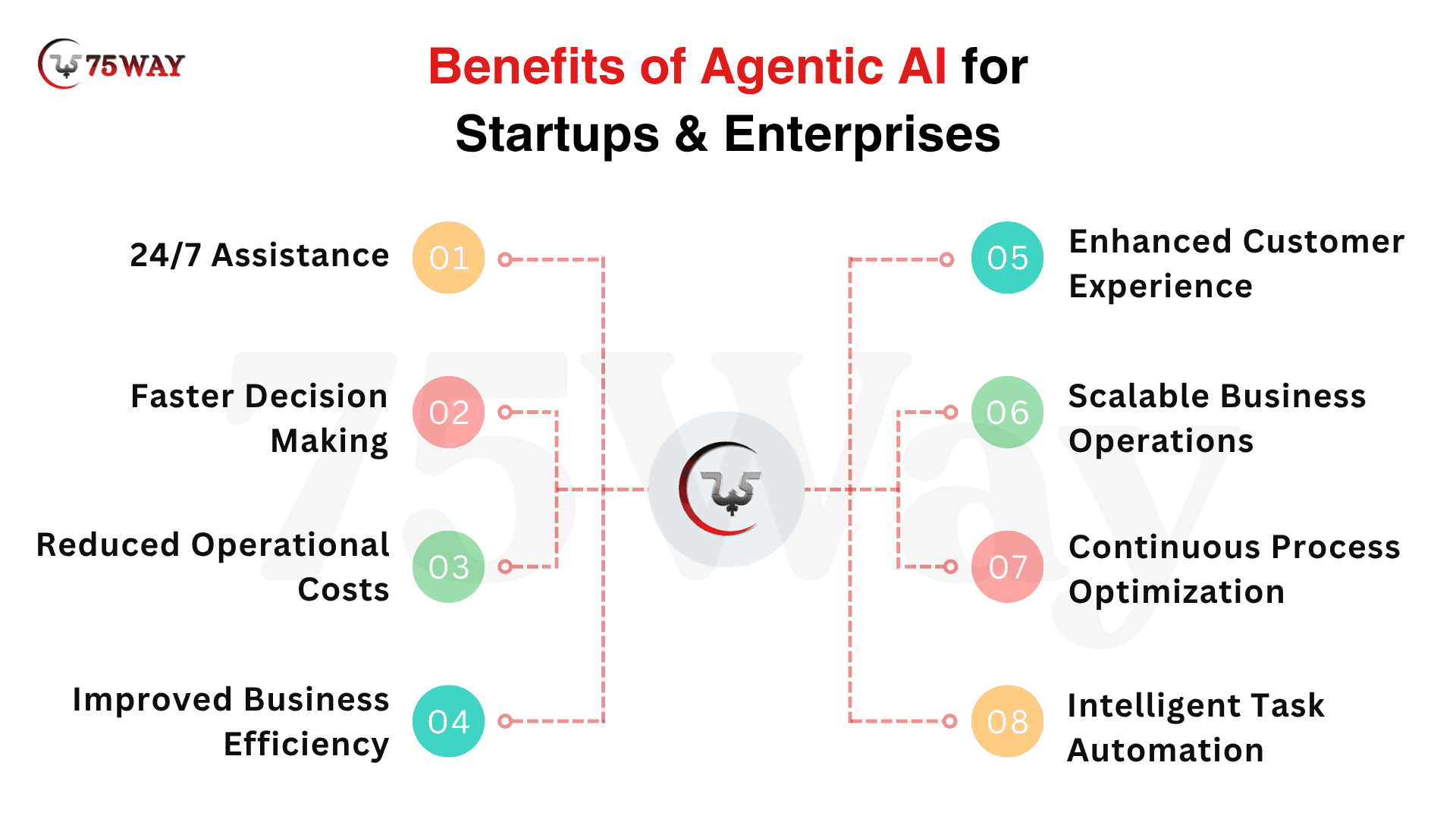
24/7 Assistance: Agentic AI provides continuous support without downtime, handling queries, tasks, and workflows autonomously. Businesses can offer uninterrupted service, respond instantly to requests, and maintain operational continuity, ensuring teams stay focused on high-value, strategic work.
Faster Decision Making: By analyzing real-time data and predicting outcomes, agentic AI accelerates decision-making processes. It reduces delays, minimizes errors, and allows teams to respond to market changes swiftly, improving overall agility and competitiveness.
Reduced Operational Costs: Automating routine tasks and workflows with agentic AI reduces reliance on manual labor, minimizes errors, and optimizes resource utilization. This results in significant cost savings for startups and enterprises across operations.
Improved Business Efficiency: Agentic AI streamlines processes, coordinates multiple tasks, and ensures optimal workflow execution. By minimizing redundancies and automating repetitive operations, businesses achieve higher productivity and operational efficiency.
Enhanced Customer Experience: With autonomous support and personalized services, agentic AI improves customer satisfaction. It resolves queries faster, predicts user needs, and delivers consistent experiences, building trust and loyalty.
Scalable Business Operations: Agentic AI allows organizations to handle increased workloads without proportional increases in resources. Processes can scale seamlessly, supporting business growth while maintaining efficiency and performance.
Continuous Process Optimization: The system monitors workflows, identifies inefficiencies, and self-improves over time. Continuous optimization ensures that processes remain effective, adaptable, and aligned with evolving business goals.
Intelligent Task Automation: Agentic AI manages complex, multi-step tasks autonomously. It reduces human intervention, decreases errors, and ensures tasks are completed accurately, allowing teams to focus on strategic and creative activities.
How Agentic AI Works?
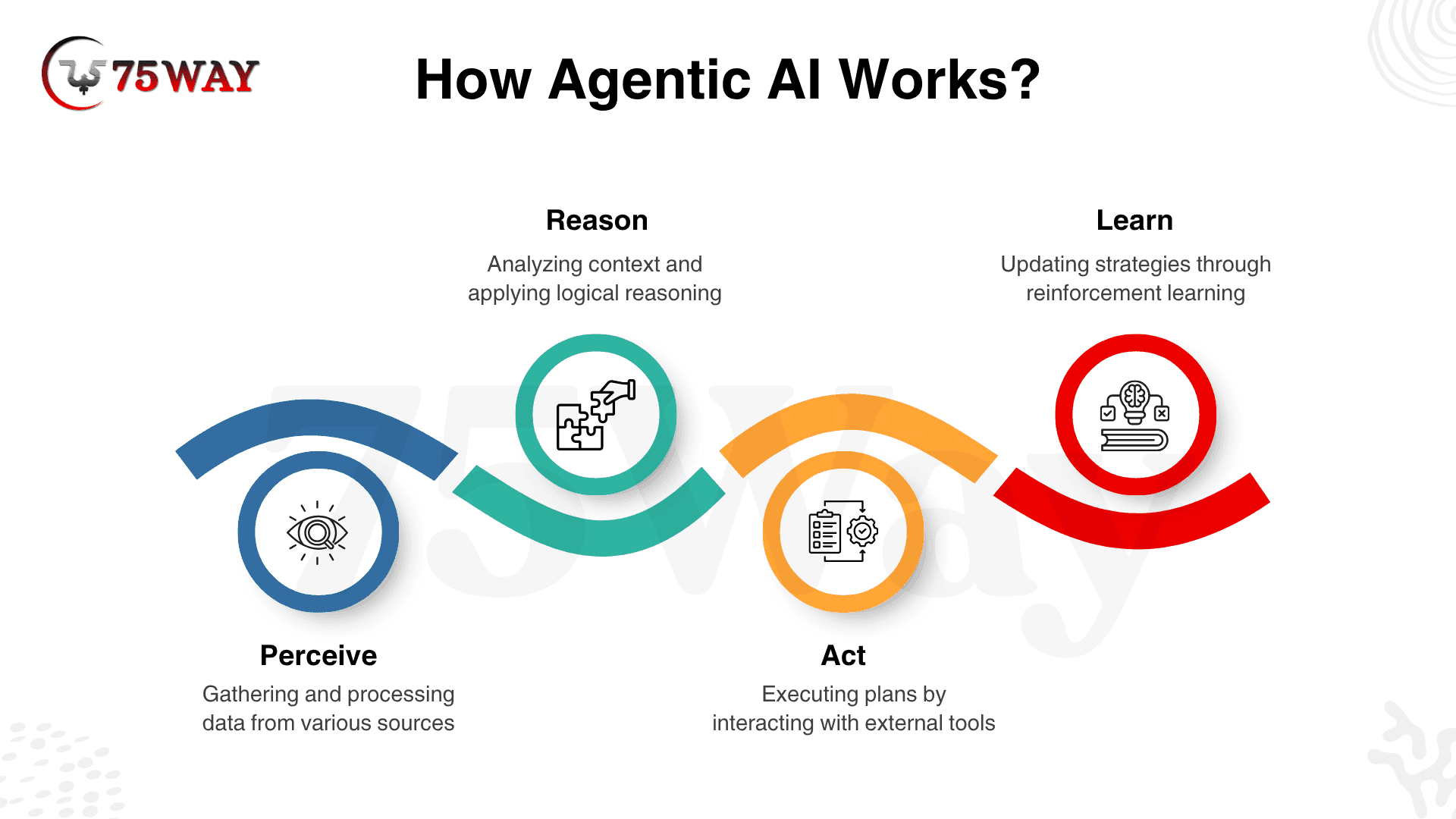
Agentic AI works by autonomously perceiving its environment, reasoning over complex information, taking goal-oriented actions, and learning from outcomes. This cycle enables AI systems to continuously adapt, optimize workflows, and make independent decisions, allowing businesses to operate smarter, faster, and with minimal human intervention across diverse processes.
Perceive: Agentic AI continuously gathers data from its environment, including sensors, user inputs, and external systems. By understanding real-time context, patterns, and changes, it identifies relevant information required to make informed decisions, detect anomalies, and monitor workflows efficiently. For example, a digital assistant perceives customer queries, system alerts, and market trends simultaneously.
Reason: The AI evaluates collected data, analyzes multiple scenarios, and predicts potential outcomes. It weighs options against goals and constraints to determine the best course of action. For instance, in a supply chain, agentic AI reasons which shipment routes are most efficient based on traffic, demand, and inventory levels.
Act: Based on reasoning, agentic AI executes decisions autonomously. Actions may include sending responses, adjusting processes, reallocating resources, or deploying agents to complete tasks. For example, a marketing agentic AI system can automatically send personalized promotions to users at optimal times without human involvement.
Learn: After actions are executed, agentic AI monitors outcomes and feedback to improve future decisions. Continuous learning allows it to refine strategies, correct mistakes, and adapt to changing environments. For example, a customer support AI learns which responses resolve issues fastest, improving service quality over time.
Types of Agentic AI Systems And Their Impact on Enterprises
Agentic AI systems come in various types, each designed to meet different business needs. Single, multi-agent, hybrid, and horizontal vs vertical systems enable organizations to automate workflows, enhance collaboration, scale operations, and optimize decision-making, delivering efficiency, accuracy, and strategic insights across complex enterprise environments.
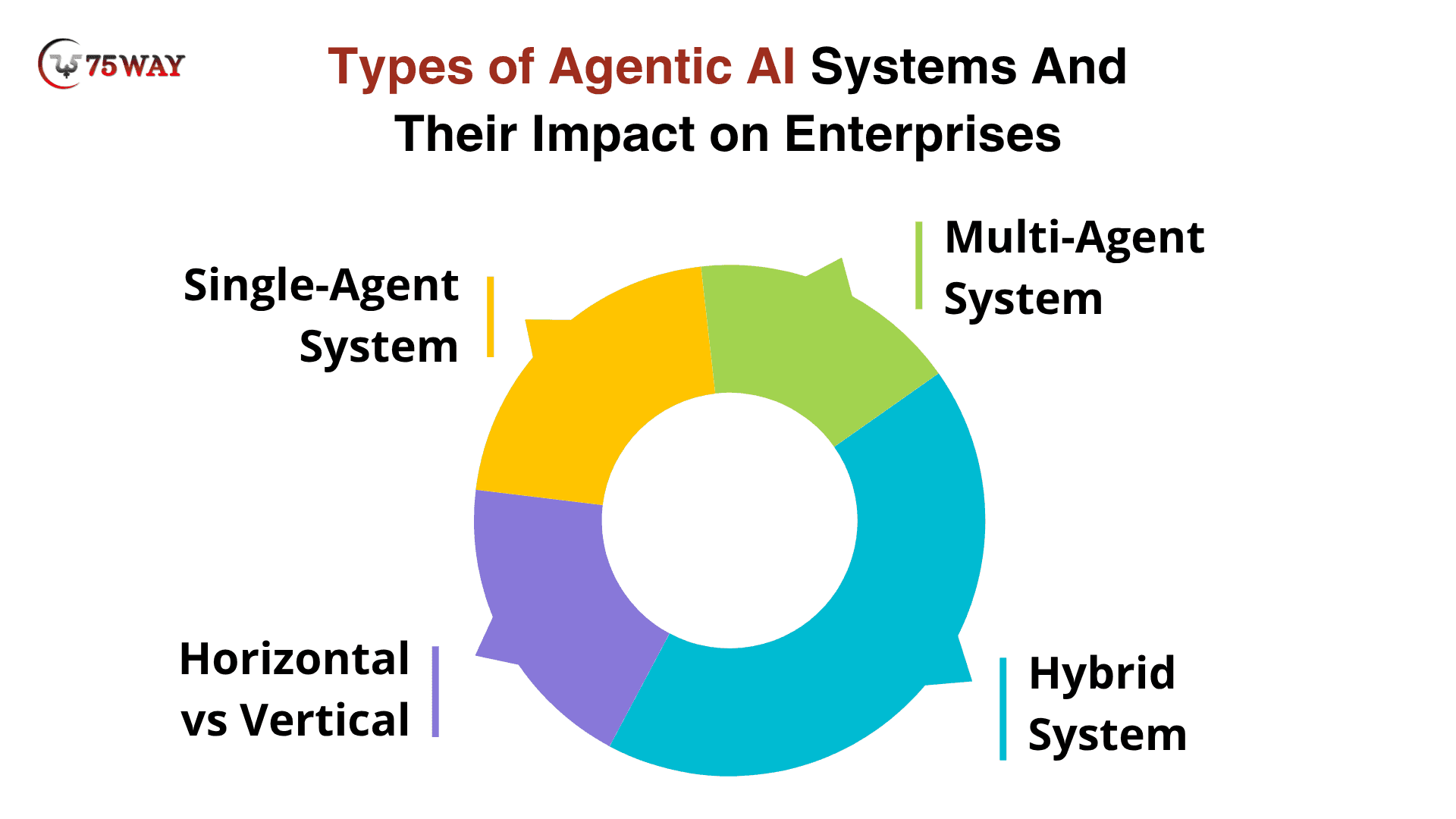
Single-Agent System: A single-agent system focuses on one autonomous agent performing specific tasks independently. It is ideal for targeted automation, such as handling customer support tickets or processing invoices, delivering precise, efficient results while reducing manual workload and allowing teams to focus on higher-value strategic activities.
Multi-Agent System: A multi-agent system consists of multiple autonomous agents collaborating to complete complex workflows. These systems enable distributed problem-solving, shared learning, and scalability, allowing enterprises to manage large-scale operations efficiently, coordinate multiple processes, and respond dynamically to changing business needs and environments.
Hybrid System: Hybrid systems combine single and multi-agent approaches, offering both specialized task execution and collaborative problem-solving. This versatility allows organizations to automate diverse workflows, scale operations effectively, and adapt to varying levels of complexity without compromising efficiency or operational accuracy.
Horizontal vs Vertical: Horizontal agentic AI systems operate across multiple functions or departments, improving cross-functional coordination and efficiency. Vertical systems focus on a specific domain or workflow, delivering deep automation and optimization. Enterprises can leverage horizontal or vertical systems depending on whether broad coverage or specialized focus is needed.
Agentic AI vs Generative AI vs Traditional Automation
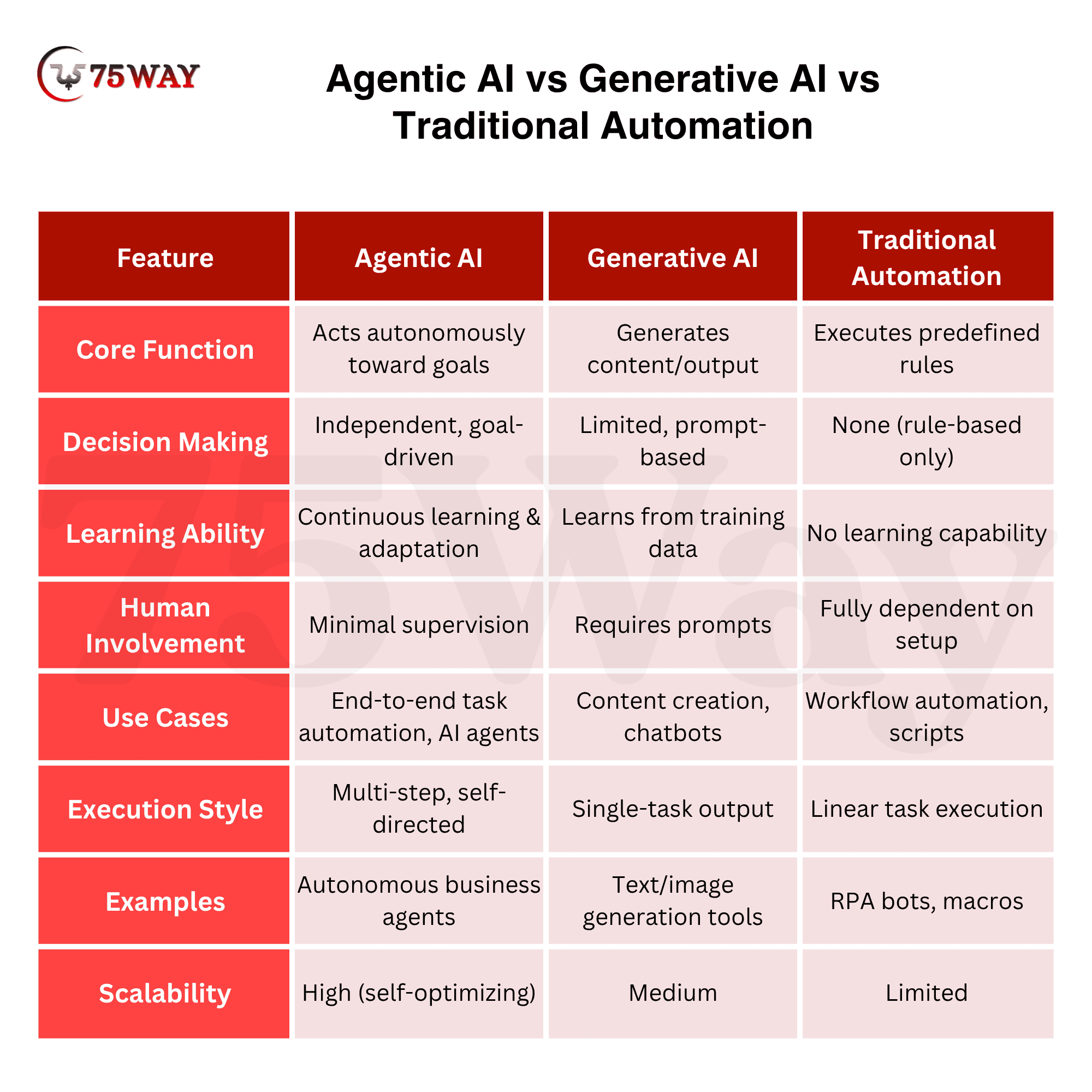
Agentic AI differs from Generative AI and traditional automation by being fully autonomous, goal-driven, and capable of multi-step decision-making and learning, while the others are limited in autonomy, adaptability, and workflow complexity.
Agentic AI is fully autonomous, goal-driven, and capable of multi-step decision-making and learning, unlike Generative AI and Traditional Automation. While Generative AI excels at producing content like text, images, or code from existing data, it relies on prompts and lacks independent workflow execution.
Traditional Automation, on the other hand, follows predefined rules to perform repetitive tasks without learning or adapting, making it suitable only for linear processes. Agentic AI can perceive environments, reason, act, and collaborate dynamically, optimizing complex workflows in real-time, whereas Generative AI focuses on output creation, and traditional automation merely executes fixed instructions. This makes agentic AI far more versatile, intelligent, and capable of driving strategic business outcomes.
Challenges & Risks of Agentic AI
Agentic AI offers powerful autonomy and efficiency but comes with challenges and risks. Businesses must address data privacy, security vulnerabilities, ethical concerns, bias, control limitations, and high implementation costs. Understanding these risks and implementing proactive solutions ensures safer, responsible, and more effective deployment of agentic AI systems across enterprises.
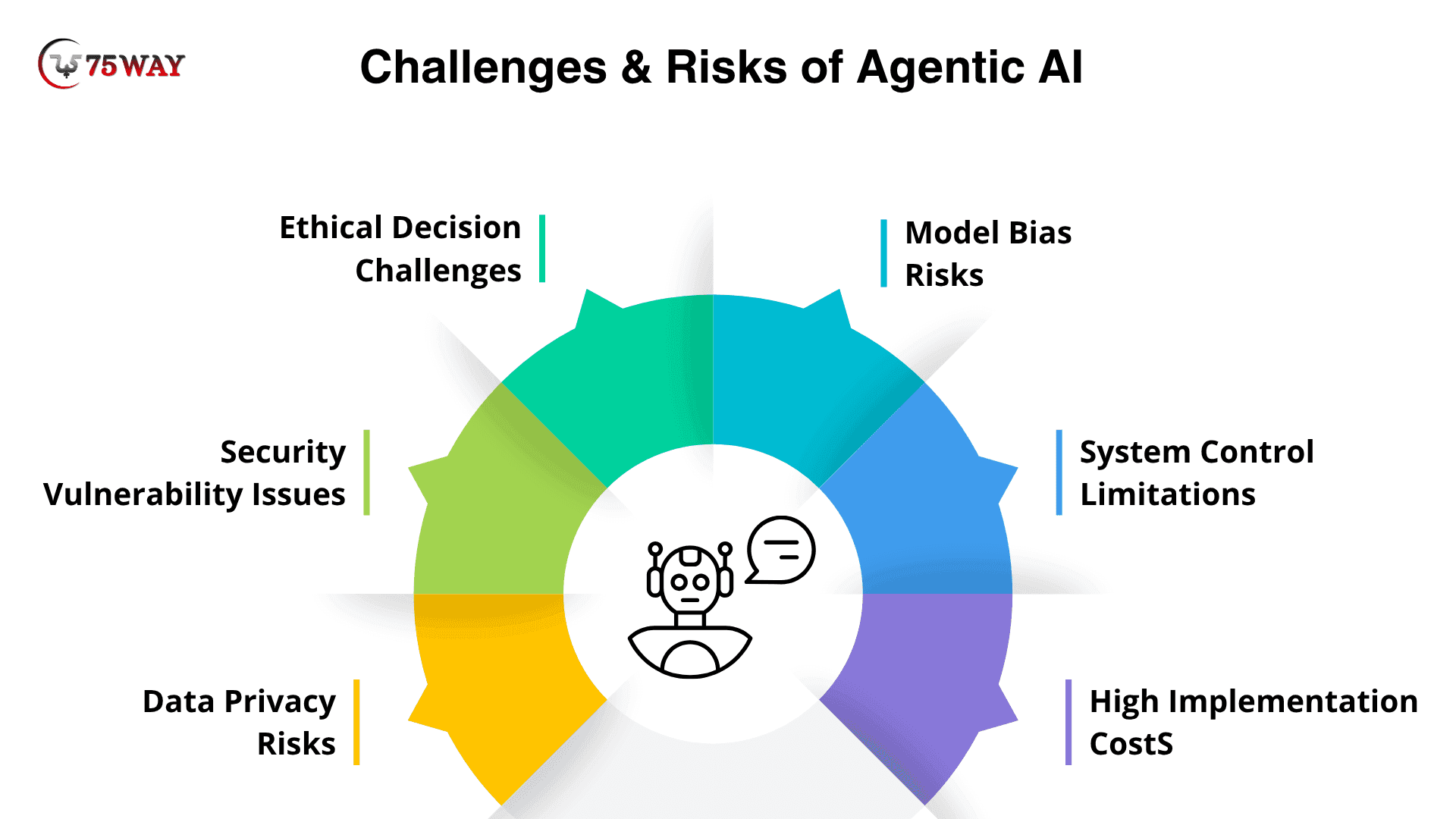
Data Privacy Risks: Agentic AI systems handle large volumes of sensitive data, including personal, financial, and business-critical information. Without proper safeguards, this can lead to breaches, unauthorized access, or misuse. To mitigate these risks, organizations should implement strong encryption, strict access controls, data anonymization techniques, and compliance with privacy regulations, ensuring sensitive information is protected while maintaining operational efficiency.
Security Vulnerability Issues: Autonomous agentic AI can be a target for cyberattacks or malicious exploitation. Vulnerabilities in algorithms or APIs may allow hackers to manipulate decisions or disrupt workflows. Businesses must conduct regular security audits, deploy intrusion detection systems, implement multi-factor authentication, and keep software updated to safeguard AI systems and maintain trust in automated operations.
Ethical Decision Challenges: Agentic AI may make decisions that have unintended social, legal, or business consequences. For example, automated hiring or loan approval systems could make biased or harmful choices. Establishing ethical guidelines, transparent decision-making frameworks, and human-in-the-loop oversight ensures AI actions remain aligned with organizational values, societal norms, and regulatory requirements.
Model Bias Risks: AI systems learn from historical data, which can contain biases related to gender, race, location, or business practices. Biased models can produce unfair or inaccurate outcomes, impacting decisions and credibility. Regular evaluation of datasets, bias mitigation strategies, diverse training data, and continuous monitoring help maintain fairness and reliability in AI outputs.
System Control Limitations: Highly autonomous AI systems can sometimes behave unpredictably or operate beyond intended boundaries, creating operational and safety concerns. Implementing adjustable autonomy levels, fail-safes, human supervision, and override mechanisms allows organizations to retain control, ensuring AI acts in alignment with strategic goals and safety standards.
High Implementation Costs: Deploying agentic AI involves significant investment in infrastructure, development, integration, and skilled personnel. High costs can be a barrier for startups and growing enterprises. Phased deployment, cloud-based solutions, leveraging pre-built AI frameworks, and carefully prioritizing high-impact processes can reduce upfront costs and accelerate ROI.
Agentic AI Implementation Framework: Step-By-Step Process
To deploy an agentic AI system, you must require a strategic approach to ensure seamless integration, efficiency, and measurable results. The framework guides businesses through identifying workflows, selecting appropriate architectures, integrating systems, deploying autonomous agents, and continuously monitoring and optimizing performance. Following these steps ensures AI adoption delivers maximum value and operational excellence.
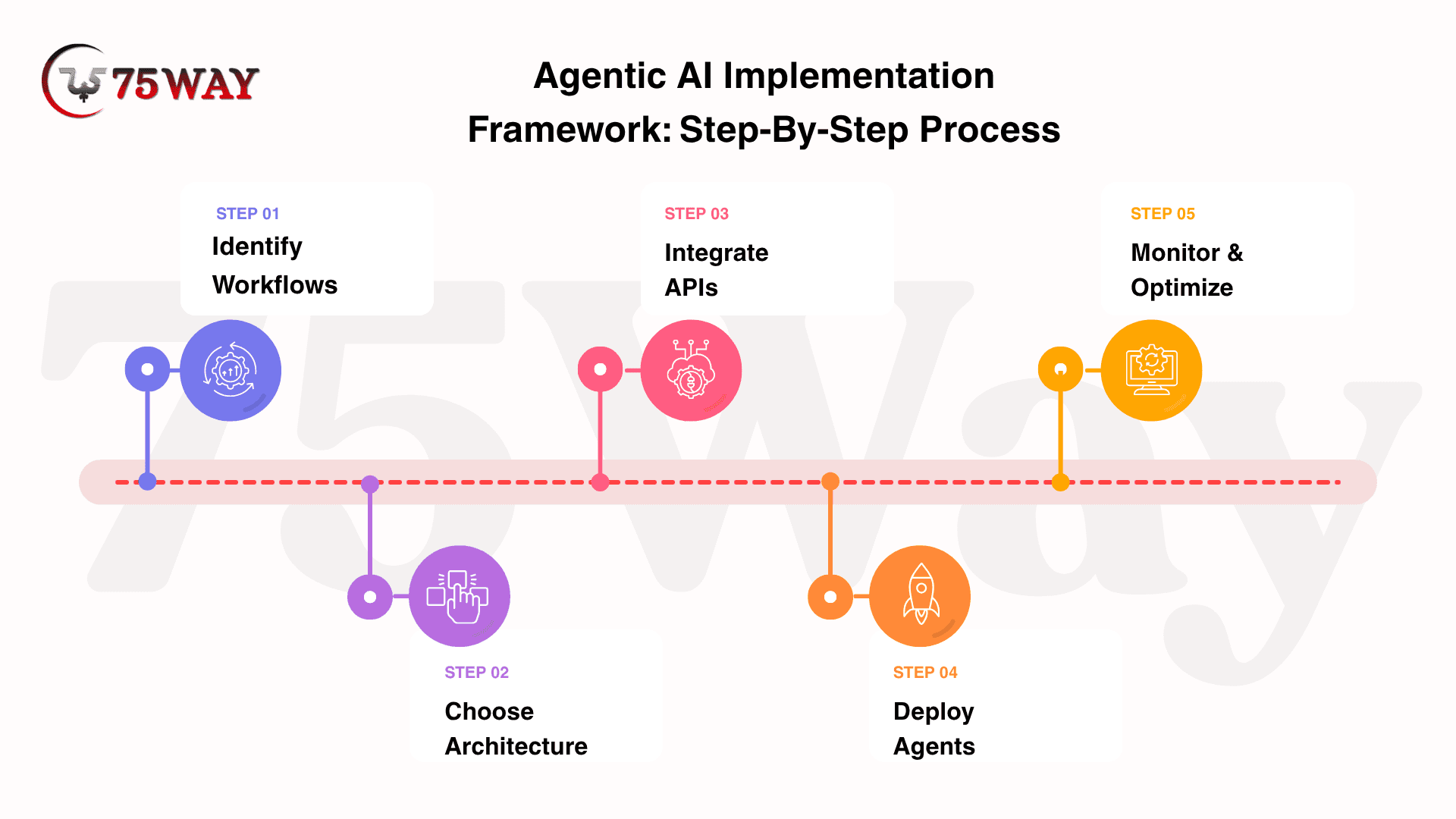
Step 1: Identify Workflows
The first step is to examine your business operations and pinpoint workflows that can benefit most from agentic AI. Focus on repetitive, multi-step tasks such as customer support queries, sales follow-ups, or invoice processing, where automation can reduce manual effort and increase efficiency.
Mapping each workflow in detail, identifying inputs, outputs, dependencies, and decision points, ensures the AI implementation addresses the right areas. For example, a retail company may map order-processing steps to automate inventory updates, customer notifications, and shipment tracking.
Step 2: Choose Architecture
The next stage is to select the appropriate AI architecture, which is crucial for performance and scalability. Decide between single-agent, multi-agent, hybrid, or horizontal vs vertical systems based on workflow complexity, operational needs, and integration requirements.
For instance, a logistics firm handling multiple delivery routes may opt for a multi-agent system to coordinate autonomous agents managing different routes. This ensures smooth collaboration, distributed problem-solving, and optimized decision-making across operations.
Step 3: Integrate APIs
APIs enable agentic AI to communicate with existing software, databases, and cloud platforms, ensuring seamless data flow and interoperability. Integration allows AI to access real-time information, trigger actions, and operate across multiple systems without disruption.
For example, a fintech company can integrate AI into accounting software via APIs, enabling the AI to automatically reconcile transactions, generate reports, and alert staff to anomalies, reducing manual effort and human error.
Step 4: Deploy Agents
Once the APIs are integrated, you have to implement AI agents into selected workflows in a phased approach. Start with pilot tasks or high-priority processes to test functionality, monitor performance, and resolve issues before scaling across the organization.
For example, a customer service department may deploy an AI agent to handle FAQs and basic ticketing first. As performance stabilizes, the AI can gradually take on more complex queries, enabling a smooth transition to full automation.
Step 5: Monitor & Optimize
Continuous monitoring is a critical phase in agentic AI deployment, ensuring that the system functions as intended and aligns with organizational goals. By tracking key performance metrics, identifying inefficiencies, and gathering user and system feedback, businesses can fine-tune AI behavior, improve decision accuracy, and enhance workflow efficiency over time.
For example, an e-commerce platform can closely monitor AI-driven inventory management systems to analyze stock levels, sales trends, delivery timelines, and customer demand patterns. Insights gained from this monitoring help the AI adjust forecasts, optimize replenishment schedules, and proactively prevent stockouts or overstocking. This continuous optimization ensures that AI adapts to changing market conditions, improves operational efficiency, and maximizes overall business performance.
Final Remarks
Agentic AI is revolutionizing the way businesses operate by combining autonomy, intelligence, and adaptability. From automating repetitive workflows to enhancing decision-making and optimizing processes in real-time, it empowers startups and enterprises to achieve higher efficiency, scalability, and growth. While challenges such as data privacy, bias, and implementation costs exist, a structured framework ensures smooth deployment and measurable results. By understanding its features, use cases, and implementation strategies, organizations can harness agentic AI to stay competitive and innovative in rapidly evolving markets. Start transforming your business operations today, reduce manual effort, and unlock smarter workflows with advanced agentic AI development services.
Frequently Asked Questions (FAQs)
What Industries Are Adopting Agentic AI Rapidly?
Industries like finance, e-commerce, logistics, healthcare, and technology are adopting agentic AI at a rapid pace. These sectors benefit from autonomous decision-making, workflow automation, and predictive analytics, enabling faster operations, reduced costs, and improved customer experiences.
How Secure Are Agentic AI Systems In Business Environments?
Agentic AI systems are highly secure when implemented with encryption, access controls, and continuous monitoring. Businesses must follow cybersecurity best practices, conduct regular audits, and implement fail-safes to prevent breaches or unauthorized access to sensitive data.
What Skills Are Required To Work With Agentic AI?
Working with agentic AI requires knowledge in AI/ML development, data analysis, programming, and system integration. Professionals should also understand workflow automation, ethical AI principles, and continuous monitoring to optimize agentic AI performance effectively.
Can Agentic AI Integrate With Existing Business Systems?
Yes, agentic AI can integrate seamlessly with ERP, CRM, supply chain, and financial systems using APIs and middleware. Proper integration ensures real-time data access, smooth workflow automation, and enhanced operational efficiency.
What Are The Key Limitations Of Agentic AI Today?
Current limitations include high implementation costs, potential bias, data privacy concerns, limited understanding of complex human contexts, and reliance on high-quality data. Mitigation requires ethical guidelines, robust security, continuous monitoring, and high-quality datasets.
How Will Agentic AI Impact Future Job Roles?
Agentic AI will shift roles from repetitive manual tasks to strategic and creative responsibilities. Employees will focus on oversight, decision-making, and innovation, while AI handles routine operations, enhancing productivity and enabling business growth.