AI Summary
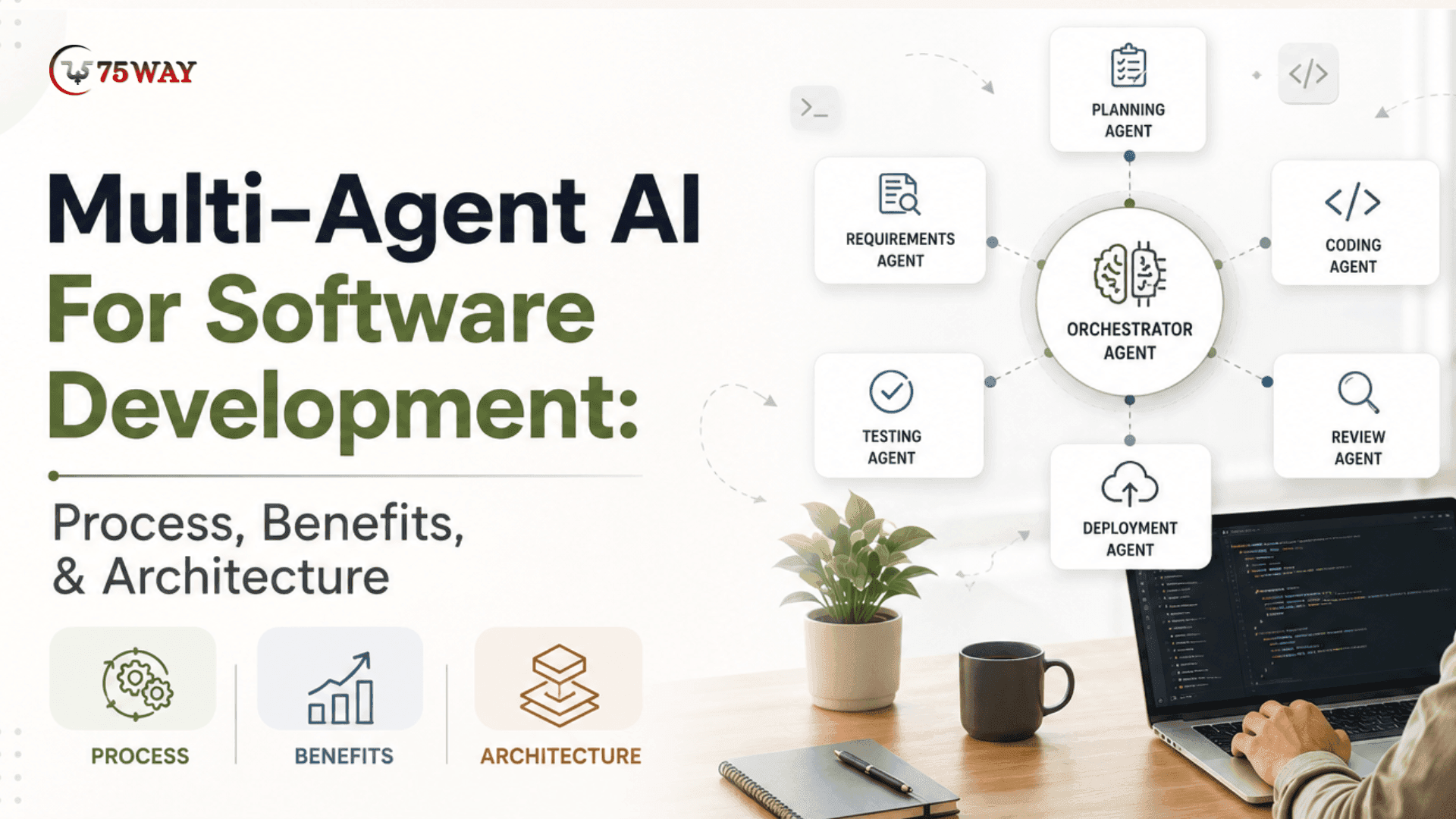
Multi-agent AI is changing software development by enabling multiple intelligent agents to collaborate across coding, testing, planning, and deployment tasks. This guide explains the process, architecture, benefits, and applications of multi-agent systems. Businesses can understand how AI-driven development workflows improve speed, efficiency, and scalability.
Key Takeaways
- Multi-agent AI enables collaborative software development workflows.
- Multiple AI agents handle specialized engineering responsibilities.
- Architecture defines communication between intelligent development agents.
- AI agents improve software quality and delivery speed.
- Businesses gain scalable automation through multi-agent systems.
What if software development could involve a team of AI specialists working together instead of a single AI assistant answering prompts? That is the idea behind multi-agent AI, where different agents take responsibility for specific tasks such as coding, testing, research, and optimization.
For businesses, this means moving from basic AI assistance toward a more collaborative system that can handle complex workflows with less manual coordination. Developers can focus more on innovation while AI agents manage repetitive and time-consuming parts of the development process.
This guide breaks down the complete multi-agent AI development approach, including how the system works, its underlying architecture, and why companies are considering it for future software projects.
What Is Multi-Agent AI For Software Development?
Multi-agent AI for software development is a system in which multiple specialized AI agents collaborate to complete different stages of the software development lifecycle. Instead of relying on a single AI assistant, businesses can deploy a team of intelligent agents, each focused on a specific responsibility such as requirements analysis, coding, testing, debugging, documentation, or deployment.
For example, one agent can analyze project requirements, another can generate code based on the plan, a testing agent can identify errors, and a security agent can review vulnerabilities. Together, these agents create a continuous software development workflow that reduces manual effort and improves engineering efficiency.
Unlike traditional development automation tools that perform predefined actions, multi-agent AI systems can reason, adapt, and make decisions based on project context. They use technologies such as large language models (LLMs), retrieval-augmented generation (RAG), APIs, development tools, and enterprise data sources to understand requirements and execute tasks more intelligently.
Multi-Agent AI Architecture To Build Custom Software: Working Process
The architecture of a multi-agent AI system defines how different agents communicate, share information, access tools, and complete software development tasks. A well-designed architecture ensures that every AI agent performs its assigned role while collaborating effectively with other agents. A typical multi-agent AI architecture consists of multiple layers working together to create an intelligent development ecosystem.
- Agent Layer: The agent layer contains specialized AI agents responsible for different software development activities. Each agent has a specific purpose, such as coding, testing, planning, security analysis, or deployment management.
These agents operate independently while collaborating through shared workflows. Their specialization allows complex development tasks to be divided efficiently.
- Orchestration Layer: The orchestration layer manages communication between different AI agents. It decides which agent should handle a specific task, tracks progress, and ensures workflows move in the correct sequence.
This layer acts as the central coordinator that keeps the entire multi-agent system organized and prevents conflicts between different AI agents.
- Knowledge Layer: The knowledge layer provides agents access to relevant information, including documentation, code repositories, business rules, databases, and previous project data.
Technologies such as retrieval-augmented generation (RAG) allow agents to retrieve accurate information and make better decisions based on business context.
- Tool Integration Layer: The tool integration layer connects AI agents with external development tools, APIs, cloud platforms, testing frameworks, and enterprise systems.
These connections allow agents to perform practical actions instead of only generating recommendations. For example, coding agents can interact with repositories while deployment agents can communicate with cloud environments.
- Execution Layer: The execution layer enables AI agents to perform assigned tasks and deliver outcomes. It manages code execution, testing processes, deployment activities, and workflow automation.
A strong execution layer ensures that AI agents can move beyond suggestions and actively contribute to software development operations.
Read More:What Is AI Agent Develeopment?
How Multi-Agent AI Differs From Traditional AI Coding Assistants
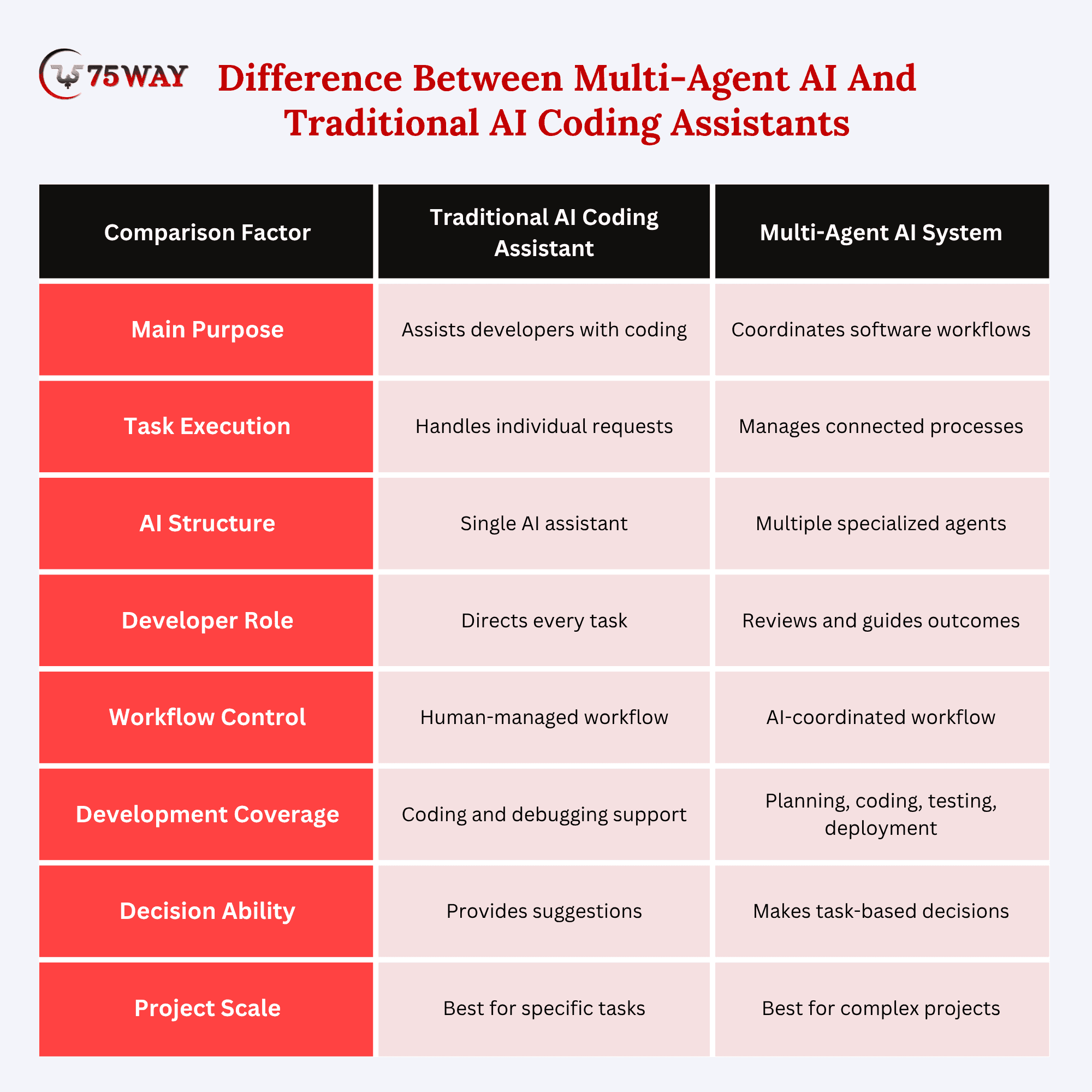
The key difference is that traditional AI coding assistants help developers complete specific coding tasks, whereas multi-agent AI systems coordinate multiple agents to manage broader software development workflows, from planning to deployment.
Traditional AI coding assistants work as individual developer companions. They help with tasks like writing code snippets, suggesting improvements, explaining errors, and completing repetitive programming work. Developers remain responsible for deciding the next steps, managing workflows, reviewing outputs, and connecting different stages of development.
Multi-agent AI systems take a more collaborative approach by assigning different responsibilities to specialized AI agents. For example, one agent can analyze requirements, another can design architecture, another can generate code, another can test functionality, and another can review performance. These agents communicate with each other, complete connected tasks, and help move software projects forward with less manual coordination.
Multi-Agent AI Software Development Process: How AI Agents Collaborate From Idea To Deployment
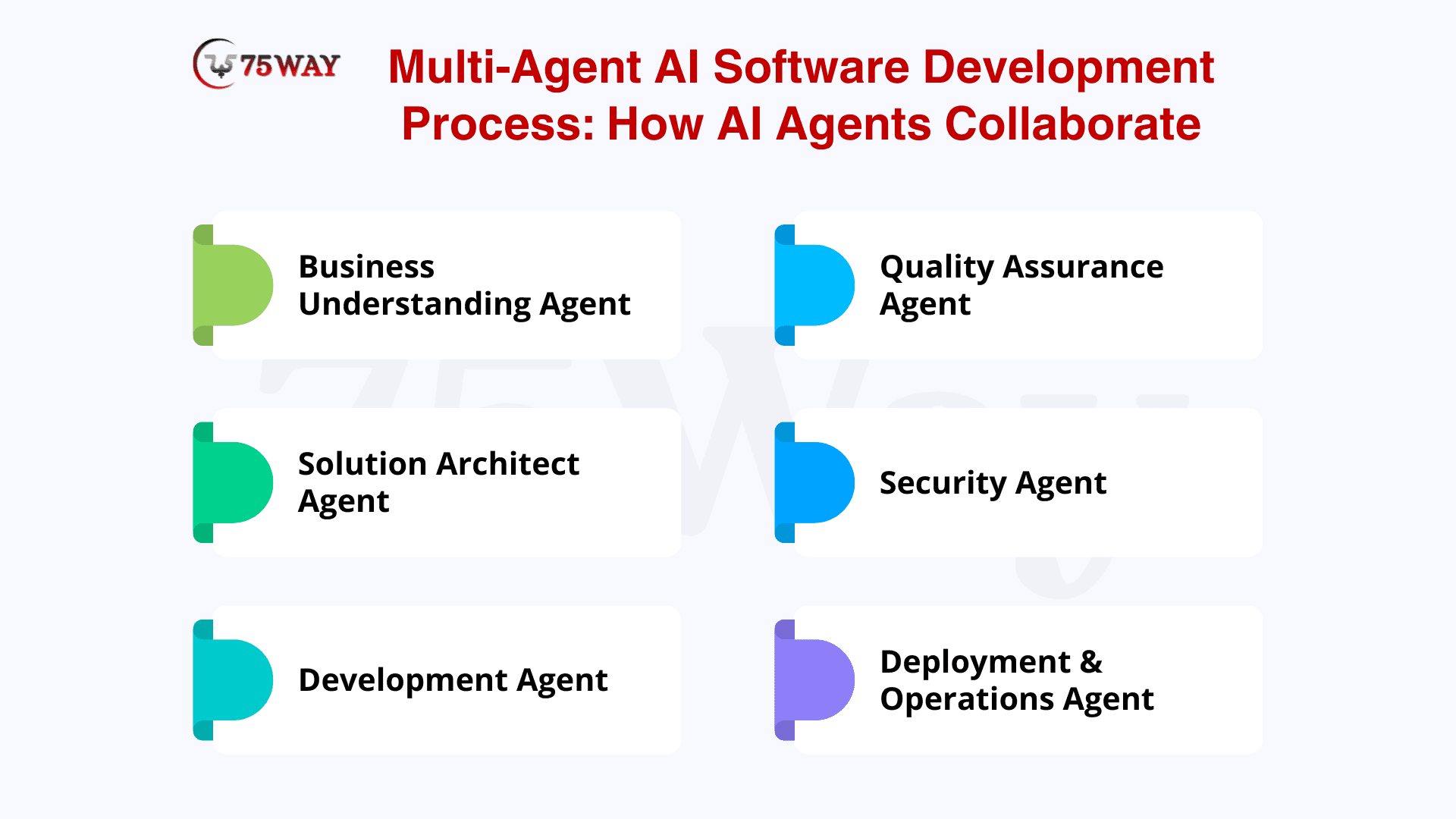
Multi-agent AI changes this workflow by assigning specific responsibilities to specialized AI agents instead of relying on one general-purpose system. Think of it as a digital engineering team where each AI agent works like a specialist.
One agent understands business requirements, another designs the technical approach, another writes code, while others test, secure, and deploy the application. This collaborative approach helps businesses reduce repetitive engineering work, accelerate development cycles, and maintain better software quality. Below are the key stages where multi-agent AI supports modern software development.
Step 1: Business Understanding Agent: Turning Ideas Into Clear Requirements
Before development begins, AI agents analyze the business idea, user expectations, project objectives, and technical requirements. The business understanding agent reviews documents, product goals, and existing workflows to create structured requirements that development teams can follow.
Instead of developers spending hours collecting scattered information, this agent organizes project details, identifies missing requirements, and highlights potential challenges early. This creates a stronger foundation for development and reduces costly changes later in the project.
Step 2: Solution Architect Agent: Designing The Right Technical Foundation
Once requirements are defined, the solution architect agent plans how the software should be built. It evaluates suitable technologies, system architecture, database structures, APIs, and infrastructure requirements based on project needs.
This agent works like an experienced software architect by creating technical roadmaps and dividing complex projects into manageable development tasks. Its recommendations help teams build applications that are scalable, secure, and easier to maintain.
Step 3: Development Agent: Building Software Through Intelligent Assistance
The development agent takes the technical plan and converts it into functional software components. It generates code, suggests improvements, creates reusable modules, and assists developers throughout the programming process.
Unlike basic code-generation tools, this agent understands project context and collaborates with other agents to ensure development decisions align with requirements. Developers can focus more on creative problem-solving while AI handles repetitive coding activities.
Step 4: Quality Assurance Agent: Ensuring Reliable Software Performance
Quality assurance is critical for delivering software that users can trust. The testing agent automatically creates test scenarios, reviews application behavior, identifies errors, and verifies whether features perform as expected.
By testing continuously during development, this agent helps teams detect issues earlier instead of discovering problems after launch. This improves software reliability, reduces debugging efforts, and supports faster releases.
Step 5: Security Agent: Protecting Applications Before Deployment
Security cannot be treated as a final step in modern software development. The security agent continuously reviews code, analyzes vulnerabilities, checks authentication processes, and identifies potential risks within the application.
By integrating security checks throughout development, businesses can reduce exposure to cyber threats and create safer applications. This proactive approach helps maintain compliance and protects sensitive business and user information.
Step 6: Deployment And Operations Agent: Managing Software After Development
After coding and testing are completed, the deployment agent prepares the application for production. It manages deployment configurations, infrastructure requirements, release processes, and environment setups.
Once the software goes live, monitoring agents continue tracking performance, detecting unusual activity, and suggesting improvements. This creates a continuous development cycle where AI agents help maintain software quality even after launch.
See More: AI Agent Development: A Step-by-Step Guide For Beginners
Key Components of Multi-Agent AI Systems For Building Software
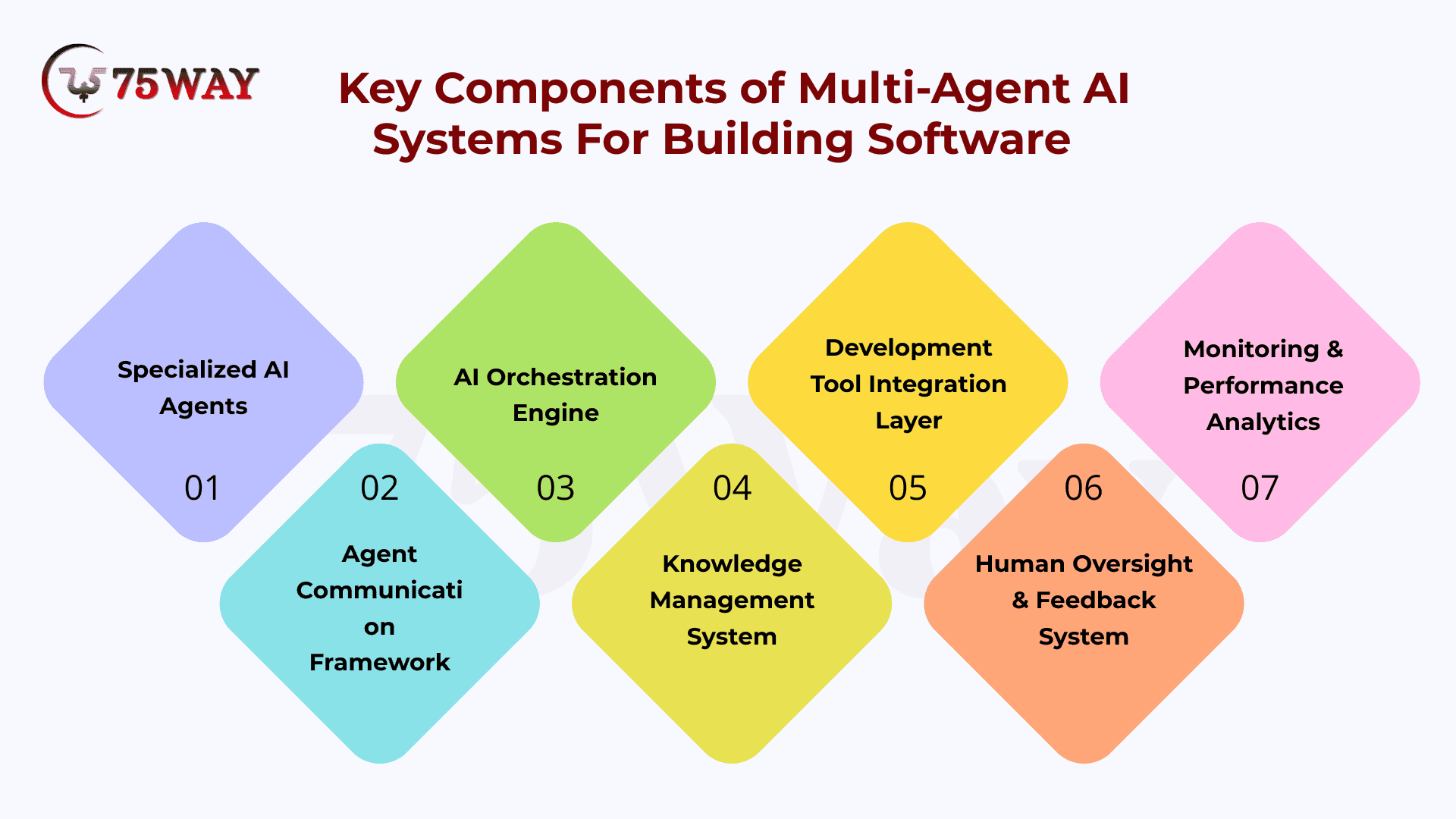
A successful multi-agent AI system requires a structured framework that allows agents to communicate, access information, use development tools, and complete tasks efficiently. Each component plays a specific role in creating a coordinated AI-powered software development environment.
1. Specialized AI Agents
Specialized agents are the core building blocks of a multi-agent AI system. Each agent is designed to handle a specific software development responsibility, such as requirement analysis, coding, testing, security review, or deployment.
Instead of asking one AI system to manage every task, businesses can assign focused roles to different agents. This specialization improves accuracy, reduces workload, and allows multiple development activities to happen simultaneously.
2. Agent Communication Framework
Communication between AI agents determines how effectively they collaborate. A communication framework allows agents to share updates, exchange information, provide feedback, and coordinate tasks during the development process.
For example, a coding agent can receive instructions from a planning agent, while a testing agent can send error reports back for improvements. This continuous interaction creates a connected development workflow rather than isolated AI activities.
3. AI Orchestration Engine
The orchestration engine acts as the central coordinator of the entire multi-agent system. It assigns tasks, manages workflows, monitors agent activities, and ensures each agent completes responsibilities in the correct sequence.
Without orchestration, multiple agents may work independently without proper coordination. A strong orchestration layer creates an organized environment where AI agents collaborate toward a shared development goal.
4. Knowledge Management System
AI agents need access to accurate information to make reliable decisions. A knowledge management system provides agents with project documentation, code repositories, technical guidelines, business rules, and historical data.
Using technologies like retrieval-augmented generation (RAG), agents can retrieve relevant information before performing tasks. This improves accuracy and ensures AI-generated outputs align with business requirements.
5. Development Tool Integration Layer
Multi-agent AI systems become more powerful when connected with existing software development tools. Integration layers allow AI agents to interact with code repositories, testing platforms, cloud environments, project management tools, and enterprise systems.
These connections enable agents to perform practical actions such as creating code commits, running tests, managing deployments, and updating project documentation.
6. Human Oversight And Feedback System
Although AI agents can automate many development activities, human expertise remains essential for strategic decisions and quality control. Human oversight systems allow developers and managers to review outputs, approve critical actions, and provide feedback.
This collaboration between humans and AI creates a balanced approach where automation improves productivity while experienced professionals maintain control over important decisions.
7. Monitoring And Performance Analytics
Continuous monitoring helps businesses understand how effectively their multi-agent AI system performs. Analytics components track agent activity, workflow efficiency, error rates, development speed, and software quality metrics.
These insights help teams optimize agent performance, improve workflows, and ensure the AI system continues delivering value as projects become more complex.
A well-designed multi-agent AI system combines intelligent agents, communication frameworks, orchestration, knowledge access, integrations, and human supervision. Together, these components create a scalable AI development environment capable of handling complex software engineering tasks.
Business Benefits of Adopting Multi-Agent AI To Create Software
A software development workflow becomes more efficient when AI agents can divide responsibilities, review each other's work, and solve problems collaboratively. Here are the key benefits businesses can achieve by adopting multi-agent AI systems.
- Faster Software Development Cycles: Multi-agent AI accelerates development by allowing different agents to work on multiple tasks simultaneously. While one agent prepares code, another can review requirements, generate tests, or analyze potential issues. This parallel workflow reduces delays between development stages and helps teams deliver software updates faster without compromising quality.
- Improved Code Quality & Reliability: Quality-focused AI agents continuously review code, identify errors, suggest improvements, and validate functionality throughout development. Instead of detecting problems only during final testing, teams can address issues earlier in the process. Continuous AI-powered reviews help create cleaner code, reduce technical issues, and improve overall application stability.
- Reduced Development Costs: By automating repetitive engineering activities, multi-agent AI reduces the amount of manual effort required for routine tasks. Agents can assist with documentation, testing, debugging, code reviews, and workflow management. This allows development teams to focus resources on complex challenges while improving productivity without continuously increasing operational costs.
- Better Collaboration Between Teams: Multi-agent AI creates a shared development environment where information flows efficiently between different tasks and team members. Agents can organize requirements, maintain documentation, track progress, and provide updates. This improves coordination between developers, project managers, testers, and business stakeholders throughout the development process.
- Enhanced Software Testing & Security: Testing and security agents continuously analyze applications for performance issues, vulnerabilities, and functional errors. They can execute automated tests, review code changes, and identify risks before software reaches users. Early detection improves application safety, reduces maintenance requirements, and supports more reliable software releases.
- Scalable Development Operations: As software projects become larger, managing increasing complexity becomes challenging. Multi-agent AI systems help businesses scale development operations by distributing tasks among specialized agents. This makes it easier to manage complex applications, multiple projects, and frequent updates without placing additional pressure on development teams.
- Continuous Improvement Through Learning: Multi-agent AI systems can analyze previous development activities, project data, and performance results to improve future workflows. Agents become more effective as they gain access to better information and feedback. This continuous learning approach helps businesses optimize development processes and achieve better outcomes over time.
- Improved Decision-Making With AI Insights: Multi-agent AI systems analyze development data, project progress, code performance, and operational feedback to provide actionable insights. These agents help teams identify bottlenecks, predict potential risks, and make informed decisions throughout the software development lifecycle.
How Multi-Agent AI Is Used Across Software Engineering Workflows: Complete Use Cases
From writing the first line of code to maintaining applications after launch, software teams manage dozens of connected activities. The use cases below show how multi-agent AI supports different engineering workflows by bringing automation and collaboration into each stage.
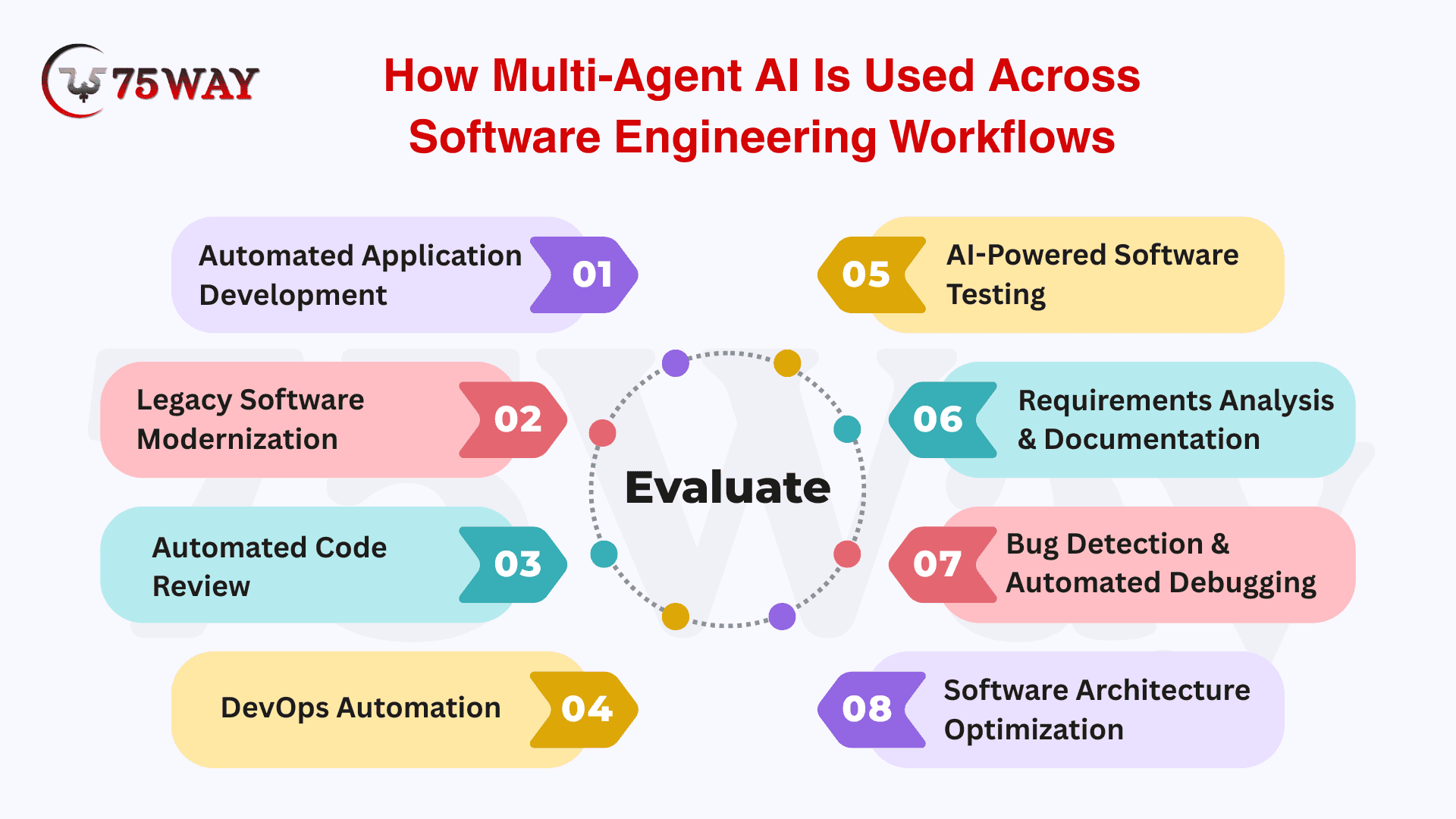
- Automated Application Development: Multiple AI agents can collaborate to transform software ideas into functional applications. Requirement agents analyze business goals, architecture agents design technical solutions, coding agents develop components, and testing agents validate application performance.
- Legacy Software Modernization: Organizations managing older applications can use AI agents to analyze existing codebases, identify outdated technologies, and recommend modernization strategies. These agents help developers understand complex legacy systems and support migration planning.
- Automated Code Review: Code review agents examine source code to identify errors, security risks, performance issues, and coding standard violations. They provide improvement suggestions before code moves into production environments.
- DevOps Automation: Multi-agent AI supports DevOps processes by automating deployment workflows, infrastructure management, monitoring, and incident response. Deployment agents can manage releases, while monitoring agents identify performance issues after launch.
- AI-Powered Software Testing: Testing agents automatically create test cases, execute validation processes, identify bugs, and analyze application behavior. They can perform functional, regression, and performance testing throughout the development lifecycle.
- Requirements Analysis & Documentation: AI agents can analyze business requirements, user feedback, technical documents, and project discussions to create structured documentation. They identify missing details, clarify specifications, and maintain updated project records.
- Bug Detection & Automated Debugging: Debugging agents analyze application errors, trace issues, and suggest possible solutions based on code behavior and historical data. They help developers identify the root cause of problems faster.
- Software Architecture Optimization: Architecture agents evaluate application structures, technology choices, scalability requirements, and system performance. They recommend improvements to databases, APIs, infrastructure, and application design.
Challenges of Implementing Multi-Agent AI In Software Development
Although multi-agent AI offers significant advantages for software development, businesses must address several challenges before adopting these systems at scale. Building an effective multi-agent environment requires careful planning, technical expertise, and continuous optimization to ensure AI agents work accurately and securely.
1. Managing Agent Coordination
Multiple AI agents need clear communication rules and task responsibilities to work effectively. Without proper orchestration, agents may duplicate efforts, provide conflicting outputs, or fail to complete workflows efficiently.
Solution: A strong coordination framework helps businesses define agent roles, manage interactions, and maintain consistent development processes.
2. Ensuring Output Accuracy
AI-generated code and recommendations may require human validation to ensure correctness, security, and alignment with business requirements. Incorrect assumptions or outdated information can impact software quality.
Solution: Review processes where developers monitor AI outputs and make critical decisions when required.
3. Data Privacy And Security Concerns
Multi-agent AI systems often require access to business documents, code repositories, databases, and internal workflows. Protecting this information is essential to prevent unauthorized access or data exposure.
Solution: Implement security controls, access permissions, encryption, and compliance practices when deploying AI development systems.
4. Integration With Existing Development Tools
Connecting AI agents with existing tools, frameworks, repositories, and enterprise systems can be complex. Poor integration may limit automation capabilities and reduce workflow efficiency.
Solution: Use flexible architectures that allow AI agents to communicate smoothly with their current technology environment.
5. Higher Initial Development Investment
Building a customized multi-agent AI system requires investment in AI infrastructure, development expertise, integrations, and testing. The initial cost can be higher compared to adopting basic AI coding assistants.
Solution: Achieve long-term value through improved productivity, reduced manual effort, and faster software delivery.
6. Maintaining Human Oversight
Despite advanced automation capabilities, human expertise remains necessary for strategic decisions, complex problem-solving, and quality control. Overdependence on AI agents without proper supervision can create risks.
Solution: The most effective approach combines AI automation with human judgment to achieve better software outcomes.
Best Practices For Implementing Multi-Agent AI In Software Development
Successfully implementing multi-agent AI requires more than deploying multiple AI agents. Businesses need a clear strategy, suitable architecture, and strong governance practices to ensure agents deliver reliable results throughout the software development lifecycle.
- Define Clear Agent Responsibilities
Each AI agent should have a specific role and objective within the development workflow. Assigning clear responsibilities prevents overlapping tasks and helps agents collaborate more efficiently.
For example, coding agents should focus on development tasks, while testing agents should handle quality validation, and security agents should manage risk analysis.
- Start With Focused Workflows
Businesses should begin with specific development processes instead of automating the entire lifecycle immediately. Starting with tasks such as code reviews, testing automation, or documentation allows teams to evaluate performance before expanding AI adoption.
A gradual implementation approach reduces risks and helps organizations improve workflows based on real results.
- Integrate Human Review Processes
Human oversight remains essential for maintaining software quality and making critical decisions. Developers should review AI-generated code, architecture recommendations, and security suggestions before implementation.
Combining human expertise with AI capabilities creates a balanced development environment with better accuracy and control.
- Use Reliable Data Sources
AI agents depend on accurate information to generate useful outputs. Businesses should provide access to updated documentation, code repositories, technical guidelines, and approved knowledge sources.
High-quality data improves agent performance and reduces incorrect recommendations during development.
- Monitor Agent Performance Continuously
Multi-agent AI systems require regular evaluation to ensure they deliver expected outcomes. Businesses should track accuracy, task completion rates, development speed, and software quality improvements.
Continuous monitoring helps identify weaknesses and optimize agent workflows over time.
- Prioritize Security And Governance
Security controls should be included from the beginning of implementation. Organizations should establish access permissions, data protection policies, and compliance measures to protect sensitive information.
Strong governance ensures AI agents operate safely within business and technical environments.
How Businesses Can Adopt Multi-Agent AI For Software Development
Adopting multi-agent AI requires a structured approach that aligns technology capabilities with business objectives. Businesses can identify where AI agents can create the highest impact. A practical adoption roadmap includes:
- Identify Automation Opportunities
Evaluate existing software development processes and identify tasks that consume significant time or require repetitive effort. These areas often provide the best opportunities for AI agent implementation.
- Select The Right AI Architecture
Choose an architecture that supports business requirements, including agent communication methods, data access, integrations, and scalability needs.
- Build And Test Initial Agents
Start with limited AI agents focused on specific workflows. Test their performance, collect feedback, and improve their capabilities before expanding usage.
- Integrate With Development Ecosystems
Connect AI agents with existing tools such as code repositories, project management platforms, testing systems, and cloud environments.
- Scale Based On Results
Once initial workflows show measurable improvements, businesses can expand multi-agent AI adoption across additional development activities and larger projects.
Role of Human Developers In Multi-Agent AI Development
Human expertise remains essential for understanding business goals, making architectural decisions, reviewing AI outputs, and solving complex problems that require creativity and strategic thinking.
- Strategic Planning: Developers and technical leaders define project objectives, select suitable technologies, and establish development strategies. AI agents support these decisions but rely on human direction to align solutions with business needs.
- AI Agent Management: Human teams create agent roles, configure workflows, monitor performance, and improve agent behavior. Effective management ensures AI systems remain accurate, secure, and aligned with project requirements.
- Quality Control: Developers validate AI-generated code, review architectural recommendations, and approve important changes before deployment. Human oversight ensures software maintains high standards for performance and security.
- Innovation & Problem Solving: While AI agents automate many technical activities, human creativity remains critical for designing unique solutions, improving user experiences, and addressing complex challenges.
Multi-agent AI works best as a collaboration between intelligent systems and skilled developers. Businesses that combine AI automation with human expertise can achieve faster development cycles while maintaining control over software quality and innovation.
Security Considerations In Multi-Agent AI Software Development
Security becomes increasingly important when businesses introduce multiple AI agents into software development workflows. A secure multi-agent AI system ensures that automation improves productivity without creating vulnerabilities within the software development process.
1. Secure Agent Access Control
Each AI agent should receive only the permissions required to perform its assigned tasks. Limiting access prevents unauthorized actions and reduces the risk of sensitive information exposure.
Role-based permissions help organizations control which agents can access code repositories, databases, cloud systems, and internal resources.
2. Protect Sensitive Development Data
Multi-agent systems often process valuable information, including source code, customer data, business logic, and technical documents. Strong encryption and secure data handling practices are essential to protect this information.
Businesses should implement secure storage, controlled data sharing, and privacy-focused AI workflows.
3. Validate AI-Generated Code
AI-generated code should go through security reviews before being integrated into production environments. Agents may unintentionally introduce vulnerabilities, outdated libraries, or insecure coding practices.
Automated security testing combined with human review helps maintain application safety and reliability.
4. Monitor Agent Activities
Continuous monitoring allows businesses to track agent decisions, actions, and system interactions. Logging agent activities helps identify unusual behavior and provides visibility into how AI workflows operate.
Regular audits improve accountability and support better security management.
5. Maintain Compliance Standards
Organizations operating in regulated industries must ensure AI systems follow relevant security and compliance requirements. Proper governance helps businesses manage data protection, privacy obligations, and industry-specific standards.
Compliance-focused AI development creates safer and more reliable software environments.
Final Thoughts
Multi-agent AI is redefining software development by enabling multiple intelligent agents to collaborate across the entire engineering lifecycle. From understanding requirements and generating code to testing, security analysis, and deployment, these systems help businesses create faster and more efficient development workflows. However, successful adoption requires careful planning, reliable architecture, secure implementation, and the right balance between AI automation and human expertise. As businesses continue investing in intelligent software solutions, multi-agent AI will play a major role in improving productivity, scalability, and innovation. Working with a veteran multi-agent AI development company helps organizations transform AI possibilities into practical development outcomes.
Frequently Asked Questions
How Does Multi-Agent AI Improve Software Development?
Multi-agent AI improves development by automating repetitive tasks, enabling parallel workflows, and supporting faster decision-making. It helps teams improve productivity, software quality, and delivery speed.
Can Multi-Agent AI Replace Software Developers?
Multi-agent AI is designed to support developers rather than replace them. Human expertise remains important for strategic decision-making, creativity, architectural planning, and the review of AI-generated outcomes.
Is Multi-Agent AI Suitable For Enterprise Software Development?
Yes, multi-agent AI can support enterprise development by improving scalability, workflow automation, and software delivery processes. Enterprises can customize agents according to their security and operational requirements.
What Technologies Are Used To Build Multi-Agent AI Systems?
Multi-agent AI systems commonly use large language models, machine learning frameworks, APIs, automation tools, and retrieval-augmented generation. These technologies help agents understand information, communicate, and complete development tasks.
How Do Multi-Agent AI Systems Ensure Software Quality?
Multi-agent systems improve quality through automated testing, code reviews, debugging, security analysis, and continuous monitoring. Specialized agents identify issues earlier and support more reliable software releases.